






Abstract
The performance of polymers such as acrylics, styrene-acrylics, styrene-butadiene, ethylene vinyl acetate, type added in cementitious composites are well reported in the literature to boost properties in the fresh mortar stage as workability, anti-bleeding, and hard stage as deformation, adhesion strength, crack bridging, cohesion, durability and reduced water uptake. Polymer treatment was performed in fiber cement boards by adding 5% w/w (dry basis) of styrene-acrylic copolymer aiming to investigate the impact on the mechanical and physical properties at initial curing period (28 days) and after the 200 soak and drying ageing cycles. Dimensional stability at 28 days and the cellulose fiber/cement interface transition zone were assessed by scanning electron microscopy combined with dispersive energy X-ray spectroscopy (EDS). These experiments confirmed that the water absorption value in polymer modified cement boards was reduced by 50% after the ageing cycles when compared to the unmodified boards. Additionally, improvements on board’s rigidity with reduction of modulus of elasticity (MOE) values up to 40% and 15% reduction of board shrinkage was noticed, enhancing boards dimensional stability and preventing fibers from the mineralization process by keeping the cellulose fiber adhered on the cementitious matrix, providing a dense and cohesive fiber-cement interface transition zone after the ageing cycles. This achievement can open important fields of application for the reinforcement of flat panels.
Introduction
Fiber cement is a building material composed of cement and mineral additives such as pozzolanic materials and/or limestone fillers reinforced with fibers distributed along the cementitious matrix. Due to its versatility, fiber cement boards are used in several applications in the construction industry as residential and commercial buildings, can be found in shape as corrugated for roofing tiles and flat boards for interior/exterior walls. 1
Corrugated fiber cement sheets are the most used technologies in Latin America and represents 50% of the roofing market (Figure 1). The benefits are, higher durability, lower maintenance cost and installation. The Latin America fiber cement roofing market is growing faster than the global roofing market. 2

Roofing and fiber cement market at glance.
The development of asbestos free fiber cement, called New Technology (NT) began in the 1980's in some European and Latin American countries. At the beginning, fiber cement producers tried to use only cellulose fiber in combination with the cementitious matrix, this concept was abandoned in the late 1980’s due to durability issues and increasing stiffness over time. Later on, the combination of synthetic fibers with cellulose presented a viable alternative and have being used since then. 3 , 4
Nowadays, the synthetic fibers used in the mechanical reinforcement of cement based composites are polyvinyl alcohol (PVA), polypropylene (PP) fibers, and in some cases polyethylene-polypropylene copolymers. 5
The replacement of asbestos fibers by the combination of synthetic and cellulose fibers raised new challenges from both aspects, manufacturing and durability. The main concern about the usage of cellulose fibers in cement boards is the fiber degradation due to the mineralization process that takes place in the alkaline environment of the Portland cement matrix, causing board’s embrittlement. Another phenomenon that takes places when exposed at moisture and drying cycles is the fiber swelling and shrinkage, which impacts negatively in the fiber/cement adhesion. 6 , 7
Mohr et al.
6
suggested that decomposition of cellulose fibers in high alkalinity, and fiber mineralization (precipitation of hydration products, mainly portlandite, within the fiber structure) to be likely the main cause of fiber cement boards brittleness. In the article it was suggested the following mechanism:
Initial fiber-cement debonding due to fiber shrinkage during wetting-drying cycles; Precipitation of relatively low-strength hydration products within this new void space; Fiber mineralization by the reprecipitation of hydration products within fiber structures.
In order to reduce cement porosity and permeability, the carbonation treatment is performed in cementitious boards by exposing the fiber cement board in an environment saturated of CO2 to promote carbonation. This treatment decreases the fiber mineralization process and improves cellulose durability, as it reduces the alkalinity of the cement matrix, lowering the pH to values lower than 9. 8 , 9
Other approaches were investigated to preserve cementitious composites as coating the uncured mineral material, concrete or roofing tiles, with a film forming polymeric binder in two coatings which provides a high gloss finishing for aesthetics purposes and protection. 10
Therefore, reducing the alkalinity in the cementitious pores that could dissolve the fibers and deal with water absorption seems to be key to address the fiber cement durability by both preserving fibers and avoiding the fiber swelling and shrinkage that drives the fiber mineralization and increases board’s stiffness.
Polymers in aqueous solutions, dispersions, or powders are used in combination with cementitious materials at polymer/cement ratio 0.01 (cementitious tile based adhesive) to 0.1 (water proofing membranes) to improve properties, such as workability, flexural tensile strength, hardness, vibration damping, freeze-thaw resistance, adhesion between cementitious matrix and substrates, increase mortar cohesion, as well as reduce water absorption and thermal conductivity. 11 , 12
The present research contributes to the understanding of the impacts on the mechanical and physical properties when synthetic polymers are added in fiber cement boards cured through air process at initial curing period (28 days) and after the 200 soak and drying cycles. Dimensional stability at 28 days and the cellulose fiber-cement interface transition zone were equally assessed after the ageing cycles.
Materials and methods
Raw materials characteristics
Inorganic binder and fillers
Portland cement, CPV ARI Ultra Rápido® ASTM C 150 (Type III) produced by Holcim and limestone by Calcário Agrícola – Itaú, were characterized by the X-ray fluorescence method. The contents were determined in a standardized sample in the calibration STD-1, and on the non-standard analysis of the chemical elements between fluorine and uranium, in a Malvern Panalytical X-ray fluorescence spectrometer model Zetium (Table 1).
X-ray fluorescence chemical analysis for particulate (% by mass) and mass loss in fire.

aLoss on ignition (LOI) was performed at 1020°C for 2 h.
Cellulose fiber
Softwood pulp used in the preparation of the composites is made of long fibers from coniferous species such as pinus. Fibers used herein was furnished by Klabin S/A, sold under the brand name PineCel®. Cellulose fiber was taken from the Hatschek process of asbestos free fiber cement production after the refining step, with refining intensity around 60–63° Schopper Riegler (ISO 5267-1), at a Brazilian fiber cement producer. Properties of the cellulosic pulp are presented in Table 2.
Cellulose pulp properties.
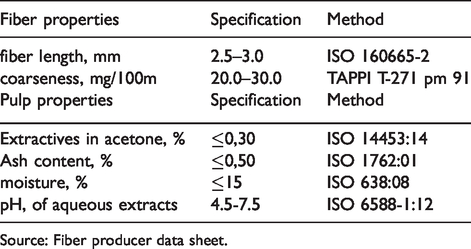
Source: Fiber producer data sheet.
Synthetic fiber
Polyvinyl alcohol (PVA) fibers are the most used synthetic fiber worldwide to produce the air cured fiber cement asbestos free products. Commercial PVA fibers used herein was produced by Anhui Wanwei Updated Hightech Material Industry Co. LTD, China. PVA fiber properties are presented in Table 3.
PVA fiber properties.

Source: fiber producer data sheet.
a1dtex = 1 g per 10,000 m.
b1 better – 4 worse.
Polymer used in fiber cement boards modification
Styrene-acrylic (SA) latex used in this experiment was furnished by The Dow Chemical Company, available under trade name Primal™ AS-8012. SA latex is alkaline resistant and designed for modifying cement to offer good flexibility, in particular to be used in cementitious water proofing membranes. SA latex characteristics are presented in Table 4 (PRIMAL™ AS-8012 TDS 13 ).
Styrene acrylic (SA) latex characteristics.

Source: Primal AS-8012 TDS 13
aTg = glass transition temperature.
Air curing fiber cement formulas
Unmodified fiber cement boards are composed by 64% cement, 31.1% limestone, 1.9% PVA fiber and 3% of cellulose fibers was used as a reference. 14
Polymeric treatment was performed on the fiber cement boards by adding 5% of SA latex (w/w dry basis) on the total dry formula basis. This dosage was defined based on previous work when authors targeted to reduce cementitious mortar permeability through the usage of synthetic polymers. 11 , 15
Casting fiber cement boards
Fiber cement boards were prepared by the dewatering process that consists on dispersing the raw materials as cement, limestone and fibers, followed by the casting process. Dispersion process was carried out as follows: Cement and limestone were dispersed in water (250 mL) for 2 min at 2000 rpm; After that, the cellulose fiber was pre-dispersed in water (100 mL) during 2 min at 2000 rpm; Then, synthetic fiber was dispersed in water (350 mL) for 2 min at 2000 rpm; The cementitious slurry (cement and fillers + cellulose + synthetic fiber) were assembled and mixed for 2 min at 2000 rpm; Finally, the remaining water and SA latex were added in the cement slurry and mixed for 2 min (1000 rpm).
Air curing procedure
Fiber cement boards were then wrapped in polyvinylidene fluoride wrap and left in an oven for 24 h at 50 °C. 16 After this initial period, the product was removed from the oven and placed at room temperature for 6 days at (23 ± 2) °C, for continued curing. Upon completion of the curing period, fiber cement boards were cut (160 × 40 × 5) mm3 and mechanical properties were assessed.
Mechanical assessment
Specifically, a stress strain curve was generated by tensile testing the indicated fiber cement board using an EMIC load testing machine, model DL 30000 equipped with a 1 kN load cell and employing a 4-point bending configuration with a maximum supported length of 135 mm. The speed of displacement used was 5 mm/min. Mechanical assessment were performed on specimens saturated specimens by immersion for 24 h of immersion prior to the test. 17
The limit of proportionality (LOP), modulus of rupture (MOR), modulus of elasticity (MOE) and specific energy (SE) were calculated from the flexural test, according to RILEM 49 TFR. 18
Physical assessment
Physical properties as water absorption, apparent porosity (void volume) and bulk density were assessed according to ASTM C 9481-81.
19
The water absorption (%w/w), bulk density (g/cm3) and apparent void volume (%v/v) values were calculated according to equations (1) to (3) below.


TGA/DTG analysis
The efficiency of the air curing process as well as the degradation of the polymers incorporated in the cementitious matrix were studied through thermogravimetric analysis (TGA) and its respective differential (DTG). 20
Samples were prepared by grinding the material in a ceramic vessel with the aid of a pestle to reduce particles smaller than 75 µm, after which they were analyzed using the NETZSCH STA 409 PC/PG thermogravimetric analyzer. Tests were performed at a temperature range of 20–1000°C with a temperature increment rate of 10 °C/min with 50 mL/min nitrogen injection. 8 , 9 , 21
Thermogravimetric (TGA) and its derivate (DTG) graphics were used to study the hydration reaction yield by identifying the peaks of the hydrated products, comparing the unmodified fiber cement composite with the polymer modified cementitious boards. DTG peaks were considered according as follows: 100°C – mass loss due to water dehydration in the pores of the composite; 100–300°C – different stages of dehydration of C-S-H; 320–370°C – decomposition of styrene acrylic polymer;
22
500°C – decomposition of portlandite - Ca(OH)2; 700–850°C – high crystallinity CaCO3 decomposition.
8
,
9
,
21
Heat flow calorimetry
Hydration of ordinary Portland cement (CPV) with and without styrene acrylic latex was measured via heat flow by adiabatic calorimetry Grace AdiCal™. Samples were prepared by stirring 600 g cement with water (w/c = 0.5) in a 700 ml plastic container. Polymer modified cement was prepared by stirring 600 g cement with water (w/c = 0.5) and 5% of SA polymer (w/w dry basis).
After that, samples were placed in the adiabatic calorimetry equipment and closed for 60 h, after this period, the adiabatic box was opened and data were transferred to the software.
FC dimensional stability
Drying shrinkage was measured following recommendations of Brazilian Standard NBR 15498 23 in a Thermotron environmental test chamber. After 28 days of curing, the specimens were cut to size (160 × 40 × 5) mm3. Then, it was recorded their initial length, before drying, and placed at 23 ± 5 °C and 90% relative humidity for 5 days. 17
After this period, the equipment is set to keep the temperature at (23 ± 5) °C and relative humidity 50% for 14 days. Length of the specimens are measured every day by a dial indicator Mitutoyo Absolute.
The length variation (mm/m) of the composites is measured during 14 days of drying shrinkage and is compared in relation to the initial length. The values of length reduction during the drying operation were divided by the initial length of the specimens in order to find the length variation in mm/m. Additionally, in order to control the mass weight the specimens are weighed in an precision scale Adventurer™ Ohaus®.
Accelerated aging cycles
The accelerated aging cycles aims to speed up natural weathering using soak and drying cycles as tested in previous works. 24 , 25 Specimens were successively immersed into water at (20 ± 5)°C for 170 min, after an interval of 10 min, they were heated up to temperature of (70 ± 5)°C for 170 min in a forced ventilation oven.
Another interval of 10 min at room temperature also preceded the subsequent cycle, as recommended by the EN 494 Standards. 26 A total of 200 cycles was executed in order to better identify the benefits of polymer modification in the physical and mechanical behavior of the composites.
Mercury intrusion porosimetry (MIP)
The MIP tests were carried out in a Micromeritics PoreSizer 9320 with a maximum intrusion pressure of 200 MPa. A surface tension of 0.495 g/cm3 was assumed for the mercury and density of 13.534 kg/dm 3 . The equilibrium time between low and high pressure was 10 s. The assumed contact angle for advancement and retraction was 130°. The amount of mercury in each interval was recorded. Samples were cut in nominal dimensions of (6 × 6 × 6) mm3 dried at 70 °C for 24 h and stored in sealed containers free of contact with air and moisture until the moment of analysis. This technique was adopted to determine the pore size distribution of the fiber cement boards, as is usually done in the characterization of cementitious materials. 27
Back-scattered electron images of fibrous composites
Scanning electron microscopy (SEM) equipped with back-scattered electron detector was applied to cut and polished surfaces for characterization of fiber and cement matrix interface, before and after the 200 ageing cycles.
Fiber mineralization process can be identified as white spots on the cellulose in the SEM images due to reprecipitation of hydration products into the fiber lumen. 17 , 28
Cementitious phases were recognized by the contrast of atomic number of different chemical elements using the backscattered electron mode. Dark and light areas were related to lower and higher atomic numbers respectively. Energy-dispersive X-ray (EDS) spectrometry atomic mapping was also performed in order to localize the carbon, calcium and silicon atoms on the same polished surface specimens.
The preparation of specimens for back-scattered electron analyses was accomplished with low-pressure (25 kPa gauge) impregnation using epoxy resin furnished by Struers.
Back-scattered electron samples were polished with silicon carbide grinding paper with sequential grit sizes of 600 and 1200 (MD-Piano from Struers) for 4 min each using water as lubricant. A final polishing was carried out using, in turn, 9 and 3 μm diamond polishing compound for 6 min per size.
Polished samples were carbon coated and examined using a Quanta 650 FEG microscope, with an accelerating voltage range of 200 V to 30 kV and electron beam current of 100 nA, equipped with a Bruker Quantax EDS detector, enabling qualitative and quantitative analysis.
Statistical analysis
Mechanical (MOR, LOP, SE, and MOE) and physical results (water absorption, bulk density and apparent porosity) were subjected to the analysis of variance ANOVA (p < 0.05) with the aid of JMP Pro® 14.2.0 software.
Results and discussion
Mechanical properties: Before and after ageing cycles
Comparison of the average stress-strain curves obtained during the flexural tests, before and after the 200 ageing cycles can be found in Figure 2.

Stress vs. strain curves for unmodifed fiber cement boards and fiber cement boards modified with SA polymer – before and after the ageing cycles.
Fiber cement boards modified with SA polymer have reached the same MOR results as the unmodified boards in approximately at ∼0.03 mm/mm, after the ageing cycles, according to the ANOVA analyses (Table 5). More details on the mechanical performance are discussed in the subsequent sections.
Flexural tests MOE results.

Note: Levels not connected by same letter are significantly different (p < 0.05).
Modulus of rupture (MOR)
The MOR is expected to increase after the 200 soak and drying cycles, this is due to the continuous process of cement hydration as empty space and pores are filled by the products formed by the cement hydration reaction, in addition those products are deposited around the fibers modifying its interface, leading to stiffer material. 28 , 29
MOR of the fiber cement composites modified with SA polymer has increased from 6.18 to 8.46 MPa after the ageing cycles, approximately 40% while the unmodified fiber cement boards have increased the MOR values approximately 20%.
Polymer treatment performed on the fiber cement composite has prevented the MOE to increase after the 200 soak and drying cycles, mitigating the embrittlement of the boards after the ageing test (Figure 3).

Average values and standard deviations of modulus of elasticity (MOE) vs. modulus of rupture (MOR) of fiber composites modified with SA polymer and unmodified boards, tested after 28 days of cure and 200 accelerated ageing cycles; arrows indicate the behavior of properties after ageing cycles.
Limit of proportionality (LOP)
Fiber cement modified with SA polymer, after the ageing cycles exhibited higher LOP results, according to the ANOVA analyses using the Tukey test (p < 0.05), and has increased the value approximately 50% after the 200 ageing cycles as reported by Tonoli et al. 17 and Urrea-Ceferino et al. 25
Specific energy (SE)
The specific energy has dropped after the 200 ageing cycles. SE is the total energy absorbed during the stress vs. strain tests and is calculated by integrating the area under the curve. 30 The lower the SE, the lower the tenacity, thus leading the composite to failure earlier.
Modulus of elasticity (MOE)
MOE is related to the board rigidity, the higher the value, the more rigid the composite is. As reported in previous work MOE results are expected to increase after the ageing cycles due to the fiber mineralization. 17
In this present work, fiber cement boards modified with SA polymer have increased MOE results from 5.6 to 7.6 GPa approximately by 35%, demonstrating the polymer efficiency in reducing board’s rigidity after the accelerated ageing cycles. On the other hand, the unmodified fiber cement boards have increased the results from 6.9 to 11.9 GPa (∼75%), suggesting that the embrittlement process is taking place, see Figure 4.

Average values and standard deviations of modulus of elasticity (MOE) vs specific energy (SE) of fiber composites modified with SA polymer and unmodified boards, tested after 28 days of cure and 200 accelerated ageing cycles; arrows indicate the behavior of properties after ageing cycles.
Micro-cracking formation was another characteristic of fiber cement board modified with SA polymer. Figure 5 shows the control fiber cement specimen after the flexural tests, showing a larger crack opening after reaching the MOR. Fiber cement specimens modified with SA polymer, have presented multiple micro-cracks, demonstrating their superior capacity to dissipate energy.

Fiber cement specimens* after flexural stress tests: control: large crack; SA polymer multiple cracks.
Physical properties: Before and after ageing cycles
Bulk density, water absorption and apparent void volume were assessed on unmodified composites and their counterparts modified with SA polymer, according to ASTM C 9481-81 19 and are presented in the sections below.
Apparent void volume (%v/v)
When cement is mixed with water, chemical reactions take place and result in the formation of hydration products; the two silicate phases C3S and C2S give calcium silicate hydrate C-S-H (50–60%) gels and calcium hydroxide (Ca(OH)2 crystals) (20–25%) as hydration products, plus ettringite, minor residues of the original anhydrate cement, and residues of the original water-filled spaces in the fresh paste. C-S-H gel is the main component of cement paste and is responsible for the strength and microstructure of cement paste. C-S-H gel is a colloidal amorphous gel, which contains pores of approximately a few nanometers in size that are called gel pores. The bulk volume of C-S-H gel, after cement grain is fully hydrated, requires 60% more volume than the original volume of the un-hydrated cement grain and the water, and this expansion moves into capillary pores. 31
As hydration proceeds, the amount and distribution of capillary and gel pores changes considerably; the capillary pore volume is reduced because the capillary pores become filled with hydration products as calcium silicate hydrate, portlandite, ettringite, monosulfoaluminate, etc., and the gel pore volume increases as more gel is formed. Therefore, there is a net reduction in total porosity. 31 , 32
Correia et al. 33 reported a correlation between the aging cycles and the decrease in the values of physical characteristics as apparent porosity in composites reinforced with vegetable pulp subjected to 50, 100 and 200 accelerated aging cycles, this corroborates with findings herein.
In these experiments, highest apparent porosity values were achieved on unmodified fiber cement boards after 28 curing days (39%). After the 200 ageing cycles, apparent void volume of unmodified boards has reduced its value from 39% to 33%. This reduction is due to the capillary pores filling with hydration products.
Figure 6 shows a comparison between results achieved on the apparent void volume run after the initial curing period (28 d) and after the 200 aging cycles.

Composite results: apparent void volume*.
Fiber cement boards modified with SA polymer has yielded values statistically equivalent to the unmodified boards after the 200 cycles according to ANOVA analyses (p > 0.05), showing the polymer ability to tighten the pores at the initial stage, which gives an enormous advantage that impacts directly on the boards water absorption reduction at early stage.
We hypothesized that the polymeric film formed is covering the pores and preventing the secondary ettringite grow inside the pores with the consequent cracking over time. Aging tests that could be accelerated by testing the mechanical performance of keeping the board at 70 °C for 21 days.
Bulk density (g/cm3)
Figure 7 shows a comparison between results achieved on the bulk density run after initial curing period (28 days) and after the 200 aging cycles.

Composite results: bulk density*.
Highest results on bulk density were achieved on composites modified with SA polymer. Initial results achieved on fiber cement boards modified with SA polymer has yielded values statistically equivalent to the unmodified boards after the 200 cycles according to ANOVA analyses (p < 0.05). This is explained by the reduction of total porosity as the capillary pores are filed with hydration products (Figure 16).
Water absorption (%w/w)
Figure 8 presents and compares the water absorption results obtained from the physical assessment performed on the unmodified and modified with SA polymer fiber cement boards run after the initial curing period (28 days) and after the 200 aging cycles.

Composite results: water absorption*.
Water absorption results obtained from the tests performed on unmodified fiber cement boards after the 200 ageing cycles has reached the same level of the boards modified with SA polymer without accelerated ageing. This shows the polymer ability to tighten the porous in the capillarity region, more specifically of 0.05–0.5 μm (Figure 17), thus reducing overall permeability (Figure 9).

Average values and standard deviations of modulus of rupture (MOR) vs. water absorption of fiber composites modified with SA polymer and unmodified boards, tested after 28 days of cure and 200 accelerated ageing cycles; arrows indicate the behavior of properties after ageing cycles.
The water absorption reduction was observed in previous work when combining cement with styrene acrylic polymers. Chew et al. 34 have reported 25% reduction of water absorption by increasing the polymer/cement ratio from 0 to 0.1 in mortars. Herein, at ∼0.07 polymer/cement we observed a reduction of ∼14% on water absorption at the initial stage and ∼40% after the ageing cycles.
The control sample after 200 aging cycles has yielded the same water absorption (and density) as the SA modified boards at 28d. Having boards with lower water absorption at early stage present an advantage as preventing shrinkage and possible cracking due to movements caused by the water ingress. 17
Polymer modification performed in fiber cement boards have contributed to reduce the water absorption and apparent porosity, which contributed significantly to the physical property enhancement. The cement polymer mechanism proposed occurs as follows
35
:
First the polymer particles, cement, water and aggregates are mixed uniformly. This stage is defined as initial and there are no chemical reactions, only physical interactions. In the later stage, the hydration of the cement is induced by the contact with the water; rapidly calcium ions and hydrated calcium silicates are precipitated into the pores of the slurry and cement particles are charged electrically. Part of the polymer will stick to the cement or C-S-H particles due to chemical bonds part will stick to calcium ions forming flocculated polymers. The smaller polymer portion will be adhered to the aggregates by physical interactions. The next step is the progress of cement hydration, this reaction initially may be significantly delayed due to the polymer envelope. With the evolution of hydration, the water present in the pores will be consumed at the same time as cement hydration products will precipitate and their concentration will increase. The polymeric film surrounding the cementitious matrix should partially coalesce at this stage. In the final step, the cement hydration process begins to reduce, and the microstructure of the polymer modified mortar is then formed. As the liquid phase is consumed, the polymer surrounding the cementitious matrix coalesces completely, forming a network forming a polymer-cement compound, see Figure 10 below a representative model of the polymer modification mechanism.
Representation of the polymer modification mechanism of Portland cement.

Boards dimensional stability
Figure 11 presents and compares the mass loss (%) of the unmodified fiber cement board and modified with SA polymer. The mass loss values on the boards modified with SA polymer is lower. This can be associated to the fact that water absorption is lower, as the less water is presented in the boards the lower would be the shrinkage upon drying, therefore improving the overall dimensional stability.

Mass loss (%) vs. days of unmodified fiber cement boards and fiber cement modified with SA polymer.
The length values of the specimens decreased in relation to the initial condition (90% saturated). Specimens modified with SA polymer presented lower drying shrinkage than unmodified fiber cement boards. The cement matrix of the boards modified with SA polymer is denser and compact which improves the contact between fibers and cementitious matrix that leads to a cohesive structure with lower drying shrinkage (Figure 12).

Length variation (mm/m) vs. days of unmodified fiber cement boards and fiber cement modified with SA polymer.
Thermogravimetric analyses (TGA/DTG)
The efficiency of the hydration reaction was evaluated for the two different fiber cement composites, the unmodified and modified with SA polymer, through the thermogravimetric analyses (TGA/DTG).
The mass loss between 105 °C and 150 °C indicates the C-S-H, ettringite phase dehydration. At 180 °C is seen a weight loss indicating presence of monosulfate. 36 The mass of loss in the range of 300–500°C is noticed with higher intensity in the samples modified with polymers, indicating the polymer degradation in this area; Cellulose fiber degrades in the temperature interval 295–370°C as described in previous works. 37
Mass loss in the region 320–370°C is regarding to the acrylic polymer decomposition as reported in previous work, 22 when thermal analyses of several styrene acrylic copolymers and homopolymers were studied. In the present study, in this region occurs the only difference between both composites studied (Figure 13).

TGA/DTG graphics of unmodified fiber cement composites and modified with SA polymer.
A large peak is seen in both samples in the region of 700–850°C, which is related to the degradation of high crystallinity CaCO3 decomposition, at the same intensity. Which suggests there was no impact on cement hydration and CaCO3 formation in fiber cement composites modified with SA polymer.
Heat flow
Cement setting retardation is one of the main concerns of fiber cement producers as this might impact board production rate. Heat flow curves of Portland cement (CPV) hydration in the presence and absence of SA polymer are shown in Figure 14 below. Cement paste modified with SA polymer has impacted slightly on the cement hydration exothermic peak, approximately 2 h.

Heat flow graphics of neat cement CPV and modified with SA polymer.
Baueregger et al. 38 have demonstrated that cementitious composites modified with 5% styrene butadiene polymer has delayed the cement exothermic peak around 10 h. The sequestration of calcium ions by the di-acid presented in the polymer significantly slows down the formation of C-S-H, the main product of Portland cement hydration, and the precipitation of portlandite Ca(OH)2.
The concentration of calcium (Ca+2) in the solution increases during the cement hydration process, reaching its peak at the end of phase II of cement heat flow hydration, where the precipitation of C-S-H and Ca(OH)2 is higher. Figure 15 presents a schematic representation of the different periods during the hydration of alite (C3S). Period I represents the rapid dissolution of the anhydrous phase, period II is a period of low chemical activity called the induction period, period III is the acceleration period in which massive precipitation of hydrates (C–S–H and CH) occurs and finally period IV is the deceleration period where the rate of hydration decreases gradually. 39

Calcium ions concentration during the cement hydration phases.
Therefore, the sequestration of the calcium ions from the solution by the carboxylic groups presented in the polymer after the saponification or di-acids ultimately delays the cement exothermic peak, the same mechanism inferred by the use of polyacid acrylic polymers. 35
SA polymer used herein is designed to be cement stable, however, it’s not delaying significantly the cement setting because the internal and external stabilization system utilized during the latex preparation is carefully chosen to prevent the cement setting delay.
Mercury intrusion porosimetry (MIP)
Pores in cementitious composites can be divided in two categories capillary and gel pores. Capillary pores can be divided in two types, macropores (10–0.05 µm) and medium capillaries (0.05–0.01 µm). Gel pores can be divided in three categories, small isolated capillaries (0.01–0.025 µm), micropores (0.025–0.005 µm) and interlayer spaces (≤0.005 µm). 40 , 41
Water permeability is highly affected by the pores in the capillary region. As shown in Figure 16, fiber cement boards modified with SA polymer have reduced the pores amount/size in the capillary region, optimizing the pores size distribution and improving the compactness of the boards greatly, which is one of the reasons for the improvement on water ingress.

MIP results.
The capillary pores filling explains the water absorption and apparent porosity reduction while using polymer combined with cementitious composites, see MIP Figure 16.
One could question the need of a polymer while a defoamer will also reduce the overall pore size and increase density. Although a defoamer will typically impact on the air pores region but will influence the rheology negatively.
Defoamers will influence on the rheology properties as typically increase the yield point and consequently the shear stress required to spread, thus hurting the workability. 42
Back-scattered electron images of cut and polished cross sections
Back-scattered electron images of cut and polished sections of fiber cement composites were taken at initial curing (28 days) and after the 200 cycles aging. Figure 17 shows a comparison between fiber cement treated with SA polymer (c and d) and without polymers added, the control (a and b) at the initial curing stage. As it can be seen in both cases, cellulose fibers are well bonded on the cement matrix.

Typical back-scattered electron images (upper) and EDS atomic mapping (right) of carbon (red), Silica (blue) and Calcium (green) of the polished cross section surfaces of fiber cement composites: (a and c) control and (b and d) modified with SA polymer images obtained 28 days after the curing period.
The micrographs in Figure 18 was performed after the 200 ageing cycles, showing alterations on the surface of cellulose and the transition zone between cement and cellulose fiber. Fiber shrinkage has debonded fibers from the cementitious matrix. Additionally, reprecipitation of hydration products was noticed in the untreated fiber cement composites (Figure 18(a), arrows 1 and 2), as inferred by Tonoli et al. 17

Typical back scattering electron images of polished surfaces and EDS atomic mapping of carbon (red), silica (blue) and calcium (green) of fiber cement composites. Unmodifed fiber cement (a,c); Fiber cement modified with SA polymer (b,d), after the ageing cycles.
Contrarily, fiber cement composites treated with SA polymer showed a denser interface transition zone between fiber/cement, improving the interface cement/fiber adhesion, which contributes to the dimensional stability, and fiber durability stopping the cellulose degradation process proposed by Mohr et al. 6
The observations on the dissolutions and reprecitipation of cement hydration products around to the fibers in the lumens and matrix pores 17 also explains the decrease of the apparent porosity values (Figure 19(a)) and increase of the bulk density values (Figure 19(b)) of the composite after the 200 ageing cycles.

Average values and standard deviations of (a) limit of proportionality (LOP) vs. apparent porosity and (b) modulus of elasticity (MOE) vs bulk density of the fiber composites modified with SA polymer and unmodified boards, tested after 28 days of cure and 200 accelerated ageing cycles; arrows indicate the behavior of properties after ageing cycles.
Conclusions
The results reported in this paper demonstrate that polymer modification performed on fiber cement boards can enhance the fiber and cement matrix interface, improving the composite microstructure and reducing the apparent porosity by lowering the number of capillary pores and filling the overall pores. Such behavior lead to the densification of cementitious matrix thus reducing water ingress by 50% after the ageing cycles when compared to the unmodified boards, therefore, contributing to the dimensional stability noticed by the 15% reduction of board’s shrinkage.
Accelerated aging tests showed that the polymeric treatment preserves the cellulosic fiber from the mineralization process and maintains the fiber adhered to the cementitious matrix, providing a dense and cohesive fiber and cement interface transition zone.
Finally, polymer treatment has contributed to reduce the board’s natural tendency of embrittlement after the 200 soak and drying cycles, see the MOE results reduction in 40% after the ageing cycles, without reducing overall strength (MOR), contributing to address one of the needs envisaged by the fiber cement producers: prevent the embrittlement over time.
Footnotes
Acknowledgements
The authors would like to acknowledge support and assistance in the execution of this work from: The Dow Chemical Company, USP FZEA – Department of Food Engineering, Faculdade de Zootecnia e Engenharia de Alimentos, Infibra S.A. and LafargeHolcim.
Declaration of Conflicting Interests
The author(s) declared no potential conflicts of interest with respect to the research, authorship, and/or publication of this article.
Funding
The author(s) disclosed receipt of the following financial support for the research, authorship, and/or publication of this article: The fourth author is grateful to CNPq (process #307723/2017-8) and FAPESP (process #2014/50948-3) financial support.
