






Abstract
To mitigate the environmental impact of conventional thermal and acoustic insulators, such as high carbon footprint, high installation costs, and limited biodegradability, this study presents a novel fabrication approach for seamless, double-layer fabric-based composite panels with engineered hollow structures that integrate natural and synthetic fibers. Unlike conventional composites, these panels are formed from custom-woven textile sections, creating a tailored pore architecture integral to the material. Four distinct textile compositions comprising 100% cotton, 60% wool/40% polyester, 100% flax, and 100% polyester were developed in two pore architectures to optimize multifunctional insulation performance. Each panel was evaluated and compared to benchmark commercial panels in terms of thermal, acoustic, and mechanical properties. Thermal conductivity measurements revealed that fine-pore structures exhibited optimal insulation properties, ranging between 0.16 and 0.19 W/m·K, with the 60% wool/40% polyester fine-pore structure panels achieving the lowest value (0.16 W/m·K). Acoustic testing demonstrated superior sound absorption coefficients (SAC) in case of coarse-pore structures, particularly for the 60% wool/40% polyester (SAC = 0.51) and 100% flax (SAC = 0.42) composites. This performance was consistently effective across the tested frequency range of 100–1000 Hz. In addition, the flexural strength testing identified the fine-pore 60% wool/40% polyester composite panels as the most robust, withstanding the highest load before failure (1198.1 N). The flexural strength of these panels surpassed that of other material in both pore sizes, demonstrating their superior mechanical durability. These results highlight a novel class of eco-friendly, cost-effective, high-performance fabric-based composites, setting a foundation for sustainable building technologies.
Keywords
Introduction
The urgent need to address climate change has placed the construction sector under increasing scrutiny, as buildings are responsible for nearly one-third of global energy consumption and contribute 30%–40% of direct and indirect CO2 emissions.1,2 While early re-search efforts stated that the fossil fuel combustion leaves half of CO2 in the atmosphere, 3 a recent study noted that increased population, economic development, and energy consumption are the main drive to CO2 emissions which contribute largely to the modern world climate change events. 4 The expansion of floor area in developing countries, rising by approximately 3% annually, further intensifies the demand for energy-efficient and environmentally responsible building solutions. International frameworks such as the Paris Agreement and the United Nations Sustainable Development Goals (SDGs) have prompted research into sustainable materials and technologies for the building environment.
Thermal insulation is a cornerstone of energy-efficient building design, directly impacting heating and cooling loads and, consequently, the carbon footprint of buildings.5,6 Conventional insulation materials including expanded polystyrene (EPS), extruded polystyrene (XPS), and polyurethane foams are effective in reducing thermal conductivity values reaching a range of 0.03–0.038 W/m·K for standard densities (12–30 kg/m3). However, they face criticism for their high embodied energy, poor biodegradability, and environmental persistence.7,8 This has prompted a global research effort to develop alternative insulation materials that are both high-performing and sustainable.
Recent years have witnessed a surge in the development of composite insulation materials that combine natural and synthetic fibers. Natural fibers such as flax, jute, kenaf, hemp, wool, and cotton offer advantages including renewability, low density, and biodegradability, while synthetic fibers like polyester and polypropylene contribute mechanical strength and durability.9–13 Hybrid composites leverage the strengths of both, achieving superior thermal and mechanical properties. 7 For instance, Korjenic et al. 9 demonstrated that natural fiber insulation panels could achieve thermal conductivity values comparable to mineral wool, with added benefits of lower environmental impact. Bharath et al. 14 reported that hybrid composites of natural and synthetic fibers not only improved insulation performance but also enhanced fire resistance and mechanical stability. Mlhem et al. 15 conducted an experimental investigation on bio-based composite panels from treated date palm fibers, achieving both low thermal conductivity (0.0901–0.106 W/(m·K)) and high compressive strength.
Beside material composition, the internal architecture of insulation panels plays a decisive role in their performance. Several recent studies have investigated the effect of engineered pore structures, such as hollow, honeycomb, multilayered, and gradient porosity designs, on thermal and acoustic insulation.16–18 Increasing the number of cavities or reducing the size of pores within a panel disrupts heat transfer pathways and enhances insulation capability. Dlimi et al. (2023) 16 found that increasing the number of holes in hollow concrete blocks significantly reduced thermal conductivity, a finding that was also confirmed by Pokorny et al., 17 who showed that concrete blocks modified with carbonized lightweight bio-based aggregates to reduce its weight enhanced the porous structure and exhibited superior thermal insulation. Malbila et al. 19 evaluated the thermal performance of double-wall systems (combining Compressed Earth Blocks [CEB] and cement blocks with an air gap) in dry tropical climate and compared them to single-material walls. Double-wall systems (5 cm air gap) outperformed the single wall structures achieving higher thermal insulation (0.20 m2·K/W). The effect of pore size on insulation was further explored by Patnaik et al., 20 who demonstrated that fine-pore composite mats provided better thermal resistance, while coarse-pore structures enhanced sound absorption. Li et al. 21 Investigated the influence of filling EPS into the cavities of sintered hollow bricks affects thermal performance. Filling external cavities minimizes inner surface heat flow, while filling both internal and external cavities maximized time lag (enhanced thermal insulation).
Textile-based composites have emerged as a promising class of multifunctional insulation materials, offering lightweight, flexible, and customizable solutions for building envelopes.7,22 Woven, knitted, and non-woven textiles can be engineered to optimize both thermal and acoustic properties. Patnaik et al. 20 highlighted that these non-woven fabrics with controlled porosity achieved sound absorption coefficients above 0.5 in key frequency ranges, while also providing competitive thermal insulation. An early attempt included the use of recycled textile fibers and bio-based binders, further enhancing the sustainability profile of these materials. 8 Li et al. 22 reviewed the use of textile materials as sound absorbers, noting their rapid adoption in building applications due to cost-effectiveness and high performance.
Noise pollution is a growing concern in urban environments, linked to adverse health outcomes such as cardiovascular disease, sleep disturbances, and reduced cognitive performance. 23 The World Health Organization and European Environment Agency estimate that over 20% of the EU urban population is exposed to harmful levels of noise. Consequently, building materials that combine thermal and acoustic insulation are increasingly in demand. Studies have shown that composite panels with tailored pore structures and fiber blends can achieve high sound absorption and noise reduction, making them ideal for modern building envelopes. 20 Makrygiannis and Karalis 18 investigated how brick geometry and material composition impact thermal insulation in buildings. Researchers compared traditional horizontal hollow bricks with vertically perforated bricks, testing three clay mixtures: pure clay, and two variants with 2% and 8% paper sludge additives. Paper sludge created more insulating voids within the structure, enhancing energy insulation efficiency while vertically oriented perforations promoted better air circulation.
The literature review insights present actionable pathways for developing energy-efficient buildings through the development of smarter wall structure design and the selection of more eco-friendly and sustainable materials. Despite the current advances, challenges remain in studying the synergistic integration between material composition, pore architecture, and multifunctional performance in insulation panels including acoustic and thermal behaviours. Most commercial solutions still rely on conventional foams or mineral wools, which do not fully address sustainability, cost, and performance trade-offs. There is a persistent need for more innovative composite panels that integrate renewable fibers, engineered pore architectures, and scalable manufacturing processes to achieve superior thermal and acoustic insulation with reduced environmental impact.
This study addresses these challenges by introducing a novel strategy in terms of the development of seamless, double-layer textile composites with engineered hollow structures. Unlike prior work often focusing on non-woven mats or loose fibers in a binder, our approach leverages custom-woven fabrics where the pore architecture is pre-designed and intrinsically formed during panel fabrication, seamlessly integrating material composition and macroscopic structure. The research evaluates this unique class of panels—composed of distinct natural and synthetic fiber blends in tailored coarse and fine-pore geometries in terms of thermal conductivity, sound absorption, noise reduction, and mechanical strength, benchmarking the results against commercial panels from review of literature. By advancing the understanding of structure–property relationships in textile-based composites, this work aims to contribute to the next generation of sustainable, high-performance building envelope solutions.
Materials and methods
Composite preparation
Four fabric materials—100% Cotton, 100% Flax, 100% Polyester, and a 60% Wool/40% Polyester blend—were used to manufacture double-layer, hollow, and seamless textile sections. The fabric materials of a plain weave structure were designed, modified, and produced at an industrial partner “Misr for spinning and weaving – Elmahalla Elkobra, Egypt”. The assigned materials have the weft threads made from 100% Cotton, Wool/Polyester 60/40% blend, 100% Flax, and 100% Polyester. The weaving machine is a double-warp loom, while the warp threads were exclusively 100% cotton. Two section widths were produced: 15 cm and 7.5 cm, as shown in Figure 1. (a) Double-layer fabric with 15 cm section width, (b) double-layer fabric before processing.
A three-dimensional hollow structure was designed to minimize heat transfer by trapping air, making it suitable for thermal and acoustic insulation in industrial and residential buildings. To fabricate this structure, a custom aluminum-wood mold was used. The fabric was impregnated with polyester resin (2% hardener) and shaped using the mold to form the composite. The polyester resin was poured to the fabric surface and was distributed carefully by a plastic smooth scraper to ensure that all the fabric surface was filled-up with the resin. The presence of the mold from inside enabled spreading the resin to both structure surfaces.
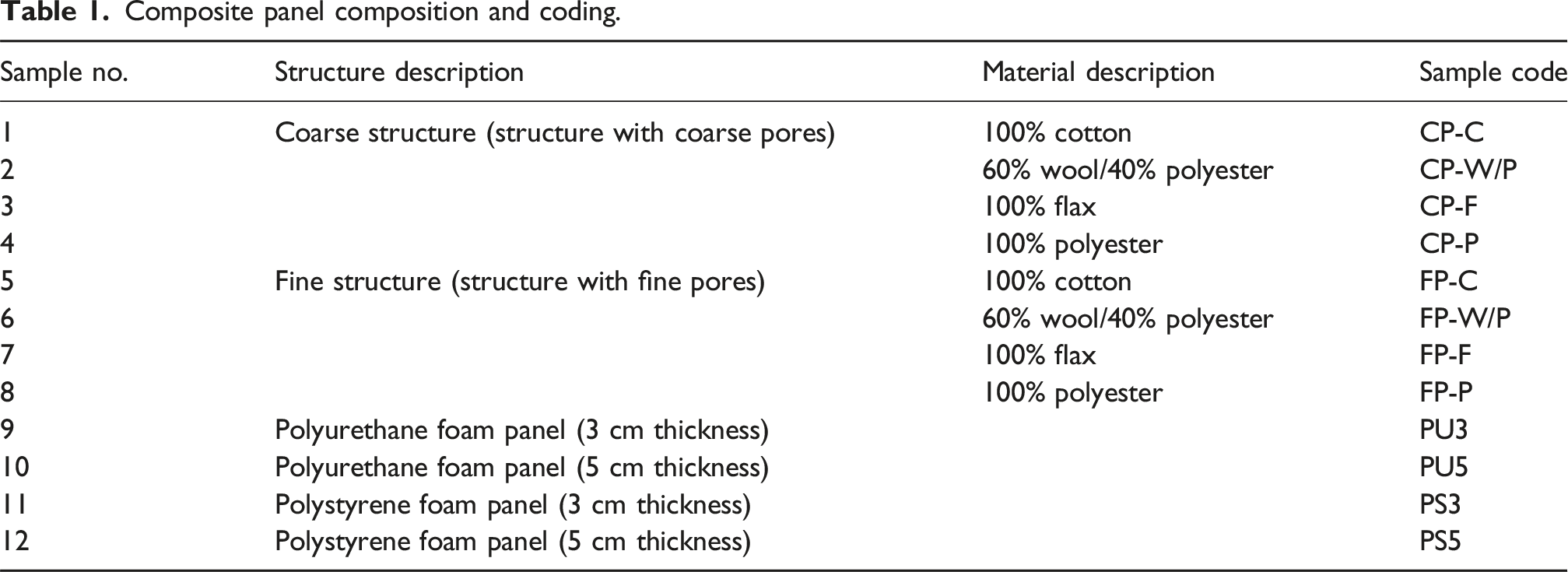
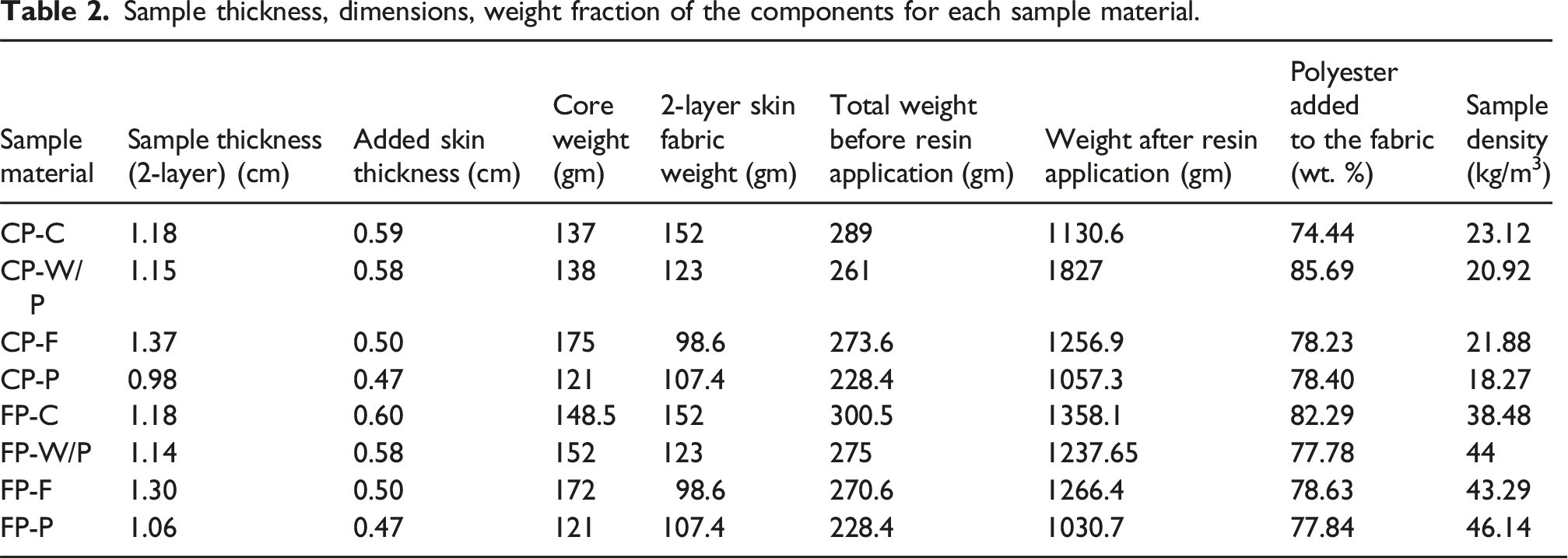
To ensure smooth demolding after curing, polycarbonate sheets were placed on both the top and bottom surfaces of the fabric. A glass panel was then positioned above the polycarbonate sheet to provide a flat surface and distribute pressure evenly when dead weights were applied, eliminating air gaps within the composite. The full production setup is illustrated in Figure 2. The assembly was then left for 7 days at room temperature to be fully cured and solidified. The produced samples were cut, handled (Figure 3), and coded to be introduced to the testing, as shown in Table 1. The volume fraction of the polyester amount added to the fabric (wt. %) varies amongst prepared samples and it falls in the range between 74.44 and 85.69 wt. %. The details of preparation including the volume or weight fraction of the textile or fibres for sample dimensions of 30 × 30 × 5 cm are summarized in Table 2. A schematic of the lay-up system for the developed composite panel building. The produced composite panel where (a) coarse-pored structure, (b) fine-pored structure. Composite panel composition and coding. Sample thickness, dimensions, weight fraction of the components for each sample material.

Thermal conductivity testing
As per ASTM C-518, the thermal conductivity of test specimens measuring 30 × 30 cm2 and thicknesses of 2.5 and 5 cm for sandwich panels was assessed using the Lasercomp device (Figure 4). The test was applied in the laboratories of Housing and Building Research Center (HBRC). Thermal conductivity is the decisive factor to measure how well samples can insulate heat. Thermal conductivity coefficient ( Lasercomp device used for conducting the thermal conductivity test.

Sound absorption testing
Sound absorption coefficient (SAC, α) was identified for each developed sample using PULSE acoustic material testing according to ASTM E1050. The test was applied in the laboratories of Housing and Building Research Center (HBRC). The impedance tube (Figure 5) was used to evaluate the sound absorption coefficient of the produced materials throughout a third octave frequency range of 100–1000 Hz. The test was conducted with an average relative humidity of 50% and a temperature of 25°C. Sound absorption test set-up using the impedance tube.
Noise reduction test
Another criterion to evaluate the sound insulation properties of the developed panels is Sound Reduction Index (RI) calculation according to ISO 15186-1:2000. 24 Unlike techniques that depends on expensive and complex designed reverberation rooms, this standard allows for economical and accurate determination of sound insulation in less-than-ideal laboratory conditions. The standard uses sound intensity techniques to directly measure the sound energy transmitted through a test specimen. The standard emphasizes frequencies critical for building acoustics, particularly 100 Hz–3150 Hz, where human hearing and structural sound transmission are most sensitive. For this purpose, a 50 cm3 acoustic box with a 3 cm-thick polyurethane lining is constructed of wood to represent the source room with the acoustic source of noise (load speaker). Since the ISO standard specifies sound insulation measurements in one-third-octave bands over a frequency range of 50 Hz to 5000 Hz for laboratory testing, white noise signal is used in this work with its broader band (20 Hz–20 kHz) exciting all frequencies uniformly, helping detect weak insulation points.
To provide the highest level of manufacturing efficiency, polyurethane foam was used to seal all corners and attachment points. One side of the box is left with an easy detached wall in order to install, test, and replace each designed panel. According to the standard procedure, the installed panel is labelled as the test specimen, and it is mounted between the source room (the box with the load speaker) and a receiving room (the surrounding outside the box). Once a sound field is generated in the source room, the sound intensity is transmitted through the test specimen to the receiving room and is measured using an Integrated Sound Level Meter (ISLM) device of type Bruel & Kjaer 2238 mediator in terms of sound pressure level (dBA).
Flexural test
The flexural strength of the developed composite panels was evaluated using a four-point bending test, following the guidelines of ASTM D790.
25
This method provides a reliable assessment of the mechanical robustness and load-bearing capacity of the panels, which is critical for their practical application in building envelopes. Test specimens were prepared with consistent dimensions to ensure valid comparisons between different material types and pore architectures. All specimens had a consistent length (50 cm) and width (10 cm). The thickness corresponded to the full panel thickness (2.5 cm for fine-pore, 5 cm for coarse-pore) to evaluate the performance of the entire composite structure, including the effect of pore size on the sample’s bending behaviour. This approach allows the test to evaluate the performance of the entire composite structure taking into consideration the effect of pore size in the sample thickness. Each specimen were subjected to bending using a Mecmesin Multitest 5-xt 5 kN universal testing machine (Figure 6(a)) with a support span of 30 cm and a loading span of 15 cm, following ASTM D790. This setup was chosen to ensure a region of constant maximum bending moment between the loading noses, providing a pure flexural stress state for a more accurate measurement of flexural properties. The loading was applied at a constant crosshead speed until the specimen fractured or exhibited significant deformation, as shown in Figure 6(b). A constant displacement rate of 15 mm/min was selected. This moderate rate was chosen to simulate the type of quasi-static loads these panels might experience during installation or service in interior wall applications, while also preventing dynamic effects that could skew the results. (a) Multitest5-xt (5 kN) with four-point bending setup, (b) Sample under bending test.
The maximum load at failure (breaking load, N) was recorded for each specimen. To ensure high repeatability and accuracy of results, a minimum of three specimens were tested for each material and pore structure configuration. The results are presented as the mean ± standard deviation. The statistical significance of the differences in flexural strength between material types and pore architectures was confirmed. The average maximum breaking load for each material type and pore size configuration was then calculated and reported. This flexural test setup enables a direct comparison of the mechanical performance of panels with different fiber compositions and pore architectures. The results provide valuable insights into the structural integrity of the composites and their suitability for use as both thermal and acoustic insulation materials in building construction.
Results and discussion
Thermal conductivity results
The thermal conductivity coefficient (λ) of the developed fabric-based composite panels was measured to evaluate their effectiveness as thermal insulators for building applications. The results, summarized in Figure 7, reveal significant influences of both pore size and material composition on the thermal performance. Values of thermal conductivity test for the different materials produced.
Panels with fine-pore structures consistently exhibited lower λ values compared to their coarse-pore counterparts across all material types, confirming the beneficial role of smaller pores in reducing heat transfer. For example, the FP-W/P (fine-pore, 60% wool/40% polyester) panels achieved the lowest thermal conductivity of 0.16 W/m·K, which is approximately 16% lower than the coarse-pore structure of the same panel. Similarly, the fine-pore 100% polyester panel recorded a thermal conductivity of 0.17 W/m·K, compared to 0.20 W/m·K for its coarse-pore variant, representing a reduction of about 15%. This reduction can be attributed to the enhanced air entrapment within finer pores, which acts as an insulating barrier by limiting conduction and convection heat transfer. The smaller pore size minimizes convective currents inside the panel, thereby improving thermal resistance.
These quantitative results align with existing literature emphasizing that porous pore architectures provide superior thermal insulation by effectively inhibiting the airflow velocity, trapping air, and disrupting heat flow pathways. Alazzawy et al. 26 confirmed this concept by testing different natural fiber-based epoxy composites from hemp, jute, date palm. The composites with low concentration fibers leads to higher amount of air voids which, in turn, reduces the thermal conductivity levels. Dlimi M. et al. 16 investigated the effect of pore size and number on the thermal conductivity of concrete bricks. They found that the smaller dimension pores and the higher number of pores in the same structure improve the thermal insulation of the structure.
The material composition also played a significant role in thermal conductivity. Panels made from natural fibers such as 100% flax and 100% cotton exhibited a thermal conductivity of 0.18 W/m·K and 0.19 W/m·K, respectively. These values are found slightly higher than those of polyester-based panels due to the intrinsic thermal properties of natural fibers, which generally have higher thermal conductivity and greater moisture absorption tendencies. Moisture uptake can degrade insulation performance by increasing heat transfer through the panel. The 60% wool/40% polyester panels demonstrated intermediate thermal conductivity values, with fine-pore samples at 0.16 W/m·K and coarse-pore samples at 0.28 W/m·K. This hybridization leverages the thermal benefits of polyester’s low conductivity and hydrophobicity while benefiting from the bulk and resilience of wool fibers, resulting in balanced thermal insulation performance. In accordance with the current findings, Bouzit et al. 27 confirmed that polyester-based composites (80% wt. gypsum plaster and 20% wt. fibers), offer the best thermal insulation among the tested materials (0.2 W/m·K), with values comparable to conventional gypsum insulation materials (0.28 W/m·K). Furthermore, folds and scales on the wool fibre, the lumen existing in the flax and cotton fibers, create air pockets in the structure, which reduce the heat transfer within the panel.12,13,28
In their study, Hu et al. 29 investigating non-destructive testing of the wood and cork used in building construction for thermal conductivities. Different types of softwood, hardwood, and cork were used for the comparison. The thermal conductivity values for the spruce, pine, fir, beech, bamboo ranged from 0.109 to 0.329 W/m·K in the direction perpendicular to the grain, which is the most relevant for insulation as heat flow through a wall is typically across the grain. These values are strongly dependent on density and moisture content, with higher density species like bamboo (λ⊥ = 0.329 W/m·K) conducting heat much more effectively than low-density cork (λ = 0.050-0.066 W/m·K). In comparison, the fabric-based composites in the current work demonstrate a competitive and often superior insulating performance. Fine-pore panels, particularly the 60% wool/40% polyester blend, achieved a thermal conductivity of 0.16 W/m·K. This value is significantly better than that of medium-to-high-density woods like pine (0.166 W/m·K), fir (0.185 W/m·K), and beech (0.217 W/m·K) reported in ref. 29, and is comparable to the lower end of the softwood range (spruce at 0.135 W/m·K). While specialized insulation materials like cork still outperform the developed composites, the current work results successfully bridge the gap by offering thermal performance that is better than many common structural woods used in construction.
For benchmarking, commercial polystyrene foam panels were also evaluated. These panels exhibited the lowest thermal conductivity values, typically in the range of 0.03–0.038 W/m·K. This performance is superior to the developed fabric-based composite panels, whose best-performing fine-pore structures achieved thermal conductivities of 0.16–0.19 W/m·K. While polystyrene foam remains the industry standard for thermal insulation due to its exceptionally lowλvalues, it is important to note that it suffers from major drawbacks, including high embodied energy, poor biodegradability, and environmental persistence.
Sound absorption results
The sound absorption performance of the developed fabric-based composite panels was evaluated and discussed, with key results demonstrated in Figure 8. The sound absorption coefficient (SAC, α) was measured across the 100–1000 Hz frequency range using the impedance tube method, following ASTM E1050 standards. Sound absorption coefficient measured values of the test samples.
The material composition of the developed panels proved to have a significant effect on the sound absorption performance. The CP-W/P (coarse-pore, 60% wool/40% polyester) panels achieved the highest α value of 0.51, followed by the CP-F with an α value of 0.42. Replacing the wool/polyester with 100% polyester material causes a reduction in the sound absorption coefficient of around 25%. Remarkably, the 100% cotton panels showed the lowest sound absorption behavior exhibiting coefficient values between 0.18 (coarse pored structure) and 0.2 (fine pored structure).
Changing the panel structure from coarse-pore structure to fine-pore structure deteriorated the SAC values by 43% and 39% in the cases of wool/polyester and polyester samples, respectively. Cotton and flax materials are found insensitive to the changes in the structure pores in terms of size and numbers. The superior sound absorption of coarse-pore panels align with the established understanding that larger and more interconnected pores enhance acoustic performance by allowing deeper penetration of sound waves and increasing their interaction within the fibrous matrix. 22 This mechanism leads to higher conversion of sound energy into heat, thereby improving the SAC values, particularly at mid and low frequencies relevant for building applications. Zhao et al. 30 developed multilayered composite panels with gradient pore sizes, achieving both low thermal conductivity and high sound absorption coefficients exceeding 0.7 in the 20–1600 Hz range. The current study’s coarse-pore panels, particularly CP-W/P panels, demonstrate comparable SAC values, supporting the concept that tailored pore structures are key to multifunctional insulation. Patnaik et al. 20 demonstrated that non-woven mats from recycled wool and polyester with two layered design achieved excellent sound absorption coefficient above 0.5 in key frequency ranges. The scales on wool fibers (observed via SEM) created tortuous paths for sound waves, enhancing absorption by increasing friction. This suggests that natural irregularities in pore geometry (from wool’s scales) improved damping. RPET’s smooth surface (lacking scales) resulted in lower absorption (α ≈ 0.61) versus wool results (α ≈ 0.74), highlighting how fiber texture alters pore networks. The SAC of 0.51 for the wool/polyester coarse-pore panel in this study matches or matches these benchmarks, confirming the effectiveness of engineered pore structures. The outstanding performance of wool/polyester blend is explained by the intrinsic properties of wool fibers, which possess natural crimp and surface scales. These features create additional micro-cavities and increase the tortuosity of the sound path, amplifying absorption effects. The hybridization with polyester improves structural integrity without compromising acoustic efficiency. These results are conformed with the current study outcomes for panels from wool/polyester. Vaghela et al. 31 proved experimentally that increasing the wool fiber percentage in wool-reinforced composite with polyester resin, leads to a similar sound absorption to natural wood. Zach et al. 32 also reported the viability of agricultural waste fibers, especially from flax, as insulation panels achieving SAC values up to 0.40. The results for the flax and wool/polyester panels in this work are in line with these studies, further validating the design approach.
The low SAC values for the cotton-based panels can be justified by their structure thickness. Cotton Thin cotton panels (less than 10 mm) may not provide enough depth for effective sound wave penetration and dissipation. Ersoy et al. 33 tested natural fiber waste materials (including cotton-like fibers) at varying thicknesses between 10 and 50 mm. The thin panels (10 mm) showed negligible absorption below 500 Hz (SAC ∼0.1–0.2). The insensitivity of cotton and flax-based panels to pore structure changes (size/number) can be attributed to inherent fiber properties and morphological characteristics. Acoustic energy dissipation mechanisms are found relying mainly on fiber vibration damping from flax’s high lignin content and tortuosity effects from cotton’s convoluted surface morphology rather than pore-mediated viscous losses that dominate synthetic materials. 34
The high SAC values observed for the developed fabric-based panels, particularly those with coarse-pore structures and hybrid fiber compositions, position them as competitive alternatives to traditional acoustic insulators such as mineral wool and polyurethane foams.
Noise reduction results
The noise reduction performance of the developed fabric-based composite panels was evaluated through the Sound Reduction Index (RI), which quantifies the material’s ability to attenuate airborne sound transmission. All acoustic measurements were initially recorded as noise levels, specifically sound pressure levels (SPL) in decibels (dBA), on both sides of the test specimen. To convert these SPL measurements into the RI, the following standardized formula was applied: Sound reduction index (RI) for each test panel.

The coarse-pore panels generally exhibited superior noise reduction compared to fine-pore panels across all material types. For instance, the CP-F panels achieved an RI of approximately 28 dBA, outperforming its fine-pore counterpart, which registered around 22 dBA. Similarly, the 100% polyester coarse-pore panel demonstrated an RI near 30 dBA, exceeding the fine-pore polyester panel’s 24 dBA. These differences of 6–8 dBA are significant in practical terms, as every three dBA increase represents roughly a doubling of perceived sound attenuation, which highlights the pronounced effect of pore size on noise reduction performance.
The enhanced noise reduction in coarse-pore panels can be attributed to the larger and more interconnected pore spaces, which increase the path length and complexity for sound waves traveling through the material. This leads to greater scattering, reflection, and viscous dissipation of acoustic energy within the panel by increasing sound wave path length. The increased tortuosity and air volume within coarse pores also promote multiple internal reflections, further attenuating sound transmission. These mechanisms are consistent with the review of Sharma et al., 34 who reported that the size and shape of pores in fibrous composites have a great influence on the noise reduction. Another similar research by Mohammadi et al. 35 confirmed that the key factors influencing sound absorption include material properties (porosity, density, tortuosity, airflow resistivity) and structural characteristics (thickness, fiber arrangement, pore connectivity). Hassan et al. 36 compared three different natural fibers composites and stated that Larger, interconnected lumen structures in fibers enhance sound absorption better than smaller lumen ones.
Material composition also played a critical role in noise reduction. Panels made from 100% flax and 100% polyester consistently outperformed those composed of cotton or wool/polyester blends. For example, the wool/polyester coarse-pore panel achieved an RI of approximately 20 dB, which is notably lower than the 28–30 dB range observed for flax and polyester panels with similar pore structures. This disparity may stem from differences in fiber density, stiffness, and surface morphology. Flax fibers possess higher density and stiffness, contributing to greater mass per unit area and improved sound blocking. Polyester fibers, being synthetic and uniform, provide consistent structural integrity that supports effective sound attenuation. In contrast, the wool/polyester blend, while mechanically robust, may have a more heterogeneous structure that slightly diminishes its noise reduction efficiency.
Interestingly, cotton panels showed relatively modest noise reduction values, around 18–22 dBA, with minimal sensitivity to pore size variations. This suggests that the intrinsic fiber properties of cotton, including its lower density and softer morphology dissipate noise, regardless of pore architecture.
The combined effect of pore size and material composition underscores the importance of tailoring both parameters to meet specific acoustic insulation requirements. Coarse-pore structures are advantageous for maximizing noise reduction, particularly when paired with dense, stiff fibers such as flax or polyester. These panels are well-suited for applications in urban or high-noise environments where sound transmission control is critical. Conversely, fine-pore panels, while less effective for noise reduction, may still be preferable where thermal insulation and mechanical strength are prioritized.
The polystyrene foam panels exhibited RI typically in the range of 14–16 dB, which is notably lower than the RI values achieved by the developed fabric-based composite panels, where the best-performing coarse-pore polyester and flax panels reached 30 dB and 28 dB, respectively. The noise reduction data clearly demonstrate that coarse-pore polyester and flax panels provide the highest sound transmission loss, with improvements of up to 8 dB over fine-pore equivalents. This quantitative enhancement, combined with the intrinsic material properties, positions these panels as promising candidates for sustainable, high-performance acoustic insulation in building envelopes.
Flexural strength
The flexural strength of the developed fabric-based composite panels, in terms of the peak load at fracture, was evaluated using a four-point bending test according to ASTM D790. The results, summarized in Figure 10, reveal clear distinctions in mechanical performance based on both material composition and pore architecture. Breaking load of each test panel.
The FP-W/P (fine-pore, 60% wool/40% polyester) composite panels demonstrated the highest flexural strength among all tested samples, withstanding the greatest load before failure of 1198.1 N. This superior performance can be attributed to the synergistic interaction between the natural resilience and crimps existing in wool fibers along with the high tensile strength and durability of polyester. Nassef et al. 37 demonstrated that bio-based composite panels using wool fibers waste achieve comparable flexural strength to wooden based composites. The hybridization of these two fibers enhances the distribution of stress and provides effective crack-bridging during bending, resulting in a composite that is both tough and flexible. Similar findings were recorded for natural fibers composites by Mahesh, 38 concluding that hybrid composites from bamboo and jute fibers exhibited higher tensile and impact strength values than non-hybrid composites.
Changing the structure from coarse-pores structure to fine-pores structure resulted in an increment increase in the strength by 43% and 41% in case of FP-W/P panels and FP-F panels, respectively. The fine-pore structure further contributes to this strength by increasing the density and uniformity of the composite, which reduces the presence of large voids and minimizes stress concentrations that can initiate cracks. Additionally, the increased number of strong interfaces between fibers and the polyester resin matrix in fine-pore structures promotes better stress transfer and mechanical integrity. The results align closely with the findings of Sharma et al., 34 who reported that pores in natural fibers-reinforced composites strongly affect the structure properties such as the mechanical strength. The findings reinforce the importance of considering both material composition and pore architecture in the design of sustainable, high-performance building insulation panels, particularly for applications where mechanical robustness is as critical as thermal and acoustic performance. Commercially, the developed panels possess an acceptable value of flexural strength when compared to the commercial gypsum plasterboard, which sustains a maximum breaking load of 725 Newton in the longitudinal direction while in the transverse direction it sustains 300 Newton as recorded by Irbe et al. 39
Panels composed entirely of polyester also exhibited high flexural strength, particularly in coarse-pore forms. This is consistent with the known mechanical performance of polyester-based composites, where the synthetic fibers provide a uniform and robust reinforcement throughout the matrix. The observation that coarse-pored polyester panels exhibit higher flexural strength by 27% than their fine-pore counterparts can be attributed to the interplay between pore architecture and the intrinsic properties of polyester fibers within the composite matrix. In coarse-pore structures, the larger and more widely spaced pores result in thicker, more robust polyester walls or struts between the voids. These thicker sections act as primary load-carrying elements, providing greater resistance to bending and localized stress concentrations during flexural loading. The increased cross-sectional area of these walls allows for more efficient stress distribution and reduces the likelihood of premature failure due to microcracking or buckling, which can be more prevalent in fine-pore structures where the walls are thinner and more susceptible to deformation. Moreover, the polyester resin used in the composite fabrication process tends to impregnate and reinforce the thicker walls of coarse-pore structures more effectively, leading to improved fiber-matrix adhesion and overall panel integrity.
In contrast, panels made from 100% cotton and 100% flax displayed lower flexural strength values, with only minor differences observed between their coarse and fine-pore structures. The relatively modest mechanical performance of these natural fiber panels can be explained by their intrinsic material properties. Cotton and flax fibers, while advantageous for thermal and acoustic insulation due to their hollow and convoluted microstructure, possess lower inherent tensile and bending strength compared to synthetic fibers or hybrid blends. Their smoother surfaces and lower aspect ratios also result in less effective bonding with the polyester resin, making the overall composite less responsive to improvements in pore architecture. This observed insensitivity of cotton and flax panels to pore structure modifications is supported by findings in the literature. Studies by Dlimi et al. 16 and Korjenic et al. 28 have shown that the mechanical performance of natural fiber-based composites is largely dictated by the fiber type and its compatibility with the matrix, rather than the pore structure alone. In these materials, the benefits of reducing pore size or increasing pore number are quickly outweighed by the limitations imposed by the fibers themselves. In contrast, hybrid composites, such as the wool/polyester blend, benefit from both the mechanical reinforcement of synthetic fibers and the resilience of natural fibers, especially when combined with a fine-pore architecture that maximizes fiber-matrix interaction.
In comparison with other construction materials, engineered composites from 100% pulled wool fibers (without skin) 37 exhibited strength values in the range of 0.89–2 MPa which is less than the recorded values for FP-W/P composites (2.16 MPa) by at least 59%. It is worth noting that the developed FP-W/P composites showed higher flexural strength by 20% than cork-gypsum board which exhibits only 1.8 MPa according to previous work. 40 In their work, Benaniba et al., 41 reported that bio-composite from date palm fibers, cement, and sand showed flexural strength values ranging from 2.8 to 3.8 MPa (depending on the concentration of date palm fibers) which is higher than the results of FP-W/P by minimum 30%. Another building material Cementitious composites reinforced with Kenaf natural Fibre were found to reach almost 6 MPa. 42 Hence, the developed multifunctional composite structures in this work conform with the range of flexural strength values reported by other similar works in literature.
For further explanation of the obtained results, scanning electron microscope SEM is conducted on the four types of the prepared composite structures, as shown in Figure 11. The imaging was applied to the sample cross-section to illustrate the cohesion between the fabric yarns and the polymeric resin. Four magnification factors (80x, 200x, 500x, and 1000x) were examined to obtain the best image that expresses the fabric/resin cohesion. The magnification of 80x was found sufficient to preview the cross-section morphology representing the cohesion between the fabric and the applied polyester resin. Scanning electron microscope SEM of (a) 100% Cotton sample, (b) 60% Wool/40% Polyester sample, (c) 100% Flax, and (d) 100% Polyester.
Amongst all composite structures, 60% Wool/40% Polyester samples show better cohesion between the applied polyester resin and the fabric. The hairiness of cotton yarns in the 100% cotton structure and the crimps and the scales of wool fibers in the 60% wool/40% polyester structure assisted to merge and well-contact the fabric and the polyester resin. On the other hand, the yarns of the 100% flax and 100% polyester composite structures are almost smoother and show a lower cohesion between the fabric and the resin. This is found conformed with the results of the flexural strength test results, where CP-W/P and FP-W/P exhibits the highest break load levels. On the other hand, Samples from 100% Flax structure and 100% Polyester show the fabric yarns and fibers protruding from the composite preserving their structure. This has reflected on the sound reduction index of the samples (CP-F, CP-P, FP-F, and FP-P) which shows better sound reduction index than the other materials used.
Conclusions and future work
This research introduces a novel class of fabric-based composite panels, engineered from both natural and synthetic fibers and designed with tailored hollow structures, for advanced thermal and acoustic insulation in building applications. The systematic investigation of four fiber compositions which are 100% cotton, 60% wool/40% polyester, 100% flax, and 100% polyester, across coarse- and fine-pore architectures has demonstrated the following key findings: • Fine-pore structures consistently exhibited lower thermal conductivity values compared to their coarse-pore counterparts, with reductions ranging from 30% to 45% depending on the material. Fine-pore composites comprising 60% wool/40% polyester, achieved exceptionally low thermal conductivity values (as low as 0.16 W/m·K), positioning them as viable and sustainable alternatives to common hardwood wood construction materials such as pine and beech. • The larger pores in these structures facilitated greater dissipation of sound energy, enhancing their acoustic performance. Coarse-pore panels made from 60% wool/40% polyester and 100% flax exhibited the highest sound absorption coefficients (0.51 and 0.42, respectively), while 100% flax and 100% polyester panels delivered the greatest noise reduction, confirming the effectiveness of engineered pore structures in controlling acoustic insulation. • Results from flexure mechanical test showed that the FP-W/P composite panels possess superior flexural strength, surpassing other tested materials. The results indicate that the synergy between fiber type and pore architecture can yield robust, durable panels suitable for practical building applications.
The innovative integration of natural and synthetic fibers within hollow, textile-based composite structures not only advances the functional performance of insulation materials but also addresses critical sustainability challenges. These panels offer significant reductions in carbon footprint and improved biodegradability compared to conventional insulators such as polystyrene and polyurethane. Although the initial material cost of natural fibers like wool and flax can be higher than raw polystyrene, the developed composites offer significant potential for long-term cost savings. This arises from their use of renewable and often recycled materials, which reduces dependency on volatile fossil-fuel-based polymers. Furthermore, their multifunctionality (combining thermal and acoustic insulation with mechanical robustness) can reduce the need for separate material layers, simplifying construction and lowering overall installation costs. Future work will include a detailed techno-economic analysis to quantify these cost benefits. Flexural strength results present an important foundational step demonstrating the potential of the developed composites; hence, future work is recommended to explore the long-term durability of the developed composite samples including creep and fatigue strength under different thermal loading conditions in the construction linings. Also, fire resistance, water affinity, and large-scale manufacturability of these composites will be further investigated. Additionally, optimizing fiber blends and pore architectures could unlock even greater performance enhancements, fostering broader adoption in sustainable building practices. This includes exploring ternary fiber blends that incorporate a higher percentage of stiffer natural fibers such as hemp and jute alongside wool to enhance acoustic damping, while using polyester to maintain mechanical integrity. Additionally, pore architecture design will move beyond the current coarse and fine dichotomies toward graded pore structures, where pore size gradually changes through the material’s thickness, allowing simultaneous optimization of thermal insulation via fine pores and sound absorption via coarse pores within a single panel.
Footnotes

Ethical considerations
No ethical approval was required for this research as it did not involve human tissue or any other parts of living organisms.
Author contributions
Conceptualization, W.H., A.S., and I.E.; methodology, W.H., A.E., and M.G.A.N.; samples preparation, W.H., A.E.; validation, M.G.A.N., W.H., A.E.; formal analysis, M.G.A.N W.H., A.E.; investigation, A.S., and I.E., and A.E.; resources, W.H., I.E., and M.G.A.N.; data curation, I.E., A.E., W.H., and A.S.; writing—original draft preparation, A.E. and M.G.A.N.; writing—review & editing, W.H., I.E., and A.S.; visualization, A.E. and M.G.A.N.; project administration, A.S. All authors have read and agreed to the published version of the manuscript.
Funding
The authors received no financial support for the research, authorship, and/or publication of this article.
Declaration of conflicting interests
The authors declared no potential conflicts of interest with respect to the research, authorship, and/or publication of this article.
Data Availability Statement
The data that support the findings of this manuscript are available from the corresponding author upon request.