






Abstract
Predicting the service life of structural parts with hydrophilic constituents requires accounting for moisture-induced aging during the design phase. This involves determining the moisture content distribution through the material’s thickness over time. Traditionally, composites with at most one hydrophilic constituent are considered. For materials with multiple heterogeneous hydrophilic constituents, traditional methods for estimating macroscopic moisture content are no longer adequate. To address this, this work introduces an original, general methodology to localize moisture at the constituent scale (matrix and hygroscopic reinforcements) from the knowledge of the macroscopic laminate moisture field and the sorption isotherms of each constituent. The proposed framework employs an algorithm to correlate macroscopic water content fields with local moisture distributions in composite constituents. Model validation was conducted by comparing predicted moisture profiles and diffusion characteristics with experimental data on a flax/epoxy composite from literature. Using the Hailwood-Horrobin equation, the model accurately represents the sorption isotherms of flax/epoxy composites, with a high correlation coefficient (R2 = 0.9905) to experimental data. For the epoxy matrix, the predicted maximum moisture content capacities are 1.4 wt% and 2.5 wt% at 45% and 75% relative humidity, in close agreement with the experimental values of 1.2 wt% and 2.4 wt%, respectively. For flax fibers confined within the matrix (composite), the calculated maximum moisture content capacities are 2.7 wt% at 45% relative humidity and 6.8 wt% at 75% relative humidity, compared with 4.2 wt% and 7.0 wt% reported for free fibers, thereby highlighting the confinement effect of the surrounding matrix.
Keywords
Introduction
In the context of the fourth industrial revolution, composite materials have emerged as a crucial alternative to metallic structures across various industries due to their lightweight nature, exceptional mechanical performance. They also offer significant potential for reducing energy consumption in transportation. 1 Despite these advantages, composites, especially those of bio-based origin, are highly sensitive to harsh environmental conditions. Exposure to high levels of relative humidity remains a significant obstacle to their wider adoption.2,3 The hydrophilic nature of their polymer matrix4,5 and in certain cases their fibers, causes volume changes in eco-friendly composites such as cellulose-rich plant fiber composites.6,7,8,9 This leads to reduced mechanical integrity and durability. 10 Beyond durability concerns, the recycling of composite parts presents a significant challenge. Indeed, the recycling of polymers is inherently difficult, and this is further complicated by the difficulties in separating the various constituents of materials at the end of their service life.11,12,13
In this context, natural fiber-based composites offer promising alternatives. These materials exhibit favorable mechanical properties, low density, and a renewable source, thereby contributing to a reduction in carbon footprint and environmental impact.14,15,16 However, managing the hygro-elastic behavior of these composites subjected to mechanical loads in humid environments also remains challenging. Moisture absorption induces volumetric changes and may lead to connected effects such as plasticization.17,18,19,20
As a result, in several industrial sectors, these bio-based composites are already considered for semi-structural parts exposed to humid environments, which makes moisture uptake and durability key design constraints. In the marine industry, for example, Baltic Yacht manufactured the Baltic 68 Café Racer Pink Gin Verde, whose hull incorporates naturally grown fibers as reinforcement. 21 Moreover, flax-fiber-reinforced biocomposites have been used for small crafts such as canoes. 22 In the automotive sector, prototypes of vehicle parts have also been developed within the LIFE COMP0LIVE project using biocomposites based on olive-tree waste fibers and recycled polypropylene. 23 These examples clearly highlight the need for predictive moisture-transport models specifically suited to composites containing two hygroscopic constituents.
From a durability perspective, extending the service life of structures is a key lever for reducing resource consumption and end-of-life pollution. Achieving this objective requires predicting the lifecycle of hydrophilic composites in humid environments. Since key aging mechanisms (swelling, plasticization and associated property changes) are governed by the local moisture content, 3 such predictions require access to moisture distributions rather than solely global uptake. Consequently, understanding and predicting the hygro-elastic behavior of hydrophilic composites across scales is essential for improving their durability and expanding their applicability across various industrial sectors. In the present state of knowledge, a major scientific obstacle is the lack of a model capable of determining the water content distribution of at the constituent scale in materials containing two or more hydrophilic constituents.
Previous efforts in his direction include a numerical tool to address various hygromechanical coupling phenomena in a polymer matrix-based composite reinforced with carbon fibers. 24 This research investigated key parameters, such as the diffusion coefficient and Young’s modulus, which are dependent on the moisture content field at the scale of the constituents, due to plasticization effects.25,26,27 Furthermore, the study examined the evolution of the mechanical states resulting from moisture absorption by the material. Our results revealed that considering hygromechanical coupling effects, such as the moisture-dependent diffusion parameters and matrix softening during diffusion, significantly influences moisture transport and local mechanical properties. These effect strongly impact the predicted strains and stresses fields at different scales of the composite, including within individual plies and t their constituents (matrix and reinforcements). However, the study did not account for water absorption by carbon fibers, as they were genuinely assumed to be hydrophobic.
In order to extend the applicability of this model to composites comprising two hydrophilic constituents, such as natural fiber reinforced composites, where the absorption of moisture by cellulose fibers cannot be overlooked, an original modelling approach is introduced in this paper. The motivation behind the development of this tool stems from the necessity to effectively address the local properties of composite constituents, considering them as functions of the heterogeneous local moisture contents experienced by either the reinforcements or the polymer matrix. This objective entails the adoption of a model capable of determining local moisture content fields within the composite constituents throughout the entirety of the moisture diffusion process. This is particularly critical during the transient phase when moisture distributions are non-uniform at both the composite and constituent scales.
Methodology and case study
General algorithm
The macroscopic water content field, represented by


The inversion of expression

This methodology was previously employed in a similar context for estimating relative humidity within an air filled cavity in a polymer sample.
28
This pioneering work assumes that the cavity is filled with humid air, which is in equilibrium with the water content existing in the solid surrounding the cavity at its boundaries. In accordance with the present study, we consider a thermodynamic equilibrium for water transport in our heterogeneous solid, as if a reservoir of humid air existed at each point in space Illustrative representation of the conceptualization of an equilibrium of water between “virtual” pockets of humid air and the corresponding actual macroscopic moisture content field in a dense solid.
From the profile in the thickness of the effective macroscopic relative humidity

In the above equations, the superscript
The corresponding local, pseudo-macroscopic water contents can be deduced from the sorption isotherms of the constituents, generically defined by the function:

Under these assumptions, we can write:

The algorithm used to solve this problem is summarized in Figure 2. Calculation scheme for local pseudo-macroscopic water content 
Case study
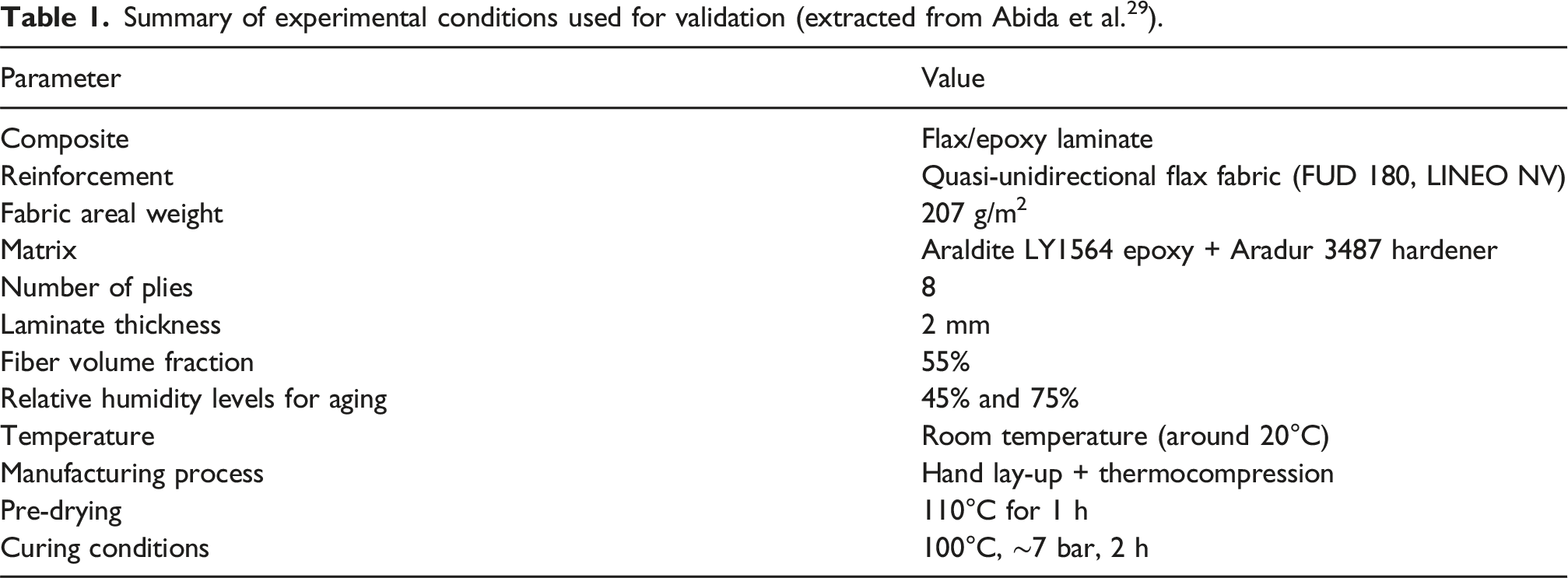
This case study focuses on the application of the methodology presented in section II.1 to a 2 mm thick flax/epoxy laminate consisting of eight unidirectional plies. For the purposes of the simulation, the laminate was modelled as a cylindrical structure with a substantial internal diameter of 80 mm, chosen to approximate the behavior of a thin plate, similar to the flat specimens used by Abida et al. 29 The reinforcement is a quasi-unidirectional flax fabric (FUD 180, LINEO NV) with a measured weight of 207 g/m2, composed of twisted yarns and few weft threads, pre-treated with epoxy-compatible sizing. The matrix is an Araldite LY1564 epoxy resin with Aradur 3487 hardener (100:34 ratio). Laminates were produced via hand lay-up and thermocompression, including pre-drying at 110°C and curing at 100°C under ∼7 bar pressure. 29
Summary of experimental conditions used for validation (extracted from Abida et al. 29 ).
Macroscopic sorption isotherm
To model the sorption isotherm for the flax/epoxy composite, the Hailwood-Horrobin equation
30
was applied, as shown in equation (7). According to Hailwood and Horrobin, water is present in the material in two forms: one that is simply dissolved and another that forms a hydrate. It is assumed that the three species within the solid phase - dissolved water, non-hydrated molecules, and hydrated molecules - form an ideal solid solution.
30
The equation below represents the corresponding maximum moisture uptake capacity:
In this equation,
The Hailwood-Horrobin sorption isotherm is a widely used model for characterizing sorption behavior in a variety of materials, including biocomposites, wood, and natural fibers such as flax. For instance, in a study on humidity-responsive actuation of bioinspired hygromorph biocomposites for adaptive structures, the Hailwood-Horrobin model was employed to describe sorption and desorption isotherms for flax/maleic anhydride grafted polypropylene biocomposites. 32 Furthermore, in the context of wood and plant fibers, a study examined water sorption by measuring isotherms for flax fibers at different temperatures using the Hailwood-Horrobin model. 33 Similarly, this model has been employed to investigate the water vapor sorption behavior of various natural fibers, including flax.31,34
Using the Hailwood-Horrobin sorption model within the theoretical framework, the macroscopic water content at any given time and position is expressed as:
Here,
Solving equation (8) yields the following positive root for the macroscopic relative humidity:
The sorption parameters of the Hailwood-Horrobin mode were adjusted to align with the experimental data collected by Abida et al.
29
at macroscopic scale on composite samples. The resulting values were:
Epoxy sorption isotherm
It is hypothesized that the sorption isotherm of the epoxy matrix follows a linear Henry’s law, as expressed in equation (10).
Henry’s law was chosen for its simplicity, consistency with data, and suitability for low sorbate concentrations. This choice is supported by previous research.35,36,37
Flax sorption isotherm
The model proposed by Park
38
is frequently cited by researchers as an accurate representation of moisture behavior in natural fibers.39,40,41,42,43,44 In the present work, it was decided to adopt an alternative methodology, namely the rule of mixtures, as elucidated in equations (11) and (12). It is hypothesized that the interaction between the fibers and the surrounding composite matrix might influence the manner in which the fibers absorb moisture. The rule of mixtures is employed to ensure that the total amount of water absorbed is distributed fairly between the fibers and the matrix, in accordance with the principle of mass conservation. Additionally, it is assumed that the nearly hydrophobic matrix absorbs moisture similarly to the bulk polymer, even when surrounding flax fiber. This implies that it is considered in the present work that the sorption behavior of the polymer matrix is unaffected by the presence of natural fibers within the composite. This assumption helps us estimate the maximum moisture absorption capacity of the hydrophilic fibers within the composite.

In the aforementioned equations,
The effect of fiber confinement by the surrounding matrix has been highlighted in the work of El Hachem et al., 45 who investigated moisture absorption at multiple scales in unidirectional flax/polypropylene biocomposites. Their study showed that the moisture absorption of fibers samples, free to expand, is higher than that estimated for the same fiber type embedded in composite samples by applying rule of mixture based on mass conservation principle, considering a fiber volume fraction of 20%, illustrating the effects, induced by the surrounding polymer matrix, on the sorption isotherm law of vegetal fibers. These findings are consistent with those of Joffre et al., 8 who investigated the effect of a hydrophobic matrix on the swelling and water uptake of wood fibers. The distinction between materials such as polylactic acid and wood fibers serves to illustrate the considerable influence exerted by the matrix on this phenomenon. Furthermore, the work of Derrien and Gilormini46,47 investigated the interaction between stress and diffusion in polymers, demonstrating that compression stresses can reduce swelling and water absorption. Further advancements in this approach were detailed in the theoretical work of Sar et al., 48 which took into account the effect of mechanical states on polymer density and the consequences on moisture uptake. These studies emphasize the impact of matrix confinement on the variations in sorption isotherms between “free” and matrix-embedded flax fibers.
In the present case study that is based on the work of Abida et al.,
29
Figure 3 compares classical sorption models, such as the Park and Hailwood–Horrobin models, with a modified rule of mixtures that accounts for confinement effects imposed by the surrounding matrix. In contrast to the preceding comparison with El Hachem’s work, the deviation from ideal predictions is less pronounced. This discrepancy may be attributed to the variation in fiber volume fractions within the studied composites, with El Hachem et al. utilizing a volume fraction of 20% and Abida et al. employing a volume fraction of 55%. The lower fiber volume fraction in El Hachem et al.'s study amplifies the influence of the thicker surrounding matrix confinement effect, potentially resulting in a more pronounced disparity observed when comparing the sorption isotherms. Comparison of sorption isotherms for flax fibers: classical models (Park and Hailwood–Horrobin) versus a confinement-adjusted rule of mixtures. Model fits are based on data reported in Abida et al
29
.
Furthermore, the sorption isotherm predicted according to the present methodology agrees well with both Park’s and Hailwood and Horrobin’s models, as illustrated in Figure 3. This confirms the efficacy of these established models in representing the moisture sorption behavior of “unstrained” flax fibers.
Results and discussions
The water content profile across the composite’s thickness allows the estimation of pseudo-macroscopic moisture content in each constituent, reflecting how humidity gradients affect both the matrix and the fibers differently. Figures 4 and 5 illustrate the predicted pseudo-macroscopic moisture content profiles for flax fibers and the epoxy matrix at relative humidities of 45% and 75%, respectively. These profiles show how moisture accumulates differently in the two constituents, with the flax fibers exhibiting significantly higher moisture uptake due to their hydrophilic nature. The matrix, by contrast, shows a slower and more limited uptake. Pseudo-macroscopic localized water content profiles for (a) flax fibers and (b) epoxy matrix within the thickness of a composite sample exposed to hygroscopic ageing at RH = 45%. The x-axis represents the real position across the sample thickness (in mm), where 0 mm corresponds to the inner surface and 2 mm to the outer surface of the hollow cylindrical laminate. Profiles correspond to steady state conditions. Pseudo-macroscopic localized water content profiles for (a) flax fibers and (b) epoxy matrix within the thickness of a composite sample exposed to hygroscopic ageing at RH = 75%. The x-axis represents the real position across the sample thickness (in mm), where 0 mm corresponds to the inner surface and 2 mm to the outer surface of the hollow cylindrical laminate. Profiles correspond to steady state conditions.

Furthermore, we have plotted “localized” sorption curves for both the epoxy matrix and flax fibers, which are presented in Figures 6 and 7, respectively. In the case of the matrix, the predicted moisture content at saturation for 45% relative humidity is in close alignment with experimental observations, with a value of 1.4% compared to the 1.2% reported by Abida et al.
29
Similarly, at 75% relative humidity, the predicted moisture content at saturation is 2.5%, which closely matches the experimental value of 2.4% from the same study. However, a significant difference is observed during the transition phase, where the predicted moisture uptake occurs more rapidly than the experimental data. This may arise because the predicted matrix response corresponds to epoxy embedded within the fiber architecture (matrix constrained by the surrounding fibers), whereas the experimental dataset corresponds to pure epoxy. The fiber-induced confinement and the reduced characteristic diffusion length in the matrix regions can accelerate the transient kinetics compared with pure epoxy. Predicted and experimental kinetics of diffusion of the pure epoxy matrix, as a function of the ageing condition applied at the boundary of the sample. Predicted kinetics of diffusion of the pure flax fibers confined within a matrix, where the kinetics account for mechanical constraints imposed by the surrounding matrix, as a function of the ageing condition applied at the boundary of the sample.

However, the results for flax fibers exhibit some differences when compared to the experimental data reported by Abida et al. 29 This was anticipated due to the matrix confinement effect, which restricts moisture absorption by “constrained” fibers. At 45% relative humidity, the calculated moisture content at saturation is 2.7%, which is in close agreement with the 4.2% reported by Abida et al. At 75% relative humidity, the calculated value is 6.8%, which is relatively close to 7% measured by Abida et al.
Summary of the key advantages and current limitations of the proposed model.
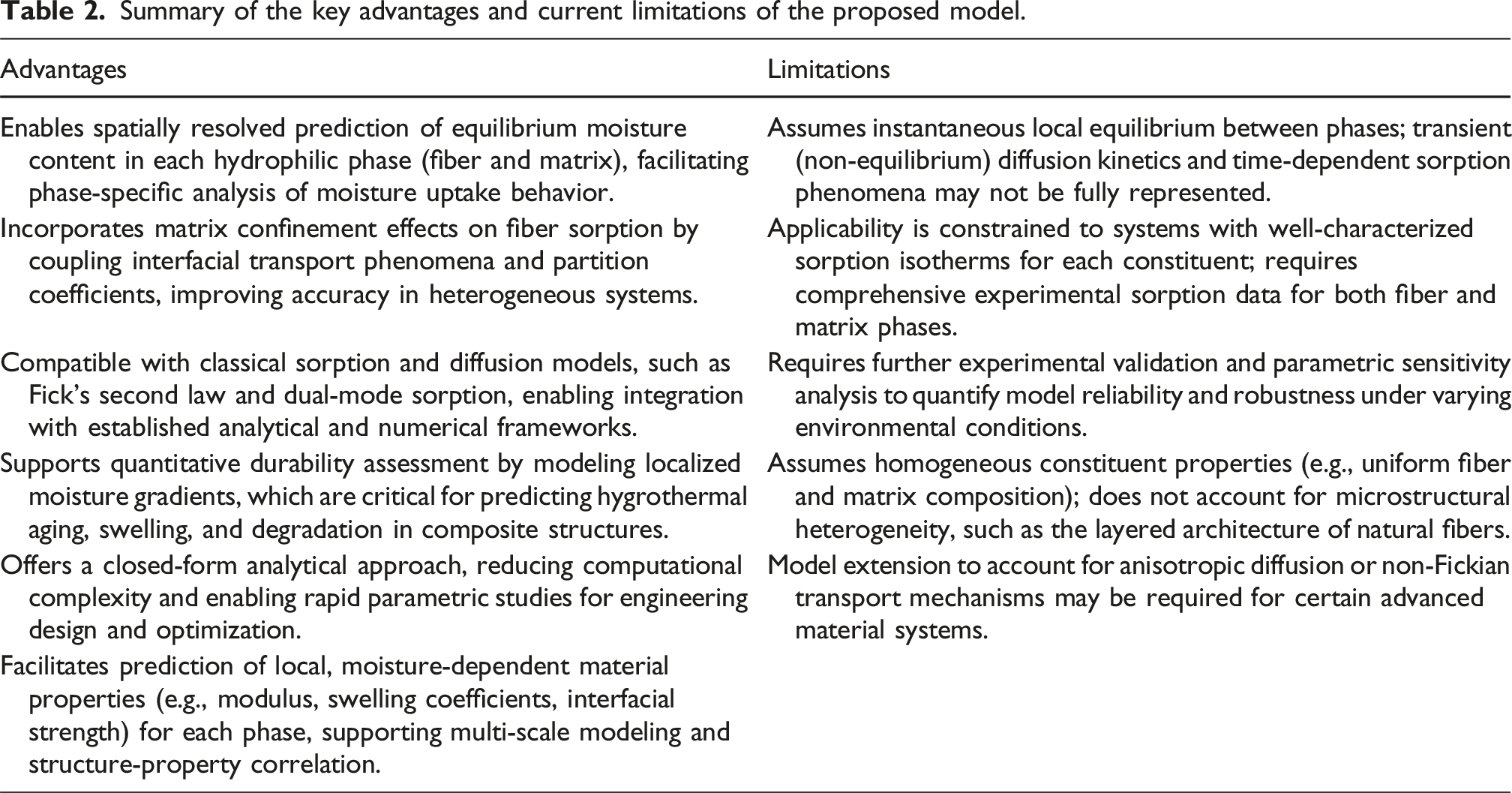
The developed methodology enables localized prediction of moisture content within composite constituents, providing a crucial input for evaluating how humid environments affect material performance. By providing access to the local moisture content in each phase, the model offers a foundation for predicting localized mechanical states, such as swelling strains and internal stresses, through coupling with suitable constitutive laws for the matrix and fibers.
Previous studies have shown that the local moisture content within a given constituent can influence the local evolution of material properties during transient diffusion. For instance, Obeid et al.21. Demonstrated that in polyamide-6, local plasticization induced by moisture not only reduces the Young’s modulus but also alters the coefficient of moisture expansion. The present methodology enables similar coupling effects to be considered at the scale of each hydrophilic constituent, making it possible to model local property gradients resulting from moisture uptake in materials comprising multiple hydrophilic phases.
This extension will be essential for applications in sectors such as aerospace, automotive, and marine, where moisture-induced mechanical effects –including stress concentrations and swelling-induced damage– are critical factors affecting durability and failure risk.
Conclusions
• This study presents a multi-scale modeling approach for determining the moisture content within the hydrophilic constituents of composite materials, with a particular focus on those reinforced with natural fibers such as flax. • The methodology enables prediction of local moisture distribution in both the matrix and the fibers, using a rule of mixtures to incorporate the effect of matrix confinement on fiber sorption behavior. • Applied to a flax/epoxy laminate, the model reproduces the macroscopic sorption isotherm of the composite with very good agreement (R2 = 0.9905) and predicts maximum moisture content capacities in the epoxy matrix of 1.4 wt% and 2.5 wt% at 45% and 75% relative humidity, respectively, in close agreement with the experimental values of 1.2 wt% and 2.4 wt%. • For composites made of flax fibers embedded within the matrix, the model predicts maximum moisture content capacities of 2.7 wt% at 45% RH and 6.8 wt% at 75% RH, compared with 4.2 wt% and 7.0 wt% measured on free fibers, thereby highlighting the confinement effect of the surrounding matrix on fiber sorption. • The ability to predict and comprehend moisture distribution across different scales within a composite is crucial for optimizing material performance, particularly in harsh environmental conditions, where temperature and humidity can significantly influence material behavior. Furthermore, better understanding local moisture absorption can help prevent swelling or damage through improved design. Additionally, it promotes more efficient material usage, reducing waste and contributing to sustainability efforts. • The proposed framework was validated against macroscopic experimental measurements reported in the literature (Abida et al.
29
). Future work will also target direct experimental validation of the predicted constituent-scale (pseudo-macroscopic) moisture fields using local water-content measurement techniques (e.g., Fresnel fiber-optic sensors) currently being developed in GeM (e.g., M. Girard and co-workers).
49
• Although illustrated here on a flax/epoxy laminate, the proposed framework is, in principle, applicable to other composites containing two or more hygroscopic constituents, and can be extended in future work to non-isothermal conditions and non-equilibrium sorption kinetics. • Future work can also extend the framework to temperature-dependent and potentially non-isothermal conditions by using sorption isotherms and transport parameters identified at different temperatures (and, for thick structures, by accounting for coupled temperature and moisture fields during diffusion).
Footnotes

Ethical considerations
Ethical approval was not required for this study.
Funding
The authors received no financial support for the research, authorship, and/or publication of this article.
Declaration of conflicting interests
The authors declared no potential conflicts of interest with respect to the research, authorship, and/or publication of this article.
Data Availability Statement
The data that support the findings of this study are available upon request.