






Abstract
Burning mouth syndrome (BMS) is a debilitating condition that has a striking female predilection. Although the oral mucosa is normal in appearance, patients with BMS experience oral burning that most commonly localizes to the lips and tongue. BMS is a diagnosis of exclusion, and all underlying pathoses associated with allodynia must be ruled out prior to rendering the diagnosis. The etiopathogenesis of BMS remains poorly understood, and thus patient management is challenging. Data indicate that oral and systemic factors both contribute to the development and persistence of the condition. Of particular interest, emerging work identifies structural and functional deficits within the nervous system that may lead to a more mechanistic understanding of BMS pathology. In addition, several novel findings suggest that circadian rhythm dysfunction may be a previously unappreciated yet clinically significant driver of disease. Circadian rhythm controls pain perception, mood, and sleep and plays a key role in the regulation of the hypothalamic-pituitary-adrenal axis. Since these are altered in patients with BMS, this may be reflective of underlying circadian dysfunction. While evidence-based treatment strategies for BMS are lacking, current treatment approaches consist of local and systemic medications, such as clonazepam, alpha lipoic acid, capsaicin, low-level laser therapy, gabapentin, and amitriptylin. In addition, the use of cognitive behavioral therapy is reported. This review provides an overview of the recent literature related to the etiology and treatment of BMS and identifies current challenges facing researchers and clinicians alike.
Introduction
Like that of many complex pathoses, the etiology of burning mouth syndrome (BMS) remains poorly understood, and thus patient management is challenging. While there are several advances in understanding the causes of BMS in recent years, our knowledge concerning the condition is continuously evolving. Moreover, further evidence-based studies are needed to determine the most efficacious treatments. This review provides an overview of the recent literature regarding the etiology and management of BMS.
Definition and Diagnosis of BMS
While there is no universally agreed upon definition for BMS, it is generally accepted that the condition is characterized by oral pain and discomfort with normal-appearing oral mucosa. Patients must have this presentation in the absence of any local or systemic condition that is typically associated with stomatodynia (i.e., Candida infection, diabetes mellitus, thyroid disease, nutritional deficiencies). Therefore, BMS is a diagnosis of exclusion (Task Force 1994; Headache Classification Committee 2013).
Putative Etiology
The etiology of BMS is complex and likely multifactorial. Several lines of evidence demonstrate that disturbances in taste and nervous and endocrine function may precipitate or exacerbate disease. Moreover, emerging data suggest that circadian rhythm dysfunction may contribute to BMS. Since BMS is a relatively rare condition that may be difficult to diagnose (Aljanobi et al. 2017), many studies are conducted with small numbers of patients. Therefore, much of the work presented herein needs to be validated with larger patient cohorts. However, studies with small numbers of patients are valuable in establishing a basis for further hypothesis-driven research. With this caveat in mind, we highlight emerging data regarding the putative causes of BMS.
Altered Pain Perception
Studies related to the perception of pain have provided insight regarding underlying causes of BMS. Pain can be broadly classified as either nociceptive or neuropathic based on the nature of the stimulus. Nociceptive pain results from a noxious insult, such as inflammation or mechanical or thermal stimuli. This is in contrast to neuropathic pain, in which the pain is thought to be generated and maintained by the nervous system (Raney et al. 2017). Neuropathic pain affects the central and peripheral nervous systems and is characterized by burning, electric shock–like sensation, prickling, and/or numbness (Lopez-Jornet et al. 2017). Most chronic pain conditions have nociceptive and neuropathic components (Raney et al. 2017).
Recent work based on neuropathic pain questionnaires suggests that approximately 30% to 60% of patients who have BMS suffer from neuropathic pain (Braud et al. 2013; Lopez-Jornet et al. 2017). A corroborative study supports these findings, as such patients showed reduced sensitivity to cold and warmth as well as diminished thermal pain thresholds as compared with healthy controls (Mo et al. 2015). Patients with BMS can be grouped into 3 subsets: those who experience peripheral small fiber neuropathy, those with major subclinical central trigeminal neuropathy, and those who exhibit inhibitory dopaminergic deficiency (Lopez-Jornet et al. 2017). Thus, much attention in recent years has focused on central and peripheral nervous system dysfunction in the context of this disease.
Indeed, patients having BMS display structural and functional deficits in key brain regions associated with pain perception. Structural analyses performed on a small number of patients with BMS and healthy controls revealed changes in the medial system of the pain-related network in BMS (Wada et al. 2017). A corroborating study found abnormal structure and function in the medial prefrontal cortex and hippocampus of those with BMS (Khan et al. 2014). Moreover, changes in gray matter of the pain matrix are described, suggesting that deficits in pain control may contribute to disease (Sinding et al. 2016). Additional work demonstrates that patients who have BMS and experience depression have low cerebral blood flow (Liu et al. 2015). Importantly, dopamine levels in the putamen may be diminished in the context of BMS (Hagelberg et al. 2003).
One study used noxious thermal stimuli to identify differences in specific brain responses between patients with BMS and healthy controls that are indicative of impaired function of the central and peripheral nervous systems (Shinozaki et al. 2016). Furthermore, a functional magnetic resonance imaging study found that activity in the postcentral gyrus (the location of the primary somatosensory cortex) is stronger among those with BMS in response to angry facial expressions (Yoshino et al. 2017). This is significant because it provides a possible mechanism linking psychological disorders with brain function in BMS, although further work is necessary to define the underlying pathophysiology responsible for the observed functional alterations.
The peripheral nervous system is also implicated in disease development, as small fiber neuropathies are described in patients with BMS (Lauria et al. 2005; Yilmaz et al. 2007; Yilmaz et al. 2016; Hartmann et al. 2017). While the underlying basis for this is poorly understood, recent work shows that specific defects in pain sensory pathways contribute to the disease. In particular, a regulator of nociception and pain sensation, artemin (Artn), is elevated in the tongues of patients who have BMS as compared with healthy controls (Shinoda et al. 2015). Artn is a ligand for the GDNF (glial cell line–derived neurotrophic factor) family member GFRα3, which regulates the expression of TRPV1 (transient receptor potential vanilloid 1) in the periphery (Ikeda-Miyagawa et al. 2015). TRP channels play key roles in temperature perception, sensitization, and nociception (Moran and Szallasi 2018). TRPV1 expression is increased in trigeminal small nerve fibers in patients with BMS (Yilmaz et al. 2007). In addition, TRPV1 levels correlate with baseline pain scores among those who have BMS, suggesting that increased receptor levels could contribute to the heightened pain sensation experienced (Yilmaz et al. 2007). Significantly, studies in a mouse model of BMS reveal that treatment with an Artn-neutralizing antibody diminishes heat hyperalgesia by reducing the number of glossal GFRα3- and TRPV1-positive trigeminal ganglion neurons (Shinoda et al. 2015). This work suggests that the Artn/GFRα3/TRPV1 axis could be an important mechanism contributing to BMS in humans and that blockade of such may have therapeutic utility (Moran and Szallasi 2018).
Dysgeusia
Studies over several years report abnormal taste among patients who have BMS, although the reason for this observation is poorly understood (Kolkka-Palomaa et al. 2015). Recent work examined taste disturbances in BMS with electrogustometry (EGMt). EGMt is a reliable technique that allows for the estimation of taste detection thresholds. This method can also be used to assess the integrity of taste pathways (Stillman et al. 2003). A case-control study between patients with BMS and age- and sex-matched controls used EGMt to reveal that the patients with BMS had diminished taste sensitivity in fungiform and foliate taste buds (Braud et al. 2017). Moreover, visual analog scale scores for such patients correlated with EGMt values at the lateral borders and the tip of tongue (Braud et al. 2017). It is important to point out that the pH of the saliva is a critical factor in controlling signal transmission in EGMt. Hydrogen ions released at the anode result in a localized acidic environment, thereby activating taste buds that sense sour through ionic channels (Stillman et al. 2003). The effect of pH on the sensation perceived is poorly understood (Stillman et al. 2003). Thus, one caveat related to the use of EGMt in patients with BMS is that alterations in salivary composition are reported and these differences could affect the salivary pH (Kolkka-Palomaa et al. 2015; Aljanobi et al. 2017). Therefore, although further studies are needed to confirm these results, the data suggest that pain perception and dysgeusia may be interrelated among patients who have BMS.
Neuroendocrine and Hormonal Disturbances
Neuroendocrine and endocrine system dysfunction is also described in patients with BMS. Specifically, plasma adrenaline levels are significantly lower among individuals who have BMS (Koike et al. 2014). A more recent study found that serum cortisol levels are slightly increased while dehydroepiandrosterone (DHEA), the precursor of testosterone and estradiol, is decreased significantly among patients who have BMS (das Neves de Araujo Lima et al. 2016). Additional work examining salivary protein expression in the context of disease symptoms revealed that salivary 17β-estradiol levels correlated with disease severity (Kang et al. 2017). Moreover, cortisol levels and the cortisol/DHEA ratio in whole saliva showed an inverse relationship with the severity of oral burning (Kang et al. 2017). Although further work is needed, it is plausible that these alterations may be due to abnormal oscillations in the hypothalamic-pituitary-adrenal (HPA) axis (Russell et al. 2015). This axis controls secretion of adrenal hormones, including cortisol and DHEA. Emerging data suggest that decreased DHEA levels are indicative of HPA dysfunction (Charoensri et al. 2017). Given the importance of the immune-neuroendocrine axis in the maintenance of health, dysregulation of these systems likely contributes to chronic pain conditions such as BMS.
Psychological Factors
Evidence suggests that patients who have BMS experience higher levels of psychogenic disturbances as compared with those observed in the general population. A recent systematic review of 14 controlled studies published since 2000 reported that almost all found an association between psychological factors and BMS (Galli et al. 2017). Significantly, this review revealed that anxiety and depression are the most common disorders observed among patients with BMS (Galli et al. 2017). Of note, the psychological factors associated with BMS may be more pronounced in females, as emerging data show that women who have BMS experience higher levels of somatization, obsessive compulsive disorder, and paranoid ideation when compared with a sex-matched control group. In contrast, men who have BMS differed from the male control group in only 1 parameter: the positive symptom distress index, which reflects the degree to which each symptom is experienced (Yoo et al. 2017). These results suggest that psychogenic disturbances are associated with BMS more frequently in women than men, although the reason for this observation is poorly understood. Interestingly, depression among those having BMS correlates with plasma noradrenaline and cortisol levels, providing further evidence that underlying HPA abnormalities may contribute to the psychological disturbances seen in BMS (Koike et al. 2014).
Sleep Disorders
Recent work demonstrates that self-reported poor sleep quality is higher for patients who have BMS than for controls (Lopez-Jornet, Lucero-Berdugo, et al. 2015; Adamo et al. 2017). Interestingly, depressed mood and anxiety were positively correlated with sleep disturbances in a study of 200 individuals with BMS (Adamo et al. 2017). Moreover, a large retrospective population-based cohort study found that sleep disorders may increase the risk of BMS development (Lee et al. 2014). However, the former studies relied exclusively on self-reporting, and the latter used a technique to evaluate sleep quality that is not validated for patients who have BMS (Almoznino et al. 2017). Therefore, while further work is needed to confirm the relationship between BMS and sleep-related pathoses, emerging data indicate that many such patients suffer from poor sleep quality and this may be related to the significant number of mood disorders experienced by this patient population.
Circadian Rhythm
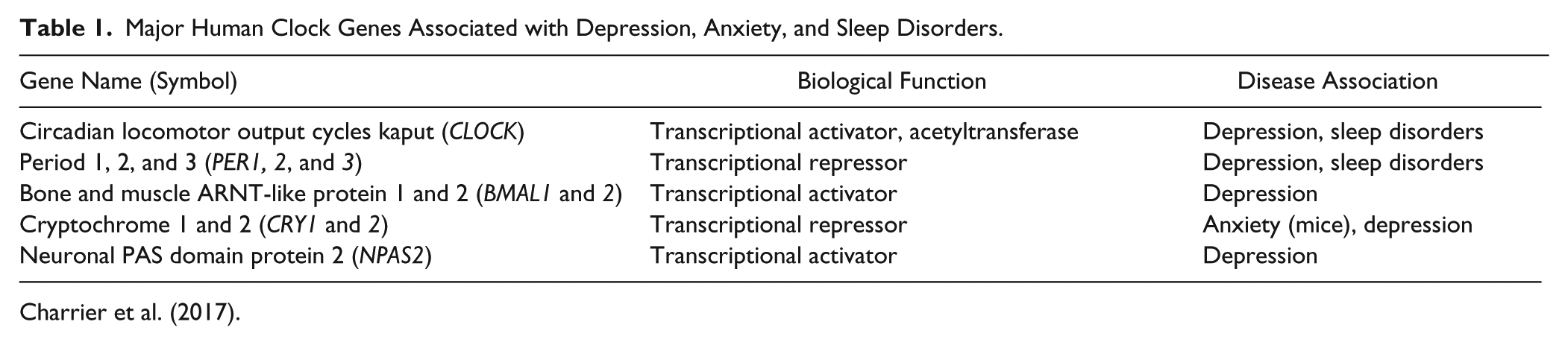
Circadian clock dysfunction is an emerging area of research that may underpin many BMS disease manifestations (Lopez-Jornet, Molino Pagan, et al. 2015). Numerous studies revealed that the circadian rhythm is controlled by complex transcriptional networks and posttranscriptional regulatory mechanisms that have profound effects in health and disease (Albrecht 2017). Specifically, proteins encoded by clock genes are critical in establishing and maintaining chronobiology (Fig. 1). Clock genes are implicated in numerous human pathoses, including mood and sleep disorders (Albrecht 2017; Charrier et al. 2017) (Table 1). Of particular relevance to BMS, pain perception, depression and anxiety, and sleep disorders are inextricably linked with circadian disturbances (Bortolato et al. 2016; Anyan et al. 2017). Moreover, the HPA axis is regulated by circadian outputs (Kalsbeek et al. 2012), and dopamine is the primary modulator of the circadian rhythm in the central nervous system (Korshunov et al. 2017). The HPA axis and dopamine levels may both be altered in BMS (Hagelberg et al. 2003; das Neves de Araujo Lima et al. 2016). It is intriguing to speculate that pathologic alterations in circadian rhythm oscillations underlie the anxiety, depression, sleep disturbances, HPA axis dysfunction, and chronic pain experienced by patients who have BMS. Figure 2 provides a summary of these interactions. Taken together, these data suggest that the continued identification of regulatory mechanisms that control the circadian rhythm will likely lead to discovery of novel disease-related networks among patients with BMS and other chronic pain disorders, which will carry diagnostic and therapeutic significance (Gilron and Ghasemlou 2014).

Major human clock genes control the circadian rhythm through complex protein-protein interactions. The circadian clock is controlled by numerous autoregulatory feedback loops. Circadian locomotor output cycles kaput (CLOCK; referred to as NPAS2 in neuronal tissue) and brain and muscle ARNT-like protein 1 (BMAL1) serve as transcriptional activators that promote the expression of cryptochrome 1 (CRY) and period (PER) genes. PER and CRY proteins are negative regulators of BMAL1/CLOCK and BMAL1/NPAS2 heterodimers, respectively. PER also plays a role in the regulation of dopamine synthesis.
Major Human Clock Genes Associated with Depression, Anxiety, and Sleep Disorders.
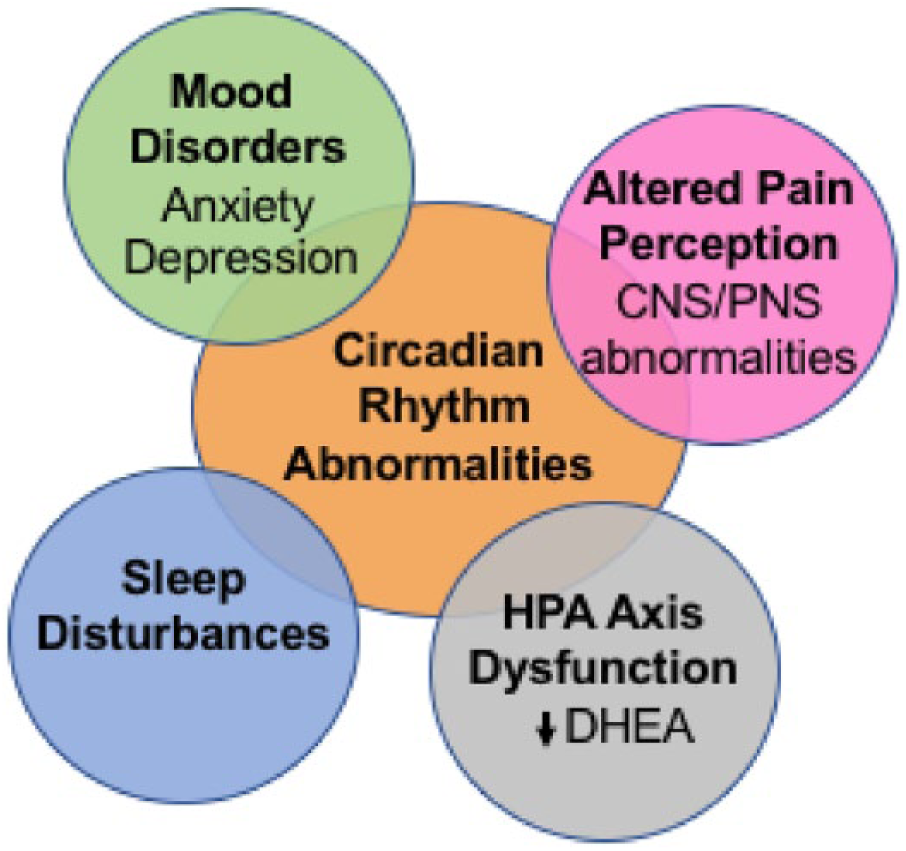
Emerging evidence for circadian rhythm dysfunction in the etiopathogenesis of burning mouth syndrome. Pathologic alterations in circadian rhythm oscillations may underlie the elevated pain perception, depression and anxiety, sleep disorders, and hypothalamic-pituitary-adrenal (HPA) axis dysfunction that are described for patients with burning mouth syndrome. CNS, central nervous system; DHEA, dehydroepiandrosterone; PNS, peripheral nervous system.
Management
The first step in treating patients who present with stomatodynia is to determine if the symptoms are associated with systemic conditions or local factors or if the cause is idiopathic. Local factors encompass parafunctional habits, candidiasis, geographic tongue, and xerostomia, while systemic conditions include esophageal reflux, diabetes, and nutritional deficiencies. If the source of oral discomfort is determined, then the patient does not fulfill the diagnostic criteria for BMS (Spanemberg et al. 2012). However, if no underlying cause of the burning is identified, the patient should receive a diagnosis of BMS.
It is important to note that there is a need for continued work to determine the optimal treatment modalities for BMS, as a recent Cochrane database systematic review of studies published between 1995 and 2015 found that evidence is lacking with regard to specific treatment recommendations for this condition (McMillan et al. 2016; Fischoff and Spivakovsky 2017). Thus, placebo-controlled, double-blinded studies with long-term follow-up will be instrumental in establishing evidenced-based therapies (Kisely et al. 2016). Current treatment approaches can be separated into 3 categories: topical therapies, systemic treatments, and behavioral strategies (Klasser et al. 2016; for advantages and disadvantages of local and systemic therapies, see Table 2). An overview of each is provided, with emphasis placed on recent advances and the need for continued research.
Local and Systemic Therapies for Burning Mouth Syndrome.

Miziara et al. (2015), Kisely et al. (2016), McMillan et al. (2016), Al-Maweri et al. (2017), Liu et al. (2017).
Topical Therapies
Clonazepam
A recent meta-analysis revealed that clonazepam—a benzodiazepine that agonizes the GABA receptor (gamma-aminobutyric acid)—effectively reduces symptoms associated with BMS (Cui et al. 2016). Importantly, topical clonazepam was found to be an effective treatment modality at short-term (<10 wk) and long-term (>10 wk) intervals (Cui et al. 2016). Side effects of this treatment included xerostomia, lethargy, and fatigue. It is important to inform patients that clonazepam can cause dependence, as symptoms may return when the medication is discontinued (Cui et al. 2016). Nonetheless, topical clonazepam may be a good option for the management of BMS, particularly for individuals who are unwilling or unable to take systemic medications.
Capsaicin
Capsaicin (Capsicum frutescens) is an analgesic that acts on the sensory afferent neurons to control neuropathic pain (Spanemberg et al. 2012). It binds to TRPV1, thereby inactivating neuronal responses to heat (Kisely et al. 2016). Prolonged exposure to capsaicin depletes TRPV1, leading to desensitization of pain receptors (Kisely et al. 2016). Of note, TRPVI is implicated in the pathogenesis of BMS (vide supra). Three studies examining the efficacy of capsaicin revealed significant improvement in burning symptoms when compared with placebo (Kisely et al. 2016). Adverse effects of this therapy include an increased burning sensation immediately after application of topical formulations and dyspepsia, especially if the capsaicin is ingested as a capsule (Liu et al. 2017). This should be taken into account when capsaicin is prescribed, particularly for patients with a history of gastric-related disorders. However, capsaicin therapy may provide significant relief from oral burning when administered to a carefully selected patient cohort.
Laser Therapy
Low-level laser therapy (LLLT) is associated with analgesic, anti-inflammatory, and biostimulatory properties. This treatment reduces burning sensation by increasing the synthesis and release of serotonins and β-endorphins and decreasing bradykinin secretion. Moreover, LLLT blocks the depolarization of C-fibers, which transmit heat and pain stimuli (Al-Maweri et al. 2017). A systematic review of 10 studies evaluating LLLT among patients with BMS indicated that laser therapy is efficacious in reducing stomatodynia. However, many variations in laser use parameters were reported, so further work is needed to develop standardized treatment recommendations (Al-Maweri et al. 2017).
Systemic Therapies
Clonazepam
There is evidence to suggest that systemic clonazepam results in significant improvement in pain among patients who have BMS (Miziara et al. 2015; Cui et al. 2016; Kisely et al. 2016; Fenelon et al. 2017). A study of 100 patients found that systemic clonazepam was most effective for patients with normal salivary production, those who reported the greatest severity of symptoms at initial presentation, and those who did not use psychotropic medications (Ko et al. 2012). While this therapy appears to be effective for pain management, preliminary data indicate that mood, taste dysfunction, and xerostomia were not improved by systemic clonazepam (Heckmann et al. 2012). Nonetheless, this drug may be a good short-term therapeutic option for those with BMS. It is important to note that the use of systemic clonazepam long-term has yet to be evaluated in depth, and further studies are required to evaluate its safety and effectiveness in this context (Kisely et al. 2016).
Alpha Lipoic Acid
Alpha lipoic acid (ALA) is a mitochondrial coenzyme with antioxidant and neuroprotective properties that may stimulate the production of neural growth factors (Kisely et al. 2016). However, the therapeutic benefits of ALA for BMS are unclear. While unblinded and single-blinded studies consistently reported significant improvements in pain intensity with the use of systemic ALA, only 2 of 5 double-blinded studies showed a difference in mean pain scores when ALA was compared with a placebo (Kisely et al. 2016; Liu et al. 2017). One study indicated that headaches and gastric upset were the most frequently reported side effects of ALA therapy, although these differences were not significant when compared with placebo (Liu et al. 2017). While ALA shows promise for the treatment of BMS, more studies are warranted to establish its effectiveness for this condition.
Gabapentin
Gabapentin is an anticonvulsant medication that acts as an agonist of the inhibitory neurotransmitter GABA. In a crossover placebo-controlled trial, patients with BMS were administered gabapentin, ALA, or a combination thereof. Fifty percent of the subjects in the gabapentin group reported improvements in pain scores, as opposed to 15% in the placebo group (Liu et al. 2017). Interestingly, when gabapentin was administered in conjunction with ALA, 70% of patients had diminished pain (Liu et al. 2017). Although further studies with gabapentin are needed, this therapeutic is thought to be particularly promising, as it is effective for treatment of related conditions, such as glossopharyngeal neuralgia and general neuropathic pain (Liu et al. 2017).
Amitriptyline
Amitriptyline is a tricyclic antidepressant with analgesic properties. A recent retrospective study compared the effectiveness of amitriptyline and clonazepam in reducing oral pain. Patients were assessed at 6 wk and 3 mo following treatment. Both patient groups reported diminished pain at each time point, and there were no significant differences between the groups (Fenelon et al. 2017). Patients in both treatment arms experienced asthenia as an adverse effect, and those taking amitriptyline also reported dry mouth (Fenelon et al. 2017). The results of this study suggest that amitriptyline may be an effective treatment for pain associated with BMS, although care should be taken in prescribing drugs that may cause dry mouth in this patient population, as such therapies may contribute to oral discomfort when given long-term.
Emerging Therapeutic Approaches
Several other potential treatments for BMS are documented in the literature, although many of these are single reports and so it is important to evaluate these drugs in larger patient cohorts. Recent work suggests that topical bupivacaine may be an effective topical anesthetic when used to relieve the symptoms of BMS (Treldal et al. 2016). In addition, paroxetine showed promise in an escalating dose study conducted over 12 wk (Miziara et al. 2015). Furthermore, preliminary work suggests that melatonin may improve anxiety among patients with BMS, although the clinical significance of this finding is unclear (Varoni et al. 2018). One study examined an herbal supplement from Brazil, catuama. Catuama is an herbal product that combines 4 medicinal plants: Paullinia cupana (guarana), Trichilia catigua (catuaba), Zingiber officinale (ginger), and Ptychopetalum olacoides (muira puama). The combination of these plants demonstrates antinociceptive, antidepressant, and vasorelaxant properties. This study reported that catuama reduced symptoms in the BMS group as compared with controls (Miziara et al. 2015). Given the promising nature of these preliminary studies, further research is warranted to determine whether these approaches are well tolerated and efficacious over time in patients with BMS.
Behavioral Strategies
Cognitive behavioral therapy (CBT) is a psychological treatment used to manage depression and anxiety as well as physical symptoms (Matsuoka et al. 2017). Specific techniques include biofeedback, relaxation, exposure, and cognitive restructuring. Relaxation and cognitive restructuring are relevant to the management of BMS. As the name implies, relaxation techniques include progressive muscle relaxation and focused breathing to alleviate discomfort, while cognitive restructuring seeks to identify and modify destructive thoughts related to emotional and behavioral problems (Matsuoka et al. 2017). In the context of BMS, targeting of pain catastrophizing is particularly important. Pain catastrophizing is defined as a heightened negative cognitive-affective orientation toward pain, and it is among the most robust physiologic predictors of pain outcomes (Schutze et al. 2017). CBT requires several sessions that focus on patient education, distraction, evaluation of harmful automatic thoughts, and replacement of those thoughts with those that are more beneficial (Matsuoka et al. 2017).
Given the chronic nature of BMS, several studies demonstrated that CBT is effective in the management of patients with this condition. Twelve to 15 sessions of CBT reduced the pain severity and discomfort of such patients, and the maintenance of improved symptoms was observed for 6 mo following this therapy (Bergdahl et al. 1995). Specifically, treatments that emphasize reducing dysfunctional cognitive factors, including pain catastrophizing, are especially effective in alleviating the symptoms associated with BMS (Matsuoka et al. 2017). Additional work suggests that cognitive therapy in combination with ALA may be more effective than either approach alone, although further studies are necessary to determine the specific combinations that are optimal for the management of BMS (Miziara et al. 2015).
Future Directions
BMS is a debilitating chronic pain condition with oral and systemic disease manifestations that significantly diminish the quality of life of those who are afflicted. Given the paucity of mechanistic studies regarding the etiopathogenesis of BMS and the low quality of evidence for short- and long-term treatment outcomes for the disease (McMillan et al. 2016), continued work is imperative to elucidate the causes of BMS and to establish evidence-based treatment recommendations.
Author Contributions
A. Ritchie, contributed to data analysis and interpretation, drafted and critically revised the manuscript; J.M. Kramer, contributed to conception, design, data analysis, and interpretation, drafted and critically revised the manuscript. Both authors gave final approval and agree to be accountable for all aspects of the work.
Footnotes
The authors received no financial support and declare no potential conflicts of interest with respect to the authorship and/or publication of this article.