







Abstract
The goal of this qualitative research was to achieve a deeper psychological understanding of professional hospital clown work with hospitalized children during their end-of-life care period. Using a statistical text analysis with a co-occurrence strategy we showed several narrative categories from a clown’s perspective: “Tragic metamorphosis,” “Meditating on the mystery,” “An ultimate poetic atmosphere,” “Interconnectedness and interrelatedness of all things,” “An emotional catalyst,” “The deep need to say goodbye,” “Ethical guidance values.” We will interpret the narratives categories according to humanistic/existential framework as the theoretical base. The clown addresses those aspects of healing that are not well developed in modern Western medicine, the treatment of the whole person. The clown embraces human nature as physical, emotional, cognitive, and spiritual.
Keywords
Children of all countries are faced with life-threatening conditions. More children are living longer with life-limiting illnesses which often necessitate palliative care as part of their overall treatment (Martin, Kochanek, Strobino, Guyer, & MacDorman, 2005; Williams-Reade, 2013). The children’s most mentioned negative emotions were sadness, difficulty in talking to their parents about their feelings regarding illness and death, and fear of being alone (Theunissen et al., 2007). In addition to the illness itself, the children were also stressed by the separation from their parents, the strange environment, the fear of painful treatments, and/or the uncertainty of the treatment outcome (Rennick & Rashotte, 2009; Wilson, Megel, Enenbach, & Carlson, 2010).
In a palliative care perspective (Belasco, Danz, Drill, Schmid, & Burkey, 2000; Billings, 1998), hospital clowns, also known as clown doctors (Spitzer, 2006) help pediatric patients and their parents with the stressors and to circumvent the accompanying feelings of fear, helplessness and sadness, thus, supporting the healing process (Anes & Obi, 2014; Barkmann, Siem, Wessolowski, & Schulte-Markwort, 2013; Koller & Gryski, 2008; Linge, 2007, 2011, 2012, 2013; Spitzer, 2006; Tan, Hannula, & Metsälä, 2014).
Patch Adams, as a young doctor in the 1970s, began clowning for hospital patients in Virginia, USA. Big Apple Circus established the Clown Care Unit in New York City in 1987 as the first structured hospital clown program (Spitzer, 2006), with frequent and regular visits to host hospitals. Today, there are now many hospital clowning program around the world (Spitzer, 2006). Clowns meet their partner in a designated “dressing room” space. Next, begins the transformation into character: “The silly clothes, the oversized shoes, the white coat with too many pockets, the outrageous props and musical instruments are all checked” (Spitzer, 2016, p. 34). Hospital clowns are professional performers. They come from a variety of backgrounds—clowning, acting, physical theatre, mime, music, and close-up magic (Linge, 2011, 2012, 2013; Tan et al., 2014; Van Blerkom, 1995). In an exploratory study, Dionigi (2016) highlighted specific differences between clown doctors and the general population: Clown doctors showed higher agreeableness, conscientiousness, openness, and extraversion, as well as lower neuroticism compared with other people. Generally, benefits of clown care include creating a positive emotional state (joy, happiness, laughter, amusement and a sense of meaningfulness), promoting interaction between the parents and the child, and fostering affirmative environmental conditions (Anes & Obi, 2014; Linge, 2007, 2011, 2012, 2013; Spitzer, 2006; Tan et al., 2014). Generally it is known that hospital clowns’ activities included entertaining and comforting parents of children in intensive care units, and distracting AIDS or cancer patients during medical treatment (Linge, 2011, 2012, 2013; Tan et al., 2014; Van Blerkom, 1995), but little is known about the specific clowning attitudes in the palliative stage (e.g., in a child’s advanced cancer treatment), especially in a child’s the end-of-life care period.
Aims of This Study
The goal of this qualitative research is to achieve a deeper psychological understanding of hospital clowns’ work with the hospitalized children in the end-of-life care period, seen from a clown perspective. The more concrete question of the study is: How do the professional hospital clowns experience the relationship with the hospitalized children with advanced cancer and even in the last moments of a child’s life.
We argue that professional hospital clowns’ work in palliative care, especially in the end-of-life care period can mobilize spiritual processes such as the meaning of life, connectedness to humanity, harmony with universe, and a sense of the transcendence (Breitbart, 2002; Bryson, 2004; Byrne, 2002; Carroll, 2001; Dyson, Cobb, & Forman, 1997; Frankl, 1959; Taylor & Ferszt, 1990).
Method
Research Design
The present study utilizes a methodology focusing on the individual’s lived experiences and inspired by phenomenology and a narrative approach (Giorgi, 2009; Husserl, 1977; Mead, Morris, & Mead, 1934/2000; Neimeyer, 2006; J. A. Smith, Flowers, & Larkin, 2009).
This interview model (see the details and questions in the “Data Collection” section), was inspired by a Rogerian nondirectivity approach (Rogers, 1951). It was used to make a connection with the clown phenomenological world. The style of the interview is inspired by the Rogerian psychotherapeutic principles: empathy, congruence, nondirectivity, positive unconditional regard that empower and motivate the client in the therapeutic process (Rogers, 1951, 1961, 1975).
Our descriptive level is based on an automated semantic analysis (bottom-up method), using a text analysis software T-LAB Version 9.1.3 (Lancia, 2004, 2007). Bottom-up methods pursue the aim of mapping the meaning of the text, without a predefined coding system. The development of bottom-up procedures of semantic analysis are based on explicit, invariant rules of coding. Procedures of this kind would represent a highly significant contribution to the growth of qualitative process research. On the one hand, they would allow the automated implementation of the semantic analyses, and they would provide a shared ground supporting and constraining the nonrenounceable human inferential judgments, so increasing the intercoder agreement as well as the comparability among textual analysis (Salvatore, Gennaro, Auletta, Tonti, & Nitti, 2012). In choosing T-LAB version 9.1.3 (Lancia, 2004, 2007) text analysis software, two advantages were key: the multitude of instruments offered for text analysis and the possibility to use them in an integrated way (i.e., for examples, word association, thematic analysis, co-occurrence analysis, comparative analysis), and the possibility of analyzing a very large text. Finally, we will interpret the findings (the narratives) in a humanistic/existential framework as the theoretical base.
The text analysis software T-LAB has been used in a lot of recent articles: social science and medicine (see a complete bibliography on https://tlab.it/en/bibliography.php). In the field of palliative care, the software has been used in recent qualitative research (Caputo, 2015) to explore the main themes relating to euthanasia (moral values, professional ethics, end-of-life care, patient’s right to health care) as provided by psychology-related research. Saita, Molgora, and Acquati (2014), using T-LAB, presented the Cancer Dyads Group Intervention and preliminary findings about its effectiveness: a correspondence analysis of the verbatim transcripts of the first three groups was conducted. The findings highlight the evolution of the participants during the intervention and confirm the congruence between goals and the participants’ experience. Santarpia, Ricci, Meuche, Gamberini, and Destandau (2018), using T-LAB in a qualitative study, presented the narrative effects of detailed shamanic sessions (the use of the drum, telling and interpreting visions according to the shamanic mythology) in the context of psycho-oncological treatment. In particular, the narrative positions of a patient (Mrs. AA) are described as they occurred before and after shamanistic sessions. The authors suggested that these sessions enabled Mrs. AA to produce a larger and more singular narrative about her end-of-life experience: from the beginning narrative position of feeling “the acute consciousness of the finitude” to an emergent narrative position based on “the perception of an interdependence/interconnexion in all relation (human and spiritual world).”
Participants
In line with J. A. Smith et al. (2009) recommendation for homogeneous and purposeful sampling, professional clowns were invited to participate in the study if they went through a palliative experience with hospitalized children in which there were end-of-life moments. Our criterion, following Linge’s (2011, 2012, 2013) research in order to identify the category “Children” was 0 to 18 years. They were being treated and cared for on these wards during stays of various lengths.
Professional Hospital Clowns
We interviewed four professional clowns, two women and two men (mean age = 48.5 years, SD = 11.5): Clown A (women, 68 years old), Clown B (women, 39 years old), Clown C (man, 46 years old), and Clown D (man, 41 years old). All of them work for a famous French company founded in 1991. It was the first clown-doctor company in Europe with hospital clowning programs. All of them have more than 4 years of professional experience in palliative care. As shown in the literature (Linge, 2011, 2012, 2013; Tan et al., 2014; Van Blerkom, 1995), they come from a variety of backgrounds—clowning, acting, physical theatre, circus, mime, music, and close-up magic.
Data Collection
An interviewing guide was prepared: three main questions for the professional clowns related to the relevance and credibility of having hospital clowns, framing the areas to be explored. The interviews were conducted by a trainee clinical psychologist (under professional supervision), using nondirectivity approach (Rogers, 1951), who carefully observed the phenomenological and lived experiences of clowns. She explored three main questions with the professional clowns. The interview approach was rooted in three key questions that were expanded upon using common nondirective interviewing techniques.
Can you describe your thoughts and feelings in palliative care?
Can you tell me some stories with the children and their family in their last day of life?
Can you tell me about some of the strategies you used to manage these moments of the existence?
Procedure
All the six interviews were conducted at the interviewees’ workplaces (coffee rooms, conference rooms, or staff rooms) or using a video–audio internet tool (Skype). The interviews lasted between 45 and 60 minutes. The interviews started with a review of the aims and questions. Following this was a short description of the ethical principles. The interviews were audio-recorded and later transcribed in their entirety. Professional hospital clowns signed a “consent to participate” form which specified that they could leave the study at any time and that all personal information about them would be kept strictly confidential, according to University Ethics Committee.
Data Analysis
The Descriptive Level
The interviews and sessions were recorded on a dictaphone and then transcribed accurately in a document. In the document (.txt type), we arranged the four clowns’ interviews into four variables (using a specific writing 1 ). This document was analyzed with the aid of the software T-LAB Version 9.1.3, a linguistic and statistical tool for text analysis, developed by Franco Lancia (2004, 2007). T-LAB tool allowed us to pick out co-occurrence and similarity relationships within any corpus or its subset (for example, in this study, the four clowns’ interviews). This strategy determined a potential local meaning based on associationist theories of thought (Chalmers, 1993; James, 1890; Locke, 1690/1975). Word co-occurrences are computed within the elementary contexts 2 (sentences or paragraphs). Each time the selection of associated words is carried out by the computation of an “Association Index” (Cosine, Dice, Jaccard) and their computation is quite fast. Moreover, the user had to take into account that the greater the number of words included in his or her list, the more reliable the similarity values become.
In our analysis, we organized a target conceptual category of
The Theoretical Level
The theoretical interpretation of the results was the next stage in the analytical work. The theoretical construct is based on the humanistic/existential approach (Angus, Watson, Elliott, Schneider, & Timulak, 2015; Maslow, 1943; Rogers, 1951; Santarpia, 2016). We offer the following working definition of the humanistic/existential approach for the purposes of the present article: “Humanism is concerned with such existential themes as meaning, mortality, freedom, limitation, values, creativity, and spirituality as these arise in personal, interpersonal, social, and cultural contexts” (Schneider & Längle, 2012, p. 428). In the 20th-century several clinicians and scientists (Frankl, 1959; Maslow, 1943, 1967; Yalom, 1980) in humanistic/existential framework (Bugental, 1964), described the ways in which critical life crises offered possibilities for positive personal change. More recent calls for an emphasis on positive psychology (Seligman & Csíkszentmihályi, 2000) represent a continuation of this tradition.
Results
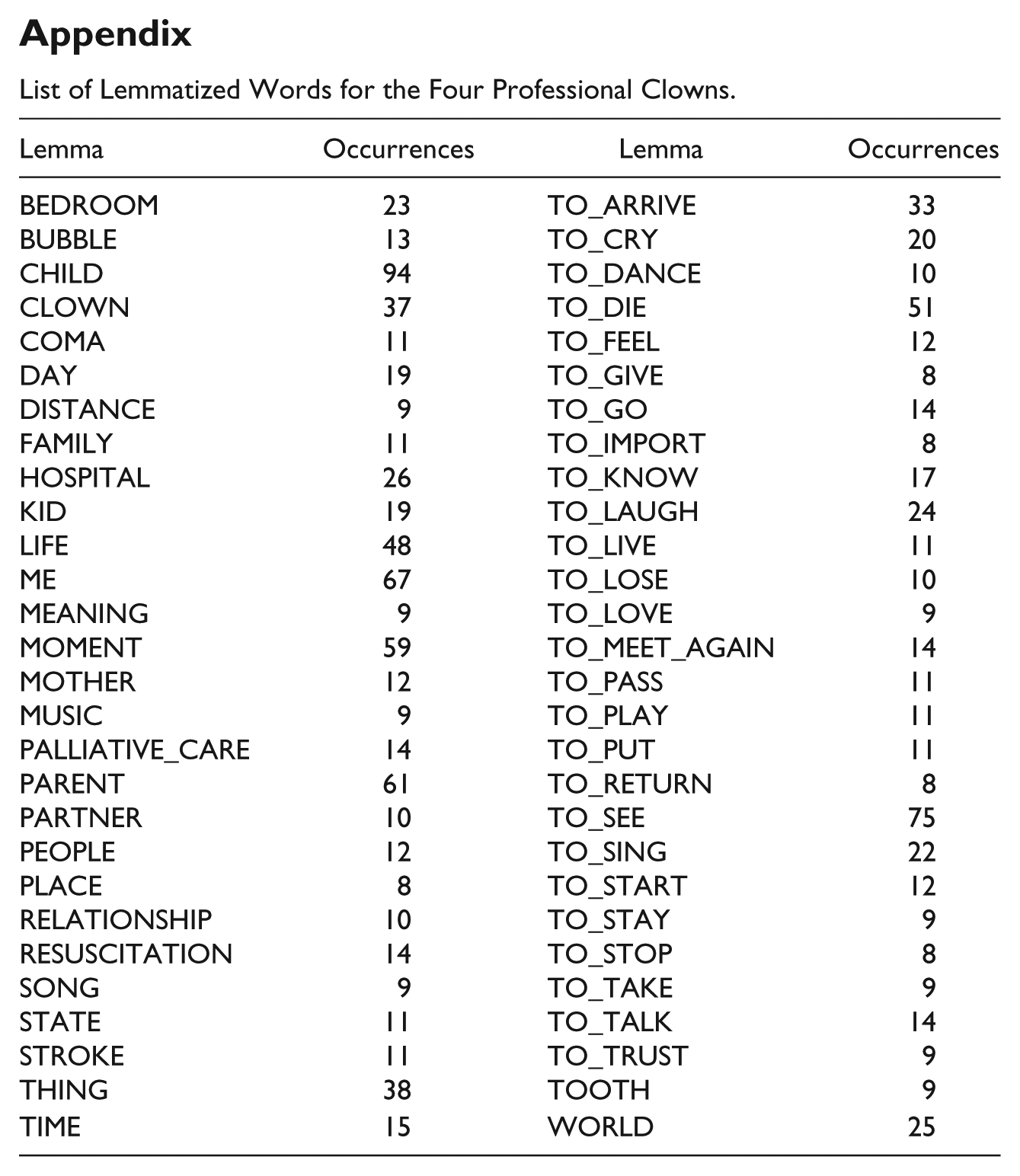
As proposed in the research design, first, we presented a descriptive level (using T-Lab software) in which we showed the narrative of the clowns, and then second, we analyzed (using a narrative and humanistic theoretical approach) the narrative of each participant. The examined corpus (Figure 1) for four professional clowns was made up of 1,428 transcripted words, 10,317 occurrences, 1,306 lemmatized words, and the number of hapax 6 was 770. The list of lemmatized words was based specifically on the palliative care experience of the four professional clowns (see the list in the appendix, ≥8 occurrences).
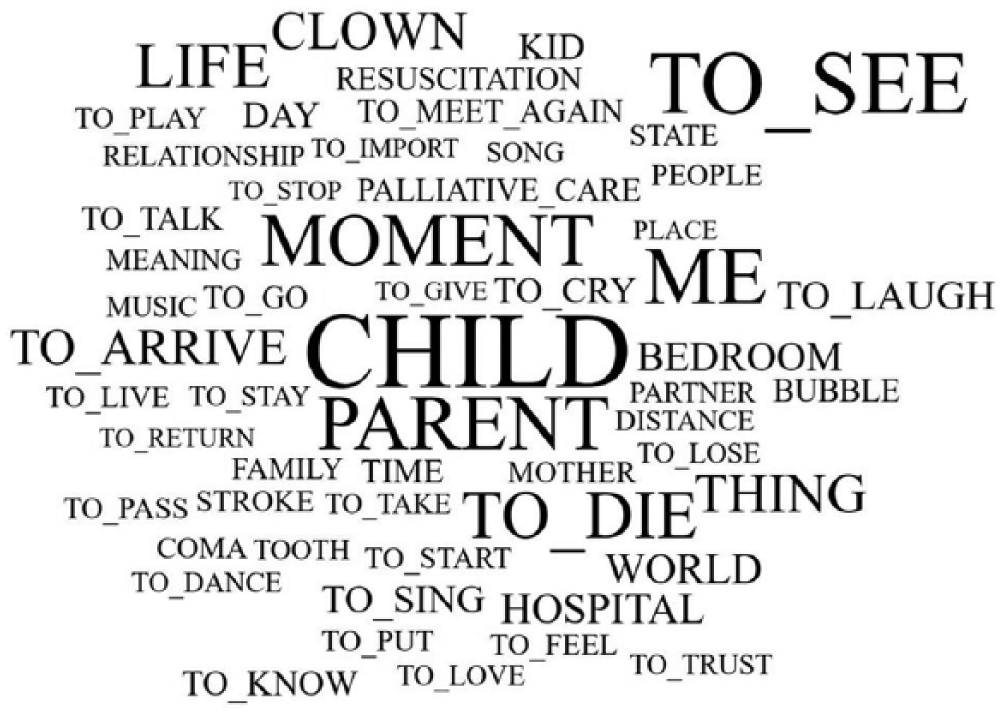
Graph of words cloud for the professional clowns’ narrative.
In graph of words cloud (Figure 1) the lemmatized word CHILD has the greatest number of occurrences (94). This shows that the narrative of the participants was centered on the life of the deceased child.
Understanding the Work of Hospital Clowns in the Palliative Care
Concerning the conceptual category
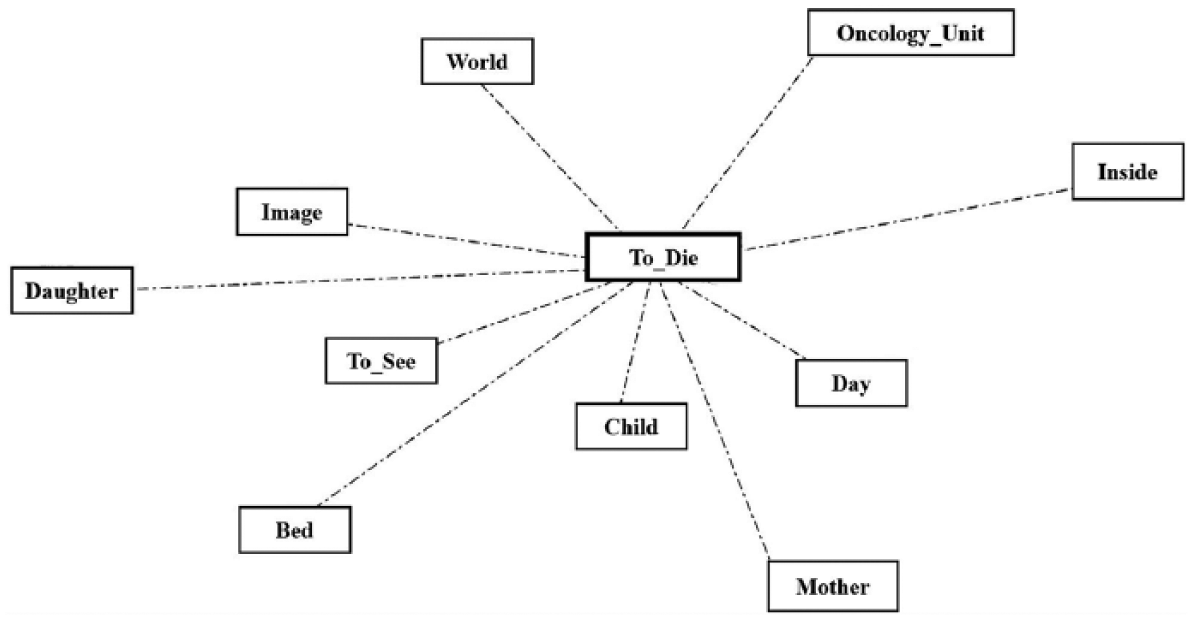
Clowns’ narrative.
Tragic Metamorphosis
From the clown perspective these word-associations (see repeated characters that have a bold font style in our narrative examples) conjure up a tragic and rapid metamorphosis of the child’s body that is articulated through several moments of the narrative: It was really at the beginning of my practice. There was a small
These word-associations, linked to several adverbs of time (later, after), evoked a narrative concerning the acute consciousness of the finitude.
Meditating on the Mystery
Spirituality is much broader than religion (Mueller, Plevak, & Rummans, 2001; Taylor & Ferszt, 1990), as it concerns harmony with all the forces of universe (Carroll, 2001). Following these spiritual horizons, the next narrative concerning the last days of a girl’s life is based on “Meditating on the mystery”: There is another story that came to me, it was a little girl who was in intensive palliative care in an
An Ultimate Poetic Atmosphere
Williams (1985) uses the word “poetry” in a very broad sense. Poetry represents the world of creativity and imagination; in other words, the fruit of our human desire to discover meaning in the world and in our lives. We do this in many ways: through music, painting, drama, and other arts, as well as through the gifts of spirituality and reflective living (Coulehan & Clary, 2005; Williams, 1985). Following this definition of “poetry,” we use the adjective “poetic.” We described these emotional encounters created by the clown, with the dying child and his parents, as “an ultimate poetic atmosphere”: I always remember a room where the parents were waiting in the elevator. We arrived in plain clothes and the
This “poetic atmosphere” can evoke a form of flow experience (Csikszentmihalyi, 1990). “Flow” is the mental state of operation in which a person performing an activity is fully immersed in a feeling of energized focus, full involvement, and enjoyment in the process of the activity. In essence, flow is characterized by complete absorption in what one does, and a resulting loss in one’s sense of space and time (Csíkszentmihályi, 1996; Nakamura & Csíkszentmihályi, 2012). In fact, in the next narration the clown describes this particular time experience: At the end of the And when I talk about life, I talk about a heart that beats. A I talk a lot about resuscitation because I am referring doctor/clown, I perform a lot in resuscitation, in
Interconnectedness and Interrelatedness of All Things
In the next narrative Clown D recalled a form of narrative, very similar to a shamanic consciousness (Meuche, 2015), recognizing the nondual nature of the universe and seeing the “interconnectedness and interrelatedness of all things”: I
An Emotional Catalyst
Emotion regulation refers to the processes by which we influence which emotions we have, when we have them, and how we experience and express them (Gross, 1998). Clowns have a tendency to approach people, places, or things so as to regulate to emotion. They express, experience, provoke primary emotions (Gross, 2007) through strange objects. They can express immediate empathy with a mother who finds the strength to cry. The professional clowns can be seen as “an emotional catalyst”: I remember once in an I work in an
The Deep Need to Say Goodbye
The clowns can go beyond a professional relationship in palliative care. They can feel the need to attend the child’s funeral as sign of their strong and intense relationship. In the next narrative, we collected a narrative from a clown’s perspective concerning “the deep need to say goodbye” to the child: I remember a
In the next narratives, “the deep need to say goodbye” is associated with a strong relationship with the child’s family. The clown becomes an emotional and social support for the parents: There’s something to be aware of concerning a child’s end of life in the I remember a small
Ethical Guidance Values
In the next narratives, Clown D described two “ethical guidance values”: solemnity and authenticity (Rogers, 1951, 1977): I confess that I have never witnessed a really near As I said, I haven’t never seen the exact moment of the
Discussion
The death of a child defies the expected order of life events: We can feel cast into a world that is absurd, alien, unimaginable, uninhabitable (Neimeyer, 2011; Wheeler, 2001). In the humanistic/existential theoretical approach (Angus, Watson, Elliott, Schneider, & Timulak, 2015; Frankl, 2004; Kierkegaard, 1941; Maslow, 1943; May, 1969; Rogers, 1951; Santarpia, 2016; Yalom, 1980, 2009), these tragic existential assumptions evoke “the meaninglessness” or “the absurd.” It refers to the conflict between the human tendency to seek inherent value and meaning in life (Frankl, 1959) and the human inability to find any. In this context “absurd” does not mean “logically impossible,” but rather “humanly impossible” (Kierkegaard, 1843/1985). As noted by Irvin Yalom (1980) “meaninglessness” is a crucial experience of the four ultimate concerns (the inevitability of death, freedom and its attendant responsibility, existential isolation, and finally, meaninglessness). Frankl (1959) insisted that meaning can be found in all circumstances, even in the most miserable experiences of loss and tragedy. In fact, this article addressed the loss of a child, considered as a devastating, absurd and meaningless human tragedy. In this study, we wanted to explore how professional hospital clowns experience this painful event with the hospitalized children even in the last moments before a child’s death. We argued that professional hospital clowns’ work in palliative care could mobilize spiritual values such as “meaning of life,” “connectedness to humanity,” “harmony with universe,” and “a sense of the transcendence” (Breitbart, 2002; Bryson, 2004; Byrne, 2002; Carroll, 2001; Dyson et al., 1997; Frankl, 1959; Taylor & Ferszt, 1990).
In our findings, we showed four narrative categories from a clown’s perspective (Meditating on the mystery, An ultimate poetic atmosphere, Interconnectedness and interrelatedness of all things) that can evoke spiritual values such as harmony with the universe and a sense of transcendence (Breitbart, 2002; Bryson, 2004; Byrne, 2002; Carroll, 2001; Dyson et al., 1997; Frankl, 1959; Taylor & Ferszt, 1990). Several pieces of research (Charles, 1945; Van Blerkom, 1995; Willeford, 1969) have compared professional clowns to shamans. They can connect to the rational as well as the magic events of the universe. For example, shamanic consciousness recognizes the nondual nature of the universe and sees the “interconnectedness and interrelatedness of all things” (Meuche, 2015, p. 4).
Concerning connectedness to humanity, we found four narrative categories related to the clowns’ attitudes (Tragic metamorphosis, An emotional catalyst, The deep need to say goodbye, Ethical guidance values). Finally, following the narrations gathered, the professional hospital clowns seemed to affirm:
(a) A poetic presence (a combination of imaginative and creative verbal and nonverbal communication) as response to the absurdity of dying of the child. In this perspective, Linge (2012) identified a magical attachment between the child and the hospital clowns, stating that this attachment: constituted a temporary relationship, gave anonymity, entailed role reversal, and created an emotional experience of boundary-transcending opportunities. This magical attachment touched the humanity of the clown deeply and his sense of empathy
(b) A presence evoking the flow experience (Csíkszentmihályi, 1990), characterized by the complete absorption in what one does, and a resulting loss in one’s sense of space and time (Csíkszentmihályi, 1996; Nakamura & Csíkszentmihályi, 2012) with imaginative and surrealist actions
(c) A spiritual positioning based on the harmony with the universe and a sense of transcendence. Van Blerkom (1995) compared professional clowns to shamans. Both clowns and shamans mediate between order and chaos, the sacred and the profane, real and supernatural, culture and anticulture, or nature (Charles, 1945; Van Blerkom, 1995; Willeford, 1969)
(d) A deep connection with humanity based on emotional consciousness (Lane, Quinlan, Schwartz, Walker, & Zeitlin, 1990), emotional empathy and ethical guidance values such as solemnity and authenticity (Rogers, 1951, 1977). In the humanistic approach (American Humanistic Association, 2003; Bugental, 1964; Mann, 1996; Santarpia, 2016; Schneider & Längle, 2012) moral values are properly founded on human nature and experience alone. Human life is based on guiding principles, not dogmatic rules
(e) An existential dimension according to the four ultimate concerns: the inevitability of death, freedom and its responsibility, existential isolation, and finally, meaninglessness (Yalom, 1980). Working with children and witnessing their death would of course activate the clowns’ own existential concerns pertaining to their own mortality and fears of death. Similar concerns about freedom and isolation are salient as well for these individuals
Conclusion and Limitations
The clown, like the shaman (Charles, 1945; Van Blerkom, 1995; Willeford, 1969), addresses those aspects of healing that are not well developed in modern Western medicine, the treatment of the whole person. The clown embraces human nature as physical, emotional, cognitive, and spiritual. In this perspective, the hospital clowns could help the patient and family provide meaning to the experience of illness, even in the end-of-life period in pediatric palliative care. Future research will be crucial in understanding if hospital clowning can bring a positive contribution in reconstructing meaning, helping the parents to address this potential crisis of meaning in the context of bereavement.
A potential limitation regards the methodology, as our automated semantic analysis (bottom-up method) can provide a shared ground supporting for the researchers but it cannot totally cancel the nonrenounceable human inferential and affective judgments/interpretations. Another potential study limitation is interviewing a relatively small sample of clowns, all of whom were employed by the same agency. This may limit the generalizability of the findings as it is possible that clowns from other agencies and countries conceptualize their work differently. Further research could focus on the children’s experiences of the clown care: The authors touch upon that in the introduction, but any other thoughts they could offer on this would be most intriguing to readers in the future.
Footnotes
Appendix
List of Lemmatized Words for the Four Professional Clowns.
| Lemma | Occurrences | Lemma | Occurrences |
|---|---|---|---|
| BEDROOM | 23 | TO_ARRIVE | 33 |
| BUBBLE | 13 | TO_CRY | 20 |
| CHILD | 94 | TO_DANCE | 10 |
| CLOWN | 37 | TO_DIE | 51 |
| COMA | 11 | TO_FEEL | 12 |
| DAY | 19 | TO_GIVE | 8 |
| DISTANCE | 9 | TO_GO | 14 |
| FAMILY | 11 | TO_IMPORT | 8 |
| HOSPITAL | 26 | TO_KNOW | 17 |
| KID | 19 | TO_LAUGH | 24 |
| LIFE | 48 | TO_LIVE | 11 |
| ME | 67 | TO_LOSE | 10 |
| MEANING | 9 | TO_LOVE | 9 |
| MOMENT | 59 | TO_MEET_AGAIN | 14 |
| MOTHER | 12 | TO_PASS | 11 |
| MUSIC | 9 | TO_PLAY | 11 |
| PALLIATIVE_CARE | 14 | TO_PUT | 11 |
| PARENT | 61 | TO_RETURN | 8 |
| PARTNER | 10 | TO_SEE | 75 |
| PEOPLE | 12 | TO_SING | 22 |
| PLACE | 8 | TO_START | 12 |
| RELATIONSHIP | 10 | TO_STAY | 9 |
| RESUSCITATION | 14 | TO_STOP | 8 |
| SONG | 9 | TO_TAKE | 9 |
| STATE | 11 | TO_TALK | 14 |
| STROKE | 11 | TO_TRUST | 9 |
| THING | 38 | TOOTH | 9 |
| TIME | 15 | WORLD | 25 |
Acknowledgements
The authors would like to express their thanks to Tonino Anzante for commenting on, and proofreading this work. A special thanks goes to the clown doctors of the French association, “Le Rire Médecin.”
Declaration of Conflicting Interests
The author(s) declared no potential conflicts of interest with respect to the research, authorship, and/or publication of this article.
Funding
The author(s) received no financial support for the research, authorship, and/or publication of this article.
Notes
Author Biographies
 ), a company she founded in 1991. It was the first clown-doctor company in Europe. In addition, she is now training doctors and nurses at several medical institutions in France as well as assisting and supervising professional companies to develop new clown-doctor programs in hospitals.