






Abstract
Existential empathy is an emerging construct within humanistic and person-centered psychology. It refers to the therapist’s capacity to remain present with a client’s existential concerns, to resonate with these concerns, and to communicate this resonance empathically. Recently, an experiential–existential psychotherapy (EEP) training program was developed to cultivate existential empathy by enhancing therapists’ openness to existential concerns and their ability to engage with them. This qualitative study explores how therapists experience the development of their existential empathy following participation in EEP training. It also explores which elements of the training they perceive as most helpful. Ten therapists were interviewed before and after the 1-year training program using two methods: a Change Interview and an Existential Cue Interview, the latter involving a video stimulus of a client expressing her existential concerns. Findings suggest that training can enhance therapists’ existential awareness, their capacity to remain present with existential issues, and their ability to engage with these issues from a human-to-human stance. Effective training appears to require a combination of cognitive components, such as theoretical frameworks, and experiential components, including personal engagement with one’s own existential issues.
Keywords
Introduction
Empathy has been a foundational pillar in humanistic psychotherapy since Rogers (1951) identified it as one of the core conditions for therapeutic change. This emphasis is strongly supported by empirical evidence, showing empathy accounts for approximately 10% of the variance in outcome – exceeding the impact of specific therapeutic techniques (Elliott et al., 2018; Wampold, 2009). In the most recent meta-analysis, which included 82 independent samples (N = 6,138), empathy emerged as a robust and moderately strong predictor of therapy outcome (Elliott et al., 2018).
Although no universal definition exists, empathy is widely understood to include both cognitive and affective components (Cooper, 2001; Cuff et al., 2016; Elliott et al., 2018). The cognitive dimension is typically described as a perspective-taking process, wherein one attempts to imagine how it is to perceive and experience the world as the other person (Cooper, 2001; Elliott et al., 2018). In contrast, the affective process is typically referred to as an automatic emotional process, where one feels and mirrors the emotion of the other’s experience (Cooper, 2001; Elliott et al., 2018). Cooper (2001) also emphasized the importance of physical and somatic resonance in empathic understanding. He argued that contemporary cognitive-affective models often overlook the physical, somatic aspects of human experiencing, and that therapists can most fully “know” their clients by also resonating with their “lived-embodiment.” He referred to this kind of empathy as embodied empathy.
Despite the demonstrated importance of empathy, Elliott et al.’s (2018) meta-analysis revealed considerable heterogeneity in the effects of empathy, prompting calls for further research into the contexts in which empathy may be particularly beneficial or potentially less effective. In response, Vanhooren (2022a) recently proposed that empathy may hold particular value in addressing clients’ existential concerns, introducing the concept of existential empathy – a novel and emerging construct within humanistic and person-centered psychology.
Existential Empathy
Existential empathy refers to the therapist’s capacity 1 to stay present with clients’ existential concerns, emotionally resonate with this existential layer, and empathically communicate their presence and empathy to the client (Vanhooren, 2022a). Although no universal definition of existential concerns exists, many authors in existential psychology draw on Yalom’s (1980) framework of the existential givens. According to Yalom, existential concerns arise when individuals are confronted with one or more of these four ultimate conditions of existence: death, freedom/responsibility, isolation, and meaninglessness.
Bugental (1981) proposes a related set of existential concerns, including finiteness, choice, embodiedness, awareness, and separateness (later revised to “separate-but-related”; Bugental & Sterling, 1995). Greenberg et al. (2004) present a classification aligned with Yalom’s four existential givens but add identity as an additional existential theme. Although classifications differ across authors, they consistently point to a focus on ontological rather than ontic concerns. Ontic concerns refer to everyday, concrete issues (such as being unemployed), whereas ontological concerns involve fundamental aspects of being human (Holzhey-Kunz, 2014). Even within phenomenologically-oriented approaches to existential therapy, which prioritize lived-experience over pre-defined existential themes, an openness and attention remain to ontological dimensions of lived experience – such as temporality, embodiment, or finitude – because these structures shape how individuals encounter concrete life situations (Spinelli, 2015; Vanhooren, 2026). Research also confirms that working with these ontological issues is one of the characteristic practices of existential and existential-humanistic therapists (Correia et al., 2017, 2018). Since clients frequently struggle with these ontological concerns (Chavez-Baldini et al., 2024; Menzies & Menzies, 2023), it becomes essential to consider how empathy operates specifically in relation to them.
The theory of existential empathy builds on the theory of general empathy by Rogers (1951, 1980) and Barrett-Lennard (1993), posing that empathy is a process consisting of the empathic resonance of the therapist, followed by their empathic communication of this resonance, which further unfolds in the therapeutic relationship (Vanhooren, 2023; Vanhooren et al., 2022). Vanhooren (2022a) argues that distinguishing existential empathy from general empathy is essential, as engaging with existential concerns entails specific challenges that are not typically encountered when working with ontic concerns.
While the relationship between existential empathy and outcome still needs to be explored, the emerging literature (Frediani et al., 2025; Vanhooren, 2022a, 2022b, 2023; Vanhooren & Schneider, 2026; Verdegem et al., 2025) advocates that the theory of existential empathy may be useful in clinical practice. It also aligns with the recent development of formulating the specific competences that therapists must master within a curriculum of existential psychotherapy (Vos, 2021).
To help situate existential empathy, Vanhooren (2019, 2023) posits that three meaning dimensions can be distinguished in the client’s utterances (Vanhooren, 2019, 2023). The macro-dimension refers to the client’s ultimate/existential concerns and their self-transcendent ontological meanings. The meso-dimension consists of the client’s life narrative, self-concepts, beliefs, world assumptions, and other conceptual meanings. The micro-dimension refers to the client’s felt sense about the here-and-now inner and interactional experiences. Whereas general empathy focuses on micro- and meso-dimensions, existential empathy also focuses on the macro-dimension. When a therapist expresses existential empathy, they are thus attuned to this macro-dimension. They can also simultaneously attune to the micro- and meso-dimensions, but existential empathy specifically involves an openness to the client’s existential concerns. The macro-dimension is thus not synonymous with existential empathy; rather, it refers to the level of meaning being addressed.
Empirical Research on Existential Empathy
Although empirical research on existential empathy is still emerging, initial findings support its conceptual distinctiveness. In a study involving 353 Belgian therapists, Vanhooren et al. (2022) found that existential empathy, as measured by the Existential Empathy Questionnaire (EEQ), was only moderately correlated with general empathy (r = .36, p < .001). These findings provide preliminary evidence that existential empathy is a coherent construct with potential clinical relevance: therapists who score high on general empathy may not necessarily score high on existential empathy (Vanhooren, 2018; Vanhooren et al., 2022). Moreover, existential empathy significantly and uniquely predicted experiential and existential avoidance, even after controlling for general empathy, thus supporting its convergent and incremental validity (Vanhooren et al., 2022).
Recent theoretical and empirical work has also begun to explore the competencies required for existential empathy to unfold. According to Vanhooren (2022a), these competencies include the ability to tolerate uncertainty and “not-knowing,” as existential concerns often lack clear or definitive answers (Schneider & Krug, 2017). Therapists must also be sufficiently grounded (physically, emotionally, spiritually) and be able to face their own ultimate concerns to remain present with clients confronting similar issues (Vanhooren, 2022b). In addition, a basic understanding of existential processes is essential to help therapists recognize and engage with clients’ existential issues (Vanhooren, 2018).
A recent qualitative study by Frediani et al. (2025) lends empirical support to these theoretical propositions regarding uncertainty tolerance, groundedness, and knowledge about existential concerns. In this study, 22 therapists participated in role-plays with actor-clients expressing existential concerns. Some therapists – particularly those with less experience or training – reported feeling overwhelmed and uncertain. These reactions appeared to stem from discomfort with their own existential vulnerability and limited knowledge about how to engage with such concerns. In contrast, more experienced and existentially trained therapists were better able to remain present and open. Those who managed to stay engaged described using grounding techniques to reanchor themselves when confronted with the emotional weight of the topic. These findings suggest that existential empathy may not only involve emotional openness but also knowledge and specific grounding techniques to navigate the shared vulnerability inherent in engaging with existential concerns (Frediani et al., 2025).
Two additional qualitative studies (Frediani et al., 2023; Hill, 2017) further indicate that therapists can find it challenging to engage with clients’ existential concerns. These studies suggest that working with unsolvable existential issues is part of a broader learning process in therapeutic development.
Role of Training
Given the clinical relevance and conceptual distinctiveness of existential empathy, a key question arises: How can therapists be effectively trained to develop this capacity? While general empathy can be enhanced through training – with meta-analytic evidence showing moderate to large effects (Hill & Knox, 2023; Teding van Berkhout & Malouff, 2016) – little is known about how to cultivate existential empathy specifically. Although no studies have directly addressed this, Pierson et al. (2015) offer preliminary insights into the potential role of training. In their evaluation of an existential-humanistic psychotherapy training program, trainees reported increased tolerance for the unknown, greater comfort with their own vulnerability, and enhanced presence with clients – capacities that align with key elements of existential empathy (Vanhooren, 2022a).
Recently, a new model of therapy and training has been proposed that explicitly incorporates the development of existential empathy: experiential–existential psychotherapy (EEP) training (Vanhooren, 2019). EEP is a humanistic, person-centered, focusing-oriented, and existential therapy that aims to help clients grow and deepen their presence and existence in the face of their current challenges (Leijssen, 2014; Madison, 2010; Vanhooren, 2018).
The EEP training program is designed to foster the therapist’s capacity for existential empathy by increasing their openness to existential issues. It encourages trainees to explore their own existential dilemmas, develop awareness of clients’ existential concerns, and remain present with the existential layer of the therapeutic encounter. Additionally, EEP emphasizes the ability to flexibly attune to the micro-, meso-, and macro-dimensions, supporting empathic engagement across all levels.
Purpose of the Present Study
In this study, we aim to increase our understanding of how the capacity for existential empathy develops and what facilitates its development. Aligned with this goal, the research questions we will address in this paper are: (1) How do trainees perceive the development of their capacity for existential empathy after following experiential–existential training? (2) Which elements do trainees identify as supporting this development?
To enhance the trustworthiness of the study, we triangulated the trainees’ self-reported changes (Change Interview) with an additional study, including pre- and post-training interviews using a standardized existential cue (Existential Cue Interview). The research question guiding this additional study was: Which (subtle) changes in therapists’ capacity for existential empathy can be reliably observed before and after EEP training?
Method
Design
By examining existential empathy, we are building on the theoretical model of existential empathy as defined by Vanhooren (2019, 2022a, 2022b). This implies that the study should be situated as theoretically informed Qualitative Psychotherapy Research (Hissa & Timulak, 2020). In this approach, the research is grounded in a clearly articulated theory that informs all stages of the process, from formulating research questions to data collection and interpretation. Guided by this framework, our study centers existential empathy as the core focus, and, following Hissa and Timulak’s (2020) recommendations, we explicitly trace how the theory shaped each phase of the research.
Procedures
The data for this study included interviews conducted both before and after a year-long EEP training with 10 participating therapists. We chose a generic descriptive-interpretive qualitative research approach (GDI-QR) to analyze all interview data, as GDI-QR has been described as an appropriate method for exploring lived experiences in psychotherapeutic and clinical settings (Elliott & Timulak, 2021). GDI-QR is grounded in a critical realist and dialectical constructivist stance, which acknowledges a reality that can be partially known and emphasizes the researcher’s active role in meaning-making (Barker et al., 2015; Elliott & Greenberg, 1997). Concretely, this involves clarifying researchers’ prior assumptions (see further) and treating data as dialogical rather than absolute truth (Elliott & Timulak, 2021).
EEP Training
The training consisted of 14 in-person, 7-hour days. The first 3 days introduced EEP therapy, existential empathy, and the framework of micro-, meso-, and macro-dimensions. To give trainees a clearer sense of what existential concerns may entail, the following 4 days focused on Yalom’s (1980) existential “givens”: existential isolation and connection (day 4), meaning and meaninglessness (day 5), death and the boundaries of life (day 6), and freedom, choice, and responsibility (day 7). An additional training day was dedicated to post-traumatic growth. The final 7 days emphasized supervision and personal exploration of the trainees’ own existential issues.
The training aimed to increase therapists’ ability to recognize existential concerns in therapy, remain present with clients’ existential struggles, and empathically attune to the macro-dimension without losing connection to the micro- and meso-dimensions of the therapeutic encounter. Training days combined lectures, demonstrations, role-plays, group exercises, and video reviews. Trainees were also assigned readings aligned with each training topic. To support integration and reflection, each trainee completed a final thesis, including a personal development reflection and a client case formulation. The training was delivered by five trainers, including the last author, who conducted 2 of the 14 training days.
Recruitment
In the academic year 2023 to 2024, 17 trainees enrolled for a 1-year training of EEP. This training is organized by Focus on Emotion, which is an organization that collaborates with the University of Leuven in Belgium. All 17 trainees were contacted before the start of the training by the EEP training coordinator (not one of the authors), who outlined the study’s aims and invited therapists to confirm if they were interested. Subsequently, extra written information about the study was provided to the 12 interested trainees by the first author. There were no withdrawals in this phase; the sample size of the pre-training interviews was thus 12. For the post-training interviews, the sample size was 10, as two trainees had dropped out of the program early due to personal reasons.
The Social and Societal Ethics Committee of the University of Leuven approved the study (G-2022-5449). All participants were fully informed about all aspects of the study and signed an informed consent before the first interview.
Participants
The sample consisted of 10 white Western European trainees with a mean age of 43.3 years (SD = 7.96). All 10 participants identified as female. No additional racial or ethnic diversity was present in the cohort. All participants were actively engaged in clinical practice during the training year and had considerable clinical experience (M = 14.9 years, SD = 8.31). Most were psychologists (n = 8), with one social worker and one sexologist. All except two had completed a psychotherapy training in the past. Their therapeutic orientations included person-centered (n = 3), couple and family (n = 3), psychodynamic (n = 1), and integrative (n = 1).
Data Collection: Existential Cue and Change Interviews
To assess changes in the capacity for existential empathy, data were collected at two time points: a pre-training interview (T1), which consisted of one part (Pre-Training Existential Cue Interview); and a post-training interview (T2), which consisted of two parts (Post-Training Existential Cue Interview and Change Interview).
At the start of the Pre-Training Existential Cue Interview, the trainees were shown a short video clip (2 min) of a client expressing her existential anxiety and feelings of existential insignificance and asked to imagine this client was consulting them. The client was a female actor, experienced in playing client roles, who was asked to portray “Eugenia,” a real client of existential psychotherapist Yalom (2018; see also Frediani et al., 2025). In the video, she describes how, during a recent city trip, she was suddenly struck by anxiety and thoughts about why she had chosen this city over another and why she was walking on this side of the road rather than the other. These thoughts spiraled into big questions about whether any of her choices matter and whether life itself matters if we all die in the end anyway. She frequently wakes up at night feeling anxious, and she is now consulting the therapist as her anxiety has persisted. This video was chosen as it vividly portrays experiences of meaninglessness and life’s finitude, both of which are commonly identified as key existential issues.
Immediately after the video, the trainees were asked two main questions: (1) What did they experience when the client raised her existential concerns? (2) How would they react or intervene if this were a real session? The choice of these questions was guided by the theory of existential empathy (Vanhooren, 2022a, 2022b), which emphasizes both the empathic resonance (1) and the empathic communication (2) of the therapist.
At T2, trainees first completed the Post-Training Existential Cue Interview. They were shown the same video and asked the same questions as in T1. Exposing the trainees to the same video allowed us to trigger a first-person experience of existential themes in the here-and-now (see micro-phenomenology, e.g., Bitbol & Petitmengin, 2017), record the trainees’ responses, and compare these responses to the same standardized situation 1 year later.
After responding to the Existential Cue Interview questions, the trainees were also asked whether they experienced any changes in their capacity for existential empathy over the past year (Change Interview). Given that the EEP training covered existential empathy, both theoretically and experientially, trainees were accustomed to reflecting about their own capacity for existential empathy and found the question manageable. If any changes were reported, they were asked what they attributed these changes to. To help reduce social desirability bias, trainees were explicitly told that reporting no change was also a valid response and were encouraged to consider factors outside the EEP training that might have influenced their development. These questions are based on Elliott’s Client Change Interview Protocol (Elliott & Rodgers, 2008). Since growth in trainees has been proposed to parallel the growth clients experience in psychotherapy (Pierson et al., 2015), we considered this protocol applicable.
The T1 interviews, held in the summer of 2023, lasted between 26 and 46 min (M = 39 min) and the T2 interviews, held in the summer of 2024, lasted between 55 min and 81 min (M = 55 min). All interviews were conducted by the first author and transcribed verbatim by the fifth and sixth authors.
Positionality of the Research Team
The primary research team included the first author – a female psychologist and psychotherapist trained in couple, family, and experiential–existential therapy – and two female graduate psychology students conducting their master’s theses. Four male senior researchers served as supervisors. Among them, two are family therapists with expertise in the person-of-the-therapist; one is a humanistic-existential-pluralistic psychotherapist; and the last author is a person-centered, focusing-oriented, existential–experiential therapist.
The most salient positionality consideration concerns the first and last authors’ professional commitment to the EEP model and their belief in the value of existential empathy. The last author was also involved in delivering the training. While this expertise was essential for designing and conducting the study, it also introduced the potential for allegiance and compliance effects – a tendency to perceive or present the outcomes in ways that affirm the model’s effectiveness. To counterbalance this, the research team included two master’s students and three senior researchers who had no prior affiliation with the EEP model. Their critical distance and fresh perspectives supported ongoing reflexivity in interpreting and framing the findings. Moreover, both the first and last authors approached the study with a degree of skepticism regarding the likelihood of observing substantial changes in the capacity for existential empathy over the course of a single year. They viewed the development of existential empathy as a gradual, long-term process and were open to the possibility that only minimal change would be observed.
Data Analysis
The analysis for both the Existential Cue and Change Interviews began with organizing all data into meaning units. The two graduate students independently formed these meaning units, formulated corresponding core ideas, and then discussed them until reaching consensus (see consensual approach by Hill & Knox, 2021). Researcher 1 subsequently revised all meaning units and then independently conducted the next phase, which required different analysis methods for the Change and Existential Cue Interviews.
Change Interview
The meaning units of the Change Interview data were organized into two main domains. These two domains were decided upon before analysis and were related to the research questions: Meaning units that referred to the changes the trainees experienced during the training were placed in Domain 1 (in correspondence with research question 1) and meaning units that referred to elements supporting their learning process were placed in Domain 2 (in correspondence with research question 2). Subsequently, per domain, all the meaning units were examined, exploring which meaning units could be clustered into (sub)categories according to similarities (Elliott & Timulak, 2021). Within each domain, four subcategories were identified, and the frequency of each category within the sample was determined as recommended by Elliott and Timulak (2021).
Existential Cue Interview
For the Existential Cue Interview, we began with a within-case analysis, followed by a cross-case analysis. This approach allowed us to trace each trainee’s process over time and identify group-level patterns grounded in individual trajectories (Kneck & Audulv, 2019). To organize the longitudinal data, we used matrixes – a method recommended in the literature on qualitative longitudinal analysis (Kneck & Audulv, 2019; Miles et al., 2019; Saldaña, 2003).
Each trainee was assigned a matrix with three columns: pre-training, post-training, and change (see Table 1). In the first two columns, we documented themes emerging at each time point. For example, Trainee 4 initially expressed feeling powerless in response to the client’s existential concerns (pre-training column); later, she described feeling equipped and eager to engage with these concerns (post-training column). The third column captured the shift between these two moments – for instance, from powerlessness to perceiving therapeutic possibilities.
Example of Within-Case Matrix.
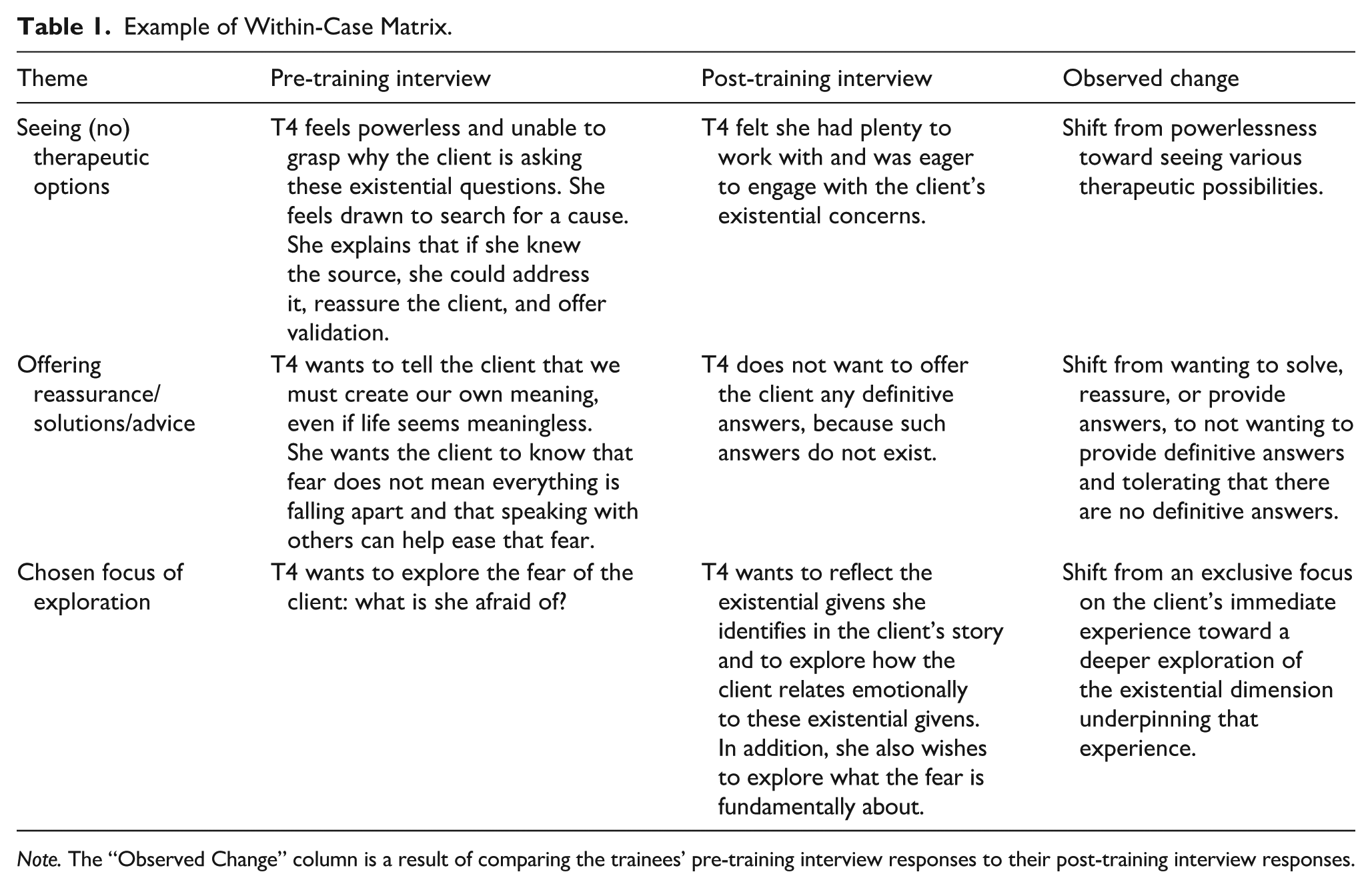
Note. The “Observed Change” column is a result of comparing the trainees’ pre-training interview responses to their post-training interview responses.
Themes were identified by grouping meaning units that shared a core meaning; in this example, the overarching theme was “seeing (no) therapeutic options.”
When a theme remained unchanged or was not revisited in the post-training interview, the change column was left blank. For instance, Trainee 2 expressed appreciation for the client’s courage pre-training but did not mention it post-training. Given the open-ended nature of the interviews, such omissions were not interpreted as change. Only themes explicitly discussed at both time points were included in the change column. Once all within-case matrixes were completed, we conducted a cross-case analysis by examining the entries in the change columns across trainees. Similar shifts were then grouped into higher-order categories.
It is important to note that the analysis of the Existential Cue interview data was informed by the preceding Change Interview analysis. The framework developed during the Change Interview analysis shaped how we interpreted the Existential Cue data. This means that changes identified during the cross-case analysis of the Existential Cue data that closely resembled changes found in the earlier Change Interview analysis were assigned the same category label. For instance, during the cross-case analysis, it became evident that participants noticed more existential issues – a change that closely aligned with the category “Experiencing greater existential awareness” previously identified in the Change Interview analysis. Changes that had not been identified in the Change Interview analysis were also noted and assigned new category labels (e.g., “More trust in the process”).
Audits and Member Check
All supervisors reviewed the preliminary findings and suggested sharpening the focus on existential empathy, as participants often spoke broadly about various changes. In response, the first author revisited the raw data to refine the analysis and ensure closer alignment with the research questions. In the summer of 2025, member checks were conducted by sharing a video-recorded presentation of the findings with participants, who were invited to provide feedback on whether the interpretations aligned with their experiences. Unfortunately, only three participants responded. While all three found the findings familiar and recognizable, two expressed a need for further training, both to refresh what they had previously learned and to gain support in integrating that knowledge more effectively into their practice.
Findings of the Change Interview
The two main domains of the Change Interview were named “Changes in capacity for existential empathy” and “Elements supporting the development of existential empathy.” In the section below, we report on all the categories and subcategories of these two main domains, including quotes from the interviews. To differentiate between conclusions drawn from the Existential Cue data and those from the Change Interview data, we present the findings of each analysis separately. All findings are also summarized in Table 2, which indicates for each category the data source from which it was derived.
Domains, Categories, and Subcategories of the Change and Existential Cue Interviews.
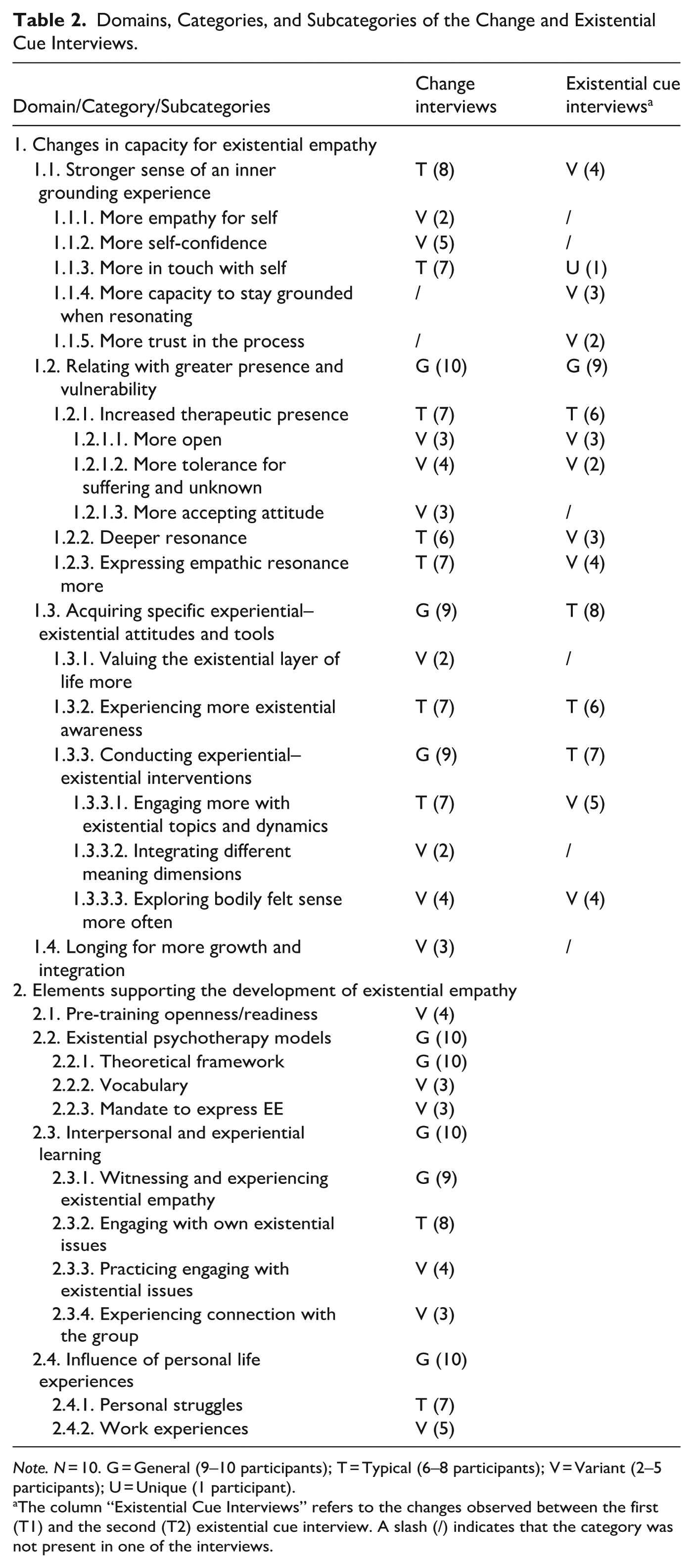
Note. N = 10. G = General (9–10 participants); T = Typical (6–8 participants); V = Variant (2–5 participants); U = Unique (1 participant).
The column “Existential Cue Interviews” refers to the changes observed between the first (T1) and the second (T2) existential cue interview. A slash (/) indicates that the category was not present in one of the interviews.
Changes in Capacity for Existential Empathy (Domain 1)
Stronger Sense of an Inner Grounding Experience (1.1)
Several trainees described how changes in their relationship with themselves supported their capacity to offer existential empathy. This shift was characterized by greater self-empathy (1.1.1), increased self-confidence (1.1.2), and a deeper connection to their own experiencing (1.1.3). These changes appeared to foster a sense of inner grounding, enabling them to approach clients with more calmness and openness. Some reflected that self-criticism or uncertainty previously distracted them, whereas a more grounded self-relationship created space for deeper presence. Trainee 4, for example, reported:
Yes, I think that for me it mainly means that if I feel more calm and confident within myself, then I can also be more present with that client and his or her feelings, and more actively listen and feel along.
Being more in touch with their own experiences and existential issues also appeared to heighten their sensitivity to the existential dimensions of their clients’ struggles. Trainee 8, for example, stated:
I have also become more consciously engaged with these things as a person, especially with my own [existential] themes. That has made me more sensitive and better able to attune to the client, because I’m more in touch with all of that myself, and I’m less inclined to push it away or ignore it.
Relating With Greater Presence and Vulnerability (1.2)
All trainees reported a shift in how they related to their clients. The first change they described was an increased sense of therapeutic presence (1.2.1). Some felt that their growing awareness of existential issues helped them better understand how clients become stuck in life’s dilemmas. This perspective appeared to foster a more open, accepting, and compassionate stance. Trainee 1, for example, explained:
Recently with a client, [we had] a good conversation; we were going to start working on something, and then at the end she [said], “Maybe I want to do something else after all.” So then we explored that (. . .) and then it was almost a done deal, and then she says, “No, no, no, I still want to stay with you; no, that seems best to me after all.” And then I noticed that she really finds commitment – making that choice – very difficult, so then I asked her that. And I also noticed that I experience less frustration.
Several trainees also described feeling more at ease with uncertainty and more able to tolerate not-knowing. Trainee 5, for instance, reported: “I’m also much more present with clients and better able to tolerate what they are going through.”
A related second shift involved resonating with clients on a deeper level (1.2.2). Trainees described feeling moved in a more vulnerable, human, and emotional way, rather than just on a cognitive level. Trainee 1, for instance, described:
I think I am also being touched on a different level now – and allowing myself to be touched by the other person. (. . .) Yes, on a more vulnerable level, a more human level, a more equal level. . . and on a more emotional level.
A third shift concerned the more open expression of empathic resonance (1.2.3). This development marked a deepening of the previous shift: as trainees began to resonate with clients on a more vulnerable and human level, they also became more able – and more willing – to articulate this resonance in the therapeutic encounter. Trainee 1, for example, described it as: “More feeling-along on that human level, and reflecting something back about that.”
Acquiring Specific Experiential–Existential Attitudes and Tools (1.3)
In addition to the changes in relation to themselves (1.1) and the therapeutic relationship (1.2), nearly all trainees also reported developing specific experiential–existential attitudes and tools (1.3), which they linked to their capacity for existential empathy. For some, this involved placing greater value on the existential dimension of therapy (1.3.1). Trainee 7, for instance, reported:
I think that before (. . .), I was less quickly or less convinced of the importance of also naming and discussing it. Now I recognize much better what existential themes people can get stuck on, and I’m also convinced of the importance of bringing that up at the start of therapy.
For most trainees, this change also included a heightened existential awareness (1.3.2). According to Trainee 3, this ability to identify existential issues is closely linked to the ability to stay present with them:
I think I was generally able to stay with those themes before, but maybe I did not always recognize them. So perhaps I was not actually staying with them after all – because I did not fully recognize them. In that sense, the fact that I now recognize them better already helps me stay with them more.
Most trainees also reported having learned to conduct specific experiential–existential interventions (1.3.3), which they perceived as closely linked to their capacity for existential empathy. The most frequently reported intervention involved engaging more directly with existential themes and dynamics (1.3.3.1). Trainee 5, for example, expressed: “I more quickly name the theme of loneliness or responsibility, or the limitations of existence, if I were to notice that in the conversation, you know, and it helps.”
By consciously attending to this existential layer in their conversations, trainees felt they created more space for existential empathy to emerge. Other, less frequently reported interventions, were integrating different meaning dimensions (1.3.3.2) by switching between micro-, meso-, and macro-dimensions and exploring the bodily felt sense (1.3.3.3) more often. When asked how this bodily focus related to her capacity for existential empathy, Trainee 7 reflected:
Because I work more on the micro-level with them, in their experience, in the here and now, the [emotional] intensity is also greater. It touches me differently – more intensely. I feel it physically too, and that creates something different.
It thus seemed that the trainees viewed their capacity for existential empathy not only as an attitude or feeling, but as something embodied in their therapeutic actions.
Longing for More Growth and Integration (1.4)
In addition to the changes reported, some trainees felt they needed more time to consolidate their learning and adapt it to their specific professional contexts and/or individual therapeutic style. Trainee 1, for example, expressed:
On one hand, I notice that mainly my attitude and feeling, and the expression of that in my own way is indeed different from before the training. . . And still, I think there are a lot of concrete, just follow-up interventions, that I would like to make more my own.
Elements Supporting the Development of Existential Empathy (Domain 2)
Pre-Training Openness/Readiness (2.1)
When asked about factors supporting their growth, some trainees noted that it had begun before the training, driven by personal interest and experiences that had already fostered a readiness to engage with the existential dimension of therapy. Trainee 7, for instance, explained how reading a book about EEP had already set this process in motion: “I think this book – that [I read] before the training – had very much set me on that track. I also think that it’s been a deepening; it’s something that then also set other things in motion because of it.”
Existential Psychotherapy Models (2.2)
All trainees reported that the two existential frameworks introduced in the training – (1) the experiential–existential micro-, meso-, macro-dimension model, and (2) Yalom’s four givens – were essential to developing their capacity for existential empathy. These frameworks not only enhanced their awareness of the existential issues but also provided a conceptual structure that made these abstract themes more tangible. The frameworks seemed to offer structure in navigating the sometimes diffuse nature of existential issues. Trainee 3, for instance, said:
Because “the existential” is actually a very vague and broad concept, giving it some categories, like existential givens, and giving those givens names, it becomes somewhat more tangible and easier to stay with, because you know what it’s about. Otherwise, it feels like one big black mass, and now there is at least a bit of structure.
Some trainees reported that being offered a vocabulary (2.2.2) to talk about existential issues was helpful. Having more words to speak with clients about the existential dimension made it easier to articulate their existential empathy. Trainee 6, for instance, explained: “I also received language to be able to talk about it with people. I learned to pick it up and put words to it, to express it.”
In addition, a few trainees highlighted the importance of receiving the mandate to express their existential empathy (2.2.3). Trainee 6, for instance, also expressed: “What I also learned, and I find this an important one, is that I received, in a way, the mandate to talk about it in therapy, about the universally human.”
Interpersonal and Experiential Learning (2.3)
Beyond the training content, all trainees emphasized that their experiences during the training were crucial to developing their capacity for existential empathy. It was not only the theoretical understanding, but also the direct experience of receiving existential empathy (2.3.1) that proved deeply meaningful. Several trainees noted that the trainers embodied existential empathy, which had a powerful impact. As Trainee 9, for instance, expressed:
Certain instructors really served as role models in that regard. (. . .) I mean, they were role models in showing that it’s okay not to know. Maybe not in a very concrete way, but in how they embodied being present with existential themes. How should I put it? Yes, in a way, they modeled or embodied something – a kind of calm.
In addition, the experiential nature of the training helped trainees internalize existential empathy on a felt level. As Trainee 4, for example, described: “Also the exercises you do in that training, they make sure that you don’t just [understand it] in your head, (. . .) but that you also feel it and experience what it really is.”
Building on this experiential foundation, many trainees described how engaging with their own existential issues (2.3.2) during the training further deepened their understanding of the existential dimension of life. Trainee 6, for instance, explained:
It was also the fact of having really worked through them yourself in the training, so having been very explicitly engaged with them, also means that you can more easily –well, at least for me – that I can see them more easily.
Finally, the opportunity to practice engaging with existential issues (2.3.3) through role-plays, along with the experience of connection with the group (2.3.4), was also seen as an important element of their learning experience.
Influence of Personal Life Experiences (2.4)
Most trainees shared that they were facing personal existential struggles (2.4.1) during the training, such as dealing with illness, recovering from relational wounds, or grappling with life decisions. These experiences closely interacted with the training process: while the training supported them in navigating their challenges and deepened their sensitivity to their existential issues, their personal struggles also heightened their openness to engage with the existential dimension in their therapeutic work. As Trainee 2 expressed:
I actually had a terrible year and was shaken up on many existential levels. So the training was helpful in providing a kind of holding space (. . .). It wasn’t an ordinary year, but it did intensify my sense of awareness and sensitivity.
In addition to these personal experiences, several trainees reported that experiences in their professional context (2.4.2), such as attending external workshops about existential psychotherapy, positively contributed to their learning process. Some also described how witnessing the positive impact of existential empathy on their clients reinforced their appreciation for it. Trainee 6, for instance, reported:
[What contributed was] also to put it into practice and start experimenting with it in my therapy room with my clients. Yes, that also gave more insight into: “Ah, I have experienced it myself, and for them it is apparently also very important.”
Findings of the Existential Cue Interview
Triangulation with the Existential Cue Interviews (see Table 2) showed that the reported changes “Stronger sense of an inner grounding experience,” “Relating with greater presence and vulnerability,” and “Acquiring specific experiential–existential attitudes and tools” were also observable when comparing trainees’ pre- and post-training responses to the video. The category “Longing for more growth and integration” did not emerge, which is understandable, as this theme reflects a narrative about their ongoing process and is unlikely to surface in a focused discussion of the video.
Stronger Sense of an Inner Grounding Experience
A stronger sense of an inner grounding experience became apparent in how the trainees described their stance toward the client’s existential experiences. Whereas in the Change Interviews, the trainees spoke mostly about increased self-confidence and self-empathy, in the Existential Cue Interviews, this emerged through two new categories. The first was a greater capacity to stay grounded while resonating (1.1.4) with the client. Several trainees initially reported feeling almost “contaminated” by the client’s confusion. For example, Trainee 9 initially shared that she felt drawn into the client’s chaos and struggled to find any sense of direction herself. Post-training, however, she described consciously stepping into the client’s world, embodying the client’s perspective without losing her own grounding. The second new category concerns a growing trust in the process (1.1.5). Trainee 1, for example, shared that although she still felt somewhat powerless while observing the client, she now experienced a deeper trust in the existential process that could unfold.
Relating With Greater Presence and Vulnerability
Increased therapeutic presence (1.2.1) was reflected in a shift from initial pressure to act or provide reassurance, toward a more receptive stance. For example, while Trainee 8 initially considered quickly offering the client reassurance, she later described noticing the client’s suffering and wanting to remain present and explore it together. A deeper personal resonance (1.2.2) also became evident. For instance, whereas Trainee 1 initially expressed feeling compassion for the client’s concerns, she later described feeling personally touched, recognizing the client’s struggles and resonating with the fundamental fear of non-existence.
Greater expression of empathic resonance (1.2.3) was also observed in trainees’ imagined responses. Trainee 3, for example, initially stated she would remain silent about her empathic reactions. After the training, however, she felt more able to share the imagery and emotional responses that arose during the interaction, recognizing these as valuable tools for connection.
Acquiring Specific Experiential–Existential Awareness
Increased existential awareness (1.3.2) became evident in how the trainees more explicitly identified existential themes in the post-training interviews. They noted, for example, themes such as meaninglessness and freedom/choice in the video – topics they had not previously recognized. This heightened awareness was accompanied by a greater inclination to engage in experiential–existential interventions (1.3.3). For instance, whereas Trainee 6 had not initially noticed the theme of meaninglessness, she later expressed a desire to explore this topic with the client.
Discussion
The main findings – emerging across both the Existential Cue Interviews and the Change Interviews – suggest that, following training in EEP, therapists tend to relate to clients’ existential concerns with greater presence and from a more human, vulnerable stance. Additionally, there appears to be an increase in therapists’ existential awareness and a greater willingness to engage with existential concerns in therapy.
The stronger sense of inner grounding – which can be understood as a steady place within oneself from which one can resonate with the client without becoming overwhelmed or losing touch (Missiaen & Vanhooren, 2021) – should be interpreted with more caution, as it appeared less consistently across the two types of interviews. While in the Change Interviews, the trainees typically described inner grounding as a crucial aspect of developing their capacity for existential empathy, it was not observed among many trainees in the Existential Cue Interviews (potentially due to the format of these interviews).
Essential Training Components
The elements trainees found most helpful highlight the importance of integrating both cognitive and experiential components in training. All participants emphasized that it was this combination that enabled them to develop their capacity for existential empathy. This aligns with the conceptualization of “general” empathy as involving both cognitive and affective elements.
The cognitive component of the EEP training appears essential for recognizing existential concerns, building confidence to engage with them, and finding language to explore and express existential empathy. This supports recent findings by Frediani et al. (2025), who found that understanding existential processes seemed to help therapists remain present and empathic in the face of existential issues. Their research also pointed to the importance of learning to ground oneself when encountering existential concerns. One emerging question is whether theoretical concepts and language themselves serve as a form of grounding. Engaging with existential themes often evokes a sense of losing footing, as seen in therapists’ initial responses to the Existential Cue video. In this context, theory and language may offer a foundation to fall back on. This idea echoes Rogers’ (1980) notion that one can only empathize deeply with another’s experience if one has a secure way of returning “home”– a metaphorical ground within oneself.
The experiential component of the EEP training, on the other hand, appeared essential in helping trainees connect more deeply with their own existential issues, which in turn seemed to enhance their ability to recognize those of their clients. This personal involvement also provided a lived experience of the value of existential empathy, which further motivated them to engage more with their clients’ existential issues and express their existential empathy. In this way, the experiential component underscores that developing the capacity for existential empathy is not merely a matter of acquiring knowledge or skills, but of engaging the whole person. This finding echoes Rogers’ (1951) view that core therapeutic conditions, such as empathy, are not techniques to be taught, but attitudes therapists must fully embody. In his view, methods and techniques were rather an implementation of these attitudes, which in their turn, were an expression of a philosophical stance toward human beings and life itself (Rogers, 1951, 1980).
Our findings suggest that this distinction between skills and attitudes may indeed be more fluid and circular than dichotomous and linear. When the trainees reflected on the development of their capacity for existential empathy, they often referred to experiential–existential tools and interventions they had learned, indicating that they experienced existential empathy as something enacted through therapeutic practice. This perspective aligns with Sousa’s (2015) argument that therapeutic postures and techniques in existential psychotherapy are interdependent and shape one another within the therapeutic process. It also resonates with the broader research on the interplay between common factors (such as empathy) and specific techniques in psychotherapy (Hubble et al., 2009).
Theory of Existential Empathy
This study also offers insights into the theoretical understanding of existential empathy. Broadly, the competencies needed for existential empathy outlined by Vanhooren (2022a) receive preliminary support. Trainees emphasized the importance of engaging with their own existential issues, grounding themselves, tolerating not-knowing, and learning to communicate their resonance. They also highlighted the value of attuning to the client’s bodily felt sense (the micro-dimension), which allowed them to connect with existential concerns (the macro-dimension) in a more embodied, rather than abstract or purely cognitive, way – thereby deepening their capacity for existential empathy.
One dimension that received notably less attention in trainees’ reflections is the meso-dimension – that is, the client’s life narrative, self-concepts, beliefs, and world assumptions (Vanhooren, 2019). While trainees frequently referred to the micro- and macro-dimensions in describing the development of their capacity for existential empathy, references to the meso-dimension were sparse. This raises several possibilities: trainees may have already felt competent in addressing this dimension in their clinical work; the training may have placed less emphasis on it; or the current theoretical framing of existential empathy may not yet fully articulate the connection between attuning to the meso-dimension and macro-dimension. Vanhooren (2023) notes that working with existential concerns can reshape how individuals experience themselves and construct their life narratives. However, further theoretical and empirical work could better clarify how therapists can attune to clients’ meaning-making structures and personal narratives while engaging with their existential concerns.
Another dimension that remains largely underrepresented in our findings is the connection with spirituality. Vanhooren (2022b) describes openness to the existential dimension of life as potentially involving a deeper connection to the universe and one’s spiritual self. He, furthermore, suggests that grounding could also be fostered by investing in one’s awareness of being part of something bigger than oneself. In our study, however, only one participant explicitly referred to such a spiritual connection, describing it as a sense of belonging that transcended the immediate group and resembled a shared belief system – what she called a kind of “common religion” rooted in a sense of believing in shared humanity.
This raises the question to which extent a felt connection with spirituality is helpful for developing existential openness and, by extension, existential empathy. Our data suggest that such a connection might not necessarily be required. However, several questions remain: What is the impact of the broader cultural and religious context – specifically a Western European setting where religion and spirituality are often less emphasized – on how existential openness and empathy are experienced? Are there individuals for whom a connection with spirituality is experienced as an essential component of existential openness and empathy? And if so, how do these individuals differ from those who do not experience spirituality in this way?
Limitations
Several methodological limitations must be acknowledged. First, the study’s framing makes it particularly susceptible to social desirability and compliance effects. Although we attempted to mitigate these, our measures likely did not eliminate the influence of social desirability. The possibility of overreporting positive change should therefore be considered.
Second, interviews were conducted immediately after the training, when impressions were still vivid. Ideally, a follow-up interview would have taken place a year later, but project timing did not allow for this. Although the member check 1 year later yielded limited responses, it indicated that some trainees needed more sustained training to maintain and continue their growth in their capacity for existential empathy.
Third, the training likely influenced how trainees conceptualized and articulated existential empathy. Since the program explicitly addressed themes such as not-knowing and relating from a human position, these concepts may have provided a shared vocabulary that shaped how participants described their development. The presence of these elements in the data may thus reflect both genuine change and the language introduced during training. However, the emphases trainees placed – for example, on what supported their growth or how grounding was achieved through knowledge and increased self-confidence rather than spiritual connection – offer insight into which aspects of the training were most meaningful to them.
To counterbalance the effects of social desirability, we triangulated findings using the Existential Cue Interviews. The added value of this method is modest: Overall, fewer categories were found, and their frequency was lower compared to the more narrative-rich Change Interviews. This is likely due to the brief and artificial nature of the video. The video lasted only 2 min and lacked real interaction, which may have limited the depth of reflection. Moreover, certain changes, such as increased confidence, are not easily observable in this format. Nevertheless, most of the categories that we found in the Existential Cue Interviews were consistent with those from the Change Interviews. This suggests that at least some of the reported changes were not merely narrative constructions but also manifested in how trainees responded to client-like situations.
That said, the video remained an artificial stimulus. Observing real therapist–client interactions before and after training would have yielded richer data but posed ethical, practical, and methodological challenges. We could, for example, not foresee whether a client session would involve (explicit) existential issues. We also acknowledge that viewing the same video twice may have prompted deeper reflection. However, using a different video would have introduced variability, as each client evokes different responses from a therapist.
Finally, the sample consisted exclusively of White European female participants, and both the EEP trainers and the research team shared the same cultural backgrounds. This lack of variation in gender, racial, and ethnic identity constitutes an important limitation of the study. Scholars have emphasized how existential concerns might be experienced differently across populations worldwide (Felder & Robbins, 2021; Hoffman, 2009). It is therefore plausible that the processes involved in developing the capacity for existential empathy could differ in more diverse samples.
Future Research
In addition to examining the training of existential empathy in more culturally and demographically diverse therapist populations, several other important directions for future research emerge from this study. First, quantitative studies are needed to assess the clinical relevance of existential empathy. Second, studies should examine whether therapists’ levels of existential empathy are associated with therapy outcomes. Third, research should evaluate whether training in existential empathy leads to measurable increases in existential empathy scores, and how these compare to other training approaches. Such studies require validated measurement tools. The EEQ (Vanhooren et al., 2022) is a promising self-report instrument measuring the therapist’s existential empathy. However, given evidence that client-perceived empathy better predicts outcomes than therapist self-ratings (Elliott et al., 2018), it would be valuable to complement the EEQ with a client-rated measure of the therapist’s existential empathy.
Beyond questions of measurement and outcomes, it is also important to consider who benefits most from training. Our findings suggest that many trainees already demonstrated an openness to exploring existential issues, often shaped by their own life experiences. It remains unclear whether individuals less attuned to such issues would experience similar gains or whether they would identify the same components as helpful.
Another worthwhile direction for future research concerns differences in therapists’ previous training and professional experience. In our study, participants entered the training with varied therapeutic backgrounds and different levels of professional experience. Examining how such background factors shaped their learning process was beyond the scope of the current analysis. However, it would be valuable for future studies to investigate how these differences influence the ways therapists develop the capacity for existential empathy.
Implications for Training Existential Empathy
Our study suggests that the development of existential empathy can be facilitated through training. Such training appears to benefit from a combination of cognitive components, such as theoretical frameworks, and experiential components, including personal engagement with existential issues.
Moreover, the findings indicate that developing the capacity for existential empathy requires the integration of empathic attitudes and specific existential skills (Sousa, 2015). This reflects a broader pedagogical principle: Mastering complex skills is inseparable from personal involvement (Dreyfus, 2004). At the same time, personal involvement is not merely abstract but is enacted through concrete interventions, illustrating a circular dynamic between doing and being (Rogers, 1951).
Finally, the role of the trainer appears to be an important factor. Trainers who embody existential empathy and serve as role models may enhance the learning process, underscoring the importance of trainer presence and embodiment in fostering this capacity.
Footnotes
Acknowledgements
The authors express their sincere gratitude to all participants for their valuable time and willingness to contribute to this study. The authors also thank the actor for her involvement in the study. Furthermore, the authors are grateful to the staff of the Experiential-Existential Psychotherapy and Counseling Course at Focus on Emotion for their support in facilitating participant recruitment.
ORCID iDs

Ethical Considerations
The Social and Societal Ethics Committee of the University of Leuven (Katholieke Universiteit Leuven) approved the study (G-2022-5449).
Consent to Participate
All participants were fully informed about all aspects of the study and signed an informed consent before the first interview.
Funding
The authors disclosed receipt of the following financial support for the research, authorship, and/or publication of this article: This article was funded by KU Leuven (Grant 3H210278 ZKE0397 C24M/21/010) awarded to Siebrecht Vanhooren.
Declaration of Conflicting Interests
The authors declared no potential conflicts of interest with respect to the research, authorship, and/or publication of this article.
Data Availability Statement
Due to ethical considerations, the data supporting the findings of this study are not publicly available. The small sample size and the nature of the interview content make it possible to identify individual participants, compromising confidentiality. However, illustrative quotes from the interviews that support the study’s findings are included in the manuscript.