







Abstract
The aim of this study was to analyze whether children with and without difficulties in handwriting, spelling, or both differed in alphabet writing when using a keyboard. The total sample consisted of 1,333 children from Grades 1 through 3. Scores on the spelling and handwriting factors from the Early Grade Writing Assessment (Jiménez, in press) were used to assign the participants to one of four groups with different ability patterns: poor handwriters, poor spellers, a mixed group, and typically achieving students. Groups were equalized by a matching strategy, resulting in a final sample of 352 children. A MANOVA was executed to analyze effects of group and grade on orthographic motor integration (fluency of alphabet writing) and the number of omissions when writing the alphabet (accuracy of alphabet writing) by keyboard writing mode. The results indicated that poor handwriters did not differ from typically achieving children in both variables, whereas the poor spellers did perform below the typical achievers and the poor handwriters. The difficulties of poor handwriters seem to be alleviated by the use of the keyboard; however, children with spelling difficulties might need extra instruction to become fluent keyboard writers.
Keywords
Learning to write is important for academic participation and later career prospects. Difficulties in writing hinder students in expressing their knowledge and thoughts in assignments for all academic topics. The final goal of learning to write is to be able to translate ideas into written text. Before engaging in text generation and composition, beginning writers have to gain automaticity in the lower order processes of writing, such as the retrieval of phoneme-grapheme correspondences, controlled motor movements to make legible letter forms, and the retrieval of orthographic word representations (Graham, Berninger, Abbott, Abbott, & Whitaker, 1997; Kim et al., 2011). Automaticity of lower order writing skills requires quick, accurate, and efficient execution of the mechanical process of writing without conscious thought. When lower order skills become automatized, working memory becomes available for idea generation, planning, monitoring, and revision. Therefore, quality of text composition is significantly affected by the fluency of lower order writing skills (Graham, 1990; Medwell & Wray, 2007). Berninger (1999) summarized findings of different studies that addressed the role of spelling and handwriting in compositional fluency and quality. In the primary grades, 66% of the variance in compositional fluency was accounted for by handwriting and spelling, whereas in the intermediate grades it was 41%. Regarding compositional quality, 25% of the variance could be explained by handwriting and spelling in the primary grades, whereas 42% explained the variance in the intermediate grades.
Transcription Skills
The lower order skills for letter and word production have been called transcription skills, which include spelling and handwriting. The child has to know which graphemes represent the separate sounds of a word (phonemes), and then she or he has to be able to execute the fine motor movements to make the letters. Transcription skills are one of the pillars in the functional model of writing, which aims to explain children’s development of writing. The model was proposed by Berninger and Amtmann (2003), inspired by the cognitive process model of writing of Hayes and Flower (1980). The cognitive process model provided a theoretical framework for the composing process of adult skilled writers, including only higher order cognitive processes such as planning, translating, and reviewing. Based on empirical research regarding developing writers, Berninger and Amtmann concluded that the lower order cognitive processes are relevant to explaining the development of compositional writing in children. In their functional model of writing, transcription forms the basis for text generation, together with executive functions (i.e., supervisory attention, goal setting, planning, and reviewing). Working memory functions serve as a mediator among transcription, executive functions, and text generation.
Difficulties in transcription skills can be caused by handwriting and/or spelling disabilities (Berninger, Abbott, Ausburger, & García, 2009; Cholewa, Mantey, Heber, & Hollweg, 2010; Graham et al., 1997; Miceli & Capasso, 2006; Smits-Engelsman & Van Galen, 1997). In the most common definition of handwriting disabilities, the acquisition of the fine motor task of handwriting is disturbed or delayed, resulting in poor legibility and slow writing. The indicators for legibility that have been used in research studies are spacing between words, spacing between letters in words, alignment, letter size, and slant. Other possible factors include errors in letter formation, such as reversals, added strokes, missing strokes, and missing letters (Graham & Weintraub, 1996; Kushki, Schwellnus, Ilyas, & Chau, 2011). On the other hand, handwriting difficulties might not be exclusively caused by poor motor skills. A structural equation model employed in a study with primary and intermediate grade participants revealed that the role of fine motor skills was only indirectly related to handwriting (measured by a text copy task), through orthographic coding (Abbott & Berninger, 1993). Also Graham and Weintraub (1996) emphasized that the execution and production of the motor processes is affected by linguistic aspects of writing, such as semantic, syntactic, lexical, and phonological abilities. The child must first decide which letter represents the first sound of the word he or she wants to write before the motor program can be retrieved from long-term memory.
Spelling disabilities occur at the word level (Miceli & Capasso, 2006). Following the dual-route theory, difficulties can arise in the spelling of regular words because of poor phoneme-grapheme conversion but also in the spelling of irregular and exceptional words when difficulties in storing or retrieving words from the orthographic lexicon occur (Houghton & Zorzi, 2003; Plaza & Cohen, 2004).
Because handwriting and spelling are two different abilities, it is not surprising that they rely on different cognitive processes. There is, however, one common predictor for both handwriting and spelling difficulties: orthographic motor integration, the ability to “retrieve letter forms from long term memory integrated with the ability to plan and execute fine-motor movements under time-limited conditions” (Berninger, 1999, p. 103). Orthographic motor integration (or fluency of alphabet writing) is measured by writing the alphabet from memory in alphabetic order under timed conditions. Writing the alphabet in this way requires automatic phoneme-grapheme conversion and fine motor aspects to form legible letters, as children have to retrieve the letters from memory before writing them down. Because it is such a strong predictor for transcription, this skill also contributes significantly in explaining quality and fluency of text composition (Graham et al., 1997; Jones & Christensen, 1999).
Transcription skills have been studied in different writing modes: by pen and by keyboard (Berninger et al., 2006; Berninger et al., 2009; Christensen, 2004). Nowadays, children write on a keyboard on a regular basis in the classroom and at home, which makes keyboard writing increasingly important to investigate. Regarding spelling performance on a keyboard, Masterson and Apel (2006) examined whether the spelling skills of typically developing children in Grades 2 through 6 are affected by writing modality, controlling for keyboarding proficiency. Results demonstrated that the children spelled equally well with pen and keyboard, regardless of the level of linguistic complexity of the words. The authors suggested that (a) spelling draws on lexical representations stored in long-term memory and (b) tactile involvement via handwriting is not necessary for students to demonstrate their spelling abilities. Cunningham and Stanovich (1990) investigated spelling acquisition via pen and keyboard modalities in typically developing middle-class children at the middle and end of Grade 1. Results indicated that the pen modality had an advantage over the keyboard modality, as children learned to spell more words by pen. However, in a replication of this study by Vaughn, Schumm, and Gordon (1992), using a sample of typically developing lower-middle-class children and children with learning disabilities at the end of Grade 1, no differences between the pencil and keyboard modes in learning to spell words were found. Berninger et al. (1998) investigated the influence of the writing mode in a spelling intervention study. The sample consisted of second graders at risk for spelling disabilities; half of them were also at risk for learning disabilities. Results indicated that writing by pen offered a relative advantage in learning to spell words of high predictability. Keyboard use resulted in better performance when writing multiletter spelling units. The authors attributed this finding to the trade-off between attending to the construction of motor plans for letter production and attending to sound-spelling correspondence.
Alphabet writing in both writing modes has also been studied. Christensen (2004) demonstrated that orthographic motor integration in handwriting and keyboarding are correlated. Orthographic motor integration in keyboard mode was even more related to the quality and length of text composition (r = .54 and r = .55, respectively) than in the handwriting mode (r = .44 and r = .30, respectively).
Berninger et al. (2009) found that elementary school students wrote more letters of the alphabet in 15 s by keyboard than by pen (Grade 2: η2 p = .18; Grade 4: η2 p = .42; Grade 6: η2 p = .72). This positive effect of keyboard use when writing the alphabet was also found for first graders by Berninger et al. (2006), but no effect sizes were reported. The pen had an advantage over the keyboard when it came to fluency in alphabet writing in Grade 2 (η2 p = .04) and in sentence and essay writing in all elementary grades (sentence writing: Grade 2: η2 p = .41; Grade 4: η2 p = .31; Grade 6: η2 p = .04; essay writing: Grade 2: η2 p = .24; Grade 4: η2 p = .50; Grade 6: η2 p = .11; Berninger et al., 2009). Writing the alphabet by pen and keyboard share some underlying processes, such as phonological awareness, orthographic coding, rapid and automatic naming, and even graphomotor planning (measured by the finger succession task; Berninger et al., 2006). Significant correlations were found between keyboard and pen in speed of producing the entire alphabet and automaticity of letter production in Grades 1, 3, and 5. However, keyboard and pen seem not to draw exactly on the same processes, because no significant relationship was found regarding accuracy of alphabet writing (Berninger et al., 2006).
Keyboarding Skills and Writing Disabilities
What do we know about keyboarding skills of children with writing disabilities? In the 1980s and 1990s, researchers proposed keyboard writing as an alternative for children with writing disabilities. Some meta-analyses confirmed an advantage of the keyboard over handwriting (Bangert-Drowns, 1993; Cochran-Smith, 1991; Goldberg, Russell, & Cook, 2003). In a meta-analysis of 20 studies that provided remedial writing instruction using a word processor, Bangert-Drowns (1993) found 9 studies included students who had demonstrated difficulty with writing. These 9 studies yielded a significantly larger average effect size (.049) than the other 11 studies that provided writing instruction on word processors to students without difficulty in writing (.09). The author suggested that the use of a word processor is particularly interesting for students with difficulties in writing. Goldberg et al. (2003) performed a meta-analysis on 26 studies, focusing on the comparison between K-12 students writing with keyboard versus pen. Significant mean effect sizes in favor of keyboard use were found for quantity of writing (d = .50, n = 14) and quality of writing (d = .41, n = 15).
Freeman, MacKinnon, and Miller (2005), however, warned that keyboarding is not an easy-to-master skill and emphasized the need for explicit instruction. Children have to become fluent writers on keyboards before they can equal or improve the quality and length of text composition. Educators should also be aware that writing difficulties can be transferred to keyboard writing. One reason for this is that motor activities are initially less complex on a keyboard than by pen, but when children develop keyboarding skills, the keys are touched in rapid succession, and motor skills become more important. The correlation between writing by pen and writing by keyboard in graphomotor planning supports this idea (Stevenson & Just, 2012). Second, handwriting is not exclusively predicted by motor activities (Berninger et al., 2006). Orthographic motor integration, among others, plays a significant role in both writing modes. It is possible that children with poor orthographic motor integration abilities will have more difficulty becoming fluent keyboarders than children without writing disabilities (Christensen, 2004).
Although children can have handwriting difficulties only, spelling difficulties only, or difficulties in both skills, recent investigations have not made such distinctions. Some studies looked at the spelling abilities of children with spelling disabilities, but their designs did not control for a handwriting disability. The same has occurred with studies of handwriting disabilities: When selecting the sample, the researchers did not take into account spelling abilities. In this study, a first attempt is made to investigate children with different ability profiles in different aspects of writing the alphabet on a keyboard. The first aim of the study was to examine whether children in Grades 1 through 3 with different kinds of writing difficulties (poor handwriting only, poor spelling only, both poor handwriting and spelling) differ from typically achieving children in their performance of orthographic motor integration in keyboard writing. The second purpose was to see whether children with different writing difficulties make more omission errors when writing the alphabet in 1 min than typically achieving children and how this error pattern develops over the grades. Omission of letters measures the accuracy of alphabet writing. Children who do not commit omission errors have knowledge of the alphabet and have the ability to find the letters on the keyboard.
We hypothesized that the three groups with writing difficulties would perform below the typical achievers in keyboard orthographic motor integration. We expected that children with spelling difficulties only and difficulties in both handwriting and spelling (the mixed group) would perform below the typically achieving group. According to previous research, fluency in alphabet writing is a stronger predictor for handwriting performance than fine motor activities. We therefore expected that children with handwriting difficulties would also be less fluent in keyboard writing than the typically achieving children but would perform better than the poor spellers. Regarding the omissions, we expected that there would be no difference between the performance of typically achieving children and the poor handwriting group. Although members of the latter group were expected to be less fluent in the retrieval of phoneme-grapheme correspondence and the coordination of fine motor activities, we assumed they would have no difficulty memorizing the alphabet order. This memory component might be more challenging for children with spelling difficulties.
Method
Participants
The total sample consisted of 1,333 children (692 boys, 641 girls) from Grades 1 through 3. These children were recruited from intact classes of 12 state and private schools in urban and suburban areas of Santa Cruz de Tenerife. From this sample we identified four groups with different difficulty patterns: poor handwriters, poor spellers, mixed (difficulties in both areas), and typically achieving children.
The selection of children with different kinds of writing difficulties was based on their performance on various measures of the Early Grade Writing Assessment (EGWA; Jiménez, in press). Exploratory factor analysis of EGWA identified four factors, of which two were relevant for classifying children with handwriting and spelling difficulties: handwriting fluency and spelling (for more detailed information about the factor analysis and the total sample, see Jiménez, Marcos, González, & Suárez, 2016). The group of poor handwriters scored below the 25th percentile on the handwriting fluency factor and above the 50th percentile on the spelling factor. Scores below the 25th percentile on the spelling factor and above the 50th percentile on the handwriting fluency factor were an indication for the group of poor spellers. Children who scored below the 25th percentile on both factors belonged to the mixed group. The typically achieving group consisted of children with scores above the 50th percentile on both factors.
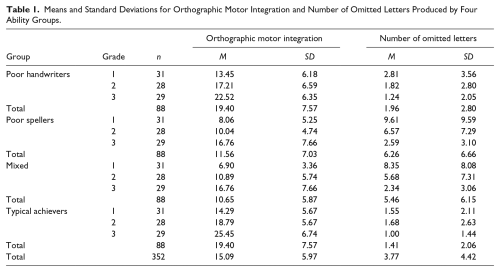
Boys were overrepresented in the three difficulty groups, while there were more girls in the typically achieving group. Also, the group of typical achievers was larger than the other groups: typically achieving (n = 334; 141 boys, 193 girls), poor handwriters (n = 105; 63 boys, 42 girls), poor spellers (n = 97; 52 boys, 45 girls), and mixed (n = 106; 68 boys, 38 girls). To equalize group sizes, children were matched on age and sex. By doing so, the ratio of boys to girls was maintained in the difficulty groups and obtained in the typically achieving group (60% boys, 40% girls). We chose deliberately to maintain this ratio: first to avoid excluding valuable data of boys with difficulties and second because the population with (risk of) writing difficulties has been overrepresented by boys in other studies as well (e.g., Berninger & Fuller, 1992). The final sample consisted of 352 children: Grade 1 n = 124, Grade 2 n = 112, and Grade 3 n = 116. The distribution of the children in groups per grade is reported in Table 1. A Kruskal-Wallis test revealed no differences in sex between groups; there were more boys than girls in every group H(3) = .14, p = .99. There was no significant effect of age on ability groups, F(3, 348) = .04, p = .99. The proportion of lefthanders was equal among all groups χ2(3) = .42, p = .25.
Means and Standard Deviations for Orthographic Motor Integration and Number of Omitted Letters Produced by Four Ability Groups.
Materials
The children were assessed on EGWA and the Test Estandarizado para la Evaluación de la Escritura con Teclado (“Spanish Keyboarding Writing Test”; Jiménez, 2012); see also Jiménez (2016) and Jiménez et al. (2016) for more information about both assessment batteries. The measures that were used for classification are the tasks that loaded significantly on the handwriting factor (letter production) and spelling factor (word production) obtained in the factor analysis of EGWA.
Handwriting fluency factor (EGWA)
The first task in this factor was alphabet copying (factor loading = .896)
All the letters of the alphabet were presented on a template in manuscript or cursive, depending on the script the child learned at school. The student had to make an exact copy of each of the letters. The indicator that forms part of the handwriting fluency factor was the number of letters correctly copied in 1 min. We considered correct those letters on which none of the following errors was committed: misalignment, reversals, added strokes, and missing strokes.
The second task was allograph selection (factor loading = .893)
All the letters of the alphabet in capital letters were presented on a template. The students had to write the correct lowercase letter for each capital letter presented. The indicator that forms part of the handwriting fluency factor is number of letters correctly written in lowercase in 1 min. We considered correct those letters on which none of the following errors was committed: misalignment, reversals, added strokes, and missing strokes.
Spelling factor (EGWA)
This factor was composed of several tasks.
Writing dictated words with inconsistent spelling (factor loading = .790)
Words were dictated in isolation and did not conform to spelling rules. As the spelling of these words was arbitrary, the words could be spelled correctly only by using lexical knowledge. For example, veneno (poison) is written with v but sounds like b. Phonological knowledge would not help to decide between v or b; orthographic representation is required. The indicator that forms part of the spelling factor was the number of words spelled correctly.
Writing words that fit spelling rules from dictation (factor loading = .779)
Words that fit Spanish spelling rules were dictated to the child in isolation (for more information about the Spanish spelling rules, see Jiménez, in press). The dictated words had to be written on the horizontal baseline. The aim of this task was to determine the use of the lexical route by the student. Correct spellings indicated that the student had memorized these rules, recalling a word’s orthographic representation. The indicator that formed part of the spelling factor was the number of words spelled correctly.
Writing sentences from dictation (factor loading = .687)
Sentences were dictated to the child. The examiner read one complete sentence and then slowly repeated each word of this sentence. If the student asked to repeat a word, the examiner could do so only once. The indicator that formed part of the spelling factor was the number of words spelled correctly. One point was assigned for each correctly spelled word. In this task we did not penalize for the use of lowercase letters at the beginning of the sentence or for missing stress marks. Words that had been written attached to another were assigned 0 points.
Writing pseudowords from dictation (factor loading = .626)
Pseudowords were dictated to the child in isolation. This task aims to determine the use of the phonological route. Correct spelling indicated that the student applied the rules of phoneme-grapheme correspondence. The indicator that formed part of the spelling factor was the number of pseudowords with correct graphic representations of the sounds. Points were assigned when the child transformed each phoneme into its corresponding graphemes. Words that sounded the same as the dictated target, whether they did or did not conform to spelling rules, were considered correct.
Writing the alphabet in order from memory (factor loading = .496)
The child had to write the alphabet in the correct order from memory. The examiner recorded the elapsed time and asked the child to put a mark after 1 min. The child then kept writing until he or she finished writing the alphabet or when 5 min had elapsed. When a child finished the alphabet within the 1st min, he or she had to start over again and keep writing the alphabet. The indicator that formed part of the spelling factor was the number of letters written correctly in order in 1 min.
Criterion measurement keyboard writing
The child had to type the alphabet in the correct order from memory on a keyboard in 1 min. When a child finished the alphabet within the 1st min, he or she had to start over again and keep on typing the alphabet. The child kept typing until she or he finished writing the alphabet or when 5 min had elapsed. The number of letters typed correctly in order in 1 min was scored and registered by the computer (orthographic motor integration), along with the number of omitted letters in 1 min (omissions). For example, if a child typed a/b/c/d within the 1st min, the score for orthographic motor integration was 4, and the score for omissions was 0. If a child typed a/b/z in 1 min, the score for orthographic motor integration was 3 because the child had written 3 letters correctly in the correct order. The score for omissions was 24, because between the b and the z 24 letters were omitted.
Procedure
The tasks were individually administered in a quiet room. All tests were administered by trained undergraduate and master’s degree students (see Jiménez, 2016, for more detailed information about the procedure).
Data Analyses
We calculated two variables from the task that measured writing the alphabet on the keyboard: orthographic motor integration (number of correct letters typed in 1 min) and omissions (number of omitted letters in 1 min). A 4 (Group) × 3 (Grade) MANOVA was performed to examine differences between groups in orthographic motor integration and omitted letters when typing the alphabet as a function of grade level. Post hoc comparisons, simple effect analysis, and planned contrasts were followed up to interpret the interaction and main effects.
Results
Prior to conducting the MANOVA, we observed a significant correlation of the two dependent variables (orthographic motor integration and number of omissions) in the moderate range (r2 = –.45, p < .05). Covariance matrices between groups were unequal: The Box’s M value of 289.09 was associated with a p value of .00; however, due to equal group sizes, we assumed Pillai’s Trace was robust for this violation.
A MANOVA was executed to examine the performance of children with different types of writing disabilities regarding keyboard orthographic motor integration and number of omitted letters in the keyboard alphabet task as a function of grade level. Using Pillai’s Trace, we found a significant interaction effect between group and grade level, V = .084, F(12, 680) = 2.49, p < .05. The univariate contrasts revealed an interaction effect only for the number of omissions, F(6, 340) = 2.87, p < .05, r = .16. Regarding orthographic motor integration, there was a main effect for both group, F(3, 340) = 48.47, p < .01, r = .23; and grade level, F(2, 34) = 72.56, p < .05, r = .23 (see Figures 1 and 2).
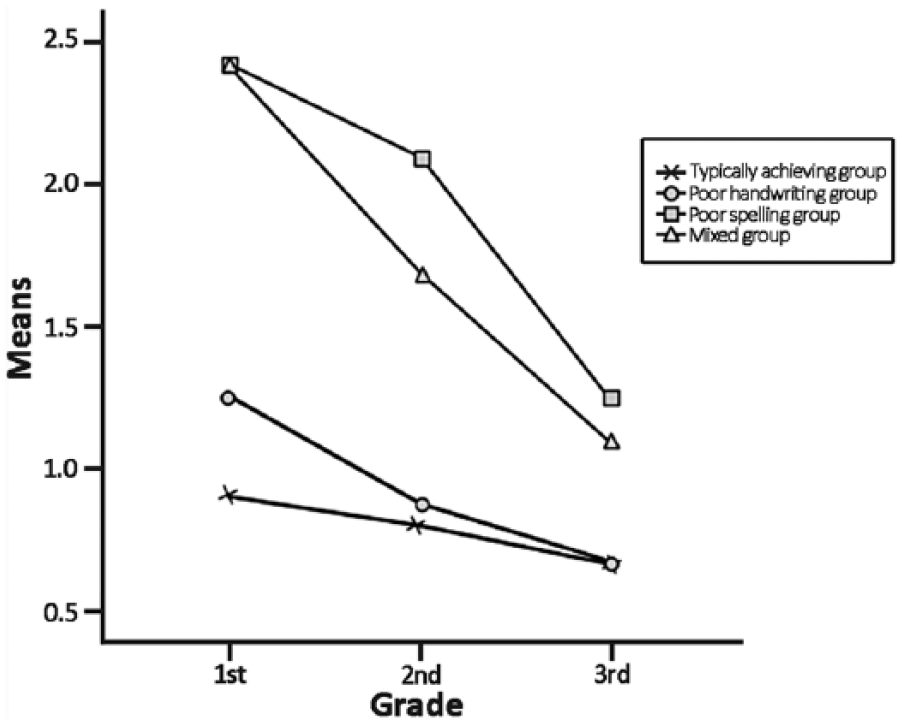
Number of omitted letters in alphabet writing in 1 min.
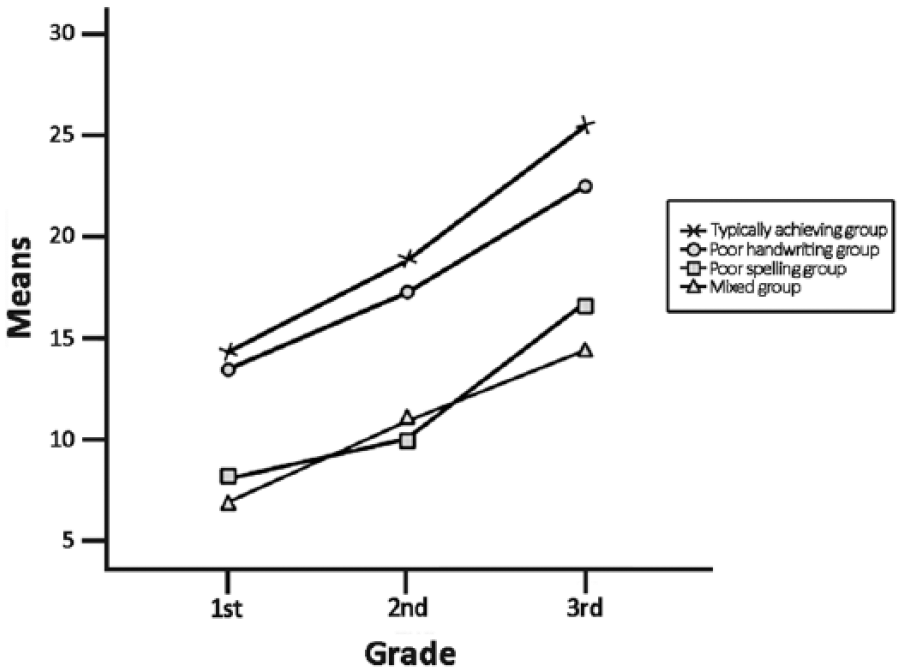
Number of letters written correctly in alphabetic order in 1 min.
Number of Omissions
An ANOVA with post hoc comparisons was performed in order to interpret the interaction effect. The post hoc analysis revealed that for Grades 1 and 2 both the poor spellers and the mixed group were significantly outperformed by the typically achieving group and by the poor handwriters (Grade1: p < .001; Grade 2: p < .01). The differences between the poor handwriters and the typical achievers were not significant; neither were the differences between the poor spellers and the mixed group. In Grade 3 no differences between groups were observed.
To determine whether the difference between these combined groups was significant, a simple effect analysis was performed contrasting the poor handwriters and typical achievers with the poor spellers and the mixed group. In Grade 1 the simple effects indicated that children with spelling difficulties, with or without handwriting difficulties, committed significantly more omissions compared to the typically achieving and poor handwriting groups, F(1, 346) = 53.57, p < .001, r = .37. In Grade 2 the same pattern was observed: The typically achieving and poor handwriting groups significantly outperformed the poor spelling and mixed groups, F(1, 346) = 19.99, p < .001, r = .23. In Grade 3, however, there were no significant differences between groups, F(1, 346) = 1.957, p = .163, r = .07. The number of omissions by the typically achieving and poor handwriting groups was relatively stable; their performance did not improve significantly across grades. Grade level did exert a small, but significant, effect over the group with spelling difficulties, F(2, 340) = 13.7, p < .01, r = .20, and the mixed group, F(2, 340) = 10.01, p < .01, r = .17.
Orthographic Motor Integration
Six nonorthogonal planned contrasts were performed to follow up the main effects for group and grade in orthographic motor integration. We examined whether all groups with difficulties together performed below the typically achieving group: if the poor handwriters performed below the typically achieving children, if the poor spellers performed below the poor handwriters, and if the mixed group performed below the poor spellers. Applying the Bonferroni correction (.05/6) to reduce the chances of obtaining false-positive results (Type I error), we used a critical p value of .01.
The first planned contrast revealed that when comparing typically achieving students with the three groups with difficulties together, the typically achieving students were more fluent in typing the alphabet than the groups with difficulties, t(348) = −7.12, p < .01, r = .36. We then compared the groups with difficulties separately. When just comparing the poor handwriting group with the typically achieving children, there was no significant difference, t(348) = −1.67, p = .095, r = .08. The poor spellers performed significantly below the poor handwriters, t(348) = −5.78, p < .01, r = .30. There was no significant difference between the poor spellers and the mixed group, t(348) = −.86, p = .388, r = .04.
The planned contrasts for the grade effect revealed that children in Grade 2 wrote the alphabet more fluently on a keyboard than did Grade 1 children, t(980.69) = 7.65, p < .01, r = .24. The Grade 3 children displayed greater automaticity in writing the alphabet on a keyboard than the Grade 2 children, t(821.45) = 11.23, p < .01, r = .36.
Discussion
The aim of the study was to compare children with different writing profiles (typically achieving, poor handwriting only, poor spelling only, and mixed) based on paper-and-pen writing assessment, in their keyboarding performance of alphabet writing.
When comparing the typically achieving group with the three groups with difficulties together, we observed that the typically achieving children outperformed the groups with difficulties on the alphabet-typing task. However, contrary to our hypothesis, when we compared the groups with difficulties separately, results indicated that children with poor handwriting skills did not perform below typically achieving children. The poor handwriters even performed significantly better than the children with spelling disabilities and the mixed group in both orthographic motor integration and the number of omitted letters. Christensen (2004) argued that handwriting difficulties will be transferred to keyboard writing because skills other than fine motor abilities are involved in keyboarding. Berninger et al. (2009) also concluded that children with transcription disabilities are not relieved from the mechanical burden of writing when using the keyboard. In the current research design, we could not compare the pen versus keyboard writing modes, but we can conclude that the poor handwriters, who performed below the typically achieving children in handwriting copying tasks, kept up with the typical achievers when they typed the alphabet on a keyboard. Writing by pen requires fine motor skills to form neat and legible letters that are well aligned. When writing by keyboard, children do not have to worry about those aspects. This study demonstrates that in children with specific handwriting difficulties, keyboarding increased the rate of alphabet production.
A floor effect was observed for typically achieving students and poor handwriters in the number of omitted letters when typing the alphabet in order. There was little variability in their omission scores, as most of these children did not omit any letter or just one, even in Grade 1. Grade level did not affect the performance of these groups, because the number of omissions could hardly be reduced. The groups with poor spelling committed more omission errors than the typical achievers and the poor handwriters in Grades 1 and 2. In Grade 3, however, there were no differences between the groups. The higher number of omission errors seems to indicate that children with poor spelling ability had difficulty remembering the order of the alphabet and the corresponding letters, while the poor handwriters did not demonstrate such difficulty.
Orthographic motor integration in keyboard writing was better developed in typically achieving students and in poor handwriters. Their performance developed and improved with every grade level. No interaction effect was found, which means that although the poor spellers and the mixed group lagged behind their peers, they developed alphabet-typing fluency at the same rate, improving their performance at every grade level. Berninger et al. (2009) indicated that at the letter level, children with and without transcription disability write letters more automatically with the keyboard than with the pen. The results of the current study demonstrated that children with spelling difficulties lagged behind their peers in typing the alphabet on a keyboard. For intervention purposes, it is important to take into account that poor spellers might need extra instruction to develop automaticity in keyboarding.
Study Limitations
This study has a number of possible limitations. The first is that differences between groups have been analyzed only on the alphabet-typing task. Other researchers, such as Connelly, Gee, and Walsh (2007) demonstrated that children write more and faster by pen than by keyboard, probably because of practice and experiences in writing by pen. This was also the case for children with transcription disabilities (Berninger et al., 2009). Because this study focused exclusively on alphabet typing, no conclusions can be drawn for sentence or text writing on a keyboard. In this study, poor handwriters typed the alphabet like typical achievers. Jiménez et al. (2016) corroborated this finding when studying the performance of poor handwriters in typing words and sentences. However, regular practice (and perhaps explicit instruction) on the keyboard might be needed for poor handwriters to keep up with the typical achievers when it comes to fluency in essay writing on a keyboard, as fine motor abilities will become more relevant when developing typing skills (Stevenson & Just, 2012).
Another limitation of this study is the method of classifying children based on tasks that are correlated; in this case, the handwriting tasks and the spelling tasks. The critique of this classifying method comes from Schatschneider, Carlson, Francis, Foorman, and Fletcher (2002) in relation to the double deficit theory in reading disabilities. The authors demonstrated that the severity of the disability of the group with the double deficit (which is the mixed group in the current study, with both handwriting and spelling difficulties) is at least partly due to a statistical artifact caused by the method of classifying. One could assume that the severe problems of the mixed group were caused by the double deficit. On the other hand, Schatschneider et al. argue that when tasks that are used to classify groups are correlated, a distortion in the cell means is introduced, which in turn results in lower mean levels of spelling ability for the mixed group than for poor spellers. This would explain the severity of the difficulties in the mixed group. In the current study, the mixed group tended to perform below the poor spellers, although the differences were not significant. We should be aware that it is possible that this tendency was not caused by having a double deficit (poor handwriting + poor spelling) but rather by the method of classifying.
The students with spelling difficulties performed below the typical achievers and the poor handwriters on keyboard orthographic motor integration. The spelling factor that was used to classify children with spelling difficulties contains the alphabet-writing task in paper-and-pencil writing mode. One could argue that this is the reason that children with spelling difficulties performed below the other groups in the alphabet-writing task; however, the alphabet task was the one that loaded least on the spelling factor (.496), contributing very little to the factor scores. The tasks that denominated the spelling factor were writing dictated words with inconsistent spelling (.790), writing dictated words that fit spelling rules (.779), writing sentences from dictation (.687), and writing dictated pseudowords (.626); see Jiménez (2016) for more detailed information.
Conclusion
This study has been a first attempt to investigate the keyboarding skills in alphabet writing of Spanish children with different writing profiles. In the current study we focused exclusively on alphabet writing, and therefore we do not expect that the transparency of the Spanish language will influence the results. Transparency could affect keyboard performance when it comes to typing sentences or text. Jiménez et al. (2016) reported that Spanish children with spelling disability lagged behind their peers when typing words and sentences. The Spanish orthography is easier to master than the English orthography; therefore, English children might be better trained in visual/orthographic cues. For future research we recommend studying sentence and essay writing in opaque languages in order to obtain more insight into keyboarding skills of these vulnerable groups in other language domains. It would also be interesting to study the keyboard performance of older children, as keyboarding is not yet taught in the early grades.
Footnotes
Declaration of Conflicting Interests
The author(s) declared no potential conflicts of interest with respect to the research, authorship, and/or publication of this article.
Funding
The author(s) disclosed receipt of the following financial support for the research, authorship, and/or publication of this article: This research was supported by Agencia Canaria de Investigacion, Innovacion y Sociedad de la Informacion, ref. ProID20100030 from the Government of the Canary Islands.