






Abstract
This longitudinal study examined story-writing development of students from Grade 4 to Grade 6, comparing the developmental trajectories of English as a first language (EL1s; n = 43) and English learners (ELs; n = 108) in general, and in groups of EL1s and ELs with typically developing and poor reader profiles. In relation to their EL1 or EL reference group, students were classified in Grade 4 as typical readers (n = 72), poor decoders (n = 53), or poor comprehenders (n = 26), with EL1s and ELs proportionally represented in each group. The effects of language, grade level, and reading group on story-writing measures were examined. Both EL1s and ELs developed story-writing skills in a similar manner, showing significant growth between Grades 4 and 6. Typically developing ELs attained age-appropriate story-writing levels. Poor decoders and poor comprehenders showed similar profiles of strengths and weaknesses, regardless of whether English was their first or second language. Both poor reader groups had significant difficulties in story-writing, struggling with the mechanics of writing, sentence structure, and story organization. Findings are discussed in terms of the interconnected relationship between reading and writing profiles, and the importance of a comprehensive understanding of sources of learning difficulties in ELs and EL1s.
Literacy skills are critical factors for success at school for all students, regardless of language status. There is a large body of research on the typical and atypical development of various aspects of reading in students who speak English as a first language (EL1s). This research has expanded to investigations of typical and atypical development of reading skills among English learners (ELs; Spencer & Wagner, 2017). However, by comparison, less is known about the development of writing in ELs, and the relationships between reading and writing in typically developing and struggling ELs have received very little attention to date. The current study sought to capitalize on what is already known about poor and skilled readers and apply this knowledge to examine how writing skills develop in ELs and EL1 students.
Writing Development
The “simple view of writing” (SVW) stipulates that transcription skills and executive functions are the two necessary components for text generation, that function within a limited working memory framework (Berninger et al., 2002), and that underlie writing difficulties. Transcription skills consist of handwriting and spelling, while executive functions include planning, monitoring, reviewing, revising, organizing, and attending. Working memory is required to generate and manage ideas for text generation, and to translate those ideas into language. In turn, language must be translated into orthographic symbols, whether using paper and pencil or a keyboard. The working memory environment is capacity-limited, and the fewer the resources required for transcription skills, the greater the resources available for higher level composing skills (MacArthur, Graham, & Fitzgerald, 2006). The SVW framework implies that mastery and coordination of lower level transcription skills are necessary (though not sufficient) to produce high-quality, coherent, fluent writing at the text level. The SVW has been useful as a framework for understanding writing development in both EL1s and ELs.
Research findings suggest that young ELs develop writing skills in much the same way as their EL1 peers. This includes using invented spellings, showing awareness that print conveys meaning, responding well to opportunities to write, changing stances for different writing audiences, and being able to critically evaluate text (August & Shanahan, 2006). In general, ELs can demonstrate spelling and composition skills that can be on par with their monolingual peers when their schooling in English begins in the primary grades, even though they may take longer to master the spelling of specific phonemes that do not exist in their L1 (Wang & Geva, 2003). In a similar vein, Babayiğit (2014) demonstrated that the contributions of word-level skills (e.g., spelling, word reading) and language skills (e.g., vocabulary) to the writing quality in narratives produced by 9-year-old students are similar between ELs and EL1s. This suggests that similar processes are involved in writing development regardless of language status, and that ELs can be successful in creating meaningful narratives even as their oral language skills are still developing.
Harrison and colleagues (2016) also found that EL and EL1 students in Grade 3 demonstrated similar writing proficiency on a narrative paragraph writing task. However, they noted subtle differences between the language groups on the relative contributions of the component processes related to writing. For example, the ELs benefited from lexical access (rapid naming) and grammatical knowledge, whereas the EL1 students relied on vocabulary and grammatical knowledge. This suggests that ELs are compensating for their weaker oral language by using alternate cognitive-linguistic pathways to achieve writing success.
The Affinity Between Reading and Writing Skills
Fitzgerald and Shanahan’s (2000) call to consider the importance of the reading–writing connection has generated research that underscores shared knowledge and cognitive processes between reading and writing. According to this approach, reading and writing are connected because they rely on similar knowledge representations, cognitive processes, and contexts. Fitzgerald and Shanahan (2000) outlined four main types of knowledge that readers and writers both use, including meta-knowledge, relevant content knowledge in a domain, knowledge about universal text attributes (e.g., phonological awareness, morphology, syntax, text structure formats), and procedural knowledge. The shared knowledge approach suggests that the relationship between reading and writing skills may be bidirectional, and, therefore, that there should be a “spillover” effect from intervention targeting reading to improvement in writing skills and, conversely, from writing instruction improving reading skills (e.g., Graham & Hebert, 2011; Graham et al., 2018). To illustrate, a meta-analysis by Graham and colleagues (2018) demonstrated that teaching reading strengthened students’ writing ability in both elementary and secondary school students, with statistically significant effects found across a variety of writing measures (overall writing, writing quality, words written, spelling).
The notion that reading and writing skills are interconnected is especially relevant for children who struggle with reading and writing, and is even more poignant for struggling ELs. However, unlike the field of reading, theoretically motivated, systematic, and rigorous research on writing development is less advanced (MacArthur et al., 2006; Miller & McCardle, 2011). Research has documented the affinity between word reading and spelling skills among EL1 children, and the contribution of processing skills such as phonological awareness to both word reading and spelling (e.g., Moats, 2005). Similar relationships have been also demonstrated in studies involving ELs (e.g., Geva & Lafrance, 2011; Jongejan, Verhoeven, & Siegel, 2007).
Writing Development in Students With Reading Difficulties
Students can be identified whose difficulties reside primarily in the realm of word-reading-related difficulties (poor decoders) or reading comprehension difficulties (poor comprehenders). Not surprisingly, there is growing evidence to suggest that students with reading problems also have significant challenges with writing. Research findings consistently reveal that similar underlying cognitive processes (i.e., phonological awareness, rapid naming skills) are associated with decoding difficulties in L1 and L2 learners (Lesaux & Geva, 2006; McBride-Chang, Liu, Wong, Wong, & Shu, 2012). Morken and Helland (2013) found that the cognitive skills that are important for reading (i.e., phonological processing, rapid naming, working memory) differentiated the dyslexic group from the typically developing group of 11-year-old students in terms of various writing indices, such as transcription fluency and semantic errors.
Research with poor comprehenders has shown that they generally do well on spelling measures, but their written narratives capture less of the story content compared with good comprehenders (Carretti, Re, & Arfe, 2013; Cragg & Nation, 2006). Specifically, poor comprehenders produce fewer main ideas and less sophisticated story structures, and demonstrate difficulty in organizing and communicating a narrative. Poor comprehenders who do not have decoding difficulties may have cognitive and linguistic profiles that are distinct from those found among poor decoders. For example, poor comprehenders tend to have below average vocabulary, semantic, morphosyntactic, listening comprehension, and oral story-telling skills (Catts, Adlof, & Wiesmer, 2006), and struggle with higher level and metacognitive skills such as inference-making and comprehension-monitoring (Cain, Oakhill, & Bryant, 2004). Research suggests that ELs who are poor comprehenders also struggle with various language aspects, including semantic, syntax, and morphosyntactic skills (Geva & Massey-Garrison, 2013; Spencer & Wagner, 2017).
The Current Study
While there is general agreement of a connection between reading and writing, the exact nature of this connection is still not fully laid out (Graham & Hebert, 2011). It is not clear whether the writing profiles of EL1s and ELs who are poor decoders or those who are poor comprehenders have distinct writing strengths and weaknesses. Given what is known so far, it stands to reason that one should find that the writing profiles of poor decoders and poor comprehenders are limited by different component skills of writing. For example, it is likely that the poor decoders’ narratives will be limited by spelling difficulties, whereas the poor comprehenders’ narratives will be limited by their difficulties with oral language (grammar, syntax, vocabulary). Finding that such distinct patterns exist should shed light on the potential correspondence between patterns of reading strengths and weaknesses and distinct writing strengths and weaknesses. This will also help in the development of more effective literacy interventions for struggling students.
The present study examined the story-writing development of school-aged students from Grade 4 to Grade 6 with a focus on comparing the writing development of EL1s and ELs who were typical readers, poor decoders, or poor comprehenders. Three questions were addressed: (a) Do ELs develop writing skills at a different rate, or with differing profiles, as compared with EL1s? (b) Do poor decoders and poor comprehenders develop writing skills at a different rate, or with differing profiles, as compared with typically developing readers? and (c) Do ELs with reading difficulties differ from EL1 students with reading difficulties in terms of their writing development?
Method
Participants
The data for the present study were taken from a larger project that followed a cross-sequential longitudinal design. It involved four successive cohorts of students who were recruited in Grade 1 and followed from Grades 1 to 6. Newcomer ELs are withdrawn daily for 30 to 40 min of English-language instruction for up to 2 years and are placed in regular classrooms for the rest of the school day. Regular classroom teachers are expected to provide additional language support as needed. Classrooms in urban areas reflect immigration trends, and EL participants came from a variety of home language backgrounds. The students were tested yearly on a variety of cognitive, language, and literacy measures. The sample was drawn from 14 schools in four different school boards in a large multicultural and multilingual Canadian city. EL1 and EL students were recruited from the same schools and classes.
The EL sample consisted of students who had been living in an English-speaking country for at least 4 months prior to Grade 1. Information regarding students’ L1 was gathered from school files, with appropriate informed parental consent, at the onset of the study. Gender distribution was roughly equal. Writing was assessed annually in Grades 4 to 6. The average age at time of testing in Grade 4 was 9 years, 6 months; in Grade 5, the mean age was 10 years, 8 months; and in Grade 6, 11 years, 7 months. The ELs came from six different language groups: Portuguese, Punjabi, Tamil, Urdu, Chinese, and Russian. The sample for the present study consisted of 151 students: 108 ELs and 43 EL1s.
Missing data are inevitable in longitudinal research, and data from participants who dropped out over time were eliminated. To ensure the cases with missing data did not differ significantly from cases with complete data, Little’s Missing Completely at Random (MCAR) test was conducted with language status (EL1 or EL) and gender entered as categorical variables and Wide Range Achievement Test–Third Edition (WRAT-3) spelling scores (see below) in Grades 4, 5, and 6 entered as continuous variables. Given that spelling and story-writing scores were highly correlated in all three grades (r = .68, p < .01, in Grade 4; r = .69, p < .01, in Grade 5; and r = .69, p < .01, in Grade 6), spelling scores appeared to be a suitable proxy for story-writing scores. The results confirmed that the data for the sample were MCAR, χ2(8) = 10.12, p = .26. That is, patterns of missing data were unrelated to language status, gender, or spelling abilities. Therefore, it can be assumed that the data used in the current analysis were representative of the overall sample.
Measures
Receptive vocabulary
The Peabody Picture Vocabulary Test–Revised (PPVT-R; Dunn & Dunn, 1981), a test of receptive vocabulary, was used to assess children’s oral language proficiency. The internal consistency for this test was .92 and .93 for EL and EL1, respectively.
Real-word reading
A test of word recognition, the Reading subtest on the WRAT-3 (Wilkinson, 1993), was used to determine children’s ability to identify and decode age-appropriate English words. The WRAT-3 reliability coefficients range from .85 to .95.
Pseudoword decoding
The Word Attack subtest from the Woodcock Reading Mastery Test–Revised (WRMT-R; Woodcock, 1987) was administered to evaluate children’s ability to read nonwords using appropriate grapheme–phoneme correspondence rules. The internal consistency and split-half reliability exceed .90.
Reading comprehension
The Reading Comprehension subtest from the Gates–MacGinitie Reading Test (GMRT; MacGintie & MacGintie, 1992) was used to assess students’ comprehension of narrative and expository text. In Grades 4, 5, and 6, Level D4 (Form 3), Level D 5/6 (Form 4), and Level D 5/6 (Form 3) were administered, respectively. There was high internal consistency in the current data (Cronbach’s α = .85–.88 across time points).
Spelling
The Spelling subtest of the WRAT-3 (Wilkinson, 1993) measures children’s ability to spell English words of increasing difficulty. The WRAT-3 reliability coefficients range from .85 to .95 in the EL1 and EL groups.
Story composition
The Test of Written Language–Third Edition (TOWL-III) story composition (Hammill & Larsen, 1996; Spontaneous writing format, Forms A and B) was the dependent measure of main interest. Form A was administered in Grades 4 and 6, while Form B was administered in Grade 5. The standard TOWL scoring consists of three subtests and a total story-writing score that combines the three subtests for a maximum of 70 points. The Contextual Conventions subtest targets the ability to utilize the basic mechanics of writing in context. It consists of 12 items that address the appropriate usage of capital letters, punctuation, and spelling. A global rating system is used for most items (e.g., 0 = poor, 1 = average, 2 = good), for a total of 18 points. The second subtest, Contextual Language, focuses on higher level language aspects of writing in context (e.g., grammar, vocabulary, verb usage). Its 14 items evaluate quality of sentence structure (e.g., presence of run-on sentences, the use of compound and complex sentences), components of sentences (e.g., introductory phrases, conjunctions), and the quality of writing (e.g., subject–verb agreements, complexity of vocabulary used). A total of 31 points can be obtained. The third 11-item subtest, Story Construction, focuses on the overall coherence and quality of the story (i.e., plot and sequence). The quality of the prose, character development, use of emotion, and action are also rated. A total of 21 points can be obtained.
To add nuance and depth, writing was rated on the following supplemental criteria: word count; the proportion of punctuation, capitalization, and spelling errors per 100 words; and the number of correctly spelled words with seven or more letters. To capture syntactic complexity, the proportion of T-units (see Note 1) present in poorly constructed, simple, or complex/compound sentences in relation to the overall number of T-units in the story was also calculated.
The TOWL-III was generally considered to be a valid and reliable test (internal consistency, test–retest reliability with alternate forms, scorer reliability coefficients approximate .80–.90 for different ages according to the manual). Scoring of the TOWL-III Story Composition was conducted by two graduate students and an undergraduate research assistant with background in linguistics. To minimize scorer bias, each of the three subtests (Contextual Conventions, Contextual Language, and Story Construction) was scored separately on different occasions. Coding reliability was established separately for each of the three subtests (Contextual Conventions, Contextual Language, and Story Construction). Randomized samples of 20% of the stories at each data collection wave were double-scored. Intra-rater reliability was calculated with intra-class correlation coefficients. Given that Form A was administered in Grades 4 and 6, reliability for those grades was calculated together. Form B was administered in Grade 5 only, and its reliability was calculated separately. A high degree of reliability was achieved for the Contextual Conventions and Contextual Language subtests (0.92 and 0.91, respectively, in Grades 4 and 6; 0.96 and 0.93 in Grade 5). Reliability for the Story Construction subtest was also acceptable (0.95 in Grades 4 and 6; 0.81 in Grade 5).
Reading Groups Defined
In line with the simple view of reading (SVR) framework (Gough & Tunmer, 1986), children were defined as typical readers, poor decoders, or poor comprehenders. The following guidelines were used with the present sample. The 30th percentile was chosen as a cutoff point for poor readers, and children who scored above the 40th percentile were considered typical readers. This methodology placed typical readers squarely in what is usually considered the “average” to “above average” ranges, thereby ensuring they represented a skilled reading group. Students who scored between the 31st and 40th percentiles were not included in subsequent analysis, to make the poor reader groups and the typical readers more distinct. This relatively lenient cutoff for the poor reading groups and relative strict criterion for the typical reader group minimized reading ability overlap between groups, following past research practices (e.g., Geva & Massey-Garrison, 2013; Kruk & Luther Ruban, 2016). Early intervention research has used a cutoff at the 25th or 30th percentile on reading measures to identify children who are at risk for reading difficulties (Scanlon, Anderson, & Sweeney, 2010). The practice of using cutoffs has been challenged (Branum-Martin, Fletcher, & Stuebing, 2013). It is important to recognize that the skills that characterize learning disabilities are dimensional (Snowling & Hulme, 2012) and that severity varies along these continua.
To identify poor decoders, a composite decoding score was calculated by averaging students’ Grade 4 pseudoword decoding and real-word reading raw scores. In line with the literature reviewed, an independent-samples t test revealed no significant differences between the EL1 (M = 30.40, SD = 6.04) and EL (M = 30.20, SD = 7.18) groups on the decoding composite score, t(176) = 0.19, p = .85. As the EL and EL1 groups did not differ from each other on the composite decoding measure, students who scored at or below the 30th percentile of the combined sample (EL1 and EL) on the decoding measure were identified as poor decoders. A group of 53 students was identified as being poor decoders (24 boys, 29 girls; 16 EL1 students, 37 EL students).
An independent-samples t test revealed significant group differences between the EL1 (M = 26.23, SD = 7.80) and EL (M = 23.21, SD = 7.72) groups on reading comprehension scores in Grade 4, t(176) = 2.42, p = .02, with the ELs scoring significantly lower than the EL1 students. Research demonstrates that ELs often lag behind their monolingual peers on reading comprehension, even after many years of schooling in the L2 (Farnia & Geva, 2013). In an effort to avoid over-identifying ELs as poor comprehenders, separate cutoff points were used based on the 30th percentile score in the EL1 and EL groups, respectively. Using the 30th percentile mark for the whole sample would have resulted in fewer EL1 students and more ELs being identified as poor comprehenders. Therefore, students were identified as poor comprehenders relative to their EL/EL1 group. Children who scored at or below the 30th percentile on reading comprehension relative to their respective language group (i.e., EL1 or EL), and above the 40th percentile on the decoding composite score relative to the whole sample, were identified as poor comprehenders. A group of 26 students was identified as poor comprehenders (17 boys, 9 girls; 7 EL1 students, 19 EL students). Typical readers were those who scored above the 40th percentile on decoding (relative to the whole sample), as well as on reading comprehension (relative to their respective EL1 or EL language group). A group of 72 students was identified as typical readers (32 boys, 40 girls; 20 EL1 students, 52 EL students). The breakdown of typical readers, poor decoders, and poor comprehenders was similar across language groups (typical readers: 48% EL, 47% EL1; poor decoders: 34% EL, 37% EL1; poor comprehenders: 18% EL, 16% EL1). Two-way contingency table analyses confirmed that language status (i.e., EL1 vs. EL) was not significantly related to the reading ability group, Pearson χ2(2, N = 151) = 0.12, p = .94, and that the proportions of students who were EL1s/ELs were similar across the three reading groups.
Results
Before proceeding with the research questions motivating this study, it was important to establish that the EL and EL1 groups differed from each other on English-language proficiency. The vocabulary means and standard deviations in the EL and EL1 groups, respectively, for each grade level were as follows—Grade 4: EL = 94.74 (15.51) and EL1 = 105.54 (12.16), Grade 5: EL = 101.21 (14.44) and EL1 = 110.49 (11.59), and Grade 6: EL=110.24 (13.03) and EL1=118.61 (11.47). At each grade, the vocabulary scores of the ELs were significantly lower than the vocabulary scores of the EL1 students, F = 21.32 (p ≤ .001). In addition, in both language groups, the vocabulary scores increased from grade to grade.
To investigate writing development between Grades 4 to 6, separate repeated-measures analyses of variance (ANOVAs) were conducted with the writing measures, including supplemental writing scores, entered as dependent variables. Raw scores were used in the analyses rather than normed scores because the published test norms are based on EL1 samples and therefore may not be reliable where ELs are concerned. Language status (EL1-EL) and reading group (typical reader, poor decoder, poor comprehender) were the between-subjects variables. Time (the repeated factor) had three levels: Grades 4, 5, and 6. Due to the large number of analyses conducted, a conservative significance level of p ≤ .001 was chosen. Finally, post hoc pairwise comparisons were carried out to determine the nature of the significant differences between the three groups.
As can be seen in Table 2, the effect sizes for many of the writing measures comparing adjacent grade levels and reading groups were of medium to large magnitude. In contrast, there were no significant EL1-EL differences or noticeable effect sizes for any of the writing measures.
Research Question 1: Do ELs Develop Writing Skills at a Different Rate, or With Differing Profiles, as Compared With EL1s?
The descriptive statistics and ANOVAs for the WRAT-3 spelling measure and the story-writing measures, including supplementary scores, are summarized in Tables 1 and 2, with the outcomes of the group comparisons summarized in Table 3. There were no significant interactions between language status (EL1 vs. EL) on the spelling measure. That is, the ELs and EL1 mean scores on the decontextualized (WRAT-3) spelling skills were not significantly different from each other in Grades 4 to 6. As described in the “Method” section, the story-writing test elicited a variety of summary statistics pertaining to these writing component indicators. There were no significant main effects of language group, indicating that the ELs scored as well as EL1s on story-writing.
Descriptive Statistics for Spelling and TOWL-III Story-Writing Measures by Grade Level, Language Status, and Reading Group.
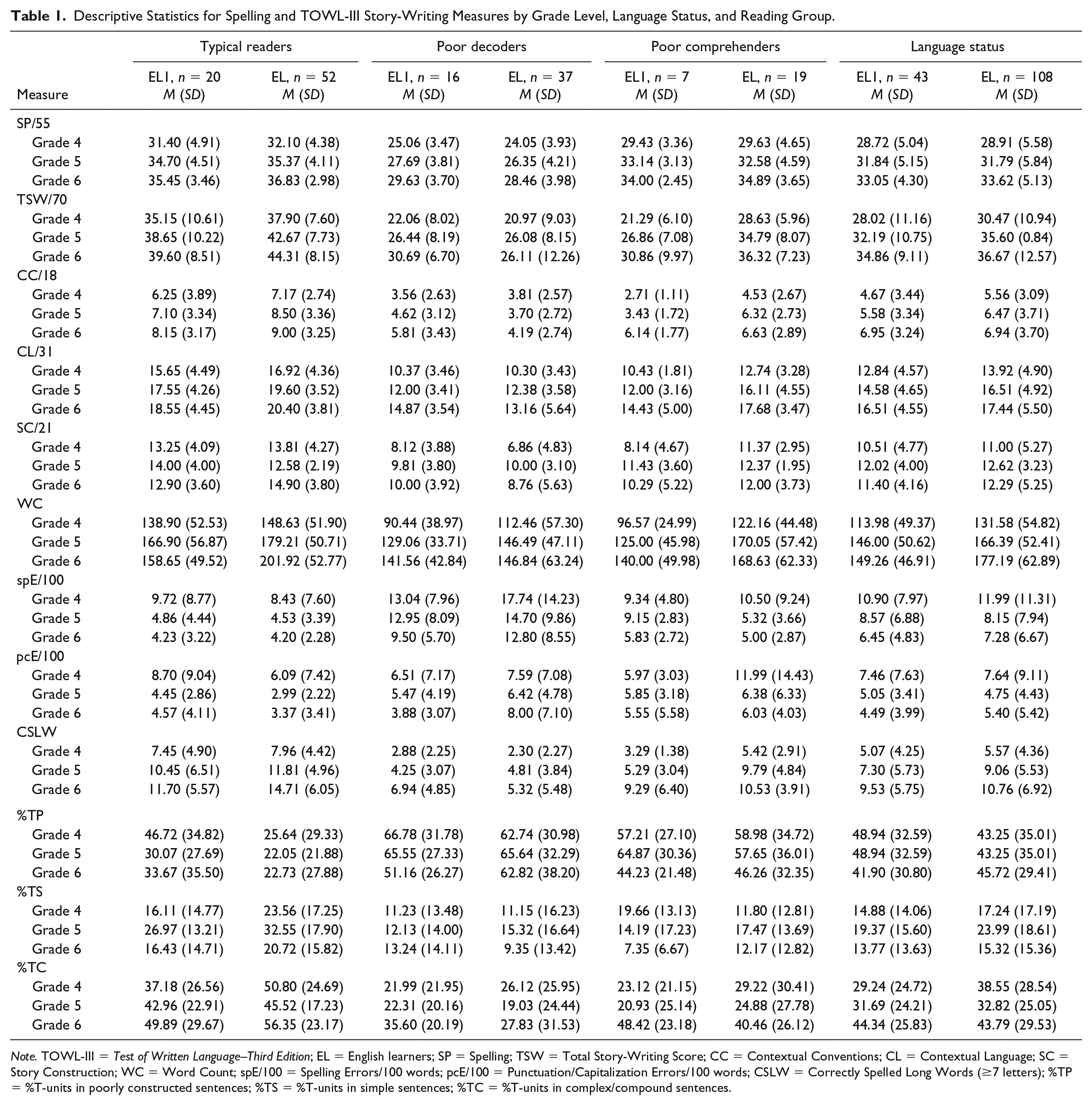
Note. TOWL-III = Test of Written Language–Third Edition; EL = English learners; SP = Spelling; TSW = Total Story-Writing Score; CC = Contextual Conventions; CL = Contextual Language; SC = Story Construction; WC = Word Count; spE/100 = Spelling Errors/100 words; pcE/100 = Punctuation/Capitalization Errors/100 words; CSLW = Correctly Spelled Long Words (≥7 letters); %TP = %T-units in poorly constructed sentences; %TS = %T-units in simple sentences; %TC = %T-units in complex/compound sentences.
Analysis of Variance for Spelling and TOWL-III Story-Writing Scores—The Effect of Grade Level, Language Status, and Reading Group.
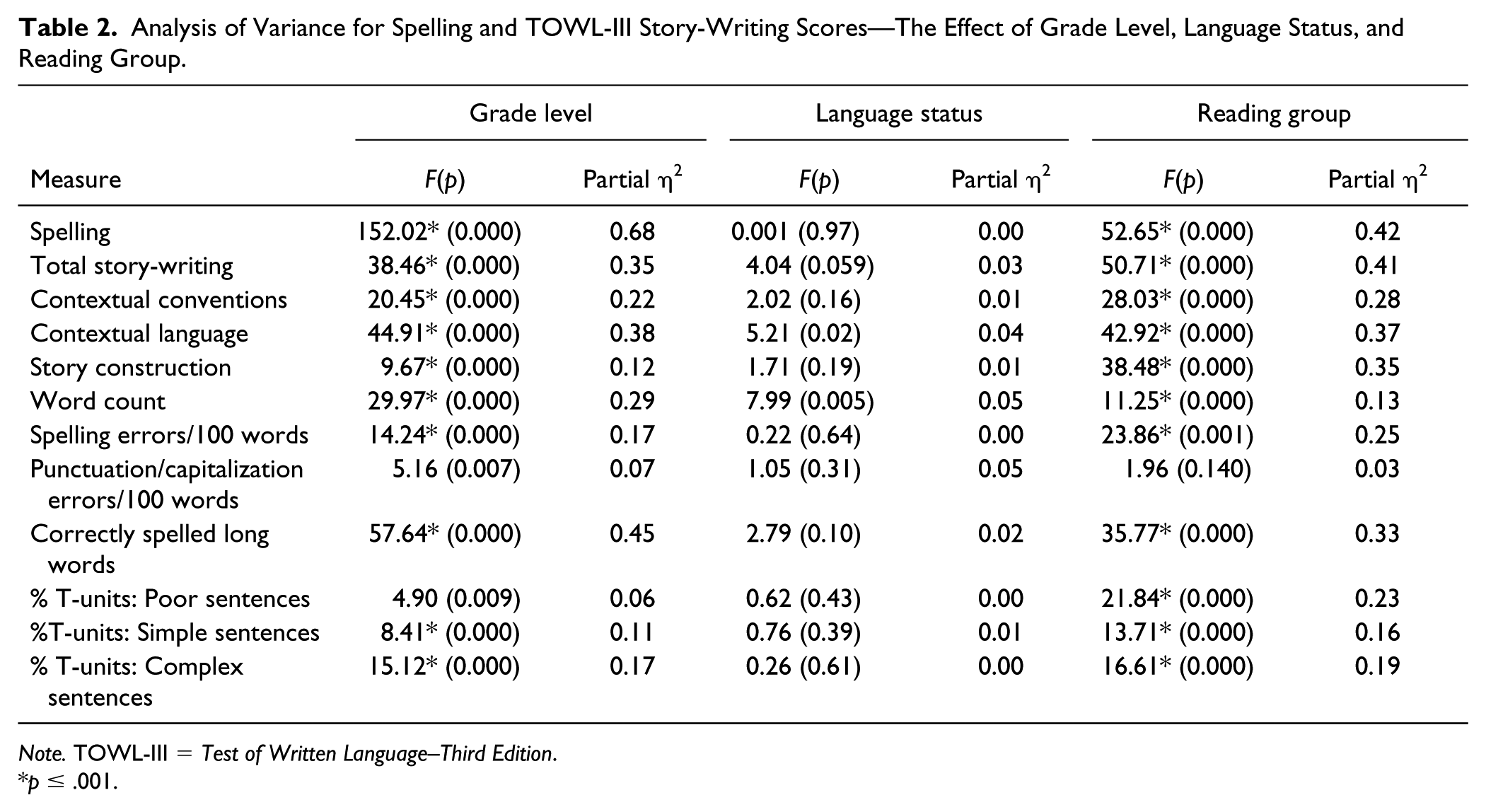
Note. TOWL-III = Test of Written Language–Third Edition.
p ≤ .001.
Pairwise Comparisons for Spelling and TOWL-III Story-Writing Measures Across Grade Level, Language Status, and Reading Group.
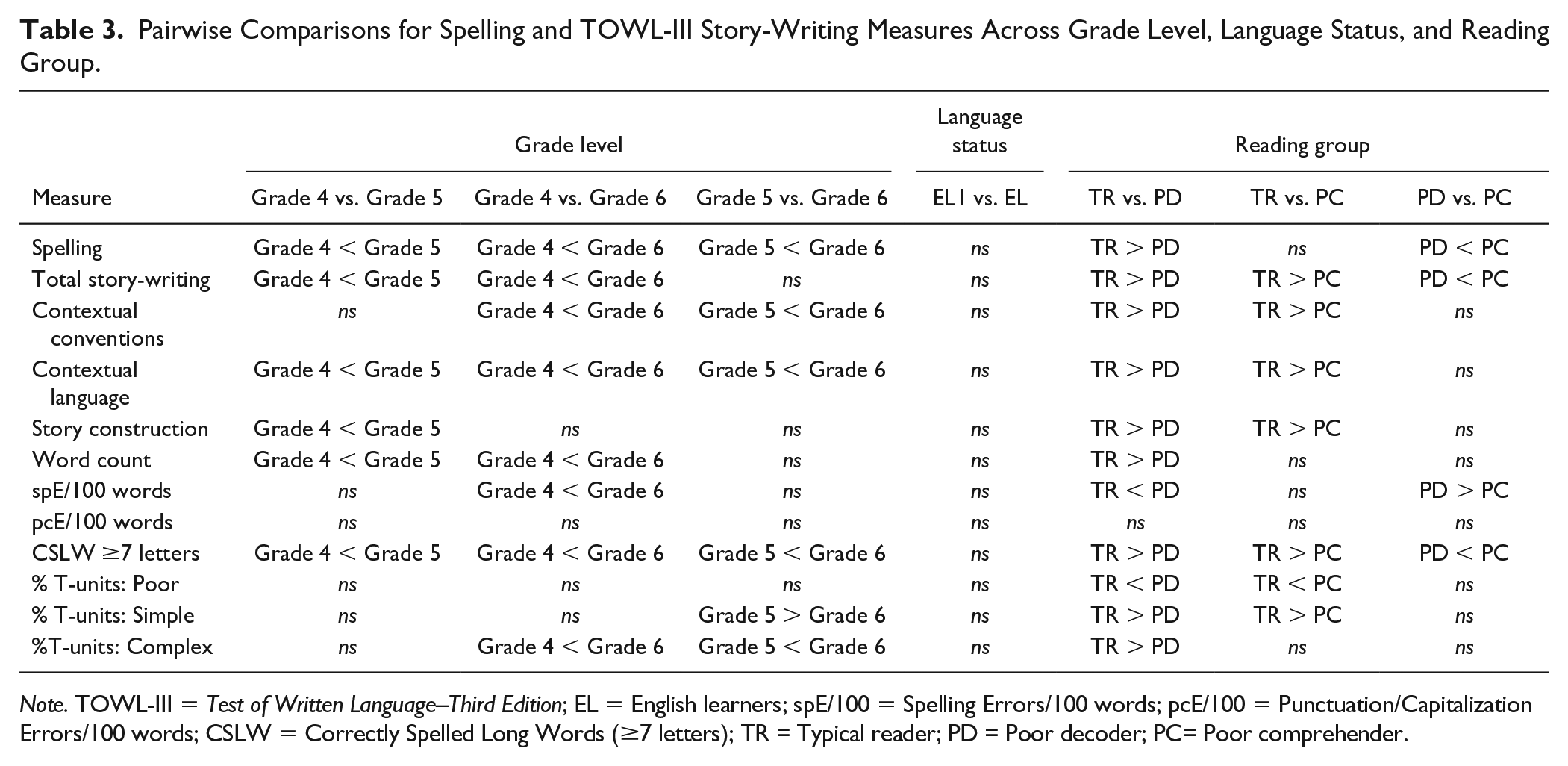
Note. TOWL-III = Test of Written Language–Third Edition; EL = English learners; spE/100 = Spelling Errors/100 words; pcE/100 = Punctuation/Capitalization Errors/100 words; CSLW = Correctly Spelled Long Words (≥7 letters); TR = Typical reader; PD = Poor decoder; PC= Poor comprehender.
EL1s and ELs improved over time in a similar manner on the story-writing total score, contextual conventions subtest, contextual language subtest, and story construction subtest. Across Grades 4 to 6, students also wrote longer stories, made fewer spelling mistakes, were more likely to spell correctly longer words, and gradually increased their use of compound and complex sentences. Coinciding with an increase in compound and complex sentences, students wrote fewer simple sentences in Grade 6 than they did in Grade 5. There appeared to be no discernible change in students’ punctuation/capitalization errors or percentage of poorly constructed sentences over time.
Research Question 2: Do Poor Decoders and Poor Comprehenders Develop Writing Skills at a Different Rate, or With Differing Profiles, as Compared With Typically Developing Readers?
Different profiles emerged among the reading groups (see Table 3). In both the EL and EL1 groups, and across all spelling indices, poor decoders had significantly lower spelling scores than typical readers and poor comprehenders, alike. Interestingly, poor comprehenders spelled more long words correctly than poor decoders, and, in turn, spelled fewer long words correctly than their typically reading peers. All groups improved from grade to grade in a similar manner when spelling words in isolation.
Distinct story-writing profiles were also associated with the reading groups. Typical readers had significantly higher story-writing total scores than poor decoders and poor comprehenders. In turn, poor comprehenders had significantly higher scores than poor decoders on total story-writing scores. In addition, typical readers scored significantly higher than both the poor decoder and poor comprehender groups on all three narrative writing subtests (i.e., contextual conventions, contextual language, and story composition). Typical readers wrote more well-constructed simple sentences than other students, and a higher proportion of compound and complex sentences than poor decoders and poor comprehenders, though the latter difference did not reach significance. In addition, typical readers wrote longer stories, having a significantly higher word count than the poor decoders.
Contrary to expectations, with the exception of spelling, there were no significant differences between poor decoders and poor comprehenders on any of the three story-writing subtests—contextual conventions, contextual language, or story composition. Both poor decoders and poor comprehenders had problems with writing mechanics, grammar, and story organization, and both struggled with sentence structure, producing significantly more badly constructed sentences in their writing than typical readers. There were no differences between the reading groups on the number of punctuation/capitalization errors. Poor comprehenders tended to write fewer words than typical readers but more words than poor decoders; however, neither difference reached statistical significance.
Research Question 3: Do ELs With Reading Difficulties Differ From EL1 Students With Reading Difficulties in Terms of Their Writing Development?
There were no significant interactions of language group with reading group. The ELs with a poor decoder or poor comprehender profile performed similarly to EL1s with a poor decoder or poor comprehender profile on the spelling and story-writing measures. ELs who were poor decoders tended to mirror their EL1 peers with decoding problems in terms of performing below both typical readers and poor comprehenders on the spelling measures, and performing below typical readers on the story-writing indices. Likewise, EL and EL1 poor comprehenders demonstrated similar profiles performing below typical readers on story-writing indices but maintaining intact spelling skills.
Discussion
Similar Growth in Story-Writing in EL1 and EL
Both ELs and EL1s showed considerable growth in story-writing skill over time—This is evident whether one focuses on component writing skills or on more global indices. Specifically, as they advanced to Grade 6, students demonstrated increased writing fluency evidenced in their tendency to produce longer stories, improved lower level writing skills such as spelling, and increased use of “academic” vocabulary as demonstrated in their attempts to spell correctly words with at least seven letters (e.g., anymore, captured). They also improved their understanding of sentence structure and were better able to produce in their narratives grammatically correct compound and complex sentences.
The current results are in line with previous research showing that older EL1 students demonstrate more sophisticated written vocabulary in their narrative writing than their younger peers (Olinghouse & Leaird, 2009), and extend this observation to ELs who have begun their schooling in their L2 in Grade 1. The longitudinal design helped to demonstrate that both ELs and EL1s can and do improve their writing skills over time, and that this improvement is noted across the board on the various writing component skills. Over time, there was gradual overall improvement in the mechanics of writing and grammatical skills, reflected in the narratives produced by EL1 and EL students, and spelling (assessed out of context).
In addition, the ELs and EL1s improved their higher level narrative writing skills, demonstrating advancement on story plots, sequencing, character development, and introductory and concluding statements. With time and school experience, students’ written narratives reflected improved story grammar elements. Of particular interest is the finding that there were no significant effects of language status on story-writing. Both the EL1 and EL groups had similar story-writing profiles, regardless of whether English was their first or second language. This supports previous research that has shown writing quality and proficiency to be similar between EL and EL1 students despite the ELs having lower oral language proficiency (Harrison et al., 2016).
The Writing Skills of Poor Decoders and Poor Comprehenders
The present study demonstrates that reading group is a significant source of variation in written expression skills. Whether they are EL1 or EL, poor decoders and poor comprehenders struggle with writing tasks, and on the whole, both poor decoders and poor comprehenders experience significant difficulty with story-writing.
It appears that the quality of the narratives of the typical readers is in sync with their decoding skills, and their ability to comprehend what they read and their writing skills continue to improve over time. The typical comprehenders are also typical writers who use language components effectively and accurately, are increasingly able to produce complex syntactic structures, are not hampered by writing conventions such as the use of capital letters and punctuation, and can produce engaging and well-formed written narratives. Children with word decoding or reading comprehension difficulties alike gradually improve their writing skills as well, but they continue to produce narratives that are of poorer quality on a variety of indices, including their ability to monitor writing conventions, their ability to produce more complex language structures, and their ability to write stories that comply with narrative conventions.
Interestingly, the written products of the poor decoders and poor comprehenders are not associated with distinct story-writing profiles. Instead, in comparison with typical readers, poor decoders and poor comprehenders alike demonstrate significant difficulty in composing narratives. Whether they are monolinguals or ELs, students who are poor decoders or poor comprehenders have significant trouble with sentence structure, writing fluency, and overall story organization. Moreover, both the poor decoder and poor comprehender groups struggle with generating grammatically correct sentences, are more likely to write run-on and fragmented sentences, and are less likely to produce compound and complex sentences than their typically achieving peers. The only difference that sets apart the poor decoders from the poor comprehenders is the prevalence of spelling errors among the poor decoders. These results underscore the importance of the component skills of writing (spelling, oral language skills) that are essential for proficient and effective writing to take place.
These findings support to some extent the shared knowledge framework articulated by Fitzgerald and Shanahan (2000). For example, when reading words, children must learn to deal with letters and phonemes and how they combine, and when writing, children must learn about letters and sounds to spell accurately. The spelling difficulties of poor decoders likely limit their ability to share their ideas effectively in their written narratives. Likewise, the shared knowledge of text attributes (e.g., story grammar, text organization) may explain how poor comprehenders who have difficulty understanding or inferencing causal relationships from texts also have difficulty creating organized and sequenced narratives. Yet, a tighter and more transparent connection between the source of reading comprehension difficulties and specific written narrative profiles did not emerge in this study for El or EL1 students.
Future Directions
While the current study makes significant contributions to the literature on L1 and L2 writing development and its relationship with reading profiles, it is not without limitations. The relatively smaller sample size of EL1 students as compared with ELs, coupled with the subdivision of students into reading groups, contributed to unequal sample sizes and reduced statistical power. A conservative approach to statistical analyses was taken to compensate for this, and the overall sample is considered large by educational research standards, especially in research involving writing. However, larger sample sizes and more power would allow for more fine-grained analysis of profiles such as “dyslexic” poor decoders with intact language comprehension and “mixed deficit” readers with poor decoding and poor comprehension. It should also enable a more fine-grained analysis of writing profiles of EL and EL1 students with different reading profiles. Future studies should also take into consideration contextual factors (e.g., ethnicity, socioeconomic status [SES], gender) that may influence writing development. Due to the complexity of writing, future models should be expanded to include the consideration of writing as a social activity (Graham, 2018) and the role of metacognitive processes (Hacker, 2018).
Given the paucity of research on EL writing development, especially in the context of different sources of reading difficulties, the potential for future research seems limitless. For example, the possibility that poor decoders may be able to produce better stories orally than their peers who have language comprehension difficulties needs to be examined. The poor decoders’ written narratives are likely constrained by their weak spelling skills. An oral alternative would remove the spelling barrier and likely allow more distinct differences between the poor decoders and comprehenders to emerge. It is also not clear whether the nature of writing difficulties displayed by poor decoders and poor comprehenders might become more distinct in higher grades. Systematic research is also needed to articulate more clearly the kind of writing interventions that are effective for children with different reading difficulties (poor decoder, poor comprehender). In addition, researchers may consider issues such as whether there are early indicators of risk present in the primary grades, how these predictors may change over time, as well as how story-writing and academic writing difficulties manifest as students proceed through high school. This will help elucidate the connection between reading and writing more fully.
The findings from this longitudinal study confirm that typically developing EL students are capable of developing age-appropriate literacy skills in English when they begin formal schooling in English at a young age. Importantly, this study also highlights the fact that students with specific difficulties in decoding and reading comprehension have concomitant difficulties in story-writing, regardless of language status, and that these difficulties do not remit over time. This speaks to the pervasive nature of these difficulties and the importance of early assessment and intervention for all students.
Footnotes
Declaration of Conflicting Interests
The author(s) declared no potential conflicts of interest with respect to the research, authorship, and/or publication of this article.
Funding
The author(s) disclosed receipt of the following financial support for the research, authorship, and/or publication of this article: The research reported was supported by Grant 410-96-0851 from the Social Sciences Research Council of Canada and a grant from the Ontario Ministry of Education to the third author. In addition, the research reported was based on part of the first author’s PhD dissertation at the University of Toronto.