







Abstract
In this research, the authors propose that incidental exposure to price promotions can cause downstream impatience in an unrelated domain. Specifically, price promotions trigger reward seeking—a general motivational state—and reward seeking, in turn, yields impatience. Seven experiments (N = 1,795) demonstrate how incidental exposure to price promotions can cause greater willingness to pay to avoid waiting (Experiments 1a and 1b), shorter actual wait times (Experiments 2, 3b, and 5), greater propensity to break a rule to save time (Experiment 3a), and greater discounting in a consequential intertemporal choice (Experiment 4). Consistent with this account, the effect is both more pronounced for people with greater reward sensitivity (Experiments 3a and 3b) and mediated by reward seeking (Experiment 4). Finally, a conceptual replication in a field setting underscores the external validity and managerial relevance of the findings (Experiment 5).
Price promotions—temporary and tangible monetary incentives intended to influence consumer decision making (Chandon, Wansink, and Laurent 2000)—serve as a key shopper marketing tool. Managers use them to increase sales (Neslin 2002), price discriminate (Blattberg, Eppen, and Lieberman 1981; Narasimhan 1988; Varian 1980), clear inventory (Pashigian and Bowen 1991), induce brand switching (Dodson, Tybout, and Sternthal 1978; Raghubir and Corfman 1999), and increase purchase quantity (Gupta 1988). But might their frequent use change the judgments and behaviors of consumers in unexpected ways?
In this research, we suggest that incidental exposure to price promotions can cause impatience in an unrelated domain. We explain that price promotions trigger reward seeking—a general motivational state—and reward seeking, in turn, yields impatience. This account builds on previous work demonstrating that price promotions serve as reward cues for consumers (Wadhwa, Shiv, and Nowlis 2008), and reward cues can activate a general motivational state (i.e., reward seeking) that causes impatience (Li 2008). Thus, while much of the literature on price promotions has focused on the numerous immediate benefits they provide to consumers (e.g., Chandon, Wansink, and Laurent 2000; Lee and Ariely 2006), we explore and provide evidence for a novel downstream consequence: impatience.
That exposure to a price promotion in one context can produce impatience in a separate context is a critical implication for marketing practice because price promotions have become ubiquitous. Television commercials, website banners, direct mail flyers, promoted tweets, highway billboards, sponsored Facebook posts, radio advertisements, mobile phone pop-ups, newspaper inserts, retail storefronts, pizza boxes, backseat taxi screens, email spam, and even digital displays on gas station pumps all frequently advertise price promotions, which have become a pervasive feature of everyday life. Our work, therefore, characterizes a potentially negative, unintended, unanticipated, and wide-ranging consequence of their frequent use.
In the following sections, we further explicate our theoretical framework. We then report seven experiments examining how price promotions cause impatience—even when people do not actually take advantage of a real and accessible price promotion and even when impatience is measured in an unrelated domain.
Theoretical Background
In addition to offering cost savings, price promotions also yield various nonmonetary benefits for consumers, which can be characterized as either hedonic (e.g., opportunities for value expression, entertainment, exploration) or utilitarian (e.g., perceived enhanced quality, convenience; Chandon, Wansink, and Laurent 2000). In addition, price promotions can lead consumers to feel like “smart shoppers” when taking advantage of deals (Raghubir, Inman, and Grande 2004; Schindler 1998), serving as a potential source of transaction utility (Lichtenstein, Netemeyer, and Burton 1990; Thaler 1985). Consequently, a significant body of work has focused on identifying individual differences in consumers’ sensitivity to price promotions (e.g., Blattberg and Neslin 1990; Lichtenstein, Ridgway, and Netemeyer 1993).
Price Promotions Trigger Reward Seeking
Critically, because price promotions provide numerous monetary and nonmonetary benefits (Chandon, Wansink, and Laurent 2000), they serve as reward cues for consumers. For example, previous research has found that people primed to seek rewards are attracted to products that are on sale, but not to identical products that are not on sale (Wadhwa, Shiv, and Nowlis 2008). And reward cues (i.e., stimuli with high incentive value), in turn, can activate a general motivational state, which enhances subsequent reward-seeking intentions and behaviors (Berridge 2004; Kambouropoulos and Staiger 2001; Wadhwa, Shiv, and Nowlis 2008). Thus, for example, sampling a reward cue (e.g., sugary fruit punch) magnifies appetitive desire not only for cue-specific stimuli (e.g., more fruit punch) but also for broader drive-specific rewards (e.g., a different sugary beverage) and anything else that is potentially rewarding (e.g., chocolate cake, a massage, a vacation in Bora Bora).
Furthermore, the notion that price promotions serve as reward cues and trigger reward seeking is consistent with research demonstrating that they both cause purchase decisions to be driven by affect (i.e., rather than by information processing; Aydinli, Bertini, and Lambrecht 2014) and evoke positive affective responses from consumers. For example, price promotions can elevate consumers’ moods (Heilman, Nakamoto, and Rao 2002), enhance immediate consumption enjoyment of purchased products (Lee and Tsai 2014), and result in more positive impressions of not only on-sale products but also unrelated products (Naylor, Raghunathan, and Ramanathan 2006). In this research, we argue that these positive affective responses to price promotions contribute to the activation of a general motivational state (i.e., reward seeking). This prediction is further consistent with neuroscience research suggesting a biological basis for the relationship between monetary incentives and reward seeking (Knutson et al. 2001; Lea and Webley 2006; Pessiglione et al. 2007).
Reward Seeking Causes Impatience
A separate literature, meanwhile, has demonstrated that the activation of a general motivational state (i.e., reward seeking) can cause people to seek immediate gratification and thereby exhibit impatience. Specifically, previous research finds that people engaged in reward seeking become more present oriented. As a result, they choose smaller-sooner (vs. larger-later) options, prefer vices (to virtues), and make more spontaneous purchase decisions (Li 2008). In a similar vein, when a general reward circuitry is activated in one context (e.g., when participants view erotic photographs or touch underwear belonging to the opposite gender), impatience can result in a separate, unrelated context (e.g., higher discount rates implied by monetary intertemporal choices; Festjens, Bruyneel, and Dewitte 2014; Van den Bergh, Dewitte, and Warlop 2008; cf. Kim and Zauberman 2013). Together, these findings characterize impatience as an important consequence of reward seeking.
Present Research
In this research, we build on previous work demonstrating that price promotions serve as reward cues for consumers (Wadhwa, Shiv, and Nowlis 2008), and reward cues can activate a general motivational state (i.e., reward seeking) that causes impatience (Li 2008). Thus, we bridge two previously separate literatures to link price promotions and impatience. Importantly, as noted, consumers need not actually take advantage of price promotions for the hypothesized effect to arise. For example, previous research finds that merely incidental exposure to reward cues (e.g., the scent of cookies) can nevertheless induce greater intertemporal discounting (Experiment 2 in Li [2008]). Similarly, in our hypotheses and experiments, we examine only incidental exposure to price promotions (i.e., participants do not actually save money on a real purchase). To that end, we first test the following hypothesis:
Our account proposes reward seeking as the underlying mechanism. Two theoretical implications follow. First, people with higher predisposed sensitivity to reward cues should react more intensely to price promotions. One relevant measure of reward sensitivity is the Behavioral Activation System (BAS) scale, which has been linked to affective response tendencies for impending rewards (Carver and White 1994). Therefore, the focal effect should be moderated by reward sensitivity (i.e., BAS scores). In particular, it should be stronger for people who are high, rather than low, on the BAS scale:
Second, reward seeking should play a mediating role:
We conducted seven experiments (see Table 1) to test this account. Experiments 1a and 1b examine whether incidental exposure to price promotions increases willingness to pay (WTP) to avoid waiting (i.e., impatience; H1), while Experiment 2 examines actual wait times (H1). Experiments 3–5 replicate the focal effect and shed light on the proposed mechanism. In particular, Experiment 3a tests moderation by reward sensitivity (i.e., BAS scores; H2) and measures a social consequence of impatience (i.e., willingness to break a rule to save time). Experiment 3b replicates this moderation by reward sensitivity and examines actual wait times (H2). Experiment 4 tests the mediating role of reward seeking (H3), and Experiment 5 provides a conceptual replication in a field setting (H1).
Overview of Experiments.
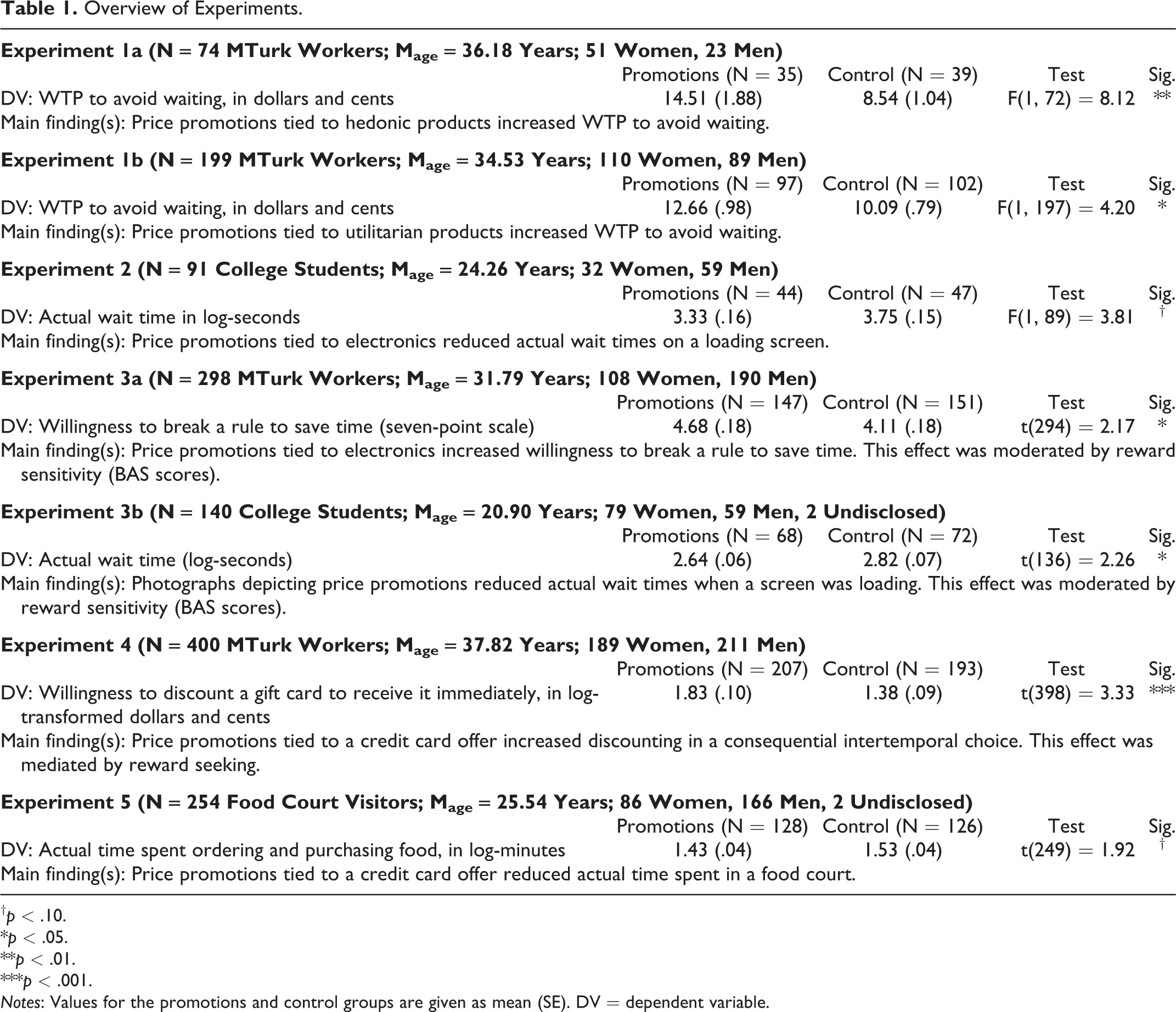
†p < .10.
*p < .05.
**p < .01.
***p < .001.
Notes: Values for the promotions and control groups are given as mean (SE). DV = dependent variable.
Experiments 1a and 1b: Price Promotions Cause Greater WTP to Avoid Waiting
We designed Experiments 1a and 1b to test whether exposure to price promotions causes impatience (H1). Specifically, we manipulated exposure to price promotions using different poster advertisements and measured WTP to avoid waiting. Experiments 1a and 1b were identical, with one exception: we presented price promotions tied to hedonic products in Experiment 1a and price promotions tied to utilitarian products in Experiment 1b. We tested both hedonic and utilitarian products to bolster the generalizability of any potential effect. We predicted that irrespective of product type, exposure to price promotions would increase WTP to avoid waiting (i.e., increase impatience).
Method
In Experiment 1a, a total of 83 U.S.-based Amazon Mechanical Turk (MTurk) workers (Mage = 35.19 years; 54 women, 29 men) participated in exchange for $.50. In Experiment 1b, a total of 209 MTurk workers (Mage = 34.58 years; 113 women, 96 men) participated in exchange for $.35. Experiments 1a and 1b employed a 2 (condition: promotions vs. control; between-subjects) × 3 (wait time: 30 minutes vs. 60 minutes vs. 90 minutes; within-subjects) mixed design. We manipulated exposure to price promotions with a poster evaluation task and measured WTP to avoid waiting each of the three different wait times.
First, all participants were randomly assigned to either the promotions condition or the control condition and evaluated a poster according to several criteria (e.g., overall design, information clarity, product attractiveness; see the Web Appendix for stimuli). The poster evaluated in each condition offered the descriptions, advertised prices, and accompanying images for several common consumer products and were identical, with one exception: depending on the condition, participants viewed either just the advertised prices for the products (control condition) or both the advertised prices and “regular,” undiscounted prices for the products (promotions condition). For example, in Experiment 1a, both posters contained the description, price, and image of a can of Pringles potato chips. In the control condition, the advertised price of $1.25 was listed alongside the description of the product. In the promotions condition, the same advertised price of $1.25 was listed alongside the description of the product, in addition to a regular, undiscounted price listed below the description of the product: “Regular: $1.59.” Thus, we held advertised prices constant between conditions and, to increase the salience of price discounts in the promotions condition, introduced regular, undiscounted prices. In Experiment 1a, the products were primarily hedonic (e.g., popcorn, potato chips, chocolate); in Experiment 1b, the products were primarily utilitarian (e.g., toothpaste, highlighters, bottled water).
Next, in a purportedly unrelated follow-up questionnaire, all participants answered a series of questions in response to a scenario describing an opportunity to pay money to avoid waiting (adapted from Leclerc, Schmitt, and Dube 1995). Specifically, participants read: “Imagine you are waiting at a bus station, and the next scheduled arrival for the bus you need to take, Bus B, is in 30 minutes. Buses arrive exactly on time. The station attendant notices you are waiting and informs you that an earlier bus running the same route, Bus A, has been delayed and is about to depart. One open seat in Bus A is now available. The trip will take the same amount of time, and Bus A is identical to Bus B.” We then asked participants to indicate how much they would be willing to pay to avoid waiting the 30 minutes: “Suppose that the ride on Bus B would cost you $20. How much extra would you be willing to pay to board Bus A so that you don’t have to wait for Bus B to arrive?” Participants then indicated, in an open text field, how much they would be willing to pay to avoid waiting the 30 minutes. Next, participants assumed that the wait time would instead be 60 minutes (“Now, suppose that Bus B is scheduled to arrive in 60 minutes instead of 30 minutes”) and similarly indicated how much they would be willing to pay to avoid waiting the 60 minutes. Finally, participants assumed that the wait time would instead be 90 minutes (“Finally, suppose that Bus B is scheduled to arrive in 90 minutes”) and again indicated how much they would be willing to pay to avoid waiting the 90 minutes.
Results and Discussion
Prior to analyzing the data, we removed observations for which WTP responses across the increasing wait times did not increase monotonically. That is, we removed observations for which WTP to avoid waiting 30 or 60 minutes exceeded WTP to avoid waiting 60 or 90 minutes, respectively (nine observations in Experiment 1a and ten observations in Experiment 1b). This exclusion rule was established a priori and intended to serve as a comprehension check.
In Experiment 1a, as predicted (H1), a condition (promotions vs. control) × wait time (30 minutes vs. 60 minutes vs. 90 minutes) mixed analysis of variance (ANOVA) revealed a main effect of condition (F(1, 72) = 8.12, p = .006), such that participants in the promotions condition exhibited more impatience (i.e., expressed greater WTP to avoid waiting) than did participants in the control condition (see Table 2). We did not observe a two-way interaction (F(2, 144) = 1.77, p = .175). Similarly, in Experiment 1b, as predicted (H1), a condition (promotions vs. control) × wait time (30 minutes vs. 60 minutes vs. 90 minutes) mixed ANOVA revealed a main effect of condition (F(1, 197) = 4.20, p = .042), such that participants in the promotions condition exhibited more impatience (i.e., expressed greater WTP to avoid waiting) than did participants in the control condition (see Table 2). 1 We did not observe a two-way interaction (F(2, 394) = .26, p = .773).
Experiments 1a and 1b: Mean (SD) of Impatience (WTP to Avoid 30-Minute, 60-Minute, and 90-Minute Wait Times), by Condition.

†p < .10.
*p < .05.
**p < .01.
The results of Experiments 1a and 1b provide initial evidence for our account: exposure to price promotions caused impatience (H1). Participants were willing to pay more to avoid waiting when we made discounts salient.
We should note, however, that although the manipulation did not involve actual discounts (i.e., participants did not actually save any money), a rival account could argue that the salience of discounts in the promotions condition implied to participants that they had saved money (or would in the future save money) and thus could afford to pay more to avoid waiting (i.e., a “house money” effect; Thaler and Johnson 1990). A separate alternative explanation can be characterized by anchoring: the regular, undiscounted prices listed in the promotions condition were greater than the advertised prices and thus could have inflated WTP to avoid waiting. Therefore, to rule out both a “house money” account and an anchoring explanation, in Experiment 2 we measured a nonmonetary, consequential form of impatience.
Experiment 2: Price Promotions Reduce Actual Wait Times
We designed Experiment 2 to examine the effect of exposure to price promotions on a different expression of impatience: actual wait times (H1). In addition, we conducted Experiment 2 in a field setting, where wait times reflect a particularly meaningful, consequential behavior for participants, given that the opportunity cost of waiting is higher in the field than in a lab setting. We again presented participants with different poster advertisements and predicted that exposure to price promotions would decrease actual wait times (i.e., increase impatience).
Method
A total of 96 students (Mage = 24.58 years; 32 women, 64 men) in the student union at a private university participated in exchange for candy. Experiment 2 employed a single-factor (condition: promotions vs. control), between-subjects design, in which we manipulated exposure to price promotions with a poster evaluation task. To test for impatience, we measured the amount of time (i.e., number of seconds) participants waited for a video to load.
First, a research assistant approached students and recruited potential participants for a short survey to be completed on an iPad. Students who agreed to participate were assigned to either the promotions condition or the control condition and were told to evaluate a poster according to several criteria (e.g., overall design, information clarity, product attractiveness; see the Web Appendix for stimuli). The poster evaluation task was similar to the task used in Experiments 1a and 1b, except that we displayed various electronics, rather than hedonic and utilitarian products. As in Experiments 1a and 1b, participants evaluated either a promotions poster or a control poster, and we manipulated the salience of price discounts in the same manner.
Next, as part of a purportedly unrelated follow-up questionnaire, all participants initiated a video survey that was described as optional. Specifically, participants read: “Press the continue button below (‘>>’) to load the Video Survey (optional).” All participants then clicked the continue button and navigated to the next page, which instructed participants: “Please wait while the video loads.” Under this instructional text, we presented a video box containing an animated image of a loading wheel, which we programmed to spin indefinitely (i.e., without ever loading a video). The bottom of the page contained a button labeled “Skip this section,” and participants were free to press the button at any time. We then measured, using the survey software, the total time each participant spent waiting for the video to load, prior to clicking the “Skip this section” button.
Results and Discussion
Because the raw wait times were significantly right-skewed (Shapiro–Wilk test: z = 8.56, p < .001), we log-transformed the number of seconds that each participant spent waiting. In the results that follow, we report raw wait times for ease of explication, but we performed our statistical tests on the log-transformed number of seconds.
Also, five participants stopped the survey to inquire with the research assistant about problems loading the video. In these five cases, which did not differ by condition (χ2(1) = .26, p = .612), we instructed the research assistant to tell participants to simply press the “Skip this section” button and move on. We excluded these five observations from our analyses because these participants did not follow the same procedure as the other participants. Because we only recruited participants sitting alone at different tables, it is unlikely that any of the other participants overheard this instruction.
As predicted (H1), an ANOVA revealed a marginally significant effect of condition (F(1, 89) = 3.81, p = .054), such that participants in the promotions condition exhibited more impatience (i.e., they were less willing to wait for the video to load) than did participants in the control condition. 2 Specifically, participants who evaluated the promotions poster waited fewer seconds (M = 52.29 seconds, SD = 118.65 seconds) than did participants who evaluated the control poster (M = 71.66 seconds, SD = 121.28 seconds).
These results conceptually replicate the pattern observed in Experiments 1a and 1b: exposure to price promotions caused impatience (H1). Moreover, in Experiment 2, we employed a nonmonetary, consequential measure of impatience: actual wait times. Thus, these findings rule out competing explanations based on either perceptions of having saved money or anchoring. With convergent evidence for the focal effect, we designed the next study to offer process evidence for our account.
Experiment 3a: Reward Sensitivity Moderates the Effect
We propose that price promotions trigger reward seeking, and reward seeking, in turn, yields impatience. Thus, reward sensitivity should moderate the focal effect (H2). Therefore, in Experiment 3a, we examined the moderating role of the BAS scale (Carver and White 1994), predicting that those with high reward sensitivity (i.e., high BAS scores) would exhibit more impatience as a consequence of exposure to price promotions than would those with low reward sensitivity (i.e., low BAS scores). In addition, in Experiment 3a, to further test the robustness of the focal effect, we employed a new measure of impatience: a behavioral intention to break a rule to save time. Impatience should increase aversion to waiting, and breaking a rule to save time allows people to avoid waiting.
Method
A total of 298 MTurk workers (Mage = 31.79 years; 108 women, 190 men) participated in exchange for $.20. In Experiment 3a, we manipulated a single factor (condition: promotions vs. control), in a between-subjects design. We manipulated exposure to price promotions with a poster evaluation task and administered the BAS scale (Carver and White 1994). To test for impatience, we measured participants’ self-reported propensity to break a rule to save time.
The poster evaluation task was identical to that used in Experiment 2. After evaluating the poster, as part of a purportedly unrelated follow-up questionnaire, all participants read the following scenario: “Imagine that you have finished shopping at your local grocery store. The store is very crowded, so the checkout lines are long (the estimated wait-time is 20 minutes). You notice that there are no lines for the self-checkout lanes. However, you have 15 items in your shopping cart, and the signs above the self-checkout lanes indicate that they are to be used by customers with 10 or fewer items.” All participants then indicated their likelihood of improperly using the self-checkout lane (“How likely is it that you would use a self-checkout lane to avoid the 20-minute wait?”), using a seven-point scale (1= “Not at all likely,” and 7 = “Very likely”).
Finally, all participants completed the BAS scale (Carver and White 1994), which comprises 13 statements (e.g., “When I get something I want, I feel excited and energized”; “When I see an opportunity for something I like, I feel excited right away”), evaluated on four-point scales (1 = “Strongly disagree,” and 4 = “Strongly agree”). We averaged responses to the 13 statements to calculate, for each participant, a composite BAS score (α = .85). These BAS scores did not differ by condition (F(1, 296) = .50, p = .482).
Results and Discussion
To test our main hypothesis—that those with greater reward sensitivity are more likely to exhibit impatience (i.e., break a rule to save time) as a consequence of exposure to price promotions—we estimated a regression with likelihood to improperly use the self-checkout lane as the dependent variable and condition (control = 0 and promotions = 1), BAS score (mean-centered), and the interaction thereof as independent variables.
We observed a significant effect of condition (B = .54, SE = .25, t(294) = 2.17, p = .031), conceptually replicating the results of Experiments 1a, 1b, and 2: participants in the promotions condition exhibited greater impatience than did participants in the control condition (H1). Specifically, participants in the promotions condition expressed a stronger intention to break a rule to avoid waiting (M = 4.68, SD = 2.17) than did participants in the control condition (M = 4.11, SD = 2.26). Moreover, we observed a significant condition by BAS score interaction (B = 1.72, SE = .62, t(294) = 2.79, p = .006), suggesting that reward sensitivity indeed moderated the focal effect (H2).
To decompose this interaction (Spiller et al. 2013), we used the Johnson–Neyman technique to identify the range(s) of BAS scores for which the simple effect of condition was significant. This analysis revealed a significant positive effect of condition on impatience for any BAS score greater than 2.93 (see Figure 1). This critical point fell slightly below the overall mean BAS score (M = 2.96, SD = .41).

Experiment 3a: Reward sensitivity moderated the effect of exposure to price promotions on impatience (propensity to break a rule to save time).
These results indicate, as predicted (H2), that reward sensitivity moderates the effect of exposure to price promotions on impatience. Specifically, participants exposed to price promotions exhibited greater propensity to break a rule to save time, and this effect was more pronounced among those with high reward sensitivity (i.e., higher BAS scores). We designed Experiment 3b to replicate this moderation by reward sensitivity with a different manipulation and a consequential form of impatience.
Experiment 3b: Reward Sensitivity Predicts Lower Actual Wait Times as a Consequence of Exposure to Price Promotions
Whereas the previous experiments employ a poster evaluation task to manipulate exposure to price promotions, Experiment 3b introduces a new manipulation: evaluation of photographs depicting real-world signs and labels that advertise price promotions (vs. real-world signs and labels that do not advertise price promotions).
In addition to the BAS scale, we collected several individual differences measures to include in exploratory analyses. Specifically, we included the Behavioral Inhibition System (BIS) scale (Carver and White 1994) to distinguish between appetitive motives (measured by the BAS scale) and aversive motives (measured by the BIS scale). We also included the Regulatory Mode Questionnaire (Locomotion and Assessment scales) to explore the role of self-regulation of goal-directed action (i.e., price promotions might cause consumers to spend less time assessing goals or locomoting toward them) and the Consumer Impulsiveness Scale (Puri 1996) to determine whether the magnitude of the effect depends on dispositional impulsiveness. Finally, we included three price perception scales: Price Consciousness, Value Consciousness, and Sale Proneness (Lichtenstein, Ridgway, and Netemeyer 1993).
We predicted that reviewing photographs depicting real-world signs and labels that advertise price promotions would cause participants to become impatient (relative to reviewing photographs depicting real-world signs and labels that do not advertise price promotions) and that this effect would be moderated by reward sensitivity (i.e., BAS scores). Furthermore, we predicted that reward sensitivity would uniquely and most strongly predict lower actual wait times as a consequence of exposure to price promotions, compared with the other dispositional factors we included in our exploratory analyses.
Method
A total of 140 students at a public university (Mage = 20.90 years; 79 women, 59 men, 2 undisclosed) participated in exchange for course credit. In Experiment 3b, we manipulated a single factor (condition: promotions vs. control), in a between-subjects design. We manipulated exposure to price promotions with a photograph evaluation task and administered the BAS scale (as in Experiment 3a), along with the exploratory individual differences scales. Finally, to test for impatience, we measured the amount of time (i.e., number of seconds) participants waited for a web page to load.
We conducted Experiment 3b in two phases. The experimental phase contained the manipulation and dependent variable, while the scales phase contained the BAS scale (Carver and White 1994) and the exploratory individual differences scales. Half of the participants completed the scales phase one week prior to completing the experimental phase. The other half of the participants completed the experimental phase and the scales phase within the same hour-long session. These latter participants first completed the experimental phase at the beginning of the session, then completed several unrelated surveys, and finally completed the scales phase at the end of the session.
In the experimental phase, participants were randomly assigned to either the promotions condition or the control condition. Under the guise of a photography study, we asked all participants to assess the technical qualities of ten photographs (see the Web Appendix for stimuli). Specifically, we instructed participants as follows: “We would like you to assist in the evaluation of photographs. Two criteria that are typically used to judge the quality of a photograph or an artistic print are composition and lighting.” We then offered detailed criteria for assessing the composition and lighting of photographs and presented each participant with ten photographs to evaluate. For each photograph, we asked participants to answer these questions: “What do you think of the composition of this image?” (1 = “Very bad,” and 7 = “Very good”) and “What do you think of the lighting of this image?” (1 = “Very bad,” and 7 = “Very good”). Those in the promotions condition evaluated seven photographs depicting real-world signs and labels that advertised price promotions, in addition to three filler photographs, which were common to the promotions and control conditions. Those in the control condition evaluated seven photographs depicting real-world signs and labels that did not advertise price promotions, in addition to the same three filler photographs.
After evaluating the ten photographs, participants encountered a loading screen containing the following instructions, as in Experiment 2: “Please wait until you are automatically directed to the next page. If you are not automatically directed within a few moments, please press the continue button (‘>>’) below.” We positioned an animated image of a loading wheel under this instructional text, and we programmed the loading wheel to spin indefinitely. Thus, the web page did not redirect participants to the subsequent page until they pressed the continue button. We then measured, using the survey software, the total time each participant spent waiting for the page to redirect, prior to clicking the continue button.
In the scales phase, participants completed the BAS scale (see Experiment 3a; Carver and White 1994). We also included the BIS scale (Carver and White 1994), which comprises seven statements (e.g., “I worry about making mistakes”), scored on four-point scales (1 = “Strongly disagree,” and 4 = “Strongly agree”). In addition, we administered the Regulatory Mode Questionnaire (Kruglanski et al. 2000), which is composed of 24 statements (12 statements for each of the Locomotion and Assessment scales; e.g., “I don’t mind doing things even if they involve extra effort”), scored on six-point scales (1 = “Strongly disagree,” and 6 = “Strongly agree”). We further included the Consumer Impulsiveness Scale (Puri 1996), which consists of 12 adjectives (e.g., “impulsive,” “careless,” “self-controlled”), scored on seven-point scales (1 = “Usually would describe me,” and 7 = “Seldom would describe me”). Finally, we presented the three price perception scales: Price Consciousness, Value Consciousness, and Sale Proneness (Lichtenstein, Ridgway, and Netemeyer 1993). Each price perception scale comprises five to seven statements (e.g., “I am very concerned about low prices, but I am equally concerned about product quality”), scored on seven-point scales (1 = “Strongly disagree,” and 7 = “Strongly agree”). We randomized the order of presentation of these scales within the scales phase.
Results and Discussion
First, because the main effect of condition and the interaction between condition and BAS did not differ depending on whether participants completed the scales phase one week prior to completing the experimental phase or shortly after the experimental phase (i.e., within the same hour-long session; all t < 1), we combined the two waves. Importantly, this result also confirms that moderation by reward sensitivity does not require elicitation of BAS scores immediately after exposure to price promotions (as in Experiment 3a). In other words, participants’ predisposed sensitivity to rewards independently predicts the magnitude of the effect and is not merely an artifact of exposure to price promotions.
In addition, as in Experiment 3a, we averaged responses to the 13 statements of the BAS scale to calculate, for each participant, a composite BAS score (α = .79). BAS scores did not differ by condition (F(1, 138) = .14, p = .710). Also, because the raw wait times were significantly right-skewed (Shapiro–Wilk test: z = 8.31, p < .001), we log-transformed the number of seconds that each participant spent waiting. In the results that follow, we report raw wait times for ease of explication, but we performed our statistical tests on the log-transformed number of seconds.
To test our main hypothesis—that those who maintain greater reward sensitivity will be more likely to exhibit impatience (i.e., spend less time waiting for the web page to load) as a consequence of exposure to price promotions—we estimated a regression with the log-transformed number of seconds that each participant spent waiting as the dependent variable, and condition (control = 0 and promotions = 1), BAS score (mean-centered), and the interaction thereof as independent variables.
We observed a significant effect of condition (B = −.19, SE = .09, t(136) = −2.26, p = .025). Specifically, participants in the promotions condition exhibited more impatience (i.e., they were less willing to wait for the web page to load; M = 14.75 seconds, SD = 8.53 seconds) than did participants in the control condition (M = 19.10 seconds, SD = 16.13 seconds; H1). Moreover, we observed a significant condition by BAS score interaction (B = −.59, SE = .23, t(136) = −2.54, p = .012), suggesting that reward sensitivity moderated the effect of condition on actual impatience (i.e., wait times; H2).
As in Experiment 3a, to decompose this interaction (Spiller et al. 2013), we used the Johnson–Neyman technique to identify the range(s) of BAS scores for which the simple effect of condition was significant. This analysis revealed a significant positive effect of condition on impatience for any BAS score greater than 3.02 (see Figure 2). This critical point fell slightly below the overall mean BAS score (M = 3.06, SD = .37).

Experiment 3b: Reward sensitivity moderated the effect of exposure to price promotions on impatience (actual wait times).
We also estimated separate regressions that tested moderation of the effect by each of the exploratory individual differences scales. We did not observe any significant interactions, consistent with our prediction that reward sensitivity would uniquely and most strongly predict lower actual wait times (see the “General Discussion” section and Table 3). These null results included a lack of moderation by sale proneness, which may be of particular interest, given the manipulation (e.g., photographs depicting real-world signs and labels advertising sales). We therefore included the Sale Proneness scale in Experiment 4 to verify this null result.
Experiment 3b: Reliability and Tests of Moderation.

Notes: Condition was coded as control = 0 and promotions = 1. Higher numbers on each scale correspond to higher scores on that particular scale. All regressions included condition, the scale, and the interaction thereof as independent variables. The dependent variable was time spent waiting (log-seconds). CI = confidence interval.
In short, with a different manipulation (i.e., real-world signs and labels that advertise price promotions) and a consequential measure of impatience (i.e., actual wait times), Experiment 3b replicated the moderation by reward sensitivity (H2) observed in Experiment 3a, corroborating our account of the psychological process by which exposure to price promotions causes impatience. With convergent evidence for a theoretically derived moderator (i.e., reward sensitivity), we next directly tested the proposition that exposure to price promotions yields impatience by triggering reward seeking.
Experiment 4: Reward Seeking Mediates the Effect
In Experiment 4, we measured reward seeking directly to test its mediating role. To provide initial evidence for this hypothesis, we first conducted a pretest to establish the causal link between price promotions and reward seeking (see Supplemental Experiment 1 in the Web Appendix). Consistent with our account, participants exposed to price promotions (using the manipulation from Experiment 1a) expressed greater desire for rewarding products (e.g., “a glass of fine wine,” “an hour-long massage,” and “a glass of fruit punch”) than did participants not exposed to price promotions (F(1, 241) = 12.02, p < .001).
With initial evidence directly linking price promotions to reward seeking, we designed Experiment 4 to test the full causal chain (H3). Specifically, we predicted that exposure to price promotions would increase both impatience and reward seeking (as measured by a three-item scale that we developed). Furthermore, we assessed impatience using a measure commonly used in the marketing literature: delay premiums demanded in a consequential intertemporal choice. We predicted that reward seeking would mediate the focal effect. Finally, we also included the Sale Proneness scale (Lichtenstein, Ridgway, and Netemeyer 1993) to further explore any potential moderating role.
Method
A total of 400 MTurk workers (Mage = 37.82 years; 189 women, 211 men) participated in exchange for $.25. Experiment 4 employed a single-factor (condition: promotions vs. control), between-subjects design, in which we manipulated exposure to price promotions using a credit card evaluation task. We measured impatience by asking participants how much they would be willing to discount a gift card to receive it immediately, rather than receiving it in four months, and we measured reward seeking with a three-item scale.
In the first part of the survey, we presented participants with one of two credit card offers. In the promotions condition, participants viewed a mock-up of a new “Visa discountcard” (see the Web Appendix for stimuli) and read a brief description: “Enjoy an unlimited 40% DISCOUNT on all online purchases—no exceptions! Introducing the first and only credit card designed with online shoppers in mind.” In the control condition, participants viewed a mock-up of a new “Visa securecard” and read a brief description: “Enjoy the peace of mind offered by the most secure card in the industry.” All participants then evaluated the attractiveness of the given credit card and responded to the following prompt: “Please take a moment to briefly describe how you would use this card.”
We then presented all participants with the impatience and reward-seeking measures in counterbalanced order. We measured impatience with an incentive-compatible, consequential discounting task (adapted from Study 1 of Bartels and Urminsky [2011]): “To thank you for participating in this study, we have entered you into a lottery for a $100 Starbucks gift card. The drawing will occur exactly one week from today. If your survey is chosen, you will receive a $100 Starbucks gift card in four months, or you can pay to receive it immediately after the drawing is held. What is the maximum amount that you would be willing to pay (i.e., deduct from the value of the card) to be able to use it immediately?” Participants then indicated, in an open text field, how much they would be willing to discount the gift card to receive it immediately. Higher delay premiums indicated greater impatience. We told participants that in one week we would actually offer one randomly selected participant the choice between receiving either a $100 Starbucks gift card in four months or a $100 Starbucks gift card discounted by the indicated amount immediately.
We measured reward seeking by asking participants to express their agreement or disagreement with the following three statements, which we presented in random order: (1) “I feel motivated to seek out something rewarding right now,” (2) “I want to feel stimulated right now,” and (3) “I desire a satisfying experience right now.” Participants responded using seven-point scales (1 = “Strongly disagree,” and 7 = “Strongly agree”). Finally, all participants completed the Sale Proneness scale (Lichtenstein, Ridgway, and Netemeyer 1993; see Experiment 3b for details).
Results and Discussion
Because the raw discounts demanded by participants were significantly right-skewed (Shapiro–Wilk test: z = 10.56, p < .001), we log-transformed the delay premiums. In the results that follow, we report raw discounts demanded by participants for ease of explication, but we performed our statistical tests on the log-transformed delay premiums.
As predicted (H1), participants in the promotions condition were willing to discount the gift card more to receive it immediately (i.e., they exhibited more impatience; M = $13.36, SD = $20.25) than were participants in the control condition (M = $8.84, SD = $15.70; t(398) = 3.33, p < .001).
We next averaged responses to the three reward-seeking statements to calculate, for each participant, a composite reward-seeking score (α = .93). Participants in the promotions condition also exhibited greater reward seeking (M = 4.90, SD = 1.66) than did participants in the control condition (M = 4.28, SD = 1.63; t(398) = 3.82, p < .001). We then conducted a mediation analysis to determine whether reward seeking mediated the effect of condition on impatience. We used the bootstrap procedure, with 10,000 resamples (Preacher, Rucker, and Hayes 2007). As predicted (H3), reward seeking mediated the effect of condition on impatience (indirect effect = .13, SE = .04; bias-corrected 95% confidence interval = [.056, .227]).
Finally, to further explore the potential role of sale proneness (α = .88), we estimated a regression with delay premium (i.e., impatience) as the dependent variable and condition (control = 0 and promotions = 1), the Sale Proneness scale, and the interaction thereof as independent variables. In estimating the regression, we did not observe a significant condition by sale proneness interaction (B = −.02, SE = .11, t(396) = −.22, p = .826), replicating the null effect observed in Experiment 3b (see the “General Discussion” section). 3
The results of Experiment 4 suggest that reward seeking indeed plays a causal role in triggering the effect of exposure to price promotions on impatience. With evidence for moderation by reward sensitivity and mediation by reward seeking, in our final experiment we examined the focal effect in a field setting.
Experiment 5: Field Study
We conducted Experiment 5 in a field setting, with a realistic, ecologically valid price promotion (e.g., a cobranded university credit card that offered a discount on purchases) and examined actual behavior (e.g., time spent ordering and purchasing food in a dining facility). Importantly, the area in which visitors order and purchase food is physically separated from the area in which visitors consume their food. Therefore, this is an area in which visitors do not wish to spend time, and impatience could decrease time spent ordering and purchasing food in several potential ways: (1) some restaurant stalls are more popular than others, so impatient participants might choose a less popular stall with a shorter line; (2) impatient participants might make decisions about what and from where to order more quickly than others; and (3) impatient participants might physically move through the food service area more quickly. We predicted that visitors exposed to price promotions would spend less time ordering and purchasing food (i.e., exhibit greater impatience) than would participants not exposed to price promotions.
Method
A total of 326 visitors (Mage = 26.05 years; 115 women, 206 men, 5 undisclosed) to a food court at a private university participated in exchange for a $1.00 cash payment. Experiment 5 employed a single-factor (condition: promotions vs. control), between-subjects design. We manipulated exposure to price promotions using a credit card evaluation task and, to test for impatience, measured the amount of time (i.e., number of minutes) participants spent ordering and purchasing food.
The dining facility includes one area for ordering and purchasing food (labeled “food service” in Figure 3) and another, separate area for consuming food (“eating area” in Figure 3). The food service area contains a variety of fast casual restaurant stalls, each with a different cuisine (e.g., pizza, burritos, sandwiches, sushi).

Experiment 5: Floor plan of the dining facility.
First, a research assistant approached visitors who were alone before they entered the single entrance to the food service area (location A in Figure 3) and said: “Hi, I’m with the [name of the university behavioral laboratory], and I was wondering if you had time to take a brief survey for one dollar.” If the participant agreed, the research assistant said: “I just need you to fill out this one page and then bring me back your receipt.”
There were two versions of the survey, which required evaluating a cobranded university credit card. Participants first read: “Below is an advertisement for a new financial services product that the [name of university] may offer to students, faculty, and staff. We are interested in gauging demand for this product.” We then presented a mock-up of the credit card (note that the university actually offers cobranded credit cards to campus affiliates). Alongside the image of the credit card, we listed its benefits (e.g., “no annual fee,” “no foreign transaction fees”). These listed benefits were identical between conditions, with one exception: the first benefit listed was either “unlimited 25% off all on-campus purchases” (promotions condition) or “accepted for all on-campus purchases” (control condition). In the promotions condition, the subheading read, in bolded red type: “Enjoy a 25% DISCOUNT on all on-campus purchases!” In the control condition, the subheading read, in standard black type: “Perfect for all of your on-campus purchases!” All participants then evaluated the credit card according to several criteria (e.g., overall attractiveness, appeal of the benefits, potential usefulness; see the Web Appendix for stimuli).
After participants completed and handed the survey back to the research assistant, the research assistant gave the participant $1.00 in cash, reminded the participant to bring back the receipt, and recorded the time that the participant entered the food service area. Customers in the food service area must first decide which restaurant stall to visit, wait in line, place an order, and then collect their food. Then, because the restaurant stalls do not process payment, customers pay at one of three cash registers (location B in Figure 3). After paying, customers are issued a receipt, which we asked participants to return to the research assistant. Each receipt contains a time stamp for the purchase, from which we subtracted the recorded entry time to compute a measure of time spent in the food service area.
Results and Discussion
A total of 69 participants (21%) did not return their receipt. This attrition rate did not differ by condition (χ2(1) = .12, p = .727). We further excluded another three participants for failing to follow the procedure: one participant left the dining facility and returned with a receipt from an off-campus restaurant, one participant took the survey twice (we excluded the second instance), and another participant went into the food service area before taking the survey.
To test our main hypothesis (H1), we estimated a regression with time spent ordering and purchasing food as the dependent variable and condition (control = 0 and promotions = 1) and dummies for hour of day (i.e., one for 11
Because the raw wait times were significantly right-skewed (Shapiro–Wilk test: z = 6.28, p < .001), we log-transformed the number of minutes that each participant spent ordering and purchasing food. In the results that follow, we report raw wait times for ease of explication, but we performed our statistical tests on the log-transformed number of minutes.
As predicted (H1), we observed a marginally significant effect of condition (B = −.11, SE = .06, t(249) = −1.92, p = .056), conceptually replicating the results of Experiments 2 and 3b, which similarly measured actual wait times: participants in the promotions condition exhibited greater impatience than did participants in the control condition. Specifically, participants in the promotions condition spent less time ordering and purchasing food (M = 3.58 minutes, SD = 1.97 minutes) than did participants in the control condition (M = 4.13 minutes, SD = 2.52 minutes).
General Discussion
Price promotions serve as a key shopper marketing tool. They have become an inescapable feature of the modern retail landscape. Understanding the psychological consequences of exposure to price promotions, therefore, is both theoretically and practically meaningful. In this research, we find that incidental exposure to price promotions triggers reward seeking—a general motivational state—and reward seeking, in turn, yields impatience.
We found evidence for this account across seven experiments, in which we manipulated incidental exposure to price promotions and measured impatience in a variety of contexts (e.g., WTP to avoid waiting, actual wait times, propensity to break a rule to save time, consequential delay premiums). In Experiments 1a and 1b, we found that incidental exposure to price promotions caused participants to express greater WTP to avoid waiting, and in Experiments 2, 3b, and 5, participants actually spent less time waiting (H1). We also tested our proposed mechanism in Experiments 3a and 3b, which documented moderation by reward sensitivity (H2), and in Experiment 4, which revealed that reward seeking mediates the focal effect (H3).
Furthermore, to analyze the robustness of our findings, we conducted a single-paper meta-analysis following the procedure outlined by McShane and Böckenholt (2017). The single-paper meta-analysis estimated the total effect size of incidental exposure to price promotions on impatience at .32 (95% confidence interval = [.224, .415]; see Figure 4). 4

Single-paper meta-analysis.
Finally, we ruled out competing explanations by using behavioral measures of impatience, confirming that the effect does not stem from either perceptions of having saved money or anchoring. We also tested price promotions tied to different types of items (e.g., both hedonic and utilitarian) and across a wide array of price levels (e.g., from low-cost snacks and office supplies to expensive electronics), suggesting applicability to a broad range of product categories.
Theoretical Implications
Several theoretical implications are worth highlighting. First, in Experiment 3b, our exploratory analyses of additional individual differences measures revealed marginally significant interactions for the Assessment scale of the Regulatory Mode Questionnaire (Kruglanski et al. 2000) and the Value Consciousness scale (Lichtenstein, Ridgway, and Netemeyer 1993; see Table 3). We caution that these results are preliminary (and not central to our theoretical account) and believe further investigation is warranted. For example, it is possible that certain types of price promotions trigger impatience more acutely for certain types of consumers (e.g., price-conscious consumers may be more sensitive to advertisements emphasizing low prices, while impulsive consumers may be more sensitive to advertisements emphasizing limited-time offers). Future work could examine these predictions.
Notably, we did not observe moderation by the Sale Proneness scale (Lichtenstein, Ridgway, and Netemeyer 1993) in either Experiment 3b or Experiment 4. At first glance, this may seem surprising, given that one related prediction might be that consumers with higher sale proneness would exhibit a more intense impatience reaction as a consequence of incidental exposure to price promotions. However, sale proneness describes “an increased propensity to respond to a purchase offer because the form of the purchase offer positively affects purchase evaluations” (Lichtenstein, Netemeyer, and Burton 1990, p. 56). Yet we exposed participants to price promotions incidentally, meaning they neither responded to an actual purchase offer nor made an actual purchase evaluation. One implication, therefore, is that sale proneness may indeed moderate the effect—but only in situations in which consumers think about taking advantage of a real and accessible price promotion. Moreover, given that reward seeking represents a general motivational state—as opposed to a dispositional inclination to respond to a particular type of marketing instrument (i.e., sale proneness)—it is also possible that sale proneness predicts impatience only in domains related to the price promotion (in this work we examine impatience in domains unrelated to the price promotion). Future work could explore these potential antecedents and consequences. Finally, the results of a factor analysis in Experiment 4 suggest that reward seeking and sale proneness are, in fact, distinct constructs.
In Experiment 4, we also measured reward seeking with a three-item scale that we developed and believe future research could employ, particularly as a complement to the BAS scale. The BAS scale captures dispositional reward sensitivity, while our three-item reward-seeking scale captures situational reward sensitivity (e.g., “I want to feel stimulated right now,” “I desire a satisfying experience right now,” “I feel motivated to seek out something rewarding right now”). Researchers aiming to directly measure reward seeking could employ and refine this scale, which is sensitive to momentary changes in reward seeking (unlike BAS scores, which did not differ by condition in Experiments 3a and 3b).
We further add to the growing body of work demonstrating the potential negative effects of price promotions. In particular, price promotions can increase price sensitivity (Jedidi, Mela, and Gupta 1999; Kalwani and Yim 1992; Mela, Gupta, and Lehmann 1997), erode brand loyalty (Papatla and Krishnamurthi 1996), and even undermine perceptions of product efficacy (Irmak, Block, and Fitzsimons 2005; Shiv, Carmon, and Ariely 2005). Moreover, scarcity promotions (e.g., a product is limited in availability) have been shown to trigger physical aggression (Kristofferson et al. 2016). Our research further suggests that price promotions should be seen as a double-edged sword: they serve as reward cues for consumers, but the downstream consequences of price promotions may not be as uniformly positive, or even benign, as previously assumed.
Future Research
A number of other potential directions for future research seem promising. First, the nature of the products advertised as part of a price promotion may have different effects on impatience. While our results demonstrate that the focal effect arises for both hedonic and utilitarian products, it is plausible that other distinctions may be meaningful. For example, price promotions tied to experiential purchases may lead to more impatience than price promotions tied to material purchases, given that people tend to derive more happiness from the former (Van Boven and Gilovich 2003). Experiential purchases, therefore, may serve as stronger reward cues.
Moreover, because reward seeking shifts consumers’ temporal focus to the present, increased susceptibility to failures of self-control may be a related consequence of incidental exposure to price promotions (and is consistent with our theorization). That is, to the extent that self-control dilemmas implicate trade-offs between immediate benefits and future costs, price promotions may lead to more myopic decision making.
In addition, examining when and how people satiate their desire for rewards would be a fruitful avenue for future work. For example, experiencing an actual reward after initial incidental exposure to a price promotion might suppress reward seeking, thereby limiting any potential downstream effect on impatience. And consumers already engaged in reward seeking may not exhibit the effect at all (see Supplemental Experiment 2 in the Web Appendix for a demonstration). Similarly, actually saving money on a price promotion could itself serve as a reward and, consequently, produce satiation in the short term.
Finally, in this work we explored only incidental exposure to price promotions. Participants in our experiments did not actually save any money, and we measured impatience in an unrelated domain. This represents a particularly strict test of our account. But it also suggests that the focal effect could be magnified in situations in which consumers actually take advantage of a real and accessible price promotion and then encounter a situation requiring patience in a related domain. For example, it is possible that one reason why many shoppers find Black Friday (i.e., the day that traditionally marks the beginning of the holiday shopping season in the United States) so aversive is that to take advantage of the deep discounts, they must wait in long lines. Here, exposure to price promotions is not merely incidental, and impatience manifests in a related domain.
Managerial Implications
Managers can potentially use these findings to strategically increase or decrease impatience in certain situations. For example, a restaurant seeking to turn its tables over more quickly might offer patrons coupons alongside their checks at the end of meals. Airline passengers at the gate might board planes more quickly after hearing advertisements for credit cards offering travel discounts. Other situations, on the other hand, might call for a reduction in the use of price promotions—particularly if wait time or temporal uncertainty is a key aspect of the relevant product or service. For example, customers often wait for delivery, queue in long lines, and expect timely service. In these situations, managers might be wise to try to limit customers’ incidental exposure to price promotions, where possible.
Moreover, previous research has linked spontaneous purchase decisions to impatience (Li 2008). Therefore, managers may want to offer price promotions to customers in settings where they wish to encourage such spontaneous purchase decisions. For example, price promotions could be strategically located in checkout lines, on car dealership lots, or next to one-click purchase buttons on retail websites. In these contexts, price promotions might indirectly boost sales incrementally by increasing unplanned consumption.
Incidental exposure to price promotions could also affect both the types of product attributes that consumers consider and how carefully they consider them. For example, impatience might cause people to weigh more heavily the temporal dimensions of a product (e.g., the battery life of an electronic device, how long the effects of a medication last, the amount of assembly required for a piece of furniture). And price promotions may also cause consumers to become less discriminating of the options they do consider—perhaps evaluating them less carefully or evaluating fewer options altogether. Managers could strategically decide how much information and how many options to provide in these contexts (e.g., a complicated product or a large choice set may be evaluated more favorably in the absence of price promotions, when customers are less impatient).
Furthermore, the impatience caused by incidental exposure to price promotions may undermine the consumption experience itself in situations where consumers find impatience aversive. For example, some sports bars are known for playing music videos during the commercial breaks of televised sporting events. Others simply play the commercials, which frequently contain price promotions. Our work suggests that this seemingly inconsequential choice might actually have the effect of increasing impatience. Therefore, managers would be wise to try to limit the prevalence of price promotions in these settings.
Conclusion
In this research, we find that incidental exposure to price promotions causes impatience. Specifically, price promotions serve as reward cues for consumers, and exposure to reward cues triggers a general motivational state (i.e., reward seeking) that causes impatience. Therefore, although consumers enjoy price promotions as opportunities to save money, paradoxically, price promotions may actually backfire, such that some consumers might be worse off overall, if the resulting impatience deprives them of larger rewards later. In other words, the bargain itself might be more than consumers bargain for.
Supplemental Material
Supplemental Material, jmr.16.0350-File003 - Price Promotions Cause Impatience
Supplemental Material, jmr.16.0350-File003 for Price Promotions Cause Impatience by Franklin Shaddy and Leonard Lee in Journal of Marketing Research
Footnotes
Associate Editor
Susan Broniarczyk
Declaration of Conflicting Interests
The author(s) declared no potential conflicts of interest with respect to the research, authorship, and/or publication of this article.
Funding
The author(s) disclosed receipt of the following financial support for the research, authorship, and/or publication of this article: The authors thank the “Singapore Ministry of Education Social Science Research Thematic Grant” under MOE2017-SSRTG-022 for support. Any opinions, findings, and conclusions or recommendations expressed in this material are those of the authors and do not reflect the views of the Singapore Ministry of Education or the Singapore Government.

Notes
References
Supplementary Material
Please find the following supplemental material available below.
For Open Access articles published under a Creative Commons License, all supplemental material carries the same license as the article it is associated with.
For non-Open Access articles published, all supplemental material carries a non-exclusive license, and permission requests for re-use of supplemental material or any part of supplemental material shall be sent directly to the copyright owner as specified in the copyright notice associated with the article.
