







Abstract
This research documents how introducing redemption tasks requiring a token (i.e., trivial) amount of effort—for instance, by asking the consumer to enter a promo code or solve a CAPTCHA to receive a discount—increases price promotion effectiveness compared with equivalent straight discounts (i.e., applied automatically). Eight studies (including two field experiments) and three additional Web Appendix studies provide robust evidence for the beneficial effect of token-effort requirements on redemption rates. This effect occurs because the easy-to-attain redemption task induces a high perceived return on effort. Thus, this effect only occurs when the redemption task requires token-type effort but not when it is effortful. This research offers costless and easy-to-implement managerial recommendations for boosting the promotional effectiveness of price promotions.
Price promotions are a cornerstone of marketing strategy and are widely used across industries. While price promotions bestow many indirect benefits—such as enabling retailers to manage inventory, increase traffic, and expand their customer base—their primary benefit remains the ability to increase sales volume. Indeed, in a recent survey, 80% of consumers reported that offers or discounts motivated them to purchase brands for the first time, and 74% identified promotional offers as a leading factor when deciding where and what to buy online (Roesler 2018). Given the various benefits of price promotions, it is not surprising that the marketplace is also replete with many promotion tools, such as flash sales, quantity discounts, bonus packs, coupons, and free shipping. However, price discounts (e.g., 20% or $20 off) remain the most common and recognizable tool used in the marketplace.
Interestingly, the effort required to redeem these price promotions can also vary. On one end of the spectrum are the no-effort promotions. These promotions impose no barriers to redemption; for example, a discount (e.g., 20% off) is automatically applied to the purchase. On the other end of the spectrum are the high-effort promotions. In these instances, consumers incur substantial effort to redeem the discount. For example, consumers may need to mail in rebate forms after their purchase or expend effort to accumulate loyalty points to receive a voucher. Between these two extremes lie redemption processes requiring trivial effort, such as promotions that require customers to enter a promo code at checkout (e.g., “GET15OFF”) to avail themselves of a discount. Although consumers have to exert some effort to redeem this promotion, the amount required is trivial; henceforward, we refer to this as a token effort. This research investigates how requiring consumers to expend a token amount of effort (vs. no effort) to redeem a promotion influences their redemption decisions.
Because effort is aversive (e.g., Hull 1943; Kool et al. 2010), one might expect that any effort involved in the redemption process will likely hurt redemption rates over promotions that require no effort. Indeed, it is reasonable to expect that consumers are less likely to make purchases when the redemption process is cumbersome. This argument has merit, as consumers tend to respond negatively to effort in all its forms, whether cognitive or physical (Kool et al. 2010). For example, consumers are more likely to choose alternatives that require lower cognitive effort to process, as higher cognitive effort evokes negative affect (Garbarino and Edell 1997). Likewise, consumers often consider the effort to assemble a critical barrier to buying do-it-yourself products (e.g., Griswold 2017). In line with this notion, we surveyed 100 U.S. participants (55% female, 42% male, 3% other; Mage = 35 years) recruited from Prolific to make a prediction in our contexts. Participants imagined themselves as sellers and were told that they could either ask each customer to enter a promo code to get a 15% discount or give the customer a 15% discount automatically. They were asked to predict which offer would make customers more likely to buy. Most (79%) of them predicted that the straight discount would be more effective, whereas only 21% predicted the promo code would be more effective.
Contrary to conventional wisdom, our research proposes that introducing a token amount of effort to redeem promotional offers can increase redemption rates. Thus, our primary contribution is to the literature on promotions. While much of the existing research documents the positive effects of promotions in generating sales (e.g., Bell, Chiang, and Padmanabhan 1999; Blattberg and Neslin 1990; Chandran and Morwitz 2006; Palmeira and Srivastava 2013; Inman, Peter, and Raghubir 1997), there is a dearth of research on the role that the redemption process plays in affecting sales. In the current research, we investigate how the effort involved in redemption influences sales promotion effectiveness and document an instance where effort has beneficial effects in a consumption context. Our second contribution is to the literature on purchase utility (Grewal, Monroe, and Krishnan 1998; Lichtenstein, Netemeyer, and Burton 1990; Thaler 1983, 1985). Extending this stream of research, we demonstrate that consumers can also derive value from the nonmonetary aspects of a transaction, specifically, the perceived return on effort to redeem an offer. This perceived return on effort positively drives consumers’ redemption of the promotional offer.
Our findings also offer important practical implications for marketers. One key metric used to determine the success of any sales promotion is the number of sales it generates. Therefore, every element that boosts sales will likely have substantial implications for managers. In the following sections, we present our conceptual framework, followed by eight studies supporting the token-effort effect, and conclude with a discussion of its implications.
Conceptual Framework
Price promotions are a crucial component of the marketing mix as they significantly impact product sales (e.g., Bell, Chiang, and Padmanabhan 1999; Blattberg and Neslin 1990). Considerable academic research has extensively investigated the effectiveness of various types of promotions, including price discounts (e.g., 20% or $20 off the list price; Grewal et al. 1998), quantity discounts (Dolan 1987), limited offers (Inman, Peter, and Raghubir 1997), bonus packs (Chen et al. 2012), coupons (Heilman, Nakamoto, and Rao 2002), free shipping (Chandran and Morwitz 2006; Palmeira and Srivastava 2013), uncertain rewards (Goldsmith and Amir 2010), and promotional games (Hock, Bagchi, and Anderson 2020). While much is known about the efficacy of these different promotions, little work has investigated how the redemption process impacts sales. We focus on price discounts and examine how token amounts of effort involved during the redemption process influence consumers’ redemption decisions. We demonstrate that introducing a token redemption effort increases consumers’ purchase likelihoods (and therefore sales) relative to redemptions that require no effort. This effect occurs because of two reasons. First, in the token-effort condition, consumers are more likely to attribute the responsibility for obtaining the discount to themselves—after all, they have to act to redeem the offer. Second, they believe this effort is well spent as they earn a discount for exerting a trivial amount of effort. Thus, because consumers perceive the return on the token amount of effort positively, their purchase likelihood increases.
Price Promotion Design
Prior research has predominantly focused on promotion design with little attention to the redemption process. This oversight is surprising because the terms “redemption” and “redemption rates” are frequently used in the academic and popular press and are synonymous with purchasing the promotional product and acquiring the discount. However, there is limited work explaining how varying the redemption process for a particular promotion can impact redemption. Our research provides some insights. Specifically, we focus on price discounts and investigate how effort in the redemption process impacts purchase propensity.
It would, however, be inaccurate to suggest that the role of effort has not been investigated in promotional contexts at all. Prior research suggests that traditional coupons (e.g., mail-in coupons and rebates) require time and effort investment from consumers, which lowers their use (e.g., Clark, Zboja, and Goldsmith 2013). The effort required to redeem such coupons is often so significant that it can be used as a price discrimination tool to provide a lower price to the more price-sensitive consumer segment (e.g., Narasimhan 1984). Our research differs from this stream in multiple ways: First, in our contexts, the price discount remains the same, but what changes is the redemption effort. Second, the effort we study is of a token nature, which is very low or trivial. Prior research has often equated low effort with no effort, neglecting to examine the impact of a token level of effort on consumer decisions. Finally, we examine the mechanism via which a token redemption effort impacts consumers’ purchase decisions and delineate boundary conditions.
Effort and Price Promotion Redemption
Unlike straight discounts that are applied automatically and involve no effort, many price promotions require consumers to exert some effort to redeem the promotional offer. For example, traditional coupons often require consumers to mail in the coupons to receive the promised rebate (high effort). By contrast, consumers can claim digital coupons (e.g., promo codes and discount vouchers), which are widely available and featured on shopping websites, with a few keystrokes or a simple click (token effort).
Conventional wisdom might suggest that requiring consumers to exert this token effort will have detrimental consequences compared with automatically applied discounts, as consumers find effort aversive. Indeed, a large body of research suggests that consumers consider effort costly and aversive (e.g., Hull 1943; Inzlicht, Shenhav, and Olivola 2018; Kool et al. 2010). For example, Hull's (1943) law of least effort argues that ceteris paribus, people will choose the actions that minimize effort or work. In addition to physical effort, consumers generally dislike cognitive effort (Camerer and Hogarth 1999; Kool et al. 2010). For example, consumers are often described as “cognitive misers” due to avoidance of cognitive effort (Fiske and Taylor 1984; Kahneman 2011; Kool et al. 2010). Exerting effort can also evoke unpleasant feelings such as anxiety, stress, and fatigue (e.g., Garbarino and Edell 1997; Kurzban 2016). As a result, consumers tend to value convenience and avoid effortful tasks in the marketplace (e.g., Garbarino and Edell 1997; Kelley 1958).
Prior research has nevertheless identified some instances where effort can add value (e.g., Inzlicht, Shenhav, and Olivola 2018). Building on the notion of cognitive dissonance or effort justification (e.g., Festinger 1957), this stream of the literature shows that in retrospective evaluations, consumers may value items more when they have invested more effort in pursuing such items (e.g., Axsom and Cooper 1985; Benozio and Diesendruck 2015; Norton, Mochon, and Ariely 2012). The marketing literature has also documented that some individuals hold a “no pain, no gain” lay belief that costlier means yield better outcomes (Cheng, Mukhopadhyay, and Schrift 2017; Cutright and Samper 2014; Kramer et al. 2012).
Studies in a related stream of research indicate that effort in product creation or warranty redemption can signal unobservable product quality (e.g., Galak and Nelson 2011; Jain, Slotegraaf, and Lindsey 2007; Kirmani and Rao 2000; Kruger et al. 2004). For example, Kruger et al. (2004) suggest that consumers may judge a poem or painting that took longer to produce to be of higher value. Similarly, Galak and Nelson (2011) find that a historical analysis written in difficult-to-read (vs. easy-to-read) font can be perceived as higher in quality. In contrast, Jain, Slotegraaf, and Lindsey (2007) show that difficult-to-redeem (vs. easy-to-redeem) warranties are associated with lower product quality perceptions.
Nonetheless, it is important to note that existing research has primarily compared high effort with low effort and has often treated low effort as synonymous with no effort. In one exception, Dallas and Morwitz (2018) compare low effort with no effort. Using the context of pseudo-free offers, “offers that are presented to consumers as free but that require consumers to make a nonmonetary payment (such as completing a survey or providing personal information) in order to receive the ‘free’ good or service,” they show that “consumers are generally just as likely to accept pseudo-free offers (with nonmonetary costs) as comparable truly free offers (with no costs), as long as the costs of the pseudo-free offers are below some threshold” (Dallas and Morwitz 2018, p. 900). Furthermore, these pseudo-free offers involving nonmonetary costs (e.g., answering a five-minute survey to receive a chocolate bar) performed better than offers involving monetary costs (e.g., paying $.50 to receive a chocolate bar). Though related, our work differs markedly from this work: Our contexts differ (we study product purchases involving a discount, while they study offers that are presented to consumers as free), the tasks differ (our token-effort tasks are much less effortful—such as entering a promo code or solving a CAPTCHA that can be accomplished with a few keystrokes or a simple click, while theirs require more effort, such as answering a customer satisfaction survey and disclosing personal information), and our process and findings are also different (e.g., we show that token redemption effort increases redemption compared with no effort, whereas they find that pseudo-free offers involving nonmonetary costs performed the same as free offers). Next, we discuss why introducing a token redemption effort in the price promotion will increase redemption rates compared with equivalent straight discounts (i.e., those requiring no effort).
Token Effort and Price Promotion Redemption
Prior research has suggested that the total utility/value consumers derive from a product purchase is the sum total of acquisition utility/value and transaction utility/value (Grewal, Monroe, and Krishnan 1998; Lichtenstein, Netemeyer, and Burton 1990; Thaler 1983, 1985). “The former depends on the value of the good received compared to the outlay, [while] the latter depends solely on the perceived merits of the ‘deal’” (Thaler 1985, p. 205).
It is important to note that previous research has primarily focused on the utility or value derived from the financial terms of a deal (Thaler 1983, 1985; see also Cai, Bagchi, and Gauri 2016; Grewal, Monroe, and Krishnan 1998). For example, Thaler (1983, 1985) suggests that transaction utility is computed by subtracting the purchase price from consumers’ initial reference price. Meanwhile, some research suggests that consumers can also derive utility or value from nonfinancial terms of price promotions (e.g., Darke and Dahl 2003; Schindler 1998). For example, Schindler (1998) shows that perceived responsibility for obtaining a discount can elicit positive feelings among consumers. Likewise, the literature on cocreation in services also extols how feeling responsible for the service recovery process translates into positive outcomes, including greater satisfaction (e.g., Roggeveen, Tsiros, and Grewal 2012). Extending this stream of research, the current work shows that consumers can also derive value from the nonfinancial terms of a deal. Specifically, we propose that when consumers have to expend effort to redeem a promotion relative to when they do not, the amount of effort required to redeem the offer influences consumer decision-making in two ways.
First, if consumers have to expend effort to redeem the promotion, they will be more likely to attribute the reason for obtaining the discount to themselves. After all, they must expend effort to redeem the discount, even if it is minimal. This redemption effort requirement will cause consumers to perceive a greater responsibility for obtaining the discount than when no effort is required. By contrast, if the discount is automatically applied, consumers will be less likely to believe they are somehow responsible for obtaining the discount.
However, greater perceived responsibility for obtaining the discount alone may not always lead to a higher redemption rate. We propose that a second crucial factor that affects redemption rates is consumers’ assessment of whether the effort required to redeem the promotion is worth the benefit (i.e., whether the return is worth the effort investment). We expect that with a trivial redemption effort and reasonable monetary benefit (i.e., discount), consumers will judge the effort required to redeem the benefit to be worth the benefit, which would translate into a high return on effort. This perceived return on effort will increase consumers’ redemption of the promotional offer. In contrast, when the discount is automatically applied, consumers are unlikely to judge the perceived return on effort to be high. This is because, in this situation, effort is not even a factor included in their decision-making. The discount was automatically applied, so no effort was extended, and because of this, the associated perception of return on effort is not relevant in this context. These arguments are consistent with research suggesting that when information is omitted, it seldom impacts decision-making (Kardes and Sanbonmatsu 2003; Kardes et al. 2006; Palmeira 2011). Thus, we expect the perceived return on effort to be higher for discounts that require a token redemption effort relative to straight discounts.
Higher perceived return on effort may also impact redemption decisions via a different pathway. Previous research suggests that when consumers believe they are smarter shoppers (Burton et al. 1998; Schindler 1998; e.g., they feel proud or like winners), these feelings impact decision-making. In our contexts, if those expending a token amount of effort attribute responsibility for obtaining the discount to themselves and also believe that they are getting a higher return on effort, this may also impact their feelings of being a smart shopper. We also expect these feelings to influence redemption decisions (i.e., an indirect effect). In other words, perceived return on effort can directly and indirectly increase consumers’ redemption decisions.
Taking these factors together, we hypothesize that price promotions requiring a token redemption effort will increase redemption rates compared with equivalent straight discounts (i.e., no effort). We term this phenomenon the token-effort effect. This effect occurs because the token redemption effort induces a greater perceived responsibility over the discount and a higher perceived return on effort. More formally,
Moderating Factors
Our theory relies on two assumptions. The first assumption is that the effort attribute is not salient for consumers in the no-effort condition. Considerations about redemption effort are irrelevant for them, so they do not derive much value from the nonfinancial terms of the deal. That is, they do not derive much of a benefit from the perceived return on effort. If this is true, then drawing attention away from the effort in the token-effort condition should lead to a similar pattern of results and attenuate our effect. One way to do this could be to more explicitly ask consumers to focus on other important factors of the decision mix, such as the financial cost of the purchase. Drawing attention to financial cost should divert consumers’ attention away from the token redemption effort and make it less likely for consumers to consider the return on effort, effectively attenuating our effect. More formally,
The second assumption is that consumers derive value based on perceived return on effort (i.e., the relative comparison between the redemption effort and the corresponding benefit). Consumers will perceive a higher perceived return on effort when the effort is trivial and the corresponding benefit is reasonable. However, the perceived return on effort will be low when the redemption effort is high. This prediction also aligns with the notion that consumers would find high effort aversive. Thus, holding the discount benefit constant, we expect our proposed effect to occur only when the redemption effort is low (i.e., a token effort) and to be attenuated when the redemption effort is high. More formally,
Overview of Studies
We present results from eight studies that test our token-effort hypothesis (see Figure 1 for an overview of the conceptual framework and Table 1 for a summary of the results of each study). Studies 1 and 2 investigate the token-effort hypothesis through field experiments. These studies examine whether token effort in promotional offers can enhance conversion rates (Study 1) and unique click-through rates (Study 2) in comparison with equivalent straight discounts (H1). Study 3 replicates this token-effort effect (H1) using an incentive-compatible experiment that utilizes two product replicates. Study 4 documents the robustness of this effect by showing that it holds whether or not the token effort is semantically related to the discount. Studies 5a, 5b, and 6 provide process evidence for our proposed mechanism. Specifically, Studies 5a and 5b (preregistered) demonstrate that a token redemption effort induces a greater perceived responsibility over the discount, leading to a higher perceived return on effort, thereby increasing the redemption rate (H2 and H3). Study 6 shows that the token-effort effect is attenuated when customers’ focus is redirected from the effort involved to the financial cost of the purchase (H4). Finally, Study 7 shows that the token-effort effect only occurs when the redemption effort is low but not when the effort level is high (H5), providing further support for the return on effort mechanism and ruling out a “higher effort = higher value” alternative explanation.
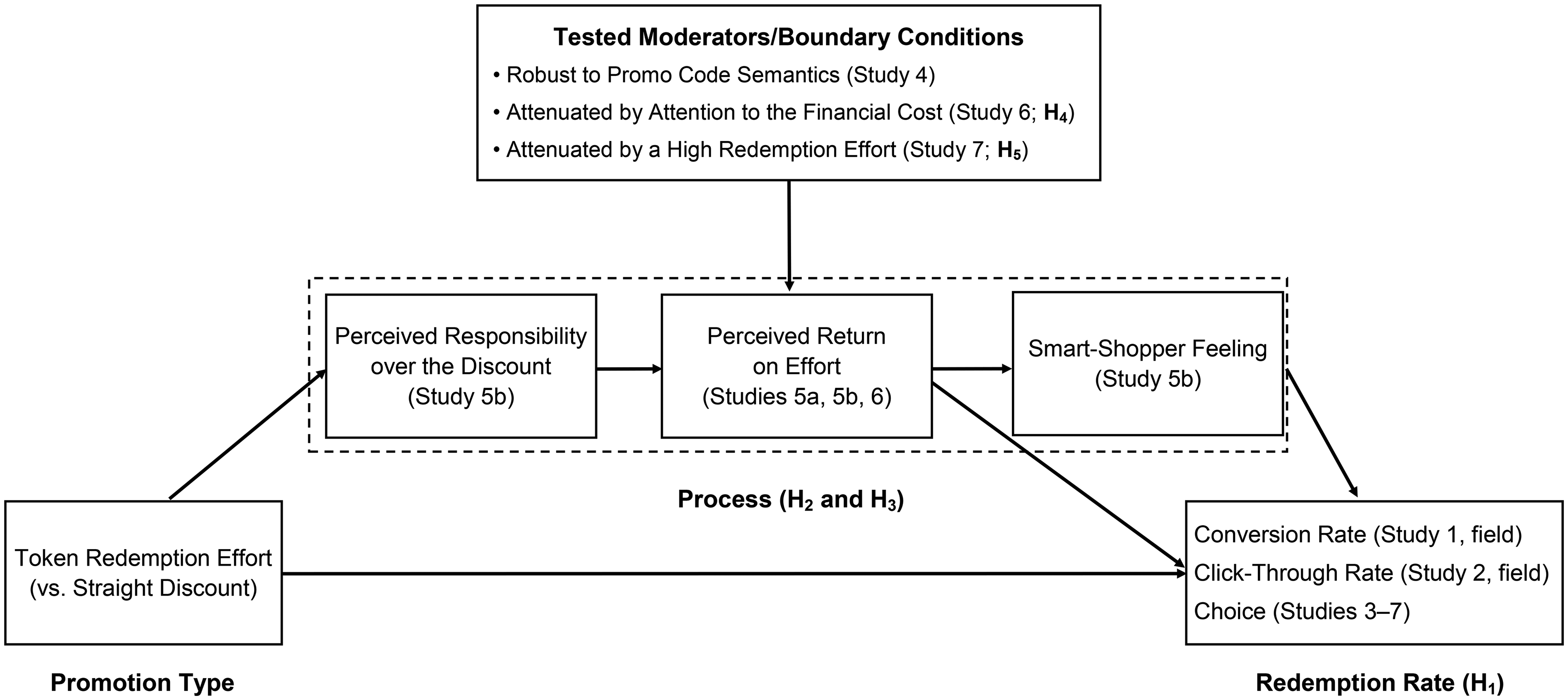
Overview of Conceptual Framework and Studies.
Summary of Results by Conditions Across Studies.
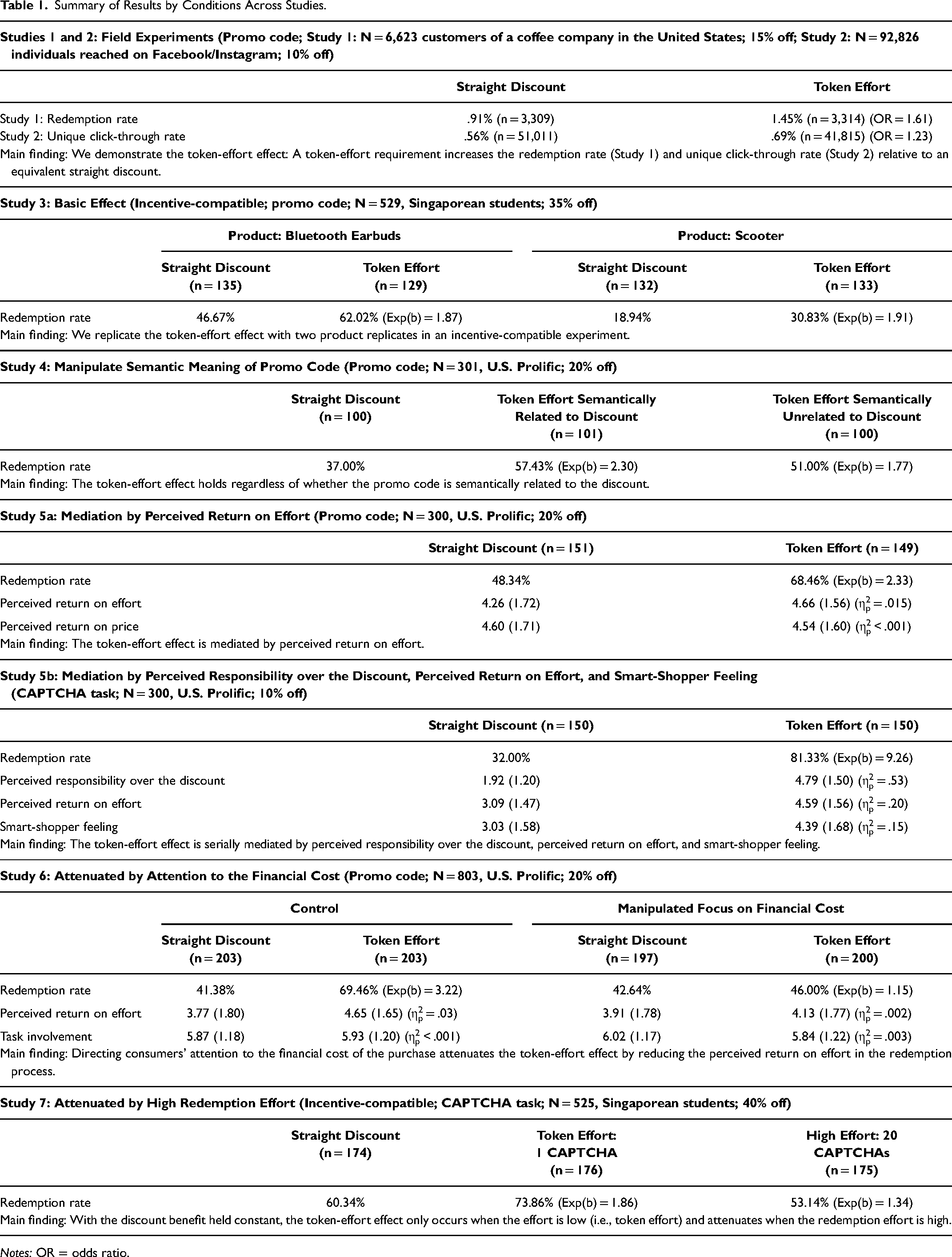
Notes: OR = odds ratio.
In our empirical studies, we used either promo codes or CAPTCHA tasks as token-effort tasks. 1 We did not exclude any participants from any study. Web Appendix A reports the stimuli and measures used in all the studies. All data are available on OSF (https://osf.io/h2knq/). Together, our findings establish the robustness of the token-effort effect that marketing managers can leverage to improve the effectiveness of price promotions.
Study 1
Using purchase data, Study 1 provides initial support for the token-effort effect (H1). We collaborated with Zoka Coffee, a U.S.-based roastery and chain of coffeehouses. We examined whether introducing a token redemption effort (i.e., requiring people to enter a promo code) to obtain a discount in an email promotional campaign increases redemption rates over an equivalent straight discount (i.e., an automatically applied discount).
Method
The firm conducted an email campaign A/B test by randomly assigning the customers to two groups. Zoka Coffee emailed 6,644 active online customers (i.e., customers who had made at least one online purchase over the previous 12 months). The promotional email was successfully delivered to 6,623 customers (token effort: 3,314 customers vs. no effort: 3,309 customers; the bounce-back rate was similar in the two conditions: .3% for token effort vs. .4% for straight discount).
The promotional email introduced a new coffee product, the Spring Blend, sold in 12-ounce bags for $19.95. Customers received one of two versions of the email. Both versions started with the same headline that introduced the limited-time offer. In the token-effort condition, the promotion email featured the message: “Enter ‘SB15OFF’ to unlock 15% off on our new Spring Blend.” In the straight-discount condition, the promotion email instead featured the following message: “Get 15% off on our new Spring Blend,” and the discount was automatically applied. The email included images of the Spring Blend coffee bag and a product description, which were constant across conditions (see Web Appendix A for details). Customers in both conditions could click the “Order Now” button in the email to get directed to the product landing page on the company's official website.
The promotional email was sent to all customers between 7:30 a.m. and 7:45 a.m. (in each customer's local time zone) on April 20, 2021. The campaign ran until midnight on April 22, 2021. The company did not engage in other forms of social media marketing during or immediately before this email campaign. At the end of this two-day promotional campaign, the platform recorded the number of conversions derived from each of the two versions of the promotional email.
Results and Discussion
In the token-effort condition, the email led to 48 conversions, whereas in the straight-discount condition, the email led to 30 conversions—consistent with our prediction. An A/B test revealed that the promotion involving a token effort (i.e., promo code) generated a significantly higher redemption rate (Mtoken-effort = 1.45%) compared with the straight-discount condition (Mstraight-discount = .91%; z = 2.04, p = .04, OR = 1.61), in support of H1. In other words, introducing a token effort (i.e., enter a promo code) to redeem the discount for a product helped the company generate a higher redemption rate than providing an equivalent 15% straight discount.
Study 2
Because the results of Study 1, albeit statistically significant, were based on a relatively small number of actual sales, we conducted a conceptual replication of that study using an alternative dependent variable that would result in a larger number of observations. To this aim, we partnered again with Zoka Coffee to conduct another A/B test, this time focusing on unique click-through rates as an alternative measure of consumer interest. Notably, social media-based A/B tests are subject to “divergent delivery” due to the optimization and targeting algorithms of the platform (De Langhe and Puntoni 2021). Thus, while this study does not allow us to establish causality without confounds, it provides additional ecologically valid evidence for our effect of interest.
Method
The company conducted an A/B test on the Meta ads platform, randomly displaying one of two promotion ads to consumers on Facebook and Instagram. As in Study 1, the product description and image remained constant in both versions. In the token-effort condition, the ad featured the message: “Today, use code ‘ZCTENOFF’ to take 10% off 12 oz bags of Espresso Paladino and Fitzroy Blend at ZokaCoffee.com.” In the straight-discount condition, the ad instead featured the following message: “Today, take 10% off 12 oz bags of Espresso Paladino and Fitzroy Blend at ZokaCoffee.com.” These messages were repeated as captions in the ad image (see Web Appendix A). Consumers in both conditions could click the “Shop Now” button to get directed to the product landing page on the company's official website. The campaign ran with a predetermined budget of $2,000 and lasted 12 days. We examine unique click-through rate (measured by unique clicks divided by the number of individuals reached) as the dependent measure, a more accurate metric of consumer interest that is not susceptible to bias from spurious data (e.g., repeated clicks from the same individual, the same ad shown to the same individual multiple times; King, O’Rourke, and DeLongis 2014; Yin and Huang 2022).
Results and Discussion
The promotion involving a token effort (i.e., promo code) resulted in a significantly higher unique click-through rate (Mtoken-effort = .69%; 289 unique clicks out of 41,815 individuals reached) compared with the straight-discount condition (Mstraight-discount = .56%; 286 unique clicks out of 51,011 individuals reached; z = 2.52, p = .01, OR = 1.23), supporting H1 again. In other words, introducing a token effort (i.e., enter a promo code) to redeem the 10% discount helped the company generate a higher unique click-through rate than providing an equivalent 10% straight discount.
Study 3
Study 3 aims to replicate the token-effort effect in a controlled setting using an incentive-compatible design with two product replicates.
Method
Participants and design
Five hundred twenty-nine undergraduate students from a large university in Singapore completed this experiment for partial course credit (61.4% female, 38.2% male, .4% other; Mage = 20.2 years). We used a 2 (promotion type: token effort vs. straight discount) × 2 (product replicates: earbuds vs. scooter) between-participants design. Our dependent variable was the proportion of participants redeeming the promotional offer.
Procedure
To make the experiment incentive-compatible, we followed prior research (e.g., Allard, Hardisty, and Griffin 2019; Jia et al. 2024) and informed participants that one person would be randomly selected to receive a cash allocation of $100 and fulfill the purchase decision made in the study. We reminded participants that their choices would have consequences: The person selected would receive the product (if a purchase decision was made) and the remaining balance in cash. Next, we instructed participants to imagine coming across a promotional offer while shopping online. The product replicates were manipulated between participants: Depending on the condition, the product was either an $80 pair of Bluetooth earbuds or an $80 scooter (see Web Appendix A). The two product replicates were selected because they were popular among the sampled population and had a similar monetary value. The products were discounted by 35%. In the token-effort condition, participants had to enter the promo code (GET35OFF) to claim the discount, whereas in the straight-discount condition, the discount was automatically applied. Participants then answered whether they would purchase this product (no/yes).
Results
A logistic regression on the redemption decision (0 = no, 1 = yes) with promotion type (−.5 = straight discount, .5 = token effort) and product replicate (−.5 = earbuds, .5 = scooter) as independent factors did not reveal a significant two-way interaction (b = .02, SE = .38, Wald χ2(1) = .003, p = .95, Exp(b) = 1.02). Importantly, a significant main effect of promotion type (b = .635, SE = .19, Wald χ2(1) = 10.94, p < .001, Exp(b) = 1.89) emerged. Consistent with H1, introducing a token redemption effort increased participants’ redemption rates relative to a straight discount of the same value for both earbuds (token effort: 62.02% vs. straight discount: 46.67%; b = .62, SE = .25, Wald χ2(1) = 6.21, p = .01, Exp(b) = 1.87) and scooter (token effort: 30.83% vs. straight discount: 18.94%; b = .65, SE = .29, Wald χ2(1) = 4.93, p = .03, Exp(b) = 1.91). A significant main effect of product replicates also emerged (b = −1.31, SE = .19, Wald χ2(1) = 46.57, p < .001, Exp(b) = .27), indicating that redemption rates were higher for the earbuds relative to the scooter.
Discussion
Replicating the effect observed in the field experiments (Studies 1 and 2), Study 3 used an incentive-compatible experiment with two product replicates to demonstrate that introducing a token redemption effort (e.g., by entering the provided promo code) increases the effectiveness of the price promotion over a straight discount of the same value.
We acknowledge that one limitation of this study is that we did not measure prior ownership of the product. It is reasonable to assume that owners of scooters are unlikely to be interested in another scooter, while owners of earbuds might still be, which could explain the scooter's overall lower redemption rates. However, the fact that we observed the token-effort effect for both products suggests that ownership is unlikely to explain the token-effort effect.
Study 4
Study 4 aims to replicate the token-effort effect with a different product stimulus and sample population. In addition, Study 4 examines whether the semantic meaning of the token redemption task (e.g., promo code) influenced our results. In other words, if the promo code explicitly signals a discount (e.g., by including “OFF”), would it increase redemption rates relative to a code that does not refer to a discount?
Method
Participants and design
Three hundred one U.S. participants from Prolific completed this experiment for a nominal payment (48.5% female, 50.8% male, .7% other; Mage = 34.3 years). We used a three-level (promotion type: token effort semantically related to the discount vs. token effort semantically unrelated to the discount vs. straight discount) between-participants design. Our dependent variable was the proportion of participants redeeming the promotional offer.
Procedure
We instructed participants to imagine that they were shopping online and came across a promotional offer on a pair of shoes initially priced at $200 (see Web Appendix A). In the token effort semantically related (unrelated) to the discount condition, we told participants they could redeem a 20% discount on this pair of shoes by entering the promo code SUMMER20OFF (SUMMER2022). In the straight-discount condition, we told participants that there was a 20% discount on this pair of shoes, which was automatically applied. Participants then indicated whether they would like to purchase the shoes (no/yes).
Results
A logistic regression on redemption decision (0 = no, 1 = yes) revealed a significant overall effect of the condition (Wald χ2(2) = 8.63, p = .01). Replicating the previous results, redemption rates were significantly higher in the token effort semantically related condition (57.43%) than in the straight-discount condition (37.00%; b = .83, SE = .29, Wald χ2(1) = 8.29, p = .004, Exp(b) = 2.30). Redemption rates in the token effort semantically unrelated condition (51.00%) were also significantly higher than in the straight-discount condition (37.00%; b = .57, SE = .29, Wald χ2(1) = 3.95, p < .05, Exp(b) = 1.77). Notably, the two token-effort conditions were not significantly different from each other (b = .26, SE = .28, Wald χ2(1) = .835, p = .36, Exp(b) = 1.30). These results support H1 again.
Discussion
Study 4 replicated the token-effort effect using a different sample and product. Importantly, this study also showed that the token-effort effect held regardless of whether the token redemption task was semantically related to the discount.
Study 5a
Studies 5a and 5b examine our proposed process. Specifically, in Study 5a we test whether a token redemption effort induces a higher perceived return on effort, which leads to an increase in redemption rate. We also rule out an alternative explanation—one rooted in transaction utility, suggesting that consumers somehow believe they derive additional benefit or value from the final price paid when they expend a token effort. Study 5b replicates this result while adding a theoretically relevant antecedent and outcome of perceived return on effort: perceived responsibility over the discount and smart-shopper feelings.
Method
Participants and design
Three hundred U.S. participants from Prolific completed this experiment for a nominal payment (47.3% female, 52.0% male, .7% other; Mage = 34.8 years). We used a two-level (promotion type: token effort vs. straight discount) between-participants design. Our dependent variable was the proportion of participants redeeming the promotional offer. This study was preregistered (https://aspredicted.org/8KQ_64X).
Procedure
We instructed participants to imagine that they were shopping online and came across a promotional offer on a pair of shoes initially priced at $200 (see Web Appendix A). In the token-effort condition, participants could redeem a 20% discount on these shoes by entering the promo code GET20OFF. In the straight-discount condition, there was a 20% discount on these shoes, which was automatically applied. Participants then indicated whether they would like to purchase the shoes (no/yes).
We then measured two facets of the deal: Two items captured perceived return on effort, while two others measured perceived return on price. According to our theorizing, differences in the perceived return on effort should mediate our effect, while the return on price should be constant—because the final price is the same. Specifically, as a measure of perceived return on effort, participants indicated the extent to which they derived benefit or value from the redemption effort (“benefit derived from the effort involved in redeeming the discount,” “value derived from how you get the discount”) on a seven-point scale (1 = “none,” and 7 = “a lot”; α = .77). As a measure of perceived return on price, participants indicated the extent to which they derived benefit or value from the final price paid (“benefit derived from the price paid for the product,” “value derived from how much you pay”) on a seven-point scale (1 = “none,” and 7 = “a lot”; α = .93). A principal component analysis with varimax rotation confirmed that these measures emerged as two separate factors (87.25% of the variance explained). In addition, a confirmatory factor analysis showed that the two-factor model with perceived return on effort and perceived return on price as separate constructs produced a better model fit (RMSEA = .09, CFI = .996) than the one-factor model (RMSEA = .45, CFI = .79; Δχ2 = 121.33, p < .001).
Results
Redemption rate
A logistic regression on the redemption decision (0 = no, 1 = yes) with promotion type (−.5 = straight discount, .5 = token effort) as the independent variable revealed a significant main effect of promotion type (b = .84, SE = .24, Wald χ2(1) = 12.28, p < .001, Exp(b) = 2.32): The token-effort discount achieved a higher redemption rate than the straight discount (token effort: 68.46% vs. straight discount: 48.34%), in support of H1.
Perceived return on effort
An analysis of variance (ANOVA) revealed that those in the token-effort condition indicated a higher perceived return on effort (Mtoken-effort = 4.66, SD = 1.56) than those in the straight-discount condition (Mstraight-discount = 4.26, SD = 1.72; F(1, 298) = 4.44, p = .04,
Perceived return on price
An ANOVA on perceived return on price revealed no difference between the token-effort condition (Mtoken-effort = 4.54, SD = 1.60) and the straight-discount condition (Mstraight-discount = 4.60, SD = 1.71; F(1, 298) = .09, p = .77,
Mediation analysis
We performed a mediation analysis to test whether the token effort increased participants’ redemption rate via a higher perceived return on effort (PROCESS Model 4 with 5,000 bootstrap samples; Hayes 2017). As predicted, in support of H2, a higher perceived return on effort mediated the effect of the token effort on the redemption rate (indirect effect = .20, SE = .10, 95% CI = [.02, .43]; see Figure 2 for detailed path coefficients). The comparable mediation through perceived return on price was nonsignificant (indirect effect = −.05, SE = .19, 95% CI = [−.42, .32]). Those results support our proposed mechanism by showing that a token-effort requirement creates a higher perceived return on effort, increasing the redemption rate. Meanwhile, the token-effort requirement does not increase the perceived return on price.
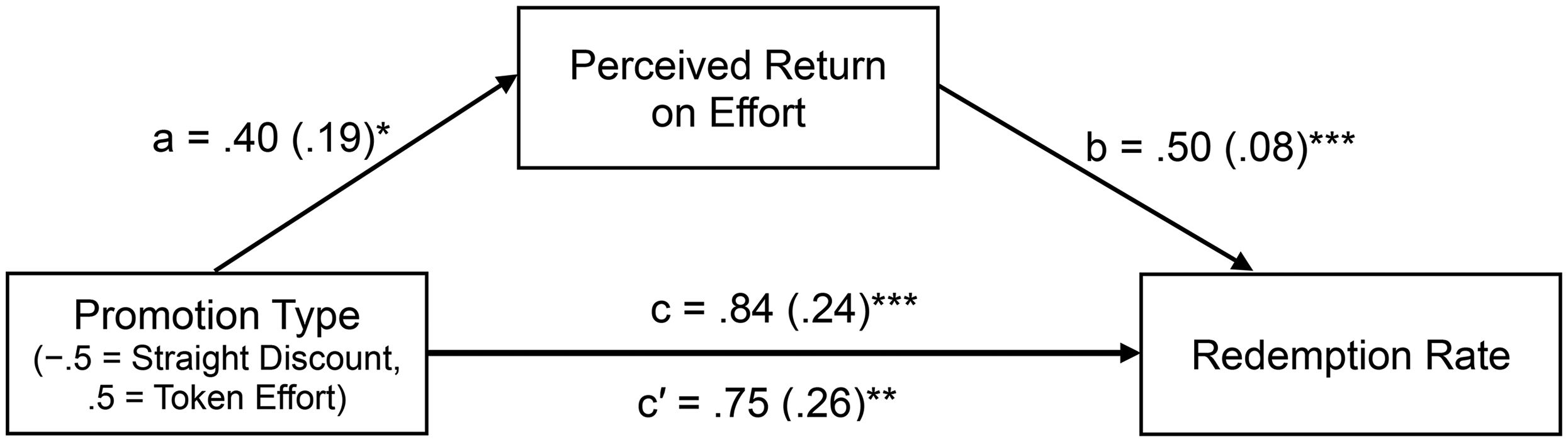
Mediation Analysis in Study 5a.
Discussion
Study 5a supports our proposed mechanism by showing that a token-effort requirement creates a higher perceived return on effort, increasing the redemption rate. Meanwhile, the token-effort requirement does not increase the perceived return on price (i.e., transaction utility based on the price paid).
Study 5b
In Study 5b, we formally test H3 by examining whether perceived responsibility over the discount serves as an antecedent of perceived return on effort. Furthermore, we also test the smart-shopper feeling as a theoretically relevant outcome of the return on effort in this study.
Method
Participants and design
Three hundred U.S. participants from Prolific completed this experiment for a nominal payment (56.7% female, 41.0% male, 2.3% other; Mage = 35.8 years). We used a two-level (promotion type: token effort vs. straight discount) between-participants design. Our dependent variable was the proportion of participants redeeming the promotional offer. This study was preregistered (https://aspredicted.org/RHF_3XP).
Procedure
We instructed participants to imagine that they were shopping online and came across a promotional offer on a pair of shoes initially priced at $200 (see Web Appendix A). In the token-effort condition, participants could redeem a 10% discount on this pair of shoes by solving one CAPTCHA task. In the straight-discount condition, there was a 10% discount on this pair of shoes, which was automatically applied. Participants then indicated whether they would like to purchase the shoes (no/yes).
Participants then responded to five seven-point items measuring their perceived responsibility over the discount (adapted from Schindler 1998): “How much control do you have on the discount you get?” (1 = “very little control,” and 7 = “a lot of control”), “How much does your action influence the discount you get?” (1 = “not at all,” and 7 = “very much”), “How responsible are you for the discount you get?” (1 = “not at all,” and 7 = “very much”), “Who do you think is responsible for the discount you get?” (1 = “the store,” and 7 = “you”), and “Is the reason you get the discount something ______?” (1 = “outside of you,” and 7 = “inside you”; α = .92). Next, we asked participants to indicate their perceived return on effort on three seven-point items: “To what extent do you feel rewarded for the effort involved in redeeming the discount?” (1 = “not at all,” and 7 = “very much”), “How much benefit do you feel you derive from the effort involved in redeeming the discount?” (1 = “none,” and 7 = “a lot of benefit”), and “How much value do you feel you derive from the effort involved in redeeming the discount?” (1 = “none,” and 7 = “a lot of value”; α = .92).
Finally, participants completed a four-item scale measuring the smart-shopper feeling (“By getting this promotion”: “I feel like a smart shopper,” “I feel proud,” “I feel like a winner,” and “I feel good about myself”; α = .96; Burton et al. 1998; Chandon, Wansink, and Laurent 2000; Schindler 1998).
Results
Redemption rate
A logistic regression on the redemption decision (0 = no, 1 = yes) with promotion type (−.5 = straight discount, .5 = token effort) as the independent variable revealed a significant main effect of promotion type (b = 2.23, SE = .27, Wald χ2(1) = 66.44, p < .001, Exp(b) = 9.26): The token-effort discount led to a significantly higher redemption rate than the straight discount (token effort: 81.33% vs. straight discount: 32.00%), in support of H1.
Perceived responsibility over the discount
An ANOVA revealed that those in the token-effort condition indicated a higher perceived responsibility over the discount (Mtoken-effort = 4.79, SD = 1.50) than did those in the straight-discount condition (Mstraight-discount = 1.92, SD = 1.20; F(1, 298) = 333.07, p < .001,
Perceived return on effort
An ANOVA revealed that those in the token-effort condition perceived a higher return on effort (Mtoken-effort = 4.59, SD = 1.56) than did those in the straight-discount condition (Mstraight-discount = 3.09, SD = 1.47; F(1, 298) = 73.62, p < .001,
Smart-shopper feeling
An ANOVA revealed that those in the token-effort condition also had a greater smart-shopper feeling (Mtoken-effort = 4.39, SD = 1.68) than did those in the straight-discount condition (Mstraight-discount = 3.03, SD = 1.58; F(1, 297) = 51.65, p < .001,
Mediation analysis
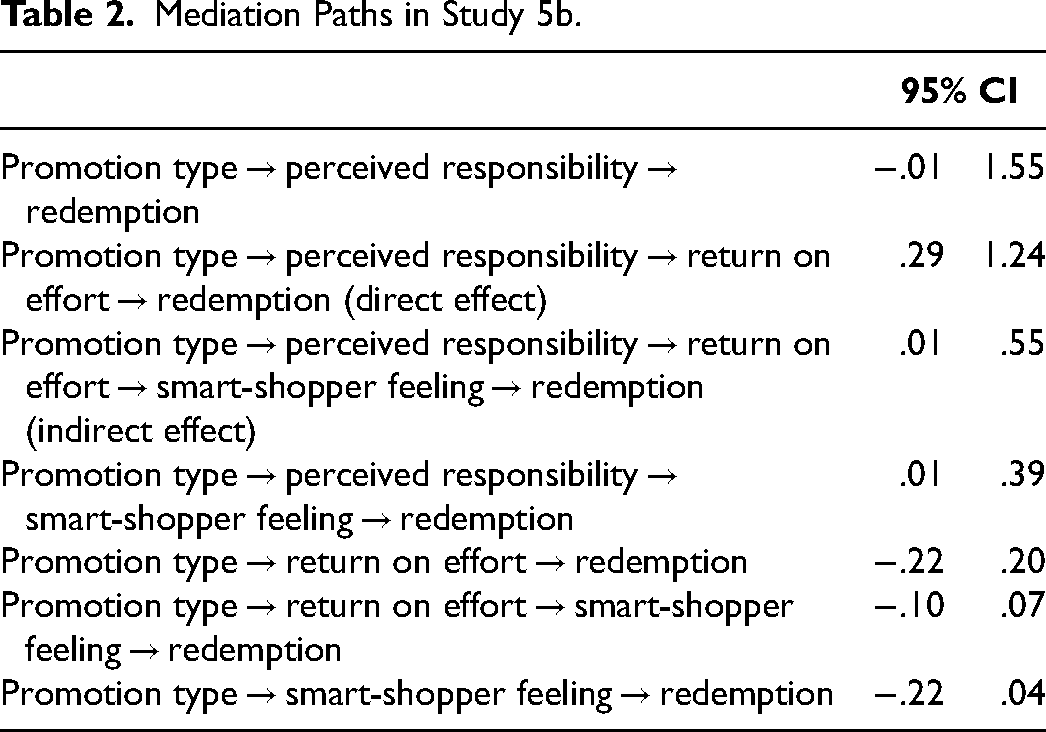
We performed a serial mediation analysis to test the causal link: token effort → perceived responsibility over the discount → perceived return on effort → smart-shopper feeling → redemption rate (PROCESS Model 6 with 5,000 bootstrap samples; Hayes 2017). Consistent with H3, the serial mediation analysis revealed that a token-effort requirement makes consumers feel more responsible for obtaining the discount, which makes consumers perceive a higher return on effort and have a greater smart-shopper feeling, thereby increasing the redemption rate. Further, we found that perceived return on effort had both a significant direct effect (B = .70, SE = .24, 95% CI = [.29, 1.24]) and a significant indirect effect via smart-shopper feeling (B = .25, SE = .14, 95% CI = [.01, .55]) on redemption rate (see Figure 3 and Table 2 for detailed path coefficients).
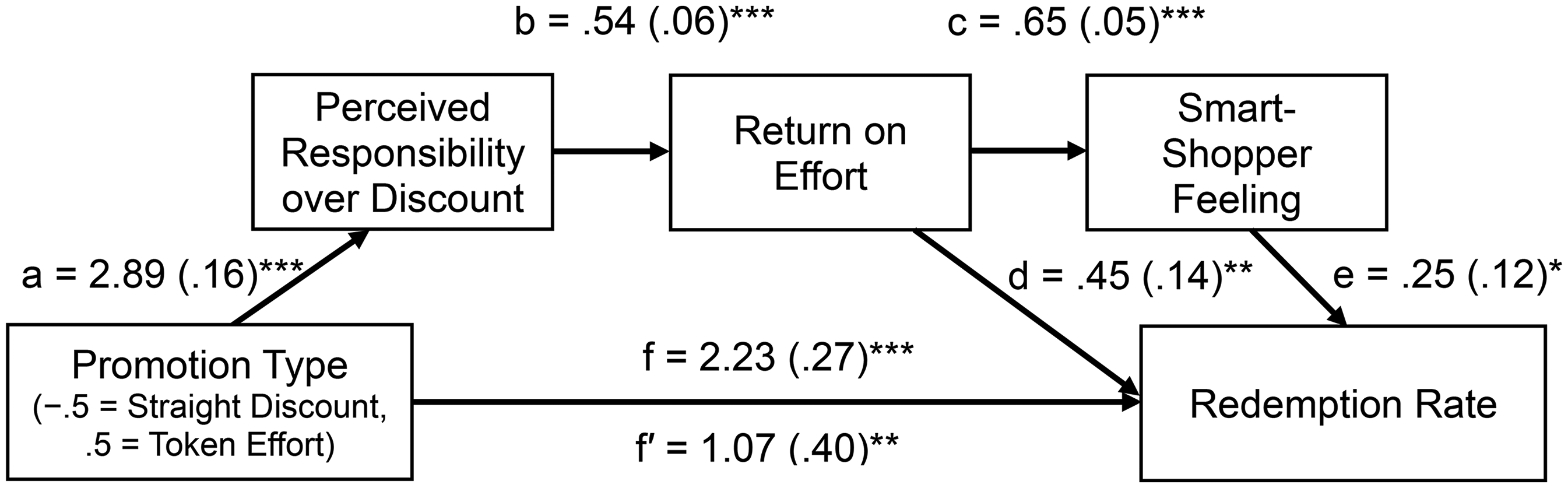
Mediation Analysis in Study 5b.
Mediation Paths in Study 5b.
Discussion
The results from Study 5b corroborate the results of Study 5a and identify perceived responsibility over the discount as an antecedent of the perceived return on effort: The token-effort effect occurs because introducing a token redemption task causes consumers to perceive a greater sense of responsibility over the discount, which leads to a higher perceived return on effort (see Web Appendix C for a preregistered replication of the results). In addition, the results from this study show that perceived return on effort has both a direct positive effect and an indirect positive effect (via smart-shopper feeling) on redemption rate.
It should be noted that, in Studies 5a and 5b, the direct effect of the token effort on the redemption rate decreased but remained highly significant after the mediator was included in the model, suggesting that other possible mechanisms may also be at play.
Study 6
Study 6 uses a moderation-of-process approach (Spencer, Zanna, and Fong 2005) to support our proposed process. Specifically, we expect the token-effort effect to attenuate when we direct consumers’ attention away from the perceived return on effort by asking consumers to ruminate on the financial cost of the purchase instead (H4).
Method
Participants and design
Eight hundred three U.S. participants from Prolific completed this experiment for a nominal payment (48.6% female, 50.3% male, 1.1% other; Mage = 42.4 years). We used a 2 (promotion type: token effort vs. straight discount) × 2 (manipulated focus: control vs. focus on financial cost) between-participants design. Our dependent variable was the proportion of participants redeeming the promotional offer.
Procedure
We asked participants to imagine they came across a promotional offer for a $200 jacket. Participants learned that they could enter the promo code GET20OFF to receive a 20% discount on the jacket (token-effort condition) or that there was a 20% discount (straight-discount condition) on the item. As in our previous studies, participants in the control condition were only asked whether they would purchase the product (no/yes). In the focus on financial cost condition, participants were asked to first write about how they would feel about spending this amount of money on the jacket before indicating their choices. We then measured all participants’ perceived return on effort using the same three items as in Study 5b (α = .95). As a test of an alternative explanation, we also measured participants’ involvement with the task using three seven-point items (Johar 1995): “While reading the previous scenario, you:” (1 = “were not interested,” and 7 = “were very interested”; 1 = “were not absorbed,” and 7 = “were very absorbed”; 1 = “skimmed the description quickly,” and 7 = “read the description thoroughly”; α = 80).
Results
Redemption rate
A logistic regression on redemption decision (0 = no, 1 = yes) with promotion type (−.5 = straight discount, .5 = token effort) and manipulated focus (−.5 = focus on financial cost, .5 = control) as independent factors revealed a significant two-way interaction between the promotion type and the focus manipulation (b = 1.03, SE = .29, Wald χ2(1) = 12.66, p < .001, Exp(b) = 2.81). There was also a significant main effect of the focus manipulation (b = .47, SE = .15, Wald χ2(1) = 10.25, p = .001, Exp(b) = 1.59) and promotion type (b = .65, SE = .15, Wald χ2(1) = 20.21, p < .001, Exp(b) = 1.92). Within the control condition, participants were significantly more likely to redeem the promotional offer in the token-effort condition (69.46%) than in the straight-discount condition (41.38%; b = 1.17, SE = .21, Wald χ2(1) = 31.44, p < .001, Exp(b) = 3.22), replicating the token-effort effect. However, in the focus on financial cost condition, the difference between the token-effort condition (46.00%) and the straight-discount condition (42.64%) was attenuated (b = .14, SE = .20, Wald χ2(1) = .45, p = .50, Exp(b) = 1.15), consistent with H4. In comparison of the two token-effort conditions, asking participants to focus on the financial cost significantly reduced the redemption rate (b = −.98, SE = .21, Wald χ2(1) = 22.24, p < .001, Exp(b) = .37).
Perceived return on effort
An ANOVA on perceived return on effort revealed a significant two-way interaction between the promotion type and the focus manipulation (F(1, 799) = 7.02, p = .008,
Involvement with the task
An ANOVA on involvement with the task revealed no significant interaction between promotion type and manipulated focus (F(1, 799) = 2.20, p = .14,
Moderated mediation analysis
We performed a moderated mediation analysis to test whether and where the focus on financial cost manipulation moderated the causal link through perceived return on effort in explaining the effect of the token effort on redemption rates (PROCESS Model 59 with 5,000 bootstrap samples; Hayes 2017). The analysis revealed a significant two-way interaction effect of promotion type and manipulated focus on the mediator (p = .008). However, there was no interaction effect of the mediator and the manipulated focus on the redemption rate (p = .63), suggesting a moderation on the first mediation path. We observed a significant index of moderated mediation (index = .89, SE = .39, 95% CI = [.16, 1.70]; see Figure 4 for detailed path coefficients). Perceived return on effort mediated the effect of promotion type on redemption rate in the control condition (indirect effect = 1.23, SE = .27, 95% CI = [.75, 1.81]), but not in the focus on financial cost condition (indirect effect = .34, SE = .27, 95% CI = [−.19, .87]). Those results hold even when controlling for task involvement in the model.
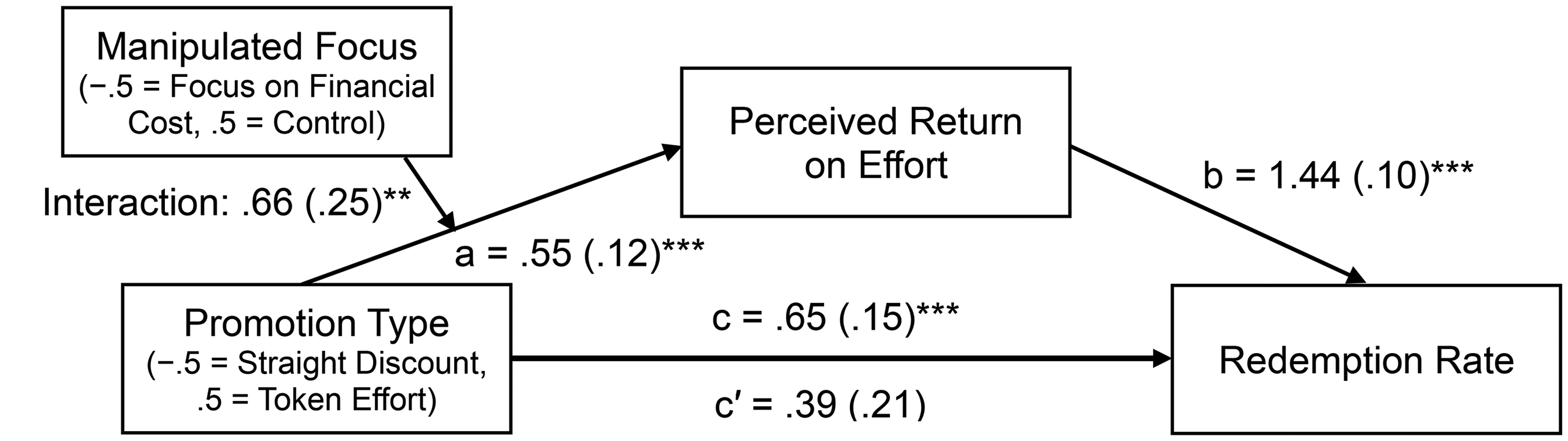
Moderated Mediation Analysis in Study 6.
Discussion
Study 6 used a moderation-of-process approach to complement the mediation evidence from Studies 5a and 5b. We found that the token-effort requirement did not increase redemption rates among consumers who were asked to ruminate on the money they would spend on the purchase. In other words, directing consumers’ attention to the financial cost of the purchase attenuates the effect because it distracts them from perceiving a return on effort in the redemption process.
Study 7
Study 7 tests another boundary condition of the token-effort effect. Our effect emerges because token effort induces a high perceived return on effort, which is based on the relative comparison between discount benefit and redemption effort. When the redemption effort is trivial, consumers derive a high perceived return on effort. However, when the redemption effort is high, consumers would no longer experience a high perceived return on effort, which is in line with the notion that consumers find high effort aversive. Thus, our proposed effect will attenuate when the redemption effort is high (H5).
This study thus enables us to test an alternative explanation suggesting that people may find the deal more valuable when more effort is needed. Specifically, this “higher effort = higher value” alternative explanation predicts that consumers would be more likely to redeem the offer when the redemption effort is high (vs. low). By contrast, we expect our proposed effect to emerge only when the redemption effort is low (i.e., a token effort) but not when the redemption effort is high.
Method
Participants and design
Five hundred twenty-five undergraduate students from a large university in Singapore completed this experiment for partial course credit (59.8% female, 39.6% male, .6% other; Mage = 20.4 years). We used a three-level (promotion type: token effort vs. high effort vs. straight discount) between-participants design. Our dependent variable was the proportion of participants redeeming the promotional offer.
Procedure
As in Study 3, participants learned that one person would be randomly selected to receive a cash allocation of $20 and execute the purchase decision made in this study. We instructed them to imagine they were shopping online and came across a promotional offer for effervescent vitamin C tablets. The regular price was $16. In the token-effort condition, participants had to solve one CAPTCHA to redeem a 40% discount on the product. In the high-effort condition, participants had to solve 20 CAPTCHAs to redeem the same 40% discount on the product. In both effort conditions, we provided participants with an example of such a CAPTCHA (see Web Appendix A). In the straight-discount condition, participants were told that there was a 40% discount on the product. We reminded participants that their choices would have consequences: The person selected would receive the product (if a purchase decision was made) and the remaining balance in cash.
Participants indicated whether they would like to redeem the promotional offer (no/yes). Those who indicated “yes” completed the appropriate number of CAPTCHAs for their condition. Notably, none of the participants failed to complete their redemption task.
Results
A logistic regression on redemption decision (0 = no, 1 = yes) revealed a significant overall effect of the condition (Wald χ2(2) = 16.22, p < .001). Consistent with H1, redemption rates were significantly higher in the token-effort condition (73.86%) than in the straight-discount condition (60.34%; b = .62, SE = .23, Wald χ2(1) = 7.17, p < .01, Exp(b) = 1.86). Redemption rates in the token-effort condition were also significantly higher than in the high-effort condition (53.14%; b = .91, SE = .23, Wald χ2(1) = 15.91, p < .001, Exp(b) = 2.49). Notably, the high-effort condition did not differ from the straight-discount condition (b = .29, SE = .22, Wald χ2(1) = 1.84, p = .17, Exp(b) = 1.34), suggesting that the positive effect of redemption effort on redemption rate disappeared when the effort was high. These results support H5.
Discussion
Study 7 shows that an effort requirement boosts the redemption rate only when the requirement involves token effort, not high effort. The boundary condition concurs with extensive prior findings that consumers find high effort aversive (e.g., Hull 1943; Kool et al. 2010). The finding is consistent with our conceptualization: Consumers find high redemption effort aversive and will not experience a positive perceived return on effort. Thus, only a token redemption effort has an overall positive effect on the redemption rate. Study 7 is thus inconsistent with a “higher effort = higher value” alternative explanation, which would predict the highest redemption rate in the high-effort condition.
General Discussion
Despite the large body of research on price promotions in marketing, there is a limited understanding of the role of the redemption process in driving promotion effectiveness. Our research aims to fill this gap by exploring how token effort in the redemption process influences consumers’ redemption decisions. We propose and demonstrate a robust token-effort effect: The requirement of token redemption effort, relative to the straight discount, increases redemption rates. This effect occurs because the need to expend a token amount of effort (relative to no effort) leads consumers to attribute the responsibility of obtaining the promotion to themselves, and because the effort required is trivial, this induces a positive perceived return on effort. We also document that perceived return on effort has both a direct and indirect effect on redemption rates by impacting feelings of being a smart shopper. Furthermore, these effects only emerge when only a token amount of effort is required (which is too trivial to be aversive), but not when the effort required is high.
Eight studies provide converging support for our propositions. In Study 1, a field experiment, a token-effort discount led to more sales conversions than an equivalent straight discount. Study 2 also uses a field experiment to show a similar effect on click-through rates. Study 3 replicates the token-effort effect in a controlled setting with an incentive-compatible design and two product replicates. Study 4 shows that the token-effort effect is also robust to the semantic meaning of the redemption task. Studies 5a and 5b test the proposed mechanism via mediation, showing that a token redemption effort requirement increases the perceived return on effort, which increases the redemption rate. Study 5b also documents the roles of perceived responsibility over the discount and smart-shopper feeling. Providing additional process support, Study 6 shows that directing consumers’ attention to the financial cost of the purchase attenuates the token-effort effect by reducing the perceived return on effort in the redemption process. Further, consistent with the perceived return on effort mechanism, Study 7 shows that a redemption effort requirement boosts the redemption rate only when the requirement involves token effort, not high effort.
Together, these studies document the token-effort effect in the laboratory and in the field with a wide range of products (coffee, earbuds, scooters, jackets, shoes, and vitamin tablets) and price points (initial price: $16 to $200). We also varied the discount rates across studies (10% off to 40% off). Our effects are robust and replicate for shoppers, students, and online panelists (e.g., Prolific) and across geographies and cultures (e.g., United States, United Kingdom, Singapore). Admittedly, while there could be cultural differences between the United States, the United Kingdom, and Singapore, we do not believe those impact how consumers in these regions react to token-effort tasks, and we do not observe such differences.
Our research also rules out several alternative accounts for the token-effort effect. First, we show that the token-effort effect cannot be explained by a “higher effort = higher value” alternative account, as we show that this effect only occurs when the redemption effort is trivial but not when the effort is high (Study 7). In addition, we find that the token-effort effect cannot be explained by inferences of exclusivity (see Web Appendix D) and appears inconsistent with considerations about the token effort being fun. Specifically, a posttest with 104 U.S. participants from Prolific evaluated the extent to which they considered the following ways of getting a 20% discount (automatically applied vs. entering a promo code vs. solving two CAPTCHA tasks) to be work or fun (1 = “definitely work,” and 7 = “definitely fun”; Babin, Darden, and Griffin 1994). A within-subject ANOVA revealed that compared with an automatically applied discount (M = 5.55, SD = 1.34), entering a promo code (M = 4.33, SD = 1.48; F(1, 103) = 55.48, p < .001) and solving two CAPTCHA tasks (M = 2.30, SD = 1.37; F(1, 103) = 284.64, p < .001) were considered less fun. However, although expending token effort is not fun, as we show in Study 5b, consumers do experience feelings of being a smart shopper when they obtain a discount by expending a token amount of effort. Therefore, we believe that perceived return on effort is a more parsimonious explanation for the positive impact of token redemption effort on redemption rates.
Theoretical Contributions
Our research makes three major theoretical contributions. First, while a large body of research has examined different types of price promotion designs (e.g., Chandran and Morwitz 2006; Chen et al. 2012; Goldsmith and Amir 2010; Hock, Bagchi, and Anderson 2020; Inman, Peter, and Raghubir 1997; Palmeira and Srivastava 2013), this research is among the first to investigate the impact of the redemption process itself on the redemption rate. Contrary to conventional wisdom, we find that a token redemption effort requirement increases the redemption rate by drawing attention to the (easy) redemption process and inducing a positive perceived return on effort. Importantly, we also show that a token redemption effort can boost the promotional effectiveness of small discounts—which prior research often finds ineffective (Biswas et al. 2013; Cai, Bagchi, and Gauri 2016; Grewal, Marmorstein, and Sharma 1996; Guha et al. 2018; Gupta and Cooper 1992).
Second, our research contributes to the literature on purchase utility (Grewal, Monroe, and Krishnan 1998; Lichtenstein, Netemeyer, and Burton 1990; Thaler 1983, 1985). While this stream of literature has primarily focused on the value derived from the financial terms of a deal), our research adds to the research, suggesting that consumers can also derive value from nonfinancial terms of price promotions (e.g., Darke and Dahl 2003; Schindler 1998). Specifically, we identify the perceived return on effort as an important driver of promotional effectiveness. This perceived return on effort positively drives consumers’ redemption of the promotional offer.
Third, our research contributes to the literature on effort (e.g., Cheng, Mukhopadhyay, and Schrift 2017; Hull 1943; Inzlicht, Shenhav, and Olivola 2018; Kool et al. 2010) by documenting one situation in which effort can have a positive effect on consumers’ responses in the marketplace. Importantly, our research shows that our effects only emerge when the effort required is low and attenuate when the redemption effort level is high.
Managerial Implications
The current research provides pertinent managerial implications. First and foremost, this research offers a costless yet effective pricing strategy for marketers to increase the effectiveness of their promotional campaigns. Our token-effort effect occurred in the field (promotions from a coffee company; Studies 1 and 2) and was robust to the product category (coffee, earbuds, scooter, jackets, shoes, and vitamin tablets), price point (initial price: $16 to $200), consumer population (online panels in the United States and United Kingdom, undergraduate students in Singapore, Facebook/Instagram users, and customers of a business). Notably, we also found that the token-effort effect appears most prominent for discount levels within the low-to-moderate range (10% off to 40% off) and attenuated when the discount depth is very high (e.g., 70% off; see Web Appendix E).
Unlike traditional coupons that require high effort and thus are often used by marketers as a price discrimination tool or screening device (Narasimhan 1984), the current research helps marketers understand why digital coupons (e.g., promo codes, digital discount vouchers), which require a trivial effort to redeem and are widely available to customers, can positively influence consumers’ responses to promotional offers. We note that sellers on most online shopping platforms should find it easy to implement a token-effort requirement. Many platforms (e.g., Uber, Lyft, DoorDash, Amazon, Temu, Shopee) offer promo codes or digital coupons. Our findings suggest that instead of automatically giving consumers a discount, sellers can boost redemption rates and sales by asking consumers to exert a trivial effort to redeem the discount.
Limitations and Future Research
While our current studies show that the token-effort effect is highly robust, we should note that this effect is comparatively smaller in the field (Studies 1 and 2) than in our experiments. Thus, managers should expect more modest effect sizes in complex and busy environments. Our experiments often focused on achieving high internal validity by manipulating prominently featured price promotions and, in many cases, somewhat simplified stimuli (relative to everyday shopping decisions) for a sole purchase decision. We might anticipate diminished impacts in shopping environments where consumers’ attention is more fragmented. For example, when consumers make many purchasing decisions, each decision possibly involves the usage of numerous price promotions. In addition, if consumers encounter these promotions frequently, they may come to see them as a mere tactic, ultimately reducing the effectiveness.
The current research also raises several interesting future research questions. First, while we provide robust evidence for the mediating role of perceived return on effort in the token-effort effect, the direct effect of token effort on redemption rate decreased but remained statistically significant in the mediation analyses of Studies 5a and 5b, suggesting that other possible mechanisms may also be at play. In other words, the effect of a token-effort requirement on consumers’ redemption decisions is most likely multiply determined. Future research can examine other possible processes that may underlie the token-effort effect.
Second, future research is needed to explore other potential moderators of the token-effort effect. For example, while we observe the token-effort effect using a wide range of products, it is possible that this effect may be more pronounced for certain kinds of products. Another potential moderator is the type of token effort. We considered the most common kinds of token efforts seen in purchase contexts. However, promotions requiring small, yet aversive efforts, such as sharing friends’ contact information and reposting brand communications on social media, could have adverse effects. In addition, examining whether the token-effort effect is attenuated when consumers perceive a lower sense of responsibility for the discount due to other situational factors would be interesting. Future research should also investigate whether there are individual or cultural variations (e.g., locus of control) in the token-effort effect.
Third, while the current research focuses on how introducing a token amount of effort impacts redemption decisions relative to no effort, future research could consider other effort levels and assess whether similar effects emerge. We speculate that as long as the effort is not considered aversive and the benefits outweigh the effort, the positive effect of the perceived return on effort will persist. When comparing across effort levels (e.g., token effort vs. no effort, token effort vs. high effort), we held the discount benefit constant. Future research could consider contexts where effort and benefits change simultaneously (e.g., one CAPTCHA for 10% vs. four CAPTCHAs for 40%).
Fourth, while the current research has focused on consumers’ redemption decisions related to the immediate effects of price promotions, future research is needed to examine whether token redemption efforts can have any long-term effects. For example, would consumers be more likely to develop a higher postpurchase satisfaction or even greater store loyalty after exerting token redemption effort to redeem the promotional offers? These empirical questions can benefit from future research.
Finally, future research should also examine whether the token effort might positively affect consumer welfare beyond price promotions. For example, would introducing a token-effort requirement to join an exercise program increase consumers’ likelihood of joining it and their motivation to pursue health-related goals? Exploring these research directions would enrich our understanding of the role of token-effort effects in marketing and provide additional insights for marketers and policy makers.
Supplemental Material
sj-pdf-1-mrj-10.1177_00222437251338050 - Supplemental material for The Token-Effort Effect: Trivial Redemption Effort Increases Price Promotion Effectiveness
Supplemental material, sj-pdf-1-mrj-10.1177_00222437251338050 for The Token-Effort Effect: Trivial Redemption Effort Increases Price Promotion Effectiveness by Kuangjie Zhang, Thomas Allard, Nidhi Agrawal and Rajesh Bagchi in Journal of Marketing Research
Footnotes
Acknowledgments
The authors thank the JMR review team for their valuable feedback and guidance throughout the review process. The authors also thank Jeff Babcock and Lisa Dahlby-Freeburg at Zoka Coffee for their support and Johannes Boegershausen for his comments on previous versions of this article.
Author Contributions
The first two authors contributed equally to this research.
Coeditor
Rebecca Hamilton
Associate Editor
Dhruv Grewal
Declaration of Conflicting Interests
The author(s) declared no potential conflicts of interest with respect to the research, authorship, and/or publication of this article.
Funding
The author(s) disclosed receipt of the following financial support for the research, authorship, and/or publication of this article: This work was supported by the Singapore Ministry of Education Academic Research Fund Tier 1 Grant (grant number RG107/22).

Notes
References
Supplementary Material
Please find the following supplemental material available below.
For Open Access articles published under a Creative Commons License, all supplemental material carries the same license as the article it is associated with.
For non-Open Access articles published, all supplemental material carries a non-exclusive license, and permission requests for re-use of supplemental material or any part of supplemental material shall be sent directly to the copyright owner as specified in the copyright notice associated with the article.
