






Abstract
Objectives:
To examine the social ecology of homicide in Toronto, Canada.
Method:
Using both ordinary least squares regression and negative binomial models, we analyze the structural correlates of 965 homicides occurring in 140 neighborhoods in Toronto between 1988 and 2003.
Results:
Similar to research in U.S. cities, Toronto neighborhoods with higher levels of economic disadvantage, higher proportions of young and Black residents, and greater residential instability have higher homicide rates. In contrast to U.S. studies, Toronto neighborhoods with higher proportions of residents who are recent immigrants also have higher homicide rates. In multivariate models, only two of these characteristics—economic disadvantage and the proportion of residents aged 15 to 24—are significantly associated with homicide in Toronto’s neighborhoods. Despite low levels of both lethal violence and spatial inequality in Toronto, the correlates of homicide in its neighborhoods are similar in some respects to those in U.S. cities.
Conclusion:
Our findings lend support to the notion of invariance in some ecological covariates of homicide but also highlight the need to be cautious about generalizing from U.S.-based research on the relationship between immigration and homicide.
It is fitting that Chicago, the birthplace of theory and research on the social ecology of crime, has been the site of more studies of how neighborhood context shapes homicide and other crimes than any other city in the world (e.g., Block and Block 1992; Browning, Feinberg, and Dietz 2004; Bursik and Grasmick 1993; Sampson 2012; Shaw 1929; Zimmerman and Messner 2011). In the last few years, “neighborhood effects” research on homicide has been extended to other American cities, such as New York, St. Louis, Columbus, Miami, and San Diego (Hannon 2005; Kubrin 2003; Lee, Martinez, and Rosenfeld 2001; Martinez, Stowell, and Cancino 2008; Peterson, Krivo, and Harris 2000). The findings from this research are remarkably consistent across regions of the country, cities of different sizes, and levels of homicide: Urban neighborhoods in the United States characterized by high levels of economic disadvantage, racial isolation and inequality, and single-parent families and that border on neighborhoods with high levels of violent crime have higher homicide rates (Kirk and Laub 2010; Messner and Zimmerman 2012; Peterson and Krivo 2010).
How well findings from this research on neighborhood context and homicide, or violent crime in general, generalize to cities outside the United States is a question that has been raised only relatively recently. Most notably, Sampson (2006:52) expressed concern “that most of our knowledge has been gained from U.S. cities.” Sampson and Wikström (2008) subsequently responded to this concern in a study comparing neighborhood correlates of violent victimization in Stockholm and Chicago. They found strong similarities in the social structural characteristics of neighborhoods associated with violence in “two cities with vastly different makeup and history” (p. 117). Other research on the community correlates of violent offending and victimization outside the United States has also yielded findings consistent with U.S.-based research (Browning and Erickson 2009; Charron 2009; Lee 2000; Oberwittler 2004; Savoie 2008; van Wilselm, Wittebrood, and de Graaf 2006).
These are studies of nonlethal violence, however, not of homicide. As Zimring and Hawkins (1997) have noted, what sets the United States apart from other industrialized nations is not its level of violent crime, but its homicide rate. While differences between homicide rates in the United States and other industrialized countries have decreased recently, because of a dramatic drop in U.S. rates, they remain substantial. Furthermore, the nature of homicide in the United States differs from other industrialized democracies in important respects: United States homicides tend to be more male-dominated, less likely to involve family members or intimate partners, more likely to be committed with firearms, and more highly concentrated in urban areas. Because of these quantitative and qualitative differences, the neighborhood correlates of homicide in the United States cannot be assumed to parallel those in other nations, even those with similar economic and political structures.
Evidence about the relationship between neighborhood characteristics and homicide in other countries is sparse. The only English-language study conducted in a western industrialized country we were able to locate is Nieuwbeerta’s and colleagues’ (2008) analysis in the Netherlands. 1 Consistent with findings from U.S. studies, Dutch neighborhoods characterized by high levels of socioeconomic disadvantage and low levels of social cohesion have higher risks of homicide. A handful of studies of community-level correlates of homicide have been conducted in some non-English-speaking and/or less-developed countries, which provide important comparative insights. However, their measures of neighborhood characteristics and, in some cases, homicide, as well as the analytic techniques typically used, are not directly comparable to those used in research in the United States (e.g., Barata et al. 1998; Ceccato, Haining, and Kahn 2007; Morris and Graycar 2011; Szwarcwald et al. 1999). Nevertheless, across all of these studies one local area characteristic—economic disadvantage—is consistently and positively associated with homicide.
There are at least two important limitations on studying the neighborhood correlates of homicide in cities outside the United States. First, in cities in the industrialized world, homicides are less frequent than in U.S. cities; when geocoded to smaller areas, the numbers may be too low for systematic analyses (Nieuwbeerta et al. 2008, for example, pooled data on homicides over eight years to ensure sufficient numbers for their neighborhood-level analysis). Second, in cities in the nonindustrialized world, while the number of homicides may be substantial, homicide data may be too unreliable and/or influenced by idiosyncratic factors to allow meaningful neighborhood-level analyses (Zdun 2011).
The alternative we propose is to pool data on homicides across a number of years in a major city in an industrialized country. The site for our study is Toronto, Canada, a city less than 100 miles from the U.S. border but with a homicide rate as much as one-ninth of rates in U.S. cities of comparable size. For example, of U.S. cities with over 1 million population, San Diego had the lowest homicide rate (2.2) and Philadelphia had the highest (19.6); Chicago’s homicide rate was 15.2 (Uniform Crime Reports 2010); Toronto’s 2010 homicide rate was 2.2 (Toronto Police Service 2011).There are additional differences, but also important similarities, in the character of and context for homicide in Toronto and the U.S. cities where neighborhood-level homicide research has been conducted. If the social ecology and neighborhood correlates of homicide in Toronto are similar to those found in research on U.S. cities, this suggests the structural context for homicide at the local level transcends at least one national border. If, however, the relationship between community structure and homicide in Toronto is different, explanations may need to be sought in more nation-specific economic, social, and public policies, and/or cultural orientations. Answers to these questions will contribute to research and theory on the social ecology of urban homicide both in and outside the United States.
Homicide in Canada, Toronto, and the United States
As noted above, there are important differences between the character of and context for homicide in Canada (and Toronto) and the United States, which could produce differences in the neighborhood-level correlates of homicide in Toronto; we detail these next. Following that, we outline reasons to expect similarities between Canada (and Toronto) and the United States in the community contexts for homicide.
Differences in the Characteristics of and Contexts for Homicide
For at least the last century, homicide rates in Canada have been substantially lower than in the United States (Gartner 2004). In the 1980s and early 1990s, the U.S. rate was as much as five times greater than the Canadian rate. Although in recent years the difference has decreased, it is still substantial. In 2010, the Canadian homicide rate was 1.6 (per 100,000), one-third the U.S. rate of 4.8. Canadian homicides also differ in character from those in the United States. The proportions of homicides involving family members and intimate partners, female victims, older persons, and weapons other than firearms are larger in Canada than in the United States (Gartner 2004; Sprott and Cesaroni 2002); and, in contrast to the United States, Canada’s urban homicide rates are not consistently higher than the rates in smaller towns and rural areas (Francisco and Chenier 2007). Although reliable and comparable statistics on drug- and gang-related homicides in the two countries do not exist, evidence also indicates gangs and drugs play a lesser role in Canadian homicides (Carrington 2002; Ouimet 2008). There are also differences between the two countries in the racial distribution of homicide offending and victimization, although the exact size is not known because Canadian police departments and the Canadian Centre for Justice Statistics do not publish or provide data on the racial or ethnic origins of victims or offenders.
Furthermore, the structural contexts for homicide in the two countries are distinctive in important respects. Levels of poverty and economic inequality are lower in Canada; handguns are more strictly controlled and less numerous; markets for psychoactive, highly addictive drugs (e.g., crack cocaine) are less extensive and spatially concentrated; and racial segregation and exclusion are less pronounced (Fong and Wilkes 2003; Oreopoulos 2005; Ouimet 2008). Canada’s social welfare policies have hindered the development of the type of inner-city areas with high concentrations of poverty, public housing, and disenfranchised populations that exist in many U.S. cities (Walks and Bourne 2006). Thus, those who live in low-income neighborhoods in Canada’s cities are likely to have access to better housing, more extensive social services, and nonpoor areas of their cities than their counterparts in the United States.
Similarities in the Characteristics of and Contexts for Homicide
Despite the differences just described, homicide in Canada and Toronto is perhaps not as distinct from homicide in the United States as some Canadians believe. For example, over the past 50 years, trends in homicide rates in the two countries have tracked each other very closely; the correlation between the two rates from 1960 to 2009 is .91 (Figure 1). This suggests that the macro-level factors driving lethal violence in the two countries are similar in important respects. Zimring (2007:200) makes a similar point in his analysis of the crime drop in the United States and concludes that “it would not be wise for any serious student of crime in the United States to neglect comparisons with Canada when analyzing crime trends.” Furthermore, some of the just-described differences in the characteristics of homicide between Canada and the United States are less pronounced—although still substantial—when comparing Toronto with the United States. In 2009, for example, firearms accounted for 30 percent of Canadian homicides, 48 percent of homicides in Toronto, and 68 percent of homicides in the United States; and since the early 1990s, a growing proportion of Toronto’s homicides, compared to homicides in Canada generally, have occurred in public spaces and targeted young, Black males and strangers (Gartner and Thompson 2004). In other words, even though Toronto’s homicide rate is quite similar to that for Canada as a whole, over the past two decades some aspects of its homicides have come to resemble homicides in the United States.

Homicide rates (per 100,000 Residents) Canada and the United States, 1960 to 2009.
The context for homicide in Toronto has also changed in ways that suggest diminishing differences from U.S. urban areas. Toronto’s neighborhoods have become increasingly stratified into distinct areas of great wealth and great poverty; neighborhoods near the center of the city have become more affluent and predominantly White, while neighborhoods in the inner suburbs have experienced a greater concentration of economic disadvantage than ever before (Filion, Osolen, and Bunting 2011; Walks 2004). Neighborhood-level characteristics typically associated with high homicide rates in U.S. cities—for example, poverty, racial and ethnic segregation, joblessness, and large numbers of young people and single-parent families—are increasingly consolidated in some Toronto neighborhoods (Hulchanski 2007; United Way and CCSD 2004). For these reasons, it is possible that, despite differences between Toronto and U.S. cities in the quantity and quality of homicide, the neighborhood characteristics associated with homicide rates may be similar.
Neighborhood Correlates of Homicide
Four main theoretical perspectives have framed research on neighborhoods and homicide: (1) contemporary versions and extensions of social disorganization theory (Kubrin and Weitzer 2003; Peterson and Krivo 2010); (2) cultural perspectives (Matsueda, Drakulich, and Kubrin 2006; Sampson and Bean 2006); (3) strain/deprivation perspectives (Mears and Bhati 2006; Nieuwbeerta et al. 2008); and (4) routine activity/opportunity perspectives (Messner and Tardiff 1985; Tita and Griffiths 2005). Although they postulate different mechanisms linking various structural characteristics of neighborhoods with homicide, these perspectives identify similar correlates of homicide rates: local levels of economic disadvantage, informal social control, and availability of potential victims and offenders. Here we briefly discuss these characteristics and offer hypotheses regarding their relationships with homicide in Toronto’s neighborhoods.
Socioeconomic Disadvantage
Whether measured as absolute, relative, or concentrated poverty, socioeconomic disadvantage is the most consistent ecological correlate of homicide, not just at the neighborhood level (Hannon 2005; Stults 2010) but at all levels of analysis (McCall, Land, and Parker 2010). Economic deprivation is hypothesized to reduce networks of informal social control among neighbors as well as generate a pool of potential victims and offenders with few resources to protect themselves from involvement in homicide (Caywood 1998; Sampson, Raudenbush, and Earls 1997). Ethnographic research suggests the link between poverty and violence also may be explained by the development of social norms that are tolerant, and in some cases prescribe the use, of violence as a means of maintaining status and/or resolving conflicts (Anderson 1999; Stewart, Schreck, and Simons 2006).
Canada’s social welfare system is more extensive than that in the United States and its level of income inequality is substantially lower, which could attenuate the relationship between economic disadvantage and homicide (Hajnal 1995). However, as noted above, Nieuwbeerta and colleagues (2008) found a positive association between socioeconomic disadvantage and homicide in local areas in the Netherlands, where the level of economic inequality is similar to that in Canada. 2 Because of this and the consistency of the association between different measures of economic disadvantage and homicide at the neighborhood and other levels of analysis and in different countries—including Canada (Daly, Wilson, and Vasdev 2001)—we expect a positive relationship between neighborhood poverty and homicide in Toronto. Thus, our first hypothesis is as follows:
Racial Composition
African Americans are disproportionately represented among homicide victims and offenders in the United States, and the neighborhoods in which they live also tend to exhibit high homicide rates (Kubrin and Wadsworth 2003; Peterson and Krivo 2010). Two general perspectives—structural and cultural—have, either individually or in combination, informed research on the relationship between race and homicide in the United States. Structural perspectives identify the concentration of poverty, interracial economic inequality, and racial segregation as the mechanisms linking large percentages of Black residents with high urban homicide rates (Krivo and Peterson 2000). Cultural perspectives suggest that a normative order may emerge in response to these structural characteristics and mediate their effects on local levels of violent crime (Stewart et al. 2006). Many U.S.-based studies have found that when controlling for structural factors—such as economic disadvantage—the association between the proportion of residents who are Black and homicide becomes nonsignificant, which lends support to structural perspectives (Gjelsvilk, Zierler, and Blume 2004; Jones-Webb and Wall 2008). Consistent with cultural perspectives, in some of these studies the relationship between the proportion of residents who are Black and homicide, while reduced when controlling for structural characteristics, remains significant (Hipp 2007; Peterson, Krivo, and Harris 2000).
Toronto is characterized by much less entrenched but still substantial levels of segregation by race/ethnicity and income, and Black Canadians 3 are the most segregated of all racial/ethnic groups in Canadian cities (Fong and Wilkes 1999, 2003; Kazemipur and Halli 2000). At the same time, no Canadian city (including Toronto) has levels of racial segregation that produce neighborhoods that are almost wholly Black, as is the case in many U.S. cities. Nor does Canada have the extensive history of slavery and violent racial oppression that the United States has experienced. As such, there may be an exceptionally pernicious type of racial discrimination in the United States, and the relationship between racial composition and homicide—to the extent it is driven by both structural and cultural factors—may be particularly strong in the United States. Nevertheless, there may still be an association between the proportion of Black residents and homicide in Toronto. However, to the extent it can be explained by high rates of poverty in neighborhoods with more Black Canadians, we would not expect this relationship to remain when controlling for economic disadvantage. Thus, our second hypothesis is as follows:
Immigrant Composition
Although early work on the social ecology of crime posited that neighborhoods home to large numbers of recent immigrants would have higher rates of violent crime, including homicide, recent research in the United States has challenged this assumption (Sampson 2008; Stowell et al. 2009; Wadsworth 2010). Even in immigrant neighborhoods that are severely economically disadvantaged, homicide rates have been shown to be no different from or less than rates in other urban neighborhoods in the United States (Lee et al. 2001; Martinez 2002). The nature of and context for immigration in Canada are, however, substantially different from the United States, which allows us to examine the generalizability of this relationship. In the United States, immigration is dominated by people from Latin American countries, whereas in Canada, Latinos constitute a very small proportion of the immigrant population; and immigrants to Toronto represent a more diverse array of home countries than do immigrants to most cities in the United States. In addition, Canada’s immigration policies include the provision of a network of settlement services that are more extensive than those in the United States (Bloemraad 2006; Siemiatycki and Triadfilopoulos 2010), which may be why Charron (2009) found a negative relationship between the proportion of recent immigrants and rates of violent crime (not including homicide) in Toronto’s neighborhoods. Therefore, despite the differences between immigration in Canada and the United States, we expect to see a similar relationship between immigration and homicide at the neighborhood level:
Residential Instability
Neighborhoods with high levels of population turnover and fewer residents who own their own homes often have weaker networks of informal control, personal ties among residents, and participation by residents in community organizations. Conversely, high levels of residential stability and home ownership are associated with greater financial and emotional investments by residents in their neighborhoods, which encourage both efforts to protect the neighborhood from violence and disorder and higher levels of interaction and civic engagement (Putnam 2000; Sampson and Groves 1989). This is how the positive relationship between residential instability and neighborhood homicides observed in some U.S. cities has been explained (Browning et al. 2010; Kubrin 2003).
However, the evidence with regard to residential instability and homicide is far from consistent, with some studies finding no or even negative relationships (Morenoff, Sampson, and Raudenbush 2001; Nieuwbeerta et al. 2008). Similarly, in a study of the neighborhood correlates of violent crime (not including homicide) in Toronto, Charron (2009) found no association between residential mobility and violent crime. This may be due to the nature of Toronto’s housing market. In the last two decades, upscale condominium developments have expanded greatly in the central city area, drawing affluent young people into the downtown core; the turnover in these developments is quite high, however, because residents move out as they get married or have children. Thus, although these neighborhoods may not have strong informal networks of control, their affluence may counterbalance any effects of residential instability. Consequently, we hypothesize:
Age Composition
Because young people experience higher rates of homicide victimization and offending, neighborhoods with high concentrations of them should have more homicides (e.g., Hannon 2005; Mears and Bhati 2006). This is solely a compositional effect; as routine activity theory would predict, large numbers of young people, particularly young males, in a neighborhood mean more potential offenders and victims. There are also reasons to expect a contextual relationship between neighborhood age structure and homicide: Because young people tend to be more mobile and less invested in their neighborhoods than older people, their concentration in a neighborhood may reduce levels of informal social control and raise homicide rates (Rountree and Warner 1999). However, the empirical evidence from multivariate analyses is mixed, with some finding a relationship (Hannon 2005; Mears and Bhati 2006) and others not (Browning et al. 2010; Kubrin and Weitzer 2003). Although homicide in Canada is less concentrated among young people than it is in the United States, the average age of victims and offenders in Toronto has decreased over the last two decades (Gartner and Thompson 2004). Therefore, we hypothesize:
Data and Measures
The Geography of Homicide in Toronto
We use data on 965 homicides in Toronto between 1988 and 2003 collected from police files, coroners’ records, and newspaper articles to test our hypotheses. In the first stage of data collection, individual homicide files from the Toronto Police Service were reviewed. Subsequently, these data were cross-checked against death records held by the Office of the Chief Coroner of Ontario and the few discrepancies found—such as homicides by police officers, which were not included in the police files, but were documented in the coroners’ records—were corrected after additional investigation. Finally, to obtain additional information on each case, major Toronto newspapers were searched. There were 979 homicides known to officials during these years; however, in 14 cases, no information on the location of the killing was available, reducing the number of homicides we analyze to 965. The homicide data were pooled over this 16-year period to ensure sufficient numbers for analysis at the neighborhood level.
As discussed above, the characteristics of and context for homicides in Toronto differ in some respects from homicides in major U.S. cities. Following Sampson and Wikström’s (2008) comparison of Stockholm and Chicago, and based on a “most different” research design, we also use Chicago (and the Block et al.’s [1998] homicide data set) as a comparison for illustrative purposes. During the 16 years of our study, Chicago (with a population of 2.9 million in 2000) had over 8,800 homicides, nine times as many as Toronto (with a population of 2.5 million in 2000). Chicago’s homicides were also different in character from Toronto homicides (Table 1). Toronto’s homicides were more likely to have female victims, older victims and offenders, and White victims, 4 more likely to occur in private dwellings and to involve family members or intimate partners, and less likely to be committed with firearms. These differences, particularly the more “domestic,” private nature of homicides in Toronto, may influence their neighborhood correlates in ways distinctive from U.S. urban areas, including Chicago.
A Comparison of Characteristics of Homicide in Toronto and Chicago.
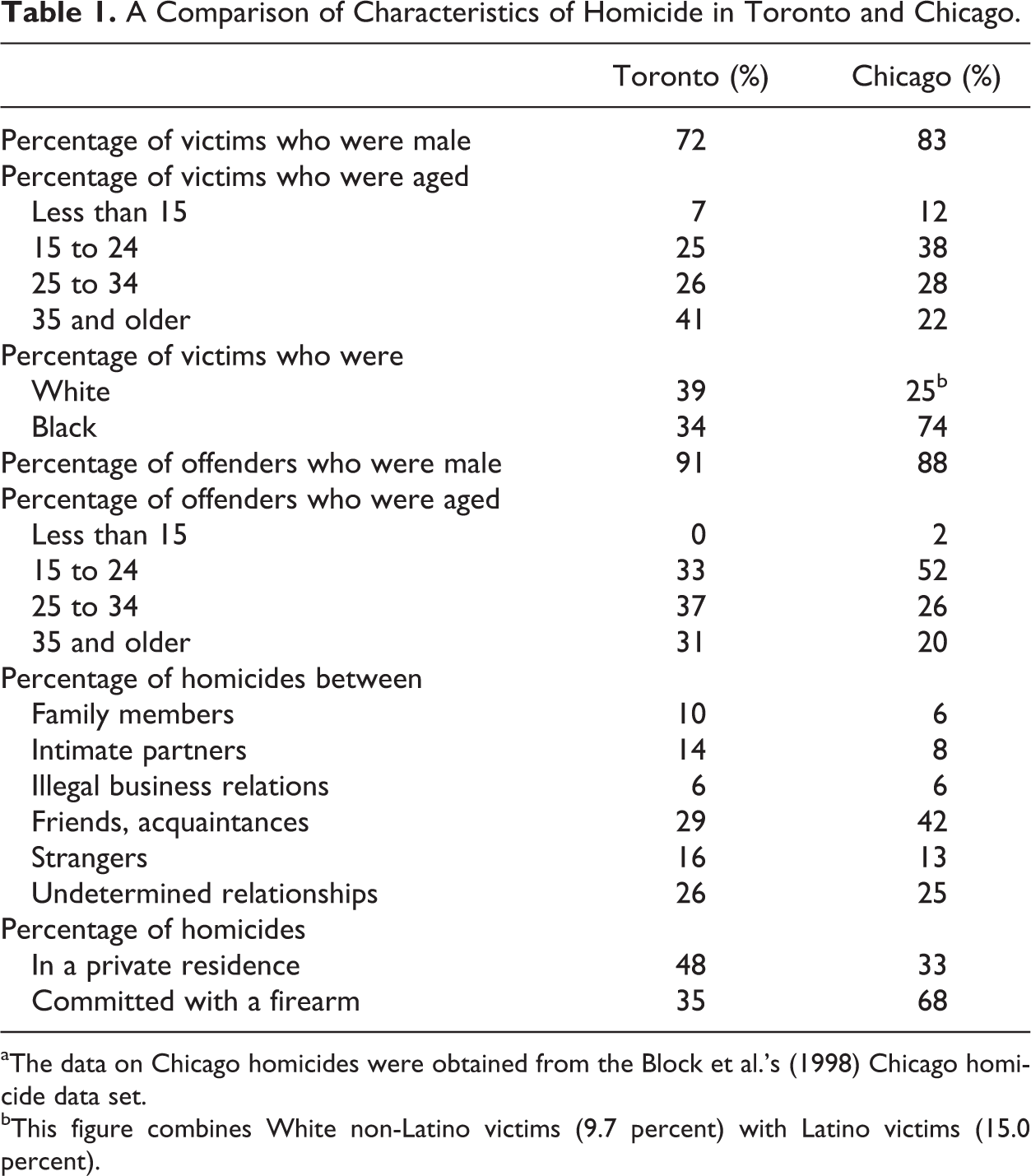
aThe data on Chicago homicides were obtained from the Block et al.’s (1998) Chicago homicide data set.
bThis figure combines White non-Latino victims (9.7 percent) with Latino victims (15.0 percent).
In Toronto, there are 531 census tracts; however, using census tracts as the unit of analysis is not feasible because of the relatively small number of homicides. Instead, each of the 965 homicides was geocoded to one of 140 local areas (or neighborhood clusters [NCs]) based on the location of the killing, not the location of the victim’s or offender’s residence, because we are interested in the neighborhood contexts that generate violent events, not violent individuals. These NCs, each of which is comprised of several census tracts, were delineated by Toronto’s Social Policy and Research Unit based on social service areas, main streets, former municipal boundaries, and/or natural and manmade boundaries, such as rivers or highways. From 1988 to 2003, 7 (5 percent) of the neighborhoods had no homicides, 32 (23 percent) had 1 or 2 homicides, 45 (32 percent) had between 3 and 6 homicides, 50 (36 percent) had between 7 and 20 homicides, and 6 (4 percent) had between 21 and 37 homicides. The number of homicides was converted to a rate (per 100,000) to correct for variations in population across neighborhoods. A map of Toronto indicating levels of homicide in these 140 neighborhoods is shown in Figure 2.

Homicide rates in Toronto’s neighborhoods, 1988 to 2003.
Measuring the Neighborhood Context for Homicide
Because our study spans 16 years, we combined measures of neighborhood characteristics from four censuses (1986, 1991, 1996, and 2001) and averaged them to produce one score for each of our independent variables for each NC. To measure socioeconomic disadvantage, we use five variables often included in neighborhood-level homicide research in the United States, either singly or as a composite index: (1) median family income; (2) the percentage of the neighborhood’s total income composed of government transfer payments; (3) the percentage of neighborhood residents defined as low income by Statistics Canada; 5 (4) the percentage of neighborhood residents aged 15 and older who were unemployed; and (5) the percentage of households in the neighborhood headed by either a male or female lone parent. Measures of the other independent variables we include in the analyses are the percentage of neighborhood residents who identified their racial/ethnic origin as “Black”; the percentage of neighborhood residents who immigrated to Canada within the last 10 years; the percentage of neighborhood residents aged 5 and older who had not changed residences in the past five years; the percentage of dwellings in the neighborhood lived in by their owners; and the percentage of neighborhood residents who were aged 15 to 24.
Table 2 presents descriptive data on and correlations between our independent and dependent variables. There is substantial variation among neighborhoods in Toronto in the social, economic, and demographic characteristics in our analysis. For example, in these 140 NCs, home ownership ranged from a low of just over 1 percent to a high of almost 95 percent; the percentage of residents defined as low income ranged between just over 4 percent to almost 70 percent; and the percentage of families headed by single parents ranged between 7 percent and 45 percent. Clearly, the city of Toronto encompasses communities that are distinctly and considerably different from each other on a number of dimensions.
Means, Standard Deviations, and Bivariate Correlations: Toronto Neighborhood Clusters (N = 140).
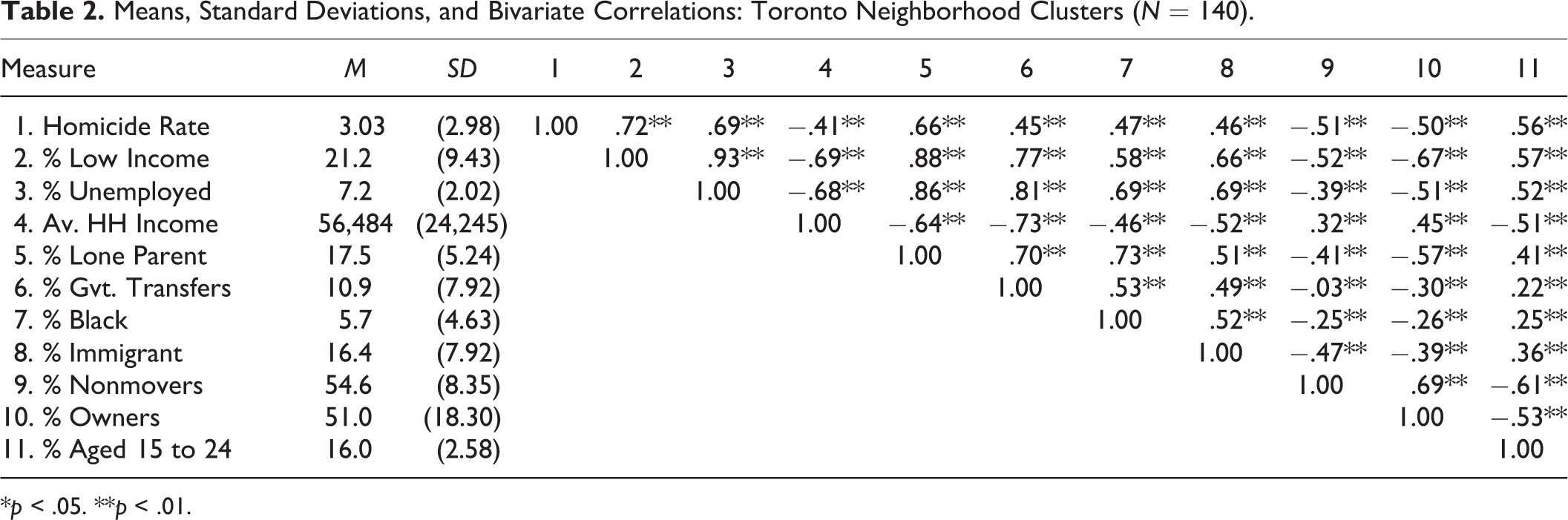
*p < .05. **p < .01.
Nevertheless, most of the differences among Toronto neighborhoods are not as great as those in many U.S. cities, such as Chicago. For example, during the years of our study, there were no neighborhoods in Toronto where the proportion of Black residents exceeded 25 percent, whereas in Chicago the proportion of Black residents in many neighborhoods was well over 80 percent and in some cases 100 percent. Furthermore, in Toronto, no neighborhood had an average unemployment rate greater than 20 percent, a welfare receipt rate greater than 40 percent, a representation of lone parent families greater than 50 percent, or a poverty rate greater than 75 percent. In contrast, in some Chicago neighborhoods, unemployment rates were as high as 55 percent, the proportion of households receiving welfare as high as 77 percent, single-parent households as high as 95 percent, and poverty rates as high as 99 percent (Cohen, Farley, and Mason 2003). Even taking into account variations in the measurement of these characteristics between the two cities, these differences indicate that spatial inequality is much greater in Chicago than in Toronto. Consequently, if the neighborhood correlates of crime are similar in the two cities, despite dramatic differences in the levels and concentration of disadvantage, this would highlight the robustness of the structural context for lethal violence across different contexts.
The bivariate relationships between the neighborhood characteristics and homicide shown in Table 2 are consistent with expectations, with one exception. All five measures of economic disadvantage are strongly related to homicide, indicating that in Toronto, as elsewhere, poor neighborhoods experience higher homicide rates. In addition, neighborhoods with larger proportions of residents who are Black, have recently moved, do not own their own homes, and/or are aged 15 to 24 have more homicides. In contrast to expectations, the proportion of immigrant residents is positively related to homicide. This is not altogether surprising, given the strong positive correlations between immigration and measures of economic disadvantage. Indeed, neighborhoods in Toronto with large proportions of immigrants share many characteristics—such as high levels of poverty and residential instability—with neighborhoods with large proportions of Black residents.
Because the five measures of economic disadvantage are highly correlated with each other, including each of them in our models could create problems with multicollinearity. Therefore, we conducted a principal components factor analysis and found the five measures load on a single factor, with factor loadings ranging between .85 and .94. We therefore created an “economic disadvantage index” by summing standardized scores for each of these five variables; the correlation between this index and the homicide rate is .50. To be consistent with other studies of neighborhoods and homicide, we also constructed a residential stability index by combining standardized scores for the percentage of residents who had not moved in the past five years and the percentage of residents who owned their own homes. These two variables also load on a single factor and their factor loadings are each .90; the correlation between this index and the homicide rate is −.44.
Analysis
We use ordinary least squares (OLS) regression to examine the distribution of homicide rates in Toronto’s neighborhoods as a function of the set of independent variables. Spatial autocorrelation, which can bias parameter estimates, is common in the residuals of regression models in neighborhood-level analyses of homicide. A significant coefficient for a spatial lag term indicates that levels of homicide in neighborhoods adjacent to each other tend to be very similar, because “the effects of social conditions in a given community extend to communities that are geographically proximate” (Mears and Bhati 2006:510). The Moran’s I statistic we calculated using ArcGIS 902 indicated the presence of spatial autocorrelation and so we add a spatial lag to all of our models.
Multivariate Results
We estimate a series of multivariate models, beginning with a model that includes only the disadvantage index and the spatial lag term, because economic disadvantage is consistently and strongly related to neighborhood homicide in other research and may be responsible for relationships between other independent variables and homicide. Consistent with Hypothesis 1 and the bivariate results, economic disadvantage is significantly and positively related to homicide in Toronto’s neighborhoods (model 1 in Table 3). Thus, although there is a stronger social safety net for the citizens of Canada than those of the United States and Toronto’s neighborhoods do not reach the levels of disadvantage found in many urban neighborhoods in the United States, this is not sufficient to buffer residents of Toronto’s more economically disadvantaged neighborhoods from higher risks of homicide.
OLS Regressions of Neighborhood Homicide Rates in Toronto (N = 140).
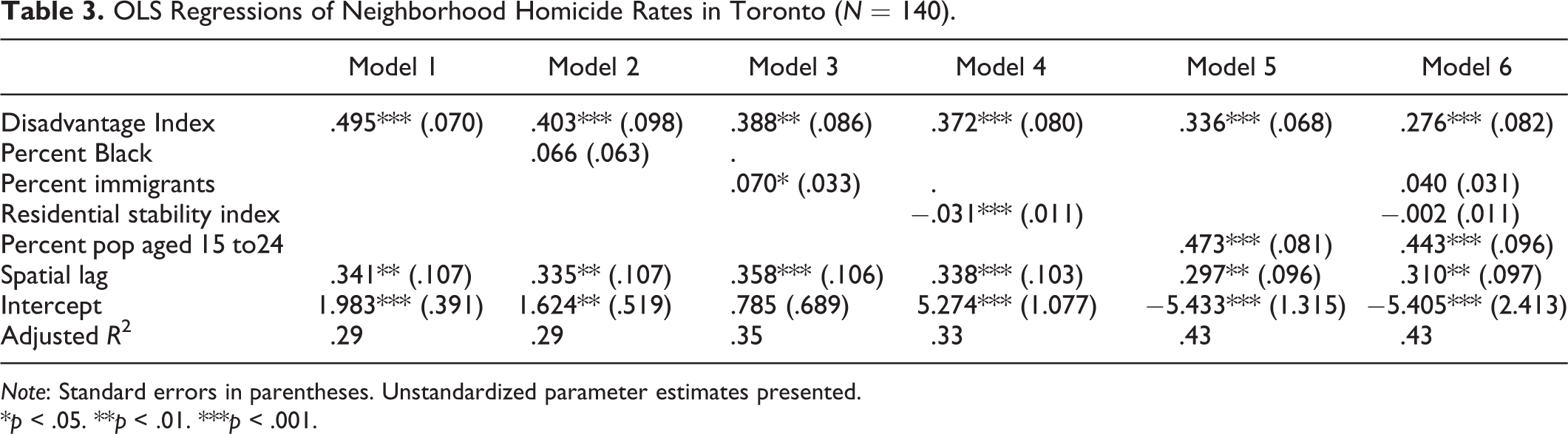
Note: Standard errors in parentheses. Unstandardized parameter estimates presented.
*p < .05. **p < .01. ***p < .001.
In models 2 and 3, we determine whether the positive bivariate relationships between homicide and the proportion of Black residents or the proportion of immigrant residents remain when controlling for economic disadvantage. The coefficient for percent Black residents is not significant, indicating that Toronto neighborhoods with many Black residents have higher homicide rates because they are characterized by high levels of resource deprivation. This finding is consistent with Hypothesis 2. In contrast, the coefficient for percentage immigrant residents is significant, but not in the expected direction. Unlike a number of U.S.-based studies, Toronto neighborhoods with higher proportions of recent immigrants have higher homicide rates, even when controlling for economic disadvantage. This finding does not support our third hypothesis.
In model 4, we examine whether residential stability protects against homicide, when holding levels of economic disadvantage constant. The coefficient for our index of residential stability is negative and significant, indicating that regardless of a neighborhood’s economic context, low population turnover and high levels of home ownership buffer it from homicide. Consequently, Hypothesis 4, which stated there would be no relationship between residential instability and homicide, particularly when controlling for economic disadvantage, is not supported.
Model 5 estimates the relationship between the proportion of a neighborhood’s residents aged 15 to 24 and homicide. The strong, positive relationship, which holds when controlling for economic disadvantage, suggests that, consistent with routine activity theory, homicides are more likely where there is a greater “supply” of potential offenders and victims. Alternatively or in addition, neighborhoods with many young people—even if they are not resource deprived—may lack sufficiently strong informal controls to prevent violent crime. This finding is consistent with our fifth hypothesis.
Finally, model 6 estimates the simultaneous effects of all of our independent variables, except percentage Black, which is excluded because it is not significantly related to homicide when controlling for disadvantage. In this final model, only economic disadvantage and the proportion of young residents are significantly associated with homicide. It therefore appears that our measures of immigrant residents and residential stability are related to homicide in Toronto’s neighborhoods largely because of their association with age composition. In other words, neighborhoods with larger proportions of immigrant residents, higher rates of population turnover, and lower rates of homeownership have higher homicide rates largely because a larger proportion of their residents are in the high-risk years for victimization and offending. The results for model 6 provide support for Hypotheses 1 and 5 and partial support for Hypothesis 4, but fail to support Hypothesis 3. 6
As a test of the robustness of our findings, we also estimated a series of negative binomial models that used homicide counts as the dependent variable and controlled for neighborhood population. This analytic approach has been used in a number of studies of neighborhoods and homicide because homicide is a relatively rare event at the neighborhood level (Kubrin 2003; Kubrin and Wadsworth 2003). When analyzing counts for rare events, assumptions of OLS regression may be violated, resulting in biased estimates (Osgood 2000). We chose negative binomial models rather than basic Poisson models because our data showed evidence of overdispersion. The results from these analyses replicate those from the OLS analysis. Because we pooled the data over a relatively long period of time, our analyses could obscure differences in the relationships between our independent variables and homicide in different time periods. As a check on this possibility, we estimated our models separately for two 8-year periods: 1988 to 1995 (using census data from 1986 and 1991 to measure the independent variables) and 1996 to 2003 (using census data from 1996 and 2001). This reduced the number of homicides in each neighborhood in the two analyses (compared to the analysis pooling data across all 16 years) and had the expected effect: Coefficients were smaller, standard errors were larger, and the relationships were not as strong. Nevertheless, the results were substantively the same and the coefficients for each independent variable were not significantly different from each other in models for different time aggregations.
We should note that the spatial lag term is significant in all our models, which is not surprising but worth commenting upon. In Toronto, as in other cities where studies of neighborhoods and crime have been conducted, neighborhoods with high rates of homicide tend to be adjacent to other neighborhoods with high rates of homicide. Unfortunately, we, like so many other researchers, “do not know if [this] diffusion stems from common community social processes related to disadvantage, social networks and chains of retaliation, or any other specific social mechanism” (Peterson and Krivo 2010:92). However, some research has suggested that living near areas that are economically disadvantaged or have high rates of homicide raises the risks of homicide, regardless of the economic character or level of homicide in one’s own neighborhood (Morenoff et al. 2001; Peterson and Krivo 2010).
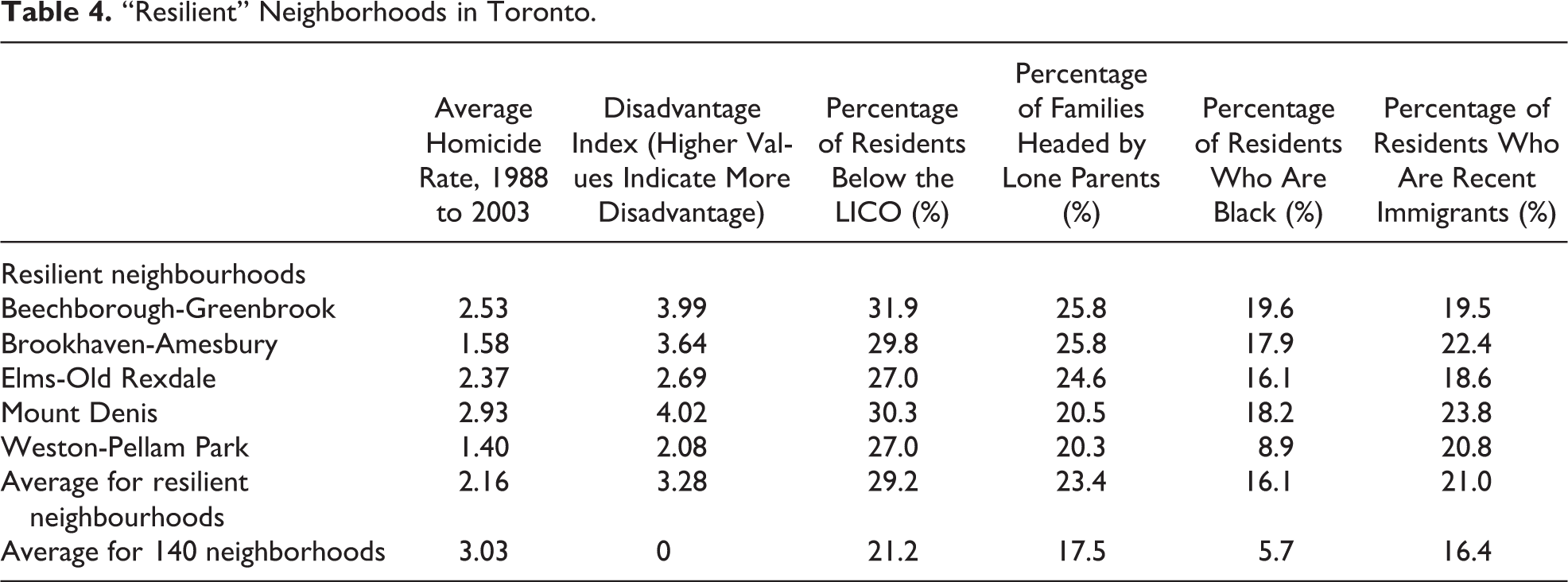
The possibility that conditions in neighboring communities can affect what happens in one’s own community may help explain some of the exceptions to our general findings among the Toronto neighborhoods we have studied. We identified a small number of neighborhoods in Toronto that share many structural characteristics with more violent Toronto neighborhoods, but that do not have high homicide rates. Characteristics of these “resilient neighborhoods,” as we call them, are shown in Table 4. Each of these neighborhoods has higher than average levels of poverty, families headed by lone parents, Black residents, residents who are recent immigrants, and residents aged 15 to 24. In this sense, they are comparable to Toronto neighborhoods with high homicide rates. Indeed, these resilient neighborhoods also border on neighborhoods with high rates of homicide. However, homicide rates in the resilient neighborhoods are below—and in some cases, well below—the citywide average. Understanding how these neighborhoods have buffered themselves from high levels of homicide would require information on more than the types of characteristics that can be measured with census or other official data. The social interactional mechanisms that have been identified in neighborhood-level research based on surveys and interviews of residents—such as social cohesion or collective efficacy—could provide clues to this resilience (Morenoff et al. 2001; Nieuwbeerta et al. 2008). But the fact that these resilient areas also share borders with neighborhoods with lower than average levels of disadvantage and homicide rates should also be considered. In other words, just as being adjacent to disadvantaged and violent areas may raise a neighborhood’s risks of violence, being adjacent to less disadvantaged and nonviolent areas may lower a neighborhood’s risks of violence.
“Resilient” Neighborhoods in Toronto.
Discussion
The goal of this study was to advance cross-national research on the relationship between neighborhood structure and lethal violence by examining the social ecology of homicide in Toronto, Canada. Our measures of several neighborhood characteristics related to homicide in U.S.-based research were strongly correlated with homicides in Toronto at the bivariate level, and two of these—an index measuring economic disadvantage and the proportion of residents aged 15 to 24—remained significantly associated with homicide in a model that included all of our measures. Thus, despite the lower levels of lethal violence and spatial inequality in Toronto, the correlates of homicide in Toronto neighborhoods appear very similar to neighborhood-level correlates of homicide in U.S. cities. This conclusion echoes that of Nieuwbeerta et al. (2008), in their study of neighborhoods and homicide in the Netherlands, and of Sampson and Wikström (2008), in their comparison of violent victimization in Stockholm and Chicago. In other words, evidence from Sweden, the Netherlands, and Canada demonstrates that even in contexts of “inequality compression” (Sampson 2012:19), concentrated disadvantage raises the risks of homicide. This suggests that “there is something fundamental about place stratification and violence that cuts across international boundaries and yet is locally manifested in its distributional form” (Sampson 2012:19-20).
The single exception to this pattern of consistency between Toronto and U.S. cities in the neighborhood correlates of homicide is immigrant composition. Although our measure of the percentage of neighborhood residents who immigrated to Canada in the previous 10 years is not significantly related to homicide in the full model, it is strongly related to homicide at the bivariate level and when controlling for economic disadvantage. Notably, Nieuwbeerta et al. (2008) also found a positive relationship between the proportion of non-Western immigrants and neighborhood homicide in the Netherlands. 7 Taken together, these findings suggest the need to be cautious about generalizing from U.S.-based research on the relationship between immigration and violent crime. As noted earlier, unlike Canada (or the Netherlands), immigration in the United States is dominated by people from Latin American countries, which is why so many studies of neighborhoods and crime use a measure of the percentage of Latino residents as a proxy for immigrant residents. A higher proportion of immigrants to Canada and the Netherlands come from non-Western countries, and so it may be that processes of integration and acculturation are very different for them compared to immigrants to the United States from Latin America. The positive relationship between immigrant residents and various measures of poverty, as well as homicide, at the neighborhood level in Toronto suggests Canada’s efforts to ease the transition of new immigrants to Canadian society have fallen short. 8
This finding also highlights the importance of investigating the generalizability of findings from U.S.-based research on homicide. Different national contexts, just as different local contexts (Graif and Sampson 2009; Vélez 2009), may alter relationships between structural characteristics and homicide observed in the United States. This does not necessarily imply that the mechanisms linking structural characteristics to homicide are different or that the theoretical explanations for the spatial distribution of homicide in the United States are not valid elsewhere. Rather, it indicates the importance of articulating and attempting to measure those underlying mechanisms, something the present study has not been able to do because of the lack of data. Our study has relied on measures of neighborhood characteristics available from the Canadian census, which prevents us from testing different theoretical accounts for our findings or including measures of such potentially important neighborhood characteristics as the floating population or crime attractors (e.g., bars and nightclubs). Furthermore, because of the small number of homicides in Toronto, we are unable to analyze how changes in neighborhood characteristics or in the larger political and economic context in which they exist affect homicide at the neighborhood level. Despite these and other limitations of our study, its findings are a further illustration of Zimring’s (2007:128) conclusion with regard to the “extraordinary similarities” between Canada and the United States in trends in homicide, despite dramatic differences in homicide levels: “The appropriate … question is to ask whether the commonalities in the two nations’ experience outweigh the differences, and I believe they do.” The same can be said for the neighborhood ecology of lethal violence.
Footnotes
Declaration of Conflicting Interests
The authors declared no potential conflicts of interest with respect to the research, authorship, and/or publication of this article.
Funding
The authors disclosed receipt of the following financial support for the research, authorship, and/or publication of this article: This research was supported in full by a grant to the first author, and in part by grants to the second author and Bill McCarthy from the Social Sciences and Humanities Research Council of Canada. We thank Bill McCarthy for his permission to use some of the data we analyzed and Maurice Yates for his advice on aspects of the analysis.