







Abstract
The purpose of this study was to explore the influence of personal, parental, and school-related musical factors on music participation among public elementary and secondary school students in an economically advantaged urban area in China. A total of 12,155 students from sixth, eighth, and 11th grades reported their demographic information, musical interest, attitude, self-concept, perceived parental support, and perceived school music environment. The results indicated that (a) the female students and those with higher socioeconomic status had higher levels of musical interest, more positive attitudes, a stronger musical self-concept, greater perceived parental support, and better perceived school music environments; (b) there was a gap between National Curriculum Standards and actual music education delivery at the elementary level; (c) students’ demographic and personal factors were more influential than parental and school factors in predicting music participation; (d) there was a significant association between socioeconomic status and engagement in out-of-school music activities; and (e) parental support and the perceived school music environment moderated the relationships between personal factors and music participation. By illuminating the complex dynamics that affect music participation in a metropolitan Chinese context, we hope to enhance global understanding and foster cross-cultural discourse on music education.
Keywords
Music participation, encompassing engagement in formal music courses, school music groups, and out-of-school music activities, is not only an integral part of a comprehensive education but also a powerful catalyst for cognitive, emotional, and social development (Bundick, 2011; Guhn et al., 2019; Hallam, 2010; Ilari et al., 2020). Despite this profound importance, the level of music participation among public school students varies considerably (Holster, 2023; Pendergast, 2020). A deeper understanding of the factors influencing music participation is crucial for designing effective interventions and programs aimed at its promotion. Researchers have identified a multilayered framework, including demographic differences and personal, parental, and school factors related to music, which can either facilitate or hinder a student’s involvement in music (Pendergast, 2020; Yoo, 2020). This framework provides a comprehensive approach to explore the factors unique to music participation in metropolitan China, thereby offering a nuanced understanding of the dynamics at work in these economically advanced urban environments.
In China, as in other countries, the government has enacted policies to ensure equal access to music education in public elementary and secondary schools and to encourage various extracurricular music activities (Gong & Wang, 2023; Ministry of Education, 2022). In 2015, a joint policy was issued by the Central Committee of the Chinese Communist Party and the State Council promoting arts participation in public elementary and secondary schools (The Central Committee & the State Council, 2015). Metropolitan areas in China, characterized by high population density, socioeconomic dynamism, and cultural vibrancy, provide rich educational resources and cultural activities that can offer students ample opportunities for musical engagement (Ho, 2016; Xiang et al., 2020). However, there is a lack of empirical research on students’ music participation in public schools in metropolitan areas in China focusing on the complex interplay of factors at the personal, parental, and school levels. Therefore, we sought to address this gap in the literature by exploring the predictors of music participation among elementary and secondary school students in metropolitan areas of China. By offering insights from a non-Western context, the results of this study contribute to a deeper global understanding of and encourage cross-cultural discourse on the issues of music participation.
Trends and Issues in Music Participation
Exploring trends and issues in music participation is crucial for understanding how cultural, educational, and socioeconomic factors influence students’ engagement with music. Research conducted in regions such as Australia (McPherson et al., 2015), Brazil (Hendricks, 2010), Finland (Juvonen, 2011), Hong Kong (Leung & McPherson, 2011), Israel (Portowitz et al., 2010), mainland China (Xie & Leung, 2011), Mexico (González-Moreno, 2010), South Korea (Seog et al., 2011), and the United States (McPherson & Hendricks, 2010) has highlighted a universal trend of diminishing music participation as students progress to higher grade levels. This trend reflects a decrease in the perceived value of music as students increasingly prioritize their post-school career paths (McPherson & O’Neill, 2010).
Three key issues have emerged from international research on music participation. First, music is commonly undervalued in comparison to core academic subjects, a perception that tends to strengthen as students advance through the educational system (e.g., Leung & McPherson, 2011; Seog et al., 2011; Shuler, 2011; Williams, 2011). One exception to this trend is Brazil, where the importance and utility of music increase with student age (Hendricks, 2010). This difference may be due to cultural influences on the perceived relevance of music education and implies a need for tailored approaches across diverse educational contexts. Second, active music involvement is associated with increased academic motivation, indicating that music participation may positively impact students’ overall engagement and academic performance (McPherson et al., 2015). Third, the inclination toward music education is influenced by gender (e.g., Elpus & Abril, 2019; McPherson & O’Neill, 2010) and socioeconomic status (SES; e.g., Elpus, 2014; McPherson et al., 2015), with girls generally valuing music more than boys and students from lower socioeconomic backgrounds showing greater interest in music learning opportunities.
Previous studies, however, have revealed a compelling contrast: Although interest in formal music courses has diminished, engagement in out-of-school music activities remains robust (Elpus & Abril, 2019; Leung & McPherson, 2011; McPherson & Hendricks, 2010; Portowitz et al., 2010). This discrepancy suggests that although students maintain a keen interest in music participation, the current school system may not fully meet the musical preferences and needs of a substantial segment of the student population. The present study explored this nuanced understanding of students’ interaction with music both inside and outside the school setting, thus contributing to the global discourse on music participation.
Factors Related to Music Participation
Numerous factors influence students’ decisions to participate in music activities, including demographic factors and personal, parental, and school-related variables that can either encourage or inhibit music engagement and ultimately lead to notable inequities and disparities (e.g., Evans, 2015; González-Moreno, 2010; Holster, 2023; Leung & McPherson, 2011; McPherson et al., 2015; Seog et al., 2011). Consequently, examining these elements that may either augment or deter involvement in music can empower educational practitioners, parents, and policymakers to formulate and implement strategies tailored toward enhancing students’ music participation (Yoo, 2020).
Demographic Differences
The common demographic differences identified in studies of music participation concern students’ gender, SES, and grade level (Elpus & Abril, 2019; Pendergast, 2020). Empirical studies have consistently highlighted a gender disparity in musical engagement, with girls exhibiting a higher propensity to participate in music activities than boys (e.g., Elpus & Abril, 2011, 2019). McPherson et al. (2015) found that in Australian schools across grades five to 12, girls rated music as more important and useful than boys. Elpus and Abril (2019) reported a higher representation of female students in high school music ensembles among a national sample of U.S. high school students. Extending this trend, Smolarczyk et al. (2022) observed that girls in German secondary schools showed a greater intention to participate in out-of-school music classes than boys. Understanding the disparities related to gender is crucial for developing inclusive and effective music education programs (Smolarczyk et al., 2022).
Furthermore, echoing the premise of Bourdieu’s (1984) habitus theory, numerous studies have suggested a positive correlation between higher SES and children’s participation in musical activities (Albert, 2006; Lorah et al., 2014; Yoo, 2020). Moreover, an inverse relationship between students’ age and music participation has been consistently identified in the literature, with secondary school students reporting less music-learning involvement than elementary school students (Fritzsche et al., 2015; Xie & Leung, 2011).
Personal Factors
Previous studies have emphasized the influence of personal factors on musical participation, with key elements including musical interest, attitude, and musical self-concept (e.g., Demorest et al., 2017; Freer & Evans, 2019; Pendergast, 2020; Waters et al., 2014). Pendergast (2020) revealed that a strong interest in music often leads to active involvement in music programs both within and outside of school settings. McPherson and O’Neill (2010) reported a discernible decline in musical interest as students transitioned to higher grades, particularly as they began to prioritize future career considerations over music. Researchers have also observed a stronger interest in out-of-school music activities than formal music classes (Leung & McPherson, 2011; McPherson & Hendricks, 2010; Portowitz et al., 2010).
Attitudes toward music are crucial in shaping students’ participation in music education. Numerous studies, including those by Freer and Evans (2019), Clements (2002), Ruybalid (2016), and Waters et al. (2014), have consistently demonstrated a strong link between a positive attitude toward music and increased enrollment in music classes. Freer and Evans (2019) noted that fulfilling psychological needs not only enhances the value that students place on music but also reinforces their intentions to pursue music education at the high school level.
Musical self-concept is also pivotal in shaping students’ engagement with music. Research by Demorest et al. (2017) and Austin (1990) revealed that students who perceived their musical abilities positively were more likely to pursue music education. Conversely, negative self-perceptions, such as feeling “tone deaf,” have been shown to deter individuals from participating in music (Abril, 2007; Knight, 1999; Whidden, 2010). The influence of early experiences and support is profound. For example, Siebenaler (2006) emphasized that positive early musical experiences coupled with supportive social interactions are crucial for maintaining involvement with music during educational transitions. Furthermore, parental support and teachers’ influence can significantly shape students’ musical self-concept. Studies have shown that positive feedback from parents and teachers and teachers’ adaptability to individual student needs greatly contribute to a robust musical self-concept, thereby promoting continued music participation (Chandler et al., 1987; Clements, 2002; Evans et al., 2013; Fawcett et al., 2009; Freer, 2009; Sichivitsa, 2004).
Parental Factors
Parental support is pivotal in facilitating musical engagement (North & Hargreaves, 2008; Zdzinski, 2013). Simpkins et al. (2012) posited that students’ valuation of an academic subject or activity can be profoundly shaped by their perceptions of parental beliefs, attitude, and supportive behaviors. Within the context of music education, a multitude of studies have corroborated that students perceiving parental endorsement are more likely to partake in school-based music classes (Ng & Hartwig, 2011; Ruybalid, 2016). The degree of a child’s musical participation can be either amplified or attenuated by parental actions. These actions encompass a range of supportive behaviors, such as offering musically enriching experiences, granting autonomy in the pursuit of musical interest, and engaging in dialogues about their child’s musical inclinations (Creech, 2016).
School Factors
The role of the school music environment can also facilitate or hinder students’ participation in music-related activities (Abril & Bannerman, 2015; Pendergast & Robinson, 2020; Shaw & Auletto, 2022). The school music environment, characterized by an array of elements—from the quality and vitality of music instruction to the availability and variety of musical resources, from the overarching school culture and its disposition toward music to the amount of institutional support for music programs—is a significant determinant of music participation. For instance, schools that prioritize music programs, as indicated by administrative endorsements and financial support, construct an environment conducive to students exploring their musical inclinations (Elpus, 2014). A diverse range of resources, such as instruments and practice spaces, can also catalyze students’ musical exploration and engagement (Abril & Gault, 2008).
Despite the general trend of positive attitudes toward music highlighted in studies such as McPherson and Hendricks (2010), numerous students choose not to engage in school music programs. This contradiction suggests the presence of underlying factors that may moderate the relationship between attitudes toward music and actual participation. Such a paradox points to the necessity for a more nuanced exploration of these moderating influences to fully understand the dynamics that influence student engagement in music (Clements, 2002; Siebenaler, 2006). Parental support (e.g., Zdzinski, 2013) and the school environment (e.g., Pendergast & Robinson, 2020) are among the influential external factors that potentially alter the relationships between personal factors and music participation among students.
Music Education and Participation in Metropolitan Areas of China
The term “metropolitan areas of China” denotes expansive urban conglomerations, comprising central cities and their surrounding suburban expanses (Xiang et al., 2020). These areas are distinguished by their substantial population density and socioeconomic vibrancy, as exemplified by urban centers such as Beijing, Shanghai, Guangzhou, and Shenzhen. Within the context of China’s metropolitan areas, music participation among elementary and secondary public school students spans three domains: formal music courses, school music groups, and out-of-school music activities (Ministry of Education, 2022). Formal music courses, mandated by the national curriculum, equip elementary and secondary students with fundamental skills and offer a structured introduction to music (Ho, 2022). School music groups, which are elective, furnish students with a platform for collaborative musicianship, performance, and deeper engagement with music (Gong & Wang, 2023). Diverse forms of out-of-school music activities further augment students’ musical experiences, allowing for individualized learning and expansion of musical pursuits (Ho, 2016). Each domain of music participation contributes uniquely to students’ holistic musical development, shaping their skills, interest, and identities as music learners (Pendergast, 2020; Pendergast & Robinson, 2020). As such, understanding participation in these diverse contexts is imperative for elucidating the complexities of music education in China’s urban educational landscape.
Following the national policy endorsement in 2015, which advocated for arts participation among school-age children (The Central Committee & the State Council, 2015), there has been a marked evolution in the arts education landscape within the nation’s public elementary and secondary schools (Guo, 2021). The most recent version of the National Music Curriculum Standards (Ministry of Education, 2022) further stipulates that elementary school students should participate in two formal music lessons per week (45 minutes per lesson) and that secondary school students should participate in one formal music lesson per week. Despite these advancements, empirical research concerning music participation within Chinese public schools remains limited. This leaves an open question regarding the extent to which public schools are fulfilling the national policy requirements.
Abundant with music and educational resources, metropolitan areas can provide a representative glimpse into China’s economically developed urban regions. However, the research focusing on public schools in these metropolitan areas has primarily concentrated on pedagogical issues (Gong & Wang, 2023; Zhang et al., 2023), evaluations of extracurricular music activities (Guo et al., 2022), and analyses of students’ musical values and preferences (Ho, 2016, 2017, 2022). This highlights the need for more comprehensive research that encompasses broader aspects of music participation in metropolitan contexts. To bridge this gap, the present study used a large-scale survey to investigate demographic differences and the personal, parental, and school factors that may influence music participation among students in metropolitan areas of China. This approach not only shed light on the dynamics of music participation in an advanced urban setting in China but also established a comparative framework for assessing music participation across regional contexts globally.
Study Purpose and Research Questions
In this study, we investigated music participation among public elementary and secondary students in a metropolitan area of China using a multifaceted approach focusing on various influential factors. The primary objectives were to examine the influence of demographic characteristics (gender, grade level, and SES) on students’ interest in music, attitudes toward music, musical self-concept, perceived parental support, and perceived school music environment. Additionally, we sought to evaluate the frequency of formal music courses against the benchmarks set by the National Music Curriculum Standards (Ministry of Education, 2022). An important aspect of the research involved examining the impact of demographic, personal, parental, and school-related factors on students’ involvement in school music groups and out-of-school music activities. Recognizing the gap between students’ expressed interest in music and their actual participation (McPherson & Hendricks, 2010), we also explored the moderating effects of parental support and the school music environment on the established connections between personal factors such as musical interest, attitude, and self-concept and actual music participation, thereby addressing the intricate dynamics of music education in metropolitan China. The research questions guiding this study were as follows: (1) Are there differences in interest in music, attitudes toward music, musical self-concept, perceived parental support, and perceived school music environment among students of different genders, SES, and grades? (2) How many formal music courses per week are offered for sixth, eighth, and 11th graders? Does the number of weekly courses offered meet the requirements of the National Music Curriculum Standards (Ministry of Education, 2022)? (3) What is the influence of students’ demographics and their personal, parental, and school-related factors on their participation in school music groups? (4) What is the influence of students’ demographics and their personal, parental, and school-related factors on their participation in out-of-school music activities? and (5) How do parental support and the perceived school music environment moderate the relationships between students’ interest in music, attitude toward music, and musical self-concept and their participation in school music groups and out-of-school music activities?
Method
Participants and Procedures
We recruited participants from a provincial capital city located within a major metropolitan area of China. According to the 2021 census data, this city has a population of 18.7341 million and a median annual household income of CNY76,900 (USD $10,702), which is significantly higher than the national average (National Bureau of Statistics of China, 2022). To ensure a comprehensive representation of public elementary and secondary schools across the city, an equal allocation stratified sampling method was applied (Cohen et al., 2018). This method was based on the distribution of schools across the city’s 11 districts. As a result, a total of 35 public schools participated in the study, specifically, 13 elementary schools, 11 middle schools, and 11 high schools. The study targeted student cohorts from the sixth, eighth, and 11th grades. These cohorts were chosen because they (a) could provide insights into music participation at the elementary, middle, and high school levels and (b) should have participated in formal music courses, as mandated by the National Music Curriculum Standards (Ministry of Education, 2022).
The study was conducted between January and April 2023. The procedure and survey instruments were approved by the university ethics committee. Permission for the study to be carried out in each school was obtained from the school’s principal, and parental consent was obtained for the individual students. The researchers visited each school and distributed the survey to potential participants. The final sample comprised 12,155 students, 48.2% of whom were female. The sixth grade encapsulates ages 12 and 13, the eighth grade encompasses ages 14 and 15, and the 11th grade includes ages 17 and 18. The total sample was distributed across the grade levels as follows: 3,240 (26.6%) in the sixth grade; 4,705 (38.7%) in the eighth grade; and 4,210 (34.6%) in the 11th grade.
Demographic Information
The demographic information includes the students’ gender (i.e., male or female), grade (i.e., sixth, eighth, and 11th graders), and SES (i.e., family possessions). When choosing the method for evaluating students’ SES, we took into consideration the cultural and educational landscape of China. Instead of directly probing family income or parents’ educational backgrounds, we measured SES by enumerating specific household items. This approach is particularly relevant in the Chinese cultural context, where family discussions about exact income figures are often discreet, potentially leaving students with an incomplete understanding of their family’s financial standing (Guo et al., 2022). Furthermore, the notable expansion of higher education across the country has led to a significant increase in the number of individuals with university degrees (Ou & Hou, 2019), thus reducing the distinctiveness of using parents’ educational attainment as a reliable indicator of a student’s SES. Therefore, we used family possessions instead of family income or parents’ educational level to prevent the students from giving incorrect answers or skipping questions because they did not know the answers (Organisation for Economic Co-Operation and Development, 2010).
We adapted the measurement of SES from the Program for International Student Assessment (PISA; Organisation for Economic Co-Operation and Development, 2010). The PISA index, which typically includes items such as TVs, washing machines, refrigerators, computers, and personal cars, was adapted to align with the regional context and our study’s objectives. Because washing machines and refrigerators are common household items for families living in metropolitan China, we substituted these with indicators more reflective of the local milieu. The presence of multiple TVs, computers, and iPads was used as a proxy for a family’s discretionary income and leisure space (Dong et al., 2022). Furthermore, to underscore the study’s focus on music, we measured the number of musical instruments in students’ homes, thus offering a perspective on the nexus between familial resources and music engagement. The students reported whether their family had a TV, a personal car, a computer, an iPad, and a musical instrument. The responses were coded according to the number of each of these items their family possessed (1 = 0 items, 2 = 1 item, 3 = 2 items, and 4 = 3 or more items). The SES score was obtained by averaging the five items concerning family possessions (Cronbach’s α = .682).
Music Participation
Music participation was measured based on students’ actual music participation behaviors, which was in line with Renninger and Hidi (2016). Their study emphasized the importance of collecting behavioral data as a more accurate measure of an individual’s engagement in an activity than relying solely on students’ reported intentions to participate. This perspective is particularly pertinent to our study, which focused on assessing actual music participation behavior among students and the factors that influence it. Elpus (2017) also posited that students’ self-reported music participation is valid in social scientific music education research. Consequently, the present study used students’ self-reported music participation behaviors as the dependent variables (DVs).
Participation in formal music courses was measured by the weekly frequency of formal music lessons (1 = zero, 2 = once, 3 = twice, and 4 = 3 times or more). Participation in school music groups was measured by one item: “Have you participated in school music groups (e.g., band, orchestra, chorus, choir, or other music groups)?” We coded the answers into a binary indicator, with negative answers as 1 and affirmative answers as 2. Participation in out-of-school music activities was measured by the frequency of such activities, using one item asking, “How often do you participate in out-of-school music activities in your leisure time (e.g., community music activities, popular music festivals, concerts, musical comedy, or other music-related activities)?” The answers were coded as 1 = never, 2 = once or twice per year, 3 = once or twice per semester, and 4 = once or twice per month.
Personal Factors
Personal factors were established using measures that have been identified as contributing to music participation, including musical interest, attitude, and self-concept. Musical interest was measured by the mean score of two items (e.g., “In general, I like participating in music activities”) adapted from Simpkins et al. (2010). Attitude to music was measured by the mean score of three items (e.g., “I think learning music is important”) adapted from Freer and Evans (2019). Musical self-concept was measured by the mean score of five items (e.g., “I enjoy performing music in front of others, such as singing or playing instruments”), which were adapted from Demorest et al. (2017). The responses to all the aforementioed items were based on a 5-point Likert scale ranging from strongly disagree to strongly agree.
Parental Factors
We adapted five items measuring parental support from the Parental Involvement and Home Environment Scale developed by Zdzinski (2013) to measure students’ perceptions of their parental support. An example item is “My parents think music education is important for me.” The participants rated their responses on a 5-point Likert scale ranging from strongly disagree to strongly agree. A mean value of the five items was calculated for analysis.
School Factors
The students’ perceptions of their school music environment were measured by four items, which were designed based on the national arts policy (The Central Committee & the State Council, 2015), which highlights four aspects of school music education: qualified teachers, provision of instruments, physical space for teaching and learning, and enriched music-related activities. Accordingly, the students’ perceived school music environment was measured by the following four items: (a) “Formal music courses at my school are instructed by experienced teachers with specialization in music,” (b) “the provision of musical instruments at my school adequately meets my learning needs,” (c) “my school is equipped with music rooms that facilitate my music learning and practice,” and (d) “my school frequently organizes a range of music-related activities, enriching my campus experience.” The participants rated their responses on a 5-point Likert scale ranging from strongly disagree to strongly agree. A mean value of the five items was calculated for analysis.
The internal consistency reliability (Cronbach’s α), ranges, means and standard deviations of all the measures, and the Pearson correlation coefficients among them are presented in Table 1.
Descriptive Statistics and Pearson Correlations for the Measures.
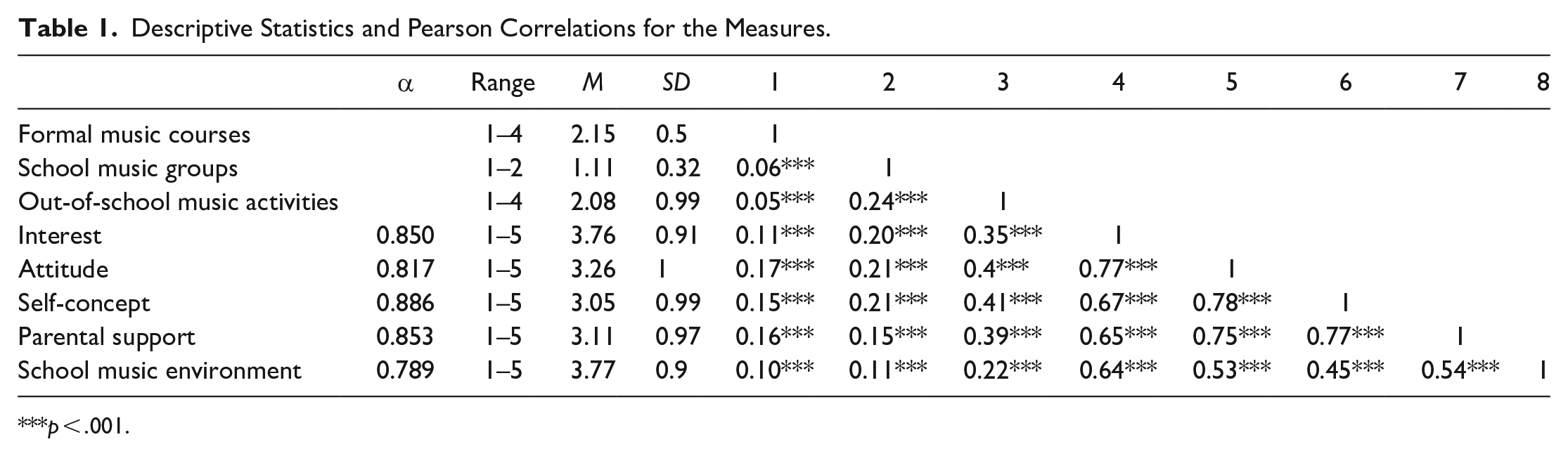
p < .001.
Results
Research Question 1: Are There Differences in Musical Interest, Attitude, Self-Concept, Perceived Parental Support, or Perceived School Music Environment Among Students of Different Genders, SES, and Grades?
We conducted a multivariate analysis of variance to examine the main and interaction effects of gender, SES (which was classified into three groups comprising 27% low-, 46% medium- and 27% high-SES students), and grade level on the five DVs, namely, students’ musical interest, attitude, self-concept, perceived parental support, and perceived school musical environment. Box’s test revealed a violation of homoscedasticity (p < .001); therefore, we applied the more conservative Pillai’s trace for multivariate analysis. In Table 2, we report the F statistics and corresponding p values to indicate the statistical significance of these effects.
MANOVA and Univariate F-Test Results.
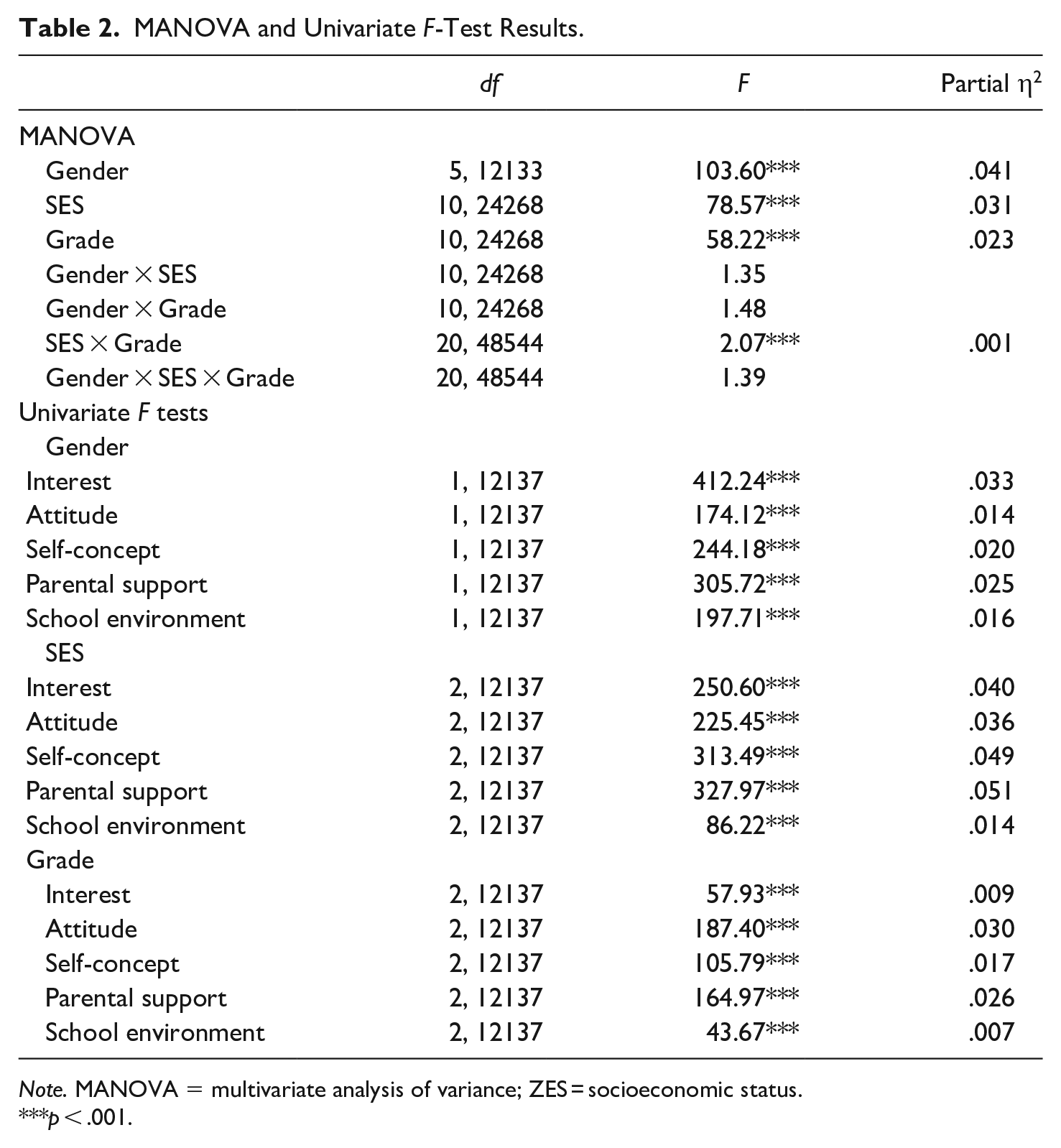
Note. MANOVA = multivariate analysis of variance; ZES = socioeconomic status.
p < .001.
Significant main effects were found for gender, F(5, 12133) = 103.6, p < .001, partial η2 = .041; SES, F(10, 24268) = 78.57, p < .001, partial η2 = .031); and grade, F(10, 24268) = 58.22, p < .001, partial η2 = .023. The female students had higher scores in the five DVs. We detected a significant interaction between SES and grade, F(20, 48544) = 2.07, p < .01, partial η2 = .001. However, a partial eta square of less than .01 is negligible. The other interaction effects were found to be nonsignificant. Univariate analyses revealed that gender, SES, and grade had significant effects on all the DVs (p < .001). However, the interaction effect of SES by grade was not statistically significant.
We further conducted Scheffé’s post hoc tests to investigate pairwise differences between the SES and grade levels. The Bonferroni correction (i.e., 0.5/15 = 0.003) was applied to control for Type I errors for pairwise comparisons. Our results showed that the students with higher SES values scored higher in the five DVs. In addition, the sixth graders exhibited a more positive attitude to music, higher self-concept, and greater perceived parental support than the eighth and 11th graders (p < .001). In terms of musical interest and perceived school music environment, both the sixth and eighth graders scored higher than the 11th graders (p < .001); the differences between the sixth and eighth graders were not statistically significant. Means and standard deviations for multiple comparisons are included in Supplementary Table S1 in the supplemental document included with the online version of this article.
Research Question 2: How Many Formal Music Courses per Week Are There for Sixth, Eighth, and 11th Graders? Does the Number of Weekly Courses Offered at Different Grades Meet the Requirements of the National Music Curriculum Standards?
We used descriptive statistics to determine the frequency of formal music classes undertaken by the sixth, eighth, and 11th graders. To identify adherence to the National Curriculum Standards (Ministry of Education, 2022), we compared the reported frequency of music classes to the minimum class requirements as set forth by the standards. Specifically, the standards dictate that sixth graders participate in a minimum of two formal music classes weekly and that eighth and 11th graders should participate in at least one class weekly. However, our comparison of the gathered data with these standards revealed that only 46.35% of the sixth graders were meeting the prescribed standard. In contrast, most of the eighth (98.39%) and 11th graders (91.28%) were found to be in adherence with the standard. Details regarding the number of weekly music classes taken by students across the specified grades are included in Supplemental Table S2 in the supplemental document included with the online version of this article.
Research Question 3: What Is the Influence of Students’ Demographics and Personal, Parental, and School-Related Musical Factors on Their Participation in School Music Groups?
We applied a binary logistic regression analysis to determine the effects of the students’ demographics (i.e., gender, SES, and grade) and personal (i.e., musical interest, attitude, and self-concept), parental (i.e., perceived parental support), and school factors (i.e., perceived school music environment) on the likelihood of the students participating in school music groups (Table 3). The model’s appropriateness was evaluated using the chi-square statistic and the Hosmer and Lemeshow goodness-of-fit test.
Logistic Regression Model for School Music Group Participation.
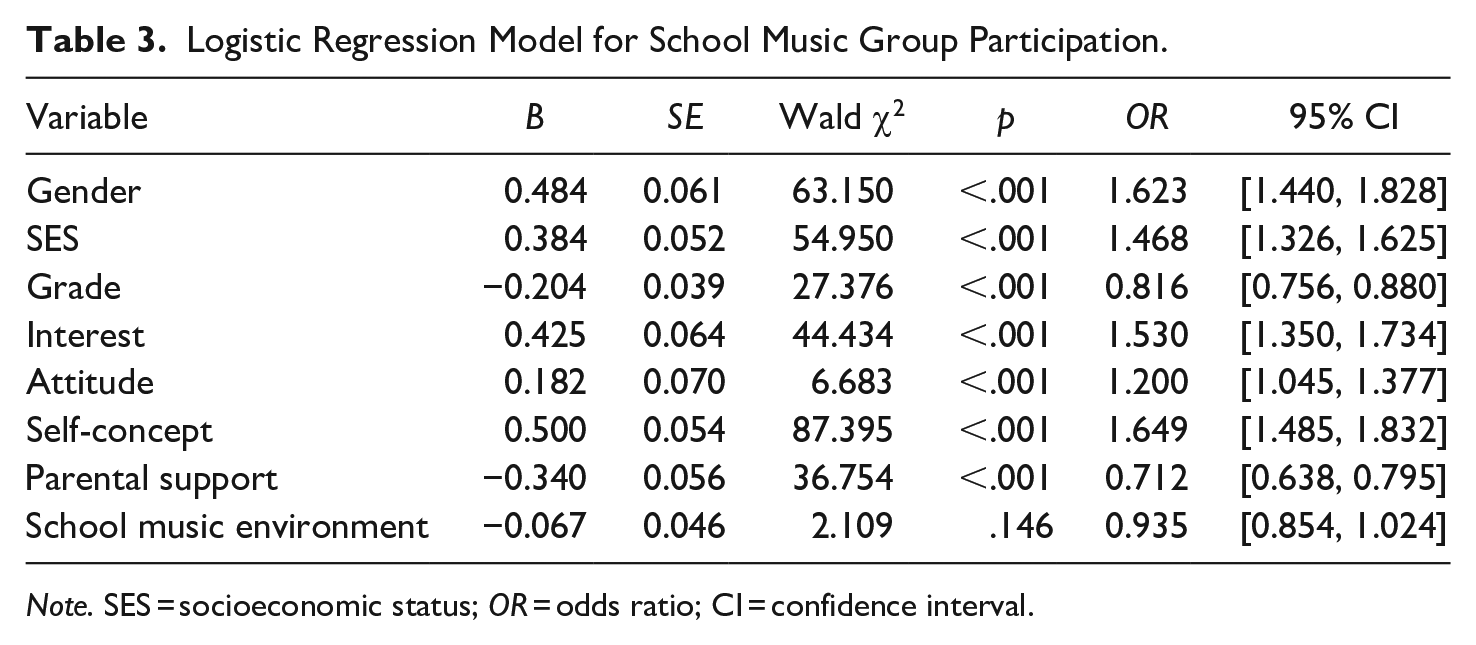
Note. SES = socioeconomic status; OR = odds ratio; CI = confidence interval.
The overall logistic regression model was statistically significant, χ2(8, N = 12,155) = 817.634, p < .001, indicating that the predictors, as a set, reliably distinguished between the students who participated and those who did not participate in school music groups. The Hosmer and Lemeshow test was not statistically significant, χ2(8, N = 12,155) = 14.415, p = .072, suggesting that the model’s predictions were not significantly different from the observed outcomes, further supporting the model’s goodness of fit.
Seven of the eight predictors were statistically significant (p < .001): gender, SES, grade, interest, attitude, self-concept, and perceived parental support. Students’ musical self-concept emerged as the most influential factor, with each unit increase leading to a 64.9% increase in the odds of participation (odds ratio [OR] = 1.649). Gender also played a significant role, with female students being 62.3% more likely to participate than male students (OR = 1.623). Interest in music had a substantial impact, with each unit increase leading to a 53% increase in the odds of participation (OR = 1.530). SES also had a notable positive effect, with a 46.8% increase in the odds of participation for each unit increase (OR = 1.468). Attitudes toward music had a moderate positive effect, with each unit contributing to a 20% increase in the odds of participation (OR = 1.200). In contrast, higher grade levels were linked to a 18.4% decrease in the odds of participation (OR = 0.816) for each unit increase in grade level, and higher perceived parental support was associated with decreased participation by 28.8% (OR = 0.712) for each unit increase in parental support.
Research Question 4: What Is the Influence of Students’ Demographics and Their Personal, Parental, and School-Related Factors on Their Participation in Out-of-School Music Activities?
We conducted a multiple linear regression analysis examining the students’ demographics (i.e., gender, SES, and grade) and personal (i.e., musical interest, attitude, and self-concept), parental (i.e., perceived parental support), and school-related factors (i.e., perceived school music environment) as predictors, with out-of-school music activity participation as the DV. Multicollinearity among the predictors was examined through the variance inflation factor, which ranged from 1.46 to 4.02 for all of the variables. These values are well below the typical concern threshold of 5 (O’Brien, 2007), suggesting no serious multicollinearity issues in our model. The model itself was statistically significant, as indicated by the F test (F = 434.978, p < .001). It accounted for approximately 22.3% of the variance in out-of-school music activity participation.
The multiple regression analysis revealed that participation in out-of-school music activities was positively associated with all of the predictors except the perceived school music environment. Specifically, gender (B = 0.063, SE = 0.016, β = 0.032), SES (B = 0.239, SE = 0.015, β = 0.136), grade (B = 0.143, SE = 0.010, β = 0.112), students’ musical interest (B = 0.049, SE = 0.016, β = 0.045), attitude (B = 0.161, SE = 0.016, β = 0.162), musical self-concept (B = 0.162, SE = 0.015, β = 0.161), and perceived parental support (B = 0.118, SE = 0.015, β = 0.115) all significantly (p < .001) and positively influenced participation in out-of-school music activities. Conversely, the perceived school music environment (B = –0.053, SE = 0.012, β = –0.048, p < .001) was negatively associated with participation in out-of-school music activities. The model’s explanatory power was significant, with an R2 value of .223, indicating that the independent variables accounted for approximately 22.3% of the variance in participation in out-of-school music activities. The adjusted R2 value of .222 suggested that the model’s explanatory power remained robust even after adjustment for the number of predictors. The overall model was significant, F(8, 12146) = 434.978, p < .001, and the Durbin–Watson statistic (D-W = 1.985) suggested that the assumption of independent errors was met. These results are shown in Supplemental Table S3, which is included in the supplemental document with the online version of this article.
Research Question 5: How Do Parental Support and the Perceived School Music Environment Moderate the Relationships Between Students’ Musical Interest, Attitude Toward Music, and Musical Self-Concept and Their Participation in School Music Groups and Out-of-School Music Activities?
Multiple linear regression analyses were used to explore the impact of parental support and school environment as potential moderators of the relationships between personal factors (i.e., interest, attitude, and self-concept) and participation in school music groups and out-of-school music activities. The findings indicated that interest (B = 0.069, SE = 0.003, t = 22.085, p < .001, β = 0.196), attitude (B = 0.068, SE = 0.003, t = 24.126, p < .001, β = 0.214), and self-concept (B = 0.069, SE = 0.003, t = 24.072, p < .001, β = 0.213) significantly predicted participation in school music groups. Parental support significantly moderated the relationships between interest (B = 0.016, SE = 0.003, t = 5.858, p < .001, β = 0.055), attitude (B = 0.007, SE = 0.002, t = 2.752, p = .006, β = 0.024), and self-concept (B = 0.005, SE = 0.002, t = 2.234, p = .025, β = 0.020) and participation in school music groups. Conversely, the school environment significantly moderated the relationship between interest (B = 0.009, SE = 0.003, t = 3.295, p = .001, β = 0.031) and participation in school music groups but did not significantly moderate the relationships between attitude and self-concept and participation in school music groups. These results are shown in Supplemental Table S4, which is included in the supplemental document with the online version of this article.
The findings indicated that interest (B = 0.384, SE = 0.009, t = 41.404, p < .001, β = 0.352), attitude (B = 0.397, SE = 0.008, t = 48.108, p < .001, β = 0.400), and self-concept (B = 0.413, SE = 0.008, t = 49.827, p < .001, β = 0.412) significantly predicted participation in out-of-school music activities. Parental support significantly moderated the relationships between interest (B = 0.067, SE = 0.008, t = 8.440, p < .001, β = 0.074), attitude (B = 0.035, SE = 0.007, t = 5.001, p < .001, β = 0.041), and self-concept (B = 0.020, SE = 0.007, t = 3.006, p = .003, β = 0.025) and participation in out-of-school music activities. Similarly, the school environment significantly moderated the relationships between interest (B = 0.090, SE = 0.008, t = 10.994, p < .001, β = 0.097), attitude (B = 0.044, SE = 0.008, t = 5.619, p < .001, β = 0.048), and self-concept (B = 0.023, SE = 0.008, t = 2.815, p = .005, β = 0.024) and participation in out-of-school music activities. These results are shown in Supplemental Table S5, which is included in the supplemental document with the online version of this article.
Discussion
This study builds on previous research by investigating music participation among students in public elementary and secondary schools within an economically advanced urban region in China. The results relating to the first research question indicated that the female students and those with higher SES had higher levels of musical interest, more positive attitudes, a stronger musical self-concept, greater perceived parental support, and better perceived school music environments. These observations are consistent with research that has found significant SES (Elpus & Abril, 2011; Yoo, 2020) and gender (McPherson et al., 2015) differences in music-related personal, parental, and school factors. Our study also revealed that students in lower grades had a more positive attitude and a stronger self-concept, coupled with better perceived parental support and school environments. This difference in musical confidence between younger and older students could be attributed to the developmental and psychosocial transitions that characterize children’s formative years, when the search for identity and the opinions of peers and society become increasingly influential (Holster, 2023; McPherson & O’Neill, 2010). Additionally, mounting academic pressure and intensified competition within a rigidly structured educational system may further erode students’ self-concept in music (Cheng, 2023; Lohbeck, 2023) as academic achievements in other subjects take precedence, a trend that is notably pronounced in China, where the academic burden significantly escalates with each educational level.
The findings in relation to the second research question highlighted a discrepancy between the weekly frequency of formal music lessons for Grade 6 students and the requirements of the National Curriculum Standards (Ministry of Education, 2022). Various factors may impede the implementation of music lessons, ranging from resource-related issues, such as the lack of qualified teachers, insufficient musical instruments, and inadequate physical spaces dedicated to music education (Abril & Bannerman, 2015; Shaw & Auletto, 2022), to broader systemic challenges within the educational framework, including the low prioritization of music education in the school curriculum (Major, 2013; Shaw, 2018). Specifically, in the context of China’s economically prosperous urban schools, our findings revealed potential misalignment with recent educational reforms. However, given that the new curriculum standards were introduced in early 2022 and this study was conducted in the first half of 2023, it is possible that some schools had not yet adjusted their curricula to meet the new requirements given the potential challenges they might have encountered during the transition.
For the third research question, our findings indicated that the influence of students’ demographic and personal factors, such as gender, SES, interest, attitude, and self-concept, were more important than parental and school factors in predicting music participation. Elpus and Abril (2011) and McPherson et al. (2015) similarly highlighted gender and SES as key predictors of music participation, with females and students from higher SES backgrounds being notably more involved, reflecting the sociocultural dynamics and resource distribution in music education. Attitude, interest, and self-concept in music participation were also identified by Holster (2023) and Yoo (2020) as intrinsic factors, and Pendergast (2020) highlighted the pivotal role of student values, attitudes, and identities. All of these findings affirm that students’ characteristics and preferences are decisive factors in their decision to engage in music activities.
Our study identified two notable divergences from the findings of previous international studies regarding the factors influencing students’ participation in school music groups. First, contrary to the positive association between perceived parental support and participation in school-based music classes identified by Ng and Hartwig (2011) and Ruybalid (2016), our findings indicated a negative impact of parental support on students’ participation in school music groups. This paradoxical result may reflect a unique cultural aspect within the Chinese context whereby parents highly value music education and tend to opt for formal private music lessons outside school, providing personalized instruction that is not always feasible in school music groups because of large class sizes (Guo et al., 2022). Second, our study discovered that the school music environment did not exert a significant influence on the students’ participation in school music groups. This might suggest a minimal disparity in the music environments across public schools located in economically advanced regions of China, largely due to uniform government funding allocated for public school music education. Therefore, decisions regarding students’ participation in school music groups appear to be predominantly influenced by the students’ personal and parental factors rather than the school factor.
In addressing the fourth research question related to out-of-school music participation, we identified a significant association between rising SES and increased engagement in out-of-school music activities, which has been established by previous research (e.g., Lorah et al., 2014; Yoo, 2020). This finding underscores the critical role of socioeconomic factors in shaping access to and participation in cultural and educational activities outside schools. This trend is particularly accentuated in the context of Chinese society and education, where extracurricular enrichment and familial resources are closely linked, reflecting socioeconomic status (Guo et al., 2022). This creates notable disparities in access to music opportunities, highlighting the need for targeted interventions to address this imbalance. However, a noteworthy finding was the negative relationship between the students’ perceived school music environment and their participation in out-of-school music activities. This finding implies that students might have sought musical engagement outside of school if the school environment did not provide sufficient musical inspiration or opportunities.
To answer the fifth research question, we examined the interaction effects between personal factors (i.e., musical interest, attitude, and self-concept), parental support, and school environment to understand their impact on participation in school music groups and out-of-school music activities. The interaction effects varied in magnitude, indicating different levels of moderation. First, the large effect sizes of the interactions between interest, attitude, and parental support, particularly for out-of-school music activities, underscore the critical role of parents’ influence in fostering active engagement in music. This result is consistent with Kong’s (2023) study based on Bourdieu’s (1984) cultural capital theory, which found that parental cultural capital may be directly or indirectly imparted to students through parental support and displayed through students’ disposition toward cultural activities. Our study further confirmed parental support as a significant moderator, strengthening the relationships between students’ interest and attitude and participation in out-of-school music activities.
The small but significant interactions involving the school music environment reflect its subtle influence, particularly in creating a supportive backdrop that can moderate students’ engagement based on their musical interest and self-concept. However, the school music environment did not significantly moderate the effects of students’ attitude or self-concept on their engagement in school music groups, which is in contrast to previous research findings (e.g., Pendergast & Robinson, 2020). A possible reason for this difference is that the participants in our study were all from public primary and secondary schools in metropolitan areas of China, and thus, there may have been limited variability in their school music environments. Future research could expand the scope to include students from socioeconomically diverse areas to examine how different school environments impact students’ musical engagement, potentially offering a more comprehensive understanding of the factors influencing music participation. This broader perspective could elucidate the extent to which school resources, culture, and support systems uniquely contribute to shaping students’ musical experiences and engagement levels (Shaw & Auletto, 2022).
Conclusion and Implications
The current study undertook a comprehensive examination of demographic differences in music-related personal, parental, and school factors and their influence on participation in formal music courses, school music groups, and out-of-school music activities among public elementary and secondary students. By illuminating the complex dynamics that affect music participation in a metropolitan Chinese context, we hope to enhance global understanding and foster cross-cultural discourse on music education.
This study offers implications in three primary areas. First, we observed that fewer than half of the students surveyed from public elementary schools were receiving formal music lessons that aligned with the requirements of the National Curriculum Standards (Ministry of Education, 2022). This indicates a concerning discrepancy between such requirements and formal music education at the elementary school level. A previous study emphasized that successful policy reform hinges on a series of supportive actions, including targeted teacher training and equipping schools with the necessary resources (Shaw & Auletto, 2022). Consequently, the Ministry of Education should allocate appropriate resources to elementary schools to bridge this gap. Additionally, investigating Chinese elementary school music teachers’ perceptions and implementation of new curriculum standards could offer valuable insights into the challenges and prospects of adapting to evolving educational policies and expectations (Shaw, 2018). This could involve qualitative studies that explore teachers’ experiences, the challenges they face, and the strategies they use to meet the new standards. By providing a platform for teachers’ voices, such research could yield valuable insights into the practical aspects of educational reform in music education and inform the development of support mechanisms to facilitate these changes.
Second, our study underscores that SES is a significant predictor of increased engagement in out-of-school music activities, highlighting the issue of equity in music education within metropolitan areas of China. In this context, access to extracurricular activities such as music often mirrors familial resources, leading to disparities in music education opportunities (Yoo, 2020). To bridge this gap, it is essential for schools to forge collaborative partnerships with local music organizations, cultural centers, and philanthropic entities. Such alliances can facilitate the subsidization of music programs, ensuring that students from diverse SES backgrounds gain equal access to enriching musical experiences (Culp & Clauhs, 2020). Schools could further enhance these efforts by hosting community music events and festivals and fostering participation across the socioeconomic spectrum. These initiatives, encompassing workshops, performances, and interactions with local musicians, promise to provide a culturally rich and diverse music education while also reinforcing community bonds and promoting inclusivity (Shaw, 2018). This multifaceted approach aligns with the broader educational goals and cultural ethos of Chinese society and aims to cultivate a more inclusive and equitable landscape for music education.
Finally, music educators should prioritize the nurturing of students’ musical self-concept given its significant role in influencing music participation within and outside school settings, as established both by our study and Lohbeck’s (2023) research. Notably, our study found that musical self-concept retains its predictive strength despite external influences such as parental support and the school environment. This finding indicates the need for a strategic shift in music education to emphasize the reinforcement of students’ internal perceptions of their musical abilities.
There are two principal limitations in the scope of this study. First, the sample was confined to urban areas, potentially limiting the representativeness of the findings for the entire national context, particularly rural or economically disadvantaged regions. The focus on metropolitan areas might mean that the results reflect unique sociocultural and educational dynamics that are not found in nonurban settings and therefore do not fully capture the varied influences on music participation across China’s diverse geographic and socioeconomic spectrum. Second, the study’s approach to gender analysis within music education adhered to a binary male–female framework. Future research should build on this initial exploration to embrace a broader and more nuanced understanding of gender identities (e.g., Nonte et al., 2022) in line with contemporary advancements in social sciences to ensure a more comprehensive and inclusive representation of gender diversity in music education research.
Supplemental Material
sj-docx-1-jrm-10.1177_00224294241257154 – Supplemental material for Music Participation Among Public School Students in Metropolitan China: An Examination of Personal, Parental, and School Factors
Supplemental material, sj-docx-1-jrm-10.1177_00224294241257154 for Music Participation Among Public School Students in Metropolitan China: An Examination of Personal, Parental, and School Factors by Ning Luo and Tao Guan in Journal of Research in Music Education
Footnotes
Declaration of Conflicting Interests
The authors declared no potential conflicts of interest with respect to the research, authorship, and/or publication of this article.
Funding
The author(s) disclosed receipt of the following financial support for the research, authorship, and/or publication of this article: This work was supported by the Guangdong Philosophy and Social Science Foundation (Grant Number: GD23XYS034).

Author Biographies
References
Supplementary Material
Please find the following supplemental material available below.
For Open Access articles published under a Creative Commons License, all supplemental material carries the same license as the article it is associated with.
For non-Open Access articles published, all supplemental material carries a non-exclusive license, and permission requests for re-use of supplemental material or any part of supplemental material shall be sent directly to the copyright owner as specified in the copyright notice associated with the article.
