







Abstract
This study examined, using data from the National Longitudinal Transition Study–2, the impact of constructs associated with self-determination (i.e., autonomy, self-realization, and psychological empowerment measured while youth were in secondary school) on postschool—(a) employment and payment/benefits, (b) education, (c) independent living, and (d) social engagement—outcomes. Findings suggest that up to 8 years after youth exited school, autonomy, self-realization, and psychological empowerment predict postschool outcomes. Psychological empowerment showed a strong relationship with employment wages and benefits, and autonomy and self-realization contributed to predicting independent living and postsecondary education enrollment. Implications for future research and practice are discussed.
Self-determination has been characterized as a predictor of positive postschool outcomes (Shogren, Wehmeyer, Palmer, Rifenbark, & Little, 2015; Test, Mazzotti, et al., 2009; Wehmeyer & Palmer, 2003; Wehmeyer & Schwartz, 1997). In early work, Wehmeyer and colleagues (Wehmeyer & Palmer, 2003; Wehmeyer & Schwartz, 1997) measured the self-determination status of students with disabilities exiting high school and found those with higher self-determination levels reported more positive postschool outcomes in employment and community living, up to 3 years postschool. Test, Mazzotti, et al. (2009), in a literature review to identify secondary transition practices that affected postschool outcomes, suggested the promise of self-determination interventions to affect postschool employment and education outcomes but highlighted that more research was needed. Shogren et al. (2015) tracked students who participated in a randomized controlled trial of interventions to promote self-determination in secondary school (Wehmeyer, Palmer, Shogren, Williams-Diehm, & Soukup, 2013), finding that when students exited high school with higher levels of self-determination, they experienced more positive employment and community access outcomes up to 2 years postschool.
Most studies have examined the impact of self-determination on postschool outcomes in the shortterm, following students for 1 to 3 years immediately after they exit secondary school. Research on longer term outcomes is needed, as early adulthood (generally defined as the period from 20 to 40 years of age; Lerner, Easterbrooks, & Mistry, 2003) continues to be a time of transition as young adults move between postsecondary education and employment, between family homes and other living arrangements, and into different types of social relationships (Settersten, Furstenberg, & Rumbaut, 2005). Researchers have found that self-determination status may affect outcomes differently through early adulthood; for example, Shogren et al. (2015) found that while overall self-determination status when exiting school predicted postschool employment at 1 year, employment status at 1 year postschool was a stronger predictor than self-determination status of employment at 2 years postschool. But challenges exist with regard to collecting longer term data on postschool outcomes. The National Longitudinal Transition Study–2 (NLTS2) provides nationally representative data on the secondary school and postschool early adulthood experiences of youth and young adults with disabilities, following youth for up to 8 years postschool (Newman et al., 2011). Specifically, NLTS2 collected data over a 10-year period in five waves (each wave represents a 2-year period of data collection) beginning in 2000 with youth with disabilities aged 13 to 16. While ongoing research is needed to further extend outcome data throughout early adulthood, NLTS2 provides an opportunity to examine the relationship between secondary school experiences and longer term early adulthood outcomes with youth up to the age of 26.
Researchers have explored the relationship between various student, family, and school program characteristics and postschool outcomes using NLTS2 data. For example, Carter, Austin, and Trainor (2012) explored predictors of postschool employment outcomes, demonstrating the impact of a paid job while in high school and higher parent expectations on employment outcomes in the 2 years following the transition from high school. Similarly, Doren, Gau, and Lindstrom (2012) found an impact of parent expectations on postschool education and employment outcomes through the third wave of NLTS2 data collection, when youth were up to 4 years postschool. Other research groups have explored factors that predict postsecondary education participation, documenting the impact of access to core content instruction in general education secondary classrooms on enrollment at 2- and 4-year colleges and universities (Lombardi, Doren, Gau, & Lindstrom, 2013; Rojewski, Lee, & Gregg, 2015). Still other research groups have explored the role of characteristics associated with self-determination (i.e., autonomy, psychological empowerment, and self-realization, which were directly assessed while youth were in secondary school) on postschool outcomes. Berry, Ward, and Caplan (2012), for example, examined the degree to which autonomy, psychological empowerment, self-realization, and other demographic characteristics predicted enrollment in postsecondary education for young adults receiving Social Security benefits, finding that youth with higher levels of autonomy and psychological empowerment were more likely to enroll in 2- and 4-year institutions. Shogren and Shaw (2016b) examined the degree to which autonomy, psychological empowerment, and self-realization predicted adult outcomes for youth aged 23 to 26 (Wave 5 of data collection) across multiple latent outcome domains created by combining multiple NLTS2 items such as financial independence, financial supports, employment, emotional well-being, postsecondary education, independent living, health status, social relationships, access to services, and advocating for needs. They further compared, across disability groups represented in NLTS2, differences in outcomes, finding that different characteristics of self-determination predicted outcomes differently. In further work, they found additional impacts of gender and race/ethnicity on the relationship between the self-determination constructs and adult outcomes, again with different patterns across disability groups (Shogren & Shaw, 2016a).
Additional research is needed to extend analyses of the impact of self-determination and other secondary school experiences on outcomes, particularly using outcome data collected throughout all waves of NLTS2 data collection to examine changes in the impact of self-determination characteristics over time. Shogren and Shaw (2016a, 2016b) only looked at the impact of autonomy, self-realization, and psychological empowerment on Wave 5 NLTS2 outcome data. Others restricted their sample to focus on specific subpopulations (e.g., those receiving Social Security benefits or who are deaf or hard of hearing; Berry et al., 2012; Garberoglio, Schoffstall, Cawthon, Bond, & Ge, 2014). The purpose of this article, therefore, was to address this gap in the literature and examine the degree to which autonomy, self-realization, and psychological empowerment (measured while youth were in secondary school) predicted postschool outcomes. Our specific research questions were as follows:
Method
Data Source
NLTS2 utilized two-stage stratified cluster sampling to retain a nationally representative sample of approximately 11,500 students who were 13 to 16 years old and receiving special education services at Wave 1 of data collection. In the first stage of sampling process, all eligible local education agencies (LEAs) and state-supported special schools (i.e., clusters) were stratified by geographic region, district enrollment, and district/community wealth. LEAs and special schools were randomly selected within each stratum. In the second stage, students who were between the ages of 13 and 16 years and in at least seventh grade were randomly chosen from the selected LEAs and special schools. Ignoring such complex features of sampling design could lead to biased parameter estimates and overstated significance levels, and thus erroneous inferences about the target population. Following the NLTS2 guidelines, therefore, all data analyses were conducted using the stratification, cluster, and weighting information provided in the design-based structural equation modeling (SEM) approach (Asparouhov & Muthén, 2005; Stapleton, 2006) implemented in Mplus 7.0 (L. K. Muthén & Muthén, 1998–2012).
Sample
The sample utilized in the analyses (which, when weighted, provides estimates of the general population of students with disabilities who were able to participate in the direct assessment) was 66% (SE = 2%) male and a slight majority of students had learning disabilities (51%, SE = 2%), and the remaining sample was distributed across other disability labels, including 6% emotional disturbance, 4% speech impairment, and 4% intellectual disability. The majority reported their race/ethnicity as White (61%, SE = 2%), followed by Black/African American (19%, SE = 1%), Hispanic (18%, SE = 1%), Asian (1%, SE = 0.3%), Native American (1%, SE = 0.4%), and multiethnic or Other (0.1%, SE = 0.1%).
Data Analysis and NLTS2 Variables
A series of SEM models were hypothesized to evaluate the predictive effects of autonomy, psychological empowerment, and self-realization on the early adulthood outcome variables. As mentioned previously, data on autonomy, psychological empowerment, and self-realization were collected while youth were in school as part of the NLTS2 direct student assessment. Students completed the direct student assessment once when they were between 16 and 18 years old. Students in the older age cohorts (ages 15 and 16 at the start of data collection) were sampled in Wave 1, and students in the younger age cohorts (ages 13 and 14 at the start of data collection) were sampled in Wave 2 (Wagner, Newman, Cameto, & Levine, 2006). To participate in the direct student assessment, students had to be able to provide reliable responses to self-report items, as judged by their teachers (Wagner et al., 2006). Javitz and Wagner (2005) reported an overall response rate of 54% for Wave 1 and 60% for Wave 2. Thus, the sample utilized in this analysis was restricted to those students for whom direct assessment data on self-determination were collected, which was between 54% and 60% of the overall NLTS2 sample, and thus does not generalize to the entire population of students with disabilities, only those that could participate in direct assessment situations.
The direct student assessment included 26 (of 72) items from The Arc’s Self-Determination Scale (SDS; Wehmeyer & Kelchner, 1995). The SDS is based on the functional theory of self-determination (Wehmeyer, 2003b). When all items on the SDS are utilized, overall self-determination and subscale scores representing the four essential characteristics of self-determined behavior defined by the functional theory—autonomy, self-regulation, psychological empowerment, and self-realization (Wehmeyer, 2003a)—can be calculated. The subset of items utilized in NLTS2, however, only encompassed selected items from the Autonomy, Psychological Empowerment, and Self-Realization subscales, which is why those domains are examined in the present analysis. Autonomy is defined as the degree to which a person acts according to their own preferences, interests, and abilities without under external influence. Self-Realization is having an understanding of one’s strengths and support needs, and Psychological Empowerment is defined as a belief in the relationship between your actions and the outcomes you experience (Wehmeyer, 2003a). Previous work has examined the 26 included items and developed a framework for creating latent constructs for use in SEM analyses. We adopted the previously validated framework for including the 26 NLTS2 items to define the three latent self-determination constructs, each identified by two or three parcels (see Shogren, Kennedy, Dowsett, & Little, 2014).
In terms of the outcome constructs, Table 1 provides specific detail on the NLTS2 items used to represent each of the four outcome areas: (a) employment and payment/benefits, (b) postsecondary education, (c) independent living, and (d) social engagement. NLTS2 items were selected that represented each of these outcome domains from the Waves 4 and 5 Parent/Youth Interview (see http://www.nlts2.org/studymeth/#data_collection for more information about the Parent/Youth Interview). We targeted variables that were measured in Waves 4 and 5, but in some instances, variables were only collected in Wave 4 or 5. Although other research has used multiple items to define latent early adulthood outcome constructs (Shogren & Shaw, 2016b; Shogren, Shaw, & Little, in press), we chose to analyze specific NLTS2 items to specifically examine the impact of self-determination on key indicators of postschool outcomes. In terms of employment status, we used an NLTS2 created variable of youth or parent report on whether the young adult had a job currently or had held a job in the past 2 years (yes/no). We also examined indicators of pay and benefits, specifically items where youth or parents reported hours per week at job, health insurance, retirement benefits, paid vacation or sick leave, and whether the young adult had received a pay raise at his or her job. In terms of postsecondary education, we examined whether the youth or parent reported that the young adult had attended any postsecondary institution since leaving high school, and in Wave 5, whether they had attended a 2- or 4-year institution. In terms of independent living, a new variable was created based on the type of living arrangement, specifically if the youth reported living on his or her own, with a spouse or roommate, in college housing or a dormitory, or in military housing, this was recoded as living independently; and if a young adult reported living at home, in foster care, in a group home, with another relative, in a hospital, or in a correctional facility, this was recoded as not living independently. Finally, in terms of social engagement, a NLTS2 variable where youth or parents reported the number of days per week the person gets together with friends was utilized.
NLTS2 Outcome Variables and Weighted Means or Percentages.
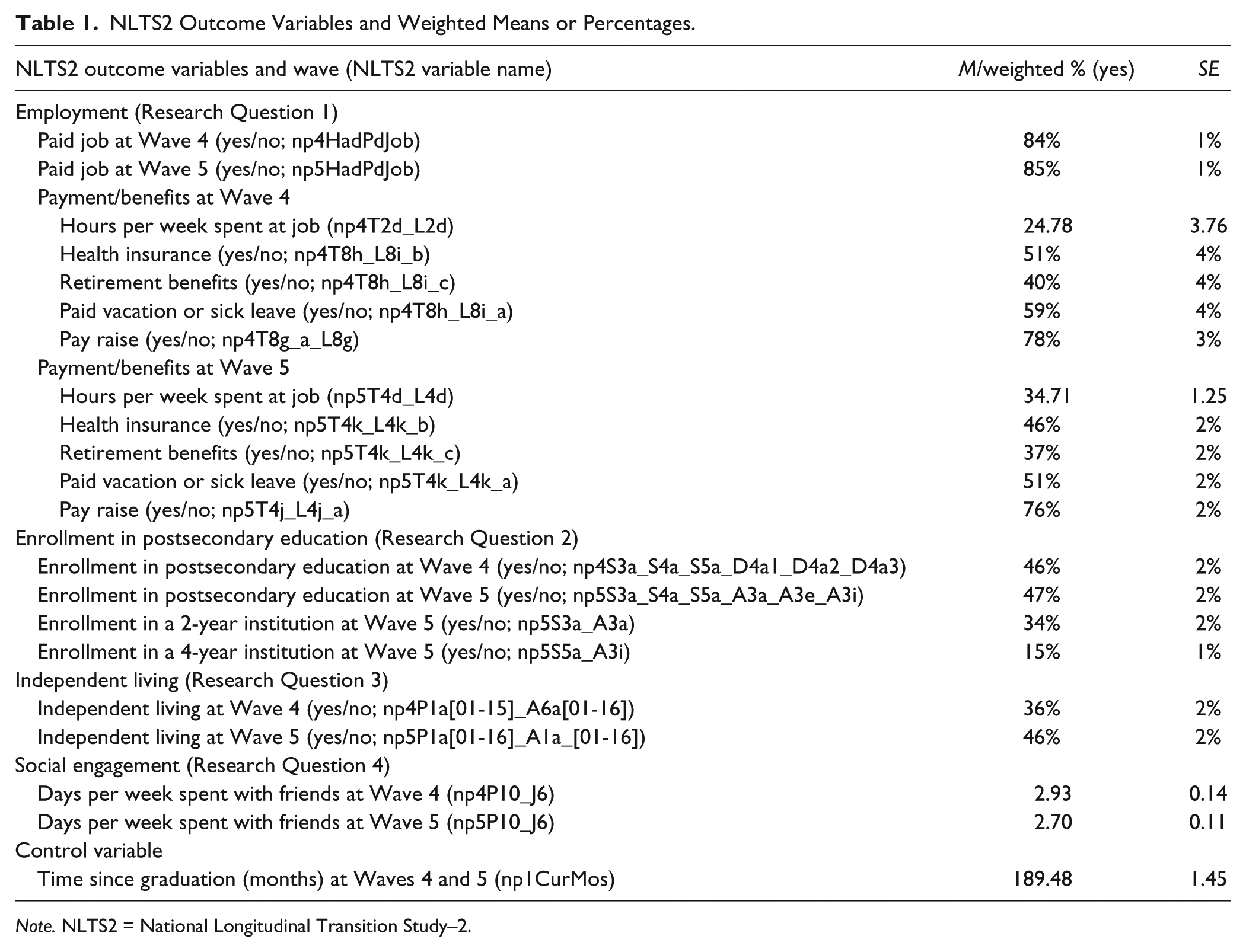
Note. NLTS2 = National Longitudinal Transition Study–2.
Separate models were developed for each outcome variable, and the significance of the hypothesized associations was determined via the Wald Test for corresponding model parameters (e.g., latent regression paths). Overall model fit was assessed using root mean square error of association (RMSEA; Steiger & Lind, 1980), nonnormed fit index (NNFI; Tucker & Lewis, 1973), and comparative fit index (CFI; Bentler, 1990). RMSEA measures absolute fit of a hypothesized model in the population, while both CFI and NNFI quantify the benefit of the hypothesized model over a more restricted “null” model in which the covariances at the structural level are all assumed to be 0. Although no criterion can establish a sufficient cutoff for these fit measures, typically RMSEA indicates better fit as it approaches 0, and CFI and Tucker–Lewis index (TLI) suggest better fit as they approach 1.
Given that some of the NLTS2 variables were discrete or ordinal in nature, robust weighted least squares (M. W. Brown, 1984) was chosen for parameter estimation, which is referred in Mplus as weighted least squares means and variances (WLSMV; Asparouhov & Muthén, 2010). The major limitation of WLSMV is its unreliable performance with a small sample (T. A. Brown, 2006; Flora & Curran, 2004). However, the current sample size of more than 10,000 (at least >2,000 observations on individual variables) easily exceeded the benchmark criteria of 200 recommended for use of WLSMV (B. O. Muthén, du Toit, & Spisic, 1997).
Results
Descriptive Findings
Table 1 provides weighted percentages and means for the NLTS2 variables included in the analysis. In terms of the employment variables, 84% and 85% of young adults who participated in the direct assessment had a paid job currently or in the past 2 years at Wave 4 or 5, and the average numbers of hours worked at that job were slightly below 25 hr a week at Wave 4 and increased to slightly below 35 at Wave 5. However, when looking at the percentages that had health insurance, retirement benefits, and paid vacation or sick leave, the percentages went down slightly from Wave 4 to Wave 5. A large majority reported having received a pay raise in both Waves 4 and 5. In terms of enrollment in postsecondary education, smaller percentages reported enrollment at Waves 4 and 5 than postsecondary employment; although larger numbers reported enrollment in 2-year institutions versus 4-year institutions at Wave 5. A minority reported living independently (defined as living on his or her own, with a spouse or roommate, in college housing or a dormitory, in military housing) in both Waves 4 and 5, although the rates increased in Wave 5. Social engagement, defined by interactions with friends each week, was slightly less than 3 on average in Wave 4 and decreased slightly in Wave 5.
The observed outcome variables of employment and payment/benefits were regressed on the three latent self-determination constructs (autonomy, self-regulation, and psychological empowerment). Data on autonomy, self-regulation, and psychological empowerment were collected at Wave 1 or 2 of NLTS2 data collection, depending on the age of the student. Employment and the related payment/benefits information was measured at both Waves 4 and 5. Time since exiting high school, which was measured at both Waves 4 and 5, was also included in the model to control for within-wave variation in employment-related opportunities. This model (Model 1) fit the data well (see Table 2).
Model Fit.
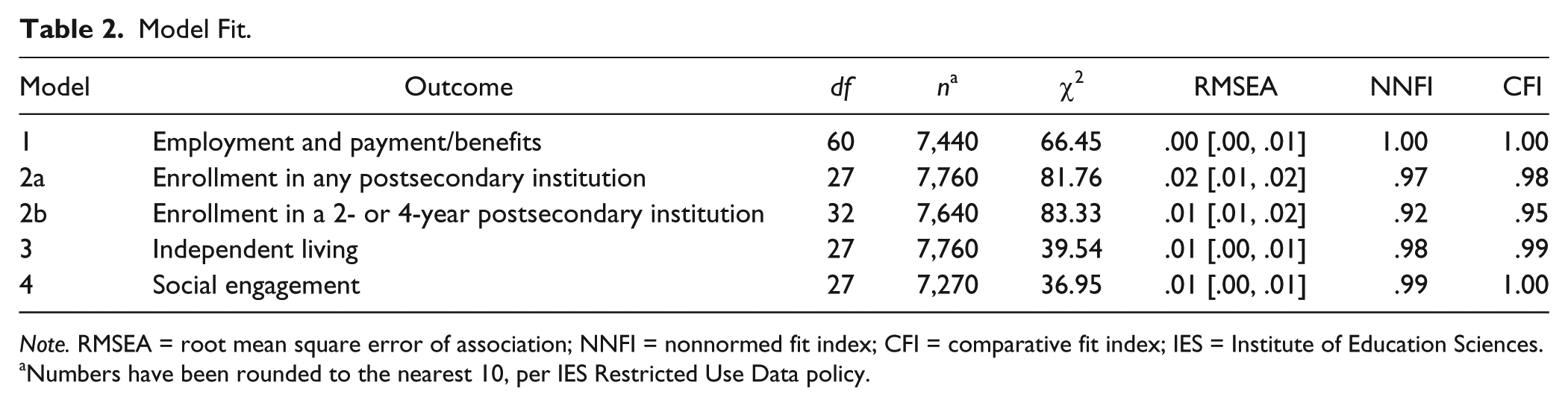
Note. RMSEA = root mean square error of association; NNFI = nonnormed fit index; CFI = comparative fit index; IES = Institute of Education Sciences.
Numbers have been rounded to the nearest 10, per IES Restricted Use Data policy.
Autonomy (β = 0.25, SE = 0.05, p < .001), self-realization (β = −0.24, SE = 0.06, p < .001), and psychological empowerment (β = 0.24, SE = 0.05, p < .001) all significantly predicted employment status at Wave 4 (at the ages of 21–24). These effects were consistent at Wave 5—autonomy (β = 0.20, SE = 0.05, p < .001), self-realization (β = −0.18, SE = 0.06, p < .01), and psychological empowerment (β = 0.22, SE = 0.05, p < .001) all continued to significantly predict employment. These results suggested that young adults with disabilities who had higher levels of autonomy and psychological empowerment while in school were more likely to have a paid job after high school, whereas young adults with higher self-realization while in school had a lower likelihood of obtaining a job.
In regard to payment/benefits data collected at Wave 4, only psychological empowerment approached significance in predicting retirement benefits (yes/no; β = 0.14, SE = 0.08, p = .08). At Wave 5, psychological empowerment significantly predicted number of hours spent at job (β = 3.74, SE = 0.67, p < .0001), whether or not the young adult received a promotion or a raise (yes/no; β = 0.14, SE = 0.07, p < .05), paid vacation or sick leave (yes/no; β = 0.13, SE = 0.06, p < .05), health insurance (yes/no; β = 0.23, SE = 0.07, p < .01), and retirement benefits (yes/no; β = 0.18, SE = 0.07, p < .01). This implies that young adults who had higher levels of psychological empowerment while in school were more likely to spend more hours at their jobs and receive work-related benefits, especially between the ages of 23 and 26.
The first model (Model 2a) examined enrollment in any type of educational institution (yes/no), and this model produced excellent fit (see Table 2). None of the self-determination constructs significantly predicted postsecondary enrollment at Wave 4 (at the ages of 21–24). At Wave 5 (at the ages of 23–26), autonomy was a significant predictor (β = 0.20, SE = 0.10, p < .05)—Young adults who had higher levels of autonomy while in school were more likely to access postsecondary education. In the second model (Model 2b), postsecondary enrollment at Wave 5 was further categorized into enrollment at 2- and 4-year institutions. This model yielded reasonable fit (see Table 2). Psychological empowerment significantly predicted enrollment in a 4-year institution (yes/no; β = 0.29, SE = 0.13, p < .05), indicating that young adults with disabilities who were more psychologically empowered were more likely to enter a 4-year institution. The other two self-determination variables were not predictive of enrollment.
The outcome variable of independent living (yes/no) at Waves 4 and 5 was regressed on the three latent variables of self-determination. The model (Model 3) fit the data well (see Table 2). Although only autonomy approached significance (β = 0.21, SE = 0.11, p = .06) at Wave 4 (at the ages of 21–24), all the self-determination constructs significantly predicted independent living at Wave 5 (β = 0.24, SE = 0.11, p < .05, for autonomy; β = 0.27, SE = 0.13, p < .05, for self-regulation; β = 0.29, SE = 0.13, p < .05, for psychological empowerment).
The observed outcome variable of social engagement was regressed to the three latent self-determination constructs; this model (Model 4) produced good fit (see Table 2). Although none of the self-determination variables significantly predicted social engagement, self-realization approached significance at Wave 5 (β = 0.23, SE = 0.12, p = .05). These results indicated that young adults who had higher levels of self-realization while in school spent more time with their friends at the ages of 23 to 26.
Discussion
The primary purpose of this study was to examine the relationship between the self-determination constructs of autonomy, self-realization, and psychological empowerment, which were self-reported by youth while they were in secondary school, and postschool employment, education, independent living, and social engagement outcomes in Waves 4 and 5 of NLTS2 data collection. In the following sections, we highlight implications for further research and practice, and then describe limitations of secondary analysis using NLTS2 data that must be considered in interpreting the findings.
Implications for Future Research
As described in the Introduction, researchers have not examined the relationship between autonomy, psychological empowerment, and self-realization, and specific postschool outcome variables related to employment, postsecondary education, independent living, and social engagement at Waves 4 and 5 of NLTS2 data collection. Given that other researchers have found different predictive relationships between self-determination and adult outcomes depending on the time since exiting school (Shogren et al., 2015), there is a need to examine differences in the predictive relationships of autonomy, self-realization, and psychological empowerment across the waves of data collection. Furthermore, examining specific outcome variables (e.g., employed or not employed, enrolled in postsecondary education or not enrolled) rather than broad latent constructs provides more precise information on the outcomes predicted by self-determination constructs.
Employment
The finding suggests that the autonomy, self-realization, and psychological empowerment predicted employment postschool, and the predictive relationships were similar across Waves 4 and 5, although the relationships were slightly weaker for Wave 5 employment data. This differs from other research that tracked youth with disabilities 1 and 2 years after high school and found overall self-determination significantly predicted employment only 1 year postschool (Shogren et al., 2015). But, unlike previous studies (e.g., Shogren et al., 2015), this study specifically examined autonomy, self-realization, and psychological empowerment rather than overall self-determination, primarily because the fourth construct that defines self-determination (i.e., self-regulation) was not measured in NLTS2. Autonomy and psychological empowerment positively affected employment outcomes, but there was a negative relationship between self-realization and employment status. This unexpected finding warrants further investigation. For example, it is possible that youth who had greater self-realization were making different decisions about employment, perhaps focusing on postsecondary education or other areas of early adult life. Or this could have been a spurious finding of the data set, particularly given the expected pattern of relationships between autonomy and psychological empowerment. Other studies (Shogren, Kennedy, Dowsett, Garnier Villarreal, & Little, 2014) have suggested differential impacts of personal factors, such as race/ethnicity, on the self-realization construct, and future research is needed to examine mediators or moderators of the relationship between self-realization and employment outcomes, and the role of cultural factors (Trainor, Lindstrom, Simon-Burroughs, Martin, & Sorrells, 2008) in influencing self-determination.
For those young adults who were employed, psychological empowerment was a marginal predictor of having benefits at Wave 4 and at Wave 5, and a strong predictor of number of hours spent working, receiving a raise, and having vacation/sick leave, retirement and health benefits. These findings suggest that as young adults age, having greater psychological empowerment (i.e., believing that there is a relationship between your actions and the outcomes you experience) exerts a strong influence on benefits/wages. This confirms early research in the field (Wehmeyer & Palmer, 2003; Wehmeyer & Schwartz, 1997), suggesting an impact of self-determination on not just employment status but benefits and job growth opportunities. It also suggests that psychological empowerment may exert a stronger influence. Further research is needed to examine, for example, whether young adults with greater levels of psychological empowerment feel abler or are more successful in advocating for raises, more hours, and benefits because they understand and communicate the relationship between their work-related actions and outcomes. Additional research is also needed to develop strategies to enhance psychological empowerment, particularly in transition age youth to enable them to have the tools in adulthood to advance in their careers, particularly as increasing hours, wages, and benefits are issues that often do not receive as much attention as employment opportunities.
Postsecondary education
None of the self-determination constructs predicted postsecondary education at Wave 4, but autonomy significantly predicted overall enrollment at Wave 5 and psychological empowerment predicted enrollment in a 4-year institution. These findings suggest differential impacts of autonomy and psychological empowerment as young adults aged. Further research is needed examining the impact of these constructs over time, as Berry et al. (2012) found that autonomy and psychological empowerment predicted enrollment at 2- and 4-year institutions in Wave 3 data collection. As such, research is needed that explores the impact of self-determination on postsecondary education decision making as youth immediately exit secondary school, as well as the impacts as youth move further away from secondary school completion and continue to make decisions about continuing their education. Factors related to completion of postsecondary education also need to be further explored as other studies (Petcu, Van Horn, & Shogren, in press) have found that self-determination constructs, particularly psychological empowerment, continue to affect experiences as youth move through postsecondary education.
Independent living
Independent living outcomes were defined by a variable that we created for this study by collapsing various categories of living arrangements that could be selected by young adults or their families during the Parent/Youth Interview. While future research is needed looking at more specific breakdowns of the impact of self-determination constructs on living arrangements in early adulthood, for the variable as defined in this analysis, at both Waves 4 and 5, most young adults were not living independently although greater numbers (46% vs. 36%) reported living independently at Wave 5. At Wave 4, none of the self-determination constructs significantly predicted independent living outcomes, but by Wave 5, all three constructs significantly and positively predicted independent living, suggesting that each of these three elements of self-determination began to affect the living arrangements of the young adults. Further research is needed to explore the mechanisms through which these constructs exert an influence, and why the influence is greater as young adults age; however, it may be that understanding and acting on one’s preferences, strengths, and needs, and feeling empowered to take action all increasingly affect living arrangements as young adults experience greater opportunities to select where they live. For example, for youth with and without disabilities, independent living may be occurring later and later in early adulthood. Research is needed that tracks the longer term outcomes, following young people with disabilities as they enter their late 20s and 30s, and beyond, and explore the ongoing impact of self-determination and the degree to which environment opportunities and supports for self-determination change. For example, is it that there are greater opportunities to live independently as young adults age, and being more self-determined better equips young adults to take advantage of those opportunities?
Research is also needed that examines the degree to which different living arrangements are preferred by young adults with disabilities and the relationship to self-determination. For example, some young adults may prefer living with family members or in other types of living arrangements that are aligned with cultural values and preferences. Other researchers have found that, in adulthood, having choices of living arrangements and within living arrangements affects self-determination and quality of life outcomes (Neely-Barnes, Marcenko, & Weber, 2008; Tichá et al., 2012). Further research is needed on the reciprocal relationships between living arrangements, choices and preferences, and self-determination and quality of life outcomes.
Social engagement
At Wave 5, self-realization approached significance in predicting social engagement. This potentially suggests that young adults that better understood themselves may be more likely to spend more time with friends, perhaps reflecting other findings suggesting that friendships and social networks affect quality of life outcomes and may enable young people with disabilities to learn more about themselves and their interests (Carter et al., 2009). Further research is needed, with more robust social engagement constructs and measures, examining the role of self-determination in enhancing social networks as well as the relationship between social relationships and other outcomes such as employment.
Implications for Practice
The findings suggest that policy and practice that support the implementation of evidence-based practices to promote self-determination skills that lead to enhanced self-determination in secondary school (see Wehmeyer et al., 2013) will likely affect not only self-determination outcomes while youth are in school but also postschool outcomes. Given the focus of transition services and the postschool outcomes that schools are increasingly being asked to track and affect, promoting self-determination provides a means to achieve these outcomes (Trach, Oertle, & Plotner, 2014). However, given that finding that the relationship between self-determination and postschool outcomes changes over time, considering the expansion of data collection systems to provide longer term data throughout early adulthood is warranted.
Psychological empowerment, in particular, had a strong relationship with several outcomes, particularly employment benefits and wages. Both autonomy and self-realization also played a role in predicting positive outcomes, with the exception of the findings related to self-realization and employment status which is an area in need of further research. But, given the role of self-realization in predicting independent living and social engagement, it still appears to be a relevant construct for promoting postschool outcomes. Work is needed to continue to address the ongoing barriers to implementing self-determination interventions (i.e., teacher reports of insufficient time, training, and implementation supports), using best practices related to implementation and scaling-up interventions (Fixsen, Blase, Duda, Naoom, & Van Dyke, 2010; Fixsen, Blase, Naoom, & Wallace, 2009), particularly as evidence-based practices to promote self-determination exist (Martin et al., 2006; Wehmeyer et al., 2013; Wehmeyer et al., 2012) but are not widely implemented. Overall, the findings confirm the importance of ongoing policy and practice efforts to enhance implementation, given the ongoing impact of self-determination constructs on postschool outcomes up to 8 years postschool.
Limitations
Limitations related to secondary data analysis must be considered in interpreting the findings and their implications. First, while the NLTS2 sample was structured to be representative of the population of students with disabilities, our analyses used a restricted sample that included youth who were deemed able to participate in the direct assessment, based on the ability of the youth to reliably respond to self-report questions as judged by a teacher. As described in the “Method” section, only 54% and 60% of the NLTS2 sample participated (in Waves 1 and 2, respectively) in the direct assessment. Thus, the sample is restricted to those students who were able to provide reliable self-report, and thus likely had less significant support needs. The weighed findings, therefore, cannot be generalized to the entire population of secondary students with disabilities. This is particularly important when considering the weighted outcome variables reported in Table 1, as the sample included in this analysis may be more likely than students with a wider range of disability labels and support needs to experience positive postschool outcomes related to employment, education, and independent living (Newman et al., 2011). Thus, the findings with regard to outcomes as well as the predictive relationship between the self-determination constructs and outcomes must be interpreted within these constraints.
Furthermore, data on the outcome variables were generated from the Parent and Youth Interview (the only data source available postschool) and reflect the self-report of youth adults with disabilities or a parent if the youth were not able or unavailable to respond. There was no independent confirmation of, for example, employment status, benefits, wage, and enrollment in postsecondary education. This must be considered in interpreting the results, as well as the fact that the data from the parent report were used when youth report was unavailable, which may have influenced the findings. Further research is needed that integrates additional data sources to further examine outcomes, for example, actual earning and benefit data to enhance the accuracy of reporting. Finally, the self-determination constructs were created with a limited subset of items from The Arc’s SDS, which did use all the items initially developed to measure each of these constructs. This limitation must be considered in interpreting the relationships found. However, as the NLTS2 data provide one of the few sources of information on autonomy, self-realization, psychological empowerment, and early adulthood outcomes for a nationally representative sample of students with disabilities, the benefits of exploring these relationships for future research and practice outweigh the limitations of the data sources, although these limitations must be kept in mind.
Conclusion
Overall, the findings of this study provide additional confirmation of the role of self-determination in influencing adult outcomes up to 8 years postschool and highlight the value of efforts to enhance self-determination in secondary transition services (Test, Fowler, et al., 2009; Test, Mazzotti, et al., 2009). Furthermore, the findings provide additional detail on the role of specific characteristics of self-determination in affecting outcomes, and differential predictive relationships based on the time since exiting school that provide implications for research, policy, and practice in secondary transition services and supports.
Footnotes
Authors’ Note
The opinions expressed are those of the authors and do not represent views of the Institute or the U.S. Department of Education.
Declaration of Conflicting Interests
The author(s) declared no potential conflicts of interest with respect to the research, authorship, and/or publication of this article.
Funding
The author(s) disclosed receipt of the following financial support for the research, authorship, and/or publication of this article: The research reported here was supported by the Institute of Education Sciences, U.S. Department of Education, through Grant R324A110041 to the University of Kansas.