







Abstract
The purpose of this systematic literature review was to determine trends in the curricular focus and instructional context of intervention research conducted with transition-age students with severe disabilities between 1975 and 2014. A total of 138 studies met inclusion criteria. Across the last three decades, interventions focused on functional skills declined while academic interventions increased. The most frequently used instructional contexts were special education classrooms, simulated activities, mass trials, and either a researcher or nonresearcher as the instructor. Differences in instructional context were present according to curricular focus. Findings suggest the need for interventions that span the breadth of curriculum promoted in the literature with specific emphasis on increasing interventions in areas predictive of positive post-school outcomes. Interventions are also needed that reflect instructional contexts that align more strongly with contexts valued within the field of severe disabilities.
According to the Individuals With Disabilities Education Improvement Act (IDEA; 2004), school should prepare students for postsecondary education, employment, and independent living. Achievement of these outcomes requires careful planning, including the provision of transition services beginning no later than age 16 years. IDEA (2004) clarifies that these services must focus on improving functional and academic achievement; be based on the individual’s needs, strengths, preferences, and interests; and include instruction, related services, community experiences, and post-school adult living objectives (Sec. 602[34]).
An important component of transition services is the identification of appropriate curricula that align with post-school goals and desired outcomes. For transition-age students with severe disabilities (i.e., significant intellectual disability or autism, multiple disabilities), the high school curriculum traditionally focuses on functional skills (e.g., vocational, community, home living, recreation and leisure), and to a lesser extent, academic skills (e.g., English/language arts, math, science). Functional skills have been emphasized for several reasons. First, employment and independent living outcomes for students with severe disabilities are less positive than for individuals with other types of disabilities. Individuals with severe disabilities are employed at lower rates, working fewer hours, with lower wages (Newman et al., 2011) and live in more restrictive settings with less access to the community (Kim & Dymond, 2012) than individuals with fewer support needs. Second, students with severe disabilities often experience difficulty generalizing skills learned at school to natural settings in the community (Drasgow, Wolery, Chezan, Halle, & Hajiaghamohseni, 2017; McDonnell, 2017). Waiting to provide instruction on functional skills until students graduate from high school at age 18 and enter post-high school programs (i.e., ages 19–21) may not allow sufficient time for acquisition of transition-related skills. Third, because disability services post-school are based on eligibility rather than entitlement, acquiring skills needed for adulthood prior to exiting school may improve independence post-school and potentially reduce the intensity of services needed. Fourth, analyses of published research suggest instruction in functional life skills (e.g., independent living skills, vocational education) is predictive of positive transition-related outcomes (see Mazzotti et al., 2016; Test et al., 2009).
Curriculum, and the context in which that curriculum is taught, have long been important topics of discussion in the field of severe disabilities (see Dymond & Orelove, 2001; Ford, Davern, & Schnorr, 2001; Hunt, McDonnell, & Crockett, 2012; McDonnell, 2017; Ryndak, 2008–2009; Spooner & Brown, 2017; Spooner, Dymond, & Kennedy, 2006). Early efforts to educate students with severe disabilities focused on teaching skills according to a student’s behavioral characteristics or developmental level. Evidence of poor post-school outcomes led to a shift in the 1980s to focus on functional, age-appropriate skills that were determined based on the environments in which a student needed to function (see Brown et al., 1979). In the 1990s, students with severe disabilities were increasingly educated alongside their same-age peers without disabilities, leading to greater curricular emphasis on socialization and participation in typical classroom routines (see Stainback & Stainback, 1992). The passage of IDEA (2004) and the No Child Left Behind Act (NCLB; 2001) brought greater attention to academic skills ensuring students addressed state learning standards and demonstrated progress in the general curriculum. In the last decade, discussions about curriculum have recognized the importance of a blended approach that includes both academic and functional skills (see Hunt et al., 2012).
For many parents, practitioners, and researchers, the context in which the curriculum is delivered is as important, and perhaps more important, than the curriculum itself. Contexts frequently discussed in the literature pertaining to transition-age students with severe disabilities focus on the location of instruction, activity in which instruction occurs, instructional trials provided, and the person(s) providing instruction. The literature advocates that students with severe disabilities receive their education during high school in locations that include same-age peers (e.g., general education classroom, other settings in the school building) and/or adults without disabilities (e.g., the community; Brown, Shiraga, & Kessler, 2006; Dymond, Renzaglia, & Hutchins, 2014). After age 18 years, it is recommended that transition services be provided in integrated community settings because same-age peers are no longer enrolled in high school (Neubert & Moon, 2006; Wehman et al., 2017). Equally important is that skills be taught within natural activities at the time of day when the skill is normally performed (Bambara, Koger, Burns, & Singley, 2016; Brown et al., 2006). Although instruction using massed or dispersed trials may be effective in teaching new skills, ultimately, students must be able to perform skills learned under the natural conditions available in everyday life (Drasgow et al., 2017). The literature also advocates use of peer supports as a means to promote learning, interactions with peers, and inclusion; and a decreased reliance on paraprofessionals for support (Carter, Sisco, Melekoglu, & Kurkowski, 2007; Giangreco, Doyle, & Suter, 2012).
During the last decade, numerous literature reviews have been conducted to determine whether curricular practices widely used in the field of special education meet criteria to be deemed evidence-based. An area that has received limited exploration pertains to trends in the curricular focus of intervention studies and the contexts in which they have been delivered. Although such an investigation does not speak to the quality of the research base or the extent to which practices are evidence-based, it has the potential to illuminate whether researchers are investigating the breadth of curriculum identified as important. In addition, understanding the contexts in which interventions are delivered and whether they have changed over time, may help gauge the extent to which researchers are developing interventions aligned with contexts valued in the field (i.e., contexts that are socially valid, age-appropriate, promote inclusion, and are associated with positive student outcomes).
Two studies have examined the curricular focus of research articles published in the area of severe disabilities. Nietupski, Hamre-Nietupski, Curtin, and Shrikanth, (1997) conducted a review of six special education journals to determine changes in the curricular focus of articles published between 1976 and 1995 that focused on children aged 3 to 22 with severe disabilities. An overall decline was found in the number of curricular articles published during each 5-year period examined. The authors also noted a steady drop in the number of articles published on functional skills from 1980 to 1995 and a corresponding increase in the number of articles published on interactions and inclusion in the general education classroom. Shurr and Bouck (2013) replicated the Nietupski et al. study to examine trends between 1996 and 2010 using the same six journals and four additional journals broadly focused on special education. They found a similar, continuing decline in the number of curricular articles published during each 5-year period; however, unlike Nietupski et al., they noted relative stability among the number of articles published on functional skills, a decrease in articles published on interactions, and a substantial increase in articles published on cognitive-academics.
Efforts to chronicle instructional contexts employed in curricular research have focused primarily on the location of instruction. For example, Shurr and Bouck (2013), in their review of curricular research in severe disabilities, categorized articles published between 1996 and 2010 according to location. They found 52% of the 134 articles did not specify a location of instruction and 29% identified mixed locations. Alwell and Cobb (2006), in their 20-year review of the literature on secondary transition and students with disabilities, summarized the locations in which research occurred within six areas (i.e., transition planning, vocational skills, social skills, self-determination, life skills, and counseling interactions). They found most studies were implemented in special education classrooms, although the community was often used in studies focused on life skills and vocational skills.
Several gaps are present within existing reviews of the curricular literature. The Nietupski et al. (1997) and Shurr and Bouck (2013) investigations offer interesting insights regarding trends in curricular focus; however, use of selected journals and inclusion of a broad range of curricular articles (i.e., empirical and nonempirical) limits conclusions that can be drawn about the focus of intervention research. The Alwell and Cobb (2006) and Shurr and Bouck (2013) reviews describe one instructional context (i.e., location of instruction). Research has yet to examine other contextual variables important in the field of severe disabilities and whether instructional contexts employed in curricular research have changed over time. The current study sought to address these limitations to identify trends that might guide future curricular intervention research. The following research questions were addressed:
Method
This study was part of a larger review of the literature that focused on trends in secondary education curriculum for students with severe disabilities (Dymond, Plotner, Bonati, & Neeper, 2017).
Selection of Articles
A search of the ERIC, ProQuest, and PsycINFO databases was conducted using the terms secondary education, severe disabilities, and curriculum. Related terms were also used. Terms associated with secondary education included middle school, junior high school, high school, post high school, adolescents, and transition-age youth. Terms related to severe disabilities included moderate, trainable, severe, or profound mental retardation, cognitive disability, intellectual disability, or learning difficulties; significant cognitive disability; and intensive, extensive, or pervasive supports. Related terms for curriculum included strategy, intervention, instruction, learning, and teaching techniques. The search yielded 1,536 journal articles.
Articles were retained if they met the following criteria: (a) peer reviewed, (b) written in English, (c) published between 1975 and 2014, and (d) topical focus on secondary education curriculum for students with severe disabilities. A start date of 1975 was selected because it marked the year in which all students with disabilities were required to receive a free and appropriate public education (Education for All Handicapped Children Act, 1975). Secondary education was defined as any educational practice focused on students 11 to 21 years old. Curriculum was defined as a specific content area (e.g., academics, functional skills) or skill (e.g., reading, grocery shopping). Severe disabilities were defined as intensive, extensive, or pervasive support needs; moderate, severe, or profound intellectual disability; or terminology appropriate for the period in which the article was published.
The title and abstract of each article were reviewed to determine whether articles met the inclusion criteria. If insufficient information was presented, the article was read in its entirety. Interrater reliability was calculated for 25% of all articles (peer reviewed, 100%; written in English, 100%; published between 1975 and 2014, 100%; secondary education, 96%; curriculum, 86%; severe disabilities, 95%). Of the 1,536 articles reviewed, 376 met inclusion criteria.
From this data set, articles were coded according to type of article. Type of article included (a) experimental/quasi experimental (group comparisons, single case), (b) nonexperimental (causal-comparative, correlation, survey, meta-analysis, literature review, other), (c) case study, (d) qualitative noncase study, (e) mixed methods, (f) program description, (g) position or opinion paper, or (h) nonempirical literature review (see Creswell, 2002). The title and abstract were reviewed for each article, and if type of article was unclear, the entire article was read. Interrater reliability was calculated for 25% of the articles. Agreement was 97%.
Experimental and quasi-experimental studies (n = 158) were selected for the current review due to their ability to determine causal relations. Two researchers independently reviewed each article to confirm that the independent variable focused on secondary education curriculum and the dependent variable measured student outcomes. Differences of opinion were discussed until the researchers reached 100% agreement. Studies were excluded if the intervention did not teach students new skills (n = 13), the dependent variable was not specific to a curricular area (n = 4), or the study focused on the effectiveness of a special education program (n = 3). A total of 138 articles met criteria for inclusion in the current literature review.
Coding of Articles
Curricular focus was defined as the curriculum associated with the dependent variable on which the intervention was designed to effect. Codes emerged from the articles reviewed and focused on academics (i.e., language arts, mathematics, science, social studies) and functional skills (i.e., domestic and daily living; community; recreation and leisure; safety; self-determination; social, speech and language; vocational). Curricular focus was categorized as functional if (a) the dependent variable was described by the study’s author(s) as a functional skill and/or (b) the skill taught was determined to have immediate use in the setting in which it was taught (e.g., teaching a student to manually sign “more” to obtain more to drink would be coded as social speech and language/functional). Alternatively, curricular focus was categorized as academic if (a) the dependent variable was described by the study’s author(s) as an academic skill and/or (b) the skill did not have immediate use in the setting in which it was taught (e.g., teaching sight words to expand vocabulary would be coded language arts/academic).
Context was defined according to four core areas identified in the literature: (a) location of instruction, (b) activity, (c) instructional trials, and (d) instructor. Location of instruction referred to the physical location in which the intervention was delivered and included the special education classroom, general education classroom, other school settings (e.g., cafeteria, hallway), community, or unclear/unspecified location. The activity in which instruction occurred was coded as natural if it occurred in the setting where the skill is typically performed in daily life (e.g., reading a recipe while cooking, paying for lunch at a restaurant), simulated if it occurred in contrived activities used for purposes of skill acquisition (e.g., using a computer to learn about grocery shopping, using pretend money to “pay” for an item), and both if it was taught within natural and simulated activities. Instructional trials were coded as mass when repeated practice on the same skill was provided during one instructional period (e.g., eating with a spoon, labeling pictures on flashcards), dispersed if skills were taught throughout the day at the natural time when the skill was typically performed (e.g., requesting a preferred leisure activity, using a checklist as a self-management tool), and both if there was evidence of mass and dispersed instructional trials. Instructor referred to the entity that delivered instruction and included researchers, nonresearchers (e.g., teachers, job coaches, peers), and the computer.
One researcher coded all articles. A second researcher performed interrater reliability for 25% of the articles. Interrater agreement was as follows: curricular focus, 90%; location of instruction, 98%; activity, 90%; instructional trials, 93%; and instructor, 94%.
Data Analysis
Frequencies and percentages were calculated to describe the curricular focus and instructional contexts in which researchers have conducted intervention studies focused on secondary curriculum for students with severe disabilities. Data were examined by decade to determine trends over time. To ensure a conservative interpretation of the data, changes in trends were determined to exist when percentage differences between two decades (e.g., 1975–1984 and 1985–1994) were at least 10% or percentage differences across three or more decades (e.g., 1975–1984 and 1995–2004) were at least 20%.
Findings
A total of 138 intervention studies were identified that met study criteria. During the 40 year period examined, 11 (7.97%) were published between 1975 and 1984, 57 (41.30%) between 1985 and 1994, 27 (19.57%) between 1995 and 2004, and 43 (31.16%) between 2005 and 2014. The following four sections report findings specific to each research question.
Curricular Focus
A variety of academic and functional skills were addressed (see Table 1). Interventions designed to impact the development of functional skills (74.6%) were more prevalent than those focused on academic skills (25.4%). Most interventions conducted on academic skills focused on language arts (17.4%), while in the area of functional skills, the majority investigated social, speech, and language (23.9%). Curricular areas representing less than 10% of all intervention studies included mathematics, science, social studies, recreation and leisure, and safety skills.
Curricular Focus of Intervention Studies Published From 1975–2014 (N = 138).
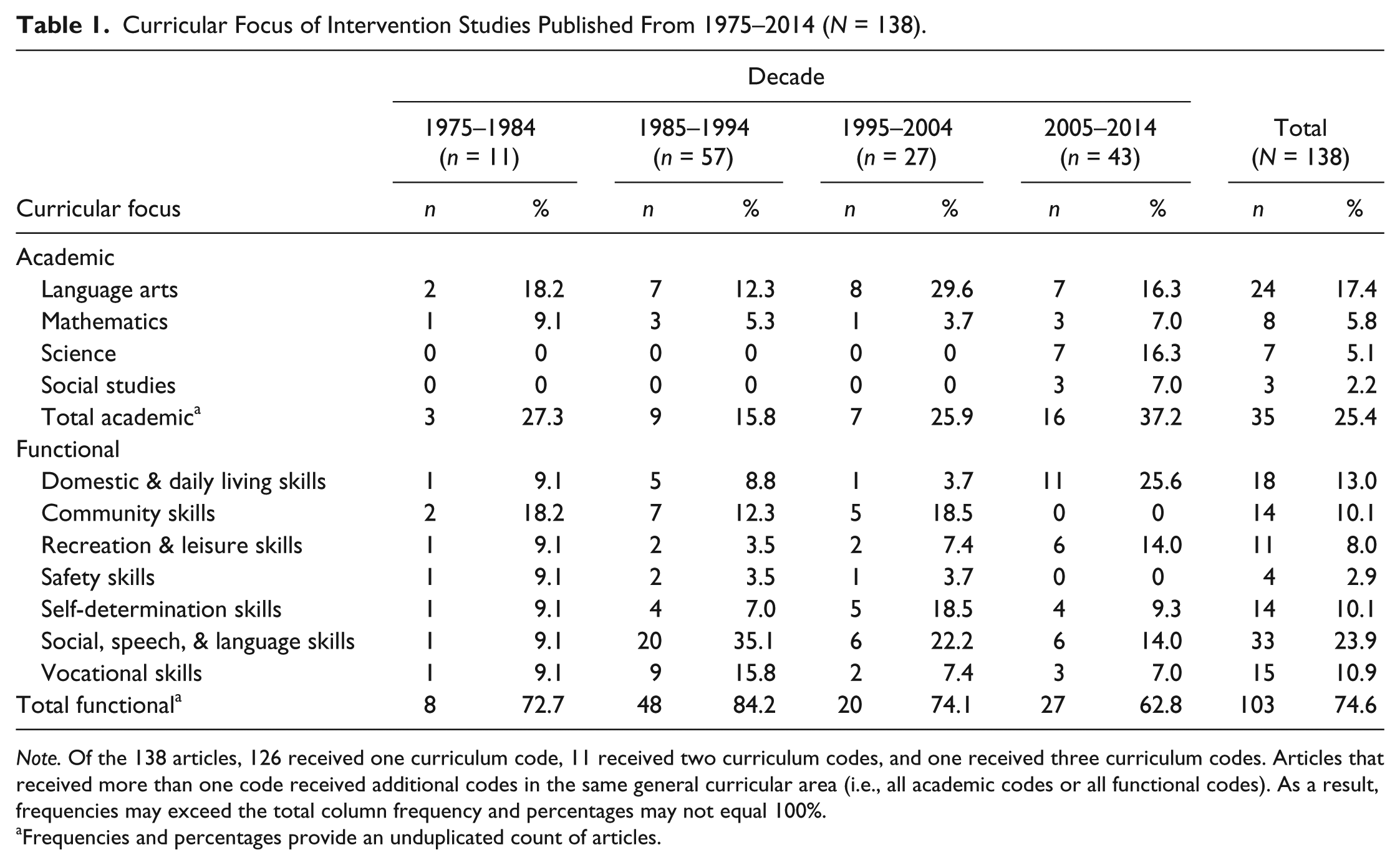
Note. Of the 138 articles, 126 received one curriculum code, 11 received two curriculum codes, and one received three curriculum codes. Articles that received more than one code received additional codes in the same general curricular area (i.e., all academic codes or all functional codes). As a result, frequencies may exceed the total column frequency and percentages may not equal 100%.
Frequencies and percentages provide an unduplicated count of articles.
Over the last three decades, the percentage of interventions focused on academic skills has increased from 15.8% to 37.2%, while the percentage of interventions conducted on functional skills has decreased from 84.2% to 62.8%. The greatest number of intervention studies focused on academics occurred in the most recent decade (2005–2014), whereas the greatest number of interventions on functional skills were produced from 1985–1994.
Academic interventions across all decades have consistently targeted both language arts and mathematics; however, it is only within the last decade (2005–2014) that interventions have focused on science and social studies. Language arts is the only academic area in which a change is noted between decades. A spike in interventions occurred in 1995–2004 (29.6%); in all other decades, percentages ranged from 12.3% to 18.2%.
The functional skills area with the greatest change over time was social, speech, and language skills. There was a dramatic increase from 1975–1984 (9.1%) to 1985–1994 (35.1%), followed by a decrease during 1995–2004 (22.2%). Three curricular areas experienced changes between two decades. The percentage of studies focused on domestic and daily living skills increased between 1995–2004 (3.7%) and 2005–2014 (25.6%). During this same time period, the percentage of studies addressing community skills decreased from 18.5% to zero. Self-determination skills witnessed growth from 1985–1994 (7%) to 1995–2004 (18.5%).
Instructional Context
The majority of intervention studies were conducted in special education classrooms (50.0%), using simulated activities (58.7%) and mass trials (59.4%), and were implemented by either a researcher (49.3%) or nonresearcher (46.4%). Contexts representing less than 10% of all studies included activities involving both mass and dispersed trials and the computer as an instructor. Table 2 summarizes trends in instructional contexts.
Instructional Contexts Used Within Intervention Articles Published from 1975 to 2014 (N = 138).
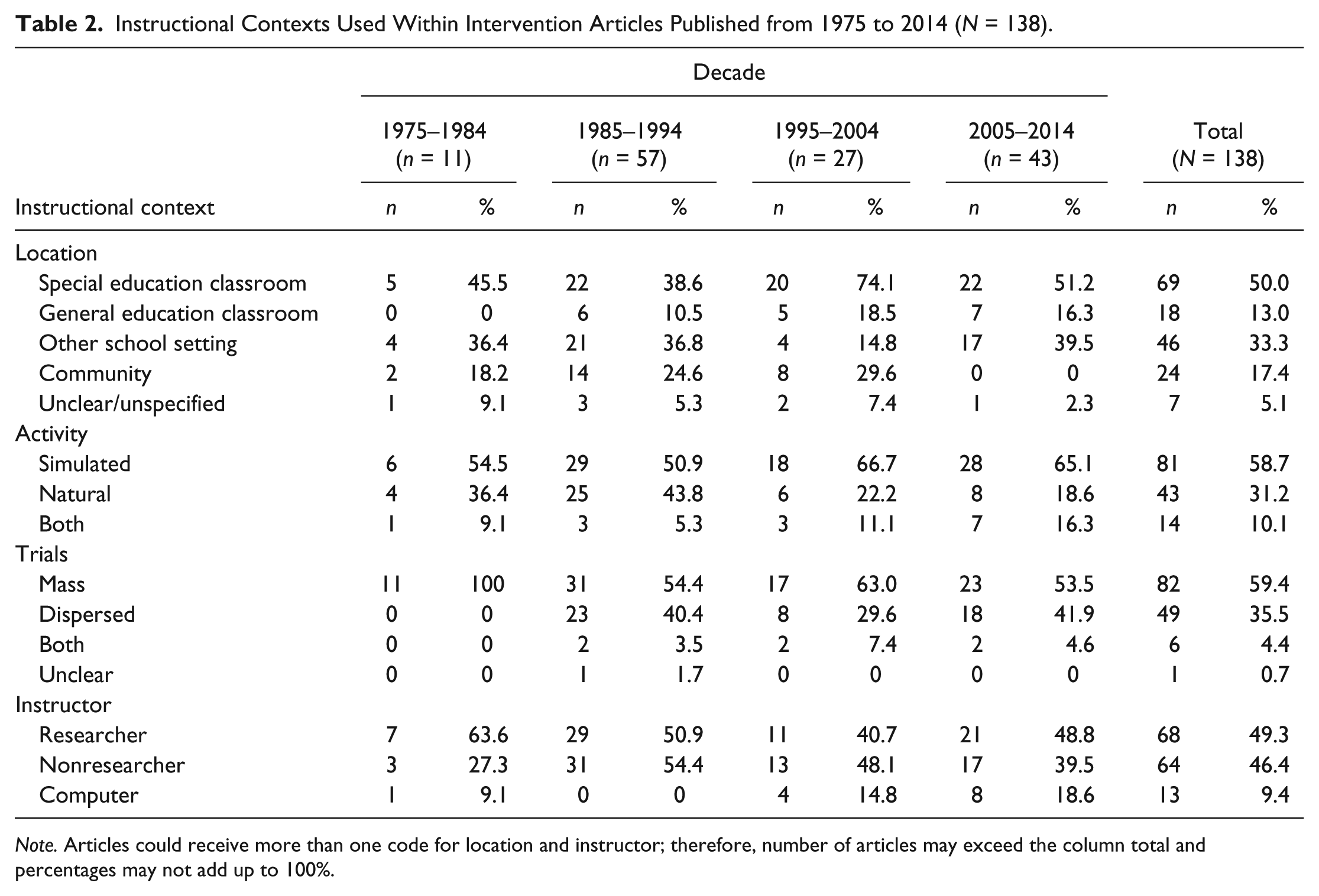
Note. Articles could receive more than one code for location and instructor; therefore, number of articles may exceed the column total and percentages may not add up to 100%.
Within each decade, the special education classroom was the predominant location in which interventions were delivered. A substantial increase occurred in the percentage of interventions conducted in special education classrooms between 1985–1994 (38.6%) and 1995–2004 (74.1%) followed by a decline during 2005–2014 (51.2%). Interventions in general education classrooms increased between 1975–1984 (0%) and 1985–1994 (10.5%); use of this setting remained relatively constant thereafter. Other school settings were used consistently within each decade (i.e., 35% to 39% of interventions) except in 1995–2004 when the percentage of interventions substantially decreased to 14.8%. Perhaps most noteworthy, however, is the shift in use of the community. Interventions occurring in the community dropped from 29.6% during 1995–2004 to zero in 2005–2014.
The percentage of studies employing simulated activities outpaced the percentage of studies employing natural activities across each decade examined. A small percentage of interventions used simulated and natural activities within the same intervention. Between 1985–1994 and 1995–2004, there was an increase in the percentage of interventions using simulated activities (i.e., 50.9%–66.7%) and a corresponding decrease in use of natural activities (i.e., 43.8%–22.2%).
With regard to instructional trials, mass trials were employed more frequently in each decade than dispersed trials. A small, but consistent, number of interventions employed both mass and dispersed trials within the same intervention. There was a decrease in the percentage of interventions employing dispersed trials between 1985–1994 (40.4%) and 1995–2004 (29.6%), followed by growth from 2005–2014 (41.9%).
Researchers and nonresearchers were employed as instructors at comparable percentages in every decade except 1975–1984 when the percentage of interventions delivered by researchers (63.6%) greatly exceeded the percentage delivered by nonresearchers (27.3%). The use of researchers to deliver interventions gradually decreased each subsequent decade until reaching its lowest percentage by 1995–2004 (49.7%). One other notable trend is the increased use of computers to deliver instruction that occurred between 1985–1994 (0%) and 1995–2004 (14.8%).
Instructional Contexts Used in Intervention Locations
Table 3 describes the activities, instructional trials, and instructors used within each location of instruction. Interventions that took place at school (i.e., special education classroom, general education classroom, other school setting) employed primarily simulated activities. The community was the only location where instruction predominately occurred within natural activities. Although various types of instructional trials were used in each location, the general education classroom was the only setting in which dispersed trials were used more frequently than mass trials. Interventions in special education classrooms, general education classrooms, and the community had a higher percentage of nonresearchers implementing interventions as compared with other school settings, where the use of researchers was more prevalent. Computers were used to deliver instruction in all settings except the general education classroom.
Instructional Contexts Used in Locations Where Interventions Were Conducted (N = 138).
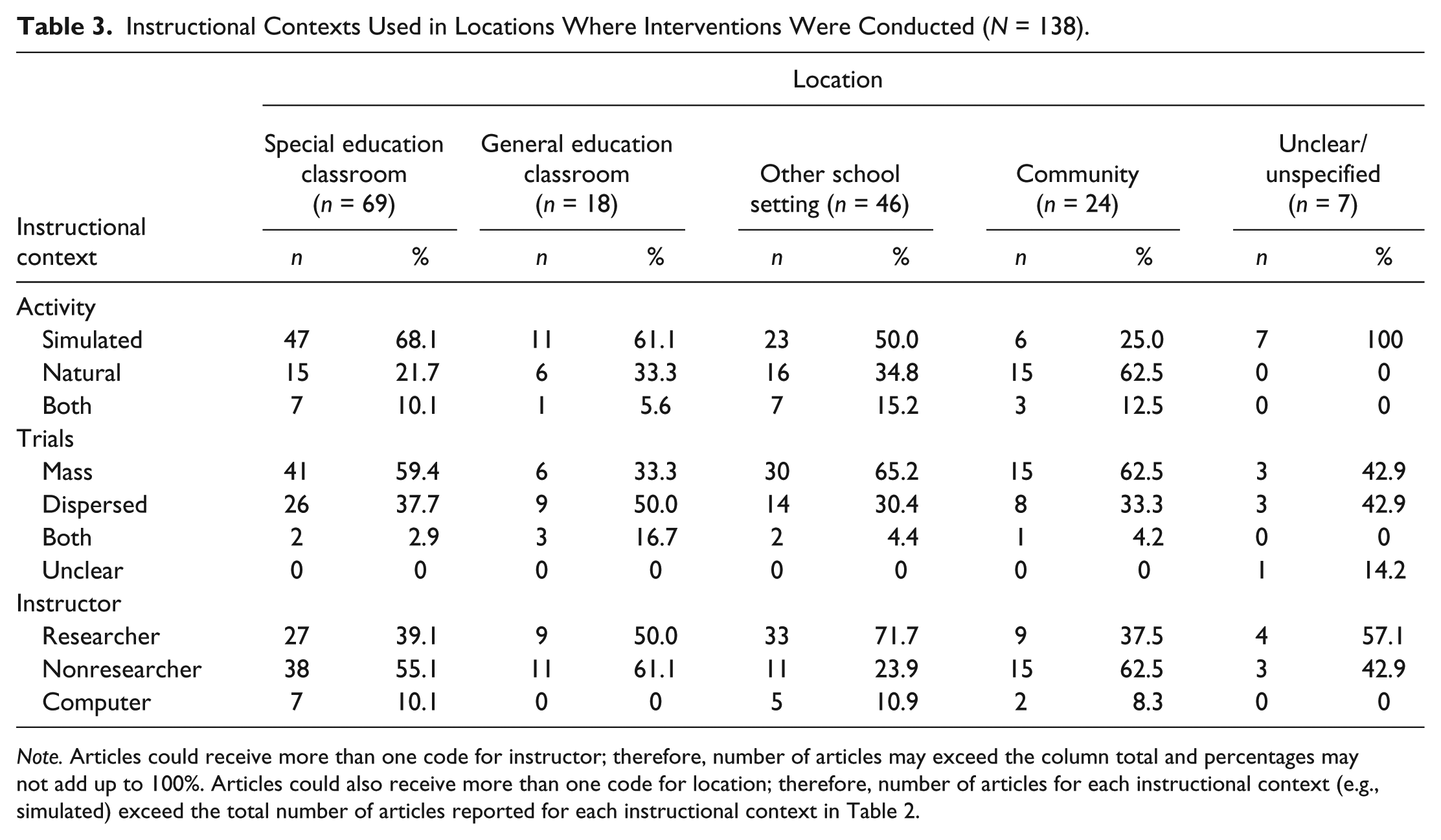
Note. Articles could receive more than one code for instructor; therefore, number of articles may exceed the column total and percentages may not add up to 100%. Articles could also receive more than one code for location; therefore, number of articles for each instructional context (e.g., simulated) exceed the total number of articles reported for each instructional context in Table 2.
Instructional Contexts Used Within Academic and Functional Curricular Interventions
Academic and functional skills interventions were conducted primarily in special education classrooms and nonclassroom school settings, by researchers and nonresearchers. Differences were evident in the activity and instructional trials used (see Table 4). Academic interventions exclusively used simulated activities (100%), and instructional trials were predominantly mass (80.0%). Functional skills interventions, in contrast, used a greater variety of instructional contexts including simulated (44.7%) and natural (41.7%) activities, and mass (52.4%) and dispersed (40.8%) instructional trials.
Instructional Contexts Used Within Academic and Functional Curricular Interventions (N = 138).
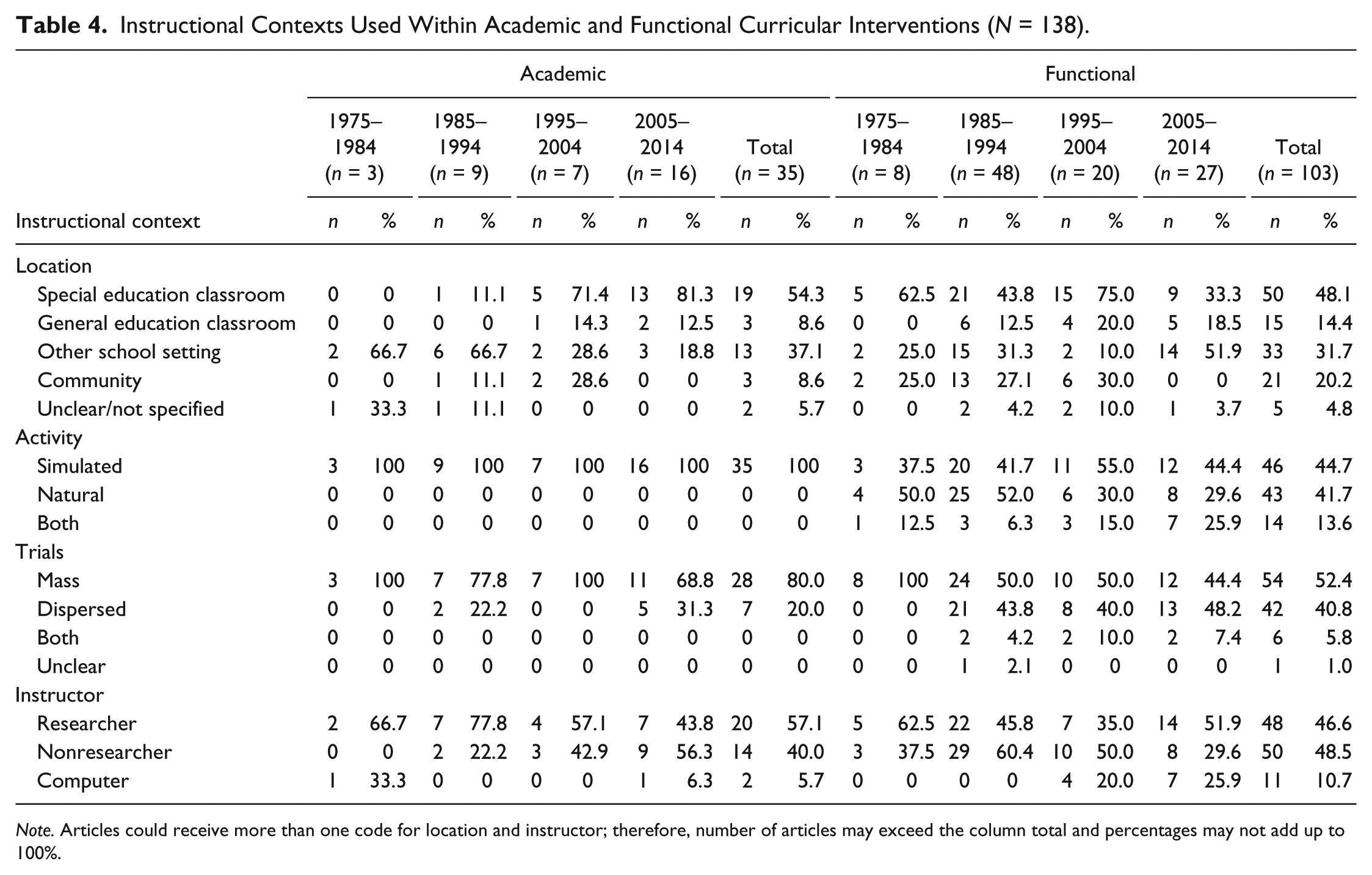
Note. Articles could receive more than one code for location and instructor; therefore, number of articles may exceed the column total and percentages may not add up to 100%.
Within academic interventions, there has been a shift in the location in which interventions are delivered. Most interventions were implemented in other school settings in 1975–1984 (66.7%) and 1985–1994 (66.7%); however, special education classrooms became predominate in 1995–2004 (71.4%) and 2005–2014 (81.3%). The types of activities and instructional trials used within academic interventions have remained consistent across time. Interventions focused on academic skills have exclusively used simulated activities and mass trials have consistently outpaced the use of dispersed trials. Dispersed trials were used within only two decades (1985–1994 and 2005–2014), and combinations of mass and dispersed trials were absent across all decades. In terms of instructors, the percentage of academic interventions implemented by researchers increased between 1975–1984 (66.7%) and 1985–1994 (77.8%) but then steadily decreased to its lowest level by 2005–2014 (43.8%). In contrast, the percentage of interventions implemented by nonresearchers progressively increased from 1975–1984 (0%) to 2005–2014 (56.3%).
Trends among functional skills interventions differ from academic interventions. Across time, there appears to be an inverse relation between the percentage of functional skills interventions taking place in special education classrooms and other school settings. When the percentage of interventions in special education classrooms increased, the percentage in other school settings decreased (and vice versa). Changes also were present in the use of community settings. Interventions in the community accounted for 25% to 30% of all instructional locations from 1975 to 2004, but ceased to be selected for interventions during the last decade. Functional skills interventions primarily occurred in natural activities in 1975–1984 (50.0%) and 1985–1994 (52.0%), and then shifted to greater use of simulated activities in 1995–2004 (55.0%) and 2005–2014 (44.4%). The percentage of interventions using both natural and simulated activities within the same intervention increased from 1995–2004 (15.0%) to 2005–2014 (25.9). In terms of instructional trials, a noticeable shift occurred between 1975–1984 and 1985–1994 when the percentage of studies using mass trials decreased from 100% to 50.0% and the percentage using dispersed trials increased from zero to 43.8%. Finally, substantial variability is present between decades in the percentage of functional skills interventions using researchers and nonresearchers to deliver instruction; however, a sizable increase in the use of computers occurred between 1985–1994 (0%) and 1995–2004 (20.0%).
Discussion
The purpose of this literature review was to examine trends in curricular focus and instructional context of intervention research conducted with transition-age students with severe disabilities between 1975 and 2014. Findings from this review should be considered in relation to the limitations that exist. Although we consulted with the education librarian at our university to confirm appropriate search strategies and databases, our search process may have inadvertently excluded articles meeting study criteria. A hand search of journals focused on severe disabilities and/or transition, and use of an ancestry or descendancy approach with articles selected based on the initial search (Cooper, 2010), may have yielded additional articles, and thus, different findings. Unlike previous research that has examined curricular focus (Nietupski et al., 1997; Shurr & Bouck, 2013), we took a much narrower view of what constitutes curricular research by only selecting interventions employing experimental or quasi-experimental design. The findings therefore do not fully capture the range of literature that focuses on curriculum and context. We also did not examine the quality of the intervention studies or confirm they met quality indicators established in the field of special education. As such, no inferences should be drawn about the extent to which existing literature demonstrates effective curricular approaches or contexts for learning.
Another set of limitations relate to the coding process. Curricular focus was judged based on the language authors used to describe the dependent variable(s) of their study. Some language used in earlier decades may be viewed by today’s standards as having different meaning. For example, with the broader definitions of literacy now prominent in severe disabilities, it may be that some studies coded as “social, speech, and language” would be described as “language arts” if written today. The curricular focus areas identified in this literature review (see Table 1) should therefore be viewed as representing the language of the era in which the study was conducted. Likewise, the demarcation of curriculum as “functional” or “academic” may appear to present a dichotomy that was not intended. These categories were selected to organize the findings in a manner that enabled comparisons using language historically associated with particular curricular areas.
The process used to code articles in the area of instructional contexts also presented challenges because we found many studies employed multiple contexts within the same study. Although we coded “activity” and “instructional trials” according to all possible combinations (e.g., for activity, we coded simulated, natural, both, and unclear), we chose not to represent all combinations for “location of instruction” or “instructor” in order to avoid having too many small categories of comparison. As a result, the findings do not fully acknowledge the many studies that employed multiple locations or instructors. When coding for context, we also chose to code academic skills taught within academic tasks at school as simulated activities rather than natural activities. Our definition of “natural” emphasized applications in typical daily life as opposed to life within the school setting; one could easily argue that academic skills are “natural” activities within a school setting.
A final area to consider when interpreting the findings relates to limitations inherent in our focus on transition-age students with severe disabilities and analysis of the literature by decade. The term severe disabilities is not uniformly defined. The keywords used in our search may exclude terms others might deem synonymous with severe disabilities. We also focused on transition-age students; therefore, the curricular focus and instructional contexts employed in interventions with younger children may differ. Last, examining the literature in 5-year increments, as was done by Nietupski et al. (1997) and Shurr and Bouck (2013), may have produced slightly different results.
Trends in Curricular Focus
Previous reviews of the curricular research literature have employed various selection criteria; therefore, comparisons with the current literature are possible, but limited in scope. Over the last three decades, we found a steady decline in the percentage of articles focused on functional skills. This finding mirrors the work of Nietupski et al. (1997) but contradicts Shurr and Bouck (2013) who noted greater stability in functional skills research. A broader array of literature was examined in both of these studies (i.e., articles were not limited to experimental and quasi-experimental design or to transition-age students), which may account for differences in findings. We also found a gradual increase in the percentage of studies addressing academic skills, similar to Shurr and Bouck. A finding from Nietupski et al. and Shurr and Bouck not supported by the current literature review pertains to the decline both sets of authors found in curricular research over time. To the contrary, we found variability between each decade and an increase in curricular research during the last decade (2005–2014). Differences in the present findings may be due to many factors, including our focus on transition-age students, exclusion of nonintervention studies, broader procedures for identifying articles, and examination of differences by decade rather than 5-year increments.
An important question to ask as a result of this literature review is whether sufficient intervention research has occurred to support the breadth of curriculum deemed important for transition-age students with severe disabilities. On a very basic level, it appears a sizable body of intervention studies (n = 138) have been conducted, although the number produced by decade varies widely. This suggests the need for more consistent efforts among researchers to examine practices that inform the delivery of curriculum for transition-age students with severe disabilities. Looking more specifically at the curricular focus of the interventions, it is evident that several areas have received limited attention. Academic interventions, as a whole, constitute a substantially smaller proportion of the literature base than functional skills interventions. It is only within the last decade that academic interventions have grown in prominence, likely due to requirements for all students with disabilities to access and make progress in the general curriculum (Every Student Succeeds Act [ESSA], 2015; IDEA, 2004; NCLB, 2001). Within functional skills, few interventions have targeted safety skills. Also noteworthy is the absence of interventions on community skills in the last decade and the limited attention to vocational skills during the last two decades. Although the importance of these skill areas is well recognized in the literature (see Brown, McDonnell, & Snell, 2016), it appears intervention research may not be occurring at rates sufficient to support new knowledge and practice in these areas. The growing emphasis on academic research may be leaving fewer researchers available to investigate curricular areas once more prominent in the field. It is also possible interventions are occurring in these areas but with individuals who did not meet our definition of severe disabilities or fall within the range considered transition-age.
Research informs practice and practice informs research. If research is concentrated on only certain curricular areas, it may inadvertently direct the focus of instructional practice in ways that do not support the full range of outcomes desired for students exiting school. Our review suggests the type of skills investigated within intervention studies mirror the curriculum advocated at various points between 1975 and 2014 (Dymond & Orelove, 2001; Spooner & Brown, 2017). For example, functional skills were heavily emphasized from 1985 to 1994 and academic interventions were most prevalent from 2005 to 2014. If all areas are valued and deemed important for preparing youth for adulthood, then it follows that intervention research should reflect the breadth of curriculum that is valued within the discipline.
Although a case could easily be made for increasing research in all areas identified and valued within the discipline, it seems especially important to devote increased attention to curricular areas identified as predictive of positive post-school outcomes. In a review of the secondary correlational literature, Test et al. (2009) identified 16 predictors of employment, independent living, and/or postsecondary education. Predictors associated with curricular areas included career awareness, community experiences, exit exam requirements/high school diploma status, occupational courses, paid employment/work experience, self-advocacy/self-determination, self-care/independent living skills, social skills, vocational education, and work study. Mazzotti et al. (2016) found additional evidence to support the Test et al. findings and identified three additional predictors associated with curricular areas including youth autonomy/decision making, travel skills, and goal setting. A comparison of these predictors with trends from the current literature review suggests new intervention research is particularly needed in the areas of vocational, community, and self-determination skills. Safety skills cut across each of these curricular areas and also warrant attention.
Trends in Instructional Contexts
Findings from our review suggest the instructional contexts used most frequently in past intervention research are special education classrooms, simulated activities, mass trials, and instruction from either a researcher or nonresearcher. Instructional contexts investigated in our review were broader in scope than previous literature reviews, yet some comparisons are possible. We found most intervention studies (94.9%) clearly specified the location in which the intervention was implemented. In contrast, Shurr and Bouck (2013) found 48% of the 134 curricular research articles in severe disabilities they reviewed did not specify a location. Differences in findings are likely explained by our narrow focus on intervention studies. A second point of comparison is with Alwell and Cobb (2006) who found most interventions for secondary-age youth with disabilities were delivered in special education classrooms. Our own review supports this finding.
Trends in two contextual areas (location, activity) we examined appear at odds with contexts valued in the field of severe disabilities. Half (50.0%) of all interventions took place in special education classrooms; in fact, more interventions were conducted in special education classrooms from 1995–2014 (51.2%–74.1%) than from 1975–1994 (38.6%–45.5%). In addition, there were no interventions implemented in community settings during the most recent decade (2005–2014). These findings are perplexing given IDEA (2004) requires students to be educated in the least restrictive setting, research supports positive outcomes for students educated with peers (Carter et al., 2007; McDonnell, 2017), and inclusive opportunities are predictive of positive post-school outcomes (Mazzotti et al., 2016; Test et al., 2009). Furthermore, instruction in community settings is widely promoted for teaching community, vocational, and independent living skills in natural settings (Brown et al., 2006; Dymond et al., 2014; McDonnell, 2017); and community experiences are predictive of positive post-school outcomes (Test et al., 2009).
A second context seemingly at odds with the literature is what we termed activity. In the studies we examined, the majority (58.7%) occurred in simulated activities (i.e., contrived activities used for purposes of skill acquisition). Studies conducted during the two most recent decades exceeded this average (1995–2004, 66.7%; 2005–2014, 65.1%), suggesting the use of simulated activities is increasing. Instruction within natural activities has been promoted for its ability to help students learn skills under the conditions in which they are typically performed (Bambara et al., 2016; Drasgow et al., 2017). In addition, learning within the natural activity has been shown to promote generalization (McDonnell, 2017). Developing interventions that include instruction within natural activities appears essential to demonstrating the effectiveness of a practice in the contexts students currently access or will access as adults.
Intervention research has the potential to identify new and promising contexts for educating transition-age students with severe disabilities. In addition to demonstrating techniques that enable students to acquire knowledge and skills, intervention research can also serve to illustrate the contexts in which students can successfully learn. Researchers therefore have the power to influence the contexts in which practitioners teach simply by demonstrating how effective instruction can be delivered within natural activities, inclusive settings, and by individuals other than a researcher. As new interventions are developed, context must be considered and purposefully selected, not just for its potential ability to produce student learning but also for its alignment with contexts valued by the field.
Implications for Research and Practice
This literature review identified trends in the curricular focus and instructional contexts of intervention research focused on transition-age students with severe disabilities. Although we compared instructional contexts for academic and functional interventions, we did not examine contexts for specific curricular areas. Researchers interested in a particular curricular area (e.g., domestic skills) may find it useful to examine the context of existing interventions in order to inform their development of new interventions. Moving forward, future research might examine the extent to which the trends we identified in curricular focus and instructional context are associated with changes over the past 40 years in legislation (e.g., IDEA, NCLB, ESSA) or research funding priorities from the U.S. Department of Education’s Office of Special Education Programs (OSEP) or Institute of Education Sciences (IES). Future research might also examine the extent to which current trends in the curricular focus and instructional contexts of intervention studies mirror actual instructional practices in schools across the nation.
Findings from this literature review reinforce the need for a consistent flow of intervention research that spans the curricular areas deemed important for transition-age students with severe disabilities. Particular focus is needed in areas identified as predictive of positive post-school outcomes, including vocational, community, self-determination, and safety skills. As researchers develop new proposals for intervention research, care should be taken to select contexts for implementation that reflect contexts valued in the field of severe disabilities. When these contexts are not practical or feasible, consideration should be given to replicating interventions in natural, inclusive contexts prior to extending research in alternative directions.
Footnotes
Declaration of Conflicting Interests
The author(s) declared no potential conflicts of interest with respect to the research, authorship, and/or publication of this article.
Funding
The author(s) disclosed receipt of the following financial support for the research, authorship, and/or publication of this article: The contents of this article were developed under a grant from the U.S. Department of Education, #H325D130034. However, those contents do not necessarily represent the policy of the U.S. Department of Education, and you should not assume endorsement by the Federal Government. Project Officer, Louise Tripoli.
