







Abstract
How do speakers think and feel about neologisms? And how do these thoughts and feelings affect speakers’ desire to use a neologism? In the present work, we synthesized existing literature on speakers’ intrapersonal reasons for neologism use. From this synthesis, we derived a model of speaker attitudes about neologisms consisting of three core factors—efficiency, extravagance, and extralinguistic relevance. In three studies, we then empirically assessed whether this model accurately reflected how speakers thought and felt about neologisms, as well as how these thoughts and feelings affected whether speakers wanted to use a neologism. Results indicated that our conceptual model reasonably captured the various types of feelings people have about neologisms and confirmed that each of these types of feelings can be relevant to neologism use.
1 Introduction
Since early 2020, no matter where in the world you are, you will be familiar with the term COVID-19. Along with the pandemic came a whole range of new words, used daily, such as covidiot (a person who is stigmatized as failing to observe regulations or guidelines designed to prevent the spread of disease) and quarantini (a strong alcoholic beverage made during a quarantine or lockdown). What do speakers think about such new words and what makes a speaker want to use them? To shed light on these questions, this work investigated how well linguistic theory about why speakers use neologisms is reflected in speakers’ thoughts and feelings about neologisms, and whether speakers’ reported likelihood of using neologisms was related to these thoughts and feelings.
A large range of factors have been suspected to condition the spread and ultimate success of neologisms (see, for example, Kerremans, 2015; Keyes, 2021; Metcalf, 2002). Generally speaking, four types of factors can be distinguished: word-internal factors such as word length, morphological structure or phonological structure (Keyes, 2021; Zaefferer, 2021); social factors including who coined it or has used it so far and their prestige (e.g., a celebrity) or whether it is used by influential media outlets (Fischer, 1998; Kerremans, 2015); factors related to usage, for example frequency of use or diversity of users—ambiguous factors that can be seen as both causes and effects of success (Kerremans, 2015; Metcalf, 2002); and factors related to cognitive and affective aspects that can be attributed to language users, for example whether a word appeals to them and seems to make sense (Keyes, 2021; Schmid, 2008; Zaefferer, 2021). On closer examination, however, it turns out that most factors combine aspects from two or more of these categories. For example, the notion of appeal links properties of the word with the attitudes of speakers. The idea that unobtrusive words and words which do not give rise to metalinguistic debates are more likely to succeed links characteristics of words with aspects related to usage and speakers’ attitudes. Zaefferer (2021), for example, identifies four relevant factors, viz. word length, descriptive fit, discriminativeness of meaning and attractiveness, which also combine different perspectives.
The focus of our paper lies in the interaction between properties of words, on one hand, and speakers’ attitudes toward words, insofar as they influence their willingness to use them. We see a lot of predictive potential in a systematic study of these attitudes, since it is precisely this willingness that is required for a word to be adopted by more and more speakers and thus spread in the community. Therefore, we investigate the effect of speakers’ attitudes toward words dependent on three types of factors that we have distilled from the research by Kerremans (2015), Keyes (2021), Metcalf (2002), and Zaefferer (2021). We group these factors into three categories: efficiency, extravagance and extralinguistic relevance.
1.1 Efficiency
Efficiency is understood as communicative efficiency (Keller, 2014, p. 135; Schmid, 2020, pp. 76–78) and refers to aspects of a neologism that make it easier to be understood. One such characteristic is transparency, including both morphological and semantic transparency. Words can be considered transparent to the extent that speakers can identify their components (morphological transparency) and the meanings associated with them (semantic transparency) from their forms. This contributes to the experience that a word has a clear meaning. For instance, compounds and derivations such as camp site or inspiration are generally more transparent than blends such as glampsite (roughly “a luxury (glamorous) camp site”) or fitspiration (again roughly “a person or thing that makes you want to stay fit”). The fact that speakers tend to prefer transparent forms can have cognitive reasons—as when the patterns underlying their formation are already familiar and firmly entrenched schemata abstracted from language use (cf. Bybee, 2006)—or pragmatic reasons, since the ultimate goal of a coiner is to be understood. Thus, from a theoretical perspective it is to be expected that both listeners and coiners usually prefer more transparent forms with clear meanings over more opaque ones (Schmid, 2008, p. 15).
Words may be transparent and yet be experienced as being not precise, in the sense that the form provides insufficient or even misleading information about the meaning. For example, the fact that fitspiration refers to a person or thing is all but obvious, even when one has realized that the word is derived from fit and inspiration. The more easily the specific meaning of a word can be comprehended and pictured, the more appealing it might be when competing for lexicalization (Keyes, 2021, p. 247; Kjellmer, 2000, p. 209). A word will thus make communication more efficient when there is a precise link between the form of a word and its meaning. Such efficiency could in turn lead to a word being preferred due to its usefulness.
New words can also be understood through local parallels and analogies, that is, when they are recognized as being similar to known words. When speakers encounter a new word and cannot find it upon checking their mental lexicon, they start looking for familiar patterns and comparable existing words (Schmid, 2008, p. 14). For example, even though the suffix-like element -gate is not yet highly productive, analogies to existing formations such as watergate, Iraqgate, boobgate or nipplegate are sufficient to render new formations formally and semantically transparent (Callies, 2016).
Morphologically, a word like*pensivity as a nominalization of pensive, following the pattern of active—activity, creative—creativity, native—nativity, would be easily understood by speakers (Kjellmer, 2000, p. 210). When it comes to compounds or blends, it was found that people tend to decode a word more easily if they are either familiar with the parts of the word or a certain pattern (e.g., elephant food is formed in analogy to animal + food) (Kerremans, 2015, p. 56). Other authors have suggested that clear links between motivation of a neologism’s structure and meaning (i.e., descriptive fit) make neologisms more memorable and thus more likely to be used (Zaefferer, 2021, p. 128). Neologisms with clear analogies to existing words are thus plausibly more transparent, and thus more attractive to speakers, than morphologically or semantically isolated words.
In sum, we expect that the extent to which a neologism is perceived to clearly reveal its meaning, to convey that meaning precisely, and to be similar to already known words will inform a cluster of related feelings about the neologism. We label this cluster of related feelings efficiency, and we expect that speakers who view a neologism as efficient will want to use that neologism more.
1.2 Extravagance
Extravagance refers to aspects of a neologism that make the neologism attract attention and elicit positive affective reactions from listeners (Haspelmath, 1999, pp. 1056–1057; Keller, 2014, p. 139; Schmid, 2020, pp. 78–79). The idea of extravagance has been well formulated in previous work. It has already been acknowledged that speakers can affect how people feel about a given neologism by creating puns and using other forms of humor or creativity (Zaefferer, 2021). Previous analysis has also characterized nonce-formations and neologisms as attention seekers that try to catch the reader’s eye by being witty or otherwise sticking out (Lipka, 2002, pp. 147, 189). Consistent with this idea is that it was found that humor or puns can also help a neologism to get noticed (Kjellmer, 2000, p. 215) as well as to be preserved (Keyes, 2021, p. 245).
Extravagance can even provide a license to break conventional rules and productivity constraints in forming neologisms. The German suffix -bar (“-able”) generally requires a transitive verb base, as in essbar (“eatable, edible”) or machbar (“doable”). In the German example of unkaputtbar, lit. “un-broken-able” (Crystal, 1998, p. 93ff.), however, the root kaputt (“broken”) is an adjective (Hohenhaus, 2005, p. 369). Because of such unconventional usage, neologisms are often used to attract attention in slogans or advertisements (as in the case of unkaputtbar) or to achieve humor in less formal communication, for example in the yellow press (Hohenhaus, 1996, pp. 296–317). Humorous, witty, or creative words thus appear to stand out to potential speakers.
In contrast to the previous perspectives, at least one theorist has suggested that extravagance could be a liability—some words might be too funny to be permanently added to the vocabulary (Metcalf, 2002, pp. 129, 144). However, this theorist also acknowledges exceptions, such as couch potato—lan expression that started as a joke, but soon became established (Metcalf, 2002, p. 130). Other counterexamples include Carroll’s funny-sounding nonsense words chortle, galumph as well as the umbrella term for such words themselves: portmanteau (Metcalf, 2002, p. 33). There thus appears to be some consensus that humorous and creative neologisms stick out and that these qualities can motivate neologism use.
In sum, we expect that the extent to which a neologism is perceived as humorous and as a creative wordplay will inform a cluster of related feelings about the neologism. We label this cluster of feelings extravagance, and we expect that speakers who view a neologism as extravagant will want to use that neologism more than a less extravagant neologism, other things being equal.
1.3 Extralinguistic relevance
Extralinguistic relevance refers to a neologism’s relevance to the context in which it is coined.
The importance of neologism relevance has previously been explored in discussions of the potential of new words to fill conceptual gaps or to denote nameworthy portions of experience (e.g., Downing, 1977; Kerremans, 2015, pp. 21–25; Keyes, 2021, pp. 255–260). Nameworthiness can depend on a speakers’ surroundings. For example, a word like snowman is very unlikely to succeed in most parts of Africa due to its lack of nameworthiness (Lipka et al., 2004, p. 10). Nameworthiness can also reflect societal innovation (Lipka et al., 2004, p. 11) and changes in society (Fischer, 1998). For example, Millennium-bug, a word denoting worries about how computers would handle the shift from 1999 to 2000, was in frequent use at the end of 1999, but it hardly occurred 15 years later (Kerremans, 2015, p. 38). Other terms have cyclical nameworthiness. The use of Cherpumple (various layers of pie baked inside various layers of cake, blended from cherry, pumpkin and apple), for instance, tapered off after its initial invention but found a second peak in the next winter holiday season after its first creation (Kerremans, 2015, p. 129 ff.).
Widespread nameworthiness has been identified as key to a neologism’s survival. A word that can only be used in a very specific situation might not survive, unless supported by other factors such as extravagance (e.g., amuse-bouche—‘a single, bite-sized appetizer (hors d’œuvre)’) (Metcalf, 2002, p. 158). Conversely unsatisfied nameworthiness has been proposed as a key driver of neologism generation. Concepts that do not yet have appropriate expression quickly prompt new coinages to fill existing gaps (Ayto, 2007, p. 1; Crystal, 1995, p. 133; Keyes, 2021, p. 255).
We expect that the extent to which a neologism is perceived as having continued relevance to societal trends, innovations, and recent events will inform a cluster of related feelings about the neologism. We label this cluster of related feelings extralinguistic relevance, and we expect that speakers who view a neologism as extralinguistically relevant will want to use the neologism more.
1.4 Theoretical model and hypotheses
From the literature reviewed above, we derive a three-factor model of speaker attitudes about neologisms (Figure 1). This model posits that speaker attitudes toward neologisms include feelings about a neologism’s efficiency, extravagance, and extralinguistic relevance. By efficiency, we mean a neologism’s clarity, precision, and similarity to already known words. By extravagance, we mean the extent to which a neologism is perceived as funny, creative, and a pun (i.e., wordplay). By extralinguistic relevance, we mean the extent to which a neologism is perceived as having continued relevance to current trends, innovations, or recent events. Our model makes three related predictions: first, that these aspects of speaker attitudes toward neologisms will be empirically identifiable; second, that they are separable from one another; and third, that they are influential on a speakers’ likelihood of using a neologism.
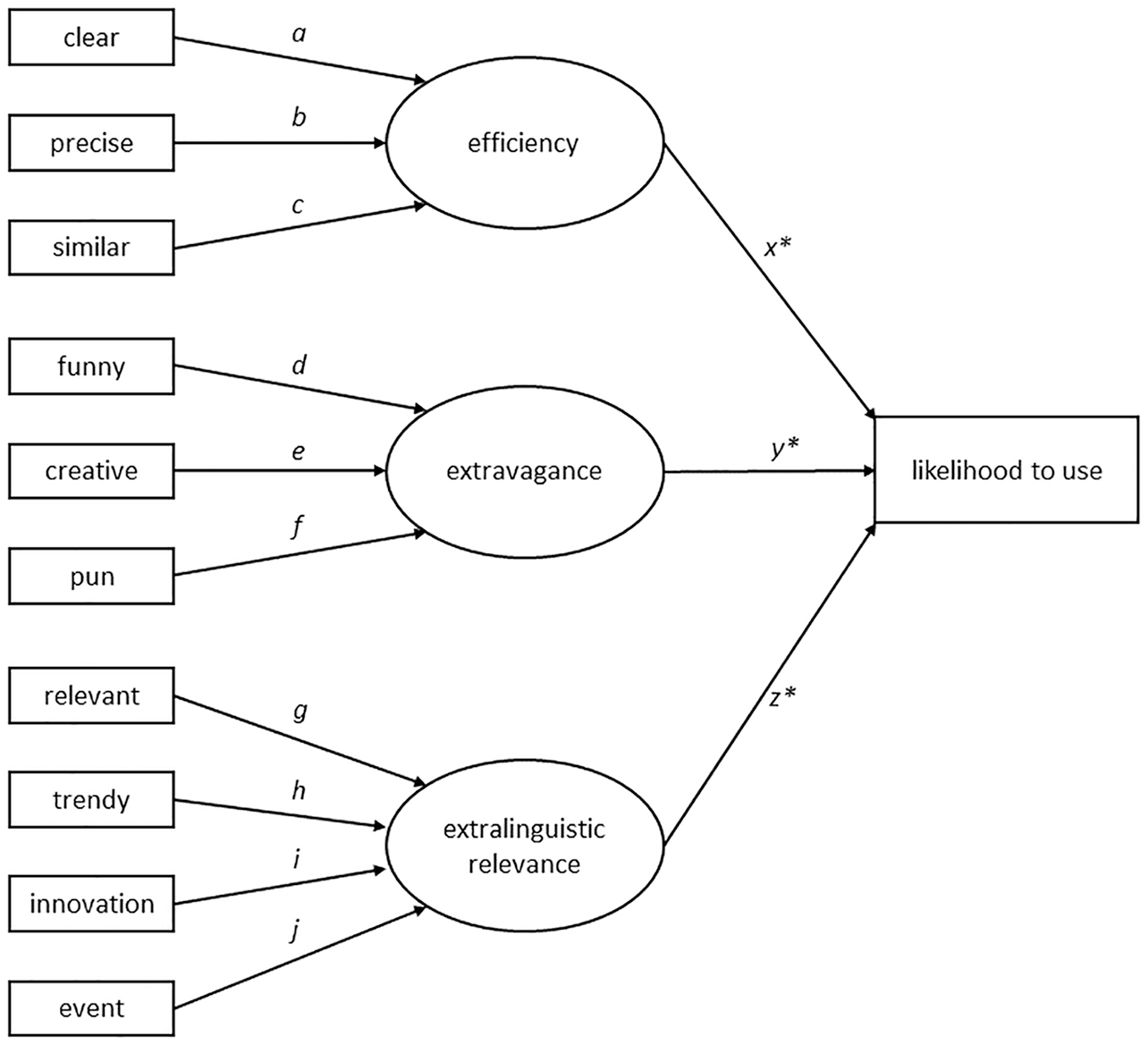
Theoretical model of attitudes about neologisms and the influence of those attitudes on likelihood to use a neologism. Overall perceptions of neologism efficiency (paths a–c), extravagance (paths d–f), and extralinguistic relevance (paths g–j) are indexed by related clusters of neologism characteristics. Perceptions of efficiency, extravagance, and extralinguistic relevance, in turn, each uniquely influence likelihood to use a neologism (paths x*–z*).
We tested these predictions in three studies. Study I demonstrated that speakers would make spontaneous reference to efficiency, extravagance, and extralinguistic relevance by asking speakers to explain their reasons for using (or not using) a given English neologism, in their own words. Study II more closely examined the structure of speakers’ thoughts and feelings about English neologisms by asking speakers to rate neologisms on the various components of efficiency, extravagance, and extralinguistic relevance, and to rate their likelihood of using those neologisms. Using German neologisms, Study III then replicated the results observed in Study II in a German-speaking population.
2 Study I
In Study I, we asked English-speaking participants to describe, in their own words, why they would (or would not) use various English neologisms. Their spontaneous explanations were then classified and subsumed in various categories. We predicted that participants would spontaneously refer to the components of efficiency, extravagance, and extralinguistic relevance in explaining why they would or would not use a neologism.
2.1 Participants and design
One hundred and forty-six participants (97 women, 44 men, 3 non-binary, 2 unknown; 89 under 25 years old, 36 participants between 26 and 45, 20 over 46, and 1 unknown) participated in an online questionnaire study. Participants were recruited through snowball sampling and received entry into a raffle for three prizes ranging from 25 to 100 GBP in value. The questionnaires were prepared and uploaded using questionpro.com and were available for 2.5 weeks.
2.2 Word selection
We focused on blends, specifically N + N blends such as the above-mentioned glampsite and fitspiration. Further examples are snaccident (“food that is consumed in an accidental, often regrettable way, both in quality and quantity”), cruffin (“a hybrid of a croissant and a muffin”) and belfie (a ‘bottom selfie’’). Such blending is a popular recent method for creating English neologisms (Kemmer, 2003, p. 69).
An existing database of neologisms, available as part of the NeoCrawler project at LMU Munich (Kerremans et al., 2019, 2011) was used to retrieve 24 neologisms intended to be broadly representative. The neologisms were baecation, begpacking, belfie, bleisure, breadatarian, broga, brongerie, catio, cronut, cruffin, doga, fitspiration, glampsite, hamdog, honeyteer, mantrum, maranioa, oblication, presstitute, runger, sharenting, snaccident, trumpanzee, veganuary. See Appendix A for definitions and specific selection criteria.
In addition to the 24 target neologisms, 12 established N + N blends were included as distractors (for instance, motel and brunch). These distractors fulfilled two functions. First, they served as control words. Since they are all well-established words, it was expected that participants would both know and use them. Second, they were included to keep the participants motivated and give them a “sense of achievement,” as being constantly confronted with unknown words might be demotivating and make people quit the study.
The resulting set of stimulus words proved too large to include in a single questionnaire—participants can become bored quickly and answer quality declines as a result. We thus divided the stimulus words into two shorter questionnaires each including 18 stimulus words.
2.3 Procedure and materials
Participants completed the study as and when it was convenient for them using their own smartphone, tablet, or computer. When participants accessed the survey, a short text provided some background information about the study and ensured that participants offered informed consent for their participation. This was followed by routine demographic questions, including asking for the participants’ native language, which ensured that only native English speakers took part in the study.
Next, participants were presented with one word at a time. Participants learned the definition of each word but were not given further context. Participants were then asked, “Would you use this word?” and, depending on their answer, “Why would you use the word?” or “Why would you not use the word?.” Participants responded by typing into a text box. See Appendix B for a reproduction of the questionnaire.
Based on our theoretical treatment of efficiency, responses that referenced clarity of form and meaning, precision (including specificity), or similarity to another word (including familiarity), were classified as reflecting efficiency. Example responses include, “It’s very easy to guess its meaning,” “It is very straight to the point,” and “It is not clear at all what this means.” Based on our theoretical treatment of extravagance, participant responses that referenced fun (including humor), creativity (including wit), or a pun were classified as reflecting extravagance. Participants stated, for instance, “It’s a funny word,” “quirky,” “It’s a ridiculous word,” and “Too cheesy.” Based on our theoretical treatment of extralinguistic relevance, participant responses that referenced relevance to recent trends, events, and innovations were classified as reflecting extralinguistic relevance. Responses included “Describes a particular modern phenomenon,” “It makes sense, and happens quite often, enough to deserve its own term,” “I don’t think it would come up in my conversations,” and “Unnecessary, would rather just explain it.” Responses that made no reference to any of efficiency, extravagance, or extralinguistic relevance tended to be very generic (e.g., “why not,” “honestly?”), or simply difficult to classify with certainty (e.g., “If I ever encountered the said foodstuff,” “I’m a purist”).
Efficiency, extravagance, and extralinguistic relevance were not treated as mutually exclusive. That is, where a participant made reference to both efficiency and extravagance in their explanation, that response would be coded as reflecting both efficiency and extravagance. Responses were initially classified by two independent coders (88.28% agreement; Cohen’s kappa = 0.68, substantial). A third independent coder additionally classified responses where the first two coders disagreed, and the resulting majority classification was taken forward.
2.4 Results
We predicted that participants would spontaneously make reference to the components of efficiency, extravagance, and extralinguistic relevance in explaining why they would or would not use a neologism. This prediction was supported. Across the various words, participants provided 1744 explanations for why they would or would not use a given neologism. Of those explanations, 1559 (89.39%) made reference to at least one of efficiency, extravagance, or extralinguistic relevance. More specifically, 1334 (76.49%) made reference to one of these factors, 221 (12.67%) made reference to two of these factors, and 4 (0.22%) made reference to all three of these factors. Of the specific categories, extralinguistic relevance was mentioned most often (701 explanations, 40.01%), efficiency was mentioned next most often (637 explanations, 36.53%) and extravagance was mentioned least often (356 explanations, 20.41%).
2.5 Discussion
As expected, participants made frequent reference to the components of efficiency, extravagance, and extralinguistic relevance in explaining why they would or would not use a neologism. Such references in turn support the importance of these elements for understanding participants’ motivations to use neologisms. These results cannot, however, confirm (a) that our conceptual clustering of these components into efficiency, extravagance, and extralinguistic relevance was meaningfully reflected in speakers’ psychology and attitudes, and (b) that each of efficiency, extravagance, and extralinguistic relevance were independently influential in speakers’ judgments about whether they would use a neologism. Such explicit modeling of speaker psychology and attitudes required a more quantitative approach.
3 Study II
Study II examined the specific structure of speakers’ attitudes about a set of neologisms. Study II accomplished this by asking speakers to rate several neologisms on the component parts of efficiency, extravagance, and extralinguistic relevance (see Figure 1), and to rate their likelihood of using a neologism. We then used a statistical technique (multilevel structural equation modeling) to empirically assess (a) whether our theoretical model accurately captured the structure of speakers’ attitudes toward these neologisms, and (b) whether efficiency, extravagance, and extralinguistic relevance, would separably predict participants’ reported likelihood of using these neologisms.
3.1 Participants and design
One hundred and forty-three people (96 women, 44 men, one non-binary, and 2 unknown; 112 participants were under 25 years old, 24 between 26 and 45 and seven over 46 years old) who had not participated in Study I took part in a correlational design. Participants were again recruited through snowball sampling and were entered into a raffle for three raffle prizes ranging in value from 25 to 100 GBP. The questionnaires were prepared and uploaded using questionpro.com and were available for 2 weeks.
3.2 Word selection
Six neologisms and three distractors were selected from Study I for more detailed examination. The deciding criterion was the proportion of participants who indicated they would use a particular word in Study I. Three higher-use words (oblication, cruffin, and glampsite), and three lower-use words (belfie, brongerie, and honeyteer) were selected, along with three distractors (motel, brunch, smog). See Appendix A for more detailed information about the selection criterion frequency.
3.3 Procedure
Access and introductory procedures were identical to Study I. As in Study I, participants were presented with one word at a time. Participants learned the definition of each word but were not given further context. Participants then rated each word on several dimensions using a 7-point Likert-type scale anchored at 0 (not at all) and 6 (absolutely).
To assess the components of extravagance, participants rated whether each neologism was funny (“is funny/witty”), a pun (“it is a pun”), or creative (“it is creative”). For efficiency, participants rated whether each neologism had a clear meaning (“has a clear meaning”), was precise (“it is precise”), or was similar to something they already knew (i.e., bore an analogy; “is similar to a word I already know”). For extralinguistic relevance, participants rated whether each neologism depicted a new trend (“describes a current trend/phenomenon”), an innovation (“describes a new innovation/thing”), a current event (“is related to a current event”), or would be relevant from now on (“describes something that will be relevant from now on”). After completing this first set of ratings, participants rated how likely they were to use the neologism using the same 7-point Likert-type scale. See Appendix B for a reproduction of the questionnaire.
3.4 Results
We used multilevel structural equation modeling (implemented using lavaan package 0.6-18 in R 4.2.2) to evaluate the viability of our specified model (cf. Figure 1). Single-level structural equation modeling considers the matrix of correlations between a set of measured variables to quantify the plausibility of specified underlying models. In the present work, this technique could be used to assess how well the model presented in Figure 1 captured participants’ responses to a single neologism. Multilevel structural equation modeling expands on single-level structural equation modeling by considering several related sets of correlation matrices. The present work used this technique to assess how well the model presented in Figure 1 captured participants’ responses to all the presented neologisms. 1 This process had several steps. First, we assessed how well our specified model described the data gathered in Study II, generally speaking. Next, we compared the performance of our specified model to the performance of plausible alternative models. Finally, we assessed our specific predictions about (a) the structure of participants’ attitudes about neologisms, and (b) the relevance of participants’ feelings about a neologism’s efficiency, extravagance, and extralinguistic relevance to their reported likelihood of neologism use.
3.4.1 Global model fit and comparison to alternative models
The extent to which a statistical model provides a good description of a set of observations can be quantified with fit indices. Specifically, fit indices provide a numerical summary of how well a specified model predicts the observed system of correlations between the various variables contained in a set of observations. Fit indices can be absolute, indicating the overall degree to which a given model successfully describes a given set of data, or relative, indicating the relative success of different models while accounting for model parsimony (Brown, 2015, p. 1).
To assess absolute fit, we report χ2 and its associated p-value, the root mean square error of approximation (RMSEA) and its 90% confidence interval, as well as the Standard Root Mean Square Residual (SRMR). χ2 is evaluated according to its p-value. The interpretation of that p-value is, however, very different than in many other statistical contexts (e.g., a test of independence applied to frequency data). A p-value larger than 0.05 would indicate that there are no detectable problems with model fit. Even well performing models usually have p-values much smaller than 0.05, however. RMSEA indicates acceptable fit when both its calculated value and the upper limit of its confidence interval fall below 0.10. SRMR similarly indicates acceptable fit when it falls below 0.10. None of these fit indices are superior to one another. Absolute model fit is thus best assessed by considering them jointly (Kline, 2011).
To assess relative fit, we report the Akaike Information Criterion (AIC). AIC is useful in that it allows direct comparison of substantially different models. There are, however, no specific guidelines to interpret the absolute value of AIC. Rather, lower numbers are better and even apparently small differences between models’ AIC can indicate differences in relative model performance (Kline, 2011).
Absolute fit indices indicated that our model (Figure 1) fit the data acceptably well, χ2 = 310.42, p < .001; RMSEA = .09, 90% CI [.08, .10]; SRMR = .07; AIC = 35,721.68. To ensure that alternative models could not provide even better fit, we compared the fit of our model to more parsimonious alternative model structures.
We first compared our model to a single factor model in which all aspects of efficiency, extravagance, and extralinguistic relevance directly informed a single overall attitude about a neologism. This unitary attitude in turn predicted the reported likelihood of neologism use. This alternative model represents a speaker psychology that does not differentiate between efficiency, extravagance, and extralinguistic relevance. This alternative model had both worse absolute fit than our specified model, χ2 = 615.40, p < .001; RMSEA = .12, 90% CI [.11, .13]; SRMR = .09, and worse relative fit AIC = 36,016.67.
We next compared our model to a two-factor model in which we removed the distinction between efficiency and extravagance but retained extralinguistic relevance as a distinct factor. The two resulting factors then jointly predicted the reported likelihood of neologism use. This alternative model represents a speaker psychology in which attitudes about a neologism per se are undifferentiated (i.e., no psychological distinction between efficiency and extravagance) but in which attitudes about the neologism’s relation to its referent and context (i.e., extralinguistic relevance) are differentiated. This second alternative model also had worse absolute fit than our specified model χ2 = 472.21, p < .001; RMSEA = .11, 90% CI [.10, .12]; SRMR = .08, as well as worse relative fit, AIC = 35,877.48.
These results thus indicate that (a) our specified model provided a reasonable account of the current data and (b) our specified model could not be effectively replaced by more parsimonious logical alternatives in the current data.
3.4.2 Factor loadings
The extent to which measured variables index common underlying constructs (e.g., the extent to which precision ratings index the underlying idea of efficiency) can be assessed through factor loadings. Factor loadings typically range between 0 and 1 with higher numbers indicating a stronger relationship between the measured variable and the underlying construct. Scores of 0.70 indicate that the measured variable provides an excellent index of the core underlying construct. Scores between 0.50 and 0.70 indicate that the measured variable provides a reasonable index of the underlying construct. Scores below 0.50 but above zero indicate that the measured variable is related to the underlying construct but is not a core feature of that construct. Scores that cannot be reliably differentiated from zero indicate no detectable relationship between the measured variable and the underlying construct.
Factor loadings in Study II are summarized in Table 1. Table 1 also reports upper limits and lower limits for 95% margins of error (MoE) for each factor loading.
Factor loadings, standardized regression coefficients, and 95% margins of error for Study II.
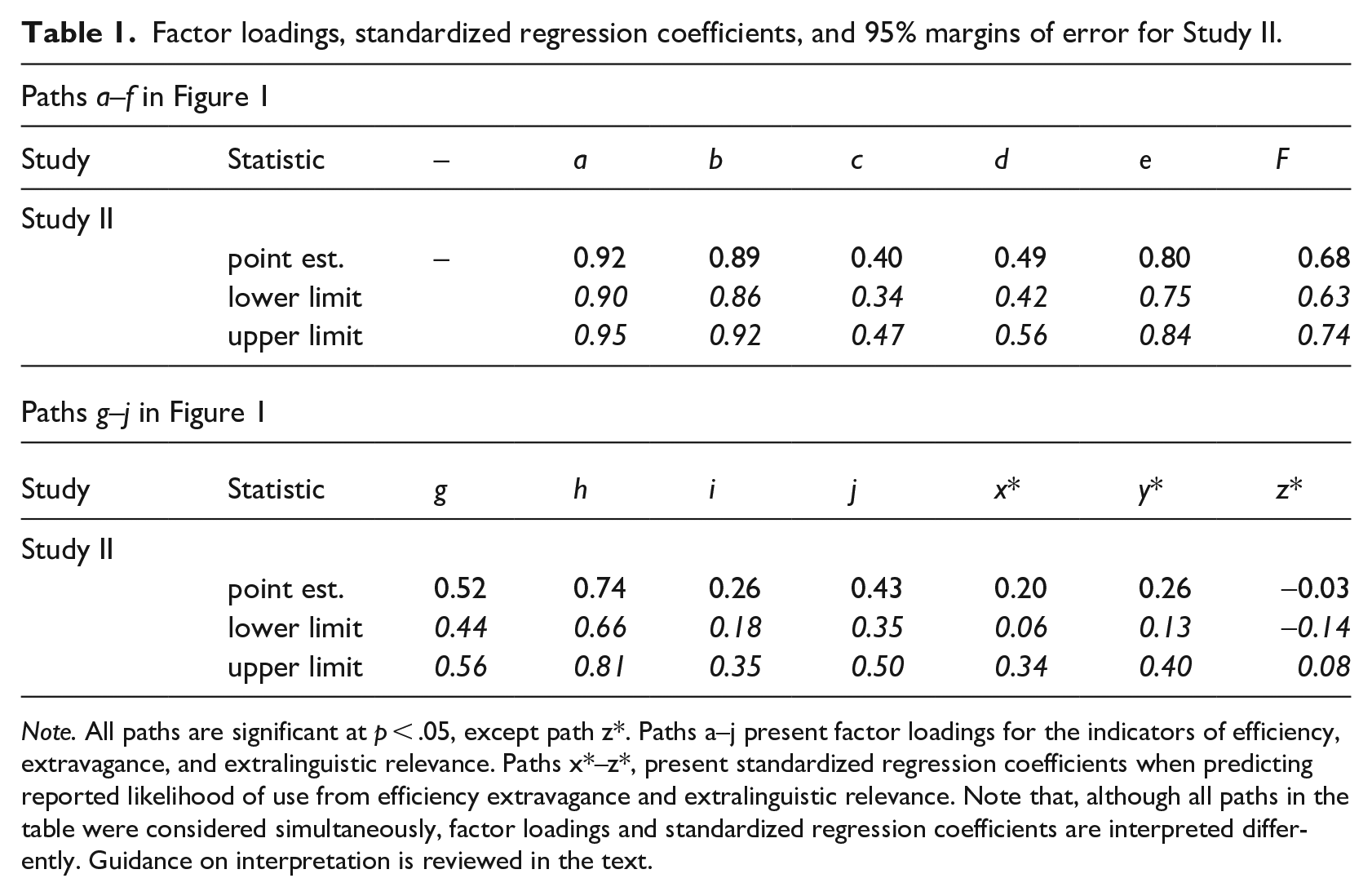
Note. All paths are significant at p < .05, except path z*. Paths a–j present factor loadings for the indicators of efficiency, extravagance, and extralinguistic relevance. Paths x*–z*, present standardized regression coefficients when predicting reported likelihood of use from efficiency extravagance and extralinguistic relevance. Note that, although all paths in the table were considered simultaneously, factor loadings and standardized regression coefficients are interpreted differently. Guidance on interpretation is reviewed in the text.
Factor loadings for efficiency (paths a through c in Figure 1) indicated that each of perceived precision, clarity, and analogy was related to underlying attitudes about neologism efficiency. The extent to which a neologism was considered precise (path b, 0.89, 95% MoE[0.86, 0.92]) and clear (path c, 0.92, 95% MoE[0.90, 0.95]) both appeared to be core aspects of attitudes about neologism efficiency. The extent to which a neologism was perceived as similar to already known words (path a, 0.40, 95% MoE[0.34, 0.47]) was related to attitudes about neologism efficiency but not strongly enough to be considered a core component of those attitudes.
Factor loadings for extravagance (paths d through f in Figure 1) indicated that each of perceived creativity, wordplay, and humor was related to underlying attitudes about neologism extravagance. The extent to which a neologism was considered creative (path e, 0.80, 95% MoE[0.75, 0.84]) and a pun (path f, 0.67, 95% MoE[0.63, 0.74) both appeared to be core aspects of attitudes about neologism extravagance. The extent to which a neologism was considered funny (path d, 0.49, 95% MoE[0.42, 0.56]) was more ambiguous. The overall estimate of the relationship between a neologism’s funniness and attitudes about extravagance suggests that funniness is just below the threshold for being considered a core aspect of neologism extravagance. The margin of error on that estimate straddles the boundary between core and peripheral importance, however. In the present data, funniness thus cannot be clearly classified as core or peripheral to extravagance.
Factor loadings for extralinguistic relevance (paths g through j in Figure 1) suggested that each of continued relevance, relevance to new trends, relevance to recent innovations, and relevance to current events was related to underlying attitudes about a neologism’s extralinguistic relevance. The extent to which a neologism was perceived to reflect a new trend (path h, 0.74, 95% MoE[0.66, 0.81]) appeared to be a core aspect of attitudes about extralinguistic relevance. The extent to which a neologism was perceived to have continued relevance (path g, 0.52, 95% MoE[0.44, 0.56]) and to be related to current events (path j, 0.43, 95% MoE[0.35, 0.50]) were both related to attitudes about neologism extralinguistic relevance, but their centrality to those attitudes was ambiguous—that is, both had margins of error that straddled the threshold between central and peripheral relatedness. The extent to which a neologism was perceived to reflect recent innovation (path i, 0.26, 95% MoE[0.18, 0.35]) was related to attitudes about neologism extralinguistic relevance, but not strongly enough to be considered a core component of those attitudes.
Overall, these results indicate that our conceptual model reasonably captured how speakers thought and felt about the neologisms they encountered. In all cases, the specified conceptual components were related to the expected underlying attitude. Not all of these conceptual components were equally central in participants’ psychology, however. Analogy appeared to be a more peripheral component of how participants viewed neologism efficiency, and relevance to recent innovations appeared to be a more peripheral component of how participants viewed neologism extralinguistic relevance. Other components of extravagance and extralinguistic relevance were ambiguous in their centrality.
3.4.3 Reported likelihood of neologism use
The extent to which theorized constructs (e.g., efficiency, extravagance and extralinguistic relevance) predict an outcome of interest (e.g., reported likelihood of neologism use) can be assessed through the coefficient of determination and standardized regression coefficients. The coefficient of determination (denoted R2) indexes the joint success of a set of predictors in explaining an outcome variable of interest. The coefficient of determination is directly interpretable as the proportion of variance in an outcome variable explained by a set of predictors. Conventional interpretations of the coefficient of determination in social science suggest that a value of 0.02 corresponds to a small effect, 0.13 corresponds to a medium effect, and 0.26 corresponds to a large effect (Cohen, 1988). In the present study, efficiency, extravagance, and extralinguistic relevance (paths x* through z*, Figure 1) jointly explained a medium amount of variance in reported likelihood of neologism use, R2 = 0.17, p < .001.
Whereas the coefficient of determination indexes both unique and shared influence among a set of predictors, standardized regression coefficients (denoted β) index the unique influence of individual predictors. Standardized regression coefficients typically range between zero and one (or between zero and negative one in the case of inverse relationships). Values closer to one indicate stronger relationships and values of zero indicate no relationship. Conventional interpretations of standardized regression coefficients in social science suggest that a value of 0.10 corresponds to a small effect, 0.30 corresponds to a medium effect, and 0.50 corresponds to a large effect (Cohen, 1988). In the present study, the unique influence of both efficiency, β = 0.20, 95% CI [0.06, 0.34] and extravagance, β = 0.26, 95% CI [0.13,0.40], was small. Surprisingly, the unique influence of extralinguistic relevance was not detectably different from zero, β = -0.03, 95% CI [-0.14, 0.08].
3.5 Discussion
The results of Study II indicated that our model was reasonably successful. Global evaluations of model fit indicated that our model provided a reasonable account of the present data. In addition, comparison to more parsimonious logical alternatives indicated that the model could not be simplified without losing explanatory ability. Such a performance is a strong showing for the first quantitative test of the proposed model.
Examination of the specific conceptualizations of efficiency, extravagance, and extralinguistic relevance provided insight into which aspects of linguistic theory are most strongly reflected in speaker psychology. Importantly, all the proposed components of efficiency, extravagance, and extralinguistic relevance, were related to the intended underlying psychological construct. The linguistic theory we drew on to derive our model thus appears to be well instantiated in speaker psychology.
Some of the observed relationships were stronger than others, however. Feelings about neologism precision and clarity formed a clear core for attitudes about efficiency, but feelings about analogy appeared less central to attitudes about efficiency. Feelings about neologism creativity and the quality of being a pun formed a clear core for attitudes about extravagance and perceived humor was ambiguous in its centrality to attitudes about extravagance. The quality of being relevant to a new trend was at the core of extralinguistic relevance, and both continued relevance and relevance to current events were ambiguous in their centrality. The quality of being related to a social innovation appeared less central to the way participants thought about extralinguistic relevance, however.
Efficiency, extravagance, extralinguistic relevance did not predict reported likelihood of neologism use quite as we anticipated. As expected, participants who felt a neologism was more efficient reported being more likely to use that neologism. Similarly, participants who felt a neologism was more extravagant reported being more likely to use that neologism. Participants’ feelings about a neologism’s extralinguistic relevance, however, did not appear to affect participants’ reported likelihood to use a neologism.
Although our theoretical model performed reasonably well, model performance using a single sample of neologisms could plausibly be attributed to idiosyncratic characteristics of those specific neologisms. To demonstrate that our model’s performance was not a fluke of the specific neologisms that we examined, we conducted a third study.
4 Study III
Study III examined German speakers’ attitudes about a new set of neologisms. Specifically, speakers rated three compound anglicisms that recently entered the contemporary German vernacular and three German compounds that have recently achieved widespread use on the same characteristics examined in Study II. If our proposed model reasonably described speakers’ attitudes about this additional set of neologism (taken from a substantially different linguistic context), then it would strongly support the generalizability of our model’s previous performance beyond any idiosyncratic characteristics of the previously examined neologisms or sample.
4.1 Participants and design
Study III was identical to Study II except that new words were selected for use with a German sample. One-hundred fifty-six participants (103 women, 51 men, two non-binary; 17 under 25 years old, 112 between 25 and 45, 24 over 46 years old, and 3 unknown) took part. Participants were again recruited through snowball sampling and were entered into a raffle for three raffle prizes, ranging in value from 25 to 100 EUR. The questionnaires were prepared and uploaded using questionpro.com and were available for 2 weeks.
4.2 Word selection
As in Study II, we searched for neologisms with polarized usage frequency. Study III focused on compound neologisms rather than blends, however, since compounds are more appropriate to German linguistic structure. Various sources were used in order to retrieve the material. After having retrieved a list of preliminary words from OWID (Online Wortschatz Informationssystem Deutsch) and Wortwarte (Lemnitzer, 2011), they were counterchecked in the Duden (the German reference dictionary). As in previous studies, if the words had not been added to a reference dictionary, they were classified as neologism. Usage frequency was assessed with Google, brand24 and the application COSMAS II of the German Reference Corpus (DeReKo), one of the largest corpora of German. Only words on the lower and upper end of the frequency spectrum were chosen. See Appendix A for more detailed information about the selection criterion frequency.
Note that all three high-frequency words were Anglicisms: foodtruck (“a truck that sells food”), egosurfer (“a person who surfs the internet looking for their own name”), and imageboost (‘something that enhances one’s public image’). This reflects the reality of neologism usage in modern German. As observed by Bauer (2020), in early 2020 the most frequently used hashtags on Twitter in Germany were taken from English. It seems that anglicisms are much more “hashtagable” than German words. The low frequency words were Willkommensklasse (“an introductory class on German language and culture for refugee children”), Bleistiftstemmer (“a person with a clerical job involving large amounts of tedious paperwork”), and Schwarmstadt (“a city undergoing reurbanization because of youth migration”).
Parallel to the previous studies, we also included three established words as distractors: Quizmaster, dolce vita, and Wutbürger.
4.3 Procedure
The questionnaire structure and administration were identical to Study II. The questions themselves were translated as literally as possible into German by the first author, a native German speaker and native-level English speaker (see Appendix B).
4.4 Results
We used the same analysis strategy as in Study II 2 and we focused on consistency between studies in interpreting analysis outcomes.
4.4.1 Global model fit and comparison to alternative models
As in Study II, we assessed both global and relative fit and we expected to see acceptable global fit and better relative fit compared with the specified alternative models. As expected, absolute fit indices indicated that our model (Figure 1) fit the data acceptably well; χ2 = 148.59, p < .001; RMSEA = .08, 90% CI [.07, .10]; SRMR = .08; AIC = 17,166.12. Similarly, our model consistently outperformed the specified alternatives. The alternative single factor model had worse absolute, χ2 = 1,137.91, p < .001; RMSEA = .24, 90% CI [.23, .26]; SRMR = .22, and relative fit, AIC = 18,145.45, and the alternative two factor model also, too, had worse absolute, χ2 = 645.8, p < .001; RMSEA = .19, 90% CI [.17, .20]; SRMR = .15, and relative fit AIC = 17,657.34. Taken together these results indicate that our proposed model provided a reasonable account of speakers’ thoughts and feelings about neologisms across two different sets of neologisms taken from two different linguistic contexts.
4.4.2 Factor loadings
If our model generalized across the linguistic and cultural differences between English and German words and participants, we would expect to see a pattern of factor loadings reasonably similar to what we observed in Study II.
Factor loadings for Study III are summarized in Table 2. Overall, results for Study III paralleled results from Study II.
Factor Loadings, Standardized Regression Coefficients, and 95% Margins of Error for Studies II and III.
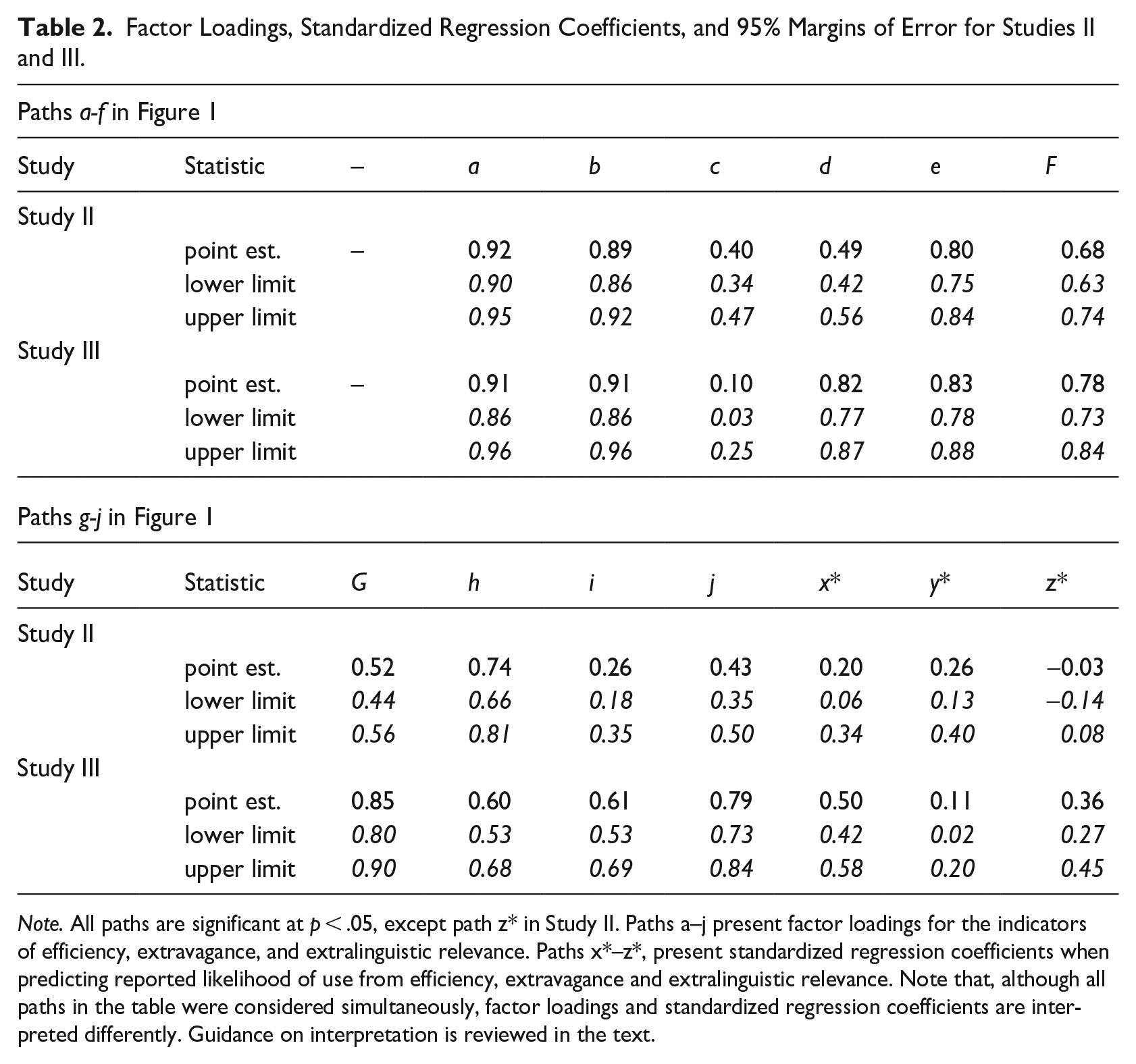
Note. All paths are significant at p < .05, except path z* in Study II. Paths a–j present factor loadings for the indicators of efficiency, extravagance, and extralinguistic relevance. Paths x*–z*, present standardized regression coefficients when predicting reported likelihood of use from efficiency, extravagance and extralinguistic relevance. Note that, although all paths in the table were considered simultaneously, factor loadings and standardized regression coefficients are interpreted differently. Guidance on interpretation is reviewed in the text.
Specific results for efficiency (paths a through c in Figure 1) paralleled Study II completely. Precision, 0.91, 95% CI [0.86, 0.96], and clarity, 0.91, 95% CI [0.86, 0.96], were both core components of perceived efficiency, but analogy was peripheral to participants’ perception of efficiency, 0.14, 95% CI [0.03, 0.25].
Results for extravagance (paths d through f in Figure 1) largely paralleled Study II. As in Study II, both creativity, 0.83, 95% CI [0.78, 0.88], and the quality of being a pun, 0.78, 95% CI [0.73, 0.84], were central to participants’ perceptions of extravagance. In addition, humor, 0.82, 95% CI [0.77, 0.87], was central to participants perceptions of extravagance.
Results for extralinguistic relevance (paths g through j in Figure 1) paralleled Study II with one exception. As in Study II, the quality of reflecting a new trend, 0.60, 95% CI [0.53, 0.68], was central to participants’ perceptions of extralinguistic relevance. The qualities of having continued relevance, 0.85, 95% CI [0.80, 0.90], and of being related to current events, 0.79, 95% CI [0.73, 0.84], were both central to participants’ perceptions of extralinguistic relevance. The quality of reflecting a recent innovation behaved differently between studies, however. Reflecting a recent innovation, 0.61, 95% CI [0.53, 0.69], was central to participants’ perceptions of extralinguistic relevance in the present study but was peripheral to extralinguistic relevance in Study II.
4.4.3 Reported likelihood of neologism use
Perceived efficiency, extravagance, and extralinguistic relevance (paths x* through z* in Figure 1) jointly explained a large amount of variance in reported likelihood of neologism use, R2 = 0.41. Efficiency has a large unique influence, β = 0.50, 95% CI [0.42, 0.58], extravagance had a small unique influence, β = 0.11, 95% CI [0.02, 0.20], and extralinguistic relevance had a medium-sized influence, β = 0.36, 95% CI [0.27, 0.45]. These results indicate that both efficiency and extralinguistic relevance had a stronger relationship with reported likelihood of neologism use in the present study than they did in Study 2. Taken together, these studies thus suggest contextual variability regarding the influence of perceived efficiency, extravagance, and extralinguistic relevance on reported likelihood of neologism use.
4.5 Discussion
These results confirmed the performance of our proposed model in capturing the way that participants think and feel about neologisms. Global and relative indices of model fit confirmed that the model provided a reasonable account of participant attitudes across linguistic contexts. Moreover, factor loadings indicated that the specific components of perceived efficiency, extravagance, and extralinguistic relevance were largely consistent with the proposed model and behaved similarly across different languages and linguistic contexts.
There were some differences between Study II and Study III, however. A neologism’s relevance to societal innovation appeared peripheral to extralinguistic relevance in Study II but central in Study III. We suspect this difference reflects the importance of anglicisms to the wider cultural and political climate in Germany. Anglicisms in the modern German vernacular are associated with modernity, new trends, innovations, internationalism, and cosmopolitanism (cf. Bruckner, 2020, p. 28; Onysko, 2007, p. 9; Piller, 2001; Truslove, 2020, p. 64) in a way that is probably not true of most neologisms.
Whereas the overall structure of speakers’ thoughts and feelings about neologisms appeared consistent across contexts, the relative impact of efficiency, extravagance, and extralinguistic relevance was more variable. With hindsight, we suggest that these findings most likely reflect contextual variability in the determinates of neologism use. For example, if an aspiring “influencer” regards a neologism as extravagant, that characterization is likely consistent across contexts. How strongly extravagance motivates neologism use, however, would probably depend on whether the influencer was creating content for an online audience or communicating with colleagues about their day job.
5 General discussion
In this work, we reviewed linguistic theory about why speakers choose to use neologisms and derived a tripartite model based on neologism efficiency, extravagance, and extralinguistic relevance (Figure 1). We then empirically assessed whether this model was actually reflected in speakers’ thoughts and feelings about neologisms, and whether speakers’ report that their likelihood of using neologisms was related to these thoughts and feelings.
Our findings confirmed that the reviewed linguistic theory about intrapersonal reasons for neologism use was well reflected in speaker psychology. In Study 1, speakers were asked to describe the reasons that they would or would not use a neologism, in their own words. These speakers made spontaneous reference to each of efficiency, extravagance, and extralinguistic relevance in their explanations. In Studies II and III, speakers rated various neologisms on each of the characteristics identified in previous literature as composing efficiency, extravagance, and extralinguistic relevance. Statistical modeling of these ratings indicated that the proposed tripartite model captured the overall underlying structure of speakers’ thoughts and feelings about neologisms reasonably well.
Importantly, Studies II and III used different sets of neologism instantiated in different linguistic contexts. The applicability of the proposed model across these different contexts indicates that the model generalizes beyond the idiosyncratic properties of either the particular speakers or the particular neologisms examined in these specific studies. Of course, whether the model would further generalize to contexts that are not WEIRD (Western, Educated, Industrialized, Rich, Democratic; Henrich et al., 2010) remains an empirical question.
The present work also confirmed that perceived efficiency, extravagance, and extralinguistic relevance can each affect whether speakers want to use a neologism. The relative influence of efficiency, extravagance, and extralinguistic relevance on reported likelihood of neologism use was, however, variable across samples. In hindsight, we see no reason why the influence of these three factors should be constant across different neologisms and different linguistic contexts. Rather, some neologisms may be attractive to speakers because of their precision whereas others may be attractive because of their wittiness or because of their wider relevance. Similarly, different speakers might use the same neologism for different reasons. We are not aware of any specific research that can systematically explain the variable importance of these three factors across different neologisms, speakers, and linguistic contexts. Systematically accounting for and predicting the variable importance of efficiency, extravagance and extralinguistic relevance to speaker motivation for neologism use thus presents an exciting direction for future research.
One aspect of our proposed model appears to require amendment. Contrary to our expectations, analogy between a neologism and existing words was only peripherally related to perceptions of neologism efficiency across both Study II and Study III. We suspect that analogy is less central to perceptions of efficiency because speakers are not consciously aware of the impact that analogy has on their ability to understand the word. This may have to do with the comparable irregularity of blends vis-à-vis regular word-formation patterns, where analogical relations between, for example, nouns endings in -ity or -ness or -ment are very obvious. It is also possible that analogy is, so to speak, already “taken care of” by clarity and precision, insofar as recognized structural similarities between existing and new words increase the probability that the new word is considered to be clear and precise.
A limitation of the present work is that we focused exclusively on blends (and in the German sample on compounds). Although we would be surprised if other formation processes yielded neologisms that were viewed in fundamentally different ways, this aspect of the generalizability of the model presented remains unconfirmed. Confirming such generalizability will be a useful direction for future work.
Another limitation of the present work is that it relies on explicit self-report of thoughts, feelings, and likely behaviors. At least two reasonable questions arise with the use of such measures: (1) Are participants accurately expressing their thoughts and feelings? (2) Will participants’ reports translate to actual behavior?
Fazio’s (1990) influential and well-supported MODE model of attitude-behavior consistency speaks directly to the first question. This model suggests that the sorts of self-report used in the present work would accurately capture participants’ true feelings unless there were some sort of external pressure (e.g., social desirability) influencing participants’ responses. We are aware of no social conventions that would prevent participants from sharing their true opinions of the neologisms we evaluate, although we acknowledge the point is ultimately empirical.
Ajzen’s (1991) similarly influential and well-supported Theory of Planned Behavior speaks directly to the second question. This model suggests that the extent to which intention translates to behavior depends on contextual support for the behavior in question. We view contextual support for neologism use as extremely important but as outside the scope of the present model. We instead refer the reader to other authors’ attempts at modeling contextual influences on neologism use (Keyes, 2021; Schmid, 2020; Zaefferer, 2021).
