






Abstract
Purpose
Gunshot residue (GSR) analysis is a crucial forensic application in the investigation of firearm-related crimes. This analysis traditionally relies on samples collected from the hands of suspected shooters. However, post-shooting activities such as hand cleaning can significantly diminish the presence of GSR on the hands, which compromise the use of routine sampling techniques. This study explores the potential of the hyponychium – a sheltered anatomical region beneath the free edge of fingernail – as an alternative GSR sampling site that may retain particles longer despite post-shooting hand cleaning activities.
Methods
Using six participants, samples were collected from both hands and the hyponychium following firearm discharge, with GSR particle counts analyzed via scanning electron microscopy (SEM) coupled with energy-dispersive X-ray spectrometry (EDX). Post-shooting activities including hand wiping with paper towels, wet wipes, rinsing with water, and washing with soap and water were performed to evaluate GSR persistence in the hyponychium.
Results
Obtained results demonstrated that the dorsum of the right hand initially contained the highest GSR particle count. However, all post-shooting cleaning methods significantly reduced the particle numbers on the hands, with washing with soapy water nearly eliminating detectable GSR. In contrast, the hyponychium consistently retained GSR particles, albeit at reduced levels, even after washing.
Conclusion
Findings suggested that the hyponychium is a promising supplementary sampling site for GSR analysis, particularly when conventional hand samples are compromised by post-shooting hand cleaning methods. This alternative approach may improve analytical accuracy in cases where critical evidence might otherwise be lost.
Introduction
Increase in firearm accessibility potentially contributes the rising incidence of firearm-related incidents, which cause serious public health and security concerns worldwide. 1 Although the rates of firearm-involving crimes changes across different regions and time periods, it appears unlikely that a comprehensive solution will be implemented in near future. 2 As firearm-related crimes persist, the need for forensic science investigations involving novel approaches will continue to grow.
As in all criminal investigations, cases involving firearm-related incidents require the clarification of relationships between the perpetrator, victim, weapon and the crime method. Gunshot residue (GSR) analysis takes place among the most crucial forensic methods for identifying individuals involved in firearm-related incidents. Furthermore, it helps crime scene reconstruction by determining the shooting distance, in certain cases.3–6 Beyond verifying a person's proximity to the gunshot discharge point, GSR analysis potentially assists in determining whether the person from whom the sample was taken is a shooter, bystander, or victim, based on the sampling site and the number of GSR particles detected.3,5,7
Among various analytical methods for GSR detection, scanning electron microscopy (SEM) coupled with energy dispersive X-ray spectrometry (EDX) is widely used. This method does not damage the sample during analysis and provides reliable results, which makes it a preferred technique for inorganic GSR detection. 3 7–11 In routine forensic casework, hands are of primary importance in GSR sampling as they are the anatomical area most likely to come into contact with discharged GSR particles.3,4,7 However, as the time between the shooting and the collection of the sample increases, the amount of GSR particles detectable on the hands decreases. 12 Additionally, both intentional and unintentional actions such as hand washing, cleaning, or touching objects in living environments further reduce the number of recoverable GSR particles.3,12 Factors such as hand washing, contact of the hand with different materials, air flow, and interaction with other people can cause particles to transfer from the hand to other materials, resulting in significant loss of GSR particles and, unfortunately, in some cases, complete loss of detectable particles.13–17 These challenges have led to increased scientific interest in alternative sampling sites that can retain GSR particles for longer periods. Recent studies have investigated the effectiveness of GSR sampling from nontraditional sites, including nasal mucosa, nasal secretions, scalp and facial hair, ears, clothing, and personal accessories.4,1418–23 Findings based on these studies suggest that such alternative sampling areas carry potential to preserve characteristic GSR particles for a longer duration than routine sampling locations on hands, particularly in cases where a thorough GSR cleaning is not intentionally carried out.19,20,22,23
Anatomically, the region beneath the fingernail, the ‘hyponychium’ (Figure 1), presents a potential site for GSR accumulation. This space locates between the free edge of nail plate and the digital pulp (fingertip).
24
A number of living and nonliving particles accumulate in the hyponychium during daily activities. In forensic biology, the accumulation of epithelial cells in the hyponychium is often used to establish physical contact between individuals and identification through DNA analysis, particularly in cases involving physical struggles.
25
Due to the hyponychium's capacity to collect and protect particles from external intervention, this study seeks to address two key research questions:
Do GSR particles accumulate in the hyponychium? Can GSR particles in the hyponychium remain detectable after the hands are exposed to various activities, such as wiping with paper towels, using wet wipes, rinsing with water, or washing with soap and water?
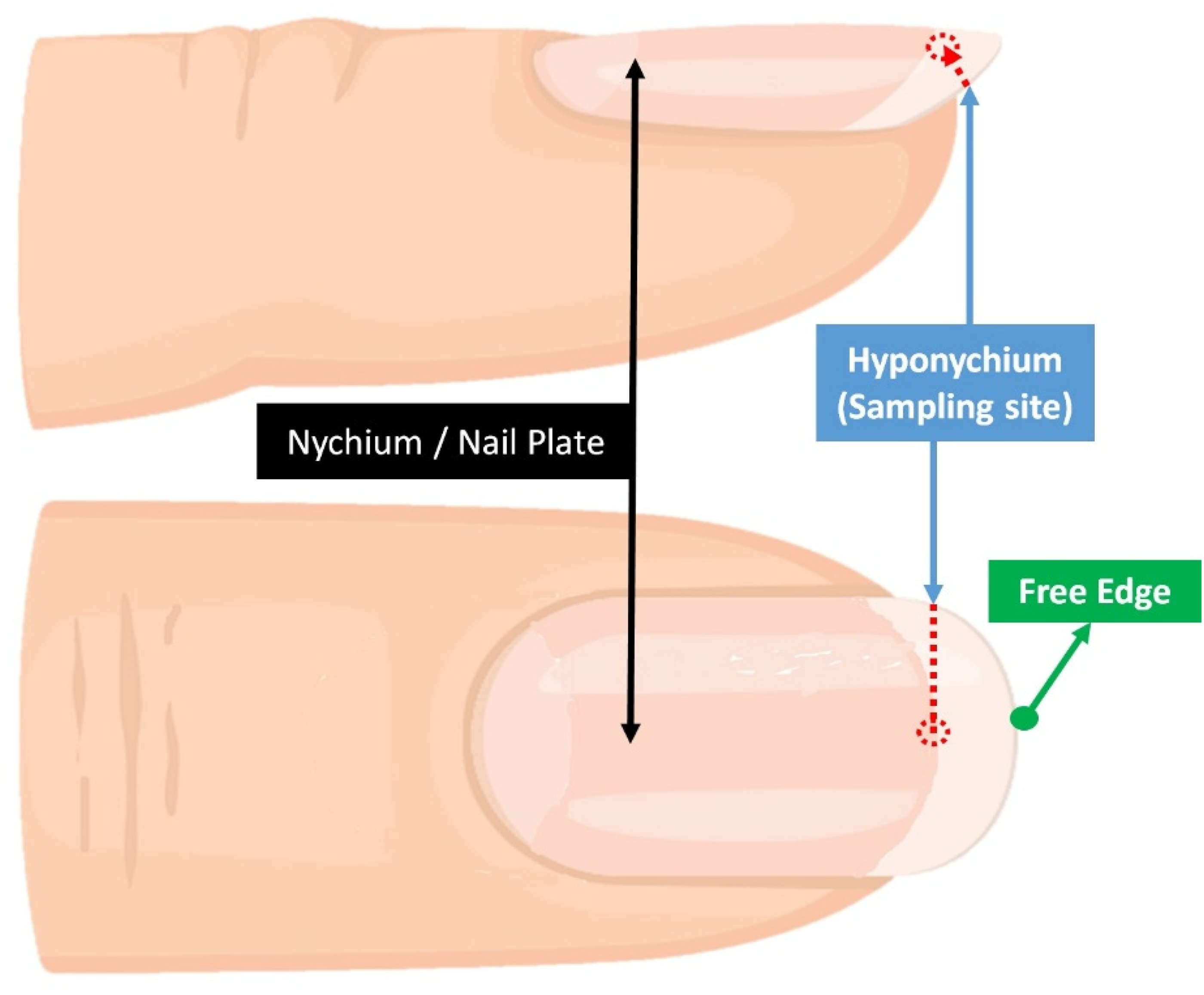
Graphical representation of hyponychium.
This study aims to investigate whether it is possible to detect inorganic GSR particles in the hyponychium, a sheltered space beneath the free edge of nail. Additionally, we evaluate whether GSR particles could be detected in the hyponychium can persist despite common post-incident activities such as rubbing the hands with paper towels, rubbing with wet wipes, washing with water and washing with soapy water, that could otherwise compromise the results of GSR analysis on hands.
Materials and methods
Design of the study
To tackle post-shooting hand cleaning activities, this study aims to evaluate the hyponychium as a potential alternative sampling site for GSR, specifically targeting the detection of the characteristic three-component structure of GSR particles (Pb/Sb/Ba). Six individuals with basic firearms training participated in the experiment. None of the participants had been involved in any kind of firearm activity for at least 15 h before the shooting tests, ensuring minimal contamination. The study was conducted at the Ankara Gendarmerie Criminal Office's shooting range under controlled conditions.
The participants fired a shotgun between 9:00 a.m. and 9:30 a.m. on five consecutive weekdays. Each shooter used a semi-automatic Huglu shotgun and Sterling 28 g, 12-caliber ammunition, standing while firing. To ensure consistent GSR particle distribution and avoid cross-contamination, the same individual was responsible for both the loading and firing for all tests.
Prior to the start of the study, the firearm's barrel was thoroughly cleaned with aqua regia (a 1:3 molar ratio of nitric acid [HNO₃] and hydrochloric acid [HCl]) to eliminate any residual particles from previous shooting incidents.
Blank samples were obtained for examination before each shot. In all scenarios, GSR particles were collected using the standard stub-lifting method, which employed carbon adhesive tapes mounted on aluminum stubs (Ted Pella Inc., USA), a common technique used by crime scene investigators.26,27 The study was designed with five distinct experimental scenarios:
Scenario 1 (Control): Samples were collected one hour after shooting from multiple areas on the hands of the shooter, including the right palm, left palm, right and left dorsum, interdigital areas (between the thumb and index finger), and beneath the free edge of the nails (hyponychium) on both hands. Scenario 2 (Paper Towel Wiping): Samples were obtained from the hyponychium and the dorsum of the right hand one hour after shooting. However, prior to sampling, participants were instructed to rub their hands with a cellulose-based paper towel (Hayat Kimya, Istanbul, Turkey) for at least 30 s. Scenario 3 (Wet Wipe Cleaning): The same procedure was followed as in Scenario 2, but participants used wet wipes (Hayat Kimya, Istanbul, Turkey) for GSR removal instead of paper towels. Scenario 4 (Tap Water Rinse): Participants rinsed their hands with tap water for 30 s before sampling. Scenario 5 (Soap and Water Washing): Participants washed their hands for 60 s under tap water with solid white soap (Procter & Gamble Turkey, Istanbul, Turkey) and tap water before samples were collected.
The samples were taken by touching the tips and inner parts of the right- and left-hand, and hyponychium by gently scraping the hyponychium for two times with a wooden toothpick (Lindo Wood Products, Sakarya, Turkey). The samples were then transferred to GSR collection aluminum plates (Ted Pella, USA) in accordance with standard stub-lifting procedures. 26 Blank samples were also taken from the toothpicks before the transfer to ensure that toothpicks are GSR free. Samples were then analyzed for inorganic GSR particles.
All scenarios, except Scenario 1, were repeated five times with two-week intervals between each repetition. After each test, participants clipped their fingernails. An additional nail clipping was requested one week after the initial clipping to ensure potential GSR retention. Prior to each repetition, blank samples were obtained from the participants’ hands to confirm the absence of GSR. This approach ensured that no GSR from previous experiments remained on the hands or nails.
SEM/EDX analyses
A JEOL® JSM-6490LV (Peabody, MA, USA) scanning electron microscope (SEM) equipped with an energy-dispersive X-ray spectrometer (EDX) was used for GSR analysis. The system was operated using INCA Tech software (İstanbul, Turkey), specifically designed for GSR detection. The characteristic three-component structure of GSR particles (lead [Pb], antimony [Sb], and barium [Ba]), as internationally defined, was identified and analyzed in the collected samples. 28 The SEM/EDX analyses was performed under the following parameters: backscattered electron detector (BSD), accelerating voltage of 20 kV, process time of 4, working distance of 8.5 mm, contrast/brightness settings of 30–50/40–60, magnification set to x250, scan speed of 3, and a resolution limit for detecting the smallest particle feature size of 0.96 µm.
The laboratory conducting the study is a member of the European Network of Forensic Science Institutes (ENFSI). As part of quality control, positive control samples were analyzed using standard synthetic GSR particles provided by the ENFSI Firearms/GSR Expert Working Group study (Quo Data). 29 Prior to each test, both positive control samples and negative controls (from blank toothpicks and clean hands) were analyzed to ensure the validity of the test results. The time interval between each shot and SEM/EDX analysis was maintained at one hour.
Statistical analysis
Descriptive statistics for numerical data are presented as means and standard deviations. The Analysis of variance (ANOVA) was employed to evaluate differences in GSR particle counts between sample locations in Scenario 1 and to compare hyponychium particle counts across different scenarios. The assumptions for conducting ANOVA were checked and validated. The Shapiro-Wilk normality test was utilized to assess the normality assumption. The assumption of homogeneity of group variances was tested using the Levene test. Mauchly's Test of Sphericity was used to assess the sphericity assumption. Because the case numbers were equal, the honestly significant difference test with Tukey's correction was utilized for further analysis. The significance threshold was determined to be 0.05. All statistical analyses were performed using Jamovi 2.4. 30
Results
In routine sampling from different parts of the hands of the participants in Scenario 1, the highest number of particles was detected on the dorsum of the right hand (Table 1).
Particle counts of different sample areas in cases.
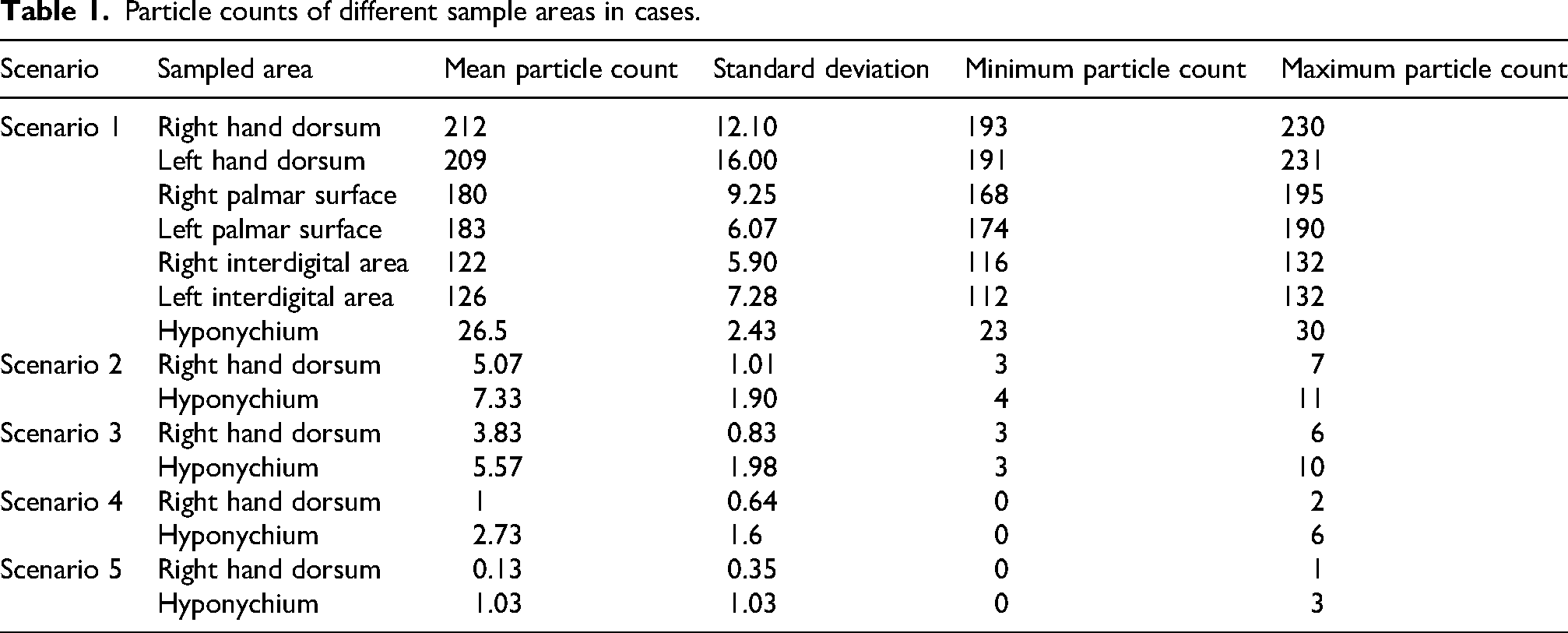
An ANOVA test revealed a statistically significant difference between the sampling regions (p < .01). However, post hoc tests found no significant differences between the right and left dorsum (p = 1.00), right and left palmar surfaces (p = .99), and right and left interdigital areas (p = .99). Significant differences were observed among all other regions (p < .01).
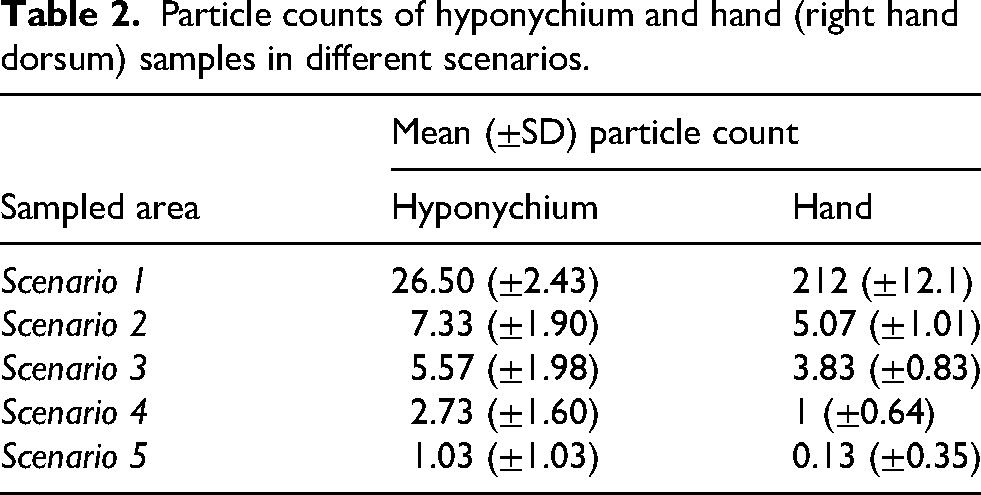
The particle count was highest in Scenario 1 and lowest in Scenario 5 for both the right-hand dorsum and hyponychium samples (Figure 2). While the mean particle count on the dorsum of the right hand in Scenario 5 was 0.13, the hyponychium samples showed an average of 1.03 characteristic particles (Table 2).
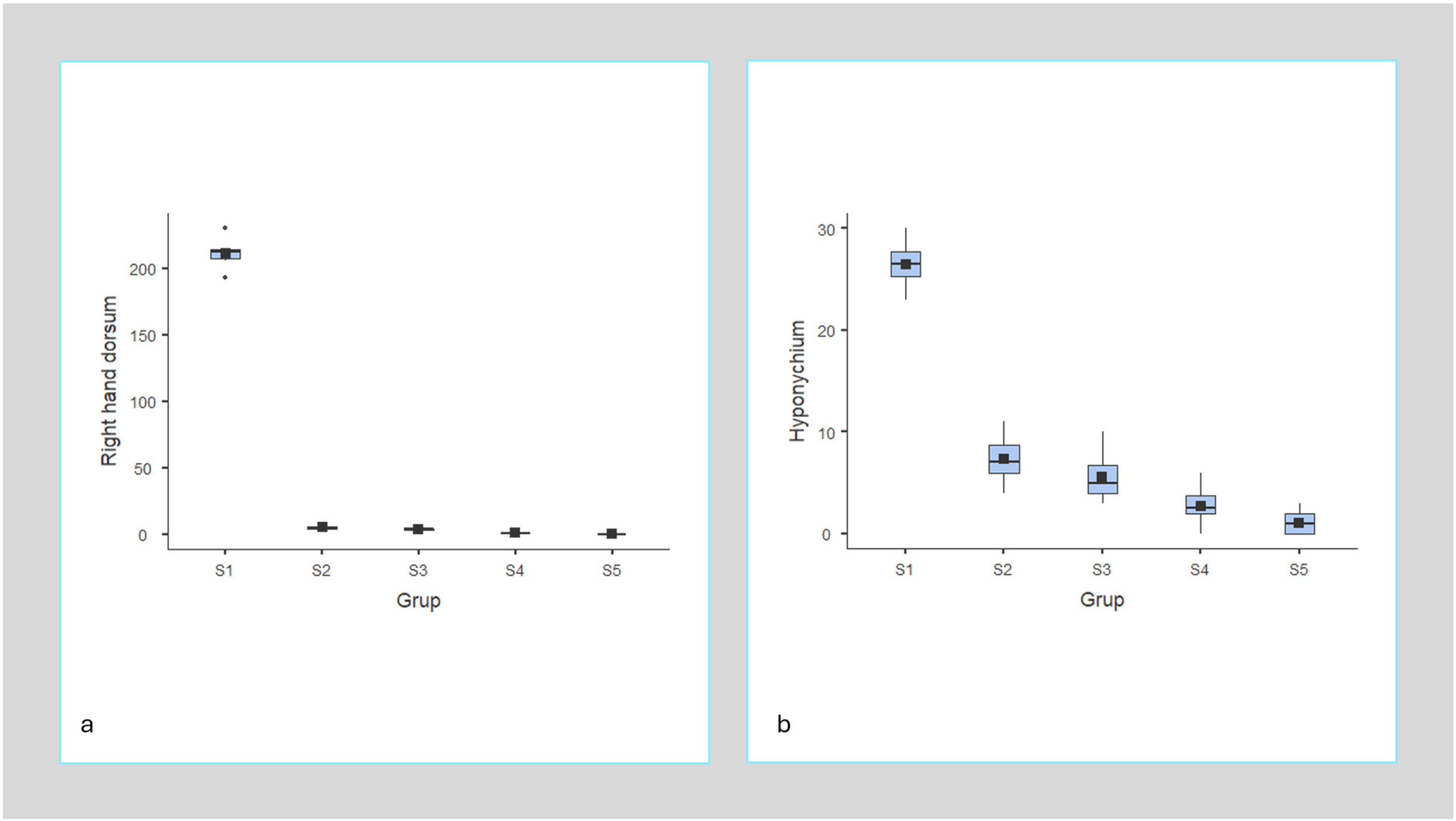
Box plot graphic of right-hand dorsum particle counts (a) and hyponychium particle counts (b) in different scenarios.
Particle counts of hyponychium and hand (right hand dorsum) samples in different scenarios.
Further ANOVA tests showed no significant difference between the repetitions of Scenarios 2–5 (p = .83). However, significant differences were observed in the mean particle counts for both the right-hand dorsum (p < .01) and hyponychium samples (p < .01). Post hoc tests indicated that the particle counts in the hyponychium samples were significantly different across all scenarios (p < .01). In contrast, for the right-hand dorsum, only Scenario 1 showed a significant difference from the other scenarios (p < .01), while no significant differences were detected among the other scenarios.
Discussion
In forensic science, the accurate detection and analysis of GSRs is of high importance for establishing relationship between suspects and firearm related incidents. Previous researches have consistently demonstrated that GSR particles diminish over time, influenced by factors such as environmental exposure, transfer to the surrounding objects and manual cleaning efforts. Notably, the dominant hand, where higher concentrations of GSR are expected, emerges as a focal point in routine investigations. This study focuses of GSR persistence in the often-overlooked hyponychium as a potential sampling site for tackling hand cleaning activities following shooting. By standardizing the conditions surrounding GSR sampling, this study offers a nuanced understanding of how various actions post-discharge impact the detection of GSR, and a potential was to tackle certain challenges caused by cleaning activities.
In the present study, samples were obtained from various parts of the hands of six individuals following firearm discharge in Scenario 1. The highest concentration of characteristic GSR particles was detected on the dorsum of the right hand, which corresponded to the shooters’ dominant hand. Literature has consistently shown that the number of inorganic GSR particles on the hands diminishes over time.15,31,32 The average number of particles detected on the hands after shooting in our study was 212 (±12.1). When evaluating scenarios in which participants attempted interventions to remove these particles, very few particles remained on their hands.
Previous studies have demonstrated that routine daily activities can significantly reduce the number of inorganic GSR particles, even without deliberate attempts to remove them.3,10,15,31 Brożek-Mucha reported that this decrease is most pronounced during the first 30 min post-discharge. 31 To minimize the effect of time on particle loss and to better highlight the differences between scenarios, all samples in our study were collected at the 60th minute after firearm discharge.
In the study by Jalanti et al. conducted over two decades ago, 15 a general decrease in inorganic GSR particles over time was observed. However, substantial variability in particle counts was noted, likely due to the differing activities performed by the individuals. In our study, we controlled these variables by standardizing the type and duration of interventions that could influence the transfer and loss of GSR particles. Additionally, the time intervals between firearm discharge, intervention, and sample analysis were kept consistent across all scenarios, resulting in no significant differences in particle counts between individuals.
Previous literature has demonstrated that post-discharge actions such as hand washing, drying, and rubbing significantly reduce detectable GSR particles and, in some cases, eliminate them entirely.16,32–34 Our findings align with this: washing with soap and water combined with mechanical rubbing removed nearly all inorganic GSR particles. Similarly, washing with water alone and rubbing with paper towels significantly decreased detectable GSR levels. Although a statistically significant difference was found in the number of characteristic particles in scenario 1 compared to other scenarios, there was a clear downward trend in particle counts from scenario 1 to scenario 5.
Kilty et al. study dealing with post-discharge hand cleaning methods, participants dried their hands. In their study, no GSR particles were detected with neutron activation analysis. 16 On the other hand, while cleaning methods in our study were different from Kilty et al. study, the present study revealed that washing hands with soap and water completely removed characteristic inorganic GSR particles. Additionally, we showed that cleaning hands with a paper towel, wet wipe or rinsing with tap water significantly reduced inorganic GSR particles.
Another study revealed that while rinsing with water decreased GSR particles, mechanical scrubbing followed by towel drying completely removed particles, leaving no trace detectable by SEM-EDX. 34 In our study, participants washed their hands as they would in daily routines for 30 s, including mechanical rubbing. Despite not incorporating a drying step, an average of only 3.56 (±1.38) characteristic inorganic GSR particles were detected post-washing. In a more recent study, Vander Pyl et al. examined the impact of handwashing, rubbing, and shaking hands on both organic and inorganic GSR particles using synthetic skin. Their findings indicated that inorganic GSR particles were more effectively removed than organic particles, and that washing with soapy water followed by drying nearly eliminated GSR particles. 32 Despite slight differences in the drying procedure, our study revealed consistent findings.
The reduction of GSR particles caused by post-shooting activities has been a key focus in forensic research, leading to the investigation of various strategies to gather preserved evidence. Therefore, multiple alternative sampling locations have been explored in the literature.7,12,19,20,22,23,35 These locations share a common feature as they are being neglected to clean or touch frequently by individuals involving a firearm incident. One such location, the hyponychium, stands out due to its naturally sheltered and anatomically unique characteristics, making it a valuable candidate for GSR sampling.
Our findings showed that the hyponychium contained fewer GSR particles compared to other parts of the hand. However, manipulations performed in scenarios 2, 3, 4, and 5 resulted in a greater reduction in GSR particles on other hand regions, whereas the decrease in the hyponychium was more limited. Notably, in scenario 5, no GSR particles were detected on the hand, but small amounts were still found in the hyponychium. This persistence can likely be attributed to the nail plate's ability to trap nearby particles and the protected nature of hyponychium.
A limitation of this study is the use of uniform weapons and ammunition. Future research should investigate how different firearms and ammunition types impact GSR accumulation in the hyponychium. Additionally, further studies are needed to assess the persistence of inorganic GSR particles over time without intervention to evaluate the routine applicability of hyponychium sampling in forensic investigations.
Conclusions
This study provides important evidence that hyponychium, an underexplored anatomical site beneath the nail plate, could serve as a useful alternative sampling area for inorganic GSR analysis to tackle GSR cleaning. Traditional sampling from dorsum of the hand remains highly effective immediately after firearm discharge, as indicated by the highest particle counts recorded. However, routine post-discharge cleaning activities like wiping with paper towels or washing with water significantly reduce detectable GSR particles on the hand, with soapy water proving almost completely effective in the moving residues.
The present study shows that GSR particles remain detectable in the hyponychium even after cleaning activities, although the particle number decreases. This persistence of GSR in the hyponychium can be attributed to its sheltered structure, which provides greater protection against external factors that typically cause particle loss from the hands. The hyponychium is therefore a potentially valuable site for forensic investigators, particularly in cases where traditional manual sampling fails to produce conclusive results due to manipulations intended to conceal involvement in firearms incidents. Although further research is needed to confirm these findings in larger and more diverse populations, and to study more in-depth persistence of GSR particles in hyponychium, the results of this study suggest that incorporating hyponychium sampling into standard forensic protocols may be useful in forensic investigation of firearms-related crimes.
Footnotes
ORCID iDs

Ethical statement
The research/study was examined and found appropriate by the Ankara Criminal Laboratory Directorate of the Gendarmerie Criminal Presidency, taking into account the justification, purpose, approach and methods of the research/study, and it was decided on 15/08/2024 with the decision number 2024/8-15 and the scientific project number 014 that there was no ethical and scientific objection to carrying out the research/study.
Authors’ contributions
Conceptualization: Ramazan Akçan, Mahmut Şerif Yıldırım, Derya Demircioğlu, Emre Erkan, Ali Rıza Tümer, Necdet Sağlam; Methodology: Ramazan Akçan, Mahmut Şerif Yıldırım, Derya Demircioğlu, Emre Erkan, Ali Rıza Tümer; Formal analysis and investigation: Ramazan Akçan, Mahmut Şerif Yıldırım, Derya Demircioğlu, Emre Erkan; Writing‒original draft preparation: Ramazan Akçan, Mahmut Şerif Yıldırım, Merve Çapacı; Writing‒review and editing: Ramazan Akçan, Mahmut Şerif Yıldırım, Necdet Sağlam; Supervision: Ali Rıza TÜMER.
Funding
The authors received no financial support for the research, authorship, and/or publication of this article.
Declaration of conflicting interests
The authors declared no potential conflicts of interest with respect to the research, authorship, and/or publication of this article.
Data availability
All data related to this study are stored in the archive of the Ankara Criminal Laboratory Directorate of the Gendarmerie Criminal Presidency and can be shared upon reasonable requests.