







Abstract
This article describes ways that music education can be made more culturally responsive, or congruent with the orientations of culturally diverse students. Music education in the United States has historically been based on Eurocentric frameworks that may no longer be applicable in an increasingly multicultural society. For the many teachers charged with the responsibility of teaching students from backgrounds other than their own, there is a demonstrated need to develop pedagogical practices that respond to cultural diversity. In response to this need, this article builds on an abundance of literature addressing culturally responsive pedagogy in general education to apply the principles specifically to choral music education. In addition to describing culturally responsive approaches to repertoire selection, rehearsal technique, and curriculum design, the article discusses how choral music education can go beyond a surface treatment of diverse repertoire to one that develops students’ sociopolitical competence and empowers them toward social action.
“Since language is one of the most intimate expressions of identity, indeed, ‘the skin that we speak,’ then to reject a person’s language can only feel as though we are rejecting him.” 1 Replacing only a few words in author and educator Lisa Delpit’s statement produces a thought-provoking perspective for music teachers to contemplate: since music is one of the most intimate expressions of identity, indeed, “the skin that we sing,” then to reject a person’s music can only feel as though we are rejecting him. American music education has historically been based on Eurocentric frameworks, the relevance and efficacy of which have been questioned as society has become increasingly diverse. Are the truths and methods music educators have long held dear causing some students to feel as though their music, and therefore their very being, is rejected in our classrooms?
How do our music curricula embrace or exclude our students? What can we as teachers do to widen the circle?
This question reflects larger concerns surrounding how to respond to culture in the music classroom. Culture, a difficult concept to define, refers to “a dynamic system of social values, cognitive codes, behavioral standards, worldviews, and beliefs used to give order and meaning to our own lives as well as the lives of others.” 2 The conception of culture used here assumes that in addition to being shaped by culture, individuals can serve as agents for shaping culture. 3 The idea that people can influence culture is essential to the belief that teachers and students can effect social change.
Cultural concerns have become increasingly important to the many teachers charged with the responsibility of teaching students from cultural backgrounds different from their own. The National Center for Education Statistics reported that from 2000–2001 to 2007–2008, the proportion of public school enrollment composed of white students decreased from 61 to 56 percent. 4 However, in 2008, the majority of public school teachers—about 83 percent—were white. 5 These statistics suggest that the diversity represented by public school students is not reflected in the population of teachers, indicating a need to develop pedagogical practices that meet the needs of students from a wide variety of cultural backgrounds. Frederick Erickson’s observation that everyone is cultural and multicultural suggests that all teachers, not only those who perceive their classrooms to be particularly diverse, have a responsibility to attend to the culturally influenced strengths and needs of the individuals in their classrooms. 6
Many terms have been used to refer to ways of making classroom instruction more congruent with the cultural orientations of ethnically diverse students, including culturally relevant, sensitive, centered, congruent, reflective, mediated, synchronized, and responsive. 7 I will use culturally responsive pedagogy to refer to these ideas, which award-winning author Geneva Gay defined as “using the cultural knowledge, prior experiences, frames of reference, and performance styles of ethnically diverse students to make learning encounters more relevant to and effective for them.” 8 I have selected culturally responsive pedagogy as my term of choice because the inclusion of the word responsive refers to the teacher’s response to children’s cultural backgrounds and resulting strengths and needs, implying a child-centered approach.
Choral music education in particular, with its strong foundation in the Western classical tradition, is often approached from a Eurocentric perspective. While upholding a rich Western classical tradition is an achievement that should be celebrated and continued, educators should also be aware of ways in which choral music education can be prone to ethnocentricism in its practice. Because singing provides an accessible avenue for both validating students’ own cultural backgrounds and teaching about diverse cultures, choral music education has the potential to be at the forefront of making music education as a whole more culturally responsive. This article builds on an abundance of literature addressing culturally responsive pedagogy in general education to apply the principles to choral music education. 9 In addition to describing culturally responsive approaches to repertoire selection, rehearsal technique, and curriculum design, I will discuss how choral educators can go beyond a surface treatment of diverse repertoire to one that develops students’ sociopolitical competence and empowers them toward social action.
Selecting Repertoire from a Culturally Responsive Perspective
Many choral teachers approach curriculum and instruction from a “repertoire-at-the-center” perspective, making repertoire selection a logical point of departure for infusing choral music education with culturally responsive practices. It is contradictory to tout music’s power as universal but then rely heavily or solely on Western classical music in our teaching of the subject. While many educators acknowledge a need to diversify the curriculum by including repertoire representative of many cultures, identifying where to begin can be overwhelming. Culturally responsive teaching, with its student-centered focus, suggests that we begin the repertoire selection process by considering our students rather than by perusing a publisher’s catalogue or reading through a stack of octavos. To guide this process, components of Gay’s definition of culturally responsive teaching might be transformed into questions that inform repertoire choices: What music would build upon my students’ prior experiences? What pieces would capitalize on their cultural knowledge? What selections could my students experience through their preferred learning styles? Which would showcase their culturally informed performance styles? Instead of thinking of culture as something distant and removed, one way that culturally responsive teachers can attend to the culture present in their own classrooms is by including repertoire that honors their own students’ cultural heritage.
Teaching from repertoire that validates students’ cultural backgrounds develops students’ cultural competence, which “refers to the ability of students to grow in understanding and respect for their culture of origin.” 10 Developing cultural competence through music provides students who perceive a disconnect between home and school cultures ways to navigate between those cultures, to be bicultural, and to be bimusical. For example, some African American students equate academic achievement with a loss of their African American identity, viewing doing well in school as “acting White.” 11 Gloria Ladson-Billings indicated that culturally responsive teaching “develops a relevant black personality that allows African American students to choose academic excellence yet still identify with African American culture.” 12 Music teachers can capitalize upon music’s role in conceptualizing and projecting one’s identity to help all students develop a “relevant personality.”
Several factors complicate the process of determining what music represents students’ cultural heritage. Each individual belongs to multiple social groups defined by variables—such as class, race, ethnicity, gender, nationality, and religion—that interact in complex ways to make one’s cultural identity highly individualized and personal. 13 Ladson-Billings coined the useful term “culture of reference” to refer to the cultural group (including ethnic and racial characteristics) with which one most identifies. 14 Teachers must consider that students’ cultures of reference may be different from their cultures of origin and that they may identify with multiple cultures. They must also avoid essentializing culture by assuming that all people belonging to a social category are culturally similar. 15
For example, a music teacher attempting to respond to the needs of his or her Hispanic students might essentialize culture by programming an arrangement of a Mexican folk song, assuming that all Hispanic students identify with Mexican culture. 16 Puerto Rican, Mexican, and Cuban students, for instance, might respond differently to various musical traditions, as might individuals within each of these groups. Similarly, a teacher might assume that all Hispanic students will automatically relate to pieces sung in Spanish, failing to recognize that not all Hispanic students speak Spanish. Selecting quality arrangements or performing in a variety of languages might be important first steps, but can fall short of cultural responsiveness when accompanied by assumptions that any single musical tradition is representative of or relevant to all people of a given cultural background.
Given these complexities, how can music teachers select repertoire that represents students’ cultures of reference? One seemingly obvious answer is to respectfully ask students and parents about their musical backgrounds. Many teachers have students complete questionnaires at the beginning of the school year in order to get acquainted, and including questions about students’ musical experiences outside of school can be informative. When teachers seek parent involvement through booster organizations, back-to-school nights, or volunteer sign-ups, they might inquire about languages in which parents are fluent and areas of expertise they might be willing to share. Autobiographical assignments can offer further insight into what music the students find culturally relevant. Students could be asked to collect a song from a family member, bring a recording of music they enjoy at home, develop a timeline of their musical lives, or create a podcast featuring music that represents their cultural background. Teachers could model autobiographical work by constructing a lesson around music from their own cultural background, and then ask students to discuss or bring in music that serves similar purposes in their lives.
Culturally responsive teachers do not limit themselves to addressing only the cultures of those present in the classroom, but address cultural diversity from multiple perspectives. They seek to deepen students’ understanding of, appreciation for, and value of cultures other than their own. In an ethnically and racially mixed classroom, each musical experience might simultaneously validate some students’ cultures while broadening others’ cultural horizons. Therefore, teachers must consider how repertoire functions along two dimensions: its cultural responsiveness and its cultural validity.
The term authenticity has proved problematic due to its multiplicity of definitions, and scholars have questioned whether authenticity can exist when music is re-created in school settings outside of its culture of origin. Responding to this conundrum, professor and scholar Carlos Abril suggested that educators should strive to create “culturally valid” musical experiences, which he defined as being typical and characteristic of the represented culture. 17 Several authors have provided insights into how culturally valid repertoire can responsibly be selected and performed. 18 While I will not duplicate their efforts, a few ideas follow. Many published “multicultural” choral octavos can be characterized as “arrangements based upon international material,” often created by someone from outside of the culture of origin. 19 Teachers should be aware that publication does not guarantee cultural validity or quality. Choral directors should carefully evaluate all published materials and would be well advised to seek out unpublished material from primary sources.
The single most important way of ensuring the cultural validity of repertoire, as well as the manner in which it is taught, programmed, and performed, is to consult directly with representatives of each culture. If at all possible, choirs should have an opportunity to work with musicians native to each culture studied. Teachers can draw upon resources present in the community to learn music directly from parents, students, and colleagues. While the best means of consulting is undoubtedly live and in person, technological advances open possibilities for collaboration that might not otherwise be possible. With their permission, a videoconferencing session with an expert can be recorded and shared with multiple classes. Over some years, an impressive collection of resources could be acquired.
Among the most important experts with whom teachers can consult are their own students. Delpit observed that “The teacher cannot be the only expert in the classroom. To deny students their own expert knowledge is to disempower them.” 20 Including music from students’ cultures of reference is one way to empower students by allowing them to serve as experts. Teachers could respect and channel students’ expert knowledge by asking them to coach pronunciation of languages in which they are fluent, assist the class by providing information about the music’s cultural context, or take a leadership role in evaluating the cultural validity of the choir’s performances. Allowing students to share the role of expert does not mean that teachers relinquish control of their classrooms, but that they model a receptive attitude and lifelong learning by occasionally learning from and alongside students.
Rehearsals that Respond to Culture
The cultural responsiveness of even the most responsible repertoire choices can be undermined by rehearsal practices that are not congruent with the orientations of ethnically diverse students. Gay noted that “These discontinuities can interfere with students’ academic achievement, in part because how students are accustomed to engaging in intellectual processing, selfpresentation, and task performance is different from the processes used in school.” 21 While it is beyond the scope of this article to describe the multitude of strategies teachers might use to accommodate diverse students’ learning styles in rehearsal settings, some ways of attending to cultural incompatibilities common in choral music education are discussed.
Consider a teacher who selects a gospel piece in response to African American students who have grown up singing gospel at their church, where music is learned aurally. The teacher introduces the piece by handing out scores and asking the choir to sight-read from notation. While the repertoire choice may be responsive, the learning and performance styles emphasized in the rehearsal may not be synchronous with those emphasized in these particular students’ culture of reference. For students who have not previously experienced gospel music, teaching from a score might reduce the cultural validity of the experience. This is not to suggest that students should not learn to read notation, but that repertoire from notated traditions would better serve that purpose. (This hypothetical situation is provided only as an example. Certainly, there are gospel musicians who work with notation.)
The choice of whether to teach music orally or from notation should be determined by two factors: the learning styles of the individuals being taught and the manner in which the music would be taught and learned in its culture of origin. Culturally responsive teachers recognize aural learning as a valid learning style and teach music orally when appropriate, considering the cultural responsiveness and validity of doing so. Teaching orally can provide opportunities for some students to use their preferred learning modality while strengthening the overall musicianship of all singers.
On the other hand, music teachers may be tempted to deemphasize musical notation if it is not particularly valued by students’ cultures of reference. Delpit’s analysis of skills-based versus process-based approaches to language arts instruction offers several interesting parallels to children’s development of fluency with musical notation. Delpit emphasized that the formal conventions of Standard English writing and speaking represent a cultural code that students must learn to succeed in mainstream society. 22 Fluency with musical notation similarly represents a cultural code that could control students’ access to opportunities, positioning teachers as gatekeepers. In denying students access to this code, teachers could prevent students’ entrance into college music programs or limit their participation in certain ensembles. Therefore, teachers should adopt a balanced approach to teaching notation.
Choral music education as commonly practiced in the United States has also emphasized a Western classical style of vocal technique. The success with which students have been taught this tradition is an achievement of which our profession is justifiably proud. However, culturally valid performances of diverse music sometimes require the use of equally diverse vocal timbres (e.g., the extensive use of chest voice featured in some African and African American styles). 23 To perform these styles using traditional Western classical vocal timbre might compromise the cultural validity of the performances and thwart the ideals of culturally responsive teaching by denying some students opportunities to demonstrate their culturally informed performance styles. Delpit argued that “All people have the right to their own language. We cannot constantly correct children and expect them to continue to want to talk like us.” 24 Teachers need to consider whether students will continue to want to “sing like us” if we insist that there is only one valid way to sing.
Some choral educators have expressed concern that singing in styles other than the Western classical tradition will result in vocal damage. Teachers obviously have a responsibility to attend to students’ vocal health regardless of the style or cultural origin of the music being sung. Students can be taught to approach a variety of vocal timbres healthily with attention to matters such as posture, breath support, and appropriate vocal range, and by guarding against physical tension and overuse.
Studies suggest that given opportunities to demonstrate culturally preferred performance styles, students may be more receptive of other styles, including but not limited to traditional Western classical vocal timbre. African American students’ speech style has been shown to diverge more from Standard English in classrooms where their vernacular speech was constantly corrected. 25 A similar relationship has been found between vocal style and cultural mistrust. In Chinn’s (1997) study, African American participants who scored higher on a cultural mistrust survey demonstrated more characteristics of African American singing when asked to sing “America” in the key and style of their choice. 26 Instruction can support mastery of multiple vocal styles, timbres, and techniques without denigrating the performance styles emphasized in students’ cultures of reference. Rather than rejecting these styles outright, making students feel that “the skin they sing” is entirely invalid, teachers can guide students to discover for which musical contexts different vocal styles are appropriate.
Beyond the Repertoire: Developing Sociopolitical Competence
Music teachers cannot be content to focus solely on musical content and avoid potentially controversial issues related to race, ethnicity, and culture, but must be prepared to handle uncomfortable conversations that may arise as long-held beliefs of students are challenged, assumptions are questioned, and stereotypes are confronted. Students should be guided to recognize and challenge systems of oppression, inequality, and social injustice, a process Ladson-Billings called “promoting students’ sociopolitical competence.” 27 For music teachers, this translates into a need to go beyond simple exposure to diverse music and to guide students to discuss, interrogate, and delve deeply into related sociopolitical issues. Approaches to music education that reduce music to its constituent parts allow for the avoidance of social implications and issues. 28 One could teach the South African song “Shosholoza” with attention to its melodic, rhythmic, harmonic, and formal characteristics, but complete avoidance of the song’s connection to apartheid. This would result in an incomplete understanding of the song and a misguided attempt at culturally responsive teaching. It is not being suggested that music teachers should transform into social studies teachers, abandoning musical content and concerns. Rather, teachers can attend to students’ musical and sociopolitical development as mutually reinforcing ends.
One way that choral teachers can promote students’ sociopolitical competence is by selecting repertoire and materials that open dialogue. For example, the song “We Shall Overcome” logically leads to discussion of the civil rights movement, which could lead into discussion of present-day human rights issues. Students can also analyze how social groups are represented (or not represented) in classroom materials or other media. A teacher’s first instinct might be to eliminate culturally insensitive materials, but instead, such materials might be brought into the classroom for analysis provided they are carefully selected and developmentally appropriate. Students could analyze stereotypes conveyed through song lyrics or musical clichés, such as a “cha-cha- cha” concluding a piece. By exercising these analytical skills, students can progress toward developing the sociopolitical competence required to recognize and challenge stereotypes, racism, and oppression.
Teachers can also go beyond discussion and analysis of sociopolitical matters by empowering students toward social action. Abril profiled a teacher who did just this when students questioned her decision to program “La Raspa” for an upcoming concert, arguing that the piece portrayed Mexicans stereotypically. 29 When students voiced their concerns, the teacher assigned students the responsibility of deciding whether to perform the piece. To inform their decision, students conducted a poll of parents, friends, and community members. This example models several characteristics of teachers who develop students’ sociopolitical competence: they avoid positioning themselves as the only expert, encourage students to take responsibility for deciding appropriate action, and open dialogue that may even extend beyond their own classrooms. Teachers can further empower students by engaging them in the role of social critic through music composition or by having students write program notes, opinion pieces, or blogs from a critical stance.
Building a Curriculum of Culturally Responsive Musical Experiences
Music teachers might consider two complementary aims of culturally responsive music education to be validating students’ cultures of reference and broadening their cultural horizons. With practical limitations on instructional time, designing curriculum that responds to culture without compromising other aims of musical instruction might be a daunting prospect. Teachers might feel overwhelmed by the seemingly infinite number of cultures they could experience with students and discouraged by the impossibility of being personally expert in all of these forms of musical expression. It might be helpful to approach curriculum design, with repertoire at its core, by envisioning a continuum from familiar to unfamiliar, which world music expert Huib Schippers called the “unfamiliarity index.” 30
Repertoire drawn from students’ cultural backgrounds serves as an appropriate starting point for musical instruction, giving students something familiar, relevant, and accessible with which to engage and build confidence. When students perceive the teacher as an “outsider” or “other,” beginning with music from the students’ cultural backgrounds can reduce resistance and build rapport and credibility, paving the way to subsequent learning. The unfamiliarity index is highly individualized, and, as previously noted, knowing what music should be considered “very familiar” for particular learners requires sensitivity on the part of the teacher.
Educators should not be satisfied with mere familiarity with previously unfamiliar music as an end result of culturally responsive teaching. Therefore, I propose a continuum model for culturally responsive curriculum design in which teachers plan experiences that provide students with cultural validation, then help students progress toward thoughtfully valuing music that has previously been beyond the realm of their personal experiences (see Figure 1). “Thoughtful valuation,” a term borrowed from John Dewey that refers to mediation and criticism of experience, reflects an ultimate aim of culturally responsive teaching. 31 As Paul Woodford aptly described, criticism in this context does not imply negativism but, rather, refers to “breadth and depth of experience coupled with a commitment to careful research, analysis, and judgment about things that matter.” 32 By positioning “thoughtful valuation” as the continuum’s endpoint, I mean that students should go beyond mere exposure to, familiarity with, or passive acceptance of music representative of diverse cultures, learning to value it with a sense of social responsibility. Music teachers who desire to help students effect social change should consider John Dewey’s notion that thoughtful valuation, rather than art itself, is the true agent of societal transformation. 33

Culturally Responsive Curriculum Continuum
Musical experiences generate the momentum to move students along the continuum. My emphasis of the word experiences suggests that culturally responsive teaching refers to repertoire, methods, or knowledge not in isolation but, rather, in synergy with one another, resulting in musical experiences that are more relevant to and effective for culturally diverse students. In a racially and ethnically mixed classroom, students will approach each musical experience from many different positions along the continuum. Fortunately, the academic year affords many opportunities (e.g., multiple musical experiences within a lesson, several pieces performed in each concert, etc.) to connect with individuals at various points between cultural validation and thoughtful valuation.
How can educators select midpoint experiences that move students toward thoughtful valuation of music from diverse cultures? Student interest might drive the decision-making process, or other aims and goals of instruction might make the choice of one experience more logical than another. Decisions might be guided by practical reasons, such as a schoolwide initiative to learn about a specific culture or an opportunity to collaborate with another teacher or department. Serendipitous events (e.g., a doctoral student from Zimbabwe happens to be attending a nearby university, a parent plays erhu, etc.) might provide the impetus for designing an experience. Providing role models from students’ cultures of origin performing in other traditions (such as Wynton Marsalis, Yo-Yo Ma, Gustavo Dudamel, or William Grant Still) might be a possible intermediate step to help students progress from culturally familiar music toward thoughtful valuation of previously unfamiliar music.
Teachers need not feel pressured to “cover” every conceivable culture, an approach that would undoubtedly result only in superficial encounters with the music given limitations on time for instruction and teacher preparation. Instead, teachers could thoughtfully select one or two cultures to study in depth each year. Students could then experience several works from one culture rather than one piece from each of several cultures, resulting in deep, meaningful experiences. Because choral teachers are often privileged to work with students for more than one year, the continuum model could be envisioned as a spiral in which students repeatedly progress from experiences that validate their own cultures toward thoughtfully valuing the music of diverse cultures though a multiyear process (see Figure 2). Teachers can focus their efforts each year and develop a rotation of cultures about which they feel sufficiently knowledgeable and comfortable to teach. Students would amass an impressive repertoire and might come to thoughtfully value the music of several previously unfamiliar cultures upon graduation from a program approached in this manner.
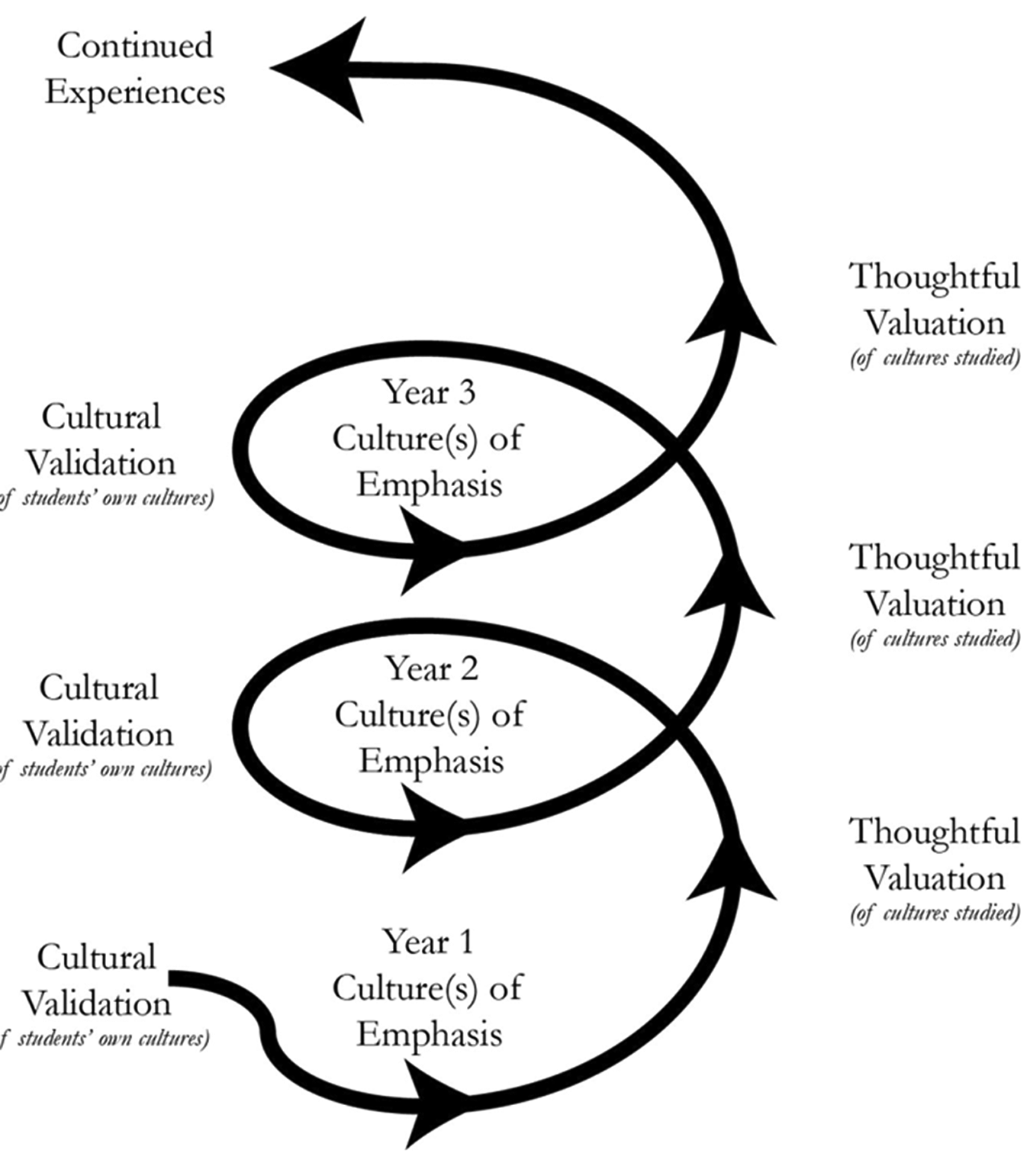
Multiyear Culturally Responsive Spiral Curriculum
Gay emphasized that culturally responsive pedagogy teaches to and through the strengths of culturally diverse students. 34 Choral music educators can teach to and through these strengths by selecting culturally valid repertoire that responds to students’ needs, adopting a balanced approach to teaching notation, promoting singing with a variety of vocal timbres and techniques, developing students’ sociopolitical competence, and designing curriculum around musical experiences that lead students to thoughtfully value music representative of diverse cultures. Because of music’s power as a cultural referent, music teachers are uniquely positioned to improve the quality of students’ educational experiences through culturally responsive practice.