






Abstract
This article describes concrete ways music teachers might engage in policy at the school level and how such engagements strengthen our work and our schools. By making decisions about where to build bridges to policies that further our work and where to buffer from those that impede our vision, we as teachers assert greater control in policy making as it impacts our classrooms. Such policy strategy can be enacted individually and also in collaboration with colleagues in our schools to build a more robust space for policy making on the ground. Whenever teachers create new materials or practices or share ways of thinking explicitly connected to certain policies, we shift the nature of these policies locally and also enlarge our roles in policy.
How can our involvement with policy strengthen our music programs?
NAfME is glad to offer one hour of professional development recognition to you for reading this article. Please follow the link below and complete a short quiz to receive your certificate of completion.
Policy gets in.
Chances are, you’ve felt it too. There’s a part of being a teacher that involves being in charge of your classroom (or at least wanting to be), and just when you think you’re in charge—policy strikes. A few years ago, I asked teachers from several schools in New York City to draw illustrations of policy. Multiple teachers drew lightning striking their school, like the one Abbie made in Figure 1. Bam! We’re hit by standardized tests! Bam! New special education regulations! Bam! Funding trouble!
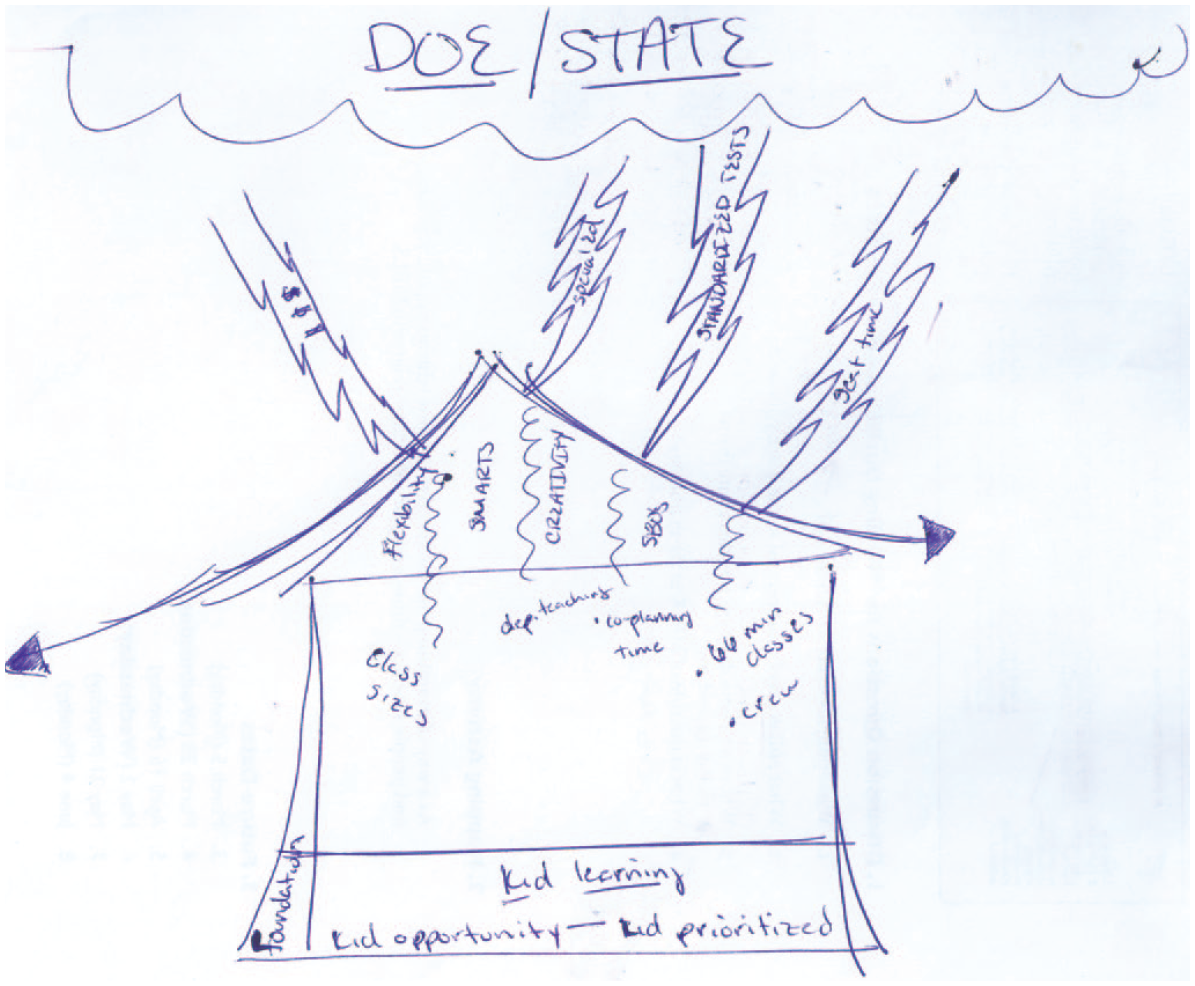
Abbie’s Illustration of Policy Making as Storm and Shelter
Admittedly, this is probably not the most useful way to think about policy. For one thing, we’d never venture outdoors. But I do think the lightning image captures a particular aspect of policy—the chaos, the constant assault—that is felt too often in our lives as teachers. As a current middle school teacher who once worked as a city policy strategist and follows policy closely, even I feel the dread. What next? Where’s the next interruption to my work coming from? Not only is it hard to keep track of where policy is coming from, but it is also hard to see sometimes. To extend the metaphor, policy is often cloudy: It isn’t always clear what is being asked, for what reasons, and what we might do about it.
For many teachers, the instinct is to close the classroom doors and dig in. But let’s admit it: That doesn’t always work. Gone are the days, if they ever existed, where we could easily drown out policy demands with a well-executed Bach chorale. If you’re like me, the idea of closing doors also doesn’t sit right because there’s an instinct to open up. Policy is a way of making change, of problem-solving, and there’s something attractive about taking part in it. This special issue exists because we know as a profession that we need to open our doors, build our capacities for policy making, and find new ways to shepherd our music programs through a changing policy landscape. But how, or when?
This article presents a general strategy, one that includes both reaching out and closing in—what some policy researchers call bridging to policy spaces and buffering from them. I also suggest that as music teachers, we need to build new spaces for collaborative policy making in our schools and argue that policy is something social music teachers can take part in with others. Here is something that is easy to miss in Abbie’s illustration of policy: A shelter has been built in the storm, capable of redirecting and withstanding many of those policy strikes. Our schools and our classrooms hold more power in policy making than we are often aware of. In this article, I detail the strategies we can use to build that work and share some of the experiences of teachers I’ve worked with along with my own across many different kinds of schools.
Bridging to Policy
Take a moment and name three policies central to your work.
Now name three that are central to your school as a whole.
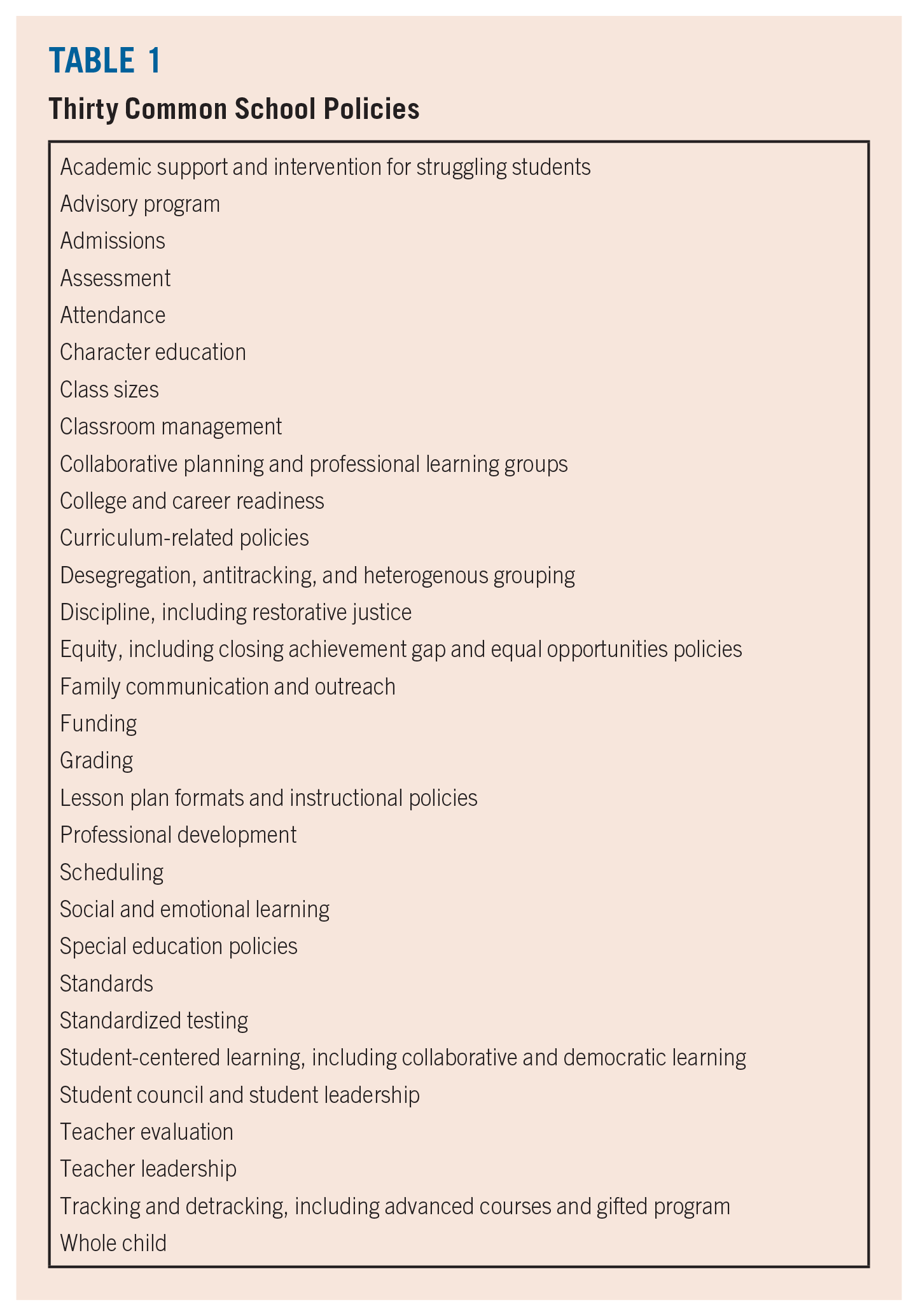
This is usually how I start a policy inquiry group with teachers—something I have been doing in many schools across New York. Many have trouble with both of these questions and the second one in particular. 1 It may be helpful to look at Table 1 for a list of example policies teachers have named as important to their schools. While most teachers can name policies like standardized testing or teacher certification that command national attention—and organizations like the National Association for Music Education (NAfME) seek to keep us informed of what’s happening on Capitol Hill—policy has a way of making itself invisible to us at the school and classroom levels. This is particularly true where we do not perceive our work or our school as particularly distinctive. A teacher facilitating innovative student-led chamber groups as part of a commitment to student-centered learning, for example, or one working in a school focused on mastery-based learning can more readily name these as prominent policies directing their work. On the other hand, I once asked a group of teachers to name policies central to their school, and one teacher protested, “We’re just an ordinary school!” Ordinariness doesn’t mean the absence of policy: It often masks our general acquiescence to what has been chosen for us.
Thirty Common School Policies
Recognizing the role of policies in our work is a crucial first step for connecting to policy in ways that are empowering to us. There’s the time-honored adage, “If you don’t stand for anything, you’ll fall for everything.” Although I’m not sure if I believe in standing stubbornly for the sake of standing, there is an aspect of truth to this when it comes to policy. When teachers choose to connect with larger issues in education through our practices, we further certain policy ideas in schools and our field—we create space for them. Policy researchers Meredith Honig and Thomas Hatch argue that by inviting in or increasing our interaction with certain policies—by bridging to particular policies (to use their term)—schools can strengthen their work by choosing the policy developments that will be most helpful to them. 2 The same is true for teachers.
Bridging can look like explicitly interacting with certain policy initiatives or focus areas that interest us in our schools. An elementary school music teacher I worked with, Jamie, was interested in her school’s focus on social and emotional learning. She was curious about how the school’s vision might connect with her own Orff-inspired teaching and felt certain there were ways to connect the two. In her case, she requested a meeting with several of the school’s instructional leaders to talk through these possibilities. A high school teacher, Brian, was concerned that Latinx students often seemed disengaged from his classroom and teaching and began meeting with a team of colleagues investigating achievement gaps and their root causes. In both cases, Jamie and Brian developed practices that placed their classrooms in dialogue with larger policy initiatives in their schools. By creating new materials, developing performance events, or sharing new ways of teaching or thinking, we make certain policies alive for our classroom and school. By naming the policies our work connects to and joining our work with that of others, we make the work explicit. These actions and approaches, often musical in nature, may shift the nature of certain policies in our schools—reverberating across classrooms and enlarging our own policy roles in the process. 3 This is particularly true in the case of what Honig and Hatch call “early adoption”—when schools and teachers join in the work of a new program or reform at its start and in doing so gain great potential for charting its direction.
Bridging does not always need to happen in our immediate school environment, and sometimes the policy work teachers are interested in connecting to is happening outside our school. There are numerous music education communities that work to impact policy: I am thinking in particular of teacher networks working to develop and transform curriculum with respect to issues of equity, access, or student-centered learning. There are also numerous spaces outside of music education dedicated to furthering thinking and action across a range of education policies. My own teaching and thinking have been heavily influenced by my participation in communities inside and outside of music education working on issues related to urban education and social justice. These spaces have included committees, conferences, workshops, teacher collectives, online forums, and research—places where policy may be debated and imagined and proposed. By being present in this work (see music education researchers Carlos Abril and Brent Gault’s article in this issue for ideas) and by sharing my own practices and perspectives with others, I have shaped the evolution of certain policies in small ways, grounded my practice in certain policies, and furthered the presence of such policies in my school.
Let me state outright that I am speaking about policy as something that is not static—not simply found in rules or laws—and I argue that a policy is best understood as the large collection of responses and contributions that give life to particular policy ideas. Policies evolve constantly and take different forms in different places. Although it is true that there are written policy directives, such as a piece of legislation or a district regulation, there are almost always multiple interpretations and enactments. 4 Many policies are also more informal, embedded in school cultures or in music education as the way things are done. Thus, when we as teachers bridge to particular policies, we impact how that policy is understood locally in our school and our networks and sometimes a wider community. It is also important that we build legitimacy for certain policy ideas in our field that may be more favorable to our work. 5 Music education researchers Carlos Abril and Brent Gault have observed that when teachers pay attention to the ways certain classroom practices relate to broader educational outcomes—like social and emotional learning or achievement across marginalized subgroups—they may find new ways to advocate for their programs. 6 Such policy-making practice, built from the bottom up, serves as a place to stand in the face of other policy demands.
Buffering from Policy
It would be an understatement to say that too often, unexpected policies and their demands arrive at our doors uninvited. Bridging helps us build a strengthened space of practice anchored by particular investments, but it doesn’t stop the storm. In the picture Abbie drew (Figure 1), she depicts a roof engineered with flexibility, smarts, and creativity (“SBOs,” or school-based options, in her drawing is a mechanism teachers can use in New York City to build innovative practices at the school level). We know instinctively as teachers that policy can be redirected or filtered. There are ways to do this with strategy, and there are ways to do this that diminish our standing. The strategic questions are, How will I connect? and How will I refuse?
If you’re like me and many of the music teachers I’ve worked with, there’s a good chance you’ve engaged in what Honig and Hatch call buffering before. “That doesn’t apply to me” or “I do that already” are classic responses to policy demands that many of us have used previously in our work. When pressed to teach numeracy or literacy in music classes as a way of increasing test scores, I will admit I’ve said something about musical notation being a kind of reading or rhythms being a way of teaching fractions (both without much conviction—but it worked).
Slightly more involved are strategies that require making cosmetic changes in our work, largely for show: renaming or realigning certain aspects of our teaching to make them fit the policy demand (e.g., posting a “college- and career-ready standard” on the board or in a curriculum unit plan) or adding a peripheral practice (e.g., programming an isolated piece of music related to the cultural background of some students). In both cases, little in our core practice is changed.
Chances are very few of these buffering strategies are unfamiliar to you. Many of them reflect knee-jerk responses teachers across all subjects develop as a way of resisting change—responses resulting from the overwhelming demands made on our work. The problem is this: Our tendency and ability to evade policy engagement, particularly as teachers in a sometimes marginalized academic subject, threaten to move music educators and music education even more to the margins. Our profession has made a bit of a habit of touting music’s wholesale effectiveness as a solution to various policy concerns, from addressing nearly every twenty-first-century skill imaginable to all kinds of social and emotional needs. Substantive engagement becomes an afterthought regardless of the importance of the concern. 7 When we say we’re doing something just for show, we give up a little of our possibility to engage substantively with what may very well be something we truly care about.
Let me suggest this: Being strategic about policy is a choice of where to engage, not a decision to disengage. Buffering is necessary: It would be impossible to respond substantively to every policy demand, many of which have extremely short life spans (researchers call this “policy churn” 8 ). But it is not the same as disengagement. Bridging and buffering are not opposites, and sometimes they overlap considerably. In the case of the early-adoption strategy, for example, early interaction with new reform initiatives grants teachers an opportunity to reduce undesired impacts on our classrooms—a way of buffering. It is not infrequent for music teachers today to work at the vanguard on assessment policies in their schools or join their school scheduling committees as a way of ensuring their classrooms are not negatively impacted. At its best, such participation is both a strategy for protecting certain aspects of our programs and a strategy for thoughtful change in other areas. My own involvement in my school’s scheduling work has led me to reduce structural barriers to the participation of students with special needs in my music program and has pushed my teaching practices accordingly.
At an individual level, policy strategy invites teachers to develop our awareness of the policies surrounding our work and make deliberate decisions. What are the policies central to your school or wider education environment that you do and do not wish to engage in? How will you connect? How will you refuse?
Building Spaces
Although there is much that individual music teachers might do to engage with policy, there is more we can do with colleagues in our schools and across music classrooms. Together, there is greater potential for shaping the kinds of policies that impact us—and if we do policy with others, we don’t have to do everything ourselves! Here is a start: Convene a few teachers to discuss or examine a policy, either a specific topic that interests you or the idea of education policy in general. You may be surprised to learn who is interested. Maybe meet after school or at a café, bar or someone’s house. Maybe it begins as a committee formed out of a union chapter meeting or a professional learning community or inquiry group open to the entire staff. Maybe it feels like a book club, dedicated at first to reading research teachers bring in, or it carries the air of surreptitious planning—the promise of designing a new way to do something. Because there is something surreptitious about teachers doing policy: It’s not just music teachers who feel left out of policy at times.
In 2013, something shifted for me when at my current school, my colleagues and I questioned a new citywide mandate that each teacher be evaluated by two standardized tests. I was far from the only teacher who would be evaluated in subjects I did not teach, and none of my colleagues relished the prospect of giving such tests any more weight than they already had. After a series of meetings, we refused to comply as an entire staff, outlining our reasons and strategy for refusal in a public editorial online. 9 A year later, after many schools did the same, the state walked back aspects of the requirement and expanded alternatives. This is perhaps a lucky example of teacher and school activism and one whose end result owes itself to many factors. But I tell the story to make this point: Schools are powerful places to talk and think about making policy, with implications that reach beyond our classrooms. It is one thing to bridge and buffer as an individual, in the service of our music programs. It is another to work in concert with colleagues or our school as a whole to create new spaces for policy making that sustain shared values.
Here are a few tips for what it might look like to do this work, which come from years of building policy spaces in a variety of schools:
Take the time as a group to share perspectives and even draw illustrations for how a particular policy issue manifests in the school (like Abbie’s map). Pay attention to differences in people’s understandings and what their implications are for collective action.
Read some research studies or reports. Often these can seem distant or impersonal to teachers, and we need to locate ourselves by asking how our classrooms and schools interact with these larger policy issues.
Gather local data on your school or classrooms either through a review of public documents (e.g., school budgets, test scores, demographics) or through student and teacher interviews (e.g., feelings of belonging, experiences registering for certain classes).
Seek expertise in the form of colleagues, administrators, or guest speakers, and be patient when feeling stuck. But also know that new discoveries about our students and school are more common than you might think.
Imagine alternatives and make plans. Be creative and don’t shy away from the impossible and the ideal. Big ideas, even when they aren’t implemented, still change the way we think.
If you are familiar with teacher inquiry cycles, this may seem familiar. At its heart, this work is a process of curiosity, study, planning, and acting. There are plenty of models for inquiry; I am partial to Kath Murdoch’s, available online. 10
A last note: The starting place doesn’t have to be about music. Music and our classrooms will always find a way in.
Playing to Our Strengths
I have argued throughout that we should think of policy as something that is social: It is something we take part in and take part in with others, whether with colleagues in our schools or larger communities across schools. As long as we treat policy as an administrative rule or a legal fact, we ignore the fact that policy is something made at all levels, in many different places, among many different people. I mentioned earlier that if we work with others, we don’t have to do everything ourselves, and there are many different roles teachers play in policy.
In one of the policy inquiry groups I convened, the teachers there found it revealing to describe policy-making roles for each staff member. Jamie, the first-year music teacher I mentioned earlier, reported she was probably a “policy receiver.” To the extent that she interacted with policy at all, she said, it felt like compliance—a constant pressure to do whatever it was she was supposed to be doing. Clara, a veteran teacher and administrator in the school, reacted with surprise. Calling Jamie a “policy entrepreneur,” she pointed out that Jamie had entirely reshaped the music curriculum and her classroom and displayed a distinctive creative streak: “You teach it so differently.”
Following that realization, we named several dozen staff members in the school using some labels created by policy researchers 11 and generating our own. Almost no one, not even the students, were simply “policy receivers.” Many teachers played multiple roles with respect to different policies. Consider what kind of policy maker you are or might be:
Policy entrepreneur—creating and integrating various policies to support your classroom work
Policy crafter—developing materials, practices, and performances that make certain policies concrete
Policy liaison—bridging work between outside policies and spaces with your school or classroom
Policy enthusiast—advocating for and building investment around a particular policy
Policy researcher—asking questions and researching local contexts that add nuance to policy understandings in your school and networks
Policy framer—selecting and interpreting policies in order to create a vision for others
Policy enforcer— setting expectations and enforcing participation in policies.
These various roles (and there are more!) suggest that we might play to our strengths as individuals and particularly when joining others in collective acts of policy making.
A Social Endeavor
The more we do this work with others, the more weight our perspectives hold in our schools and the more big picture our own thinking becomes with respect to our programs. In my mind, it is a way of speaking practice to policy. It is about taking the kinds of practices that we engage in and locating them explicitly and strategically in the work of policy making. It is also about building a robust sense of practice on the ground, well connected and open in some ways yet that might also be capable of resisting various demands in other ways.
In the same meeting in which Abbie drew Figure 1 as a depiction of policy making, I also drew my own illustration for my school (Figure 2)—not policy as a storm but as an artist’s collective of sorts where a wide range of policy materials are gathered and made sense of individually and collaboratively. I don’t suggest either of our drawings is more true, although I believe there is something useful to be found in both.
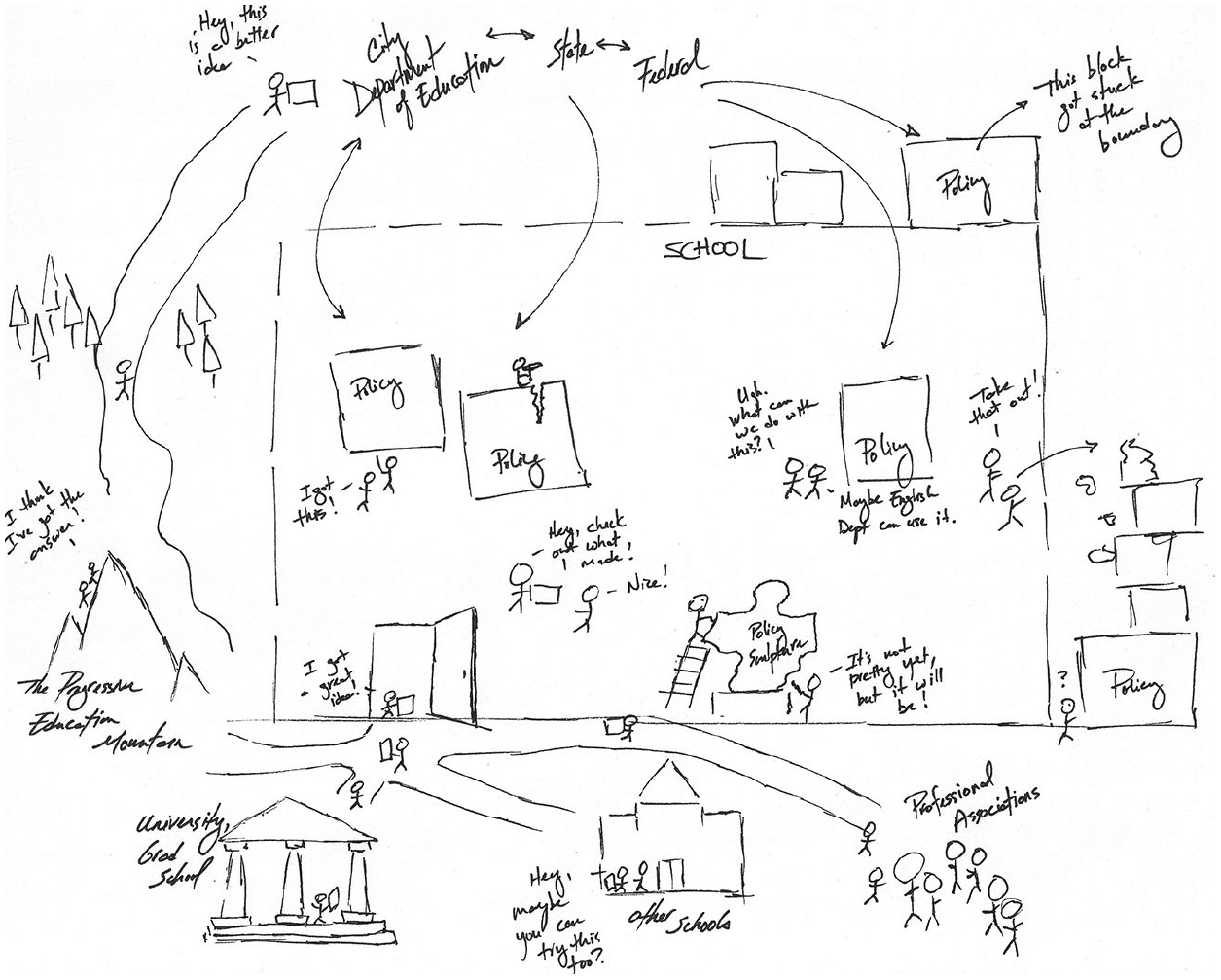
The Author’s Illustration of Policy Making as an Artist’s Collective (among Other Things)
Let me close by sharing that while doing this work alongside many phenomenal teachers, I’ve sometimes found myself feeling stymied or limited in making the changes I hoped to see. I’ve also faced my own reluctance to engage and, if I’m to be truthful, resentment—especially when I confront my own positioning at the margins of schools I’ve worked in. I know firsthand the difficulties of traveling between buildings or of teaching courses at the times colleagues in other subjects meet to plan collaboratively. But working strategically with policy has changed me and my schools. Recognizing that policy is a social endeavor, perhaps the first step, is to bring policy into our conversations with others. Our colleagues need to hear more from us.
