







Abstract
Although bereavement is an experience emerging adults of every culture go through, there is limited cross-cultural research on coping following bereavement. Therefore, this study aimed to explore similarities and differences between European American and Japanese emerging adults regarding their experiences with coping strategies following a death, with consideration of cultural rituals related to bereavement. Open-ended 30- to 50-min virtual interviews were conducted among 7 European American and 7 Japanese adults between the ages of 20–30 years old. Through qualitative analysis researchers found that for both cultures, reported characteristics of coping strategies typically aligned with conceptions of emotion engagement and emotion disengagement coping, as defined in Tobin’s Coping Strategies Inventory (2001). Both cultures reported similar coping strategies, although European Americans reported a greater variety of activities within the coping categories. Some coping behaviors could not be categorized under either coping strategy, implying a need for more research and conceptual refinement.
Bereavement refers to a situation where individuals have lost a person significant to them through death (Stroebe et al., 2008) and is a common experience in emerging adulthood (Balk, 2011; Varga, 2016). The associated grief often registers a loss of self and an important relationship, triggering a process of complex emotions as one engages in self-evaluation and establishes new ways to remain connected and in a relationship with the important person who was lost (Cholbi, 2019, 2022). Many studies have explored the negative physical health and psychological impacts that result from the death of a family member or close friend (Gilmer et al., 2012; Marks et al., 2007), however, the process of grieving also tends to result in self-knowledge and growth (Cholbi, 2019). Coping responses, characterized as thoughts and behaviors used to manage stressful situations, may vary among individuals and between cultures (Lee et al., 2020; Leitenberg et al., 2004; Porter & Claridge, 2021; Stroebe et al., 2008). Research on coping processes during bereavement is limited, especially among emerging adults who may be particularly engaged in identity exploration, and therefore, may respond to death differently than individuals in other developmental stages (Jones & Martini, 2023).
Given the unique multicultural nature of the United States population, it is important for professionals working with grieving individuals to understand the potential cultural differences in conceptions of death and how they may shape behaviors and emotions throughout the process of bereavement. When cultural differences are examined, however, Asian cultures are typically generalized in a way that mainly reflects Chinese values and practices, and Japanese populations are much less frequently considered (Lynch & Hanson, 2011). Therefore, this study aims to explore how Japanese and European American emerging adults compare with respect to their experiences of grief and the coping strategies they implement after a significant loss.
Cultural Differences in the Conceptualization of Death and Grief
European American Perspectives
The attempt to understand resolution of grief has been a central issue for theorists in Western literature (Stroebe et al., 2008). Social expectations around grief are influenced by the Western cultural values of rationality and equality. Rationality emphasizes the importance of maintaining functioning so as to promote productivity. For example, grief following the death of a close family member is socially acceptable whereas grief related to other losses is devalued, which ultimately serves to minimize the disruption to individual functioning and loss of productivity. Furthermore, because of an emphasis on “resilience,” ongoing experiences of grief are often ignored or discouraged, and instead a bereaved individual’s ability to return to normal is an indicator of healthy adjustment (Cholbi, 2019). Equality is reflected in the view that everyone should be treated the same, without exception. For example, a common belief is that the duration of grief should be similar for all members of society, and that grief will be resolved after symbolic rituals (e.g., a funeral) have been completed. This Western value is evident specifically among European Americans, where the culture is organized to have work- or goal-oriented views and to promote a positive view of themselves (Kitayama et al., 1997; Lynch & Hanson, 2011), which may discourage ongoing public expressions of grief.
Regarding the religious component of bereavement processes, Stroebe et al. (2008) note that many of the measurements and conceptualizations of grief examine whether individuals actively seek help from God, blame God, or seek support from members of a religious community. Many studies in the past (as cited in Stroebe et al., 2008) also noted that church attendance and belief in the afterlife are commonly reported among those coping with a loss. Considering the prevalence of Christianity in the United States, it is common for bereaved individuals to associate the meaning of a death with God’s will. For example, a bereaved person may explain a death by believing their family member is better off in God’s care.
Japanese Perspectives
In Japan, ancestor worship has been a central belief and basis of death rituals since the eighth century (Klass et al., 1996). Ancestor worship is based on kinship, where people believe that the role they have in their current family is related to what their ancestors did in the past. In Japanese culture, the ideal outcome is for the deceased person to transform into a god (kami), but this is only possible once the karma of past generations has been eliminated. Karma refers to “pay-back” or debt that results from the transgressions of one’s ancestors. The alternative is rebirth, in which case the karma is passed down to the next generation. Therefore, the current status a family holds in society is due to the behaviors of their ancestors, so the living relatives are expected to behave well to maintain and honor that status.
Unlike the one-time event of a funeral in most Western cultures, in Japanese culture, there are several rituals practiced honoring deceased relatives that occur on an ongoing basis (Allison, 2020; Klass et al., 1996). A wake and funeral occur immediately following a death, and additional rituals occur 7 days after the death (to recognize transformation to a god) and 49 days after the death (to recognize rebirth). Another ritual occurs annually during the season of O Bon in late summer when the spirits of deceased ancestors are believed to return to their graves and their family’s Butsudan altars. To call their ancestors’ spirits home, families traditionally light candles or lanterns in their homes, and leave offerings at the altars. In addition, Japanese give offerings such as memorial and food to the altars as a practice of concern for the dead. In Japanese culture, death is heavily tied to spirits, families, kinship, and ancestor worship, as illustrated by the death rituals and the belief that the status of the family is based on connectedness with the ancestors.
To summarize, Western culture focuses on equality and productivity which results in devaluing individual perceptions of grief, holding ceremonies as a way to equally implement the recognition of grief, as well as seeking support from God and religious communities due to broadly held Christian traditions (Stroebe et al., 2008). On the other hand, Japanese culture values ancestor worship, which is reflected in views about the deceased transforming into a kami, as well as continued rituals following death (Klass et al., 1996). Though cultural beliefs and practices shape experiences with bereavement, there are other factors as well that account for intracultural variation.
Consequences of Loss
Relationship to the Deceased
Existing research suggests adverse psychological outcomes are common among individuals who experience a loss through death, and the severity of those outcomes are related to the degree of closeness to the deceased person (Manoogian et al., 2018; Marks et al., 2007; Mash et al., 2013). Cholbi (2022) argues that one may feel sad or mourn any death, but will on truly grieve when the loss is of someone with whom one’s identity is intertwined, and therefore, the death registers a sense of loss of self and of attachment. The grief process is difficult as it requires examination of self through the examination of the relationship one had with the deceased.
In a quantitative study, young adults who experienced a sibling’s death reported higher levels of physical issues, complicated grief, and mild to severe depression and lower self-worth compared to those who lost a close friend or did not experience a death (Mash et al., 2013). Similar outcomes were reported in studies that focus on intergenerational losses. A longitudinal study of American adults found the loss of a father was associated with increased depressive symptoms, especially for men, and loss of both parents was associated with a significant decrease in reports of positive affect, especially for women (Marks et al., 2007). In addition, women who lost one or both parents before or during the study reported greater declines in global perceptions of happiness compared to women whose parents remained alive.
Similarly, emerging adults who experienced the death of a grandparent reported feelings of sadness, and described their experience as rough, painful, and devastating (Manoogian et al., 2018). When participants had closer relationships with their grandparents, they reported deep emotional responses whereas emotionally distant participants were less likely to experience intense emotional responses, but did report guilt for not trying hard enough to build relationships with their grandparents. Another study that included college student participants who experienced a broad range of losses (e.g., parents, grandparents, uncles, aunts, close friends, family friends, cousins, siblings, in-laws, and children), found that participants who were close to and interacted often with the deceased person reported more images, thoughts, and grief related to the deceased person than others who did not report being close and having many interactions (Liew & Servaty-Seib, 2018).
Overall, previous research shows that people who have lost siblings, parents, or grandparents tend to experience negative psychological outcomes (Liew & Servaty-Seib, 2018; Manoogian et al., 2018; Marks et al., 2007; Mash et al., 2013) and individuals who had close relationships with the deceased tend to report more severe psychological effects (Liew & Servaty-Seib, 2018; Manoogian et al., 2018; Mash et al., 2013).
Grief and Loss in Emerging Adulthood
When examining outcomes of bereaved emerging adults it is important to consider developmental context. Emerging adults are often included in adult samples without examining their unique characteristics and developmental changes (Liew & Servaty-Seib, 2018). Emerging adults are engaged in a transactional process as they move from adolescence to adulthood where they explore their identities related to love, work, and worldviews, often separating themselves from their families (Arnett, 2000). Grieving emerging adult college students also face obstacles related to academic and emotional changes, in addition to the developmental processes of identity exploration and interpersonal relationship formation. Emerging adults who experience the death of a parent report needing to put their lives on hold, and often delay typical developmental milestones (Porter & Claridge, 2021). The intersection of developmental processes and transitions with bereavement experiences places emerging adults at heightened risk of complicated grief outcomes (Mash et al., 2013; Porter & Claridge, 2021).
European American Experiences
A mixed-method study involving 950 college students found there were several behavioral changes among participants after experiencing a loss (Cupit et al., 2016). Women reported greater perceived negative outcomes in academic performances compared to men, and those who reported high closeness to the deceased were more likely to report changes in study habits. Another mixed-method study found that emerging adults who experienced the death of a grandparent experienced a cognitive shift in themselves, such as increased self-awareness, renewed understanding as to what family means, reconsideration of how they fit into their family, recognition of their own parents’ grief, and more motivation to do well in their life in general (Manoogian et al., 2018).
Emerging adults experience losses resulting from various causes of death which may also contribute to their grief response. Emerging adults may experience deaths of friends and family due to accidents, medical issues, suicide, or homicide (Mash et al., 2013). One study found the most common cause of death among a sample of bereaved college students was illness, but others included accidents, suicide, old age, homicide, surgery complications, and military casualties (Cupit et al., 2016). When deaths are perceived as either unexpected or off-time, they are more difficult to accept (Manoogian et al., 2018; Porter & Claridge, 2021).
In sum, existing research both highlights the uniqueness of the bereavement experiences of emerging adults from a theoretical standpoint (Liew & Servaty-Seib, 2018), as well as demonstrates how emerging adults’ bereavement intersects with their particular developmental context (Cupit et al., 2016, 2022; Mash et al., 2013; Porter & Claridge, 2021). Emerging adults also experience bereavement due to various causes of death, many of which are unexpected or off-time, which relates to intensity of psychological experiences (Cupit et al., 2016; Manoogian et al., 2018). Thus, it is important for grief-related research to recognize the multiple layers of circumstances emerging adults encounter alongside the psychological and behavioral shifts that may occur during the bereavement process.
Japanese Experiences
The literature on grief experiences among Japanese individuals is limited, and no studies to our knowledge have examined emerging adults’ experiences specifically. One cross-sectional quantitative study (Miyabayashi & Yasuda, 2007) examined experiences of 215 bereaved Japanese adults (29–91 years old). Participants experiencing unexpected deaths (e.g., suicide) reported poorer general health, more social dysfunction, and more depression than those who expected the death due to a prolonged illness. Another cross-sectional study examined ruminative response styles among Japanese parents who lost their children (Ito et al., 2003). The study found that the death of a child was associated with rumination for some parents, which is a risk factor for depression after bereavement. In sum, Japanese grieving adults reported psychological issues similar to studies targeting people in Western countries (Ito et al., 2003; Miyabayashi & Yasuda, 2007), however more research is needed.
Cross-Cultural Comparisons of Coping Strategies
Coping includes behaviors and patterns of thought resulting from efforts to deal with stressful situations and negative emotions, and is dependent on the context of the situation (Leitenberg et al., 2004; Tobin, 2001). Previous literature has examined the relationship between stressful experiences in general and coping strategies among European Americans. Leitenberg et al. (2004) studied White college students' adverse experiences in childhood (ACEs) and their adult coping strategies. They utilized the Coping Strategies Inventory (Tobin et al., 1984) which measures engagement coping and disengagement coping. According to Tobin (2001), emotion disengagement reflects strategies in which individuals try to disengage themselves from the interaction with the person or environment causing them stress, and emotion engagement reflects strategies in which individuals attempt to manage the situation or personal interaction that is stressful. Controlling for socioeconomic status and age, the study found that compared to individuals with lower ACE scores, those who had higher ACE scores tended to use disengagement/avoidant coping to respond to new stressors when they became college students (Leitenberg et al., 2004). Another study of White emerging adults found that participants who reported more self-efficacy, resilience, and social support-seeking behaviors more frequently implemented problem solving coping strategies (Li et al., 2018). The results of these studies suggest that even though people may experience similar stressors or stress in general, the type of coping strategies used varies across individuals.
Studies examining coping following bereavement among college students similarly find that use of more avoidant strategies is associated with more difficulties in coping (Murrell et al., 2018). Interpretations of the loss may also contribute to coping outcomes. For example, one study found that when individuals interpreted the loss as a punishment from God, they tended to report higher levels of depressed mood and interpersonal loneliness (Stein et al., 2009). On the other hand, seeking spiritual support following a loss was identified as a helpful strategy among another sample of emerging adults (Collison et al., 2016).
Although coping strategies among European Americans are well-researched, little to no research exists that examines coping strategies among Japanese samples (Leitenberg et al., 2004; Li et al., 2018; Taku et al., 2008). Some of the literature on grief and loss outcomes within Japanese culture focuses on posttraumatic growth (PTG), rather than coping skills. Posttraumatic growth is defined as “positive psychological changes experienced as a result of the struggle with highly challenging life circumstances” (Taku et al., 2008, p. 428). In a quantitative study of Japanese undergraduate students who reported bereavement as the most traumatic/stressful event that happened in their lives, PTG resulted from deliberate ruminative thinking (as opposed to intrusive rumination) immediately following bereavement (Taku et al., 2008), as well as from some behaviors such as “putting their palms together” in front of the deceased person’s picture, going to their parent’s grave, and having fun with friends (Hirooka et al., 2017). Though these behaviors were not classified as coping, they are conceptually similar to coping behaviors discussed in the literature on European Americans.
Other studies have pointed to cultural practices following bereavement as serving a similar role to coping strategies. For example, Ito et al. (2003) found that bereavement rituals may mitigate some of the negative effects of grief among parents who lost a child. During the rituals occuring in the first 49 days following a death, bereaved relatives have the opportunity to share memories, cry, comfort each other, and connect with each other (Klass et al., 1996). These culturally embedded rituals that aid in the processing of grieving may serve as a mechanism similar to coping strategies. In sum, even though Japanese studies have examined psychological changes after a loss (Taku et al., 2008), the question remains whether coping strategies that are commonly applied in the literature among European American samples are present among Japanese individuals, as well as if the same patterns of coping strategies will be displayed in response to stressors specific to bereavement (Leitenberg et al., 2004; Li et al., 2018).
Rationale for the Study
Loss is associated with negative psychological outcomes among emerging adults, but more research is needed to examine coping strategies within this specific population (Cupit et al., 2016; Liew & Servaty-Seib, 2018; Manoogian et al., 2018). Views on death and afterlife differ between European American and Japanese cultures, as seeking help from God and minimization of individual grief are common in European American culture, whereas ancestor worship and continuous rituals practiced after death are common in Japanese culture (Klass et al., 1996; Stroebe et al., 2008). Therefore, this study addressed this gap in the literature by exploring the following research question: What are the similarities and differences between European American and Japanese emerging adults regarding their experiences with coping strategies following the death of someone close to them? Given the complexity of grief, bereavement, and coping processes (Cholbi, 2019) as well as the scarcity of research exploring emerging adults’ experiences with grief, and even less focusing specifically on the Japanese members of this population, qualitative methods are appropriate for this line of inquiry. Specifically, this study employed a grounded theory approach whereby themes emerged from participants’ narratives rather than from an a priori framework (Glaser & Strauss, 1967).
Methods
Sample
Participant Demographics.
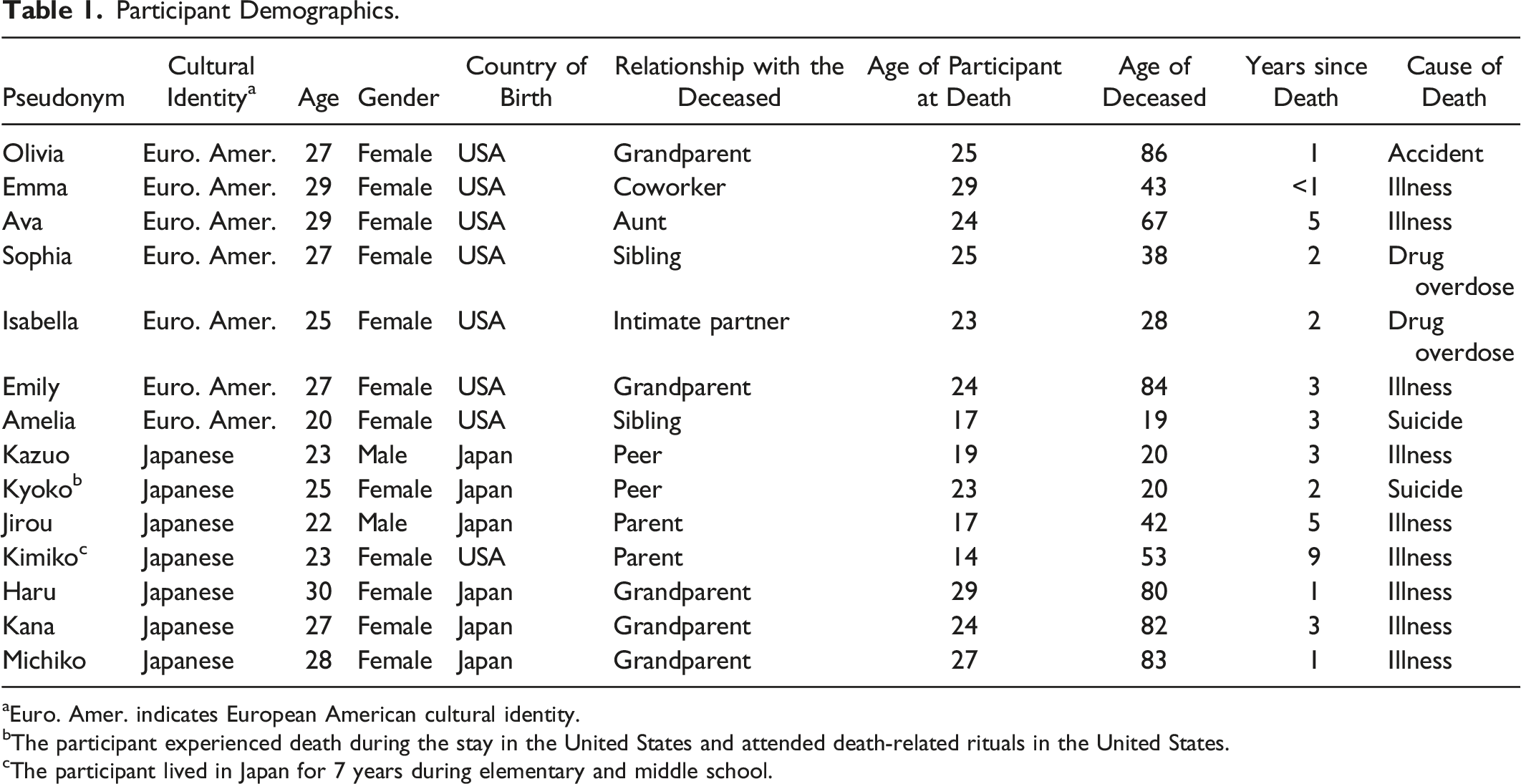
aEuro. Amer. indicates European American cultural identity.
bThe participant experienced death during the stay in the United States and attended death-related rituals in the United States.
cThe participant lived in Japan for 7 years during elementary and middle school.
Procedures
Convenience sampling methods were employed by distributing requests for participation through social media as well as via email through the international office of a mid-size regional university in the Pacific Northwest. Announcements were posted in private social media groups in which most of the members shared interests with the researcher (e.g., Child Life Connection: Student Forum, Aspiring Child Life, Vivid Navigation) but did not know the researcher personally. The 30- to 50-min interviews were conducted by the first author and took place via Skype or Zoom, based on participants’ preference. Interviews with European American participants were conducted in English, and interviews with Japanese participants were conducted in Japanese. Informed consent was obtained verbally, and every effort was made to protect confidentiality, including deletion of the video and audio recordings after transcription. Human subjects approval was obtained from the researchers’ institution prior to recruitment.
Interview Protocol
The interview protocol was translated into Japanese by the first author and reviewed by another bilingual (Japanese-English) individual to make edits for clarification and ensure the accuracy of the content after translation. The researcher began each interview by verbally reviewing informed consent documents and asking if participants agreed to record the interview. Next, participants were asked demographic questions, questions regarding the deceased person, and seven-open ended questions, including questions such as “What are some things (if any) you do in order to process your current feelings about the loss?” and “Is there anything you currently do to remember the person who died or maintain a connection to them?” The interviewer asked follow-up questions as needed, and participants were reminded of the voluntary nature of the study during the interview, particularly when they appeared distressed or emotional. Resources for support with mental health were provided at the end of the interview.
Analytic Strategy
Participants were recruited and interviewed until the novel information gained from each additional interview was negligible. Once the data were collected, the first author (a native Japanese speaker) transcribed the interviews and translated the Japanese transcription into English using DeepL translator before starting analysis. To ensure the accuracy of transcription and translation from Japanese to English, the first author reviewed the entire translated document and made any necessary modifications. Then the second author (native English speaker) reviewed the translations and in consultation with the first author made additional edits to improve clarity. English transcripts were reviewed and edited by an undergraduate assistant (native English speaker). Participants were offered the opportunity to review transcripts to ensure accuracy, though none provided feedback.
Analysis of the transcribed interviews was informed by a grounded theory approach, where theory emerges from the collected data rather than existing literature or theory (Glaser & Strauss, 1967). In a grounded theory approach, it is important to avoid imposing existing theory in the analysis process, and instead researchers should allow new themes to come out of participants’ narratives. The coding process was divided into four phases and was conducted by the first two authors. In phase one, each conducted multiple readings to explore possible patterns within the data such as coping, rituals, behaviors, and cultural differences. Initial impressions and notes were discussed in multiple meetings. For phase two, the researchers drew upon their initial impressions to develop a preliminary coding system (Berg, 2007) and then began coding the data in Dedoose. In this third phase, the researchers randomly picked two transcriptions from each culture and coded them individually. The researchers met to discuss agreements/disagreements on the meaning of codes and revisions to the coding system. After the coding system was revised and a shared understanding of the codes was reached, the researchers coded the remaining transcripts and continued to meet to discuss possible revisions or additions to the codes.
For the final phase, researchers continued to meet to check for consistency based on the finalized coding scheme and noted patterns and themes in the data. These discussions informed the axial coding process in which codes were categorized and their properties defined. As categories of coping strategies began to emerge, the researchers agreed to implement an existing framework of emotion engagement/disengagement (Leitenberg et al., 2004; Tobin, 2001). The researchers used the categories to make comparisons and draw conclusions about patterns (Dunne, 2011).
Researcher Identities
The potential for the researchers’ backgrounds and motivations for engaging in research on this topic to influence the findings were also acknowledged as the analysis was conducted. The lead author is an emerging adult holding a masters in family and child life, and currently residing in Japan. She identifies as Japanese, and lost her grandmother during early emerging adulthood herself. The second author is middle-aged, resides in the United States, and is a university professor and mother of two young children. Her racial identity is White and her ethnic background is European American and fourth-generation Mexican American. She has experienced the deaths of several family members (mostly grandparents), one of which occurred in emerging adulthood. The third author is a middle-aged professor, marriage and family therapist, and mother to two young children. She identifies as European American, and although she has experienced the death of several family members, none were during her emerging adulthood. Researchers strove to reduce bias by being mindful of how their cultural identities and personal experiences with bereavement may limit their understanding, and employed investigator triangulation by seeking clarification or confirmation from each other throughout the analysis process (Carter et al., 2014.).
Findings
Coping and Cultural Identity
The researchers examined patterns of coping strategies and within cultures, and sought to identify similarities and differences. Based on Tobin’s Coping Strategies Inventory (2001), researchers divided the coping-related codes into two categories: emotion disengagement and emotion engagement. Emotion engagement strategies were discussed by all of the participants, whereas emotion disengagement coping strategies were shared by five of seven European Americans and four of seven Japanese participants.
Emotion Disengagement
Disengagement coping is defined as distancing oneself from one’s feelings and from others, and blaming oneself for what has happened (Tobin, 2001). The coping behaviors categorized as emotion disengagement included guilt, avoidance, isolation, pleasure-seeking, and self-harm. Most of the disengagement strategies participants exhibited were associated with an off-time death, for both European American and Japanese participants.
Cultural Similarities
Avoidance was observed among four European American and two Japanese participants. Participants reported avoiding or suppressing emotions, experiences, or memories that were distressing. For instance, Sophia unexpectedly lost her brother due to a drug overdose two years ago. She explained that she still feels that the death is not real sometimes and fears it will “hit [her] like a ton of bricks” one day. A Japanese participant, Haru, lost her grandmother due to illness a year ago. She did not know her grandmother’s illness was serious until after the death occurred. At the time of the loss, Haru was pregnant and lived in the United States. She describes how she avoided looking at pictures or personal items that reminded her of her grandmother, and instead focused on her pregnancy. Haru reported, “I tried to avoid looking at things that my grandmother made, like things that she sewed for me. Yeah. I tried not to think about it as much as possible.”
Cultural Differences
Two Japanese participants reported guilt while none of the European American participants reported guilt. Both participants blamed themselves for the death. Kyoko lost a friend to suicide during her stay in the United States, two years ago. During the interview, Kyoko told the interviewer that the friend confessed romantic feelings for her, but she told him she wanted to stay friends. She wondered if there was a connection between his confession and his suicide, or if other factors were at play: I wondered if he didn’t have enough support from the people around him. He was also worried about his family. I don’t know, I don’t know. I just don’t know which one it was. If I could ask him, “Why did you do that?” If I could ask him, I would. I just have to say I’m sorry. I’m sorry. I wish I could have been there for him, though.
Kimiko lost her mother when she was 14 years old, due to illness. She was 23 years old at the time of the interview. Recalling changes in her feelings, she told the interviewer: I was very sad right after the loss. I was very rebellious, so I thought that I might have caused her to get sick by giving her a lot of stress, and I blamed myself. I was very rebellious. Gradually, instead of blaming myself, I came to appreciate my mother more and more, thanking her for raising me and teaching me all these things.
Other Circumstances
There were two participants who reported disengagement strategies that were not present in any other participants’ narratives. One Japanese participant, Jirou, whose father died of cancer when he was in high school, reported pleasure-seeking as a coping strategy to avoid thinking about the loss. He shared that sometimes he escaped from reality by being childish or seeking sexual pleasure. Amelia was 17 when she lost her sister due to suicide. She reported self-harm and isolation as coping strategies, when she moved away from home to start her first semester of college, around three years prior to the interview.
There was also a pattern between support from family and friends and the reported coping strategies. Of the nine participants who reported any emotion disengagement coping, five expressed a lack of support or discouragement of expression of emotions from friends or family. Conversely, most of the remaining five participants who only reported engagement coping discussed support from family and friends, including having open conversations.
Emotion Engagement
Emotion engagement coping was defined as reflecting and expressing feelings through open communication with others, increasing social interaction, and recognizing emotional reactions to stress (Tobin, 2001). In this study, coping strategies in which participants confronted the death and sought to actively process their feelings were coded as emotion engagement, and included crying, finding comfort in afterlife beliefs, keeping items that reminded the participant of the deceased person, finding acceptance, looking back at photos/videos/messages, staying positive, and engaging in prayer. All participants reported at least one form of emotion engagement.
Cultural Similarities
Connecting to memories of the deceased person through a symbolic item (e.g. teddy bear, lip stick, palmistry, etc.) and afterlife beliefs were common emotion engagement strategies reported by both European American and Japanese participants. Acceptance of the death, staying positive, and crying were commonly reported from both cultural groups as well.
Kana, a Japanese participant, reported one example of connection-seeking through a symbolic item. She lost her grandfather three years ago due to illness. She was living in Japan at the time and was involved in taking care of her grandfather at the hospital during the last several months of his life. When Kana was asked what she did to process her emotions, she answered, “There is a line in the palmistry called the mystic cross line, and when my grandfather passed away, it was very clearly crossed, and it looked like he was protecting me.” Sophia, whose brother died from suicide, explained that she and her family looked for signs in nature that he was still with them, such as a butterfly that hovered around her niece, or a red cardinal representing a visit from a loved one.
Michiko lost her grandfather due to illness about a year ago. Like Haru, she was pregnant at the time of his death. She found comfort in her beliefs that her grandfather could still connect with her baby: “Sometimes I see my baby smiling at nothing, or waving hands like this, and I wonder if my grandpa is still here. I changed my mind and started to believe that. . . that even if he is gone, he can still see us and the baby.”
Cultural Differences
Japanese participants more frequently attributed meaning to the death and reported looking back at messages/videos/photos compared to European American participants. Some examples of how participants attributed meaning to death include beliefs about the deceased leaving a final message, the timing of the death leading to fortunate outcomes, and the death inspiring new interests. There was one Japanese participant who reported speaking to the deceased person at their gravesite. Kana reported attributing meaning to the death of her grandfather. She explained that she considered taking a leave of absence from school due to her grandfather’s hospitalization, but the grandfather ended up passing away sooner than expected. Kana’s grandmother told her that the timing of the death of the grandfather, which resulted in Kana not needing to take a leave of absence from school, was a sign that Kana should be job hunting and find a job at that time. The grandmother’s story motivated her to pursue her career interests and start working.
European American participants reported more prayer, mindfulness, and journaling/writing letters compared to Japanese participants. When asked what activities Isabella did to process her feelings, she answered: Probably about a month or so after he died, I kind of wrote out everything I had been thinking and questioning. Essentially, being like if I were able to ask him all those things, I kind of wrote down everything that I was struggling with, especially the things that I knew that I was never really going to get answers to because so much of it was a shock and was really confusing.
Talking with others was also slightly more common among European Americans, with five European American and three Japanese participants discussing this strategy. There were a greater variety of coping strategies reported among European Americans, such as seeking comfort from pets, being outdoors, and expressive arts. Emma, who had lost her coworker sought comfort from her dog, and Olivia who lost her grandmother described going to the park or outside to just walk, pray, or think was an important way for her to process emotions. In total, there were six coping strategies described by European American participants that were not present among any Japanese participants, suggesting a more uniform set of coping strategies among Japanese participants.
Mixed Coping Strategies
Some participants reported coping behaviors that reflected both emotion disengagement and emotion engagement simultaneously. Amelia lost her sister and went to a new school. When asked how she processed her emotions, she indicated that when listening to music she experienced both emotion engagement and disengagement. She explained that engaging her emotions through music “would sometimes trigger me to go into isolation and self-harm.” Kyoko discussed she could not bring herself to delete messages from and pictures with her friend who died by suicide. However, she explained that she avoids looking at them because she wants to believe he is in heaven and tries not to be sad. Basically, I try not to think about sad things too much. But there are some things that I can’t erase. I don’t block Snapchat or anything like that, and I still keep Facebook. Because I can see messages and such. . . I have photos, and I cherish them.
For both participants, one strategy seemed to produce both emotion engagement and disengagement, which was unique to these two participants. For other participants who reported both emotion engagement and disengagement coping, the behaviors or strategies occurred in different contexts or at different times.
Bereavement Rituals
Bereavement rituals are short or long-term culturally-embedded activities that support individuals within that culture to cope with loss (Klass et al., 1996; Stroebe et al., 2008). Bereavement rituals were examined as a subset of coping strategies when addressing cultural similarities and differences. Researchers divided rituals into immediate rituals and ongoing rituals. Immediate rituals were defined as events/ceremonies that took place right after the death occurred. Ongoing rituals were defined as events/actions/behaviors related to religious beliefs that occurred in the months/years after the immediate rituals, or that happen on the same date every year (e.g., anniversary of the death or the deceased’s birthday). Researchers analyzed similarities and differences between each culture, for both immediate and ongoing rituals related to the death.
Prevalence
All but one European American participant and one Japanese participant attended some kind of funeral and/or ceremony for immediate rituals after the death. One Japanese participant was absent from her grandmother’s funeral because she was living in the United States, and her family believed that attending a funeral while pregnant could harm her baby. Traditions related to the funeral or ceremony varied slightly between cultures. Attending a wake was common for Japanese participants while eulogies, burials, and obituaries were discussed by European American participants only.
Similarities and Differences
Both Japanese and European American participants shared about annual remembrance rituals. Examples included celebrating the deceased’s birthday or the day they passed away by making food, holding events, or buying what the deceased liked.
Attending a wake was the most common immediate ritual reported among Japanese participants. Receiving a monetary gift was reported by one Japanese participant, which was unique to Japanese participants. Jirou noted that his friend offered a monetary gift when his father passed away to show support. For ongoing rituals, ringing a bell, O Bon, and offering incense/food to the Butsudan altar were unique to Japanese participants. For ongoing rituals, continuing holiday traditions (Christmas and Thanksgiving) and praying the rosary were unique to European American participants.
Michiko explained the ongoing rituals after her grandfather’s death. The “ding-ding thing” is the Orin which is the bell that is set in front of the Butsudan altar: Well, the family bought a teddy bear to symbolize my grandfather. It’s in my parents’ room now, and in front of that, you know the thing that goes ding-ding? There’s a ding-ding thing in front of it….So whenever I visit them, I go in front of it and tell Grandpa I am here, talk to him, and ring the ding-ding thing.
Ava explained how her family has a tradition on Christmas of recognizing family members who have passed away by hanging their stockings in a separate location from everyone else’s. She explained her deceased aunt’s stocking is now included in this tradition: “...we kind of pin them up as like, ‘hey, we’re remembering my grandparents’ and so then we added my aunt the last five years by putting hers pinned on the wall.”
Discussion
Coping Strategies Used Among European American and Japanese Emerging Adults
European American participants reported a greater variety of coping strategies than Japanese participants. Japanese participants reporting less variation among coping strategies could be due to the Asian cultural view of valuing connectedness among individuals within relationships (Kitayama et al., 1997). The Japanese cultural emphasis on interdependence is demonstrated by fostering connection through role obligation (Kitayama et al., 1997). By implementing similar coping strategies, the surrounding community is more easily able to recognize the behaviors of the bereaved person as a symbol of “grief” or that they are “in the midst of processing emotions,” which facilitates connection and interdependence in the community. These findings may contribute to existing theories on collectivism and coping such as the cultural transactional theory of stress and coping (Chun et al., 2006) or the sociocultural model of stress-coping-adaptation (Aldwin, 2007).
In addition, all participants expressed emotion engagement coping strategies, even though some of them also reported emotion disengagement coping strategies. Two Japanese women were the only participants to report guilt as one of their emotion disengagement coping strategies, which may reflect the cultural tendency of self-criticism. When asked to evaluate themselves, Japanese people tend to explain efforts and failure, whereas European Americans tend to explain their contributions and successes (Kitayama et al., 1997). The two participants who expressed guilt tended to emphasize their past behaviors towards the deceased person, which could be related to unconsciously criticizing their behaviors and self-evaluating that they could have made more effort. However, previous literature has also found guilt and self-criticism among bereaved emerging adults in the United States (Manoogian et al., 2018; Porter & Claridge, 2021), and self-evaluation is a common part of grieving (Cholbi, 2019), so this experience is likely not limited to members of Japanese culture.
In addition to emotion engagement and disengagement, two participants reported a mixed approach where a single behavior was engaging and disengaging simultaneously. The result of having mixed coping strategies contradicts the previous literature and suggests that there may be some coping-related behaviors that are not readily categorized as engagement or disengagement (Leitenberg et al., 2004; Li et al., 2018).
In sum, results of this study suggest the concepts of emotion engagement and disengagement can be applied to both European American and Japanese bereaving emerging adults. On the other hand, there was more diversity in reported activities that served as coping strategies among European American participants, whereas there was less diversity among Japanese participants. This discrepancy may result from cultural differences, and in particular, the greater emphasis on interdependence in Japanese culture (Kitayama et al., 1997).
Cultural Views and Coping Strategies
Participants from both cultures emphasized efforts to continue their relationship with the deceased (Cholbi, 2019) and reported emotion engagement coping strategies such as keeping items that reminded them of the deceased person and relying on afterlife beliefs. According to previous literature, one of the most common coping strategies used in Western culture following a death is related to afterlife beliefs (Stroebe et al., 2008). Moreover, ongoing rituals following a death are commonly embedded in Japanese culture (Klass et al., 1996), which can be connected to the reason why these participants had items that represented a connection to the deceased person (e.g., palmistry, teddy bear at the Butsudan altar). Considering that personal expressions of grief are often devalued within Western cultures (Stroebe et al., 2008), having an item that reminds the participants of the deceased person may have been a way for European American participants to process grief privately and without interrupting their role in society. Attributing meaning to the death was commonly seen only for Japanese participants, which may reflect cultural beliefs related to ancestor worship. A common belief is that ancestors are trying to protect the living and the behaviors of the ancestors affect the living (Klass et al., 1996).
Cultural Similarities/Differences in Bereavement Rituals
Comparing and contrasting the immediate rituals participants reported, attending a wake was common for Japanese participants, while eulogies and obituaries were unique to European American participants. For the ongoing rituals, ringing a bell, the O Bon festival, and burning incense or offering food to the Butsudan altar were reported by Japanese participants. This reflects the cultural practice of having ongoing rituals, especially O Bon, and continuous remembrance by making offerings to the Butsudan altar (Allison, 2020; Klass et al., 1996). Not all of the Japanese participants reported ongoing rituals such as making offerings, which could be due to some participants’ exposure to other cultures (e.g. by living in the United States), the country in which the death occurred, their developmental context as emerging adults, or changes in Japanese culture.
Among European American participants, praying the rosary was reported, reflecting cultural practices of seeking support from a religious community or God (Stroebe et al., 2008). Continuing traditions was also unique among European Americans, which could be a way for participants to recognize the death and their grief while also maintaining continuity, since values of equality are reflected in the culture, and grief is expected to be resolved after the immediate ritual (Stroebe et al., 2008). Contrary to past research, annual remembrance was reported by both European American and Japanese participants as ongoing rituals. Based on the literature, it was expected that only the Japanese participants would report ongoing rituals after the death (Klass et al., 1996); however, findings contradicted the expectation that rituals among European American participants would reflect Western culture’s emphasis on equality and the resolution of grief after one immediate ceremony (Stroebe et al., 2008).
Some of the similarities in grief experiences across cultures may be related to the shared developmental period of emerging adulthood. Consistent with previous literature, emerging adults in this study experienced losses from a variety of causes, and described challenges in coping especially related to off-time losses (Manoogian et al., 2018). With respect to support from family and friends, a lack of social support or discouragement of emotional expression related to the death was common among participants who reported emotion disengagement. This result is consistent with findings from a previous study in which participants who implemented disengagement coping tended to report less social support than those who exhibited an engagement coping style (Leitenberg et al., 2004). This suggests that social support may be related to coping styles among emerging adults, and warrants further exploration in future research.
Strengths and Limitations
This study had the same number of participants for each culture, which limits bias due to one sub-sample being larger than the other. Furthermore, because this was a qualitative study, the participants were able to explain in depth about their grief experiences, and the interviewer was able to probe with follow-up questions and clarifications. By demonstrating that both emotion disengagement and engagement coping strategies are found in European American and Japanese samples, this study also expands upon findings in previous literature and supports broadening the use of Tobin’s coping framework (Marks et al., 2007; Tobin, 2001). This study also expands research on grieving experiences among Japanese populations by focusing on emerging adults.
This study is also limited in several ways. First, all of the European American participants were female, and only two Japanese participants were male. Given that gender may play a role in grief experiences and coping strategies (Marks et al., 2007; Mash et al., 2013), young men’s experiences with bereavement and coping are likely not well-represented in this study. Second, many European American participants had completed grief-related classes prior to the interview, which could have impacted their grief processes and their ability to communicate and analyze their feelings and behaviors. Third, the sample was relatively small, which may have limited the variety of experiences that were reported. Further research is needed to explore larger samples that are more representative in terms of gender and exposure to professional training in grief and coping. Finally, the Japanese interviews were translated into English, and some culturally-based concepts were not possible to express in English. This could have caused slight differences in the nuances of the language and affected how the researchers were able to analyze the Japanese participants’ responses. Future studies would benefit from the use of professional translation services that were unfortunately beyond the budget for this project.
Conclusion and Suggestions for Future Research
The findings in this study suggested that Tobin’s (2001) framework of coping strategies can be implemented to analyze how emerging adults process grief and experience bereavement among both European American and Japanese samples. However, having two participants from different cultures report mixed coping strategies suggests that not all coping behaviors can be easily categorized as reflecting only engagement or disengagement. This finding underscores the value of qualitative methods and may contribute to future efforts to refine existing measures (Leitenberg et al., 2004; Tobin, 2001).
The ongoing rituals reported among European American participants also suggest the need to refine existing theory on cultural views about death that emphasize values of equality among European American populations (Stroebe et al., 2008). Literature surrounding death rituals among Japanese populations could also be expanded (Allison, 2020), as the emerging adults in this sample reported engaging in few traditional death rituals. This study also aligned with previous research on bereavement among emerging adults in that participants experienced grief alongside significant life transitions, including leaving the family home, entrance into the workforce, completing higher education, and becoming parents (Porter & Claridge, 2021). Future research should consider the multiple transitions emerging adults navigate as they cope with bereavement.
Professionals who work with grieving populations should consider the possibility of ongoing rituals among clients from both European American and Japanese cultures, as well as honor each individual’s cultural rituals and activities that have personal meaning for them. As suggested from the findings, professionals should also consider that some bereaved emerging adults could exhibit behaviors that reflect complex processes of grief, especially given the typical developmental tasks of emerging adulthood, and may require extra support. Rather than interpret complex or prolonged grief symptoms as maladaptive, they should be viewed as an adaptive part of a transformative process of self-growth (Cholbi, 2019).
Footnotes
Declaration of Conflicting Interests
The author(s) declared no potential conflicts of interest with respect to the research, authorship, and/or publication of this article.
Funding
The author(s) received no financial support for the research, authorship, and/or publication of this article.
