







Abstract
The revolution in web-based technologies has enriched pedagogical practices and motivated scholars to address learners’ positive and negative emotions in the web-based language learning environment. In this study, we first examined the psychometric properties of the Foreign Language Enjoyment Scale (FLES) and then developed the Online Foreign Language Enjoyment Scale (OFLES). We adopted a mixed-method approach using a sample of 383 first language Chinese EFL undergraduates. In stage one of the research, exploratory factor analysis and confirmatory factor analysis supported an 11-item and 4-factor OFLES structure with an ideal model fit. The four sub-domains of the new enjoyment construct were OFLES- Teacher, Private, Interaction, and Competence. The Teacher domain accounted for most variance. In stage two, the qualitative analyses of feedback on an open-ended question concerning enjoyable episodes from 56 of the 383 participants revealed various sources of enjoyment for Chinese university EFL learners attending online English courses. Our findings contribute to an emerging wave of research examining the cross-contextual application of the FLES and provide important pedagogical implications for L2 practitioners and researchers. We discuss suggestions for future research.
Keywords
Introduction
As emotions permeate educational settings (Artino, 2012), researchers addressing emotions in traditional classroom environments and web-based language learning (WBLL) environments have found that the latter provokes much more enjoyment than the former does (Sansone et al., 2012), in that online learners are more likely to use strategies, to establish effort beliefs (Tempelaar et al., 2012) and thus to develop interest across a wide range of disciplines, especially when they are learning a foreign or second language (Li & Dewaele, 2020).
English as a foreign or second language (EFL/ESL) has been the most common target language in scholarly explorations of WBLL (Hwang & Fu, 2018). With the advent of web-based communication technologies, researchers and teachers found an increased academic focus on learners’ emotional states in online EFL classrooms (Loderer et al., 2020), including negative and positive emotions (MacIntyre & Mercer, 2014). Yet, the past four decades have witnessed an exclusive dedication to learners’ negative emotions, mainly foreign language classroom anxiety (FLCA) (Dewaele et al., 2018; Jin & Jun Zhang, 2018; Shao et al., 2019) in traditional face-to-face classrooms (Gkonou et al., 2020). The positive experience of enjoyment (Dewaele & MacIntyre, 2014) did not receive equal scholarly attention in the EFL learning context until Positive Psychology (PosPsy) was introduced to second language acquisition (Dewaele & Li, 2020). After PosPsy emerged as a branch of psychology to balance out the negative focus of the discipline and to allow a better understanding of what makes people thrive and flourish (Csikszentmihalyi, 2008; Seligman & Csikszentmihalyi, 2000), educational researchers began to hold a more holistic view of emotions (Dewaele et al., 2018; Dewaele & MacIntyre, 2014; Elahi Shirvan & Taherian, 2021; MacIntyre & Mercer, 2014; MacIntyre & Vincze, 2017), as their attention gradually shifted to positive emotions (Dewaele et al., 2018; Jin & Jun Zhang, 2018; MacIntyre & Gregersen, 2012) that were considered facilitators of learners’ academic achievement and well-being (Li & Xu, 2019).
Under this influence, enjoyment became one of the most studied positive emotions (Jiang & Dewaele, 2019) and established a focal point within the positive emotional network (Pavelescu & Petrić, 2018; Piniel & Albert, 2018) across different contexts. Enjoyment, as a key component of flow experiences (Csikszentmihalyi, 2008, 2014), is a more complex emotion than pleasure (Csikszentmihalyi, 2008, 2014; Seligman & Csikszentmihalyi, 2000); it “takes on additional dimensions such as an intellectual focus, heightened attention, and optional challenge” (Boudreau et al., 2018, p. 153). Moreover, EFL learners experiencing enjoyment are believed to be capable of developing greater interest in learning, deepened thinking, enhanced confidence (Dewaele & MacIntyre, 2016), and improved performance (Dewaele & Alfawzan, 2018; Jin & Zhu Zhang, 2018; Li, 2020; Li et al., 2018, 2019). Foreign Language Enjoyment has therefore been recognized as a facilitator of foreign language (FL) learners’ participation or communication, for proficiency in processing language input, and for mastery of the target language (Dewaele & Alfawzan, 2018; Dewaele & Dewaele, 2018; Saito et al., 2018).
Except for studies in Western contexts (Botes et al., 2020; Dewaele et al., 2018, 2019; Dewaele & Dewaele, 2017; Dewaele & MacIntyre, 2014, 2016), a growing number of FLE investigations have targeted Asian countries, with China leading in the number and depth of these studies (Jiang & Dewaele, 2019; Jin & Jun Zhang, 2018, 2019; Li, 2020; Li et al., 2018, 2020; MacIntyre et al., 2019; Shao et al., 2019). Related studies mainly addressed: (a) a variety of antecedents for EFL learners’ level of enjoyment, ranging from internal learner variables (e.g., age, gender, attitude towards the target FL, level of mastery of the FL) to external teacher/classroom variables (e.g., attitudes towards teacher, predictability of the FL class) (Dewaele et al., 2018; Dewaele & MacIntyre, 2014, 2016); (b) correlations between learners’ academic achievement and FLE or Foreign Language Classroom Anxiety (FLCA) (Jin & Jun Zhang, 2018; Li et al., 2019); and (c) development and validation of different versions of FLES (Dewaele & MacIntyre, 2014; Li et al., 2018) and their respective underlying dimensions (Jin & Jun Zhang, 2018).
Regarding the methodological framework for assessing foreign language enjoyment (FLE), one prominent measure is the Foreign Language Enjoyment Scale (FLES) developed by Dewaele and MacIntyre (2014). The FLES is a self-report questionnaire of 21 items involving Likert scale ratings. In developing the scale, 1740 foreign language learners rated their level of positive emotion, while eight items examined FLCA. The authors linked participants’ foreign language enjoyment (FLE) and FLCA to several independent variables (e.g., gender, age, level of education, level of multilingualism, FL mastery, relative standing among peers, and nationalities). Based on this initial dataset, Dewaele and MacIntyre (2016) then conducted follow-up research and identified two sub-dimensions of FLE, namely FLE-Social and Private. Since then, a rising number of Chinese researchers noticed that FLE and FLCA were uniquely different in the Chinese context (Jiang & Dewaele, 2019), and different versions of the FLES were developed to thoroughly examine each of their psychometric properties (Jin & Jun Zhang, 2018, 2019; Li et al., 2018).
The first systematic exploration of the FLE with Chinese EFL learners was conducted by Li et al. (2018). Participants were 2078 Chinese high school students. Based on the original FLES (Dewaele & MacIntyre, 2014), these authors developed the Chinese Version of the Foreign Language Enjoyment Scale (CFLES) and identified three sub-domains of this new 14-item scale, namely, FLE- Teacher, Private, and Atmosphere. These findings confirmed the crucial role a teacher plays in creating a positive classroom atmosphere and ultimately in forging students’ positive attitudes toward FL learning. Though individual learners have diverse subjective experiences, the given learning context and classroom atmosphere also made an impact on learners’ emotional state. The authors also found that Chinese EFL learners generally reported less enjoyment than did other international samples, replicating Dewaele and MacIntyre (2014) findings.
Following Li et al. (2018), Jin and Jun Zhang (2018) targeted 320 Year 1 Chinese senior high school students to investigate underlying dimensions of the FLES and the pattern of those dimensions’ effect on FL achievement. They established the 20-item CFLES with three dimensions of enjoyment - Teacher Support, English Learning, and Student Support. Jin and Jun Zhang (2019) conducted a follow-up confirmatory factor analysis on the original CFLES and result showed that it could be reduced to a 16-item scale with the same factor structure. They then compared this shortened CFLES with the early Li et al. (2018) version and argued that the shorter version showed “a more solid dimensional division and better psychometric properties” (p. 14).
A literature review revealed that no valid and reliable measure had been developed for the WBLL environment. On one hand, the original FLES developed by Dewaele and MacIntyre (2014) may not accurately evaluate learners’ FLE levels across diverse contexts and cultures; and, on the other hand, the CFLES developed by Li et al. (2018) and modified by Jin and Jun Zhang (2018) had not yet not been demonstrated in the WBLL environment. Thus, it is now necessary to stringently test the reliability and validity of the original FLES and reformulate it, if necessary, to better fit the target WBLL environment.
The present study is, to our knowledge, the first empirical attempt to explore the construct of FLE among Chinese EFL learners in WBLL environment. The rationale for this study resides in Hwang and Fu’s (2018) call for new research to explore potential applications of web-based-technology-supported language learning, and Linnenbrink-Garcia and Pekrun’s (2011) call to “clearly define emotions and carefully align their assessment of emotions with their theoretical conceptualizations” (p. 2). Accordingly, we aimed to address four research questions with this study: 1. How reliable and valid is the new Chinese Version of Online Foreign Language Enjoyment Scale (OFLES)? 2. What is the factor structure of the OFLES for Chinese university EFL learners? 3. How much enjoyment do Chinese university students (undergraduates) report on the OFLES? and 4. What are the sources of enjoyment reported by Chinese university EFL learners on the OFLES?
Method
Local Context
All participants in this study were enrolled in a non-English-major undergraduate course titled “College English,” using the same textbooks (one for listening and speaking; the other for integrated skills with a specific focus on reading). The course was originally conducted face-to-face in physical classrooms, but, due to the national lockdown during the COVID-19 pandemic, it became an open online course that used instant communication software Tencent and the MOOC platform. This course then consisted of 48 teaching hours over a 16-week semester from February to June 2020. The prioritized goal of the course was to enhance students’ general English proficiency, including their ability to listen, speak, read, and write, and to accurately convey the Chinese culture in English.
Methods
We adopted a mixed-method exploratory design. In stage one of this research, we collected quantitative data in order to (a) identify Chinese EFL learners’ conceptual structure of the OFLES, (b) reveal the main dimensions underlying the OFLES items, and (c) validate the Chinese Version of the OFLES. In stage two of this research, we collected and coded qualitative data regarding categories of emotion-related episodes to explore the various sources of enjoyment among EFL learners. In this way, we embellished, validated, enriched and further clarified quantitative findings with the qualitative question, providing emergent themes and interesting emotional episodes (Cresswell & Plano Clark, 2011).
Participants and Procedure
We used a convenience sampling procedure to recruit participants in May 2020, based on their availability and relatively easy access to their subjective feedback. However, we noticed that our sample may not fully represent the target population of Chinese undergraduates, meaning that we must carefully interpret our research findings. Our final sample constituted 383 students, among whom 52 were anonymous participants without background information in the formal confirmatory factor analysis of stage one research and 58 were invited to respond to an open-ended question of the stage-two research. All participants were non-English-major undergraduates in their second academic semester of Year 2. They were all from the same university in northwest China with the specialty in energy sources and mining safety engineering, which was evaluated as the first-class major by the Ministry of Education. Detailed information about the participants is presented in Table 1.
Detailed Participant Information.
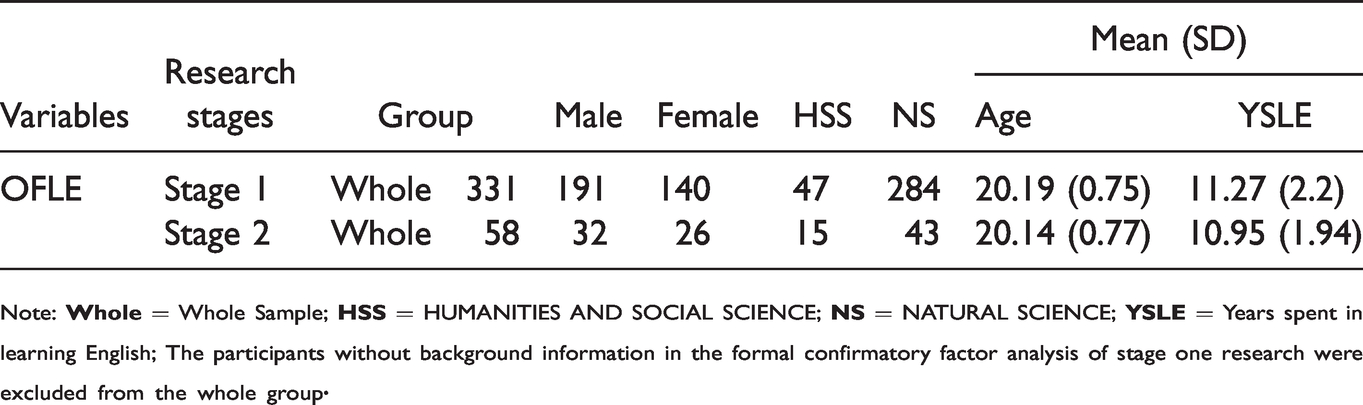
Note:
The authors, as English teachers working in the university from which the participants were recruited, contacted their colleagues to distribute the online questionnaire to their students. Before administering the questionnaires, we verbally informed participants of the nature and purpose of the study to reduce the possibility of bias via Internet chatrooms held by their English teacher who followed the instructions given by the first author. We informed the participants that the data collected would be used only for research purposes and that questionnaires would be handled anonymously. We obtained their consent to participate in this research at the end of the instruction section in the form of their response to the first authorization item in the questionnaire. After obtaining their consent, we posted the electronic questionnaire online and administered it with the consideration that these millennial participants were not only adept at using computers and smart devices but were allowed to use electronic devices at home during the COVID 19 pandemic. We then collected the data were via the website Wen Juan Xing in May 2020.
Next, in June 2020, we conducted a follow-up survey by posting one open-ended question online that asked participants to reflect on their enjoyable episodes during online English learning. Fifty-eight participants were recruited for this follow-up, with 56 of their essays valid for being coded in terms of these enjoyment experiences. All the questions were asked and answered in Chinese electronically to ensure that their online foreign language experiences were examined subtly and accurately. After collecting their feedback, we translated the Chinese transcripts into English for the convenience of coding emotion-related episodes and of reporting findings.
Materials
We used a composite questionnaire to collect quantitative data. This questionnaire was comprised two sections, namely the sociodemographic section related to participants’ background information (e.g., name, age, gender, major and time span in English learning) and the OFLES items linked to participants’ level of enjoyment during online FL learning. The second section involved participants’ responses to a 21-item self-report questionnaire recorded on a 5-point Likert scale (coded form 1 = strongly disagree to 5= strongly agree), with all scale items taken from the FLE scale developed by Dewaele and MacIntyre (2014) that we had reformulated to better fit the new context of web-based learning and teaching in the wake of the COVID-19 pandemic. Three university English teachers completed the translation of the reformulated 21-item OFLES. We then joined with two psychologists to attest to the readability and suitability of this modified questionnaire. All items in the OFLES were positively phrased. Finally, we implemented a back translation before distributing the questionnaire to participants in the present study. Example items are: “I enjoy learning English online,” and “Online English class provides a positive environment.” One open-ended question was asked: “Have you ever experienced a specific event or episode that you really felt enjoyed or fascinated and gained a sense of achievement in your online EFL learning for this semester? If yes, please describe your feeling as detailed as possible.”
Data Analysis
A two-step process is usually conducted to validate a model, namely the assessment of both the measurement models and the structural model. As recommended by Urbach and Ahlemann (2010), we carried out (a) an exploratory factor analysis to test the presumed unidimensionality of the scale, and a confirmatory factory analysis to establish the construct; (b) the average variance extracted (AVE) to analyze convergent validity, and the squared AVE to measure discriminant validity; (c) Cronbach’s alpha, split-half reliability, and composite reliability to examine the items’ internal consistency, and item loadings to assess item reliability.
We used both SPSS (Statistical Package for the Social Sciences) 25.0 and Mplus 8.3 to address our first two research questions. To validate the underlying OFLES construct and confirm its factor structure, we conducted a series of exploratory factor analyses and confirmatory factor analyses in a hierarchal order. First, we assessed unidimensionality, which refers to a latent variable having each of its measurement items relating to it better than to any factors (Gerbing & Anderson, 1988), by exploratory factor analysis. We determined the number of selected factors by the numbers of factors with an Eigenvalue over 1.0. Second, we applied confirmatory factory analyses to establish the construct of OFLES with an ideal model fit. In running the confirmatory factor analyses in Mplus, we used two estimators: (a) maximum likelihood estimation (ML) and (b) maximum likelihood estimation, robust standard errors and the mean adjusted chi-square test statistic (MLM). We used the MLM estimator when the chi-square value was expanded due to multivariate abnormality of the collected data. Moreover, indices such as the Chi-Square, the RMSEA, the CFI/TLI and the SRMR were all used to evaluate the model fit (Kline, 2005). Specifically, Root Mean Square Error of Approximation (RMSEA) values of between 0.08 and 0.10 provided a mediocre fit and below 0.08 showed a good fit (MacCallum et al., 1996). In line with Hu and Bentler (1999) suggestions, cut-off values close to or above 0.95 were considered demonstrative of good fit regarding Comparative Fit Index (CFI) and Tucker Lewis Index (TLI) values, and values below 0.08 were deemed good fit concerning Standardized Root Mean Square Residuals (SRMR). The details are shown in Table 2.
Model Fit.
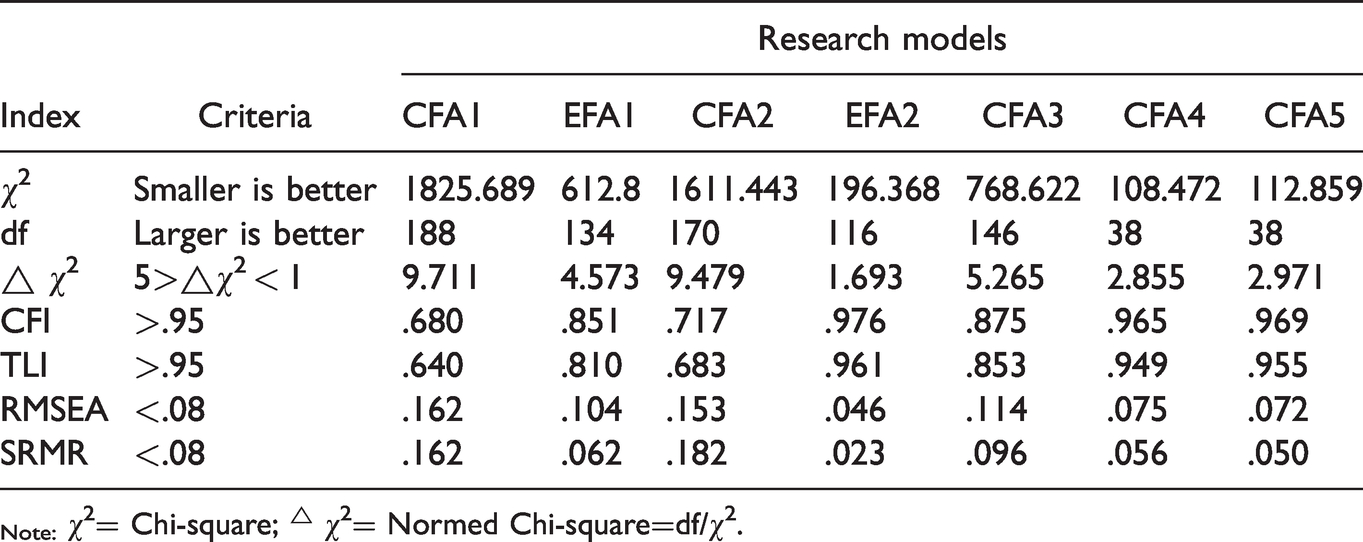
Note: χ2= Chi-square; ▵ χ2= Normed Chi-square=df/χ2.
In addition, we examined reliability by assessing internal consistency reliability and indicator reliability. We calculated Cronbach’s alpha, split-half reliability, composite reliability and indicator loadings. The reason we used both Cronbach’s alpha and composite reliability to estimate construct reliability is that Cronbach’s alpha is a traditional criterion for assessing internal consistency reliability and Chin (1998) highly recommended composite reliability to overcome some of Cronbach alpha’s deficiencies.
Apart from the aforementioned construct validity and reliability tests, we assessed convergent and discriminant validity to examine the degree to which individual items reflected a latent variable construct convergence in comparison to items measuring different constructs and the degree to which the measures of different latent variable constructs differed from one another. Therefore, we further confirmed goodness of fit of current data to each subscale and to the whole OFLES.
Next, we performed descriptive analyses by SPSS 25.0 to address our third research question, exploring Chinese undergraduates’ level of FLE through online EFL classrooms. Finally, we conducted qualitative analyses with Nvivo 12 to mine data for sources for various dimensions of online foreign language enjoyment OFLE, the theme of our fourth research question.
Results
Construct Validity: Confirmatory Factor Analysis and Exploratory Factor Analysis of the OFLES
Regarding the confirmatory factor analysis to test the goodness of fit based on participants’ responses to the 21 items adapted from the original two-factor FLES (Dewaele & MacIntyre, 2014), results showed that the adapted OFLES model in OFLES did not obtain statistically acceptable support from data in the present study (see Table 2 CFA1).
As the first confirmatory factor analysis results were not satisfactory, we calculated an exploratory factor analysis and uncovered a new two-factor structure. Principal component analysis and Varimax with KAISER normalization, and exploratory factor analysis with Geomin oblique rotation and MLR estimator were integrated into extracting the two factors. The results showed that data in the present study did not adequately fit the two-factor model (see Table 2 EFA1). After removing one item with a loading lower than .40 (i.e. OFLE5: “I don’t get bored at attending my English course online.”), we ran another confirmatory factor analysis to confirm the two-factor structure only to find a poorly supported 20-item two-factor model (see Table 2 CFA2).
Given the unsuccessful attempt to extract two factors, we implemented a new exploratory factor analysis by combining principal component analysis and Varimax with KAISER normalization without limiting the model to two factors. Bartlett’s test of Sphericity was significant (p<.001), and the Kaiser-Meyer-Olkin measure of sampling adequacy (KMO=.922) was higher than the recommended value of .60 (Kaiser, 1970). Thus, both tests suggested the sampling in this study was good and there was an objection to the assumptive zero hypotheses of no correlation among principal components, implying that it was possible to run factor analyses with the data in this study.
Due to the explorative nature of our modified OFLES, one item had standardized loadings lower than .50 (OFLE2: “I can laugh off embarrassing mistakes in the foreign language when learning online”) was deleted, leaving 19 items remaining in a new four-factor structure that explained 69.58 percent of the accumulated variances. This new structure for the OFLES emerged from our exploratory factor analysis with Geomin oblique rotation and MLR estimator (see Table 2 EFA2).
Finally, we conducted a confirmatory factory analysis to confirm the new four-factor construct and found that the new model also failed to maintain an ideal fit (see Table 2 CFA3). The normed chi-square of 5.27 was higher than the acceptable level of 5, leading us to conduct a further modification by removing two items with standardized loadings lower than .70 and with R2 lower than .50 (OFLE 9: “In online English class, I feel proud of my accomplishments,” OFLES 11: “It’s cool to know a FL.”), and six items ranking highest in terms of modification indices (OFLE 1: “I can be more creative learning English online,” OFLE 3: “I don’t get bored with online English Learning,” OFLE 13: “Making error is part of the online learning process,” OFLE 14: “The peers are nice and support each other via the Internet,” OFLE 19: “We form a tight online learning group,” OFLE 21: “We laugh a lot and share the feeling with the peers online.”). Eventually, 11 items remained. Responses to the remaining items then underwent a new confirmatory factor analysis with estimator MLM to modify the unnormal data distribution. The results demonstrated that the new construct gained an ideal fit (see Table 2 CFA4) with acceptable loadings of all 11 items (see Figure 1).
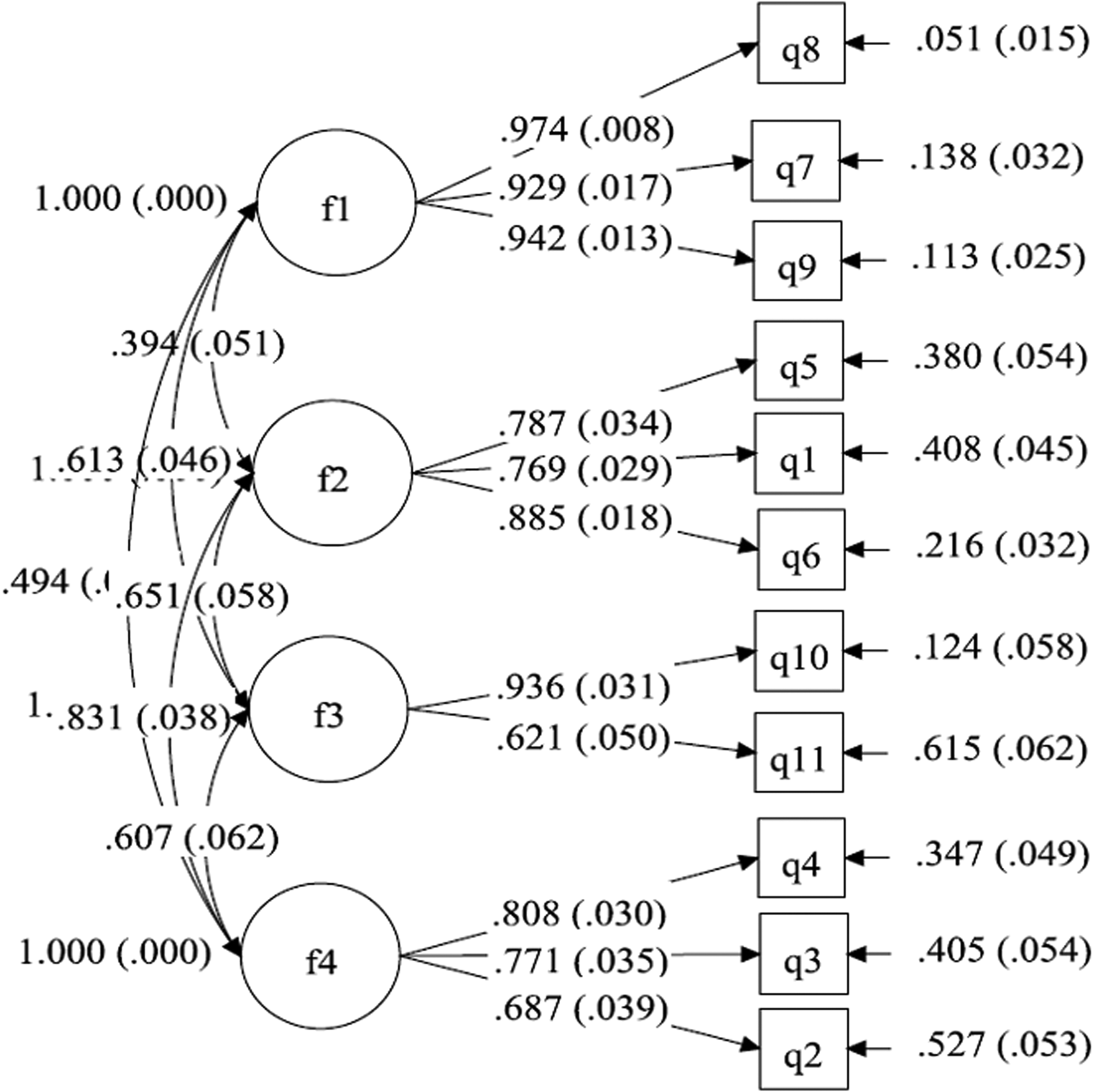
Graphical Representation of the Four-Factor Model and Factor Loadings in the Final CFA.
Motivated by the necessity to further validate the new model, we conducted a formal confirmatory factory analysis by applying data collected on responses from all 383 participants, among whom only 52 responded to 21 items of the OFLE and did not provide background information. These results indicated that the four-factor model gained an excellent fit and provided enough support for the data in this study (see Table 2 CFA5). The standardized factor loadings of all but one the 10 items were at the ideal level (see Figure 2).
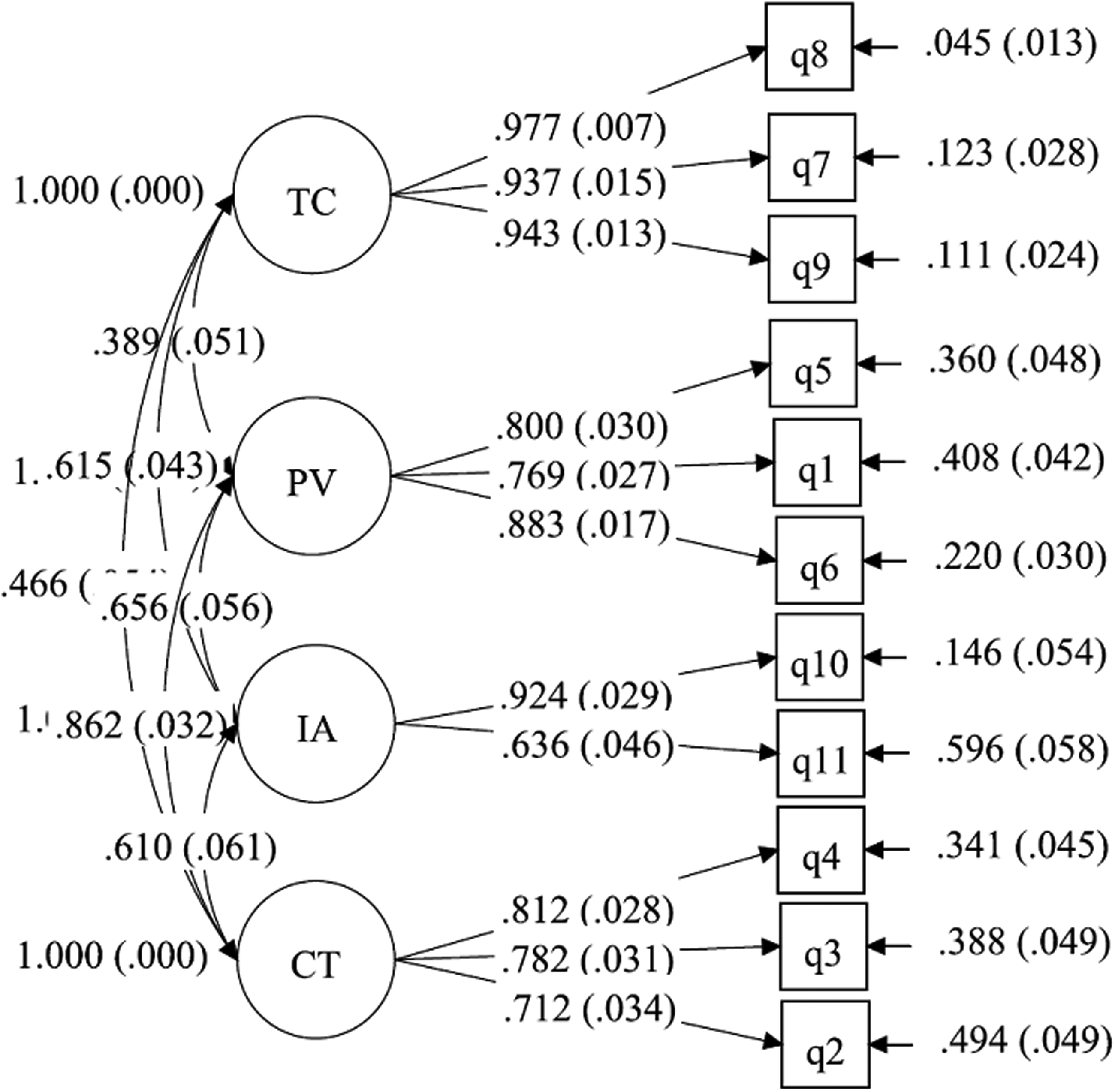
Graphical Representation of the Four-Factor Model and Factor Loadings in the Formal CFA.
Other Validity Tests: Convergent and Discriminant Validity
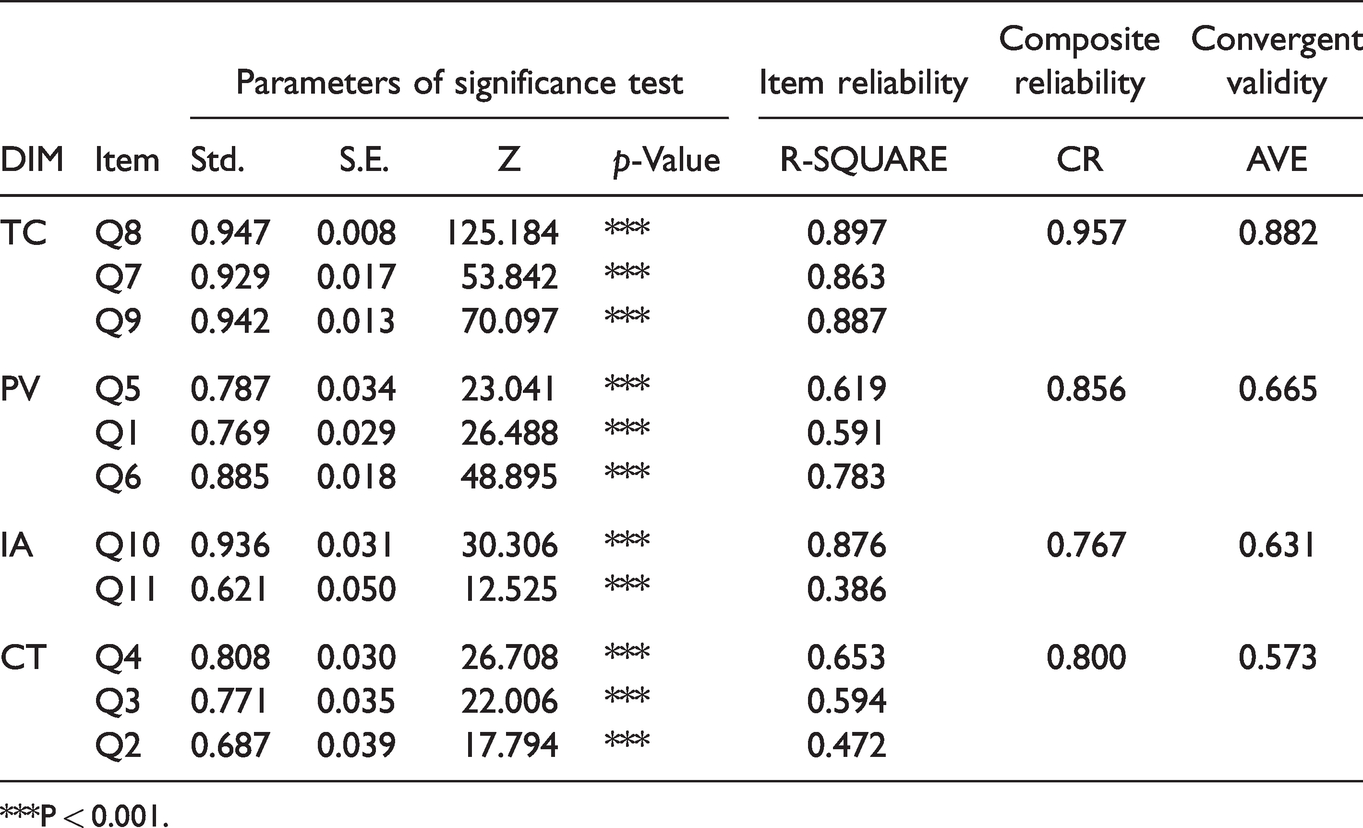
We verified the validity of each subscale by assessing convergent and discriminant validity. Convergent validity assesses the degree to which each item for a specific factor is convergent when compared with items for other factors representing different subscales. The average variance extracted (AVE) is a commonly applied criterion proposed by Fornell and Larcker (1981). As seen in Table 3, the AVE of each subscale was higher than the acceptable cutoff value of .50, implying that the individual latent variables represented by each subscale were on average able to explain more than half of the scale’s indicator items. Specifically, the OFLE-Teacher explained 88.2% of its indicators, Private 66.5%, Interaction 63.1%, and Competence 57.3%. Thus, there is a robust basis for concluding that the independent factors in the present study demonstrated sufficient convergent validity.
Item Reliability, Composite Reliability and Convergent Validity of the OFLES.
***P < 0.001.
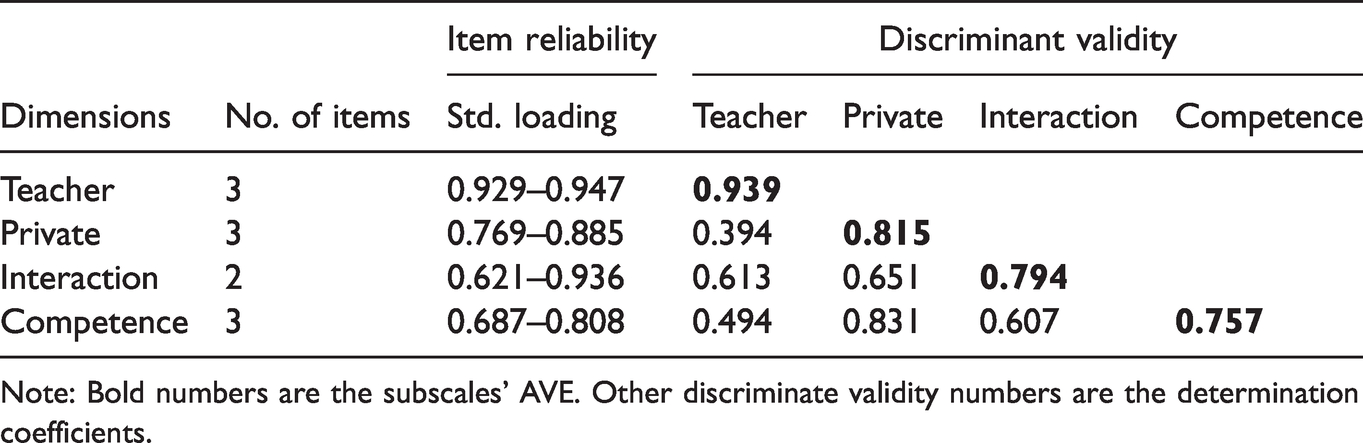
Discriminant validity examines the degree to which different factors of a measure differ from one another, thus testing whether the items do not unintentionally measure other factors. As Fornell and Larcker (1981) suggested, a latent variable or a subscale in a construct should share more variance with its assigned items than with any other subscale. Accordingly, the AVE of each factor should be greater than the subscale’s highest squared correlation with any other factor. Specifically, we compared r2 (the determination coefficient) with the AVE (see Table 4 and Figure 2). The AVE for the four subscales were .939, .815, .794, and .757 respectively and r2 of each subscale were lower than the AVE, indicating that each subscale had high discriminant validity.
Discriminant Validity of the OFLES.
Note: Bold numbers are the subscales’ AVE. Other discriminate validity numbers are the determination coefficients.
Internal Consistency Reliability and Item Reliability
We calculated Cronbach’s alpha, split-half reliability, and composite reliability to test internal consistency reliability of the OFLES, with standardized indicator loadings assessing item reliability. First, the four OFLE Cronbach’s alpha coefficients were Teacher (.964), Private (.851), Interaction (.735), and Competence (.800); and, as the new construct was .901, all exceeded the proposed threshold value of .600 (Nunnally & Bernstein, 1994), demonstrating that the construct and its subscales were internally consistent. Second, the split-half reliability revealed the Rhh correlation between the two halves of the OFLES to be .689 (Items 6, 7, 8, 15, 16, 17 and Items 18, 20, 12, 10, 4) and the Rxx (split-half reliability of the scale) to be .817, indicating high internal reliability. Since Cronbach’s alpha tends to severely underestimate internal consistency (Urbach & Ahlemann, 2010), we complemented internal consistency reliability testing with composite reliability that took into account that indicator items had different loadings instead of assuming they were weighed equally. In Table 3, the composite reliability values for the OFLE sub-dimensions were: Teacher = 0.957), Private = 0.856, Interaction = 0.767, and Competence = 0.800, all of which were higher than the threshold value of .70 (Nunnally & Bernstein, 1994), supporting acceptable reliability of the construct (Hair et al., 1998).
Next, we examined indicator items reliability with individual item loadings in the construct. As Tables 3 and 4 show, these values were all significant at the .001 level and higher than .60, indicating that the subscales explained enough variance and all the items in the new scale were appropriate for further analysis.
Factor Structure of the OFLES
Based on the four-factor model generated by confirmatory factor analysis and the interpretation of the meanings of concomitant items, the four enjoyment factors of the Chinese Version of the OFLES were confirmed and conceptualized as Teacher, Private, Interaction, and -Competence. The well-established four-factor model comprehensively portrayed Chinese university students as enjoying the fun of learning English via the Internet, appreciating their personal achievements by interacting with teachers and peers in the online classrooms, activating curiosity of and interests in web-based learning environments, realizing their teachers’ encouraging and supportive attitudes as conveyed online, and implementing the student-centered pedagogical practices in a virtual classroom without face-to-face communication.
Levels of Enjoyment on the OFLES
We calculated the mean scores of the Chinese Version of OFLES and each of its subscales were calculated. As Figure 3 presented, the mean scores of the whole scale and each subscale were 39.23 (SD = 11.2; 11 items), 12.52 (SD = 3.03; three items), 9.9 (SD = 3.04; three items), 7.04 (SD = 2.2; two items), and 9.77 (SD = 2.93; three items). The average scores of each item in the whole scale and each subscale were 3.57 (SD = 1.02), 4.17 (SD = 1.01), 3.3 (SD = 1.013), 3.52 (SD = 1.1), and 3.26 (SD = 0.98), respectively, indicating that the EFL students experienced enjoyment of on line foreign language learning mostly on the Teacher dimension, followed by Interaction, Private, and Competence (see Figure 3).
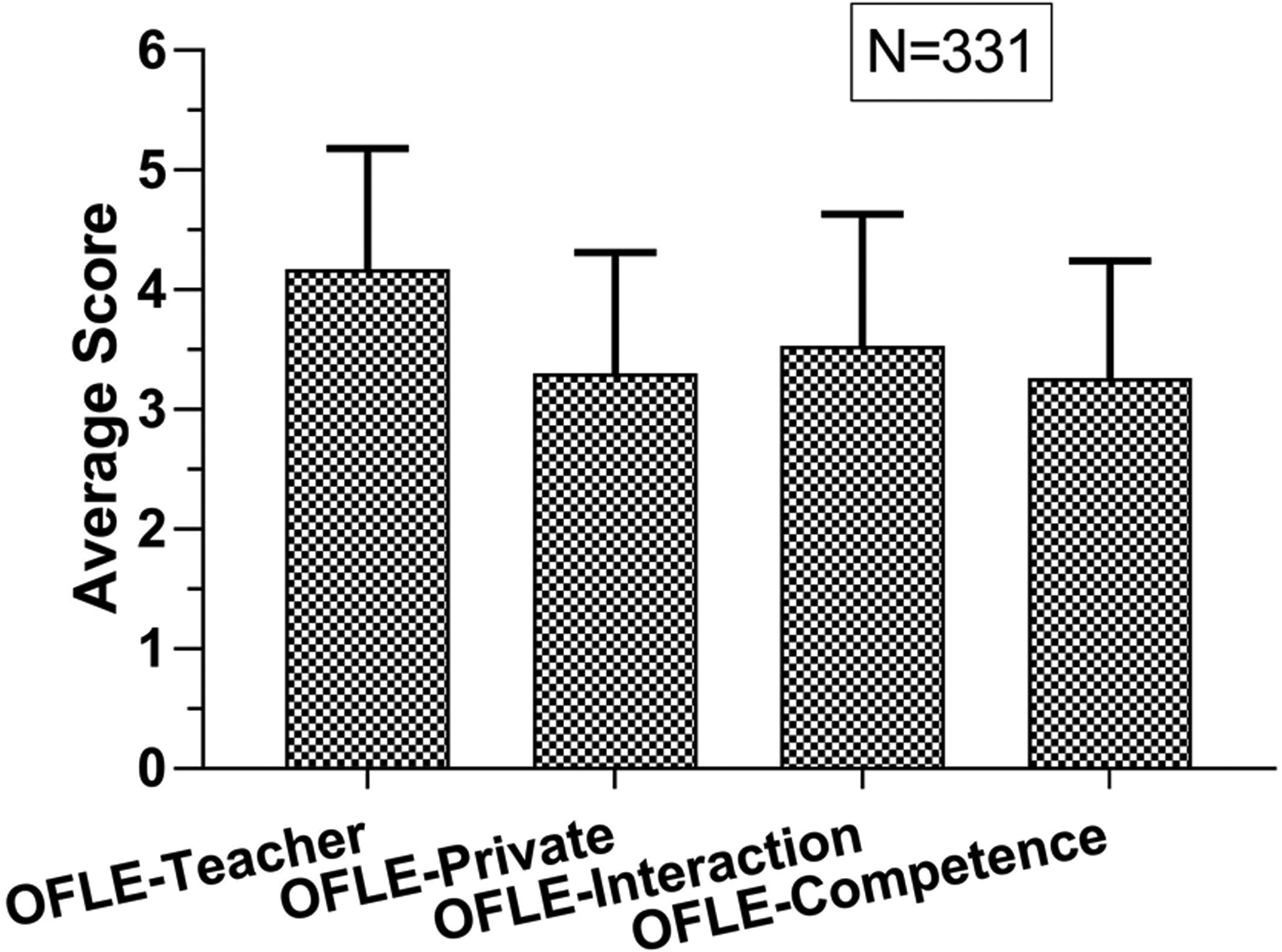
Profile of Online Foreign Language Enjoyment (Error Bars Represent Standard Deviation).
Qualitative Analyses of Participants’ Views on Enjoyable Episodes in EFL Class
We combined the coding approaches of Dewaele and MacIntyre (2014, 2019) and Li et al. (2018), and, based on participants’ feedback, we coded their reported emotion-related episodes into main categories identified during stage one of our research. These qualitative data allowed us to further interpret the specific sources of enjoyable language learning experiences under each category, as some participants attributed their enjoyable experiences to specific online classroom activities, while others regarded teachers or peers as their main sources of enjoyment. We were very concerned about a repertoire of EFL learners’ perceived internal and external causes of enjoyment from separate OFLES dimensions of Teacher, Private, Interaction, and Competence, and their possible interactions in a WBLL environment.
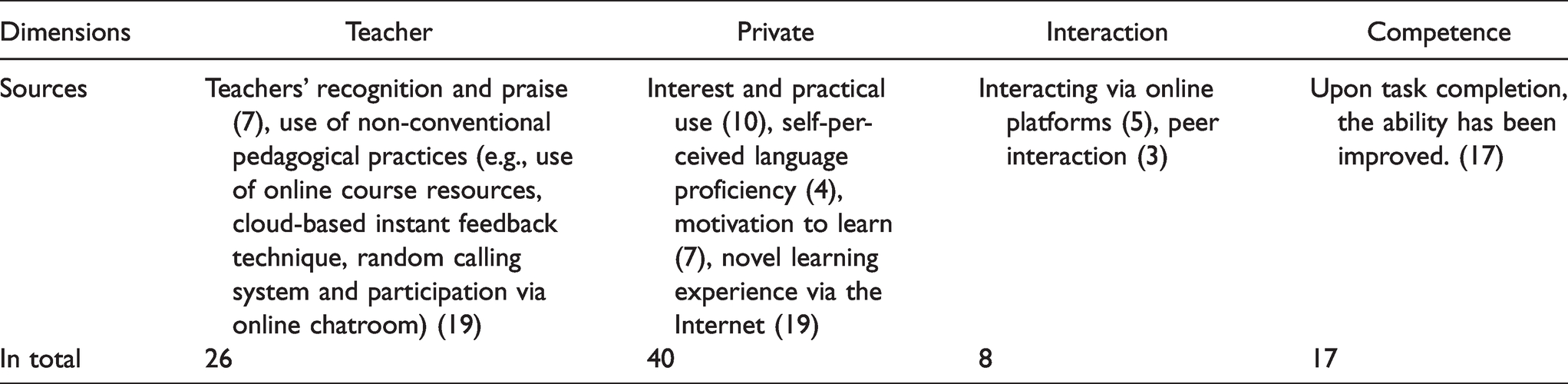
As a subgroup extracted from the whole sample, 58 participants answered the open-ended question and wrote 56 essays available to be coded in Nvivo 12. These qualitative data created a total of 2079 English words. The length of feedback per participant averaged 35.24 words. For reporting purposes, we chose data extracts that were most representative of the category. The follow-up qualitative analyses were two-fold. First, we estimated the total number of coding references to be 118, and we coded participants’ attitudes towards enjoyable experiences during online EFL learning into positive (46.6% [55/118]), neutral (37.3% [44/118]), mixed-minded (10.2% [12/118]), and negative (5.9% [7/118]). Second, we identified the striking features as themes for each dimension in an effort to perceive learners’ internal and external variables, with the components, sources and the conceptualization of online foreign language enjoyment, as summarized in Table 5.
Four OFLES Dimensions and Number of Enjoyment Mentions by 56 Participants.
Sources of Enjoyment in the OFLES Teacher Dimension
The first OFLES dimension, titled Teacher, emphasized the enjoyable emotions provoked by EFL teachers in their attempts to establish an encouraging FL learning atmosphere online. Student responses showed that they valued EFL teachers’ praise, personal attention or recognition, especially verbal encouragement of students via the Internet. Student “XHC” appreciated his accomplishment while thinking about the teacher’s praise:
Teachers’ non-conventional applications of online platforms or cloud-based estimation systems enhanced the enjoyable experiences. Learners were fascinated with the novel technology-driven online classrooms (e.g., cloud-based instant feedback technique, random calling system, and participation via online chatrooms) in which online activities successfully enlivened the classroom climate and improved students’ engagement. CX remembered a moment of pleasure after receiving instant feedback from an online learning platform:
Sources of Enjoyment in the OFLES Private Dimension
The second dimension, titled Private, highlighted EFL learners’ private enjoyment, growing through personal progress, or perception of good performance in the online EFL classrooms. GPF’s experience supported this view:
Meanwhile, some participants reported that enjoyment arose from the perception of novel online language learning, including novelty in themes, techniques, and teaching strategies (e.g., use of online course resources, English news and interviews, online word quizzes of spelling, pronunciation or translation). LJK offered a typical case:
Sources of Enjoyment in the OFLES Interaction Dimension
The third OFLES dimension, titled Interaction, stressed an unusual way of participating in online classroom activities. Instant feedback from cloud-based estimation system was expected to optimize the online classroom climate which was taken as a prerequisite for flow experiences (Egbert, 2003). EFL learners had access to enjoyable experiences by interacting via or with an online platform. FHY shared his case:
EFL learners were involved in online activities that successfully enlivened the classroom. Thus their enjoyment also benefitted from web-based peer interactions. YX’s description better illustrated this:
Sources of Enjoyment in the OFLES Competence Dimension
Previous studies (Dewaele & MacIntyre, 2016; Jin & Jun Zhang, 2018; Li. et al., 2019) demonstrated the multidirectional effect between students’ emotions in the language classroom and EFL learners’ performance. More specifically, learners’ academic achievement exerted an impact on learners’ emotions, determining the extent to which EFL learners were motivated to learn the FL well. Since motivation also applies to the WBLL environment (Artino, 2012), efforts are needed to realize academic satisfaction with and personal confidence in a good mastery of a FL which contributes, in turn, to enjoyment in the online EFL classroom, even in cases in which learners are confronted with difficulties completing an online task. RJN’s mixed sentiment conveyed this idea:
Discussion
Our aim in this study was to adapt the FLES to develop a new measure, the Online Foreign Language Enjoyment Scale (OFLES). We adopted a mixed-method approach to examine the psychometric properties of the OFLES and to explore the sources of enjoyment in online foreign language learning among Chinese university EFL learners.
Our first two research questions addressed the extent to which the new OFLES was reliable and valid in the online EFL context, and we examined the robustness of its factor structure. Indeed, there have been few studies similarly examining the factor structure of the FLES (Dewaele & MacIntyre, 2016; Jin & Jun Zhang, 2018; Li et al., 2018) and providing cross-cultural replications of the FLES factor structure (Jin & Jun Zhang, 2018; Li et al., 2018). We the found evidence of an ideal model fit (χ2 = 112.859, Δχ2(38) = 2.971, CFI = .969, TLI = .949, RMSEA = .075, SRMR = .075) for the FLES in Chinese samples who were online university EFL learners; and we revealed a four-factor structure of the OFLES with Teacher, Private, -Interaction, and Competence dimensions. While this factor structure replicated that of the FLES in terms of its dimensions of Social and Private with an international FL learner sample (Dewaele & MacIntyre, 2016), we notice a nuanced distinction in that we relabeled FLE-Social as OFLE-Teacher. When compared with two other studies carried out in the Chinese EFL context, our study had similar findings that private and social dimensions underpin the FLE construct. The three earlier studies differ in that we not only identified OFLE-Interaction, but also distinguished OFLE-Competence from OFLE-Private, instead of integrating them into FLE-Private as in Li et al. (2018) or into Enjoyment of Student Support as in Jin and Jun Zhang (2018). Generally, these distinctions can be interpreted as evidence that antecedents for FLE vary across learning contexts and environments. More specifically, the Chinese EFL learners in our study attributed learning enjoyment to novel interactions with peers and teacher via the Internet, which was also supported by our qualitative analyses of participants’ feedback. Based on their descriptions of enjoyable experiences, we found a component penetrating all sources of enjoyment was the novelty of online learning in the Competence dimension, also mentioned 19 times for OFLE-Teacher, 19 times for OFLE-Private, and 5 times for OFLE-Interaction. The explanation may lie with the fact that online EFL practices are novel and different from traditional classroom routines. Moreover, EFL learners were able to detect their strengths and weaknesses in language learning, with instant feedback. So, the private enjoyment of online FL learning was outweighed by students’ perceptions of benefits from building competence in coping with online learning tasks. While they perceived themselves as competent at using the target FL, they were able to develop interest in a second language self that may subsequently produce a long-term state of flow (Lake, 2013).
In addition to exploratory and confirmatory factory analyses, we further confirmed construct validity of the OFLES by analyzing its convergent and discriminant validity, with the newly established four-factor-11-item construct having proven valid with reference to the AVE and determination coefficients. As Table 3 showed, the AVE of each subscale exceeded the threshold value of .50, showing that the subscales better converge to reflect the construct of OFLE. Additionally, the AVEs for the four subscales were higher than their correlation coefficients, confirming a high discriminant validity of the new construct (see Table 4 and Figure 2). Unsurprisingly, Chinese participants in this study reported positive learning experiences of interacting with a competent teacher who created a supportive learning environment, gaining interest in and perceiving the value of learning a FL, and eventually attaining personal growth through competency in that FL. Therefore, we have solid basis for concluding that the new measure is a valid construct with four relatively separate but intertwining subscales that jointly depict Chinese university EFL learners’ online foreign language learning enjoyment.
Following validity testing, we conducted a series of reliability tests to examine the construct’s internal reliability. We calculated Cronbach’s alphas, split-half reliability, and composite reliability. Although the split-half reliability test and composite reliability are analogous to Cronbach’s alpha and are usually a more conservative and better estimate of reliability (Urbach & Ahlemann, 2010), all of these tests were reported here so that comparisons can be made with other studies that only reported Cronbach’s alpha. We found Cronbach’s alpha coefficients of .901 for the OFLES overall, .964 for Teacher, .851 for Private, .735 for Interaction, and .800 for Competence, indicating a high level of internal consistency (.70 is considered as desirable for new measures in exploratory research; Nunnally & Bernstein, 1994). The Chinese version of the OFLES had higher internal consistency than the English version of the FLES (α = .86) as developed by Dewaele and MacIntyre (2014) and the Chinese version of the FLES (α = .826) modified by Li et al. (2018); but the OFLES had a slightly lower internal consistency (α = .91) than another version of the FLES with 17 items developed by Jin and Jun Zhang (2018). These results indicate that reliability across scales may vary since the number of items included and the language used to show the items are cross-contextually or cross-culturally different. Next, the Rhh correlations between the two halves of the OFLES were estimated to be .689 and .817, also again supporting high internal reliability. Finally, complimentary values of composite reliability also attested to the high reliability (i.e., >.70, Hair et al., 1998) of the new construct (Teacher = .957, Private = .856, Interaction = .767, Competence = .800).
Since composite reliability considers that indicator items vary in loadings, it is an alternative measure for testing construct reliability, and it is better to integrate these criteria in comparing internal consistency among different constructs. By reviewing previous attempts to either develop or adapt the FLES, we noticed only one parallel investigation into composite reliability of the FLES (Li et al., 2018) and only a minor variation in Cronbach’s alphas and composite reliability values between the present study and Li et al. (2018).
Our third research question examined levels of online foreign language learning enjoyment of Chinese university EFL learners. To the best of our knowledge, the Chinese version of OFLES is the only instrument particularly developed to assess this construct in a sample of Chinese EFL learners. Despite the uniqueness of the online learning environment, it is notable that Chinese undergraduates seemed to experience more enjoyment in traditional classrooms than they did in online learning when comparing the average score of undergraduate participants’ on the FLE in the Jiang and Dewaele (2019) study (M = 3.94) and the average score on the OFLS in the present study (M = 3.57). Of course, these scores from different psychometric tests and different student groups cannot be statistically compared to determine the significance of this difference. If there is a real, rather than apparent difference, the reason may lie in the idea that even though the use of technologies has a potential to enhance language learners’ interactions and positive perceptions of learning (Hwang & Fu, 2018), learners are also confronted with aspects of reduced control in online learning environments (Daniels & Stupnisky, 2012), including such problems as a perceived inability to operate mobile devices and follow teachers’ instructions online or the unpredictability of course delivery. Indeed, these problems may elicit learners’ depression or anxiety.
With respect to various cultures where learners are living, we also compared the extent of enjoyment between FL learners in an international sample (Dewaele & MacIntyre, 2014: M = 3.82) and Chinese samples (Li et al., 2018: M = 3.94; Jin & Jun Zhang, 2018: M = 3.12; and our current study: M = 3.57). The result is not completely in line with what was revealed in Li’s (2020) and MacIntyre et al. (2019) studies showing that Chinse EFL learners experienced less FLE-measured enjoyment than international FL learners. Cultural circumstances may influence learners’ enjoyment in FL learning, but many other variables are involved, including teacher interest in student enjoyment, face-to-face vs. virtual classrooms, students’ age, students’ level of education, and the uncertainties mentioned earlier as to whether aggregated average scores on various modified measures of foreign language learning enjoyment are comparable.
Our fourth research question dealt with the possible sources of enjoyment in online foreign language learning among Chinese university EFL learners. First, participants reported a major concern for what a teacher does in an online classroom. Their enjoyment not only had origins in the teacher’s appraisal, but these individuals’ emotions were related to the teachers’ creation of an accessible and comprehensible language environment (Arnold & Fonseca, 2007) in which learners’ beliefs in the significance of FL learning were better reinforced. Indeed, the crucial role a teacher plays in promoting psychologically favorable learning atmosphere in traditional classroom has been universally recognized in Western cultures (Dewaele et al., 2018; Dewaele & MacIntyre, 2014; Wong et al., 2018) and in Asian countries (Lake, 2013), especially in the Chinese culture (Li et al., 2018; Jin & Jun Zhang, 2018) where the teacher is always taken as an authoritative figure who has “exclusive control in establishing a positive atmosphere” (Li et al., 2018, p.193). Herein, the present study naturally revealed that online EFL learners relied extensively on the teacher who was expected to give valuable and positive feedback that accurately estimated their performance. However, qualitative data did not dovetail with the quantitative finding that the OFLE-Teacher dimension contributed to the largest proportion of learner enjoyment. Rather, the qualitative result ranked this source second to OFLE – Private with respect to the frequency of mentions.
Second, participants attributed their enjoyment to a wide range of personal perceptions of FL learning, namely pride for an outstanding performance (e.g., in word pronunciation), strong L2 motivation, awareness of the prospective use of a FL in daily communications, convenient access to missed lectures presented online, and aesthetic design in course delivery. But relative to all the components that may stimulate learners’ interest or curiosity (Loderer et al., 2020), the most important were the task value beliefs related to enjoyment (Artino, 2012); EFL learners found online FL learning fascinating only when they recognized the practical use or value of English beyond their performance on exams. But even though learners perceived that value, teachers should not make tasks too demanding because the proximal experience of “flow” presupposes an optimal level of task difficulty in which manageable challenges are posed (Czimmermann & Piniel, 2016). Otherwise, learners’ motivation may gradually decline under the pressure of being unable to successfully learn a FL (Lake, 2013). Third, though the participation in a virtual environment rather than an in-person classroom gives students a sense of safety and comfort as noted by GPF’s statement “I sent the audio of my word aloud to the group chatroom and got the teacher’s praise. In the past, I dared not read English in front of everyone when being face to face”, the novel interactions with people online don’t necessarily lead to enjoyable experiences. Web-based technologies not only feature flexibility in time, space, and distance (Chen et al., 2013), but they may also arouse a feeling of isolation from the teacher and from peer support. The negative effect of technologies on learner emotions may lead to poor language learning performance (Hauck & Hurd, 2005; Yang et al., 2008).
While the enjoyment sources and their components were established in our qualitative analyses, the discrepancy between our quantitative and qualitative findings is noteworthy. Why did the OFLES-Private dimension outweigh the OFLES-Teacher as the main source of enjoyment in our qualitative analyses? Possibly participants’ subjective descriptions revealed more details in their emotions than they could reveal in the self-report questionnaire. The variety of our codes for sources of enjoyment increased, as the frequency of the students’ mentions of their private feelings rose. But with respect to the importance of different dimensions of enjoyment, the objective data always speaks louder than subjective data. Though the four dimensions of the OFLES were analyzed separately for the convenience of interpretation, future researchers are advised to take a holistic view when coping with the latent variables of a construct, because factors always interact and overlap to create a complex understanding of the online learning event.
Limitations and Directions for Further Research
Although these findings substantiate the psychometric quality of the OFLES, there were clear limitations to the present research. The validation of a new measure entails the assessment of measurement properties on a variety of samples in similar and different contexts (Chen et al., 2013), because the validity of a measure cannot be definitively confirmed in a single study. Indeed, all the participants in the present study shared several homogeneous properties, namely the same mother tongue, an identical instructional level, similar age and years spent in learning English, and they mainly specialized in natural science studies (85.8% of the participants) with only a small minority of humanities and social science majors. Thus, it is open to question whether these findings generalize cross-culturally to other diverse populations or cross-contextually to the online learning environment. Similarly, while this first attempt to create an instrument with Chinese university EFL learners proved successful, more research is needed to test the psychometric quality of the instrument with high school students and older adult populations.
Conclusion
The present study adopted a mixed-method approach to investigate Chinese EFL learners’ foreign language learning enjoyment in a WBLL environment. We identified a four-factor structure of a new OFLES and provided a better understanding of the conceptualization of Chinese EFL learners’ online foreign language learning. From a measurement perspective, our findings corroborated the reliability and validity of the OFLES. The item statistics and reliabilities of the OFLES were good to excellent, and the scale was found to be well-suited to describe the internal structures of learning enjoyment and its underlying dimensions in this context.
The quantitative and qualitative findings of this study carry important implications. First, they suggest that the Chinese Version of OFLES can be used to assess learners’ enjoyment of foreign language learning. To date, the instrument has mainly been employed for research purposes, but it also has potential to be applied in academic evaluations. Second, although caution should be given to not overinterpreting these findings, they are clearly in line with the assumption that EFL learners were fascinated with the novel way of learning a FL online. By implication, researchers and teachers are advised to boost students’ enjoyment through frequent use of modern technologies and to equip themselves with strategies to establish a positive classroom atmosphere and eventually to promote learners’ FL learning.
Supplemental Material
sj-pdf-1-pms-10.1177_00315125211041714 - Supplemental material for Investigating Chinese University Students’ Enjoyment in a Web-Based Language Learning Environment: Validation of the Online Foreign Language Enjoyment Scale
Supplemental material, sj-pdf-1-pms-10.1177_00315125211041714 for Investigating Chinese University Students’ Enjoyment in a Web-Based Language Learning Environment: Validation of the Online Foreign Language Enjoyment Scale by Xin Wang, Yang Wang, Yizhi Yang and Lu Wang in Perceptual and Motor Skills
Footnotes
Acknowledgments
We thank the editor, Prof. J. D. Ball, and the anonymous reviewers for their constructive comments on the earlier versions of the manuscript. We would also like to thank the psychologists and the EFL teachers involved for translating the questionnaire and allowing us to contact their students. We are grateful for the cooperative student participants and the kindest help and valuable feedback from Prof. Keqin Yao in the related project.
Author Contributions
X. W. designed the research and wrote the whole manuscript. Y. W. collected and processed the data. Y. Z. Y. analyzed the data. L. W. revised the manuscript.
Declaration of Conflicting Interests
The author(s) declared no potential conflicts of interest with respect to the research, authorship, and/or publication of this article.
Funding
The author(s) disclosed receipt of the following financial support for the research, authorship, and/or publication of this article: This study was supported by a grant awarded to the first author by Higher Education Research Foundation in Xi’an University of Science and Technology (# GJY-2020-YB-10).
Data Availability Statement
The datasets generated for this study are available on request to the corresponding author.
Ethics Statements
Ethical review and approval was not required for the study on human participants in accordance with the local legislation and institutional requirements. All participants provided electronic informed consent.

Author Biographies
References
Supplementary Material
Please find the following supplemental material available below.
For Open Access articles published under a Creative Commons License, all supplemental material carries the same license as the article it is associated with.
For non-Open Access articles published, all supplemental material carries a non-exclusive license, and permission requests for re-use of supplemental material or any part of supplemental material shall be sent directly to the copyright owner as specified in the copyright notice associated with the article.
