







Abstract
In this study, we examined whether experience level and various dual motor and cognitive or single tasks influenced young soccer players’ physical performance during small-sided games. Participants were 72 players from U-13 (n = 36) and U-17 (n = 36) groups who participated in 3-to-a-side small-sided games under four experimental conditions: control, a secondary motor task, an additional related secondary cognitive task, and an additional secondary non-specific task. We used GPS devices to measure physical performance in terms of distances covered and accelerations at different thresholds. We found no significant interaction effect between player experience and task condition (p = .540), meaning that dual tasks had comparable effects on players of different experience levels. There were significant main effects of both experience level (p < .001) and condition (p < .001) on most physically related variables. Older players outperformed younger ones, particularly in high-intensity actions. While secondary motor tasks decreased physical performance, secondary cognitive tasks, irrespective of specificity, did not impair players’ performances. In conclusion, experience level did not influence the players’ physical response to dual tasks, and a secondary motor task was more disruptive to physical performance than either of two types of secondary cognitive tasks. Cognitive tasks can be incorporated into soccer training without compromising physical performance.
Introduction
Past research has extensively explored dual tasks across various applications, including in studies of dementia risk assessment (Jayakody et al., 2020), age-related deficits (Bock & Beurskens, 2011), cognitive training (Elkana et al., 2020), and sports training (Gabbett et al., 2011; Laurin & Finez, 2020). Dual-task protocols usually involve a primary task (e.g., ball juggling) and an additional secondary task (e.g., math operations) (Jayakody et al., 2020; Schaefer, 2014). Despite an acute decrement in performance (dual-task cost), practicing under dual-task conditions has generally led to long-term positive adaptations, particularly among athletes (Moreira et al., 2021). In team sports, athletes face continuous challenges in processing extensive information while concurrently executing various actions. Therefore, mastering dual-task scenarios can offer benefits to athletes and enhance their performance in game settings.
The underlying mechanisms of dual-task cost are still under investigation. One potential approach to unraveling this phenomenon is to examine the attentional resources needed to manage multiple tasks simultaneously. Attention, defined as players’ ability to focus on key elements of the game to inform decision-making (Memmert et al., 2009), is crucial in team sports, where athletes must process extensive information from a dynamic environment (Memmert, 2010). Attentional Control Theory (ACT) posits that heightened anxiety induced by secondary tasks may disrupt executive functions (Eysenck et al., 2007). ACT involves the goal-directed allocation of cognitive resources to internal and external stimuli (Furley & Wood, 2016). Within dual-task training, increased anxiety may shift attention towards bottom-up processes, impairing integration with top-down processes and potentially decreasing performance, particularly in sports contexts (Raab, 2014). While most studies have examined the negative effects of dual tasks in lab settings, limited research has explored game-based dual tasks, such as small-sided games (SSGs), which entail high attentional complexity. SSGs, with their unpredictable elements, offer a platform for a primary motor-cognitive task alongside optional secondary tasks, intensifying attentional demands.
To gain deeper insights into the effects of dual tasks in practical settings like SSGs, researchers should explore how player expertise influences learning and performance. Previous studies have shown that experts outperform novices in decision-making tasks under dual-task conditions in simulated soccer scenarios (Zoudji et al., 2010). For example, experienced basketball players demonstrated smaller performance declines when engaging in dual tasks, such as multiple object tracking, compared to novices (Qiu et al., 2018). Additionaly, working memory capacity has been shown to mediate attentional focus and predict dual-task sport performance (Vaughan & Laborde, 2020). This result could be explained by the experienced individual relying more frequently on automatic processes that may require minimal additional attentional resources for motor skills execution (Diekfuss et al., 2016). On the other hand, Laurin and Finez (2020) showed that working memory capacity did not predict juggling performance under dual-task conditions, and Buszard et al. (2017) theoretically suggested that experts do not possess larger working memories than non-experts. Therefore, it is not clear that possessing higher cognitive skills supports expert-related performances. The discrepancies in findings across studies may be attributed to variations in the nature of the dual tasks employed. Laurin and Finez (2020) used a predictable task (juggling) in which the role of working memory was likely to have been diminished for most participants, and Qiu et al. (2018) adopted a laboratory-based task in which in situ expert-novice differences were likely to be reduced. Therefore, exploring dual-task performance within actual match-play scenarios may provide unique insights, compared to research conducted in laboratory or closed-environment settings.
Apart from levels of player expertise, another factor to consider in dual-task sports research is the nature of the dual-task. For instance, various additional cognitive tasks like the 3-back test, visuospatial tracking, and sequence memorization induce dual-task costs in both cognitive-cognitive (e.g., secondary cognitive task added to a primary cognitive task) and cognitive-motor (e.g., secondary cognitive task added to a primary motor task) scenarios (Howell et al., 2017; Laurin & Finez, 2020; Moreira et al., 2021). Multitasking has been linked to increased decision-making and reaction times, potentially leading to delayed motor responses in game-based scenarios. However, the impact of dual tasks on physical variables in such contexts remains largely unexplored in previous research. Although the effects of secondary motor tasks on athletic performance during game-based tasks are underexplored in sports literature, in other domains, such as rehabilitation after concussion, and among the elderly, motor-motor dual tasks have positively influenced balance performance similar to cognitive-motor dual-task training (Mercan et al., 2016) in the same fashion as has cognitive-motor dual-task training (Akin et al., 2021). However, in these studies, the primary task did not require high-speed actions common in soccer game tasks (Abt & Lovell, 2009; Carling et al., 2016). Also, one previous research team reported that the dual-task cost was higher for an additional motor than for an additional cognitive task (Beurskens et al., 2016). In a sports context, a secondary motor task might hinder players’ movements, potentially incurring greater costs than a secondary cognitive task, but this possibility is also untested. More information on cognitive and motor secondary tasks is needed to assist coaches in deciding how best to use dual-task-training regimens in team sports training.
One dimension of secondary tasks that coaches and researchers can control is the degree to which secondary tasks are specifically related to the main sports tasks. Tasks that are more contextually related likely exhibit superior transferability from practice to competition (Lucia et al., 2021; Williams & Hodges, 2023), although game-based tasks have not been tested so far within the context of dual-task training. Most added cognitive tasks in the dual-task literature have been unrelated to the primary task, such as counting-back while juggling (Vafaeimanesh et al., 2023). Conversely, players might be asked to engage in specifically related cognitive secondary tasks, such as having footballers count passes. Players’ familiarity with such tasks might reduce working memory demands and mitigate the dual-task cost. Interestingly, past investigators found that directing attention to an extraneous distractor imposed less cognitive workload than directing attention to an aspect of skill execution (Diekfuss et al., 2016). Extraneous distractors in game-based tasks could be the elaboration of math operations and the need to pay attention to visual stimuli on the sidelines of the pitch. Also, soccer players may find soccer-related secondary tasks more enjoyable than counting-back or letter memorization tasks, potentially facilitating the integration of dual tasks into training routines. However, it remains uncertain whether additional task-related tasks (e.g., counting the number of passes during a small-sided soccer game) would result in different dual-task costs – likely reduced - than unrelated secondary tasks.
Based on our literature review, we aimed, in this study, to achieve three objectives. First, we sought to investigate differences in dual-task costs during small-sided soccer games between players of varying experience levels. Given the reported ability of experienced players to mitigate dual-task costs, we anticipated an interaction effect between experience level and task conditions, with greater between-group experience differences observed during more demanding tasks. Second, we aimed to assess the impact of the characteristics of secondary tasks (motor or cognitive; sport-specific or non-specific) on players’ physical performance. We hypothesized that secondary motor tasks would incur a higher dual-task cost than cognitive tasks, and tasks more closely related to the sport would rely more on automatic processes, resulting in fewer dual-task costs than non-specific tasks. To examine these varied task parameters, we implemented four experimental task conditions (single task, cognitive specific, cognitive general, and motor).
Method
Participants
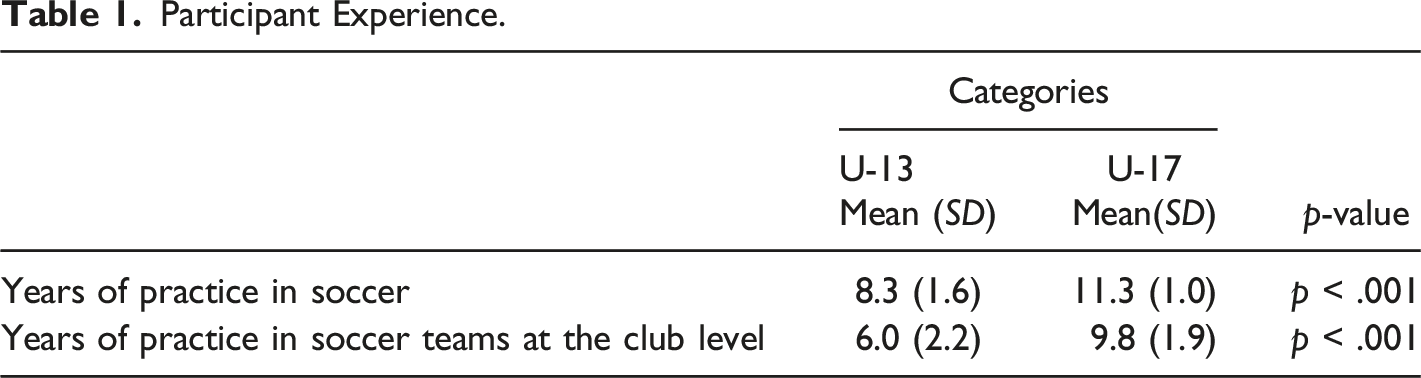
Participant Experience.
Ethical Considerations
The Local Ethics Committee of the Universidade Federal de Minas Gerais approved our research protocol (52770421.4.0000.5149) Parents/legal guardians of all youth participants provided their informed written consent in advance of the participant’s engagement in the study.
Procedure
This study was a randomized between-within-subject trial with a 2x4 factorial design, in which two age groups and three experimental conditions were factors. A previous study showed that participants exhibited higher tactical performance when playing with teammates and opponents from a similar tactical level (Praça et al., 2017), suggesting that team composition criteria should be considered when investigating players’ responses during small-sided games. To ensure balanced teams, our participants underwent testing for tactical performance using the System of Tactical Assessment in Soccer (FUT-SAT) (Teoldo et al., 2011) during the initial data collection session. The field test involved a 3-to-a-side small-sided game that adhered to all official soccer rules on a 36 x 27 meters natural grass soccer field. The test showed significant inter- and intra-observer reliability (above .79) for all tactical principles and performance indicators (Teoldo et al., 2011).
Team Composition.
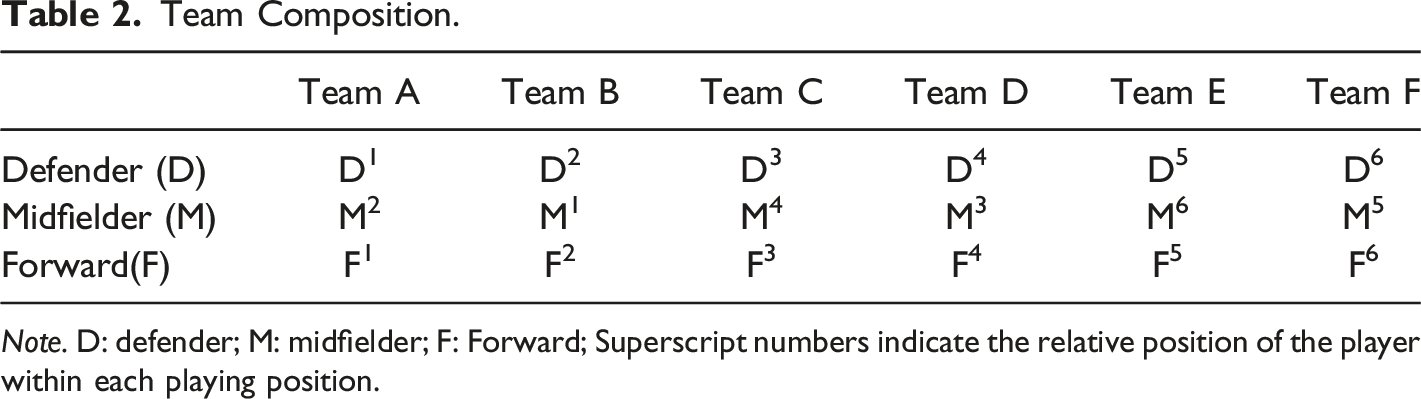
Note. D: defender; M: midfielder; F: Forward; Superscript numbers indicate the relative position of the player within each playing position.
Following the team composition phase of this procedure, we commenced the primary data collection phase. Participants encountered four experimental conditions presented in a randomized and balanced order: (a) single-task condition (ST), in which players exclusively engaged in the 3-to-a-side small-sided game; (b) specific cognitive dual-task condition (CDT1), requiring players to count the number of passes performed by the opposing team while playing the SSG; (c) general cognitive dual-task condition (CDT2), necessitating players to perform math operations while participating in the SSG; and (d) motor dual-task condition (MDT), obliging players to execute an additional motor task (holding a cone with a ball inside) while playing the SSG.
In the Single-task condition (ST), players participated in a 3-a-sided small-sided for four minutes. This standardized format of small-sided games has been widely adopted in the literature (Praça et al., 2018; Sousa et al., 2019). To minimize the influence of varying skill levels of the opposing team (Folgado et al., 2014), we meticulously balanced players’ tactical skill levels as noted above (Praça et al., 2017), and these remained constant throughout the data collection period. Consequently, Team A exclusively played against Team B across all four experimental conditions (and likewise for all other teams). On each testing day, players engaged in two distinct bouts, with four minutes of passive recovery interspersed to mitigate the impact of fatigue on players’ responses. The tasks are comprehensively described below and illustrated in Figure 1. Experimental Conditions.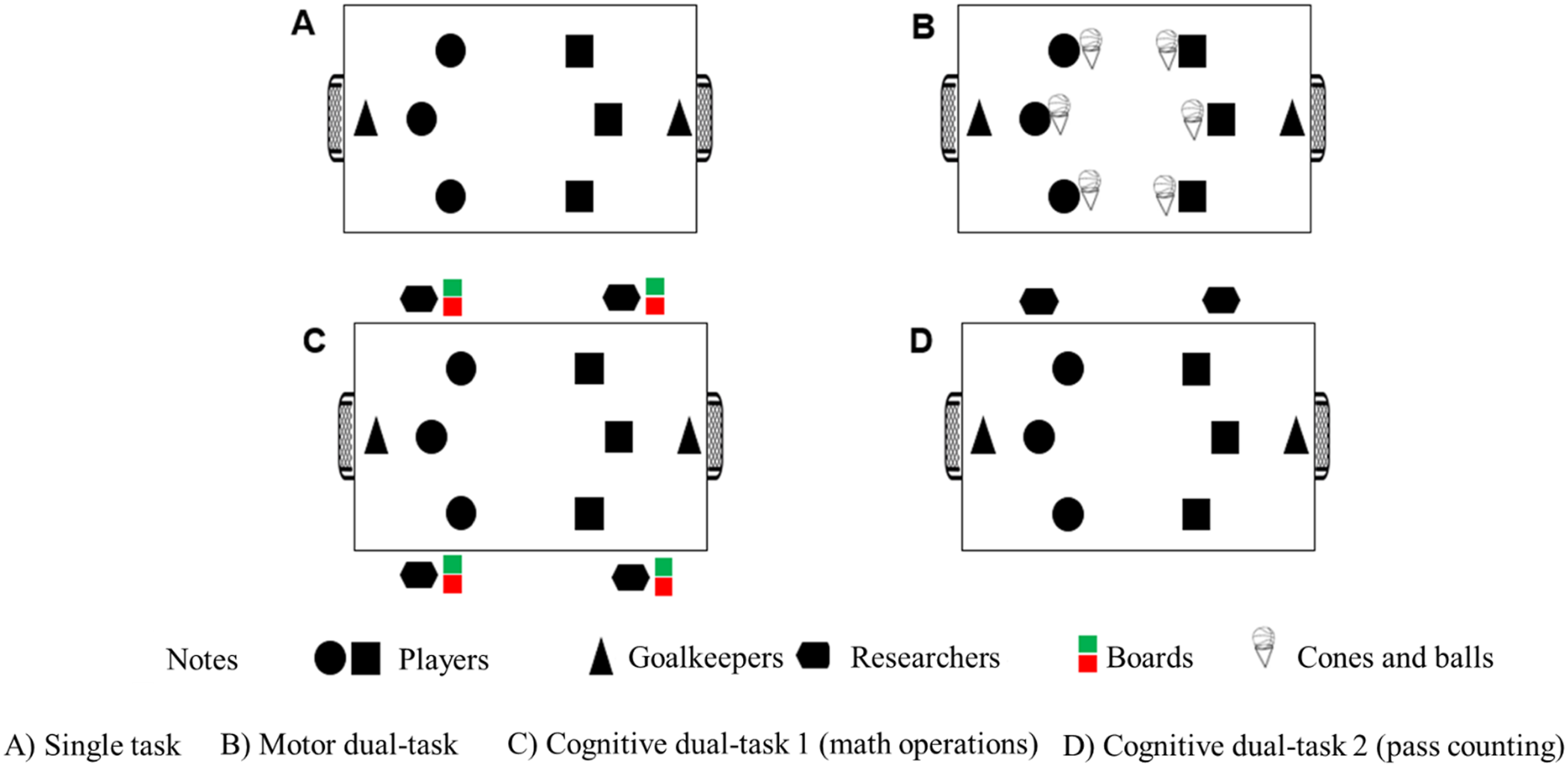
In the specific cognitive dual-task condition (CDT1), all the rules of the single-task (ST) condition were upheld. Additionally, players were assigned the supplementary task of keeping track of passes executed by the opposing team. A pass was considered valid when the ball was transferred from player A to player B within the same team, and player B successfully controlled the ball. This task was designed to consistently engage working memory, requiring players to maintain an ongoing count during the game and provide pertinent information about performance (e.g., strategizing on regaining possession if the opposing team executed numerous passes). However, the secondary information to be processed by the players was not extraneous, but task-related information (passing performance). The selection of this task followed the previous rationale of reducing the cognitive demand related to extraneous tasks Players were explicitly instructed not to communicate with each other regarding their pass counts. After the small-sided game, each player proceeded to a designated position along the sidelines (one for each player), where a paper was provided for manually recording the number of observed passes.
The general cognitive dual-task condition (CDT2) adhered to all the rules of the Single-task (ST) condition, maintaining consistency with the manual recording procedure employed in the CDT1 protocol. However, in this instance, instead of tallying passes, players were tasked with performing mathematical operations, aligning with methodologies from prior dual-task studies (Laurin & Finez, 2020). Before the game, each player received a two-digit number (e.g., 74). Throughout the game, four researchers displayed colored boards on the sidelines every fifteen seconds, indicating the specific mathematical operations. Players were required to add three to the initial number when the green board was raised and subtract two if the red board was raised. At the conclusion of the four-minute bout, players were instructed to write down the final number, which encapsulated the cumulative effect of all performed mathematical operations.
The motor dual-task condition (MDT) encompassed all the regulations of the single-task (ST) condition. In addition, players were mandated to hold a cone with one hand (the hand chosen by the player). Inside the cone, a basketball was placed. Players were directed to maintain control of the cone to prevent the inner ball from falling. Losing control of the ball resulted in being deemed offside, thereby disallowing the player from receiving the ball or engaging in defensive actions. In such instances, players were required to retrieve the ball, reposition it, and then resume play in an onside condition.
Secondary Task Engagement
Means (and Standard Deviations) of Secondary-Task Engagements by Player Experience Level.
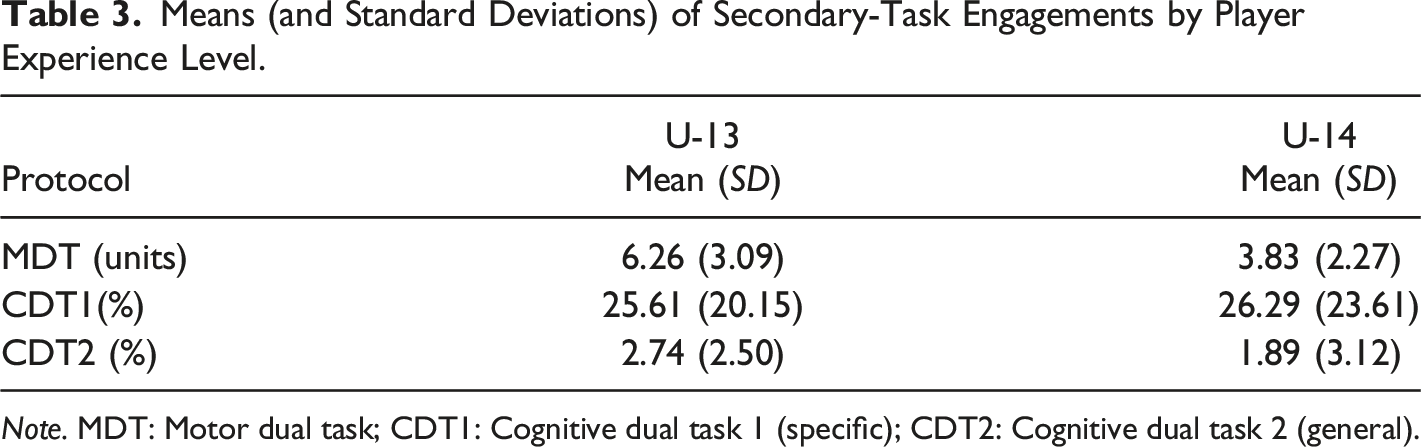
Note. MDT: Motor dual task; CDT1: Cognitive dual task 1 (specific); CDT2: Cognitive dual task 2 (general).
Instruments and Variables
Team Composition
The team composition procedures incorporated the field test of the System of Tactical Assessment in Soccer – FUTSAT - (Teoldo et al., 2011). This test involved a 3-to-a-side small-sided game (SSG) adhering to formal game rules and played for four minutes. All players within each club and age group participated in one bout, utilized to generate the tactical index for each player and create balanced teams. SSGs were recorded via a digital camera for subsequent analysis. Expert match analysts evaluated players’ tactical performance, considering offensive and defensive core tactical principles (Teoldo et al., 2011). As in previous studies, the percentage of successful tactical actions was then employed as the criterion for team composition in the main data collection phase (Moreira et al., 2020; Praca et al., 2021).
Considering the observational nature of the FUT-SAT data (Praça et al., 2022), we analyzed within and between observer agreements. From the total sample, 10% were reassessed by the same original observer (within-observer agreement) and by a different observer (between-observer agreement) after a minimum interval of 21 days. The agreement was measured by the Intraclass Correlation Coefficient (CCI 3,1) (Weir, 2005). The analysis indicated an adequate agreement (within-observer = 0.932; between-observer = 0.910).
Physical Performance
We adopted the Electronic Performance and Tracking Systems (EPTS) to analyze the players’ physical responses in the four experimental conditions. The EPTS was a 10 Hz GPS device, with Bluetooth or Adaptative Network Topology (ANT+), adopting a GPS constellation system (EE. UU.) embedded with a triaxial accelerometer (200 Hz) (Playertek, Catapult Sports, Australia). Previous studies affirmed the reliability of 10 Hz GPS units in measuring players’ displacements and positions of sport-based movements. (Akyildiz et al., 2020).
The variables related to physical demands comprised the total distance covered (meters), the distance covered at different speed zones (Zone 1: 3.0–7.19 km/h, Zone 2: 7.2–14.29 km/h, Zone 3: 14.3–19.69 km/h, Zone 4: 19.7–25.0 km/h, in meters), accelerations (from 0 to 1 m/s2, from 1 to 2 m/s2, from 2 to34 m/s2, and from 3 to 4 m/s2, in meters), and decelerations (0 to −1 m/s2, from −1 to −2 m/s2, from −2 to −3 m/s2, and from −3 to −4 m/s, in meters) performed. These thresholds and speed limits are the same as were previously adopted in other studies (Custódio et al., 2021; Lemes et al., 2020; Praça et al., 2021). These metrics were chosen because they describe the most relevant physical-related variables for soccer performance (Carling, 2013; Datson et al., 2017).
Data Analysis
The data distributions were first checked for assumptions of normality (Shapiro-Wilk’s test), homoscedasticity (Levene’s test), and sphericity (Mauchly’s test). We conducted a multivariate analysis of variance (MANOVA) to evaluate players’ performance between two age groups and within four task conditions. The MANOVA allowed us to include all dependent variables in the model to reduce inflation of type I error (Noble, 2009). This analysis is robust even when violations of the normal distribution are observed (O’Donoghue, 2012). We performed Bonferroni’s post hoc tests when significant effects were observed within and/or between participants. We calculated partial eta squared for effect size and classified the results as small effects (0.02 < η 2p < .13), medium effects (0.13< η2p < .26) or large effects (η 2p < .26) (Pierce et al., 2004). All analyses were conducted using the software IBM SPSS Statistics (version 19; SPSS, Inc, Chicago, IL, USA).
Results
Descriptive Data of the Dependent Variables From the Two Participant Groups Across the Four Experimental Conditions.
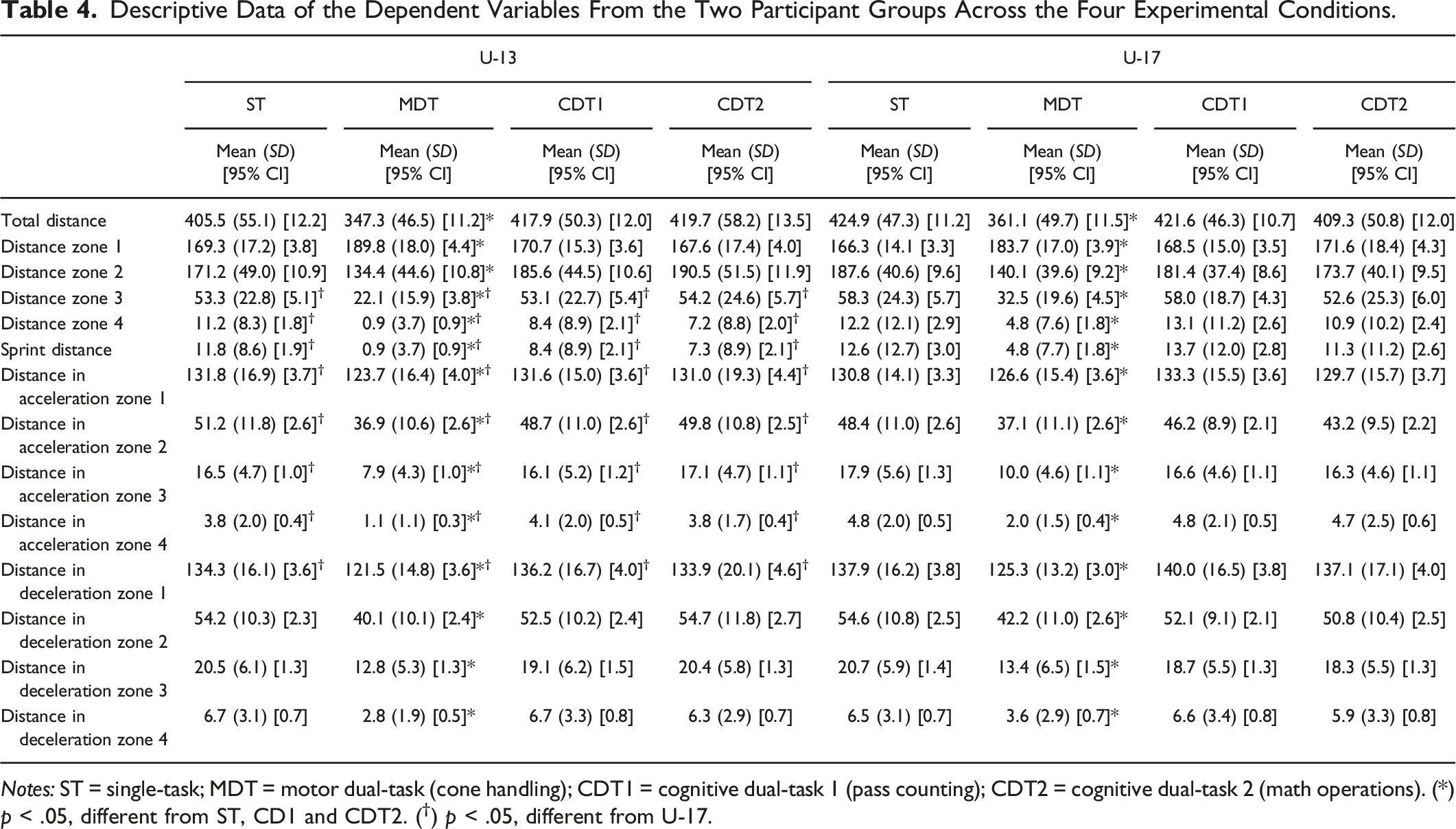
Notes: ST = single-task; MDT = motor dual-task (cone handling); CDT1 = cognitive dual-task 1 (pass counting); CDT2 = cognitive dual-task 2 (math operations). (*) p < .05, different from ST, CD1 and CDT2. (†) p < .05, different from U-17.
Between-group differences were found in sprint distance, F (1, 537) = 30.652, p < .001, η2p = .052, small effect, power = 1.000, distance in speed zone 3, F (1, 537) = 9.007, p = .003, η2p = .016, no effect, power = 0.850, distance in speed zone 4, F (1, 537) = 29.792, p = <0.001, η2p = .050, small effect, power = 1.000, distances in deceleration in zone 1, F (1, 537) = 6.753, p = .010, η2p = .012, no effect, power = 0.737, distances in acceleration in zone 1, F(1, 537) = 10.489, p = .001, η2p = .018, no effect, power = 0.899, distances in acceleration in zone 2, F (1, 537) = 3.914, p = .048, η2p = .007, no effect, power = 0.506, distances in acceleration in zone 3, F (1, 537) = 29.113, p < .001, η2p = .049, small effect, power = 1.000, and distances in acceleration in zone 4, F(1, 537) = 25.486, p < .001, η2p = .043, small effect, power = 1.000. Except for distances in acceleration in zone 1, all values were higher in the more experienced group, although negligible effect sizes were observed concerning acceleration-related variables.
Within-group differences (effect of task condition) were reported for all dependent variables. The motor dual-task condition showed a lower players’ physical performance than all other protocols, F (3, 537 ranging from 5.551 to 90.321, p < .001 for all variables, η2p ranging from 0.026 (small effect) to 0.325 (large effect). There was no dual-task detrimental effect in secondary cognitive protocols. Also, there were no differences between the two proposed secondary cognitive task conditions.
Discussion
In this study, we assessed the influence of players’ experience level on dual-task cost during small-sided games (SSGs) and compared players’ performance between SSGs with motor and cognitive secondary tasks and on tasks with more and less specific secondary tasks. We observed no significant interactions between player experience levels and task conditions. Contrary to our initial hypothesis, experience level did not alter the response to dual tasks. There was a higher dual-task cost in the motor dual-task condition compared to all other conditions, supporting our hypothesis in this regard. However, contrary to our initial hypothesis, cognitive dual tasks did not significantly impact physical performance, and the null effect was consistent across specific and non-specific secondary cognitive tasks.
Traditionally, experts tend to outperform novices in dual-task scenarios with decision-making tasks (Qiu et al., 2018; Zoudji et al., 2010). Experts’ ability to allocate fewer attentional resources to the primary task, which is expected to be automated, seems to alleviate the demands on their working memory (Vaughan & Laborde, 2020). However, our results revealed a different pattern in which we found no expertise-task type interaction effect. To elucidate this unexpected outcome, we should address two pertinent issues. First, we should consider that the primary task in our study involved participation in a small-sided game (SSG). SSGs are typically regarded as highly representative of match-play requirements from a technical-tactical perspective (Clemente et al., 2020; Clemente & Sarmento, 2020; Fernández-Espínola et al., 2020). The attentional demands in this scenario may differ from those observed in the primary tasks utilized in prior studies. Whereas some studies employed closed technical tasks, such as juggling (Laurin & Finez, 2020), others adopted computer-based laboratory tasks (Qiu et al., 2018). In both of these past scenarios, the primary task demanded a high level of attention with demands that may be higher than those encountered in a small-sided game (SSG), as the number of elements to be simultaneously processed is higher in game-based tasks than in an isolated juggling one. Conversely, SSGs may allow players to shift their attention from the primary stimuli, which is the game itself, to secondary tasks of a cognitive nature, without substantially compromising their SSG performance. We acknowledge, however, that shifts of attention were not measured in the current study. Future studies could adopt the scanning behavior (Van Maarseveen et al., 2018) as a measure for attentional shifts and adequately address this issue.
In addition to the nature of the tasks across different studies, we should consider participants’ characteristics. Our less experienced players were not novices in performing the main task. A similar paradigm was employed by Murta et al. (2022) in that the distinctions between their players with greater and lesser experience were also less pronounced. Indeed, adopting small-sided games over the training process is a widely recognized method in youth athletes’ development (O’Connor et al., 2017). SSGs are also frequently adopted as an assessment tool in youth soccer (Fenner et al., 2016; Klingner et al., 2022; Rechenchosky et al., 2021). Therefore, even if more experienced players are expected to show a higher physical, technical, and tactical performance on such a task (Fransen et al., 2017; Harley et al., 2010; Rebelo-Gonçalves et al., 2017), the less experienced ones might show high levels of familiarity and task automatization. Consequently, differences may be less prominent in studies with these participant groups compared to previous investigations that more clearly adopted distinct experts and novices in their study designs (Qiu et al., 2018).
Regarding our second objective for this study, we observed that the motor dual-task condition did result, as we expected, in a greater impact on physical performance than cognitive dual tasks. Since the secondary task involved manual cone control, we anticipated and confirmed an adverse effect on physical performance. This finding was consistent with that of Beurskens et al. (2016). The main explanation for this outcome is the greater processing competition between two tasks when both require complex movements.
On the other hand, some past literature has suggested that secondary cognitive dual-tasks reduce cognitive performance compared to single-task conditions (Broeker et al., 2018; Laurin & Finez, 2020), leading to impaired decision-making time and reaction time. Interestingly, we did not find cognitive dual tasks to decrease physical performance compared to the single-task condition. Different reasons can be proposed to explain this unexpected outcome. First, it has been shown previously that experts might rely less on working memory during dual-task conditions compared to novices (Zoudji et al., 2010). As previously argued, although our players had different experience levels, none of them can be considered novices at playing soccer. Indeed, previous studies with similar populations found a high level of tactical performance during small-sided games for U-17 (Rochael & Praça, 2023), U-15 (Moniz Carvalho et al., 2021; Sousa et al., 2019), and U-11 (Castelao et al., 2014) soccer players. Therefore, the cost in the working memory caused by adding a cognitive task to the primary activity (i.e., playing soccer) could be mitigated by these players’ high ability in the primary task (Laurin & Finez, 2020). Also, we found the attentional control required for the dual task to be lower than in previous investigations (Laurin & Finez, 2020), as our players could maintain the game pace while directing their attention toward the visual stimuli at the sidelines. Therefore, instead of simultaneously attending to both tasks, they might have prioritized the additional task when visual information was available. Task prioritization in dual tasks has been previously reported in texting and walking (Plummer et al., 2015) and in driving (Jansen et al., 2016). On the other hand, prioritizing the secondary task would be harder in the juggling task (Laurin & Finez, 2020), as the ball would touch the floor when the attention was diverted from the primary task. Therefore, employing cognitive dual-tasks in game-based tasks in team sports, such as soccer, might produce different results than in laboratory or closed skills conditions, suggesting a need for caution when translating results from laboratory to practice. This rationale can also be applied to understanding the absence of differences between tasks that varied in their specific relation to secondary task conditions.
Practically, practitioners can derive two other key implications from the present findings. First, although mental fatigue was not directly measured, there is a possible connection between it and the engagement in dual tasks (O’Keeffe et al., 2019). Previous investigators showed a deleterious effect of mental fatigue on tactical performance (Badin et al., 2016; Gantois et al., 2020), but no decreases in physical performance were observed when players were under mental fatigue in game-based protocols (Badin et al., 2016). Therefore, despite poor decision-making, sports players may maintain sufficient attention to primary tasks under dual-task conditions. Hence, it is necessary to analyze players from a multidimensional perspective when proposing dual-task training. From the standpoint of physical conditioning, adding cognitive dual tasks does not seem likely to reduce physical performance; however, adding cognitive dual tasks can promote improvements in the cognitive processes that underpin decision-making (Moreira et al., 2021). More interestingly, players in our study showed similar physical performances under specific and non-specific secondary task conditions. Yet, attending to secondary information has been found to affect performance differently, depending on how extraneous the distractor (the secondary task) is (Diekfuss et al., 2016). Therefore, future investigators should explore different sources of information when providing additional tasks, in the form of informational constraints (Travassos et al., 2012), aligning the dual-task training with the session’s purpose. For example, one would anticipate a heightened internal focus of attention when the secondary task involves monitoring the number of times a player uses the inside of their foot to touch the ball, potentially resulting in reinvestment and increased cognitive exertion (Diekfuss et al., 2016), compared to a generic counting-back secondary task. It appears worthwhile to explore whether such differences exist and how they impact skill acquisition.
Limitations and Directions for Further Research
Despite its innovations, this study had several limitations. First, in the primary task engagement of game-based versus laboratory scenarios, ensuring players’ attention to the secondary task was impossible. Although we measured players’ performance on the additional task, we had no way to ensure that they engaged simultaneously in both the secondary and the primary tasks, because there are no clear cut-off criteria for error indexes on the secondary tasks – an area that needs to be investigated in future research. Also, we did not measure the mental load of the cognitive tasks, and it is unclear whether they carried similar working memory demands. Additionally, recent investigators highlighted the value of gathering eye-tracking information from ecologically representative scenarios (Van Maarseveen et al., 2018). In future studies, in situ, eye-tracking measures could be collected to infer attentional information from dual-task conditions. Finally, differences between U-13 and U-17 participants could be explained by expertise and maturational levels. Therefore, future studies should standardize maturational levels in a between-subject design with different levels of expertise (e.g., national level versus regional level players).
Conclusion
Within the realm of small-sided games and dual-task training, we found that more experienced soccer players did not exhibit a greater ability to mitigate the dual-task cost to their physical performance than their less experienced counterparts. Additionally, we found that including a secondary motor task, but not secondary cognitive tasks, diminished physical performance among experienced and less experienced players. There were no discernible distinctions in the impact on players’ physical performances between extraneous and, more specifically sport, sport-related cognitive secondary tasks.
Based on our findings, we suggest that incorporating cognitive secondary tasks during small-sided games (SSGs) in soccer can enhance mental workload and potentially lead to long-term benefits of dual-task training. This approach appears to be independent of players’ experience levels. However, implementing motor dual-tasks may temporarily impair physical performance, potentially hindering long-term physical adaptations. Exploring specific secondary tasks holds promise for manipulating players’ attentional focus without affecting their current physical workload.
Footnotes
Declaration of Conflicting Interests
The author(s) declared no potential conflicts of interest with respect to the research, authorship, and/or publication of this article.
Funding
The author(s) disclosed receipt of the following financial support for the research, authorship, and/or publication of this article: This work was supported by the Fundação de Amparo à Pesquisa do Estado de Minas Gerais, APQ-00231-21.


