







Abstract
Introduction
Women’s rugby sevens has recently seen significant global growth, with increased resources and rising popularity driving participation rates worldwide (Brosnan et al., 2022; World Rugby, 2017). Many professional female players now work as full-time athletes, dedicating themselves exclusively to the specific demands of rugby sevens (Henderson et al., 2018).
The sport is characterized by its high-intensity, intermittent nature, involving repeated bouts of maximal effort interspersed with periods of lower intensity and rest (Koudela et al., 2025). However, the movement demands of match play in women’s rugby sevens remain insufficiently explored. There is a pressing need for more research on factors such as contextual influences, development pathways, and player-level comparisons. The elucidation of these factors would enable more informed decision-making in athletes’ physical preparation, thereby enhancing the level of professionalism in the sport (Ball et al., 2019; Brosnan et al., 2022; Clarke et al., 2017; Goodale et al., 2017; Sella et al., 2019). This information could assist coaches in designing more specific training programs, refining load management methods, and improving talent identification and recruitment processes.
Time-motion analysis using Global Positioning System (GPS) technology is commonly employed in rugby to assess the external load experienced by players during matches and training sessions (Austin et al., 2011; Bicudo, Figueiredo, Araújo et al., 2024; Bicudo, Figueiredo, Cambri et al., 2024; Higham et al., 2012; Lacome et al., 2019; Quarrie et al., 2013; Ross et al., 2015; Tee et al., 2016). External load is defined as the physical work prescribed in the training plan, and is determined by the organization, quality and quantity of exercise (Impellizzeri et al., 2019; McLaren et al., 2018). In team sports, external load is typically measured through metrics such as distance covered, accelerations, and other performance indicators (Bicudo, Figueiredo, Cambri et al., 2024; Granatelli et al., 2014; Impellizzeri et al., 2019). This enables coaches and sports scientists to accurately quantify player load (Crang et al., 2020; Cummins et al., 2013; Malone et al., 2017). Quantifying movement demands through GPS helps coaches design training sessions that are tailored to the specific demands of competition, ultimately enhancing player performance (Ullersperger et al., 2023). Following a game, GPS data can also be used to monitor player fatigue and ensure recovery strategies are aligned with individual load demands (Bicudo, Figueiredo, Cambri et al., 2024; Furlan et al., 2015; Granatelli et al., 2014; Hoppe et al., 2018; Jones et al., 2015; Whitehead et al., 2018).
Traditionally, movement demands in rugby have been quantified using absolute values over the course of an entire match or half-times. However, relying on these values for training prescription can lead to an underestimation of peak demands during the ball-in-play (BIP), leaving athletes underprepared (Cunningham et al., 2018; Delaney et al., 2015; Sheppy et al., 2020; Ullersperger et al., 2023). A more sensitive method is required to more accurately assess the intensity of efforts performed by players and avoid underestimation (Delaney et al., 2015). One alternative is to analyze intensities during ball-in-play (BIP) periods, which considers only the time when play is actively ongoing, excluding stoppages such as penalties, conversions, and injury time (Duthie et al., 2005; Pollard et al., 2018). Compared to whole-match analysis, BIP-based metrics show significantly higher intensities, and many authors recommend prioritizing this method when analyzing external load metrics derived from GPS data (Bicudo, Figueiredo, Araújo et al., 2024; Bicudo, Figueiredo, Cambri et al., 2024; Brosnan et al., 2024; Ren et al., 2024; Whitehead et al., 2018).
Another key question researchers (Brosnan et al., 2024; Granatelli et al., 2014; Murray et al., 2015; Vescovi & Goodale, 2015) aim to address is the comparison between the demands of matches as the tournament advances. It is well-established that rugby sevens tournaments can lead to cumulative fatigue across matches. Vescovi and Goodale (2015) highlighted that repeated high-intensity efforts across multiple matches can significantly affect player performance. They found that players in later stages, particularly during knockout matches, tend to show reduced total running distances and fewer sprint efforts due to accumulated fatigue. Similarly, Granatelli et al. (2014) observed a decline in high-speed running as players progress through a tournament, suggesting that fatigue can influence match outcomes, particularly in crucial knockout rounds. It is important to note that in Rugby Sevens tournaments, the interval between matches can vary from 1 hour and 20 minutes to 3 hours. Moreover, Brosnan et al. (2024) specifically analyzed fatigue patterns in women’s rugby sevens, noting that while female players maintain high intensity in early stages, a significant reduction in sprint distance and accelerations occurs as the tournament progresses. Some studies have also shown a tendency for work rates to decline even during individual matches or game-based training sessions, and that the typical two-minute halftime break is insufficient for complete recovery (Ball et al., 2019; Bicudo, Figueiredo, Cambri et al., 2024; Goodale et al., 2017).
Despite these findings, it is important to note that most of the studies mentioned previously relied on traditional whole-match averages. Consequently, a reduction in total distance and other metrics could stem from shorter BIP times during those matches, which may lead to a misinterpretation of intensity metrics. Research exploring differences in BIP time between pool stage and knockout matches highlights discrepancies compared to earlier conclusions. Higham et al. (2012) and Suarez-Arrones et al. (2012) found that men’s knockout stage matches typically have shorter BIP times due to increased fatigue and a more strategic, less free-flowing style of play. Despite the reduced BIP times, players tend to cover greater distances at high speeds, reflecting these matches’ heightened intensity and competitiveness.
Research specifically comparing external load in BIP demands between pool and knockout stages is limited, and, to our knowledge, no studies have explored this topic in women’s rugby sevens. Therefore, this study addressed this gap by comparing BIP times and external load demands (meters per minute, sprint distance per minute, and accelerations per minute) between pool and knockout matches in professional women’s rugby sevens. By analyzing data from the 2023 Super Sevens Championship, this study seeks to provide valuable insights to help strength and conditioning coaches better understand BIP demands at different stages of the competition. This, in turn, will enable the development of more tailored training programs for women’s athletes and contribute to the growing research on women’s rugby. We hypothesize that BIP times will be shorter in knockout matches; however, we expect the overall BIP demands to remain consistent between pool and knockout stages due to the high-intensity nature of the game.
Method
Study Design
An observational approach was used to assess the BIP running demands of rugby sevens athletes during the four tournaments of the 2023 Super Sevens, the Brazilian First Division National Rugby Sevens Championship, held every 3–4 weeks from September to December 2023. Athletes were monitored during pool stage matches (n = 12) and knockout matches (n = 8). A total of 20 official matches were analyzed, with data collected from all 12 players per match (average of 12.63 matches played by each player during the season), resulting in 240 match files. Each tournament comprised five matches: three pool stage games on the first day and two knockout matches (semi-finals and final) on the second day. All matches followed standard Rugby Sevens rules, consisting of two 7-min halves and a 2-min halftime break.
Participants
This study involved 21 full-time female professional rugby sevens players from the same team, with an average age of 25.4 ± 6.0 years, selected by convenience. The participants were classified at tier 4 of the participant classification framework, reflecting their competitive level in the sport (McKay et al., 2022). Their average experience in rugby sevens was 5.0 ± 2.6 years, with 3.0 ± 0.9 years of professional experience. These athletes competed at national (Brazil) and international levels, with a weekly routine that included four 60-min strength training sessions, 5–7 on-field training sessions lasting 45–75 minutes each, and two rest days on Wednesdays and Sundays. Physical assessments conducted 2 weeks before the competition yielded average results of 4.92 ± 0.20 seconds in the 30-m sprint test, 109.00 ± 16.79 kg in the 1RM squat test, and 2.14 ± 0.17 m in the broad jump test. To qualify for the study, participants had to meet the following criteria: (i) participation in at least one match of the 2023 Super Sevens Championship, (ii) absence of injuries or illnesses during the 16 weeks preceding or throughout the study, and (iii) membership in the team prior to the study’s commecement. The exclusion criteria included: (i) sustaining an injury during a match or warm-up and (ii) terminating the contract with the team during the season. No athletes were excluded from this study.
Measures
External load was assessed using Playertek+ Pods® (Catapult Sports, Australia), with firmware version J3.20–20190527-H1.8-20180703. The devices operated at 10 Hz for both GPS and GNSS systems, with an inertial sampling rate of 400 Hz and data recorded at 100 Hz. Each Pod featured a Cortex-M4 CPU and a triaxial accelerometer sampling at ±18 g and 400 Hz. Data were downloaded using the Playertek Sync tool (version 5.66 (1)), while time splits were processed with Playertek+ software (version 1.3.9). The software versions remained unchanged throughout the study. Efforts were included in the analyses if they lasted a minimum of 0.3 seconds for accelerations and 0.5 seconds for sprints. A moving average with a 5-point window was applied to smooth the data. Additionally, manual inspections were performed to detect irregularities, while variability checks, trajectory analyses, and velocity analyses were conducted to identify unrealistic spikes. Previous investigations have documented 10-Hz GPS units’ validity and reliability on distance and velocities across linear and team sports circuits (Akenhead et al., 2014; Brosnan et al., 2022; Coutts & Duffield, 2010). Although no studies have specifically assessed the validity and reliability of Playertek devices, research has compared their performance to other GPS devices, demonstrating acceptable agreement (Wilson, 2021). Furthermore, after a rigorous series of trials, Playertek devices have been approved by World Rugby for use in games and training sessions (World Rugby, 2025). Each GPS device was securely placed in a specially designed harness positioned on the players’ upper backs. The devices were activated 15 minutes before the match began and deactivated immediately after its conclusion. All players were familiar with this technology, as it had been incorporated into their regular training sessions, and each athlete used the same equipment during the championship, to avoid inter-device variability. Following established protocols from previous research (Bicudo et al., 2024; Pollard et al., 2018; Ren et al., 2024; Ullersperger et al., 2023), we evaluated BIP duration, distance covered per minute. (m/min), sprinting distance per minute - at speeds above 18 km/h (m/min), and the number of accelerations per minute - with accelerations exceeding 3.0 m/s2 (n). Match demands were analyzed using the BIP method, which categorizes segments of play by marking the start and end of each BIP period. A session was created for each match in the Playertek+® software, and time cuts were made live through the same software to differentiate each BIP, following the protocols described by Stevens (2022). After the match, GPS data was downloaded using the Playertek Sync Tool®, exported in CSV format, and converted to XLSX. Subsequently, each BIP was filtered, and athletes on the bench during the BIP were excluded from the analysis. Additionally, efforts shorter than the minimum established duration (n = 21) were also removed from the analysis. The average demands of the BIP for each match were normalized by duration and included in the analysis.
Design and Procedures
This study adhered to the ethical standards outlined in the Declaration of Helsinki (2013) and received approval from the Human Research Ethics Committee of Universidade Federal de Mato Grosso (approval number 6.052.619; CAAE: 67661823.7.0000.8124). Prior to participation, all athletes were fully informed about the study’s objectives, potential risks, and benefits. Informed consent was obtained in writing before the study commenced.
To analyze the external load metrics during BIP time between pool stage and knockout matches, BIP duration was recorded in seconds, and the demands during BIP phases were expressed as means and standard deviations. Each match was treated as a separate session, with a researcher tracking time segments to identify individual BIP moments. Players not participating during these BIP moments, such as during warm-ups and halftime, were excluded from the analysis. A standardized warm-up routine was implemented before each match, including mobility work, dynamic stretches, strength and speed activation exercises, and rugby-specific drills. After each match, the data were downloaded using Go. Playertek® software, exported to an Excel® file and stored in a database for further statistical processing.
Statistical Analysis
The external load variables were reported as mean and standard deviation values. The Shapiro–Wilk tests confirmed the normal distribution for all variables (p > .05) and the Levene tests confirmed the homogeneity of variances (p > .05). Comparisons between pool stage and knockout matches for each variable were performed using the Paired Samples t test. Effect sizes were reported as Cohen’s d, considering effects as small (0.2–0.49), medium (0.5–0.79), and large (above 0.8) (Cohen, 1988). An alpha level of .05 was set for all statistical tests. All analyses were performed on Statistica software package version 12 (Statsoft, Tulsa, OK).
Results
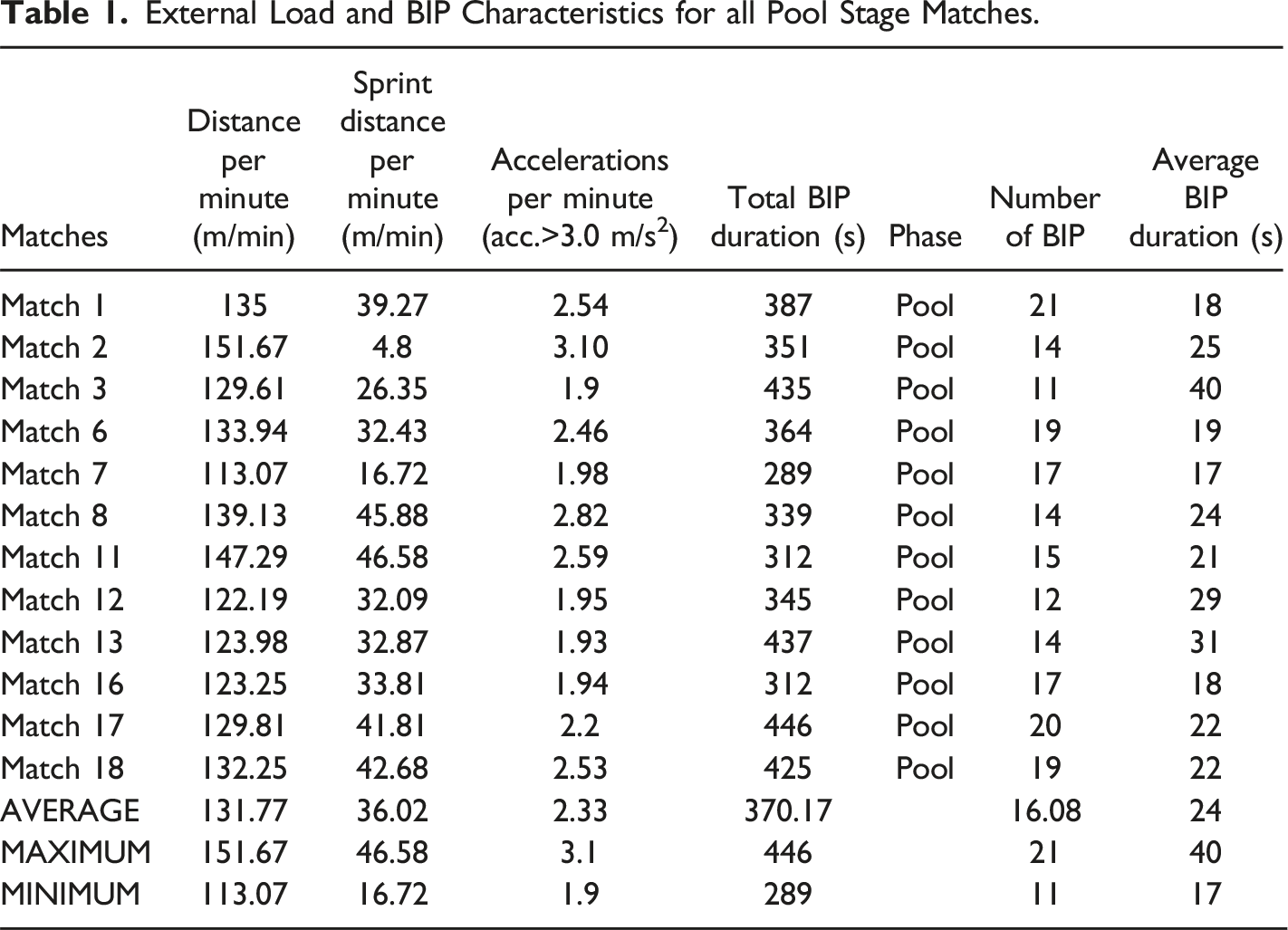
External Load and BIP Characteristics for all Pool Stage Matches.
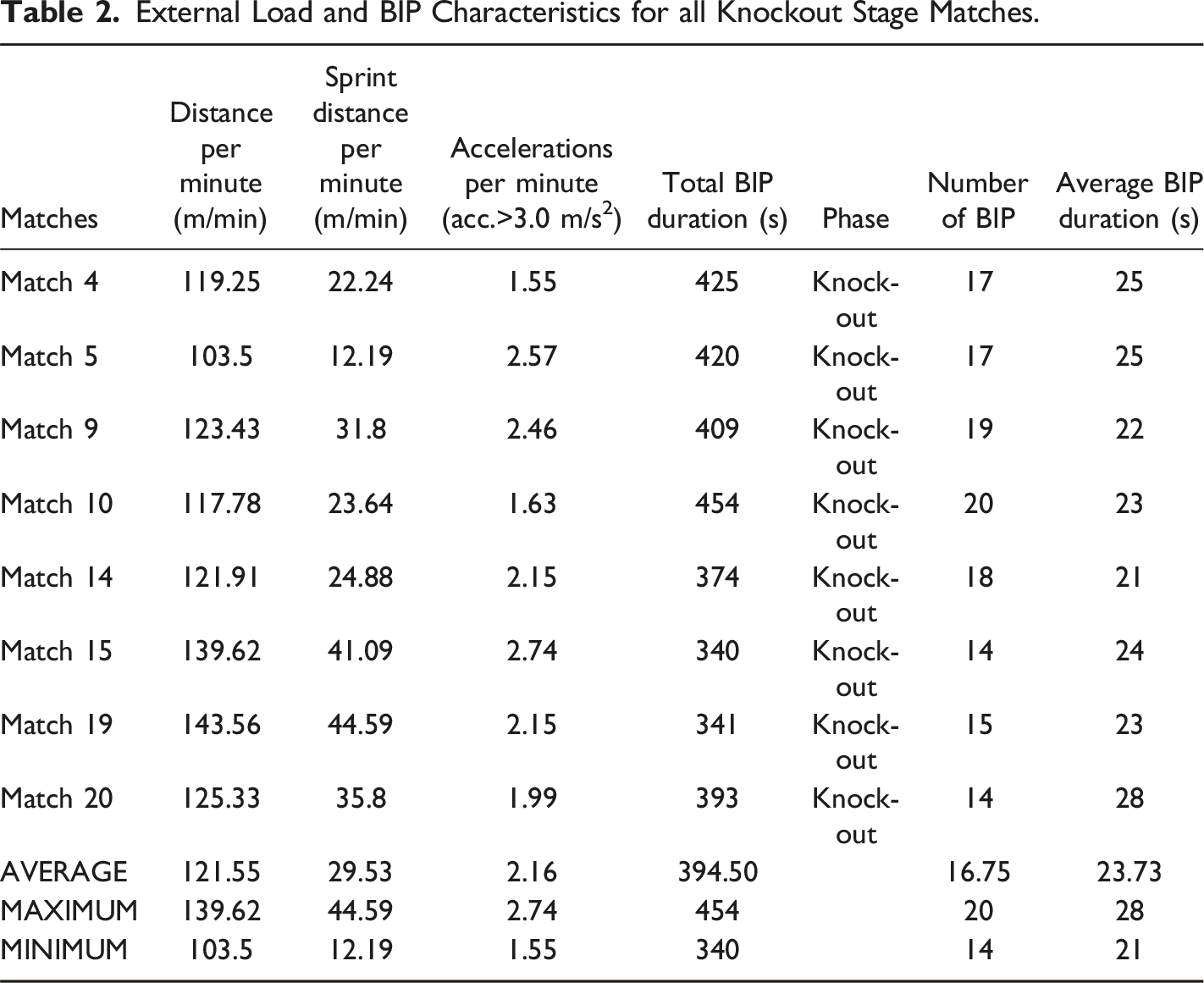
External Load and BIP Characteristics for all Knockout Stage Matches.
The analyses of Distance per minute (t = 1.539; p = .167; d = 0.544), Sprint Distance per minute (t = 1.249; p = .252; d = 0.442), and Accelerations per minute (t = 1.419; p = .199; d = 0.502) indicated no differences between pool stage and knockout stage matches, as seen in Figure 1A–C, respectively. Distance per minute (A), Sprint Distance per minute (B), Accelerations per minute (C), and BIP Duration (D) between pool stage and knockout stage matches.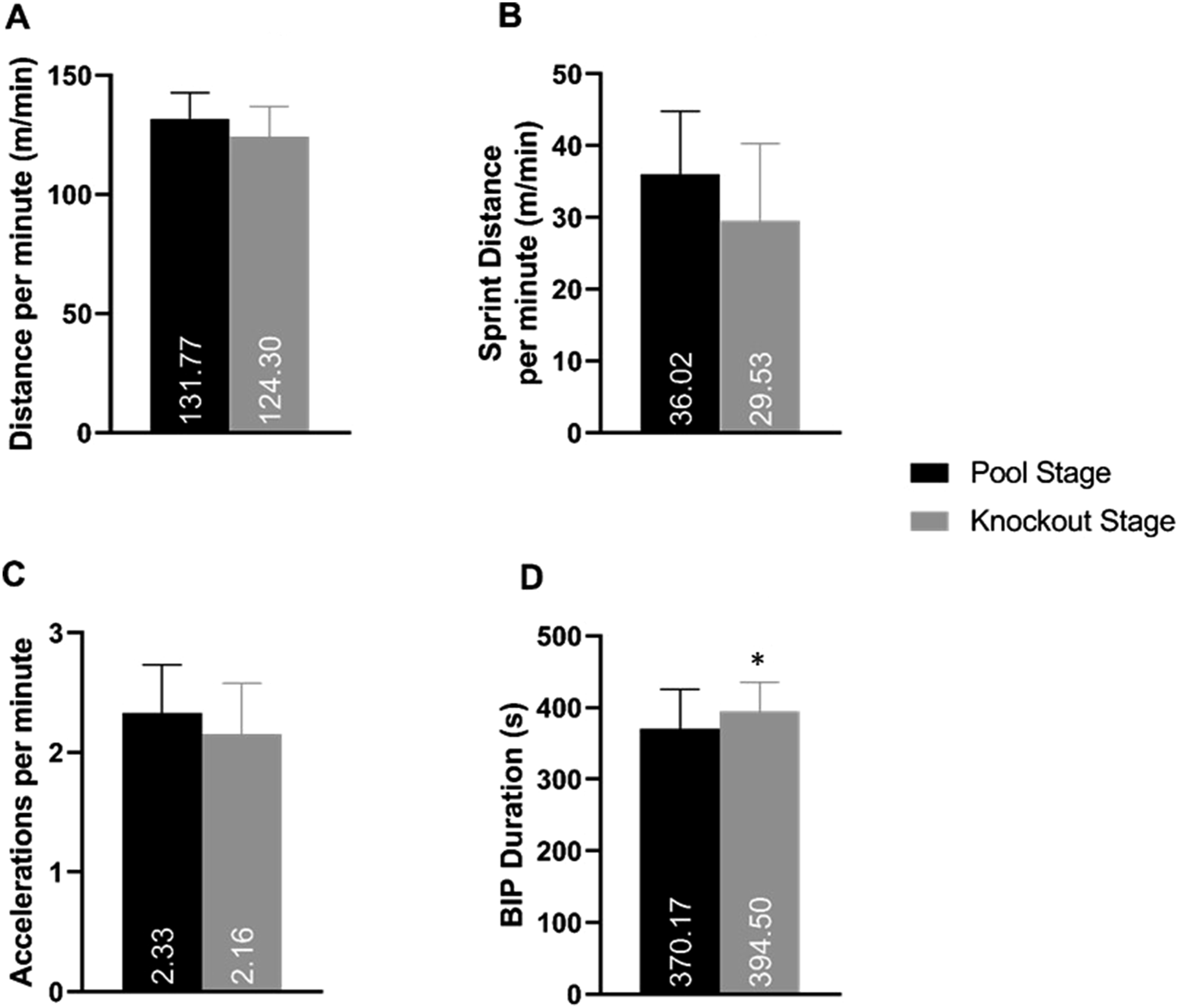
On the other hand, the analysis of the BIP Duration (t = −2.925; p = .022; d = 1.034) indicated a longer duration (6.16%) for knockout stage matches, as seen in Figure 1D.
Discussion
The present study aimed to compare BIP times and external load demands (measured as meters per minute, sprint distance per minute, and accelerations per minute) between pool and knockout matches in professional women’s rugby sevens. The findings indicated no significant differences in these external load metrics between pool and knockout stages, contrasting with previous research in men’s rugby sevens (Granatelli et al., 2014; Vescovi & Goodale, 2015), which suggested that accumulated fatigue reduces running intensity during knockout stages. Our data suggest that professional athletes maintain consistent efforts intensity across both stages of competition, despite the tournament’s high-intensity nature.
For distance per minute during BIP, values were 131.77 m/min in pool matches and 124.30 m/min in knockout matches (p = .167). Sprint distance per minute registered 36.02 m/min during pool stage matches and 29.53 m/min during knockout matches, showing a reduction of almost 18.05%, but with no significant differences (p = .252). This finding is inconsistent with previous studies (Brosnan et al., 2024; Granatelli et al., 2014; Higham et al., 2012) who registered an reduction on external load as the tournament advances. Similarly, no significant differences were found in accelerations per minute (p = .199), indicating consistent performances despite potentially greater fatigue levels.
A significant difference in BIP times was found between pool and knockout matches, with longer BIP times in knockout matches. On pool stage matches, the BIP moments represented 44.08% of the total time. In knockout matches, it represented 52.08% of the match. Just to date, the BIP proportion found on knockout matches are not far from values from 2020 Olympic Games, which possessed an average proportion of 52% of the match with the BIP (World Rugby, 2020). This highlights the potential differences between BIP times in rugby sevens and rugby xv (37%), as demonstrated by Read et al. (2018). Those findings also contradicts previous studies that registered shorter BIP times and more tactical play in later stages (Higham et al., 2012; Suarez-Arrones et al., 2012). Those differences may be result of less points scored by teams on knockout matches (an average of 23.5 point per match), when compared to pool stage matches (an average of 30 points scored per match on pool stage). Is important to considere that when a try is scored, the scoring team have 30 seconds to execute the conversion and more 30 seconds to realize the kickoff, generally pausing the game for a full minute. On the other hand, all other pauses (to execute scrums, or line-outs) are limited to 30 seconds. Therefore, one possibility is that a greater quantity of tries scored could result in less BIP times during the match. Other possibility is that as the quality of the opposition team increased, the game could have became more demanding, alingning with the findings of Murray et al. (2015), who demonstrates that when playing against higher-hanked opposition, players tend to cover greater total distance per match. The hypothesis is that the same could happens on the present study, however it’s important to note this previous study analyzed external load using methods that not differentiate moments of ball out of play, and, therefore results of relative metrics could be affected by an lower or greater time of BIP during the analyzed matches.
Despite the lack of significant differences between pool and knockout match demands, all external load variables showed medium effect sizes for distance per minute, small for sprint distance per minute, and medium for accelerations per minute. This suggests that analyzing a larger number of matches could reveal significant differences, indicating a limitation of the present study. Another limitation is that BIP durations were not associated with match outcomes or technical and tactical patterns via video analysis. Such analyses could provide insights to help coaches understand how differences in BIP times could be related to other variables. Further research could explore factors like psychological stress or tactical shifts during knockout matches to better understand performance variations. Another direction would be analyzing both teams within a match to explore the relationship between external load and match outcomes.
In summary, our study provides new insights by focusing on BIP demands rather than whole-match averages, offering a more precise understanding of the intensity athletes experience during active play. By exclusively analyzing BIP phases, we provide a more accurate reflection of the average intensities players endure, crucial for developing specific conditioning programs. Strength and conditioning coaches can use information about external load variables and BIP durations to understand the specific demands of women’s rugby sevens better, focusing on training programs that use sport-specific drills to increase and maintain high-intensity efforts, particularly under fatigue, and aiming to create methods of load control that consider specific demands of the BIP.
Conclusion
This study found that external load demands (measured by distance per minute, sprint distance per minute, and accelerations per minute) do not significantly differ between pool and knockout stages in professional women’s rugby sevens. However, knockout matches are characterized by longer ball-in-play durations, suggesting that players must maintain high-intensity efforts for extended periods. These findings highlight the importance of tailored training interventions focusing on sustaining performance under fatigue conditions and emphasize the value of analyzing BIP metrics to avoid underestimating match demands. Future research should explore other factors influencing physical performance during knockout stages, such as total BIP time across the match, final score, effect of substitutions, and technical or tactical components. This research contributes to the growing body of knowledge on women’s rugby and offers practical implications for coaches aiming to optimize athlete performance during tournament play.
Footnotes
Declaration of Conflicting Interests
The authors declared no potential conflicts of interest with respect to the research, authorship, and/or publication of this article.
Funding
The authors received no financial support for the research, authorship, and/or publication of this article.
