






Abstract
In many parliamentary democracies, incumbents can call early elections. This is thought to provide incumbent governments with an advantage due to the ability to time elections to favorable economic conditions. This article explores an additional incumbency advantage of early elections. Due to information asymmetry about election timing, government parties can better plan fundraising and campaign spending in early elections years compared to nongovernment parties giving government parties a relative financial advantage. This argument is tested on campaign-spending data from British parliamentary candidates 1950–2019. The results supports the argument. Government party candidates gain a relative financial advantage in early elections years compared to scheduled election years. The effect is found only for non-incumbent candidates and may have been eliminated by the Fixed-term Parliaments Act of 2011, which removed government election-calling power. The results suggest that government election-calling power provides incumbent parties with a relative financial advantage.
Introduction
Do early elections give a financial advantage for government parties? In many parliamentary democracies, incumbent prime ministers have considerable influence over the timing of elections and can call early election before the parliament’s term formally expires (Goplerud and Schleiter, 2016). The ability to time elections to favorable opinion polls and/or favorable economic circumstances 1 is often thought to provide incumbent governments with benefits, as supported by recent research (Schleiter and Belu, 2018; Schleiter and Tavits, 2016). However, see Smith (2003) for a contrarian view. 2
This article explores another potential advantage of early election calling for incumbent parties, a relative advantage with regards to campaign funding and spending. The link between early election calling and the incumbency advantage in campaign funding has received limited attention both in the literature on early election calling (Kayser, 2005; Schleiter and Tavits, 2016; Schleiter and Tavits, 2018) and that on the incumbency advantage in campaign finance (Fouirnaies and Hall, 2014; Potter and Tavits, 2015; Samuels, 2001). Recent exceptions are Aaskoven (2020) who studied the effect of early elections on Danish political parties’ funding and found that government parties experience a relative gain in private contributions in early elections years compared to scheduled elections, as well as McClean (2021) who found that early elections have a negative effect on opposition campaign spending in Japan.
This article expands this research agenda on the incumbent financial advantage of early elections and provides new testing ground for this argument. It is based on the argument that when election calling is the prerogative of the incumbent prime minister, the information asymmetry with regards to election timing in early election years gives government parties more time to plan and carry out fundraising activities, as well as for planning campaign expenses relative to non-government parties. This should provide government candidates with a relative advantage in campaign spending in early election years compared to scheduled election years.
This argument is tested on a dataset of campaign expenses from United Kingdom (UK) MP candidates in all lower house (House of Commons) parliamentary elections from 1950 to 2019. The results provide substantial evidence in favor of the argument. Even holding party, constituency and individual candidate constant, government party candidates gain a financial advantage, relative to non-government candidates, of several hundred British pounds in early election years compared to scheduled election years. Analyses of heterogenous effects reveal that only non-incumbent candidates benefit from this advantage, suggesting that government parties strategically use their relative financial advantage to target campaign expenses toward constituencies held by the opposition. An additional analysis suggests that the Fixed-term Parliaments Act of 2011, which took the power to call early elections away from the incumbent prime minister, has eliminated the financial advantage for government parties in the UK. As such, this article investigates not only the potential financial advantage of the executive election-calling power but also the campaign financial consequences of the loss of this power. The article’s results suggest that high incumbent election-calling power provides incumbent governments with an additional advantage over opposition parties beyond being able to call elections during favorable economic conditions and high government popularity, which may be relevant for normative and policy discussions about the desirability of the high executive election-calling power.
Theory
This section describes the theoretical background for why we should expect a financial advantage for government parties in early election years. One key assumption behind the proposed effects of these early elections is that the early elections are planned and timed by the incumbent chief executive and are thus “opportunistic” in nature (Beckman and Schleiter, 2020). If an early election is unforeseen by the incumbent, for example, resulting from an unexpected vote of no confidence, we should not expect the mechanisms below to hold.
The key mechanism behind a government party’s financial advantage in early election is the level of information asymmetry about election timing between government and non-government parties. 3 In parliamentary democracies, if the executive possesses at least some electoral calling power, then there is a potential information asymmetry about specific election timing if the election is held before the parliament’s term expires 4 (Aaskoven, 2020: 647; McClean, 2021). Presumably, an incumbent executive might know at least weeks and even months in advance that an early election is coming and might share this information with co-partisans and/or central and local party organization(s) sometime before the election is officially announced. Even when non-government parties anticipate an early election – for example, from rumors and leaks from the prime minister’s office – they have access to less certain information about this than government parties and their MP candidates who have more direct access to the prime minister. 5 So, the information asymmetry between government parties and non-government parties with regards to early elections is not only about the possibility of an upcoming early election but also about the certainty of this possibility.
This information asymmetry gives government party members, including MP candidates and the central party organizations, more time to plan fundraising activities than non-government parties in early elections years. This includes contacting previous party donors and activating fundraising networks (Aaskoven, 2020: 674–675).
It is assumed that most party organizations and private donors to political parties budget the majority of their campaign contributions and campaign funds to years of scheduled elections. Consequently, they might not be able or want to antedate all of these funds in years of early elections, when the actual occurrence of such an election is uncertain. As a consequence, the baseline level of campaign contributions, and thus campaign spending, should be lower in early election years than in years of scheduled elections (Aaskoven, 2020: 673–674). However, the more early fundraising activities of government parties should enable them to partly “close the gap” with regards to campaign contributions in early election years. This is also due to the fact that signals about a current increased demand for campaign contributions due to an upcoming early election might be more credible coming from a government party, whose political leader is actually able to call such an election, than when coming from non-government parties. Consequently, non-government parties should receive a lower level of campaign funding in early election years as opposed to scheduled election years, and campaign funding levels should exhibit a greater gap between government and non-government parties in early election years compared to scheduled election years.
Furthermore, greater knowledge about specific election timing in non-scheduled election years gives government party candidates more time to plan campaign expenses and to consequently spend more and earlier (e.g. ordering posters and other print material) on election campaigns in early election years.
Consequently, government party candidates should be able to spend more on electoral campaigns in early election years than non-government party candidates relative to scheduled election years, since they are both able to raise more funds and have had more time to plan expenses. Thus, we should expect that government party candidates have a relative campaign-spending advantage in years of early election compared to years of scheduled elections. 6
Note that the earlier argument does not entail that incumbent governments in parliamentary systems generally have an incumbency advantage with regards to campaign spending in scheduled election years or even election years in general. 7 But only that incumbent governments gain a relative spending advantage vis-a-vis non-government parties in non-scheduled as opposed to scheduled election years.
Data and estimation
To test the effects of early elections on the government party advantage in campaign spending, I rely on a dataset on UK MP candidate campaign spending collected by Fouirnaies (2021). The UK is a very suitable case for studying a relative financial advantage for government parties in early election years. While UK MP candidates face some centrally imposed spending limits (Fouirnaies, 2021), the UK has a permissive political funding regime and allows campaign contributions from a wide variety of donors including businesses, unions and individuals (McMenamin, 2011) which fit the mechanisms for how early elections enable the government party to secure more campaign funding. In addition, over the studied period, the UK went from having extremely high government election-calling power to removing this power from the discretion of the prime minister (almost) entirely with the Fixed-term Parliaments Act of 2011 which required a two-thirds majority in parliament for an early election to be held (Goplerud and Schleiter, 2016; Schleiter, 2016). This makes it possible to study the effect of early elections on party funding before and after the government power to call early elections, and thus the government-opposition information asymmetry with regards to election timing, was removed.
The dependent variable is total candidate campaign spending in constant (2020) British pounds (£), which covers both spending on advertisement, staff, meetings and other types of spending related to electoral campaigns. 8 With regards to data coverage, I include candidates from all parties in all regular UK lower house elections from 1950 to 2019, thus excluding by-elections, where the mechanisms behind the government party advantage for early elections are unlikely to be present. 9 The spending variable is skewed to the right, 10 so in Online Supplemental Appendix B, I test the robustness of the main results to using the log of the dependent variable. 11 However, the results are similar to that of the main analysis, once party characteristics are taken into account. 12
Regarding the independent variable, I code for all candidates whether they belonged to a government party at the time of the election. 13 As the other central independent variable, I construct a measure of whether the election in question can be characterized as an early or non-scheduled election.
I use two measures of early elections. One is a dummy which takes the value 1 if an election is held in another calendar year than in the one in which the parliament’s term formally expires. The other is a continuous variable measuring the number of years since the last parliamentary election at the time of the election. 14 However, as noted by Schleiter and Tavits (2016), early elections can also arise from various political conflicts (including inter- and intra-party conflicts) and other unforeseeable events. Here, we should expect the government information asymmetry advantage and consequently the financial advantage of early elections to be lower than those when an early election is called by the government for opportunistic reasons. Consequently, in Online Supplemental Appendix B, I replace the “early election” variable with the “opportunistic election” variable from the replication dataset of Schleiter and Tavits (2016). 15 However, the results here are largely similar to those of the main analysis, once party-fixed effects are taken into account.
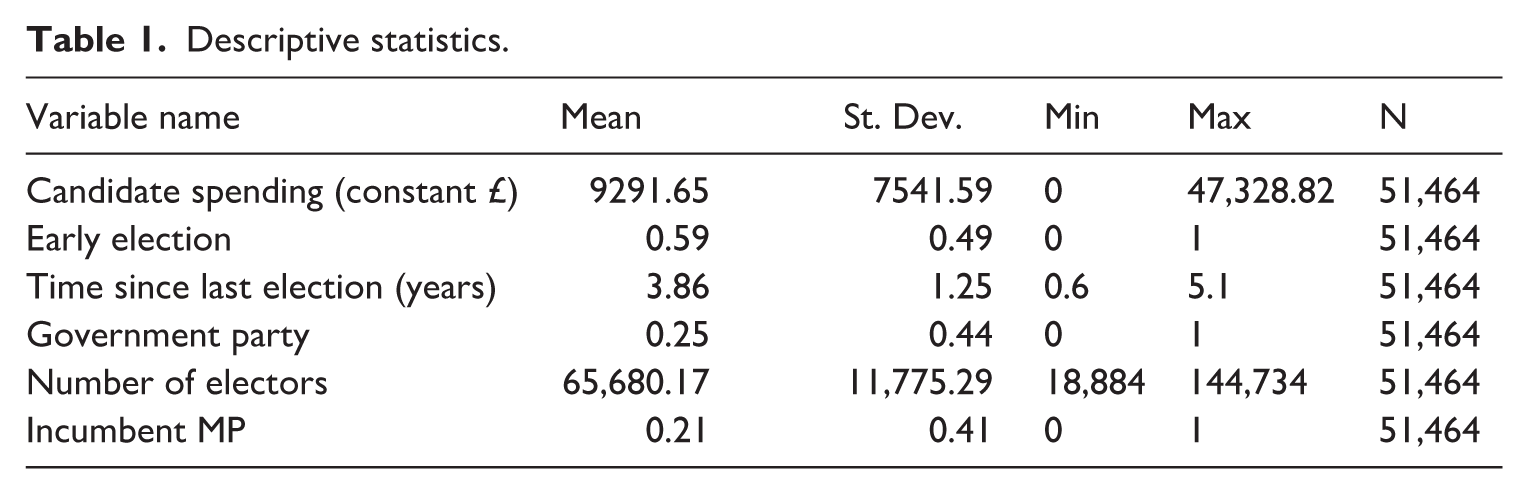
In addition, in some of the specifications, I also control for the number of electors in the constituency in which the candidate runs, as well as the party, region, constituency, candidate and year-fixed effects. Year-fixed effects also enable me to hold constant various factors that are common within each year and may be endogenously related to the prevalence of early elections such as the state of the national economy (Riera, 2015), the occurrence of national crises and even changes to UK campaign-spending regulation Fouirnaies (2021). The other fixed effects take into account that the type of governing parties and/or type of candidates running might be different between early election years and scheduled election years. Later, I also explore whether effects differ between incumbent and non-incumbent MPs. The data from these variables is also from the Fouirnaies (2021) dataset. Descriptive statistics can be seen in Table 1.
Descriptive statistics.
The estimation is done using standard ordinary least squares (OLS), with standard errors clustered at the constituency level. The estimation can be seen in equation 1 below. Here, Early is dummy for whether the year t is an early election year (or the time since last election variable in year t), and Gov. is a dummy for whether the candidate c in constituency i in year t belongs to a government party. These two variables are interacted into the third term, which is the joint effect of the government party status and the early election status. Consequently, beta3 is the estimate of interest which captures the financial advantage of early elections for government parties. Finally, X is a vector of various fixed effects (year, party, region, constituency and candidate) and the elector control variable which is added to the specifications during the analysis, while ϵ is the error term.

Main results
In Figure 1, I start by showing some descriptive statistics of average candidate spending for government party and non-government party candidates over the years covered by the analysis. 16 The results provide some evidence in favor of the government party financial advantage in early election years. In scheduled election years, government party candidates actually seem to have a slighly lower level of candidate spending compared to non-government party candidates, while government party candidates seem to spend a slighly higher amount in early election years compared to non-government party candidates. I now turn to a more systematically test of the existence of this financial advantage.
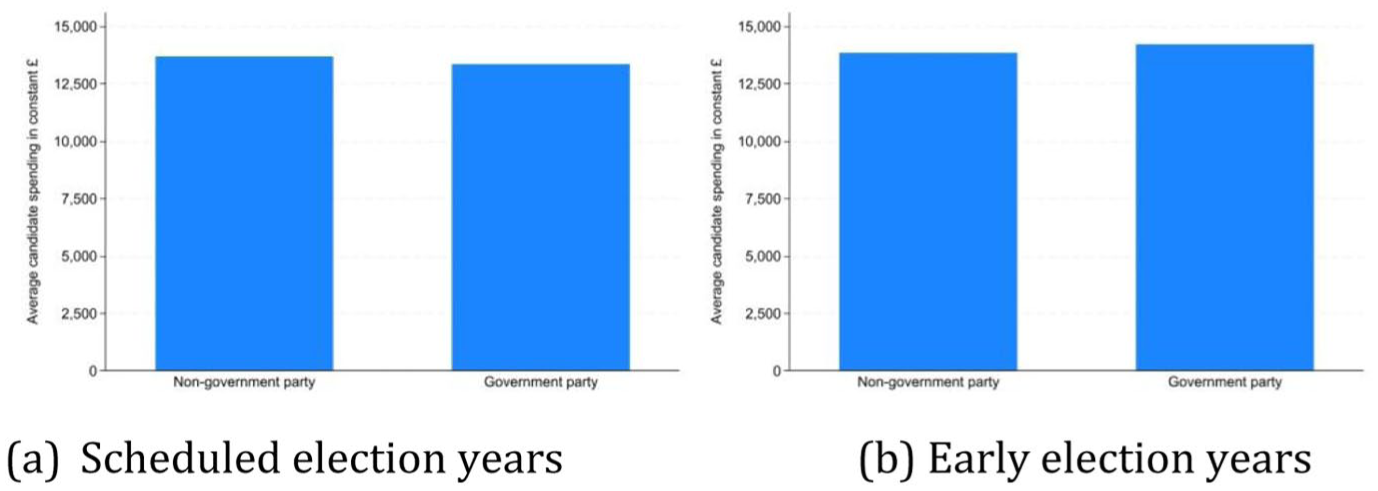
Average candidate spending 1950–2019: (a) scheduled election years and (b) early election years.
In Table 2, the estimates from the main regression analyses can be found. I focus on the main coefficient of interest, the interaction term between early election and government party status (beta3). These estimates also reveal a substantial relative government party advantage in early election years. In early election years, being a government party candidate increases that candidate’s campaign spending with about 700 British pounds. This is the equivalent of around 7.5% of average campaign spending over the period, an effect which is strongly statistically significant. When year-fixed effects are included in columns 2 and 3, however, the interaction changes sign. However, when party-fixed effects are included in columns 4–6, the sign again reverses, and – in accordance with the theoretical argument – there is a non-trivial relative government party advantage with regards to campaign spending in early election years compared to scheduled elections years.
Early elections and government party advantage.
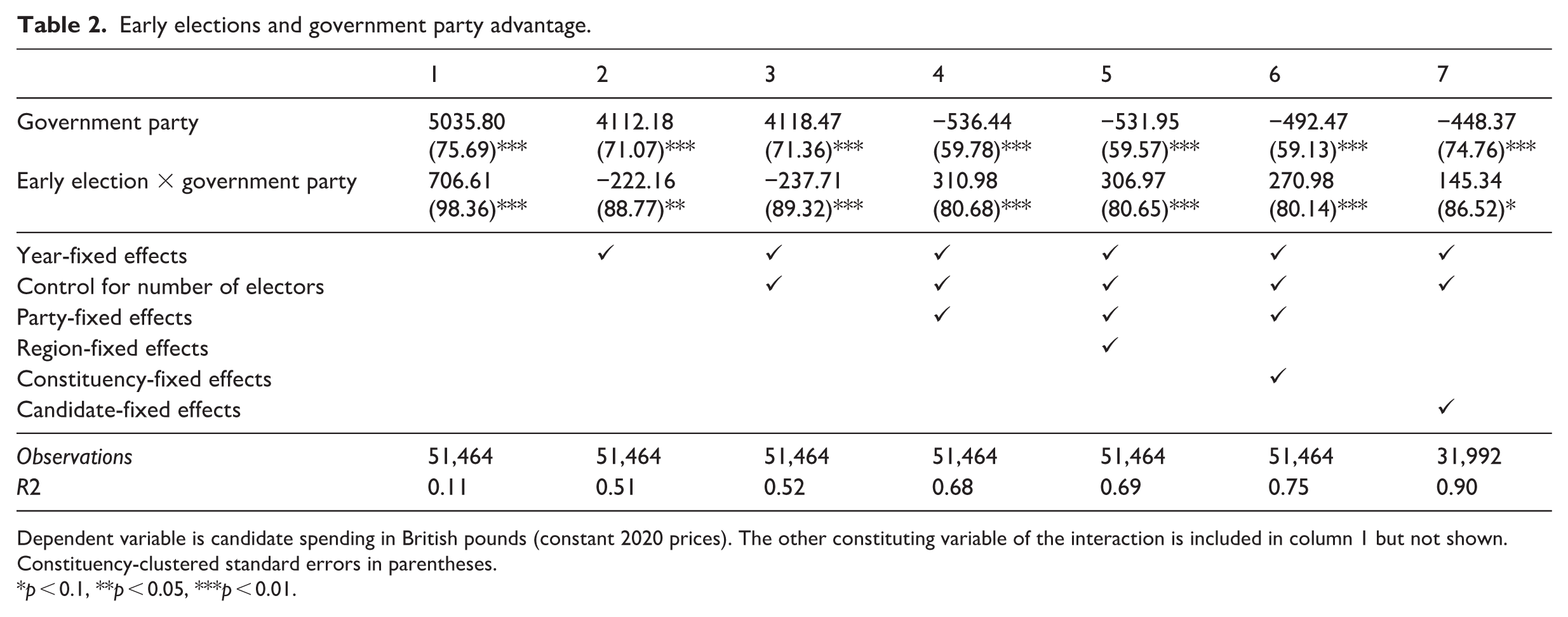
Dependent variable is candidate spending in British pounds (constant 2020 prices). The other constituting variable of the interaction is included in column 1 but not shown. Constituency-clustered standard errors in parentheses.
p < 0.1, **p < 0.05, ***p < 0.01.
Interestingly, when the estimation includes party- and candidate-fixed effects, the government party status seems to have a negative effect on aggregate campaign spending in scheduled election years, maybe since opposition parties prioritize campaign spending more than government parties. 17 However, this government party “disadvantage” does seem to be smaller in early election years, so early election years do seem to provide a relative government financial advantage compared to scheduled election years, which could be explained by the opposition parties’ disadvantage with regards to raising funds and planning campaign expenditures in early election years compared to scheduled election years, refer the theory section.
The size effect of the interaction drops with the addition of candidate-fixed effects in column 7. However, while the effect size is small, it remains non-trivial (an increase amounting to about 1.5% of average campaign spending) and is statistically significant albeit only at p < 0.1. 18 These results suggest that the effects are not only a matter of the pool of candidates being different in early election years as opposed to scheduled election years. There is thus substantial evidence in favor of the argument that government party candidates gain a relative financial advantage in early election years compared to scheduled elections.
Similar effects are found when the “years since last election” variable is used as the measure of early elections. These results can be found in Figure 2 which shows the marginal effect of government party status on candidate spending contingent on years since the last election. Holding candidate (and thus party affiliation) as well as calendar year constant, government party candidates actually spend less than non-government party candidates when the election is held close to the end of the parliamentary term, which was also suggested by the results from Table 2. However, this is not the case if the election is held early in the parliamentary term, where there is even evidence of an absolute government party advantage. These results make sense according to the theoretical argument, as the information asymmetry between government and non-government parties about election timing should be smaller the closer you get to the scheduled election date.
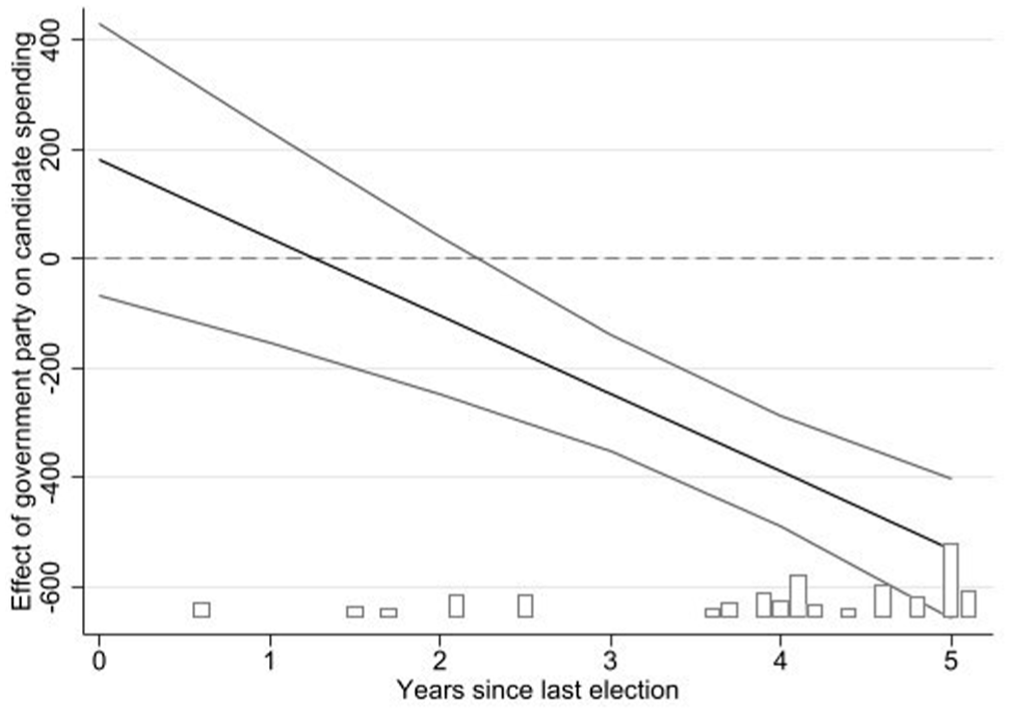
Year since last election, government party status and candidate spending.
The results are robust to excluding high-spending candidates 19 from the estimations. These results can be found in Online Supplemental Appendix D.
The role of incumbent MPs
The previous results revealed a non-trivial financial advantage for government party candidates in years of early elections compared to years of scheduled elections. In this section, I explore whether this financial advantage benefit incumbent MPs or non-incumbent candidates. 20 In order to test this, I add a dummy for whether the candidate is an incumbent MP to the interaction and report the results in Table 3 (restricting the estimation to the constituency and candidate-fixed effects models). Interestingly, the three-variable interaction between early election, government party and the incumbent MP dummy is negative and statistically significant, while the positive and statistically significant effect of the government party and incumbent MP interaction remains. These results suggest that it is non-incumbent candidates running for government parties, rather than incumbent government MPs, who benefit financially from early elections.
Early elections and government party advantage: The role of incumbent MPs.
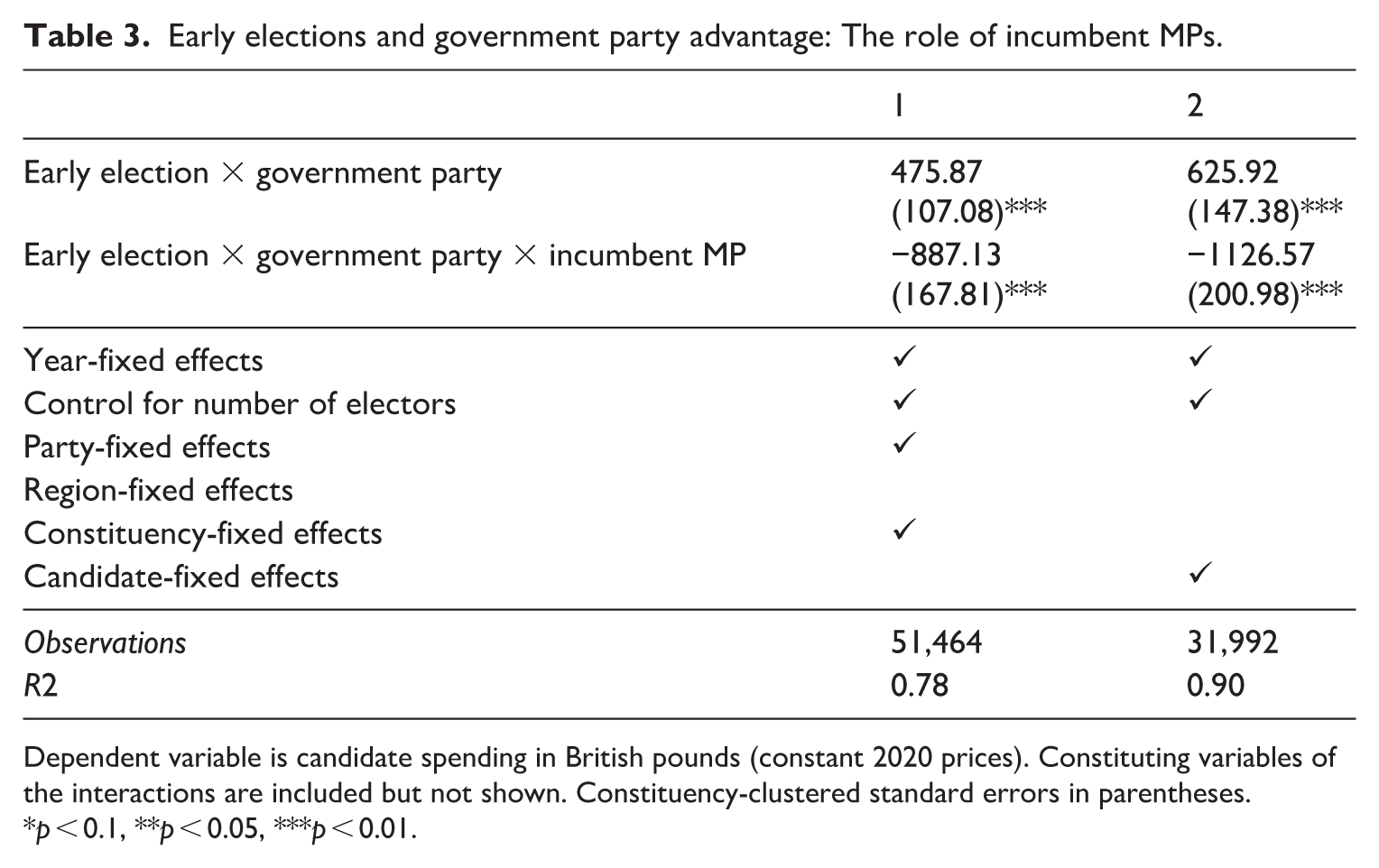
Dependent variable is candidate spending in British pounds (constant 2020 prices). Constituting variables of the interactions are included but not shown. Constituency-clustered standard errors in parentheses.
p < 0.1, **p < 0.05, ***p < 0.01.
In Figure 3, the results are shown with the “years since last election” variable as the measure of early elections. These results echo the findings from Table 3. The relative financial bonus of elections held early in the electoral term only benefit government party non-incumbent candidates rather than incumbent MPs.
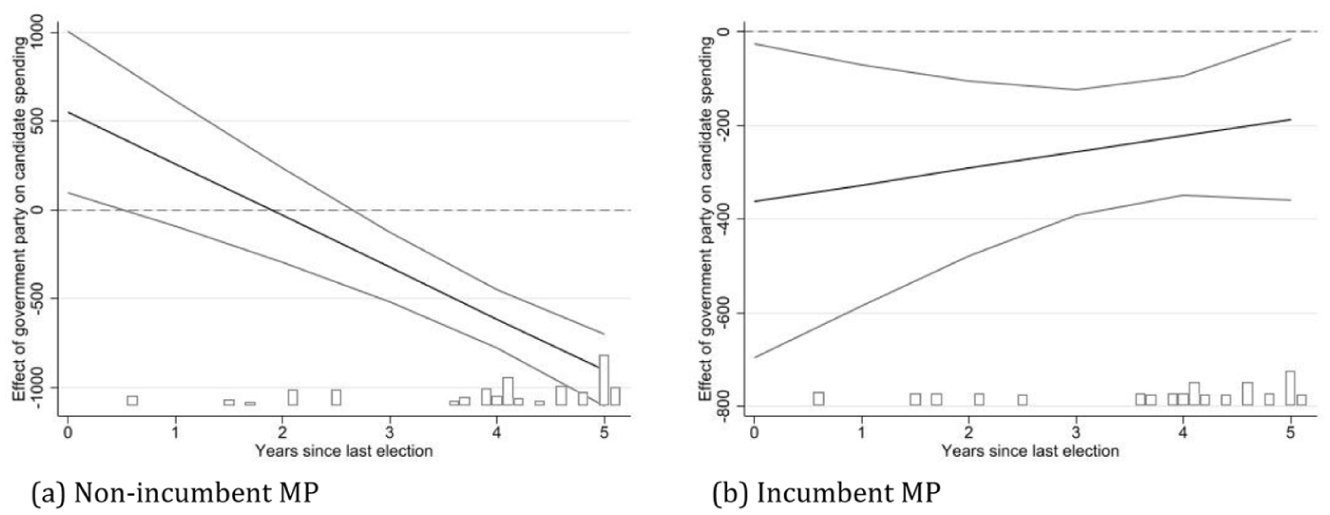
Year since last election, government party status and candidate spending: (a) non-incumbent MP and (b) incumbent MP.
The results suggest that the relative advantage with regards to raising funds and spending these in early election years for government parties goes toward supporting candidates contesting opposition-held constituencies and that early election calling also shapes incumbent British governments’ ability to increase their electoral win margin by having access to relatively better funding opportunities for their party candidates contesting in constituencies held by the opposition. It is also consistent with the view that the information asymmetry with regards to planning fundraising activities mainly benefits the national government party rather than local party organizations and that these relatively extra funds are channeled strategically toward specific candidates by the national party leadership.
In Online Supplemental Appendix E, the sample is restricted to close-race candidates (defined as candidates receiving between 45% and 55% of the vote in the election). Here, the interaction coefficients are generally larger, except when constituency and candidate-fixed effects are included. This is consistent with a story in which the relatively extra campaign funds, as well as specific candidates, are directed toward marginal districts by the incumbent party in early election years. This is further corroborated by the results found in Online Supplemental Appendix F, where only safe-race candidates (candidate vote share above 55%) are included in the analysis, and where the relative campaign-spending advantage in early election year is turned into a disadvantage.
The effects of the Fixed-term Parliaments Act
I now turn to exploring the role of the Fixed-term Parliaments Act of 2011 in shaping the government party financial advantage for early election years. If information asymmetry about specific election timing is the central mechanism behind the government financial advantage in early elections years, we should expect the Fixed-term Parliaments Act, which removed early election-calling power from the incumbent prime minister and instead gave it to the parliament (where a two-thirds majority would be needed), to nullify this early election financial advantage. 21 Table 4, where a dummy for the period after the Fixed-term Parliaments Act is added to the interaction, shows some evidence for this. The three-variable interaction between early election, government party and the Fixed-term Parliaments Act has a negative effect that is greater than the effect of the early election and government party interaction. However, the three-variable interaction fails to reach conventional levels of statistically significance. While there is uncertainty in this estimate – maybe also due to the limited number of elections under the Fixed-term Parliaments Act – the removal of early election-calling power from the incumbent government may have eliminated the financial advantage of early election for government party candidates.
Early elections and government party advantage: The effect of the Fixed-term Parliaments Act.
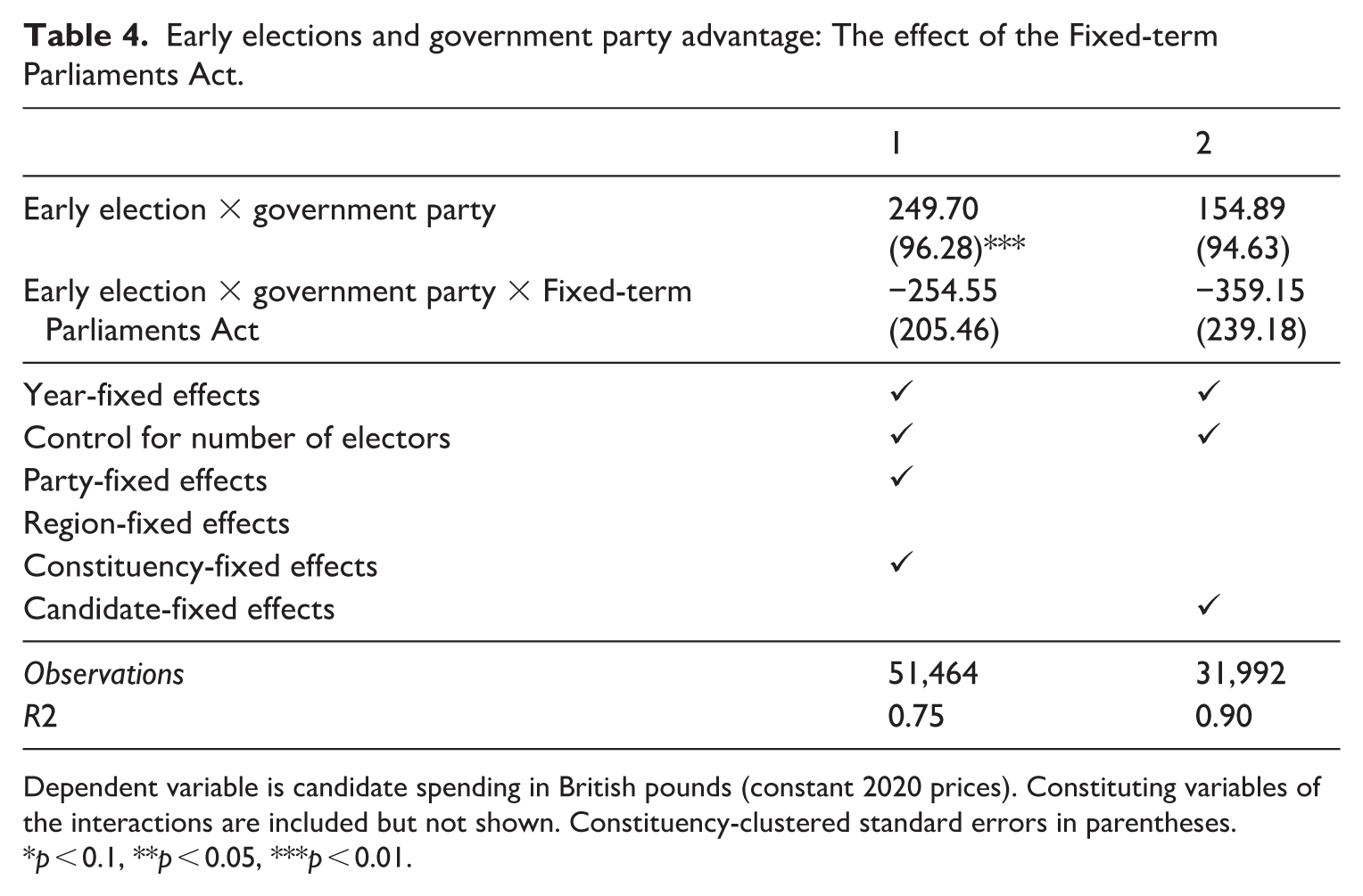
Dependent variable is candidate spending in British pounds (constant 2020 prices). Constituting variables of the interactions are included but not shown. Constituency-clustered standard errors in parentheses.
p < 0.1, **p < 0.05, ***p < 0.01.
In Figure 4, the “years since last election” variable is used as the measure for election timing. Here, the results also suggest that the Fixed-Term Parliaments Act may have eliminated the government relative advantage in campaign spending in early elections. Before the Fixed-term Parliaments Act, government party candidates received a substantial relative financial advantage if the election was held in the first 2 years of the parliamentary term, whereas this “early term” advantage has disappeared after the Fixed-term Parliaments Act, where government party candidates (holding candidate and year constant) spend less than non-government party candidates no matter the timing of the election.
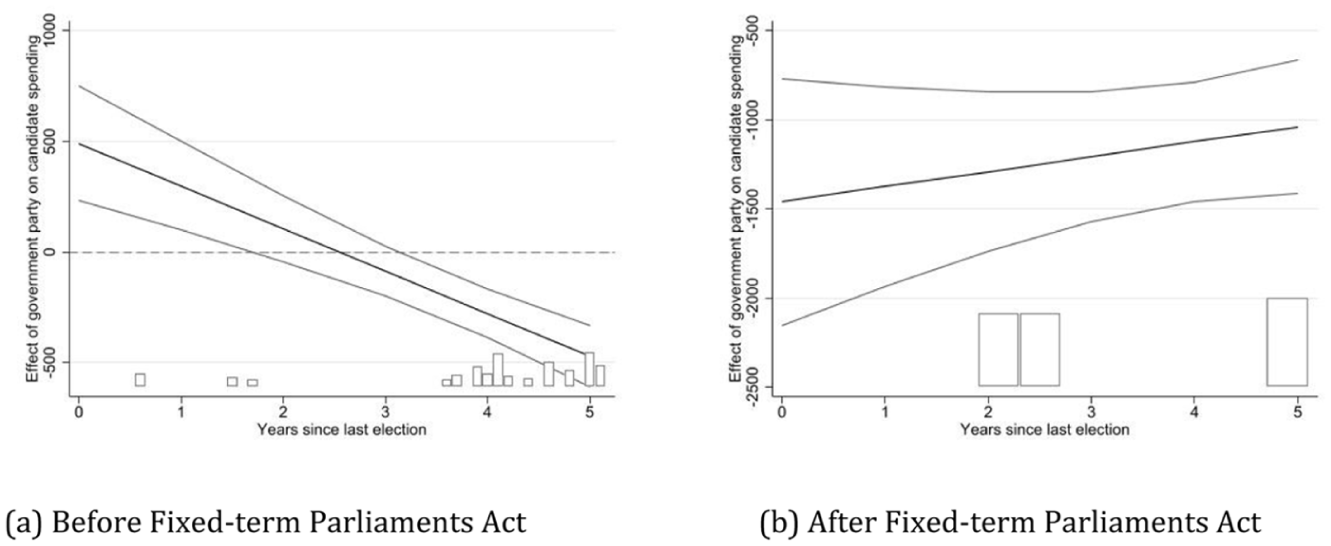
Year since last election, government party status and candidate spending: (a) before Fixed-term Parliaments Act and (b) after Fixed-term Parliaments Act.
Controlling for pre-election opinion polls
The previous results suggest that there exists an incumbent financial advantage for early elections relative to scheduled elections. However, one issue that could be raised would be the issue of government pre-electoral popularity. Governments are probably more likely to call early elections when they are relatively popular, as shown in Figure 5.
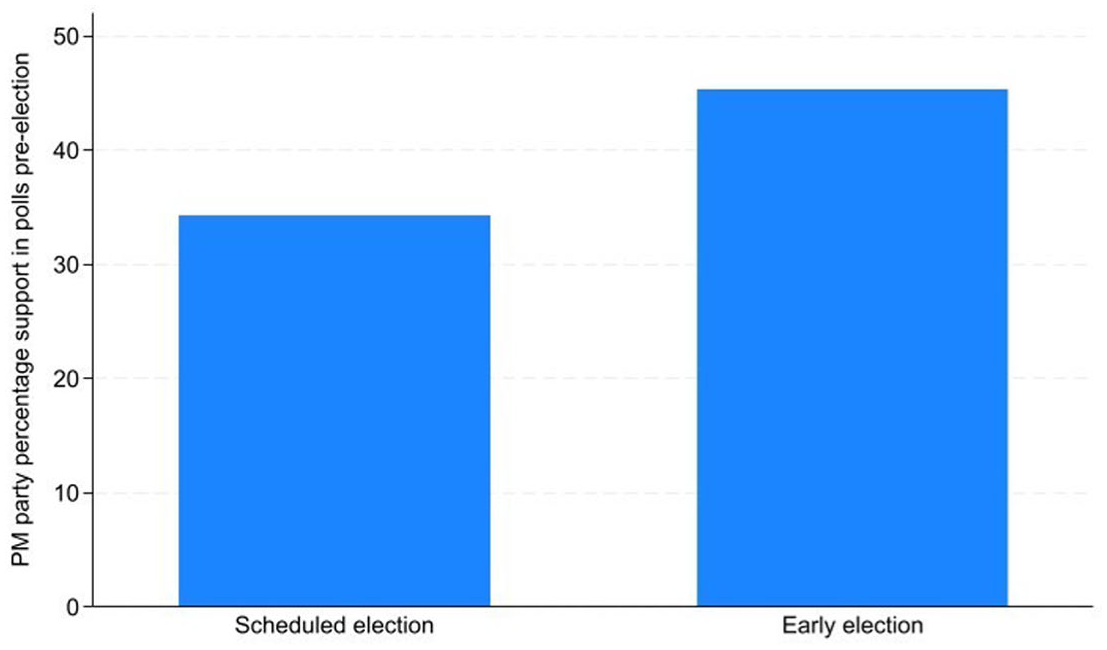
Incumbent Prime Minister (PM) party pre-electoral vote intention share.
Consequently, one might worry that the incumbent financial advantage of early elections just reflects general government party popularity and that popular parties may have a better chance of raising more campaign funds. 22 While the inclusion of year-fixed effects should address some of these issues, nonetheless, to address this issue, I add PM party vote intention share to two full estimations in Table 5 23 using opinion poll data from Mark Pack’s website. 24 However, the results here are largely similar to that of the main analysis. 25
Early elections and government party advantage: Controlling for PM party vote intention share.
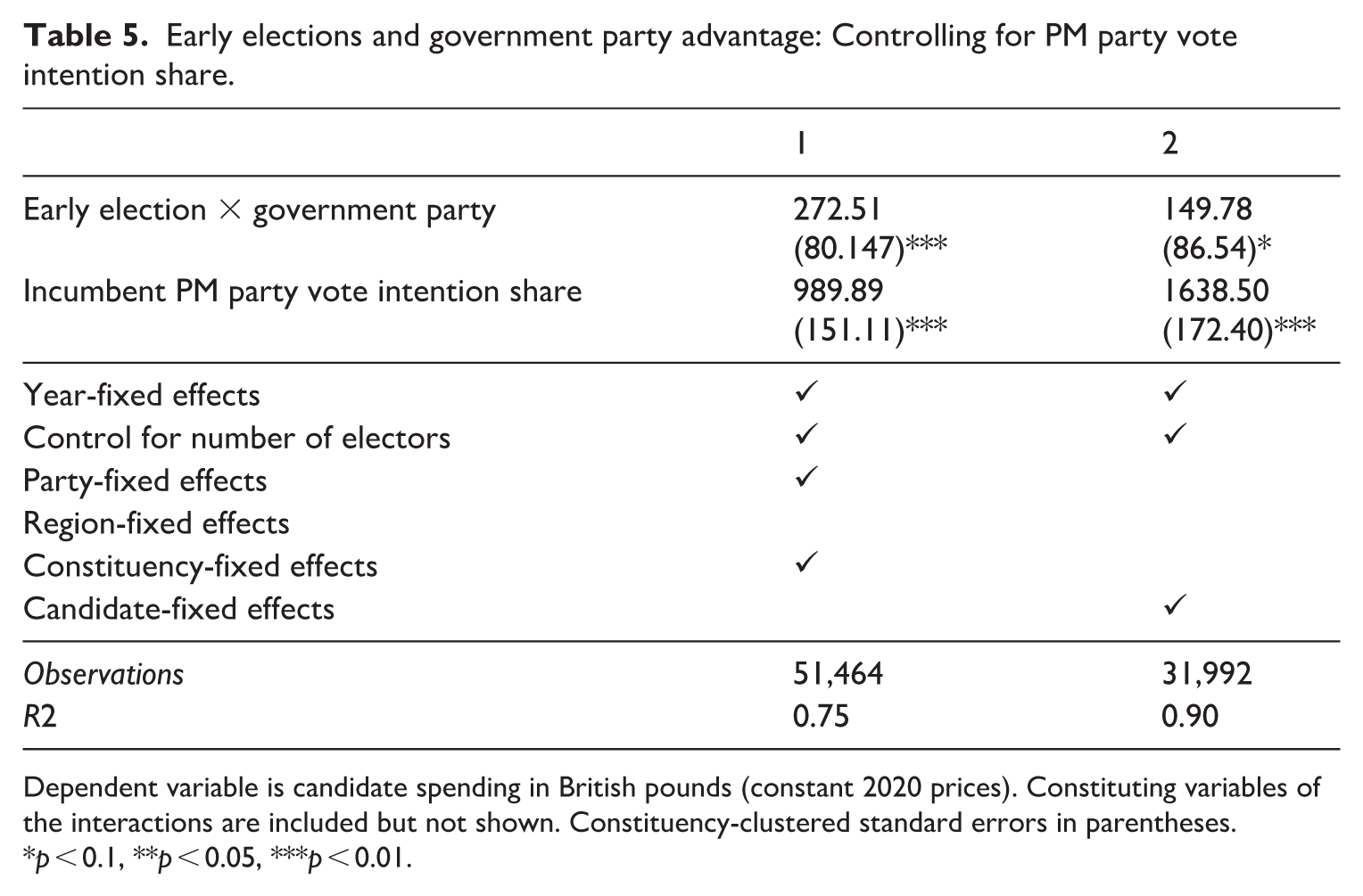
Dependent variable is candidate spending in British pounds (constant 2020 prices). Constituting variables of the interactions are included but not shown. Constituency-clustered standard errors in parentheses.
p < 0.1, **p < 0.05, ***p < 0.01.
Composition of the relative campaign-spending advantage
The previous sections have established a non-trivial relative spending advantage for government party candidates in early election years. However, what forms does this relative financial advantage take? The campaign-spending data of Fouirnaies (2021) enables a breakdown of the campaign spending into different categories. Consequently, to dig deeper into the nature of the relative spending advantage, in Table 6, I replace the aggregate candidate spending variable with these different spending categories.
Early elections and government party advantage: Spending categories.
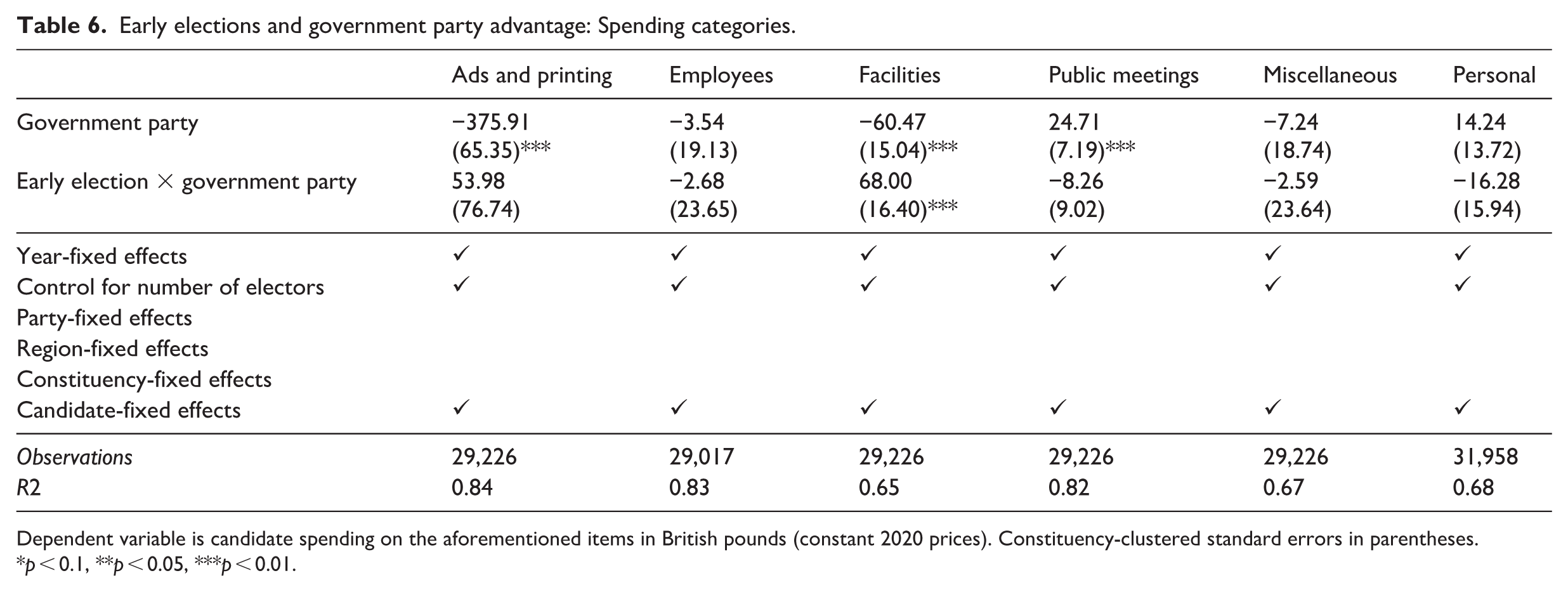
Dependent variable is candidate spending on the aforementioned items in British pounds (constant 2020 prices). Constituency-clustered standard errors in parentheses.
p < 0.1, **p < 0.05, ***p < 0.01.
As can be seen in Table 6, the relatively extra funds and/or spending opportunities for government party candidates in early (as opposed to scheduled) election years seem to be directed toward paying for campaign facilities, as well as – even though the coefficient is not statistically significant – for ads and print material. This further corroborates the interpretation from the previous results that the relatively extra campaign funds and/or spending opportunity advantages for government party candidates in early election years are strategically channeled toward attempting to win (marginal) seats by spending on campaign items to attempt to sway voters than by increasing the individual candidates’ personal expenses during the electoral campaign.
Does spending matter for electoral outcomes?
Finally, the question naturally arises whether the relative government party financial advantage actually matters for electoral outcomes. In other words, do campaign spending matter for the final electoral results? The effect of campaign spending on election outcomes is a widely studied and contested topic, especially in American politics (Schuster, 2020: 1503). Investigating in depth the relationship between candidate spending and candidate vote share in British elections is beyond the scope of this article. This is further complicated by the fact that overall candidate (and party) popularity may be a cause of both greater campaign contributions (and thus greater campaign spending) and greater vote share for the candidate in question.
Nonetheless, in Table 7, I regress each candidate’s vote share in the parliamentary election on total candidate spending with year-, constituency- and party-fixed effects. This simple analysis reveals a positive association between a candidate’s campaign spending and that candidate’s vote share. 26 Each 1000 (constant) British pound increase in a candidate’s campaign spending is associated with an increase in that candidate’s vote share of about 1.9 percentage points. This effect is a bit bigger but not that different from the estimated effect of campaign spending on vote share in British elections found by Cage and Dewitte (2022) cited in Fouirnaies (2021). 27
Effect of candidate campaign spending on candidate vote share.
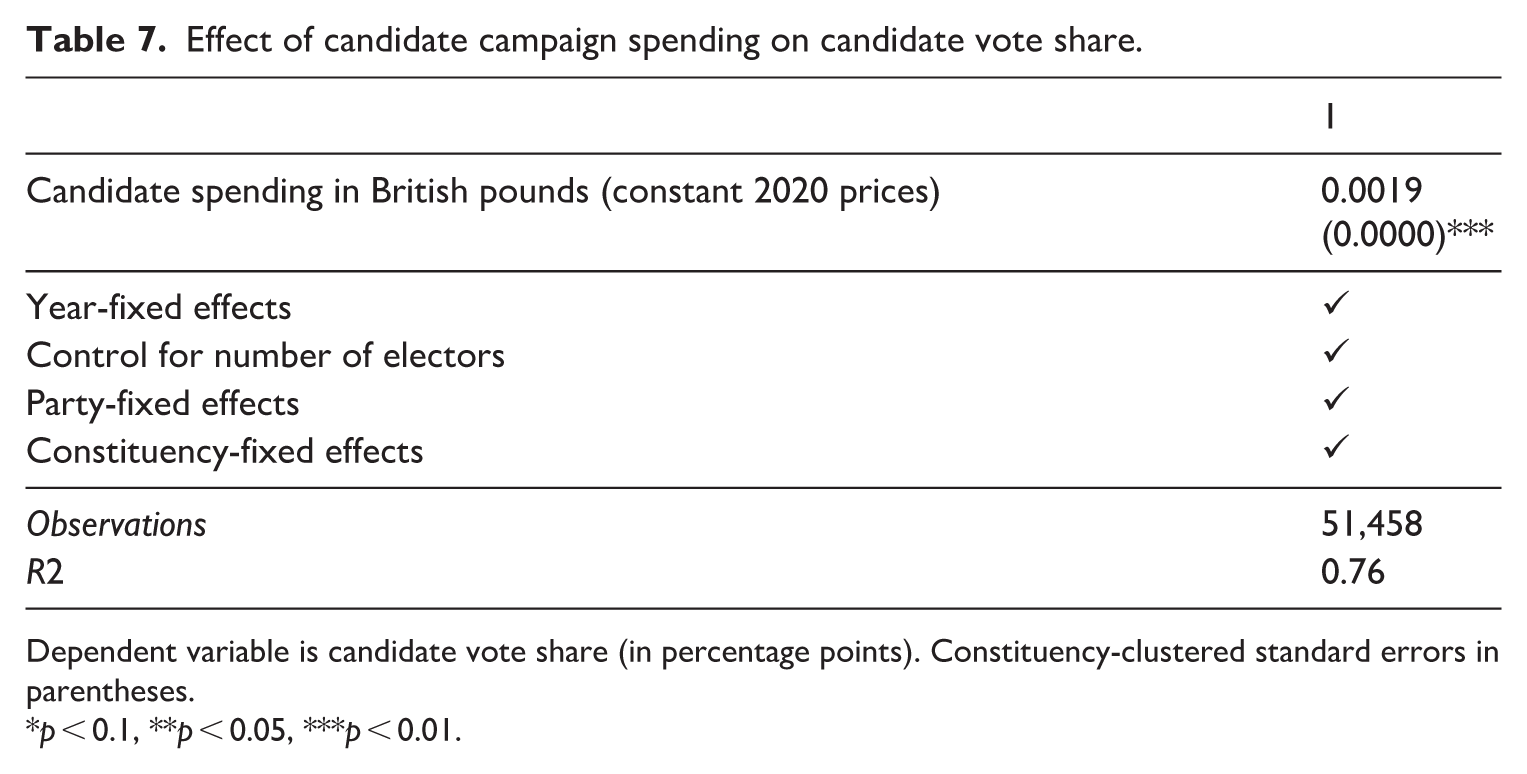
Dependent variable is candidate vote share (in percentage points). Constituency-clustered standard errors in parentheses.
p < 0.1, **p < 0.05, ***p < 0.01.
Consequently, taking these effects as a benchmark and comparing with the previous estimates, while the potential electoral advantage from campaign spending for government party candidates in early election years compared to scheduled election years is not massive, it is potentially non-trivial in marginal electoral races, which seems to be exactly the ones where these relatively extra funds seem to be allocated, see Online Supplemental Appendices E and F. However, the inherent endogeneity of party/candidate funding (and thus campaign spending) and vote share should still be acknowledged.
Conclusion and discussion
The ability to call early elections is thought to provide incumbent governments with an advantage due to the ability to pick election dates during times of favorable economic conditions and opinion polls. This article has explored another potential incumbency advantage of executive election-calling power, a financial advantage. Due to information asymmetry about election timing, government party candidates should be able to raise more funds and spend more in years of early election than non-government parties compared to scheduled election years.
This argument is tested on a dataset of British MP candidates’ campaign spending spanning all general elections from 1950 to 2019. The analyses provide substantial evidence in favor of the argument. Government party candidates gain a spending bonus of several hundred British pounds in years of early elections compared to scheduled election years. This relative advantage is only found for non-incumbent candidates, suggesting that this relative financial advantage is used by governing parties to support candidates contesting opposition-held constituencies. In addition, the Fixed-term Parliaments Act of 2011, which removed early election-calling power from the incumbent prime minister, may have eliminated this government party financial advantage in early election years. Future research on British campaign finance could investigate further whether the repeal of the Fixed-term Parliaments Act in 2022 will bring back the apparent government financial advantage of early elections.
Future research could also investigate the existence of government incumbent financial advantage in early election years in other political systems, as well as at the comparative level. Especially, it would be interesting to investigate whether the magnitude of the relative government party advantage of early elections years is greater in political systems with more executive election-calling power (Goplerud and Schleiter, 2016), as we should expect from the theoretical arguments underlining this advantage (Aaskoven, 2020).
In terms of policy relevance, this article adds to the discussion about the relative desirability of fixed versus flexible electoral terms (Schleiter and Issar, 2014). Apart from an ability to time elections to good economic conditions and favorable opinion polls, one might also have to take into account a relative financial advantage for government parties when assessing the incumbency advantage(s) of high government election-calling power. With the UK Conservative government’s repeal of the Fixed-term Parliaments Act in 2022, which again puts early election-calling power into the hands of the British prime minister, these discussions are both timely and important both in the UK and other parliamentary democracies.
Supplemental Material
sj-docx-1-psx-10.1177_00323217261449611 – Supplemental material for The government financial advantage of early elections: Evidence from UK MP candidate spending
Supplemental material, sj-docx-1-psx-10.1177_00323217261449611 for The government financial advantage of early elections: Evidence from UK MP candidate spending by Lasse Aaskoven in Political Studies
Footnotes
Acknowledgements
This project has greatly relied on the data-collection effort of Alexander Fouirnaies who has also provided valuable advice and suggestions. The author also thanks Nicole Baerg, Tom Paskhalis and workshop participants at Copenhagen Business School and University of Essex, as well as two anonymous reviewers and the editors of Political Studies for helpful comments.

Funding
The author received no financial support for the research, authorship, and/or publication of this article.
Declaration of conflicting interests
The author declared no potential conflicts of interest with respect to the research, authorship, and/or publication of this article.
Supplemental material
Supplemental material for this article is available online.
Notes
Author biography
References
Supplementary Material
Please find the following supplemental material available below.
For Open Access articles published under a Creative Commons License, all supplemental material carries the same license as the article it is associated with.
For non-Open Access articles published, all supplemental material carries a non-exclusive license, and permission requests for re-use of supplemental material or any part of supplemental material shall be sent directly to the copyright owner as specified in the copyright notice associated with the article.
