







Abstract
Sensitivity to canons of beauty as represented in the human body—and as typically defined in the Western Culture—has been poorly studied in children. Current literature shows that infants as young as about three months are sensitive to the human body structure and its parts. Using a sample of 54 three- to five-year-old children, the present study investigated preference for drawings representing the “canonical” body structure, contrasting these with drawings showing the same bodies, but where the relation between trunk and legs was modified. It was hypothesized that preference for the canonical body structures would emerge as early as three years, increasing with age. Results only partially supported the hypothesis: while three-year-olds showed a significant preference for the canonical body structures as predicted, a significant preference reversal was found for the four-year-olds, with a tendency to return to preferring the canonical body at five years. The results are discussed in light of research findings associated with developmental theories hallmarking visual art perception in children.
Introduction
Aesthetics is a multifaceted experience, universally recognized given the cross-cultural human predisposition to appreciate and value beauty. The factors that have been shown to affect the aesthetic sense in humans are various—symmetry and proportion being two of the most commonly recognized. As far as proportion is concerned, the mathematical ratio that best resembles the ideal beauty is the Golden Ratio describing the proportion between parts according to the relation 1:0.618 (Eysenck, 1968; Fechner, 1876; Huntley, 1970; Lalo, 1908; Livio, 2008; Thorndike, 1917; Witmer, 1894).The Golden Ratio—defined as the harmonic division of a line in extreme and mean ratio, and symbolized with letter ϕ (Phi)—is observed in nature (e.g., Brousseau, 1968; Doczi, 1981; Jean, 1992) and in the ideal human body, as represented by Da Vinci’s Vitruvian Man. More specifically, the Golden Ratio is found in the equilibrium between the height of a human being and the height to the navel in the ratio between the length of the arm and the section formed by the forearm and the hand (for a review, see Vico-Prieto, Cagigas, Rosas, & Callejas-Aguilera, 2016).
Using the mathematical principle underlying the Golden Ratio, in two fMRI investigations (Di Dio, Macaluso, & Rizzolatti, 2007; Di Dio, Canessa, Cappa, & Rizzolatti, 2011), Italian adults were presented with images of classical and renaissance sculptures of human bodies with canonical proportions—which were analogous to the Golden Ratio 1 —as well as with the same sculptures whose proportions were altered. During brain scanning, the participants observed the images and provided, in separate sessions, judgments about body aesthetics and proportions. The behavioral results supported the idea that canonical proportions, when associated with the Classical artistic representation of the human body, are aesthetically preferred to the modified versions of the same sculptures. Additionally, an interesting effect was observed from the imaging data: the activation of the anterior insula for the canonical as opposed to the modified sculptures, particularly during a (mere) observation task. This activation was interpreted as constituting a critical node of integration between emotion and cognition, signaling the “goodness” of the observed images—the “gut feeling.”
On the basis of these results, it appears that recognition of aesthetic canons associated with the representation the body structure may be regarded—at least in adult Westerners—as a spontaneous process, that is, occurring without an explicit request to judge the aesthetic value of the observed art-stimuli. From a developmental perspective, it is noteworthy to study whether sensitivity to canons of beauty as represented in the human body emerges early in childhood or whether this sensitivity is acquired later in adulthood. In an attempt to shed some light on this issue, the present investigation specifically explored visual appreciation of pictorial representations of human bodies in preschool-aged children.
In general, people tend to prefer object shapes to the extent that the shapes are recognized and conform to categorical prototypes (Rosch, 1975). Prototypicality or meaningfulness is, according to Martindale’s cognitive theory, the main determinant of aesthetic preference that is related to its determinants, and best described in a monotonic or U-shaped fashion (Martindale, Moore, & West, 1988). The tendency to like typical exemplars is hypothetically based on the idea that aesthetic preference is a positive function of the degree to which the mental representation of a stimulus is activated, with prototypical stimuli producing greater activation (Martindale & Moore, 1988). This idea has found support in various domains, such as color preference (Martindale & Moore, 1988), surrealist paintings (Farkas, 2002), and exemplars of other semantic categories (Martindale et al., 1988; for a review, see Palmer, Schloss, & Sammartino, 2012).
Developmentally, aesthetic preference is characterized—according to Parsons (1987)—by five progressive stages. The first stage, termed “favouritism,” emerges around four years; it is in this period that children start enjoying artworks intuitively, anchoring personal preference to their own past experiences. For example, preference for a given color may derive from association with a particular preferred food.At this age, children prefer artistic representations of realistic subjects, particularly of animals and other children (e.g., Danko-McGhee, 2000, 2006; Gardner, 1982; McGhee & Dzuiban, 1993; Taunton, 1980), as well as preferring realistic reproductions in contrast to non-objective reproductions (Coffey, 1969; Taunton, 1980). These studies support the idea that children’s conceptual knowledge of visual representations is strictly and rigidly related to fixed, personal categorical definitions of the world. This concept is best captured by Karmiloff-Smith’s representational re-description model (RRM; Karmiloff-Smith, 1990) derived from early studies relating to language and naïve physics (e.g., Karmiloff-Smith, 1986). According to the RRM, the child’s internal representations of visual stimuli are governed by a sequentially fixed list of characteristics that are constrained by the order in which the elements of the representation are drawn (i.e., procedural rigidity; see also, Karmiloff-Smith, 1986; Karmiloff-Smith & Inhelder, 1974). In her study with children aged 4 to 11 years, Karmiloff-Smith (1990) observed that internal representations of children as young as four years are bound by fixed descriptions that sequentially restrain a child’s internal representations. Using a house as an example, the descriptions could be: rectangular shape, roof, door, window, and, optionally, chimney, curtains, various numbers of windows, and so forth. It is only with subsequent representational re-descriptions that the constraint relaxes to become a flexibly ordered set of manipulable features (see also, Hollis & Low, 2005), so that early procedural rigidity “bends,” allowing for alternative interpretations of pictorial representations.
While the theories described earlier predominantly focus on how children perceive and represent the visual world, other theories consider developmental changes in preschool age, also in terms of intersubjectivity. At around four years, children’s artistic representations of the world, in fact, are not only about the represented objects—the “referent,”—but also about the person who produces the representations (Freeman, 1993a, 1993b, 1995). In Freeman’s view, pictorial reasoning in young children involves an ability to map a complex intentional network that links pictures to at least three factors: (1) the real or imagined world that the pictures represent (i.e., the referent), (2) the mind of the artist, and (3) the mind of the beholder. In this respect, it was shown that between four and five years, children begin to understand that specific visual representations may reflect the artist’s mind and not only the referent. This should partially explain why children, at about this age, begin to show a tendency to appreciate abstract visual representations (Thomas, 1966; Wohlwill, 1975) and behave more like young adults in their response to different art genres (abstract, modern, humorous, and cartoon art; Lin & Thomas, 2002; for a review, see Göksun, Kranjec, & Chatterjee, 2014). Additionally, considering Karmiloff-Smith’s representational re-description model mentioned earlier, Freeman and collaborators further suggest that, under certain conditions, children aged four years develop a more flexible, less rigid, representation of the visual world, and acknowledge new representational possibilities (Allen, Nurmsoo, & Freeman, 2015).
In the light of these theoretical frames and with respect to our experimental question, children’s hypothetical proclivity to prefer concrete, real representations of the world—as in the case of canonical human bodies—is challenged by Allen et al.’s (2015) idea of representational flexibility. Building on the protocol used with adults in which images of classical sculptures were used to investigate aesthetic perception (Di Dio et al., 2007, 2011), the stimuli used in the present study were pictorial representations of the human body, the structure of which is known and preferred—in adult Westerners—when presented in the typical, canonical form rather than when presented in an atypical, modified form (at least as far as classical art is concerned). The human body is a special stance, since we do not only see it when looking at others, but we “know” it as part of us. This matter becomes even more interesting with children, whose body forms are not definitive and, in terms of proportion, are not yet fully developed. The human body modifies with age and the psychological development travels alongside this physical modification, plausibly endowing children with a wider range of representational possibilities with respect to the concept of “canonical.” Developmental studies on body perception in infants and young children have suggested that, unlike symmetry recognition (e.g., Baylis, 1998; Humphrey & Humphrey, 1989; for a review, see Giannouli, 2013) and preference (Kellman & Arterberry, 2006; Langlois et al., 1987; see also, Rhodes, Geddes, Jeffery, Dziurawiec, & Clark, 2002; Samuels, Butterworth, Roberts, Graupner, & Hole, 1994), visuospatial body representation is not well developed during the first year of life (Slaughter & Heron, 2004; Slaughter, Heron-Delaney, & Christie, 2012; Slaughter, Heron, Jenkins, Tilse, Müller & Liebermann, 2004). It is known that, by five months, infants process bodies holistically (Hock, White, Jubran, & Bhatt, 2015), and that children start building an overall structure of the human body around nine months of age (Heron & Slaughter, 2010; Slaughter & Heron, 2004; Slaughter, Heron, & Sim, 2002), which consolidates only around the second year of life (Slaughter et al., 2012; for a review, see Bhatt, Hock, White, Jubran, & Galati, 2016). In this respect, comparing infants’ responses to typical and scrambled human bodies, Slaughter and Heron (2004) found that at 15 to 18 months of age, infants first discriminate scrambled from typical human body pictures and begin to be sensitive to violations of the three-dimensional human body. A detailed visuospatial knowledge about the human body is first evident in the second year of life. More importantly for the present purpose, sensitivity to body proportion relies on a representation of the relative size of body parts and the shape of bodies, which appears to develop very early in infancy. To investigate this type of sensitivity, Zieber, Kangas, Hock, and Bhatt (2015) familiarized 3.5-month-olds to proportionally modified bodies (e.g., long torso, short legs), and preference for these bodies was compared with corresponding proportioned versions. Infants were able to discriminate between proportioned and disproportioned bodies when the stimuli were presented upright but not when the stimuli were inverted, showing that sensitivity to the arrangement and size of human body parts develops very early.This is in line with more general findings on infant development of both conceptual and perceptual factors (Deloache, Uttal, & Pierroutsakos, 2000) showing that preference for canonical orientations is quite consistent across 30-month-old children, when, for example, they are presented with picture books.
In the present study, we recruited preschoolers aged between three and five years, to whom we asked an explicit liking question concerning depictions of the human body taken from classical art productions and adapted in the form of drawings. In particular, we presented the children with pairs of drawings reproducing classical sculptures and contrasted body images with typical proportions (canonical) with similar body images whose proportions were altered (modified). The modified versions could be elongated in the upper part and shortened in the lower part or vice versa, thus resulting in atypical body shapes. Based on studies that support the idea of an early development of knowledge of the body schema, we hypothesized preference for the canonical images already at three years, possibly strengthening with age. To collect evidence that our sample children had normative understanding of the human body structure, at the end of the main task (preference ascription), the children were presented with the Goodenough–Harris Draw-a-Person (DAP) test (Harris, 1963)—otherwise termed the DAP Test—originally developed by Florence Goodenough (Goodenough, 1926). This test simply requires a child to freely draw a person. The test evaluates the child’s ability to reproduce the human body and considers several aspects of the child’s ability, including describing pictorial details and spatial relations between parts.
Methods
Participants
The sample size required for this study was calculated using G*Power (version 3.1) with a repeated measures, between-factor design. Previous research with adult participants revealed that violation of canonical proportions accounted for 77% (Di Dio et al., 2007) and 52% (Di Dio et al., 2011) of variance in aesthetic ratings (partial η2). In the present work, we were fairly conservative setting an effect size ranging between 3 and 5 and a power (1-β error probability) ranging between .8 and .9. Computations revealed a total sample size ranging from 99 with the strictest combination (effect size = 3; power = .09) to 30 (effect size = 5; power = .08). Effects sizes set between these extremes produced a total sample size around 50, which was considered an acceptable minimum N for an exploratory study of this type.
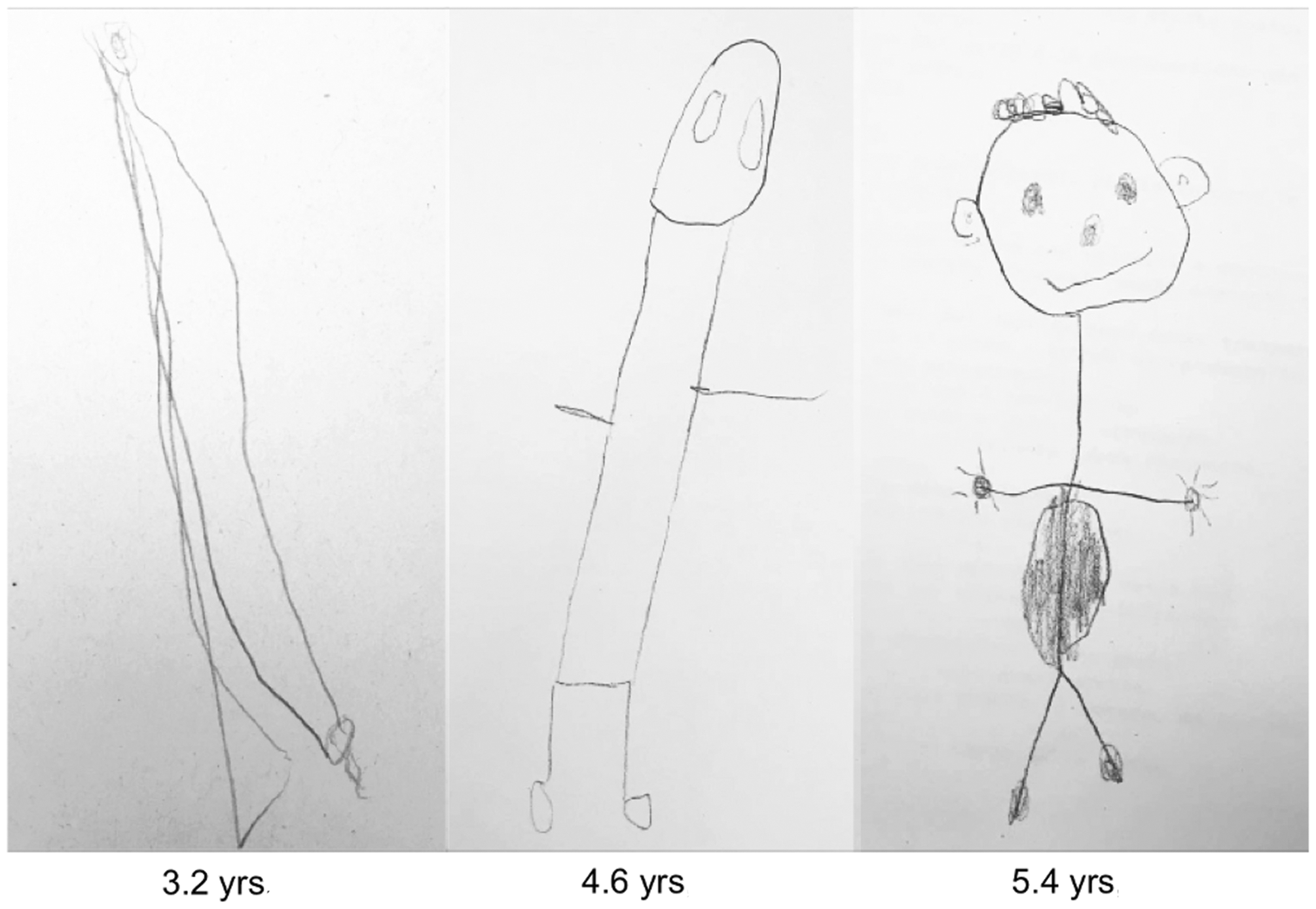
Data were collected from an initial pool of 64 preschoolers divided into three age-groups of three years (N = 20), four years (N = 22), and five years (N = 22). The DAP test (Goodenough, 1926; Harris, 1963) was used as exclusion criteria for the final sample. Two independent raters assessed the children’s performance on the DAP. A Cronbach’s α of .98 revealed a high level of consistency between scores. Results on the DAP outlined two children aged three years that scored below normative data (DAP min score = 2). These children were excluded from the data analysis, reducing the N of the 3-year-old group to 18. To homogenize the N of the three age-groups using the SPSS selection function of random sample of cases, we then selected 18 children also from age-groups four and five years. Within these three groups, the DAP scores ranged within the normative guidelines (three years: range = 2–10, mode = 2; four years: range = 6–21, mode = 6; and five years: range = 10–24, mode = 13), significantly improving from one age-group to the next (4 > 3, t(34) = 4.09, p < .0001; 5 > 4: t(34) = 3.99, p < .0001). Pearson’s correlation analysis further supported a significant positive linear correlation between children’s age and performance on the DAP (r = .69, p < .0001; Figure 1). An example of the children’s drawings is presented in Figure 2.
Example of the children’s drawings of a human body for each age-group (three, four, and five years). Plot showing the linear increase in performance on the Goodenough test with age (years).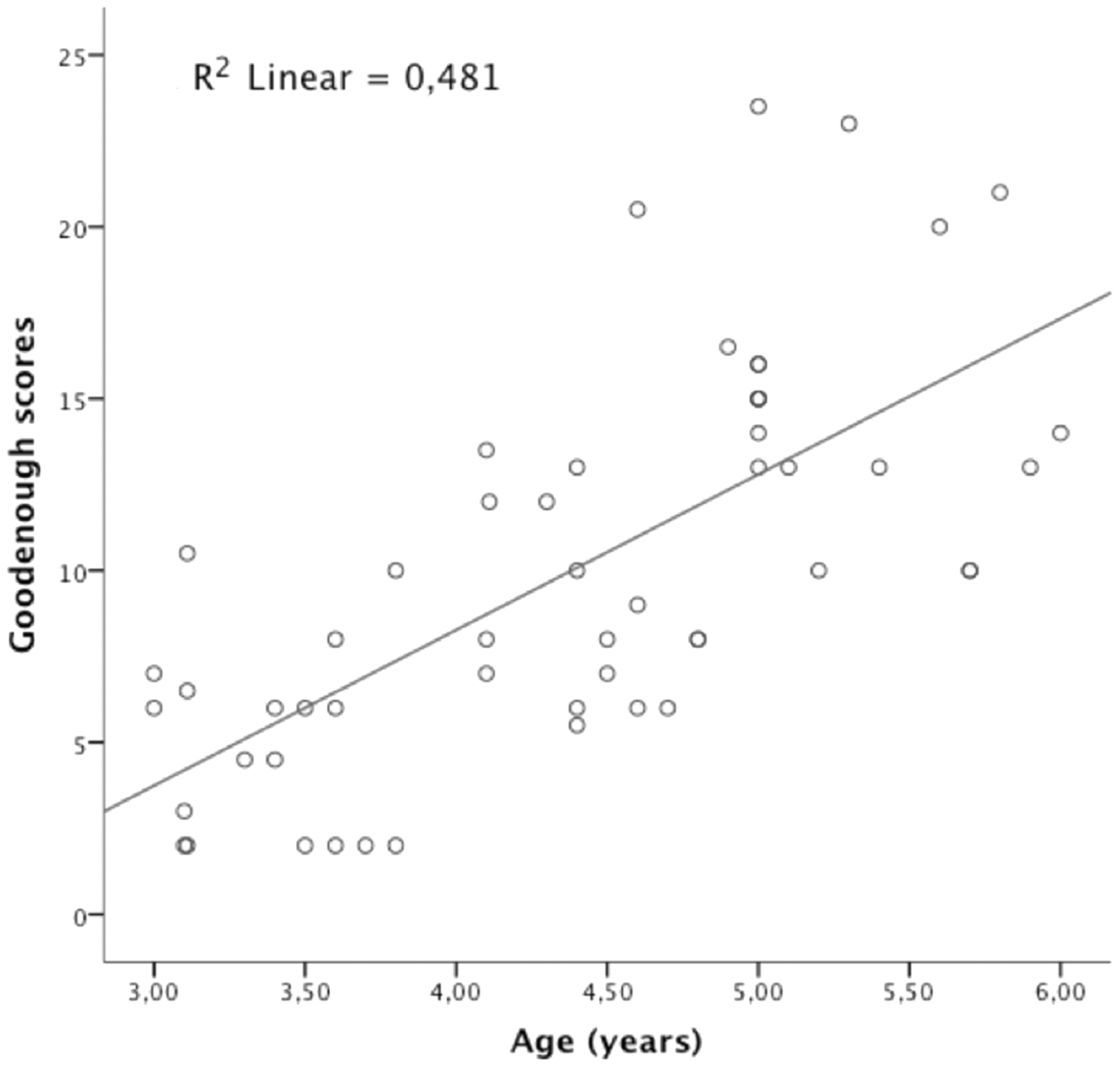
A final sample of 54 children was thus included for data analysis. The sample was categorized in three groups of three years (N = 18; M = 3.4 years, SD = .07; 10 girls), four years (N = 18; M = 4.5 years, SD = .06, 8 girls), and five years (N = 18; M = 5.3 years, SD = .1, 10 girls). All children were preschoolers recruited from different kindergartens located in five Italian cities (Mantova—northern Italy; Reggio Emilia and Ascoli Piceno, Rimini—central Italy; Reggio Calabria—southern Italy). After receiving formal consent from the principal of the schools to carry out the study, all parents provided a written consent for their child’s participation.
Children had normal or corrected-to-normal visual acuity and had no declared developmental disorders. The study was approved by the Local Ethic Committees (University of Parma).
Stimuli
The stimuli were presented on 12 cards (10 × 5 cm) representing gray-scaled drawings sketched from classical sculptures. The drawings were hand made by a professional artist with the intent to recreate these artworks adapted for children’s use in a “game” setting. Half of the cards represented a human figure with canonical (CAN) proportions, whereas the other half represented the same images with modified (MOD) proportions. Three MOD stimuli underwent a long-trunk:short-legs modification and the other three MOD stimuli underwent the opposite modification type. The stimuli are shown in Figure 3.
Stimuli used in this study—CAN: canonical; MOD (LT): modified version with long trunk, short legs; MOD (ST): modified version with short trunk, long legs.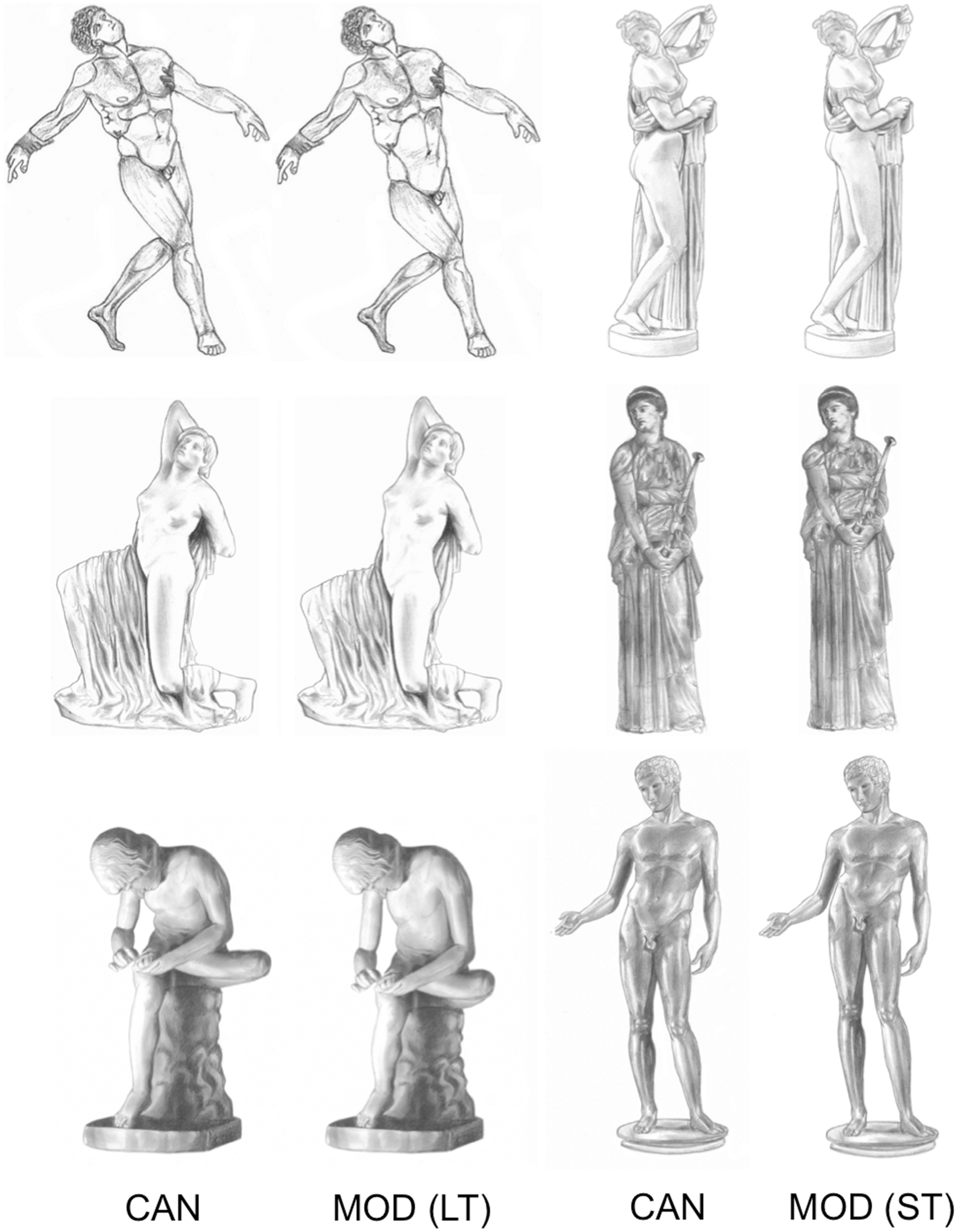
Procedure
The teachers of the preschoolers involved in the study received a written procedure form specifying the exact submission procedure, the precise order of the cards—counterbalanced prior to administration—as well as a sheet to annotate the children’s responses and eventual notes. Each individual child was tested in a quiet room. The child sat at a child table where two marks indicated the fixed positioning of the cards, which were displayed 20 cm apart. The cards were presented in pairs according to a pre-set randomized order that differed for each child. To facilitate the cards administration, prior to each testing, the teacher prepared the deck of cards in the exact order. Each pair contained a canonical image and its modified counterpart. The child had to point at the card that he or she preferred: “Point at the drawing that you like the most.” Each pair of cards was presented twice, once with the canonical stimulus on the right side and the modified on the left side and once with the opposite presentation order.
Once the cards were set on the table, the child could explore as much as he or she wished. After the child pointed to the preferred card (preference attribution), the teacher removed the cards, placing them in a separate deck and immediately replaced them with a new pair. The child was allowed as much time as needed to end the task.
At the end of the study, the child was presented with the DAP as described earlier. This test was administered at the end of the experimental session so as not to influence the preference task with factors such as fatigue or boredom.
Data analysis
Descriptive statistics (mean, skewness, and kurtosis) of the children’s scores for the canonical (CAN) and modified (MOD) stimuli, for each age-group (three, four, and five years).
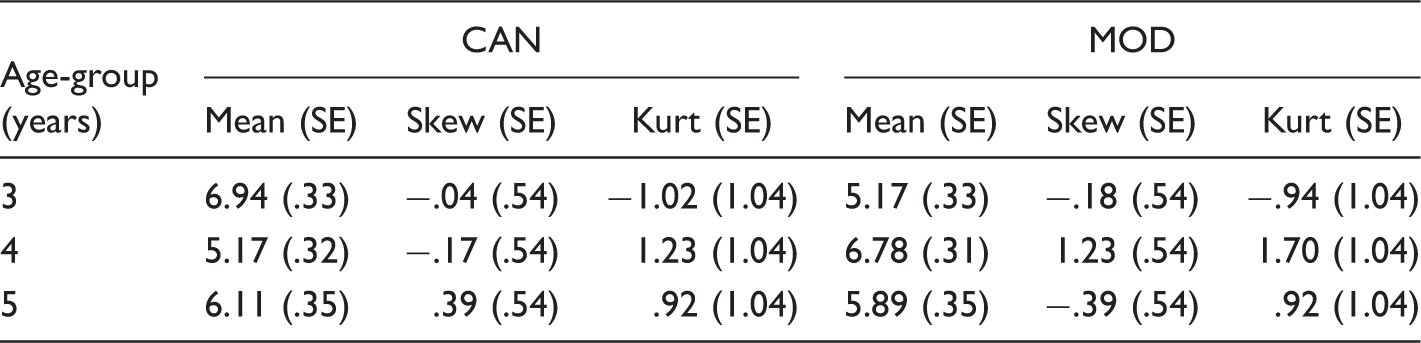
Note. SE: standard error of the mean; CAN: canonical; MOD: modified.
We then established whether card positioning within the pairs had an effect on preference attribution. The results showed no significant effect of card positioning (left or right) on preference (F(1, 51) = .52, p = .47).
The main analysis concerned the mean total number of responses given to each stimulus category, which was entered in a 2 × 2 × 3 repeated measures general linear model analysis, with two levels of stimulus type (CAN, MOD) and two levels of modification type (long-trunk:short-legs, short-trunk:long-legs) as within-subjects factors, and three levels of age-group (three, four, and five years) as the between-subject factor. Multiple comparison post hoc analyses were Bonferroni corrected.
Results
The results showed a significant interaction between stimulus type and age-group (F(2, 51) = 6.63, p = .003, partial-η2 = .21, δ = .9; Figure 4). All other comparisons were non-significant.
Graph showing the mean number of total responses given to the canonical (solid line) and modified (dashed line) stimuli for each age-group (three, four, and five years). The bars represent the standard error of the mean.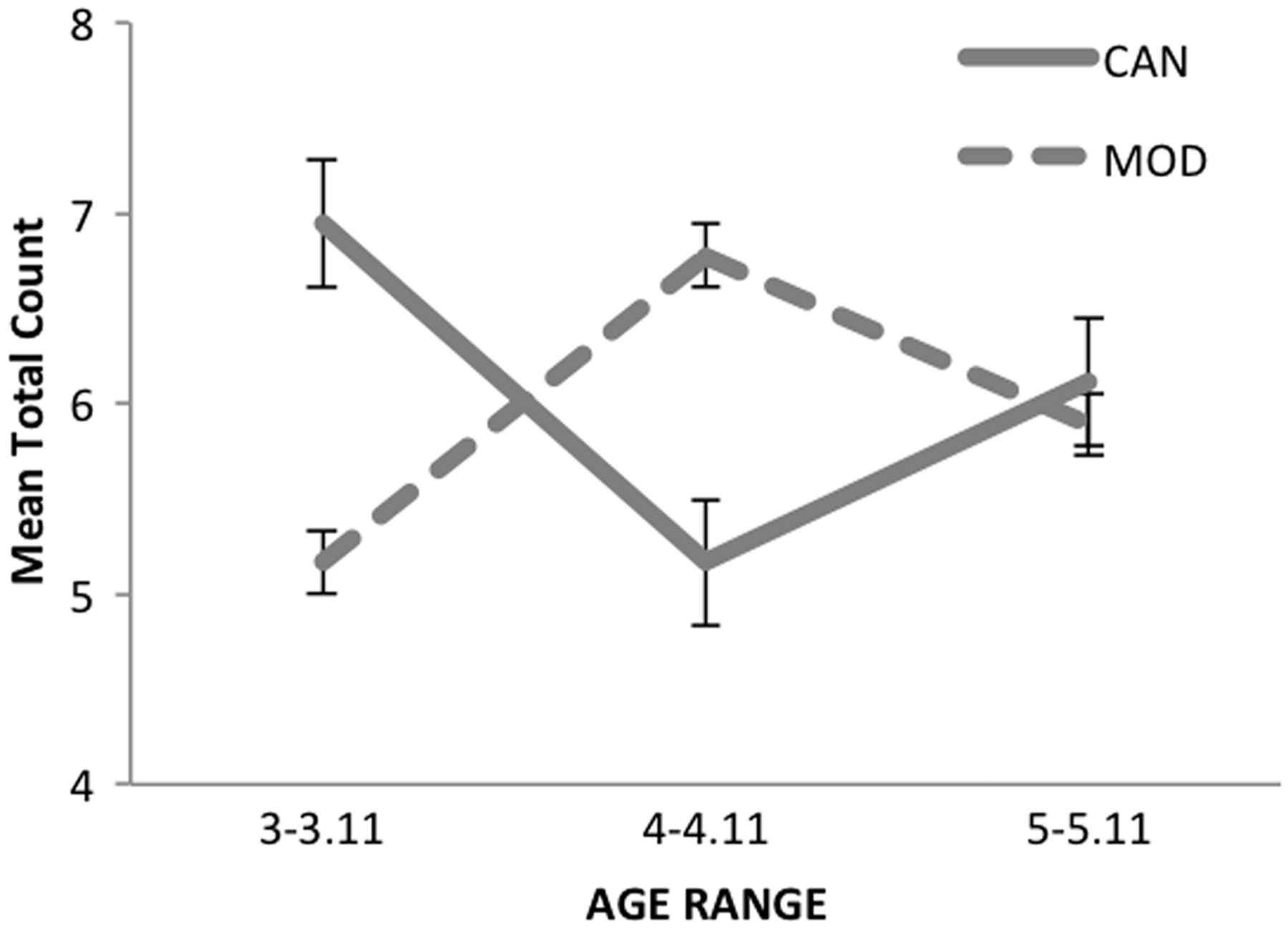
A post hoc analysis for the interaction effect revealed significant differences between canonical and modified stimuli for both three- and four-year-old children, but not for the five-year-olds. Surprisingly, the pattern of the difference observed for the three- and four-year-old groups was opposite. While three-year-olds preferred the canonical bodies compared to the modified ones (Mdiff = 1.79, SE = .66, p = .009), the four-year-olds displayed the opposite preference (Mdiff = 1.61, SE = .66, p = .02). Comparisons between age-groups showed that three-year-old children rated the canonical stimuli as more beautiful than the four-year-olds (Mdiff = 1.78, SE = .47, p < .001) and the modified stimuli as less beautiful (Mdiff = 1.61, SE = .46, p = .003). No differences were observed between three- and five-year-olds and between four- and five-year-olds.
Discussion
Based on findings with adults showing a significant aesthetic preference for canonical representations of the human body associated with classical art as opposed to modified versions of the same bodies (Di Dio et al., 2007, 2011), the present study explored the developmental path associated with this preference by assessing preference of children. Half of the stimuli were presented with canonical proportions, whereas the other half with a modified relation between trunk and legs. Given the early development of infants’ visual knowledge of the human body structure and of the relative size of the body parts (Heron & Slaughter, 2010; Slaughter et al., 2002; Slaughter & Heron, 2004; Zieber et al., 2015), as well as previous findings with adults on a similar task (Di Dio et al., 2007, 2011), we hypothesized a preference for the canonical images already at three years and a possible consolidation of this preference with age. The present data, though, revealed unexpected results. Preference for the canonical images relative to the modified ones was significant for the three-year-olds, as predicted. However, the opposite preference was observed for the four-year-old children, with a non-significant return to preferring the canonical bodies at five years.
Preference at three years for the proportioned bodies may stem from the recognition of the canonical body structure that develops already in early infancy (see, e.g., Bhatt et al., 2016). Additionally, in light of evidence showing a tendency in very young children to prefer realistic rather than abstract representations, as well as prototypical rather than altered representations of the world (e.g., Deloache et al., 2000; Karmiloff-Smith, 1990; Martindale et al., 1988), three-year-olds may have recognized as more pleasing the images that best represented the “real” human body.
The significant reverse of preference at four years, with the modified or atypical body structures preferred to the canonical ones, may indicate, on the other hand, the emergence, at this age, of some abilities or features of the evaluation process that somehow affect preference ascription. To tentatively explain these findings, some suggestions are advanced on the basis of what it is known from the developmental literature. Our initial proposal pertains to representational abilities underlying the development of theory of mind (ToM), a competence that is commonly recognized to surface at approximately four years of age (e.g., Perner & Wimmer, 1985; Premack & Woodruff, 1978; Wimmer & Perner, 1983). The core concept associated with ToM entails the disconnection or decoupling between reality and representation of reality. In this light, the modified drawings appear as the true representation because they do not “copy” reality and, as such, are most liked because they are considered as more “artistic,” more representational (see also, Gilli, Marchetti, Siegal, & Peterson, 2001; Massaro, Valle, & Marchetti, 2014).
This idea is in line with Freeman’s description of young children’s pictorial reasoning (Freeman, 1993a, 1993b, 1995) that requires an ability to relate pictures not only to the real or imagined world that they represent, but also to the mind of the artist and the mind of the beholder. This mentalistic connection with the other’s (artist’s) mind would then endow the child with an early comprehension of the concept of “artistic intention” (see, Browne & Wooley, 2001; Callaghan, 1999; Callaghan & Rochat, 2003; DeLoache & Burns, 1994; Freeman & Sanger, 1993). In this light, it is possible to suggest that, adding a new variable—that is, acquired mentalistic competence—to the system of preference attribution, may prompt the child to prefer indiscriminately what accounts for the presence or engagement of such a variable. The sense of the canonical is somehow self-determined by coherence with real proportions. The sense of modifications opens the child to consideration the other’s mind. Therefore, the appeal exerted by the modified stimuli may stem from the appeal exerted by this new discovery, namely, that there may be intentionality in the creation of a distorted figure.
An alternative, though non-mutually exclusive, explanation for the significant “reverse” preference for atypical body structures specifically at four years stems from the idea that children aged four years in our study did not indicate the modified images because they simply preferred them, but rather because they were fascinated by a sort of “novelty” effect.This alternative suggestion would be in line with the concept of “cognitive flexibility” discussed earlier, which occurs at around four years (see also, Barlow, Jolley, White, & Galbraith, 2003; Berti & Freeman, 1997; Hollis & Low, 2005; Spensley & Taylor, 1999; Zhi, Thomas, & Robinson, 1997). Thus, it is possible to suggest that children aged four years, but not three years, undergo a “re-description” phase where they begin to allow for representational changes. That is, they become cognitively more flexible, accepting the idea that images do not necessarily have to faithfully reproduce reality, but can be subjected to modifications. This would be in line with Allen et al.’s (2015) proposal that children around four years begin to develop a certain conceptual flexibility, which allows for the recognition of alternative representational possibilities (see also, Blaye & Bonthoux, 2001; Defeyter, Avons, & German, 2007). Also in this view, the interpretation shown earlier, which proposed the development of a new competence as a main drive for preference ascription to the atypical human body forms, would still hold.
The adjustment—though non-significant—of preference for canonical body structures at five years may then stem from fading of the “novelty” effect of the newly-implemented ability, in line with children’s—and adults’—general preference for prototypicality, as already discussed. Additionally, preferring canonical body images at five years is salient because it suggests the start of the integration of the new ability falling within the range of the child’s psychological abilities.
In general, the sensitive developmental phase that characterizes preschool cognition, and that entails mentalistic interpretations of reality, reveals itself also when children are called to give a preference to pictorial representations of a typical form—in this case the human body—which can be subjected to various interpretations because of its artistic value. This exploratory study, in its simplicity, unveiled a robust effect delineating a micro-developmental phase within a specific domain of experience. Some suggestions have been advanced to explain these results. These suggestions, and others, can be valuable in paving the way for a wide range of future research.
Limitations of the study
The present study was designed to explore preference for canonical human body configurations in preschool age children. Some theoretical proposals have been put forward to explain the, somewhat, unexpected though thought-provoking findings, which may account for the micro-developmental changes here observed. However, validation of the above ideas would require comparing children’s performance on the preference task with some performance on, for example, theory of mind tasks (e.g., false belief) and with other tasks that assess novelty/familiarity effects, the representational re-description model described earlier, conceptual flexibility, or other tasks. Since no such tests were carried out, our interpretations remain tentative. Hence, this study is not to be considered as definitive, but rather as an encouragement for further research. Additionally, since our limited sample size did not allow us to observe fine differences within age-groups, future studies should involve a more ample sample size to allow for greater stratification and finer analyses.
Footnotes
Acknowledgments
We wish to thank Mara Pasetti, President of the Cultural Association Ca’Gioiosa of Mantova, and Comune di Mantova for their deep involvement in the organization and support of the study as well as for providing the experimental stimuli used for the preference test. We also wish to thank the teachers who actively helped conducting the study and, in particular, the psychologist Margaux Linardi, and the schools of “Mamma Mara” (San Polo D’Enza, Reggio Emilia) and its Executive Director Bolondi Franco; “Ippolito Nievo”, “Goito- Cerlongo- Maioli”, “G. Rodari”, “Strozzi” (Mantova); “Alberto Manzi” (Bellaria Igea Marina, Rimini); Ascoli Piceno; “Il Filo di Arianna” (Reggio Calabria).