







Abstract
Existential isolation (EI) has been linked to depressive symptoms, yet evidence suggests it is not always distressing and can be meaningful for some individuals by satisfying their desire for uniqueness. To explore the mechanism between EI and depressive symptoms, the present study examined whether existential loneliness (EL) mediates the association, and whether need for uniqueness (NU) moderates the EI–EL link. Using a cross-sectional questionnaire design, data were collected from a representative sample of 379 UK adults aged 18 to 87 (M = 46.84, SD = 15.57). Correlation analysis, mediation, and moderated mediation analysis were conducted. Results showed that EL partially mediated the relationship between EI and depressive symptoms, while NU did not significantly moderate the EI–EL link. Post-hoc exploratory quadratic regression analyses and two-lines test revealed a U-shaped relationship between NU and depressive symptoms. These findings underscore EL’s role in the relationship between EI and depressive symptoms, suggesting that EL may serve as a potential target for interventions addressing depressive symptoms. In addition, while NU did not moderate the EI-EL relationship, it may serve as a useful indicator for identifying individuals at risk of depressive symptoms, specifically those with higher and lower levels of NU.
Introduction
Depression is one of the most common psychological problems worldwide, affecting millions of adults and posing significant challenges to global public health (Liu et al., 2020; WHO, 2023). Individuals diagnosed with major depressive disorder are more likely to engage in suicidal behaviours (Coryell & Young, 2005; Mesquita et al., 2023). Individuals with elevated depressive symptoms, even without a formal diagnosis are more vulnerable to adverse physical, cognitive, and psychological outcomes, such as cardiovascular disease (Whooley et al., 2008), diabetes (Anderson et al., 2001), cognitive decline (Zheng et al., 2018), and anxiety (Kalin, 2020). Given these consequences, substantial research has examined risk factors for depressive symptoms and the mechanisms underlying these associations to inform prevention and intervention efforts.
One such factor lies in the fundamental human need to belong, which plays a crucial role in shaping behaviour and mental health (Baumeister & Leary, 1995). Disruptions to this need, such as experiences of loneliness and social isolation, have been consistently identified as significant predictors of depressive symptoms (Erzen & Çikrikci, 2018; Van As et al., 2021). Beyond these interpersonal dimensions, however, existential psychology posits that a fundamental separateness from others is intrinsic to human existence, regardless of one’s social connections (Yalom, 1980). This existential condition may pose a particularly deep challenge to the need to belong and hence might also contribute to depressive symptoms. Two constructs capture this deep level of disconnection: existential isolation (EI), the feeling that one’s subjective experiences cannot be fully understood by others (Pinel et al., 2017), and existential loneliness (EL), a profound sense of loneliness arising from the awareness of this separateness (McKenna-Plumley et al., 2024). Crucially, both can arise even in the presence of others (Bolmsjö et al., 2019; Helm et al., 2020). Yet, despite their potential relevance to mental health, they have received relatively limited empirical attention.
In addition to the need to belong, individuals also possess a need for uniqueness (NU; the desire to be distinctive from others), which plays a vital role in the development of identity and a differentiated self-concept (Maslach, 1974). Although the fundamental separateness of human existence may challenge the need to belong, it may simultaneously contribute to NU. In this sense, existential separateness may not only be a source of distress but also a basis for self-distinctiveness. Despite this theoretical relevance, the role of NU in the context of existential experiences has not been sufficiently examined. Addressing these gaps, the present study investigates the associations among EI, EL, NU, and depressive symptoms, with the aim of advancing our understanding of how existential expressions of a disrupted need to belong (i.e., EI and EL) and need for uniqueness jointly shape depressive symptoms.
Existential Isolation and Depressive Symptoms
Inspired by the shared stories from his patients, the renowned existential psychiatrist Yalom (1980) proposed four ultimate concerns of human existence: death, freedom, meaninglessness, and existential isolation. He conceptualized existential isolation (EI) as a fundamental form of isolation and distinguished it from interpersonal isolation (i.e., separation from others) and intrapersonal isolation (i.e., disconnection from oneself). From his perspective, no matter how close one is to others, there remains an unbridgeable gulf. Individuals enter existence alone and must depart from it alone (Yalom, 1980). In recent years, EI has received increasing attention from social psychologists. Building on Yalom’s theoretical work, they have proposed that people feel existentially isolated when they feel alone in their experience. This research has mainly concentrated on the subjective feeling of EI and operationalises it as the sense that one cannot be fully understood by others (Constantino et al., 2023; Costello, 2017; Helm et al., 2020; Pinel et al., 2017, 2021). Different from Yalom who distinguished EI from interpersonal isolation, this body of work conceptualises EI as one type of interpersonal isolation that is related to, yet distinct from, two other forms: social isolation and loneliness (Helm et al., 2018; Pinel et al., 2017). From this perspective, social isolation reflects the objective condition of having few contacts, whereas both loneliness and EI reflect subjective evaluations of one’s connections with others. Where the two latter differ is that loneliness specifically refers to the perceived absence of satisfying social relationships, whereas EI concerns a disconnection at the level of the subjective experience (Helm et al., 2018).
To further systematize EI, the State-Trait Existential Isolation Model (STEIM) was developed, outlining potential antecedents and outcomes of EI (Helm et al., 2018). According to the STEIM, EI creates an uncomfortable state that individuals should typically be motivated to reduce or avoid (Helm et al., 2018). However, given the ever-present nature of EI, individuals may be unable to effectively eliminate or regulate these experiences and may lack clear strategies for doing so (Helm et al., 2018). Consequently, rather than actively coping with EI, individuals may acquiesce to these feelings, which can lead to helplessness, hopelessness, and social withdrawal (Helm et al., 2018). Over time, this pattern may contribute to elevated depressive symptoms (Helm et al., 2018). Supporting this proposition, positive associations between EI and depressive symptoms have been observed across diverse samples, including young adults, older adults, and clinical populations receiving psychotherapy (Constantino et al., 2019, 2023; Helm et al., 2020; Zhao et al., 2026).
Although the STEIM proposes that people should try to eliminate the feeling of EI, the reality of existential experiences might be more complex, as evident in some existing evidence. For instance, Breitbart (2017), drawing on personal experience, described EI as a reminder of “the beauty of the uniqueness of each one’s life”. Likewise, Costello (2017) reported that in a workshop designed to help undergraduates reduce their EI, only a few participants expressed interest, and some even preferred to maintain their experience of EI as it affirmed their uniqueness. These findings suggest that EI may not be a uniformly distressing experience and may, under certain conditions, be experienced as meaningful or even desirable. Another possible interpretation is that individuals may reframe it in ways that align with their need for uniqueness, thereby attenuating its negative emotional impact. From either side, the relationship between EI and depressive symptoms may be more nuanced than initially proposed, highlighting the need to further examine the mechanisms underlying this link.
Mediating Role of Existential Loneliness
A potential factor that may clarify the conceptual complexity of EI and its link to depressive symptoms is existential loneliness (EL). Although EL has a long history in existential philosophy and psychology, it has only begun to receive empirical attention in recent decades. Scholars have proposed EL as a distinct third dimension of loneliness, alongside social and emotional loneliness, which have traditionally been conceptualized as the two primary dimensions of loneliness (Ettema et al., 2010; McKenna-Plumley et al., 2023; van Tilburg, 2021). Unlike social and emotional loneliness, which address loneliness stemming from the lack of a satisfactory social network and satisfactory intimate relationships respectively, EL refers to a deep form of loneliness arising from the realization of fundamental separation from others and the world (Bolmsjö et al., 2019; McKenna-Plumley et al., 2024; Moustakas, 1961). Empirical research provides initial support for this distinction. For example, van Tilburg (2020) identified EL alongside social and emotional loneliness using factor analysis. In addition, emerging findings suggest that both EL and general loneliness (a combination of social and emotional loneliness) independently predict depressive symptoms in older adults (Zhao et al., 2026). However, most empirical studies to date have relied either on unidimensional measures of loneliness or on measures distinguishing social and emotional loneliness, neither of which accounts for EL. Thus, the present study treats EL as conceptually distinct from general loneliness to be consistent with contemporary loneliness research.
Although EI and EL both reflect the fundamental separateness of human existence, and have sometimes been used interchangeably, theoretical efforts have increasingly sought to clarify these related yet distinct constructs. Specifically, a recent review identified two distinct lines of research on EI and EL. Broadly speaking, EI has primarily been examined in U.S.-based research focusing on the perception that one’s experiences cannot be fully understood by others, whereas EL has been more commonly explored in European research emphasizing the lived experience of EL (Gil Álvarez et al., 2023). More recently, a group of researchers from both Europe and the U.S. have proposed tentative working definitions of EI and EL as an initial step toward resolving the existing conceptual challenges. Within this framework, EI is defined as the awareness of one’s unique existence, distinct and separated from others in an unbridgeable way, meaning that others cannot truly understand or share one’s experience. EL, then, refers to the distress that may arise from experiencing EI (Dezutter et al., subbmited).
Empirical work further supports the distinction between EI and EL proposed by the above theoretical accounts. One indication comes from differences in measurement approaches, which reflect how the two constructs have been conceptualized. EI has primarily been assessed using the Existential Isolation Scale, which was developed to capture the feeling of not being understood by others (Pinel et al., 2017). One example item is “Other people usually do not understand my experiences”. Multiple instruments have been developed to assess EL (e.g., Hadeei, 2024; Mayers et al., 2002; McKenna-Plumley et al., 2024; van Bruggen et al., 2017), all of which aim to capture the loneliness rooted in fundamental separateness. One example item from the Brief Scale of Existential Loneliness is “I struggle with the feeling that I cannot connect fully with others” (McKenna-Plumley et al., 2024). Additional support comes from experimental and correlational findings. For example, Pinel et al. (2017) found a moderate correlation between EI and EL and showed that recalling an EI-related experience increased EI but not EL. Moreover, EI has been found to be moderately related to depressive symptoms (Constantino et al., 2019), whereas EL has been found to show a strong association with depressive symptoms, even when different scales are used to measure EL (Gökdemir-Bulut & Bozo, 2018; Hadeei, 2024; Kretschmer & Storm, 2018; Mayers et al., 2002).
While both EI and EL have been linked to depressive symptoms, EI may influence depressive symptoms indirectly through EL. Conceptually, perceiving that one’s subjective experiences cannot be fully shared or truly understood by others may make one realize one’s fundamental separateness, which, when appraised as distressing, may give rise to EL. EL is characterized by profound negative emotional states, including emptiness, meaninglessness, helplessness, and hopelessness (Ettema et al., 2010; Sjöberg et al., 2018), which closely overlap with core features of depressive symptomatology. These emotional responses are also consistent with the outcomes proposed in the STEIM, which suggests that individuals who are unable to resolve feelings of EI may experience helplessness and hopelessness (Helm et al., 2018). As such, EL may represent a more proximal emotional mechanism linking EI to depressive symptoms. Existing findings seem to offer preliminary support for this rationale. Specifically, EI and general loneliness have been shown to independently predicted depression in young adults (Helm et al., 2020). However, a more recent study that incorporated EL and EI together into one regression model found that EI no longer significantly predicted depressive symptoms in older adults, whereas EL and general loneliness remained significant (Zhao et al., 2026). While such findings should be interpreted with caution, they might suggest that EL may account at least partially for the relationship between EI and depressive symptoms. Building on this framework, the present study proposes that EI may, in some cases, evoke feelings of EL, which in turn contribute to depressive symptoms.
Moderating Role of Need for Uniqueness
The term “uniqueness” frequently appears in the literature of EI, particularly in accounts suggesting EI may not always be experienced as distressing (e.g., Breitbart, 2017; Costello, 2017). This points to the potential role of uniqueness in shaping how EI is experienced. Uniqueness is often conceptualized as a subjective sense of self-distinctiveness that is primarily accessible to the individual (Simsek & Yalincetin, 2010; Snyder & Fromkin, 1980). According to the uniqueness theory, everyone has a need to be different from others (Snyder & Fromkin, 1980). Uniqueness contributes to self-identity, enhances self-esteem, can be emotionally satisfying and may enhance psychological well-being (Maslach, 1974; Snyder & Lopez, 2002). Empirical evidence further indicates that a stronger sense of uniqueness is associated with lower levels of depression and anxiety, and higher levels of self-esteem and life satisfaction (Bayram Kuzgun et al., 2024; Simsek & Yalincetin, 2010).
In general, individuals seek to establish and maintain a moderate level of self-distinctiveness (Snyder & Fromkin, 1980). Perceptions of being either too similar or too dissimilar to others trigger discomfort and may even be treated as threats. Being too similar may undermine individuals’ sense of distinct identity, thereby threatening self-concept and self-esteem (Lynn & Harris, 1997; Snyder & Fromkin, 1977). Being too dissimilar to others may threaten individuals by increasing the risk of social exclusion and by undermining individuals’ fundamental need to belong (Baumeister & Leary, 1995; Brewer, 1991).
Importantly, individuals differ in their need for uniqueness (NU), defined as the desire to appear unique and to distinguish oneself from other people (Snyder & Fromkin, 1977; Snyder & Lopez, 2002). Those with higher NU are more inclined to seek out and display distinctiveness—for example, by preferring distinctive products, less popular brands, and non-mainstream beliefs (Imhoff & Lamberty, 2017; Lee et al., 2020; Lynn & Harris, 1997; Snyder, 1992). In this context, EI might fulfil the desire to feel different from others as a reminder or affirmation of one’s uniqueness (Breitbart, 2017; Costello, 2017). Therefore, the emotional impact of EI may depend on the extent to which it aligns with individuals’ motivational orientation toward uniqueness. For individuals with higher NU, EI may be experienced as congruent with their motivational goals and therefore may not evoke distress. In contrast, for individuals with lower NU, EI may be experienced as incongruent with their preference for similarity and connectedness, thereby increasing the likelihood of experiencing EL. Therefore, the present study proposes that NU moderates the relationship between EI and EL, such that the association is stronger for individuals with lower levels of NU.
The Current Study
Despite strong theoretical indications and some initial empirical evidence suggesting the important roles of EL and NU in the relationship between EI and depressive symptoms, to the best of our knowledge, their interrelationships have not yet been systematically examined. In the present study, we will therefore exploratorily test a moderated mediation model (Figure 1) based on available theoretical and empirical work. Theoretically, this investigation could lead to a better understanding of how one’s existential experiences relate to one’s psychological needs and mental health. From a practical perspective, the findings of this study may inform the identification, prevention, and intervention of depressive symptoms. Both EI and EL have been linked to depressive symptoms (McKenna-Plumley et al., 2024; Pinel et al., 2017). However, EI has sometimes been perceived as an experience that individuals are reluctant to change, while EL has typically been experienced as a distressing one that individuals actively seek to overcome. For instance, If EL mediates the association between EI and depressive symptoms, interventions aimed at mitigating the negative effects of EI may benefit from incorporating components that directly address EL. Furthermore, if NU moderates the relationship between EI and EL, interventions designed to prevent EI from leading to EL could consider targeting NU. Hypothesized moderated mediation model. a-path = the effect of EI on EL; b-path = effect of EL on depressive symptoms; c’-path = effect of EI on depressive symptoms, controlling for EL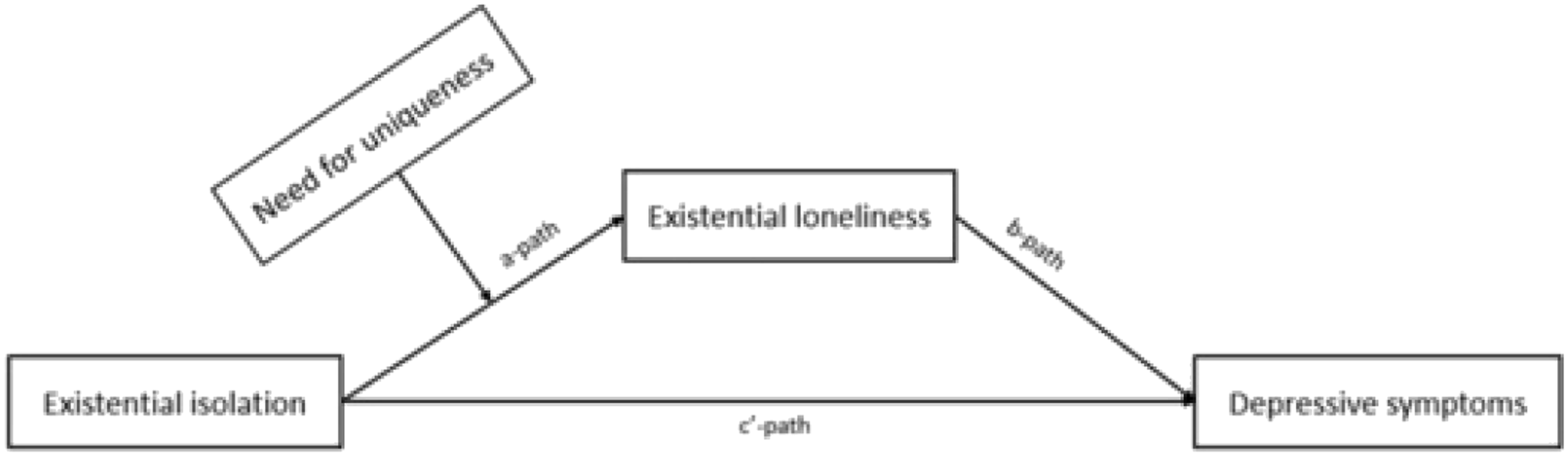
Methods
Participants and Procedure
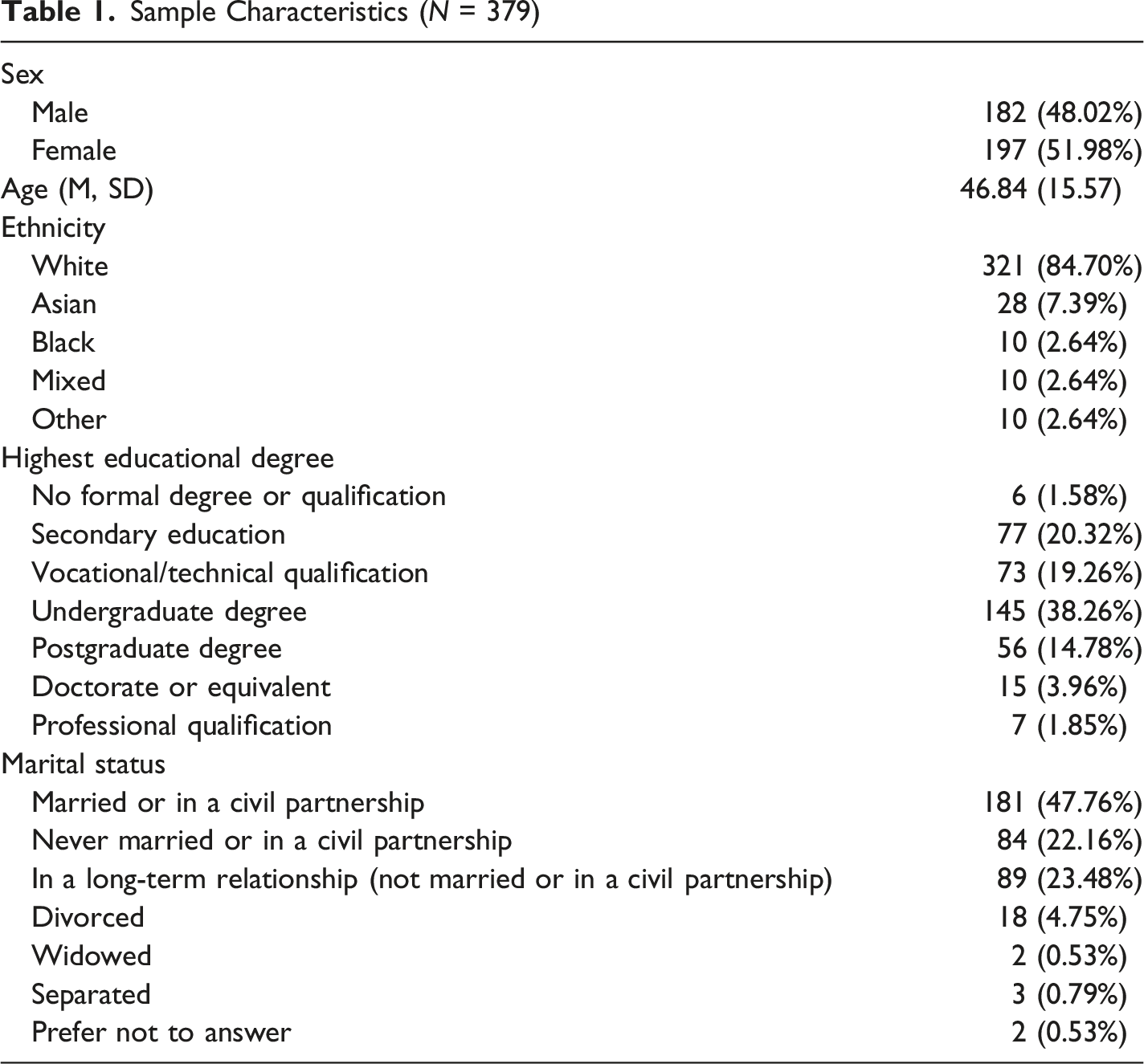
Data were collected from UK participants via the online Prolific platform in November 2024. Prolific provides samples broadly representative of the UK population in terms of age, gender, and ethnicity. Eligibility criteria required participants to be at least 18 years old and fluent in English. All participants were compensated at a rate of $12.00 per hour for their involvement. We registered this study before data collection (OSF, https://osf.io/6tyjn/). The Social and Societal Ethics Committee at KU Leuven reviewed and approved this study (reference number: G-2024-8002).
Sample Characteristics (N = 379)
Measures
Demographic data
Participants’ age, sex, and ethnicity was obtained from their Prolific profile. Marital status and highest level of education were self-reported.
Need for uniqueness
Need for uniqueness was assessed using the Self-Attributed Need for Uniqueness Scale (SANU; Lynn & Harris, 1997) 1 , which comprises four items. Participants rated how well each statement described them on a 5-point Likert scale ranging from 1 (no/weak/…) to 5 (extremely/very strong/…). Mean scores were calculated, with higher scores reflecting a higher need for uniqueness. In this study, SANU demonstrated good internal consistency (McDonald’s ω = 0.89). A one-factor confirmatory factor analysis (CFA) indicated excellent construct validity, χ2 = 0.037, df = 2, p = 0.981; CFI = 1,000; TLI = 1.008; RMSEA = 0.000; SRMR = 0.001.
Existential isolation
Existential isolation was assessed using the Existential Isolation Scale (EIS; Pinel et al., 2017) 1 , which consists of six items scoring from 1 (strongly disagree) to 7 (strongly agree). Mean scores were calculated, with higher scores representing higher levels of existential isolation. In this study, EIS demonstrated good internal consistency (McDonald’s ω = 0.93). A one-factor CFA indicated acceptable construct validity, χ2 (9) = 53.68, p < 0.001, CFI = 0.965, TLI = 0.942, SRMR = 0.039, RMSEA = 0.116.
Existential loneliness
Existential loneliness was assessed using the Brief Scale of Existential Loneliness (BSEL; McKenna-Plumley et al., 2024) 1 , which consists of six items rated on a 5-point Likert scale from 1 (strongly disagree) to 5 (strongly agree). Mean scores were calculated, with higher scores indicating higher levels of existential loneliness. In this study, BSEL demonstrated excellent internal consistency (McDonald’s ω = 0.97). A one-factor CFA indicated acceptable construct validity, χ2 (9) = 71.924, p < 0.001, CFI = 0.957, TLI = 0.928, RMSEA = 0.169, SRMR = 0.041, supporting construct validity.
Depressive symptoms
Depressive symptoms were assessed using the Center for Epidemiological Studies-Depression (CES-D8) scale (Missinne et al., 2014; Radloff, 1977; Van de Velde et al., 2010) 1 , which comprises eight items, with each item scored on a scale from 0 (rarely or none of the time) to 3 (most of the time). An example from the scale is “I felt depressed”. In this study, CES-D8 demonstrated good internal consistency (McDonald’s ω = 0.93). Both one-factor and two-factor structures of the CES-D8 have been reported in the literature (Liu et al., 2023; Van de Velde et al., 2009). Therefore, both of them were tested using CFA. The two-factor model demonstrated a better fit, χ2 (19) = 59.88, p < 0.001 CFI = 0.971, TLI = 0.957, RMSEA = 0.084, SRMR = 0.036, compared to the one-factor model, χ2 (20) = 194.61, p < 0.001, CFI = 0.871, TLI = 0.820, RMSEA = 0.173, SRMR = 0.056). Overall, the CFA results supported good construct validity. Despite the better fit of the two-factor model, the CES-D8 total mean score was retained for analyses in line with its original conceptualization and established use in the literature (Missinne et al., 2014; Radloff, 1977; Van de Velde et al., 2010), as our research questions did not concern the subfactors specifically. Higher scores reflecting increased depressive symptoms.
Data Analysis
All analyses were performed using R Statistical Software (v 4.3.2, R Core Team, 2023). As the questionnaire was programmed to require responses to all items, participants were unable to skip questions, resulting in no missing data. Descriptive statistics, including means, standard deviations, skewness, and kurtosis, were computed for the key variables. McDonald’s ω indexes were calculated to assess reliability.
Using robust maximum likelihood (MLR) estimation, a series of confirmatory factor analysis (CFA) was conducted to test the construct validity of each scale (see Measures section). Model fit was evaluated using several indices: Comparative Fit Index (CFI), Tucker-Lewis index (TLI), Root Mean Square Error of Approximation (RMSEA), and Standardized Root Mean Square Residual (SRMR). Criteria for acceptable model fit were CFI ≥ 0.90, TLI ≥ 0.90, RMSEA ≤ 0.08, and SRMR ≤ 0.08 (Hu & Bentler, 1999; Kenny & McCoach, 2003; MacCallum et al., 1996). All fit indices were considered together, rather than focusing solely on cutoff values, which is especially recommended given the small degrees of freedom and relatively small sample size in this study (Feinian et al., 2008; Kenny et al., 2015; Kenny & McCoach, 2003).
Then, a series of Pearson correlation analyses were conducted to examine the relationships among the study variables, with a correlation of 0.1 interpreted as a small effect size, 0.3 as a medium effect size, and 0.5 as a large effect size (Cohen, 1988). Values of variation inflation factor (VIF) were calculated to assess multicollinearity, with VIF values below 3 considered acceptable (O’brien, 2007).
Next, we used PROCESS version 4.3 for R (Hayes, 2022) to test the mediation model and the moderated mediation model. More specifically, PROCESS Model 4 was first used to test the mediation of EL on the association between EI and depressive symptoms. PROCESS Model 7 was then used to test the proposed moderated mediation model. Both models employed a bootstrapping procedure with 5000 resamples. Effects were considered statistically significant if the 95% confidence interval (CI) did not contain zero (Shrout & Bolger, 2002). Age, sex, marital status, and highest educational degree were included as covariates in our analysis. Marital status was recoded into a binary variable (0 = married or in a long-term relationship; 1 = other), considering the small number of participants in some categories and the fact that these were not the main focus of the current study. In addition, in the moderated mediation analyses, the continuous predictors and mediator were mean-centred to minimize multicollinearity and to make interpretation easier for the main effects of our predictors (Dearing & Hamilton, 2006).
Results
Preliminary Analyses
Descriptive Statistics and Pearson Correlations (N = 379)
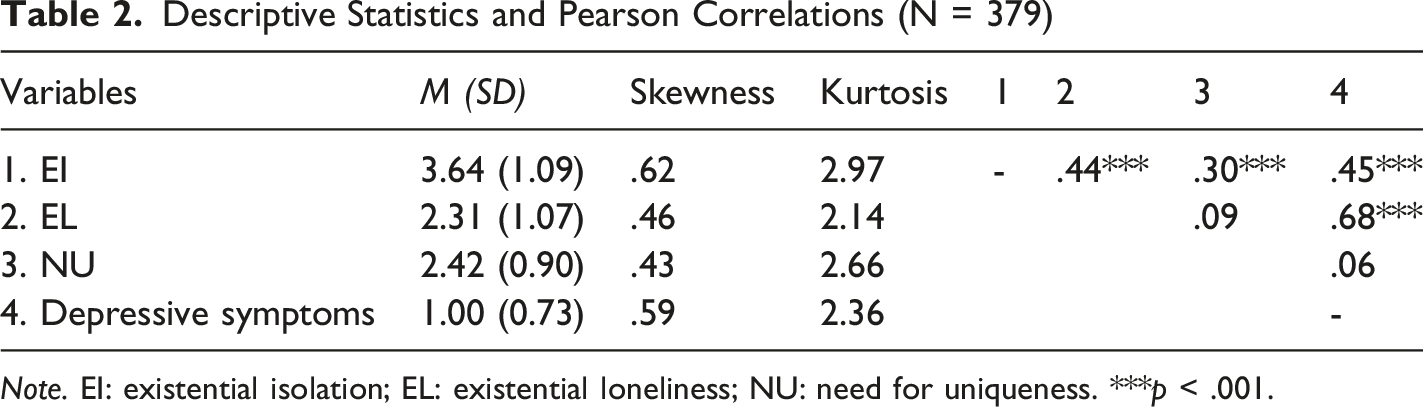
Note. EI: existential isolation; EL: existential loneliness; NU: need for uniqueness. ***p < .001.
Mediation Analysis
Mediation Analyses
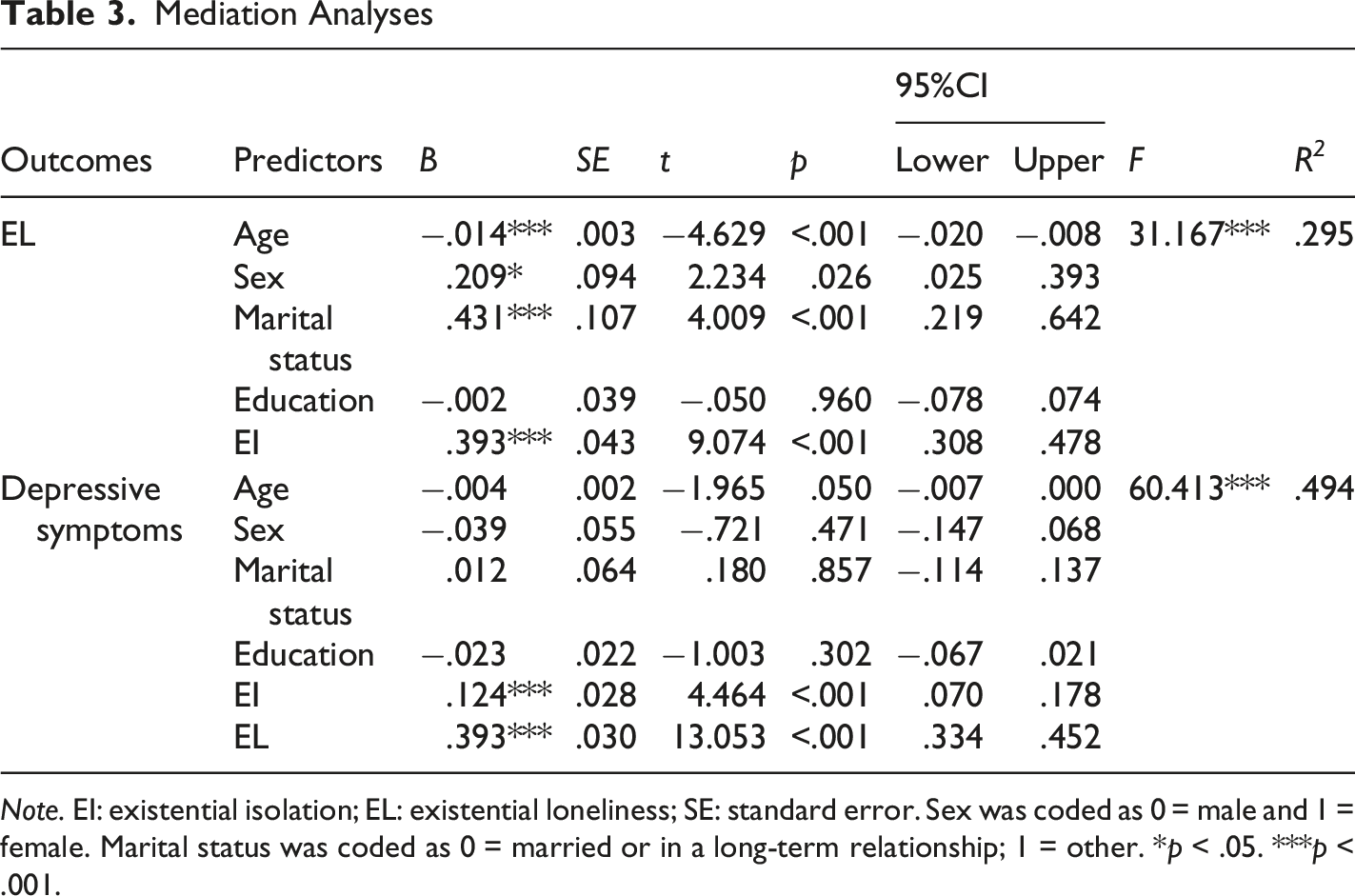
Note. EI: existential isolation; EL: existential loneliness; SE: standard error. Sex was coded as 0 = male and 1 = female. Marital status was coded as 0 = married or in a long-term relationship; 1 = other. *p < .05. ***p < .001.
Moderated Mediation Analysis
The interaction between EI and NU in predicting EL was not significant. Moreover, the index of moderated mediation was also non-significant (Index = −0.006, 95%CI = [−0.042, 0.032]). These findings provide no evidence that the indirect effect of EI on depressive symptoms through EL is moderated by NU. Instead, the indirect effect remained significant across all levels of NU. These findings do not support our second hypothesis. The full model results are reported in Tables S1 and S2 in the Supplementary Material.
Exploratory Analyses
The hypothesized moderated mediation model was not supported and correlation analyses indicated that NU was significantly positively associated with EI, but not with EL or depressive symptoms. Uniqueness theory suggests that moderate levels of self-distinctiveness may be more satisfying than either extreme levels of similarity or dissimilarity (Snyder & Fromkin, 1980). This implies that the relationship between NU and variables such as EL and depressive symptoms may follow a non-linear pattern. To explore this possibility, post-hoc exploratory analyses were conducted to examine potential curvilinear relationships between NU and EL and depressive symptoms.
Specifically, two quadratic regression models were estimated to examine potential curvilinear (i.e., U-shaped) associations of NU with EL and depressive symptoms. In each model, the linear and quadratic terms of NU were entered simultaneously, while controlling for age, sex, educational level, and marital status. NU was mean-centered prior to computing the squared term to reduce multicollinearity between the linear and quadratic predictors.
As a robustness check, the two-lines test (Simonsohn, 2018), a more rigorous method for detecting U-shaped relationships, was conducted with EL and depressive symptoms as dependent variables, respectively. Although a significant quadratic term may suggest a curvilinear association, it does not necessarily imply a true U-shaped relationship, as such effects can also reflect other forms of nonlinearity (Simonsohn, 2018). The two-lines test addresses this limitation by directly testing whether the relationship consists of two distinct linear slopes with opposite signs. Specifically, this method estimates two separate linear slopes by partitioning the predictor at a breakpoint determined by the “Robin Hood” algorithm, which maximizes statistical power for detecting U-shaped relationships. Evidence for a U-shaped relationship is indicated when the two estimated slopes are of opposite signs and both statistically significant.
Results of Quadratic Regression Analyses Predicting Existential Loneliness and Depressive Symptoms
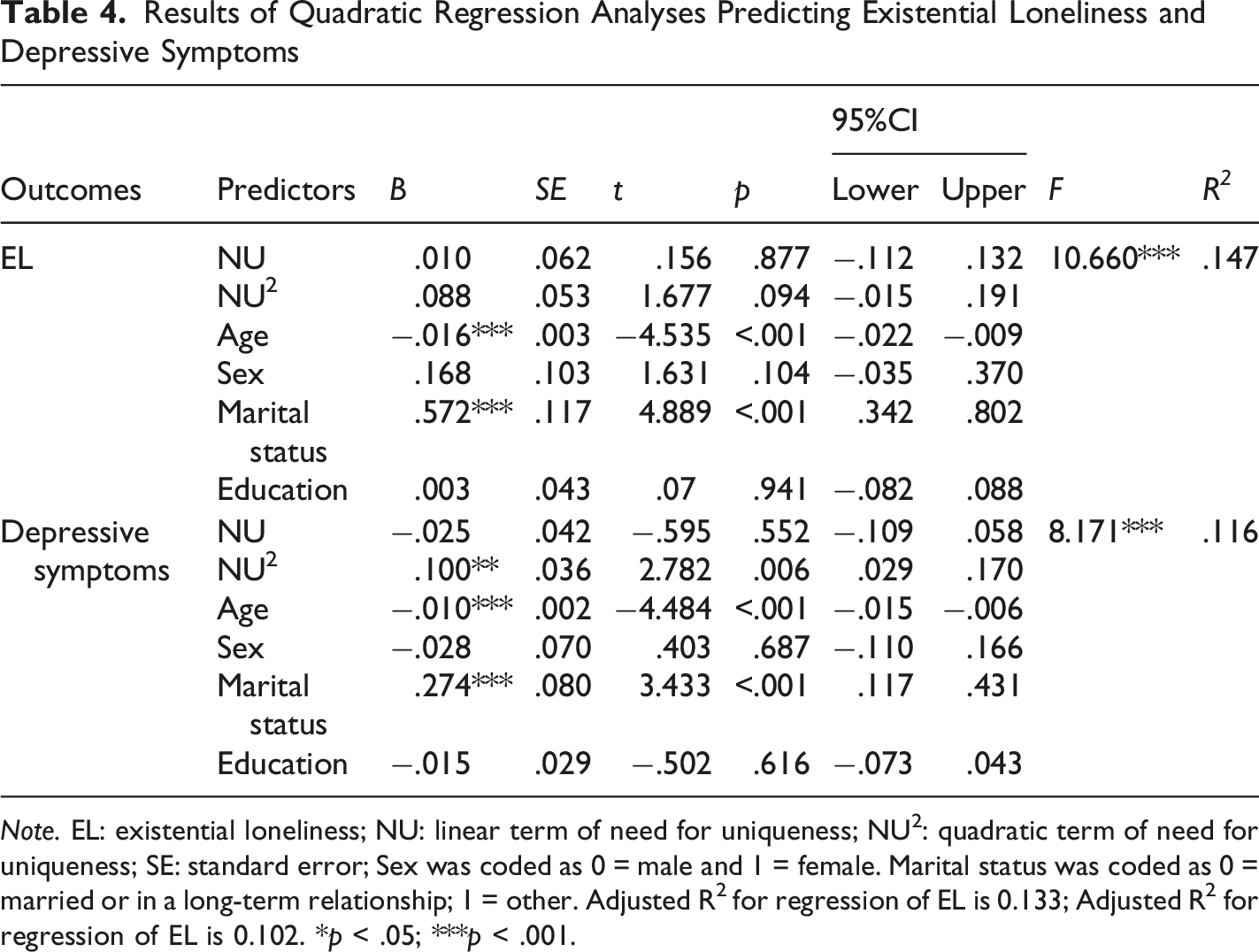
Note. EL: existential loneliness; NU: linear term of need for uniqueness; NU2: quadratic term of need for uniqueness; SE: standard error; Sex was coded as 0 = male and 1 = female. Marital status was coded as 0 = married or in a long-term relationship; 1 = other. Adjusted R2 for regression of EL is 0.133; Adjusted R2 for regression of EL is 0.102. *p < .05; ***p < .001.
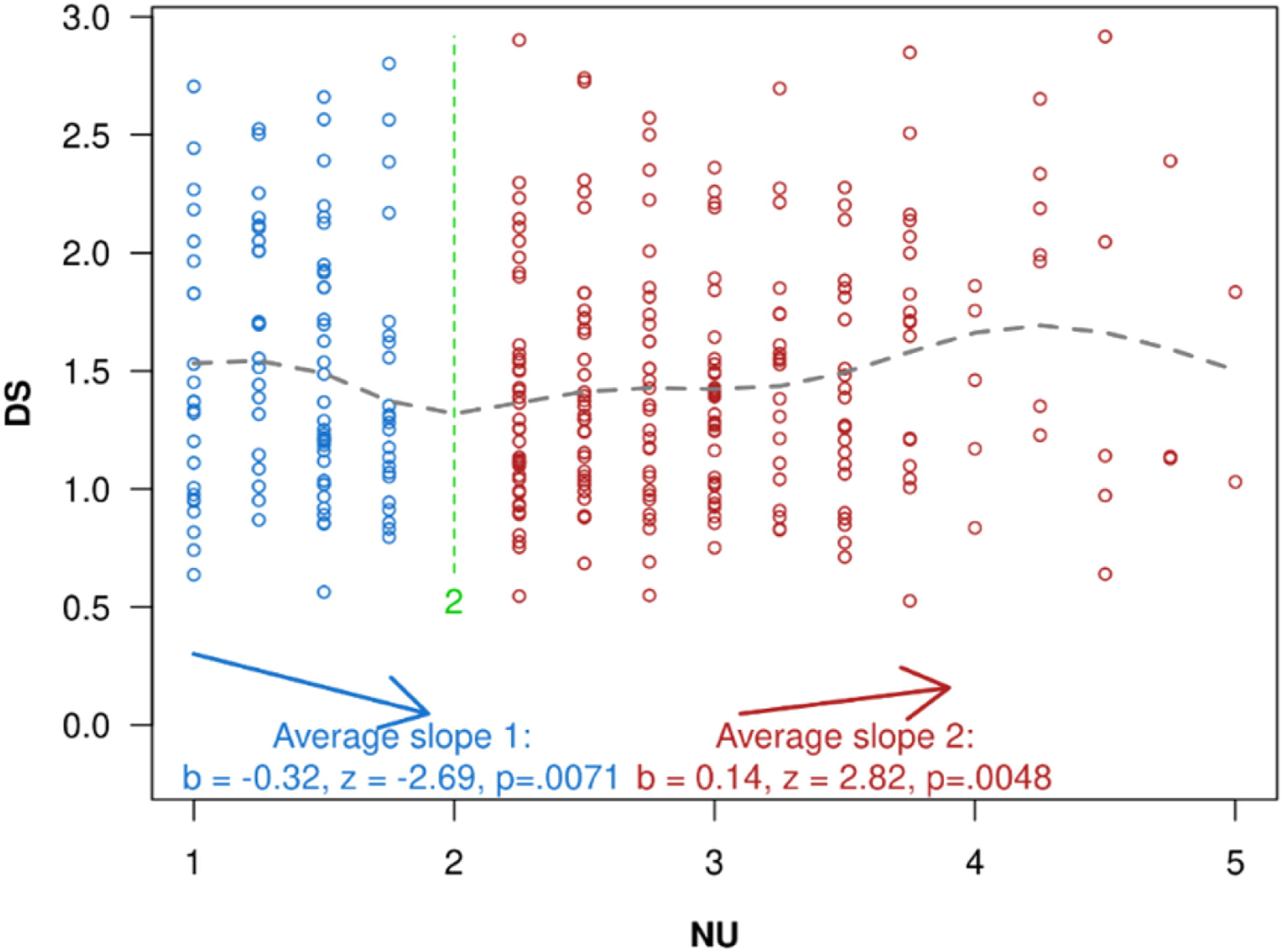
Results of the two-lines test examining the U-shaped relationship between need for uniqueness and depressive symptoms. NU = need for uniqueness; DS = depressive symptoms. The figure was generated using the web-based tool for the two-lines test provided by Simonsohn (2018, https://webstimate.org/twolines)
Discussion
The present study explored the associations between EI, EL, NU, and depressive symptoms. Consistent with theoretical perspectives and prior empirical findings (e.g., Helm et al., 2018; Helm et al., 2020; Pinel et al., 2017), EI was positively associated with depressive symptoms. Although a range of mechanisms may shape this relationship, the present study specifically targeted the mediating role of EL, a deep type of loneliness closely related to EI. The results suggest that individuals who feel existentially isolated may experience EL, which, in turn, is associated with higher levels of depressive symptoms. This is in line with the recent conceptualizations of EI and EL, which characterize EL as the distress that may come along with the experience of EI (Dezutter et al., subbmited). It also aligns with the findings of Zhao et al. (2026) suggesting that EL may play an important role in the relationship between EI and depressive symptoms.
One possible explanation for this mediating role of EL is that EI may undermine core psychological needs and increase the likelihood that individuals experience or interpret their existential separation from others as a negative and distressing experience. In particular, EI may operate through two psychological processes. As noted by Pinel et al. (2006), EI may disrupt individuals’ sense of belonging. Because belonging is typically constructed through stable and meaningful interpersonal relationships, perceived failures of being truly understood by others may weaken relational bonds and threaten the sense of belonging, thereby generating psychological strain (Baumeister & Leary, 1995; Brewer, 1991). Importantly, both weakened relational bonds and diminished sense of belonging may heighten awareness of one’s fundamental separation from others. This heightened awareness, together with the associated psychological strain, may lead individuals to interpret this fundamental separation as negative and distressing, thereby experiencing EL. Additionally, EI may challenge the need for belief validation (Long et al., 2022). Individuals typically validate their beliefs through shared reality with others, which provides confidence in one’s belief system and in one’s ability to make sense of the world. However, when individuals feel that their subjective experiences cannot be fully understood or shared, they may be unable to validate their beliefs or establish a shared reality with others (Park & Pinel, 2020). Such experiences may likewise heighten awareness of one’s fundamental separation from others and are accompanied by an unpleasant psychological state. As a result, this may render such separation psychologically distressing and may contribute to the experience of EL.
This intense emotional experience of EL may then be related to increased depressive symptoms. This association may be driven by core features of EL, including feelings of hopelessness, meaninglessness, fears of dying, being abandoned and forgotten (Bolmsjö et al., 2019; Sand & Strang, 2006; Sjöberg et al., 2018). In addition to these affective experiences, EL may also be linked to depressive symptoms through other mechanisms. For example, EL tends to intensify in life-threatening situation, such as when individuals are confronted with death (Ettema et al., 2010). The awareness of mortality may evoke death anxiety. From the perspective of Terror Management Theory (TMT; Greenberg et al., 1986), death anxiety is typically buffered by meaningful relationships that foster coherence and belonging. However, EL reflects a sense of separation that persists even in the presence of such relationships and may not be easily alleviated through social contact or emotional regulation (Bolmsjö et al., 2019; Ettema et al., 2010). In this sense, EL undermines the protective function of social bonds proposed by TMT, leaving individuals more vulnerable to death anxiety and, consequently, to depressive symptoms.
This study also examined the moderating role of NU in the relationship between EI and EL. We might expect that individuals high in NU would be less distressed by the awareness of their seperation from others; however, the present results suggest that the association between EI and EL is similar across levels of NU. One possible reason is that the study may have been underpowered to detect very small interactive effects. A post-hoc power analysis indicated that, given 379 participants, and seven predictors, the study had approximately 78% power to detect a small effect (Cohen’s f2 = 0.02). This suggests that very small moderating effects of NU may not have been reliably detected. However, even if such effects exist, their practical significance may be limited.
Beyond statistical considerations, one possible explanation of our finding is that the transition from EI to EL may represent a relatively fundamental or natural psychological process that is less contingent on individual differences in uniqueness needs. In other words, EI may be so intrinsic to the human condition that even those high in NU still may experience it as distressing, or the transition from EI to EL may occur in a relatively automatic or unconscious manner that is difficult to modulate. Zajonc (1980) suggests that affective reactions are very first reactions and can be elicited rapidly and may occur independently of, or prior to, cognitive evaluation. From this perspective, individuals may experience EL before engaging in reflective interpretations of EI, including those that affirm their uniqueness. This temporal precedence may limit the extent to which NU can shape the EI–EL link. Another possible explanation is that the EI-EL link may involve other core psychological mechanisms, such as the need to belong and the need for belief validation, which NU may not directly buffer.
Importantly, the results do not imply that NU is irrelevant in this study. Instead, a positive association between EI and NU was observed. This finding suggests that individuals who experience EI may be more likely to frame their experience in terms of uniqueness. In other words, individuals may use uniqueness as a way to make sense of experiences of being unshared or not understood, thereby maintaining psychological coherence. Similar coping strategies have been discussed in literature. For instance, individuals experiencing loneliness seem to be more likely to adopt hostility attitudes, viewing others as harmful or dissatisfying. By deeming others as unworthy to become possible relationship partners, individuals may protect their ego and reduce feelings of vulnerability (Segel-Karpas & Ayalon, 2020). In this sense, attributing one’s experience to uniqueness may help individuals reinterpret EI and protect their self-esteem, although this reframing may not necessarily alleviate EL. It may also be the case that individuals with more NU do not transition from EI to EL because an awareness of their separation from other people (EI) does not elicit distressing feelings (EL) for them.
Furthermore, exploratory analyses revealed a curvilinear relationship between NU and depressive symptoms. This finding is in line with uniqueness theory, which proposes that a moderate level of self-distinctiveness is more satisfying than extremes of similarity or dissimilarity (Snyder & Fromkin, 1980). This also aligns with earlier experimental work by Fromkin (1972), which suggests a curvilinear pattern in the relationship between distinctiveness and positive emotional outcomes. Together, these findings suggest that NU may not function as a simple linear moderator in the relationship between EI and EL, but may still play a role in mental health through more complex, nonlinear pathways. Future research could further investigate these dynamics.
While the results of this exploratory study make important contributions to literature, several important limitations of this study should be noted that can inform future work. First and foremost, although our model is theoretically grounded, it is conceptualized as causal in nature. Testing such a model with cross-sectional mediation relies on strong assumptions, including the absence of unmeasured confounders and the correct specification of temporal ordering, both of which cannot be verified using cross-sectional data (Rohrer et al., 2022). This mean we cannot draw causal conclusions. Although people who feel that they cannot be understood by any others may more likely to feel EL, the direction of this relationship may also be reversed or more complex. For instance, individuals experiencing EL may draw on EI to make sense of or justify their feelings, for example by attributing their loneliness to the belief that others cannot truly understand them. In this way, EL may also function as a predictor of EI. Therefore, this study should be taken as an exploratory step exploring these relationships, and future studies employing longitudinal designs or experimental designs are needed to clarify their directionality. Second, the use of a convenience sample recruited through the platform Prolific may have introduced selection biases, including overrepresentation of White participants and self-selection of individuals more likely to use the platform. A more systematic sampling method can be considered in future studies to test our findings. Last, our sample was drawn entirely from the UK, limiting generalizability across socio-cultural contexts. Cultural factors may be particularly relevant, as populations emphasizing independence and individual uniqueness (e.g., European Americans) display higher NU and may experience EI and EL differently than those in collectivistic cultures (Kim & Markus, 1999; Snyder & Lopez, 2002). This cultural dimension is important given that most EI and EL research has been conducted in Western contexts. Future research should therefore investigate whether these findings extend to more diverse populations.
Despite these limitations, this research offers several theoretical and practical implications. Theoretically, it contributes to the limited literature on the relationships among EI, EL, and depressive symptoms. In addition, it provides further evidence for the uniqueness theory by suggesting a U-shaped relationship between NU and depressive symptoms. Practically, the findings indicate that individuals with both lower and higher levels of NU may be at greater risk for depressive symptoms, which could help identify more vulnerable individuals. More importantly, the results suggest that targeting EL may be a more promising and effective way to reduce the potential negative effects of EI, as EL is often experienced as a form of suffering that individuals always try to overcome (Chung et al., 2019). This is particularly relevant given prior research suggesting that individuals may be reluctant to directly reduce their experience of EI. Although it has been argued that there is no permanent remedy for EL (Mayers & Svartberg, 2001), individuals appear to find ways to cope with it through self-regulation strategies such as accepting and reframing their experiences, engaging in self-reflection, searching for meaning, and redefining personal success (Chung et al., 2019). Moreover, Sundström et al. (2020) found that being a volunteer may help alleviate both general loneliness and EL. Lastly and importantly, our emphasis on interventions for EL does not imply that those targeting EI lack value. Rather, because EL partially mediates the link between EI and depressive symptoms, addressing EI directly may also be beneficial.
Supplemental Material
Supplemental Material - Exploring the Roles of Existential Loneliness and Need for Uniqueness in the Relationship Between Existential Isolation and Depressive Symptoms
Supplemental Material for Exploring the Roles of Existential Loneliness and Need for Uniqueness in the Relationship Between Existential Isolation and Depressive Symptoms by Tongtong Zhao, Laura Dewitte, Phoebe E. McKenna-Plumley, Helena Larsson, Lien Ver Elst, Jessie Dezutter in Psychological Reports.
Footnotes

Ethical Considerations
This study was approved by the Social and Societal Ethics Committee (SMEC) at KU Leuven: G-2024-8002.
Consent to Participate
Online written informed consent was obtained from participants.
Author Contributions
Tongtong Zhao, Laura Dewitte, and Jessie Dezutter contributed to the study conception and design. Data collection was performed by Laura Dewitte. Material preparation, data screening, and data analysis were conducted by Tongtong Zhao. Lien Ver Elst ran additional analyses to verify the results. The first draft of the manuscript was written by Tongtong Zhao, and all authors commented on previous versions of the manuscript. All authors read and approved of the final manuscript.
Funding
The authors disclosed receipt of the following financial support for the research, authorship, and/or publication of this article: This work was supported by Chinese Scholarship Counsil (CSC) [grant 202306990025].
Declaration of conflicting interests
The authors declared no potential conflicts of interest with respect to the research, authorship, and/or publication of this article.
Data Availability Statement
The data supporting the findings can be requested by contacting the corresponding author and that access will be granted after obtaining the necessary ethics approval and data sharing agreements.
Supplemental Material
Supplemental material for this article is available online.
Notes
Author Biographies
References
Supplementary Material
Please find the following supplemental material available below.
For Open Access articles published under a Creative Commons License, all supplemental material carries the same license as the article it is associated with.
For non-Open Access articles published, all supplemental material carries a non-exclusive license, and permission requests for re-use of supplemental material or any part of supplemental material shall be sent directly to the copyright owner as specified in the copyright notice associated with the article.
