






Abstract
Social media are known for their overly-positive contents posted by diverse network members; but little research has directly explored the effects of individual happy posts on receivers’ well-being. Two original online experiments (Study 1: N = 326 adults in English-speaking countries; Study 2: N = 111 undergraduates in the United States) tested the effects of the desirability of a post’s content on subjective well-being, as well as direct and moderating effects of the relational tie, and additionally moderated by the perceived selective self-presentation of the post. Results of the 2 (envy: high v. low) × 2 (relational closeness: close v. distant) experiment did not evidence main effects of envy (both benign and malicious) or main or moderating effect of relational closeness; but did provide mixed findings for the main effect of selective self-presentation. Findings are discussed with respect to social comparison theory and extant literature regarding the role of passive social media use on users’ well-being.
Amid the moral panic regarding the effects of using social media, meta-analyses reveal merely using communication technologies–including social media–has negligible statistical and socially-relevant impact on our well-being (e.g., Hancock et al., 2022; Meier & Reinecke, 2021; Orben & Przybylski, 2019): “a broad category of phenomena that includes people’s emotional responses, domain satisfactions, and global judgements of life satisfaction” (Diener et al., 1999, p. 277). The lack of effects of mere use has, in turn, led to calls for more granular consideration of the specific uses of and communication occurring with individuals’ social media that impact their well-being (e.g., Meier & Johnson, 2022). One dominant call has been to explore the effect on well-being due to passive social media use, the observation of others’ behaviors by scrolling or simple exposure to their social media content and “without engaging in direct exchanges with them” (Verduyn et al., 2020, p. 3). Within this research line, social media have been highlighted due to several unique properties, including connection to diverse members of users’ relational networks and the propensity for users selectively self-present themselves via posting overly-positive posting (Reinecke & Trepte, 2014). Prior research–especially work guided by the extended active-passive model (Verduyn et al., 2022)–has therefore generally considered that passive consumption of social media posts negatively impact our well-being as we are exposed to the inflated successes and experiences of our network ties (see Meier & Krause, 2022).
However, this conclusion that passive media use innately harms well-being has been challenged and critiqued (Meier & Krause, 2022; Nabi et al., 2025). Meta-analyses (Hancock et al., 2022; Valkenburg et al., 2022; Yin et al., 2019) have not supported this innately-negative relationship between passive media use and well-being, or have found effect sizes so small as to be trivial. Consequently, effects on well-being may stem from more than merely passively using social media. One way of resolving the inconsistencies in the literature may be to move beyond considering social media feeds broadly, instead considering the characteristics of specific messages observed. The present work advances this literature by considering the positive effects on well-being stemming from passive exposure to positive content posted by relational ties. Drawing on the concept of freudenfreude and social comparison theory (Festinger, 1954), the role of envy regarding the posted content and relational closeness with the poster were tested as potential antecedents to derived well-being.
Effects of Freudenfreude on Well-Being
Freudenfreude
When we see others’ experiences, we experience an array of emotions, including happiness and envy (Boecker et al., 2022). In the present work, we focus on the former outcome: how people derive happiness from others’ experiences. Though much research has been conducted on schadenfreude, the joy one feels in response to others’ misfortunes (see van Dijk & Ouwerkerk, 2014), there remains a paucity of work on the opposite: the derivation of joy in response to others’ fortunes (Boecker et al., 2022). Royzman and Rozin (2006) attributed this paucity to the lack of an English word for this phenomenon, which resulted in Boecker and colleagues (2022) introducing the effective-yet-kudgy term “happy-for-ness” (p. 3). If our vocabulary is expanded just a bit, the German word freudenfreude aptly refers to the joy one feels in response to others’ success (Chambliss et al., 2012).
Freudenfreude can be distinguished from two similar, yet distinct concepts: emotional contagion and benign envy. Emotional contagion is largely automatic process by which a perceiver mimics and synchronizes with the affective state of another (Ferrara & Yang, 2015; Kramer et al., 2014), and does not require the observer to appraise the other’s situation, evaluate its personal relevance, or form any cognitive judgment about the other’s fortune. Freudenfreude, in contrast, is a cognitively elaborated, other-oriented response that involves recognizing another person has experienced something good, appraising that outcome as genuinely positive for them, and deriving joy because of that other’s good fortune (Boecker et al., 2022). The second concept, benign envy, (detailed more below) is self-focused, occurring when another individual’s success is perceived as fair and attainable by the perceiver as well. In contrast, freudenfreude’s focus on others involves taking pleasure in another’s good fortune for their sake, without the comparative self-evaluation that defines envy in any form (Boecker et al., 2022; Royzman & Rozin, 2006).
Through the lens of online emotional contagion perspective (Ferrara & Yang, 2015; Kramer et al., 2014), viewers should adopt the emotions expressed in the content to which they are exposed. Seeing network members post positive, joyful content should elicit joy for the observer. However, data have shown the aggregate positivity a user sees in their social media feed does not necessarily result in their increased joy or well-being, and can indeed negatively impact viewers’ emotional state (De Vries et al., 2018; Liu et al., 2018; cf. Nabi et al., 2025). That the mere exposure to positive content may not innately inspire positive emotions suggests more complex processes are at work. Consequently, we turn to social comparison theory as a useful theoretical framework.
Social Comparison Theory & Self-Evaluation Maintenance Model
Social comparison theory (SCT; Festinger, 1954) remains one of the most enduring frameworks for understanding how individuals evaluate themselves in relation to others. SCT proposes people evaluate their opinions and abilities by referencing others, especially when objective standards are absent, via both downward comparison (i.e., contrasting the self against inferior others) and upward comparison (i.e., contrasting the self against superior others, including when others are successful). These social comparisons are important determinants of an individual’s self-view and well-being (Crusius et al., 2022).
Built on SCT, Tesser's (1988) self-evaluation maintenance (SEM) model further explains when upward comparisons are most threatening. The model specifies two key determinants: psychological closeness and relevance of the performance domain. First, psychological closeness amplifies the impact of another’s success: When the comparison target is a sibling, close friend, or partner, their achievements are more likely to provoke self-evaluative threat than the accomplishments of an estranged parent, passing acquaintance, or unfamiliar other. Second, the effect depends on the relevance of the performance domain. For successes that happen in an area that is important to one’s identity and self-definition, the upward comparison is more threatening than successes in domains deemed unimportant. Together, these factors predict comparisons involving close others in self-relevant domains elicit the strongest impacts, typically resulting in happy-for-ness when comparison is downward and envy when the comparison is upward (Boecker et al., 2022). Social media, wherein newsfeeds are saturated with positive content from diverse network ties, readily foster such comparisons. Thus, we consider two likely determinants of a post’s emotional effect: the relational closeness with the poster and envy of the posted content.
Relational Closeness
Through the lens of SCT (Tesser, 1988), individuals form self-evaluations and emotional appraisals through comparison with relevant relational ties; and upward comparisons–such as seeing others’ happy posts–can result in negative effects on a perceiver’s self-esteem and well-being. However, research applying SCT has found relational closeness may buffer the negative effects of upward social comparison, so that upward comparison with a relationally-close target leads to less negative (i.e., more positive) well-being (e.g., Brewer & Weber, 1994; Liu et al., 2016). Developing the SEM model, Tesser (1988) incorporated Cialdini et al. (1976) notion of ‘basking in reflected glory,’ by which people seek to associate themselves with winners, to contend that when a closer relational tie (e.g., friend, close family member) performs well the individual enhances their self-evaluation through a reflecting process to account for their proximity to success. Per Tesser, a good friend’s success can inspire an individual by “redefin[ing] the possibilities for the self: if he/she can do it so can I” (p. 189). Consequently, the same expression of another’s happiness may elicit different levels of immediate subjective well-being based on the relational closeness with the person expressing.
In contemporary digital contexts, relational networks have expanded while remaining diffuse, composed largely of weak ties that offer connection without emotional intimacy (Ellison et al., 2007). Thus, although social media expand access to information and social capital, they also heighten exposure to social comparison without the protective effects of close relationships (Burke et al., 2020). Such comparisons can evoke pride and identification, allowing individuals to bask in reflected glory when others’ successes feel attainable (White et al., 2006). Supporting evidence shows positive posts from close ties via social media elicit stronger affective responses than those from distant acquaintances (Lin & Utz, 2015; Liu et al., 2016). These findings suggest relational closeness affects the emotional consequences of social comparison, influencing whether it enhances or undermines well-being. Thus:
Positive social media posts from relationally closer posters enhances subjective well-being more than positive social media posts from relationally distal posters.
Envy
Beyond passively observing posts made by ties of varying relational closeness, the content of observed social media posts can also evoke differing types and degrees of envy. Envy is the feeling of pain or resentment that comes from comparing ourselves to someone who has something we want (Joseph, 1986); and can be distinguished from jealousy, which refers to the worry that others will take or diminish something someone already has. Feldman and De Paola (1994) noted envy arises when another person is seen as holding an ideal quality we believe we cannot attain. This gap between another’s success and our own situation can create distress. Envy consequently carries a spoiling quality: Rather than simply admiring the other’s good fortune, we may devalue it or wish to take it away (Joseph, 1986). As such, social comparison is particularly apt to elicit envy, as upward comparison results in self-comparison against the desirable outcomes attained by another, which can in turn impair well-being (Crusius et al., 2020). When we see on social media that someone has achieved something we also desire, the resultant comparison can make us feel lacking (van de Ven, 2017; Wenninger et al., 2021). In this way, envy acts as a mechanism that can reframe a friend’s success into a perceiver’s personal setback. Instead of sharing in their joy, we experience discomfort because their good fortune highlights our own unmet goals. This tension makes envy central to understanding why positive news sometimes lowers, rather than raises, our mood. And yet, recent research shows envy is not a monolithic construct, instead differentiating among forms of envy. van de Ven et al. (2009), distinguished benign envy from malicious envy.
Benign envy, characterized by a ‘moving-up motivation,’ occurs when another individual’s success is perceived as fair and attainable. Rather than provoking resentment, benign envy thus motivates the perceiver to improve themselves, their own situation and view the envied individual’s success as inspiring, transforming comparative disadvantage into personal motivation (van de Ven et al., 2009). This envy leads to socially desirable reactions and can foster behavioral outcomes (Battle & Diab, 2024; Cohen-Charash & Larson, 2017). For instance, when people feel they have some control over reaching the same goal, they use the other’s success as inspiration to work harder to ‘level up’ rather than harming others (Belk, 2011). In social media settings, benign envy can appear when we see a friend post about earning a promotion or reaching a fitness goal and we think, “I could do that too if I put in the effort.” This kind of envy can lead to positive motivation and even higher well-being because it pushes people toward self-development rather than resentment.
In contrast, malicious envy is associated with a ‘pulling-down’ motivation that aims to damage the position of the superior, when a superior other’s success is seen as undeserved or unreachable, producing feelings of ill will, withdrawal, and hostility (van de Ven et al., 2009). Malicious envy often involves negative emotions and behavioral outcomes directed towards the envied individual (Battle & Diab, 2024). Smith and Kim (2007) describe malicious envy as a painful blend of inferiority and resentment that can lead to behaviors such as gossip, disparagement, or social withdrawal; and van de Ven (2017) linked malicious envy to anger and a desire for revenge, often emerging in competitive or unfair contexts. For example, malicious envy can predict turnover intentions in the workplace (Battle & Diab, 2024) and contribute to environmentally harmful behaviors. Crusius and Lange (2017) describe malicious envy as focusing more on the person rather than on the achievement itself, which fuels thoughts of criticism, which further leads individuals to engage in destructive actions to make themselves feel better after realizing their lower position. On social media, this form of envy might emerge when a friend’s post feels boastful or highlights something that seems unfairly earned. Instead of motivating self-improvement, malicious envy lowers mood and leads to negative affect (Lin & Utz, 2015).
These disparate types of envy subsequently should lead to different psychological outcomes. When the superior outcome is seen as deserved and attainable, benign envy becomes constructive and motivates people to improve themselves and strive toward similar success. Alternately, when the superior outcome is viewed as underserved or unattainable, the resultant malicious envy is corrosive, fuels hostility and a desire to see the advantaged person fail (Smith & Kim, 2007; van de Ven et al., 2012). Lin and Utz (2015) demonstrated these differential effects, finding experiencing greater malicious envy from social media interaction positively correlates with negative affect and decreased well-being. We subsequently hypothesize a similar disparate effect of a network tie’s social media post based on the type of envy its content evokes, so that freudenfreude is also a function of the post’s content:
Subjective well-being is enhanced more by exposure to a positive social media post evoking benign envy than a social media post evoking malicious envy.
Moderating Effect of Relational Closeness
The first two hypotheses predict independent effects on the improved well-being of a passive social media user being exposed to a positively-valenced post due to (H1) the poster and (H2) the contents of that post. However, these two factors co-occur within social media, and likely have an interactional influence on the effects of freudenfreude. Again turning to SEM (Tesser, 1988), psychological closeness amplifies the impact of another’s success, so that self-evaluation is stronger when comparing one’s self with a closer tie. This intensification of the comparison should moderate the effect of envy from the post’s content on the resultant well-being. Consistent with this expectation, Lin and Utz (2015) found that relational closeness with a poster moderated the effect of a post’s valence on the viewer’s resultant happiness (though not envy). Consequently, in addition to the main effect of relational closeness with a poster on well-being, we additionally expect relational closeness to moderate the relationship between a perceiver’s envy of a post’s content and their subsequent well-being. Formally:
Relational closeness moderates the effect of envy on resultant subjective well-being, so that: (H3a) as the poster is more relationally-close to the receiver, a post evoking benign envy has a more positive effect on subjective well-being; and (H3b) as the poster is more relationally-close to the receiver, a post evoking malicious envy has a less positive effect on subjective well-being.
Moderating Effect of Selective Self-Presentation
Finally, it is important to consider the self-presentational nature of social media posts. As social media feeds are dominated by overly-positive content (Reinecke & Trepte, 2014), users are increasingly aware of the self-enhancing, self-promotional, and simply braggadocious nature of content posted on social media. The perception that someone’s presented good news or success is motivated by selective self-presentation may additionally influence the perceiver’s subsequent psychological state by moderating the relationship between envy and well-being. Recalling the SEM model (Tesser, 1988), comparisons are partly determined by the relevance of the performance domain. The belief a poster’s content is motivated by selective self-presentation (rather than as a more natural statement of recent events) might ameliorate the relevance of a depicted performance, making it seem more performative and less-representative of the presenter’s actual self, thereby reducing the effect of social comparison. There is some tentative empirical support of this supposition. Ridolfi et al. (2011) found cognitive distortions–making errors in cognitions and perceptions or distorting information in a systematic way–can influence users susceptibility to body image disturbance, so that individuals who believed digitally-altered online photos accurately reflected reality experienced body dissatisfaction upon exposure. Similarly, within the context of posting travel photos to social media, Taylor (2020) demonstrated individuals experiencing greater envy on social media engage in more self-promotive posting behaviors. Thus, when individuals think online content is posted more to present an ideal image of their self to others, rather than to present themselves faithfully, that self-presentational goal could lessen the effects of envy felt by that post: If it was posted to make one covetous of another’s success or joy, it may mitigate the positive effect of the post’s content as the post is considered a distortion of reality. To explore this potential moderating effect, we hypothesize that as a viewer perceives a positive social media post is more self-promotive in nature (i.e., putting forward an idealized or overly-positive self), the relationship between envy and well-being is weakened. The effects of freudenfreude should therefore be ameliorated when a perceiver does not believe the joyous post actually displays their network tie’s actual joy; but is instead more performative or strategically self-presentational in nature. Formally:
The selective self-presentation of a post moderates the relationship between envy and resultant subjective well-being.
Study 1
Method – Study 1
Stimuli Development
This research sought to experimentally test the effect of viewing online content on individuals’ subjective well-being, and required stimuli that either evoked envy or not. To develop such stimuli, the researchers first identified a corpus of content they had seen in their own social media feeds, identifying posts whose focus could remain consistent while editing the content to evoke malicious envy or not (e.g., “I got an award” vs. “I got an award you also were pursuing.”). Nineteen pairs of potential posts were pilot tested via a survey of N = 43 undergraduate students at a mid-sized Midwest university (Mage = 20.98, SDage = 4.91; nfemale = 31, nmale = 11, nnonbinary = 1). Respondents were exposed to 20 of the posts individually and in a random order, and asked to indicate on a 7-point Likert-type scale the degree to which they agreed with the statements “This post makes me feel envious,” and “I believe I could attain what is presented in this post,” for each post to assess its envy and attainability, respectively (see Lin & Utz, 2015). The three post pairs that best-reflected study criteria (i.e., three posts with high-envy and desirability that did not significantly differ from the other high-envy posts, which differed from low-envy within-pair, and whose low-envy pair did not differ from the other two low-envy pairs) were then selected for stimuli in the primary study. Full details of pretest stimuli and analyses can be found via the OSF repository. After establishing between-group differences in general envy in the pretest, the full study used within-participant levels of benign and malicious envy (see Measures below) to operationalize the two forms of envy.
Participants
An a priori effect size analysis (G*Power v. 3.1.9.4; Faul et al., 2008) was conducted to determine required sample size. To detect medium effects (Cohen’s f = .25), and assuming a critical p-value of p < .05, and with .95 power in a between-subjects study with four conditions with an additional independent variable, a necessary sample of 323 was calculated. Participants were subsequently recruited from English-speaking countries to take part in an online experiment via the Prolific research panel, which provides engaged participants and valid and generalizable responses (Eyal et al., 2022).
Participants (N = 326) represented six nationalities, including the United Kingdom (n = 151), United States (n = 132), Canada (n = 36), Australia (n = 4), New Zealand (n = 2), and Ireland (n = 1). They self-reported their age (M = 23.21, SD = 1.67) and gender (nfemale = 161, nmale = 162, nnonbinary = 2, ntransgender = 1). All participants were compensated US$.75 for completing the 5-min study.
Procedure
After consenting to participate, participants were randomly assigned to one of two conditions–a relationally close or relationally distant tie–with whom they are connected and regularly see posting on any social media platform. Without seeing this assignment, participants either identified someone to whom they DO feel closely connected (close tie) or someone to whom they do NOT feel closely connected (distal tie), providing a name, initial, nickname, or pseudonym for their target. Identifying this relational tie by name allowed that name to be piped into prompts and items later in the survey to increase clarity and focus. Participants were then asked to imagine they were scrolling through their social media feed when they had seen a post from their identified tie.
All stimuli were static Instagram-like posts containing an image and caption (Figure 1). To help mitigate concerns of specific messages in media psychology research (Reeves et al., 2016), multiple pretested stimuli were used in this study. All posts were positively-valenced content, holding the general topic of the post constant among pairs but altering the desirability or attainability of the depicted positive event. Participants assigned to the high envy condition saw one of three posts identified in the pretest to evoke this envy by presenting the target doing, attaining, or experiencing something perceived as desirable and achievable: either running an errand to grocery shop, getting a surprise gift of cash from an uncle, or displaying a picture of their favorite ‘auntie’—an unfamiliar woman. Participants assigned to the low envy condition saw one of three posts identified in the pretest to evoke less envy by presenting the target doing, attaining, or experiencing something perceived as positive but not necessarily desirable or achievable by others: either an extravagant shopping spree at a high-end mall, receiving cash bequeathed by a recently-deceased uncle, or displaying a picture of their favorite ‘auntie’—EGOT winner Viola Davis. Two stimuli, each depicting shopping experiences. The high envy post (left) depicts shopping in an opulent shopping mall with the caption #ShoppingSpree, whereas the low envy post (right) depicts shopping in a grocery store with the caption #GroceryShopping
To ensure adequate evaluating and processing of the stimuli, participants were only able to advance beyond the stimulus post in the survey after 10 seconds. After observing the post, participants completed three study scales, provided basic demographic information, and were then provided a completion code.
Measures
After observing the stimulus post, participants responded to three established scales used to operationalize study concepts. The first two, subjective well-being and envy, were first presented in a random order; after which all participants completed the selective self-presentation scale. All three measures were operationalized using 7-point Likert-type scales, with higher values indicating stronger agreement with (and thus higher levels of) the construct.
Well-Being
Well-being is a complex, multidimensional construct (Diener et al., 1999). As this work considers well-being as a subjective state, we operationalized subjective well-being using Sheldon and Titova (2023) ten-item subjective well-being scale. Participants identified their current general feelings in life using five positive mood items (e.g., happy, pleased; ɑ = .94) and five negative mood items (e.g., sad, frustrated; ɑ = .90) as indicators of subjective well-being. An aggregate subjective well-being measure was then calculated by adding positive mood items and subtracting negative mood items, so that higher resultant values indicate greater well-being. As noted by Puia et al. (in press), using a composite value, “is more effective than one-dimensional assessments of positive and negative affect because it accounts for extreme biases” (pp. 9-10), and in consistent with prior work (e.g., Balkis & Duru, 2026; Diener, 1994; Sheldon & Titova, 2023). Subjective well-being values in the present study ranged between −22 and 30 (M = 10.64, SD = 11.39).
Envy
Both forms of envy were operationalized via Lange and Crusius’ (Lange & Crusius, 2015) benign and malicious envy scale (BeMaS). Montes and DeAndrea (2024) noted the BeMaS is effective in assessing momentary envy effects, such as would occur from exposure to a single post while passively using social media. The BeMaS was adapted to address the specific individual considered in the stimuli. Five items assessed benign envy (e.g., “If I notice [target] is better than me, I try to improve myself; ” ɑ = .86) and five items assessed malicious envy (e.g., “Seeing [target]’s achievements makes me resent them; ” ɑ = .91). Given the different effects predicted due to differing forms of envy, the two subscales were used as within-subject predictors for analysis.
Strategic Self-Presentation
Strategic self-presentation was measured using Kim and Lee (2011) 4-item positive self-presentation scale. Items were adapted to generalize to any social medium and to refer to the specific person whom the respondent considered as posting the stimulus. Sample items include, “On social media, [target] posts photos that only show the happy side of them.,” and “On social media, [target] freely reveals negative emotions they feel” (with the later item reverse-coded). The scale demonstrated adequate reliability, ɑ = .77.
Results – Study 1
Manipulation Checks
Prior to hypothesis testing, it was important to confirm the experimental manipulations worked as-intended. First, the manipulation of relational closeness with the poster was determined by comparing the relational closeness between two conditions, operationalized via Aron et al. (1992) single, 7-point pictographic inclusion of others item, which participants were asked to use to indicate how close they perceived themselves to be with their assigned target. A between-group t-test revealed participants assigned to consider a relationally-close target (n = 163, m = 5.15, sd = 1.35) perceived their target as relationally closer than participants assigned to name and consider a relationally-distant target (n = 163, m = 2.41, sd = 1.22), t (324) = −19.21, p < .001. Thus, the manipulation of the relational closeness of a posting target was successful.
Next, though the envy evoked by stimuli were pretested, we wanted to confirm the manipulation worked as-intended with the actual sample. A between-group t-test revealed participants assigned to the high-envy condition (n = 164, m = 2.74, sd = 1.16) were more envious (operationalized as the mean of all envy items, both benign and malicious) of the post than participants assigned to the low-envy condition (n = 162, m = 2.42, sd = 1.09), t (324) = −2.55, p = .011. Thus, the manipulation of the envy evoked by a post’s contents was successful.
Given the successful manipulation of study variables, and the random assignment of participants to conditions, any differences in post-exposure perceptions should be attributed to the stimuli themselves rather than idiosyncrasies of participants (e.g., pre-exposure attitudes). Subsequently, hypotheses were first tested individually, and then finally holistically.
Hypothesis Testing
The first hypothesis predicts passively observing a positive post from a known target results in more positive subjective well-being when made by someone relationally-close as compared to someone relationally-distal. This hypothesis was initially tested by comparing the post-exposure subjective well-being of participants between relational closeness conditions. Results of an independent groups t-test revealed participants observing a positive post from a relationally-close target (m = 10.56, sd = 12.56) did not report greater subjective well-being than participants observing a positive post from a relationally-distant target (m = 10.72, sd = 10.12), t (324) = 0.13, p = .90, d = 0.01. Thus, H1 was not supported.
H2 predicts passively observing a positive post from a known target results in more positive subjective well-being when evoking benign envy as compared to a post evoking malicious envy. This hypothesis was initially tested by comparing the post-exposure subjective well-being of participants between envy conditions. Results of an independent groups t-test revealed participants in the high-envy condition (m = 11.18, sd = 10.90) did not report greater subjective well-being than participants in the low-envy condition (m = 10.10, sd = 11.87), t (324) = −0.86, p = .39, d = 0.10. Next, as a more nuanced test of the hypothesis, linear regression was used to predict subjective well-being, including both dimensions of envy as predictors. The regression was statistically significant, F (2, 323) = 15.38, p < .001, R = .30, R2 = .09, and revealed that whereas malicious envy was a significant predictor of subjective well-being (b* = −.32, t = −5.46, p < .001), benign envy (b* = .09, t = 1.45, p = .15) was not. This pattern indicates that while malicious envy suppressed subjective well-being, benign envy had no effect. Thus, H2 was not supported.
The final two hypotheses predict moderating effects of relational closeness (H3) and selective self-presentation (H4) on the relationship between envy and subjective well-being. These hypothesized dual-moderation effects were tested concurrently using Hayes (2013) PROCESS macro (v.3.3; model 2). Given the nature of moderation effects hypothesized in H3, two models were run: One with benign envy as the independent variable (X) and a second with malicious envy as the independent variable. Both models entered subjective well-being as the dependent variable (Y) and then the interval-level relational closeness (W) and selective self-presentation (Z) as moderating variables.
The first model–entering benign envy as the independent variable–was significant, F (5, 320) = 2.81, p = .02, R = .20, R2 = .04 (see Figure 2). However, consistent with prior hypothesis tests, neither relational closeness (b = −.46, se = .77, p = .55, 95% CI [-1.98, 1.06]) nor benign envy (b = −1.04, se = 1.85, p = .58, 95% CI [-4.68, 2.61]) were significant predictors of subjective well-being. Relative to H3, relational closeness did not moderate the relationship between benign envy and subjective well-being (b = .36, se = .22, p = .10, 95% CI [-0.07, 0.79]); and, relative to H4, selective self-presentation was also not a significant moderator (b = −.21, se = .30, p = .49, 95% CI [-0.79, 0.38]). Additionally, selective self-presentation did not have a direct effect on subjective well-being (b = 1.92, se = 1.03, p = .06, 95% CI [-0.10, 3.95]). Dual serial moderation models testing both benign envy (above) and malicious envy (below) as predictors of subjective well-being in Study 1. Notes. N = 326. Paths represent unstandardized coefficients, with p-values in superscript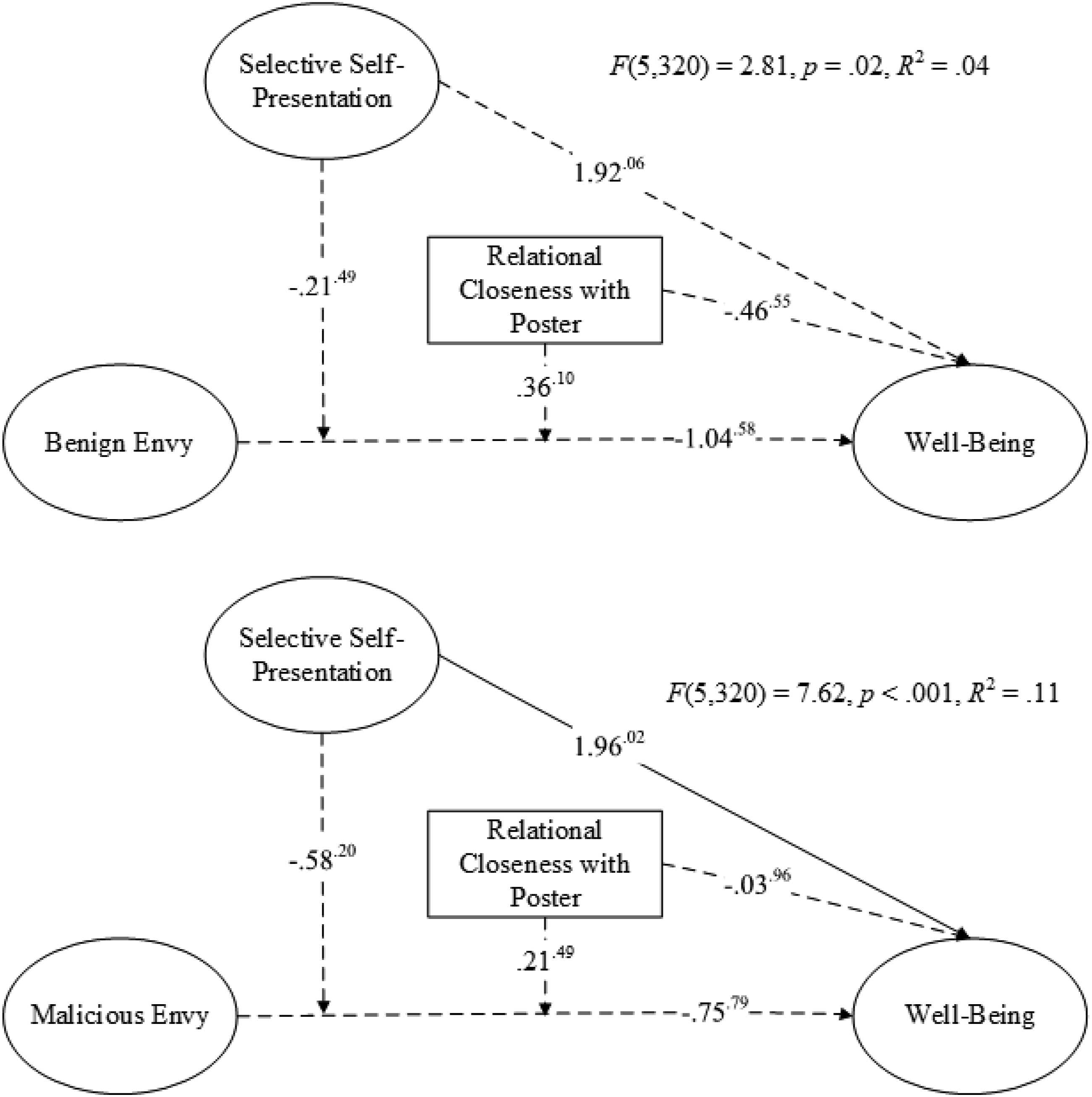
The second model–including malicious envy as the independent variable–was significant, F (5, 320) = 7.62, p < .001, R = .33, R2 = .11 (see Figure 2). Consistent with prior hypothesis tests, neither relational closeness (b = −.03, se = .61, p = .96, 95% CI [-1.23, 1.16]) nor malicious envy (b = −.75, se = 2.84, p = .79, 95% CI [-6.33, 4.84]) were significant predictors of subjective well-being. Relative to H3, relational closeness did not moderate the relationship between malicious envy and subjective well-being (b = −.21, se = .30, p = .49, 95% CI [-0.38, 0.80]). Relative to H4, selective self-presentation did not moderate the nonsignificant main effect of malicious envy on subjective well-being (b = −.58, se = .45, p = .20, 95% CI [-1.47, −0.31]). However, selective self-presentation did have an unanticipated direct effect on subjective well-being (b = 1.96, se = .85, p = .02, 95% CI [0.28, 3.64]). Taken together, these models suggest the rejection of H3 and H4.
Discussion – Study 1
Study 1 provided initial evidence of no detectable effect on subjective well-being stemming from passive exposure to a positive social media post from a relational tie. Counter to SCT, neither the closeness with the posting tie nor the envy elicited by the post’s contents had an immediate and detectable impact on subjective well-being. One initial concern of these null results was our sampling. Empirical studies of envy and well-being have been dominated by college student samples (e.g., Lin & Utz, 2015; van de Ven et al., 2009; van de Ven, 2017); and it could be that a narrower population (i.e., college students) differ in either their view of individual stimuli or in their experience of overall effects than the broader population. Indeed, studies exploring the relationship between envy and well-being using broader population samples (e.g., Battle & Diab, 2024; Nabi & Keblusek, 2014) have found more complicated, and sometimes even tenuous, support for the causal effect predicted here. Consequently, a complementary second study was conducted to determine whether the null results were an artifact of its sampling frame (and potentially narrower effects than assumed) by testing the same hypotheses with a college sample.
Study 2
Method & Measures
The same study design, stimuli, protocols, and measures that were used in Study 1 were used again in Study 2. Drawing from a different sampling frame, the reliability of the subjective well-being measure remained good, both for positive mood items (ɑ = .90) and negative mood items (ɑ = .88); and the resultant subjective well-being values ranged between −22 and 30 (M = 7.79, SD = 10.49) in Study 2. The BeMaS again resulted in good reliability for both benign envy (ɑ = .83) and malicious envy (ɑ = .81) subscales. Finally, positive selective self-presentation was again reliable, ɑ = .81.
Participants
Given the concern that participant characteristics in Study 1 may explain disparities in its results from prior research, Study 2 specifically sampled college students, who were the primary participants in the studies reflected in our literature review. A convenience sample of participants for Study 2 was drawn from a departmental research pool at a Midwestern USA university. Participants self-reported their age (M = 20.61, SD = 3.04) and gender (nfemale = 28, nmale = 75, nnonbinary = 5, nself-identified = 1). Participants completing the study received course [extra] credit from the class from which they were recruited, per syllabus policies.
Results – Study 2
Manipulation Checks and Power Analysis
Analysis of Study 2 data followed the data analysis plan of Study 1. As in Study 1, Study 2 participants assigned to consider a relationally-close target (n = 58, m = 4.90, sd = 1.22) perceived their target as relationally closer than participants assigned to name and consider a relationally-distant target (n = 53, m = 2.55, sd = 1.55), t (109) = −8.90, p < .001. However, unlike Study 1, participants in Study 2 assigned to the high-envy condition (n = 55, m = 2.42, sd = 0.86) did not differ in their level of omnibus envy post than participants assigned to the low-envy condition (n = 56, m = 2.67, sd = 0.97), t (109) = 1.40, p = .16.
Additionally, as Study 2 used a convenience sample (rather than an a priori sampling determination as in Study 1), a post hoc power analysis was conducted to compute achieved power. Again using (G*Power v. 3.1.9.4; Faul et al., 2008), and based on the average obtained effect size of f = .07, α = .05, and N = 111, the analysis estimated an achieved power = .07, indicating tests were likely underpowered to detect very small effects. Thus, Study 2 should be considered as primarily exploratory, primarily seeking to broadly determine whether findings mapped to those of Study 1 rather than presenting conclusive evidence of hypothesis support.
Hypothesis Testing
As in Study 1, the first hypothesis—predicting passively observing a positive post from a relationally-close target results in more positive subjective well-being when made a relationally-distal target—was initially tested by contrasting the subjective well-being of participants between relational closeness conditions. Participants observing a positive post from a relationally close poster (n = 58, m = 8.98, sd = 9.68) did not report greater subjective well-being than participants observing a positive post from a relationally-distant target (n = 53, m = 6.49, sd = 11.26), t (109) = −1.25, p = .21, d = 0.01. Thus, H1 was again not supported.
H2’s prediction that benign envy results in greater subjective well-being than malicious envy was again initially tested by comparing the post-exposure subjective well-being of participants between envy conditions. Results indicated no difference in subjective well-being reported by participants in the high-envy condition (m = 8.82.18, sd = 9.78) than participants in the low-envy condition (m = 5.79, sd = 11.13), t (109) = −1.02, p = .31. Following this initial test, again linear regression was used to predict subjective well-being, including both dimensions of envy as predictors. Unlike in Study 1, this regression was not statistically significant, F (2, 108) = 2.86, p = .06, R = .22, R2 = .05. Within the model, malicious envy was again a significant predictor of subjective well-being (b* = −.24, t = −2.39, p = .019), and benign envy (b* = .09, t = .90, p = .38) remained a non-significant predictor. Again, H2 was not supported.
The final two hypotheses, predicting dual-moderating effects of relational closeness (H3) and selective self-presentation (H4) on the relationship between envy and subjective well-being, were again assessed via Hayes (2013) PROCESS macro.
1
The first model–entering benign envy as the independent variable–was not significant, F (5, 105) = 1.52, p = .19, R = .26, R2 = .07 (see Figure 3). Consistent with prior hypothesis tests, neither relational closeness (b = −.01, se = 1.42, p = .99, 95% CI [−2.82, 2.80]) nor benign envy (b = −3.02, se = 2.87, p = .30, 95% CI [−8.71, 2.67]) were significant predictors of subjective well-being. Relative to H3, relational closeness did not moderate the relationship between benign envy and subjective well-being (b = .25, se = .36, p = .49, 95%CI [−0.47, 0.97]); and, relative to H4, selective self-presentation was also not a significant moderator (b = .36, se = .49, p = .46, 95% CI [−0.61, 1.33]). Selective self-presentation again did not have a direct effect on subjective well-being (b = .14, se = 1.81, p = .94, 95% CI [−3.44, 1.33]).
2
Dual serial moderation models testing both benign envy (above) and malicious envy (below) as predictors of subjective well-being in Study 2. Notes. N = 111. Paths represent unstandardized coefficients, with p-values in superscript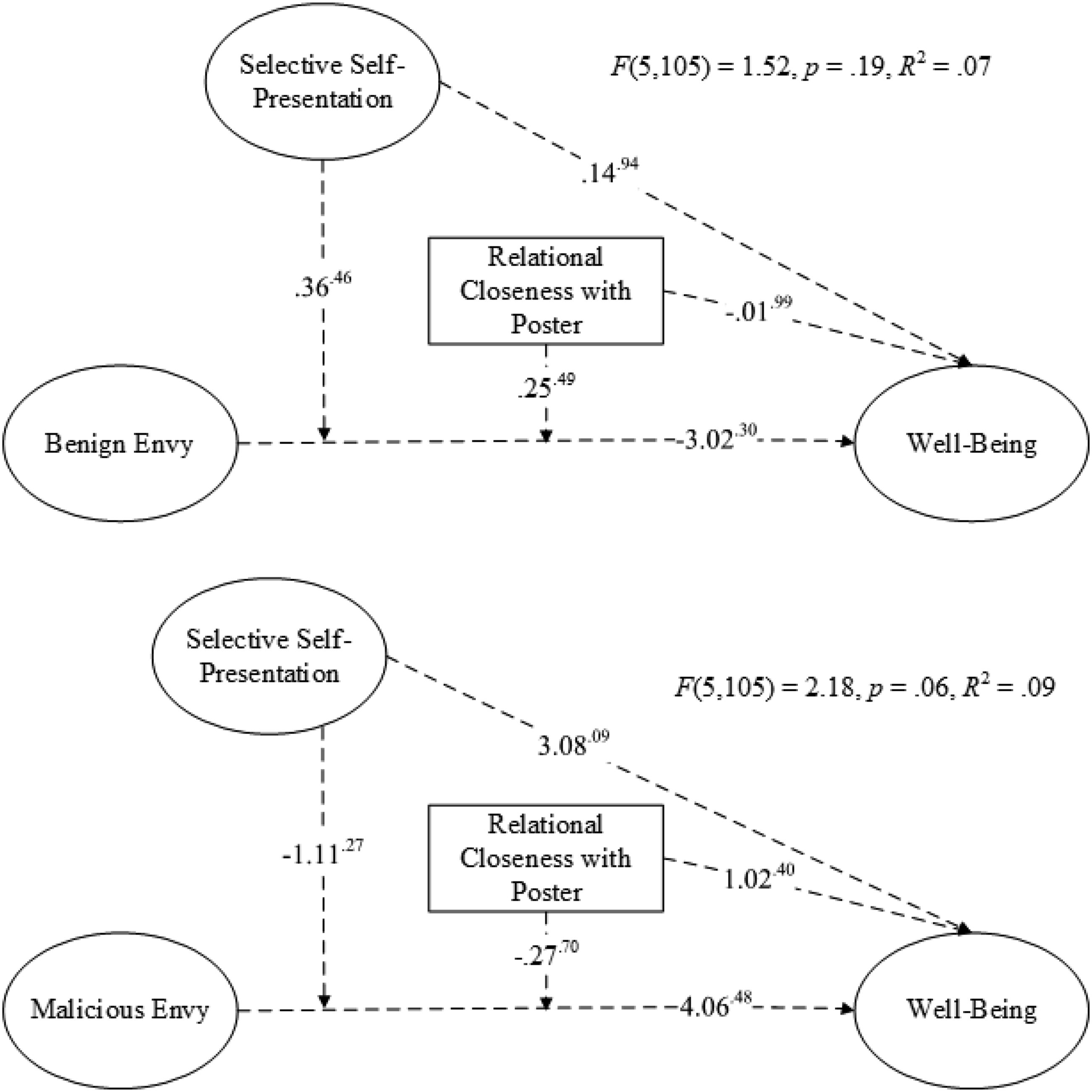
The second model–including malicious envy as the independent variable–was not significant, F (5, 105) = 2.18, p = .06, R = .31, R2 = .09 (see Figure 3). Again, neither relational closeness (b = 1.02, se = 1.22, p = .40, 95% CI [−1.40, 3.44]) nor malicious envy (b = 4.06, se = 5.73, p = .48, 95% CI [−7.30, 15.42]) were significant predictors of subjective well-being. Relative to H3, relational closeness did not moderate the relationship between malicious envy and subjective well-being (b = −.27, se = .68, p = .70, 95% CI [−1.62, 1.08]), nor was selective self-presentation a significant moderator (b = −1.11, se = 1.01, p = .27, 95% CI [−3.11, 0.88]). Finally, unlike in Study 1, selective self-presentation did not have a direct effect on subjective well-being (b = 3.08, se = 1.80, p = .09, 95% CI: [-0.50, 6.65]). Taken together, these models suggest the rejection of H3 and H4.
Discussion – Study 2
Study 2 was conducted to explore whether a college sample (rather than a broad adult sample) may experience envy and subjective well-being differently. Of initial note in Study 2 was the failure of the manipulation check for envy, which was inexplicable as the stimuli were presented to the same sampling frame (but a different sample) as the materials in the development pretest. In short, two different sets of the same sample frame viewed the three post pairs inconsistently. While it could be that history effects were to blame (e.g., college undergraduates could have changed their views on social media content in some measurable way between the conduct of the pretest and Study 2), we are unable to confidently explain the discrepancy in the general envy elicited by study stimuli between the pretest/Study 1 and Study 2. Findings of Study 2–particularly regarding envy–should thus be interpreted cautiously.
Even with the envy manipulation not working as-intended, because analyses were conducted using the within-subject measure of benign and malicious envy (rather than between-groups of aggregate envy), findings are consistent with those of Study 1 while using a population reflective of much of the related extant experimental research regarding the role of envy on subjective well-being. Consequently, these provide additional support to the findings of Study 1, suggesting the null results were not an artifact of sampling, reducing the chances these findings reflect a Type II error. Consequently, the general discussion of findings from both studies, below, treats the lack of support for hypotheses as faithful rejections rather than as methodological or sampling artifacts.
General Discussion
This research contributes to our understanding of freudenfreude in social media, experimentally considering the differential effects of passive exposure to positive news from a network tie via social media, based on the perceiver’s relationship with the poster and the envy evoked by the contents of that post. Guided by social comparison theory (Festinger, 1954) and the self-evaluation maintenance model (Tesser, 1988), findings did not support theoretically-guided hypotheses. And yet, these null results still provide important insights into the underlying processes, including implications for relational closeness, envy, and selective self-presentation.
Implications for Relational Closeness
An initial implication is for the role of relational closeness in freudenfreude. Contrary to prior studies (e.g., Lin & Utz, 2015; Liu et al., 2016) suggesting positive updates from closer ties elicit greater emotional outcomes (e.g., empathy, joy), subjective well-being was not significantly different after viewing a positive social media post from either a close or distant relational tie. This null result is unexpected through the lens of social comparison theory (Festinger, 1954) and the self-evaluation maintenance model (Tesser, 1988), as comparisons with closer others are typically more self-relevant and emotionally charged. The lack of expected support may be the blurring of the nature of relationships on social media: As posters in online spaces increasingly compete for users’ attention (Tafesse & Wood, 2023), even close relationships may metamorphosize from relational in nature to potential competitors of performance and comparison. Affective reactions to others’ posts in social media may now be driven less by relational closeness and more by the emotional appraisal the content evokes. Future work measuring perceived competition or platform-driven comparison orientations among participants could test this speculation. Through this lens, these findings may suggest the influence of relational closeness on subjective well-being in digital contexts may be diminished by platform affordances and evolving norms of social comparison. Theoretically, this challenges traditional assumptions within SCT and SEM, signaling a need to reconceptualize how relational closeness operates in mediated environments where connection, competition, and comparison increasingly coexist (see boyd, 2026).
Implications for Envy
An additional implication of this work is for the role of envy in freudenfreude. Counter to numerous other studies (e.g., Belk, 2011; Lin & Utz, 2015; van de Ven et al., 2009; van de Ven, 2017), the envy (both independently as benign envy and malicious envy, as well as when the two concepts were aggregated) evoked by a post did not influence the perceiver’s subjective well-being. We offer the following speculative explanation, noting that the relevant constructs were not measured in the present work and therefore cannot be directly tested with these data. These null effects might be explained by the focus of the stimuli. All three stimuli had direct or implicit connections to financial well-being (e.g., shopping, receiving cash, and close kinship with a wealthy celebrity). Prior research shows that posts reflecting material possessions or professional accomplishments often trigger social comparison because people perceive them as indicators of success (Belk, 2011; Lin & Utz, 2015). Contrarily status-oriented comparisons typically focus on money, lifestyle, and achievement as common measures of worth. Financial success is particularly prone to this dual reaction because wealth is both highly visible and socially valued (Battle & Diab, 2024). Thus, the envy processes our participants experienced may have been shaped by the tangible, comparative nature of money cues that were the focus of the stimuli. This explanation would suggest envy would function differently in non-financial domains such as attractiveness, athleticism, or creativity: areas are often linked to identity and personal effort rather than economic resources, and therefore inducing social comparison rather than status comparison. Given that prior studies suggest envy toward controllable traits, such as fitness or skill, can remain constructive and motivate improvement (Lange & Crusius, 2015; ven de Ven, 2017), whereas envy toward innate or socially rewarded traits, like beauty or popularity, can intensify negative emotions (Lin & Utz, 2015; Wenninger et al., 2021), the emotional effects of envy may vary depending on whether the success appears self-made, attainable, or inherent. As such, the role of envy toward a social media post’s contents may have a more nuanced effect than even the distinguishing between benign and malicious envy. Future studies should test this directly by systematically varying the domain of enviable content, that is, financial, physical creative, relational, and measuring domain-specific envy appraisals to determine whether the type of success depicted, rather than the type of envy elicited, is the more consequential predictor of well-being outcomes.
Implications for Selective Self-Presentation
Finally, an unexpected finding of this work was the unhypothesized main effect of selective self-presentation on subjective well-being. For every 1-unit change in the perception a relational tie was strategically communicating their self via their social media post there was approximately a 1.22-unit gain (BStudy 1 = 1.01; BStudy 2 = 1.43) in the participant’s subjective well-being. Though we know of no extant theory that directly links others’ selective self-presentation to one’s own subjective well-being, we offer two conjectures to explain these unanticipated results. First, positive illusion theory (Taylor & Brown, 1988) proffers exaggerated self-perceptions can aid well-being by buffering against identity threats or stressful situations. These data could extend positive illusion theory beyond the intrapersonal (see Kim & Baek, 2014) and into the interpersonal domain by suggesting our ties’ exaggerated self-presentations likewise serve to bolster our own well-being. Seeing a friend accentuate their accomplishments may suggest that friend is not likely in need of social support and other relational demands, suggesting our relational connections are strong and in good standing, and thus our obligations as relational partners are met. This explanation could be tested by future research that explores different motivations–either known or presumed–for a poster’s perceived selective self-presentation (e.g., puffery, humblebragging, functional information) on the relationship between selective self-presentation and resultant subjective well-being.
Second, these findings may suggest an expansion of the hyperpersonal model of communication (Walther, 1996), which suggests that mediated communicators recursively capitalize on their selective self-presentations online to enhance their relationship. Toma (2013) previously demonstrated one’s own selective self-presentation can enhance state self-esteem; and the present results may indicate the dyadic extension of that enhancement. By seeing our ties selectively present, we presume they are doing better and thus want to feel better ourselves. In this way, exposure to selective self-presentation may be motivational, causing receivers to want to be better commensurate with the perceived well-being of their social media ties. Future work could explore relations between perceptions of a poster’s selective self-presentation, changes in a poster’s self-esteem due to the act of posting, and a receiver’s subjective well-being to empirically assess this potential.
Limitations
This research sought to explore the immediate impacts on one’s subjective well-being from exposure to a single social media post; and as such has several internal and external limitations. First, experimental control often comes at the expense of ecological validity, which may have constrained the present work in several ways. First, recent work found repeated passive exposure to valenced social media content can affect psychological outcomes (i.e., amusement, stress; Nabi et al., 2025); and this study’s use of single exposure does not permit generalization across time or various co-present posts. Thus, while message-level consideration of the effect of passive social media use on well-being remains important, it may be critical to do so considering the more naturalistic and dynamic ways in which users encounter repeated social media content. Additionally, though pretested with a sample from the same population and functioning as-intended in Study 1, study stimuli did not elicit the intended initial differences in aggregated envy in Study 2’s manipulation check. Though continuous levels of benign and malicious envy were used in analyses (rather than simple between-group differences), future research may seek to explore whether envy is actually stable across time within a population and findings from the supplemental Study 2 should be interpreted cautiously. Finally, the posttest-only study design constrained findings to only demonstrate differences in resultant well-being, and should not be interpreted as changing subjective well-being. In other words, without a pretest baseline against which to compare posttest scores, though data can speak to what types of post factors had relative effects on outcomes, findings cannot conclusively demonstrate absolute change. Though unlikely, it could be that all posts reduced subjective well-being, and some configurations of stimuli simply decreased it more than others. Future work can incorporate a pretest-postest design or control group to help determine absolute effects.
Future research should also account for familiarity and interpersonal knowledge of targets in relation to the material presented (see Walther, 2019). For example, though being related to someone famous may not be implausible, it may be less likely a relational tie is related to someone like Viola Davis without knowing about it prior to a social media post; and moreover certain demographic characteristics (e.g., race, geography) may decrease the likelihood such a claim is presumed true. Though one can readily claim a celebrity relative, not everyone is actually related to a superstar, nor would revealing such famous kinship be expected so late in a dyad’s relational development. The perceived veracity of claims (rather than just selective self-presentation) and prior knowledge of a relational tie should be accounted for in future work to account for the legitimacy of online claims, at least as perceived by the receiver. Likewise, though multiple messages were presented in study stimuli to help findings generalize beyond a single message or type of post (see Reeves et al., 2016), findings remain constrained by several factors that did not vary: platform, type of relational tie (both in terms of actual relationship and whether the tie was a social or professional connection), and whether the post was taken as mere sharing of a positive experience or perceived to be humblebragging, the strategic presentation of bragging masked by humility or complaint (Sezer et al., 2018). Given the myriad of content and connections across platforms, future work should continue to account for various contexts, posts, and relationships to determine potential confounds and boundaries to these early findings.
Conclusion
The present work responds to recent critiques of scholarship concluding passive social media use innately harms well-being (Meier & Krause, 2022) and calls to study the underexplored effect of freudenfreude: deriving joy from others (Boecker et al., 2022). Experimental results identified that neither the type of envy elicited by a social media post nor relational closeness with its poster affected how a positive post influenced an observer’s subjective well-being. While more work is necessary to replicate and extend these findings, this research initially suggests the antecedents of freudenfreude may not be as nuanced as its better-studied counterparts (e.g., schadenfreude; Boecker et al., 2022), meaning that the poster and contents of a joyous message may not play a large role in the effects of positive social media contents.
Footnotes

Ethical Considerations
This research was exempt from ethics approval. Participants all provided informed assent to participate prior to taking part in the study.
Funding
The authors disclosed receipt of the following financial support for the research, authorship, and/or publication of this article: Funding for Study 1 of this work was supported by Illinois State University; School of Communuication.
Declaration of Conflicting Interests
The authors declare that they have no known competing financial interests or personal relationships that could have appeared to influence the work reported in this paper.