







Abstract
L2 teachers, no longer considered to be predominantly passive coursebook consumers, act as mediators between pedagogy and materials in the current era of technology-assisted language instruction and should be empowered to digitalize language learning materials to meet the immediate needs of the digital generation. In this study, we aimed to investigate L2 teachers’ collaborative reflections on the current gaps in their classroom coursebook that could be bridged by the purposeful use of digital tools and address their attitudes towards their changing roles as digital materials developers. The findings demonstrated that, in their critical reflections, from a pedagogical perspective, the teachers pinpointed the dominance of passive language usage, the absence of personalized strategy-based instruction, and the lack of interactive content in the coursebook. From a task design perspective, they referred to the dominance of edutainment-free tasks, the prevalence of artificial peer tasks, the lack of multimodal scenario-based tasks, and the absence of adaptive feedback. The teachers further highlighted their shifting roles. As digital materials developers, they could create digital content for the “digital natives,” make digital mini-lessons for classrooms, attend project-based training courses, and co-produce digital content and tasks with students’ assistance. As digital teacherpreneurs, they could run private social media-based businesses, join Edu-Tech co-working spaces, and produce digital artifacts in edutainment centers. As digital materials designers, they could collaborate with computer-assisted language learning (CALL) stakeholders and do interdisciplinary projects in virtual communities. This study promises implications for L2 teachers, teacher educators, and materials developers.
Introduction
Classroom materials as mediators between course content, teachers, and learners play a pivotal role in language learning (Bouckaert, 2019). Teachers’ engagement in materials development promotes their pedagogical content knowledge and professional identity construction (Banegas et al., 2020). Li et al. (2021) called for investigating language teachers’ professional growth through materials development as they play a critical role in the use, analysis, and design of materials. Teachers’ role in purposefully using materials is undeniable as they accommodate daily pedagogical practices, operationalize curriculum, mediate learning, and decode how students learn (Graves, 2019); however, according to Tomlinson (2020), there is a dearth of research on how teachers represent the materials they use. Xu et al. (2023) further highlighted the need for gaining insights into teachers’ active engagement in the materials development process. Although English language teaching (ELT) materials such as handouts, textbooks, and overhead transparencies act as integral components of language classrooms worldwide, research on how teachers interact with and employ the materials is scant (Guerrettaz et al., 2021). Therefore, “the relationship between language teachers and the tools of their profession—language learning materials—has remained underresearched” (Carabantes and Paran, 2022: 659).
L2 teachers typically teach institute-selected coursebooks as the main teaching materials for meeting the predefined curriculum requirements. As the digital generation typically spends several hours playing digital games, communicating with classmates through social media, using apps to fulfill daily needs, sharing multimedia content with friends, and considering the potential for living a virtual life on Metaverse, digitalizing language learning materials flexibly adaptable to their needs is not a far-fetched goal. In the post-COVID-19 era, many students may find it difficult to put aside their smartphones, tablets, and laptops in face-to-face classrooms and teachers are encountering the challenge of striking the balance between conventional and digital materials. Additionally, due to the myriad options given to teachers by digital tools, teachers are no longer perceived as passive materials consumers. Instead, teachers are increasingly expected to not only adapt the current educational technologies to their pedagogy and task design but also digitally supplement conventional teaching materials. Against this backdrop, this study sought to address the dimensions underpinning L2 teachers’ collaborative reflection in their evaluation of the coursebook from a digital perspective and explore L2 teachers’ attitudes towards digitalizing materials and their roles as digital materials developers.
Background
Teachers as Materials Evaluators and Developers
By evaluating materials as resources for mediating learning and operationalizing curriculum, teachers “think in terms of the day-to-day of the classroom and the specifics of what and how students will learn” (Graves, 2019: 338). According to Tomlinson (2020), the focus of studies on materials development has currently shifted to how teachers use materials in the classroom and what they involve the students in doing with materials. In a recent study, Li (2020) explored teachers’ reliance on curriculum materials for the design and enactment of instruction. The findings demonstrated that teachers’ knowledge of materials affects distinguishing the more and the less effective use of materials and changing materials into dynamic instruction. Furthermore, materials should be flexible to facilitate teachers’ modification, contextualization, and personalization. Bouckaert (2019) asserted that teachers should make informed decisions about selecting classroom materials, evaluating them, and adapting them to local needs and current trends.
As Li et al. (2021) acknowledged, teachers act as materials users, materials analysts, and materials designers. This highlights the need for investigating ELT teachers’ professional growth through materials development. Recent years have witnessed a growing interest in teachers’ roles in adapting, supplementing, and designing materials, using multimodal resources in the current technology-infused education, and localizing materials compatible with contextualized pedagogy principles. However, teachers may not be capable of materials development without the collaboration of other stakeholders. Materials development is an interdisciplinary project (Atkinson and Corbitt, 2023) that could not be simply done by teachers themselves. For instance, Zarco-Tejada (2019) demonstrated that international publishers typically level their books by linguistic complexity and Common European Framework of Reference (CEFR) standard, where L2 teachers may not have either the knowledge or the experience of systematically adapting ELT materials to students’ proficiency levels. Underwood (2010) further showed that aligning textbook materials with national test admission requirements is an iterative process that could not be easily fulfilled by teachers. Vitta (2023) also pinpointed the insufficient theoretical basis of teacher-made ELT materials.
Teachers are increasingly expected to play a pivotal role in the evaluation, adaptation, and production of ELT materials. Since textbook functions as an integral dimension of the course, a de facto syllabus, and a primary resource for different tests, it is important to explore teachers’ lived experiences about textbook use, content, and pedagogical approach (Harwood, 2017). Xu et al. (2023) demonstrated that ELT materials development is a multifaceted non-linear practice, highlighted the role of teachers adapting textbooks to meet immediate learning needs, pinpointed the practicalities of ELT textbooks in classroom, addressed different stakeholders’ perspectives, and called for collaborative teaching materials design through concurrent dialogic negotiations among textbook writers, university researchers, and teachers.
With the growing demand for mobilizing, innovating, and digitalizing education in the post-pandemic era, “the time may be propitious, perhaps, to surf this wave of innovation and re-invigorate the language teaching materials sector” (Mishan, 2022: 502), where global textbooks “will not serve as a panacea for teaching environments” (Hadley, 2014: 230). In the emerging virtual landscape, teachers’ roles as digital materials designers gain more significance as they should more meaningfully engage the students and enrich their learning experiences by going beyond ready-made materials and adapting content to learners’ interests. Accordingly, teachers’ reflections on the materials they currently use permit them to notice the gaps that could be filled by effective technology use and concentrate on the potential of technology-assisted materials development.
Teachers’ Online Reflections
Collaborative reflection in virtual platforms is conducive to teachers’ peer scaffolding and continuing professional development (PD) (Alemi and Tajeddin, 2020). Reflection should be viewed more as a community-oriented interpersonal than an individual intrapersonal activity (Hong et al., 2019). Prieto et al. (2020) addressed the role of online communities in promoting teachers’ reflection and PD. From among different virtual platforms, weblog contributes to teachers’ reflection (Rose, 2016). Tajeddin and Aghababazadeh (2018) highlighted teachers’ weblog-mediated reflections on classroom experiences and showed that teachers’ reflections on pedagogical incidents were more critical than descriptive. Turvey and Hayler (2017) further revealed that blogging facilitates teachers’ participation and collaboration characterized by belonging to a professional community, critical experience-based reflections, and collaborative learning.
In this study, we aimed to address L2 teachers’ collaborative reflections on the gaps in the conventional coursebook (i.e., the book series they currently teach at institutes) that could be bridged by technology-enhanced resources and investigate their perceptions of digitalizing classroom materials. To this end, the following questions were raised:
What dimensions of the coursebook do L2 teachers focus on in their collaborative weblog-mediated reflections? What are L2 teachers’ perceptions of digitalizing classroom materials?
Methodology
Research Design
In this study, we adopted a qualitative research design with a focus on a case study which aimed to present an in-depth, multifaceted understanding of a phenomenon in its real-life context and provide a holistic descriptive representation of the issue (Yin, 2014). Case studies are particularistic (focused on a particular group), descriptive (providing a thick rich description), and heuristic (presenting new insights) (Ary et al., 2019). In this study, we explored L2 teachers’ lived experiences of using currently available ELT materials during the COVID-19 pandemic and their attitudes toward digitalizing them.
Participants
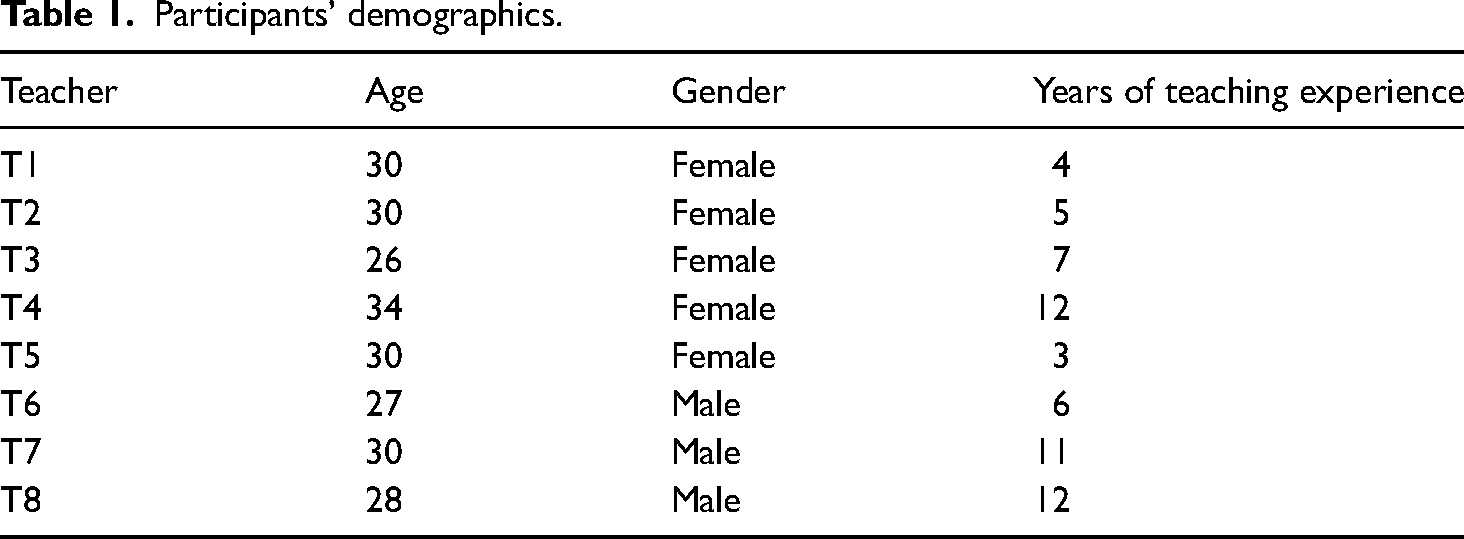
Eight L2 teachers (three males, five females) with an MA degree in ELT and an average of 7.5 years of teaching experience participated in the study during the COVID-19 pandemic (see Table 1). The teachers’ ages range from 26 to 34. Based on self-reports, they had average familiarity with CALL. Furthermore, since these teachers had been teaching different coursebooks such as Top Notch, English Results, and American File, they could better evaluate the status quo of materials development. Using the non-probability purposive sampling technique, we selected the teachers who fulfilled the two criteria: (1) the experience of currently teaching the Top Notch series, and (2) the experience of using technology in their classes during the COVID-19 pandemic.
Participants’ demographics.
Conceptual Framework
This study is guided by two types of reflection (reflection-on-action and reflection-for-action) to address the first and the second question, respectively. According to Schön (1983), reflection-on-action refers to thinking about what has happened retrospectively and reflection-for-action refers to thinking about future actions prospectively with the purpose of improvement or change. In this study, whereas reflection-on-action represented the teachers’ collaborative reflection on different sections of the coursebook they taught in institutes, reflection-for-action guided their perceptions about their future roles as digital materials curators and producers.
Materials
A sample unit (Unit Two) of Top Notch 2A (Saslow and Ascher, 2015) was selected to fulfill the purpose of the study. The Top Notch series commonly used in the institutes where the teachers taught constitutes a six-level communicative English course for young adults that is claimed to adopt communicative goals, integration of skills and content, and creation of student-centered environments. The instructional design of the Top Notch series is characterized by five key features: (1) raising students’ consciousness of their learning progress; (2) explicitly focusing on grammar and vocabulary; (3) using memorable conversation models acting as a guide for students to naturally use language for communicative purposes; (4) adopting conversation models, photo stories, and cultural fluency activities to prepare students for social interactions with people from different cultures; and (5) providing active listening syllabus. In the context of this study, young adults were the main target users of Top Notch. Since these learners were frequently surrounded by ubiquitous technologies such as smartphone apps, social networking platforms, and digital games, they were more likely to learn language in multimodal environments. By using the edutainment resources that meet learners’ immediate language learning needs, ELT materials could affectively engage them to more actively take responsibility for their learning journey.
Data Collection
We collected the data through online discussion forums and semi-structured interviews. In the two-month weblog-based discussions, the teachers critically reflected on their genuine experiences of using the target coursebook in their classrooms.
For seven weeks, the teachers shared their comments on how the gaps in teaching language skills and components (reading, listening, speaking, writing, grammar, vocabulary, pronunciation, wrap-up) as presented by the coursebook could be filled by technology-enhanced materials. The teachers formed a small online community to dialogically reflect on the coursebook and were given the voice to share contextualized insights into their coursebook-informed pedagogical experiences. For each session, the second author as the moderator initiated and monitored the discussion flow. Due to the tight schedule, the teachers preferred weekly asynchronous discussions.
The semi-structured interviews conducted after online discussion aimed to delve into the teachers’ attitudes towards digitalizing ELT materials. The two interview questions focused on the teachers’ attitudes toward current digital language learning materials and their roles as digital materials developers. The interviews were conducted in English and each took an average of one hour. The interviews were recorded and transcribed verbatim.
Data Analysis
Following Corbin and Strauss (2015), we adopted open coding, axial coding, and selective coding to analyze the data from reflective comments through the lens of content analysis. After carefully reading and getting familiarized with the recorded data, in open coding, we broke down the data into smaller units, and the ones with similar properties were given the same conceptual label. We labeled the data, inductively built categories, and compared the units of meaning embedded in these categories. In axial coding, the concepts with similar properties were placed in the same category and the connections between the categories (e.g., teachers’ discussions were categorized under two broad categories: “pedagogical content” and “task design”), and subcategories (e.g., “edutainment-free tasks” in the “task design” category) were established.
For the analysis of the interviews, we similarly pinpointed the subcategories. For instance, T1 mentioned:
I have also heard that there are some websites such as DigitBox by which you can share your digital files such as PPT slides, animations, etc. and receive money in return to selling your digitally owned products.
This statement showed the subcategory of “highlighting teachers’ roles as digital teacherpreneurs.” This stage was followed by pinpointing the broad categories. In selective coding, we attempted to build, refine, and finalize the main categories and subcategories.
Finally, we employed intercoder agreement and code-recode strategy. One-third of the data selected randomly was given to an informed coder with prior coding experience and the intercoder agreement was estimated (.92). The points of disagreement were negotiated to reach a compromise.
Findings
Teachers’ Reflections on Materials
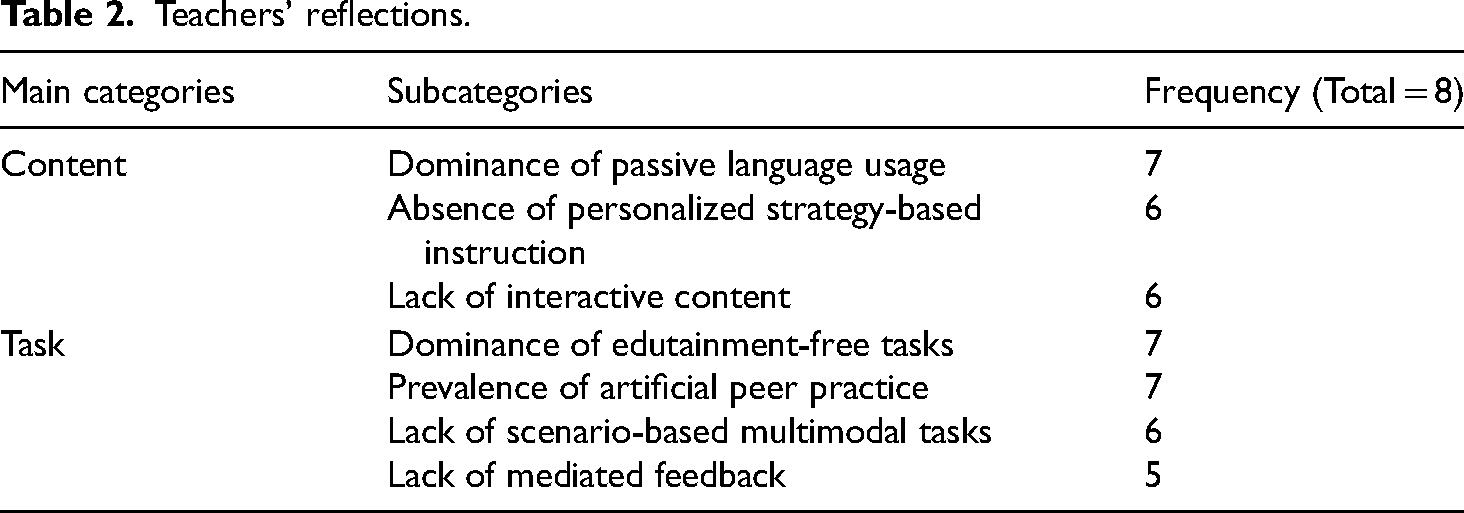
In this section, the teachers’ reflections on the current gaps in their coursebooks that could be bridged by technology are presented. The teachers specifically focused on pedagogical content and tasks (see Table 2). The concept of task refers to real-world type activities, where the outcome is not language-focused per se and the goal is to prepare the learners for meaningful language use in situated authentic interactions (Bryfonski and McKay, 2019). In this study, the coursebook acted as the launching point for the teachers’ creative ideas about developing more digital, interactive, and learner-led materials.
Teachers’ reflections.
Content Perspective
Dominance of Passive Language Usage
The teachers highlighted the simultaneous reliance on authentic input contextualization promoting discovery-based inductive learning and systematic input enhancement triggering language use in context. However, although the unit attempted to contextualize the input in different sections through the input flooding technique, there is a need for not only using daily familiar contexts (e.g., movie dialogues, X (formerly Twitter) posts, song lyrics), but also employing various input enhancement strategies (e.g., highlighting, annotating) to make the input pedagogically significant. As T1 stated: Learning grammar is not about passively memorizing rules, but learning how to use which structure in which situation. The unit has widely used input flooding … but using input enhancement tools like highlighting, underlining, or bolding specific rules is noticeably missing.
The teachers believed that although target grammatical structures are present in different sections from conversations to reading passages, explicit deductive presentation of grammar following the linear presentation-practice-production cycle and focus on passive grammar usage than active grammar use are dominant. The participants stated that effective instruction engages learners in actively building grammar knowledge by tracking specific structures in context and relating them to daily language use rather than memorizing clichéd pre-fabricated sentences. As T8 said:
Grammar is taught deductively, detached from context. Learners should have first deciphered the grammatical point like doing grammar jigsaw puzzle. “Give a man a fish and you feed him for a day! Teach a man to fish and you feed him for a lifetime!”
Accordingly, students’ cognitive engagement in making discoveries and solving language puzzles empowers them to regulate learning experiences.
The teachers further stated that although the words are contextualized in conversations and passages, there is a need for corpus-based vocabulary instruction, where students encounter words in real context-bound sentences, identify their common use, and learn their collocations. To change passive vocabulary memorization to active vocabulary use, students should frequently encounter words in daily conversations rather than artificial dialogues. T4 maintained:
I think the unit should have used topic-based word contextualization and lexical network. Familiarizing learners with corpus could raise their awareness of properly using words/collocations in daily contexts.
Data-driven instruction involves the students in learning word strings/collocations meaningfully in context. Students could be further scaffolded to produce self-made corpora.
Absence of Personalized Strategy-based Instruction
The teachers questioned the linear “one-size-fits-all” approach defining a single route to learning rather than engaging the teachers in consistently assessing students’ performance and receiving their feedback at different interlanguage development stages to tailor the instruction and predict potential learning tracks. To bridge this gap, the teachers recommended purposeful personalized instruction to flexibly build students’ learning strategies. Whereas some learners focus on experiential writing instruction to first decipher the rhetorical structure, others gradually build paragraphs by connecting smaller chunks. T1 argued:
Before explicit instruction, some learners should implicitly discover the rhetorical structure of the paragraph by using color-coding and reorganizing scrambled sentences.
The teachers argued that the coursebook must encourage the students to develop personalized language learning strategies and gradually turn into autonomous learners. Strategy-based training could be employed in teaching different skills. As T2 stated: Using note-padding, students learn how to do topical brainstorming. Coursebooks should build students’ micro-strategies similar to what YouTube teachers do to explicitly raise consciousness of learning strategies. Students are asked to listen for main ideas or listen to infer, but the “how” is a mystery.
This indicates that the teachers expect the coursebooks to raise students’ awareness of strategy-building potentials (e.g., how to brainstorm, exemplify, use connectors, etc.) for autonomous language learning.
Lack of Interactive Content
By interactive pedagogy, teachers track what students learn, what they fail to learn, and how to adapt the learning content. The coursebooks should be flexible so that students get empowered to (1) directly interact with the content, (2) track their learning progress, (3) receive immediate feedback, and (4) link learning experiences to immediate contexts. A statement by T1 is revealing: Top Notch song lyrics enhance learners’ listening comprehension. All students like listening to music. But suppose learners go beyond such entertainment by playing favorite songs, shadowing singers, and answering the questions popping up in the process.
Therefore, teachers favorably support digital content that could be flexibly adapted to learners’ performance. Teachers also referred to content variety as a space for promoting students’ engagement and motivation. For instance, T1 stated:
Multimedia sources add variety to coursebook content. Instagram stories, movie episodes, animation trailers, game reviews, podcasts, etc. set amusing contexts for learning.
The teachers complained about clichéd pedagogical content separating the students from their surrounding environments.
Task Perspective
Presence of Edutainment-free Tasks
The teachers questioned linear tasks that rely on pre-made traditional activities artificially directing students from controlled to free practices. Decontextualized predictable tasks could not cognitively challenge and affectively engage learners. To integrate language into daily lives, learners should do meaningful tasks beyond form-focused, test-oriented fill-in-the-blank/open-ended questions. The teachers recommended two alternatives: meaningfully embedding tasks in real-life contexts such as movie/animation dialogues, and purposefully engaging the teenage students in edutainment-oriented activities such as games and puzzles. This is partly reflected in T8's words:
Students better remember a movie dialogue than a pre-fabricated book sentence. Doing movie reviews, making chain stories, creating video clips, or fanfictioning are more meaningful for the teenagers.
This statement underlines normalizing edutainment in skill-based tasks to seamlessly merge formal/informal learning activities.
Dominance of Artificial Peer Practice
The teachers asserted that although different pair tasks are common, these activities are artificially collaborative because as speaking partners, students merely change roles and repeat conversations. Instead, the coursebook could involve the students in peer mini-projects that entail peer negotiation of form/meaning, peer scaffolding, peer feedback, and peer knowledge construction. By doing so, students co-produce content or play different roles to learn the language in context. T2 said: Although these tasks are beyond traditional, the students only change roles, repeat the conversations, or share general views. Students should be more deeply engaged in pair/group work to purposefully use language with tangible outcomes such as narrating stories about the last movie they watched or making their own video trailers.
Therefore, teachers welcomed collaborative tasks with purposeful division of labor and real-life outcomes that go beyond superficial language use and could be shared with others.
Lack of Scenario-based Multimodal Tasks
The teachers mentioned that the unit fails to provide reasonable pragmatic contexts to reinforce students’ speaking/writing skills. Instead of restricting learners to artificially communicative tasks, language databases (word/phrase bank) and scenario-based tasks support them to properly use language in specific contexts. This failure is highlighted by T3: I think speaking practices are artificially communicative. You cannot be a perfect speaker by memorizing conversations. Instead, you should learn how to pragmatically use language in daily conversations like how to greet your colleagues, how to apologize for being late, how to thank your professor, etc.
Students’ involvement in situation-based speaking and writing scenarios could more effectively prepare them for pragmatic language use in real-life contexts. Therefore, students need access to a rich source of useful words, phrases, and expressions.
Additionally, the teachers stated that the coursebook is too limited to paper-based sources though students’ cognitive and affective engagement could be mediated by multimodal resources. By using digital tasks, teachers and students could be empowered to create a community in which learning becomes more collaborative, student-centered, and process-oriented. This expectation is reflected in T8's statement:
Traditional tasks could be transformed to digital/semi-digital tasks that draw upon multiple audiovisual resources to track students’ learning progress.
Thus, digital tasks facilitate tracking students’ learning progress, could be smoothly integrated into online courses, and enhance task authenticity, task flexibility, task engagement, and task variety.
Lack of Mediated Feedback
The teachers believed that although the coursebook defined a specific section for review to recycle learners’ key linguistic and pragmatic knowledge, hardly were the tasks designed to assess students’ learning progress. No clear boundary was defined for providing adaptive feedback. T3 argues for peer feedback:
By engaging learners in peer feedback, they can scaffold their peer's writing and learn about paragraph structure, how to develop it, and how to use appropriate language.
This statement highlights defining context-specific mechanisms for error correction and feedback giving.
Teachers’ Shifting Roles as Digital Materials Developers
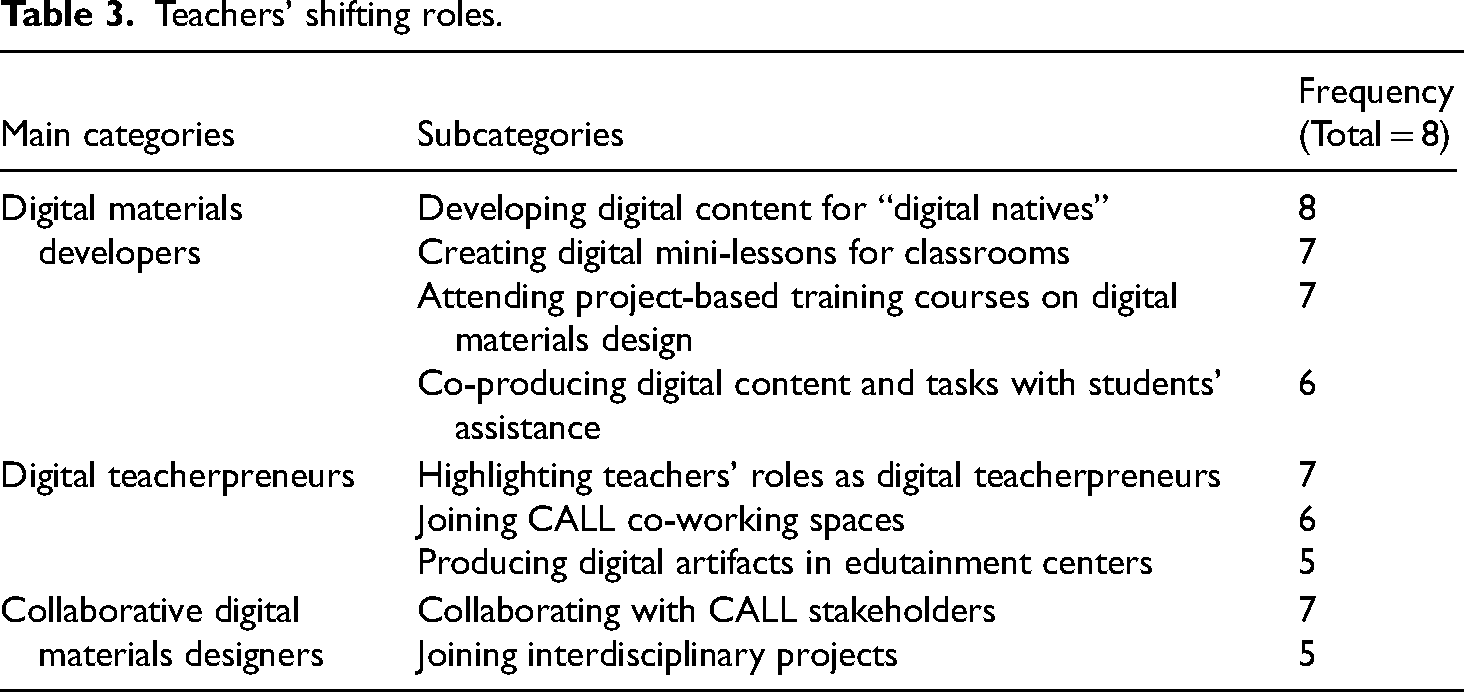
In post-reflection interviews, the participants highlighted their shifting roles as digital materials developers, teacherpreneurs, and materials designers (see Table 3).
Teachers’ shifting roles.
Teachers as Digital Materials Developers
Teachers’ talks were thematized into four categories: developing digital content for the “digital natives,” creating digital mini-lessons for classrooms, attending project-based training courses, and co-producing digital content and tasks with students’ assistance.
The digital generation is likely to go beyond paper-based sources and becomes interested in social media and applications for language learning because, as T1 stated:
The learners growing up using smartphones and playing digital games are daily overwhelmed by Instagram posts, YouTube videos, podcasts, and apps.
These multimedia contexts act as fertile platforms for digital materials designers to use teacher-friendly websites, software packages, and tools for developing primary/supplementary digital mini-lessons. According to T2: Since the outbreak of COVID-19, we have been joining different webinars to learn how to use technology in our classes. I started subscribing to the channels of two famous YouTubers sharing tutorials about using different tools for teaching and assessment purposes. I learned how to use Snagit to make short videos, how to use Kahoot to make gamified mini-tests, how to use Storybird to make short stories, etc. The urgent remote teaching inspired us to learn by making digital mini-lessons, short videos, and online quizzes.
Therefore, as digital materials are most likely to be the next generation of ELT materials, instead of passively employing traditional resources, teachers could watch video tutorials, take virtual tours, and do trials-and-errors to master making digital mini-lessons (e.g., digital content such as short animations, digital tasks such as Padlet discussions, and digital assessments/e-portfolios such as Kahoot quizzes) for their classrooms/institutes which are both teacher-friendly and time-saving.
The participants further mentioned that joining CALL short-term courses, project-based workshops, training tours, and virtual events facilitated their hands-on learning experiences and networking in small CALL communities. As T4 argued: A two-hour webinar could not be as effective as workshops held for creating online quizzes, using AI/VR in teaching, etc. Instead of attending random general CALL webinars like “How to teach online?”, teachers gain expertise in CALL sub-domains by participating in specific workshops.
This statement underscores holding content-specific, project-based workshop series. Teachers’ engagement in systematic digital materials development meaningfully promotes their competence. As T2 stated:
Our utopia would be having our materials design studios to make our teams produce e-content, and receive financial bonuses.
To add materials development to teachers’ technological pedagogical content knowledge (TPACK) (Koehler and Mishra, 2009), they need educational support (training), infrastructure support (studios/labs), technical support (IT clinics/CALL communities), and financial support.
Teachers considered students as co-producers/assistants. T1 said:
We should count on our students. Learners make real-life content for each other. Sounds amazing!
Digital-generation students possibly immersed in the virtual world could provide practical tips and jointly produce materials under CALL teachers’ supervision as they attempt to learn new language points. Such digital content could be used by students in other classes/institutes. This student-centered approach promotes learners’ engagement and motivation.
Teachers as Digital Teacherpreneurs
The participants highlighted teachers’ roles as being digital teacherpreneurs, joining CALL co-working spaces, and presenting digital products in edutainment hubs at universities/innovation centers.
Currently, some enterprising teachers create and share micro-digital content (video clips, picture stories, podcasts, etc.) on social networks and some act as education influencers on Instagram. Such teachers run small businesses by generating micro-content. T6 said: Teachers use different digital platforms like Instagram to produce materials and run their own businesses. They teach new words/idioms in animation/movie scenes or make comics for teaching grammar. Iranian teachers prefer being Instagram bloggers by having more followers, sharing posts/stories, finding innovative colleagues, receiving helpful comments/critiques, advertising products/classes, and finding investors/ project managers.
These innovative actions provide tangible evidence for relying on teachers as digital teacherpreneurs. Social networking platforms give voice to every teacher to make, curate, and share their products and cooperate in large-scale educational projects.
The teachers further focused on establishing CALL co-working spaces for creative teachers eager to bring emerging educational technologies to classrooms. As T5 said: In our country, compared to thriving start-up companies in engineering and sciences, start-up teams in education are conspicuously missing or lagging behind. Making small start-up teams in Edu-Tech co-working spaces not only helps find great teammates with shared interests and expertise, but also creates friendly professional environments for socializing, seeking assistance, and problem solving.
This statement showed the purposeful involvement of CALL teachers and content producers in learning to establish their brands.
The teachers also mentioned the need for having university-based edutainment centers and Edu-Tech hubs to receive financial incentives, attend training courses, find like-minded individuals, and participate in boot camps/competitive events to win prizes. As T3 stated:
I think teachers as entrepreneurs should be professionally and financially supported. I wonder why institutes slowly digitalize materials and hardly run start-up competitions to encourage teachers to take the venture.
This shows that teachers’ roles as materials developers must be acknowledged by institutes and they have to be financially supported as teacherpreneurs, because designing digital materials requires expertise and time. As Berry (2015) stated, “Teacherpreneurs are classroom experts who teach students regularly but also have time, space, and reward to spread their ideas and practices to colleagues as well as administrators, policy makers, parents, and community leaders” (p. 147). In particular, as Berry added, “without leaving the classroom, they will serve as virtual coaches, curriculum publishers and curators, student assessment analysts, edugame inventors, community organizers, policy researchers, and creators of their own schools” (p. 147).
Teachers as Collaborative Digital Materials Developers
The findings showed that although coursebooks provide a reliable source for developing language skills, teachers are no longer passive consumers but contribute to adapting materials to digital learners’ needs. This transition requires collaboration from two perspectives: First, teachers need the support of CALL teacher trainers, educators, researchers, and materials developers. As T5 stated:
Think of Duolingo or Oteacher. No novel idea succeeds without a dedicated cooperative team.
Second, materials development is an interdisciplinary practice that could rely on teachers, materials developers, educational technologists, IT experts, marketing specialists, etc. According to T8:
Developing digital products is the outcome of synergy among CALL teachers, programmers, graphists, instructional designers, marketing experts, etc.
Discussion
In this study, the teachers collaboratively reflected on the pedagogical and task design gaps in their coursebooks that could be bridged by digitalizing materials and shared their attitudes towards their changing roles as digital materials developers and innovative teacherpreneurs. Regarding the findings related to the first research question, it was demonstrated that in the evaluation of pedagogical content, the teachers asserted that the coursebook reinforces passive language usage that deprives the learners of inductively discovering target language rules and contextualizing them in daily environments. The teachers further predicted that students may better grasp language skills in authentic data embedded in natural contexts. The teachers also stated that the coursebook hardly encourages learners to experience discovery-based, data-driven learning to gradually turn into self-regulated learners.
The teachers further acknowledged that young adult learners should be trained to systematically apply learning strategies. The teachers expect the materials to engage these learners in building language learning strategies, keeping portfolios of personalized micro-strategies, and reflecting on their learning experiences. Additionally, students’ use of interactive materials meaningfully engages them in the learning process. Given this, the teachers track what the learners learn, what they fail to learn, and how to adapt learning content. The coursebook may fail to encourage the learners to (1) directly interact with the content, (2) track their learning progress, (3) receive immediate feedback, and (4) link learning experiences to the immediate context, where the teacher plays the mediator rather than the instructor role. Furthermore, the teachers mentioned that the variety, flexibility, and adaptability of teaching materials could be more easily fulfilled by digital pedagogical content. To provide interactive pedagogical content, ELT coursebooks should make a shift towards learner-centeredness, learning-by-doing, and scaffolding interlanguage development (Jordan and Gray, 2019).
From task perspectives, the teachers questioned the linear decontextualized form-focused tasks that do not meaningfully engage learners in real-life situations because the coursebook as a rich source of input should develop learners’ pragmatic competence in an authentic meaningful context (Limberg, 2015). The test-oriented exercises passively transfer language skills without transparently representing how they could be applied to daily contexts. However, authentic tasks create opportunities for meaningful communication by fulfilling non-linguistic goals while involving learners in linguistic challenges. To make learners interested in doing tasks, teachers recommended edutainment-based activities to facilitate learning, engagement, and motivation. If learners find the tasks cognitively and affectively challenging, they are more invested in their completion.
Furthermore, artificially collaborative tasks fail to foster peer learning and scaffolding. Teachers’ reflective comments questioned artificial group work and supported meaningful task completion, where students jointly do mini-tasks and mini-projects in which they need to genuinely experience division of labor, multimodal scenario series, higher-order thinking skills, and real problem solving by naturally using the skills they have learned in relevant contexts. The teachers further recommended using primary and supplementary digital content, which are believed to be beneficial due to their availability and affordability (Unsworth and Mills, 2020). Digital platforms assist teachers in providing adaptive feedback and monitoring student progress. Coursebooks should define the procedures for adapting feedback to the target skills and error types as appropriate feedback-giving mechanisms to enhance personalized learning experiences.
The results pertaining to the second research question showed that teachers’ engagement in developing materials for the digital generation positively contributes to satisfying most of these students’ curiosity about emerging technologies (e.g., Metaverse avatars), flexibly adapting technology-assisted content/tasks to their daily needs/interests, and adding variety to their learning experiences. According to Mishan (2022), by digitalizing materials, the pedagogical content and media are made compatible to serve the learning needs of the digital generation. Furthermore, to create digital mini-lessons, by joining e-learning designers’ communities, teachers access classified packages (a collection of educational tools/tutorials) that could be applied to teaching different skills. By sharing self-made tutorials and digital lesson studies, teachers support each other.
Despite the pivotal role of materials development in teachers’ daily pedagogical practices, it is mainly underrepresented in research, and there is a need for running PD courses on materials development that may take the form of online courses, mentoring sessions, peer collaboration, and lesson study groups (Nazari et al., 2023). Moving from the teacher role to the digital content producer role is non-linear. Therefore, materials development workshops should involve small teams taking CALL subfield-specific courses and doing authentic projects in content creation studios, where inexperienced digital materials developers are scaffolded through guided mentorship and persistent support. Materials development needs to be acknowledged as a component of teachers’ TPACK as integrating technology into classroom pedagogy inevitably engages the teachers in adapting/producing digital materials. As argued by Carabantes and Paran (2022: 65), “One way of bringing the fields of teacher education and materials development into dialog is researching places where knowledge and skills about materials design are required for the practice of English language teaching.” Therefore, integrating technology into teacher education should address mentoring, hands-on experience, and reflection. Teachers also recommended scaffolding students to collaboratively produce digital content while internalizing new language skills, and holding appealing programs/events to engage them in competing for producing quality digital content.
The teachers further highlighted their roles as digital teacherpreneurs. Iranian teachers have started making their small private businesses by applying user-friendly tools to create e-content and sharing self-made learning materials through social media, especially Instagram pages. This fecund context assists them in taking entrepreneurial initiatives by attracting followers as customers, endorsing their brands, and selling content to learners, teachers, and institute owners. As Shelton and Archambault (2019) stated, online teacherpreneurs produce educational sources, collaborate with other teachers, build virtual business spaces, develop professional networks, assist curriculum designers, enhance teaching quality, and increase teacher leadership.
Collaborative digital materials design could be promising from three perspectives: doing joint troubleshooting, sharing materials development reflections/experiences, and using ready-made digital materials. Materials development is an interdisciplinary project (Atkinson and Corbitt, 2023) that could not be independently done by teachers themselves. Teachers need to consistently interact with different CALL stakeholders, do interdisciplinary projects, and rely on CALL sub-field experts. Xu et al. (2023) called for collaborative materials design through concurrent dialogic negotiations and ongoing communications. Collaborative materials development positively contributes to “multi-directional knowledge flow, co-creation of new knowledge, and positive emotional interactions” (Shu et al., 2023: 1).
Conclusion
This study provides implications for CALL teachers to go beyond the passive coursebook consumer role, update their digital competence for creating technology-mediated language learning mini-lessons as primary/supplementary resources, join CALL materials development communities for doing troubleshooting, sharing real experiences of curating/producing materials, interacting with digital materials designers, doing time-saving collaborative projects, and using available teacher-made e-content, and trust generation-Z students as digital co-producers. CALL teachers should be supported to do preliminary needs analysis and design digital generation-friendly materials. They further need to adopt digital teacherpreneurs’ roles and join Edu-Tech co-working spaces or start-up teams. CALL teacher educators are recommended to train CALL sub-field specialists and incorporate CALL materials development in TPACK programs. Curriculum developers need to digitalize materials and integrate technology into the instructional design. Universities should support CALL start-ups by providing financial incentives, establishing edutainment hubs, and providing basic infrastructures.
Future studies may explore how digital materials design workshops develop CALL teachers’ literacy in selecting, refining, and creating e-content. Researchers could investigate how project-based workshop series could educate the future generation of CALL materials developers. Further studies may examine the effectiveness of forming digital materials development communities in building CALL teachers’ digital competence. Researchers could address digital teacherpreneurs’ genuine experiences of and attitudes towards establishing their start-up business.
Supplemental Material
sj-doc-1-rel-10.1177_00336882231222036 - Supplemental material for Teachers’ Collaborative Reflections on Classroom Materials: From Traditional Consumers to Digital Materials Developers and Teacherpreneurs
Supplemental material, sj-doc-1-rel-10.1177_00336882231222036 for Teachers’ Collaborative Reflections on Classroom Materials: From Traditional Consumers to Digital Materials Developers and Teacherpreneurs by Zia Tajeddin and Fatemeh Asadnia in RELC Journal
Footnotes
Declaration of Conflicting Interests
The author(s) declared no potential conflicts of interest with respect to the research, authorship, and/or publication of this article.
Funding
The author(s) received no financial support for the research, authorship, and/or publication of this article.

Supplemental Material
Supplemental material for this article is available online.
References
Supplementary Material
Please find the following supplemental material available below.
For Open Access articles published under a Creative Commons License, all supplemental material carries the same license as the article it is associated with.
For non-Open Access articles published, all supplemental material carries a non-exclusive license, and permission requests for re-use of supplemental material or any part of supplemental material shall be sent directly to the copyright owner as specified in the copyright notice associated with the article.
