






Abstract
Global competence-oriented English as a foreign language (EFL) education in Asia increasingly emphasizes communicative participation in English, yet classroom silence continues to characterize university EFL classes. This study examines data collected from a focus group, questionnaire and Delphi study to explore Japanese university students’ perceptions of willingness to communicate (WTC) in relation to EFL education and global competence. Findings reveal that while students view active English use as essential for global competence, they simultaneously perceive such behavior as socially risky within the Japanese classroom context. Rather than reflecting a lack of motivation, confidence or engagement, low levels of classroom verbal participation emerge as a socially situated dilemma between global communication expectations and locally embedded interactional norms. The study further demonstrates that WTC cannot be equated with verbal output, but is better understood as a latent, context-dependent capacity that may or may not be enacted through speech. From a global competence perspective, effective communication entails the ability to interpret and adapt to interactional conditions, rather than simply frequency of speech. Implications are discussed for EFL pedagogy in Asia, highlighting the need to move beyond speech-centric models of participation and create interactional spaces that enable context-sensitive engagement in English.
Keywords
Introduction
Higher education institutions across Asia have increasingly positioned English as a foreign language (EFL) education as a key site for developing students’ global competence, emphasizing English communicative ability and intercultural awareness (Sukjairungwattana et al., 2025). Despite this emphasis, research in Asian EFL contexts continues to report challenges in developing graduates capable of effective communication in English, with low willingness to communicate (WTC) and limited language output frequently observed in university classrooms (Peng, 2020). Such patterns are often attributed to students’ reticence and reluctance to speak English in classroom settings.
Japan has sought to reform EFL education for global competence outcomes, with government policy foregrounding the cultivation of EFL communication skills (Kubota and Takeda, 2021). Yet, silence persists in university EFL classrooms (Crosby, 2026), and the Japanese media continues to blame the poor communicative English ability of Japanese youth on their ‘passive’ and ‘inward-looking’ tendencies (e.g., Asia Daily, 2025).
The importance of WTC for foreign language (FL) learning is widely acknowledged (Sato, 2020). However, classic second language (L2) WTC rhetoric assumes an identifiable L2 community (MacIntyre et al., 1998), causing a potential mismatch with global competence, which emphasizes culturally plurilingual communication. In addition, recent scholarship has suggested that silence is more than simply the absence of speech and can be understood as a manifestation of learners’ communicative choices (Thein Win et al., 2025).
While WTC, silence and communicative participation have each been widely examined in Japanese contexts, existing studies have primarily focused on policy−practice misalignment, classroom interactional patterns, or observable learner output. Fewer studies have examined how students themselves interpret the communicative demands of global competence-oriented education, particularly how WTC is understood and negotiated within these broader discourses. We address this gap by investigating university students’ perspectives on the relationship between WTC, EFL education and global competence development in the Japanese higher education context, with a particular focus on how learners conceptualize WTC as socially situated and interactionally constrained. While situated in Japan, the tensions described here resonate with EFL classrooms across Asia, and highlight broader tensions in global competence-oriented EFL education, where communicative language teaching and global competence agendas intersect with deeply rooted norms valuing restraint, harmony and relational sensitivity.
Literature review
Global competence in Japanese EFL policy
Global competence and EFL education are closely intertwined in Japan, where there has been a tendency to view the ability to communicate effectively in English as ‘the hallmark of a global citizen’ (Aspinall, 2013: 117). Government global competence development strategies identify FL proficiency (conflated with EFL proficiency) as the fundamental cornerstone of global competence (CPGRGD, 2012). Despite the strong EFL focus in governmental global competence policies, both EFL education practices and language performance outcomes continue to receive negative media attention (e.g., McNeil, 2022; Osaki, 2022). A lack of WTC and tendency towards insularity among students has often been cited as a contributing factor (e.g., Yonezawa and Shimmi, 2018), but Sato (2024) emphasizes the complex relationship between silence and WTC in the Japanese context and highlights the need for a deeper understanding of the interplay between the two.
WTC as a social construct
Willingness to communicate refers to how willing an individual is to take advantage of an opportunity to speak (Nakahira et al., 2010). According to Swain's (1993) Comprehensible Output Hypothesis, learner output is essential to the development of L2 communicative competence, and MacIntyre et al. (1998) contend that promoting L2 WTC should be the foremost goal of FL education.
Willingness to communicate has been ascribed to both enduring factors (such as personality and intergroup climate) and situated factors (such as classroom atmosphere and task engagement) (MacIntyre and Wang, 2021; Yashima et al., 2018). In the Japanese context, Yashima (2002) argues that English is often associated with the international community rather than a clearly delineated group of native English speakers and proposes international posture (a learner's orientation toward international communication in English) as a more relevant construct than intergroup climate. Both enduring and situational dimensions of WTC have typically been theorized at a relatively abstract level. Less attention has been paid to how learners interpret the social legitimacy of speaking in specific classroom interactions, particularly in contexts such as Japan, where international posture coexists with local norms governing appropriate participation.
Silence, participation, and classroom norms in Japanese EFL contexts
Scholars have suggested that a lack of WTC is problematic for the development of English communication skills in Japan. This has often been operationalized by taking a deficit view of reticence and classroom silence, in which reduced verbal participation is treated as evidence of limited engagement or competence. King et al. (2020: 61), for example, take an ‘unapologetically negative view of silence’ when that means a lack of oral participation in the target language. Across WTC research in Japan, the implication is often that in addition to linguistic proficiency, students need to take the initiative in conversation and vocalize more. In other words, they need to conform with Western communication norms that prioritize talk as the primary form of participation. Harumi (2020) problematizes this essentialized view of interaction and argues the importance of considering cultural context. Harumi (2020: 37) explains that silence is ‘highly valued’ by learners and teachers in Japan and can function as a pedagogical and interactional resource. In this sense, silence may support cognitive processes such as reflection and formulation, as well as interactional practices such as turn-taking.
Extending this perspective, Harumi (2023: 147) situates silence within learners’ interactional competence, suggesting that ‘silent participation’ can constitute a ‘desirable interactional space’ shaped by cultural expectations around attentiveness and timing. From this viewpoint, the ability to manage silence appropriately (by attending to group dynamics, interpreting turn-taking norms and responding to interactional cues) emerges not as a deficiency but as a context-sensitive communicative skill. Taken together with findings from studies in other contexts (e.g., Thein Win et al., 2025), this suggests that silence should not be treated as a uniform indicator of disengagement, but rather as a multifaceted practice whose pedagogical, cognitive and interactional functions are differently realized across contexts, including but not limited to Japan.
Linking global competence and WTC: A conceptual gap
Global competence-oriented education seeks to prepare graduates to ‘survive and thrive in a globalized world’ (Sakamoto and Roger, 2022: 3), with desirable outcomes typically categorized in terms of attitudes, skills and knowledge that facilitate effective and appropriate global communication. While many global competence frameworks omit a linguistic component, English language proficiency plays a pivotal role in mediating global communication and is thus regarded as a critical pillar of global competence education in many parts of the world (Egitim and Harumi, 2026). Egitim and Harumi (2026: 17) contend that global competency entails ‘linguistic proficiency,’ 'cross-cultural knowledge,’ ‘adaptability in communication styles’ and ‘values beyond our horizon,’ with adaptability encompassing both more assertive, overtly verbal communicative practices and more implicit, context-sensitive forms of participation.
EFL education in Japan has traditionally adopted a native-speaker ideal (Galloway, 2013), and a tendency among English learners to want to speak ‘the correct and beautiful pronunciation produced by native speakers’ persists (Iino, 2019: 84). EFL educators have also been criticized for promoting an essentialized view of English communication that assumes American cultural norms as representative of ‘good’ communication in English (Bouchard, 2017). This assumption has been increasingly challenged by Global Englishes and ELF-informed perspectives (e.g., Galloway and Rose, 2015; Jenkins, 2015), which emphasize the plurality of English use and the need for flexible, context-sensitive communicative practices in global communication.
Japan's persistent native-speakerism is particularly salient in the context of global communication, where interactional norms based on Western cultural expectations will not always be appropriate. Indeed, being sensitive to one's interlocutor and the nuances of an interaction and able to adjust communicative behavior accordingly have been identified as important aspects of global competence (Sakamoto, 2022). In this sense, communicative ‘willingness’ cannot be reduced to overt verbal production alone but may also involve the capacity to participate appropriately through more implicit, context-dependent and interactionally contingent modes of engagement.
While WTC is important for EFL acquisition and effective communication, willingness may therefore manifest in different ways, and reticence will not always indicate a lack of communicative engagement. Participation may include both verbal and non-verbal interactional contributions, depending on contextual expectations and classroom norms. WTC research has acknowledged situational variability, but few studies have examined how students interpret the social legitimacy of English-speaking acts within local classroom cultures. This study examines the opinions and experiences of Japanese university students majoring in English in relation to global competence-oriented EFL education, focusing on the role and relevance of WTC within the local educational context.
Research questions
To better understand the relationship between WTC, EFL education and global competence in the Japanese higher education context, we sought to examine the following questions.
How do participants articulate the connection between WTC in English and global competence? What challenges do participants experience pertaining to expressing WTC in English in classrooms in Japan? According to participants, what can EFL educators do to help increase students’ WTC in English?
Methods
This study employed a sequential exploratory design combining qualitative data collection with structured Delphi procedures. The Delphi technique is a structured group communication method that facilitates the collection and refinement of expert or stakeholder opinions through multiple iterative rounds of feedback (Linstone and Turoff, 2002). The study reported here draws on a larger Delphi-based project examining global competence in Japan (Sakamoto, 2022) and foregrounds the student perspective through an iterative triangulated design, in which findings from each phase informed the next. Data for the present study were collected from student participants through a focus group (FG) (n = 4), followed by a questionnaire (n = 46), and then a student subgroup of a three-round Delphi study (n = 8). Rather than aiming for representativeness, these complementary methods were combined to enhance credibility through convergence, depth and iterative refinement of perspectives. Ethics approval for all stages of data collection was obtained from Macquarie University Ethics Committee (Project ID 4933) and Nanzan University Ethics Committee (Project ID 18-87). Table 1 summarizes student participant characteristics across all phases of data collection. Note that participants with Chinese as a first language (L1) were enrolled in Japanese-taught degree programmes at Japanese universities.
Participant demographics across phases of data collection.
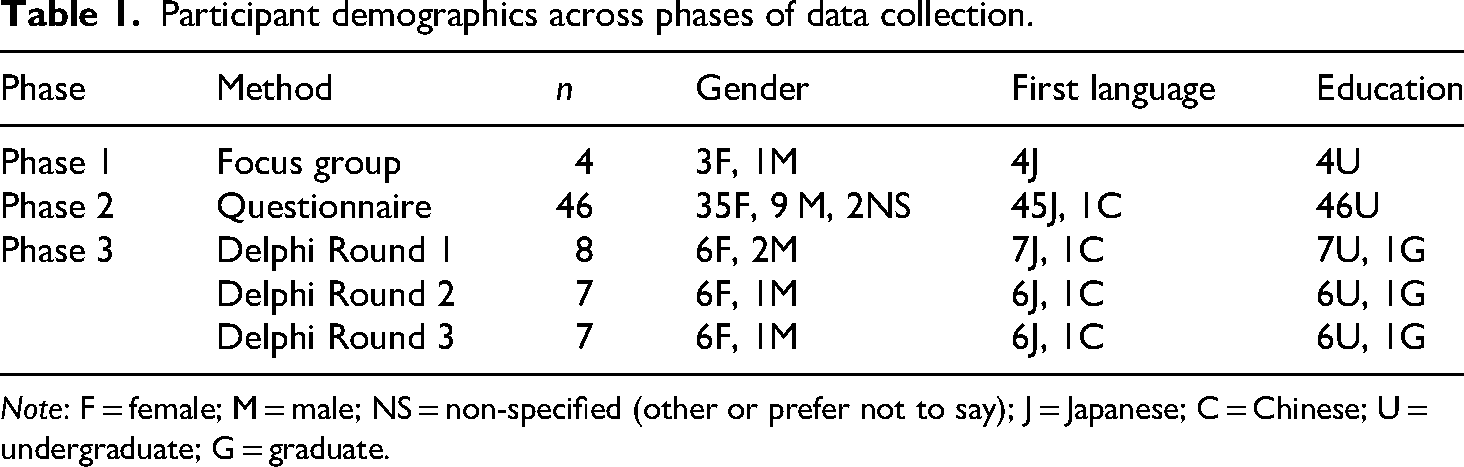
Note: F = female; M = male; NS = non-specified (other or prefer not to say); J = Japanese; C = Chinese; U = undergraduate; G = graduate.
Focus group
A 90-minute mini FG with student participants (n = 4) was convened to investigate opinions and word choices when speaking about global competence and EFL education. Participants were undergraduate English-language majors recruited via flyers distributed at the first author's institution. The FG size was kept small to encourage active participation and in-depth discussion (Liamputtong, 2011). The participants completed a series of card-sorting and discussion tasks to reflect on clarity, difficulty and perception changes resulting from the use of different terms and question phrasings related to global competence (see Figure 1). The session was conducted bilingually and audio recorded. Insights informed the design of the subsequent questionnaire.

Focus group flow.
Questionnaire
An anonymous online bilingual questionnaire was distributed to four stakeholder groups (university teachers, university students, researchers and transnational workers). The present paper analyzes responses from the student subgroup (n = 46). Participants responded to open-ended questions addressing: (a) the nature of global competence; (b) challenges involved in its development; and (c) the role of EFL educators in global competence education. Recruitment employed a criterion-based snowball sampling strategy using online mailing lists and social media. Thematic content analysis was conducted on responses from all stakeholder groups to identify salient themes, which informed the design of the subsequent Delphi rounds. In this paper, only the student responses are reported and analyzed in depth.
Delphi study
A three-round bilingual Delphi study was employed to facilitate structured, iterative and asynchronous group discussion to further explore and understand themes identified in the questionnaire. The Delphi Technique is a group communication method used to gather and refine opinions through multiple rounds of feedback (Linstone and Turoff, 2002). Four stakeholder groups (university teachers, university students, researchers and transnational workers) joined the Delphi panel and responded to several rounds of questions. The present study focuses on the student subgroup (n = 8), who were all English-language majors studying at Japanese universities.
In Round 1, panelists rated and commented on questionnaire-derived statements concerning: (a) requirements for global competence in Japan; and (b) challenges to its development. Statements prioritized by the group were carried forward to Round 2, where Q-methodology was incorporated within the Delphi process to structure participants’ prioritization of key statements (see Brown, 1993 for an overview of Q-methodology). Participants completed two Q-sorts: one ranking items by importance for global competence; and another ranking items by perceived level of challenge. For each Q-sort, participants arranged statement cards along a forced-choice continuum (e.g., from ‘most important’ to ‘least important’). They then responded to open-ended questions to explain their sorts. By-person factor analysis of the full panel's Q-sorts generated shared viewpoints, which were characterized through a process of factor interpretation and then returned to participants for final ranking and comment in Round 3. While the Q analysis was conducted on data from all stakeholder groups, the present article focuses specifically on how the student subgroup engaged with and responded to the shared viewpoints.
Findings
Through the FG, questionnaire and Delphi study, participants concurred that WTC in English is critical for global competence while conceptualizing it as distinct from verbalization and underscoring its complex and nuanced nature. Participants described challenges in juggling ‘Japanese’ and ‘global’ identities and navigating different communicative norms. The provision of opportunities and spaces for students to communicate in English without the limiting influence of local sociocultural norms emerged as an important consideration for educators and institutions. Participant responses are explained below with illustrative quotes from FG participants (denoted FG1-4) and Delphi student panelists (DS1-7). Quotes are provided in the original words of the participant unless otherwise indicated.
WTC: Having something to say and being willing to say it – In English
The first research question sought to investigate student perspectives concerning the connection between WTC in English and global competence. Participants identified communication skills, particularly in English, as an important facet of global competence, with 91% of questionnaire participants listing communication skills as necessary and 87% specifically commenting on FL/EFL skills. Students in the FG confirmed that being able to communicate in English is crucial for global communication, but pointed out that linguistic ability is only relevant if one has an opinion to share and the willingness do so.
FG3: First I think the people have to have their opinion, own opinion. [noises of agreement] FG3: Cause you know, many like, foreign people have really strong belief, on the other hand Japanese people tend not to have that and try to adjust the, like atmosphere and care what people think. FG2: And just listening to, like, what others say… FG1: Mm hmm. [agreement] FG3: [overlapping] So we have too… FG2: [overlapping] …yeah, exactly. FG3: Yeah we have to be really comfortable like, ready to talk about myself and… FG1: [overlapping] like a debate, debate or something FG3: [overlapping] …and talk what I thought
Delphi student panelists echoed the importance of having and sharing ideas, explaining that exchanging opinions facilitates deeper mutual understanding and effective problem solving for a better society. The types of communication and interaction described by students as desirable involved each party expressing their own opinions without fear or embarrassment, which they suggested was not common in Japan. One student explained thus: ‘[Students in Japan] need to express themselves, for the reason that [it is] the only way for people to understand each other. In order to do this, those students who are afraid of taking risks should become more brave. It is going to be a big challenge for them because it is not something that they are familiar with.’ (DS3)
Participants in the FG, questionnaire and Delphi study agreed that WTC with others in English was important, but some disparity emerged regarding the form this willingness should take. While many questionnaire participants opined that students needed to be bold or extroverted and able to initiate conversation, after reflection Delphi panelists determined that global competence entails more nuanced communication skills. At the culmination of three rounds of asynchronous discussion, participants concluded that being sensitive to the situation and adjusting one's communication style and behavior accordingly is critical: ‘The best [global communicators] are those who balance both [outspokenness and reticence] and respond appropriately depending on the situation.’ (DS5, translated from Japanese)
In short, participants explained that global competence entails communication with people all over the world, which in turn necessitates English language skills and a willingness to use English to communicate. However, being more globally competent is not simply a matter of speaking fluently, or loudly, or frequently; rather it requires students to develop a nuanced ability to tailor their language and communication style flexibly according to each specific interaction. While WTC emerged as important, the findings indicate that it may not always (and should not have to) manifest as outspokenness.
Key challenge: Balancing conflicting sociocultural norms
A second goal of this study was to identify what students perceived as particularly challenging pertaining to global competence development and WTC in English. In the FG session, each student arranged a set of word cards related to global competence according to their own ideas. One student explained his visual organization of the cards thus: ‘Me being, like, Japanese [gestures to left] and me trying to be international [gestures to right]’ (FG4). A similar picture of two separate and conflicting identities arose in many participants’ descriptions of the challenges they saw to becoming more globally competent. Participants explained that on the one hand, they seek to be more independent and forthright in order to adhere to perceived global communication norms; and on the other hand, they strive to meet opposite local expectations around appropriate communication patterns. One FG participant went so far as to explain: ‘maybe I think that some sort of idea of Japanese is interfering us to be effective communicator maybe’ (FG4).
Responses from all the Delphi student participants converged around the opinion that cultural norms in Japan made it very difficult to be outspoken and communicate their ideas in the way that they felt was necessary for global communication. Maintaining group harmony and avoiding standing out from the crowd emerged as powerful disincentives to speaking up or sharing personal opinions. One panelist explained that ‘it's embarrassing to be wrong, and as Japanese people we tend to worry about what other people think, so we try to avoid saying our own opinions’ (DS4, translated from Japanese). Another pointed out that ‘formal education instills us with a sensitivity to group harmony and at school it is usually not good to stand out even among your friends’ (DS2, translated from Japanese).
When students are asked to use English to complete communicative classroom tasks, something of an inner struggle appears to take place. Several participants explained that in their own experience, the need to conform to local conventions usually won out. One Delphi participant reported deliberately speaking in ‘katakana English’ (pronouncing words according to the Japanese syllabary) to blend in. Another was so worried about standing out that she avoided speaking entirely. These participants maintained that they had opinions they wanted to share, but that the risks involved made it impossible for them to do so in the classroom environment.
Educators need to provide spaces for low-risk English communication
The third research question focused on what educators can do to increase student levels of WTC in English and facilitate global competence development. Findings demonstrated that quietness is not necessarily an indication of lacking WTC but can be a result of local classroom and communication norms. Questionnaire responses suggested that if students had access to spaces where they were liberated from some of the constraining influences present in the Japanese classroom, they might be more willing to use their English to communicate and express themselves. The Delphi panelists supported the provision of increased communicative opportunities in the classroom, but noted that against a continued backdrop of social norms that value reticence, it would be difficult to actually capitalize on such opportunities: ‘While I feel that being able to express one's own opinion is important… I feel like there are limits to how much that kind of ability can really be developed in the classroom.’ (DS1, translated from Japanese)
Some participants felt that increased opportunities to interact with people from different cultural and linguistic backgrounds were needed, suggesting that moving beyond classroom-based inter-student activities may be necessary to create the ‘spaces’ that students feel they need. However, specific suggestions about how this could be achieved were not forthcoming.
Overall, participants agreed that WTC in English is important for global competence, but reported tension between expectations for assertive communication and norms governing appropriate classroom behavior in Japan. Responses also indicated that silence is not necessarily an indicator of insufficient WTC, but may be shaped by interactional content.
Discussion
Global competence-oriented EFL education in Japan has tended to equate successful communication with observable verbal participation, positioning classroom silence as a pedagogical obstacle and insufficient L2 WTC as the underlying cause. However, findings from this study challenge this assumption by demonstrating that WTC cannot be reduced to verbal assertiveness, and that classroom reticence can emerge from tensions between global competence discourse and locally embedded interactional norms governing appropriate classroom behavior.
Findings of this study present WTC as an interactionally constrained capacity that manifests differently depending on context. While WTC has been theorized as a multifaceted construct encompassing both enduring and situational factors (MacIntyre et al., 1998; Yashima et al., 2018), classroom research has tended to operationalize it through observable speech (e.g., King, 2013; Peng and Woodrow, 2010). This tendency risks overlooking the normative dimensions of interaction. Participants in this study explained that being expected to communicate actively, in English, with a Japanese counterpart in a Japanese classroom leaves them at an impasse: they must either violate local rules of communication or lose an opportunity to further develop their communicative English skills. This inner turmoil is reminiscent of King et al.'s (2020: 62) description of the Japanese university L2 classroom as ‘an emotional danger zone.’ Despite regarding WTC as pivotal for global competence and desiring to be able to speak more actively, some participants in the present study reported muting their performances or abstaining from participating to avoid attracting attention. In this sense, reticence functions not as the absence of willingness, but as one possible outcome of willingness negotiated within specific social and institutional conditions.
This perspective reframes classroom silence as potentially indicative of interactional competence rather than communication failure. Consistent with Harumi's (2020, 2023) work, participants emphasized the importance of group harmony and blending in, explaining that in the Japanese classroom context careful consideration must be given to how assertive one should be, as speaking out too much can damage one's social position or relationships. In this sense, silence may in fact function as a form of relational sensitivity and WTC cannot be equated with verbal output.
Participants emphasized that effective communication requires sensitivity to context and interlocutor. From a global competence perspective, this distinction is critical. As Egitim and Harumi (2026) argue, global competence entails adaptability in communicative style, encompassing both assertive and implicit communication. Encouraging learners to speak more frequently or more assertively may therefore be misaligned with global competence goals, as such behavior will not be appropriate or effective in all interactional contexts. WTC, therefore, is better understood as a latent, context-dependent capacity that may or may not be enacted through speech, depending on interactional conditions. Promoting WTC in global competence-oriented EFL education thus becomes less about increasing frequency of speech and more about expanding students’ capacity to evaluate interactional conditions and engage in ways that achieve appropriate and effective communication.
A further implication can be seen related to the tendency in Japanese EFL classrooms to promote essentialized (American) cultural norms, resulting in exhortations to students to ‘speak out’ and ‘be bold’ (Sakamoto, 2022). Global competence research has been critiqued for implicitly privileging communicative practices associated with Anglophone cultures, such as taking initiative and speaking up (Sakamoto, 2022). In the Japanese context, these tendencies are exacerbated by native-speakerist ideologies that promote native-like speech as the primary goal of language education (Rivers, 2013). The pluralistic aims of global competence education, where listening and restraint may be important skills, mean that global competence-oriented EFL classrooms are often characterized by a misalignment between stated educational goals and everyday evaluative practices. Participants in the present study described navigating these expectations as they attempted to reconcile Western-oriented communication norms with locally embedded expectations governing appropriate classroom interaction.
Understanding WTC as a latent, context-sensitive capacity raises important pedagogical questions for global competence-oriented EFL education. While teachers often seek to increase student participation by improving classroom atmosphere (e.g., Humphries et al., 2015) and building rapport (e.g., Tanaka, 2009), such approaches do not negate the double standard that is present in the classroom when students are expected to operate within conflicting communicative norms. Greater familiarity may even heighten the perceived risk if speaking out of turn risks damaging a friendship. Pedagogy for global competence therefore needs to equip learners to recognize, evaluate and navigate diverse interactional experiences, and cultivating WTC thus entails expanding learners’ repertoires for participation rather than training them in a single communicative style.
Participant responses in this study suggest that educators need to provide spaces where students can navigate authentic communication without interference from local communication norms. Yashima (2022) contends that learning a language yields distinct L2 dialogic spaces which may allow learners to step outside some of the sociocultural norms associated with their L1. However, findings here indicate that as long as students are asked to communicate with peers in a Japanese classroom, such spaces may remain constrained by locally embedded expectations regarding appropriate interaction. While participants did not propose specific pedagogical models, their emphasis on the need for alternative communicative ‘spaces’ can be interpreted as pointing towards learning environments in which interlocutors, interactional norms and perceived social risks differ from those of the immediate classroom peer group.
From this perspective, approaches that extend interaction beyond the immediate classroom may offer a way to mitigate the tension between global and local communicative norms. One example of a pedagogical approach that aligns with these conditions is Collaborative Online International Learning (COIL), which enables learners to engage in sustained online interaction with interlocutors from different linguistic and cultural backgrounds. Although not identified by participants themselves, COIL provides a useful illustration of how such interactional spaces might be operationalized in practice. Through online collaboration with partners outside the local classroom context, learners may experience shifts in interactional expectations, allowing them to focus more on meaning-making and intercultural exchange, and less on conforming to familiar peer norms.
COIL involves students from institutions in disparate geographical locations working together online to complete shared tasks or projects (Cotoman et al., 2021). Integrating a COIL component into an EFL course provides students with opportunities to interact with culturally and linguistically diverse individuals via digital platforms such as learning management systems or video communication tools. While students may remain physically situated in the classroom, the interaction itself is no longer bounded by it, potentially giving rise to alternative L2 dialogic spaces. Previous studies suggest that COIL can facilitate meaningful intercultural exchange and support the development of global competence (Hyett et al., 2019; Naicker et al., 2021; Oskoz and Gimeno-Sanz, 2020). However, empirical research on COIL in the Japanese context remains limited, and its potential impact on WTC as conceptualized in this study warrants further investigation.
This study contributes to WTC research by demonstrating that low classroom verbal participation may reflect a socially situated dilemma rather than an absence of willingness and may in some cases indicate interlocutor sensitivity. In global competence-oriented EFL contexts, equating WTC with outspokenness risks misaligning pedagogical goals with classroom practices. Recognizing WTC as a latent, interactionally contingent capacity invites educators to rethink how willingness is understood and how communicative opportunities are designed.
Conclusion
This study sought to examine the connection between EFL, WTC and global competence education in Japan from the student perspective. Participants underlined the importance of WTC for global competence but qualified that a lack of verbalization should not be interpreted as low willingness, citing the complexities involved in balancing perceived global communication norms with local rules governing classroom interactions. Global communication necessitates sensitivity to context and conversation partner, and EFL education needs to move away from teaching essentialized communication norms to equip learners to interpret and adapt to each interaction.
While this study provides insights into student perceptions of WTC and EFL education for global competence, some limitations must be acknowledged. First, the small and discipline-specific samples limit the generalizability of the findings. Furthermore, students who volunteered to participate likely represent highly motivated individuals and their opinions may not be indicative of those of the broader student body. In addition, data collected here relied on participant self-report. While anonymity was preserved in the questionnaire and Delphi study, some social desirability bias may have shaped participant responses in the FG. Finally, while this study highlights pedagogical implications, further research is needed to test the impact of interventions designed to support context-sensitive WTC development.
Footnotes
Acknowledgement
The authors are grateful to Phil Benson for his advice on aspects of the development of this study.

Ethical approval and informed consent statements
Ethics approval for all stages of data collection was obtained from the Macquarie University Human Research Ethics Committee (Project ID 4933) and Nanzan University Committee for Research Screening (Project No. 18-87). All participants were provided with information and consent forms approved in advance by both ethics committees. Written consent was obtained from focus groups (FGs) participants prior to commencement of the FG. Questionnaire and Delphi study participation was anonymous and informed consent was obtained electronically; participants indicated their consent by selecting a mandatory consent checkbox before proceeding to data collection.
Funding
The authors disclosed receipt of the following financial support for the research, authorship, and/or publication of this article: This work was supported by a Japan Society for the Promotion of Science Grant-in-aid for Scientific Research (19K00840) and Nanzan University pache Research Subsidy I-A-2 (2026).
Declaration of conflicting interests
The authors declared no potential conflicts of interest with respect to the research, authorship, and/or publication of this article.
Data availability statement
The data generated during this study are not publicly available due to ethical approval restrictions that do not permit sharing of raw data.