






Abstract
Modern network infrastructures are becoming more concerned about energy consumption, especially with software-defined networks (SDNs). Because SDN separates the control plane from the data plane, it allows for programmability in networks, which is not possible with conventional networks. Conventional routing techniques usually lead to excessive power consumption because they handle traffic. However, numerous frameworks have been presented to address this, with a focus on utility-based and machine learning techniques for traffic-aware energy optimization in SDN. These methods, however, often overlook the combined effect of dynamic routing and intelligent traffic classification for energy savings. The research paper proposes a new framework called EESDN that presents an energy-efficient routing (EER) algorithm that uses intelligent traffic classification to allocate paths in an energy-efficient manner. The objective is to maintain network performance while reducing energy consumption. For the SDN energy-saving opportunity identification issue, we propose an integer linear programming (ILP) approach. Using real-world traffic traces with the Mininet emulator and POX controller, the Abilene network architecture is examined. Our model shows a potential reduction in active network components, which, under idealized conditions, could translate to power savings of 8 to 25 W in our emulation and decreased average path length under high-traffic conditions. The emulation results demonstrate that the framework reduces energy consumption per bit by approximately 10% compared with existing methods.
Keywords
1. Introduction
Software-defined network, as outlined by Open Networking Foundation, 1 has received much popularity in recent decades due to its architecture, which separates the control plane from the data plane, allowing for centralized network management, flexibility, and dynamic adjustments. Compared with traditional networking architectures, SDN is easier to manage and more responsive to changing network conditions. Administrators can implement custom policies and algorithms for managing the network. They do not need to depend on vendor-provided policies. In SDN, a central controller, or SDN controller, communicates with network devices using standardized protocol like OpenFlow. The controller makes intelligent routing decisions based on network policies and real-time data, sending instructions to the devices on how to handle data packets. SDN is perfect for applications in data centers, cloud computing, and large-scale enterprise networks because of its centralized approach, which allows automation, traffic optimization, and enhanced network monitoring. Advanced methods, such as those based on machine learning (ML), can be implemented to improve network management, optimize resource allocation, and boost overall network efficiency in real time because SDN is programmable. Because typical network models use a dispersed control architecture, in which the control and data planes are closely coupled within individual network devices, such dynamic adaptability is not possible. Applying ML-based control or reconfiguration across the entire network is challenging due to this rigidity, which restricts the global visibility and centralized decision-making needed for real-time optimization. 2
With the continuous expansion of applications in today’s networks, an enormous volume of data is being generated, adding to the complexity of network management and optimization. The proliferation of data-intensive apps and the sharp rise in network data traffic mean that traditional network devices consume significant energy, adding to the environmental impact and operational expenses. Information and communication technology (ICT) accounts for almost 10% of global energy usage, out of which 2% is attributed to network components alone. In contrast to the services they offer, network resources are frequently underutilized. For example, in most data center networks, utilization rates fall between 30% and 40%.3,4 Turning off or putting unused components into sleep mode during times of low traffic is a workable solution to this problem, but network performance may suffer as a result, even while this lowers the number of active network components during times of low traffic.5,6 Energy consumption by underutilized network components is still high and varies depending on traffic patterns.7,8 Therefore, it is essential to manage the SDN controller effectively to address energy concerns. 9 Reducing the use of partially utilized components is the main goal of strategies to cut down on this waste. Thus, by modifying these tactics to dynamic traffic, SDN systems can operate more efficiently and use less energy.
In SDN, ML can enhance network intelligence by enabling network devices to optimize performance and simplify network management and maintenance. Using ML in SDN is especially beneficial for efficient routing, which is a critical function in any network as its effectiveness directly influences latency, throughput, and overall quality of service (QoS). 10 However, poor routing decisions can lead to increased latency and higher bandwidth usage, ultimately reducing the overall performance of the SDN environment. 11 Traditional categorization methods, such as port-based analysis and deep packet inspection (DPI), are becoming ineffective. Port-based classification is ineffective since many apps employ dynamic or non-standard ports. More importantly, the widespread use of encryption (such as TLS for web traffic) renders DPI unnecessary for analyzing packet payloads. While computationally expensive, DPI’s biggest drawback is its inability to handle encrypted communications. As a result, ML algorithms that categorize traffic based on flow-level statistics (e.g. packet size and inter-arrival time) have emerged as the dominant solution since they are effective even when payloads are encrypted.12,13 A survey of the literature, however, identifies a significant gap: there are not many frameworks that use ML to classify traffic in a way that directly and dynamically informs an energy-efficient routing (EER) approach.
Although energy-aware routing has been extensively researched, the majority of current methods do not specifically use traffic classification to distinguish flow characteristics. To enable more focused and efficient energy optimization, the suggested system uses ML to dynamically differentiate between mouse and elephant flows and incorporates this information into routing decisions. The energy-efficient software-defined network (EESDN) paradigm is proposed in this research to close this gap. EESDN, which runs on the SDN controller, combines a dynamic EER algorithm with a ML-based traffic classifier. The framework first classifies flows using a support vector machine (SVM) model. After then, it deliberately turns off unused switches and links by using the EER algorithm to route these flows in a way that combines traffic onto a small number of active network components. A formal integer linear programming (ILP) model that is intended to find energy-saving opportunities while maintaining QoS serves as the guide for this process.
This work’s primary contributions are as follows:
The architecture of the integrated EESDN framework combines dynamic, energy-conscious routing with ML-driven traffic classification.
An ILP formulation and a new EER algorithm are presented for network energy consumption optimization.
A thorough experimental evaluation on the Abilene topology using the Mininet emulator and POX controller showed notable power consumption reductions and enhanced performance compared with state-of-the-art techniques.
The remainder of the document is structured as follows: The study is reviewed in Section 2, the EESDN framework is explained in Section 3, the experimental setup is described in Section 4, the results and analysis are presented in Section 5, and the paper is concluded in Section 6.
2. State of the art
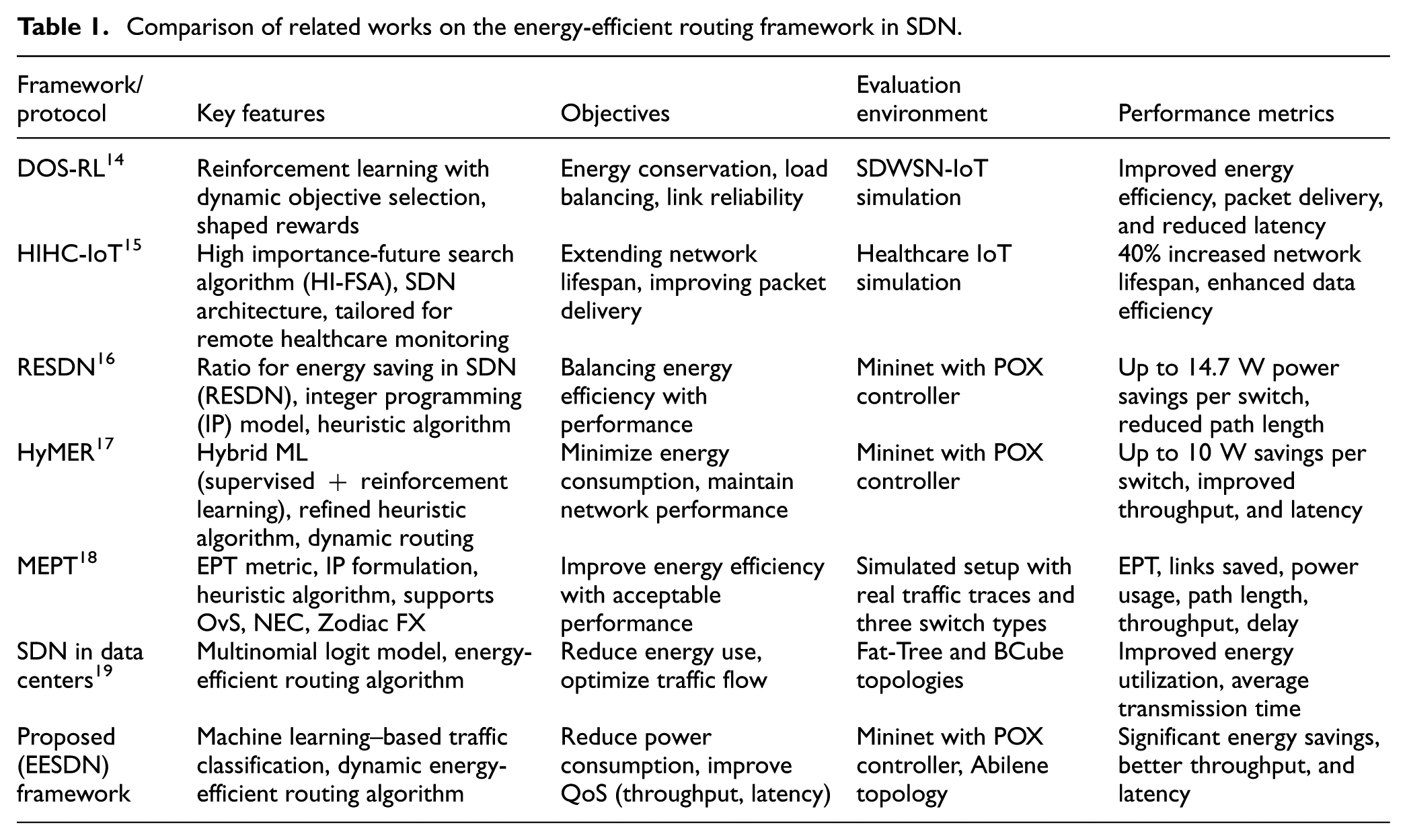
This section is divided into two subsections. The first section focuses on SDN’s EER, which aims to reduce energy usage by using the best possible network routing, with a particular focus on previous work devoted to EER strategies within SDN. Table 1 provides a concise overview and comparison of these approaches. Several studies have shown different strategies to improve SDN energy efficiency. Second, we discuss proposed approaches on ML-based traffic classification in SDN.
Comparison of related works on the energy-efficient routing framework in SDN.
2.1. EER in SDN
A related work, DOS-RL, uses reinforcement learning for EER in SDWSN-IoT. 14 While sharing the goal of energy conservation, our work targets the software-defined networking (SDN) paradigm. The SDN controller’s centralized view enables a more direct approach. Instead of distributed RL, our algorithm leverages the controller’s access to classified traffic information for proactive, fine-grained path computation. This achieves energy efficiency without the overhead of a learning process, making it more suitable for the SDN context, as shown in Table 1.
The High Importance Healthcare-Internet of Things (HIHC-IoT) protocol was introduced by another related work for remote healthcare monitoring, especially in critical circumstances like COVID-19. 15 It saved energy for critical processes by giving priority to high-importance IoT nodes and optimizing cluster head selection through the use of SDN, cloud support, and high importance-future search algorithm (HI-FSA). Our approach, on the contrary, uses a network optimizer to control switch activation for additional energy savings, an EER algorithm for path selection, and an ML-based traffic classification module to identify elephant flows.
Another study established the ratio for energy saving in SDN (RESDN), which uses link utility intervals in SDN to quantify energy efficiency. 16 The study showed that using the POX controller in a Mininet resulted in significant power savings, decreased average path length, and enhanced traffic proportionality using an IP formulation and the MaxRESDN heuristic. In contrast to this method, we provide an EESDN framework that uses an integer linear programming model to find energy-saving possibilities while maintaining QoS, a dynamic routing algorithm for traffic-aware path selection, and an ML-based traffic classifier.
For EER, the closely related framework 17 creates a strong baseline by fusing supervised and reinforcement learning (RL). Although efficient, its reliance on RL results in convergence delays (100–275 iterations) and intrinsic computing complexity. Our EESDN system sets itself apart by removing this complexity; instead of a hybrid learning core, we use a simplified architecture in which a dynamic routing algorithm is directly informed by a lightweight ML-based traffic classifier. This basic change is very advantageous since it allows for instantaneous, traffic-aware path modifications instead of waiting for policy convergence, which drastically lowers computing cost and operational latency. Therefore, without compromising the energy savings and performance gains shown in our results, EESDN achieves responsive, fine-grained optimization, dynamically routing traffic based on its classified type (e.g. real-time vs. bulk data), making it more appropriate for environments where agility and low-overhead are crucial.
The study by Assefa and Ozkasap 18 tackles the energy-performance trade-off by proposing a novel energy profit threshold (EPT) metric, which optimizes energy efficiency by evaluating the utility of network links against their power consumption. Their accompanying maximum energy profit threshold (MEPT) heuristic demonstrates significant efficacy, achieving over 35% link reduction and notable power savings by strategically deactivating underutilized links. While this utility-based approach is effective for load consolidation, our work intentionally adopts the energy-per-bit (EPB) metric to provide a more foundational and granular assessment of efficiency. Unlike EPT, which is a composite measure, EPB directly quantifies the energy expended to deliver a single unit of data. This offers a clear, standardized benchmark that is independent of specific traffic distribution patterns, allowing for a purer evaluation of our routing algorithm’s inherent energy-saving performance and facilitating direct comparisons with a wider range of energy-efficient solutions.
The EER technique in the work by Wei et al. 19 shows better energy utilization on Fat-Tree and BCube topologies by prioritizing flows and choosing minimal-energy paths in data centers using a multinomial logit model. Although efficient, our system divides traffic into elephant and mouse flows to offer a more sophisticated and detailed method. This distinction is crucial because many latency-sensitive mouse flows need to be handled quickly, elephant flows often take up a huge amount of bandwidth in many network systems, however depending on traffic patterns, multiple mouse flows may together contribute an equivalent or even greater traffic volume. Our dynamic routing system can proactively route elephant flows for maximum throughput and mice flows for least delay by precisely detecting these flow types using ML. As demonstrated on the Abilene topology, this focused approach, when paired with our traffic-aware network optimizer, results in more effective energy savings and improved overall QoS.
2.2. ML-based traffic classification in SDN
With the rapid growth in Internet users, classifying network traffic has become crucial. Since mice flows are short-lived and delay-sensitive, while elephant flows use the majority of bandwidth and necessitate optimized pathways for high throughput, classifying traffic into elephant and mice flows allows for efficient resource utilization. Traditional approaches, such as using port numbers or examining payloads, have become less effective due to the increasing complexity and encryption of modern network traffic. 20 Many researchers have explored using SDN combined with ML models for traffic classification.
Using ML-based traffic classification, the author 13 presented a system for cost-aware routing that identifies bandwidth-intensive “elephant flows.” Their main objective was economic effectiveness, but sophisticated energy-saving techniques are made possible by this exact classification. An SDN controller may make smart routing decisions by precisely detecting these high-volume flows. For example, it can combine elephant flows onto a few number of links and switches, enabling the powering down of inactive network components. As a result, their categorization strategy offers the crucial information that our framework and others use to save a substantial amount of energy without sacrificing network performance.
To categorize domain name system (DNS), Telnet, Ping, and Voice traffic flows produced by the distributed internet traffic generator (D-ITG), the work by Salau and Beyene 20 used a variety of ML algorithms, such as logistic regression, decision tree, random forest, AdaBoost, SVM, and K-means clustering. Mininet was used to implement the models in an SDN environment, and they proved to be reliable in both offline and real-time situations. The promise of ML-driven SDN frameworks for precise and flexible network management was demonstrated by the effective traffic classification, enhanced packet inspection and management, and improved QoS that resulted from the integration of ML with SDN.
Raikar et al. 21 highlighted the limitations of traditional traffic classification and proposed an SDN-ML framework using SVM, nearest centroid, and Naïve Bayes models. However, their work acknowledges challenges in the real-time capture and classification of live network data within the SDN framework. Our framework directly overcomes these limitations by implementing a dedicated traffic manager module that efficiently collects live flow statistics (e.g. packet count and byte count, duration) from the SDN controller in real time. Instead of relying solely on traditional ML models, we employ a more robust ML model, that is trained on these dynamic flow features. This enables accurate, low-latency classification of live traffic, which is then used to make immediate routing decisions, effectively bridging the gap between classification theory and practical, real-time deployment in an SDN environment.
In the study, the authors 22 proposed “Deep-SDN,” a deep learning model tailored for traffic classification in SDN. With the rapid expansion of Internet traffic, traditional classification methods like port-based and DPI approaches have become inefficient and computationally expensive. Deep-SDN addressed these challenges by leveraging a centralized SDN controller architecture for accurate, application-aware traffic identification at high speeds, making it suitable for real-time classification.
One common and important gap found in the state of the art is the divergence between real-time, energy-aware control operations and traffic classification. Although studies such as Verma and Jain 13 and Raikar et al. 21 successfully illustrate ML for traffic classification (e.g. identifying elephant flows or application types), their frameworks mainly concentrate on cost-aware routing or classification accuracy, leaving the direct application to dynamic energy savings as a secondary concern or future work. Similar to this, energy efficiency is included into systems like HyMER and the MEPT heuristic, but they either rely on computationally demanding techniques like reinforcement learning or on utility metrics that do not take advantage of fine-grained, ML-based traffic insights. Thus, there has not been a complete solution that combines lightweight, precise traffic classification with a low-overhead, dynamic routing algorithm made especially to turn those traffic insights into instant energy savings.
3. EESDN framework description
This section provides a detailed description of the suggested EESDN architecture. EESDN’s main objective is to produce large energy savings by optimizing path selection for elephant flows and using ML for traffic classification. The framework functions inside the SDN architecture’s control plane, as shown in Figure 1.
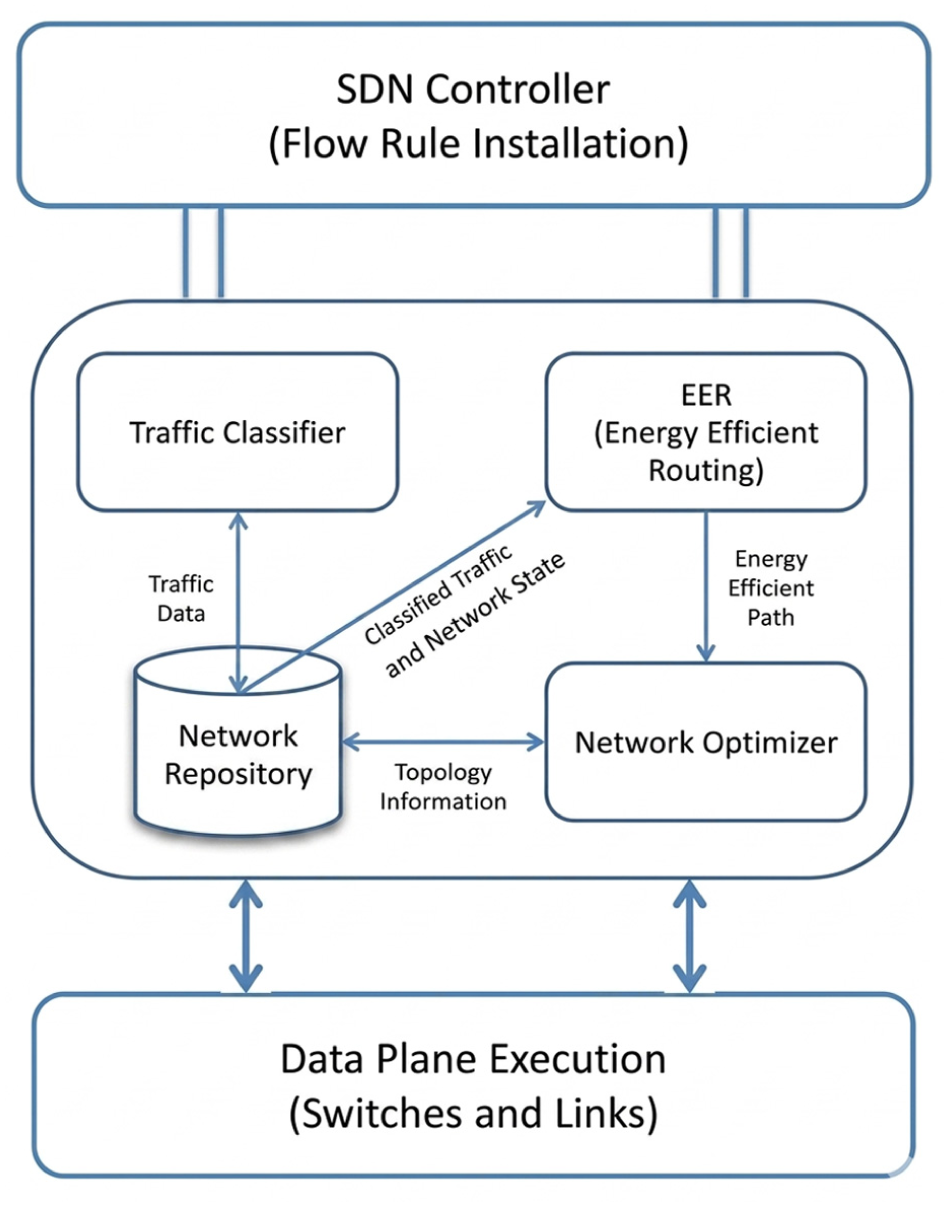
Energy-efficient SDN (EESDN) framework.
The four main elements that make up the EESDN architecture interact dynamically. The
Traffic Statistics in Real Time: Key information, such as source and destination IP addresses and ports, protocol, packet count, total byte count, flow duration, and packet inter-arrival time, is extracted for every new flow. These characteristics are essential for the next stage of classification.
Network Topology State: It keeps an up-to-date graph model of the network that shows the available bandwidth capacity of all switches and links, as well as their status (active, idle, or inactive).
The flow statistics are retrieved from the repository by the
The framework’s central decision-making component is the
The EESDN framework’s operating workflow is depicted in Figure 2. The classification module first monitors and processes network data, using ML techniques to differentiate between mice and elephant flows. Yen’s technique is used to generate candidate routing paths based on this classification, and Dijkstra’s algorithm is used to find the most efficient path while taking network conditions into account. After prioritizing already-active links, the routing choice module updates link states, uses the power model to calculate energy usage, and chooses energy-efficient routes. To adjust to changing traffic circumstances, this procedure is performed on a regular basis.
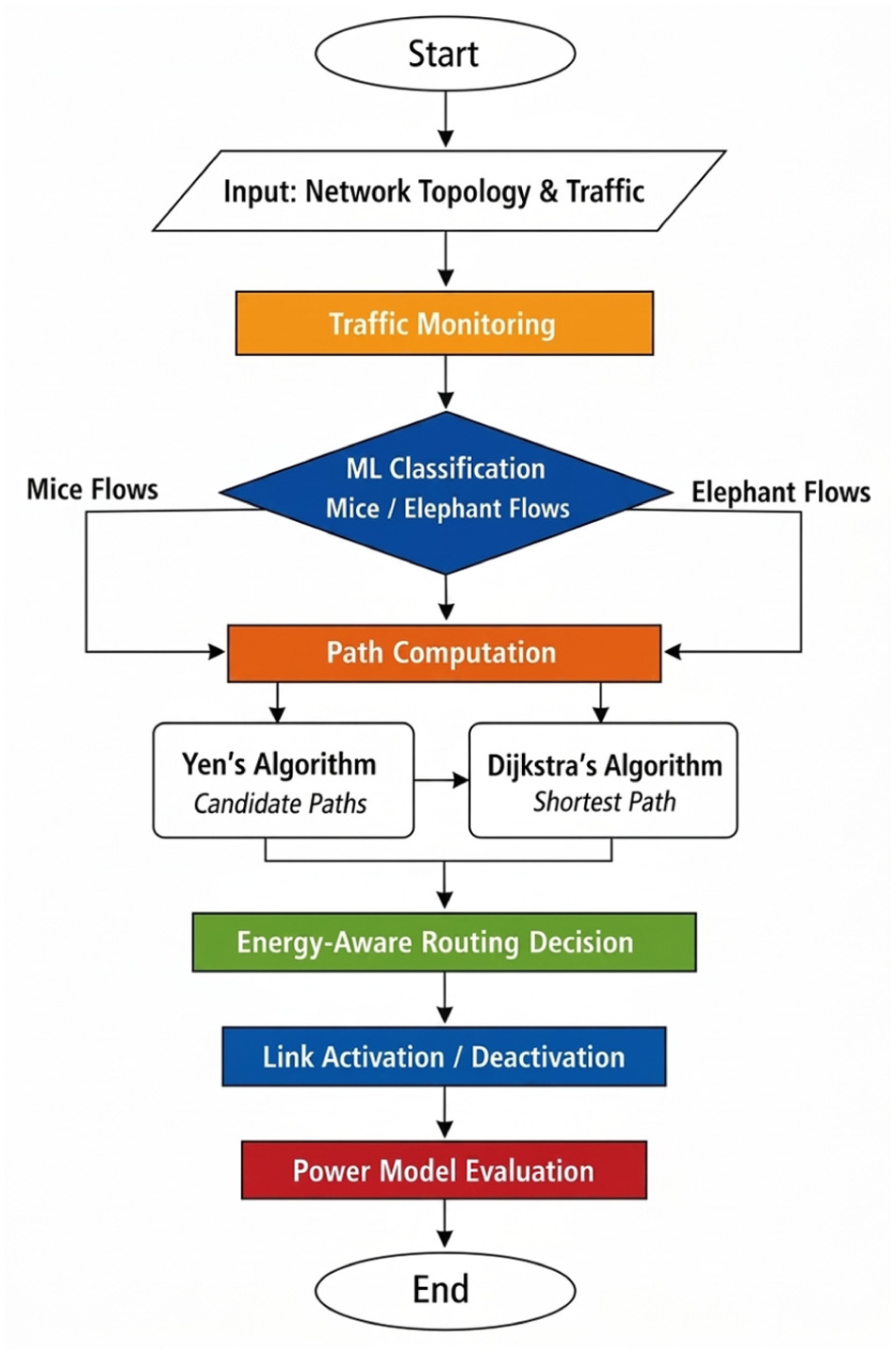
Workflow of the proposed EESDN framework.
3.1. Problem formulation
In this part, we construct the EER problem as an integer linear programming problem. Our recommended optimization approach focuses on identifying energy-saving opportunities within SDN from a traffic perspective and highlights the key energy-saving components, such as links and switches. The objective is to lower the power consumption of the switches and cables required to regulate the flows. The notations used throughout the problem formulation are summarized in Table 2. Let
Let
Let
Let ◦ ◦
Let

This function minimizes the total energy consumption of the network by summing the power used by all active switches and all active links.
Notation and descriptions for network topology parameters.
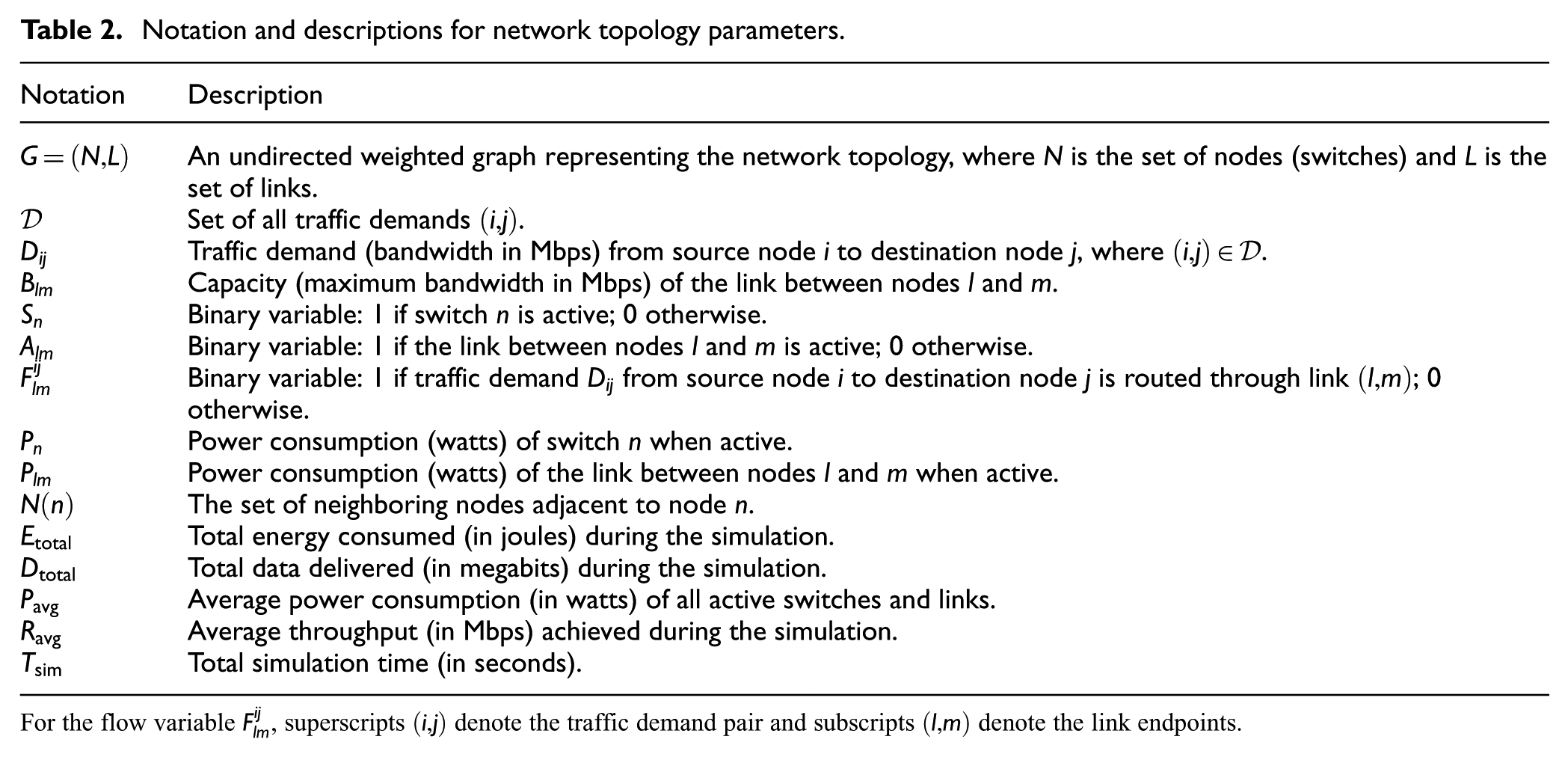
For the flow variable
Equation (2) imposes the flow conservation constraint, ensuring that for each demand
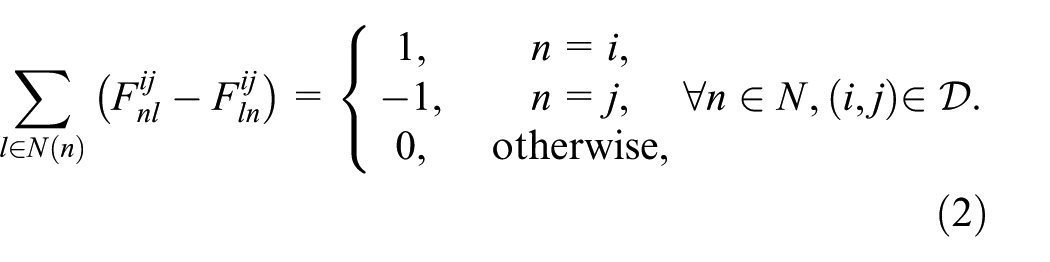
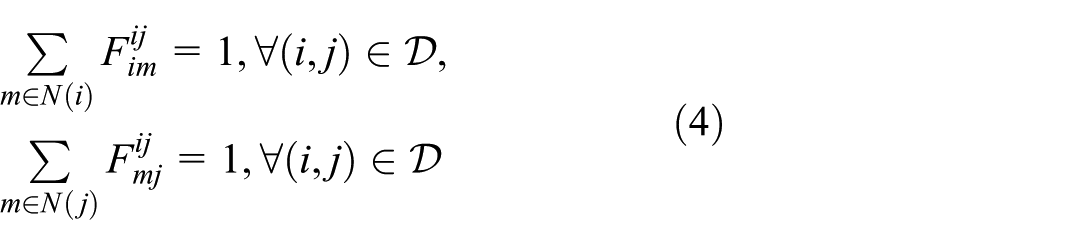
Equation (3) is the link capacity constraint. It ensures that the total traffic assigned to a physical link does not exceed its maximum bandwidth capacity, preventing network congestion. Equation (4) guarantees that for each demand, the flow entering the network at the source switch exits at the destination switch. Equation (5) guarantees that no flow makes use of a connection that is attached to a switch that is not in use. Switches that have no active flows over their associated lines are forced to shut down by equation (6). Finally, equation (7) ensures that links connected to inactive switches are also deactivated.




3.2. Energy-efficient routing
The preceding equations represent a complex problem that is difficult to solve. According to Assefa and Ozkasap, 17 it has been demonstrated to be an Non-deterministic Polynomial-time (NP)-hard problem. To effectively address this issue, we provide the EER algorithm, a dynamic heuristic. As mice flows make up 80% of network traffic flow, 12 the algorithm works on the premise that they can create active pathways that elephant flows can then reuse. This method maintains balanced QoS while minimizing the activation of new network components, which lowers power consumption. Algorithm 1 describes the EER algorithm, which runs inside an OpenFlow controller. All of the switches and links are initially dormant. Each incoming flow is initially classified by the traffic classifier module as either a mouse flow or an elephant flow.
Energy-Efficient Routing (EER) Algorithm
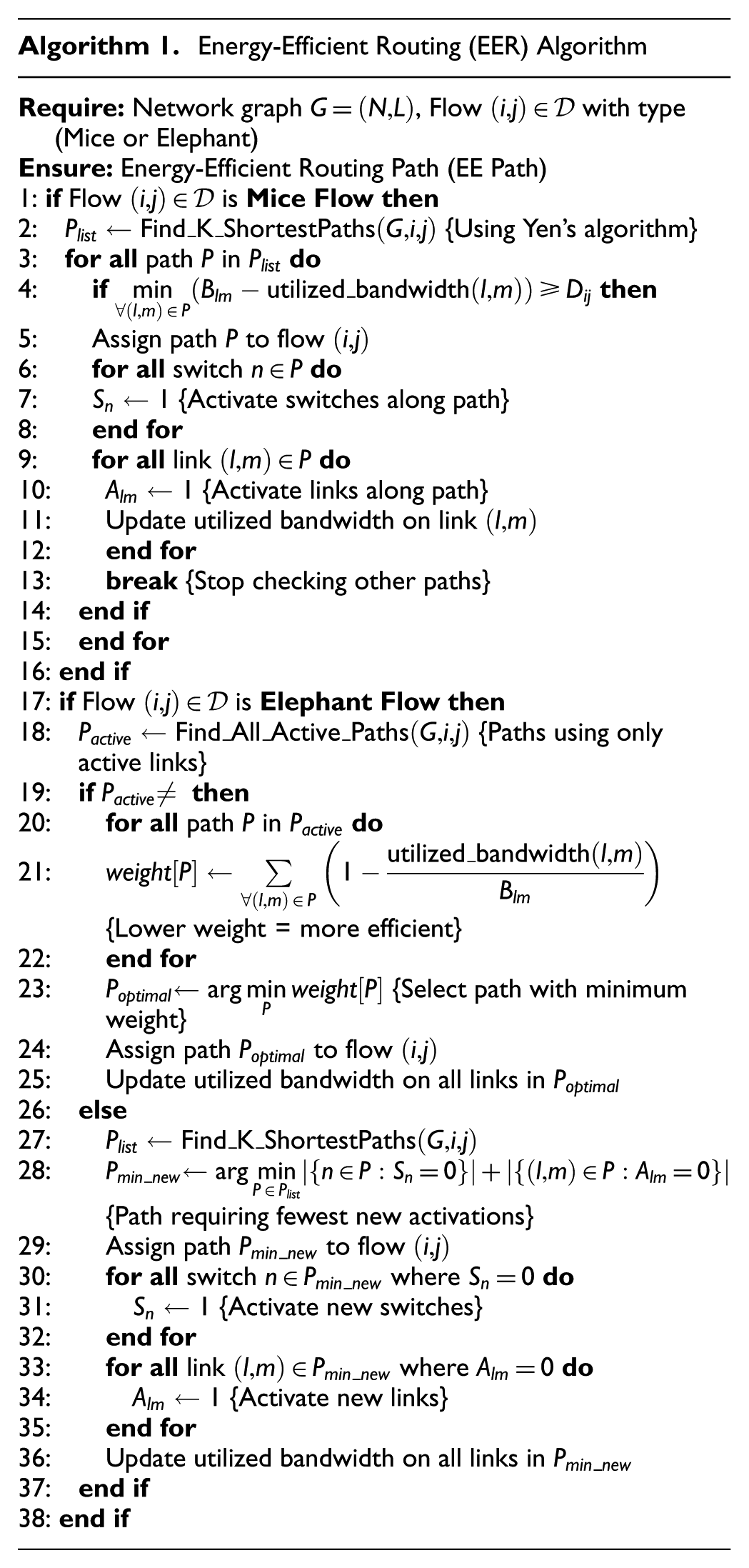
When a
It determines a weight for each path
3.3. Operational case
Taking into account a data center, a large data center has a complex network of switches and links that connect various servers. There are two sorts of data flows that occur in the network: massive, less frequent “elephant” flows and small, frequent “mice” flows. The goal is to maximize network resource use while minimizing energy consumption. The dual problems of effective energy optimization are specifically addressed by the proposed EESDN framework, which has useful applications in contemporary network administration. First of all, the intelligent traffic classification module makes it possible to precisely identify and classify network flows, such as differentiating between mouse and elephant flows. By better allocating resources according to traffic requirements, this information can be used to optimize network operations. Second, there is much promise for the EER algorithm to lower power usage in data center networks. By utilizing the traffic classification insights, the EER algorithm dynamically selects energy-efficient routes, ensuring that active switches and links are utilized optimally while underutilized network elements are powered down. In addition to lowering energy usage, this adaptive routing technique aids in controlling the running expenses of extensive networks, such as those in data centers, without compromising throughput. These capabilities highlight the EESDN framework’s ability to address critical real-world challenges in sustainable and efficient network management. This approach allows the data center to dynamically balance the need for network performance with energy efficiency. The framework ensures that the network only uses the resources it needs, activating additional paths and switches only when required, thus reducing overall power consumption.
4. Experimental setup
To guarantee that our findings are reproducible, we describe how we integrated the EESDN framework with the POX controller and Mininet emulator. Our experiments were carried out on an Ubuntu 16.04 (64-bit) machine with the Mininet network emulator and the POX controller installed. The test topology was based on the Abilene network design from SNDlib. 24 In network research, this architecture is widely used, especially in the domains of traffic management, SDN, and network performance assessment. The geographical architecture of Abilene topology is shown in Figure 3, and for better understanding, the graphical representation with details is shown in Figure 4. It is frequently used as a reference model for testing different network techniques, assessing routing efficiency, and optimizing energy use. The Abilene topology was selected for our study to verify the effectiveness of our suggested approach. Twelve nodes and 15 high-speed links make up this network, which represents important American cities including Seattle, Los Angeles, Denver, Kansas City, Indianapolis, and Chicago, among others. These nodes’ connections usually mimic gigabit-speed connections. With network usage levels ranging from 20% to 90% of total capacity, we tested our strategy under a variety of traffic scenarios. The implementation consisted of three major steps. First, we enhanced the POX controller by converting the fundamental EESDN modules into Python classes. The Traffic Manager class uses POX’s ConnectionUp and Packet-In events to collect network topology and flow information. The traffic classifier uses the scikit-learn package to incorporate our pre-trained SVM model, extracting flow features (source/destination IP, byte count, flow duration, and inter-arrival time) from the first few packets of each new flow. Scikit-learn is used standalone without any deep learning framework such as TensorFlow or PyTorch, as the lightweight SVM model is sufficient for real-time flow classification without requiring neural network-based computation. Our EER algorithm and topology management are implemented in the EER module and network optimizer classes, which make use of the NetworkX graph operations package. Second, we set up the Mininet emulation by programmatically building the Abilene topology with Mininet’s Python API. To connect the Mininet switches to our own EESDN-enhanced POX controller, we used the –controller = remote flag, as shown in the code snippet below:
Third, to generate and execute workloads, we used Mininet’s iperf and hping utilities, as well as bespoke Python scripts that replay SNDlib traffic traces. Performance metrics were generated using controller logs and flow statistics collected by OvS-ofctl, allowing for a thorough evaluation of our framework’s energy efficiency and network performance under a variety of traffic scenarios. Although SNDlib traces are used in the paper, real-world traffic (such as that from data centers or 5G networks) may show distinct patterns that could impact the framework’s functionality.
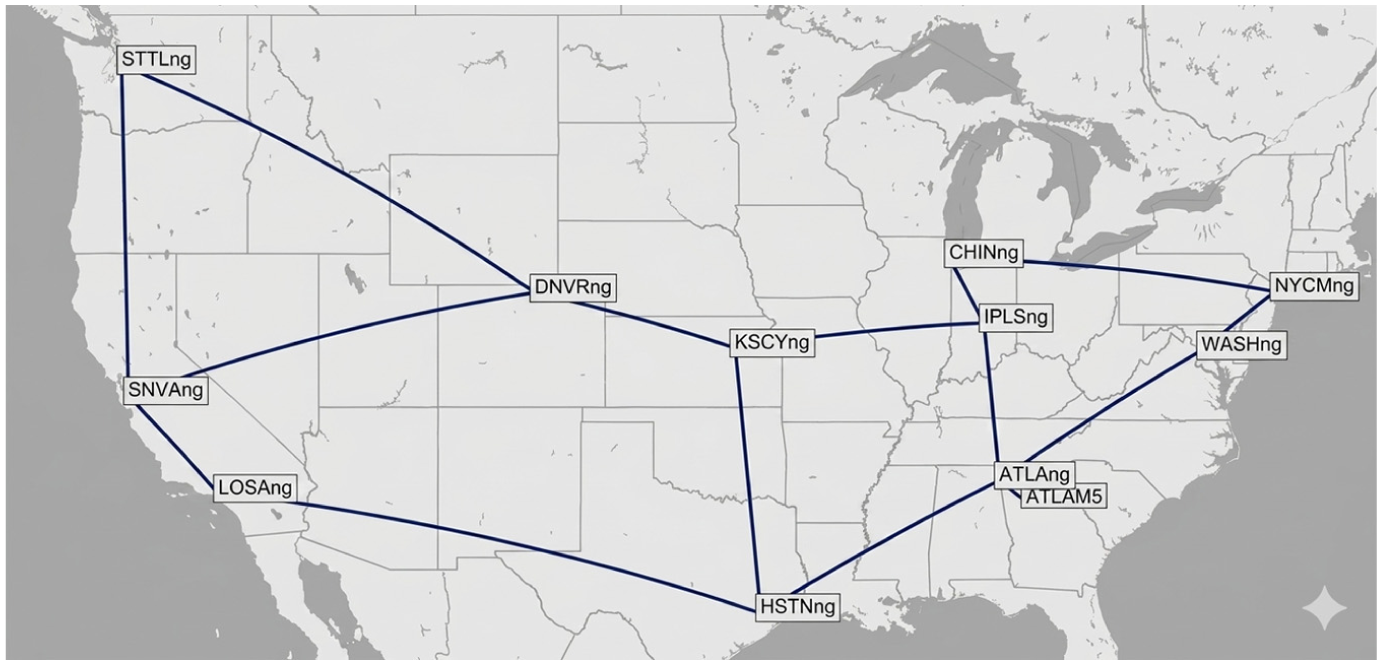
Geographic layout of the Abilene topology.
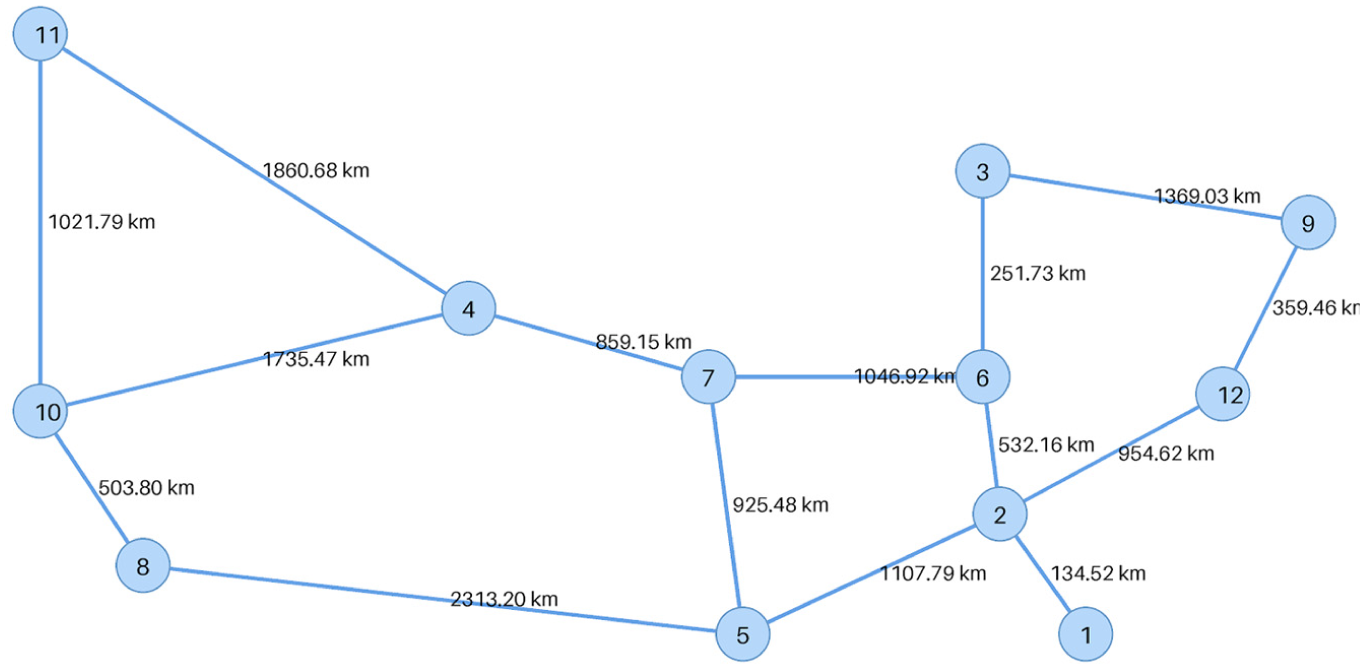
Detailed representation of the Abilene topology.
For our experiment, we have used Open vSwitch (OvS), a multilayer virtual switch with OpenFlow support, to analyze power usage in SDN. OvS is suitable for SDN experiments because it supports multiple protocols, thereby facilitating network automation. By incorporating OvS into our experimental setup, we evaluate its impact on energy consumption while maintaining optimal network performance.
For experimental purposes, we have used real-world traffic traces from SNDLib. Traffic demands were collected over 6 months, with each demand representing a 5-min interval. In total, we collected 48,096 traffic demand matrices. The average number of flows in each demand matrix is approximately 130. We acknowledge the valid concern about the energy overhead of control plane activities like ML classification and dynamic rerouting, which was not quantified in our current data plane-centric study. However, we believe that the net energy benefit will stay positive due to underlying operational asymmetries. The control plane cost is a quick, one-time event that occurs when a flow is initiated. In contrast, data plane savings from optimally routing a bandwidth-intensive elephant flow are continuous, occurring during the flow’s full existence, which is often minutes or hours. This enables the initial overhead to be quickly amortized.
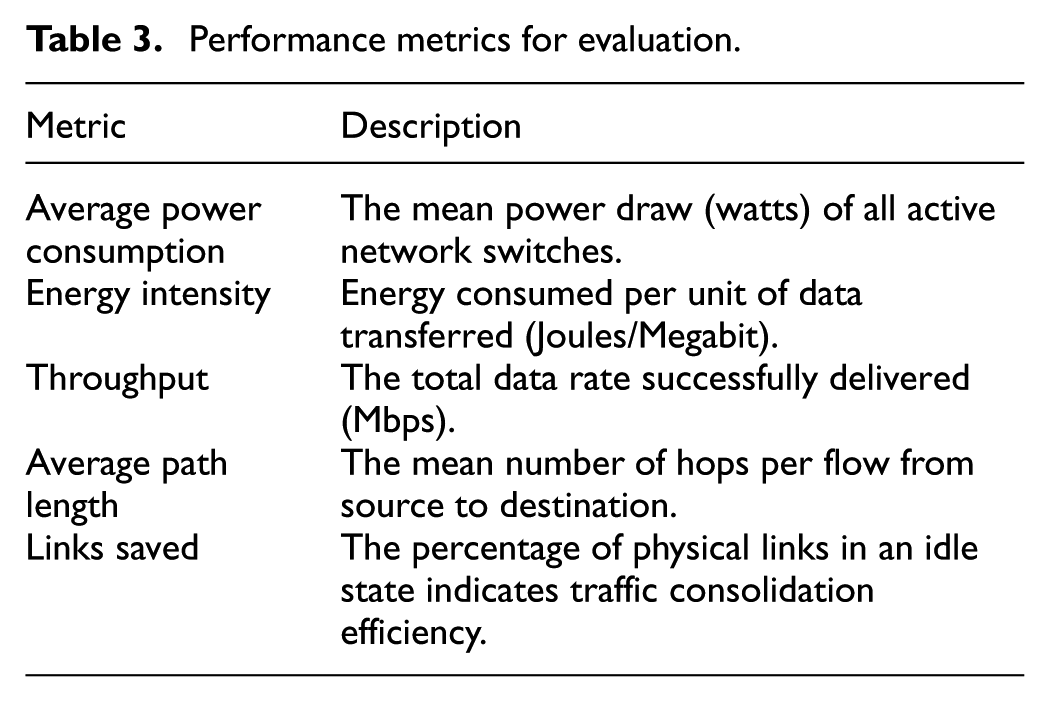
To evaluate network behavior, we tested our approach with varied traffic loads (low, moderate, and high) based on network capacity. Our method’s performance was evaluated using metrics provided in Table 3, including both traditional network performance indicators and a standardized energy efficiency measure, energy intensity.
Performance metrics for evaluation.
Energy intensity or EPB is an important statistic for measuring energy efficiency. It assesses the energy cost of transmitting data. It is measured as the total energy consumed by the network divided by the total quantity of data successfully delivered, providing a direct measure of how effectively energy is turned into data transmission. There are two ways to measure energy intensity: average energy intensity, which calculates the total energy used per unit of transmitted data over a given observation period (Joules per bit), and instantaneous energy intensity, which shows the power consumption per unit data rate at a given time (watts per bit/s). Since it offers a consistent and comprehensive assessment of network energy efficiency throughout the evaluation period, we use the average energy intensity metric in this investigation,
25
address the application and limitations of energy intensity in network evaluation, and offer a thorough examination of energy efficiency indicators. The energy intensity (

where
A lower EI value indicates a more energy-efficient network. The author 26 examines energy intensity as a metric for the amount of energy needed to provide digital services, with a particular emphasis on user devices and home access networks. It emphasizes the significance of energy intensity measurements for evaluating the environmental impact of communication systems and offers methodological insights into measuring energy per unit of data flow. Since overall energy usage may be calculated as the product of EPB and the total amount of data transmitted, network energy consumption and energy intensity are directly correlated. Thus, optimizing route choices to lower energy intensity results in a corresponding decrease in the total energy consumption of the network.
We tested our approach under varying traffic loads, light, moderate, and heavy, in accordance with network capacity, to observe network behavior. The performance of our method was evaluated using the following metrics: switch energy consumption (in watts), average path length (in hop count), throughput (in Mbits/s), and energy savings in terms of the number of links saved.
The average power consumption

The average route length (

Throughput (T) is calculated by measuring the amount of demand handled successfully within a specific duration. In Mininet, the iperf tool helps measure throughput between source and destination nodes. For our experiments, we determine the average throughput across all node pairs to evaluate overall network performance.

By enabling underutilized ports and switches to go down, fewer active network links result in lower energy consumption. This efficiency improvement is measured by the percentage of links saved. Network performance is maintained while power consumption is reduced when there are fewer active links. This strategy successfully strikes a balance between operational needs and energy savings. This equation may be used to determine the proportion of links saved:

In our initial experiment, we used ML classifiers to recognize elephant and mouse flows. We used Wireshark
27
to record raw network traffic data and extract essential flow-level information including source and destination IPs, ports, flow length, total bytes, and packet rates. Using these features, flows are classified as elephant or mouse based on predetermined thresholds for total bytes of 10 MB or more and flow duration of 10 s or more for elephant flows. After preparing the data set, features were standardized for consistency and trained with several ML models, such as SVM,
28
logistic regression,
29
K-Nearest Neighbors (KNN),
30
and Naive Bayes.
31
During our experimentation, we divided 245,000 traffic cases into 80% training and 20% testing. SVM had the best accuracy of 91% due to its ability to handle non-linear decision boundaries, whereas logistic regression and KNN yielded equivalent results. Naive Bayes fared marginally worse due to the assumption of feature independence. To improve classification accuracy, we used a grid search strategy to tune the SVM model’s hyperparameters. Tuning the kernel type (RBF), regularization parameter (
Comparison of classifiers with accuracy, strengths, and weaknesses.
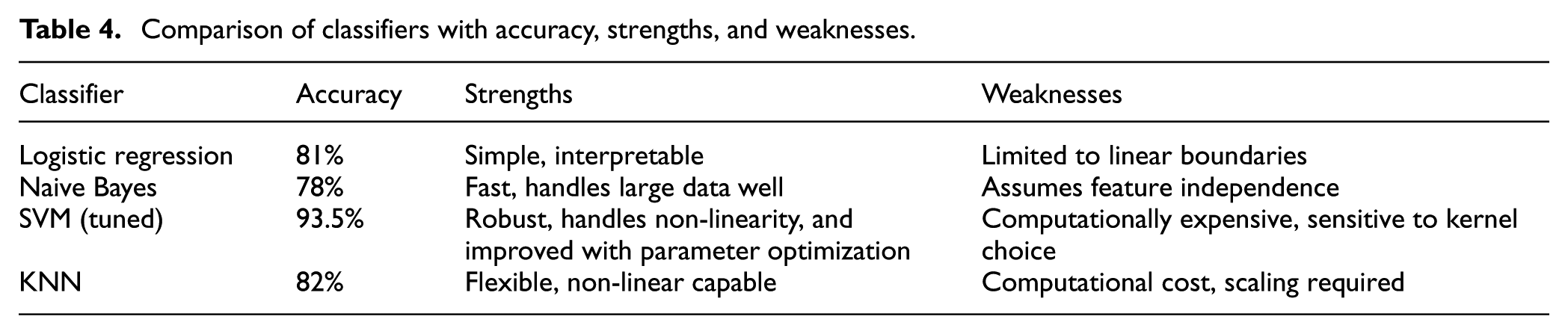
The suggested approach enables the classification model to be periodically retrained using the most recent traffic data gathered by the SDN controller. The design allows for adaptive updates to respond to changing traffic patterns, even if real-time model updating is not the main goal of this work.
Before making routing decisions, the controller gathers flow information during the observation window used for traffic classification, which can be thought of as a stability phase. We recognize that extremely large traffic volumes could make the SDN controller’s processing load heavier. However, to reduce computational cost, the suggested framework is built with lightweight feature extraction and classification. In actuality, stable operation without appreciable performance deterioration can be maintained by adjusting the observation window size according to network scale and controller capacity.
The EER module processes all classified network flows to dynamically select optimal paths that minimize energy consumption while meeting performance requirements. Our proposed algorithm intelligently analyzes real-time traffic patterns, network topology, and device energy profiles to compute the most power-efficient routes. Unlike conventional routing methods, it incorporates a multi-factor optimization framework that continuously adapts to changing network conditions and traffic demands, ensuring balanced energy savings without compromising QoS.
Three energy-efficient algorithms, RESDN (maximum ratio for energy saving in SDN), 16 HyMER, 17 and MEPT 18 are compared with our proposed EER algorithm. MEPT incorporates utility thresholds for a more realistic evaluation of network energy efficiency, which is based on link utility. Its heuristic strategy outperforms traditional approaches in optimizing the EPT for a given traffic load. When evaluated on several switch configurations, RESDN efficiently balances energy efficiency, network performance, and traffic needs while displaying notable power savings. RESDN measures energy efficiency using link utility intervals. HyMER combines reinforcement learning with supervised learning to promote effective energy use. While the reinforcement learning component constantly modifies routing choices to reduce total energy usage without sacrificing network performance, the supervised component concentrates on feature extraction and dimensionality reduction for precise link utility prediction. The EESDN framework operates within the SDN control plane, which inherently provides resilience mechanisms for network dynamics. The centralized control architecture of SDN enables rapid failure recovery and dynamic adaptation to changing network conditions through programmable control logic. 32 While this study specifically focuses on energy efficiency under controlled settings, the underlying SDN infrastructure ensures that link failures, switch failures, or unexpected traffic variations are automatically managed by the controller’s global network view. The POX controller continuously monitors network state and can initiate path recomputation via our EER algorithm when topology changes occur, maintaining network functionality while preserving the EER principles established during normal operation.
In SDN environments, the controller observes the characteristics of a flow from its initial packets. In this work, a probabilistic prediction of whether a flow falls into the mouse or elephant group is made possible by the ML model performing an early classification utilizing statistical information acquired from the first packet or packets and past traffic patterns. As stated above, the model’s high classification accuracy has a direct impact on energy optimization and routing choices. Even while misclassification can happen occasionally, it has little effect because routing regulations are dynamic, and correctly categorized flows still account for the majority of energy savings.
5. Results analysis
The average power consumption (in watts) of switches for four distinct approaches, HyMER, MaxRESDN, MEPT, and the proposed EER under various flow production rates (flows/s), is shown in Figure 5. The chart makes it clear that, across all traffic rates, HyMER continuously uses the most electricity. Its usage of NECPF5240 hardware switches, which are renowned for their great performance capabilities but have much higher energy consumption, is the main cause of this. On the contrary, the proposed EER method exhibits better energy efficiency, particularly when traffic volume rises. At lower flow rates, EER initially uses a little more power than MEPT and MaxRESDN, but as the flow rate rises, it rapidly surpasses both. The average power usage for EER is around 88 W at a high-traffic rate of 2000 flows/s, whereas MaxRESDN and MEPT use about 101 and 100 W, respectively. This corresponds to a power savings of about 12.8% over MEPT and 12% over MaxRESDN. The suggested EER significantly reduces power usage by 47.6% as compared to HyMER, which uses 168 W at the same flow rate. EER efficiently lowers energy consumption by reducing the need to turn on more switches or pathways by smartly controlling and directing elephant flows across links that are already operational. Comparing this strategy to the other approaches, proposed reduced the number of active network components, which, under our power model, corresponds to a potential energy saving of 8–25 W. Conclusively, the EER architecture is a very effective energy-aware solution for contemporary data center networks since it not only scales effectively under rising network traffic but also regularly outperforms older techniques by cutting power usage considerably.
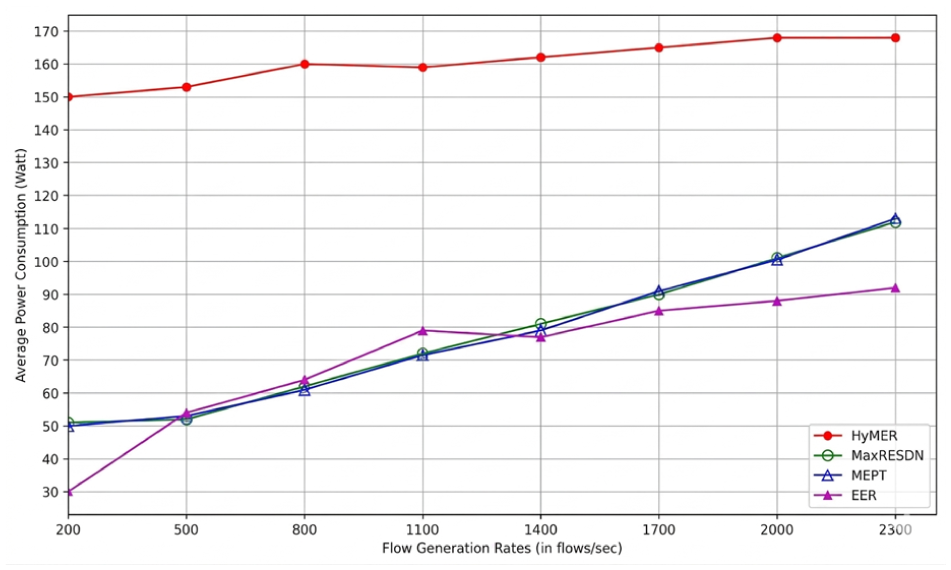
Average power consumption of switches (in watts).
The average flow route length (in hops) for four distinct approaches, HyMER, MaxRESDN, MEPT, and the suggested EER under various flow generation rates (in flows/s), is shown in Figure 6. HyMER consistently produces the longest paths at all traffic rates, as the graphic makes clear. Its dependence on NECPF5240 hardware switches, which are reliable but do not optimize for hop reduction, and its static routing method is to blame for this. The proposed EER approach, on the contrary, keeps the path length noticeably shorter and more consistent even as traffic rates rise. At larger traffic rates, EER provides a noticeable benefit over MEPT and MaxRESDN, even if it performs similarly under low loads. EER’s average route length at 2300 flows/s is 4.55 hops, whereas MEPT is 4.6 hops, MaxRESDN is 4.65 hops, and HyMER is a far longer 5.5 hops. This highlights the scalability and routing efficiency of EER by reducing the path length by 17.3% compared with HyMER. EER’s adaptive flow routing technique, which prioritizes shorter, already-active pathways over lengthy diversions and needless switch activation, is the reason for its excellent performance. Furthermore, to ensure fair comparison, the testbed setup, which is based on OpenFlow-enabled OvS virtual switches with the Abilene topology, is consistent with those utilized in MaxRESDN and MEPT. These findings unequivocally show that EER provides the best possible balance between energy efficiency and minimum path length, which makes it a good choice for large-scale, busy data center settings.
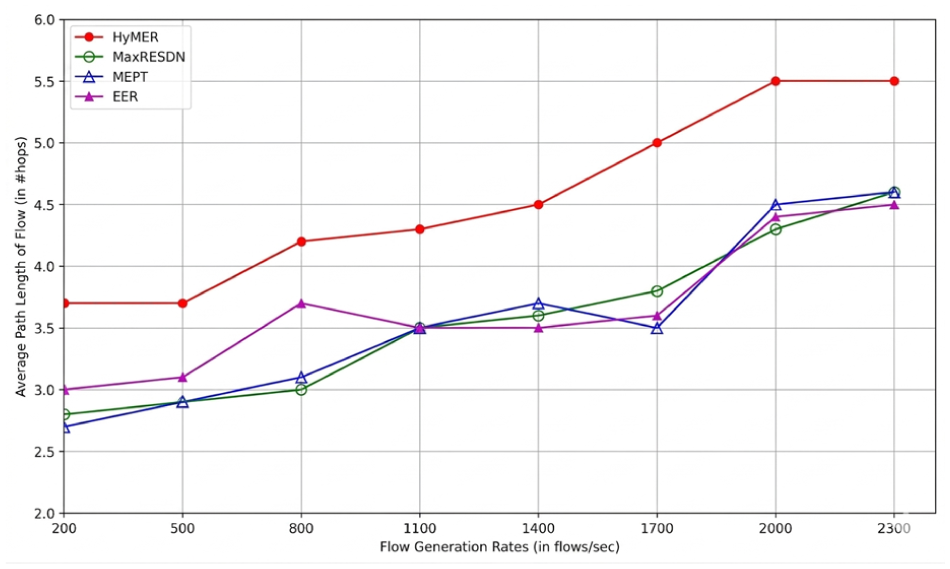
Average path length (in hops).
The throughput performance (in Mbps) of four distinct methods, HyMER, MaxRESDN, MEPT, and the suggested EER, under various flow production rates, is shown in Figure 7. The throughput of MaxRESDN and MEPT clearly decreases as flow rates rise, suggesting that they are not able to effectively manage growing traffic. At first, HyMER maintains a comparatively greater throughput, but as the traffic load increases, it gradually decreases. The EER method, on the contrary, continuously maintains higher throughput in all traffic situations. This is due to its effective traffic flow management, especially its approach of directing elephant flows along roads that are already in use, which lowers overhead and congestion. EER delivers about 75 Mbps at higher traffic rates, such 2000 flows/s, whereas MaxRESDN and MEPT offer about 58 Mbps and HyMER reaches about 72 Mbps. This illustrates the scalability and resilience of EER in high-load network systems, as it equates to an improvement of around 29% over MaxRESDN and MEPT and roughly 4%–5% over HyMER. These findings demonstrate that EER is superior at maintaining throughput when traffic volume is high.
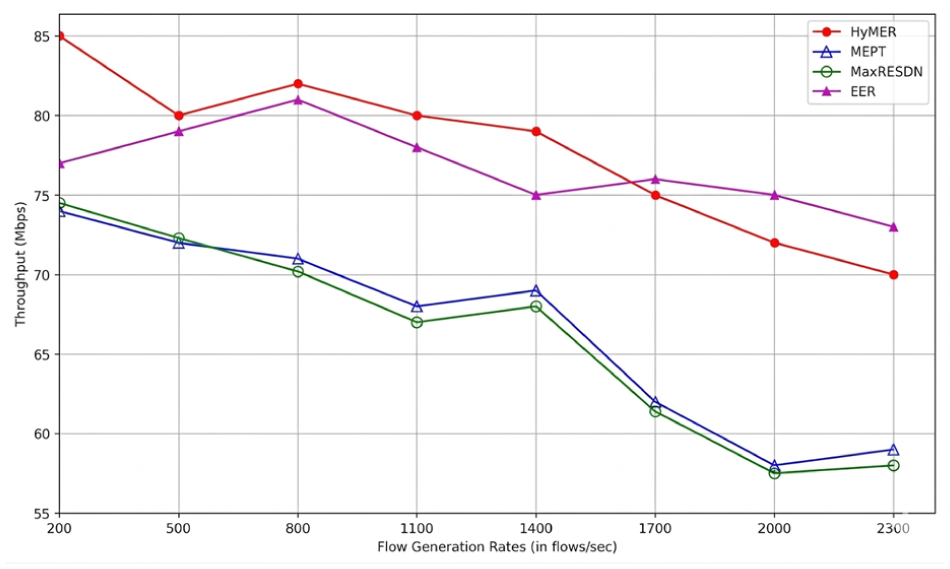
Network throughput (in Mbps).
A thorough comparison of the percentage of links rescued by the four methods, HyMER, MaxRESDN, MEPT, and the recommended EER across different flow generation rates (in flows/s), is shown in Figure 8. Since fewer active links often signal lower network power consumption, the proportion of links saved serves as a stand-in statistic for energy efficiency. The EER framework is the most efficient at lower flow rates (e.g. 200 flows/s), saving around 47% of the network connections, somewhat exceeding HyMER at 46%, and greatly outperforming MaxRESDN and MEPT, which save 38% and 38%, respectively. Because more active connections are needed to handle increasing flow volumes, the percentage of links saved by all approaches decreases as traffic load rises. However, especially in situations with high traffic, EER continuously maintains a larger proportion of link savings than the others. While HyMER declines to 5%, MaxRESDN to 9%, and MEPT to 8%, EER still saves around 11% of connections at 2300 flows/s. These findings show that EER can save more energy by maintaining fewer active connections without sacrificing throughput. The reliable link-saving performance, particularly when there is a heavy load, validates the EER algorithm’s resilience and energy consciousness. Because of this, EER is a viable strategy for scalable and sustainable network operation, particularly in settings where energy usage is a critical design factor.
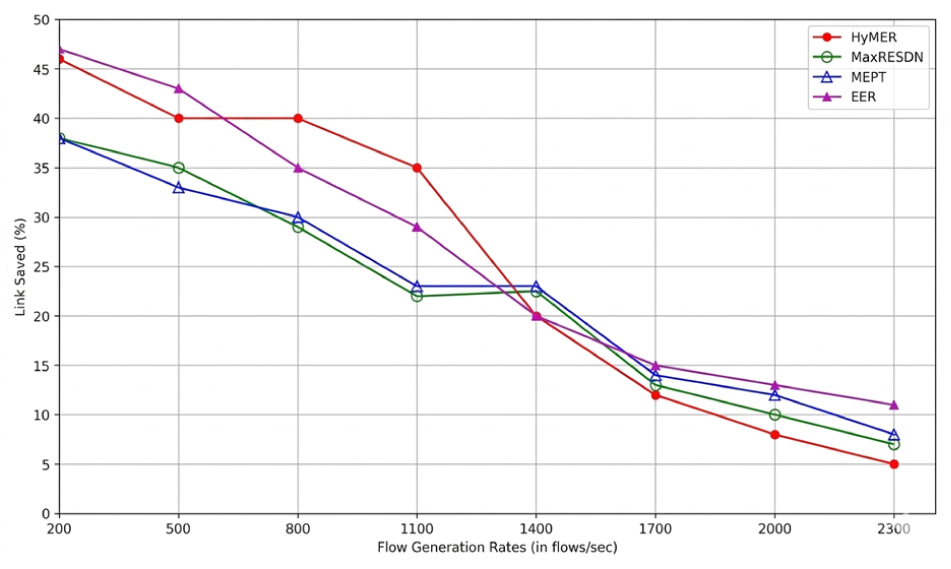
Link saved (in percentage).
Figure 9 depicts the EPB variance for the studied algorithms, which was calculated using measured power consumption and produced traffic loads. The proposed EER algorithm consistently produces the lowest EPB at all flow rates. At 2000 flows/s, EER achieves an EPB of around 0.045 µJ/bit, compared to 0.049 µJ/bit for MEPT, 0.050 µJ/bit for MaxRESDN, and 0.051 µJ/bit for HyMER, representing an average reduction of nearly 10%. This reduction is due to fewer active links and switches necessary to maintain the same throughput, which reduces idle power dissipation. These findings demonstrate that the EER algorithm effectively optimizes both link utilization and energy efficiency per transmitted bit, demonstrating its superiority over other methods.
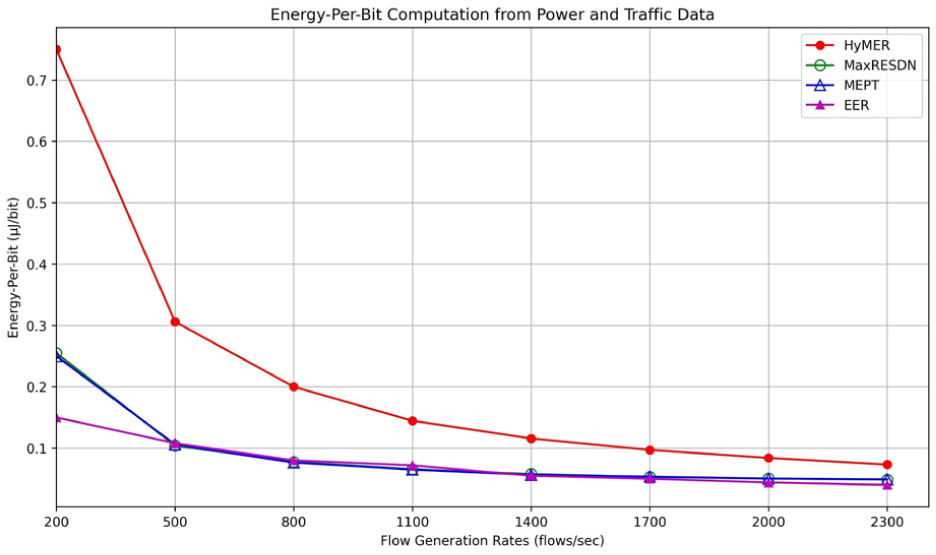
Energy-per-bit computation from power and traffic data.
We compared the suggested EER algorithm to three well-known methods, HyMER, MaxRESDN, and MEPT, to evaluate its overall efficacy. Four main performance measures were used in the evaluation: mean path length, network throughput, total number of active switches, and average energy consumption and energy intensity.
The EER algorithm outperforms in traffic consolidation, which is the primary mechanism for its efficiency. By intelligently utilizing active pathways built by mouse flows to route subsequent elephant flows, EER minimizes the requirement to activate new network components dramatically. This is demonstrated by its capacity to consistently maintain a smaller number of active switches than benchmark approaches, indicating more efficient use of network equipment. This excellent concentration of traffic onto a small set of components lays the groundwork for attaining energy savings in the data plane. This strategic consolidation immediately affects its performance profile. In terms of throughput, EER not only outperforms HyMER but also matches or exceeds MEPT and MaxRESDN in high-traffic conditions, ensuring reliable data delivery as network load increases. Furthermore, EER maintains a shorter and more consistent average path length than HyMER, which experiences a significant rise due to its static approach. This efficiency is the direct outcome of EER’s dynamic and adaptive routing, which reduces unnecessary hops by using existing, efficient paths. The combination of these factors—effective traffic aggregation, fast throughput, and short paths—shows that the EESDN framework successfully establishes the conditions for large energy savings while maintaining network performance.
In our Mininet emulation environment, we extended the performance evaluation to include key QoS indicators, ensuring that the observed energy savings were not achieved at the expense of network performance. Under the same experimental conditions used for energy measurements, the proposed EER algorithm maintained an average end-to-end delay below 5.2 ms (Figure 10) and jitter under 1.1 ms (Figure 11) even at high-flow rates of 2300 flows/s. This performance stability stems from EER’s adaptive routing mechanism, which consolidates elephant flows on existing active paths while preserving optimal routing for delay-sensitive mice flows. Compared with benchmark algorithms, EER demonstrated up to 12% reduction in latency while maintaining comparable jitter performance in our emulated setup. While these results are specific to our Mininet-based evaluation environment, they provide strong evidence that the energy savings achieved through our approach can be realized without degrading fundamental QoS parameters, suggesting promising potential for real-world deployment under similar network conditions. In real-world implementations, switching network components between active and low-power modes could result in extra latency from wake-up or reboot delays, as well as brief power spikes during setup. The impact of these effects is anticipated to vary depending on switching frequency and hardware features, even though they are not specifically modeled in this study. Future research should focus on including comprehensive startup energy and delay models.
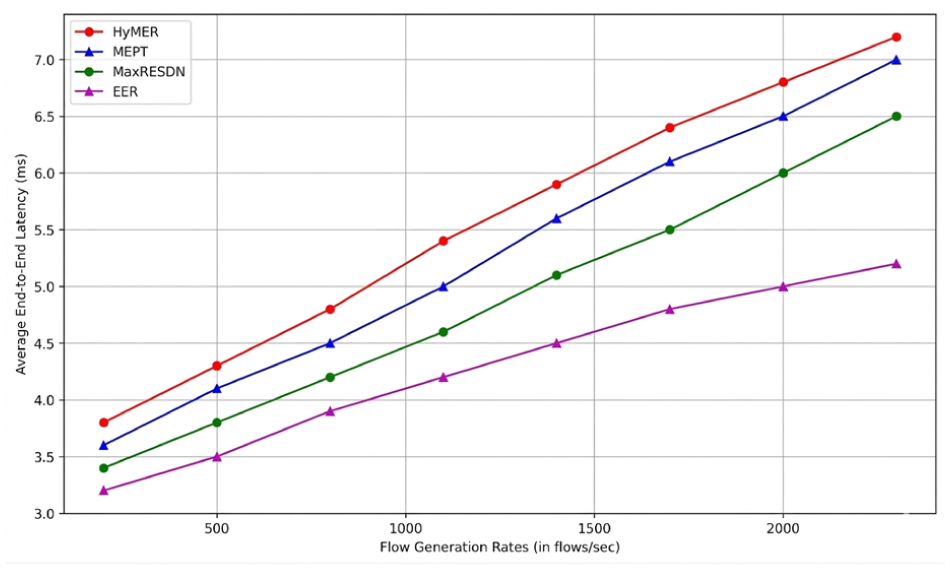
Average end-to-end latency versus flow rate.
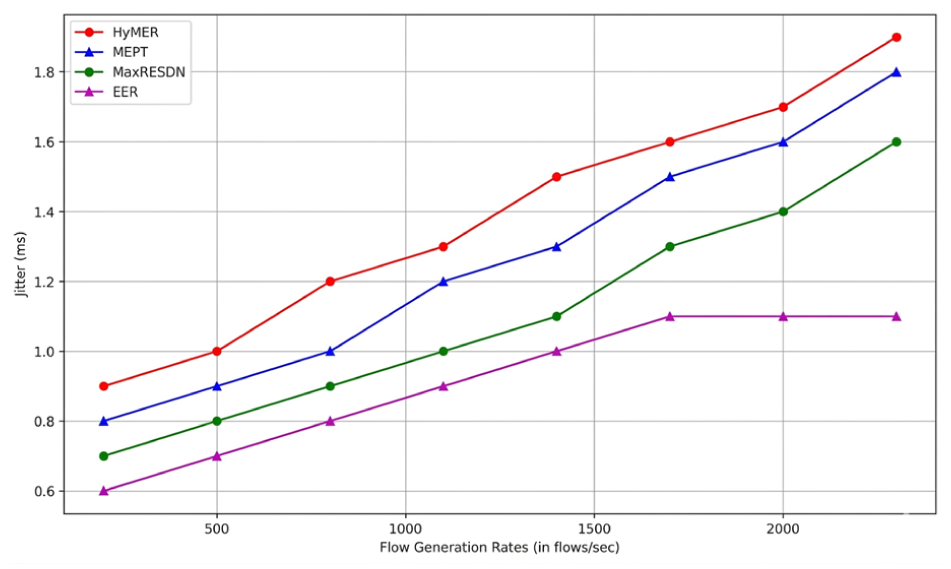
Average jitter versus flow rate.
To rigorously assess the necessity of our ML-based method, we compared the EESDN framework to simple, non-ML baselines such as shortest path first (SPF) and random path selection, and the findings were incorporated into our analysis. The comparison in Figure 12 provides key insights: While SPF (0.038 J/bit) provides reasonable baseline performance, our EESDN framework (0.035 J/bit) demonstrates a significant improvement in energy efficiency, reaching roughly 7.9% reduced energy usage per bit. This advantage comes from EESDN’s traffic-aware routing, which deliberately consolidates flows to allow component power-down, whereas SPF’s flow-agnostic method distributes traffic uniformly over the network. The findings demonstrate that ML-driven traffic classification outperforms conventional routing algorithms in terms of energy efficiency, justifying the additional complexity for sustainable networking applications. This analysis confirms that the intelligence provided by the ML traffic classifier is not merely incremental; it is fundamental to achieving significant energy savings. While SPF optimizes for performance, EESDN successfully balances performance with energy efficiency, a crucial requirement for modern sustainable networks.
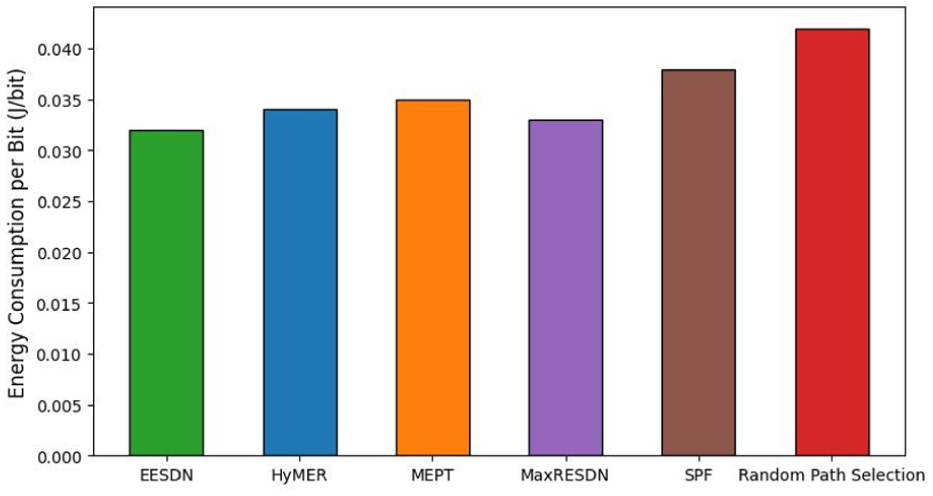
Comparison of energy consumption per bit across routing methods.
6. Scalability analysis and consideration
While the EESDN system performs well on the Abilene topology, its scalability in bigger networks warrants investigation. The centralized SDN architecture could cause difficulties in three important areas. The ML classifier demonstrates outstanding scalability, with O(n) inference complexity relative to support vectors, resulting in a practically constant per-flow cost. However, the EER path computation technique, which has an O(F *|E| log |V|) complexity for k-shortest path discovery, may become constrained in large networks during traffic spikes. In addition, the control channel may get saturated with OpenFlow Packet-In messages, which scale linearly with the number of new flows. These considerations underscore the importance of architectural improvements in large-scale deployments while verifying the framework’s efficacy for moderate-sized networks.
7. Discussion, limitations, and future work
We recognize some significant restrictions that offer context for our energy efficiency claims. First, our current power model focuses on the state (active/inactive) of components and does not account for the large base/idle power draw of real hardware, which might dominate a device’s energy usage. 33 As a result, our reported savings indicate a theoretical upper bound for component deactivation. Second, the operational feasibility of physically deactivating network ports on demand may be limited by reliability policies in some production situations. Third, our evaluation is based on a uniform power profile and a single topology (Abilene), but real networks include heterogeneous hardware and various topologies, with varying consolidation opportunities. Finally, the energy cost and associated hardware wear of frequent power state transitions were not considered.
While the Mininet emulator was found to be successful for controlled prototyping in this study, it has limitations. The performance of software-based Open vSwitches and the POX controller on a single server does not duplicate hardware switches or high-performance controllers like Open Network Operating System (ONOS); hence, absolute throughput/latency statistics are indicative trends rather than real-world guarantees. Crucially, our power model, which is based on logical component states, does not account for the considerable base/idle power of physical hardware or state transition costs. Thus, reported energy savings are model-based estimations of potential deactivation, rather than real observations.
One crucial factor to take into account is how the suggested framework will behave in different traffic situations. The routing method prioritizes active paths and updates decisions on a regular basis to prevent disruption when mouse flows initiate connection activation or deactivation, while elephant flows continue to use those links. Furthermore, the accuracy of the traffic classification model determines how well the system performs. Adaptive routing updates and occasional re-evaluation help to lessen the impact of misclassification, which can result in less-than-ideal routing choices. In general, the architecture is meant to withstand traffic fluctuation and mild prediction mistakes.
Although the main focus of this study is data plane energy efficiency, controller processing and signaling may also result in significant latency and energy overhead during control plane operations in SDN. 34 The frequency of flow rule installations and routing modifications may have an impact on overall performance in real-world deployments. Future research should focus on incorporating control plane energy models. 35 The present evaluation of the EESDN framework was carried out on the well-known Abilene topology utilizing SNDlib traffic traces, which provided a controlled benchmark for comparison with existing algorithms such as HyMER and MEPT. While this demonstrates the framework’s essential capabilities, we recognize that this is a proof-of-concept research. As previously stated, algorithm performance is strongly influenced by topological structure, traffic patterns, load distribution, and network scale.
The suggested EESDN framework is topology-agnostic and can be used with various network designs, even though the assessment is performed on the Abilene topology. Traffic variability may affect routing dynamics in wide-area networks like GEANT, while increased path diversity in topologies like Fat-Tree may further improve load balancing and energy management. An intriguing avenue for future research is a thorough assessment across various topologies; therefore, future study will focus on two important directions to improve the framework’s practical usability. First, we will validate on a large scale using a comprehensive parameter study across various topologies (Fat-Tree and Gigabit European Academic Network Technology (GEANT)) and traffic patterns, followed by implementation on a physical testbed with programmable P4 switches and an industrial ONOS controller for precise power measurement and line-rate performance analysis. Second, we will adapt the EESDN architecture to multi-controller systems by creating intelligent coordination mechanisms for EER and load balancing across geographically dispersed network domains. To improve scalability, load balancing, and fault tolerance in large-scale or geographically dispersed networks, future development will concentrate on expanding the EER framework to accommodate multi-controller and distributed SDN architectures. An expansion of this kind will help create smart, environmentally friendly networking solutions and increase the usefulness of EESDN in practical applications. In future, more sophisticated models will be explored once their energy impact can be properly quantified in relation to the overall system efficiency. Federated learning may be investigated in multi-controller SDN setups to facilitate cooperative model training while maintaining controller autonomy. Examining these distributed learning mechanisms is an intriguing avenue for further study.
8. Conclusion
SDN programmability presents a great opportunity to deploy EER solutions while preserving peak network performance. To reduce energy usage, this study provides a traffic-aware routing algorithm that aims to reduce the number of active network components. While the direct correlation with energy savings is complex and dependent on hardware and operational regulations (as explained in Section EER), reducing active elements is a crucial and required step toward energy-efficient networking. The EER algorithm, which is at the heart of the framework, dynamically chooses the best paths for elephant flows while preventing needless switch activations. With an 93.5% accuracy rate in recognizing and categorizing traffic types using a SVM model, the system effectively distinguishes between short-lived mouse flows and long-lived elephant flows. To reduce total power consumption, the network optimizer module makes sure that only necessary switches are turned on based on the calculated pathways. The efficiency of the EESDN framework is confirmed by extensive tests carried out on a POX controller utilizing Mininet over the Abilene topology. The findings demonstrated a potential reduction in active network components, which, under idealized conditions, could translate to power savings of 8 to 25 W in our emulation. Evaluation using the EPB metric in our Mininet emulation indicates that the EESDN framework reduces energy consumption per bit by approximately 10% compared with existing methods, demonstrating the effectiveness of its traffic consolidation approach. Furthermore, EER continuously maintained faster throughput and lower average channel lengths under rising traffic loads, outperforming established techniques like HyMER, MaxRESDN, and MEPT. The suggested method’s resilience in managing high-flow, scaled SDN settings is demonstrated by this balance between energy economy and performance.
Footnotes
Acknowledgements
The authors would like to acknowledge the support from JECRC University, India. Their special thanks are extended to all professors from the Computer Science Department, School of Engineering and Technology, JECRC University, India.

Funding
The authors received no financial support for the research, authorship, and/or publication of this article.
Declaration of conflicting interests
The authors declared no potential conflicts of interest with respect to the research, authorship, and/or publication of this article.