






Abstract
This article demonstrates the lasting value of C.W. Mills’ sociological imagination in understanding how intimate bodily realities and biography intersect with, and are shaped by, larger social realities, and the agency we have as individuals to affect these realities – in my case, through art. In this autoethnographic piece, I discuss my personal journey, as a feminist artist, of reimagining menopause through the dismantling of my artistic practice and creation of the Menopause Punk Song. I situate my journey within intergenerational dynamics, as well as the broader social realities and structures, including gendered ageism, body appearance pressures, the cultural moment of menopause’s visibility, art as a practice and the Covid-19 pandemic, which coincided with my menopause. I consider the frustrations and critiques that animated the Menopause Punk Song art project and the pleasures and problems its creation and performance entailed.
My menopause origin story
This is an autoethnographic account that centres the significance and potential of art in reimagining menopause. Rather than an academic study based on an empirical investigation, I use my personal experience to draw out some aspects of the broader sociological significance of art – and in particular performance – in reimagining the body, femininity and ageing, and in engaging with social taboos and addressing stigmas, shame and intergenerational silences.
At the age of 48, my mum underwent a full hysterectomy due to difficult menopause symptoms. This was a common practice in the 1980s (Mukhopadhaya & Manyonda, 2013) and although deemed ‘routine’, her hysterectomy took a sinister and dangerous turn. I was 19 at the time. I recall an emergency phone call from my dad to say mum was gravely ill and I needed to come to the hospital. The hysterectomy had been performed and while in recovery my mum had begun to deteriorate. Initially the medical team were unsure what had happened as the surgery had gone seemingly to plan. However, upon investigating, they discovered a tiny stitch had been mistakenly placed in a main artery, and this was life threatening. They immediately rushed my poor mother back into theatre, remedied the mistake and slowly she recovered.
My mother was born in the United Kingdom in 1944. While the British Women’s Liberation Movement played a key role in mobilising social and political change during the 1960s and 1970s, second wave feminism seemed to have largely passed her by, probably because she was too busy looking after three children under the age of five. Despite the important ways in which second wave feminism highlighted women’s 1 bodies as sites of structural inequality, my mum did not talk about her bodily experiences, such as menstruation, birth and menopause. It was only when my youngest child – her granddaughter – was 16, that my mother shared with me for the first time the horrific experience she had gone through when she gave birth to my eldest brother, who was breech. Recalling the story, she described the shame and loneliness that shrouded this traumatic experience both during and post-delivery. This was 1967, and my father, like most husbands at the time, was not present in the delivery room (Jomeen, 2017). It is the silence and isolation that surrounded her experience that kept the shame for so long. Shame and silence have similarly shrouded her experience of hysterectomy and menopause – for decades they remained unspoken and untold. It was these stories and the profound silence within which they were veiled that led me to think about my own menopause and to reflect on how I wanted my experience to be different. It is exactly at the same age as my mother, when I was turning 48, that my menopause story began.
Menopause, pandemic and the change
In 2020, the Covid pandemic hit. As has been widely documented (Mooi-Reci & Risman, 2021; Wenham et al., 2020), the pandemic had a disproportionate impact on gender inequality and women’s health and wellbeing. With school closures and childcare services disruption, it was women who often bore the brunt of caregiving responsibilities at home, as well as caring for elderly and vulnerable relatives. Consistent with historical discourses during times of crisis, so too during Covid, women were cast by governments as ‘the model responsible citizen’ who should take care not only of themselves but also of others (Orgad & Hegde, 2022). As a consequence of the added pressures of work, caregiving, confinement to the home and health concerns, women’s mental health was severely affected, with rising levels of stress, anxiety and depression (Kupcova et al., 2023).
It was within this context of a global pandemic with profoundly gendered implications, and in a climate of exacerbated anxiety, in which women were called on to embody ‘crisis-ready responsible selves’ (Orgad & Hegde, 2022), that I started searching for information about menopause. As discussed by Orgad (2026), the pandemic was a time when public attention on menopause had significantly increased in the UK, and when some of the women leading the conversation about menopause started their work and activism around the topic.
Feeling fearful of a hysterectomy after witnessing my mum’s experience, I decided the only way to avert this scenario was to take control of my situation and arm myself with information. I realised that I knew very little about the menopause – again, an experience that other people share (see Safwan et al., 2024; and also Orgad, 2026; Simmons, 2026) – and needed to start educating myself on the subject. I started by asking my mum some questions about her menopause symptoms and her hysterectomy, believing that daughters often experience a similar menopause age and symptoms as their mothers. However, my enquiries were met with curt and abrupt answers such as ‘it was horrific’ and ‘I nearly died’. This is an understandable reaction coming from a woman who is part of a generation where bodily experiences, such as menopause, were a social taboo. Her reluctance to talk about her experience must have been compounded by her trauma, which clearly, after all these years, was still very alive.
It is then that I decided to look for information online, though searches in 2019/2020 yielded very little. This may seem surprising given the heightened visibility of menopause today, especially in the UK (Jermyn, 2023; Orgad & Rottenberg, 2024a). However, as research shows, the main peak in menopause’s visibility in the UK started after 2021, whereas a year or so earlier, when I googled ‘menopause’, barely anything relevant came up. I tried again, determined to not have my womb dismantled. I discovered the word peri-menopause; being 48 at that time I figured I must be in that stage. Digging even further, I tried my luck with Spotify and found just one podcast created by Sam Baker, a journalist, who interviewed women in peri-menopause, menopause or post-menopause (The Shift with Sam Baker). I listened avidly to women’s stories on the podcast and noticed a common thread: they all spoke acutely about the dismissal, sidelining and invisibility they felt as ageing women (Douglas, 2020; Smith, 2023). After years of experiencing societal pressure and abiding by cultural norms dictating how they should look, act and feel, the women interviewed for the podcast said they finally felt free and liberated, as they were discovering a new sense of self-confidence; they finally did not give a ‘fuck’. This sentiment resonates with Germaine Greer’s famous book from the 1990s The Change, which was re-released in 2019. It also reverberates more recent menopause dominant discourses and their convergence with popular notions of women’s empowerment and self-confidence (Orgad & Rottenberg, 2024b).
My menopause ‘reimagining’ journey is situated in this personal intergenerational context. But it also took place, if unknowingly, in the wider context of a cultural moment championing women’s empowerment, self-confidence and the imperative to unsilence our voices and stories (Banet-Weiser, 2018; Orgad & Gill, 2022). These personal and cultural contexts converged during the pandemic, when I made the decision to dismantle my successful commercial art practice. For many, such a decision would encourage re-evaluation and trigger significant life changes (Ducharme, 2020). I decided I wanted to focus on making work that deals explicitly with my lived experience of womanhood as well as experimenting with different art mediums. Up to that point I had mainly worked as an oil painter and my work was not clearly and openly addressing women’s issues. My former style of work was also much more controlled and ‘beautiful’. The new work was freer, not only in terms of the varied use of materials but also the way I applied the paint as well as the variety of medium. It is important to also mention that at the same time my son had shared with me that he thought he might be autistic, which led to us both being diagnosed five years later. When I later explored my work with my autistic artist mentor, I realised that my former work was a product of my process of masking autism, whereas my later work was a consequence and an expression of unmasking.
It was during the dismantling of my art practice that I turned to feminist literature. I was particularly inspired by Clarissa Pinkola Estés’ book Women Who Run with The Wolves: Myths and Stories of the Wild Woman Archetype. Pinkola Estés (2008, p. 18) writes:
I saw that she stood on the shoulders of a woman far older than she, who stood on the shoulders of a woman even older, who stood on the shoulders of a woman in robes, who stood on the shoulders of another soul, who stood on the shoulders. . .
Reading Pinkola’s book at the same time as doing my menopause research and making ‘new’ artwork, an image began to formulate in my mind. I started to sketch women standing on the shoulders of other women and imagined them as providing flight and freedom. I thought back to the stories I had heard on the The Shift with Sam Baker podcast of menopausal women’s newfound self-confidence. I envisioned the familiar symptom of hot flushes as fire and self-confidence as a superpower, resonating the theme of the novel Broken Light (Harris, 2023) that was published several years later, and depicts menopause as unleashing a magical force through which menopause-aged women can exert supernatural powers (Orgad et al., 2024).
Reimagining menopause: Costumes and performance
It was then that the idea of creating a costume emerged. I wanted to turn on their head stereotypical and stigmatised media representations that depict older women as ‘elderly’, ‘unimportant’, ‘frumpy’, ‘invisible’, ‘unfashionable’ and ‘dowdy’ (Smith, 2023) – representations that ageing women often themselves internalise (Greer, 1991/2019; Steffan, 2021). In so doing, creating a costume constitutes an attempt to challenge this invisibility and invisibilisation; to refuse and reverse internalising these stereotypes that consistently belittle and caricature ageing women. I wanted to do it in a subversive and funny fashion and so decided to make a superhero-like costume out of a skin-tight full leotard – an antithetical cloth to the ‘proper’ cloth society expects ‘older’ women to wear. I designed the costume for myself. It felt rebellious: a woman approaching her 50s, wearing an item of clothing typically designed and created for girls and younger women who are ballerinas or gymnasts. Finding a leotard to fit my short, curvaceous stature was a challenge. When the one I ordered arrived, I immediately tried it on in front of the mirror. I felt I was breaking all the rules of what a woman of my shape, size and age should wear. My feelings echoed what the women on The Shift with Sam Baker podcast described and Greer’s (1991/2019) account of menopause as liberatory expressed: they were feelings of freedom and not giving a fuck.
Humour is an important aspect of my art; I purposely exaggerate and portray the (my) ageing female body as ‘grotesque’, exaggerating breasts, painting wrinkles, grey hair and large female genitalia (see Image 1).
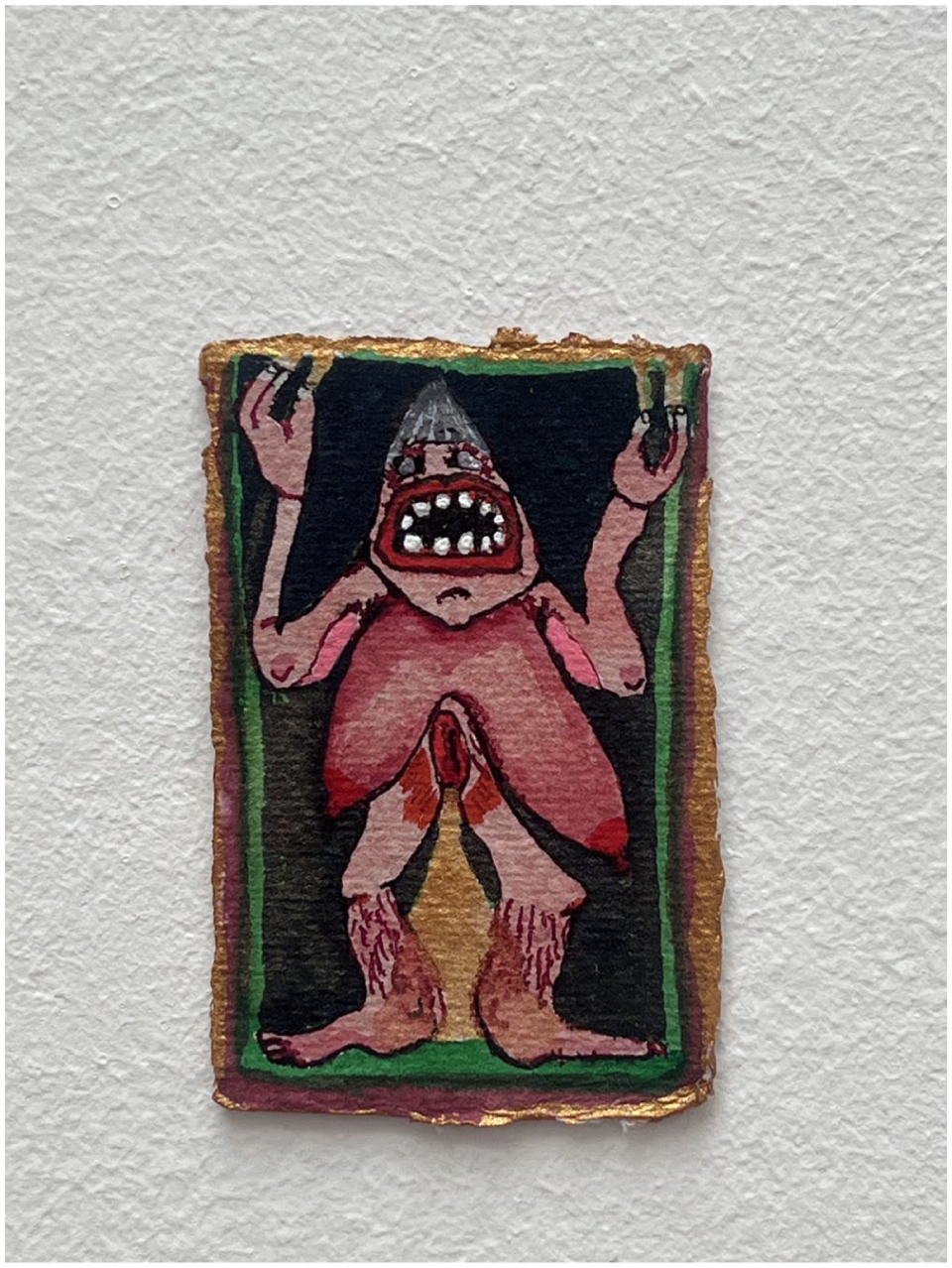
Freak Out, 2025.
In my current ‘menopausal’ artwork, I create unruly bodies and place my body at the centre of the work, to address the invisibility of older women in art (and in society, more broadly). I have spent almost a lifetime battling with body dysmorphia and spent the latter part of my life trying to ‘love’ and ‘accept’ my body: a body that does not conform to patriarchal ideals of femininity. Therefore, this art is, for me, a rebellious act. When I created the menopause costume (Image 2), I set about painting women in fire colours to represent hot flush symptoms and appliqued them onto the leotard. I made wings from the same painted figures, showing them holding each other up, as in Pinkola Estés’ (2008) vision. I also made a hat that I had reconditioned from a gold lamé Mexican wrestling hat (Image 3). Using an item of clothing from Mexican wrestling, a predominantly male sport from a masculine domain and recontextualising it within a feminine domain constituted an important way of reimagining. I embroidered flames which I attached to both sides of the hat, subversively representing the common symptom of hot flushes experienced by women in menopause, and the idea of menopausal women being ‘on fire’. Rather than eliminating this ‘fire’ – as commercial and self-help messages often exhort women (McCartan, 2025; Orgad & Gilchrist, 2025; Throsby, 2026) – I claim, own and perform it.
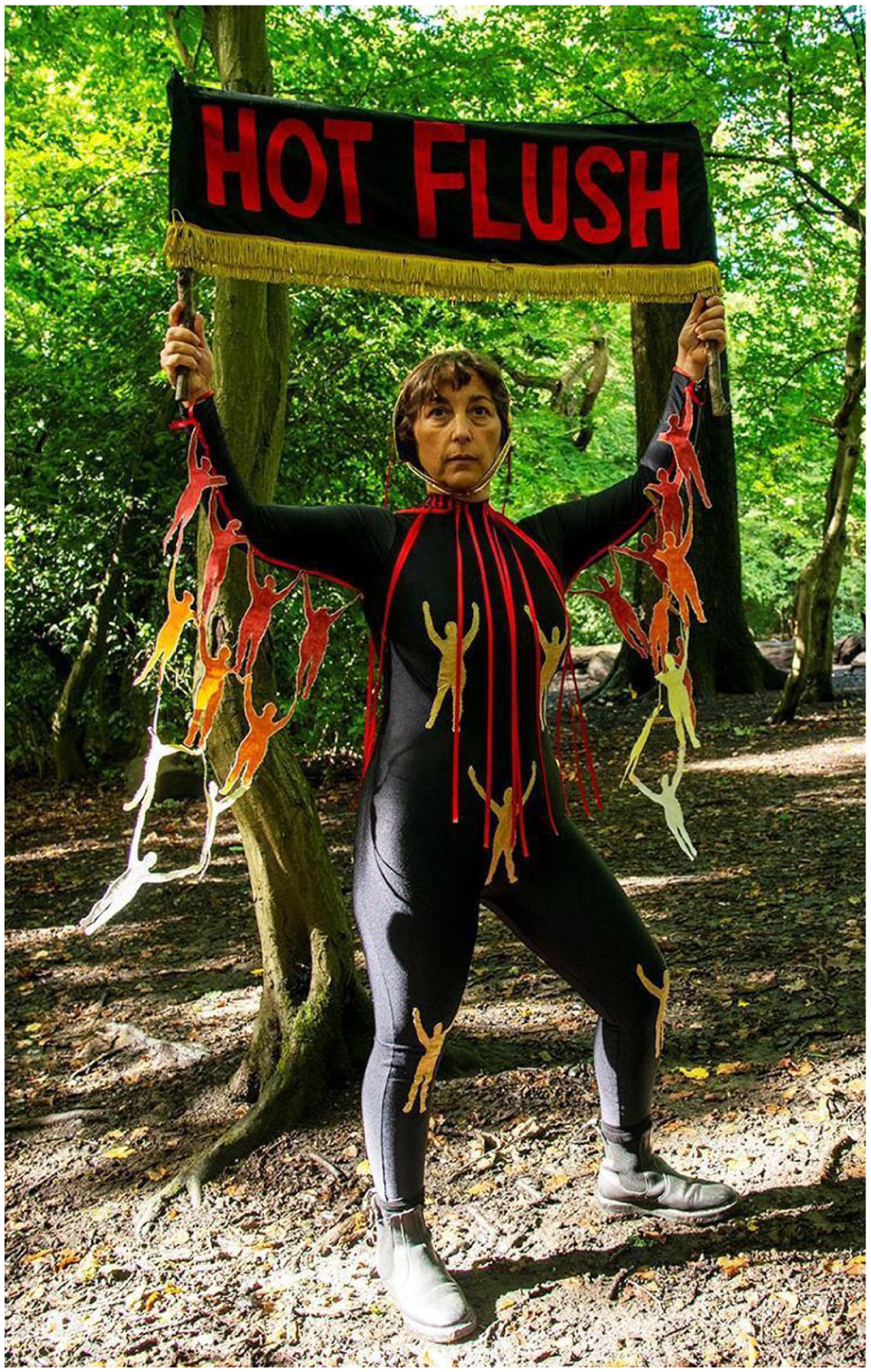
Hot Flush, 2021.
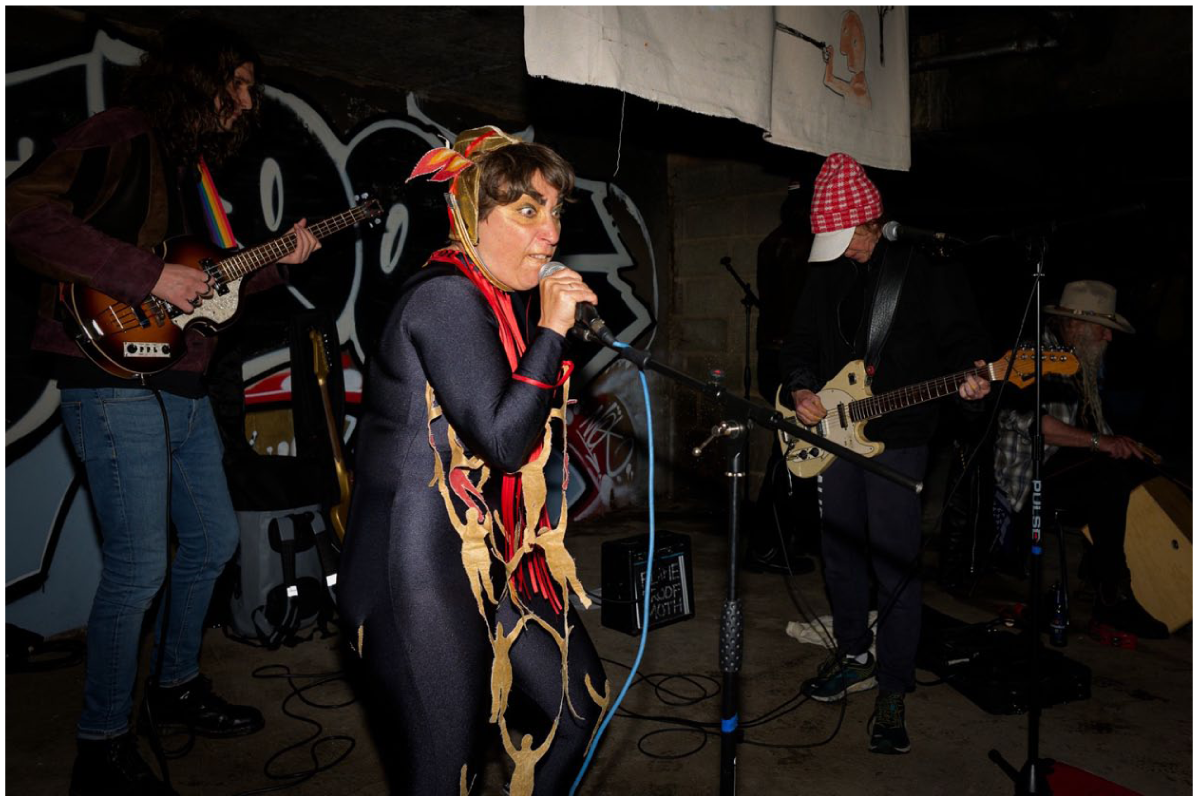
Menopause Punk Song live performance, 2022.
I then asked a family member to video me wearing the costume I designed. It was then, when I started turning around for the camera, that I became aware of how performative this felt. I had never created an art performance before, and it felt new and exciting. I noticed that when I wore the costume, I felt empowered and confident. Painting is done in the privacy of a studio and although it can feel somewhat performative, I do often feel powerful when I paint. Crucially, I am always alone and the practice of painting is never witnessed by others. In contrast, when I made and wore this costume and was then filmed, I was suddenly aware that I was now performing not only for the camera but also for my family, which decisively affected the way I carried myself in the costume. Performing in the costume gave the shame and rage I internalised – as Greer (1991/2019) observes about ageing women – an outlet; it provided a way through which to externalise and move that which has been internalised inside the body onto an audience. This then became even more exciting when at a later date I performed to a live audience and I brought to life a ‘rageful and empowered menopausal woman’.
Many of the women whose stories I had heard on The Shift with Sam Baker podcast spoke about being punks, and its associated value of defying normative femininity, especially in relation to the body and how one dresses. This inspired me to centre the performance around a punk song. Punk is a very shouty, loud, rebellious and aggressive genre (Worley, 2011). As such, it aligned perfectly with what I felt and the notion of older women becoming louder, more outspoken and confident as they age. As Way (2021, p. 115) observes in her study of older women’s perceptions of punk, ‘identifying with punk in itself is subversive for women as it could be seen as an alternative to what is referred to as normative femininity’. Indeed, like the women in Way’s study, I too was attracted to punk as a mode of transgressing conventional boundaries of femininity. Punk provided something beyond a way of dressing: it offered a ‘state of mind’, as Way (2021, p. 107) describes it, or, more accurately, a ‘state of being’ for an ageing woman who does not care any more about what others think of her (Way, 2021). Echoing Way’s (2021, p. 114) observation about the women she interviewed, ‘holding punk values could be a way of engaging in subversion within the context of social and physical ageing’.
I started fantasising about forming an all-female punk band and singing a menopause punk song wearing my menopause costume. Energised by this fantasy, I woke up one morning and the lyrics for the song literally came streaming out of me! I wrote ‘The Menopause Punk Song’ in 12 minutes. It begins. . .
My breasts are saggy
My vagina’s dry
All I want to do is cry
I’m very very anxious, a bit paranoid,
I feel all sweaty, I don’t know why
By this time, the pandemic was coming to an end. In 2021, I started a full-time painting programme with Turps Banana Art School and the menopause punk song had taken a back seat. On the course, I met a woman who was a bit older than me who told me she wrote and performed songs with her band ‘The Fragile States’. I told her I’d written a menopause punk song and would love to perform it on stage. She looked at me as if I was bonkers, especially as I had never performed before. However, as the course progressed, we became friends, and I casually dropped the idea of me singing the song with her band. This time, she took the idea more seriously and agreed. In January 2022, in front of a crowd of 100 people, I sang ‘The Menopause Punk Song’ in my costume with her band at Amp Studios, a music venue in Peckham, London. It was epic. In Image 3, I can be seen performing the song. The full video of the live performance can be watched here: Menopause Punk Song Live Version with Fragile States. 2
During the performance, I felt incredibly powerful. It felt liberating to be shouting into a microphone such explicit lyrics about the menopause, a subject that still felt taboo and unknown. Someone in the audience had luckily filmed me. I later showed it to my mum, who loved it. Importantly, it helped her talk about menopause in a new way. It was wonderful to see my mum finding the humour, openness and punk feminist attitude that the performance had brought to the subject of menopause. My own reimagining of menopause through punk performance and costume design allowed my mother to reimagine her own menopause, retrospectively. The performance also gave permission for a dialogue to open up between myself and my mum about topics that she had found too difficult to talk about with me previously, such as the traumatic birth story of my eldest brother.
Reimagining menopause again, 2025
In 2025, the BBC broadcast Riot Women, a ‘riotous’ drama created by feminist television writer and director Sally Wainwright. The programme reimagines a newly formed punk band whose all-female members write and perform their own songs inspired by their everyday lives as menopause-aged women. It addresses the broad themes affecting these women, including parental responsibilities, caring for ageing parents, divorce, mental health, retirement and sexuality and ageing as a woman. Using the punk genre, the women in the show and the programme itself are reimagining menopause. As Johnson (2025) observes, the punk music in Riot Women is
. . .a sonic expression of rage, frustration and survival that feels both personal and collective [see also Steffan et al., 2026]. There’s nothing glossy or performative about it: the songs grow out of the women’s experiences of family, work, menopause and friendship, and they hit with a force that’s as emotional as it is political. Punk becomes not just a genre, but a way of giving shape to feelings that have been contained for too long. Its raw, unpolished energy cuts through irony and self-consciousness, allowing those emotions to be expressed openly and with unfiltered truth.
The timing of Riot Women within the broader cultural upsurge and interest in menopause is interesting yet not surprising. That in late 2025, a show like this is broadcast as a mainstream BBC drama is a testament not only to how menopause has become visible but, crucially, also, reimagined as a site for women’s anger and reinvention, and as situated in the broader realities and pressures of midlife: gendered ageism, work-related biases and discrimination, and caring responsibilities.
I am now 52 and I think I am entering the menopause, though I cannot be sure. It has been six months since I have had a period, and symptoms of vaginal dryness, insomnia, irritability and slight heart palpitations have become more prevalent. Yet like many real women my age and the fictional characters of Riot Women, I am also dealing with a recent parental bereavement, care responsibilities for the surviving parent and caring for three adult/teen children living at home. I also have had my recent late autism diagnosis, which many women in midlife experience (Moseley, 2023) and which makes me view my menopause journey through a different lens, as I am aware my sensory challenges are even more heightened.
For many women, menopause is the first time they are forced to confront the fact that they might be neurodivergent. This also throws a new light on my need to make artwork that is more explicit and open about my experiences, and it is while working with Dr Victoria Gray, an autistic artist mentor and performance artist, that I connect the process of making this work as my need to unmask (Gray, n.d.). Since my diagnosis of autism, I have started a process of removing the mask I have worn for decades – all the many challenges I had to control. This process of unmasking converges with the liberating process I described of menopause and ageing: of not ‘giving a fuck’.
In December 2024, I was invited to take part in a creative workshop for the purpose of this monograph (see Orgad & Steffan, 2026). The workshop’s facilitator, Louise Ann Wilson, invited us to make a ‘map’ of our menopause journey (Image 4). My map begins with my mum’s hysterectomy. I finish it by using a needle, which happens to be pinned to my cardigan, threaded with red cotton (blood?); I use it to sew into the map. It feels fortuitous. When the workshop participants – the authors contributing to this monograph – finish the drawings of our maps, we share what we created with the group and a discussion follows. I write down the following reflections.
Grief-menopause-death of parent - autism (grief of not knowing)
River flowing
Blood drying up
Barren, dryness
Bodily
Sisterhood-water-sharing
Information-breaking taboos
Gaslighting of symptoms
Women are gaslit anyway – healthcare under researched
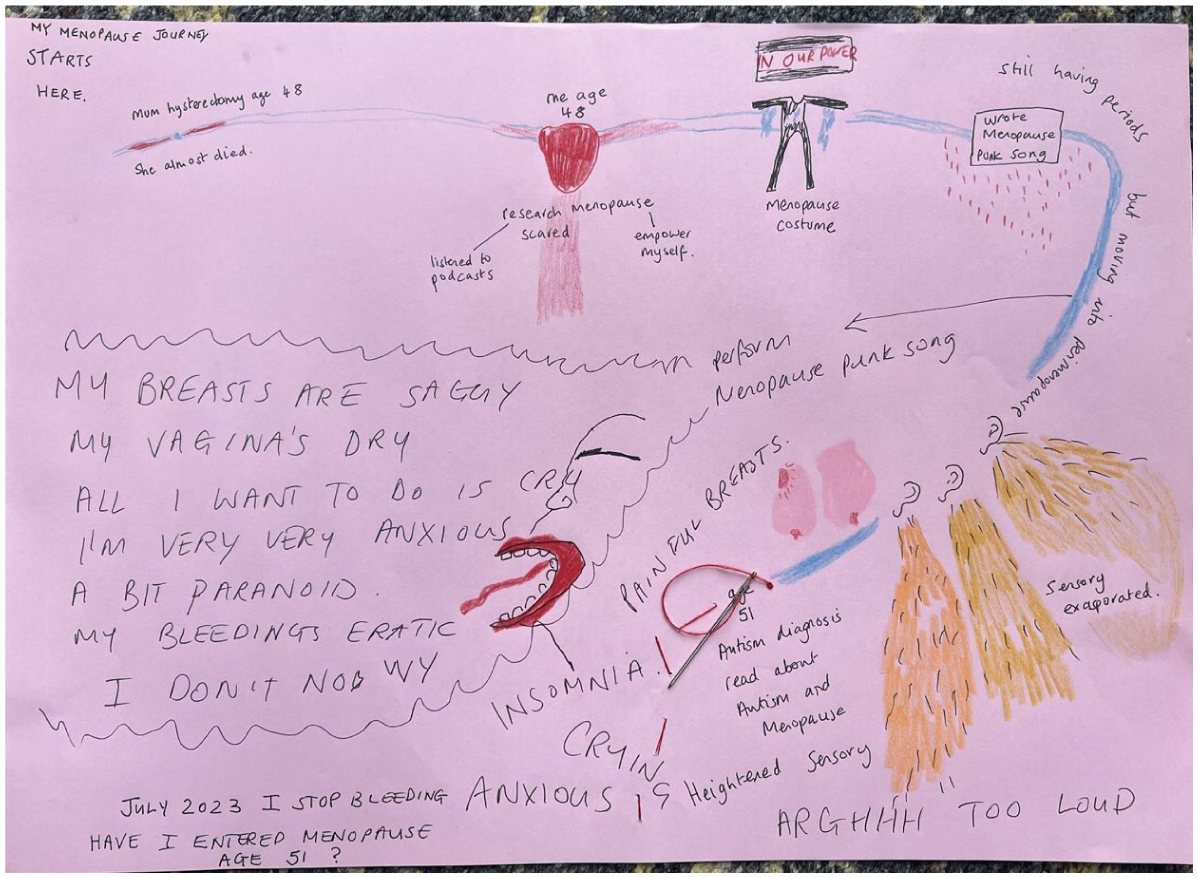
Menopause journey map, 2024.
Later that week, as I take my usual swim in the lido, I decide to make a tapestry of my menopausal map. Perhaps I will gift it to my daughter, but I won’t wait until she’s 48.
Conclusion
This article started by reflecting on my mother’s traumatic hysterectomy at the age of 48 caused by menopause symptoms. Unbeknownst to me, this experience took me on a rich creative journey that reimagines menopause in radically different ways from previous generations. As a woman artist who uses personal experiences to create artworks, the menopause provided me with ample inspiration and opportunity for exploration into the ageing body, femininity, caring responsibilities and a diagnosis of autism. Both this article and my personal journey end on a note of hope that for my daughter and future generations of women, menopause and ageing will provide an opportunity for self-expression and for both self and public awareness of the possibilities, opportunities and challenges, as they move to their next life transition.
Although my menopause journey, to use C.W. Mills’s term (1959, discussed in Orgad & Steffan, 2026), is my ‘personal trouble’ it fundamentally intersects with and is shaped by social structural forces. As Mills (1959, p. 6) writes: ‘No social study that does not come back to the problems of biography, of history and of their intersections with society has completed its intellectual journey.’ As I have shown in this article, my personal menopausal experience intersects with biology – bodily changes, autism, biography – in particular, my relationship with my mother, the intergenerational experience of menopause and the silences around it; and social conditions, events and structures – the Covid-19 pandemic, the cultural moment of menopause’s visibility, and, significantly, art. Understanding how my own intimate reality is profoundly connected with larger social realities furnished the basis for reimagining this very reality and using art to do so.
Footnotes
Funding
The author received no financial support for the research, authorship, and/or publication of this article.
Declaration of conflicting interests
The author declared no potential conflicts of interest with respect to the research, authorship and/or publication of this article.