






Abstract
Teacher leadership research lacks criticality. Moreover, teacher leaders should be knowledgeable about culturally relevant pedagogy and culturally sustaining pedagogy to serve a diverse student population and support their colleagues. The purpose of the current study was to attend to issues of diversity, equity, and racism in teacher leadership through QuantCrit. We report the results of a survey of 1,274 Nevada public school teachers’ perceptions of teacher leadership. We found a disconnect between teacher leader perceptions of equity work and their beliefs in their abilities to carry it out. We connect these findings to the QuantCrit principles.
Introduction
Nearly a decade ago, Wenner and Campbell (2017) called for more attention to issues of diversity in teacher leadership (TL)—specifically, the roles that teacher leaders can play “in shaping issues of equity and diversity in classrooms, schools, and communities” (p. 164). Various efforts have been made to address this call, including a special issue dedicated to TL in difficult times in Urban Education (Hinton & Beck, 2023) and a Social Justice Teacher Leader Self-Assessment (Smith, 2023) that was developed to encourage teacher leaders to reflect on the dispositions and attributes needed to foster social justice. Leading for equity and social justice has long been prioritized in urban schools. According to Milner et al. (2015), “urban classrooms …include wide ranges of diversity among the 6.9 million students,” and equity “should be the guiding ideal of teacher leaders in urban classrooms” (p. 85). Like Milner (2012), we view urban school sites as asset-laden: “There is a rich array of excellence, intellect, and talent among the people in urban environments” (p. 558). We use the term urban in this article to refer to the unique geography (urban intensive), population, enrollment, demographic composition, resources, disparities, and social and economic context of urban sites (Milner, 2012; Welsh & Swain, 2020).
More criticality is needed in TL research to ensure that the voices, experiences, and stories of all stakeholders are equally represented, and to ensure that racist systems are disrupted. For decades, TL has been examined in educational research in urban schools (e.g., Muchmore et al., 2004; Scribner & Bradley-Levine, 2010), and TL has been tied to student learning (Ingersoll et al., 2017). It is also important that teacher leaders are knowledgeable about approaches such as culturally relevant pedagogy (Ladson-Billings, 1995) and culturally sustaining pedagogy (Paris & Alim, 2017) to serve a diverse student population and support their colleagues in service of these students as well. We enter the conversation around acknowledging that racism exists in urban schools, prioritizing culturally relevant and sustaining practices, and examining how teacher leaders, even those who believe they are committed to challenging inequities, might lack race consciousness and be complicit in perpetuating racism (Brooks & Watson, 2019; Morris et al., 2026; Young, 2011).
The purpose of the current study was to attend to issues of diversity, equity, and racism in TL through the use of QuantCrit (e.g., Garcia et al., 2018; Gillborn et al., 2018). This framework allowed us to examine a large dataset focused on TL while maintaining a critical focus around issues of TL. We begin this article by grounding our study in QuantCrit before defining TL and reviewing foundational literature on the construct. We then return to QuantCrit methods to explain our procedures, including descriptive statistics and regression, before reporting our findings. We pay particular attention to our positionality per the tenets of QuantCrit (Castillo & Gillborn, 2023). We conclude with implications for the field, including future QuantCrit studies of TL.
Theoretical Framework: QuantCrit
Critical research around the use of quantitative data is often referred to as QuantCrit (Crawford et al., 2018; Gillborn et al., 2018). Gillborn et al. (2018) envisioned QuantCrit “embody[ing] the need to apply [Critical Race Theory] understandings and insights whenever quantitative data is used in research and/or encountered in policy and practice” (original emphasis; p. 169). Critical Race Theory (CRT) is an analytical framework created by legal scholars. Critical race theorists maintain race is a social construct, and they argue racism is structural, ingrained in society, and often goes unnoticed (Bell, 1992; Delgado & Stefancic, 2017; Wing, 1997). Ladson-Billings and Tate (1995) introduced CRT into the field of education and used it to examine how racism is embedded in education through its curriculum, discourse around student achievement, disciplinary practices, policies, and school funding. Racism also influences hiring in schools and access to TL (Beck et al., 2023; D’Amico et al., 2017; Knaus & Rogers-Ard, 2023).
Critical Race Theory has a number of principles and practices such as critiquing liberal ideas (e.g., neutrality, colorblindness, and meritocracy) and whiteness. Interest convergence, a CRT principle put forth by Bell (1980), is the idea that “[t]he interest of blacks in achieving racial equality will be accommodated only when it converges with the interests of whites” (p. 523). According to CRT, the dominant group is invested in maintaining white supremacy, has power, and seeks to maintain it. Critical race theorists also use storytelling by and about People of Color to challenge dominant narratives about experiences and versions of the truth or reality in the United States. These stories are often called counterstories (Delgado, 1989). QuantCrit is built upon the tenets of CRT, and the goal is to use quantitative methods to “support and further a critical race agenda in educational research” (Gillborn et al., 2018, p. 160). The origins of QuantCrit are also grounded in work by Annamma et al. (2013) on Dis/Ability CRT or DisCrit (Crawford et al., 2018; Gillborn et al., 2018), as well as Gillborn et al. (2018) germinal work.
Widely cited within the QuantCrit literature, Gillborn et al. (2018), using CRT as a guide, outlined five principles of the framework:
The centrality of racism Numbers are not neutral Categories are neither “natural” nor given: for “race” read “racism” Voice and insight: data cannot “speak for itself” Using numbers for social justice (p. 169)
To expand on the first principle, Gillborn et al. (2018) noted that race is more than a variable in QuantCrit. They wrote, “a sensible starting point in any quantitative analysis is to interrogate the collection, analysis, and representation of statistical material for likely bias in favor of the racial status quo” (p. 170). The second principle, numbers are not neutral, highlights how quantitative data are often collected and analyzed in ways that support the status quo of white supremacy. QuantCrit can be used as a tool to “identify the racist logics that may have shaped conclusions” (p. 170). The third principle focuses on the contrived nature of categories and groups that support racist outcomes, “Where ‘race’ is associated with an unequal outcome it is likely to indicate the operation of racism but mainstream interpretations may erroneously impute ‘race’ as a cause in its own right as if the minoritized group is inherently deficient somehow” (p. 171). Thus, QuantCrit maintains an asset focus and interpretation of results and disrupts deficit categories and groups.
The fourth principle, data cannot “speak for itself,” is aligned with the concept of counterstorying by assigning “particular importance to the experiential knowledge of People of Color and other ‘outsider’ groups … and seeks to foreground their insights, knowledge, and understandings to inform research, analyses, and critique” (Gillborn et al., 2018, p. 173). Finally, the fifth principle is a rejection of quantitative research as “value-free and politically neutral” (p. 174). Instead, Gillborn and colleagues suggested a stance of principled ambivalence, “neither rejecting numbers out of hand nor falling into the trap of imagining that numeric data have any kind of enhanced status, value, or neutrality” (p. 174). This critically conscious stance is one that is often adopted by antiracist scholars and activists, as the authors pointed out. In sum, Castillo and Babb (2024) described QuantCrit as “an articulation of how to use the current analytic tools or creating new ones in the service of more informed, racially conscious, and equitable ways” (p. 3). According to Campbell (2023), QuantCrit lends authority to scholarship about racism and social justice. QuantCrit helps us expose power inequities, challenge dominant ideologies such as race neutrality, meritocracy, and individualism, and prioritize social justice.
In their recent systematic review of work using QuantCrit, Castillo and Babb (2024) evaluated 29 relevant articles based on their research questions around positionality statements, community input, racial/ethnic categories, white reference groups, new approaches, and interpretations. The QuantCrit tenets above and Castillo and Babb's (2024) ideas guided the current study—especially the use of positionality statements and interpretations. We were also particularly guided by Gillborn et al. (2018) tenets 1, 2, 3, and 5. In sum, QuantCrit helped us expose power inequities, challenge dominant ideologies such as race neutrality, meritocracy, and individualism, and prioritize social justice within TL. We turn to our review of TL literature next.
Defining TL
Although research on TL has been around for decades, definitions of TL are still contentious. This is likely due to the varying sociopolitical context of states, provinces, and even countries (e.g., Torrance & Forde, 2017). It is also likely in part because “teacher leaders do not hold the same titles across schools” (Wenner & Campbell, 2017, p. 135). Thus, TL roles will vary not only from state to state in the context of the United States but also in the scholarly literature as a result of the diversity of positions. In this section, we review the research on formal and informal roles in TL, the five waves of TL (Levin & Schrum, 2017), and critical TL before concluding with an operational definition of TL that guided this study.
Informal and Formal TL Roles
It is widely agreed in the TL literature that roles are both formal and informal (Nguyen et al., 2019; Wenner & Campbell, 2017; York-Barr & Duke, 2004). Formal roles have ranged from department chair and coordinator, while informal roles include coaching or setting up action research groups (Muijs et al., 2013). York-Barr and Duke (2004) also noted the movement away from formal teacher leader roles, but identified domains of practice, “coordination and management, school or district curriculum work, professional development of colleagues, participation in school change and improvement initiatives, parent and community involvement, contributions to the profession of teachers, and preservice teacher education” (pp. 266–267). Thus, their contribution was the identification of broad categories of TL within which various roles could fall.
Harrison and Killion (2007) identified 10 specific roles of teacher leaders that include instructional and curriculum specialists, resource provider, learning facilitator, mentor, school leader, data coach, and catalyst for change, among others. Although they presented these as formal roles, a teacher leader who is a catalyst for change might operate more informally than a curriculum specialist. A body of work on instructional leadership, specifically, has also been developed (e.g., Neumerski, 2012). Neumerski has conveyed the tensions in this research, instead of a cohesive conversation around leading the improvement of instruction, we have created separate bodies of knowledge, each typically published in its own subset of academic journals. The result … is a body of literature on what principals should do to lead instruction, a separate body on what teacher leaders should do, and still another on what instructional coaches should do. (p. 312)
Thus, within the field of TL, there are additional tensions surrounding these formal and informal roles. In fact, teacher leaders who take on informal roles may not see themselves as leaders at all and reserve the term teacher leader for those in formal roles (Angelle & Schmid, 2007).
Hunzicker (2017) noted, “One reason teacher leadership remains elusive may be related to growing agreement among scholars that teacher leadership is a stance, or way of thinking and being, rather than a set of behaviors” (p. 2). Smulyan (2016) wrote about this stance and identified the following key perspectives:
Teaching is a profession, which means it is growth-oriented, intellectual, and process-oriented. Teaching is a political act in the battle for social justice and democracy. Teaching is a collaborative process that includes networking within and across schools and districts with the goal of building relationships, understanding, political power, and knowledge that will ultimately improve the education of all children. (p. 9)
It is important to highlight that Smulyan's notion of TL as stance is inherently tied to social justice and civic involvement as well as to the profession of teaching.
Teacher Leadership Waves
In looking across the five waves of TL, there is a trend from the creation of formal roles to the recognition of informal roles (Levin & Schrum, 2017). The first wave of TL was focused on formal roles such as department or grade-level chair (Davis & Leon, 2009; Levin & Schrum, 2017). These formal roles extended into the second wave of TL and were expanded to include curriculum facilitator and lead teacher (Levin & Schrum, 2017). Davis and Leon (2009) argued that TL “became synonymous with instructional leadership” (p. 272) in this wave due to the increased scrutiny of public education generated by A Nation at Risk.
The third wave of TL was characterized by the reduction of hierarchies and the incorporation of TL roles into teachers’ work rather than being outside of it (Davis & Leon, 2009). Mentoring and advising roles also marked this wave of TL (Levin & Schrum, 2017). The trend of democratization of TL continued in the fourth wave, which was distinguished by distributed leadership. The fifth and most recent wave of TL witnessed new roles for teacher leaders who remain in the classroom part time and take on leadership and advocacy roles outside of their classroom as well. This includes teacherpreneurs who lead online through marketing products on Teachers Pay Teachers (e.g., Shelton & Archambault, 2019) and carve out space to lead through creating content (e.g., Beck & Riddle, 2024). In sum, the five waves of TL have culminated in new formal and informal roles for teacher leaders, and teacher leaders are finding new ways to lead via online platforms and social media (e.g., Shelton & Archambault, 2019). This further complicates how TL is viewed and defined. Below we provide an operational definition of TL to guide our study after reviewing critical TL research to address this gap in the TL literature.
Critical TL
It has long been acknowledged that insufficient attention has been given to problems such as racism and inequity or to solutions, including racial and social justice and inclusion within TL scholarship (Bradley-Levine, 2018; Rojas, 2018; Smulyan, 2016; Wenner & Campbell, 2017). However, some have introduced critical theories that get to the core of these issues. Smulyan (2016) put forth a vision of TL she described as organic, and she included a focus on the political, collaborative, and professional nature of TL. Smulyan (2016) also emphasized the need for “approaches to education that address social inequities and that contribute to a vibrant, critical democracy” (p. 22). Similarly, Bradley-Levine (2018) and Bradley-Levine and Bender (2023), influenced by critical pedagogy, collaborative leadership, and ethical leadership, posited that critical TL is concerned with improving the educational experiences of marginalized students and encompasses teaching and leading for equity and social justice.
Others have described critical teacher leader practices that aim to chip away at racism and inequity in policies, curriculum, instruction, and disciplinary practices in classrooms and schools. Teacher leaders have high expectations for all students; challenge racial, gender, and other oppressions in policies and practices; and develop students’ critical consciousness, critical thinking, and agency (Bradley-Levine, 2018; Nieto, 2007; Rojas, 2018). Scholars have also noted the numerous challenges teacher leaders devoted to critical TL encounter, including lack of wellness and well-being (Bradley-Levine & Bender, 2023); collaborative climate; reasonable workload; time; and supportive administrators (Jacobs et al., 2014; Jacobs et al., 2016; Rojas, 2018). Fear of offending white parents is another obstacle to critical TL (Jacobs et al., 2014).
Many scholars agree that TL can support not only social justice and equity but also culturally sustaining efforts in schools (Jacobs et al., 2014; Jacobs et al., 2016; Nieto, 2007; Smulyan, 2016). However, this is only possible if teachers who practice TL, through informal or formal roles, see social justice and equity as a part of teaching. When this view of teaching is absent, those who become teacher leaders are unlikely to suddenly begin working for social justice and equity. Jacobs et al. (2016) study of TL offers an example. They surveyed 177 teacher leaders and stated that the “racial and ethnic makeup of the respondents was 77% White, 12% Hispanic, 5% African American, 1% Asian/Pacific islander, and 5% other” (p. 380). Jacobs and colleagues found that many teacher leaders across eight states did not believe focusing on cultural and linguistic diversity when supporting other teachers was their responsibility for various reasons, including the fact that they were teaching in predominantly white schools, committed to embracing a colorblind ideology, lacked ability and knowledge, and felt uncomfortable with topics related to diversity. Teacher leaders also believed that focusing on diversity was the responsibility of other staff members such as English as a second language teachers.
In contrast, through her work with teacher leaders, Nieto (2007) highlighted dispositions teachers embraced that contributed to their leadership in the areas of cultural sustainability, equity, and diversity. Among the teacher leaders’ practices and beliefs were the courage to discuss, problematize, and challenge ideals, policies, and actions that contributed to inequities and injustices, and they “challenge conventional wisdom” (p. 304) that is often deficit thinking about Black, Indigenous, and People of Color (BIPOC) and those who are poor. Other practices involved promoting and modeling social justice and the strategic, thoughtful use of power in and outside of the classroom. Although scholars are increasingly infusing critical theories into TL work, to date there are no QuantCrit studies of this construct.
Operational Definition of TL
Our definition of TL echoes Wenner and Campbell's (2017) and York-Barr and Duke's (2004) definitions of TL that also recognize formal and informal roles inside and outside of the classroom, teacher leaders [are] those who remain in the classroom or who move beyond the classroom to accept new responsibilities. We believe TL roles can be both formal, including those teacher leaders who become department chairs or instructional coaches, and informal, including those teacher leaders who remain in the classroom while mentoring their peers informally or leading other efforts not supported by a stipend or title. (Beck et al., 2023, p. 3)
This broad definition is not only aligned with the TL literature (e.g., Wenner & Campbell, 2017; York-Barr & Duke, 2004) but also recognizes formal and informal roles as well as the diversity of TL roles, which we believe is a matter of social justice. For example, York-Barr and Duke (2004) wrote, After reflecting on the literature as a whole, we suggest that teacher leadership is the process by which teachers, individually or collectively, influence their colleagues, principals, and other members of school communities to improve teaching and learning practices with the aim of increased student learning and achievement. (pp. 287–288)
To expand on these definitions and connect them to our current study, we also highlight how racism inherently operates within TL, including who is offered TL positions (e.g., Beck et al., 2023), how teachers lead to support all students, teacher leaders’ use of critical pedagogy including supporting other teachers in its use, as well as teacher leaders’ dispositions and mindsets. Next, we outline some of the contextual considerations that influence TL.
Context of TL
It is widely acknowledged that context influences TL (Angelle & Teague, 2014; Davis & Leon, 2009; York-Barr & Duke, 2004). Frost and Harris (2003) added that the “wider policy contexts and agendas about teacher performance and the very nature of teacher professionalism” (pp. 484–485) shape TL. Thus, TL is situated in nested layers of context, including the profession as well as the larger political context, including school, district, state/province, and national issues that mitigate teacher leaders’ abilities to act. York-Barr and Duke (2004) conveyed how school context can bolster or hinder TL, including the support and visibility of a principal. Davis and Leon (2009) confirmed this influence, “The power of the principal to stimulate (or suppress) the academic quality of a school cannot be overstated. Teacher leadership flourishes in schools with strong principals and withers in schools with weak ones” (p. 289). This is consistent with Jacobs et al. (2014, 2016), who emphasized that administrators have power and can influence how and whether teacher leaders engage in equity practices. Indeed, school cultures that are collegial and social can still hinder TL if teacher leaders are viewed as part of a hierarchy. Moreover, overly rigid school culture, overly loose school culture, supportive principals, and resistant colleagues can inhibit teacher leader development (Hunzicker, 2017). The importance of school context was also affirmed in Angelle and Schmid's (2007) study: “Teacher leadership was defined in terms of how it was lived in the context of the individual school” (p. 793). Thus, TL was not confined to particular roles or activities but mediated by the context of the school site.
There are other factors besides the influence of a principal that shape TL at the school level. Angelle and Teague (2014) found a strong relationship between collective efficacy and TL. However, the nature of the relationship was unclear—specifically, they were not sure whether TL fostered collective efficacy or vice versa. Their study reinforced the importance of informal aspects of TL–formal TL roles such as department chair were not perceived as definitive indicators of TL. There were also lower levels of principal-selected TL. They stressed the importance of “shared leadership, shared decision making, and shared responsibility for school learning” (p. 6). Davis and Leon (2009) reinforced this reciprocal relationship: “leadership is an interactive and reciprocal phenomenon determined less by formal hierarchical structures and roles and more by the amalgamation of the knowledge, skills, and dispositions possessed by each member of an organization and directed toward the advancement of organization-wide goals” (p. 274).
At the national level, Torrance and Forde (2017) illustrated how policy contexts can influence the work of teacher leaders. They analyzed Scottish national standards to better understand their influence on the teaching profession, including TL. They concluded, “the professional standards represent a policy instrument utilised both to redefine what is meant by teacher expertise and to change the profession from outwith” (p. 121). Although these national standards were intended to modernize the profession, the standards simultaneously recognized teachers’ professional expertise and agency and engaged professional organizations in policy creation and implementation. Teacher evaluations (e.g., Salazar, 2018), common in the United States, are another policy document that can shape how teacher leaders engage in their schools. National cultural norms can also affect TL. For example, Edwards (2017)—working within the context of assessment literacy—described how teachers in New Zealand play a central role in decision making around summative assessment that was not common internationally. Thus, national contexts can support or hinder TL as well. We examine person-level factors in the next section—specifically, we turn to teacher self-efficacy (SE).
Teacher SE
Self-efficacy “is a future-oriented belief about the level of competence a person expects he or she will display in a given situation” (Tschannen-Moran et al., 1998, p. 210). The origins of the construct can be traced to Bandura (1977), and teacher SE specifically is linked to the work of the Rand organization (Armor et al., 1976). Tschannen-Moran and Woolfolk Hoy (2001) defined teacher SE as “a judgment of his or her capabilities to bring about desired outcomes of student engagement and learning, even amongst those students who may be difficult or unmotivated” (p. 783). They emphasized the power of the construct. It is also important to note that SE can vary across context, climate, and culture (Young & Young, 2021); thus, a teacher who has high SE for assessment may have lower SE for classroom management. There is also a growing body of research on culturally responsive teaching SE.
Culturally responsive teaching SE is a teacher's belief that they can teach effectively by incorporating students’ cultural knowledge and assets into the teaching and learning process (Paulick et al., 2024). It also includes affording students multiple opportunities and avenues to convey their learning and supporting students in sustaining their home cultures and identities. Paulick and colleagues created a module for preservice teachers to develop their culturally responsive teaching SE and found that teacher candidates’ “preferences regarding the population of students they plan to teach may be associated with growth during that work” (p 75). Thus, teachers’ and teacher candidates’ beliefs about student populations may mediate their culturally responsive teaching SE. In their systematic review of culturally responsive teaching SE, Young and Young (2021) found that, among teacher candidates, culturally responsive teaching SE was moderate. They advocated for specific instruction on this construct in teacher preparation. In sum, teacher SE is domain-specific and mediated by teacher beliefs—particularly about students. However, it can be bolstered through coursework and professional development, which is relevant to the current study. Next, we turn to shared leadership, which is explored in the current study.
Shared Leadership
Twenty years ago, York-Barr and Duke (2004) referred to shared leadership as “uncharted waters” (p. 292) and called for more research and preparation devoted to the topic. Pearce and Conger (2003) defined shared leadership as “a dynamic, interactive influence process among individuals in groups for which the objective is to lead one another to the achievement of group or organizational goals or both” (p. 1). Thus, shared leadership is collaborative, carried out “collectively within team” (Hoch et al., 2010, p. 106).
A decade ago, Crevani et al. (2007) marked an increase in focus on shared leadership. Scholars asserted that leadership is mostly viewed as postheroic, and as such, leadership is a social process created and negotiated when individuals interact (Crevani et al., 2007; Hoch et al., 2010; Tillmann et al., 2022). When interacting, individuals often alternate between leading and following, so that leaders and followers are interdependent and share leadership (Crevani et al., 2007; Printy & Marks, 2006; Tillmann et al., 2022).
Advocates and practitioners of shared leadership argued sole leadership can be limiting ineffective, unsustainable, and unrealistic (Crevani et al., 2007; Lambert, 2002; Lovely, 2005; Pearce & Wassenaar, 2015; Thornton, 2010). So-called “heroic,” single leadership, is also misleading, as it ignores or erases the efforts of those who helped the lone, public-facing leader achieve accomplishments (Crevani et al., 2007). Within schools, attempts at solitary leadership disregard teachers’ skills, talents, and their potential to provide quality instruction for improving students’ learning (Lambert, 2002; Lovely, 2005; Thornton, 2010). In contrast, shared leadership involves teachers, administrators, and community members collaborating to make decisions about the school (York-Barr & Duke, 2004).
Shared leadership has numerous benefits for everyone in the school, including students, teachers, and principals (Wiens et al., 2024). Shared leadership invites teachers to participate in decision-making, and it increases both student and teacher learning (Thornton, 2010; Wiens et al., 2024). It also assists with teacher retention. Within shared leadership, principals can delegate, which recognizes teachers’ capabilities, gives numerous teachers opportunities to lead, makes it possible for multiple tasks to be accomplished simultaneously while increasing the quality of the work, and reduces the amount of labor assigned to individuals (Lovely, 2005). According to Wiens and colleagues (2024), little is known about how BIPOC teachers, for example, experience shared leadership. In this study, we explore teacher leader equity behaviors through the lens of QuantCrit.
Methods
Rich, thoughtful positionality statements are an important element of QuantCrit work (Castillo & Gillborn, 2023). Jori is a white middle-class woman who benefits from the privileges afforded to those groups as well as tenured faculty at a research-intensive university. She grew up in a poor, rural area, which provided her with an understanding of inequity—particularly related to education. She regularly engages in reading, workshops, and critical dialogue with other white colleagues to unpack her privilege and foster her work as an ally to marginalized communities. This study was important to her to shed light on equity work in TL; moreover, QuantCrit tenets are consistent with how she views the world and approaches her work generally as a teacher education scholar. Kaa identifies as a Black woman who grew up in a rural, southern town and is committed to antiracism and justice-based pedagogies through her work as a professor at a research-intensive university. Her interest in QuantCrit stems from her personal experiences and knowledge. Since learning about QuantCrit, she has viewed its tenets as significant and committed to being guided by them when doing quantitative and mixed methods research. Peter identifies as a cisgender white male who acknowledges the privileges of his positionality and also works at a large, research-intensive university. He has been actively researching TL, but acknowledges that the field has not focused sufficiently on issues of equity and inclusion, which brings him to participating in this research project.
Data Collection
All public school teachers in Nevada who weren’t teaching in charter schools were targeted for this survey. Teacher emails were retrieved from districts and from school websites. A total of 20,168 email addresses were collected, and survey invitations were sent. Teachers were recruited to participate in the fall of 2022 via an email that included a Qualtrics survey link. After the initial invitation, teachers were sent two follow-up reminders. Teachers were provided with information about the study and the informed consent form. Afterward, teachers were asked to take the survey electronically. In all, 1,274 teachers completed all or a portion of the survey for a response rate of 6.32%.
Participants
This article reports on the results of the survey of 1,274 Nevada public school teachers. Participants’ self-reported demographics are illustrated in Table 1. All noncharter public school teachers in the state were invited to participate in the survey. Teachers reported an average of 15.75 years of teaching in total and 6.74 years of teaching at their current school. The largest group of teachers was white (72%) and female (76.2%). This is similar to the state as a whole, where teachers are 72.7% white, 5.6% African American, and 4.3% Asian (National Center for Education Statistics, 2021). However, our sample had fewer Latinx (7.4%) compared to the state (15.4%). Teachers taught across all grade levels, and the largest category for highest degree was a master's degree (69.2%). Over half of the teachers reported working in urban schools (51.6%). Teachers also reported working in underresourced (72.0%) and diverse 1 schools, with the largest group selecting 0%–25% white (51.7%). Research described in this article was approved by the University Institutional Review Board (#2022–437).
Participant Demographics.
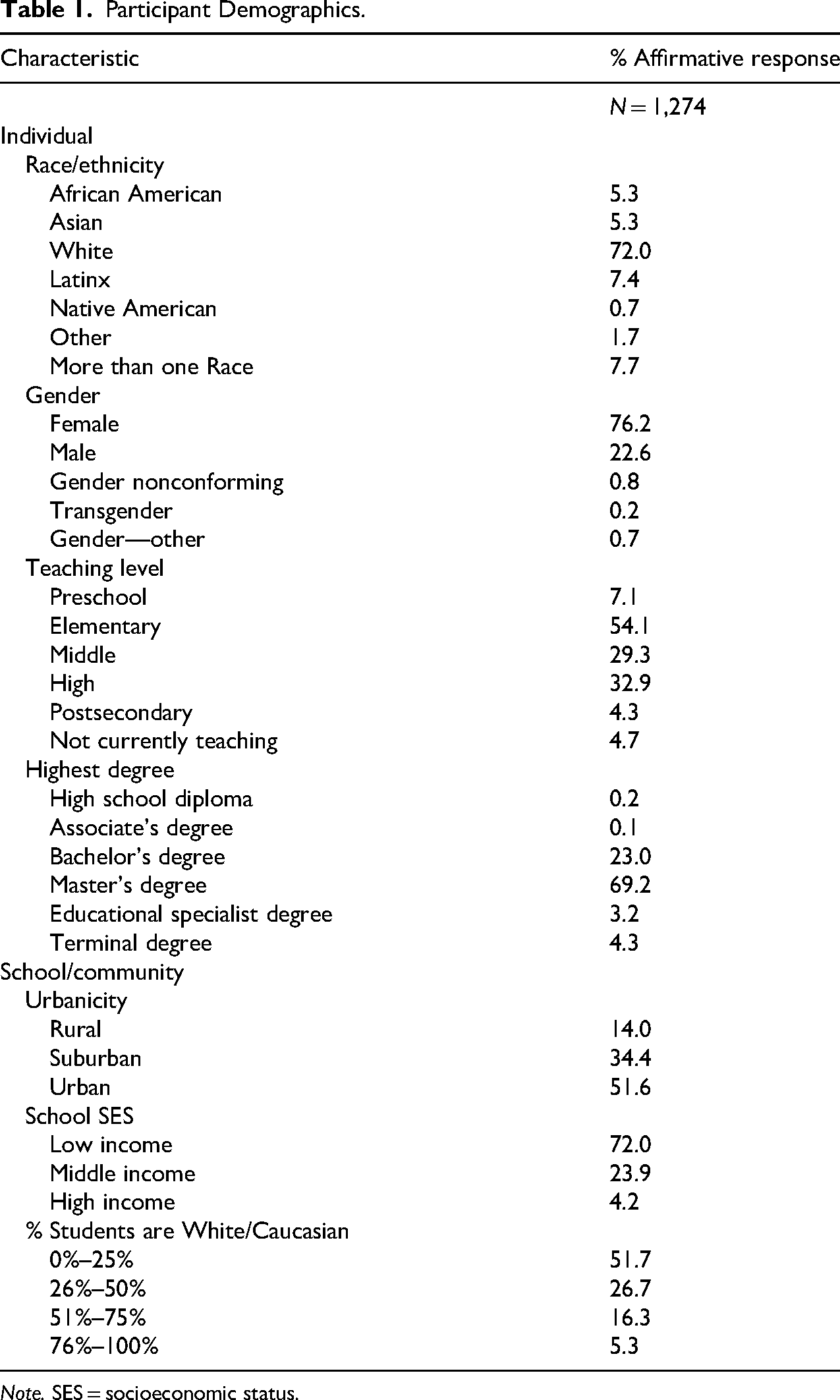
Note. SES = socioeconomic status.
Instrument
The Survey of TL (STL; Wiens et al., 2025a) served as the dependent variable in this study. The STL has demonstrated strong reliability and validity as a measure of TL behaviors and SE (Wiens et al., 2025a). The scale underwent multiple stages of validation, including expert review, think-aloud, pilot study, and finally psychometric evaluation. The STL follows a similar survey construction to the Teaching and Learning International Survey 2018 (Ainley & Carstens, 2018). Participants were provided with 29 TL behaviors and asked to (1) indicate their SE in completing these behaviors (on a 4-point Likert-style scale, 1 = not at all, 2 = to some extent, 3 = quite a bit, and 4 = a lot), and (2) how frequently they engage in these behaviors (on a 6-point Likert-style scale, 1 = never, 2 = once a year or less, 3 = 2–4 times a year, 4 = 5–10 times a year, 5 = 1–3 times/month, and 6 = once a week or more). An important tenet of QuantCrit is decentralizing whiteness in the instrument and including community members when creating the instrument. Although we did not attend to this tenet of QuantCrit (see limitations below), we did use numbers for social justice, which we elaborate on next.
While the STL includes a five-factor model of TL, based on our research questions (see below), for this study, we focused solely on the block of questions related to equity in TL. This included five items as listed in Table 2. The five items were combined into a mean score (SE α = .849; Frequency α = .814) for analysis. All demographic items were designed to be inclusive, and participants were able to select multiple types of identities (i.e., all that apply). Demographic questions included Race/Ethnicity (white, African American, Asian, Latinx, Other Race, and More than one race), Gender (female, male, gender nonconforming, and gender other), teaching level (preschool, elementary, middle, and high), and highest degree earned (bachelor's, master's, educational specialist, and terminal degree).
Equity-Related STL Items and Descriptive Statistics.
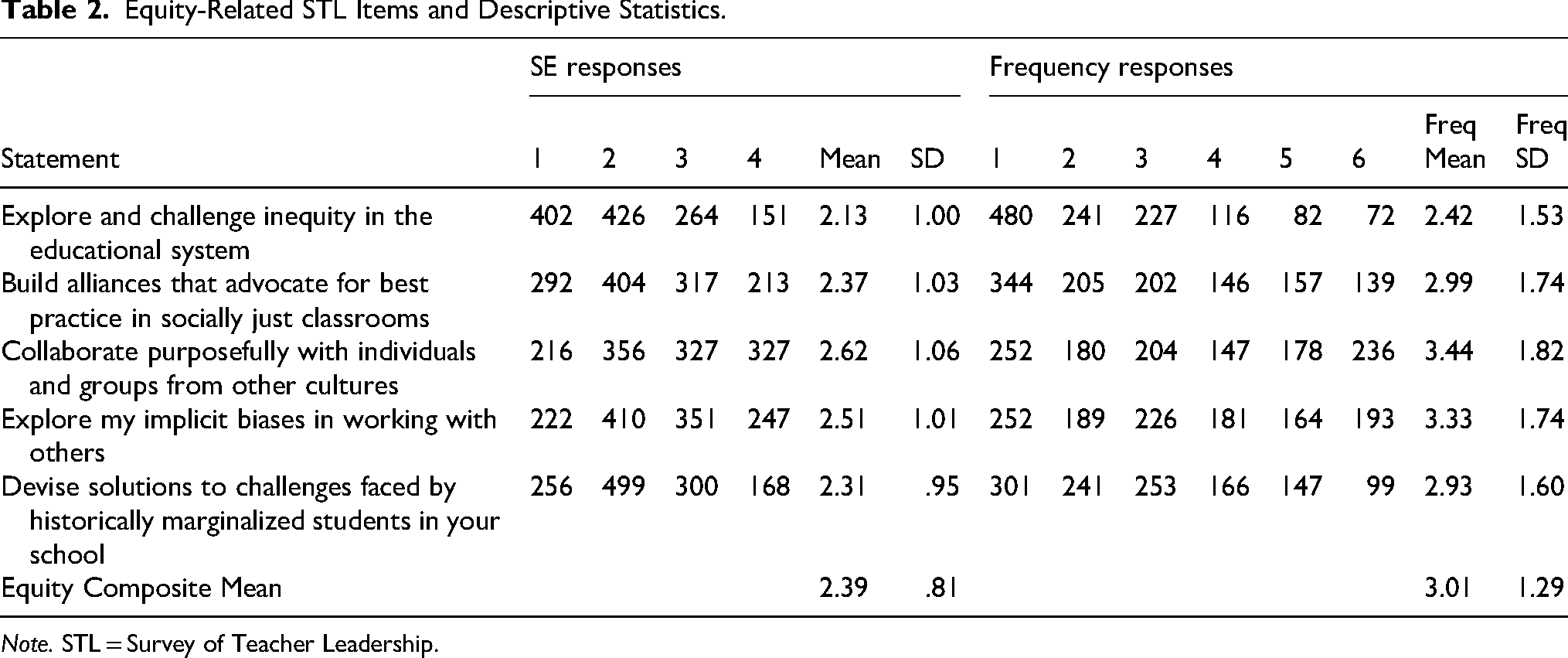
Note. STL = Survey of Teacher Leadership.
Demographic Variables
Participants were also asked to provide demographic information about themselves and their schools. Individual experiences with TL may vary depending on personal and school characteristics. Therefore, we selected the individual characteristics of race/ethnicity (Dickar, 2008), gender (Klassen & Chiu, 2010), professional teaching level (Stone et al., 1997), and highest degree (Fernández-García et al., 2019) as they may have all been shown to inform teachers’ perspectives. Additionally, school contextual factors have also been shown to be related to teachers’ experiences and were also included in the analysis (Wiens et al., 2025b). For personal information, participants indicated their race/ethnicity where they could select all options that applied to them. They also selected their gender and were able to select all that apply. Participants provided their highest degree earned as well as the level they teach. Participants also reported select characteristics of the school where they work. They indicated the urbanicity of the school from the choices of “rural,” “suburban,” or “urban.” Participants selected the school socioeconomic status (SES) from the choices “low income,” “middle income,” or “high income.” Finally, participants indicated the racial demographics of their school by responding to a question asking what percentage of students at their school are white/Caucasian. The choices for this question were “0%–25%,” “26%–50%,” “51%–75%,” or “76%–100%.”
Analysis
Analysis for this study occurred in stages to address our research questions:
What is teacher leaders’ perceived SE for equity work? What is teacher leaders’ perceived frequency for equity work? What is the association between personal and school demographic characteristics and equity TL in both SE and frequency of practices? What is the relationship between equity in TL and the other factors of TL in SE? What is the relationship between equity in TL and the other factors of TL in frequency of practices?
First, we calculated descriptive statistics to better understand the reported levels of SE in equity TL and the frequency that teachers report practicing these behaviors. Next, we wanted to understand how personal and school demographic characteristics might predict SE and frequency of TL equity behaviors. To accomplish this, we conducted a series of four multiple regression equations (Pedhazur, 1997). In the first regression, we used individual demographic characteristics as independent variables with TL equity SE as the dependent variable. The second regression used the same individual demographic variables as the independent variables with TL equity frequency as the dependent variable. The third and fourth regressions followed the same procedures, but added school demographic variables to each regression. Finally, we examined the relationship between equity practices in TL with the other components of TL as measured by the STL through correlation analysis. Using SPSS v. 29, we employed listwise deletion to handle missing data.
Limitations
Castillo and Gillborn (2023) encouraged readers to be wary of large sample sizes that may not be generalizable to other more or less racially diverse populations. The return rate of this study was 6%, but we are not advising generalization to the largest population of teachers in Nevada or elsewhere. Moreover, the instrument for this study was created with a local teachers’ union, but we did not seek out a diverse group of teachers to help us create the instrument, which is a limitation of QuantCrit research, which encourages community input. The instrument centered whiteness at times (e.g., asking teacher leaders to identify the percentage of white students in the school), but we were able to address and critique this in our discussion. Future studies should address the use of QuantCrit at the instrument design stage.
Results
Descriptive statistics illustrated the SE teachers reported in equity TL and the degree to which teachers engaged in these practices (see Table 2). The composite variable was as follows: SE (M = 2.39) and frequency (M = 3.01). The highest reported SE (M = 2.63) and frequency (M = 3.44) were for the statement, “Collaborate purposefully with individuals and groups from other cultures.” Meanwhile, the lowest reported SE (M = 2.13) and frequency (M = 2.42) were for the item, “Explore and challenge inequity in the educational system.” This could indicate that teachers are more comfortable working with their colleagues than focusing on the educational system broadly.
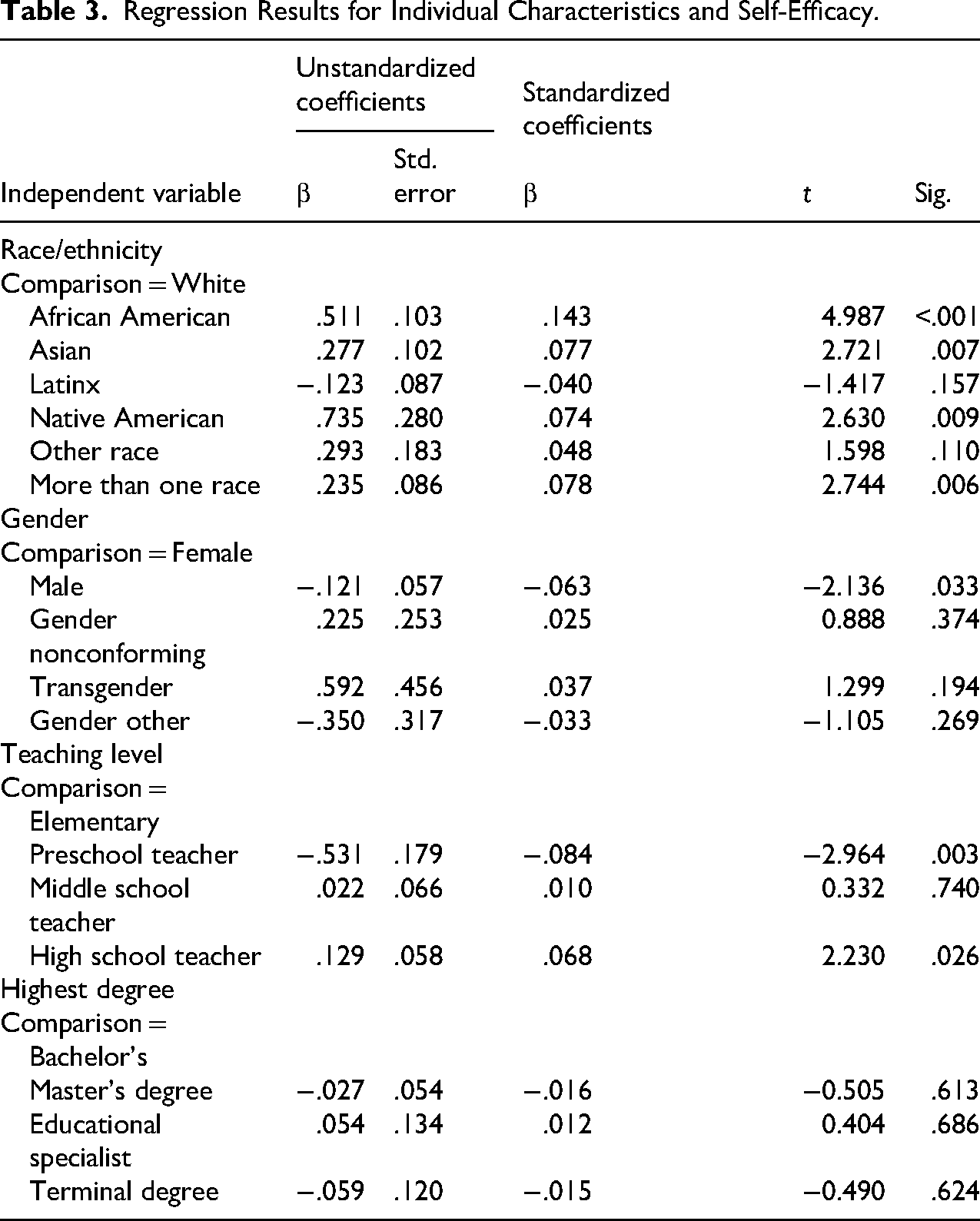
We conducted regression analysis whereby results for the first analysis showed that the entire equation was statistically significant, F(16, 1203) = 4.525, p < .001, indicating that individual demographic variables were able to predict some change in TL equity SE as shown in Table 3. The individual characteristics could explain only a small, but significant portion of the variance in the dependent variable (R2 = .057). This confirms the complexity of educational systems and the enactment of equity practices in schools. There are many factors that might explain why teachers practice equity, and their individual characteristics explain at least a small portion of that variance. Full results can be seen in Table 3. Among the individual demographic characteristics, race/ethnicity showed an association with TL SE in equity leadership including among African American (β = .511, p < .001), Asian (β = .277, p = .007), Native American (β = .735, p = .009), more than one race (β = .235, p = .006) participants who reported statistically higher SE in TL equity behaviors than their white colleagues. Meanwhile, after accounting for race/ethnicity, male teachers (β = −.121, p = .033) reported lower SE than their female peers. Finally, after controlling for other individual characteristics, there were significant differences whereby high school teachers reported higher SE (β = .129, p = .026) than did elementary teachers, while preschool teachers were lower (β = −.531, p = .003). However, there was no statistical difference among the highest degree.
Regression Results for Individual Characteristics and Self-Efficacy.
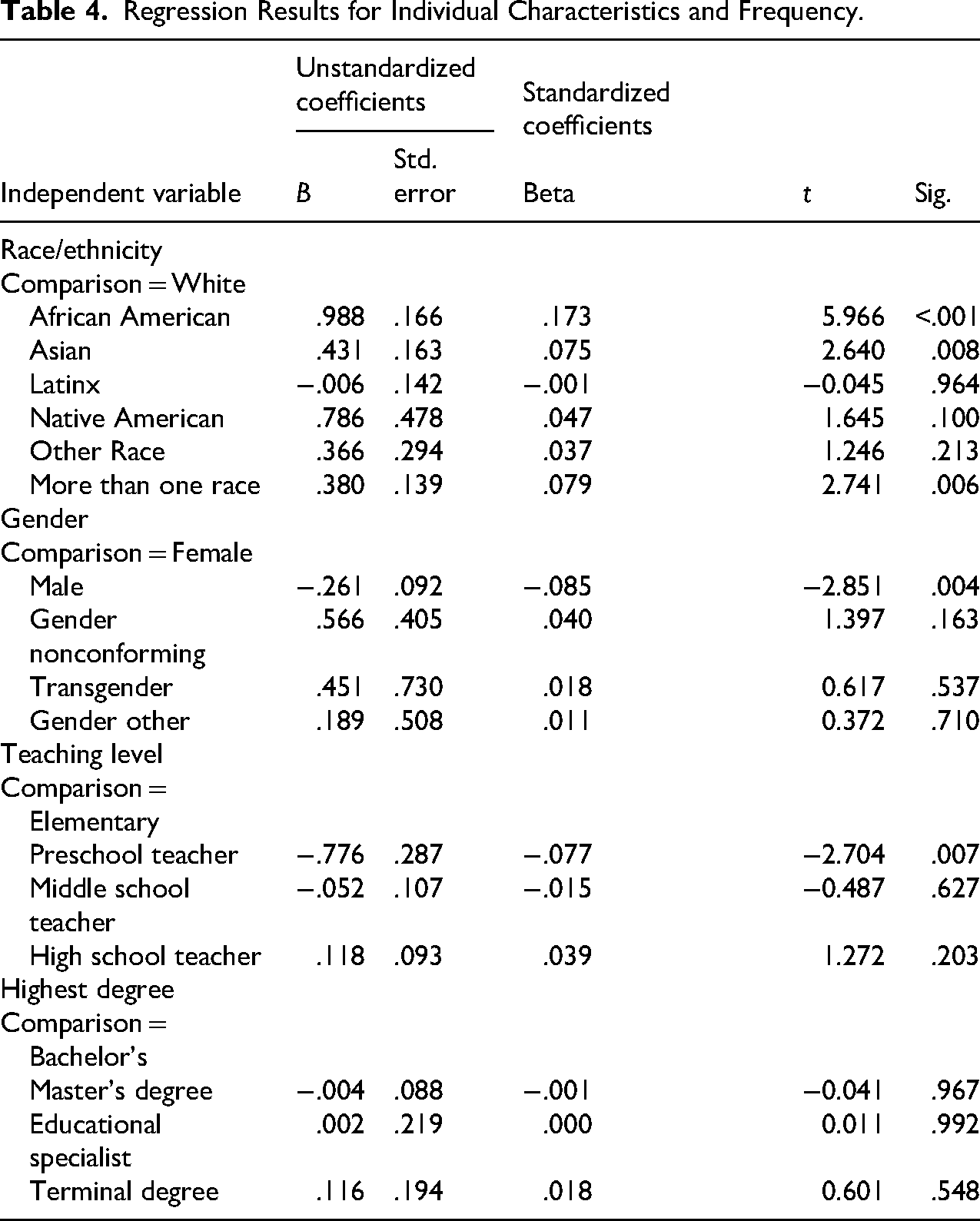
Regression analysis results for the second analysis focused on TL equity frequency of behaviors and mirrored those of the SE analysis described previously. The entire equation was statistically significant, F(16, 1187) = 4.408, p < .001, indicating that individual demographic variables were able to predict change in TL equity frequency. The individual characteristics could explain only a small, but significant portion of the variance in the dependent variable (R2 = .056). Similar to the SE discussed above, the effect size points to the complexity of understanding teacher behaviors. Focusing solely on individual characteristics does not fully explain teacher behaviors related to TL, but it can provide some insights into how these characteristics are associated with specific behaviors. Full results can be seen in Table 4. Among the individual demographic characteristics, African American (β = .988, p < .001), Asian (β = .431, p = .008), and more than one race (β = .380, p = .006) participants reported statistically significantly higher SE in TL equity behaviors than their white colleagues. Meanwhile, male teachers (β = −.261, p = .004) reported less frequent engagement in these behaviors than their female peers even after controlling for race/ethnicity. Accordingly, after accounting for other demographic characteristics, preschool teachers reported less frequently engaging in these behaviors (β = −.776, p = .007) than did elementary teachers. However, there was no statistical difference among the highest degree earned by participants.
Regression Results for Individual Characteristics and Frequency.
Next, we added school demographic characteristics to the analysis. The purpose of this step is to understand if, after accounting for individual characteristics, school characteristics predict TL equity SE or frequency. Full results of this analysis can be found in Table 5. In both cases, SE, F(19, 1161) = 4.210, p < .001, and frequency, F(19, 1146) = 4.002, p < .001, the entire regression equations were statistically significant. It should be noted that the entire model in both cases accounted for only a small amount of variance in SE (R2 = .064) and frequency (R2 = .062). However, within the regressions, for SE, only urbanicity (β = .115, p = .002) was statistically significant. This indicates that teachers in more urban schools report higher levels of SE in TL equity practices. On the other hand, teachers in more urban schools did not report that they engaged in these behaviors more frequently than less urban schools. This may imply that while teachers in urban schools feel like they have the ability to be equity teacher leaders, they do not have the opportunities to engage in these behaviors any more than teachers in less urban schools. None of the school demographics were statistically significant in the regression models.
Regression Results Including School Demographics.
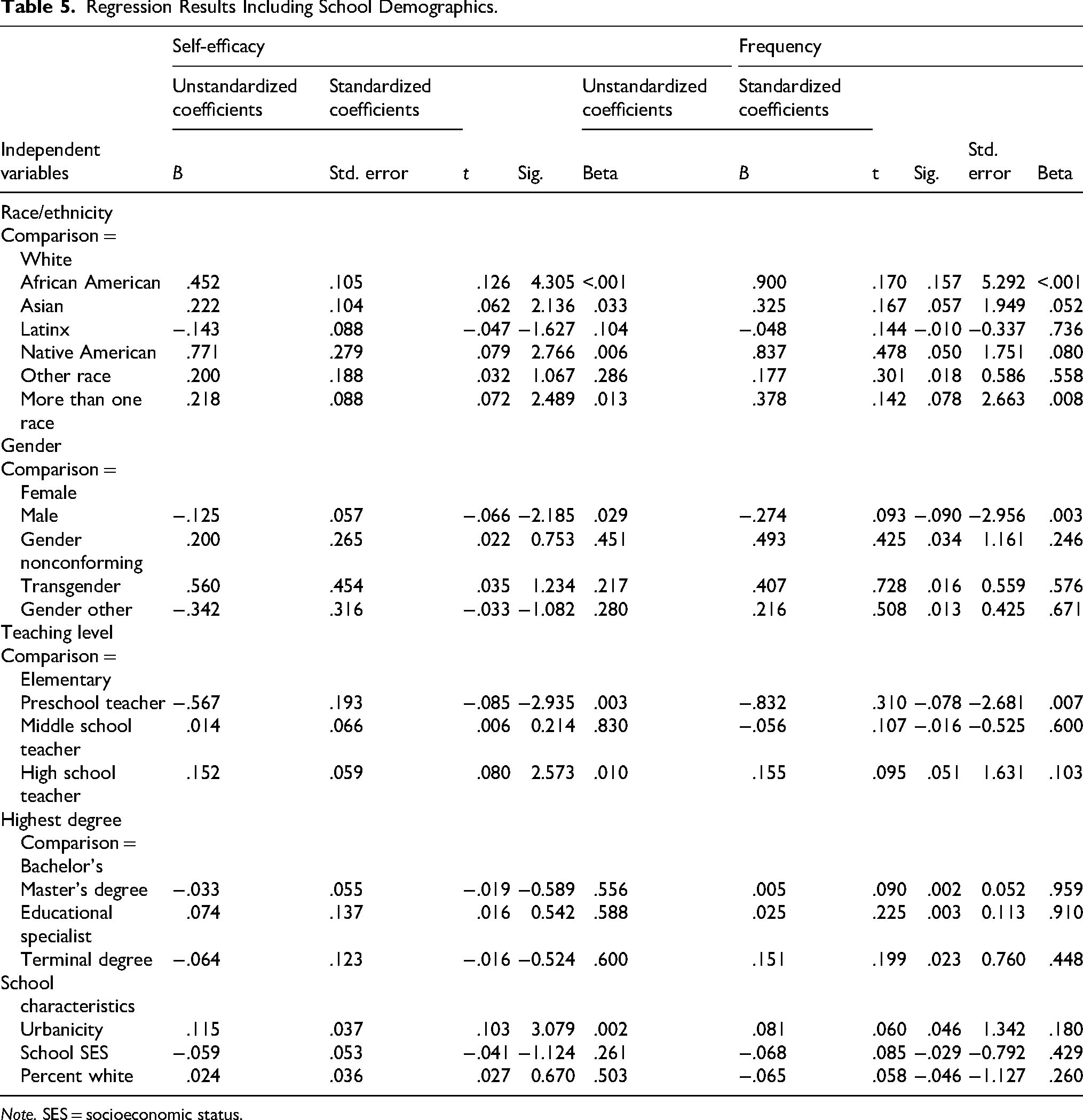
Note. SES = socioeconomic status.
Our final analysis was used to determine if other TL behaviors were correlated with other TL factors as measured by the STL. There were statistically significant relationships between TL equity and all other TL factors as shown in Table 6. Correlations ranged from r = .439, p < .001 to r = .749, p < .001. Overall, these relationships appeared to be stronger for SE than for frequency of behaviors.
Correlations Between TL Equity and Other TL Factors.
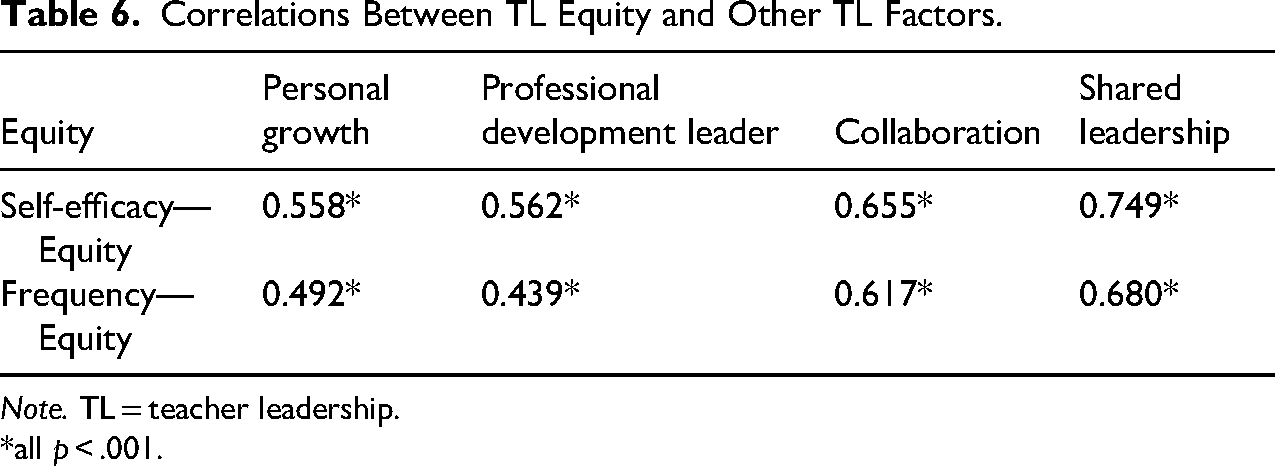
Note. TL = teacher leadership.
*all p < .001.
Conclusions
Our interpretation of our data analysis is central to enacting QuantCrit—Castillo and Gillborn (2023) made a distinction between results and interpretation. In this section, we interpret our results by situating them within relevant literature to make meaning of them within the context of race and racism. Our first conclusion is centered on the following QuantCrit principles: “1. the centrality of racism, and 5. voice and insight: data cannot ‘speak for itself’” (Gillborn et al., 2018, p. 169). The results of our first analysis convey a disconnect between teacher leader perceptions of equity work and their belief in their ability to carry it out. While teacher leaders indicated high SE and frequency for collaborating with people from diverse groups, they expressed lower SE and frequency for actually exploring and challenging equity in the educational system. If teacher leaders feel efficacious in collaborating with diverse peers, why are they unable to advocate or act on behalf of students or their peers? Context mitigates teacher leader work (Angelle & Teague, 2014; Davis & Leon, 2009; York-Barr & Duke, 2004), and the data for this study were collected in 2022, well before the current sociopolitical context in which the federal administration is attempting to end and ban diversity, equity, and inclusion (DEI) work. At the state and local levels over the last several years, teachers have been threatened with CRT hotlines (Simon & Paviour, 2022), “don’t say gay” legislation (Associated Press, 2024), and ongoing challenges to books (Blair, 2024; Hinton & Chandler, 2025) and curriculum (Kim, 2023). Thus, these public battles over education may mitigate teachers’ desires to challenge inequity or speak up on behalf of marginalized students. Research has also demonstrated that fear of offending white parents has been a barrier to critical TL work (Jacobs et al., 2014). Although teacher leaders’ context undoubtedly had some chilling effect on their equity work, it is also worth considering the disconnect between perception and action both in this result and our final analysis.
The next result speaks to QuantCrit principles 2 and 5: “numbers are not neutral” and “using numbers for social justice” (Gillborn et al., 2018, p. 169). Teacher Leaders of Color, specifically those who identify as African American and Asian, in this study reported statistically higher SE in TL equity behaviors and frequency of TL equity behaviors. It is well documented that Teacher Leaders of Color are disproportionately burdened with disciplining students (Brockenbrough, 2015) and with teaching for equity and social justice. Our study demonstrates how Teacher Leaders of Color in one state have reported not only higher SE for equity in TL equity behaviors but also higher instances of these behaviors. To disrupt systemic inequities, white teachers must also be well-versed in equity pedagogies and feel confident in implementing these equity pedagogies. There were no statistical differences between teachers who had earned the highest degree in this study, which may also indicate the importance of ongoing education and personal growth around this topic.
In this study, teacher leaders in urban schools also indicated higher levels of SE in TL equity practices. Urban schools are disproportionately staffed by Teachers of Color (Putman et al., 2016), and equity practices should not be taking place only in these schools. As the principles of QuantCrit help illuminate, if we really aim to remedy and repair educational inequality, students in suburban and rural schools must also have their needs met, and this finding again lends support to the call for white teachers and teacher leaders to educate themselves about equity pedagogies to better serve students (Gutierrez et al., 2022). If teacher educators, administrators, and teachers realized the value of equity and social justice for all students, including white students, perhaps more white educators would commit to these ideas and practices, coupling interest convergence, a CRT principle, with QuantCrit principles 2, 3, and 5 (Bell, 1980). Paulick and colleagues (2024) also found that teacher candidates’ desires to work with particular groups of students drove their culturally responsive teaching SE. Thus, teacher beliefs may drive SE and TL equity practices, and this finding provides implications for teacher recruitment and hiring (Beck et al., 2023; D’Amico et al., 2017). This result is aligned with QuantCrit principle 3: “categories are neither ‘natural’ nor given: for ‘race’ read ‘racism’” (Gillborn et al., 2018, p. 169).
Per our final analysis, there was a stronger correlation between TL equity and SE than TL equity and frequency of behaviors. This is particularly revealing in light of the fact that our sample was majority white. Morales (2022), paraphrasing the podcast Tea with Queen and J, wrote about how “BIPOC people … have higher racial IQs than white folks” (p. 704). Critical whiteness studies further reveal how white folks tend to lead racially segregated lives and not benefit from intimate, cross-racial relationships (DiAngelo, 2018; Wing, 1997). They also may not realize they have a racial identity. Thus, the white teacher leaders in this sample may have reported high SE for TL equity without fully understanding how they are upholding and perpetrating racist practices (Bell, 1992; Delgado & Stefancic, 2017; Wing, 1997; Young, 2011). Indeed, this is another symptom of whiteness: white folks often do not interrupt systems that benefit them or may not even realize that they are receiving benefits simply for being white (Bell, 1980; Young, 2011). Viewed through this lens, this result confirms the presence of racism in our analysis, which connects to QuantCrit principle 1: “the centrality of racism” (Gillborn et al., 2018, p. 169). Further qualitative research may shed light on why teachers report low SE and frequency of behaviors around these issues. In an era when DEI is being banned, a commitment to equity for all students is more important than ever. Teacher leaders have a valuable role to play in supporting this goal (Jacobs et al., 2014; Jacobs et al., 2016; Nieto, 2007; Smulyan, 2016).
Footnotes
Funding
The authors received no financial support for the research, authorship, and/or publication of this article.
Declaration of Conflicting Interests
The authors declared no potential conflicts of interest with respect to the research, authorship, and/or publication of this article.
