






Abstract
Drawing on empirical research carried out in the metropolitan regions of Freiburg, Germany, and Calgary, Canada, we reposition the sustainability policies of municipalities within a wider regional and relational framework. This perspective reveals significant epistemological blind spots in the localist and non-relational ontologies that undergird much of the urban sustainability discourse. While the city of Freiburg has garnered world-wide attention for its multi-faceted initiatives and achievements in sustainable urban development, these initiatives have yet to be coherently addressed in the wider Freiburg metropolitan region, leading to a variety of policies and practices in the hinterland that run counter to Freiburg’s ‘green city’ objectives. In a parallel fashion, the city of Calgary incorporated significant sustainability principles in its 2009 Master Development Plan and Transportation Plan –‘Plan-It’– yet such principles have not been taken up on a regional scale. Despite substantial differences in size and developmental history, both cities exhibit a profound disconnection from their regional contexts with regard to sustainable development policies and politics. In both metropolitan regions, conventional growth politics are still paramount. A significant conflict emerges between ‘sustainable’ central cities seeking a ‘sustainability fix’ to their fiscal, environmental and quality of life problems, and more remote jurisdictions seeking to attract investment through low tax regimes and limited development regulation – what we label a ‘counter-sustainability fix’. These contrasting and dialectically related policies have substantial consequences for the social and environmental dimensions of sustainable development, calling into question policies that promote ‘sustainability in one place’.
Introduction
A number of cities around the world – Freiburg, Vancouver, Zurich, Stockholm, Copenhagen, Melbourne, Singapore and many others – have garnered considerable attention for their multi-faceted initiatives and achievements in the realms of green energy, low-carbon economic development, sustainable and active mobility, compact mixed-use land use planning and citizen participation. Global and national policy programmes have helped put cities on the new frontline in efforts to combat climate change: it is now common for cities to address sustainability in both their politics and their planning (Bulkeley et al., 2011; Calthorpe, 2010; Hall, 2013; Newman and Kenworthy, 1999; Roseland, 1997; Worldwatch Institute, 2016). This urban sustainability imperative has received strong support from the Intergovernmental Panel on Climate Change (IPCC) (2014), which asserts that cities are crucial locations where innovative pathways towards sustainability can be explored and implemented. The World Bank (2010) makes a similar argument.
Yet, high profile support for urban sustainability initiatives aside, effective sustainability initiatives are frequently offset by policies and practices that promote their opposite, what we term ‘counter-sustainability’ initiatives. Particularly striking is the fact that sustainability initiatives do not often operate on a regional or broader scale, and indeed usually stop at municipal boundaries. Behind the seemingly universal support for urban sustainability are a number of contradictions and conflicts stemming from inadequate consideration of the spatial and structural constitution of the processes that shape cities, first and foremost how these processes operate in the context of territorially fragmented states and neoliberal policies that set municipalities against each other, often in beggar-thy-neighbour competition (Cox, 1993, 2010; Peck and Tickell, 1994, 2002). This inattention to the spatial and structural constitution of urban processes has implications for the success – and lack thereof – of urban sustainability policy.
In this research, we attempt to understand how sustainability initiatives taken up by two dominant central cities – both pursuing strategies of ‘sustainability in one place’–‘travel’, or fail to travel, throughout their respective metropolitan regions. Our research compares two seemingly quite different cities – Freiburg, Germany, and Calgary, Canada – within their broader metropolitan-regional relationships, foregrounding the different positions and roles of central cities vis-a-vis peripheral jurisdictions. Comparing sustainability and counter-sustainability politics and planning within and between these metropolitan regions, we examine the systemic implications of the pursuit of ‘sustainability in one place’, the limitations of sustainability initiatives under conditions of state fragmentation and neoliberal policy, and possible ways forward.
Sustainability and evolving conceptions of the urban-environmental relationship
Increasingly, eco-cities, green cities and sustainable cities are presented by academics and policy-makers alike as holistic and effective strategies for the transition to a more sustainable society. Roseland (1997), discussing the origins of eco-cities, asserts that cities are places where the many dimensions and processes of sustainability transitions come together and can be effectively addressed. Similarly, Newman et al. (2009) argue that cities need to respond to environmental crises by ending their dependence on fossil fuels and reducing their ecological footprint. Many authors, moreover, hold up cities as places that can instil hope for transition to a sustainable world (Hall, 2013; Newman et al., 2009).
This modern merging of urban and environmental agendas is a relatively recent phenomenon, first becoming common in the 1970s (Béal, 2012). More longstanding is the idea of cities as discrete territorial entities with distinct economic, social and even psychological characteristics, manifest in a binary division of rural and urban spaces. Early Marxian-inspired analyses conceived of an ‘urban mode of production’, with cities as ‘a developmental force, the seat of modern industry, of the division of labour, of the reproduction of labour-power, of technological innovation’ (Merrifield, 2013: 911). The notion of an urban mode of production had its counterpart in the notion of the urban as a mode of consumption, illustrated in Castells’ (1977 [1968]) influential treatise The Urban Question. In both conceptions, ‘the urban’ is considered a real ontological entity with discrete properties and powers. Henri Lefebvre presented the first significant break with this perspective in The Urban Revolution (2003 [1970]), in which he advocated thinking beyond the notion of the bounded city, focusing instead on ‘urban society’– a concept that emphasises the relations and flows that run through cities, but are not bounded by them. ‘Urban society’ signals cities standing in relationship to all of society, including non-urban areas, likewise shaped by processes extending far beyond constructed boundaries.
Most urban-focused sustainability strategies proceed from a pre-Lefebvrian conception of the urban, coupled with a weak notion of sustainability that does not require systemic redesign of production and exchange relations. These conceptions underlie the belief that sustainability policy can be implemented in a piecemeal step-by-step – and place-by-place – fashion. The early environmental movements of the 1960s and 1970s arose from the grassroots and often critiqued piecemeal measures, calling into question the organisation of production processes and their relationship to natural systems (Commoner, 1971; O’Connor, 1997). By the 1980s and 1990s, however, market-oriented neoliberal policies became increasingly widespread, and market-based actors, such as corporations, chambers of commerce, utilities, developers and others, began to wield significantly more influence in environmental policy generally and in urban environmental policy specifically (Béal, 2012; Keil, 2007; Krueger and Gibbs, 2007). Not surprisingly, systemic critiques as well as the social dimensions of sustainability were increasingly de-emphasised, replaced by the belief that economic growth and environmental improvement could be promoted in tandem. Under the ascendancy of ‘ecological modernisation’, the economic and political processes that determine the consumption of resources, the deterioration of the environment and the distribution of both benefits and harms were downplayed (Krueger and Gibbs, 2007; Wilson, 2015), and the core processes and power relations of a capitalist system were kept in place. Policy was focused on improvements in the technologies of production and consumption, often using market mechanisms to incentivise technological innovation and disincentivise consumption of environmentally harmful goods. Concurrently, sustainability planning became ‘post-political’ in the sense discussed by Swyngedouw, Ranciére, Žižek and others: challenges to fundamental structural organisation were eliminated from the scope of debate. Instead, problems were to be approached as technical and managerial concerns within existing political-economic structures. While climate change, energy policy and related urban issues were ‘seemingly politicised as never before’ (Swyngedouw, 2010: 213), they became governed and de-politicised ‘through a stage-managed consensus’ (MacLeod and Jones, 2011: 2632) that reduced politics to the ‘administration and management of processes whose parameters are defined by consensual socio-scientific knowledges’ (Swyngedouw, 2009: 602).
The present era of urban sustainability politics and policy, then, rests on three key inter-related assumptions: 1) the idea that cities are largely discrete territorial entities possessing a degree of autonomy and self-determination that allows them to effectively set and implement policy, despite the substantial influences of broader scale processes; 2) the idea that broader scale processes such as capital accumulation, the extraction of resources from and dumping of waste into the natural environment and the (mal)distribution of wealth need not be challenged in any fundamental way. Seen through the lens of ecological modernisation, the problems of unsustainable development are believed to be solvable through technological innovation, the fine tuning of market signals and, in the case of cities, better planning and design; and 3) the idea that sustainability is not a political question in any fundamental sense. These assumptions resonate with neoliberal policy generally, and undergird plans and policies of cities aiming to promote sustainability within their borders.
Sustainability in one place? Spatialities, systems and policy (im)mobility
There is no doubt that cities have an important role to play in the transition to a more sustainable low-carbon world. But to what extent can action at the scale of individual cities be a solution? Over the last two decades, a diverse and wide-ranging literature addressing the role that cities can play in the pursuit of sustainability has developed across the social sciences and planning and design professions.
In the rapidly growing field of sustainability transition studies, cities are often viewed as a primary site of experimentation and ‘niche innovation’ development (Geels, 2011). There is little doubt that they have become significant sites of policy, planning and design innovation (Evans et al., 2016). What drives the diffusion and adoption of innovations that underlie sustainability transitions is, however, less clear. McCann and Ward (2011) and Temenos and McCann (2013) find that policy transfer depends not only on the building of relationships between agents and institutions; it is also shaped by differing subjectivities, rationalities, institutions and local contexts. Policy mobility is not inevitable and cannot be assumed – a matter of great relevance if cities are to be considered a primary vector of sustainability transitions. As Rutherford and Coutard (2014: 1366) put it, policy transitions are inherently political and ‘may result in deep changes in the spatial organisation, economic performance, and social cohesion of societies, but the precise nature of these changes will differ between places and also over time’. Such deep changes, unsurprisingly, may provoke strong resistance and ultimately lead to the deliberate and active blocking of policy transfer. Affolderbach and Schulz (2016: 1952) argue that understanding policy (im)mobility requires an ‘actor-centred approach’ that focuses on ‘individual actors and actor groups in their respective contexts’, while Nciri and Levenda (2019) point to instances of powerful corporate and state actors intentionally framing policy experiments as failures, creating ‘perverse policy lessons’ to block their transfer. While fully concurring with these analyses, we contend that it is critically important to go beyond a focus on actors and actor networks to consider the broader spatial and structural contexts in which actors act. Policy (im)mobility is a matter of political power and struggle, constituted through a variety of co-implicated spatialities (Miller, 2013; Miller and Ponto, 2016).
Beyond networks, the spatialities of territory, scale and place are relevant to understanding policy (im)mobility. Territory concerns ‘the geographical strategies of partition and integration employed by economic and political actors (states, firms)’ (Bridge et al., 2013: 336), creating the necessary preconditions for the establishment of territorial interests and territorial competition. Scale denotes ‘territorially nested, malleable relationships among territorially embedded or constituted agents and institutions, shaping their responsibilities, capacities, opportunities, and constraints’ (Miller, 2009: 62). Such relationships can ensure sufficient municipal resources and foster collaborative inter-municipal relationships, or their opposite. Place refers to social relations, stretched across space, focused in particular locations. Places ‘are the spaces we see, smell, taste, touch, hear, and bond to (or not) as we inhabit, visit, and pass through them … [They] are the spaces of social practice and meaning’ (Miller and Ponto, 2016: 268), with important implications for the reception of policy ideas. All of these relational spatialities imply the exercise of power, including the creation of boundaries delineating geographical interests and authoritative and allocative capacities, as well as the construction of shared collective identities and values that support or inhibit the reception and adoption of new policies and practices. Territorial and scalar relationships, in particular, are often highly contentious given their implications for structuring locally dependent material and cultural interests. The assertion of territorial and scalar power is often a primary means through which policy transfer is contested, as actors representing incumbent policy regimes seek to protect their interests while challengers attempt to create fertile ground for change. Sustainability policy may travel, mutate, be rendered immobile or in some cases give rise to policies promoting its opposite.
The sustainability fix … and counter-sustainability fix
Urban sustainability initiatives must be considered within the broader spatial and structural contexts of fragmented territorial states and neoliberal policy. The notion of the ‘sustainability fix’, first proposed by While et al. (2004), represents an important attempt to understand the contemporary marriage of environmental and economic development policy, conceptualising ‘evolving forms of local economy-environment relations’ in the context of capitalist accumulation and inter-urban competition. While et al. (2004) argue that cities increasingly search for ‘spatio-institutional fix[es] to safeguard growth trajectories’ (While et al., 2004: 551) through ‘selective incorporation of environmental goals, determined by the balance of pressures for and against environmental policy within and across the city’ (While et al., 2004: 552). For many cities, sustainability initiatives not only improve environmental conditions and quality of life; they play a key role in attracting capital investment and highly skilled labour.
Alongside the benefits of urban sustainability initiatives, however, are contradictions and conflicts. In a neoliberal era of slashed revenue transfers from national and provincial governments and limited local capacity to generate revenue, municipalities are under pressure to compete for investment (Cox, 1993, 2010, 2011; Peck and Tickell, 1994, 2002). Intra-metropolitan divisions of labour, however, lead municipalities to compete on different bases. Addressing energy flows, carbon flows, commuting practices, land-use mix, urban green space and other environmental concerns may be an effective ‘fix’ to the problem of stagnant growth for some cities, but other cities may find it very difficult to attract investment and labour on this basis. Within territorially fragmented state systems, municipal entrepreneurialism frequently gives rise to conflicting territorial interests and objectives, with attendant conflicts over tax base, employment and status (Cox, 1993, 2010; Peck and Tickell, 1994, 2002).
One response to economic stagnation and competitive pressure has been to adopt city-regional strategies in which cities across metropolitan regions develop cooperative economic development strategies. Such strategies are, at best, partial and not to be taken for granted. Indeed, many municipally based urban sustainability initiatives, and the options for urban living they represent, often give rise to their opposite – growth-first ‘counter-sustainability’ initiatives resembling traditional development-focused ‘growth machines’ (Jonas and Wilson, 1999; Logan and Molotch, 1987) – elsewhere in the same metropolitan region. Within metropolitan regions, cities differentiate themselves in terms of housing costs, amenities, taxation and ways of life, as they attempt to attract investment, jobs, residents and a strong tax base. When some municipalities promote sustainable and active transportation, renewable energy, cultural amenities, parks, compact development and better housing (usually at higher cost), opportunities arise for other municipalities in the same metropolitan area to appeal to a very different market segment, such as households needing or desiring lower-cost housing, more living space, lower taxation and automobile-oriented ways of life. Indeed, given rising income inequality and increasing shortages of affordable housing, many households have little choice but to opt to live in lower-cost, more remote and less ‘sustainable’ jurisdictions (see Sheppard, 1980). In short, market-oriented urban sustainability policies tend to have a strong affinity with class and cultural polarisation, giving rise to ecological gentrification (Dooling, 2009; Quastel, 2009) in some parts of the metropolitan region, and a focus on lower-cost provision of basic necessities in others. In the context of regional scale relationships and inter-dependencies, attempts to produce ‘sustainability in one place’ (Mössner and Miller, 2015) can create regional scale contradictions and conflicts that undermine the sustainability objectives of sustainability-oriented cities, as households of lesser economic means locate in lower-cost, less ‘sustainable’ parts of the metropolitan region and commute greater distances to access jobs, services and amenities.
In both the Freiburg and Calgary metropolitan regions, we see clear examples of efforts to promote sustainability agendas and to promote their opposite: growth-first ‘counter-sustainability’ agendas. The reasons for this, in two such different metropolitan regions, are illuminated through comparative analysis.
Comparing sustainability policies and politics in the Freiburg and Calgary metropolitan regions
At first glance, comparison of the sustainability policies and politics of the Freiburg, Germany, and Calgary, Canada, metropolitan regions may seem somewhat surprising. Freiburg has garnered world-wide attention for its sustainability programmes and achievements. Peter Hall, in his last book focused on European sustainability planning, called Freiburg ‘the city that did it all’ (Hall, 2013: 248). Calgary, by contrast, is known mainly for being the headquarters city of almost all of Canada’s oil and gas corporations, for being a poster-city for urban sprawl and for having one of the world’s highest ecological footprints. It too, however, has strongly stressed sustainability in its urban planning, especially since 2009.
Our research for this comparison began with a series of individual case studies examining the planning and development dynamics of each city (for Freiburg, see Freytag et al., 2014; Mössner, 2015, 2016; Mössner and Miller, 2015; Mössner et al., 2018; for Calgary, see Miller, 2016; Miller and Smart, 2011, 2012; Townshend et al., 2018). For both cities, our attention to sustainability-related planning and politics has covered the period from the mid-1990s to the present, a period in which sustainability-related politics and planning were matters of widespread discussion and debate, if not always under the label of ‘sustainability’. Information was gathered through a variety of means: analysis of planning documents; interviews with city officials including planners, city councillors and mayors; analysis of communications by and among officials; and participant-observation in policy-making and political processes through participation in planning engagement meetings and membership on city planning committees (especially in Calgary).
Informal comparison of the Freiburg and Calgary cases reveals, despite significant differences between the two cities, a very significant commonality: intense debates and disagreement over sustainability planning within the metropolitan regions of both cities, with the large central cities favouring a sustainability agenda but outlying municipalities indifferent or opposed. This curious commonality led us to consider conflicts over sustainability policies and planning in these two metropolitan regions in an explicitly comparative manner.
Comparative research, at its most basic, examines two or more cases and attempts to make sense of them through a common explanatory model (Ward, 2010). Urban comparative research attempts to think about cities ‘through elsewhere’ (Robinson, 2015), in order to better understand the tactics, strategies and logics of urban development and policy-making. There are, of course, multiple approaches to comparative research. Building from Charles Tilly’s classic work, both Ward (2010) and Robinson (2011) provide thorough reviews of these approaches and the issues they raise. Of the four commonly accepted comparative frameworks – individualising, universalising, encompassing and variation-finding – the framework adopted for this research can be best characterised as encompassing. Encompassing comparative research assumes that ‘different cases are … part of overarching, systemic processes, such as capitalism or globalisation. […] [T]hey can be analysed as instances or units, albeit systematically differentiated, within the broader system’ (Robinson, 2011: 7). This characterisation is consistent with our observations of the dynamics of the Freiburg and Calgary metropolitan regions. However, we go beyond a conventional comparative approach to examine the Freiburg and Calgary metropolitan regions relationally (Hart, 2018; Ward, 2010), considering how interactions and relationships between municipalities have affected the (im)mobility of sustainability policy. This relational comparison occurs on two levels: between the Freiburg and Calgary metropolitan regions, and within the Freiburg and Calgary metropolitan regions. Given space limitations, our analysis focuses primarily on the latter.
Searching for a sustainability fix in Freiburg and Calgary
While Freiburg is widely recognised as a global leader for its sustainability initiatives and the scope of its ambitions (Hambleton, 2015: 228), Calgary’s more recent sustainability agenda is nonetheless significant given the extent to which it attempts to change the development trajectory of a major city that has not been historically aligned with sustainable development. In recent years, both cities have developed sustainability agendas in a more or less autonomous fashion, de-emphasising their embeddedness in their broader metropolitan regions. Each city’s connection with its hinterland appears tenuous, fragmented and surprisingly under-addressed in research and practice. On this basis, both cities have mainstreamed sustainability planning at the municipal scale, producing clear economic and environmental benefits, but also unintended consequences.
Freiburg
Mainstreaming sustainability at the municipal scale
Freiburg, a medium-sized city of just over 230,000 people in 2018, has a long history of sustainable urban development that can be traced back to the environmental movements of the 1970s. Freiburg was among the first cities in the world to establish an institutional framework to promote sustainability goals in urban politics, policy and daily life. Early 1970s protests by farmers from the nearby wine-growing region against a proposed nuclear power plant near the village of Whyl are often cited as the beginning of Freiburg’s environmental ethos (see Rohracher and Spath, 2014), but significant environmental objectives did not appear in the city’s policy agenda until the late 1980s and early 1990s. Given the territorial delimitation of municipal power, it is not surprising that most of Freiburg’s sustainable urban development agenda has been focused within the city’s borders. By the 1990s, politicians, policy-makers, citizen initiatives and private investors began to seriously promote a set of urban policies favouring eco-housing, energy-efficient green buildings, public transportation, bicycling and walking in response to steadily growing demand for housing in a very tight housing market. The politics of sustainable urban development was spurred by the creation of new spaces of citizen participation in planning and neighbourhood design, the promotion of more sustainable modes of consumption in everyday life and the institutionalisation of comparatively strict energy and environmental standards that later became cornerstones for future sustainable neighbourhood development (Müller, 2015). Support for these initiatives has been particularly strong among citizens with connection to the University of Freiburg, the city’s largest employer. In the 1990s, the sustainability agenda culminated in the development of two eco-neighbourhoods (almost entirely based on private market housing), Vauban and Rieselfeld, that are now widely discussed in the international sustainability literature and bolster the city’s green image.
The ecological success of these two neighbourhoods derives from a number of widely praised planning features, some of them quite innovative: combined heat and power (biomass fuelled in Vauban) with district heating; a ‘plus energy’ solar district (in Vauban) that utilises both passive solar design and photovoltaics; attention to soil permeability and environmentally sound water management; an emphasis on active and public transportation including light rail, cycling and walking; minimal use of cars; direct citizen participation in residential planning; and private homeowner initiatives that actively experiment with green technologies (Beatley, 2007; Hopwood, 2007; Medearis and Daseking, 2012; Newman et al., 2009; Scheurer and Newman, 2009). Although Rieselfeld and Vauban contributed to a stabilisation of the housing market for a short period, as housing demand continued to climb, prices for housing in these neighbourhoods followed suit, with Vauban and Rieselfeld becoming attractive investment sites.
Market signals and the urban sustainability fix
Freiburg’s planning innovation notwithstanding, both the Vauban and Rieselfeld eco-neighbourhoods largely follow a conventional development model in which the private housing market responds to housing demand. Vauban and Rieselfeld illustrate the locally focused and market-reliant approach that underlies Freiburg’s sustainability planning. This approach has given rise to a range of social consequences and contradictions, first and foremost high housing prices and rents resulting from the very success of Freiburg’s sustainability initiatives. Both neighbourhoods are among those with the highest rent increases over the past decade (Amt für Liegenschaften und Wohnungswesen der Stadt Freiburg, 2013). Expensive rents and housing prices, the relative lack of affordable housing for lower-income households and consequent social polarisation are all causes for concern. Vauban in particular has become home to a comparatively higher-income, eco-friendly, academic middle class that has privileged access to public participation processes (Mössner, 2015). Indeed, the success of Freiburg’s sustainability planning has been a double-edged sword. On the one hand, the city has made great strides in promoting sustainable mobility, renewable energy and a high quality of life, achievements for which the city rightly deserves praise. On the other hand, successes like these – which have been replicated in several other parts of the city – have made Freiburg an even more attractive city, which, in the context of a market-based system of housing allocation, has priced a substantial portion of those who live and work in Freiburg out of the city’s housing market. These dynamics came to a head in 2018 when the Green mayor, Dieter Salomon, was voted out of office after failing to convincingly balance issues of sustainability and affordable housing. Today a new political and administrative direction aims at creating housing on a large-scale basis, falling back on more traditional and market-based planning instruments in the new developments of Gutleutmatten and Dietenbach.
Calgary
Mainstreaming sustainability at the municipal scale
In comparison with Freiburg, Calgary is a relatively young city – first incorporated in 1884 – that has seen the overwhelming majority of its growth since the Second World War. Its population in 1945 was just over 97,000 people; by 2019, the population of the city had grown to almost 1.3 million, making it the fastest growing major city in Canada. Its growth has been fuelled, first and foremost, by the oil and gas industry; Calgary has become home to the headquarters of virtually all Canadian oil and gas corporations. Highly remunerated employment has produced the highest median household income in Canada: CA$100,320 in 2017 (Alberta Government, 2020). Given that almost all of Calgary’s growth has occurred during the automobile era, its infrastructure is decidedly automobile-oriented and its development stereotypically sprawling: mostly low-density, automobile-dependent and based on segregated land uses. The combination of high levels of household spending and inefficient land use and transportation has given Calgary a very high ecological footprint, calculated at 9.8 global hectares per person – five times the globally sustainable level of resource consumption (Global Footprint Network, 2015).
Calgary’s low-tax, minimally regulated, automobile-dependent suburban growth model seemed to work reasonably well through the 1990s. But by the early 2000s, attitudes towards Calgary’s growth model began to change. Not only did traffic congestion start to become a significant problem – in 2000, Dave Bronconnier ran for mayor on an unofficial slogan of ‘roads, roads, roads’– it was increasingly apparent that Calgary’s quality of life was declining. Moreover, city revenue was increasingly falling short of what was needed to build and maintain the city’s sprawling infrastructure and to provide city services.
As mayor from 2001 to 2010, Bronconnier broadened his approach to the city’s problems to include expansion of public transportation infrastructure, increasing development levies paid by suburban developers and intensifying development. Perhaps his most significant policy, however, was to initiate a citizen-based city-visioning project from 2004 to 2006 called ‘imagineCalgary’. ImagineCalgary engaged over 18,000 citizens, producing a Long Range Urban Sustainability Plan for Calgary that called for major changes in the development trajectory of the city. The goals of the imagineCalgary plan (adopted by the City Council as a non-binding advisory document) addressed the full range of sustainability concerns, aiming to produce a future that would be more environmentally sound, socially and economically equitable and participatory. Among its many specific targets, it called for lowering of the city’s ecological footprint to 7.25 global hectares per person by 2036. Building from imagineCalgary, the City incorporated significant sustainability principles into its 2009 Master Development and Transportation Plan, ‘Plan-It’. The plan emphasised the coordination of land use and transportation planning, with a particular eye to increasing density and significantly expanding the modal shares of public transportation, walking and cycling, and decreasing reliance on the private automobile.
Market signals and the urban sustainability fix
In the extensive public consultation process for Plan-It, planners laid out three different development scenarios: 1) ‘Dispersed’– essentially a continuation of Calgary’s automobile-dependent sprawl; 2) ‘Compact’– a dramatic reorientation focusing on densification and active and public transportation, with virtually all new growth taking place within the city’s existing built footprint; and 3) ‘Hybrid’– a compromise scenario calling for growth to be evenly split between new suburban development and intensification within the city’s built footprint. Given citizens’ strong support for change, one might have expected the compromise Hybrid scenario to gain strong support across the city and on the City Council, but the proposed change in direction turned out to be highly controversial.
Resistance came largely from the Urban Development Institute (UDI), which represented, first and foremost, Calgary’s suburban development industry. Its resistance was, perhaps, to be expected, given the implications of Plan-It for suburban development. UDI argued that Plan-It was a social engineering document that took away the choice of consumers in a free market. UDI made no mention of the extent to which suburban sprawl had been subsidised by the City of Calgary (by not charging developers the full cost of infrastructure for new development), and many conservative City Council members bought into the UDI argument for ‘free’ choice. Plan-It appeared headed for defeat until citizens mobilised in support of it. Cognisant of the market-oriented bent of opposing City Council members, supporters seized on an independent economic analysis conducted by the IBI Group for the City of Calgary, The Implications of Alternative Growth Patterns on Infrastructure Costs (City of Calgary, 2009). The analysis showed that the City would save CA$11.2 billion in infrastructure costs and CA$130 million in annual operating costs if it adopted the Hybrid scenario, compared with the Dispersed scenario (City of Calgary, 2009). The argument was compelling, from a strictly economic perspective, so much so that Plan-It was unanimously approved by Calgary City Council in September 2009. The new land use and transportation plan, combined with increases to development levies that would, by 2016, see the elimination of City subsidies for suburban infrastructure, represented a major change in growth and development policy. This sea change has begun to curtail low density suburban sprawl and promote intensification within the built footprint of the city, providing a sustainability fix for the City’s tenuous fiscal balance sheet; it has also begun to reverse the problem of declining quality of life by increasing investment in public and active transportation. This is a major accomplishment, given the scope and scale of Calgary’s sustainability challenges. While one can make a compelling argument that Plan-It represents real progress towards the realisation of a more sustainable city, this claim must be qualified on at least two counts: 1) The argument that won the day for Plan-It was strictly economic – indeed, neoliberal – in its rationale. Environmental policies have been supported largely to the extent that they can be justified in economic cost–benefit terms, and the social objectives so prominent in the citizen-produced imageCalgary plan have gone largely unrealised; 2) Like Freiburg’s sustainability policies, the overall effects of Plan-It and other Calgary sustainability policies cannot be understood divorced from regional relations.
Regional relations: Counter-sustainability policies and practices
Freiburg’s regional embeddedness
The provision of affordable housing is a major blind spot in Freiburg’s sustainable urban development agenda. The local Badische Zeitung newspaper reports that the city witnessed a new peak of young family relocation to the surrounding region in 2016. Approximately 660 parents between the ages of 30 and 45 left the city with their children in search of ‘cheaper’ housing (Badische Zeitung, 2017). Further underscoring the phenomenon of outmigration from Freiburg, Baden-Württemberg’s Statistisches Landesamt (2020) estimates that 4524 people between the ages of 30 and 40 moved out of the city between 2014 and 2018. Freiburg’s reliance on distant municipalities to provide much of the region’s affordable housing has led to more extensive commuting, thereby increasing energy consumption and GHG emissions. Unsurprisingly, those municipalities that have most intensively invested in the planning of new areas for single-family houses, and not necessarily sustainable housing, have had the most success attracting new residents, including higher-income households seeking more living space at lower cost.
These dynamics must be understood in the context of the governance of the wider Freiburg metropolitan region. Freiburg can be characterised as seeking a ‘sustainability fix’ (While et al., 2004) to its economic concerns, but those efforts end at its municipal borders. This is partly related to the particular governance framework of the greater Freiburg region. The Upper Rhine Valley covers an area of approximately 4000 square kilometres, bordering France to the West and Switzerland to the South. Included in the Upper Rhine Valley Regional Planning Association (Planungsverband Südlicher Oberrhein) are 126 municipalities in four administrative districts (Stadt Freiburg im Breisgau, Landkreis Breisgau-Hochschwarzwald, Landkreis Emmendingen and Ortenaukreis) incorporating approximately 1 million inhabitants (see Figure 1). Despite the long German tradition of inter-municipal cooperation, there is a ‘highly differentiated landscape of metropolitan-governance arrangements with reference to functional scope, geographical scale, institutional form and even content of metropolitan politics’ (Heinelt and Zimmermann, 2010: 16). The Freiburg metropolitan region is an example of relatively weak and dysfunctional regional governance, particularly when it comes to questions of urban sustainability.
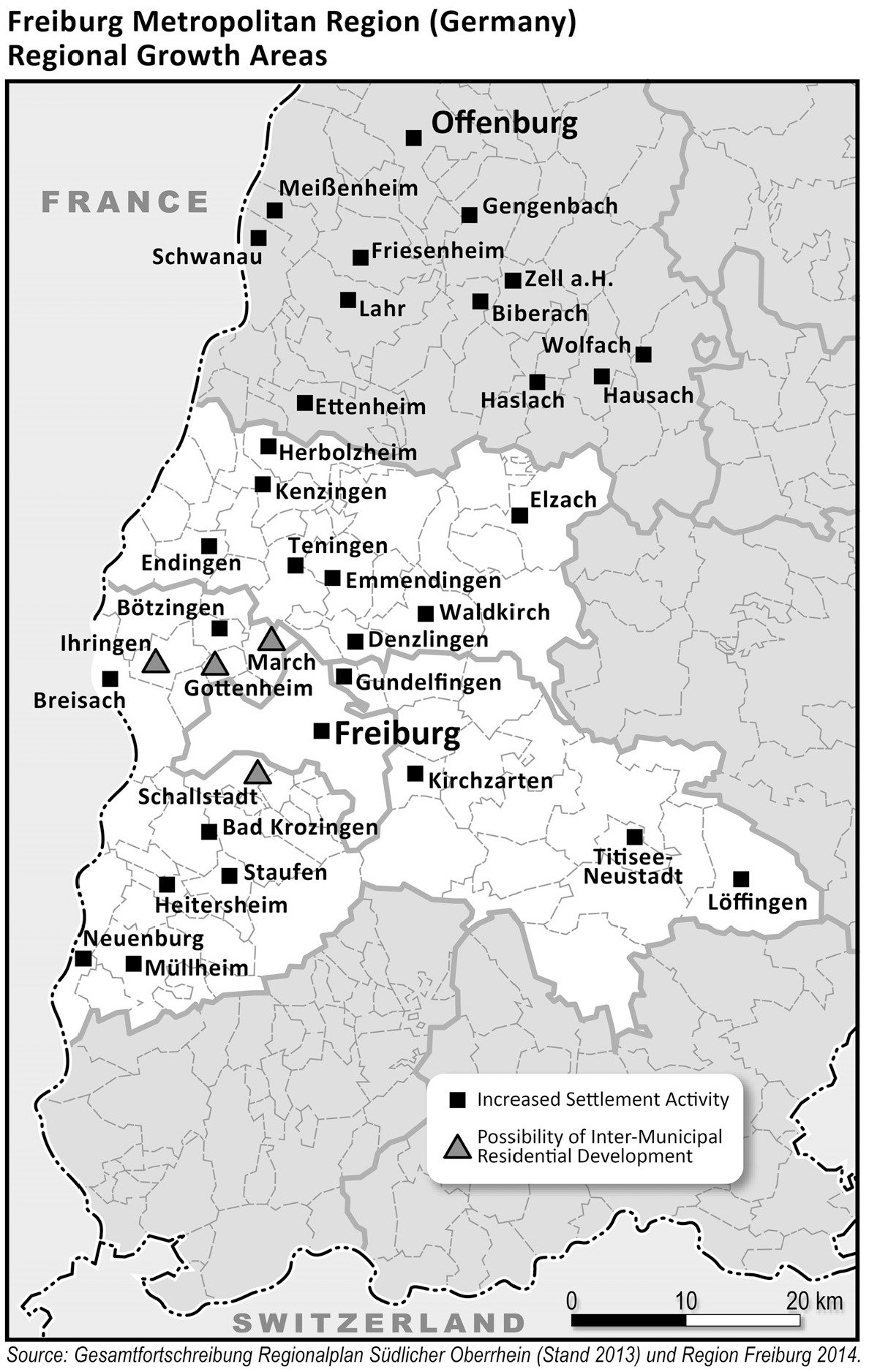
Freiburg region map.
Effective regional planning in the Freiburg region faces three central challenges: 1) the principle of subsidiarity gives planning authority and responsibility to local municipalities; 2) the principle of countervailing influence requires that higher-ranked, that is, provincial, planning authorities be respected at lower scales; 3) the strong reliance on market-mechanisms runs counter to democratic-administrative coordination.
The Upper Rhine Valley Regional Planning Association consists of a regional assembly and main administration, both located in the city of Freiburg. The regional assembly is empowered by the province (Baden-Württemberg) to be the regional decision-making body for planning matters, with 80 regional councillors elected from four districts. Not all of the 126 municipalities are represented, and mayors often participate ‘as [local] watchdogs rather than as regional politicians’ (interview with regional administrator, 19 May 2014), defending the interests of their municipalities against larger regional initiatives. Regional politics is a ‘difficult construct when [decisions are] in the end made by local politicians’ (interview with regional administrator, 19 May 2014). Regional planners, moreover, do not develop their own specific understanding of regional sustainability, but instead attempt to enact the principles developed in the province’s regional development plan.
In 2010, the regional assembly decided to revise the regional development plan that came into effect in 1995 (part of it dating back to the 1980s). In the current draft of the new plan, which is undergoing public comment, three categories of municipality have been proposed, representing different growth trajectories and different levels of environmental protection. The first category encompasses those municipalities that have potential for modest growth without significantly impacting the environment. The second category is comprised of municipalities that do not control growth and instead repeatedly expand their developable area. The third category is comprised of municipalities that exhibit little growth potential and currently have no plans to designate new areas for development. Under the new regional plan, growing municipalities (category two) are expected to be reduced from 56 (in 1995) to 40, thereby focusing population growth mostly along major transportation infrastructure (train lines and major roads). The regional plan, however, lacks a clear statement regarding sustainability and appears to be a rather weak instrument for regulating development, which is still predominantly determined by market mechanisms. This situation is largely a product of the fraught constellation of a regional assembly based on an amalgamation of local, rather than regionally oriented, interests, although it is also influenced by the self-conception of the planners who understand their responsibility to be to ‘just’ translate the abstract sustainability goals of Landesplanung (provincial planning).
As a consequence, the implementation of a regional sustainability transition extending beyond the borders of the city of Freiburg depends heavily on voluntary cooperation between Freiburg and its surrounding municipalities. Such cooperation is rare. For example, the mayor of a municipality designated for significant new growth only 23 kilometres from Freiburg told us: ‘Cooperation with Freiburg? Well. I have once talked informally with them’ (interview with mayor, 30 June 2014). The lack of cooperation between Freiburg and its surrounding municipalities, which has been confirmed by several other municipalities, occurs for a variety of reasons. In contrast to Freiburg’s international position as a green city (e.g. prominently represented at the Shanghai EXPO and at other international events), Freiburg’s politicians do not play a leading role in the greater Freiburg region (interview with regional administrator, 19 May 2014). Many municipal officials across the region feel distant from Freiburg due, in part, to the lack of an efficient regional transportation system that affects not only commuting patterns but also the building of social and political networks. Another obstacle to effective regional cooperation is political party affiliation. While the City of Freiburg was governed by a Green Party mayor (Bündnis 90/Die Grüne) from 2002 to 2018, most of the surrounding municipalities have long been governed by the Conservative Party (Christdemokratische Union or CDU). The political distance is not as great as it might first seem, however, as the Green Party in Freiburg sometimes cooperates with the Conservatives and pursues rather conservative objectives in local politics. At the provincial (Baden-Württemberg) scale, a Conservative–Green (CDU–Green Party) coalition has governed since 2016. The lack of significant policy transfer and coordination between the city of Freiburg and its surrounding region, despite obvious commuting, political and economic relationships, is not a simple matter of political obstacles and cleavages. It is, rather, based to a substantial degree in economic and cultural competitiveness. This defence of local territorial interests occurs both in Freiburg and in the municipalities of the region, and cannot be understood apart from the market economy and a growth-oriented housing market. Steady population growth in the Upper Rhine Valley has made the development and geographical distribution of new housing a major economic and political as well as cultural issue in the region. Many municipalities are re-zoning land in order to capture a greater portion of that growth, targeting both those in need of more affordable housing as well as a portion of Freiburg’s better-off middle class that seeks more space at lower cost. In a parallel fashion, Freiburg has harnessed its sustainability agenda to the wagon of high-end economic development. Municipalities across the Freiburg region are attempting to position themselves in an economic niche, especially with regard to the housing market. The net result is more suburbanisation and more commuting over increasingly long distances – an outcome that runs directly counter to Freiburg’s renowned sustainability policy objectives.
Calgary’s regional embeddedness
In the months leading up to the City Council vote on Plan-It, Calgary’s suburban development industry threatened to respond to Plan-It by shifting development beyond Calgary’s borders to the larger metropolitan region. The development industry’s threat was mostly empty, at least on a large scale, due to regional restrictions on water supply and infrastructure extension. But it did signal an understanding of the importance of the regional housing market as well as the long-standing strategy of threatening disinvestment to gain political leverage (Cox, 1993). And to the extent that an extremely weak regional planning regime was in place, the threat was not completely hollow.
The Calgary metropolitan region’s history of planning and governance has been fraught with conflict (Miller, 2016), even more so than that of the Freiburg metropolitan region. While the province of Alberta had a very strong system of regional planning in place from the 1950s to the early 1990s, this system was abolished as part of a major neoliberal policy turn in 1994. Prior to 1994, cities such as Calgary had had a very high degree of control over development beyond their borders, but from 1994 onwards strong regional planning was replaced with a quasi-anarchic system in which the only regional planning that took place was that which was formulated on a voluntary municipality-to-municipality basis. Not surprisingly, regional planning since 1994 has been highly ineffective, giving rise to considerable sprawl beyond Calgary’s borders. The level of conflict associated with regional planning and governance is considerably higher in the Calgary metropolitan region than it is in the Freiburg metropolitan region, but the central issues are strikingly similar. Decades of strict regional planning had starved the small cities, towns and rural municipalities of the Calgary metropolitan region of tax base, employment and commercial activity. Since the abolition of strong regional planning in the 1990s, their primary concern has been attracting investment to increase land values and property tax revenue while keeping costs and the overall tax burden to a minimum. Sustainability has not received strong support and, to the extent that it is associated with higher densities, restrictions on development, significant infrastructure costs and measures seen as inimical to ‘the rural lifestyle’, the sustainability agenda encounters outright opposition from significant parts of the larger metropolitan region.
Regional opposition to Calgary’s sustainability policies is most apparent in the inability of the Calgary Regional Partnership (the voluntary regional planning association, that was comprised of 17 municipalities in the Calgary region as of June 2009) to persuade all of its members to ratify the Calgary Metropolitan Plan (see Figure 2).
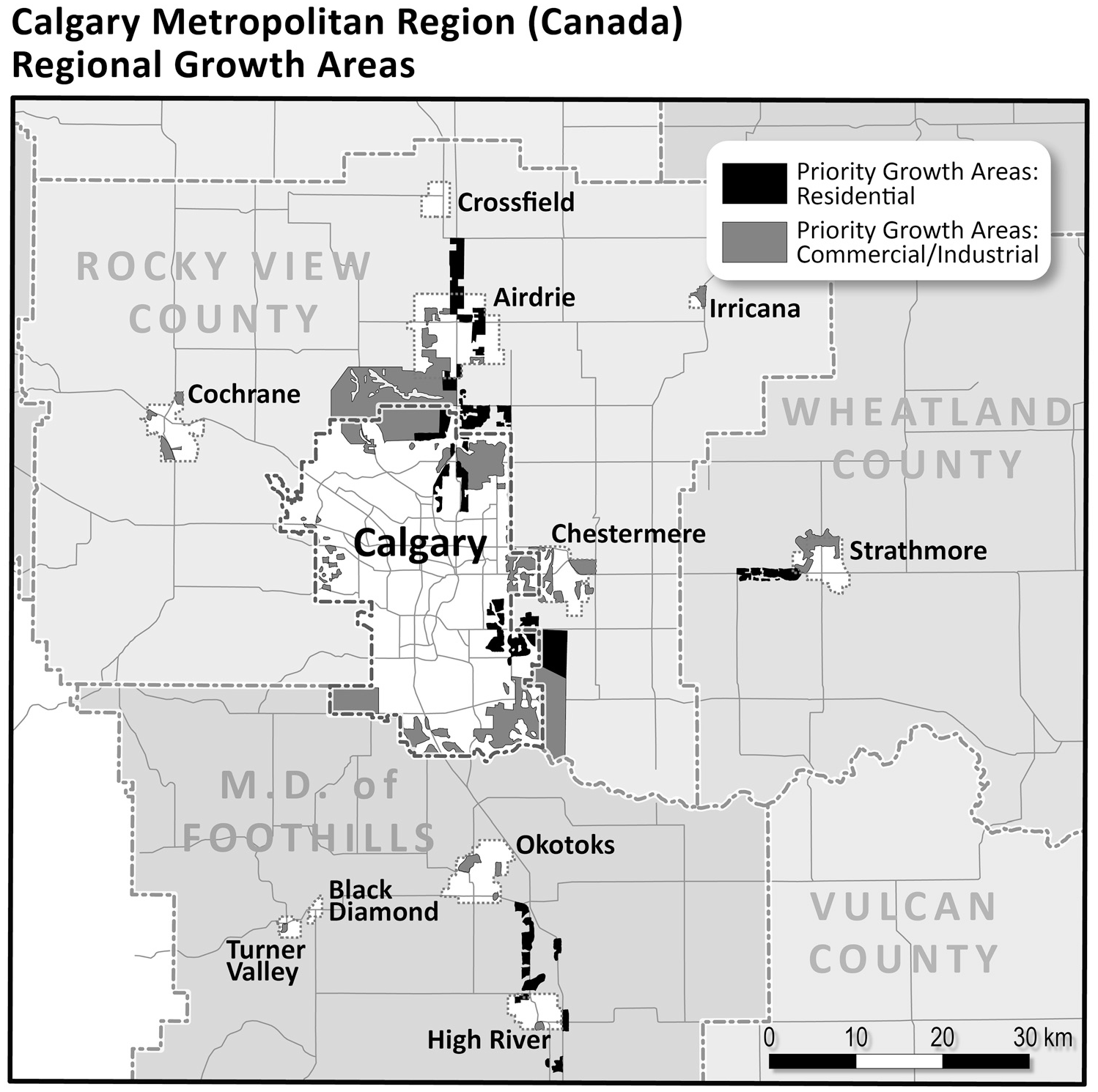
Calgary region map.
The Calgary Metropolitan Plan was drafted between 2007 and 2009 with citizen input from all municipal members of the Calgary Regional Partnership. The central principle guiding the plan was that growth and development should be coordinated across the entire metropolitan region. Practically speaking, this meant that the City of Calgary’s land use and development plan, Plan-It, and the broader regional plan, the Calgary Metropolitan Plan, needed to be coordinated and compatible. Indeed, the two plans were very much joined up, but ongoing opposition from some regional municipalities, including the largest jurisdiction bordering Calgary – the county of Rocky View – prevented its adoption. This means that the Calgary metropolitan region continues to operate without a regional plan 26 years after the abolition of Alberta’s previous regional planning system. The effect of this quasi-anarchic situation has been poorly coordinated development, the continuation of sprawl beyond Calgary’s borders – particularly to the west of the city – and increased commuting from bedroom communities to employment in Calgary. The lack of a common compatible policy framework undermines, and runs directly counter to, Calgary’s sustainability policy objectives.
Conclusions: Sustainability and counter-sustainability lessons from the Freiburg and Calgary metropolitan regions
While Freiburg and Calgary exhibit substantial differences in size, developmental history and political orientation, both demonstrate a profound disconnection from their regional contexts. The municipalities surrounding Freiburg often favour growth and new construction over densification, stricter energy standards and other approaches to reducing carbon emissions, contradicting Freiburg’s sustainable urban development agenda by promoting suburbanisation, commuting and soil sealing. Similarly, Calgary’s sustainability policies contrast with those of many surrounding municipalities which have adopted policies designed to attract as much growth and investment as possible, with a minimum of regulation. A further and very important parallel between Freiburg and Calgary is the relationship between each city and its surrounding metropolitan region: in both cases, the relationship is fraught with conflicting interests and objectives. Sustainable development in the greater Freiburg region has yet to be coherently addressed, leading to a variety of policies and practices that run counter to Freiburg’s ‘green city’ sustainability objectives. In a parallel fashion, Calgary’s more recently adopted sustainability agenda – primarily represented through ‘Plan-It’– has yet to see any significant uptake on a regional scale.
The mainstreaming of sustainability in both cities is accompanied by larger economic strategies aimed at reducing infrastructure and service provision costs and coping with the negative outcomes of urban growth. At the same time, both cities have used their sustainability agendas to reposition themselves within larger national and global systems of competition. At the forefront of these strategies are infrastructural improvements, technological innovations and smarter approaches to land use and transportation planning.
Despite their substantial differences in development history and form, the Freiburg and Calgary metropolitan regions are beset by strikingly similar conflicts over sustainability policy and governance. In each case, the region’s largest city has pursued a significant sustainability agenda as part of a larger strategy of economic development, cost containment and quality of life improvement. Freiburg’s and Calgary’s sustainability policies can be considered reasonably successful sustainability fixes (While et al., 2004). But considering the full spectrum of sustainability objectives – social, environmental and economic – from a broader process-based perspective, it is clear that both regions are falling short of achieving what might be considered a strong notion of sustainability.
Why have both regions fallen short of a strong, robust form of sustainability? The inability to coordinate sustainability policies beyond municipal boundaries plays an important role. The processes that shape cities and their social, environmental and economic sustainability do not end at municipal borders; the necessity of collaboration at the regional scale is obvious. In both the Freiburg and Calgary regions, the failure to develop coherent regional sustainability policies has multiple causes, including lack of institutional capacity (Healey et al., 2002) and conflicting territorial imaginaries and city-centricity, masked by the planning principle of subsidiarity. The lack of effective coordinating regional governance mechanisms becomes critical in the context of inter-municipal competition and a reliance on market mechanisms. Were the provision of essential goods, such as housing, coordinated through democratic institutions and guided by principles of equity and justice, inadequate provision of affordable housing would not be a widespread and persistent problem. In the context of insufficiently regulated regional housing and land markets, however, housing is distributed in accordance with land values and the ability of individual municipalities to develop strategies to capture particular segments of the metropolitan market. In lieu of comprehensive and effective affordable housing policy, sprawl becomes the de facto affordable housing policy, producing longer commutes, increased energy consumption and increased GHG emissions – all undermining core sustainability objectives.
Both Freiburg and Calgary illustrate how, in the face of weak institutions of regional governance and an almost exclusive reliance on market-based housing provision, ‘sustainability in one place’ policies may not only be weak, but may actually produce their opposite: counter-sustainability. Counter-sustainability practices may arise not only from the functioning of market mechanisms; they may also derive from policies deliberately designed and adopted by municipalities to enhance their ability to capture capital investment and tax base through inter-municipal competition.
Both the Freiburg and Calgary regions tell complex stories of dialectical relationships between sustainability and counter-sustainability policies. While Freiburg and Calgary have sought to enhance their economic situations through sustainability fixes, neighbouring municipalities have sought to enhance their own economic situations by adopting policies designed to capture different niches in the regional housing, commercial and industrial markets. These policies do not necessarily align with the principles of higher-quality, and generally higher-cost, sustainable development. A central paradox of actually existing sustainability (Krueger and Agyeman, 2005), then, is that it may produce its opposite outside its territorial container. These contradictory processes are hidden from view when sustainability is considered aspatially, but come to light when adopting a spatial-relational perspective.
The dialectic between sustainability and counter-sustainability is not, however, a given. It is a product of the operation of markets that respond to exchange value rather than human and ecological need, and of the mismatched territorial and scalar bounding of critical institutions of governance. Regional labour markets, agglomeration economies, infrastructure networks, cultures and attachments to place (Cox, 2010, 2011; Jonas, 2012; Keil et al., 2016) call into question the very local basis on which many, if not most, urban sustainability initiatives are advanced, with significant implications for the effectiveness of such initiatives. A central dilemma of the politics and planning of urban sustainability, then, derives precisely from its localist ontology and city-centric focus (see Angelo and Wachsmuth, 2015; Brenner and Schmid, 2015; MacLeod and Jones, 2011; Merrifield, 2013), which is at odds with the spatial constitution of many processes that underlie sustainability issues.
Governing for any strong notion of sustainability requires rethinking both the spatial organisation and the structural power relations that underlie urban and regional planning. That will require in-depth political debate over the design of key institutions of governance and resource allocation, not marginal adjustments in ecological modernisation policy.
Footnotes
Acknowledgements
We are indebted to Robin Poitras, cartographer of the Department of Geography, University of Calgary, and to Birgitt Gaida, cartographer of the Institute of Environmental Social Sciences and Geography, University of Freiburg, for their cartographic assistance.
Declaration of conflicting interests
The author(s) declared no potential conflicts of interest with respect to the research, authorship, and/or publication of this article.
Funding
The author(s) received no financial support for the research, authorship, and/or publication of this article.
