






Abstract
Tokyo’s suburban territory now forms part of an increasing multi-dimensional urban–suburban divide in socio-demographic, economic and political and administrative (fiscal) dimensions. Drawing on the Tokyo case we argue the need for theory to take more seriously shrinkage in suburban fortunes. Specifically, we highlight the double meaning of shrinkage as a complex, multifaceted and path-dependent process and as a municipal-level political and policy response. In this paper we offer a theoretical framework for understanding urban (sub)transformation attuned to Japanese conditions and, by extension, other developmental states. We go on to explore the multi-dimensioned isolation of Tokyo’s suburbs in terms of metropolitan-wide inter-governmental, inter-sectoral and inter-actor dynamics. In conclusion we observe the need for theory to be inclusive of the range of trajectories of suburbanisation and for politics and policy to adopt redistributive metropolitan spatial imaginaries.
Introduction
The importance of understanding processes of global suburbanisation has belatedly begun to be recognised (Ekers et al., 2015; Keil, 2017; Phelps, 2010). A focus on suburban transformation is apparent in work on retrofitting suburbia or fixing sprawl (Dunham-Jones and Williamson, 2009; Tachieva, 2010) and processes of post-suburbanisation (Phelps, 2015; Phelps and Wood, 2011; Phelps et al., 2006, 2010; Wu and Phelps, 2011). Relatively little of this literature on suburban transformation has focused on the prospect of outer suburban shrinkage increasingly likely to accompany the more widely recognised phenomenon of urban shrinkage or inner suburban shrinkage (see Hanlon et al., 2009; Martinez-Fernandez et al., 2016). It is to this issue that we turn in this paper when looking at the Tokyo case as something of a frontier of outer suburban shrinkage.
We examine the suburban territory of Tokyo Metropolis − the Tama Area. It is exclusively part of Tokyo Metropolis, while the Technology Advanced Metropolitan Area (TAMA) stretches over Tokyo Metropolis and Kanagawa and Saitama Prefectures (see Figure 1). Tokyo’s suburban territory consists of 30 suburban municipalities classified into 26 cities, three towns and one village under the Local Autonomy Act of 1947, in contrast to Tokyo’s urban territory called the Special Ward Area. As of 2018, it accommodates a large population of about 4.2 million within a vast area of about 1.2 thousand square kilometres. Tokyo’s suburban territory now experiences new path-dependent, multifaceted restructuring involving outer suburban shrinkage under a ‘back-to-the-city’ movement of workplace and residence taking place primarily since the early 2000s. Tokyo’s outer suburbs lie approximately 30–50 km from the metropolitan centre – beyond unrealised greenbelts pursued by the first National Capital Region Development Plan (NCRDP) of 1958. While there are no exact ways to define suburban spaces (Forsyth, 2012), we consider the Tama Area as Tokyo’s suburban territory because it has different political and administrative (fiscal) systems from the Special Ward Area (Ohashi, 2018).
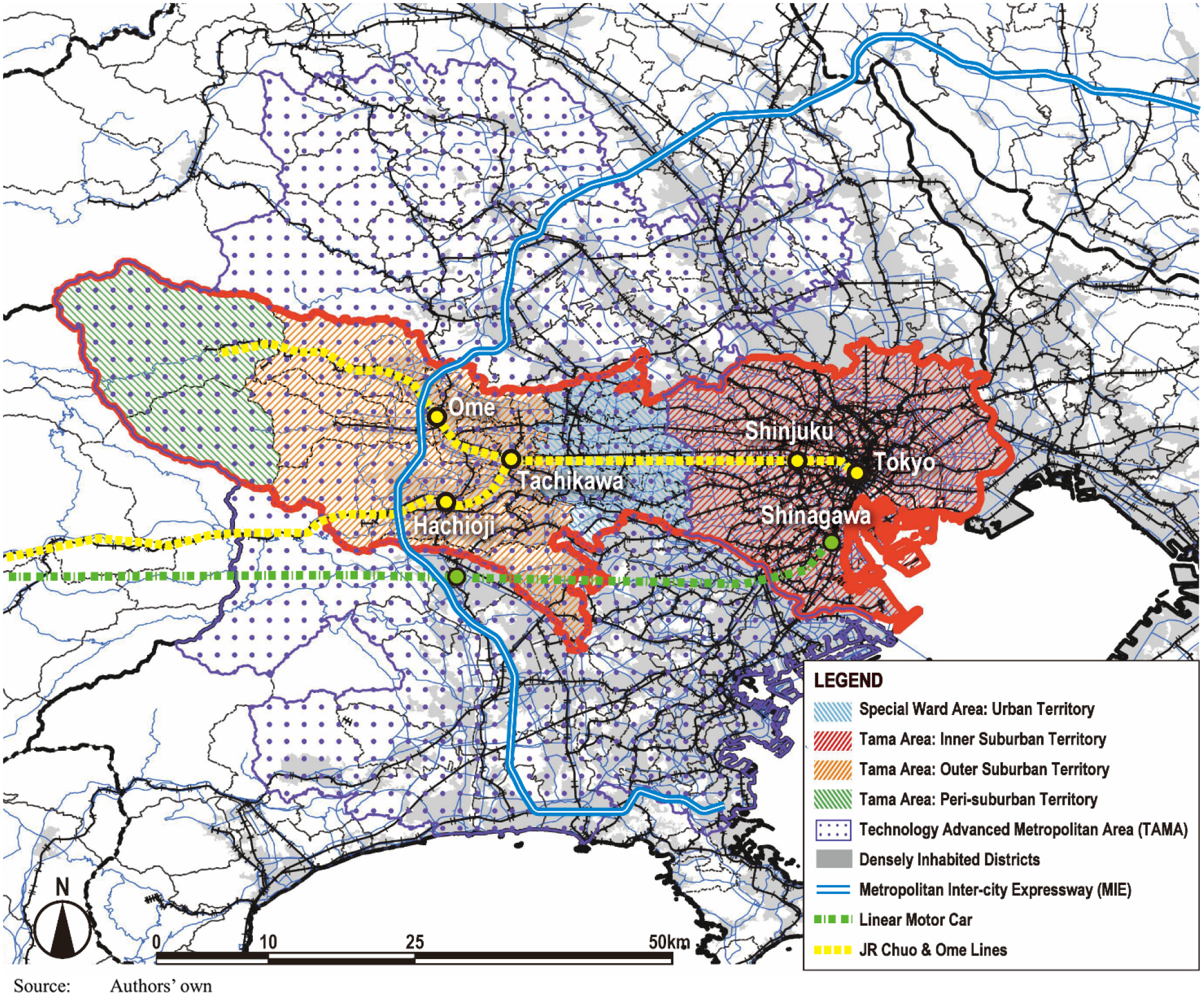
Tokyo’s suburban territory within a metropolitan context.
The (mis)fortunes of outer suburbs represent the important, but barely elaborated, analytical and policy agenda that is taken up in this paper. Until recently, shrinking cities have been little examined in Japan (Hattori et al., 2017), while some attention has been paid to suburban shrinkage in the Tokyo metropolitan area (see Kubo, 2015; Miura, 2017). However, Tokyo’s suburban territory has been less explored from the perspective of political and policy dynamics, even after the Institute for Tokyo Municipal Research (Institute for Tokyo Municipal Research (ITMR), 2011) raised the alarm over its shrinkage.
The Tokyo case affords an understanding of the dual nature of shrinkage as: (a) a multifaceted and path-dependent suburban transformation including shrinkage in stocks and flows; and (b) political and policy introspection. We adapt Phelps and Wood’s (2011) scheme of urban and suburban change to accommodate outer suburban decline and elaborating a framework particularly suited to the Japanese and Tokyo developmental state context. We then illustrate this framework drawing on extensive and intensive empirical forms of research. We investigate changes in the relative dynamics of Tokyo’s urban and suburban territories – a multi-dimensional urban–suburban divide – by investigating official secondary data sources in quantitative terms. We then explore the underlying mechanisms of this divide by way of a qualitative analysis of 45 interviews with 78 key informants with an emphasis on three case studies of outer suburban cities with contrasting trajectories (Ohashi and Phelps, 2020); for details of the informants, see the Appendix in Ohashi (2018). Interviews were a rich source of insight regarding processes of shrinkage and their determinants being recorded and lasting for at least 45 minutes and often more than 1 hour. Informants included academics, current and former public officials, private practitioners and representatives of non-profit organisations and local community groups from the three case studies of outer suburban cities but also organisations operative at the metropolitan scale. This paper emphasises the qualitative analysis of interviews which specifically pursued an understanding of political and policy shifts on inter-governmental and inter-sectoral dynamics in a suburban transition from growth to shrinkage and influences of these shifts on the private and community sectors as inter-actor dynamics. At the same time we paid careful attention to the positional shifts of Tokyo’s suburbs in the context of changing metropolitan politics and governance. In conclusion we identify the importance of analysing tales of decline within accounts of suburbanisation. Our framework draws attention to both the discontinuities and continuities in suburban (mis)fortunes between growth and shrinkage periods and the need to understand the multifaceted and path-dependent natures of the transformations involved.
Suburban fortunes: Elaborating tales of decline
Phelps and Wood (2011) proposed a variety of trajectories of suburban change with reference to some of the economic, demographic and policy drivers. They identify the following changes in suburban fortunes: (1)Post-suburb → City, (2) Growing suburb → Post-suburb → City, (3) Stable affluent suburb → Stable affluent suburb, (4) Declining suburb → Sub-suburb?, and (5) City → Suburb. Notwithstanding some limitations of this framework (Phelps, 2018), these different scenarios of suburban transformation are associated with distinct but also changing complexions of metropolitan and local politics (Phelps and Wood, 2011; Phelps et al., 2010).
This paper adds a new trajectory of ‘Post-suburb’→‘Shrinking suburb’. The term shrinkage indicates not merely socio-economic decline but the disintegration of a cohesive pan-suburban territory into isolated individual suburban territories. This ‘shrinkage’ trajectory differs from the ‘declining suburb’ trajectory where suburban regeneration possibilities remain, and instead takes on the meaning and significance of shrinkage as a process that is not the mirror image of growth (Galster, 2019), which may be dynamically non-linear and which can involve a political and policy regression of suburban communities – even those having recently reached the status of post-suburbs.
Working inductively from the Tokyo case, we can make two further theoretical contributions. First, one weakness of Phelps and Wood’s (2011) framework is that it remains oriented to understanding suburban growth rather than decline, such that we can posit the scenario of a reversal in outer suburban fortunes in which previously growing (post)suburbs can abruptly begin to shrink including in political and policy terms from wider connections and collaborations with their suburban neighbours. To address this sort of reversal, we look at the following ‘three Ps’ dimensions: (A) political and administrative (fiscal) (or
Second, the Tokyo case alerts us to the fundamentally multifaceted and path-dependent natures of changes in suburban (mis)fortunes. It becomes important to explore precisely what politics and governance arrangements are embedded in Tokyo’s suburban transformation since this will be vital to understanding the capacity for policy responses to outer suburban shrinkage. To address suburban politics and governance in the Tokyo setting, we consider the following ‘three Is’ dynamics: (A’)
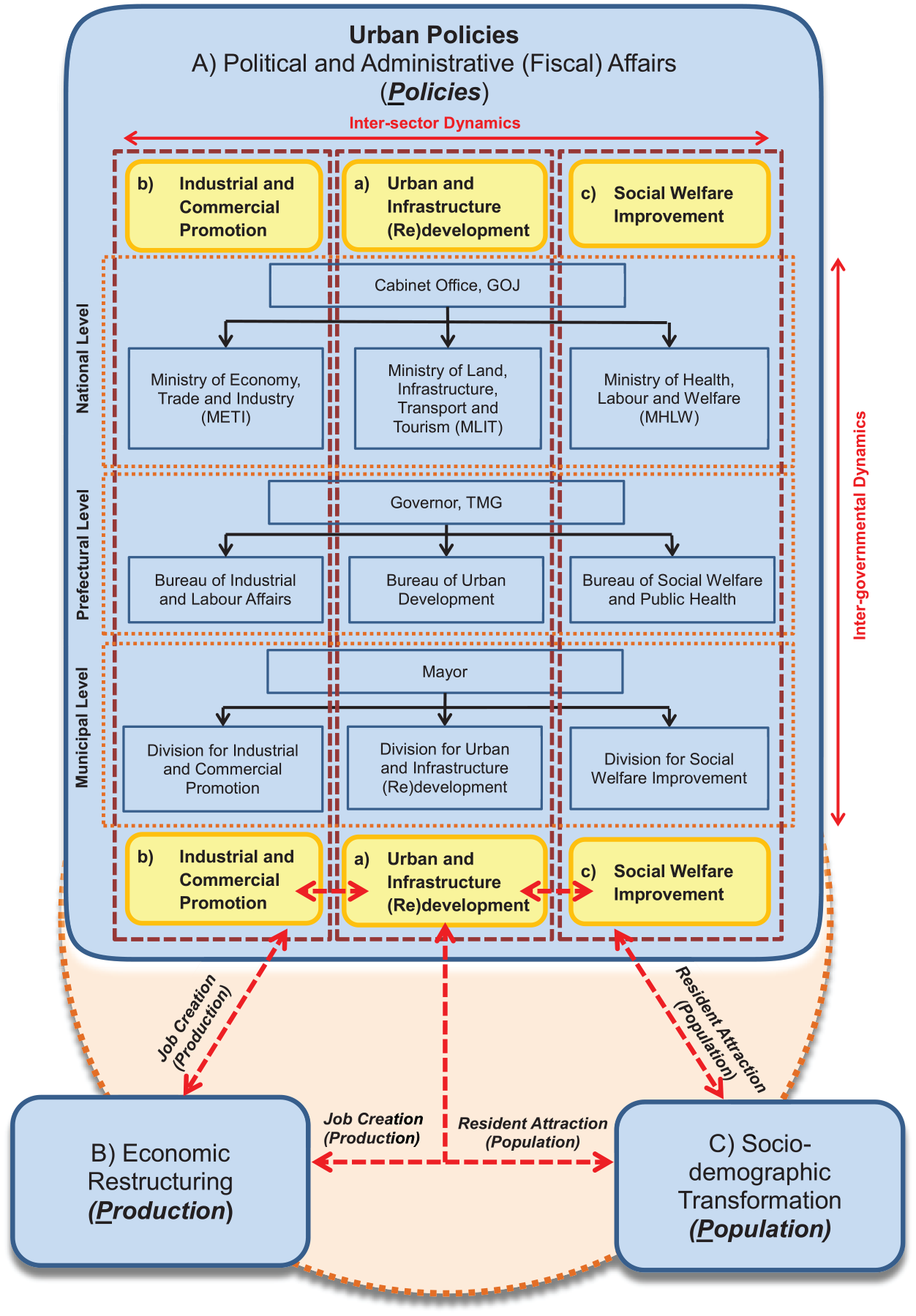
Linkages of the three urban policy domains to economic restructuring and socio-demographic transformation.
It is essential to address inter-governmental dynamics, in a situation where Japan has a three-tiered public administration system with national, prefectural and municipal levels, as shown in Figure 2. Suburban spaces have come to ‘internalize a contradictory regional politics – one held between the bounded territoriality of institutional structures and the unbounded nature of globalising urbanity’ (Keil and Addie, 2015: 909). Consideration of suburban transformations provides important glimpses of the contemporary complexity of metropolitics and governance. Phelps (2015) notes how the difficulty of bounding post-suburban communities necessitates consideration of the relational politics that operate upon and constitute them not least since different tiers of government show converging and diverging patterns of interest in suburbanisation processes. The point to draw from the Tokyo case is that these inter-governmental dynamics tend to change with the suburban transition from growth to shrinkage.
Inter-sector dynamics are important especially in the Japanese context. The centralised system of Japan has a distinct feature of over-compartmentalised bureaucracy – or ‘sectionalism’– among different policy sectors (Fukukawa, 1997). 1 Specifically, this research addresses the following three sectoral policy domains: (a) urban and infrastructure (re)development, (b) industrial and commercial promotion and (c) social welfare improvement. Broadly, at the national level, urban and infrastructure (re)development policies are administered by the Ministry of Land, Infrastructure, Transport and Tourism (MLIT); industrial and commercial promotion policies by the Ministry of Economy, Trade and Industry (METI); and social welfare improvement policies by the Ministry of Health, Labour and Welfare. This national-level administrative separation penetrates the prefectural and municipal levels of government, as shown in Figure 2. Again, inter-sectoral dynamics in any given governmental entity tend to change with the suburban transition from growth to shrinkage.
The three policy domains, which involve specific inter-governmental and inter-sectoral dynamics, are linked with economic restructuring (
Inter-actor dynamics must be explored, given that the range of stakeholders involved in suburban affairs continues to expand in ways that challenge the physical reworking of suburban space and the socio-economic dynamics operative on it (Phelps, 2015). The term governance emerges as a key analytical theme for understanding global suburbanisation (Ekers et al., 2015) in which inter-actor dynamics involving interactions amidst the ascendancy of business and community sectors become an important consideration. Here we draw attention in our framework to global/local differences in the scale dependencies of particular economic actors and traditional/new differences in the rootedness of particular social actors.
In what follows we first outline the sorts of suburban transformations that have occurred along the ‘three Ps’ dimensions. We then consider in greater detail the interactions among these ‘three Is’ dynamics as they have played into the transformations in Tokyo’s suburban (mis)fortunes.
A reversal of suburban fortunes
Tokyo’s suburban shrinkage has taken place amidst a ‘perfect storm’ of synchronised changes in the ‘three Ps’, involving international and domestic forces. On the socio-demographic side, while Tokyo Metropolis has experienced population ageing and decline (Mallach et al., 2017), this trend has more seriously damaged Tokyo’s suburban territory than the urban territory (for national and regional trends, see Ohashi, 2018). On the economic side, while Tokyo Metropolis has undergone industrial advancement alongside deindustrialisation, the suburban territory has suffered overseas transfers of labour-intensive production plants, notwithstanding the continuing agglomeration of command-and-control functions in the metropolitan centre. On the political and administrative (fiscal) side, Tokyo’s suburban territory has been increasingly dismissed (Phelps and Ohashi, 2020), given that the GOJ and the TMG have begun to stress the metropolitan centre since the early 2000s under a global competitiveness agenda (Hatta, 2006). While upper-level governmental entities have pursued polycentricity primarily since the 1980s, outer suburban Business Core Cities aimed at improving ‘suburban self-containment’ have largely failed (Phelps and Ohashi, 2020). Simultaneously, most suburban municipal governments have suffered increased fiscal limitations constraining policy actions. This coincidence of changes in the ‘three Ps’ has created the complexity of Tokyo’s suburban shrinkage with and the widening of the urban–suburban divide in the ‘three Ps’.
Given this continuing divide, Ohashi and Phelps (2020) analyse different trajectories of Tokyo’s suburban municipalities by analysing 44 variables (stocks and flows) from the ‘three Ps’ with the use of Principal Component Analysis and Cluster Analysis (see Appendix, available online). Figure 3 shows changes in the relative dynamics between Tokyo’s urban and suburban territories by utilising z-scores (standardised values) of flow variables. The growth period of 1975 to 1995 when the growing suburban territory had steadily caught up with the urban territory might be considered one of convergence in fortunes, and the shrinkage period of 1995 to 2015 when the shrinking suburban territory has been increasingly left behind under the revival of the urban territory might be considered one of divergence between them. Ohashi and Phelps (2020) find that shrinking processes are more complex than growth processes (Galster, 2019) such that the relative dynamics during the shrinkage period need to be carefully examined, as follows.
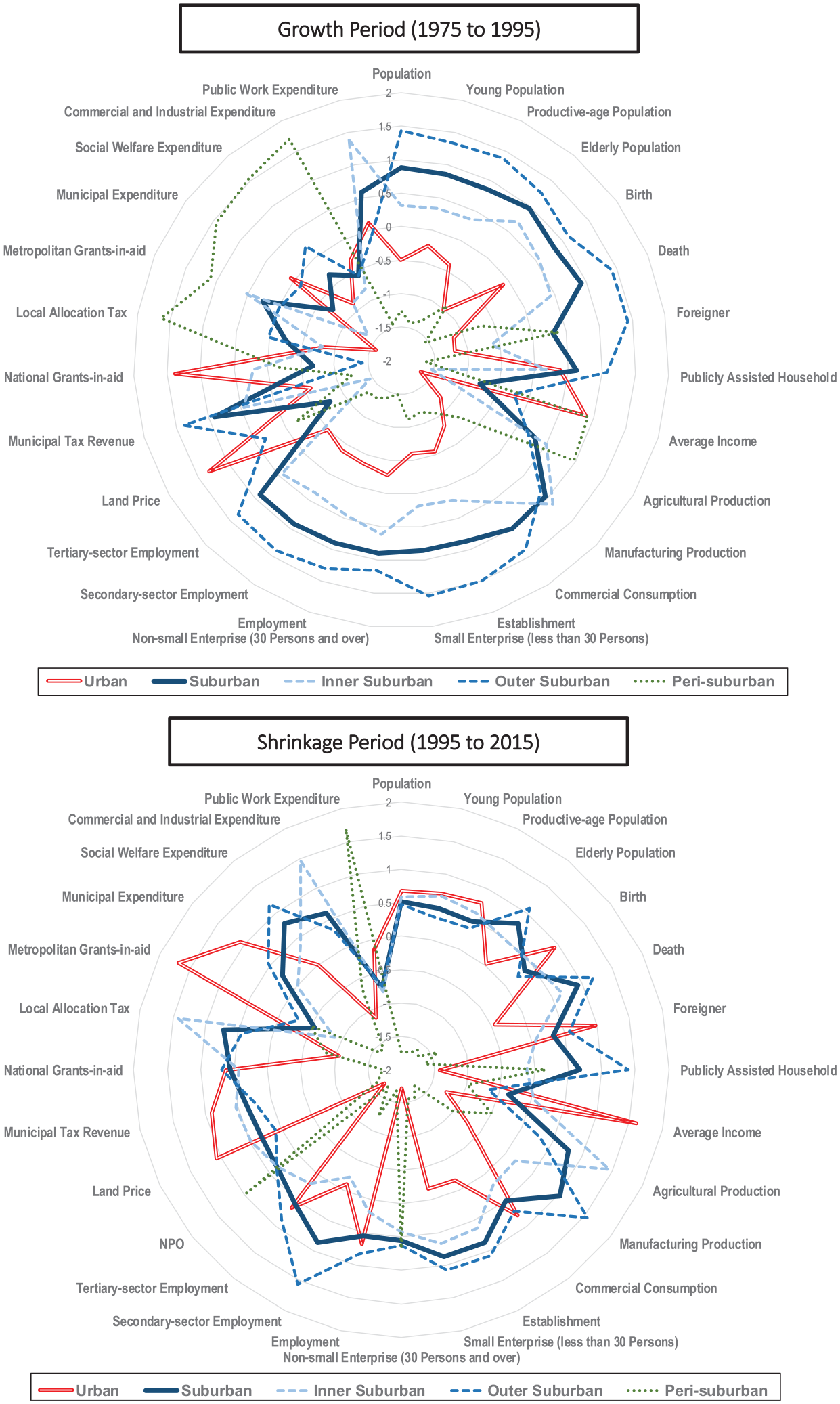
Reversal of dynamics between Tokyo’s urban and suburban territories from the ‘three Ps’ framework.
From a socio-demographic viewpoint, Tokyo’s urban territory during the shrinkage period has enjoyed a greater increase of population (especially in young and productive-age populations) with higher increases in the number of births and average income, compared with the suburban territory. This socio-demographic trend is a reversal of the growth period. From an economic viewpoint, while experiencing the greater decrease of manufacturing production under deindustrialisation, Tokyo’s urban territory during the shrinkage period has experienced a greater increase of employment (especially tertiary-sector employment) and commercial consumption in comparison with the suburban territory. This economic trend is a reverse from the growth period. From a political and administrative (fiscal) viewpoint, Tokyo’s urban territory during the shrinkage period has experienced a greater increase of municipal tax revenue with a remarkable increase of metropolitan grants-in-aid as financial support from the Tokyo Metropolitan Government (TMG), compared with the suburban territory. Notwithstanding increasing fiscal mobilisation in the urban territory, the suburban territory has confronted a remarkable increase of social welfare expenditure for medical and nursing care, which has had to be supported by increased local allocations of tax as financial support from the Government of Japan (GOJ). Without this support, most suburban municipal governments cannot afford to maintain their current levels of public affairs. This fiscal trend (especially in municipal tax revenue and metropolitan grants-in-aid) is also the reverse to the growth period. In sum, from the viewpoint of flow, all the socio-demographic, economic, political and administrative (fiscal) trends have reversed between the growth and shrinkage periods. At the same time, suburban shrinkage and urban regrowth during the shrinkage period take more complex modes of transformation than rapid suburban growth and slow urban growth during the growth period. Given that urban shrinkage has not been paralleled with suburban growth in Tokyo Metropolis unlike US cities (Sorenson, 2001), convergence and divergence are observed in relative, not absolute, terms. Because the absolute order of prosperity depends mainly on the time distance from the metropolitan centre, inner suburban decline witnessed mainly in US cities (Hanlon et al., 2009) is less relevant to Tokyo’s suburbs.
Conceptual understandings of urban decline have shifted toward those which emphasise processes of ‘glocalisation’ (Cunningham-Sabot et al., 2014; Martinez-Fernandez et al., 2016) and ‘spatial mismatches’ (Pallagst et al., 2014). This is relevant to Tokyo’s experience of outer suburban shrinkage and the urban–suburban divide, though causal relationships underlying the weakening of global–local and urban–suburban connectivity can be explored in greater detail below.
Understanding outer suburban shrinkage
We explore the underlying mechanisms of the urban–suburban divide in the ‘three Ps’. This may even amount to an urban–suburban–rural divide given suburban detachment from neighbouring provinces. 2 This divide in the ‘three Ps’ (as observable phenomena or effects) has been reciprocally generated by the metropolitan-wide dynamics of the ‘three Is’ (as underlying mechanisms or causes), namely: increased segregation in the inter-governmental, inter-sector and inter-actor dynamics. We refer to ‘suburban shrinkage’ as a product of complex, interactive processes between the ‘three Ps and three Is’ (see Figure 3). Our reference to shrinkage is more subtle and multifaceted than what is implied in the term balkanisation in the USA to refer to suburban governmental fragmentation. Tokyo’s suburban shrinkage is a case both of non-linear processes of suburban socio-economic decline and political and policy retrenchment in terms of urban–suburban and global–local connectivity. Suburban shrinkage is the political and policy internalisation of gradual contraction processes in the ‘three Ps’; namely a narrowing of social activities (with increased isolation of people such as the elderly with less mobility), economic activities (with increased confinement of economic circulation and trading patterns (Bogart, 2006) alongside increased local social welfare services) and administrative (including fiscal) activities (with decreased tax revenues and increasingly limited human and financial resources). It includes a narrowing of minds, thoughts and actions of municipal governments in policy making and implementation and consequent difficulties with inter-municipal collaboration – or the sort of psychological conservatism hypothesised by Galster (2019). Shrinkage derives from the spatial narrowing of the ‘three Ps’ spelling out the necessity of fixing the segregations in the ‘three Is’– specifically, institutional fragmentation in the policy sector of industrial and commercial promotion – to ensure collaboration among different actors for suburban economic development.
We developed the metropolitan-wide ‘three Is and three Ps’ framework in a sequential way. First, Ohashi and Phelps (2020) set up the framework solely for the purpose of quantitative analysis of the ‘three Ps’ with the use of 44 variables from the socio-demographic, economic and fiscal dimensions of the ‘three Ps’, as shown by red arrows in Figure 3. Then, this paper newly integrates the ‘three Is’ to develop the metropolitan-wide ‘three Is and three Ps’ framework enabling an investigation into the mechanisms underlying the quantitatively analysed phenomena of the ‘three Ps’. The ‘three Is’ were determined with consideration of the processes of policy making and implementation and their impacts on economic and social actors, and were also identified through interview interpretations as the key dynamics that embody Tokyo’s (sub)urban transformation. These ‘three Is’ are thus incorporated, or overlaid, into Ohashi and Phelps’s (2020) simpler ‘three Ps’ framework to develop the more integrated framework of the ‘three Is and three Ps’, which enables both qualitative and quantitative analysis on urban and suburban changes, as shown by blue arrows in Figure 4. Especially for qualitative analysis, the vital sphere of ‘Political and Administrative (Fiscal) Affairs (
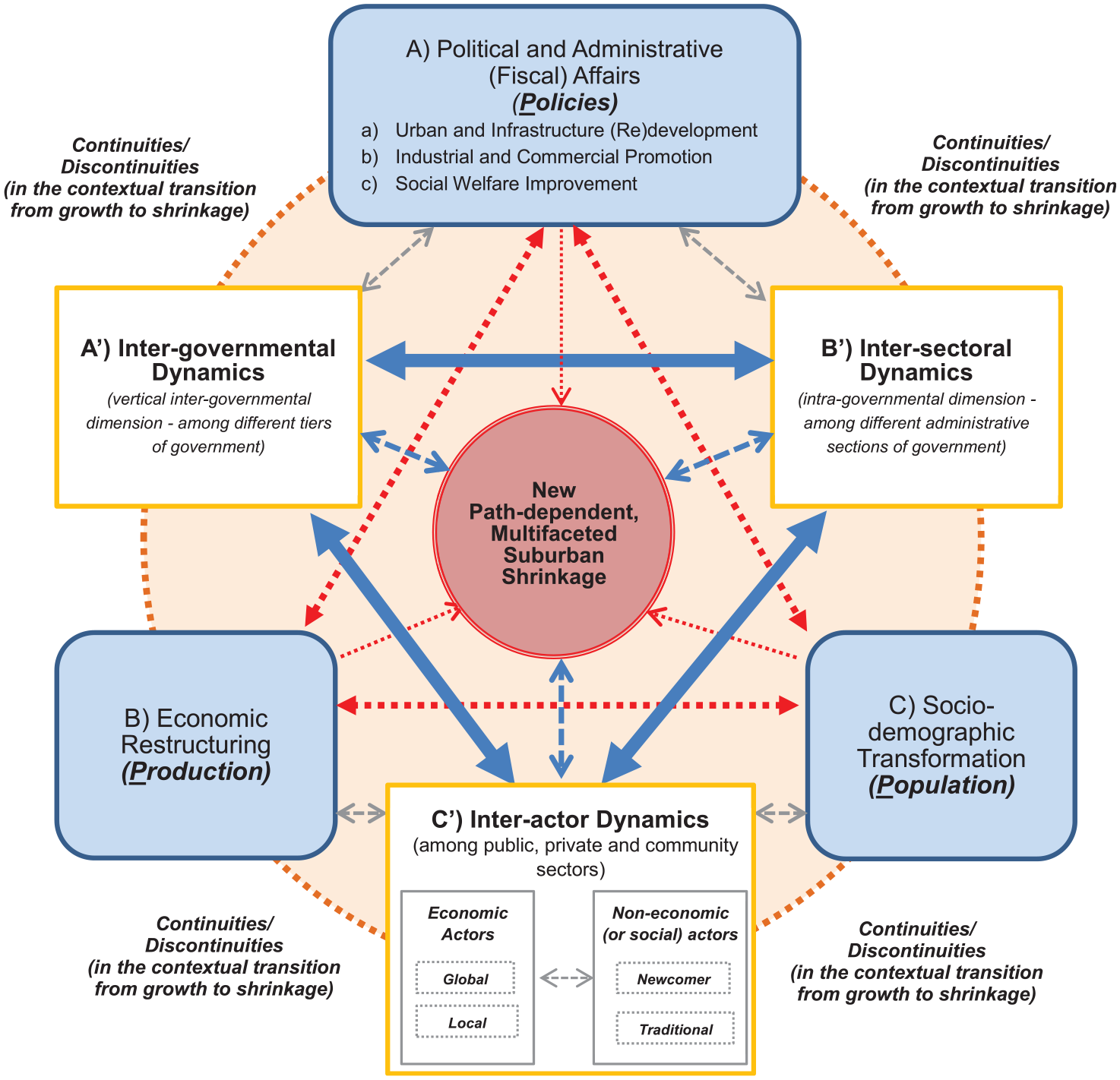
Metropolitan-wide ‘three Is and three Ps’ framework.
Tokyo’s suburban shrinkage is a product of the locational restructuring of different actors with different scalar dependencies (Cox and Mair, 1991) and selectivity (Jones, 1994). The actors that have the greatest scalar latitude include the GOJ and the TMG on the political and administrative side, global enterprises on the economic side, and higher-income households and footloose singles on the socio-demographic side. Those that have less scalar latitude include municipal governments, local small and medium enterprises (SMEs), and lower-income households and elderly people. The actors most able to refocus their attentions away from Tokyo’s outer suburbs have indeed done so – leaving the outer suburbs dependent upon those actors that are most locally rooted. We go on to investigate this locational restructuring of different actors with a view to changes in the ‘three Is’.
Inter-governmental dynamics
Since the 2010s, the revitalisation of provincial areas has become the important political and policy agenda of the GOJ. The GOJ enacted the Law on Revitalization of Cities, People and Jobs of 2014 and established the Headquarters for Overcoming Population Decline and Vitalizing Local Economy in Japan within the Cabinet Office in 2014 with an associated new ministerial position in 2015. Simultaneously, the GOJ has continued to stress the metropolitan centre. These twin foci of the GOJ are more interlinked than one might imagine since they have involved redistribution of increased tax revenues associated with the focus on the metropolitan centre into the provinces. TMG’s tax revenue has been partially redistributed to provincial governments. Moreover, the GOJ established the ‘hometown tax donation’ system in 2008, in which taxpayers can choose to divert part of residential tax to other local governments, especially those in the provinces. Tokyo’s local governments have been hurt by this programme (Nikkei, 2017).
The TMG has become increasingly spatially selective toward the metropolitan centre in light of concerns over Tokyo’s global competitiveness. The destiny of Tokyo’s suburban territory has been substantially dependent on policy directions of the TMG and the leadership of governors (Sasaki, 2011). However, governors have tended to stress the urban territory. A former public official of the TMG corroborated how: Governor Mr Ishihara (1999 to 2011), who was interested in the strengthening of global competitiveness, paid attention to the Special Ward Area and Okutama Area [peri-suburban area] without any interests in the Tama Area between them. He exemplified the Special Ward Area [with agglomerated command-and-control functions] as ‘Washington D.C.’ and the Okutama Area [with enriched natural resources] as the ‘Appalachian Mountains’. His only interest [in the Tama Area] is the opening of the Yokota Air Base for private-sector use [for global competition]. (Interview 21)
Suburban municipalities have continued to suffer from governors’ prioritisation. Despite the importance of suburban support for and votes in governors’ election campaigns often with a suburban focus, there is a long-standing sense of betrayal by respective governors and general neglect by upper tiers of government felt by suburban constituents (Interview 2: Tachikawa City Government; Interview 21: ITMR).
Inter-sectoral dynamics
The re-setting of inter-governmental dynamics has left municipal governments, local chambers of commerce and industry (CCIs), SMEs and communities to tackle suburban shrinkage alone. The urban–suburban divide has magnified to make Tokyo’s suburban territory less coherent within a wider metropolitan policy context, resulting in suburban municipalities feeling less able to share common visions and strategies required for a robust and timely response to shrinkage (Phelps and Ohashi, 2020). The effects of the aforementioned inter-governmental dynamics have become increasingly apparent in terms of the inter-sectoral policy dynamics operating upon Tokyo’s suburban territory.
Urban and infrastructure (re)development
During the period of suburban growth, the policy domain of urban and infrastructure (re)development had taken the lead role in suburban affairs at all tiers of government. Upper-level governmental entities, namely the MLIT and the TMG, had been active in infrastructure development, especially in the outer suburbs where industrial satellite cities were planned under the first NCRDP. Various infrastructures, including the Tama Monorail, were developed by the TMG to solve urban–suburban disparities (Interview 1: TMG). Importantly, within the TMG, there is a specific administrative section in charge of Tokyo’s suburban territory solely for the policy domain of urban and infrastructure (re)development.
However, entering the period of suburban decline, it is rare to find new large-scale developments in Tokyo’s suburban territory, except the recently opened Metropolitan Inter-city Expressway (MIE) (the outermost ring road of the Tokyo metropolitan area) and the Linear Motor Car (a magnetically levitated train to be developed between Tokyo and Osaka) (see Figure 1). Industrial area development along the MIE, such as the development of logistics and warehouse facilities in outer suburban Hachioji City, has been stimulated (Interview 37: Tama Shinkin Bank). However, the MIE may also have expelled some economic actors as a result of improved accessibility; an example is the outmigration of the production lines of Hino Motors, Ltd. Even though the Linear Motor Car station will be constructed near Hachioji City, there is no guarantee this will contribute to the revitalisation of Tokyo’s suburbs.
Although some public-sector infrastructure projects have been undertaken, Tokyo’s suburban territory has already shifted from public-sector-led infrastructure development to private-sector-led urban redevelopment. Areas surrounding suburban railway stations possess (re)development potential (Interviews 6 and 16: Academics) but have been dominated by residential and commercial development projects generating faster and safer returns rather than higher value-added economic functions.
Overall, the urbanisation phase, when urban and infrastructure (re)development brings economic and social prosperity, has already passed for Tokyo’s suburban territory. Decrepit infrastructures have become burdensome on municipal governments responsible for their operation and maintenance (Interview 24: Tachikawa City Government; Interview 30: Ome City Government). These infrastructure-related burdens have emerged at the moment that social welfare-related burdens have increased; municipal governments have adjusted fiscal capacities by reducing public works expenditures against increasing social welfare expenditures without noticeable changes in industrial and commercial expenditures (Ohashi and Phelps, 2020).
Industrial and commercial promotion
Historically, Tokyo’s suburban territory has been a vacuum of public intervention in the policy domain of industrial and commercial promotion. This lack of proactivity − apparent in both the private and public sectors − stems from its specific political and geographical positioning and the spatial distribution of industries. From the viewpoint of private-sector locational choices, large-scale enterprises have spontaneously concentrated in the metropolitan centre (Interview 42: Nishi Tama Network). During the period of suburban growth, suburban territory with proximity to the metropolitan centre of Tokyo had – without much public intervention – attracted the production plants and R&D facilities of large-scale companies, university campuses and offices for high-order service industries (Interview 28: Ome City Government; Interview 34: Ome CCI). The Law concerning Restriction on Factories in Existing Urbanised Areas of the Metropolitan Region of 1959 (repealed in 2002) had served to expel manufacturing facilities and university campuses from Tokyo’s urban territory. In this process, pre-existing suburban SMEs, including those in textile and military industries, could support those in-migrating industries, since SMEs’ capital – such as facilities, equipment and human skills – was flexible and adaptable enough to make close linkages with them (Interview 8: Hachioji City Government; Interview 34: Ome CCI). Tokyo’s suburban territory had previously succeeded in industrial and commercial promotion ‘spontaneously’ from the decisions of global enterprises.
From the viewpoint of public intervention, the GOJ has had regard for large-scale companies mostly in the metropolitan centre, and the TMG has supported SMEs mostly in Tokyo’s urban territory, resulting in their lesser prioritisation of Tokyo’s suburbs (Interview 39: Formerly TMG). As of 2017, since the TMG established the Tokyo SME Support Center in 1966, only one branch among 13 branches (except for its headquarters) lies in Tokyo’s suburban territory. Moreover, the Bureau of Industrial and Labour Affairs of the TMG has lacked resources in the sphere of economic development, because it originates from a regulatory function of the surveillance on labour management and administration at private companies (Interview 21: ITMR). Yet, the GOJ, namely the METI, has favoured Tokyo’s suburbs by starting an industrial cluster project with a target area of the TAMA in 2001 (see Figure 1). This project implemented by the TAMA Association has contributed to suburban economic development (Kodama, 2010) but has faced the retreat of the GOJ. Entering the ‘autonomous growth’ phase of the 2010s, the TAMA Association is required to achieve fiscal independence from the METI while simultaneously struggling with decreases in the number of members, revenue, human resources and know-how given turnovers in personnel (Interview 45: TAMA Association). In contrast to an industrial cluster project around Nagoya with the politically well-connected Toyota Motor Corporation, Tokyo’s suburban territory has few such corporate connections with the headquarters of the METI in the metropolitan centre (Interview 45: TAMA Association). The TMG has also continued to be less involved in this GOJ-led project (Interview 42: Nishi Tama Network). In addition, the TAMA Association has faced difficulties of strengthening large-scale enterprises’ participation and expanding local SMEs’ international businesses, as a general manager of the TAMA Association commented: Compared with business matchings among local SMEs, it is difficult to make connections between large-scale companies and local SMEs due to different business styles such as business speeds. … Large-scale companies have strict rules such as those related to confidentiality, resulting in a difficulty for local SMEs to understand what large-scale companies want. … The internationalization of local SMEs is difficult since our association and local SMEs have not possessed much experience and know-how about overseas businesses. We have not usually contacted and communicated with the Japan External Trade Organization and Japanese large-scale trading companies [in Tokyo’s urban territory]. When supporting local SMEs’ overseas business expansions, we have normally communicated with local organizations of the third sector in foreign countries. (Interview 45)
The project has not secured sufficient access to the GOJ, the TMG and global enterprises in the metropolitan centre. Under these circumstances, municipal governments have sought to nurture local SMEs rather than global enterprises (Interviews 28 and 31: Ome City Government), resulting in the historic failure of municipal governments to facilitate networking and partnering with large enterprises and to prevent the outmigration of their production plants and R&D facilities. Consequently, Tokyo’s suburban territory has failed to utilise urban capital for suburban economic development. Nevertheless, municipal governments have continued to be passive in the policy domain of industrial and commercial promotion, compared with the other two policy domains. Municipal governments have spent only 0.8% of their total budgets for industrial and commercial promotion – much lower than the 3.6% national average (Tama Shinkin Bank, 2010). In this regard, one general manager of the Tama Shinkin Bank commented: Municipal governments in the Tama Area have not been proactive in economic development. … Besides, their industrial and commercial administrative sections are often considered to be within part of civil services. Local CCIs are also busy only for local matters such as local commercial shops and festivals. … The Tama Area has failed to make the maximum use of the local potential of each area’s specific characteristics. (Interview 37)
Entering the 2000s, municipal governments began to enact local ordinances for industrial attraction. The ordinance for Hachioji City was made in 2004, being followed by those for Ome City in 2012 and Hino City in 2015, though Tachikawa City does not have an ordinance of this sort (Interview 2: Tachikawa City Government). The sluggish actions here are suggestive of the reactive nature of industrial and commercial promotion policy across suburban municipalities. Localised township revitalisation or area management activities have become active with the Act on Vitalization in City Center of 1998. However, these movements have barely influenced the promotion of economic circulation and trading beyond activities oriented to localised consumption. Overall, different tiers of government and related entities have worked in isolation for industrial and commercial promotion in Tokyo’s suburbs. Apart from the TAMA Association, entities such as the Tokyo SME Support Center and the Regional Industrial Cluster Association alongside the JR Ome Line have engaged in this promotion. Their projects have been implemented without much cooperation, resulting in a failure to create outcomes powerful enough to offset suburban economic shrinkage.
Social welfare improvement
As the annual budget of the GOJ has risen inexorably, the GOJ has withdrawn from Tokyo’s suburbs to reduce social welfare expenditure. It has eagerly promoted an in-home nursing care system – called the Integrated Community Care System (ICCS) – under a rhetoric that more localised systems are necessary for better-quality services with likely effects on the neglect of elderly people (Interview 26: Tachikawa City Government). Simultaneously, the TMG has recently restructured metropolitan hospitals in Tokyo’s suburbs under the Office of Metropolitan Hospital Management. A public official of Tachikawa City Government commented how: The GOJ has recently promoted the ICCS. This policy aims to reduce social welfare expenditure by promoting a shift from hospitalization to in-home care. It implicitly asks the elderly to close their lives at home without relying on medical care services of the public sector. Moreover, the TMG has tried to restructure metropolitan hospitals, resulting in the downgrade of medical care services in the Tama Area. … There is a disparity in medical care services between the Tama Area and the Special Ward Area. (Interview 26)
In addition, medical care planning by the TMG, in which only the urban territory is planned to provide advanced medical services, has de-prioritised Tokyo’s suburban territory (Interview 35: Ome City Government). The withdrawal of upper-level governmental entities has increasingly downgraded the quality of social welfare environments in Tokyo’s suburbs (Interview 26: Tachikawa City Government). Elderly people with less physical mobility are increasingly isolated with little transport accessibility to the centre of each suburban city (Interview 22: Academic). Municipal governments and other local actors are left increasingly to work for social welfare improvement.
As social welfare needs have increased across Tokyo’s suburbs, policy agendas and priorities of suburban municipal governments have narrowed to the local provision of social welfare services. Importantly, sectionalism acts as an obstacle to better industrial and commercial promotion. Notwithstanding that most social welfare industries in Tokyo’s suburbs can be considered ‘non-base industries’ targeting local markets (see Hepple, 2000), there are some signs that the policy domains of ‘industrial and commercial promotion’ and ‘social welfare improvement’ have been increasingly interlinked in Tokyo’s ageing suburbs with the expansion of social welfare markets. Social welfare industries can contribute to economic revitalisation through developments of advanced technologies for elderly and medical care and new forms of advanced social welfare society that might create new models of an ageing city. Since these technologies and services can be exported, social welfare industries can help create wider economic linkages even to global markets. However, suburban municipal governments have felt unable to position these industries as the main driver for industrial and commercial promotion because of their traditional positioning as part of local civil services. For instance, it is difficult for municipal governments to promote nursing care robots as a strategy of economic development even if ageing has left many suitable places for trials (Interview 42: Nishi Tama Network). The enduring sectionalism of government has been a continuity in political and administrative affairs and feeds into this disjuncture between the provision of social welfare services for local residents by social welfare administrative sections and the non-utilisation of social welfare industries as economic development instruments by industrial and commercial administrative sections (which continue to stress manufacturing, trading and commercial industries).
Inter-actor dynamics
Alongside the withdrawal of upper-level governmental entities, global enterprises have begun to retreat from Tokyo’s suburbs. This includes moves offshore. One general manager of a very large Japanese real estate company commented: Private developers have greatly benefitted through urban renewal projects in the metropolitan center since the early 2000s. However, office floor spaces have already been oversupplied, so there exists little new development potential. While the GOJ has attempted to attract foreign enterprises under the slogan of strengthening of global competitiveness, it seems difficult to do so, when looking at real outcomes after the advent of this slogan. Recently, foreign companies have chosen to reside in other major cities of the East Asia region such as Beijing, not in Tokyo, due to geopolitical reasons. … After the Tokyo Olympics 2020, the investments of our company will go toward overseas markets such as the US and UK. If we can take risks, we will make investments in growing East Asian countries such as China. Although the GOJ has tried to revitalize provincial areas, there are little business opportunities for us. (Interview 19)
Surplus profits gained through urban renewal projects have not been re-invested into either the suburban territory or provincial areas. Global enterprises have been increasing investments in overseas markets (Nikkei, 2016). Importantly, especially after the middle 2010s, the destinations of non-local actors’ interests have been diverging, namely: provincial areas for the GOJ, the metropolitan centre for the TMG and overseas areas for global enterprises, resulting in the isolation and weakened global connectivity of Tokyo’s suburban territory. Indeed, one very large bank discontinued part of its foreign currency-related services in outer suburban Tachikawa City and Hachioji City, consolidating activities into inner suburban Mitaka City.
Manufacturing companies have gradually retreated from Tokyo’s suburbs in a two-fold movement. Their offices and/or R&D facilities have been moved from outer- to inner-suburban areas, while those production plants that have not already been moved abroad in search of cheaper labour have out-migrated to neighbouring provinces. Simultaneously, Tokyo’s suburban territory has confronted a new stage of industrial restructuring. That is, R&D activities, especially those of large-scale electronic and/or machinery companies losing international competitiveness, have been reducing technical and research staff (Interview 37: Tama Shinkin Bank). The withdrawal of global manufacturing companies also reduces local SMEs’ opportunities for overseas business expansion.
Universities have begun to relocate suburban campuses into the urban territory to better attract new entrants, as observed in the case of the Faculty of Law of Chuo University in Hachioji City. The Tokyo Tomin Bank has closed some suburban branches (Interview 37: Tama Shinkin Bank). Foreign investors have dismissed Tokyo’s suburbs (Interview 19: Real estate company) under the trend that their investments increasingly take a form of portfolio investments rather than that of direct investments. Very little of the residential portfolios of Japanese Real Estate Investment Trusts is invested in Tokyo’s suburban territory (Aveline-Dubach, 2014). As such, outflows of private-sector capital from Tokyo’s suburbs have been faster than ever before.
The metropolitan-wide locational restructuring of non-local actors has induced the locational restructuring of local actors. The outmigration of global enterprises has triggered the outmigration of residents – especially those rooted in newcomer communities who have tended to work at their production plants or R&D facilities (Interview 43: Community group). Some local SMEs have followed their larger counterparts in migrating out of Tokyo’s outer suburbs (Interview 34: Ome CCI), triggering the outmigration of residents – even those rooted in traditional communities working for local SMEs. Taken together, the altered focus of the GOJ and the TMG and the outmigration of global enterprises have weakened relationships even among local actors and the local connectivity within Tokyo’s suburban territory.
Conclusion
Processes of suburbanisation are marked by a diversity of trajectories (Phelps and Wood, 2011). Among these, processes of suburban stasis and decline have been little elaborated. With reference to the world’s leading instance of generalised suburban decline, we identify the trajectory of ‘Post-suburb’→‘Shrinking suburb’. This trajectory is revealing of the sharp reversals of suburban fortunes that have taken place in the last decades across Tokyo Metropolis and which may yet affect other city-regions globally. The paper contributes to the development of theory when adding this specific trajectory. However, it also contributes when identifying the complexity of suburban fortunes. We developed the ‘three Is’ framework for understanding the interrelated nature of processes and policy effects as these shape Tokyo’s suburban fortunes. Here, we suggest that complex, interactive processes between the ‘three Is and three Ps’ result in a dual meaning of ‘suburban shrinkage’– as a multifaceted process of socio-economic decline and as a shrinking in the horizons of local politicians and policy-makers. While analysis and discussion of inter-governmental and inter-actor dynamics is familiar enough in the literature on suburbanisation, the Japanese and Tokyo contexts of our study also alerted us to the need to pay closer attention to the interactions among the ‘three Is’ and further those between the ‘three Is and three Ps’ than has hitherto been the case.
These metropolitan-wide dynamics of the ‘three Is’ have created a vicious spiral of suburban shrinkage, resulting in the multi-dimensional urban–suburban (extending to the urban–suburban–rural) divide through the spatial narrowing of the ‘three Ps’. Tokyo’s shrinking outer suburbs have lost some of the diversity, urbanity and economic networks which were acquired over previous decades of population and economic growth. Notwithstanding evidence regarding state rescaling (Brenner, 2004), public affairs of municipal governments who have continued to concentrate on local welfare provision as entities closest to communities have not been rescaled sufficiently to promote suburban economic development in the Tokyo case where the suburban territory has increasingly transformed from a place of production to a place of consumption with increased spending for social welfare only in local spheres. Importantly, where growing outer suburbs have been found to be more globally connected than often appreciated (Gottdiener, 1977; Muller, 1997), the notion of ‘suburban shrinkage’ emphasises a weakening of the global–local connectivity of suburbs partly through a weakening of metropolitan-wide urban–suburban connectivity.
Reconnecting Tokyo’s outer suburban economy in metropolitan, national and international spheres is critical to reverse this vicious spiral. However, Tokyo’s suburban territory has continued to be a vacuum of public intervention in the policy domain of industrial and commercial promotion. Even though the importance of this promotion has been increasingly recognised, institutional fragmentation for suburban economic development is the order of the day, resulting in a failure to utilise available resources, including those in Tokyo’s urban territory. While being important, bottom-up efforts to accelerate local economic development are unlikely to be sufficient. Rather, new spatial imaginaries and inclusive inter-governmental, inter-sectoral and inter-actor modes of governance are needed to generate new urban–suburban linkages and reverse present suburban fortunes. Suburban shrinkage in Tokyo Metropolis is likely to prevail in other suburbs in adjoining Kanagawa, Chiba and Saitama Prefectures. These suburbs are unable to secure linkages to the resources of the Special Ward Area, which require new types of inter-prefectural collaboration in industrial and commercial promotion beyond the current strategies of the National Capital Region Nine Government Summit Council as the existing inter-prefectural consortium. To maximise economic development potential across the Tokyo metropolitan area as well as Tokyo Metropolis, it is essential to reform institutional systems in the policy sector of industrial and commercial promotion to ensure urban–suburban linkages for new collaborations among different actors. The urgency and the needs may be different but metropolitan areas subject to population and economic growth and decline alike can both benefit from a redistributive metropolitics (Orfield, 2002) it would seem.
Supplemental Material
sj-pdf-1-usj-10.1177_0042098020975706 – Supplemental material for Suburban (mis)fortunes: Outer suburban shrinkage in Tokyo Metropolis
Supplemental material, sj-pdf-1-usj-10.1177_0042098020975706 for Suburban (mis)fortunes: Outer suburban shrinkage in Tokyo Metropolis by Hiroaki Ohashi and Nicholas A Phelps in Urban Studies
Footnotes
Acknowledgements
The author(s) express their sincere appreciation to the funding bodies described below.
Declaration of conflicting interests
The author(s) declared no potential conflicts of interest with respect to the research, authorship, and/or publication of this article.
Funding
The author(s) disclosed receipt of the following financial support for the research, authorship, and/or publication of this article: For this research, we received the John Crump Studentship (JC2017_38) and BAJS Studentship (BAJS_2016_34) from the British Association for Japanese Studies, Inoue Masaru Scholarship from University College London, a one-off grant from the Allan and Nesta Ferguson Charitable Trust (LPG/F/6779-18), and a travel study grant (6729) from the Gilchrist Educational Trust.

Supplemental material
Supplemental material for this article is available online.
Notes
References
Supplementary Material
Please find the following supplemental material available below.
For Open Access articles published under a Creative Commons License, all supplemental material carries the same license as the article it is associated with.
For non-Open Access articles published, all supplemental material carries a non-exclusive license, and permission requests for re-use of supplemental material or any part of supplemental material shall be sent directly to the copyright owner as specified in the copyright notice associated with the article.
