







Abstract
Since the ‘mobility turn’, urban researchers have advanced our understanding of the contentious and relational nature of cross-border policy learning. Extant research has revealed how policy ideas move through transnational networks, social interactions, and informal dialog, forming assemblages of policy learning. Despite this rich literature that centers policy learning on policy circulation, we know relatively little about how learning unfolds throughout the full trajectory of their localization as a policy process. We fill this gap by taking the policy cycle model as an analytical framework. We investigate the whole range of policy activities that shape and transform policy learning into concrete policy components through a series of interconnected, iterative stages of the policy cycle within urban policy mobility. Using the introduction of participatory budgeting in Vienna as an empirical case, we show how multiple types of learned lessons, drawn from diverse actors and sources of knowledge, become enmeshed, streamlined, and articulated into the formulation and implementation of an international best practice as a local policy. We conclude by highlighting some analytical advantages of this policy-oriented approach for researching urban policy mobility and suggest directions for future research.
Introduction
The question of how policy learning affects the localization of globally circulating policies has been central to our understanding of urban policy mobility. Within the policy mobilities literature, scholars from various disciplines, ranging from anthropology to geography, and sociology to urban planning (Harris and Moore, 2013; Healey, 2012; McCann and Ward, 2013; McKenzie et al., 2021), have captured how policy elites learn and move policy ideas from place to place through transnational policy networks, shaping interconnected urban processes and outcomes. Combined with new communication technologies and logistical means in transnational flows of knowledge, existing works consider that such cross-border interactions of policies with actors and institutions enable not only spatial, but also temporal compression of traveling policy practices (see Ward, 2024), featuring “ready-made, quick-fix, off-the-shelf policies from other jurisdictions or from private consultants” (McCann, 2011: 121).
Despite its value, the prevailing conception of policy learning within the policy mobilities literature is limited in explaining the concept’s multifaceted dimensions and varied influences on adapting traveling policy practices to the local context. While transnational policy exchange is an important source of knowledge in the global spread of best practices across cities, this perspective only partially describes the policymaking behaviors and learning activities of policy actors that primarily occur in the earliest moments of urban policy mobility. In practice, their localization will feature more complex adaptive dynamics and interactions, in which various learned lessons and their uneven deliberation flow constantly between its constitutive stages. In other words, the travel, mediation, and mutation of traveling policy practices through policy learning is more than the ideological predispositions of partisan or self-interested policymakers. Rather, it entails multiple forms of knowledge exchange between a diverse range of policy actors from different governance levels with varying capacities to influence specific policy components, including objectives, instruments, resources, and procedures. Together, they will have a specific consequence for the policy process through which urban policy mobility unfolds.
In this article, we explore various types of policy learning in urban policy mobility and their actual contribution to the policy process. Our purpose is to show how diverse learned lessons, derived from multiple sources of knowledge, become differently enmeshed, streamlined, and articulated into the local formulation and implementation of a traveling policy practice, extending beyond the introduction and adoption of its abstract idea and simplified narrative of success. Drawing on insights from policy studies, we argue that the capacity of policy actors to overcome emerging political, technical, and operational constraints in the policy process will significantly influence their ability to apply the knowledge gained in policy formulation and implementation. Indeed, there are growing considerations into the ‘topological’ influences of local policymaking on urban policy mobility (McKenzie et al., 2021). However, the relationship between policy learning and the shaping of the actual policy process, influenced by context-bound social and political interactions in local policymaking, remains underexplored in the current policy mobilities literature.
The case of participatory budgeting for climate adaptation (Wiener Klimateam) from Vienna, Austria, illustrates our theoretical approach empirically. In recent years, the global circulation of participatory budgeting (PB) has gained considerable attention within the policy mobilities literature and beyond (see Bartocci et al., 2023; Lehtonen, 2022; Montero and Baiocchi, 2022). While these studies have identified their diverging characteristics in terms of background, objective, and design, they have dealt limitedly with the interactive and iterative policy processes through which policy actors build knowledge to frame issues, choose instruments, implement solutions, and organize their evaluation. In this light, the empirical findings below trace how different learned lessons are taken up, adapted, and integrated across five distinct – yet interrelated – stages of Wiener Klimateam: (1) issue-framing; (2) instrument selection; (3) participatory process; (4) output implementation; and (5) evaluation. The discussion of these findings will connect the recent theoretical advances in policy studies on policy learning with the state of existing knowledge on urban policy mobility within urban studies.
Policy learning in urban policy mobility
The current understanding of policy learning in urban policy mobility emerged from the call to rethink global policy circulation beyond simple cross-border emulation of policy solutions and to consider the power-laden process of their reproduction at the urban scale (see Cochrane and Ward, 2012; McCann, 2011; Peck, 2011). The conception of policy learning within the policy mobilities literature after this “mobility turn” (Sheller and Urry, 2006) can be summarized as follows.
First, powerful policymakers who strive to advance their political or personal agenda selectively choose and adopt from policies that circulate through growing transnational policy networks and exchange opportunities (see Baker et al., 2016). In this process, policy experts beyond the immediate local policymaking circle, such as consultancies, think-tanks, and universities, as well as international, supranational, and non-governmental organizations, play a crucial role in framing expert knowledge and promoting model practices across borders (see Andersson and Cook, 2019). The underlying argument is that “urban politics…is…global or international in a much deeper sense” (Ward, 2018: 279), invoking the mutually constituted and relational aspect of urban policy mobility.
Second, the actual effect of learning in urban policy mobility on local policymaking is therefore minimal. The content of policy learning that is drawn from policy expertise, designs, and recommendations of “epistemic communities” (Haas, 1992) is limited to success narratives of abstract policy ideas rather than a concrete institutional reform agenda and its specific policy mechanisms (see Montero and Baiocchi, 2022). Here, the selective definition of policy success becomes a rhetorical device to mobilize political support and resources for a specific policy agenda, which may, however, falter amid various contextual constraints and – despite some generative effects (see Baker and McCann, 2020) – fail to materialize anticipated outcomes (see Stein et al., 2017).
Third, existing contextual barriers for urban policy mobility imply that many aspects of mobile policies are in fact difficult to transfer beyond their places of origin. While most obvious examples include regulatory frameworks, institutional arrangements, and physical infrastructures that are path-dependent and fixed in place (see Silva and Ward, 2025), the literature has increasingly reflected upon deliberate attempts by policy actors to purposefully render undesired elements invisible from the policy success – or failure – stories (see Lovell, 2019). Therefore, policy learning in urban policy mobility is constructed not only geographically and historically, but also “through socially contextualized means” (Peck and Theodore, 2015: 28), discursively forming policy imaginaries and specific learning patterns (see also Temenos and McCann, 2012).
Issues and gaps
The ‘mobility turn’ in these writings has generated significant scholarly contributions to our understanding of policy learning in urban policy mobility, highlighting its contentious and relational nature. However, a few issues and gaps remain, limiting a more systematic reflection on complex interactions and processes between actors, institutions, and their ideas and interests, in the real-world context of policymaking.
The first concern is the limited consideration of the path-shaping role of the broader circle of policy actors in urban policy mobility, including citizens, civil society organizations, and street-level bureaucrats, whose influence extends beyond the mobilization of support for or against traveling policy practices. Certainly, there has been growing attention to the intermediary role of non-elite policy actors in civil society and their expertise in shaping the translation of mobile policies into local contexts (see Baker et al., 2020). Yet, most of the discussion has been restricted to their activities in advocacy for, or resistance to, policy adoption outside the policymaking arena, failing to situate their actual roles in contributing to concrete policy components within the overall policy process (see Lauermann and Vogelpohl, 2019).
Second, the diversity of policy actors who are – although unevenly – present across the policy process indicates that policy learning in urban policy mobility can occur in multiple ways, with lessons drawn from various sources of information about different aspects of policymaking. Recognizing this multiplicity of sources, particularly in terms of their content and timing, has important implications for understanding how key decision-makers select information from a vast amount of emerging knowledge, transform those lessons into policy instruments, and utilize them at specific policy stages. Much is indeed said about how such piecemeal learning frames and moves – or fails – traveling policy practices as a whole (see Pitton and McKenzie, 2022). Despite growing attention to “multiple temporalities of learning” (see Wood, 2022: 139), the literature has seldom explored the connection between policy learning and the actual policy activities that forms concrete policy components and puts them into practice.
Third, context in the policy mobilities literature commonly refers to the geographical, institutional, and social embeddedness of global policy circulation within the relational politics of scale-making (see McKenzie and Aikens, 2021; see also Robinson, 2015). That said, the territorial dimension of urban policy mobility also entails sets of multifaceted competences (skills) and capabilities (resources) that challenge the ability of policy actors to understand burgeoning social problems, formulate their policy solutions, and implement them at the street-level (see McLean and Borén, 2015). So far, the contextual understanding of urban policy mobility has revealed little about the role of policy capacity – the “set of skills and resources necessary to perform policy functions” (Wu et al., 2015: 166) – and practical obstacles in relation to case-specific factors, such as problem tractability, technical complexity, and implementation structure, influencing the effective translation of learned lessons into the evolving policy process.
Situating policy learning in the local policymaking context
The main interpretation of policy learning within the policy mobilities literature developed in response to the limitations of earlier political science concepts, namely, policy transfer and diffusion (see Dolowitz and Marsh, 2000). Since then, however, a much wider literature on its multidimensional characteristics has emerged, aiming to decipher the ambiguous relationship between their contributing factors and transformative effects (see Dunlop et al., 2018). These writings challenge the common assumption that policy actors possess an innate capacity to learn, whether superficially or deeply, offering a more nuanced understanding of diverse learning patterns and their implications for the actual policy process along the following analytical dimensions.
Actors
Policy actors encompass all possible individuals, groups, organizations, and networks who make both direct and indirect contributions to policymaking at any point in time (Howlett et al., 2020: 92). Within this broad policy landscape, epistemic communities are known to constitute an important issue-framing subset of policy actors in cross-border policy learning (Dunlop, 2009). Yet, their epistemic authority may not always extend to other interconnected policy activities, such as instrument selection, decision-making, and implementation. This is because these demand specific sets of policy capacity at political (e.g. administrative oversight and authority), technical (e.g. data access and interpretation), and operational (e.g. multistakeholder collaboration and coordination) levels, often residing within specific government departments and agencies (see Capano et al., 2024). Furthermore, the increasing collaborative nature of urban policies underscores the importance of citizens and civil society organizations, as well as their deliberative influence in knowledge production across multiple decision points in the policy process.
Sources
As a policy process, urban policy mobility inevitably involves a deliberate act of decision-makers to process some kind of knowledge that will, in one way or another, influence the succeeding policy pathway (see Chindarkar et al., 2017). While important, international best practices are not the only source of evidence and information in this process. As modern policy studies acknowledged, decision-makers draw extensively on past experiences and similar efforts within their own jurisdiction, relying on established institutions and existing instruments to utilize available knowledge about previous policy frameworks and actions (see Dussauge-Laguna, 2012). As traveling policy practices become formulated into, and implemented as, local policies, they further acquire new information from monitoring and evaluation of the ongoing implementation process (Vedung, 2010). This iterative learning in turn provides them with an adaptive knowledge base for in-process assessments, in-flight adjustments, and ex-post changes in subsequent policy cycles (Nair and Howlett, 2016).
Types
The diversity of actors and sources implies that policy learning in urban policy mobility does not follow a uniform pattern. Instead, its nature and content will vary depending on who is “teaching” and “learning”, what kind of knowledge is being acquired, and at which stage of the policy process it occurs. In some cases, learning centers on the acquisition of problem-centered knowledge to frame policy issues at stake and to set corresponding objectives (Problem Learning; see Dunlop, 2010). In others, it can focus on understanding the means-ends connection between policy instruments and their anticipated outcomes (Instrumental Learning; see Simons and Voß, 2018). Learning can also take the form of navigating institutional dynamics and political complexities, which pertain to the working relationships between relevant governmental actors and their efforts toward effective policy delivery (Political Learning; see Howlett et al., 2015). Lastly, more fundamental forms of learning can emerge from multi-stakeholder collaboration with actors at and across different governance levels, influencing decision-makers’ political-ideological frame of reference to make transformative changes (Social Learning; see Siddiki et al., 2017).
Taken together, these intertwined dimensions of policy learning provide a more comprehensive framework of analysis to examine the concrete policy activities through which traveling policy practices become not only locally embedded but also converted into tangible measures for on-the-ground implementation. This policy-oriented perspective on urban policy mobility is thus particularly valuable for revealing which learned lessons become which policy components, under what enabling or constraining conditions, and how the wider policy universe experiences the resulting outputs at the street-level. The following analysis illustrates an empirical application of this approach.
Case study setting and methods
Participatory budgeting (PB) refers to democratic initiatives that aim at empowering vulnerable social groups in budgetary decision-making, enabling bottom-up governance priority setting and public investment proposals focused on the most urgent urban needs (de Sousa, 1998). Since its inception in Porto Alegre, Brazil (1991–2004), the core idea of fostering public deliberation around the use of public funds has spread to thousands of cities worldwide (Bartocci et al., 2023). Following multiple waves of diffusion and adaptation, the current trend in European and Northern American contexts emphasizes civic education and governance efficiency through larger-scale, open-to-all processes with substantial political support and financial resources, although face-to-face, forum-based engagement has been traded for digital participation (Wampler et al., 2021).
Wiener Klimateam, Vienna’s citywide PB led by its Energy Planning Department (MA20) since 2022, reflects this emerging trend at the intersection of the city’s expanding participatory governance efforts and its structural transformation toward socio-ecological sustainability. Since the 1990s, Vienna has witnessed an increasing number of migrants excluded from municipal and national elections, contributing to a widening participation gap. This democratic deficit has been particularly visible in the city’s built-up inner-city districts, which faced heightened climate-related risks alongside relatively higher levels of socio-economic inequalities and limited access to urban green infrastructure. In response, the municipal administration has experimented with diverse participatory instruments through public consultation and collaboration at the local level, enabled by highly institutionalized grassroots organizations and strong administrative roles of the district offices (see Ahn and Mocca, 2022).
While embedded in the city’s broader climate strategy toward citizen engagement in environmental governance (Vienna Municipal Administration, 2019), the initial design of Wiener Klimateam emerged from collaboration within the climate innovation initiative of the European Institute of Innovation and Technology, Climate-Knowledge and Innovation Community (EIT Climate-KIC), which helps local governments to partner with a wide range of civil society and private stakeholders to co-create climate solutions. It involved MA20 and an international non-profit organization with experience in similar budgeting initiatives across Europe. It shares several design features that are common to recent examples of PB in European cities, in terms of objectives (democratic awareness-building/governance innovation), tools (digital participation) and resources (strong government support; see Wampler et al., 2021). Yet, as we highlight below, this transnational learning has undergone significant adaptation and modification through Vienna’s own local policy networks, administrative structure, and internal evaluation processes. Despite sharing some implementation challenges with other cases (Sinervo et al., 2025), it ultimately produced a PB model with its own distinct nature and localized content.
In brief, Wiener Klimateam takes place annually in three districts, sharing a total budget of €6.5 million, and consists of the following key phases: (1) anyone with an idea relevant to climate adaptation or mitigation in one of the participating districts can submit their proposal, either online or offline; (2) experts from the municipal administration and district office review the submitted proposals and prepare a shortlist based on their feasibility, foreseen impact, and alignment with the city’s climate goals; (3) citizens whose ideas are shortlisted collaborate with experts to co-create and further develop their proposals into concrete projects; (4) citizens’ juries evaluate the co-created proposals and select the final projects for implementation; and (5) the district office hands over the final projects to relevant municipal departments, responsible for their implementation over the following two years.
Our analysis focuses on one of the three pilot districts from the first Wiener Klimateam cycle (2022–2024), Margareten, chosen as a case due to its high participation gap, dense population, and limited access to green spaces (Ahn et al., 2023). The findings highlight the diverse forms of policy learning by the key Wiener Klimateam members within MA20, based on actors, sources, and types, revealing how these specifically informed concrete policy activities within and across its five core stages: (a) issue-framing; (b) instrument selection; (c) participatory process; (d) output implementation; and (e) evaluation (see Figure 1).
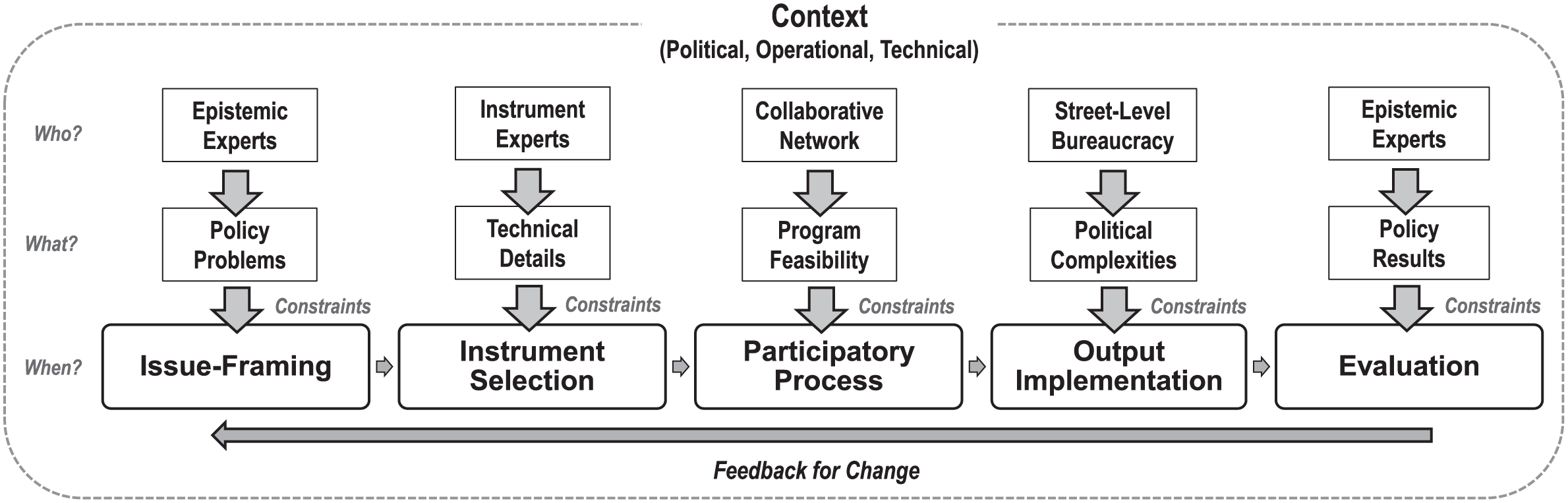
A heuristic model: the flow of knowledge in policy learning within Wiener Klimateam.
We examined policy learning from the perspective of the key Wiener Klimateam members, involved in each interview round, workshops, and ongoing informal communication, through the following steps: (i) document analysis of four official preparatory materials combined with a first round of expert interviews (n = 6), including the program’s advisory board members, to identify which knowledge shaped the definition of policy problems and the formulation of program objectives; (ii) a second round of expert interviews, including the immediate program stakeholders (n = 8), to identify which best practice instruments were selected and how they were adapted to the local governance context; (iii) structured observation of the co-creation activities, guided by process evaluation criteria (task definition/independence/structured decision-making) to identify which interactions between citizens and experts produced collaborative outputs and which did not; (iv) two stakeholder workshops and a third round of expert interviews (n = 10), including the implementing departments, to identify what is learned in the implementation of co-created projects and whether and to what extent this knowledge could inform the ongoing implementation process; and (v) a comparative analysis of the participatory design of the most recent Wiener Klimateam initiatives (2024–ongoing) to identify what feedback from the internal evaluation process was taken up and translated into concrete changes in program design.
Across all stages, we traced learning processes by identifying how the key Wiener Klimateam members explicitly interpreted and used knowledge inputs by others to frame, adjust, or modify the program. To do so, we conducted systematic coding of the collected data along the four learning types (problem/instrumental/political/social) identified in the analytical framework. Where respondents referenced acquired knowledge merely as information with no traceable evidence of reinterpretation or reflection of existing knowledge, we recorded it as non-learning and looked for potential constraints limiting its uptake.
Varieties of policy learning in urban policy mobility
The collaboration between the City of Vienna and the partners of EIT Climate-KIC marked a crucial milestone for Wiener Klimateam, leading to a broad policy concept aimed at mainstreaming citizen participation into climate budgeting in Vienna. One fundamental contribution was the new working relationship with a non-profit organization with extensive consulting experience in other European PB projects, later commissioned to steer the formulation process of a concrete budgeting program. As we will see, however, the learning processes that shaped the core components of Wiener Klimateam and influenced the resulting outputs varied and occurred far beyond this cross-border partnership.
Policy learning in issue-framing
To frame the issues to be resolved through PB, a specific set of policy actors with a distinct type of knowledge entered the preparatory phase of Wiener Klimateam. This comprised a group of local civil society organizations, scientific, and public-sector experts, mobilized by MA20 as an advisory board. One of their main tasks was to guide the identification of vulnerable social groups in the city’s decision-making process and the formulation of strategies to activate their participation, setting the key Wiener Klimateam objectives (climate protection/democratic awareness-building/governance innovation/social justice).
Across our interviews and workshops, the key Wiener Klimateam members consistently pointed to two distinct sources of knowledge drawn to identify local challenges to civic participation. First, they used four quantitative indicators from prior government research to identify the city’s districts that were more affected by Vienna’s climate vulnerabilities than others, based on heat island effect, socio-economic inequalities, life satisfaction, and green infrastructure (Verwiebe et al., 2020). Second, the representatives of three sub-municipal district offices with prior experience in similar budgeting projects provided qualitative insights into practical criticalities, including the low participation rate of vulnerable social groups and the street-level implementation of participatory outputs.
The utilization of the acquired knowledge took place in two different ways. While quantitative evidence provided a reference framework, it did not directly determine the final district selection. Our interviews with the district representatives of the pilot districts revealed existing institutional relationships and prior collaborative experiences between the districts and the municipal administration, alongside the quantitative vulnerability criteria, suggesting that path dependent governance structures influenced the conditions under which this knowledge could be fully utilized. On the other hand, the Wiener Klimateam members directly referred to the challenges expressed by the district actors as a key source of the agenda to establish more inclusive targets through an open-to-all participatory process. This led to the additional selection of civil society organizations and public institutions to serve as local multiplicators. These decisions to expand the representativeness of the wider public based on district-level inequalities marked a key difference from the democratic objectives of earlier PB cases in Latin American and Southern European cities (Wampler et al., 2021), which had explicit rules for targeted participation of the urban poor at the neighborhood level.
Policy learning in instrument selection
The actual role of the international non-profit organization, in contrast, was limited to developing the participatory instruments for Wiener Klimateam and informing the key program stakeholders, such as the municipal departments, the district offices, and the local multiplicators, about their practical use in achieving the set agenda. This knowledge exchange, facilitated through multiple stakeholder workshops, drew on their prior experiences with similar instruments in the PB projects in Antwerp, Lisbon, and Paris. However, as expressed by the non-profit representative, the instrument selection process also strongly emerged through combining their own professional expertise with the local knowledge of the program stakeholders. Together, they assessed which tools were applicable to Vienna’s governance context and how they could be adapted to meet the needs of the municipal departments, the district offices, and the local multiplicators.
In this process, the non-profit organization had to consider the decentralized structure of Vienna’s governance system, where the district offices – Vienna’s 23 sub-municipal administrative units – hold sole governing responsibilities over certain planning areas (e.g. road and green infrastructure management), while sharing others with the municipal administration (e.g. urban renewal and public space creation). Both the non-profit and the Wiener Klimateam members mentioned that the decision to allocate funds to the district offices, rather than distributing them directly, was therefore a necessary precondition for enabling wider-scale climate actions through citizen participation. Equally important was ensuring that the participatory tools could mitigate potential political risks associated with climate adaptation, such as public backlash and resistance from opposition parties. To address these challenges, the key decision-makers within the municipal administration prioritized building co-creation and co-decision into the large-scale consultation process as key mechanisms to enhance the legitimacy of the budgeting outputs.
As our interviews revealed, while the best practice PBs from other European cities provided reference points, the Wiener Klimateam members actively combined this international experience with the local stakeholder knowledge to inform the selection of two distinct participatory instruments. The first of these instruments was the extensive use of neighborhood-level events, organized by the local multiplicators, where their target groups and residents were presented with interactive learning tools, such as quizzes and maps on key climate-related issues. This offline strategy was intended to facilitate more effective engagement with the participants in the idea submission process and to inform them about the environmental conditions and existing climate programs in the participating districts. The second instrument was the greater emphasis laid on face-to-face citizen engagement in the formulation of concrete participatory outputs through co-creation and their final selection by citizens’ juries. These measures directly reflect the deliberate uptake of the combined best-local knowledge by the Wiener Klimateam members, who prioritized real-time collaboration between citizens, scientific, and public-sector experts in the participatory process. This participatory approach showed a unique difference from the three best practice PBs considered, which strongly relied on online tools (Wampler et al., 2021).
Policy learning in the participatory process
The participatory process of Wiener Klimateam aimed to combine local knowledge of citizens about climate adaptation needs and challenges with the technical expertise of the municipal departments responsible for implementing climate-related measures. Reflecting on the shortcomings of previous district-level budgeting initiatives, often stalled due to limited institutional capacity, the Wiener Klimateam members sought to facilitate climate projects that are not only bottom-up but also feasible within existing administrative framework. In Margareten, a screening round, involving experts from the district office and the municipal departments, selected 74 of the 309 total submissions for a co-creation workshop, involving around 70 participants from the municipal departments, the district office, public sector organizations, and the citizens whose proposals had been shortlisted.
For each shortlisted proposal, the district and municipal experts gave a feasibility score based on the selection criteria 1 , which the Wiener Klimateam members pre-grouped into two clusters: a large group for overlapping locations and topics and a smaller group for more distinct and individual proposals. Based on this information, the participants formed mixed groups to combine preferred proposals and to refine their content for final implementation. Most citizen participants, encountering proposals other than their own for the first time, relied primarily on these scores and the input from the expert participants for orientation. In the larger cluster, the participants had access to additional support, such as detailed maps, more space for collaboration, and a higher presence of experts. In the smaller clusters, the participants received fewer supporting materials, less collaborative space, and minimal expert presence. Our structured observation of the workshop revealed that these differences in support significantly influenced the quality of learning that emerged.
We observed learning between the citizen participants and experts primarily in the largest cluster, where they compared multiple proposals, combined citizen and expert knowledge, and co-developed integrated solutions, demonstrating sustained collaboration between five to seven participants toward feasible climate adaptation measures. In contrast, we observed limited learning dynamics in the smaller clusters, where only one to four participants engaged in shorter, less substantive exchanges, limiting genuine knowledge co-production between citizens and experts. Without structured collaborative guidelines, the intention of the co-creation process, combining innovative ideas across multiple proposals, also struggled to materialize, as 13 of the 26 final proposals were based on individual submissions – rather than integrating multiple ideas as originally intended. This indicated that the participatory process produced at least half of the outputs without genuine collaborative assessment between citizens and experts, limiting the potential for the effective translation of participatory outputs into feasible solutions. Our post-workshop communication with the Wiener Klimateam members revealed that they did not fully recognize these uneven dynamics, suggesting an obstacle of insufficient structured facilitation and monitoring mechanisms to take up collaborative learning.
Policy learning in output implementation
A citizens’ jury of 12, recruited to represent the district’s demographics, selected five final projects for Margareten, each outlining specific steps toward their realization, along with their estimated costs and expected impacts. The themes of the final projects ranged from small-scale circular economy and urban greening to climate awareness-building: (1) Repair Café; (2) Superblock; (3) Car-free Saturday; (4) Street Greening; and (5) Façade Greening. Since the lead department of Wiener Klimateam, responsible for energy planning, has no implementation authority over such activities, these were first transferred to the representatives of the district office, tasked with identifying the competent municipal departments and steering their application. As the implementing agencies, the selected municipal departments had a great level of freedom to reinterpret and redesign the final projects based on their own competences and capabilities.
Once the application began, however, the implementing departments faced numerous constraints in carrying out the final projects as intended by the participants in the co-creation process. In our interviews, the planners of the implementing departments expressed concerns over the ambitious and sometimes ambiguously formulated objectives and content of the final projects, undermining their feasibility in an actual implementation setting. Another concern was the cross-departmental collaboration needed for their implementation. While the district office, based on the jury decision, assigned multiple departments to jointly implement the final projects, the implementation design of Wiener Klimateam lacked sufficient coordination mechanisms to oversee their effective communication and collaboration. This gave the implementing departments substantial autonomy to define their own roles and responsibilities in the implementation process. Adding to these challenges, our interviews revealed that the departments considered the incentives for taking on the implementation task minimal both in political and financial terms, as they viewed the projects as competing with their ongoing programs and placing additional strain on their limited human resources.
Through ongoing communication with the district office and the implementing departments, the key Wiener Klimateam members acquired regular updates on the implementation process, learning about the administrative complexities behind translating citizen ideas into practical measures. Our exchange with Wiener Klimateam through interviews, meetings, and workshops showed that this knowledge could not be fully utilized, constrained by their limited steering capacity to coordinate and intervene in the implementation activities of other departments. Despite continuous informal involvement and emerging information, they struggled to influence the process and make ad hoc adjustments in response to unforeseen challenges arising from the final projects. The substantial changes made to all selected projects, following extensive negotiations between the district office and the implementing departments, thus reflect a combination of ambiguously formulated projects, existing departmental competences, and the absence of coordination mechanisms to align citizen intentions with administrative realities – in terms of their designs, objectives, target groups and areas. After some delays, Repair Café was eventually implemented in February 2024, although as part of an existing program run by the responsible department. Shared Zone, Car-free Saturday, and Façade Greening were later implemented with major modifications to their original scope, even as their feasibility increased. Superblock, however, has not been implemented to date.
Policy learning in evaluation
The participatory activities of Wiener Klimateam were accompanied by an internal monitoring and evaluation process. In the first pilot year, 2022, the key members commissioned a research team from a local university to develop evaluation indicators, which were later used by a public agency of the municipal administration to observe and review the next budgeting cycle in 2023. This internal evaluation used focus groups, participant observation, and participant feedback to monitor the participatory process and elicit evaluation data.
The internal evaluation document (Municipal Department and Energy Planning, 2025) demonstrates that the acquired information about the operation of Wiener Klimateam was limited to the perceived quality of the participatory process based on a subjective assessment rather than the effectiveness and impact of the overall program against the set objectives. The qualitative indicators, such as informedness, satisfaction, and willingness to participate in similar events, were less effective at identifying the critical challenges to Wiener Klimateam that transcended the participatory process itself. As a result, for instance, it was not possible to verify if their activation strategies were indeed able to involve those most affected by climate-related risks and democratic deficits. Similarly, the process evaluation, which involved surveys and workshops during the participatory phase, proved to be less effective in identifying the difficulties that the implementing departments faced in carrying out the co-created outputs at street level.
The Wiener Klimateam members’ uptake of this evaluation knowledge reflects the evaluation methods used and the type of questions asked, which can be traced in the program’s most recent design. Since September 2024, Wiener Klimateam pays special attention to transparent and simple communication for citizen participants. One concrete change is open-to-all citizen participation that has been added to the screening stage, allowing citizens to co-select ideas alongside public-sector experts for the co-creation workshops. This minor adjustment illustrates the key members’ direct response to the feedback generated through the monitoring and evaluation conducted, aiming to ensure that a diverse range of local needs are reflected in the collaborative activities. While embracing greater openness and inclusion in the selection process, however, no further major changes were made to activation strategies, participatory instruments, and implementation strategies to engage disadvantaged social groups or to ensure sustained engagement of other municipal departments. These dynamics indicate that learning occurred, but remained partial in achieving its key objectives of climate protection, social justice, and governance innovation.
Discussion
The case of Wiener Klimateam suggests that urban policy mobility is a complex, multifaceted process that involves more than just the selective reproduction of traveling policy practices by policy elites through transnational policy networks. Although globally circulating expert knowledge plays a significant role in this process, it is not the only source of inspiration for local policymaking. As shown, those responsible at the program level draw on a variety of knowledge inputs from diverse range of actors and sources of knowledge across different stages of the policy cycle. Consequently, policy learning in urban policy mobility can take multiple forms depending on who learns from whom, about what, and at what point in time. The specific type of learning that emerges may shape the policy process in distinct ways, contingent on decision-makers’ capacity to overcome constraints posed by existing governance structures and institutional arrangements throughout the policy’s formulation and implementation.
Table 1 summarizes the complex dynamics of this multistage policy learning process and its contents and constraints in Wiener Klimateam. During the issue-framing phase, the key members engaged in problem learning, where local expert knowledge from science and politics was used to define socio-spatial inequalities and the democratic deficit in the city’s climate adaptation efforts. To select corresponding instruments, they referred to the concepts and tools applied in best practice examples of PB through instrumental learning, which, however, were strongly influenced by Vienna’s administrative structure, regulatory context, and policy priorities in its environmental governance.
Multistage policy learning and outcome in Wiener Klimateam.
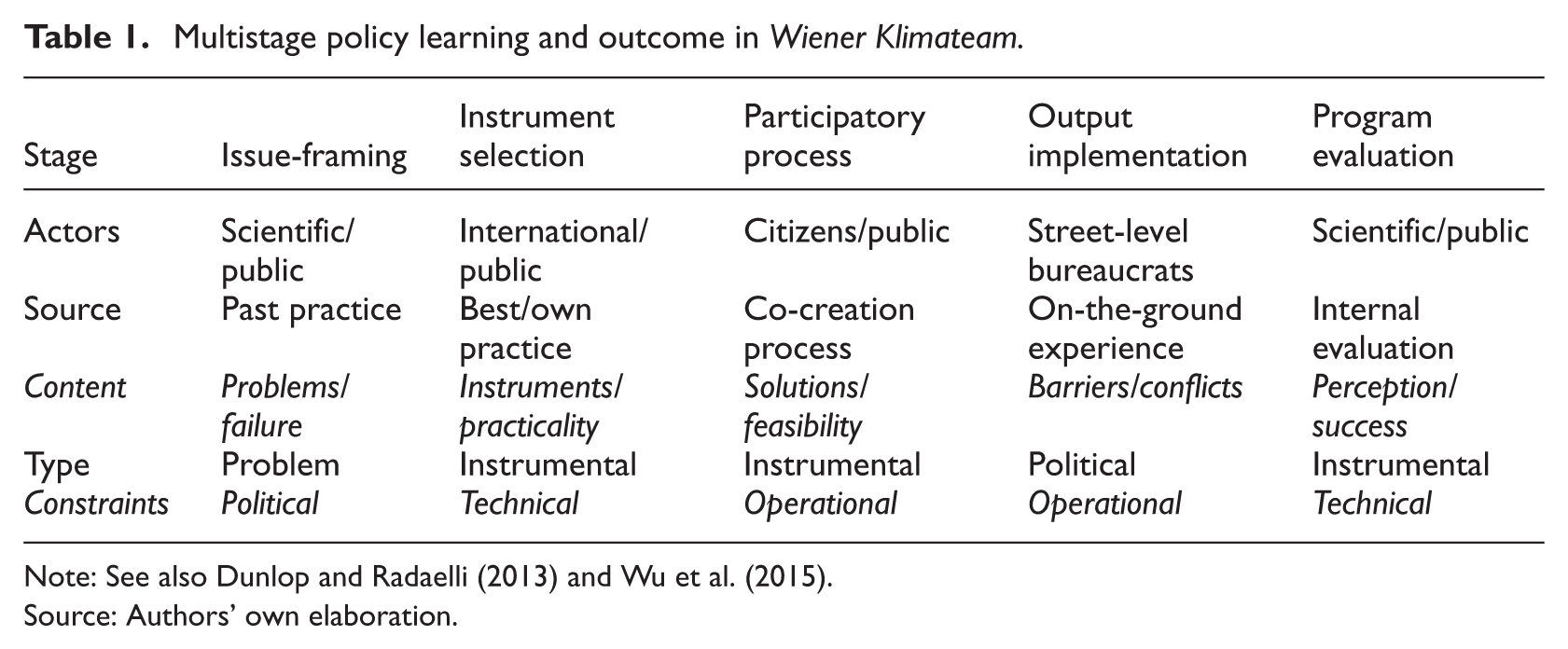
Note: See also Dunlop and Radaelli (2013) and Wu et al. (2015).
Source: Authors’ own elaboration.
The learning process continued as Wiener Klimateam advanced through each stage. Ranging from co-creation mechanisms to implementation challenges, diverse types of knowledge emerged through ongoing interactions between civil society, municipal departments, and the local scientific community, facilitated by public-citizen collaboration, interdepartmental communication, and process evaluation. As the participatory process shifted toward generating outputs for implementation, political learning emerged regarding the administrative dynamics in the street-level implementation of climate adaptation, as well as the steering of responsibilities and their coordination across departmental boundaries. Finally, the internal evaluation of the participatory process yielded further instrumental learning about the instruments used and the democratic objective anticipated, leading to more extensive citizen inclusion in the new budgeting cycle. In summary, the case of Wiener Klimateam illustrates how the learning process in urban policy mobility extends beyond initial encounters with simplified success stories of best practices, as locally-rooted, domain-specific knowledge transforms abstract policy ideas into tangible outputs for implementation.
However, our case revealed several constraints on the key Wiener Klimateam members ability to translate learned lessons into concrete policy components and to successfully respond to unforeseen challenges within the ongoing policy process (see also Ahn and Kazepov, 2025).
The first of these constraints was political. Indeed, the Wiener Klimateam members’ problem learning at the issue-framing stage successfully identified which districts and social groups were most in need by emerging climate vulnerabilities. Yet, its full uptake was influenced by existing governance relationships alongside these criteria. Through our interviews with the district representatives, prior working experience between the districts and the municipal administration emerged as a key factor that shaped the selection of the pilot districts. While Wiener Klimateam has since taken place in two districts governed by a different party than the one governing the city, this early constraint reveals the interplay between evidence-based expert knowledge and the institutional support needed to navigate the path-dependent governance conditions under which learning can be utilized.
The second constraint was technical. The open-to-all participatory approach struggled to sufficiently engage vulnerable social groups experiencing climate-related risks and democratic deficits. Despite genuine outreach efforts through local multiplicators, their working areas and target audience had less connection to the identified vulnerabilities at the issue-framing stage. As a result, citizen proposals tended to cluster around the physical locations where the local multiplicators are active and offline events took place rather than reaching the most needed areas (e.g. underserved green spaces) and residents (e.g. low-income households). Identifying these limitations was further complicated by the monitoring and evaluation framework that primarily emphasized subjective success factors of the participatory process. These constraints reveal that the effective use of learning further demands a technical capability to design goal-oriented instruments and to generate comprehensive feedback beyond what best practice and local expert knowledge can provide.
The third constraint was operational. In the co-creation workshop, the absence of sufficient facilitation structures and monitoring mechanisms constrained the learning dynamics at the knowledge co-production stage. It limited the key members’ ability not only to generate bottom-up knowledge, but also to detect and respond to emerging challenges in real-time. In the implementation stage, their ability to address implementation challenges was further constrained by the limited administrative responsibility and coordination mechanisms available to oversee the effective communication and collaboration among the implementing departments. While informal exchange and social practices between diverse policy actors are an important source of learning, these constraints reveal the practical relevance of formal mechanisms that enable knowledge to persist beyond collaborative processes and administrative boundaries within the institutional environment.
Conclusions
Since the “mobility turn”, the policy mobilities literature has shed light on the highly politicized nature of policy learning in urban policy mobility. So far, however, it has largely overlooked how diverse learned lessons materialize into concrete policy components, often sidelining the crucial policy activities that transform international best practices into local policies.
In contrast, drawing on the case of localizing PB in Vienna, we linked the dynamic process of policy learning with its actual translation into key components and activities within the policy process by disaggregating this complex relationship into the five discrete stages of the policy cycle. This analytical approach enabled a detailed exploration of the concrete learning processes and the flow of the acquired knowledge that together shaped the course of urban policy mobility in its local form. Our results illustrated that policy learning in urban policy mobility can occur in multiple forms and involve a diverse range of policy actors at different stages of its life cycle. They showed that the actual use of this learning experience is a challenging process and can vary depending on existing political, technical, and operational capacity constraints at the local level.
We acknowledge two limitations to these results. First, the stages model may oversimplify the policy-specific dynamics of policy learning in urban policy mobility, which will manifest differently across cases and contexts. When applying this model, future studies should consider that the nature and scope of localizing mobile policies can vary in terms of their scale (e.g. urban/national/international), type (e.g. distributive/redistributive), and design, (e.g. regulatory/participatory), and thus attend to the iterative logic of the policy process in question. Second, our analysis focused on the first Wiener Klimateam cycle, restricting insights into the longer-term influence of policy learning on the broader policy framework and institutional change beyond the immediate policy process. As Wiener Klimateam expands to additional districts, potential changes in political and institutional contexts, such as increased political support from above or the introduction of new coordination mechanisms, may substantially influence the uptake of emerging learning experiences in future budgeting processes. In fact, establishing direct links between learning and change has been a longstanding gap in research (Dunlop et al., 2024), calling for further longitudinal studies of the transformative outcome of urban policy mobility fostering systematic change in local policymaking.
Nevertheless, our policy-oriented approach, and the framework that we have put forward, presents a few analytical advantages over the current use of policy learning in the policy mobilities literature. First, it captures the implications of the diverse roles, responsibilities, skills, and resources of policy actors throughout the entire localization process of a traveling policy practice. This allows us to disentangle the multiple objects of policy learning in urban policy mobility that emerge from their specific characteristics. Second, it identifies multiple knowledge sources of policy learning across different stages of the policy process. This reveals decision-makers’ capacity to selectively extract lessons from emerging information, thereby determining the type of learning that ensues. Third, it helps to differentiate between types of policy learning by linking specific learning processes to distinct learning outputs. This provides a clearer understanding of how diverse learning patterns operate at varying levels of abstraction and the compounding constraints that limit their effective utilization throughout the policy process. Taken together, these dimensions enable a more systematic analysis of the local politics and process of urban policy mobility, unfolding in interconnected stages through specific configurations of actors and institutions.
Within the policy mobilities literature, the interpretative lens on policy learning in urban policy mobility is considered to have been shaped by the “discipline-specific specialization” of urban researchers, which differs from a more diagnostic approach in policy studies (Temenos and Lauermann, 2020: 1114). Yet, both strands of literature share a common ground: to uncover the complex social and political interactions that determine who teaches and who learns what, which ideas become mobile and which ones remain immobile, and which lessons localize and which ones do not. What separates urban studies on policy mobility from other disciplines, however, is the strong thematic focus on urban policies that feature specific learning characteristics compared to national and international policies. These increasingly include, among others, learning from collaborative knowledge production through community-based participatory instruments within non-hierarchical, network-based governance arrangements. Together, they can generate more complex patterns and processes of policy learning that do not always follow the traditional steps of policymaking in a clear-cut fashion. Future research then may consider the policy-specific factors and effects of policy learning that shape the localization process of mobile “urban” policies.
Footnotes
Acknowledgements
The authors express their gratitude to the anonymous reviewers for their valuable feedback and constructive suggestions throughout the revision process.

Funding
The authors disclosed receipt of the following financial support for the research, authorship, and/or publication of this article: This work was supported by Joint Programming Initiative Urban Europe under ‘Municipalist Neighborhood Experiments (MUNEX): Building Capacity From the Bottom Up’ (Project No. F-ENUTC-2021–0120).
Declaration of conflicting interests
The authors declared no potential conflicts of interest with respect to the research, authorship, and/or publication of this article.