






Abstract
The theoretical agendas of comparative urbanism and Southern urban critique encourage scholars to attend to the locatedness of concepts and theories, to stress-test their applicability across various contexts and on this basis to generate new ones or revise existing ones. Methodologically, to unlock the potentiality of theorisation, it is conducive to view urban processes as conjunctural configurations codetermined by diverse forces, as well as interconnections and contextualities across scales. This article presents a case study of Tibet Cultural Tourism and Creative Park in Lhasa, Tibetan Autonomous Region, revealing how the development of the Park follows principles of incrementalism and experimentation, and prioritises small-scale accretion of urban spaces, policy innovations and a complex mixture of economic and non-economic governance goals. As such, this article engages with and enriches the concept of incremental urbanism, which has been developed with reference to numerous Southern contexts. While so far, the concept has been applied mostly to vernacular practices and knowledge of individuals navigating the uncertainty of urban life, this study implies that the experimental, improvised, provisional and emergent aspects of urban changes are also pertinent to theorisations on urban statecraft and governance. Overall, this concept enables us to retheorise municipal statecraft as: (1) flexible, responsive and adaptive; and (2) intertwined with a diversified portfolio of governance objectives beyond growth per se.
Introduction
It is now a firmly established research agenda in urban studies to theorise Southern, small and ordinary cities, which tend to be overshadowed by, on the one hand, a handful of archetypical cities in the global North, and on the other, spectacular urban developments in both the North and South, defined by hegemonic neoliberalism that seems to know no boundary or limit. In the mosaic of urban worlds, Tibetan cities are pieces that have largely been left off the map. However, the investigation of urban transformation in Tibetan regions warrants being treated as a timely, indeed urgent mission. On the one hand, urbanity, as an assemblage of lived experiences, has implications for an increasing proportion of people in Tibet. As of 2024, while the rate of urbanisation in the Tibetan Autonomous Region (TAR) is 39.68%, in Lhasa, the capital city, 73.06% of the population are now categorised as urban residents. 1 On the other hand, Tibetan urbanisation has been a fully fledged state-led project characterised by the proactive adoption of market and entrepreneurial practices, epitomised by the commodification of land, the injection of massive state subsidy and private capital, the utilisation of financial instruments and vehicles and the proliferation of large-scale development projects. From 2010 to 2023, the built area of Lhasa expanded from 62.88 km2 to 118 km2, with large-scale new town development planned and implemented in such areas as the east city, Dongga, Doilungdêqên, Liuwu and, for the current study, Cijuelin. This is despite the fact that Lhasa and the Tibetan region in general might be where rapid urbanisation is least likely to occur, due to low levels of resource endowments, industrial developments and past investments, shaped by the regional disparity inherent in the Chinese geoeconomies. 2 In particular, we need to illustrate the intersection of market ethos and state regulatory regimes, and how it results in specific territorial assemblages of accumulation strategies, governance innovations and sociopolitical formations (Robinson et al., 2021, 2022).
In terms of the political context, urbanisation has been integral to the logics and strategies of governance and state building in TAR and the broader Tibetan regions (Grant, 2022; Roche et al., 2023; Yeh and Henderson, 2008), which constitute the central enquiry of this article. On the one hand, in the aftermath of the 2008 protest, the Chinese central state has delegated more autonomy to the local state in TAR to enhance the latter’s self-developing capacity and engagement with market processes, so that it attains more resources, policy instruments and flexibility in tackling local social, economic and political issues. On the other hand, urbanisation is to reorientate state governance towards a stronger emphasis on market and development logics to dilute ethnic and cultural politics, even though, as we show in the empirical analysis, these factors cannot be bypassed completely but rather participate in the configuration of situated economic alterity and difference (Qian et al., 2026).
Therefore, it is warranted to develop nuanced interrogation of the modi operandi through which development is promoted and regulated, and the variegated implications for economies, spaces and people in the TAR. In particular, we need to unpack how the territorial configuration of bespoke policy and business models (Robinson et al., 2021), vis-a-vis local trajectories and a variety of economic and non-economic goals, differs from or resonates with other places in China or beyond, and how inherited historical, political and institutional parameters make market-based development a sensitive, contested and ambiguous process. This article partakes in this enquiry with a case study of state-led entrepreneurial practices and land development in Tibet Cultural Tourism and Creative Park (the Park hereafter) in Lhasa. The empirical analysis reveals that instead of implementing the market mantras according to holistic and coherent plans, development in the Park follows principles of incrementalism and experimentation, revolving around recursive feedback loops between vision and praxis. This approach prioritises small-scale accretion of urban spaces, exemplified by a strong preference for small pilot projects (despite a much larger planned area), and also policy improvisations and innovations, such as the identification of land buyers even before land bidding and equity sharing between the municipal state or state-owned enterprises (SOEs) and private companies. Development is simultaneously the remaking of statecraft, since the incremental approach allows the state to chart a balance between market engagement and non-market governance goals. As we have argued elsewhere (Qian et al., 2026), urbanisation in the TAR is more about nourishing state capacity of market engagement than actually profiting from the market, given structural constraints – heavy reliance on financial subsidy allocated by the Chinese central state and the lack of participation from actors other than SOEs – and the need to pre-empt economic, social and political uncertainties that market participation unleashes in a sensitive context. Hence, incremental urbanism, featured by exploratory and experimental approaches towards policies and projects, marks the ways that available conditions are assembled to create resilience and certainty that do not exist erstwhile (McFarlane, 2017; Simone, 2016a). This developmental logic is arguably relevant to a broad range of state rationalities and practices in urbanising contexts in China and beyond, which are keen on entrepreneurial practices but simultaneously need to negotiate the limitations of resources and the complexities of inherited institutional and social conditions.
Building on the empirical materials, this study is ultimately orientated towards conceptual and theoretical innovation by way of the comparative gesture in urban studies. As Robinson (2016a, 2016b) agues, it is valuable to trace the relationality of entrepreneurial urban practices to identify genetic resemblances and divergences, and on this basis, to develop generative analysis for the invention or enrichment of concepts and theories. It is not only the portfolio of urban cases that must be expanded but, more crucially, repertoires of explanatory devices (Lawhon and Truelove, 2020; Leitner and Sheppard, 2016; Robinson, 2016a, 2016b). In the spirit of this advocacy, this article builds on the empirical findings to engage with and also expand the conceptual connotations of incremental urbanism. Our purpose is to theorise development practices that do not proceed linearly towards a predefined telos or according to coherent plans and visions but jostle with uncertainty and contingency to incrementally and experimentally devise and recalibrate what is thinkable and feasible on the ground. As McFarlane (2017) defines it, incremental urbanism refers to the gradual accretion and manipulation of urban environments based on learning-by-praxis and makeshift adaptation. While in the literature the concept is mostly applied to vernacular practices and knowledge of individuals navigating the uncertainty and vicissitude of urban life, the Lhasa case implies that sensitivity to the experimental, improvised, provisional and emergent aspects of urban changes needs to be incorporated into investigations of statecraft and governance practices, beyond grassroots practices alone, to reveal how flexibility, provisionality and adaptability feed into state competence and power, rather than just the urban aptitude of ordinary people. We surmise that this argument resonates across plural urban contexts, especially for Southern, small and peripheral cities, not only because the tenacity of local conditions and limitations makes economic development a project of trial and error but also because of the alternative and non-market logics that play a constitutive role in configuring specific governance and business models.
Methodologically, this article follows urban scholars’ recent enthusiasm for the conjunctural approach to trace urban changes as co-produced and co-determined by diverse forces and interconnections across scales – from neoliberal ethos circulating globally, to national political mandates and finally to local conditions, instead of local variants of monolithic processes such as neoliberalism and global capitalism (Leitner and Sheppard, 2020; Peck, 2017, 2024a; Robinson, 2016b). In the Lhasa case, the conjunctural approach allows us to reveal the state’s propensity towards selective adoption of development models, incremental experimentations with small-scale projects, policy innovations and a mixture of economic and non-economic governance goals. Together with the heuristic of incremental urbanism, this article supplies a novel perspective to theoretical understandings on urban development in peripheral China by emphasising that different elements are stitched together to create conjunctural formations, not through linear vision and progress but through uncertainty, friction and reiterative interaction between market mandates and local conditions. Urbanisation, after all, is radically contingent, experimental and open ended. We acknowledge that scholars championing the conjunctural approach and comparative urbanism do not entirely overlap, while some aligned to the former may even be suspicious of the emphasis on local particularities in the latter (Peck, 2015). Still, the gesture of drawing on local particularities to advance mid-level re-conceptualisations corresponds with the ambitions of both agendas, given the shared belief that theorisation and conceptualisation should start from the local scale. While conjunctural analysis may give more stress to the situatedness of mid-level concepts in broader structural processes, this echoes the emerging genetic gestures in comparative urbanism (Robinson, 2016b), which recognise that urban phenomena are inter-scalar articulations between circulating processes and territorial conditions (Robinson et al., 2022).
Incremental urbanism through the lens of comparative urbanism
For the emerging agendas of comparative urbanism, global urbanism and Southern urban critique (supplemented by alternative geographical imaginations such as global East, e.g. Shin et al., 2016), their principal mission starts from provincialising dominant concepts and theoretical paradigms based on the global North (Leitner and Sheppard, 2016; Roy, 2009, 2016; Sheppard et al., 2015), and ultimately geared towards the invention of new vocabularies and conceptualisations, namely ‘inquiries, concepts, ethico-political locations, or theoretical and technical languages’ (Bhan, 2019: 642) that grant Southern cities legitimate places in the ‘ecosystem’ of urban thoughts (Leitner and Sheppard, 2016). In other words, cities everywhere become active vantage points from which to renew urban theories (Hart, 2018; Lawhon and Truelove, 2020; Lawhon et al., 2016). In this agenda, local difference is not reduced to empirical uniqueness; rather, all cities can serve as heuristic devices with implications far beyond the immediate locations (Roy, 2009). Ideally, the analysis of Southern cities should be both genetic and generative (Robinson, 2016b) – by tracing relations, connections and the circulation of policy discourses, resources and actors, conversation is established with existing theoretical and conceptual architecture. The latter endeavour is to renew the repertoires of theories and concepts, including generating new ones and revising existing ones (Lawhon et al., 2016; Robinson et al., 2021, 2022; Roy, 2009, 2016).
Echoing the call for conceptual innovation, the primary endeavour that this article partakes in is to interrogate the idea of incrementalism and to broaden its epistemological and conceptual scope through a comparative gesture. This entails situating incrementalism at the intersection between the general and the particular, and between circulating market mandates and specific territorial conditions (Cox and Evenhuis, 2020; Leitner and Sheppard, 2020; Robinson et al., 2022). To fulfil this ambition, we are drawn to a growing corpus championing a conjunctural approach to the city, viewing the city in terms of multiple interconnected spatial-temporalities across scales in contrast to rigid structuralist categories, and as a moment of articulation, coordinated and co-constituted by a plurality of forces and logics – both local and non-local, capital and non-capital, present and past (Davidson and Ward, 2024; Hart, 2024; Leitner and Sheppard, 2020, 2022; Robinson, 2016b; Sheppard et al., 2015). Cities, in this sense, are analysed as relational and co-determinate, leaving open the possibilities of friction, rupture and change over space and time (Davidson and Ward, 2024; Leitner and Sheppard, 2020; Peck, 2024a, 2024b).
Moreover, the approach emphasises the mutual constitution of contextual circumstances and broader structuring conditions. Deviating from assuming the ontological existence of a priori wider processes such as neoliberalism, the approach traces ‘the specific set of flows, networks, connections, influences, circulations’ which add up to particular urban processes or regimes of accumulation (Robinson, 2016b: 12). The global/local distinction gives way to a relational view of interconnected processes producing differentiated effects across different contexts. Similarly, the hierarchy of core and periphery is dismantled, replaced by the epistemologies of ‘uneven spatial development, heterogeneous fields, multiscalar restructuring and site-shifting dynamics’ (Peck, 2017: 26). In this vein, the approach spirals up and down to work across different levels of contextuality and abstraction (Peck, 2017). Attending to contextuality and abstraction and bringing them to bear, recursively and iteratively, on revisable theoretical claims ultimately serves the open-ended production of meso-level concepts and theories, achieved via ‘reflexive interpretations of the interplay between grounded circumstances, mediating conditions and contingent effects on the one hand, and their enabling conditions of existence, operational parameters and connective circuits on the other’ (Peck, 2017: 9; see also Davidson and Ward, 2024; Peck, 2024a, 2024b). To summarise, the conjunctural approach lives in a media res that diverges both from universalism and particularism, laying the ground for the ‘interrogation and revision of appropriate analytical frames, midlevel concepts and operational categories’ (Peck, 2024a: 467). Echoing these insights, comparative urbanism has also advocated for the analysis of diverse actors involved in territorial regulatory formations, enmeshed nonetheless in circulating and ‘pan-urban’ processes. For example, Robinson et al. (2022: 1721) put forward the epistemology of ‘transcalar territorialisation’ to elucidate urban processes that are implicated in translocal ‘circulation of actors, ideas and practices’ but simultaneously territorial regulatory formations. With this heuristic device, she and co-authors dismiss the tendency of reducing major development projects into local variations of broader processes such as globalisation and neoliberalisation, but grant priority to specificity as the starting point of grounded theorisations centred on governance formations, territorialised institutional arrangements and relational networks of actors and financing channels (Robinson et al., 2021, 2022).
Incremental urbanism is precisely a meso-level concept that can be re-thought and expanded to facilitate a dialogue between urban frontiers such as Lhasa and the comparative urbanism agenda (McFarlane, 2017). The concept sheds particular light on the study of Cijuelin, where the development project did not proceed in just one go or in a holistic and coherent manner but depended on small steps and recursive interactions between vision and praxis to maintain state control and stable governance. So far, the concept of incrementalist urbanism has been invoked to elucidate the incremental, makeshift and everyday dimensions of urban changes, in close resonance with cognate terminologies such as do-it-yourself urbanism (Iveson, 2013), makeshift urbanism (Tonkiss, 2013), temporary urbanism (Andres et al., 2021), insurgent urbanism (Holston, 2008), etc. Above all, this concept elucidates how ordinary urban people assemble resources and eke out livelihoods amidst inherent uncertainty and insecurity, with provisional, experimental and makeshift practices. This is to appreciate a sizable proportion of urban practices as spontaneous and negotiated, defying predefined and coherent plans, responding to local needs and conditions and relying on ad hoc assemblages of resources and relations (Ferreri, 2020; Iveson, 2013; Silver, 2014; Tonkiss, 2013). These practices exploit the neoliberal and entrepreneurial turns in urban economies but tend to be situated, small scale, ad hoc and co-constituted by a broad range of contextual factors. Indeed, the lack of stable streams of resources and opportunities in many urbanising contexts in the South puts cities in a state of perpetual urgency, uncertainty and volatility. Resultantly, people need to recentre their calculative minds on matters ‘considered urgent, valuable and important’ and develop makeshift, speculative, insurgent and experimental practices to generate wellbeing that are far from pregiven or self-evident (Simone, 2010a: 286; Simone, 2010b). The fluid intersection of people, things and spaces has generative and inventive effects, and to capture these effects, small experiments, namely the creative use and appropriation of available resources, conditions and relations, need to be carried out on an ongoing basis (Simone, 2016a, 2016b).
State-led, large-scale development projects are certainly quite distinct from everyday sites of improvisation, but the epistemological sensibilities underlying incremental urbanism invite a conversation with the adaptability and context dependency of planning and developmental practices, given that state actors need to negotiate the vicissitude and complexity unleashed by neoliberal and entrepreneurial practices (Savini et al., 2015), to achieve resilience vis-a-vis unpredictability and risk (Amin, 2013). While incrementalism has so far not been explicitly invoked to theorise municipal statecraft, many studies probing into major urban development projects have interrogated the tortuous, ambiguous and negotiated ways in which the ethos of neoliberalism takes root in local contexts, hinting at incremental urbanism as a conceptual umbrella whose relevance extends beyond everyday life. This entails tracing state practices across conjunctural and multiscalar configurations – incrementalism means different things in different urbanising contexts (Ferguson and Gupta, 2002). First, market processes do not always unfold through established, formal institutions or protocols but rather through informal arrangement, improvisation and experimentation. Municipal statecraft can be inherently experimental (Lauerman, 2016). Ad hoc or improvised practices enable plural actors to engage with new and unchartered territories in urban economies, and in some circumstances broach an expanded horizon of benefits and welfare (Chien, 2018; Ferguson, 2010). There has been a strong interest in policies as recursive and progressive because entrepreneurial practices need to be evaluated within a broader set of metrics and objectives that are multi-dimensional and not centred on the economy per se (Arpini et al., 2023; Lauerman, 2016; Thompson et al., 2020). Second, market forces do not lead to the erosion of state power but often renew and reinforce the latter by pushing it towards more adaptative and innovative practices (Halbert and Attuyer, 2016). It is ‘micro-worlds’ of regulation (Amin, 2004), often expressed as policy innovations at local and regional levels, that accrue to state power and leadership in incremental ways. The trend is exemplified by emerging initiatives such as new municipalism (Arpini et al., 2023; Thompson et al., 2020), participatory planning and budgeting (Cabannes, 2004; Caldeira and Holston, 2015), inclusion of the poor into the neoliberal agenda by cultivating self-enterprising subjectivities and cultures (Gooptu, 2009, 2011), incremental regeneration in lieu of large-scale projects (Wu et al., 2022), etc. Finally, in policy innovations market logics are in complex hybridisation with non-market goals and interests, variously orientated towards participatory democracy, social equality, inclusive growth, sustainability, etc. (Arpini et al., 2023; Caldeira and Holston, 2015; Lauerman, 2016; Thompson et al., 2020). Actually existing neoliberalisms mediate between market and non-market agendas, and between capital and non-capital domains, leading to the proliferation of economic models featuring hybridity and alterity (Parnell and Robinson, 2012; Wu, 2020; Wu et al., 2024).
Similarly, the literatures on urban China have not explicitly theorised incrementalism but the conceptual sensibility is widely echoed. The propensity of the Chinese state towards pilot projects and experimentation has been well noted. Ong (2006), for example, analyses special economic zones in China as spaces of exception that are mobilised as a malleable technology of governance. With experimentation, the state reinvents and renews its capacity by creating new territorial conditions. According to Lauerman’s (2016) argument, current urban experiments in China are entangled with a complex matrix of non-economic governance objectives beyond growth, such as social engagement, participation, community cohesion, cultural revival, social stability, heritage preservation and sustainability (Lu and Qian, 2024; Qian and Lu, 2022; Teo, 2023; Wu et al., 2022). Hence, experimentation allows the state to chart a delicate course between growth and resilience, vis-a-vis unpredictabilities and risks. In this context, Wu (2018, 2020) has proposed the concept of ‘state entrepreneurialism’ to elucidate the utilisation of entrepreneurial practices as conduits of statecraft, echoing closely the debates on municipal statecraft and experimented policy innovations in the West. To highlight municipal statecraft as (1) flexible, responsive and adaptive; and (2) entangled with a diversified portfolio of goals and priorities, we may ask: How are the mantras of market, neoliberalism, entrepreneurialism, etc. adopted, negotiated and reworked, given the necessity of in-situ recalibration and adjustment? How are planning and investment decisions made and revised in response to local conditions and contingencies? How do innovations in the regulatory regime empower the urban state to balance between growth and other mandated goals of local governance? With these enquiries, we now proceed to the empirical analyses.
Background and methods
The location of the Tibet Cultural Tourism and Creative Park is shown in Figure 1. Situated on the southern bank of the Lhasa River, the Park primarily encompasses the region of the former Cijuelin Village (Cijuelin is the Chinese translation of the Tibetan ཚེ་མཆོག་གླིང; Wylie transliteration: tsche mchog gling), in the southern part of Chengguan District in Lhasa. The Park spans a total planned area of 8.14 km2, with the first phase at 4.74 km2. The first phase commenced in April 2012, involving an investment of approximately 1.27 billion RMB, while the Lhasa municipal government established a preparatory work group tasked with land development, planning and the introduction of businesses and investments. In 2014, the park was listed as a ‘National Cultural Industry (experimental) Park’ by the Ministry of Culture and Tourism. Subsequently, in 2015 the local government re-organised the preparatory work group into the Management Committee. By the time of our fieldwork, the Park had a permanent population of 7600 (with 367 households or 1200 people in Cijuelin Village) and a daily customer flow of about 12,000 on average in the peak season.
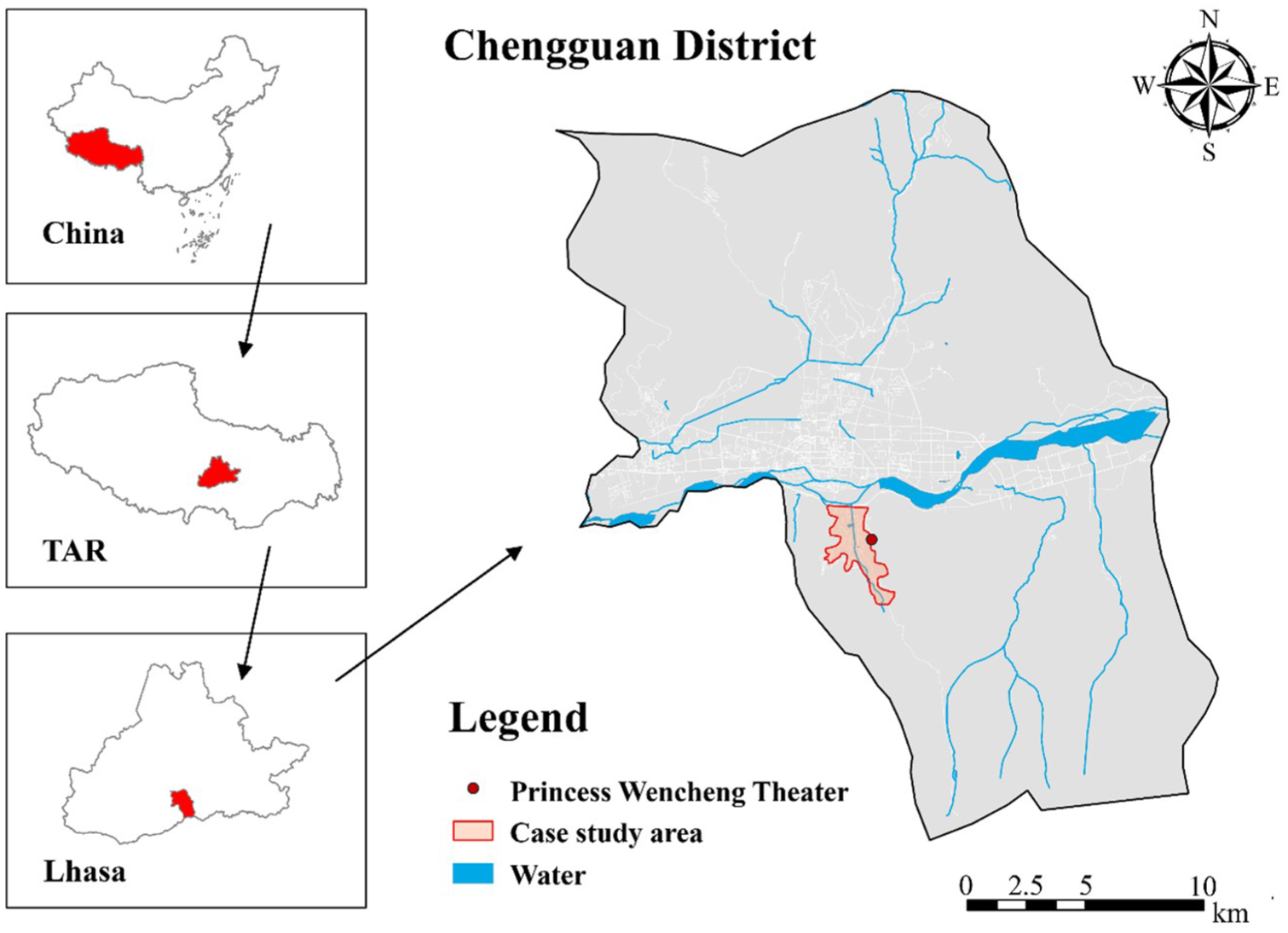
The location of the case study area.
The cultural tourism industry based on Tibetan folk culture is essential to the park. Among a variety of projects, the Princess Wencheng Theatre is a centrepiece. It occupies a planned area of 289.88 mu (about 19.3 hectares), a total built area of 13.4 hectares and a seating capacity of 4000. The theatre hosts a live theatrical performance entitled ‘Princess Whencheng’, which narrates the legends of Princess Wencheng, a Chinese princess who wedded the Tibetan Tsenpo (king) Songtsen Gampo during the Tang Dynasty (around mid-6th century AD). In addition, the Park features attractions such as the Cijuelin boutique street, Thangka Cultural Industry Park and Sho Dun Ancient Town (named after the festival Sho Dun), alongside more than 1200 commercial tenants, such as hotels, B&Bs and retailers. In addition, the Lhasa City Construction and Investment Co., Ltd. (LCCI hereafter), an SOE affiliated to the municipal government, actively participated in developing a large number of real estate projects.
The Management Committee runs an SOE, the Tibet Cultural and Creative Investment Co., Ltd. (TCCI hereafter), and its primary mission is to finance and prepare for the projects developed in the Park. In addition, TCCI is responsible for municipal maintenance and public services in the Park. TCCI has three subsidiaries, namely Tibet Nancheng Venture Capital Management Co., Ltd., responsible for coordinating bank loans for entrepreneurship and preparing tourism projects; Tibet Nancheng Municipal Management Co., Ltd., responsible for municipal services; and Tibet Nancheng Human Resources Management Co., Ltd., responsible for labour dispatch and worker recruitment for SOEs in the park.
This article is mainly based on field research conducted from September to October 2023 in Lhasa. In total, the research team spent 49 days on the field site. The research followed the ‘encompassing comparison’ (Tilly, 1984) approach, namely to focus on a single case study to generate in-situ reflections that can be compared with extant concepts and theoretical claims. Thanks to the coordination of collaborators based at Tibet (Xizang) University, the fieldwork turned out to be relatively smooth, rather than challenging, despite the political sensitivity of the region. We were able to get in touch with the government agency in charge of the Park, namely the Management Committee. This agency introduced us to a number of informants involved in the Park’s development and management, such as officials and SOE staff under its jurisdiction, and with the snowballing method we were able to access archival materials and other informants.
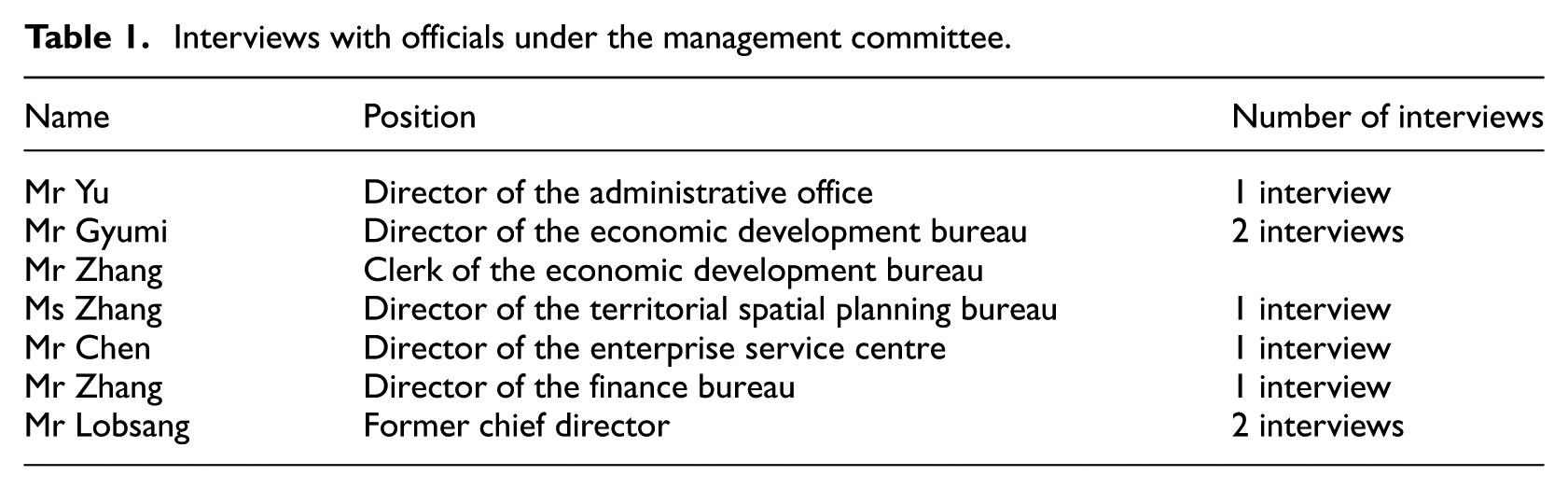
Data in support of the study mainly come from two sources. First, the study draws on the comprehensive collection of archival and second-hand data, including nine policy and planning documents, five press releases and numerous internal circuits. Second, we conducted in-depth interviews with various stakeholders. There were two types of informants. The first were current or former officials under the jurisdiction of the Management Committee. Six interviews with six current officials (five are Han cadres sent to ‘aid Tibet’ from China proper (neidi) and the other is Tibetan) from five departments were conducted. In addition, we also interviewed the former Chief Director of the Management Committee twice (Table 1). The second category comprised directors and staff from SOEs involved in the development and daily operation of the Park. This body of work involved five interviews with seven staff members from local government financial platforms (LGFPs) affiliated to the Management Committee, one with the director of an LGFP affiliated to the municipal government and another one with the SOE that developed the Princess Wencheng Theatre project.
Interviews with officials under the management committee.
Piloting with land development
Embedding the primary land development model in Lhasa
In the late 2000s, the Lhasa government unleashed sweeping market-orientated reform. This reform was then funnelled into a cascade of land-based mega projects. Guiding this grandiose transformation was a planning document – the Lhasa City Master Plan (2009–2020), crafted by Jiangsu Province Planning and Design Group Co., Ltd. Aiming to inject ‘technological advantages and development conceptions’ into Lhasa, the plan proposed the creation of three new urban districts, namely Dongcheng, Donggar and Liuwu, dramatically stretching Lhasa’s urban built area from the valley on the northern bank of the Lhasa River to the west, east and south.
In the early 2010s, the municipal government adopted the model of primary land development, and the area of Cijuelin was selected to carry out development conducted by LCCI, supported by a preparatory work group. Originating in the late 1990s in the Yangtze River Delta, the model of primary land development comprises three steps: (1) consolidating land from villagers following negotiation, acquisition and resettlement; (2) constructing essential infrastructure and urban amenities, such as water supply, drainage, electricity, natural gas, networks, etc. and (3) releasing the land into the land market, with unsold parcels temporarily stocked as state land reserve. The reasons that the Lhasa municipal government followed this model were twofold. On the one hand, over 95% of the land in Lhasa was made up of forests, grasslands and mountains. The preparation of land presented significant challenges, while necessitating substantial investment for basic infrastructure and amenities. However, private developers lacked the motivations or capabilities to amass the capital. On the other hand, Tibetan villagers held large tracts of land, in title or in practice. To secure the land for development, one needed to keep a close eye on the potential economic disputes and social unrest that might arise from land acquisition. As a result, the creation of land value from scratch could only be undertaken by the state. A director from the LCCI aptly illustrated the role of primary land development with the analogy of ‘gnawing tough bones’: If developers were to start from scratch, to acquire land, and to carry out the ‘seven accesses and site levelling’, they surely would not be willing, [because] there would be no profit. Only when the state gnawed ‘tough bones’ for them and let them see the meat would they get involved and drive subsequent development.
Meanwhile, the primary land development in Lhasa was haunted by the uncertainty brought by the friction between the urge for urbanisation and the economic realities on the ground. According to the Chinese central government, land that has undergone primary development would be designated as reserve land, which is mandated to be released into the land market for secondary development within a two-year timeframe. However, in Lhasa, until the early 2010s, there was no resourceful developer that was locally based, and the land or real estate market was not fully established. In this context, it was nearly impossible to estimate the market prospect of any development project. Besides, large-scale primary land development implied large-scale land transfer and relocation, which would further amplify political risk and economic uncertainty. As a result, ambitious nonetheless, the municipal government only carried out small-scale pilots in a prudent and experimental way, echoing the propensity of incremental urbanism towards small-scale accretion of space (McFarlane, 2017). Three pilot zones including Cijuelin were selected. For Cijuelin, a 4.74 km2 area of land at its eastern part was selected for the first phase of development.
The incremental approach of land development
The pilot project in Cijuelin was not subject to a pre-conceived plan. Instead, improvisational, occasional and exploratory endeavours epitomised the sociospatial transition, exemplifying the notion of incrementalism theorised in this article. This approach was, firstly, manifested in the heavy reliance on LGFPs to carry out the pilot. Specifically, the LCCI and the preparatory work group engaged in a partnership, reaching a profit-sharing agreement that allocated 50% of revenue derived from land transfer to each party. Subsequently, the LCCI used the prospective return from land development as the collateral to secure a loan from local state-owned banks, supplementing an initial capital injection from the local state. The two components comprised 60% and 40% of the total investment. With this money, the preparatory work group acquired land from local villagers, after which the LCCI undertook the construction of infrastructure and municipal facilities. The developed land would subsequently be listed for public bidding. The involvement of the LCCI was pivotal to the avoidance of risk and the creation of resilience. Its risk-bearing capacity stemmed from the implicit guarantee provided by the local government to bail out local SOEs, should an investment failure occur. While government guarantee can no longer be taken for granted for neidi cities (Feng et al., 2022; Li et al., 2022), it is still in practice in Lhasa given that the local state has access to abundant subsidy money from the Chinese central state and is therefore not faced by a debt crisis. Indeed, such guarantee was deemed essential given Lhasa’s unique political context, where the state kept high vigilance of social instability caused by any suspension or payment arrears.
The second aspect was the gradual and incremental method of land development adopted by the local state. In the Cijuelin pilot project, the designated land was not subject to a one-time acquisition and development but advanced piece by piece according to the needs of specific projects. Holistic planning was deliberately avoided to make statecraft more flexible. Figure 2 compares the land development procedure in neidi and in Cijuelin. Under the standard procedure in neidi, land is expected to be marketed following primary development and before bidding for commercial use, the latter referred to as secondary land development. However, in the case of the Cijuelin pilot project, particularly prior to the official establishment of the Park in 2015, primary land development occurred only after specific commercial projects were identified and confirmed. Once land quota required for the confirmed projects had been calculated, the preparatory work group would requisition the land from the village collective, followed by the LCCI undertaking the primary development. In other words, in Cijuelin, primary development always proceeded in tandem with, not prior to, secondary land development. As a local official remarked: The situation in Lhasa is different from neidi. In neidi, land is developed, and infrastructure built, before the bidding process. Here, we will secure the investors before any land development is conducted. This is because in neidi, there will always be investors, no question, but here, most people hold pessimistic views on the prospect of development because long-term profit seems not in sight.
The choice of determining the project first and acquiring the land next made the land bidding process an ostensible one, but at the same time an event of urban experimentation. On the one hand, due to the scarcity of development resources, the LCCI needed to use the expected revenue of commercial projects as collateral to borrow money from banks. A land buyer clearly in sight proved to be more persuasive for state-owned banks. On the other, pre-designation of buyers circumvented the risk of no sale, which would make the primary land development a sunken and wasteful investment. In neidi, the outcome of primary land development is land reserve. Local governments can regulate land prices by controlling the scale of land reserves flowing into the market, due to the competitive nature of the market. Conversely, the Lhasa municipal government preferred not to hold any land reserve due to economic uncertainty, the market’s limited capacity to absorb land and the political risks associated with investment failure. Zero land reserve in the early stage of Lhasa’s land development was achieved precisely through manipulative and improvisational practices such as identifying land buyers prior to the land bidding formally being put on stage.
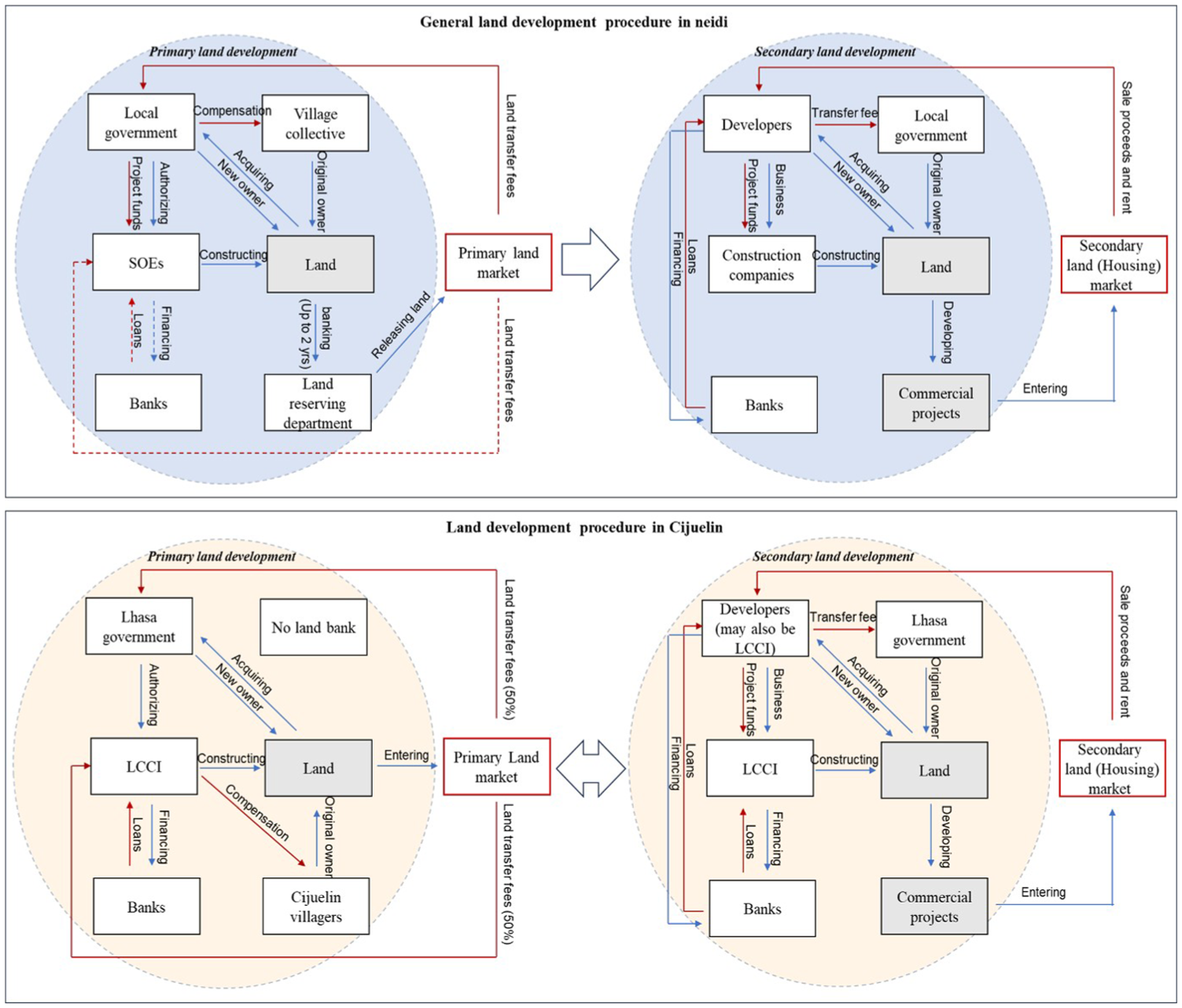
Land development in neidi and in Cijuelin.
The cultural tourism park project
Incremental growth
During the initial stage of primary land development, the Lhasa government did not delineate a specific focus for Cijuelin but improvised with economic opportunities as they incrementally arose. Consequently, the government engaged with Chengdu Usunhome Group Co., Ltd., a private enterprise specialising in tourism, along with the local SOE the Potala Tourism and Culture Group Co., Ltd., to form a joint venture. This partnership, with the two contributing respectively 68% and 32%, led to the establishment of Lhasa Hemei Potala Cultural and Creative Industry Development Co., Ltd. (LHPC hereafter). The joint venture was tasked with initiating and developing tourism projects. During this period, a stage drama titled ‘Princess Wencheng’, curated by a company based in Beijing, came to the attention of the leadership at LHPC. Princess Wencheng served as a potent symbol of cultural exchange with China Proper, enjoying considerable recognition and esteem in both Tibet and neidi. The play also aligned with Chinese nationalism, depicting Tibet as a remote frontier to be civilised by a Han centre. LHPC swiftly acquired the rights to stage the play and proposed the construction of a dedicated venue, that is, the Princess Wencheng Theatre at Cijuelin. The play assumed the format of an outdoor live performance, set against real natural landscapes rather than on a stage.
It was no easy feat to bring this play to Lhasa. Three aspects of preparatory work were carried out to maximise the chances of success. First, the SOE coordinated with the Lhasa municipal government, obtained approval for the engineering project and land use and entrusted the LCCI as the contractor to build the theatre and its surrounding infrastructure. Second, Chengdu Usunhome Group Co., Ltd. raised 1.272 billion RMB for project construction and rehearsal of the play. More than 700 million came from bank loans, and the remaining was funded by the company. Finally, the same enterprise dispatched staff with experience in outdoor live-scene plays to serve as the backbone of LHPC. Following a premiere in August 2013, the play quickly became a tourist hotspot in Lhasa. In an incremental way, prior successes served as key incentives for subsequent development practices. In 2014, the Lhasa municipal government issued the Tibet Cultural Tourism and Creative Park Plan, which expanded the planned area by nearly double to 8.14 km2.
Again, the new plan did not specify any concrete project, and the park grew as needs for land use surfaced incrementally. For example, a follow-up project completed in 2014, the Cijuelin Boutique Commercial Street adjacent to the theatre, emerged as an ad hoc response to the unexpected popularity of the performance. Further, starting in 2016, the development of the park gradually advanced westwards. A cluster of hotels and homestays took shape in the central area, initially kicked off by small commercial tenants who detected the accommodation needs of tourists. As the cluster grew, the Management Committee consciously introduced several large-scale hotel franchises from neidi and abroad, such as Jindian Group from Beijing, Yuntu Guanjia Logistics Management from Chengdu and Banyan Group from Singapore. Meanwhile, new cultural and tourism attractions were developed in the western part, inter alia the Princess Jincheng Theatre (NB: not the same as Wencheng). Seeking to build upon the success of the Princess Wencheng project, LHPC pivoted to a new show centred on another Han princess, Jincheng, who married the Tibetan Tsenpo Tride Tsuktsen about seven decades after the marriage of Wencheng. This was in response to a key limitation of the Princess Wencheng play, whose outdoor format made it impossible in Lhasa’s chilly winter.
To add further evidence to the incremental nature of development, Figure 3 summarises the distribution of projects in the Park. Due to the incremental nature of development, the Park has no clear-cut functional partitions, with relatively small functional blocks closely intertwined. This spatial pattern is also shaped by the fact that the Park only acquired agricultural and collectively used village land, while the homestead land of Tibetan villagers remained intact. This was a situated and improvisational decision, attributed to three reasons: (1) the local government and developers had insufficient funds to provide housing for the resettlement of villagers; (2) the Management Committee hoped to preserve the Cijuelin Village as authentic cultural heritage and (3) the relocation of Tibetan villagers might result in discontent and political risk.
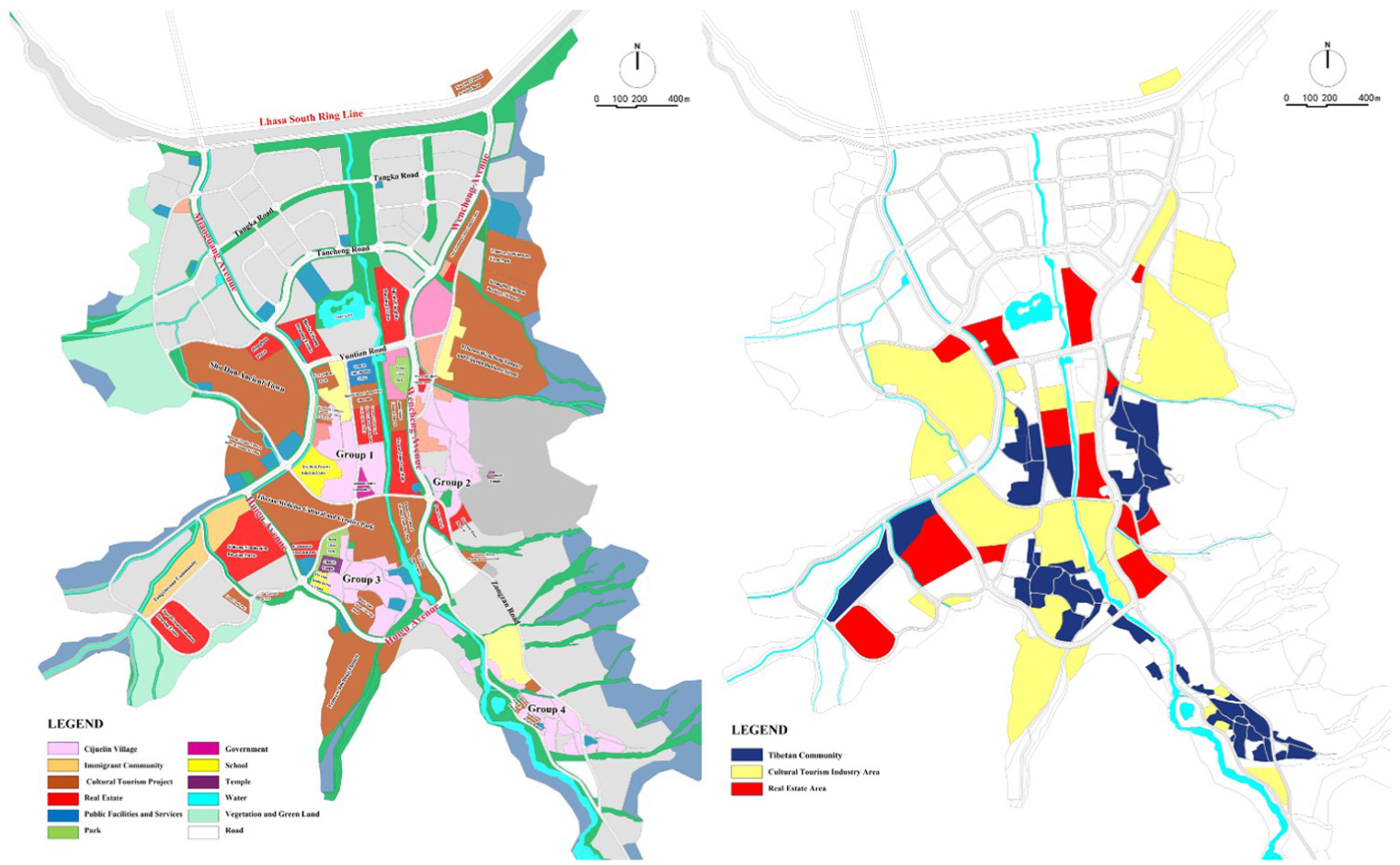
The spatial distribution of projects within the Park.
Curating the cultural industry
In the process of nourishing the cultural industry in the Park, the local state of Lhasa avoided holistic planning and uniform institutional arrangement. Instead, its tactics were flexible and responsive to a diverse portfolio of businesses, with varying sizes, risks and resources. As a result, the Park culminated in a constellation of small projects across its jurisdiction. There were three primary approaches. The first was introduction. By collaborating with established firms in cultural and tourism industries, the Park directly incorporated their businesses. Two practices stood out. The first was the direct solicitation of investment, wherein the committee offered preferential policies related to utility costs, rental fees and financial subsidies to entice businesses to establish operations in the Park. This practice was typically suited for industries characterised by substantial capital investment but relatively low risk, such as the hotel sector. The second involved joint ventures, wherein the municipal state or the committee collaborated with firms through equity sharing. This model was applicable to industries characterised by lower capital requirements but greater volatility. They therefore tended to require risk-sharing arrangements, primarily in the cultural tourism sector.
The use of joint venture to neutralise real and perceived risks in the local economy was salient. An illustrative case was Lhasa Xueyin General Aviation Company, established in 2016, based on a partnership between the local state and Nanjing Ruo’er General Aviation Co., Ltd. The Nanjing firm holds a 51% share, in collaboration with Lhasa Potala Tourism and Culture Group holding 39.2%, and Lhasa Potala General Aviation Industry Development Co., Ltd. holding 9.8%. The registered capital was 20 million RMB. The initial purpose of the joint venture was to introduce a specialised general aviation company to develop chartered flight services and helicopter tours. However, due to political sensitivity and state security considerations in Tibet, the approval for the civilian helicopter tour had been significantly delayed. To mitigate the loss and risk, the Lhasa Potala and Tourism Culture Group and the municipal government engaged in multiple discussions, realigning the company’s primary operations to aerial patrols, aerial forest monitoring and aerial photography, which targeted governmental procurements rather than tourists.
The second approach was imitation. This method involved project developers leveraging local resources and social networks to reference, emulate and replicate models of cultural tourism development in neidi. While imitation did not exclude collaboration with exogenous actors, such partnerships were not the ultimate goal. An illustrative case was the Himalayan Music Festival. To enhance the Park’s cultural brand and capitalise on the spacious outdoor space in the park, the Management Committee initiated plans in March 2021 to host a music festival, a business model that was in practice with notable success in neidi. To learn the operational procedures of a music festival, the Committee dispatched staff to conduct multiple site visits to Strawberry Music Festival in Shanghai. In 2022, the Management Committee established an event organising committee, while commissioning Tibet Nancheng Venture Capital Management Co., Ltd. (TNVC hereafter), a subsidiary of TCCI, to organise and manage the event. TNVC engaged with a well-known company with extensive experience in musical production and festival organisation as a third party to assist stage setup, operation and liaison with musicians from neidi. Moreover, TNVC aligned the music festival to the political and cultural context of Tibet. For instance, in addition to featuring well-known artists from neidi, local Tibetan singers and bands made up half of the lineup, showcasing Tibetan folk songs and dances. Furthermore, the audience size was subject to more stringent restrictions than those typically imposed in neidi, aiming to pre-empt any mass disturbance. Ultimately, the Himalayan Music Festival was held on 21–22 July 2023, attracting over 24,000 visitors and achieving an online exposure volume of 92.2 million views, making it a top cultural event in Tibet in terms of internet traffic. Based on the knowledge acquired from the music festival, TNVC has also hosted other mega festivals, like the Damxung Horse Racing Festival every August since 2023.
The third approach was incubation. In addition to directly or indirectly connecting with actors in neidi, state agencies also established learning platforms for local enterprises, assuming the role of coordinators and facilitators of learning. The incubation process encompassed three primary components: (1) the provision of financial assistance, tax incentives and low-interest loans; (2) the allocation of space with reduced rent and utility costs; and (3) activities focused on the acquisition and exchange of entrepreneurial knowledge and skills, as well as competitions. The TNVC served as the principal agent responsible for incubating entrepreneurship in the Park. This was interesting for illustrating incremental tactics in urban development, as the enterprise served as an arm of the state to mobilise limited resources not to serve profit-related purposes but the building of market competence and capacity, with the projects being quite small in terms of investment and firm sizes. On the one hand, TNVC invested in small enterprises with equity sharing; on the other hand, it organised collective learning activities. By the end of 2023, it had successfully incubated over 30 local enterprises, organised one forum on cultural and creative industry, orchestrated 30 training sessions on cultural and creative economies/talents and hosted five entrepreneurial competitions. The enterprises primarily came from sectors such as media, the internet and cultural and creative products and services. Tibet Oz Culture and Media Co., Ltd. presents a notable example. This company was founded by a Tibetan entrepreneur who graduated from a university in Beijing, undertaking businesses such as video production, advertising shooting, publicity and event planning. Targeted for incubation, the company has not only had water and electricity bills waived but also secured multiple orders during the investment promotion conferences organised by TNVC.
Negotiation with non-economic governance objectives
The development of the Park is experimental and contingent, also because cultural initiatives must negotiate the complex matrices of non-economic rationalities and governance goals set by the state (Lauerman, 2016). On the one hand, the development of cultural industries is expected to facilitate governmental agencies to achieve various social governance objectives, particularly in terms of job creation to maintain social stability and mitigate the discontent of Tibetan villagers. A notable example is the Wencheng Princess Theatre. Since its inception, the project generated approximately 50 million RMB for Cijuelin Village during construction by recruiting construction workers and logistical personnel, employing villagers for transport and renting villagers’ residences to accommodate construction workers. Over 90% of all the performers are local Tibetans, and more than 1000 manual labour jobs have been created, of which over 800 are reserved for the same group, for example cleaners and security guards. Nearly 70% of the residents in Cijuelin have secured employment through the theatre project, resulting in an additional monthly income of 3000 to 4000 yuan per household (interviews with the Management Committee). Furthermore, during performances, the theatre also rents yaks and sheep from villagers to serve as props, with each yak providing an additional income of over 100 yuan per month. As a representative from LHPC remarked: ‘We are essentially operating the business with a mindset akin to that of a social welfare program’ (Interview, 19 September 2023).
On the other hand, the cultural industry must conform to the ideologies and political propaganda of the state regarding national unity and ethnic solidarity with regard to representation, symbol and signs. In fact, although projects in the Park are centred on Tibetan cultures, the expression of the latter is restricted to content that consciously excludes religious elements, especially those related to Tibetan Buddhism, in tandem with the official atheism in China. However, the demarcation between ethnic and religious cultures is not always clearly defined, especially in the religious devout context of Tibet. The former Director of the Management Committee, for example, recounted an incident in which the Committee had reached an agreement with a Beijing-based enterprise to introduce a hotel project. However, after the construction had been completed, the Lhasa municipal government unexpectedly halted the project. The reason was that a portion of the hotel, designed in the style of a Tibetan stupa, was deemed a religious structure during the municipal approval process, resulting in the structure’s dismantling and, as of now, indefinite suspension.
Conclusion
The principal mission of comparative urbanism and Southern urban critique is to advocate a new theory culture that recognises the locatedness of theories and refuses to fit Southern urban experiences into allegedly universal theoretical claims (Robinson, 2016a; Roy, 2016). More importantly, it takes seriously the revisability of theoretical ideas and manoeuvres artfully with genetic and generic gestures to create or revise concepts and theories, making them relevant to a broader range of urban contexts (Robinson, 2016b). Aligned to this commitment to conceptual innovation, this study rethinks incremental urbanism as a key mid-level concept (McFarlane, 2017). We demonstrate that incremental urbanism is embedded in a conjuncture that plaits together neoliberal mantras circulating globally and nationally and local conditions of economic peripherality and uncertainty. While the conjunctural approach is utilised to develop this analysis, it resonates closely with the genetic gesture in comparative urbanism that emphasises how pan-urban processes such as neoliberalism are reconstituted and made into an undulating and heterogeneous topology across scales. For this reason, the singular case of Cijuelin has an implicit genetic undertone, because many Southern contexts share this status of lack and uncertainty, and must opt for incremental growth and small-scale experimentation. Hence, generatively, this study expands the conceptual scope of incremental urbanism, making it a heuristic device to understand state regulatory regimes amidst market-driven urbanisation in Lhasa, beyond its original connotations associated with vernacular and bottom-up practices. But incrementalism and makeshift state practices are arguably inherent to urban statecraft across many urbanising contexts in the Global South faced by marginality and peripherality, and increasingly in the global North as well, vis-a-vis the rapid ascendancy of austerity urbanism.
For the ongoing agenda of theorising Tibetan urbanisation, the implications of incremental urbanism are twofold. First, at the centre of state-led urbanisation in Lhasa is the remaking of statecraft. Urbanisation empowers the local state with new capacities to deal with political mandates and imperatives, such as the cultivation of self-developing capacities, the creation of momentum for economic growth by engaging with market instruments and therefore the enhancement of the legitimacy of state rule in Tibet (Qian et al., 2026). That said, however, it is not boundless state volition that is unleashed, as the state always needs to balance between market gains and the spectre of uncertainties and risks, due to structural constraints of various kinds, primarily the limitedness of financial resources and the heavy reliance on small-scale projects. As a result, the local state needs to improvise with policy arrangements and ad hoc practices to trial a broad diversity of development practices and to circumvent unplanned and unpredicted externalities, be they economic, ethnic or political, to maintain social and political stability in a contested urban frontier.
Second, it is important to understand how the exercise of particular statecraft has remade the lived spaces and experiences of ordinary people, especially local Tibetan villagers. On the one hand, state power is not limitless, despite the imposition of coercive securitisation and surveillance measures in post-2008 Tibet. In Cijuelin, part of the incremental approach is that, while rural agricultural land was appropriated by urban growth, Tibetan villagers were not displaced from homestead land and could even access employment opportunities in the surrounding projects. However, on the other hand, being incremental does not necessarily result in the reduction of dispossession and disempowerment, and it is warranted to unpack what the discontinuation of agricultural livelihoods and the fragmentation of everyday social spaces have entailed for local Tibetan villagers. For example, our observations on site sounded a note of caution about the lack of alternative employment for Tibetans, their structural dependency on job allocation overseen by the state and the difficulty in integrating into urban lifestyles, in such areas as livelihoods, social networks, market participation, etc. In other words, in incremental modes of urban development, disempowerment may have more subtle and capillary manifestations than overt displacement, economic exclusion and political confrontation. These fine-grained textures of power and inequality, as well as how people negotiate emerging modi operandi of governance, will be addressed in more depth by our ongoing research.
Footnotes

Funding
The authors disclosed receipt of the following financial support for the research, authorship, and/or publication of this article: This research receives financial support from Hong Kong Research Grants Council’s General Research Fund Scheme (Grant No. 17601021).
Declaration of conflicting interests
The authors declared no potential conflicts of interest with respect to the research, authorship, and/or publication of this article.