







Abstract
We examined correlates and predictive associations of tattoos and body piercings among 1,462 Colorado students in grades 9 to 12. More boys (19%) than girls (17%) reported tattoos, but more girls (42%) than boys (16%) reported piercings (earlobes not included). Older students reported more body modification. Structural equation models showed that although girls generally reported less deviant behavior, the indirect effect of female gender mediated through piercings was toward greater deviance that was not an artifact of girls having more piercings. Pierced girls were less school oriented than girls without piercings; they reported more substance use than boys without piercings, and pierced girls did not differ from boys in weapons possession and delinquency. However, among pierced respondents, boys still reported a greater number of deviant behaviors than girls. Educators and other adults should become aware of the possible at-risk status of body-modified adolescents, especially among girls who have piercings.
Body modification in the form of tattoos or piercings has become common, especially among young people (Manuel & Sheehan, 2007). For example, among Canadian youth aged 12 to 18 years, 8% have at least one tattoo, and 28% have at least one piercing (Deschesnes, Fines, & Demers, 2006). Approximately one quarter of university undergraduates has one or more tattoos, and half has body piercings other than earlobes (Mayers, Judelson, Moriarity, & Rundell, 2002). A Harris Poll found that 36% of respondents aged 25 to 29 have tattoos compared with 16% in the general population (Sever, 2003).
In the corporate world, tattoos have become an overt advertising tool. Dunlop offers free automobile tires to people who get a tattoo of the Flying D corporate logo (Associated Press, 2007). Despite making some inroads into the mainstream, body modification remains controversial and symbolic of nonconformity, especially among adolescents. Any permanent mark on the body signals “ . . . one’s separation . . . regardless of the chosen image . . . [it is] confrontational to the status quo . . . ” (Bell, 1999, p. 54).
This separation may be the goal of body modification, as many tattooed people say that they feel more sexy, rebellious, and attractive (Sever, 2003). Whereas body modification has been described as a vehicle for self-consciousness and a presentation of self in high form among young adults (Atkinson, 2004; Huxley & Grogan, 2005; Johnson, 2006), the difference between individuals who consider themselves to have tattoos/piercings and those who are tattooed/pierced is critical (Bell, 1999; Stirn & Hinz, 2008). The former may be more conventional individuals who think that they will not be treated as separate, and the latter are more likely to be societal “outsiders” who revel in being separate (Bell, 1999).
Control Theory
Control theory (Gottfredson & Hirschi, 1990) posits that connections with societal institutions such as family, work, and school reinforce conventional norms that mitigate deviant behavior. Tattoos and piercings represent social and physical risks (Mayers et al., 2002), and conventional norms tend to suppress them. However, the location of tattoos and piercings on the body and the fact that the body is contested ground between society and the individual (MacCormack, 2006; Schilkdkrout, 2004; Turner, 2008) means that having tattoos and piercings can show nonpredictability, control and freedom by the individual (Bell, 1999). This demonstration ultimately may be attractive to young people who are searching for identity (Arnett, 2000; Erikson, 1950; Perry, 1970, especially the dimension of freedom vs constraint; Waterman, 2004). Both nonpredictability and control are evidence of the personal efficacy that is a strong theme in the positive findings of research on body modification with adults (Atkinson, 2004; Johnson, 2006; Huxley & Grogan, 2005).
Stigma
Social stigma and discrimination are part of the societal reaction to tattoos and piercings (Goffman, 1963). Individuals who do not have tattoos tend to regard persons with tattoos as more rebellious (57%), less attractive (42%), less sexy (36%), and less intelligent (31%; Sever, 2003). In fact, this “forced homogenization” (stereotyping, MacCormack, 2006, p. 59) of persons who are body modified extends into the medical literature (Caliendo, Armstrong, & Roberts, 2005) and into the workplace (Lauman & Derick, 2006). In addition, employers in the private sector can (and do) discriminate against persons who are body modified by refusing to hire them, and managers can require employees to conceal body modifications at work. In the public sector employee rights are upheld more firmly, but even here the rules are not yet fully defined (Benton & DeRosa, 2002).
Labeling Theory
In labeling theory, having a tattoo or piercing is considered to be primary deviance. Negative societal reaction to primary deviance can take the form of stigma and discrimination (Goffman, 1963), leading Bell (1999) to conclude that being tattooed is a “freak show” (Bell, 1999, p. 56). Labeling may promote additional, secondary deviance, including behaviors such as Substance Use, Delinquency, and Weapons Possession (Lemert, 1951). Of course, the labeling process applies primarily to persons who have visible tattoos and piercings (pure deviants, Becker, 1963). Labeling applies less to secret deviants whose body modifications do not show.
Correlates of Body Modification
Body modification, especially among adolescents, is linked to a variety of at-risk and deviant behaviors, and the linkages are consistent with lack of bonds and societal reaction of stigma and labeling. The correlates of body modification include sensation seeking (Nathanson, Paulhus, & Williams, 2006; Roberti, Storch, & Bravata, 2004; Suris, Jeannin, Chossis, & Michaud, 2007; Tate & Sheldon, 2008; Wohlrab, Stahl, Rammsayer, & Kappeler, 2007), including self-cutting (Stirn & Hinz, 2008), decreased psychosocial health (Nathanson et al., 2006; Roberti & Storch, 2005; Roberts, Auinger, & Ryan, 2004; Suris et al., 2007), including eating disorders (Preti et al., 2006), and low self-esteem (Nathanson et al., 2006). Additional correlates of body modification represent more traditional deviant behaviors among adolescents such as drinking (Brooks, Woods, Knight, & Shrier, 2003; Deschesnes et al., 2006; Forbes, 2001; Roberts et al., 2004; Suris et al., 2007), drinking and driving and riding in a car with someone who has been drinking (Burger & Finkel, 2002), drug use (Deschesnes et al., 2006; Roberts et al., 2004; Roberts & Ryan, 2002; Suris et al., 2007), and delinquency (Deschesnes et al., 2006; Roberts et al., 2004; Roberts & Ryan 2002) including school truancy (Deschesnes et al., 2006; Roberts et al., 2004; Roberts & Ryan, 2002).
From the theoretical perspectives presented above and from the literature on tattoos and piercings, we hypothesize that body modification among high school youth will be correlated with our dependent variables of lower self-esteem, worse school attitudes, lower educational aspirations, more weapons possession, higher substance use, and higher delinquency.
Among adolescents, demographic variables of age, gender, and social class can have an effect on the presence of tattoos and piercings as well on as the dependent variables we seek to examine. Skin is “inscribed with texts” of age, gender, and class before it is modified via a tattoo or piercing (MacCormack, 2006, p. 59). As such, demographic variables can become important qualifiers of relations between body modification and dependent variables.
Age
Research on age shows that as adolescents get older, more of them have acquired tattoos (Brooks et al., 2003; Sever, 2003) and piercings (Brooks et al., 2003; Roberts et al., 2004). In addition, older adolescents who come from higher SES backgrounds—and who have been more successful at school—report more positive school attitudes and greater educational aspirations (Dubow, Boxer, & Huesmann, 2009; Harvey & Kerin, 1978; Strand & Winston, 2008). These same students report less weapons possession, and less substance use and less delinquency (Brooks et al., 2003; Bryant, Schulenberg, O’Malley, Bachman, & Johnston, 2007).
Gender
Girls report more body modification (Brooks et al., 2003; Deschesnes et al., 2006; Lauman & Derick, 2006; Roberts et al., 2004). These studies show that just as many girls as boys have tattoos, but girls have more piercings (even excluding ear lobes). In addition, girls have more positive school attitudes and greater educational aspirations. Boys carry weapons more often, use more substances (but do not have more problem substance use, Brooks et al., 2003), and are more delinquent (Fagan, Van Horn, Hawkins, & Arthur, 2007).
Parent Education
The educational attainment of parents often is used as an approximate measure of social class. Greater parent education is associated with fewer tattoos but not piercings (Laumann & Derick, 2006), more positive school attitudes, greater educational aspirations (Harvey & Kerin, 1978), less weapons possession, less substance use and less delinquency (Gottfredson & Hirschi, 1990).
The Current Article
The literature shows that body modification is relatively common, especially among young people, and that it cuts across traditional demographic variables of region, gender, race, and socioeconomic status (Roberts et al., 2004). The literature also shows that body modification is correlated with negative outcomes, especially for adolescents. Our study employs a large, normative sample that we use to investigate the associations of age, gender, and parent education with body modification, and in turn we investigate the effects of body modification on important attitudinal and behavioral characteristics of adolescents. Specifically, we hypothesize that age, gender, and parent education will affect both body modification and outcome variables. Furthermore, using control theory, stigma, and labeling theory we hypothesize that tattoos and piercings will predict less positive attitudes toward school, lower educational aspirations, greater weapons possession, greater substance use, greater delinquency, and lower self-esteem.
Method
Participants
The entire population of students from the ninth to twelfth grades in all high schools in a suburban school district in Colorado Springs, Colorado, was eligible to participate in the survey in April 2007. A total of 1,519 respondents participated. The response rate was 76%. Students may not have participated because of absence from class during the testing session, moving or dropping out of school after the school census date (but before testing), and refusals.
Of the population 1462 cases had complete data on all variables included in the analyses, and we analyzed only these cases for which complete data were available. Supplementary analyses indicated that students who were not included in the analyses were missing completely at random. As described in more detail below, after preliminary analyses using the entire sample, we divided the sample by gender and by piercing status to examine the moderator effects of gender and piercings on the outcome variables.
Twenty-one percent of the final sample was white, 21% were African American, 29% were Hispanic, 20% described themselves of mixed ethnicity, 7% were Asian, and 2% were Native Americans; 49% of the sample was woman. The mean age was 16 years. Twenty-one percent of respondents in the sample reported that their parents had less than a high school education, 26% of the parents were high school graduates, 26% of the parents had attended college or a trade school, and 27% were college graduates or had advanced degrees.
The majority of respondents (62%) had neither a tattoo nor a piercing. There were no large gender differences in tattoos (19% of men and 17% of woman), but girls were more likely to have piercings. This statistic did not include earlobes. Thirty percent of the sample reported piercings (42% of girls, 16% of boys). Nearly 11% had both a piercing and a tattoo.
Instrumentation and Procedures
Anonymous responses to a 112-item questionnaire were recorded on a machine-scored form. Items used in the analyses are described below and in Table 1. Respondents completed the survey in an average time of 25 minutes. School administrators informed parents about the survey in March 2007, and they posted copies of the questionnaire in each school building. Although parents could have requested that their children not participate in the survey, no refusals were reported. Written instructions were printed on the envelope for each classroom, and they requested that students collect completed surveys and seal them in the envelope for delivery to the central office of the school. School personnel sent the envelopes to the district office for transmittal to the researchers. On the instrument, written instructions promised anonymity to the student participants and invited them to decline to answer any items to which they objected or to which they felt their parents would object. The research obtained university IRB approval via an expedited process because the questionnaire was anonymous and answering posed minimal risk.
Means, Standard Deviations, and Factor Loadings for Each Group

Note: FL = factor loading; NA = not applicable.
Variables
Demographics
Age in years, gender (1 = male, 2 = female), and education level of the parent who went to school longer were assessed and included in the models. Education level of parent ranged from 1 = grade school or less, 2 = some high school, 3 = high school graduate, 4 = some college or trade school, 5 = college graduate, 6 = graduate school. Ethnicity was not associated with tattoos and/or piercings, so it was not used in these analyses.
Body modification
Two dichotomous variables indicated body modification: tattoos, and pierced. The first item asked, “Do you have any tattoos?” The second item asked, “Do you have any body piercings (other than ear lobes)?”
Positive school attitudes
Four items were used to indicate a latent variable representing attitudes of respondents toward school. The first three items stated such as, (a) I enjoy going to school, (b) My teachers really care about me, and (c) I do not care how I do in school (reverse scored). These items used the following Likert-type response categories: 1 = strongly disagree, 2 = disagree, 3 = neutral, 4 = agree, and 5 = strongly agree. The fourth item asked, What was your average grade on your last report card? Response categories were the following: 5 = mostly A’s, 4 = mostly B’s, 3 = mostly C’s, 2 = mostly D’s, 1 = mostly F’s.
Educational aspirations
This latent variable was represented by three items, (a) How much education would you like to complete? Response categories were 1 = grade school or less, 2 = some high school, 3 = high school graduate, 4 = some college or trade school, 5 = college graduate, 6 = graduate school. (b) Do you think you could finish college? (c) If you want to be a doctor or a teacher, you need more than 4 years of college. Do you think you could do that? The two items were scored as, 5 = yes for sure, 4 = yes, probably, 3 = maybe, 2 = no, probably not, 1 = no, for sure.
Weapons possession
This latent variable was indicated by two items. The first item was the mean response to four items that measured how often during the last month respondents carried a gun for self defense at school, at school sponsored activities, while out with friends, or at other times. Response categories were the following: 1 = never, 2 = once, 3 = twice, 4 = 3-4 times, 5 = 5 or more times. The second item on weapons possession was the mean response to four items identical to the ones above except that they measured how often the respondent carried a knife, club, or similar weapon. The scoring was the same as for guns.
Substance use
Substance use was measured using the following seven categories: 1 = never tried, 2 = tried once or twice in past but quit, 3 = occasionally, but not in the last month, 4 = once or twice in the last month, 5 = 3-5 times in the last month, 6 = 6-15 times in the last month, and 7 = more than 15 times in the last month. This latent variable was indicated by three measured variables: (a) marijuana use, (b) alcohol use as indicated by mean use of beer, wine, and liquor, and (c) tobacco use which was the mean of cigarettes, and smokeless tobacco. Other harder drugs such as cocaine, heroin, and psychedelics were endorsed extremely infrequently, so they were not included in the measure of substance use.
Delinquency
This latent variable was indicated by three measured variables, each of which was a parcel that was made up of the means of three randomly selected delinquency items (coefficient α = .87). The lead-in for the nine delinquency items asked the following: How often during the last 12 months have you (a) gotten into a serious physical fight? (b) taken something from a store without paying for it? (c) damaged property for no reason? (d) started a fire to damage something? (e) gone into a house or building when you were not supposed to be there? (f) sold an illegal drug? (g) gotten into trouble with the police (not including a traffic ticket)? (h) gotten into trouble with school authorities? (i) violated curfew? Items were combined at random. Response categories for all nine items were the following: 1 = never, 2 = once, 3 = twice, 4 = 3 or 4 times, 5 = 5 or more times during the last year.
Self-esteem
Self-esteem was measured by the five positively worded items from the Rosenberg Self-Esteem Scale (Rosenberg, 1965). A typical item stated, “I am satisfied with myself.” Responses were recorded using a 5-point response scale anchored by (1) strongly disagree and (5) strongly agree.
Analysis
We performed latent variable analyses using the EQS structural equations modeling program (Bentler, 2006). Latent variables are hypothesized underlying constructs that explain the shared variance among indicator variables. We evaluated the goodness of fit of the models using the maximum likelihood chi-square statistic, the Comparative Fit Index (CFI), and robust fit statistics: the Satorra-Bentler χ2 (S-B χ2) and the Robust Comparative Fit Index (RCFI). We used the S-B χ2 in addition to the maximum-likelihood fit statistics because the data were multivariately kurtose (Bentler, 2006). The CFI and RCFI, which range from 0 to 1, report the improvement in fit of the hypothesized model over a model of complete independence adjusted for sample size. The RMSEA is a measure of fit per degrees of freedom, controlling for sample size; values less than .06 indicate a relatively good fit between the hypothesized model and the observed data.
Confirmatory factor analysis
A confirmatory factor analysis tested the plausibility of the hypothesized measurement model. If necessary to improve the fit, we planned to add a minimal number of correlated error residuals suggested by the Lagrange Multiplier (LM) Test to the model provided the correlated error residuals were plausible and logical (Chou & Bentler, 1990).
Path analysis
Demographics of gender, age, and parent education were initially positioned as background predictors of the body modification variables. In turn, tattoos and piercings were positioned as mediating variables predicting the outcomes of Positive School Attitudes, Educational Aspirations, Weapons Possession, Substance Use, Delinquency, and Self-Esteem. Information from the LM test indicated which demographic variables were significant predictors of the outcome variables and should be added. Nonsignificant paths were gradually dropped until only significant paths remained. Indirect effects mediated through the body modification variables were also examined.
Multisample analyses
We planned to use multisample techniques if warranted to contrast the latent means of individuals within the data sets. As reported below, there appeared to be an anomalous difference among the girls in particular, so more fine-grained analyses contrasted girls who had piercings with girls who did not as well as boys with and without piercings using successively constrained models (Byrne, Shavelson, & Muthén, 1989; Stein, Lee, & Jones, 2006) and latent means comparisons.
Results
Confirmatory Factor Analyses
Although we intended to add modifications if necessary, none were required because of the excellent initial fit of the CFA model for both the ML and robust solutions, ML χ2 (n = 1,462) = 719.42, 225 df; CFI = .96, RMSEA = .040. S-B χ2 = 604.22, 2252 df; RCFI = .95, RMSEA = .035. All hypothesized factor loadings were statistically significant (p ≤ .001). Table 1 presents the factor loadings, means, and standard deviations of the measured variables for the entire group as well as subgroups that were created after results indicated differences among the girls and boys, especially in terms of whether they had piercings or not. In addition, all model fits were excellent when the subgroups were analyzed separately.
Table 2 reports the correlations among all of the latent variables and the demographics for the entire sample. Older participants were more likely to have tattoos and piercings as would be expected. In addition, older age was significantly associated with more Weapons Possession, and Substance Use. Females were more likely to be pierced, as reported above, and they also reported more Positive School Attitudes, higher Educational Aspirations, and less Weapons Possession and Delinquency than male counterparts. Greater parent education was most highly associated with more Positive School Attitudes and higher Educational Aspirations, and it was more modestly but significantly associated with less Substance Use and greater Self-esteem. Tattoos and piercings were significantly associated with less Positive School Attitudes and lower Educational Aspirations, and with more Weapons Possession, Substance Use and Delinquency. As would be expected, Positive School Attitudes and Educational Aspirations were highly (and negatively) associated with Delinquency. The deviant behaviors of Weapons Possession, Substance Use, and Delinquency were highly intercorrelated.
Correlations Among Latent and Demographic Variables in Full Sample
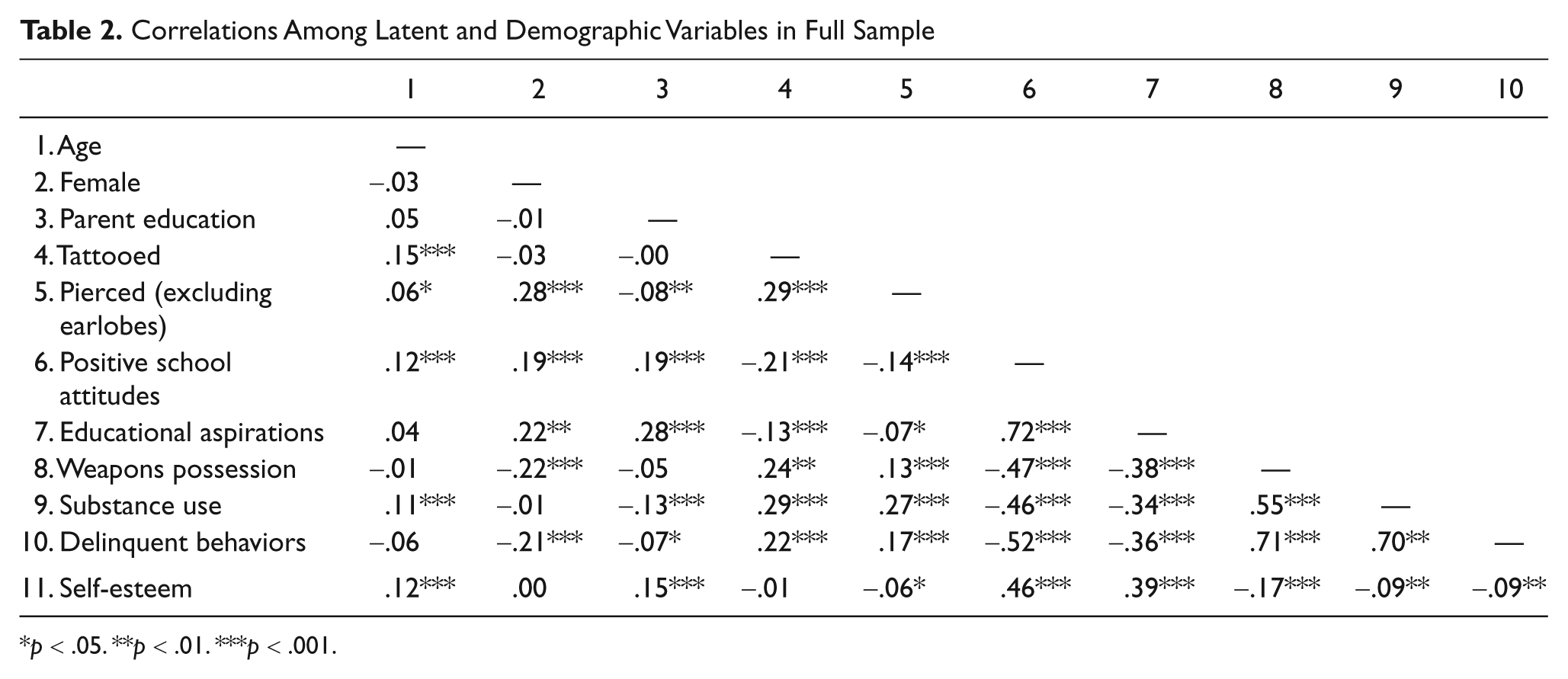
p < .05. **p < .01. ***p < .001.
Path Model
The final path model is presented in Figure 1. Fit indexes for this model were excellent, ML χ2 (n = 1,462) = 736.96, 237 df; CFI = .96, RMSEA = .039; S-B χ2 = 621.35, 237 df; RCFI = .95, RMSEA = .035. Correlations among the residuals of the dependent variables are not depicted for the sake of readability, but they resemble those reported in Table 2. Older age predicted more tattoos and body piercing, more Positive School Attitudes, higher Self-esteem, less Delinquency, and more Substance Use. Female gender predicted more piercing, more Positive School Attitudes, higher Educational Aspirations, and less Weapons Possession and Delinquency. Greater parent education predicted less piercing, more Positive School Attitudes, higher Educational Aspirations, and less Substance Use. As hypothesized, tattoos and body piercing predicted less Positive School Attitudes, lower Educational Aspirations, and more Weapons Possession, Substance Use, and Delinquency. Piercing was modestly but significantly associated with lower Self-esteem.
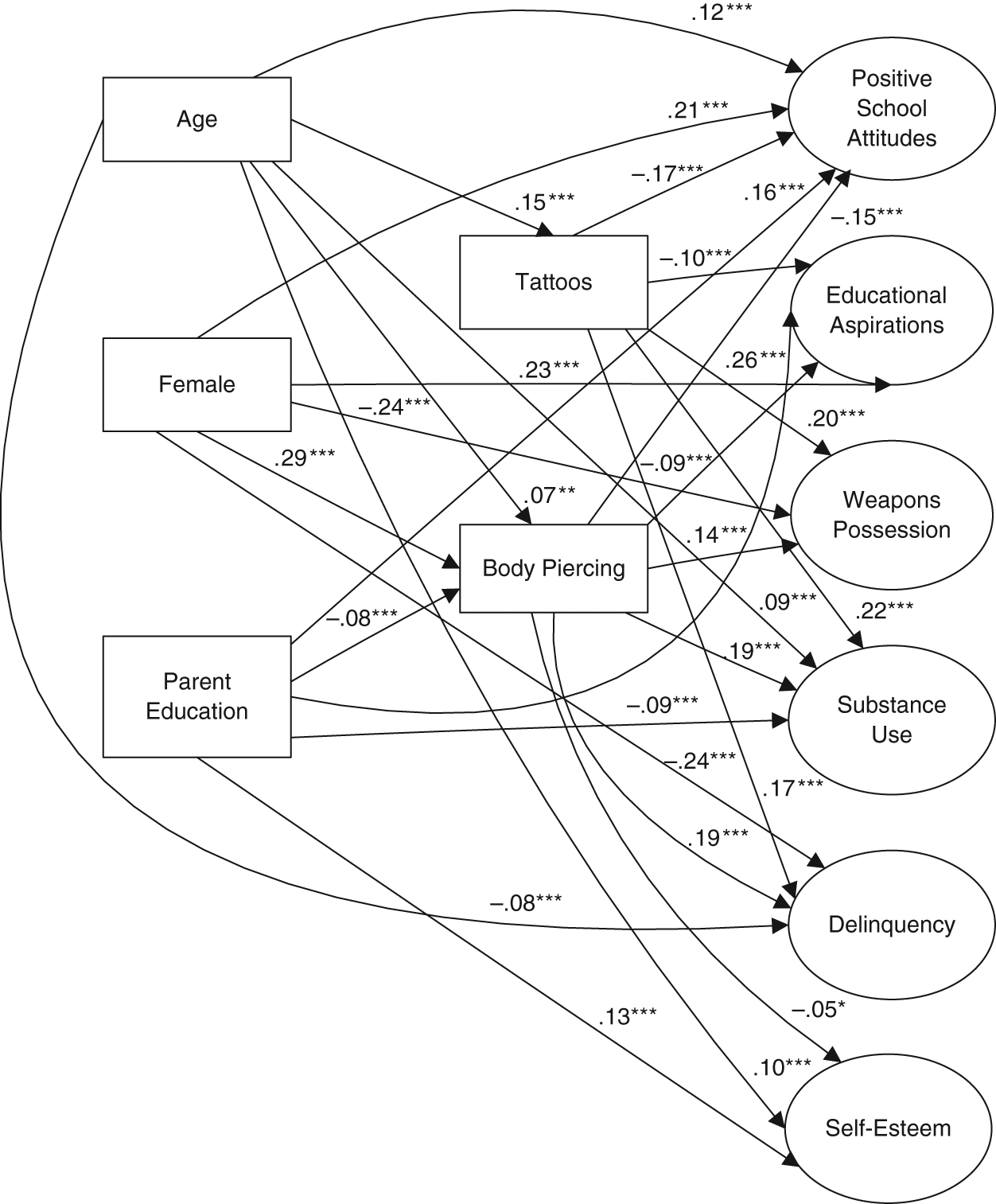
Final structural path model depicting influence of body modification on attitudes and behaviors among adolescents
Indirect Effects
Greater age predicted tattoos and piercings; thus, age in turn indirectly exerted significant effects on the outcome variables. As mediated through both body modification items, age had indirect negative effects on Positive School Attitudes and Educational Aspirations, and it had positive effects on the deviant behaviors of Weapons Possession, Substance Use, and Delinquency. Parent education, mediating through its negative influence on piercing, was significantly associated with more Positive School Attitudes and higher Educational Aspirations, and indirectly it predicted Weapons Possession, Substance Use and Delinquency. Its indirect effect on Self-esteem was not statistically significant.
As female gender was predictive of body piercing, the indirect effect of female gender mediated through piercing indicated more deviance. In addition, female gender (mediated through piercings) exerted significant indirect effects that indicated less Positive School Attitudes, lower Educational Aspirations, and more Weapons Possession, Substance Use, and Delinquency. As these significant indirect effects were counter to the general findings about the girls in the sample as a whole and general societal impressions, and because they could have been an artifact due more to the association between piercings and female gender rather than the behaviors themselves, additional multisample analyses were conducted to ascertain the actual influence of female gender based on their piercing status.
Multisample Analyses
We initially contrasted the girls with and without piercings (pierced girls n = 306, nonpierced girls n = 423). Girls with piercings reported lower parental education (p ≤ .05), were more likely to be tattooed (p ≤ .001), reported less Positive School Attitudes (p ≤ .001), lower Educational Aspirations (p ≤ .01), and more Weapons Possession, Substance Use, and Delinquency (p ≤ .001) than the nonpierced girls. There were no significant differences in Self-esteem.
Next, we successively contrasted the pierced females with both the pierced (n = 128) and nonpierced males (n = 605). The pierced males were more likely to have tattoos (p ≤ .001) than the pierced females. The pierced males had less Positive School Attitudes and lower Educational Aspirations (p ≤ .001), more Weapon Possession (p ≤ .001), Substance Use (p ≤ .05), and Delinquency (p ≤ .001). We then contrasted the latent means of the pierced girls with the nonpierced boys. The girls reported lower parental education (p ≤ .01). In addition, the girls were more likely to have tattoos (p ≤ .001). The girls reported higher Educational Aspirations (p ≤ .05), less Weapon Possession (p ≤ .01), and more Substance Use (p ≤ .001). There were no significant differences in Positive School Attitudes, Delinquency, and Self-Esteem.
Discussion
Using control theory, stigma, and labeling theory as well as existing research, we reasoned that body modification among adolescents was indicative of an orientation toward greater sensation seeking, less aversion to risk, rebellion, and less attachment to conventional norms (Gottfredson & Hirschi, 1990). Therefore, we predicted that adolescents who were not body modified would report more positive school attitudes, higher educational aspirations, less weapons possession, less substance use, less delinquency, and higher self-esteem. Our analyses supported these predictions.
Our next strategy was to examine the indirect effects of background variables, mediated through body modification, on the outcome variables. Perhaps our most important findings are those in which piercings among young women are indicative of negative outcomes. As expected from the literature, girls reported fewer deviant behaviors than boys, and girls with piercings reported a greater number of deviant behaviors, and they were less school oriented than girls without piercings. In addition, girls with piercings reported more substance use than boys without piercings, and they did not differ from those boys in weapons possession and delinquency. Nevertheless, boys with piercings still reported a greater number of deviant behaviors than girls with piercings in all categories. Previous research on tattoos and piercings rarely has examined mediation using demographic variables. An exception to this situation is research by Roberts et al. (2004), and these investigators did not find any effect of mediation using gender, so our findings in this area are new and worthy of attention in future research.
Age
From the perspective of developmental theory, as part of the search for identity, older adolescents have more social and psychological independence from parents, teachers, and other adults, and their peers have become more important to them (Arnett, 2000; Erikson, 1950; Perry, 1970; Waterman, 2004). Social independence means that they have more freedom of choice and movement, they have their own money, and if they are above 18 years old, they are allowed by law to make many decisions for themselves, some of which may involve body modification. From the perspective of control theory, older adolescents are expected to be more bonded to institutions; however, bonds with family may be decreasing, and many of our respondents who are modified are not as closely bonded school or oriented toward upward mobility through academics.
Adolescents versus adults
We observed that body modification is almost uniformly negative for adolescents, and indeed for some adults, body modification is related to deeper psychological and sociological problems. However, for other adults body modification has positive aspects of self expression to an audience of similar peers and perhaps to others in general. Especially work by Atkinson (2004) points to a carefully considered position that favors body modification. Caliendo et al. (2005) concluded that their sample of 146 intimately pierced respondents,
reported effective and reflective decision making, taking as long as 2 years to think about their intentions before initiating action. In that time, they used competent consumer skills to select artists and studios . . . a thoughtful process over time to resolve doubts and come to acceptance of the decision. (p. 482; see also Johnson, 2006)
Overall, findings for adults versus adolescents could be accounted for by teens being in an earlier stage of development, one in which peers or situational factors would affect body modification more strongly. As young adults, body modification can become a self-defining aspect of identity development. Three self-defining activities include personal expressiveness, increased competence, and goal-directed behavior (Sharp, Coatsworth, Darling, Cumsille, & Rainieri, 2007). Personal expressiveness involves the discovery of who one is and the pursuit of becoming that person. Increased competence requires greater engagement in an activity, increased self-awareness, and additional challenge that produce greater consolidation and affirmation of the self (Csikszentmihalyi, 2000). Goal-directed behavior entails commitment to choices that are salient for identity formation and to pursue them over time toward the development of a true self (Waterman, 2004).
Despite our findings, we are not sure that body modifications are uniformly negative for adolescents because the main type of research that has uncovered positive aspects of body modification among adults is qualitative, and little or no qualitative research has focused on adolescents. In qualitative research, positive cases can emerge and be taken into account, even if they are not the majority. However, in quantitative research such as ours, positive cases easily can be overwhelmed by a majority of negative ones. Our research supports most of the quantitative research on adults. Furthermore, it is possible that qualitative research among adolescents may show that body modification is more negative than it is among adults. If this is the case, we would speculate that among adolescents many body modifiers may be using it is an expression of taste (Bourdieu, 1984) and being cool (Forman, 2004).
Gender
We observed that about 18% of boys and girls had tattoos, and we observed that 16% of boys were pierced, but 42% of girls were pierced. The finding for gender and piercing supports that of Roberts et al. (2004); however, they found that 7.5% of girls and 1.5% of boys in 1995 and 1996 reported piercing other than earlobes. Clearly piercings have grown in popularity among youth (Lauman & Derick, 2006). Nevertheless, our most intriguing findings are the consistent gender differences in piercings and the gender similarities for tattoos.
Tattoos are more or less permanent; they are difficult to remove, so getting a tattoo may require greater resolve, and that fact might explain the lower prevalence of tattoos. In addition, while piercings can leave scars, when the inserted piece is removed, the holes can heal, and scars generally are less obtrusive (Brooks et al., 2003). In addition, the inserts are jewelry-like, and while boys wear jewelry, piercing-as-jewelry is more likely to appeal to young women (Zoellner, 2006). In fact, piercing may be more symbolic of deeper control than a tattoo which is on the surface. In addition, piercings may provide more stylistic options than tattoos because one can choose different inserts or no inserts at all. Finally, many more girls than boys have pierced ears, so the issues and complications of piercings are more familiar to them even though physical complications of piercings generally are greater than those for tattoos (Mayers et al., 2002). This notion is supported by the fact that in one study only 3% of respondents who reported a body piercing did not have a piercing in at least one ear lobe (Laumann & Derick, 2006).
Parent Education
The educational attainment of parents was used as a proxy for social class. Previous research showed that greater parent education is associated with fewer tattoos but not piercings (Laumann & Derick, 2006). Our results showed that parent education was associated with fewer piercings, but it was not related to tattoos. This discrepancy could be due to tattoos becoming mainstream more rapidly than piercings. Parent education also has been associated with more positive school attitudes and greater educational aspirations (Dubow et al., 2009; Strand & Winston, 2008). Our results support those in the literature.
Parent education was predicted to result in less weapons possession, less substance use, and less delinquency (Gottfredson & Hirschi, 1990). Our results showed that it had a negative relation only to substance use, and it had an indirect effect through body piercing. Finally, parent education was predicted to be positively related to self-esteem, and it was.
Implications
Stirn and Hinz (2008) have suggested that with the increasing frequency of body modifications they have become “a convenient means to either realize psychopathological inclinations such as self-injury or to overcome psychological traumas” (p. 332). But not all body modifications have such important implications, and care givers need to be able to distinguish between body modifications that simply are conformity to group norms and attempts to make one appear more attractive and those which can be markers of social and psychological problems. Unfortunately, our research did not distinguish clearly between these meanings, and adults must be careful not to apply deviant labels to adolescents who have body modifications, as the labels can become part of an emerging deviant identity. More subtly, negative reflected appraisals by others can lower self-esteem and interfere with attempts to help the adolescent (Jaret, Reitzes, & Shapkina, 2005) Certainly the number of body modifications, as well as the type, the size, and the location has importance for attempts at interpretation by adults who work with adolescents, and these characteristics are important areas of future research.
Limitations
We do not know the numbers of tattoos and piercings that the respondents have. We do not know the content of tattoos or the type of piercing. We do not know the circumstances leading up to the modification. Most important, we do not know the meaning that respondents attach to the modification.
In addition, we do not know if the modification was made by a professional. If so, Colorado law requires parental consent for clients who are under the age of 18. The modification may have been of the “jailhouse” type, made by the recipient or by a friend. In addition, our research design does not allow us to identify causes and effects surrounding body modification. This identification must await future research. Our study does not make us particularly optimistic about the pattern of correlates involving body modification in the lives of young people.
Conclusion
Although our research showed that body modification was correlated with negative outcomes, body modification should not by itself be treated as a marker of later deviance. However, educators, counselors, administrators, and other adults who work with adolescents should be alerted to the direct and indirect associations that we found, especially the higher risk among girls who pursue body modification. Although the increased popularity of tattoos and piercings apparently has lessened the stigma of body modification, it may have decreased the ability of caregivers and others who work with youth to identify, understand, and treat adolescents in particular need of help.
Footnotes
Acknowledgements
The authors gratefully acknowledge the secretarial and administrative assistance of Gisele Pham.
Views expressed in this article do not necessarily reflect those of the National Institute on Drug Abuse or the school districts.
The author(s) declared no potential conflicts of interests with respect to the authorship and/or publication of this article.
The author(s) disclosed receipt of the following financial support for the research and/or authorship of this article: Partial support for this research was provided by school districts in the Pikes Peak region of Colorado, and partial support was provided by a grant from the National Institute on Drug Abuse (DA01070-37).