







Abstract
With information supplied by a large (n = 3393) sample of high school students from Toronto, this paper tests the assumption that three forms of leisure activity—peer, risky, and self-improving leisure—have a relatively independent impact upon patterns of offending and victimization. Although we find significant support for this proposition, we also find that traditional criminal motivations are still strongly related to criminal incidents, particularly offending behavior. The positive association between leisure and victimization includes, counter intuitively, the sort of self-improving leisure that might have been expected to reduce the risk of victimization. We discuss our findings in terms of the relationship between traditional motivational explanations of crime and newer, more situational ones.
Introduction
Adult authority is characteristically suspicious of teenage leisure, often linking it to teenage impropriety (Agnew & Peterson, 1989; Sacco & Kennedy, 2002; Tanner, 2010). On occasion, however, the thinking is reversed and the leisure environment invoked as a potential antidote to youthful wrongdoing (Caldwell & Smith, 2006). Contemporary crime prevention programs, for instance, in addition to warning about the ill effects of unstructured teenage leisure (Caldwell & Smith, 2006; Feinstein, Bynner, & Duckworth, 2006; Mahoney & Stattin, 2000), often recommend more and better recreational facilities for young people as a means of keeping young people out of trouble. The present paper, with information supplied by a large sample of Toronto high school students, critically engages with both propositions: that some kinds of leisure activity result in crime and victimization, whereas other kinds serve to prevent it.
Definitions of leisure are both varied and problematic (Wilson, 1980). We conceive of leisure as not just the time available to adolescents after other obligations, such as school, have been met, but as activities that they find intrinsically rewarding (Sacco & Kennedy, 2002). Beyond that, however, teenage leisure preferences do not have the same meaning. Some leisure is more readily associated with deviant behavior, whereas others activities might be seen as educational or self-improving.
The first systematic investigation of the relationship between leisure and delinquency was conducted by Agnew and Peterson in 1989. Their findings confirmed, what, perhaps, might always have been suspected: that the leisure that corrupts and the leisure that improves are neither the same activities nor attract the same participants. They reported that delinquency was positively associated with unsupervised peer activities (e.g., hanging out with and visiting friends) and “least favorite” activities with parents and negatively associated with organized leisure activities (e.g., extracurricular school activities, scouts, church functions), passive entertainment (e.g., watching TV and movies, listening to music, reading) and noncompetitive sports. Explanation of these patterns was sought and found in the prevailing criminological theories of the day. They concluded that organized leisure reduces delinquent activity because it tightens bonds to family and school, as control theory surmises. Weak bonding, by contrast, fuels peer driven leisure that results in delinquency, as do the oppositional values identified by differential association and subcultural theories (Agnew & Peterson, 1989).
As one of the more comprehensive examinations of the relationship between leisure and delinquency, few reviews of the literature fail to cite Agnew and Peterson’s (1989) study. It remains one of the few studies to explicitly explain connections between leisure and delinquency with traditional motivational theories. By contrast, more recent investigations are likely to view the leisure environment as a relatively autonomous and independent determinant of both deviant behavior and victimization experiences.
Routine activities and offending
Closely related routine activity and lifestyle theories exemplify this newer situational approach to criminality (Birbeck & Lafree, 1993; Clarke & Felson, 1993; Cohen & Felson, 1979; Felson, 1994; Jensen & Brownfield, 1986). Situational approaches posit that crime and deviance is largely a function of opportunity: opportunity that is created when, in the absence of capable guardians, motivated offenders and their putative victims are brought together in a context of shared time and place (Cohen & Felson, 1979; Felson & Clarke, 1998; Hindelang, Gottfredson & Garafolo, 1978; Kennedy & Ford, 1990; Messner & Blau, 1987; Miethe, Hughes, & McDowell, 1991). Originally deployed to explain patterns of adult victimization, these same ideas have also been applied to adolescent offending (Bernberg & Thorlindson, 2001;Cohen, Kluegel, & Land, 1981; Felson & Clarke, 1998; Hoyt, Ryan, & Cauce, 1999; Miethe & Meier, 1990; 1994; Osgood & Anderson, 2004; Osgood, Wilson, O’Malley, Bachman, & Johnston, 1996; Riley, 1987; Vazsonyi, Pickering, Belliston, Hessing, & Junger, 2002).
Indeed, the claims of routine activity theory are probably best showcased in a large and influential longitudinal examination of young people’s routines and deviant behavior in the United States. Osgood and colleagues (1996) report that it is unstructured peer activity that leads to deviant behavior; it affords opportunity to deviate, whereas the company of peers and the absence of adult authority figures make the resultant deviant conduct both more rewarding and less likely to be sanctioned.
Osgood and colleagues (1996) conceptualize routines as mediating the structural effects of age, sex, high school grades, and parental education on deviance, with a particular focus on how correlations between those structural factors and deviance might be explained by patterns of routine activity that change over time. In this, and other routine activity research, the motivation for deviance is seen as residing primarily in the routines themselves, rather than in the dispositions of individual adolescents. Although routine activity research does acknowledge the existence of motivated offenders, it rarely investigates them (Bratt, 2008; Paulsen & Robinson, 2004; Sasse, 2005; Schwartz, DeKeseredy, Tait, & Alvi, 2001). The importance of this neglect is apparent in findings from a small number of studies that do calibrate the effects on deviant behavior of both leisure activities and the motivational characteristics of individual adolescents.
In a study conducted with high school students in Iceland, Bernburg & Thorlindsson (2001) find that strong family ties and a positive bond with school both discourage participation in unsupervised peer activities and moderate responses to the opportunities and temptations proffered by such leisure environments. Other social relationships, such as involvement with deviant peers or exposure to values supportive of deviance, have the opposite effect: they make unstructured routines more likely to result in deviant behavior. Wong (2005) also finds that relatively few teenage activities have any direct bearing upon delinquency. Instead, any impact of leisure upon delinquency is indirect, mainly because they either strengthen or weaken conventional bonds to parents and school, or because they strengthen or weaken delinquent associations. Likewise, research conducted in Antwerp, Belgium and Halmstad, Sweden, by Svensson and Pauwels (2010) finds that risky leisure (e.g., night-time activities in city centers) is not equally risky for all participants. They find that low self-control, coupled with risky leisure, produces the most problematic outcomes. In other words, there is an interaction between a kind of leisure situation and a particular kind of motivated offender.
But research of this sort—research that, variously, examines the influence of motivations on the relationship between routines and deviance, interactions between motives and leisure, or the relative importance of situational and motivational determinants of crime—is not extensive. We still know comparatively little about how leisure and criminal motivations might combine to produce deviant behavior, or prevent it (Wikstrom & Butterworth, 2006), or how those same factors might be associated with being a victim of crime.
Routine activities and victimization
Previous research indicates that among adolescents, the leisure activities most likely to result in deviant activity—unstructured peer activities—also result in victimization (Bjarnason, Sigurdardottir, & Thorlindson, 1999; Jensen & Brownfield, 1986; Lauritson, Laub, & Sampson, 1992). Previous research also indicates that delinquent activities are a stronger predictor of victimization than either structured or unstructured leisure activities (Henson, Wilcox, Reyns & Cullen, 2010; Jensen & Brownfield, 1986; Lauritson, Laub & Sampson, 1992). Seeking to explain close linkages between offending and victimization, some researchers now entertain the proposition that motivational factors affect risk of victimization, as well as the likelihood of offending (Schreck, Stewart, & Osgood, 2008). Although unstructured peer activities retain their importance as a determinant of violent victimization, such an outcome is also the consequence of personality traits such as low self-control and weak social bonding to parents and school (Schreck, 1999; Schreck, Stewart, & Fisher, 2006; Schreck, Wright, & Miller, 2002). The same researchers have similarly supplemented routine activity explanations by examining how family factors and peer relationships might also affect young people’s risk of victimization (Schreck & Fisher, 2004; Schreck, Fisher, & Miller, 2004). However, what has yet to be revealed by existing research are the relative and interactive effects, on victimization risk, of criminal motivation and leisure routines.
No less important, although existing research confirms that there are significant overlaps in the backgrounds, experiences, lifestyles, and dispositions of adolescents who perpetrate crime and adolescents who become victims of crime (Schreck, Stewart, & Osgood, 2008), fewer studies have successfully demonstrated that there are any leisure activities, net of other factors, that actually reduce the risk of victimization.
Although routine activity logic suggests that there are, or should be, safe and healthy leisure activities, identifying them has proven to be elusive. Lauritson, Laub, and Sampson (1991; 1992), for instance, report few independent associations of conventional activities, including time spent with family and studying, on risk of victimization. They found that few leisure activities protected adolescents from the risk of assault once the influence of structural factors (gender, race, family) and offending behavior had been considered; criminal motivations, however, were not controlled for.
More recent research has corroborated their findings. Henson, Wilcox, Reyns, and Cullen (2010) report that, with the exception of time spent with a romantic partner, no leisure activities ameliorative the risk of victimization independently of delinquent activity. Furthermore, recent research also suggests that participation in some structured, conventional leisure activities might prove detrimental to the safety and well-being of adolescents.
In his examination of peer group hierarchies in American high schools, Milner (2004) contends that students accord different amounts of prestige to various extracurricular activities. He reports that involvement with the school band, unlike membership of sports teams, confers “ low to moderate status in the eyes of other students” and that band members are regularly derided as “nerds” or “fags”(Milner, 2004, p. 75). The nerd epithet derives, Milner suggests, from the need for regular practice under adult supervision and the homophobic epithet from the fact that band activity is nonathletic and nonaggressive, characteristics that are at odds with the masculine norms favored and enforced by more dominant peer groups in high school.
A school-based leisure activity that is welcomed, we presume, by parents and teachers, is thus less favorably judged by prevailing youth cultural standards. Whether participation in other forms of adult-approved leisure is similarly linked to verbal abuse and victimization remains to be seen.
The Present Paper
With data supplied by a large sample of high school students in Toronto, Canada, this paper offers a further examination of the relationship between young people’s leisure activities and their experiences with crime, as both offenders and victims. Existing research pays scant attention to the manner in which criminal motivations might modify relationships between leisure and offending and victimization. We address this deficiency in two ways: First, by assessing the relative importance of a three types of leisure activities (peer leisure, risky leisure, self-improving leisure), and criminal motivations (social control, differential association and perceptions of social injustice) as factors predictive of offending and victimization outcomes. Second, by examining whether those outcomes are a product of the interaction between motivated offenders (kind of persons) and leisure activities (kinds of situations). Peer leisure includes unstructured and unsupervised activities carried out in the company of friends in the home or in public spaces, including hanging out and shopping, whereas risky leisure refers to participation in activities that are somewhat more precarious for young people, including going to parties, clubs and raves, as well as sexual activity. Conversely, self-improving leisure refers to more prosocial or educational activities, such as reading for pleasure, hobbies, and attending cultural events.
For both peer and risky leisure, our presumption is that these are activities affording maximum opportunity and reward for deviant activity. We further anticipate that any associations we find between both peer and risky leisure and offending are strengthened by the presence of criminal motivations, and weakened by its absence. More specifically, we hypothesize that the probability of peer and risky leisure situations inducing a deviant response will be greatest among those motivated by low levels of social control, strong deviant attachments, and feelings of injustice, and weakened among those without these propensities.
With self-improving leisure, we make the opposite presumptions. We posit that these are activities that minimize opportunity and reward for deviant activity, and that any inverse association between the two will be most pronounced among those least motivated to engage in illicit behavior.
We acknowledge that most theories of crime are, by design, theories of offending rather than victimization, and purport to explain why individuals commit crimes, not why they become victims of crime (Schreck, Stewart, & Osgood, 2008). The theories that might modify relationships between leisure and offending might be thought less likely to modify relationships between leisure and victimization. Nevertheless, routine activity theory has been credited with identifying the conditions and circumstances (unstructured, unsupervised leisure activities) equally likely to predict both outcomes (Schreck, Stewart, & Osgood, 2008). What we have yet to determine is whether relationships between peer and risky leisure and offending and victimization are equally likely to be modified by motivational influences.
We are more circumspect about the impact that self-improving leisure might have upon victimization. On the one hand, all of the constituent activities are more purposive and organized than peer (and risky) leisure (Osgood et al., 1996; Hawdon, 1996) and hence might be expected to be relatively safe leisure pursuits for young people. Furthermore, they are either carried out in public (going to art galleries and museums) or at home or school (reading, practicing a musical instrument, working on a hobby) where capable guardianship is supplied by, variously, fellow patrons, institutional employees, teachers and parents. On the other hand, the small amount of prior research devoted to this topic has failed to produce much evidence that participation in similarly structured or organized activities reduces the risk of victimization. Moreover, Milner’s (2004) work suggests that participation in leisure activities favored by adult authority, because they advance educational careers, also exposes adolescents to abuse from malevolent peers and, possibly, increases the risk of victimization .Thus, although the routine activity literature provides theoretical reasons for why self-improving leisure might protect adolescents from victimization, existing research offers few supportive portents. Our cautious and equivocal hypothesis is that there will be no significant association between self-improving leisure and victimization, and that there will be no interaction between leisure and criminal motivation influencing that association
Method
Data
The data for this paper are drawn from the Toronto Youth Crime and Victimization Study, a stratified cross-sectional survey of 3,393 Toronto adolescents between the ages of 13 and 18, carried out between 1998 and 2000 (Tanner & Wortley, 2002). Students came from 30 Metropolitan Toronto high schools in both the Catholic (10 schools) and larger public school (20 schools) system, where at least one class from grades 9 (aged 13 and 14) to 13 (aged 18 and 19) was randomly selected. Active consent was obtained from both students and parents for participation in the study, and the overall response rate was 83%.
Self-administered questionnaires were completed during class time, under the supervision of a member of the research team (and without a teacher present) and took approximately 45 min to complete. As the questionnaire does not include high school dropouts, institutionalized youth, and street youth, it is a school sample and thus any generalizations speak only to the experience of school-based adolescents. However, our sample is ethnically and racially diverse (39% of respondents were White, 14% Black, 12% Asian, 19% South Asian, 15% from other racial groups) and is representative of the Metropolitan Toronto high school population at the time. The project received ethical approval from the research ethics board at the University of Toronto, as well as from the Toronto Public School Board, and the Catholic school board.
Measures
Offending and victimization
Four dependent variables, all based on previously used scales (Tanner, Asbridge, & Wortley, 2008; 2009), were constructed to capture respondents’ involvement in offending and experiences of victimization. Our measures of past 12 months offending cover a spectrum of activities, varied by type and seriousness. Two scale items were constructed based on frequency of involvement in offending activities. The first scale denotes past year involvement in property offending, including self-reported property damage, theft under CAN$50, breaking into a car, stealing a car, stealing a bike, breaking and entering into a home, drug dealing, and theft more than CAN$50 (α = 0.86). The second scale measures past year violent offending and includes carrying a hidden weapon like a gun or knife in public, using physical force on another person to get money or other things; attacking someone with the idea of seriously hurting that person, hitting or threatening to hit a parent or teacher, getting into a physical fight with someone, and taking part in a fight where a group of friends were up against another group (α = 0.81).
Similarly, our measures of victimization covered a comparable range of activities, and represent experiences of property victimization and violent victimization. The property victimization scale indicates the frequency in which the following things have occurred in the past year: theft of money and theft of or damage to property (α = 0.61). The violent victimization scale measures experiences of being verbally or physically threatened, verbally or physically assaulted, and whether weapons were involved (α = 0.77).
Leisure activities
Three scale measures of leisure activities are included in our analysis. The first is peer leisure, which refers to the unstructured and under-supervised peer activities that have been at the forefront of most previous routine activity research. It is measured by involvement in seven activities: driving around in a car with friends, visiting friends at their home, shopping with friends, hanging out in malls with friends, hanging out on the street, friends visiting your home, and hanging out in coffee shops (α = 0.72). The second is risky leisure, measured by the frequency of participation in four activities: kissing and fooling around, having sex, going to house parties or raves, and going to bars or nightclubs (α = 0.79). Finally, peer and risky leisure is contrasted with a measure of self-improving leisure. Self-improving leisure includes the following seven activities: playing a musical instrument, attending cultural events, going to the library, going to the symphony or opera, going to the museum, reading a book for pleasure, and involvement with hobbies (α = 0.65). All three leisure scales were standardized.
Criminal motivations
Our measures of criminal motivations are unique to this study, though they draw on three theories of crime and criminal involvement: control theory, an amalgam of differential association and learning theory, and one of our own making, perceptions of social injustice. Drawing on Hirschi’s version of social control theory (1969), we focus on the ties that bind children and youth to parents. The parental bond was measured with four questions that tap into parents’ knowledge of the child when not at home, such as where they are and who they are with, along with a question on how important the young person views family in their life. These four items were converted to a scale (α= 0.72) and standardized, with higher scores indicating weaker social control.
Our second criminal motivation measure draws on differential association (Sutherland, 1947), focusing upon the holding of attitudes and opinions favorable to law violation (Akers & Lee, 1999; Kaplan, Martin, & Robbins, 1984). Our measure is based on a composite scale of definitions favorable (and unfavorable) to deviant behaviors, based on seven Likert-type scale question: four addressing attitudes toward fighting and violence, two question on attitudes toward drug use, and one question on attitudes toward stealing. Scores were summed and then standardized (α = 0.79), with higher scores indicating definitions more favorable to deviance.
Our measure of perceptions of social injustice locates a disposition to offend in the obstacles that structurally disadvantaged individuals and groups face in achieving universal success goals and bears some resemblance to classic strain theory (Merton, 1938). It is made up of six questions probing issues of poverty and equality of opportunity, race and class based discrimination in school, work, and the criminal justice system. The six items were converted to a scale and standardized (α = 0.65), with higher scores indicating greater social injustice.
Sociodemographic and school measures
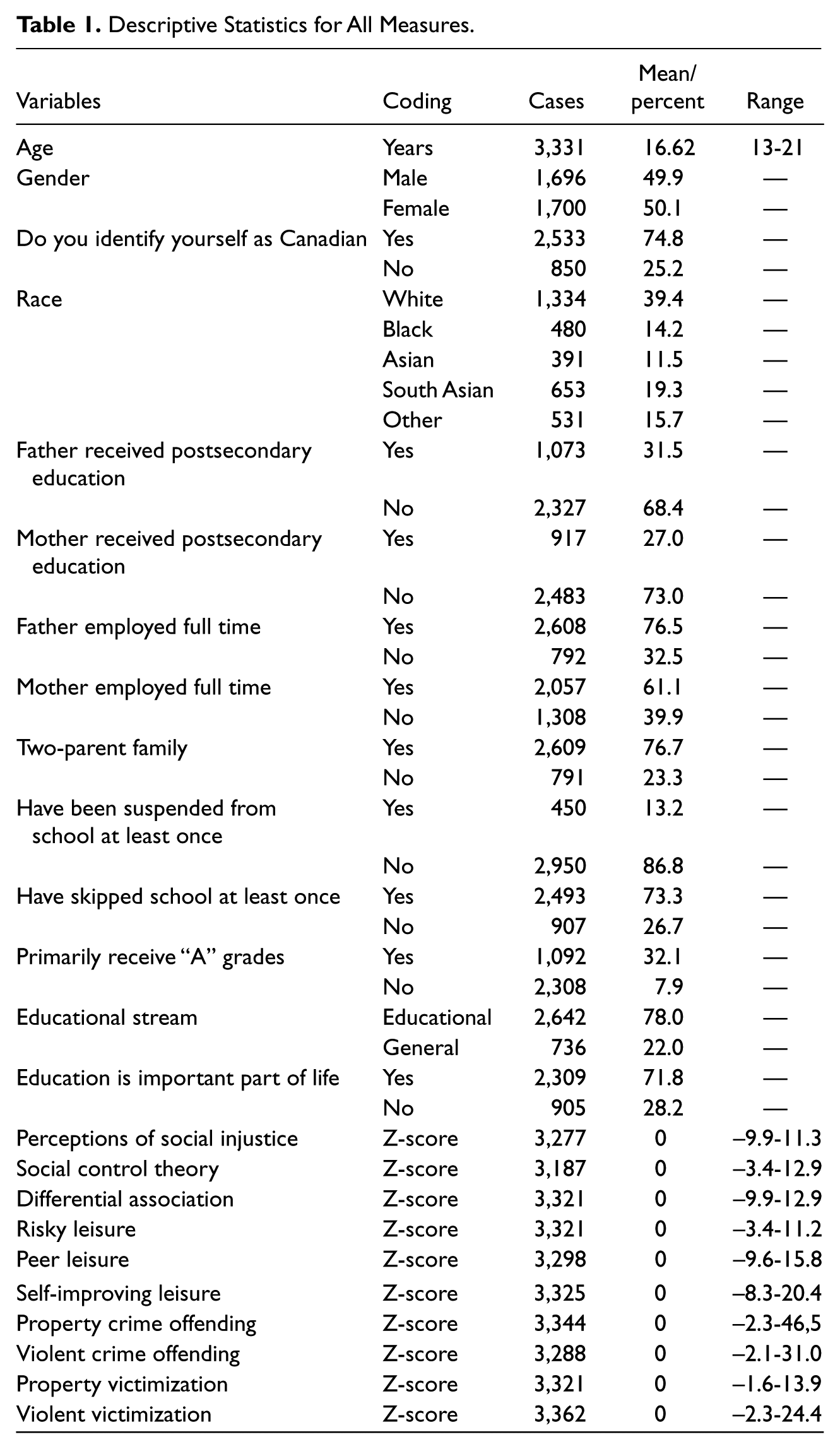
We examine the relationship between leisure activities, deviant behavior, and victimization, controlling for: respondents’ age, gender, race (White, Black, Asian, South Asian, and other), parental educational attainment (attended postsecondary education), parental employment status (presently employed), and family intactness (two-parent household). Because leisure activities, delinquency and victimization may also be related to young people’s experiences in high school, we include measures of: self-reported grades (receiving mainly ‘A’ grades), skipping school, suspension from school, educational stream (general or academic stream), and the student’s opinion on the importance of education. Descriptive statistics for all measures are presented in Table 1.
Descriptive Statistics for All Measures.
Analytic Approach
Ordinary least squares regressions, with the robust cluster variance estimators to address intra-cluster correlation across schools, is employed to examine four separate outcomes: property and violence offending, and property and violent victimization. In examining each outcome we run three separate models. The first (Model 1) is an unadjusted model that examines the bivariate associations between leisure and criminal motivations on offending and victimization. The second (Model 2) looks at the association of leisure activities and measures of criminal motivation on offending and victimization outcomes, and Model 3 adds in sociodemographic, socioeconomic, and school measures. 1 The structure of our analysis allows us to examine not only the independent effects of each form of leisure and each criminal motivation on offending and victimization outcomes, but also the relative impact of leisure after adjusting for motivations. Finally, to explore whether the effects of leisure on offending and victimization are moderated by criminal motivations, we run a series of regression models to test interactions between each leisure activities and each criminal motivation. We find no evidence of multicollinearity in all our models as the tolerance and variance inflation factors (VIF) for all measures are well within acceptable levels. All analyses are conducted with the Stata 11.0 computer program (StataCorp, 2010).
Results
Table 2 describes the relationship between leisure activity and property and violent offending. Unadjusted results indicate that both peer (p < 0.01) and risky (p < 0.01) leisure have significant positive associations with property offending, whereas self-improving (p < 0.01) leisure, by contrast, is negatively related. After adjusting for criminal motivations and other background factors, the effects of self-improving and risky leisure on property offending remain, though somewhat diminished, whereas the effect of peer leisure (p = 0.11) is no longer statistically significant. We also find that criminal motivations have strong independent effects on property offending in all models. In fact, our measure of differential association has the largest effect on property offending, followed by risky leisure, perceptions of inequity, and social control.
Linear Regression Models of Property and Violent Offending on Leisure (Peer, Self-improving, and Risky), Criminal Motivations (Social Control, Social Injustice, Differential Association), Background Characteristics, Social Class and SES Measures, and School Measures (Coefficients and t-statistic in Parenthesis).
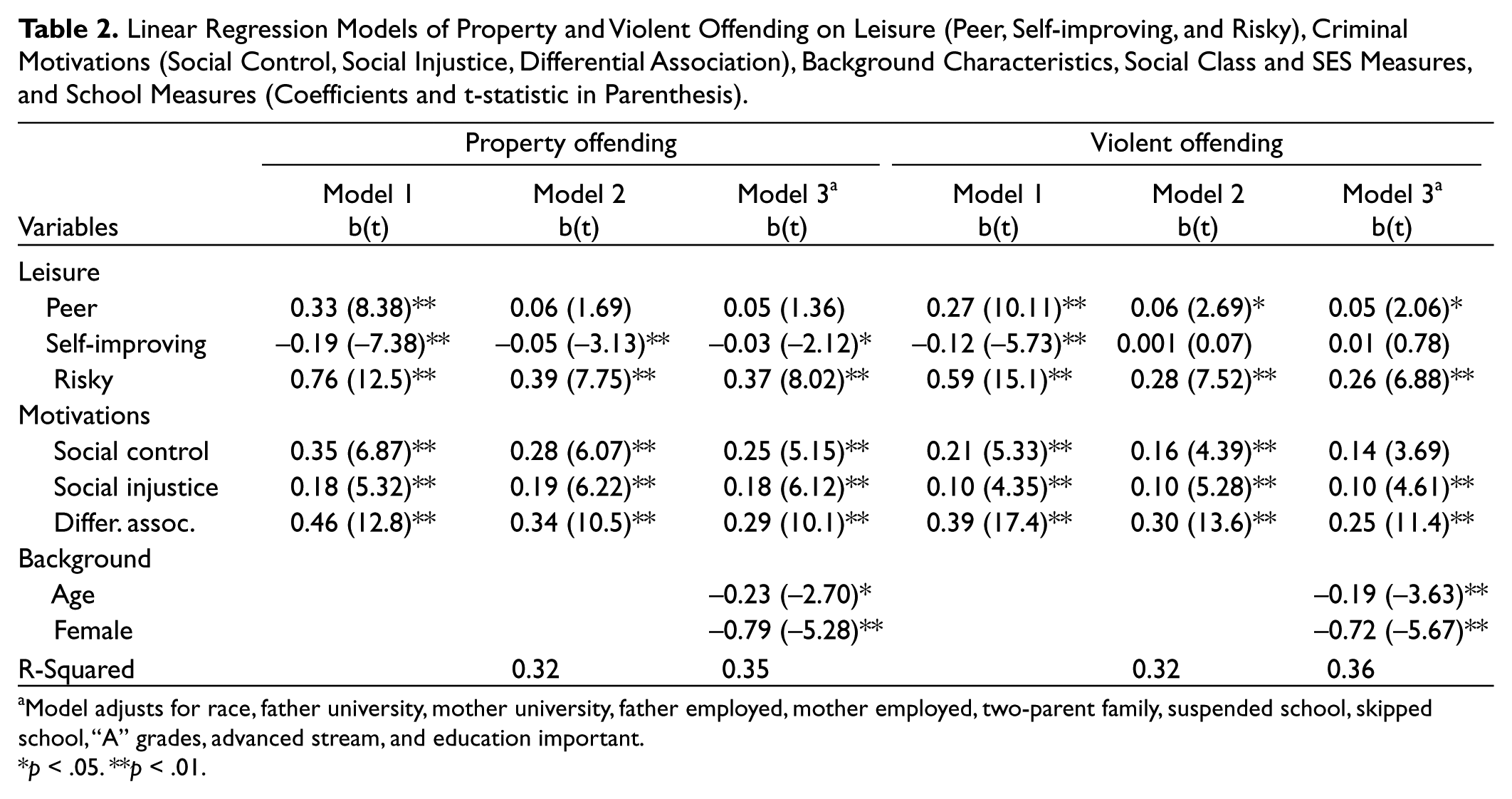
Model adjusts for race, father university, mother university, father employed, mother employed, two-parent family, suspended school, skipped school, “A” grades, advanced stream, and education important.
p < .05. **p < .01.
A similar pattern is evident when we examine the relationship between leisure activities and violent offending (Table 2). We find associations (p < 0.01) between all three leisure measures (positively for peer and risky leisure, negatively for self-improving leisure) and violent offending in the unadjusted model. However, whereas both peer and risky leisure continue to have a positive association with violent offending that is independent of criminal motivations and background factors, self-improving leisure (p = 0.44) is unrelated to violent offending after controlling for the same measures. Criminal motivations continue to have an important influence on violent offending, particularly differential association, which remains the strongest correlate of violent offending; perceptions of inequity and social control have significant, though weaker, associations.
Table 3 outlines the relationship between leisure activities and property and violent victimization. Here we find all three leisure behaviors significantly associated with property victimization, even after adjusting for criminal motivations and background factors. The association between peer (p < 0.05) and risky (p < 0.01) leisure and property victimization is, by the edicts of routine activity theory, an expected finding; the fact that self-improving (p < 0.01) leisure is similarly implicated, considerably less so. We also find leisure activities are more strongly associated with property victimization than any of our measures of criminal motivation.
Linear Regression Models of Property and Violent Victimization on Leisure (Peer, Self-improving, and Risky), Criminal Motivations (Social Control, Social Injustice, Differential Association), Background Characteristics, Social Class and SES Measures, and School Measures (Coefficients and t-statistic in Parenthesis).
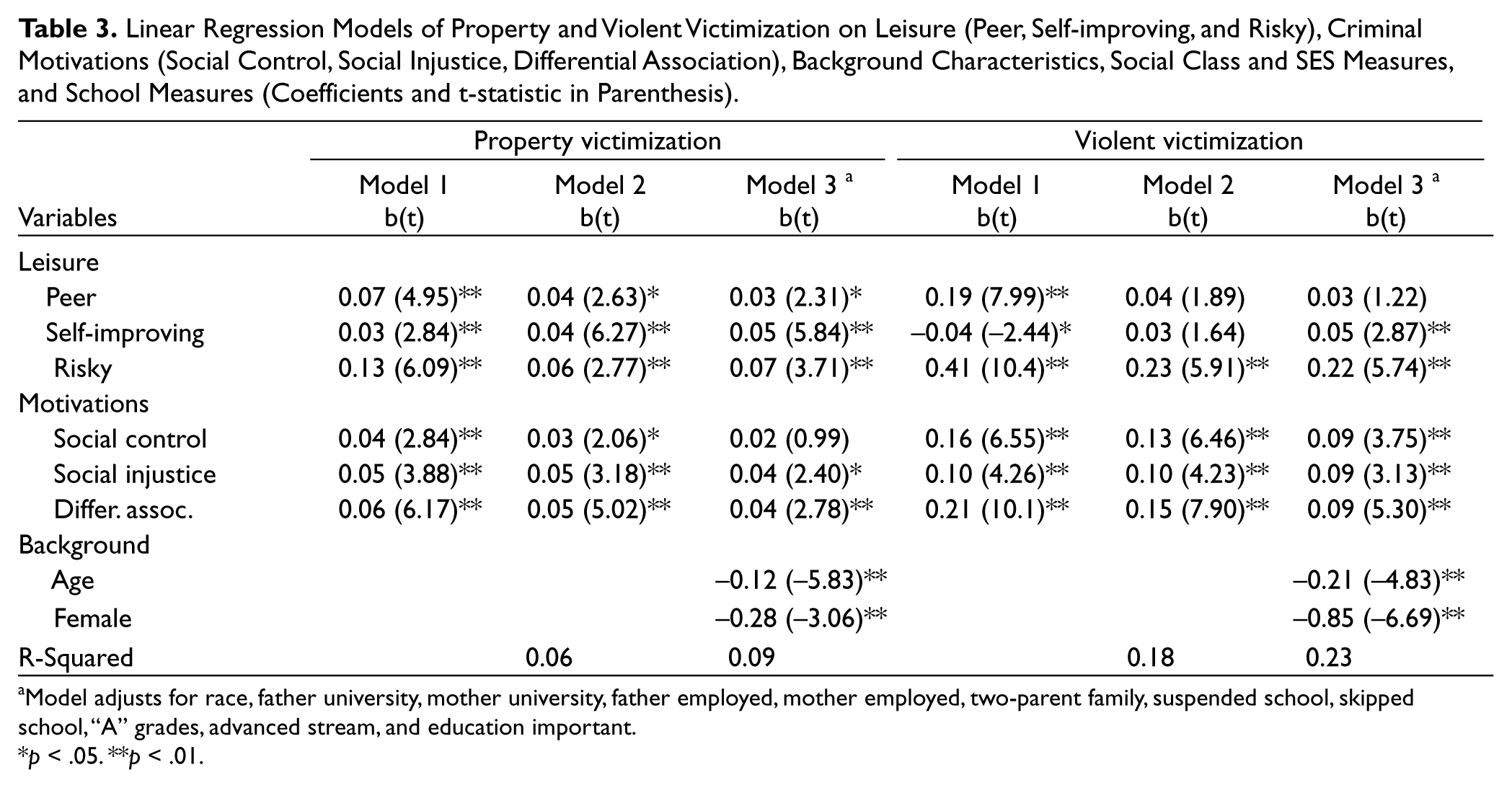
Model adjusts for race, father university, mother university, father employed, mother employed, two-parent family, suspended school, skipped school, “A” grades, advanced stream, and education important.
p < .05. **p < .01.
The relationship between leisure and violent victimization is more varied. There are significant associations between all three leisure activities and violent victimization in the unadjusted model; positive associations with peer and risky leisure, negative associations with self-improving leisure. The positive association remains for risky leisure (p < 0.01) after controlling for criminal motivations and background factors, but disappears for peer leisure. With self-improving leisure, after controlling for motivations and background factors, its association with violent victimization becomes positive (p < 0.01). As with property victimization, risky leisure is more strongly associated with violent victimization than criminal motivations.
Finally, we test the interaction of leisure activities and criminal motivations on associations with offending and victimization (Table 4). Significant interactions exist, though the nature of the effect differs depending on the leisure activity, criminal motivation, and outcome. Three general patterns are observed. First, for property and violent offending, the interactions of peer and risky leisure and criminal motivations are positive, meaning that these leisure routines have the strongest impact upon offending among respondents most motivated to commit criminal acts, and little impact upon those least motivated to offend.
Interaction Models for Leisure (Peer, Self-improving, and Risky) by Criminal Motivations (Social Control, Social Injustice, Differential Association), Adjusting for Other Factors (Coefficients and t-statistic in Parenthesis).
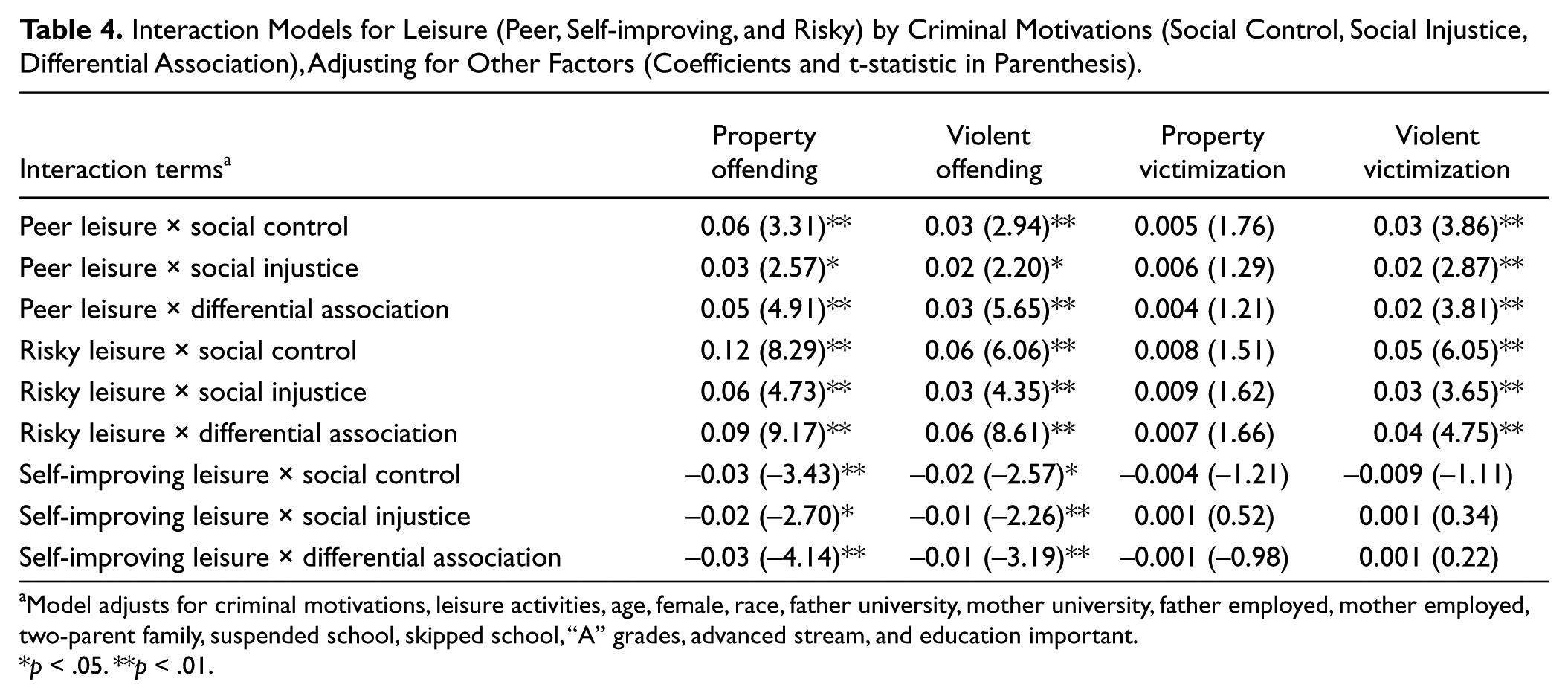
Model adjusts for criminal motivations, leisure activities, age, female, race, father university, mother university, father employed, mother employed, two-parent family, suspended school, skipped school, “A” grades, advanced stream, and education important.
p < .05. **p < .01.
Second, the interaction of self-improving leisure and criminal motivations are either nonsignificant or negative in nature. Where negative, the association suggests that greater involvement in self-improving leisure is protective in effect, because incremental increases in motivation do not increase the propensity to offend. Finally, although there are no significant interactions between leisure activities and motivations with regard to property victimization, there are significant interactions between both peer and risky leisure and criminal motivations that affect the probability of violent victimization. The nature of the interaction suggests that positive associations between violent victimization and peer and risky leisure only exist for the most criminally motivated. For those less criminally motivated, immersion in peer and risky leisure does not increase violent victimization (Table 4). However, criminal motivations do not interact with self-improving leisure in predicting violent victimization.
Discussion
This paper has sought to understand the relationship between young people’s leisure activities and their encounters with crime as both offenders and victims. Most contemporary research on this topic has been guided by routine activity theory, which sees crime as a consequence of the everyday routines or lifestyles that people pursue, rather than an effect of their personal histories or dispositions. We have engaged with this viewpoint by first examining the relative contribution of leisure activities and motives to explanations of criminal behavior and victimization experience; and second, by examining interactions between leisure activities and criminal motives.
Our findings provide qualified support for the contention that leisure routines are directly responsible for patterns of youth offending. Net of other factors, risky leisure is strongly associated with both property and violent offending, whereas peer leisure works the same way for violent offending, though not property offending, where we suggest, the effects are more indirect. The combination of net negative and nonassociations between self-improving leisure and offending behavior is also broadly consistent with routine activity arguments.
For the most part, the leisure activities that are most strongly associated with offending are also related to experiences of victimization. Peer and risky leisure are linked to higher levels of victimization, particularly for risky leisure seekers whose lifestyles put them at the epicenter of the oft observed overlapping relationship between offending and victimization (Schreck, Stewart, & Osgood, 2008).
Although refraining from peer dominated activities and, especially, risky leisure, is one strategy by which young people might make themselves less vulnerable to victimization, we could find no leisure pattern that actually protects them from predatory offenders. We had contemplated that self-improving leisure might play this role. However, although participation in self-improving leisure is associated with reduced levels of offending, it does not appear to provide any buffer against victimization. Quite the opposite, in fact; self-improving leisure is associated with a larger, not smaller, risk of victimization. A major revelation of our paper, therefore, is that activities that might be lauded as a positive investment of young people’s time and energy may leave them vulnerable to victimization.
Although self-improving leisure is valued, we suggest, by parents and educators it is seen as less positive by the majority of high school students. Young people partaking in such activities are likely seen as odd and different; and this oddity and difference, in turn, becomes the motivation for victimization by unsympathetic peers. Such students become “suitable targets,” in routine activity vernacular, because of the negative attributions made about their leisure preferences.
In making this argument, we are explicitly building on Milner’s (2004) discussion of high and low status peer activity in high school, particularly the low status, and “nerd” and “fag” stigmatization that has been associated with activities such as school band membership. We suggest that self-improving leisure is band membership, writ large, and is representative of a larger group of activities that are viewed very differently by parents and educators than by the majority of high school students. Although it is important not to overstate the similarities between the two, band membership and self-improving leisure do share the devalued characteristic of adult approval, and the capacity to attract negative attention from peers.
We are also able to eliminate an alternative possibility that self-improving leisure enthusiasts are victimized because they also spend more time in unstructured and unsupervised peer dominated and risky leisure settings. We could find no relationship between time spent in peer leisure and time spent in self-improving leisure and an inverse one between self-improving leisure and risky leisure. Self-improving leisure participants occupy a different world from their peers; but not one in which they are victimized because their preferred activities bring them into contact with motivated offenders, or because they are denied the protection of capable guardians.
Our interpretation of the stigmatizing effects of self-improving leisure is also consistent with research undertaken by Finkelhor and Asdigian (1996). They find out that some young people are at risk of victimization not because of the routines that they follow or the lifestyles that they lead, but because of how other people respond to their personal characteristics (i.e., gender, ethnicity, build, intellect). Some young people are rendered vulnerable because these characteristics fit “the needs, motivations, or reactivities of potential offenders” (1996, p. 3). Young females, for example, are at risk of victimization because sexual assault is rewarding for (male) offenders, some children and youth are victimized because of their physical limitations or psychological liabilities, whereas others arouse discriminatory behavior because of their racial and or ethnic characteristics and identities. Finkelhor and Asdigian argue that in such cases, victimization is a consequence of personal states, not the activities or lifestyles of those victimized. Some adolescents are, in other words, deliberately targeted.
Although self-improving leisure is not a personal characteristic in the same (ascribed) way that gender or race is, we think it has a similar meaning and effect: involvement and identification with it makes participants rewarding targets for motivated offenders (“bullies”) keen to assert dominance and hierarchy in peer group settings. Self-improving leisure participants are vulnerable to victimization despite low levels of criminal motivation. Similarly, and more generally, the young people in our sample are primarily at risk of property victimization because of the peer and risky leisure routines that they pursue rather than their motivational characteristics. Clearly, property victimization is the domain of criminal activity most supportive of routine activity theory’s proposition about the situational effects of teenage leisure on criminal encounters.
For the most part, however, we find that support for routine activity theory is modified because of the observed interactions between peer and risky leisure routines and motivational dispositions as they relate to victimization. The impact of these routines on victimization is greatest among students who are weakly attached to parents, more supportive of deviant conduct, and who perceive social injustice in Canadian society.
We find that motivational dispositions, deviant attitudes in particular, are as strongly associated with offending as are peer and risky leisure routines; we also find that the effect of these routines on deviant behavior is greatest among students most fully possessed of criminal motivation, and diminish considerably for less strongly motivated offenders. These findings contest a strict version of routine activity theory that concentrates more or less exclusively upon situational inducements to deviance. Overall, we argue that whatever temptations and opportunities are available to adolescents in their leisure pursuit; it is motivational states that determine whether criminal opportunities are exploited or resisted.
We believe that our research has made a significant contribution to our understanding of the relationship between young people’s leisure routines and their encounters with crime. Nevertheless, we recognize that our research has several shortcomings. First, although our models for violent and property offending, and violent victimization were robust, we must acknowledge the relatively small magnitude of variance explained by our victimization models. These are not easily explained, because the key variables in our study—background factors, education experiences, leisure activities, offending, and victimization—are all standard features of this kind of research. Second, our cross-sectional data restricts what we can say about the causal sequencing of our key variables. Although our findings indicate a close, and possibly, synchronous correspondence between leisure preferences and criminal motivation (the latter is associated with peer dominated and risky leisure, its absence with self-improving leisure), we are unable to determine which comes first—deviant motives (or its absence) or leisure preferences. Although our findings might suggest that peer and risky leisure are not just immediate causes of deviant behavior, but also a consequence of criminal motive, we cannot be certain of this without longitudinal data. Nor can we say if the interactions between situational and nonsituational sources of criminality vary over time. It may be, for instance, that the situational importance of peer and risky leisure is diminished as adolescents become young adults, with new found work and family responsibilities curbing deviant ambitions, and fewer deviant friendships providing support for deviant values (i.e., Sampson & Laub, 1993; Laub & Sampson, 2003). Future research should examining the interactions of criminal motivations and varying leisure activities on offending and victimization experiences, employing longitudinal data captured through adolescence and young adulthood.
Footnotes
Declaration of Conflicting Interests
The author(s) declared no potential conflicts of interest with respect to the research, authorship, and/or publication of this article.
Funding
The author(s) disclosed receipt of the following financial support for the research, authorship, and/or publication of this article: This research was supported by a grant from the Social Sciences and Humanities Research Council, (SHHRC), Canada.