






Abstract
Chinese outbound tourists are pivotal global players in current international tourism. Their anticipated role in taking up new activities in the future warrants attention. This study focused on one emerging activity—drive tourism—as a model of the ways to manage the growth of new specialist interests. In detail, it examined Chinese recreational vehicle (RV) tourists’ self-reported safety concerns during their Australian RV trips. The study identified the successful coping mechanisms that Chinese tourists employ across the preparation, initial familiarity, and driving stages of their travels. A holistic safety and coping framework outlining 18 coping techniques was identified. The study revealed the symbiosis between tourists, tourism businesses, and associated organizations that can lead to positive behaviors to enhance safe and enjoyable experiences as new markets adopt novel activities in unfamiliar countries.
Introduction
The study of the future of tourism has been dominated by a range of methods and approaches (Cole and Razak 2009). Some powerful tools to consider tourism’s future include quantitative forecasting (Schwarz 2008), the Delphi technique (Donohoe and Needham 2009), and scenario planning (Yeoman 2008, 2012). These approaches have broad-ranging power to assess the shape of the future. The present study adopts a rather more specific and intensive case study approach to an emerging phenomenon, and by focusing on that information, attempts to reveal important issues for tourism’s future. A case chosen in this kind of work can be seen as analogous to using an indicator species in environmental management programs (cf. Carignan and Villard 2002). In brief, such cases or indicators need to be (1) representative, acting as effective surrogates for an overall system; (2) act as early warnings for changes in environmental conditions; (3) respond to change in a predictable way; and (4) be easy to compile, analyze, and interpret (Butler et al. 2012). That is, in common with the requirements of a good environmental indicator species, the specific tourism case has to inherently represent and alert researchers to the larger forthcoming trends for the future. Further, relatively easy access to data about the case needs to exist.
In this study, the case of recreational driving by independent Chinese tourists in an unfamiliar country meets these kinds of selection criteria. That is, independent Chinese tourists are a part of the recognized changing face of global tourism demand (UNWTO 2013). Recreational driving in an unfamiliar country is a particular tourist activity that reflects the kind of interests in authenticity and place recognized in studies of educated elites in culturally diverse situations (Chambers 2009). A final and further criterion of importance that has prompted the study of this group as a window into the future of certain kinds of tourism patterns lies in their widespread use of technology. As predicted by Yeoman (2008) and suggested by McKinsey&Company (2013), this Chinese group tends to be high users of new technologies. They deploy social media and access the Internet across all stages of their travel. Their use of digital communication options reveals how they think and what influences them and provides ready access for researches to understand their experiences (Kozinets 2010).
The goals of the study, as a model or test case of the interests of newly emerging set of tourists, are to investigate the current patterns of Chinese recreational driving and the management of key issues such as safety. In outlining and specifying their behaviors and experiences through a rich descriptive account and commentary, there is an underlying aim of exploring concerns of the future in the specifics of the present.
Literature Reviews
This section of the article reviews some of the relevant literature concerning drive tourism and drive safety. It builds the foundation to explore the emerging phenomenon under consideration—Chinese tourists driving an unfamiliar vehicle in an unfamiliar country.
Drive Tourism, with an Emphasis on RV Tourism
In Western countries, the widespread availability and affordability of the motor vehicle in the first few decades of the twentieth century quickly produced new forms of recreational behavior—drive tourism (Belasco 1981). Drive tourism is now a solid component of the tourism industry in many Western countries. It is also gaining some prominence in domestic tourism in several large and emerging countries such as China, India, and Brazil (Prideaux and Carson 2011). The focus of the current section is on a subset of drive tourism, the recreational vehicle (RV) travel. RVs include caravans, pop-top caravans, camper trailers, tent trailers, motorhomes, campervans, slide-on campers, and fifth wheelers.
Most studies on RV tourism have been conducted in developed countries and have focused principally on Western markets. Counts and Counts (2004), Hardy, Hanson, and Gretzel (2012), for example, have considered the “Snowbirds” in North America while the “Grey Nomads” in Australia have also been studied (Mahadevan 2013; Obst, Brayley, and King 2008; Patterson, Pegg, and Litster 2011; Pearce 1999). The movement of senior Europeans (Viallon 2012) has also been considered. In addition, cross-cultural comparative studies have appeared, especially between the “Snowbirds” and “Grey Nomads” (Hardy, Hanson, and Gretzel 2012; Onyx and Leonard 2005).
The prevailing image of RV users is that of senior retired people who buy a caravan or convert a vehicle and spend extended periods of time traveling long distances (Born 1976; Hardy, Hanson, and Gretzel 2012). This key older group of travelers who have been studied in several countries appear to travel for different reasons, but mainly to experience freedom, warmer climates, and to enjoy the flexibility of their travel style (Viallon 2012). Recent studies on the RV users’ communication reveal that social media are increasingly being used to maintain contact with their families and friends (Patterson, Pegg, and Litster 2011; Fjelstul, Wang, and Li 2012).
Chinese Drive Tourism
Drive tourism in China, unlike that in developed countries, has a very short history. The first work was published in a fashion magazine. It reported the accounts of 10 SUV drivers traveling from Beijing to Inner Mongolia (Liu 1999). In the twenty-first century, both economic growth and the ownership of automobiles in China have increased rapidly. In the last decade, there have been considerable improvements to disposable incomes and the building of a better road network. The public’s desire for novel experiences is growing in Chinese society (Zhang, Zhang, and Ma 2006). Participating in drive tourism represents one of several new activity interests (Yu, Wang, and Scott 2011). Indigenous Chinese scholars have noticed this phenomenon and have conducted a number of studies since 2003 (Qu 2003; Zhang et al. 2009). The following section presents the most relevant domestic Chinese findings for the current study of international RV drive tourism. Importantly, these studies document the features of the drive tourism trends in China that have implications for destinations outside of that country.
The available research suggests that self-drive tourists tend to be young or middle aged (Feng 2008). The drive tourists group is largely well educated with good income (Qu 2003; Zhang, Zhang, and Ma 2006). They are unlike those tourists who enjoy traditional package tours partly because they engage very actively in the trip-planning processes. The self-drive tourists, especially the long-distance travelers, usually access online information to plan their trip. They are also active in exchanging their experiences online (Wang, Fang, and Du 2011; Wang, Chen, and Liu 2010).
A number of studies have considered the spatial and time travel patterns of drive tourism (Yu, Wang, and Scott 2011). Wang, Fang, and Du (2011), using Google Insight, examined the temporal and spatial development of Chinese drive tourism from 2004 to 2009. They suggested that drive tourism has spread quickly in China from the coastal cities to inland cities. They also showed that Chinese self-drive tourism is strongly seasonal, with Chinese New Year (January or February), May day, summer holiday (July and August), and National Day as the peak seasons. The seasonality of drive tourism, however, is significantly less evident in the three most developed coastal districts, which also produce the largest number of self-drive tourists.
A notable feature is that Chinese self-drive tourism is dominated by day tours and weekend tours (Su and Li 2008; Wang, Chen, and Liu 2010). The scenic sites and countryside around the cities are the most popular destinations. Participants’ interest declines significantly once the home to destination distance reaches 800–1,000 kilometers, but the length of the travel is also mediated by the reputation of the sites (Feng 2008). For example, Zhang, Zhang, and Ma’s (2006) study in north China reported that the ethnic-minority provinces and regions in west and southwest China, though 2,000–3,500 kilometers away, are still attractive.
An assessment of the Chinese drive tourism studies also indicated that the research has concentrated on regional patterns linked to the source areas, with recent research conducted in nondeveloped regions as well (Liu, Yu, and Nie 2012). Research on Chinese driving in other countries is very limited. Kong and Liao’s (2010) examination of driving across the Chinese–Vietnamese border is the only exception. Considering the rapid growth of Chinese outbound tourists, especially the growing independent travelers and their interest in different travel styles (UNWTO 2011), the exploration of Chinese tourists’ overseas driving behavior is timely.
A special issue relevant to the current study is the selection of motor vehicles by Chinese tourists. It has been observed that the majority of them use their own private cars for their drive trips, though the popularity of renting cars is increasing (Yu, Wang, and Scott 2011). RVs, including both the imported and domestic makes, are available in the market. The popular media has promoted RV tour as a fashionable and luxurious Western style of travel (Qyer 2012). Discussion papers about the RV market and development have emerged (Liang 2011). Empirical studies, however, have not yet been produced because of the very early stage of Chinese RV travel and difficulties in accessing the RV users.
Drive Tourism and Road Safety
Road safety is a widespread concern across countries and continents. Across the globe, numerous conferences take place every year to discuss issues related to road safety (Centre for Automotive Safety Research 2012). For example, a search of the Australasian Road Safety Research, Policing and Education (ARSRPE) conference database reveals 1,029 conference papers published from 2000 to 2012. From this source, it is apparent that diverse fields of road safety research have been conducted. Studies have considered driver characteristics such as young drivers, older road users/drivers, motorcyclists, pedestrians, drug/drink drivers, speeding drivers, unlicensed drivers, drivers who crash, and driver fatigue (ARSRPE 2012). A closer examination of this database indicated that little attention has been paid to tourists’ road safety. The only exception was conducted by Obst, Brayley, and King (2008) who assessed how the Australian “Grey Nomads” deal with the risks and safety issues when they undertake their long distance domestic travel.
A search of published journal articles found more studies within the travel medicine and safety management literature. Studies have examined the road safety issues as one component of broader health and welfare concerns. Examples of this approach include studies on tourists’ accidents in New Zealand (Page and Meyer 1996), international tourists’ moped safety concerns in Australia (Blackman and Haworth 2013), and security concerns among United States’ drive tourists (Timothy 2011).
Two groups of researchers have made a series of contributions. The key contributors are the researchers from the Centre for Accident Research and Road Safety, Queensland, notably Wilks, Watson, and their colleagues in Australia and Heggie and Heggie in the United States. Wilks and his colleagues’ studies are largely based on the statistical data generated by the transport departments of either the Australian Federal Government or the Queensland State Government. These secondary data–based investigations have enhanced knowledge in this particular area. For example, Wilks (1999) identified the reasons why drive tourism safety was understudied. Wilks, Watson, and Hansen (2000) also assessed how disorientation affects international tourists’ driving safety in Australia. Other leading reasons causing international tourists’ injuries on the roads, either fatal or nonfatal, were further identified (Wilks and Davis 2003; Leggat and Wilks 2009). Wilks and Pendergast (2011) compared the risky behaviors between international drivers and domestic drivers and suggested that international visitors from the right-hand driving system countries are more likely be involved in accidents, especially head-on crashes.
In the United States, the safety issues of driving in the national parks have been assessed (Heggie and Heggie 2004; Heggie, Heggie, and Kliewer 2008). As with the Australian research, these studies also adopted a retrospective approach by examining the recorded statistical data from relevant authorities. In the American context, exterior distractions such as scenery and unfamiliarity with the road and traffic rules were found to be a common cause of accidents for both international and domestic tourists. Speed and a lack of familiarity with rental vehicles were also reported as frequent causes of international tourist accidents. Links between tourist accidents, alcohol consumption, or driving on the unfamiliar side of the road, however, were not identified in their studies.
Synthesis: Research Questions
In reviewing the overall contribution of studies in the drive tourism area, it can be noted that there is increasing attention to international tourists driving in an unfamiliar context. However, these driving experiences are mostly about car driving, rather than the more challenging RV driving (Obst, Brayley, and King 2008). In addition, most of the international tourists studied are from Western cultures (Wilks and Pendergast 2011; Blackman and Haworth 2013), even though Asian tourists renting vehicles are increasingly visible in many international destinations. With the strong growth of the Asian economy, it is expected that the international drive tourism market will keep expanding in the future. The author of the present study is, however, not aware of any international published research concentrating on this growing and potentially large market. This study proposes that Chinese tourists, who are from a different cultural context and used to different patterns of driving and who also have a lesser mastery of English, may have different safety concerns.
It can also be argued that approaching the topic of interest with methods that complement the current retrospective style of studies is a worthwhile endeavor. RV travel is a newly emerging phenomenon among Chinese travelers, and it can be suggested that the approach of “let them talk about themselves” may be an effective method to generate a rich understanding of their choices and concerns. The value of the emic, qualitative approach to participants’ voices has been supported by tourist studies in various areas (Walle 1997; Wu and Pearce 2013). In the digital age, it can also be suggested that researchers can gain valuable access to the way tourists view the world through accessing the voices of online communities (Banyai and Glover 2012; Kazeminia, Del Chiappa, and Jafari 2013). Further, special focus is given to the influential players and opinion leaders, because of their roles in shaping the future market trends (Kozinets 2010).
This study is built on the research opportunities mentioned above. A specific group of Chinese outbound travelers are selected as the research respondents. They are the Chinese RV travelers who have visited Australia, who have presented their travel stories through social media and whose work has been read by large numbers of other would-be travelers. This methodological approach matches the considerations discussed in the previous literature by accessing the core views of those who participate in the emerging tourist behavior of RV driving and who communicate and influence the choices of the would-be tourists. The major research questions explored in this study include the following: Who are these Chinese RV travelers? What are their safety concerns while driving an unfamiliar vehicle in an unfamiliar country? and How do they cope with the safety issues that arise? As stated previously, these questions pursued within the broader aims of exploring an activity likely to be of considerable importance in the future of tourism in key Asia Pacific destinations. To better understand this market, comparisons between this emerging group and other drive tourism markets and their domestic drive behavior will be assessed. In addition, implications for the future will be offered in terms of the roles of destination managers, tourists themselves, and those who hire vehicles to international travelers.
Research Methodology: Netnography
Netnography has been recently recognized as an effective approach for undertaking blog studies (Banyai and Glover 2012; Podoshen and Hunt 2011). It is a naturalistic and unobtrusive methodology and has been found to be powerful in gaining insiders’ perspectives on a given online culture in marketing studies (Kozinets 2010; Pearce 2012). It also works well as an exploratory approach, assessing newly emerging novel phenomenon such as the present interest in the social reporting of Chinese RV travelers. In practice, this study follows the five steps and procedures proposed by Kozinets (2010): entrée, data collection, data analysis, data interpretation, and member checks.
The project commenced by carefully examining the travel blog websites in Mandarin. Two sites, Qyer.com and Sina.com, were finally selected. Qyer.com specializes in providing a forum for discussing outbound independent travel. It is the most popular and interactive online community among the Chinese outbound travelers. Qyer.com, when considered at the end of December 2012, had 477,530 travel blogs, with 14,030 about traveling to and in Australia (Qyer 2012). The second site, Sina.com, is China’s most popular comprehensive online community. It covers all aspects of life. Sina blog, as one of its subcommunities, has also been well received among the ordinary Chinese who use blogs to express and broadcast themselves, including posts about travel topics (Sina 2012). By selecting these two slightly different website styles, the researcher has been able to examine both general interest and specially focused reports about their RV travel in Australia.
The keywords to search relevant travel blogs in Qyer.com and Sina.com were “RV traveling” and “Australia.” The terms were used together. The study assessed blogs in the time period 2010–2012. Blogs were excluded from the analysis if they simply introduced RV as a travel style or were written by Australian Chinese contributors since the interest in this research is about accessing detailed reports from Chinese outbound tourists. Only rich detailed blogs posted by mainland Chinese were chosen. In addition, the blogs that did not comment on the safety issues were also excluded. In total, 37 blogs were identified to suit the purpose of the research, with 27 blogs generated from Qyer.com (coded as Q1-Q27) and 10 valid blogs elicited from Sina.com (coded as S1-S10) . RV blogs that were cross-posted were counted as one blog entry, while those who traveled to Australia on two different trips and contributed two separate blogs were considered as two blog entries.
Most of the 37 blogs adopted a detailed mixed text and image style using their own photographs to record their Australian RV tours on a daily basis. These blogs were very well read by other site users and therefore fulfill the requirements of the study to seek the key opinions of those who are seen as socially influential in the relevant community of interest (Kozinets 2010). For example, Qyer.com provides the number of times blogs have been reviewed. These blogs have been read from 487 to 240,562 occasions (on April 7, 2013).
These blogs were carefully read by the researcher. A profile for each blog was built, covering demographic information, traveling routes, dates, safety concerns, as well as the techniques adopted. The materials in the 37 documents produced a total of 117 pages. Analysis of the data was conducted manually, because the data set is reasonable in size, can be organized quite readily and the researcher is very familiar with the data context (Kozinets 2010). Cross-checking of seven blog coding was undertaken by a research assistant, who has a tourism research background and who is also fluent in both English and Mandarin. The average agreement of assigning material to the coded categories was 97%.
In the Results section, some of Chinese RV tourists’ comments will be cited. It is worth noting that all the comments were originally in Mandarin. The quotes were first translated by the researcher and later checked by and subtle interpretations negotiated with the same research assistant, to minimize any misrepresentation from the researcher’s own efforts.
Research Results
The findings of this section are organized based on the research questions of this study.
Profiling the Self-Reported Chinese RV Travelers in Australia
Based on the contextually rich information presented in the 37 blogs, the basic demographic information was collated (see Table 1). It was found that international RV traveling to Australia is just beginning, because an increase in blogs was observed (1 blog posted in 2010, 11 in 2011, and 25 in 2012). This study found that the majority of Chinese RV travelers were not senior; rather, they were relatively young (32/37). Most of them were from the first layer of Chinese coastal cities (29/37) as identified by Tourism Australia (2012a). People from other parts of China (7/37), especially those with budget airline connections (e.g., four of them are from Chengdu via Air Asia), also form important markets. Traveling with family and with one’s partner were the most popular travel groupings. Traveling with family not only included a core family of three but also meant an extended family (3/15). In addition, traveling with friends was popular. Traveling in self-organized RV units was sometimes seen (2/37), with one group of 35 people consisting of 11 core families with teenagers and another group of 15 middle-aged people interested in playing golf.
The Demographic Information Profiling the Research Informants.

Because of the limited paid holiday system in China, the majority of Chinese RV travelers spent 11–21 days for their Australian trip. The Chinese public holidays, especially the Chinese New Year and National Day golden weeks, were the most popular times to travel to Australia. Additionally, July and August were popular, because of the coincidence with the Chinese school summer holiday (especially for family travelers with older children) and the escape from the heat in China.
It was identified that RV traveling is a novel driving experience for most of those who have posted their blogs (34/37). It was also observed that the RV tourists had a low level of overseas driving experience. For two thirds of the informants, the Australia RV trip was their first experience of driving abroad. This relatively low level is particularly relevant to an understanding of their overseas travel experiences. The majority of the blog contributors (36/37) had traveled overseas; however, more than half of these trips were within Asia.
Overall Comments on Their Australian Road Trips
Before appraising the detailed research results, an assessment of the Chinese RV users’ overall driving situations and their self-appraisal is initially presented. One of the notable features of these 37 blogs is that they all reported their travel itinerary in Australia, which offers the possibility of tracking their travel routes in Australia. Most of these road trips were conducted along the 17 well-promoted Australian tourism themed routes (Tourism Australia 2011). It was found that some routes were particularly prominent. Chinese RV tourists seem to be most enthusiastic about the Great Ocean Road in Victoria. Twenty-six out of 37 assessed Chinese RV travelers drove along this route. The next most popular route is the Pacific Coast Touring Route, which connects two major capital cities, Sydney and Brisbane. Half of the Chinese RV travelers (18/37) drove along this route. A number of other route choices in different Australian states and territories were also featured in the blogs.
Examination of the Chinese RV users’ driving distance indicated that there is a considerable fluctuation among the individuals. Some tourists only undertook one themed route of 700–900 km, while some did three to four themed routes adding together to 5,000 km. Assessment of their daily driving distance indicated that the average driving distance was 232 km, with a large standard deviation of 78.7. Some of the friends-based traveling group drove as much as an average of 400 km per day, while some family and couple travel groups drove dramatically less, with the lowest being 112.5 km per day.
Across the 37 rich blogs, four small accidents were reported. The Chinese tourists embraced a predominantly positive attitude toward both the trip and the safety concerns. Some of them stated, We did our first overseas self-drive tour in New Zealand, which was very enjoyable. When we visited Australia, we were braver and tried a motorhome drive. The motorhome is quite big, but the Australian road situations are very good. We did not have any troubles during the RV trip. (informant Q4) My husband used one word to describe our road trip. That is “flow.” (informant Q8)
Their Self-Reported Safety Concerns
Though they enjoyed the trip and were positive toward the driving itself, Chinese RV tourists also revealed their safety concerns. Figure 1 summarizes their major safety concerns when driving an unfamiliar vehicle in an unfamiliar country.
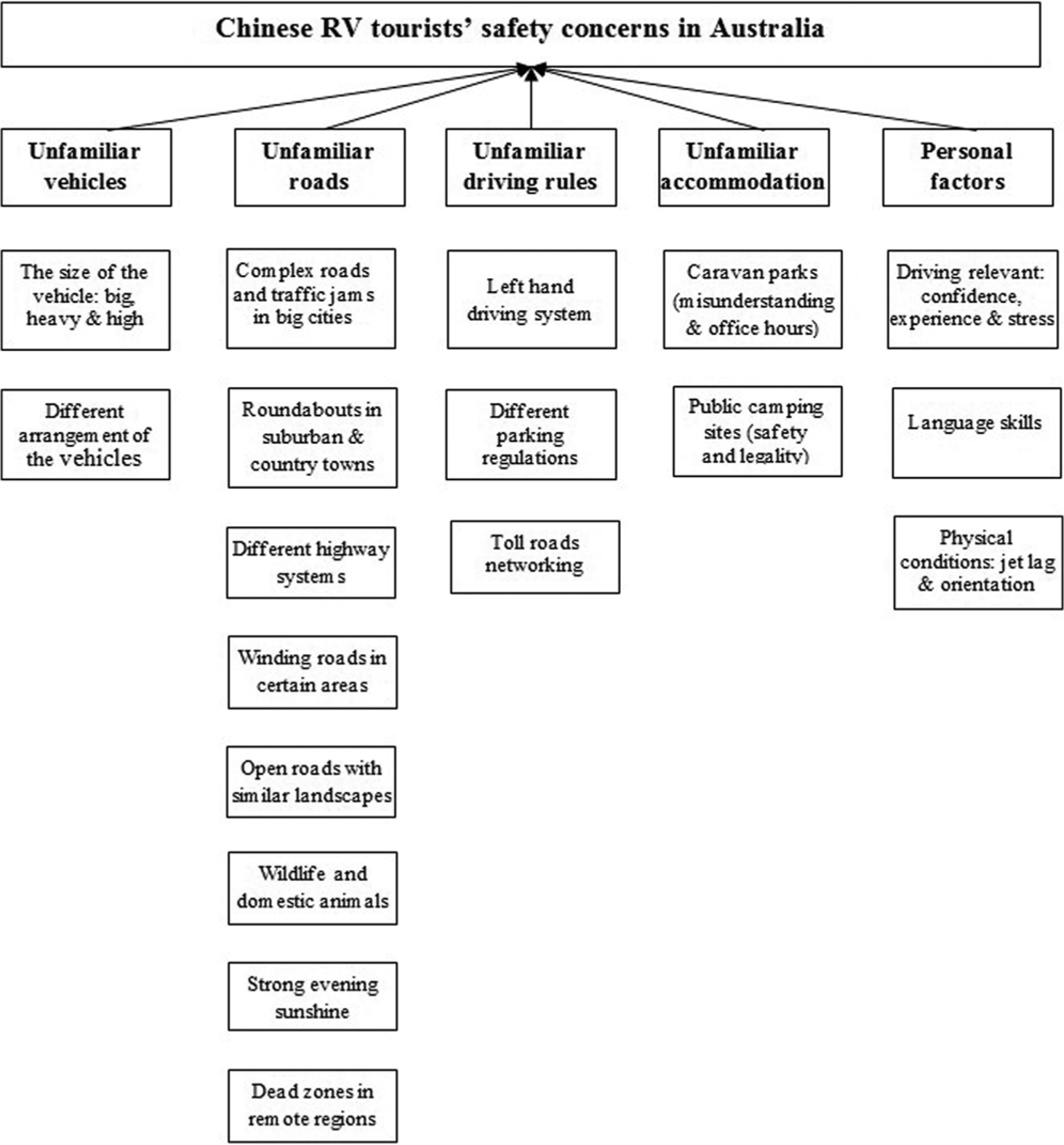
Chinese RV users’ self-reported safety concerns.
Unfamiliar vehicles
RVs, especially motorhomes, are substantially bigger than ordinary family cars. More than half of the Chinese tourists reported various issues related to size; for example, the steering wheel is large and at times hard to control, it is difficult to judge the vehicle’s height properly, and it is challenging to drive on winding roads during windy days. A typical statement offered the following view, Driving a Benz motorhome is very cool, but it is very big and high, like driving a truck. In addition, there is the extra height of the driving cab. It is not easy to estimate the height properly. The right front part of our motorhome bumped into a tall tree in front of the caravan park in Pacific Palms (in New South Wales). The top of the vehicle was dented. (informant Q23)
In addition to their concerns on the size, the different layout and functions of an RV were also highlighted. The controls for the windscreen wipers and the indicators can be confusing and misusing the controls was recorded as one of the most common mistakes (18/37). The diesel/petrol, electricity, water and gas system in the RV, also posed some challenges as reported: I did not estimate the diesel consumption very well. For our 3,500-km trip, the diesel lights lit up three times! The most terrifying experience is . . . when we arrived at the petrol station out of Kingston, there was only 4 liters of diesel left! (informant Q11) It is essential to turn off the gas during the night time. The gas leakage may cause death. (informant Q19)
Other informants recorded small day-to-day issues, for example—the need to make sure that the cabinets and the bathroom are tightly locked and the items for the shower are properly stored away.
Unfamiliar roads
The unfamiliar roads Chinese tourists encountered were considered as one of the biggest challenges. First, the roads in the big cities (e.g., Sydney, Melbourne, and Brisbane) were complex and challenging, with traffic jams, narrow space, and limited parking areas. One golf enthusiast observed when approaching Sydney, Closer to Sydney the roads become more complex. They are fairly narrow with a lot of traffic lights. Possibly due to driving a motorhome, I felt driving in Sydney is much harder than driving in Shenzhen [a mega city in south China, where the blogger comes from]. . . . A truck overtook on my right side, and broke my wing mirror. (informant S5)
Second, the different highway system in Australia was emphasized by 11 informants. Failing to consider the differences was connected to speeding, bad itinerary plans, stress on the driver, and driver fatigue. A young woman who has driven RVs twice in Australia with her friends highlighted, The Australian highway is not isolated but connects a lot of towns. As a result, we cannot drive at a certain speed as we do on the isolated Chinese motorways. We really need to slow down and to set more time than Google maps show. Otherwise, we will finish with hurrying our trip at the end of the day, which is tiring and dangerous. (informant Q3)
Third, it takes Chinese drivers some time to get used to the many roundabouts in the suburban and country towns. Nevertheless, they appreciated the design (rather than using energy consuming traffic lights). Meanwhile, they also showed their concerns. Nearly two thirds of the respondents discussed the rules for driving through roundabouts, as well as their mistakes at the beginning of the trip.
Fourth, winding roads in certain areas, sometimes coupled with strong winds, was challenging. Informant Q8 wrote, “After a break, we would like to see some kangaroos in the golf club. We were lost but finally found our way. The roads were unexpectedly winding. . . . I felt that we were driving into the ocean. Terrifying!” Friendly suggestions like “The road between Cairns and Kuranda (in Queensland) is very mountainous and winding. RVs are not recommended” (informant Q16) were also recorded.
Fifthly, the fatigue and mindlessness caused by driving on the open roads with similar landscapes was stressed. This is especially common when driving through the outback. For example, both informant Q5 and Q6 spent two days driving from Adelaide to Sydney through the inland way (around 1,200 km). Though they drove slightly different routes, both complained about being bored and fatigued during the drive. Further, both of them suggested future tourists not to take that inland route but spend more time in the cities and surrounds.
In addition, Chinese tourists noticed the threats from Australian wildlife and domestic animals. Kangaroos, camels, Tasmanian devils, emus, cassowaries, and cattle wandering across the road were the animals they encountered, especially at dawn and at night time. Generally, they were quite cautious toward the animals. One of them asserted, I kept reminding my husband to be careful. Don’t be the road killer. We would feel sorry if we ran into animals. We would also feel bad if the vehicle was damaged. (informant Q22)
Further, a few Chinese tourists, especially those who were heading west in the evening, reported their discomfort with the strong evening sunshine. Some tourists, as a result, took the reverse direction. For example, informant Q21 observed, When we planned our trip, some online friends suggested driving to the end of Great Ocean Road first and then heading back east, to avoid the strong evening sunshine. We followed the idea and found it was very helpful for safe driving. Besides, under this scenario, we were always on the mountain side, rather than the ocean side. Considering the height of the vehicle, I felt much less stressed. (informant Q21)
The last but the not least issue about the unfamiliar roads is the many technology dead zones in regional Australia. It may result in disorientation if the tourists use smart phones and tablets for their navigation. It may also cause stress because of not being able to contact the service providers, travel companions, and sometimes emergency services.
Unfamiliar driving rules
Coming from a country where driving on the right-hand side of the road is the norm, Chinese tourists found the Australian driving rules to be very different and they needed to be mindful and cautious. The change to driving on the left is considered as one of the major causes for international tourists’ accidents (Wilks and Pendergast 2011). This general rule penetrates all aspects of driving, including driving in the proper lane, going through roundabouts, parking appropriately, and undertaking a variety of turns.
The other two well-reported driving rules are the parking regulations and Australian tollways systems. These two issues, which require familiarity with local ticketing systems, may have indirect effects on the tourists’ emotions and safe driving. Watching out for the parking hours and permit regulations and paying the toll fees on time were highly recommended by Chinese tourists.
Unfamiliar accommodation system
In addition to the vehicle, the roads, and the driving rules, Chinese tourists also found the RV accommodation systems (e.g., caravan parks and the public camping sites) in Australia unfamiliar. The majority of the tourists liked their stay in caravan parks. They enjoyed the friendly staff and tourists, the child-friendly facilities, the hot water in the shower facilities, and the spacious and clean kitchens. Safety concerns, however, still exist. It can be about misunderstanding, and can also be hurrying the trip to arrive within tight office hours. The public camping sites, mostly at the beachside, in national parks and at public parking areas, were sometimes connected with threats from animals, aboriginal people, and other issues. A birdwatcher wrote, “Very few people come to this lookout. The parking area next to the lookout is equipped with toilets. Thus, we stayed overnight. It was a bit scary, staying at a depopulated place. The later trip, however, assured us that the concern is not necessary. Australia is safe country, especially in the rural areas” (informant S2).
Personal factors
The capability and confidence of dealing with the aforementioned unfamiliar issues were affected by the tourists’ personal factors, notably their driving experience and skills, their language abilities, and their physical well-being.
Though driving for many years, Chinese tourists may “have never driven in the mountainous roads, have never tried the big vehicles, and rarely driven further than 300 km” (informant Q20). They break these patterns in their Australian RV trips. This point reflects the tourists’ profiles that, for the majority of Chinese RV tourists (34/37), the Australian RV trip was their first time to use such a big vehicle.
Meanwhile, some may not be confident with their own driving skills. Informant Q14, on a honeymoon trip, indicated, “Choosing to do an RV tour demands courage. Both my husband and I don’t drive a lot in China. We finished with selecting a small campervan (5 meters in length) and buying the highest level of insurance.”
The third issue relevant with driving is the stress on the individual driver. On some occasions, respondents noted, “We only had one driver during the whole trip; he had done some road trips in the U.S. It was stressful and hard for him. If we share a motorhome trip in the future, it is better to have two or more drivers. In that case, we can drive more, see more, and won’t make the solo driver very tired” (informant 1).
Besides the driving-related issues, concerns about language skills were also noted. Though some informants (Q3 & Q20) asserted that a low level of English-speaking ability should not be a barrier for one’s overseas trip, it has also been acknowledged that understanding the English signs is necessary for a safe journey, and a higher level of competency in English enhances one’s trip.
The last personal factor relating to safe driving is about one’s physical condition. Tourists may experience jet lag and disorientation because of the long distance flight from the northern hemisphere to the south and the change in the length of daylight. These issues may result in driver fatigue, misjudgment of the time (especially due to the long evenings in summer in southern Australia), and disorientation (due to the change of sunshine direction).
Coping Techniques to Reduce the Driving Risk
Chinese RV tourists not only presented their safety concerns in their blogs but also recorded the techniques they undertook to ensure a safe and pleasant journey. It is in these recommendations and tactics that this study begins to identify the more generic implications of the special RV focus for other new tourist activities. Content analysis of the relevant issues produced 18 coping techniques across preparation, familiarity, and driving stages (see Figure 2). These coping techniques and safe practices provide substantial information for the future of this activity in drive tourism destinations, not just in Australia. The suggested initiatives involve multiple stakeholders and point the way to better management of this emerging tourist activity in the future.

Chinese RV users’ coping techniques addressing their safety concerns.
Learning and obeying Australian driving rules
As indicated earlier, there are some challenges arising from the unfamiliar driving rules. Thus, learning and obeying driving rules has been highlighted by most of the blog posters. Nine of the informants elaborated the traffic rules in their blogs, covering all aspects, for example, left-hand driving, getting through the roundabouts, turning, changing lanes, speed limits, parking, wearing safety belts, encountering road work, and tollways.
Learning and obeying driving rules penetrates all stages of the travel. They began their learning through previous travelers’ blogs, Australian transport departments’ websites, and packages sent by rental companies. They intensified their learning in practice. After the trip, they reflected on the rules and sometimes shared their experiences with others, either online or through more traditional face-to-face formats.
Selecting a proper vehicle
Selecting vehicles is the precondition of an RV trip. Analysis of the blogs found that Chinese tourists employed four tips to rent a proper RV that ensures a safe and enjoyable trip. Renting from a trustworthy company was widely adopted. The majority of the informants (32/37) chose the most reputable RV renting companies (e.g., Maui, Britz, and Apollo). Compliments about these service providers emerge frequently, I would like to commend Britz for their consistently excellent service at all stages. (informant Q17)
On the other side, recommendations from those who rent from small companies strengthen the choice of big companies. Informant Q3 observed, From my personal experience with a small company, I would say it is better to rent from big companies. Big companies offer good networks and service, which makes you feel free from anxiety.
The second tip Chinese RV renters used was choosing the right transmission that they felt confident to drive. Eleven of the informants emphasized their preferences for an automatic transmission.
We were not super confident in driving a manual vehicle, let alone the steering wheel on the right side. Though more expensive, we chose an automatic one. (informant Q8)
Another concern about the vehicle adopted by the Chinese RV tourists is to book a reasonable-size vehicle (a big motorhome versus a smaller campervan). Informant Q17, who traveled with his partner and another couple in a campervan, commented, Our trip showed that we made a wise decision in selecting a campervan. Though we all have a car driving license, we did not have any experience of driving big vehicles, let alone driving on the left-hand side. If we rent a motorhome with a bathroom, safety could be a challenge.
The last technique, which was taken by one quarter of the informants, is mixing the driving styles of an RV and a car. It was used for two concerns. For some (e.g., Q17), they practised car driving first to familiarize themselves with the different driving rules. Others rented different vehicles for roads perceived to vary in the level of challenge likely to be encountered. For example, informant Q23 chose to drive a car on the winding roads in Tasmania and for the Great Ocean Road, but then used a motorhome along the less circuitous Pacific Highway between Sydney and Brisbane.
Getting equipped, making the driving stress free
At the trip preparation stage, Chinese RV tourists also highlighted the usefulness of the equipment and insurance. Twenty-three informants suggested that tourists purchase comprehensive insurance at the booking stage or upgrade the insurance when they picked up the vehicle. Informant Q6 indicated that “it cost us half of the rental to buy the insurance, just in case. Spending the money to buy the safety assurance is always worthwhile, considering that we spent the next 11 days in the campervan. Besides the comprehensive insurance, we bought an extra insurance for road assistance. If we ran out of petrol, or broke down in the isolated inland, what a disaster it would be.”
All the Chinese RV tourists used a GPS. Some of them even had backup GPS plans. They brought an extra GPS, smartphones, or tablets. It was also found that most of them brought a GPS from China with an Australian map installed. Bringing a GPS from China is not only economical (saving $10 daily renting fee), but also easier to follow, because of the Mandarin voice interpretation.
In this study, interphones were also used by two self-organized groups. Informant S3 observed that “interphones are useful and practical. They are free, but work perfectly in the dead zones on the road. They really helped us drive together as a group.”
Getting familiar with the vehicle before hitting the road
At the vehicle familiarity stage, Chinese RV tourists took three solutions to adjust themselves to the unfamiliar vehicles and traffic rules. First, they watched the 20-minute tutorial video in the rental premises. They expressed their preferences for Mandarin interpretation. Informant Q21 stated, The DVD is in English. My wife lost her patience very soon. For the sake of safety, I kept watching and tried to fully understand the operations.
Second, after watching the video, staff provided instructions on how to operate the vehicle. This staff effort was much appreciated. Informant Q2 reported, “We made inquiries about many points and practised all the operations. Do seize this opportunity to ask questions. Once you leave the place, I bet you will never get such a good chance again!!”
The third step some of Chinese RV renters took is practising in spare spaces or allotments before starting out on their holiday. Informant Q14, a honeymoon tourist, observed, The size of the campervan is reasonable. It is only a little larger than a sedan. The tragedy was that my husband was unfamiliar with a manual transmission. He was cautious and suggested not risking driving. Luckily, there was some space behind the garage. We practised there many times, especially changing gears, reversing the vehicle, turning and familiarizing with all the components. We did not hit the road until my husband was confident.
General techniques on road
Good driving skills were seen as essential to a safe and pleasant RV trip. Seven techniques were commonly adopted by Chinese RV tourists. Driving slowly and not too far each day were identified as enhancing safety and boosting enjoyment. Comments included, My only suggestion is to drive approximately 200 km per day. Either driving at night or hurrying the journey during the day won’t make a pleasant trip. (informant Q1) I suggest being less “greedy” and putting fewer destinations in your itinerary. You may feel bad when you compress the destinations. You, however, will not regret it when you return home because of your true enjoyment of the relaxing lifestyle and wonderful views in Australia. (informant Q9)
The second approach, no/less driving at night, was also frequently recommended, because it “is dangerous due to the active wild animals. More importantly, it is a waste of the scenic road views (informant Q27).”
The third skill-related suggestion was linked to visiting big cities, where the traffic is busy and complex. There are two groups of people here. One group simply proposed not visiting big cities, while another supported visiting big cities but parking in the suburban locations. Typical statements include, Lessen your driving in big cities. It is too dangerous and pricey to break the rules, especially the hook turns in Melbourne CBD (informant Q6). We did not plan to visit big cities. We changed our mind later, because we thought it would be good to take a picture in front of the Opera House. . . . Otherwise, we are not really Chinese. . . . Parking in the suburban areas and then using the public transportation is an alternative. (informant Q11)
Driver fatigue has been well recognized as a cause for accidents. Chinese tourists, flying from a long distance away, are aware of this issue. They tend to take a break before their RV trip or otherwise remind the next group of tourists to learn from their experience. Informant 2 stated, “It is smart for us to spend the two days in Brisbane before the drive, walking around and getting ourselves recharged.”
Personal entertainment during the drive, especially for the roads with similar landscapes, was much appreciated. The most popular ones include bringing their favorite music CDs, lollies, and other members playing games, to keep the driver fresh.
In an unfamiliar destination, visiting information centers was considered as positive experience by Chinese RV tourists for both safety and enjoyment reasons.
Information centers are my favorite. The staff there are very knowledgeable, helpful and NOT commercial. They always draw lines and circles on maps and offer valuable suggestions with their genuine hospitality. The friendly staff in different centers assured our journey a lot. (informant S1)
The last issue, addressed in three blogs, is also critical: reporting accidents to RV companies and/or police if they arise. Informant Q22 called Maui twice and was very impressed with their prompt help. He reflected, Maui’s service is outstanding. You can always call their free service line, provide your plate number, the issues you encountered and the place of the accident, they will then locate the right staff and solve the problems for you. (informant Q22)
Discussion and Conclusion
This study explores a new phenomenon that has great potential to expand in the future. It looked at a specific outcome of the mega-trends that are shaping the world’s tourism future, in particular, the rise of Asian tourists (specifically the Chinese) and their endeavors to explore other parts of the world in a novel way (UNWTO 2013; Yeoman 2012). In detail, it assessed the growing Chinese outbound tourists’ overseas driving experience, in particular, their safety concerns and coping techniques for driving an unfamiliar vehicle in an unfamiliar country (Australia). The work builds its theoretical background from drive tourism research, with an emphasis on RV travel, Chinese drive tourism, and drive safety. The study extended the previous work by adopting a netnography method rather than a retrospective statistical data-based approach (Leggat and Wilks 2009; Heggie, Heggie, and Kliewer 2008).
The findings of this study respond to and extend previous research. It was revealed that the Chinese RV market is demographically different from the previously studied RV markets across North America (Onyx and Leonard 2005), Oceania (Mahadevan 2013), and Europe (Viallon 2012). The Chinese overseas RV tourists are generally younger, in their late 20s and 30s. They are well educated, social media empowered, and travel considerable distance in a shorter time period with high travel expenditure. In Jobes’s (1984) classification of RV tourists, Chinese are the classic “vacation travelers” rather than “full-timers” or “seasonal travelers.” They travel mainly for two to three weeks, principally during the Chinese golden weeks, though there is an increase in travel during school holidays and other paid holidays. Their demographic and travel time pattern matches the Chinese domestic drive tourists’ behavior (Wang, Fang and Du 2011).
Driving a large and unfamiliar vehicle is likely to be challenging, especially if the experience is the tourists’ first attempt at managing such a form of unfamiliar transport. Five safety concerns—the unfamiliar vehicle, unfamiliar roads, unfamiliar driving rules, unfamiliar accommodation systems, and personal factors—were discussed. These safety concerns can be constraints for Chinese tourists’ involvement in the RV driving activity. As Jackson, Crawford, and Godbey (1993), Nyaupane and Andereck (2007), and Kazeminia, Del Chiappa, and Jafari (2013) observed in their travel constraints studies, participation in certain leisure activities depends not on the absence of constraints but on negotiating through them. This study supports their view. In this case, Chinese tourists are active and positive in overcoming various safety challenges. Based on Chinese tourists’ emic voices, a holistic framework about their coping techniques was summarized. This framework includes 18 coping techniques across the preparation, familiarity, driving, and reflection stages. These coping techniques consistently respond to the safety concerns Chinese tourists encounter. They add a holistic perspective to previous drive safety research, which tends to be limited to the on-road stage (Wilks and Pendergast 2011). The work also highlights the view that Chinese tourists are not only seeking a safe trip but also in pursuit of an enjoyable trip. A synthesis of the safety concerns and suggestions provide directions for key stakeholders concerned with this market (see Figure 3).
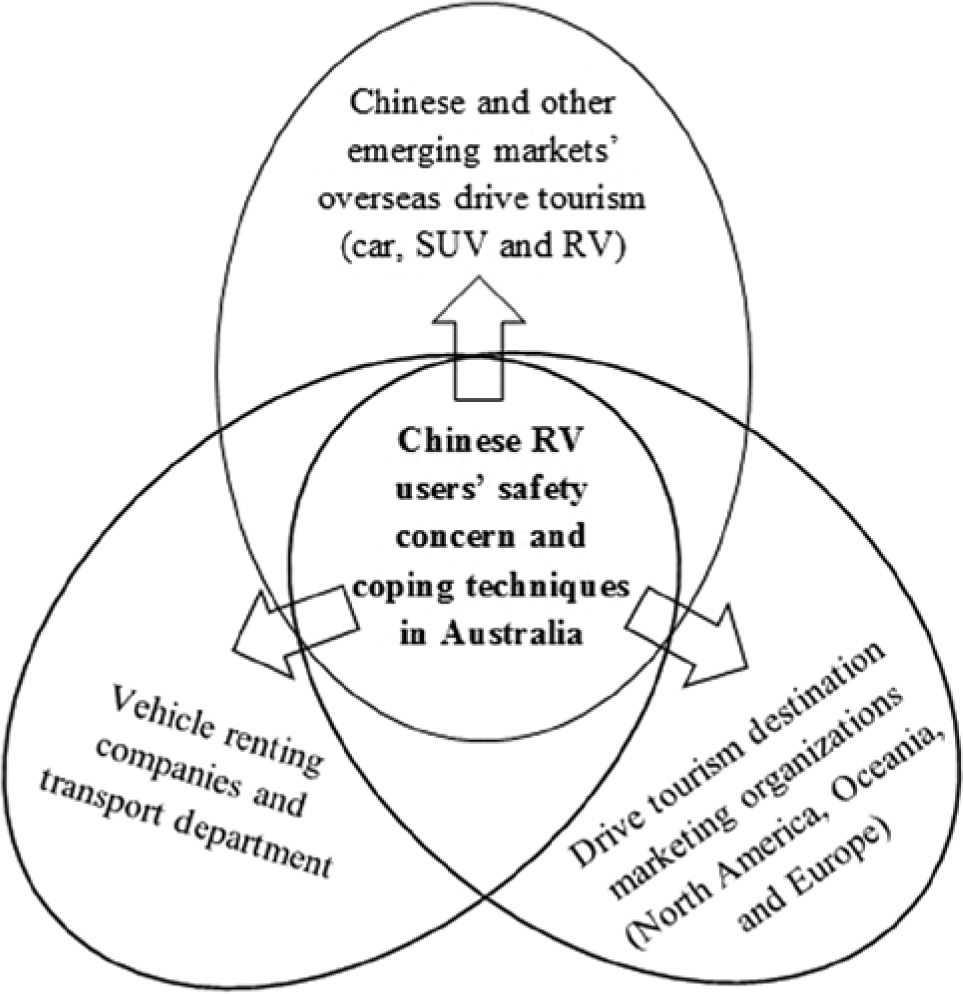
The wide application of this study.
The results of this study offer good policy guidance and practical guidance to the vehicle renting industry and the transport department. Strategies of assurance can be adopted by renting companies. For example, prioritizing the business as a supportive and friendly provider at all stages of the trip is the key issue for the new consumers. As another example, proving video and GPS in the tourists’ native language will be welcomed. This study is relevant to other drive tourism destinations, for example, North America, Europe, and New Zealand, which are also endeavoring to attract more tourists from the emerging markets, including China. Further, the results of this study can be applied beyond the RV travelers to the larger drive tourism markets, especially those from non-Western countries, with a moderate mastery of the language and a different driving system at home.
Our “indicator species”—the RV drive tourists—provide a window into the better provision of services for other independent Asian and new markets. For those traveling independently, the implications in this study are that assisting in the pre-departure information and preparation process, attending to what previous users have documented, providing strong initial on site familiarity experiences and supporting the self-management during the activity all matter for the tourists’ well-being. These four facets of interest can guide researchers in other studies of new activities. By documenting and describing more of these special cases and indicator activities, in time researchers can boost the theoretical understanding of how, in turn, communication, decision making, activity-based skills, mindfulness, and social roles mesh to inform the future of tourism.
Footnotes
Acknowledgements
The author is grateful to Professor Philip Pearce from James Cook University, for his intellectual contribution at the research design stage and his comments on earlier drafts. Appreciation also goes to Ms. Amy Osmond from James Cook University, for her thorough editing work.
Declaration of Conflicting Interests
The author(s) declared no potential conflicts of interest with respect to the research, authorship, and/or publication of this article.
Funding
The author(s) received no financial support for the research, authorship, and/or publication of this article.