






Abstract
This study applied a shared heterogeneity duration model to tourists’ length of stay at different locations of multidestination trips. This analysis helps to understand tourists’ behaviors and to predict their length of stay according to relevant variables. Such information can be applied to the development of efficient marketing strategies aiming to push the average length of stay to the desired direction, and to develop “on the fly” service provision and revenue management strategies. The focus on multiple destination trips offers an innovative analytical perspective. A large data set of 309,000 visits to Brazilian destinations was analyzed. Several empirical findings regarding determinants of tourists’ length of stay were obtained. Positively skewed distributions for duration and hazard functions were found to best fit observed data. Shared heterogeneity was found to statistically improve the explanatory capacity of duration models when multidestination tourism trips data are analyzed.
Introduction
Tourists’ length of stay and trips’ durations are two of the most important tourism demand variables. Yet, despite their relevance, these concepts have been sometimes mistakenly used as synonyms. Length of stay denotes the amount of time that the tourist spends at a given destination, whereas the duration of a tourism trip refers to the length of time between departure from and return to home. Therefore, length of stay does not include the time spent on transport, while duration of the trip does (UN 2010). Moreover, length of stay refers to a single destination, whereas duration of the trip may include stays at several different locations when a multidestination tourism trip (MTT) is regarded.
The issue of the number of destinations is particularly interesting. Sometimes, longer trips might be associated with shorter stays at destinations. This may happen if longer trips are positively correlated with the number of destinations included in the itinerary. Therefore, the analysis of tourists’ length of stay at destinations in the MTT context requires special consideration. Nevertheless, all previous econometric modeling studies about tourists’ length of stay that we know of focused on single-destination trips.
Understanding the determinants of tourists’ length of stay is useful in three main ways. First, knowledge in this area can be used to predict tourists’ length of stay according to relevant variables. Tourism destinations can benefit from precise knowledge about the determinants of MTT by developing appropriate infrastructure and offering convenient services. Second, some destinations might be interested in attracting longer-staying tourists because of their propensity for larger total expenditures, while others might be interested on shorter-staying tourists because they usually present larger daily expenditures (Thrane and Farstad 2011). Both types of destinations can benefit from understanding tourists’ length of stay by targeting specific market segments. Third, tourism managers can benefit by developing efficient “on the fly” service provision or revenue management strategies. For instance, discounts or free additional services might be offered during the stay according to the tourist’s expected additional length of stay.
Tourism has faced a worldwide trend of decreasing length of stay as reported by the UNWTO (2006, 2007) and several other authors (e.g., Alegre and Pou 2006; Barros, Correia, and Crouch 2008; Barros and Machado 2010; Fleischer and Rivlin Byk 2009; Martínez-Garcia and Raya 2008). Curiously, this trend is not observed in Brazil, where the yearly average growth rate was 1.6 from 1993 to 2010 according to official statistics of the Brazilian Tourism Ministry. In 2010, the average duration of international tourists’ stays in Brazil was 17.2 days, 31.3% longer than in 1993.
This increasing trend observed for the country as a whole is also present when tourists’ length of stay at individual Brazilian destinations is assessed. According to the Brazilian International Tourist Survey (BITS), from 2004 to 2010 the average length of stay at Brazilian destinations increased by 14.7%, varying from 8.6 days up to 9.9 days. These values are represented at Figure 1.
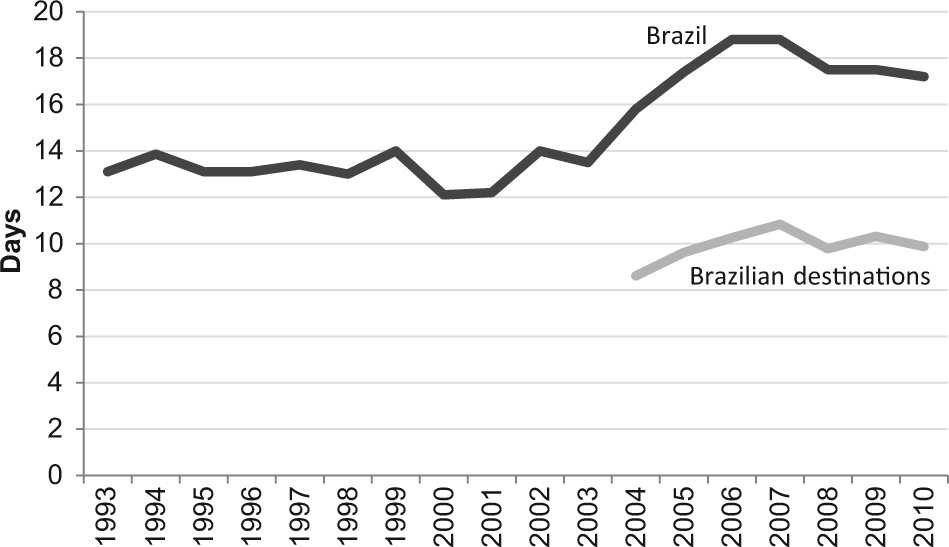
Average length of stay evolution of inbound tourists in Brazil and at Brazilian destinations.
The increasing trend of international tourists’ length of stay in Brazil and at Brazilian destinations is unusual. One potential explanation for this unexpected reality is that tourists’ behavior is facing an uncommon trend in this particular case. The confirmation of this hypothesis would pose an interesting question for further research: why tourists’ behavior in Brazil is evolving in the opposite direction of most countries? A second hypothesis is that there have been relevant changes in the composition of the inbound tourism flow in Brazil. This hypothesis is supported by some preliminary analyses. For instance, in 1993 roughly 65% of inbound tourists in Brazil were South Americans. In 2010 this share had dropped to 45%. Since South Americans tend to stay shorter in Brazil, the overall average length of stay might have increased because of the decrease in the participation of South Americans in the Brazilian inbound tourism. However, this simplistic analysis is not enough to support the second hypothesis since tourists’ behavior is affected by multiple variables. Therefore, distinguishing between these two hypotheses requires multivariate analysis.
This study modeled international tourists’ length of stay at different Brazilian destinations, contributing to the empirical and methodological domains. Determinants of tourists’ length of stay were analyzed in the MTTs’ context (Santos, Ramos, and Rey-Maquieira 2011) instead of being analyzed with respect to a single-destination trip. The effects of several variables tested in previous studies about tourists’ length of stay were analyzed for the Brazilian case with a large data set (309,413 observations) that includes rich information about tourists and the characteristics of their trips.
The dependent variable of the analysis was the length of stay at each destination visited. For example, three observations of the dependent variable were obtained from a tourist that visited three destinations within Brazil in the same trip. The analysis of tourists’ length of stay in the MTTs context might present relevant particularities as compared to the single-destination paradigm. In fact, the determinants of the overall duration of a trip might be quite different from the determinants of the length of stay at a particular destination of a multiple itinerary. Shared heterogeneity duration models were employed to take account of all particularities of this type of data.
The rest of the paper is organized as follows. The next section presents a general review of econometric modeling studies about tourists’ length of stay. Since duration models are argued to be the most appropriate statistical technique for modeling tourists’ length of stay, these models are presented in detail the third section. The fourth section presents the empirical modeling study of inbound tourists’ lengths of stays at Brazilian destinations and it is followed by the conclusion.
Literature Review
Several descriptive and univariate analyses of tourists’ length of stay and its determinants have been conducted, including Wurst (1955), Archer and Shea (1975), Lew and McKercher (2002), McKercher and Lew (2003), Oppermann (1994, 1995, 1997), Seaton and Palmer (1997), Sung et al. (2001), and Tierney (1993). Detailed assessments of the determinants of the length of stay or the duration of a trip using multivariate statistical models have only recently been conducted. Empirical findings of these studies are discussed in the following. Only those variables used in the empirical study presented in the fourth section are discussed. Other relevant variables, such as main versus secondary destinations, travel behavior, and labor status, are not regarded.
Individuals’ Characteristics
Gender was not found to be a significant explanatory variable of tourists’ length of stay 1 by several studies (Barros, Butler, and Correia 2010; Fleischer and Pizam 2002; Machado 2010; Martínez-Garcia and Raya 2008; Menezes, Moniz, and Vieira 2008; Raya-Vilchez and Martínez-Garcia 2011; Wang, Little, and DelHomme-Little 2012). The only exceptions were the studies of Barros and Machado (2010) and Peypoch et al. (2012), which found a significantly higher length of stay for male tourists.
Empirical estimates indicate that age is usually a significant covariate of tourists’ length of stay. When the effect of age is considered to be monotonic, older tourists usually tend to stay longer. Most studies found evidence in favor of a positive effect of age on the length of stay, with the exception of Barros, Correia, and Crouch (2008). When considered to be nonmonotonic, the effect of this variable on the length of stay is given by a concave function according to Fleischer and Pizam (2002) and a convex function according to Yang, Wong, and Zhang (2011).
Empirical evidences on the effect of education level over tourists’ length of stay do not provide a clear picture. Three studies found that higher education leads to shorter stays (Gokovali, Bahar, and Kozak 2007; Martínez-Garcia and Raya 2008; Menezes, Moniz, and Vieira 2008), whereas other four found evidences of the opposite (Barros, Butler, and Correia 2010; Barros and Machado, 2010; Ferrer-Rosell, Martínez-Garcia, and Coenders 2014; Peypoch et al. 2012).
Despite its evident relevance, only two studies analyzed the effect of tourists’ time availability over their lengths of stay. This deficiency might be related to the difficulty of defining and measuring individuals’ available time for traveling. Hellström (2006) estimated that the relationship between this variable and tourists’ length of stay is nonsignificant, whereas Nicolau and Más (2009) found a positive relationship.
Length of stay was most frequently found to be a normal good, that is, higher income leads to longer stays. The only exceptions were Blaine, Mohammad, and Var (1993) and Mak and Nishimura (1979), who found evidence of a negative relationship between income and length of stay. Nicolau and Más (2009) found that the effect of income is positive for the most constrained individuals, while for the less constrained ones its effect is negative. Brida, Meleddu, and Pulina (2013) found a complex pattern of income’s effect on tourists’ length of stay.
The effect of tourists’ nationality was analyzed by 11 different studies (Alegre, Mateo, and Pou 2011; Alegre and Pou 2006; Barros, Butler, and Correia 2010; Barros and Machado 2010; Brida, Meleddu, and Pulina 2013; Gokovali, Bahar, and Kozak 2007; Machado 2010; Martínez-Garcia and Raya 2008; Menezes, Moniz, and Vieira 2008; Peypoch et al. 2012; Raya-Vilchez and Martínez-Garcia 2011; Thrane and Farstad 2012). Estimated parameters by most studies were significant, indicating that expected tourists’ length of stay varies across different source markets. The only pattern that can be derived from these results is that tourists from further origins tend to stay for longer at the destination, which is consistent with direct analysis of the effect of distance conducted by other studies (Blaine, Mohammad, and Var 1993; Nicolau and Más 2009; Paul and Rimmawi 1992; Silberman 1985; Yang, Wong, and Zhang 2011; Walsh and Davitt 1983; Wang, Little, and DelHomme-Little 2012). Finally, it is relevant to stress that most individual characteristics used by previous studies refer to the chief of each travel party, rather than to characteristics of all their members.
Travel Characteristics
Travel purpose is a fundamental explanatory variable of tourists’ length of stay. Empirical evidences show that the effect of specific purposes varies across destinations. In Azores, Portugal, Menezes, Moniz, and Vieira (2008) found that business tourists are expected to stay shorter than tourists visiting friends and relatives, though leisure tourists are expected to stay longer than both groups. Leisure tourists were also found to have longer expected stays than other tourists by Mak, Moncur, and Yonamine (1977), and specifically longer than those visiting friends and relatives by Hellström (2006). On the contrary, Yang, Wong, and Zhang (2011) found that tourists on vacation at Yixing, China, have a shorter average stay than business tourists, while those visiting friends and relatives display the longest average length of stay.
More flexible means of transport seem to be associated with shorter stays. Menezes, Moniz, and Vieira (2008) estimated that tourists traveling on regular flights tend to stay shorter than those using charter flights. Yang, Wong, and Zhang (2011) found that expected length of stay increases according to the mean of transport following the sequence self-driving, coach and bus, airplane, and train.
Although in tour packages the length of stay is not under direct tourists’ decisions, tour operators are expected to adjust their products according to their customers. Longer stays are associated with organized trips according to Ferrer-Rosell, Martínez-Garcia, and Coenders (2014) and Walsh and Davitt (1983). However, most studies found that they are associated with independent tourists (Alegre and Pou 2006; Gokovali, Bahar, and Kozak 2007; Mak, Moncur, and Yonamine 1977; Thrane and Farstad 2012; Yang, Wong, and Zhang 2011).
The effect of the type of accommodation on tourists’ length of stay is not definite. Higher-quality hotels were found to be more associated with longer stays than lower-quality hotels by Alegre and Pou (2006). Conversely, higher-quality hotels were estimated to be associated with shorter stays by Ferrer-Rosell, Martínez-Garcia, and Coenders (2014) and Martínez-Garcia and Raya (2008). Staying at hotels was found to have a negative relationship with length of stay by Mak and Nishimura (1979). Alternative types of accommodation, such as campgrounds and rented and owned dwellings were usually found to be associated with longer stays (Alegre, Mateo, and Pou 2011; Alegre and Pou 2006; Martínez-Garcia and Raya 2008; Silberman 1985; Raya-Vilchez and Martínez-Garcia 2011).
The effect of party size on tourists’ length of stay is ambiguous. Four studies found that larger travel parties tend to stay shorter at the destination (Alegre, Mateo, and Pou 2011; Alegre and Pou 2006; Fleischer and Rivlin Byk 2009; Walsh and Davitt 1983). A positive effect of travel party size on tourists’ length of stay was found by three studies (Barros, Correia, and Crouch, 2008; Mak and Nishimura 1979; Uysal, McDonald, and O’Leary 1988).
Studies showed that tourists’ length of stay tends to be longer during high season (Ferrer-Rosell, Martínez-Garcia, and Coenders 2014; Fleischer and Rivlin Byk 2009; Martínez-Garcia and Raya 2008; Raya-Vilchez and Martínez-Garcia 2011; 2006). Repeaters are expected to stay longer according to Menezes, Moniz, and Vieira (2008) and Wang, Little, and DelHomme-Little (2012), while the opposite was estimated by Paul and Rimmawi (1992) and Silberman (1985). When the number of previous visits to the destination is regarded, all evidences indicate a positive relationship with tourists’ length of stay (Alegre, Mateo, and Pou 2011; Alegre and Pou 2006; Barros and Machado 2010; Gokovali, Bahar, and Kozak 2007; Mak, Moncur, and Yonamine 1977; Thrane and Farstad 2012; Yang, Wong, and Zhang 2011).
Ferrer-Rosell, Martínez-Garcia, and Coenders (2014), Martínez-Garcia and Raya (2008), and Raya-Vilchez and Martínez-Garcia (2011) estimated that city destinations are associated with shorter stays. Besides, Thrane and Farstad (2012) estimated that the more places the tourists visit, the longer the overall stay.
Prices and Expenditure
Some studies used tourism prices as an explanatory variable of tourists’ length of stay (Alegre, Mateo, and Pou 2011; Alegre and Pou 2006; Fleischer and Rivlin Byk 2009; Hellström 2006; Mak, Moncur, and Yonamine 1977; Mak and Nishimura 1979; Silberman 1985; Walsh and Davitt 1983). All these studies obtained price estimates from data about tourists’ expenditure gathered through demand surveys. Most authors considered tourists’ expenditure as a straight proxy of prices. More careful price estimates were developed by Fleischer and Rivlin Byk (2009) and Silberman (1985), who estimated prices from tourists’ expenditures by controlling for the type of accommodation.
Estimating prices from daily expenditure can be seriously criticized since the tourism product is qualified by a vast number of variables. Different expenditures may arise from different qualities, rather than prices. Even when expenditure is controlled by relevant variables, such as type of accommodation, major quality variations persist. Besides, different daily expenditures may arise from different amounts of goods and services consumed, such as additional transportation, entertainment, or shopping. The difference between expenditure and prices was earlier noted by Mak and Nishimura (1979).
When total travel expenditure is regarded, most studies found positive association with tourists’ length of stay (Alegre, Mateo, and Pou 2011; Alegre and Pou 2006; Machado 2010; Peypoch et al. 2012). Studies that analyzed the effect of daily expenditure on tourists’ length of stay are conclusive in pointing out that larger daily expenditures are associated with shorter stays (Alegre, Mateo, and Pou 2011; Alegre and Pou 2006; Fleischer and Rivlin Byk 2009; Hellström 2006; Mak, Moncur, and Yonamine 1977; Mak and Nishimura 1979; Silberman 1985; Thrane and Farstad 2011, 2012; Uysal, McDonald, and O’Leary 1988; Walsh and Davitt 1983).
Duration Models and Tourists’ Length of Stay
The variable length of stay has some particular characteristics that influence its modeling process. First, it is a strictly positive variable. No negative length of stay can be measured, neither should it be estimated. Second, the length of stay is ultimately a continuous variable, in spite of its usual measurement in discrete units, such as days or overnights. Discreteness of duration data is a collection issue rather than a fundamental characteristic of this variable. Although measuring length of stay in a continuous scale is usually unpractical, continuous estimates of the length of stay are perfectly sensible.
Different statistical methods have been applied to model tourists’ length of stay depending on the assumed properties of the dependent variable. Discrete measures of the length of stay were modeled by binary logit (Alegre and Pou 2006), multinomial logit (Grigolon et al. 2014; Nicolau and Más 2009), ordered logit (Ferrer-Rosell, Martínez-Garcia, and Coenders 2014; Yang, Wong, and Zhang 2011) and count data models (Alegre, Mateo, and Pou 2011; Brida, Meleddu, and Pulina 2013; Hellström 2006). Methods for modeling continuous duration variables include ordinary least squares (Blaine, Mohammad, and Var 1993; Mak and Nishimura 1979; Paul and Rimmawi 1992; Walsh and Davitt 1983), multiple stage least squares (Fleischer and Rivlin Byk 2009; Mak, Moncur, and Yonamine 1977; Silberman 1985; Uysal, McDonald, and O’Leary 1988), Tobit (Fleischer and Pizam 2002), and several duration models.
The term duration model refers to a family of statistical models used to explain and predict the time length of spells. These models have recently been applied to the study of tourists’ length of stay. The first paper was published by Gokovali, Bahar, and Kozak (2007) and it was followed by 10 additional studies (Barros, Correia, and Crouch 2008; Barros, Butler, and Correia 2010; Barros and Machado 2010; Machado 2010; Martínez-Garcia and Raya 2008; Menezes, Moniz, and Vieira 2008; Peypoch et al. 2012; Raya-Vilchez and Martínez-Garcia 2011; Thrane 2012; Wang, Little, and DelHomme-Little 2012).
There are two approaches for introducing a set of explanatory variables (
Theoretical propositions regarding the distribution of the length of the spell are usually scarce. Leaving this distribution unspecified yields the semi-parametric Cox Proportional Hazards model (Cox 1972). This is a disadvantageous approach if one is interested in the shape of the baseline hazard function, such as in the case that revenue management policies are at stake.
Assuming a particular distribution of the duration of the spell yields parametric duration models. Several distributions have been proposed in the literature for this purpose. The most usual distributions assumed within the proportional hazards perspective are exponential, Weibull, and Gompertz. Weibull was the most frequently tested distribution. Besides, it was also the default alternative for studies focusing on other methodological issues, rather than the best-fitting distribution (Barros and Machado 2010; Machado 2010).
Exponential and Weibull distributions may also be used within the accelerated failure time perspective. Other popular distributions used to model tourists’ length of stay using the accelerated failure time metrics are lognormal, loglogistic, and Gamma. The exponential distribution of the duration implies a constant hazard rate. In this case, the probability of ending the spell is independent from the amount of time elapsed since its beginning. Processes with nonconstant hazard functions are said to be duration dependent. Positive duration dependence happens when the probability of ending the spell increases over time. The opposite situation is referred to as negative duration dependence.
Duration dependence has relevant implications for revenue management. For instance, hotels usually have different prices according to the total length of stay. If efficient discounts are those formulated according to the probability of leaving the hotel, nonmonotonic hazard functions would require nonmonotonic discount functions with respect to the total length of stay. In that case, increasing (decreasing) discounts should be offered when the length of stay presents positive (negative) duration dependence. Duration dependence might also be used to develop “on the fly” marketing strategies oriented to influence tourists’ decisions during their stays. Unfortunately, no previous study examined duration dependence in detail.
It seems likely that the density function of tourists’ length of stay follows a positively skewed distribution because of the opposition of two effects. First, there are some relevant initial costs of visiting a destination (e.g., McKercher, Chan, and Lam 2008; McKercher and Lew 2003; Nicolau 2010). Transport to the destination is an important example of this sort of cost for the tourist. These initial costs of the visitation imply a low propensity to short stays. On the other hand, tourists’ stays usually display decreasing marginal utility. As the length of stay becomes longer, opportunities for new experiences decrease. At the same time, there are increasing additional costs of being away from home. The decreasing marginal utility of stays implies a low propensity to stay for too long.
Together, initial costs of the visitation and decreasing marginal utility of the stay lead to a positively skewed density distribution of tourists’ length of stay. This sort of density function cannot be derived from constant or monotonically decreasing hazard functions. These arguments support the criticism made by Thrane (2012) about the usage of exponential duration models to represent tourists’ length of stay.
Heterogeneity in Duration Models
Unobserved heterogeneity is a major concern in duration models arising from the omission of relevant explanatory variables or measurement errors (Lancaster 1979; Vaupel, Manton, and Stallard 1979). These are extremely common characteristics of studies using microdata (Heckman and Singer 1984). Unobserved heterogeneity of tourists’ length of stay was analyzed by five studies using duration models. Three studies found evidences in favor of the heterogeneity model (Barros, Butler, and Correia 2010; Barros, Correia, and Crouch 2008; Thrane 2012), whereas two studies found no evidence of that (Martínez-Garcia and Raya 2008; Raya-Vilchez and Martínez-Garcia 2011).
Unobserved heterogeneity introduces a multiplicative random variable (v) into the hazard function. Because of computational facility, the distributions most commonly adopted to describe v are Gamma and Inverse Gaussian (Hougaard 1984).
Unobserved heterogeneity may vary across each observation or across groups of observations. All five previous studies using heterogeneity to model tourists’ length of stay considered variations across each observation since data registries referred to different tourists. Heterogeneity across groups of observations yields “shared heterogeneity” duration models, also known as “shared frailty” models (Collier 2005; Hougaard 1986; Jones 2011; Whitmore and Lee 1991). Shared heterogeneity may happen when there is potentially more than one observation from the same individual or group. This is the case of tourists’ lengths of stays in MTTs. If observations refer to stays of the same tourist at different destinations, the error term is no longer uncorrelated among observations, which may be interpreted as shared heterogeneity. In this case, the length of stay at one destination is correlated with other observations coming from the same tourist. Therefore, modeling tourists’ length of stay in the MTT context by using duration models requires shared heterogeneity to be taken into account. The inclusion of shared heterogeneity in the duration model developed in the next section was one of the main innovations of this paper.
Ignoring unobserved heterogeneity has two main consequences (Lancaster 1979). First, the hazard function in the omitted heterogeneity model increases slower or falls faster than in the correctly specified model. Thus, failing to allow for heterogeneity prevents unbiased estimation of duration dependence. Second, in the model with no heterogeneity, the proportionate variation in the hazard rate caused by changes in
Advantages and Disadvantages of Duration Models
The adequacy of duration models to explain and predict tourists’ length of stay could be compared to other models for continuous dependent variables, such as ordinary least squares (OLS) and its derivations. The best argument in favor of duration models as a statistical tool to explain and predict tourists’ length of stay is their flexibility in terms of distributions available for the dependent variable. OLS models assume that the error term is normally distributed, whereas duration models offer a variety of distributions. Besides the lognormal distribution, the length of stay may be assumed to follow an exponential, Weibull, log-logistic, Gamma, or many other distributions. This variety of distributions may provide better parameter estimates, besides allowing for an appropriate analysis of the duration dependence and the baseline hazard function.
Several weaker arguments in favor of duration models have been proposed in the academic literature. A very common argument is that duration models take full account of data positiveness. In fact, the construction of duration models departs from this premise. However, this is a weak argument since other models such as OLS can be easily adapted to satisfy the non-negativity requirement by adopting strictly positive functions at the right hand side. A usual example of this is the log-linear specification.
Duration models are quite convenient to deal with censored data, such as when the exact moment of the beginning or the end of the spell is not observed. This feature has favored the application of these models in areas such as biomedical sciences, where censored duration data is frequently used. However, censored data about tourists’ length of stay is relatively unusual. Most tourist surveys are conducted at the end of the stay or after tourists have returned home. Therefore, the actual length of stay is usually known without censoring. Even when surveys are conducted before the end of the trip, censoring usually does not happen since planned length of stay is used as the dependent variable. Besides, duration models are not the only alternative for dealing with censored data. Several linear models adjusted for censored data have been developed, such as Tobit, censored normal regression, and interval regression.
A major advantage of duration models for some applications is the appropriate consideration of time-varying covariates. If values of the covariates change along the duration of the spell, usual statistical models are not able to provide correct estimates. Once again, these cases are frequent in areas such as engineering and biomedical sciences, though not in tourism. Therefore, in spite of the clear superiority of duration models when time-varying covariates are studied, this quality is usually not relevant for the study of tourists’ length of stay.
Empirical Analysis of Tourists’ Length of Stay in Brazil
Brazil is a country with a very large territory divided into 27 states and has a considerable diversity of tourist destinations. From north to south and from east to west there are about five thousand kilometers. In spite of the large distances and severe transport difficulties in accessing some localities, about 40% of inbound tourists in Brazil engage in multidestination trips (Santos, Ramos, and Rey-Maquieira 2012). According to official data, leisure accounts for about 47% of the inbound tourism flow, while business and VFR are also quite relevant. Most tourists travel independently, and only 12% take tour packages. These summary descriptions of Brazilian inbound tourism helps to understand why analyzing tourists’ length of stay at individual destinations is relevant. More detailed information about tourism in Brazil can be obtained in Lohmann and Dredge (2012).
The analysis of inbound tourists’ length of stay at different destinations in Brazil used data from the BITS, a survey conducted by the Foundation Institute of Economic Research and funded by the Tourism Ministry of Brazil. Data were collected through personal interviews from 2004 to 2010 at the 27 main gateways of the country, including 15 airports and 12 land borders. Interviews were conducted with the chief of the travel party. Details about this data source are described elsewhere (Santos, Ramos, and Rey-Maquieira 2012).
The BITS gathered information about tourists’ visits to multiple Brazilian destinations, which were geographically defined as municipalities. A maximum of six different destinations were registered for each tourist. When more than six destinations were visited by a tourist, the survey registered information about the destinations with longer stays.
The dependent variable of this study was the length of stay at different Brazilian destinations as measured in overnight stays. A total of 181,000 tourist interviews were obtained from the BITS. Since each tourist visited an average of 1.7 destinations, 309,413 observations of lengths of stays were available.
Covariates used to explain the length of stay were categorized into five groups. The first group included different individuals’ characteristics. Age was introduced in its linear and squared forms, allowing for nonmonotonic effects on the length of stay. Household income was measured in thousands of constant dollars of 2010. Squared income was also used, allowing for nonmonotonic effects. Eleven countries of origin from where more than 100,000 tourists go to Brazil annually were identified by specific dummy variables. The remaining countries were identified by continent-specific dummy variables.
The second set of explanatory variables included several travel characteristics. The number of destinations visited and its squared value were used additionally to a dummy variable indicating single-destination trips as a qualitatively different case. Squared and nonsquared values were also used for party size and per capita daily expenditure. Seasons were defined as high season (December to February), low season (July and August), and off-season (remaining months). Expenditure was measured in constant dollars of 2010.
The third category of explanatory variables regarded the set of different destinations visited. A total of 190 destinations with more than 100 observations in the database were identified by a specific dummy variable. All destinations were also categorized according to its state and region. The analysis of this information may help to identify best tourism management practices. All destinations were also characterized by their population and by a binary variable indicating coastal localization.
The fourth category of variables included a single information, the year of the trip as identified by specific dummy variables. The objective of introducing this information in the model was to test the hypothesis that the increasing trend of tourists’ length of stay in Brazilian destinations was caused by changes of tourists’ behavior. This hypothesis was tested through the set of year-specific dummies since they capture time variations in the expected length of stay for tourists with constant profiles. If this set of dummy variables displayed an increasing trend, then the hypothesis would be confirmed. Otherwise, the estimates would lead to the acceptance of the null hypothesis that the increasing trend was caused by changes in the composition of the inbound tourism flow. The confirmation of the null hypothesis would be consistent with the observed worldwide decreasing trend of tourists’ length of stay.
Finally, the fifth category of covariates consisted of instrumental dummy variables used to identify lacking data. This procedure was intended to avoid unnecessary data loss, as well as a potential sample selection problem. For instance, 21.5% of the total data set has missing values at the income variable.
Different duration models were employed in the analysis. When shared heterogeneity takes place, the Cox proportional hazards model requires the estimation of an independent parameter for each group. As the number of observed individuals is very large, the computational cost becomes cumbersome. Anyway, the proportional hazards hypothesis of the Cox model was tested using Schoenfeld’s residuals (Grambsch and Therneau 1994; Schoenfeld 1982) by taking two different approaches. First, the Schoenfeld test was conducted by using all observations while shared heterogeneity was omitted. Second, the test was applied to a subsample of the data set where a single observation from each tourist was randomly selected. The proportional hazards hypothesis was rejected by both approaches with respect to almost all variables. Therefore, the Cox proportional hazards model was discarded.
Only Weibull and log-normal distributions for the duration variable could be tested because of the large sample size. Gamma and inverse Gaussian distributions for the heterogeneity term were considered. The best-fitting alternative was selected according to the log likelihood and the Akaike information criterion. The results showed that the lognormal distribution outperformed the Weibull for the duration variable. This result indicates that tourists’ length of stay present a positively skewed hazard and duration distributions. The gamma heterogeneity distribution provided slightly better results. Therefore, the lognormal-gamma model was selected for the analysis.
Estimated coefficients, standard errors, and p values are presented in three different tables. Table 1 displays estimates referring to individuals’ characteristics, while Table 2 refers to travel characteristics and Table 3 presents estimates regarding different destinations, years, and constants. The first line of each multinomial variable presents the p values for the Wald test of the hypothesis that all coefficients are simultaneously equal to zero. The procedure is followed for quantitative variables used in their squared and nonsquared forms.
Model Estimates: Individuals’ Characteristics.

Reference group.
Model Estimates: Trips’ Attributes.

Reference group.
Model Estimates: Destinations, Year, and Constants.

Reference group.
The following paragraphs analyzes percentage changes in the expected average length of stay. It is worth clarifying that estimates of fractional length of stay does not mean that individuals will fractionalize their stays. Rather, in the individual level this measure should be interpreted as a latent individual. Besides, it also applies for aggregate analysis. As a benchmark for interpretation, a 9.9% increase represents an additional expected day for the average tourist in the data set.
Table 1 shows that men tend to stay roughly 4.7% 2 shorter at destinations than women. This is the first study to find gender differences in this direction. The expected length of stay follows a significant convex function of age. 3 The effect of age is negative for young tourists, whereas for older tourists this influence is positive. The minimum length of stay is expected for tourists age 46. Tourists age 56, for example, are expected to stay 1.3% 4 longer than those 10 years younger.
The relationship between level of education and length of stay is significant, though not monotonic. Tourists who have completed high school tend to stay 2.4% longer than those who did not. On the other hand, graduate and postgraduate tourists tend to stay shorter than high school educated tourists (5.9% and 8.4%, respectively). It is interesting to recall that previous studies were inconclusive about the relationship between these two variables. Thus, in spite of its significance, the influence of level of education seems to present a complex and variable pattern.
Estimates show that tourists’ income does not have a significant effect on expected length of stay within the MTTs paradigm. Both squared and nonsquared income variables were nonsignificant. Previous studies within the single-destination paradigm were not conclusive regarding the relationship between income and length of stay. The present study supports the idea that the effect of income is case specific, and that in the MTT context it may be different from the previously studied single-destination context.
Place of origin is a significant determinant of tourists’ length of stay (p < 0.01). Asians and Oceanians are the ones staying longer. Other tourists with relatively large expected stays are those from Africa, Germany, England, Spain, and Other European Countries. On the other hand, South Americans tend to stay for the shortest periods. Paraguayans have the overall shortest expected length of stay (59.4% less than Asians and Oceanians). These results seem to point out distance as an underpinning variable providing sense to differences across countries. Tourists from farther countries seem to tend to stay longer at each destination visited. This outcome is consistent with most previous studies.
Shorter lengths of stays at destinations are associated with multidestination tourism trips. Tourists visiting two destinations are expected to stay 43.7% 5 shorter than those visiting a single destination. As the number of destinations visited increase, the duration of the stay decreases even more. The addition of a third destination in the itinerary implies a 20% extra decrease on the expected length of stay at each destination, while for the fourth destination the expected decrease is 14.6%. It is interesting to note that stepping from a single to a multiple destination trip implies a qualitatively different change as compared to the addition of a destination to an originally multidestination trip. In other words, the number of destinations is not enough to explain the length of stay, whereas the difference between single and multiple destination trips is relevant. This qualitative difference is evidenced by the significance of the multidestination trip variable.
Travel purpose is significantly associated with tourists’ length of stay (p < 0.01). Sun and sea tourists are expected to stay for a relatively long period, although tourists visiting friends and relatives (VFR) tend to stay roughly 2.3% longer. Ecotourists and cultural tourists present medium expected lengths of stays. Business tourists tend to stay for the shortest period among the identified purposes; around 26.8% less than VFR tourists. As discussed earlier, the relationship between travel purpose and length of stay may vary from one to another destination. Thus, these results cannot be properly compared with previous empirical findings.
Tourists taking international trips by air are expected to stay 11.9% longer than tourists traveling by roads. This finding is consistent with previous studies. Longer stays are also expected for tourists traveling independently. Those traveling on organized package tours tend to stay about 10.8% shorter than independent tourists. This finding is also consistent with most previous studies.
Type of accommodation is a significant covariate of tourists’ length of stay (p<0.01). Those staying at hotels are expected to stay for the shortest period. As compared to this group, tourists accommodating at friends’ and relatives’ dwellings are expected to stay 29.9% longer, those at rented dwellings 41.5% longer, and tourists at their own dwellings 66.9% longer. These results may help to understand the relationship between type of accommodation and tourists’ length of stay since previous studies were inconclusive in this issue.
The effect of party size is negative in most cases. The expected length of stay follows a convex function of party size, with a minimum value at 6 people. About 0.5% of the sampled parties are larger than six people. This result may enlighten the ambiguity found by earlier researchers. No previous study allowed a nonmonotonic effect of party size on tourists’ length of stay. The adoption of monotonic functions might have been the cause of their contradictory findings.
Tourists who visit Brazil for the first time are expected to stay 9.4% shorter at each destination than those who are visiting the country for the second time. For tourists who have already visited Brazil, the expected length of stay decreases about 0.2% for each additional previous visit. Although this rate of decrease is very small, both parameters involved are significant. This result is contradictory to all previous studies (Alegre, Mateo, and Pou 2011; Alegre and Pou 2006; Barros and Machado 2010; Gokovali, Bahar, and Kozak 2007; Mak, Moncur, and Yonamine 1977; Yang, Wong, and Zhang 2011). Note that the effect of the second visit is substantially positive, while the addition of further visits is only marginally negative. Moreover, earlier studies did not consider the difference between both variables regarding previous visits (i.e., first visit and number of previous visits). In those cases, the strong positive effect of being a repeater might have prevailed over the negative effect of additional previous visits. Misleading conclusions might have been obtained under those conditions.
The summer season is associated with the longest stays, while the off-season is associated with the shortest stays. The difference in length of stay between both is 10%. The length of stay at the winter season is closer to the one at the summer season (2.1% difference). These findings are consistent with all previous empirical evidence.
Tourists’ length of stay follows a convex function of per capita daily expenditure. The minimum point of this function is at US$547. Only 1.4% of all international tourists in Brazil spend a higher daily average amount. Thus, the relationship between both variables is negative for most cases. This finding is strongly consistent with earlier studies. Besides, the marginal effect of expenditure is also decreasing (in absolute values). An additional dollar of expenditure is associated with a 0.9% shorter stay for tourists spending around US$100 daily, whereas the same figure for tourists spending US$200 is 0.4%.
Table 3 displays estimates relative to destinations and constants of the model. The structural constants presented regard the survival function of each model. The survival function of the lognormal model is S(t,
The coastal nature of the destination was found to be a significant determinant of tourists’ length of stay (p = 0.01). More populated destinations are positively associated with longer stays. These two outcomes indicate that the average length of stay varies according to some destinations’ attributes. Further investigation in this topic should be made in future studies.
Tourists visiting the Southeast and the South are expected to stay significantly longer. Therefore, destinations in these regions should be taken as benchmarks for destinations in other regions with regard to tourists’ length of stay. Future detailed analysis of the characteristics of destinations in these regions may provide useful insight about how to push up tourists’ length of stay. All groups of variables identifying specific destinations were statistically significant (p < 0.01), which indicates that the expected length of stay varies significantly across destinations.
The set of dummy variables identifying the year of the observation is significant (p < 0.01). Although all parameters of individual years are nonsignificant, the correlation between year and the value of estimated parameters for year dummies is −0.38. However, this correlation is not significant (p > 0.10). Therefore, there is no concrete evidence of a decreasing trend in the expected length of stay for tourists with the same profiles and travel characteristics over time. However, even if the decreasing trend is not confirmed, testing the opposite trend would lead to hypothesis rejection. Thus, this result is sufficient to reject the hypothesis that the increasing trend of tourists’ length of stay in Brazilian destinations was caused by changes of tourists’ behavior. The null hypothesis that this trend was caused by changes in the composition of the inbound tourism flow is accepted. In other words, since the expected length of stay for a tourist with constant characteristics is not increasing over time, the increasing trend of the average length of stay at Brazilian destinations can only be attributed to the attraction of different sorts of tourists in recent years.
Finally, it is necessary to highlight the statistical significance of the v parameter. This means that shared heterogeneity is a relevant characteristic of data regarding different stays from the same tourists. The shared heterogeneity model provided an absolute percentage error 15.1% smaller than the same model without shared heterogeneity. Besides, the nonheterogeneity model incorrectly indicates 17 variables as nonsignificant (p < 0.05) when, in fact, they were significant. On the other hand, the nonheterogeneity model mistakenly indicates one nonsignificant variable as if it was significant. Therefore, shared heterogeneity must be taken into account in this case in order to obtain improved estimates of parameters explaining tourists’ length of stay.
Conclusion
This paper modeled international tourists’ length of stay in Brazilian destinations within the MTTs paradigm. Results obtained help to understand tourists’ behaviors and consequently to forecast variations in the average length of stay according to changes in determinants, to develop efficient marketing strategies aiming to push the average length of stay to the desired direction, and to develop efficient “on the fly” marketing strategies.
To our knowledge, this was the first empirical study to focus on tourists’ length of stay at the MTT context. Moreover, the study used a large data set with more than 309,000 observations. The combination of these two characteristics allowed the study to provide several innovative findings, which are summarized in five main conclusions.
First, positively skewed distributions are evidenced to be appropriate for representing tourists’ length of stay. In other words, too short or too long stays are less likely, while an optimum intermediate length of stay is observed. This finding supports theoretical expectations related to the joint effects of initial costs of the visitation and decreasing marginal utility of the stay. Moreover, the superiority of positively skewed hazard distributions indicates that the probability of ending the stay is lower when the elapsed time since the beginning of the stay is small or large. This probability is higher when the spell already lasts for a medium length. This outcome is particularly useful for the development of individual “on the fly” marketing strategies. For instance, discounts aiming to enlarge the stay of an actual guest should be offered at medium duration of the stay, that is, when the hazard of ending the stay is higher.
Secondly, shared heterogeneity across observations proved to be a necessary characteristic of the statistical model when multidestination tourism data are analyzed. Introducing a gamma distributed shared heterogeneity term in the duration model improved estimates substantially. Moreover, this finding shows that tourist surveys conducted at single destinations might have an improved predictive capacity by gathering information about tourists’ lengths of stays at other destinations visited in the same trip.
Thirdly, specific effects of different explanatory variables were analyzed. Most findings were consistent with previous studies, such as those regarding the effects of origin, mean of transport, type of trip organization, season, and expenditure. Further empirical evidence was provided about effects unresolved by earlier studies, such as age, level of education, type of accommodation, and travel purpose. Remarkably, income was not found to be a significant determinant of tourists’ length of stay within the MTTs paradigm.
Further interesting evidences were found in the relationship between length of stay and party size. Different previous studies pointed out opposite effects by using monotonic functions. This study used a nonmonotonic function and found that a negative relationship exists for small parties, while for relatively large parties the relationship is positive. It was also found that tourists who visit Brazil for the first time are expected to stay shorter than those who are repeating their visits to the country. However, additional previous trips for repeaters have a negative effect on the expected length of stay. This finding is conflicting with earlier studies and may have been obtained from the more-complete consideration of the effect of previous visits in the present study.
The effect of the number of destinations included in the itinerary was analyzed for the first time in the academic literature. Estimates showed that multidestination trips are associated with shorter stays. Hence, tourists trade off stay time for a larger number of destinations in their trips. This might create some conflict between destinations and destination regions. A tourist profile expected to stay shorter at the destination might be the one expected to stay longer in the destination region since he or she is expected to visit a larger number of destinations. The difference between length of stay at the destination and in the destination region is an important issue that was not analyzed before in the academic literature.
The fourth relevant conclusion of this study regards differences in tourists’ length of stay across destinations and types of destinations. Dummy variables regarding different destinations were statistically significant, which indicates that the expected length of stay varies across destinations. Tourists’ length of stay was also found to vary across regions and states, pointing out some cases that might be used as benchmarks for policy makers. Further research should be conducted to investigate the causes of these regional variations. Moreover, variations were shown to be at least partially caused by destinations’ characteristics. More populated and coastal destinations were found to be associated with longer stays. The detailed analysis of the effects of other destinations’ attributes is a relevant topic for future research.
Finally, the increasing trend of international tourists’ length of stay at Brazilian destinations was proved to be caused by changes in the composition of the inbound tourism flow. This finding shows that the Brazilian reality is not contradictory to the worldwide international tourism trend regarding length of stay. In fact, the trip of a tourist with constant characteristics does not show an increasing length of stay in Brazilian destinations.
Footnotes
Declaration of Conflicting Interests
The author(s) declared no potential conflicts of interest with respect to the research, authorship, and/or publication of this article.
Funding
The author(s) disclosed receipt of the following financial support for the research, authorship, and/or publication of this article: Grant provided by the Càtedra Sol Meliá d’Estudis Turistics. Authors are also grateful for the support of Professor Wilson Abrahão Rabahy.