






Abstract
Studies scrutinizing the tangible and intangible factors regarding the length of stay (LOS) in a destination are rare. The emotional factors have not always been integrated into this analysis. We have contributed to fill this gap in the literature considering the degree of happiness with the tourist destination. We used a sample of 1253 tourists and three regression models were estimated (OLS regression model, a Weibull survival model and a zero-truncated negative binomial) to study the LOS. We verified that the emotional factor related with happiness affects the LOS. Furthermore, regarding the managerial/practical implications it is important to highlight that the tourists who intend to visit the city have gastronomic and wine experiences, and, through their contact with the cultural heritage of the city, they will stay for a longer period of time. In addition to economic factors, as expenditures, there are also emotional and experiential aspects that influence LOS and these have to be included in the communication of a tourist destination. The attributes of a destination are not enough to influence the LOS. The destination must also be a set of experiences that will increase the happiness of the tourist with the destination.
Introduction
One of the main exponents of humanistic psychology, in recent years, is Abraham Maslow, who presented in 1943 his first draft of the theory of human motivations, in which he presents the popular pyramid of human needs. Throughout his researcher’s career, the theory has been refined, noting that its disposition is flexible as a way of mirroring the individual’s evolution, his circumstances and the society in which he is inserted. Its foundations have been the basis for a vast scientific community adapting to the specificity of each study of human nature.
With the improvement of living conditions, especially in countries that have managed to maintain a peaceful and prosperous coexistence, since the second world war, the needs of human beings in a perspective of a scale of priorities to be met, have come to know an important evolution, as certain basic needs begin to be seen as being fulfilled (Ahuvia, 2017). Like an iceberg in the middle of the ocean, some basic needs seem to be submerged, despite of being essential to keep human matter and spirit (deficiency needs) healthy, and others that are uncovered and that human beings seek to update themselves, feel accomplished, happy and with a sense of general well-being (growth needs) (Ahuvia, 2017).
Globalization and progress have whetted the appetite for meeting these growth needs, allowing the development of many economic activities, such as tourism-related activities. The evolution of this sector has accompanied technological progress in the transport sector, in the improvement related to the quality of people’s lives and also in the growing demand for new experiences during holidays, seeking to fulfill cognitive and aesthetic needs (Bruwer and Rueger-Muck, 2019; Hosany and Gilbert, 2010; Kim, 2014). The search for happiness and well-being is an obvious consequence of this evolutionary process, which can be found in many ways. Several studies highlight the increasing importance of experiences over material goods to find that these give essentially short-term happiness (Mogilner and Norton, 2019; Sääksjärvi et al., 2016). Experiences are so important that the Chinese government pointed tourism, culture, sports, health and aged care as the “five happiness sectors”, with tourism ranking first (Wei et al., 2019). So, in order to reach an overall life satisfaction, the traveling process should happen frequently and in each trip the level of happiness generated should increase the expectation for the next trip (Wu et al., 2017), reinforcing the feeling of happiness especially in a pre-travel anticipation stage (Wei et al., 2019). The perception of satisfaction begins long before the moment of actual consumption when the consumer faces a complex decision process considering a wide range of tourism options (Mckercher and Tse, 2012; Mckercher and Wong, 2004). Marujo et al. (2012) underline this complexity at an economic and social level, distinguishing the moments of pre-decision, decision and travel, to establish the connection between the motivations of tourists and the level of satisfaction with the experience. This multi-stage process is also emphasized by Sarra et al. (2015), who have classified it as a multifaceted and hybrid experience since it depends on a set of variables of different types that, jointly, affect the level of tourist satisfaction before, during and after the tourist experience.
The perception of happiness achieved in each of these phases is important to define the time during which tourists want to carry out and maintain the experience or come to repeat it in the future. The decision on the length of stay (LOS) is important not only for tourists but also for destinations, conditioning the set of activities that they can perform and the potential return they may generate. In the scope of our research we intend to highlight this connection between tourism and happiness, distinguishing between tangible and intangible factors associated with the decision to travel, in order to determine consequences on the LOS in a tourist destination. The studies that address this connection focus on several aspects associated with the quality of the tourist experience. However, the few that included the LOS factor provided a superficial approach, without deepening the factors linked to a happy tourist experience.
The recent work of Gössling et al. (2018) shows us that the LOS is showing a tendency to decrease, considering the determinant variables as cost, income, gender, age, education, travel party size, nationality, flexibility of transportation, transport speed, booking time, package vs self-organized travel, seasonality, destination type, accommodation form or available day. Most of these variables are socio-demographic or correspond to tangible factors. This is in vein with the concern of this research aiming to fill the literature gap of intangible factors as determinants of LOS.
For this purpose, we studied the influence of both sets of factors over the average stay of tourists in the city of Porto, a city widely known for its unique heritage context that has earned, on several occasions, the title of best European destination by the European Consumers Choice. This recognition has allowed an annual increase in the number of tourists, who were captivated by the positive experiences of other visitors, shared on social networks or through word-of-mouth (Niedermeier et al., 2019), signaling the quality of the destination and the fulfillment of the expectations generated. Del Bosque and Martín (2008) confirm the importance of this reality, indicating that the more positive the preconceived image of a destination is, the greater the expectations of tourists, working as a driver of satisfaction. The creation of a captivating brand image that conveys genuineness and authenticity is important to increase consumer happiness and well-being (Jian et al., 2019), and the intangible cultural heritage (Filipović, 2018; Herz and Arnegger, 2016) the city has to offer, allows the completion of the vision of Porto as a tourist product where there will always be new things to discover.
Combining the tangible and intangible sides of the tourist experience in the analysis of its influence on the LOS, this paper is organized as follows: first we begin with a literature review about the main determinants of the LOS – sociodemographic characteristics of tourists, the activities in the city, the expenditures and the importance of subjective well-being or happiness in the process of decision. Next, we run three models to evaluate the LOS in the city of Porto, based on the analysis of the results generated with the application of a questionnaire to a sample of 1253 tourists. Following that, we conduct a comparison of these results with the conclusions of the literature review, in order to present our main findings and conclude with some future lines of investigation.
Literature review
Length of stay
The duration of a tourist’s stay is an important theme in the analysis of the economic and social return that a tourist can bring to the local community (Alén et al., 2014; Barros and Machado, 2010). We can consider the LOS as a key parameter in the measurement of tourism, determining the total number of guest nights spent by a given number of tourists in a destination (Aguiló et al., 2017; Barros and Machado, 2010). The longer the stay in a particular destination, the greater the economic impact should be, not only translated into expenditure related to accommodation and catering, but also in other businesses that indirectly benefit from this activity (spillover effect) (Barros et al., 2010; Jackman et al., 2020; Jacobsen et al., 2018; Oliveira Santo et al., 2015). In addition, this also increases the level of sustainability of the travel, reducing the ecological footprint linked mainly to transport logistics (Aguiló et al., 2017; Jacobsen et al., 2018).
In this context, an important aspect that operators of a given destination should be concerned with is to stimulate, not only the attraction of tourists, but also to extend their stay in the destination as much as possible (Jensen and Hjalager, 2019). Therefore, it is vital to have a good understanding of consumer behavior, trying to understand how to attract their attention, create the expectation of a good experience and the feeling of well-being, even before the choice is made. The combination of expectations and the perception of usefulness (Stroe, 2016; Woo et al., 2015) that the trip will bring happiness, is an essential aspect to define not only the choice of destination, but also the LOS. Different authors suggest that tourism trips can make tourists happier, offering them opportunities to improve their knowledge, socialize and feel mentally and physically well (Carneiro and Eusébio, 2019; Wu et al., 2017), but there are still little empirical results to confirm this assumption.
Happiness in tourism destination – Intangible factors
As highlighted by Del Bosque and Martín (2008), the good image of a destination has a positive influence on the expectations of tourists and their loyalty, and increases the possibilities of a future experience; prior tourists’ beliefs that a destination has everything to provide a good experience, have significant influence over satisfaction and positive emotions (Sirgy, 2019).
Consumer well-being (Diener and Seligman, 2002; Mogilner et al., 2012) plays a central role in their decision-making process and, for this reason, it is important to better define this term in order to analyze the behavior of tourists when choosing the LOS of their travels. The way literature has been addressing this issue depends a lot on the purpose of the research, which also determines the terminology used. In this sense, pointing out only a few examples in researches dedicated to the involvement of tourist activities, we may highlight the terms of subjective well-being (McCabe and Johnson, 2013; Rivera et al., 2016; Saayman et al., 2018), quality of life (Uysal and Sirgy, 2019; Woo et al., 2019), life satisfaction (McCabe and Johnson, 2013; Neal et al., 1999; Woo et al., 2015), mindfulness (Loureiro et al., 2019; Moscardo, 2017), hedonic and eudaemonist well-being (Ryan and Deci, 2001; Yu et al., 2016) or, simply, happiness (Nawijn, 2011; Rivera et al., 2016; Wei et al., 2019).
Within the scope of this study, we focus on the development of the term subject well-being (SWB) which, in many works, is a synonym of happiness. This term is related to a positive influence, a lack of negative influence and a high level of life satisfaction (Diener et al., 2003, 1999; Šeinauskienė et al., 2015) and expresses the individual perception of happiness, regardless of the surrounding social context (Rivera et al., 2016). The SWB is a cognitive and/or emotional assessment of life (Martin-Krumm et al., 2015) which refers to the hedonic approach of individuals looking for pleasurable experiences, avoiding pain whenever possible (Ryan and Deci, 2001). This search for happiness has been gaining increasing importance, especially in more developed western societies, often because the pace of life and professional responsibilities, leave little time for leisure and the performance of activities associated with positive emotions (Kwon and Lee, 2020). However, emotions are defined to explain individual’s reactions to something; in this case, they are appropriate to acknowledge tourists’ experiences and to predict the length of stay and the future intention to repeat the visit (Bigné et al., 2005; Mitas et al., 2012).
This view of time, as a scarce resource, is highlighted by Mogilner et al. (2018) that, depending on the way people choose to spend their time, indicates it may affect the scope of happiness more than material goods or even money. Several studies highlight that, in the short term, life experiences bring a greater degree of happiness to consumers than the acquisition of material goods (Sääksjärvi et al., 2016), with the exception of individuals with low income levels (Thomas and Millar, 2013). In line with this temporal perspective, Mogilner and Norton (2019) refer to tourist activities as short-time experiences which fulfil individual short-term needs, provide experienced short-term satisfaction and, maybe, memorable long-term satisfaction. However, an experience is selectively created by each individual from a numerous of experiences based on the person’s unique valuation and perception of reality, which might have an influence on the tourism experience (Kim, 2014).
The way time is spent may condition the feeling of happiness even more than the accumulation and enjoyment of material goods (Rivera et al., 2019; Sääksjärvi et al., 2016), which conceptually spread the sources of happiness to the realization of experiential activities. The diversification of these sources will make it possible to keep consumers satisfied, as long as the stimuli are adjusted to the time period that each individual has for leisure; over-diversification may have the opposite effect (Etkin and Mogilner, 2016).
In order to reach long term happiness, Sääksjärvi et al. (2016) indicate that a material component should be combined with the immateriality of the experience which, in the case of tourist activities, may be the purchase of souvenirs, gifts or other symbolic objects; these could represent a happy moment and help to enhance the experience from just positive to memorable. This combination of tangible and intangible factors has a great weight both on the behavior of the travel consumer and other short-term experiences and determines, among other things, the time during which they intend to prolong the moment of consumption.
Research examining the link between SWB and happiness and tourism is profuse, although few studies focus on the importance of extending the period of stay of tourists and the tangible and intangible factors that lead to this decision (Kwon and Lee, 2020). Albayrak et al. (2010) focus on the influence of several factors on hotel products’ acceptance according to their tangibility, highlighting that although they are tangible, they also have a relatively greater influence on overall customer satisfaction; therefore, intangible elements are essential to ensure their competitiveness. Under Del Bosque and Martín (2008) hypothesis, the destination image, generates expectations over a positive experience which, in the case of confirmation through the subjective disconfirmation process, leads to loyalty and word-of-mouth communication; the sum of positive and negative emotions reflects an intangible process of evaluation towards the tourist product, which may be influenced by the length of stay, signaling its present and future success. Neal et al. (2007) have researched the moderation effect of LOS, concluding that LOS is associated with higher levels of satisfaction in leisure activities.
Tangible factors and their influence on LOS
As for city tourism, intangible cultural heritage represents an important role in the surroundings of the tourist experience, raising the destination brand, tourist consumption, length of stay and it also favors the development of offer segmentation. This is highlighted by Filipović (2018) which points art, language, national customs, music and performing arts, sport, festivals and festivities, as the main intangible heritage flags a destination can use to demonstrate its authenticity (Jian et al., 2019) and cultural identity (Marujo et al., 2012). When these items are not explored and included in the tourist product, the length of stays tends to be shorter and emotionally less intense. Marujo et al. (2012) identified this problem in the city of Évora, calculating that the average period of stay of tourists is lower for those who travel in organized groups, due to under exploration of aspects related to the traditions, local culture, gastronomy and wines. As for Lisbon, Sarra et al. (2015) identified architecture, food & wine and local people as the main drivers of satisfaction, which increase as the number of days spent in the city also increase; in order to be satisfied, tourists should stay four/five days in the city, thus revealing improved levels of satisfaction. Accordingly, Thrane (2016) concludes that satisfied “open returners” tourists tend to extend their LOS, although they represent a small part of tourists, which is smaller if traveling is done by plane. Even if the LOS is defined prior to the tourist experience, satisfaction may have a long-term positive consequence like repeating the visit and a higher level of expenditure. Yang and Zhang (2015) conclude that tourists are more likely to increase LOS if they receive good feedbacks about the destination (from family, friends or word-of-mouth by any means).
Sociodemographic characteristics and their influence on LOS
The knowledge of sociodemographic characteristics of the tourist helps us to determine the profile of the tourist and their LOS. According to Solomon et al. (2006), the profile of consumers can be understood as the set of characteristics inherent, in this case, to a tourist that distinguishes himself from a group, thus contributing for the description of the segment of the market where the tourism strategies will be directed. The sociodemographic data obtained to determine a profile could be gender, age, level of income, marital status and profession, among others (Alén et al., 2014). It should be noted that the needs and preferences of the tourist are closely associated with sociodemographic variables (Alén et al., 2017).
According to Wallace (2000) as the population has aged, it has become much more heterogeneous with respect to the purchasing power, educational level and health conditions and that will affect the consumption patterns and LOS in the tourism industry (Van den Berg et al., 2011). Then, travel behavior is more related to the life cycle stage in which the tourist is in, which gives rise to different behavior results in the LOS in terms of age, employment status, level of income, gender, profession, among others (Barros and Machado, 2010; Brida et al., 2013; Collins and Tisdell, 2002; Cooper et al., 2007; Lal, Kumar and Anon, 2019).
In order to fulfill our objective, we follow the methodology of Lyubomirsky and Lepper (1999), who consider the tangible (Porto wine cellars and historical heritage, monuments, museums) and intangible factors through the measure of subjective happiness, and the sociodemographic characteristics of tourists applied to the city of Porto.
Methodology
The data stem from a survey carried out to national and international tourists who were visiting the main attractions in the city of Porto (e.g. Porto Railway Station – São Bento, Clérigos Church, near Livraria Lello, San Francisco Church, Music House, Stock Exchange Palace, Ribeira Pier, close to the beach – Foz do Porto and so on). We collected a sample during October 2018 and we have obtained 1253 complete answers. The interviewers were previously prepared to apply the questionnaires. The interviews were conducted in four languages: Portuguese, Spanish, English and French. Before the application of the questionnaire, the interviewers questioned the respondents if they were doing tourism and, after a confirmatory answer, they were informed about the duration of the questionnaire (maximum 10 minutes) and the main purpose. The process was repeated several times during the month of October.
To achieve the research objectives that we had suggested, four sections of the questionnaire were used: (i) the sociodemographic characteristics of the tourists – gender, age, marital status, schooling, work conditions and nationality; (ii) the main tourist attractions and activities that the tourist has visited or intends to visit – Porto wine cellars, historical heritage, monuments, museums, highlife and shopping, (iii) the daily mean expenditure in the city (we contemplate the expenditures of travel, accommodation, meals and others), (iv) the statements that analyse the degree of happiness with a destination, which were an adaption of the scale of Lyubomsky and Lepper (1999) and (v) the intention to return.
To analyse the LOS, we have estimated three models: an OLS regression model, a Weibull survival model and a zero-truncated negative binomial regression model (Thrane, 2016) and we use the STATA software (version 14).
Results
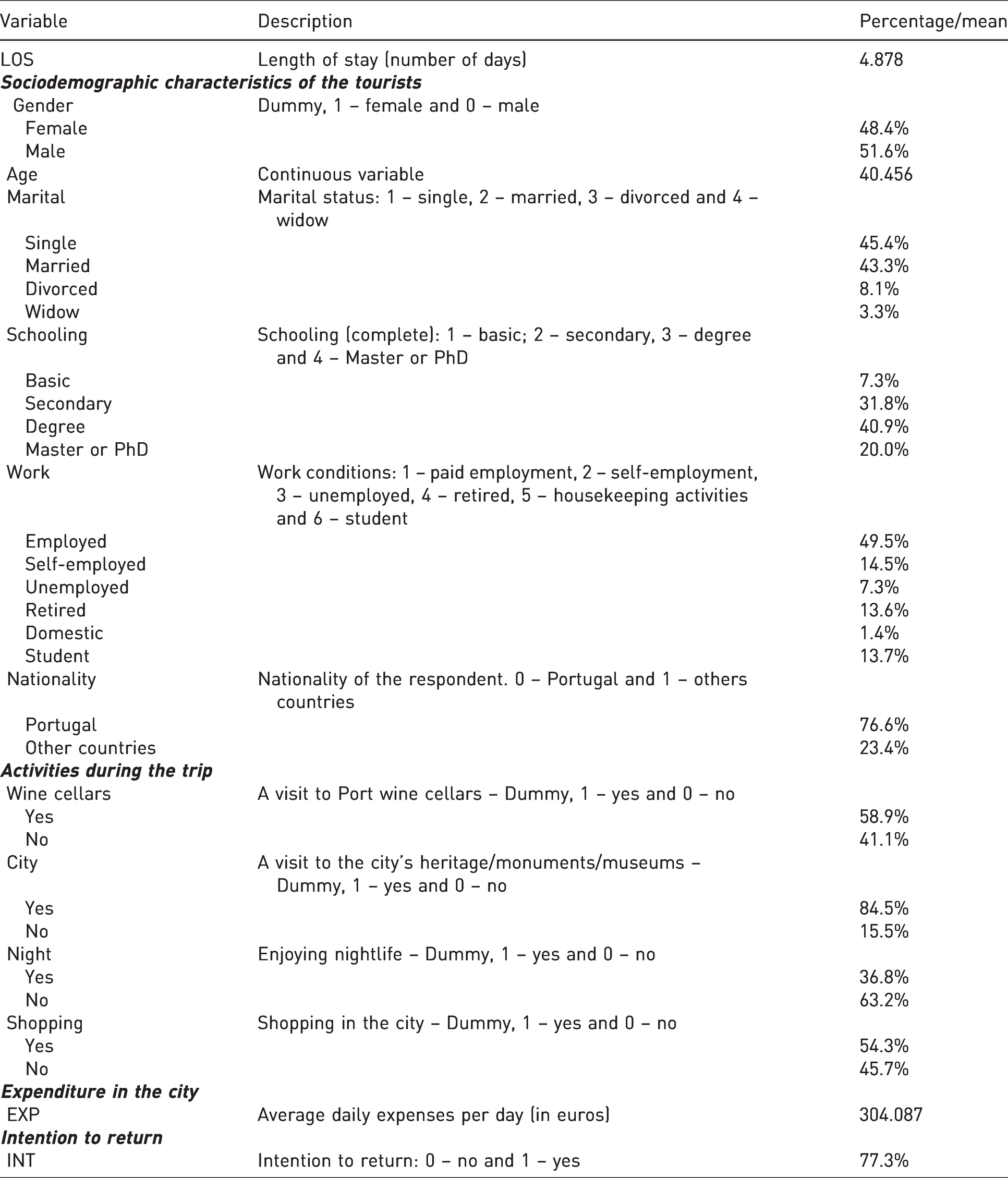
The main characteristics and description of the variables collected in the questionnaire are presented in Tables 1 and 2. The sample collected is composed of women (48.4%) and men (51.6%) and the respondents had an age average of 40.46 years old. In scope of marital status, 45.4% were single, 43.3% married, 8,1% divorced and 3,3% widowed. The majority, 60.1%, had at least a degree, almost half were working for others and 73.7% were foreign tourists (according to the country of origin of the foreigners, 12.53% lived in Germany, 10.53% in Brazil, 8.38% in France, 7.98% in the United Kingdom and the rest in other countries).
Description of the variables: Sociodemographic characteristics, activities during the trip, expenditure and intention to return.
Scales application of activities during the city visit and happiness with destination.
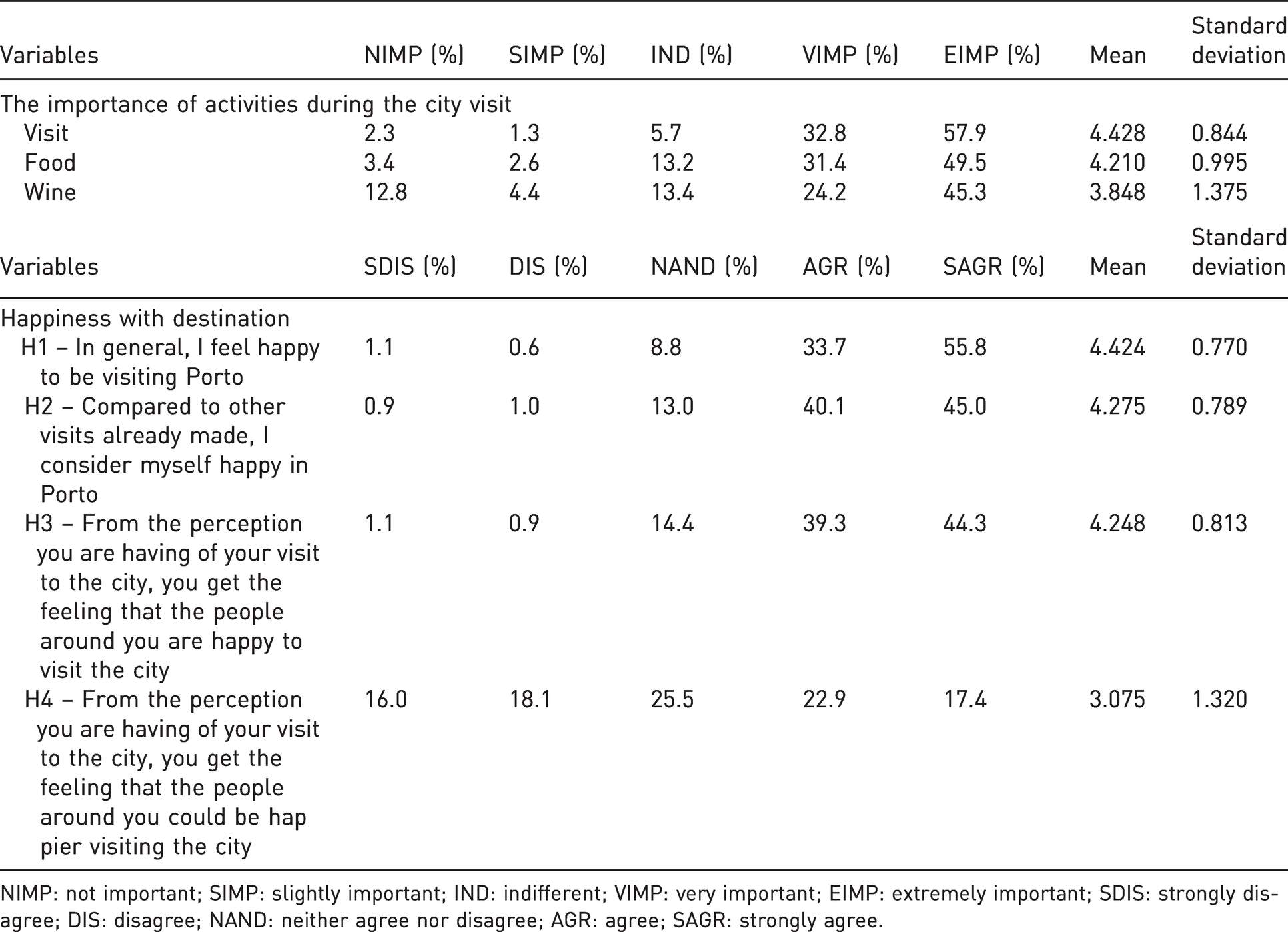
NIMP: not important; SIMP: slightly important; IND: indifferent; VIMP: very important; EIMP: extremely important; SDIS: strongly disagree; DIS: disagree; NAND: neither agree nor disagree; AGR: agree; SAGR: strongly agree.
In 2018, the profile of the tourists in the North of Portugal was 48.8% of tourists from Portugal and 51.2% of tourists from abroad – the majority from the USA, Spain, Brazil, Germany and the United Kingdom (INE, 2019). The sample used in the present study appears to be overrepresented in terms of foreign tourists, but the sending markets are widely represented.
Table 2 presents the results of the responses of the scale used and shows that the visit, food and wine are extremely important factors for the tourist who is visiting the destination. The same occurs in relation to the happiness factor. Regarding activities in the city, it appears that the main attractions are the heritage, monuments and museums, as 84.5% of the respondents indicated that they visited or intended to visit those locations. More than half of the respondents (58.9%) visited or intended to visit Porto wine cellars. It was also found that 54.3% intended or had already made purchases and 36.8% were going to enjoy the night in the city.
Regarding the importance of activities during the city trip, we have observed that visiting the city achieved the highest level of importance, followed by the taste of the food/dishes and meeting the Portuguese chefs.
Regarding the level of happiness, we verified that the sentence “I feel happy to be visiting Porto” obtained the highest average level of agreement followed by “Compared to other visits already made, I consider myself happy in Porto”. During the trip the tourist spent or intended to spend an average of about 304.08 EUR per day. Considering a future behaviour, 77.25% of the tourists revealed their intention to return to the city of Porto.
This study presents the results of three econometric models following the methodology of Thrane (2016). Considering this author, in the OLS trip duration (LOS) model the LOS is the dependent variable (in the natural log) and it may be formally described as
where Z is a vector of independent variables,
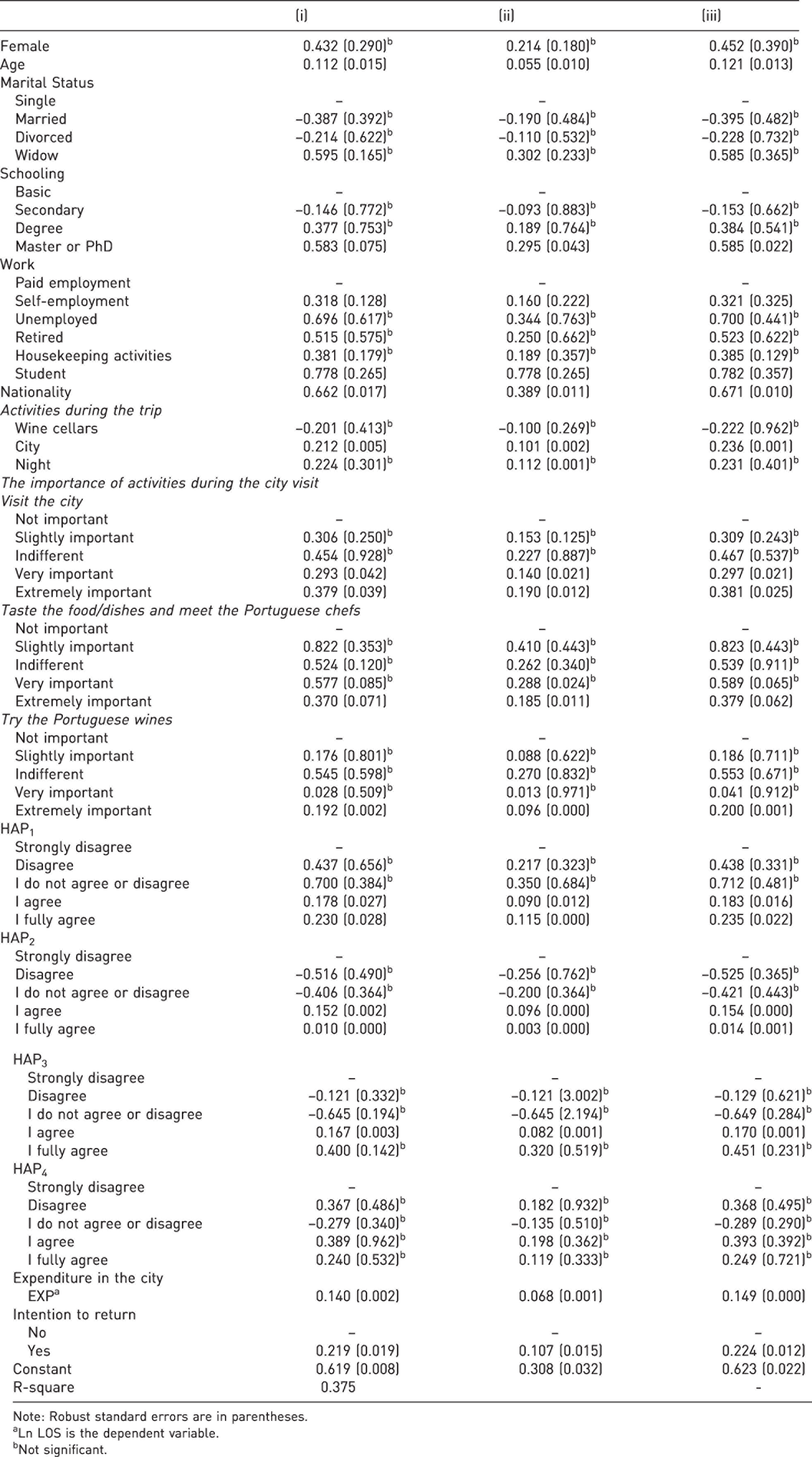
The three models to explain the LOS: (i) OLS regression model,a (ii) Heterogeneity-adjusted Weibull model in AFT metric and (iii) Zero-truncated negative binomial model.
Note: Robust standard errors are in parentheses.
aLn LOS is the dependent variable.
bNot significant.
For the OLS’ model, with reference to the sociodemographic characteristics of the tourists, we observed different impacts to explain the LOS in which the majority is significant with the exception of gender and marital status. Our results highlight that the trip duration increases with the age. In this case, for each additional year, the tourist stays another half day – that corresponds to 11.9% through the result of exp (0.112) – 1 and considering the average of the LOS. Regarding the academic degree, having a master’s or a PhD degree influenced the length of stay in 79.1% (almost four days) in relation to the tourists that do not have academic qualifications. Being self-employed had an effect on the length of stay of 37.4% (almost two days) in relation to those who are paid/employed. A similar result was obtained by students, whose length of stay in Porto showed a 6 days increase in relation to the paid-employed. Regarding the nationality, foreign tourists stay 4.6 days more than Portuguese tourists.
Considering the activities in the city, visiting the city (heritage, monuments and museums) impacts an average of 1.2 days as far as staying another day is concerned. Regarding the importance of factors related to the things a tourist can do in the city, the results revealed to be statistically significant and had an impact on the LOS. Tourists that consider important or very important to visit the city stay more 1.7 and 2.2 days, respectively, on average in Porto when compared to the tourists that stated that this was not important. The tourists that indicated it was very important to taste the food and wines also stayed 2.2 and 1.0 more days on average in the city, when compared to the tourists that stated that this was not important.
Concerning the statements of happiness, for the tourists who completely agreed that they felt happy visiting Porto, they have shown propensity to stay 1.26 days more in Porto when compared to the tourists who completely disagreed. For the tourists who agreed with the statement “Compared to other visits already made, I consider myself happy in Porto” we observed that this increased the LOS by 16.4% compared to those who totally disagreed with the statement. About the statement “From the perception you are having of your visit to the city, you get the feeling that the people around you are happy to visit the city” the tourists who have agreed increased their stay by 18.2% in relation to those who totally disagreed. For the last statement “I get the feeling that the people around me could be happier during their visit to the city” we did not have significance regarding the LOS.
Considering the expenditure per day in the city of Porto, the tourists who are more likely to spend more per day, stay less time in the city. Comparing respondents who indicated the intention to repeat the destination, with those who indicated that they do not intend to return, there is an increase of 24.5% in the LOS.
Finally, the three models are not similar in a strict statistical sense because they are essentially distinct in terms of parameterization (Thrane, 2016). In substantive terms, the results of the three statistical models are qualitatively similar (Thrane, 2016). In the case of duration models, there are other techniques that could be used (e.g. Poisson or negative binomial regression, among others). However, this paper follows an “agnostic” approach and presents the results of the three models.
Discussion
This research intended to explain LOS considering three kinds of main variables: socio-demographic, tangible factors and intangible factors using three different regression models.
The results obtained with respect to the effect of sociodemographic characteristics of the respondents in the LOS showed us that the age, the academic degree, being self-employed, students and foreign tourists are the variables that are statistically important and increase the LOS in Porto. These results are in vein with several other studies that argue that several sociodemographic characteristics of tourists affect the LOS (Barros and Machado, 2010; Brida et al., 2013; Collins and Tisdell, 2002; Cooper et al., 2007; Lal, Kumar and Anon, 2019). An interesting result was the exception of the gender and the marital status. This could be explained as the population has become more heterogeneous and the gender and marital status are no longer a sociodemographic characteristic that differentiates tourism (Van den Berg et al., 2011).
Regarding the activities in the city, the results showed us that visiting the city, have gastronomic and wine experiences and knowing the cultural heritage of the city are important factors regarding the LOS. These results are in consonance with the study of Sarra et al. (2015) conducted in Lisbon, and Marujo et al. (2012), in Évora.
With regard to happiness, the results showed that the respondents who visit the city of Porto are very happy and that had an effect in the LOS. These results are in line with the research of Mogilner and Norton (2019) that state that tourist activities fulfil individual short-time needs and experiences but they also imply a memorable long-term satisfaction. As in this research the interpretation of happiness was the subjective well-being, this happiness could be explained by the moods, the feelings and life satisfaction (Nawijn, 2011).
Finally, the results about the daily expenditure in the city have presented a contradictory result between spending in the city and staying in the city. Tourists’ expenditures when they visit a city contain several aspects – overnight, food, and travel in the city, admission to monuments and museums and shopping – that increases the expenditures during a stay. As Law and Au (2000) posit, tourists’ expenditures for shopping account for a significant part of their total travel spending and that can make the LOS shorter.
Conclusion
Tourism destinations are chosen for different motives, as we have confirmed in the present study. Previous studies mainly focus on the tangible factors or functional attributes of tourism destinations as being the main drive of tourism’s LOS (Albayrak et al., 2010). However, recent aspects of experiential and emotional benefits of a place destination have been gaining more attention from scholars and managers (Nawijn, 2011; Rivera et al., 2016; Wei et al., 2019).
This study contributes to the LOS academic literature by showing that the main factor mentioned by tourists as being of main importance is connected with the emotional aspects of the stay, that is, the happiness that tourists experience in the destination. In the questions related with happiness and the LOS, all respondents showed that they felt happy visiting Porto and that happiness affected and increased the LOS.
This research suggests some reasons why tourism managers have to pay attention to the impact of tourists’ happiness at a destination. The identification of the determinants of tourism happiness at a destination could lead to a better adjustment of the service tourism offers. As several authors posit, tourists’ happiness varies according to different types of tourism services and travel activities, as a consequence this acknowledgement can help tourism organizations (Chen and Li, 2018; Gillet et al., 2016). For tourism and hospitality managers, nurturing happy tourists is very important because it could increase the LOS. The experience factors (e.g. taste Portuguese gastronomy and wines) also present a positive correlation with the LOS. Both results allow us to conclude that the destination must be a set of experiences that increase the happiness of the tourist with the destination. The tourism managers can achieve that, for example, by helping tourists to meet their experiences’ goals and include some elements that are more familiar and recognisable to the tourists in those experiences, helping them when they explore realities they were not aware of or even when they are trying to discover something new.
Furthermore, a destination needs to retain the tourist's loyalty, and a result that we have verified is that the tourists that have confirmed the intention to return tended to stay longer in the city. This will possibly be a tourist satisfied with the attributes of the destination and equally happy with that same destination.
This research has some limitations which also call for future research. First, one of the limitations is the geographical coverage, because the data was collected in only one city. Future research should focus on other cities and countries. Second, a cross sectional survey has limitations in exploring changes in tourism LOS, thus it was not possible to establish causal relationships between LOS and other variables. Future research may use longitudinal approaches in order to understand to which extent and how the LOS changes when tourists return to the city. Third, the set of variables used to explain the LOS in this research may not be exhaustive. Future research may use other variables that can contribute to explain the LOS of the tourist (e.g. understand if the LOS is decided before the trip or if the tourist has the flexibility to change the days he/she decides to stay at the tourist destination).
Footnotes
Acknowledgement
The authors are deeply grateful to ISAG – European Business School and Research Center in Business Sciences and Tourism (CICET) for all support.
Declaration of conflicting interests
The author(s) declared no potential conflicts of interest with respect to the research, authorship, and/or publication of this article.
Funding
The author(s) disclosed receipt of the following financial support for the research, authorship, and/or publication of this article: This work is funded by National Funds through the Foundation for Science and Technology under the project UID/GES/04752/2019.
