







Abstract
This study introduces the Limen Experiences in Tourism Scale, a paired-percentage instrument that operationalizes Turner’s liminal-liminoid framework as five bipolar continua Exploration-Familiarity, Freedom to-Constraint, Freedom from Routine-Attachment, Individualism-Collectivism, and Personality Change-Status Quo. Validation with 2,432 adult travelers from panel and university samples confirmed a stable five-factor structure and revealed clear age gradients: respondents aged 18 to 34 located themselves over 20 percentage-points nearer the liminoid pole on both Freedom continua than those aged 65+. The scale enables destinations to pinpoint visitor positions – for example, 60% Exploration/40% Familiarity – and design calibrated offerings that range from “guided discovery” itineraries for ambivalent explorers to ritualized group formats for liminal seekers. By empirically demonstrating that liminal and liminoid coexist as measurable degrees rather than discrete states, the findings also resolve a long-standing conceptual divide in tourism studies. Generalizability remains constrained by the Hungary-centric sampling frame; future research should replicate the continuum across diverse cultural contexts and test how positional scores predict behavioral and affective outcomes.
Keywords
Introduction
A coastal destination watches its traditional sun-and-sand visitors dwindle year after year. In response, the local tourism board launches a suite of experimental initiatives: twilight meditation sessions on ancient fishing boats, week-long artisan workshops where guests learn traditional crafts alongside village elders, and midnight markets that blur the boundary between tourist spectacle and constructed notions of authentic local life (N. Wang, 1999). Some visitors seek the structured, communal rhythm of the workshops, finding meaning in shared rituals and collective traditions. Others gravitate toward the spontaneous freedom of the midnight markets, crafting their own adventures and personal transformations. This scenario illustrates that tourism today is not only about crossing geographic borders, but also about navigating psychological thresholds between who we are and who we might become. This scenario exemplifies what anthropologists call liminal and liminoid experiences – threshold states that have become increasingly significant for understanding contemporary tourism. In classical terms, liminality describes transitional “threshold” states (from the Latin limen, meaning threshold), typically encountered through ritual passage – experiences that are collectively mandated and formally structured (Turner, 1969). By contrast, liminoid experiences (Santos et al., 2017; Turner, 1974b) are optional, individually chosen, and more characteristic of voluntary, playful activities found in modern leisure and tourism. Throughout this study, we treat liminal and liminoid as theoretically distinct endpoints on a continuum, rather than as discrete categories. Recent shifts in product customization and visitor demographics make the present investigation timely. Although standardized mass-market packages continue to dominate global arrivals, the rise of customized, niche-oriented alternatives (Alexander et al., 2017; Yang et al., 2024) reveals a critical gap: tourism scholarship still lacks a multidimensional instrument that differentiates structured, communal liminal experiences from self-directed, playful liminoid ones. Developing such an instrument promises theoretical refinement – by resolving the long-standing conflation of these states – and managerial leverage, by giving destination planners a diagnostic tool to segment visitors by their preferred balance of structure and autonomy and to calibrate experience design accordingly. Reports from leading organizations (OECD, 2024; World Economic Forum [WEF], 2025) converge in calling for more granular understanding of tourist motivations and innovation in experience delivery. Though not invoking liminal and liminoid explicitly, these calls for personalization and systematization underscore the relevance of our theoretical intervention. Field research confirms the conceptual versatility of threshold theory: Brooker and Joppe (2014) construct a typology of tourism operators grounded in liminal concepts, while Milazzo (2023) interprets fan tourism spaces as liminoid arenas of identity play. Both studies illuminate the theoretical distinction between structured transformation and autonomous play, yet neither proposes a scalable measurement framework – underscoring a key gap this study attempts to addresses. Threshold-based concepts such as liminal and liminoid have been applied to a wide variety of phenomena, including backpacking (Ting & Kahl, 2016), festival-based immersion (Lamond & Moss, 2020), theme-park attractions (Milazzo, 2023), spiritual pilgrimages (Lim et al., 2010), and flexible work-and-travel arrangements (Miao et al., 2024). However, the diversity of applications has generated substantial measurement challenges, and scalable, systematic methods remain scarce (Ibarra & Obodaru, 2016; Soulard et al., 2021; Tomazos & Murdy, 2024). Existing quantitative efforts – such as those by Lim et al. (2010), Seunghwan et al. (2015), and Zhang and Xu (2019) – rarely engage the liminal–liminoid continuum comprehensively, leaving practitioners without diagnostic tools to obtain quantitative insights (Huang et al., 2024). Unlike traditional scales that treat opposing characteristics as independent, we capture tourists’ positioning on this continuum via paired-percentage scaling, which requires respondents to allocate 100% between opposing poles – for example, “discovering new things” versus “preferring familiarity.” See detailed explanation in the Methodology section.
To respond to these shortcomings we set four specific goals:
Introducing the Limen Experiences in Tourism model and the Limenscape concept as new theoretical mechanisms for understanding transitional states;
Validating the Limen Experiences in Tourism Scale – which operationalizes the Limenscape by measuring tourists’ positions across its constituent dimensions – using paired-percentage scaling for precise quantification of tourist preferences;
Examining the dimensional structure and measurement invariance of this approach across gender, age, and cultural background within the studied samples; and
Testing nomological validity via established tourism scales.
Viewing liminal and liminoid traits as points on the same scale clarifies where visitors place themselves and helps designers tailor experiences accordingly.
Literature Review
Evolution of Concepts
The concepts of liminal and liminoid have become central frameworks within tourism studies, illuminating how tourist experiences manifest as transitional or threshold states. Originally rooted in anthropology – Van Gennep’s (1909) stages of rites of passage and Turner’s (1974b, 1979) classic distinction between collective, structured “liminal” and individualized, playful “liminoid” – these ideas have been widely adapted. Tourism scholars such as Graburn (1977, 1983), E. Cohen (1979, 1988), MacCannell (1992), Urry (1990), and Dann and Cohen (1991) employed these constructs to examine inversion, authenticity, and the disruption of everyday norms. Crucially, later advances – particularly Spiegel (2011) – reconceptualized liminal and liminoid as ideal-type poles on a continuum, rather than discrete categories, echoing Graburn’s (1983, p. 21) early insight and clarifying that limited attribute “blending” is theoretically permissible. This continuum perspective forms the basis of the present study’s approach.
Diversification and Application in Tourism Contexts
Since the early 2000s, the theoretical landscape has broadened considerably. Edensor (2001) analyzed tourism’s inherently liminal practices, while Andrews and Roberts (2012) extended liminality to settings such as ruins and beaches. The framework has been applied to holiday interactions (McCabe & Stokoe, 2004), gendered tourism (Aitchison, 2005, 2012), backpacker subcultures (O’Regan, 2015), and queer tourism (Waitt & Markwell, 2020), illustrating its adaptability. Wu et al. (2020) demonstrated the cultural specificity of liminal rites at Chinese music festivals, while Milazzo (2023) analyzed how agency, play, and value formation in commercial media tourism spaces can both enable and constrain transformative experiences. Empirical and conceptual advances have highlighted the complexity and contextual variability of threshold experiences. Brooker and Joppe (2014) developed a typology for tourism innovation based on liminality; D. Wang and Shen (2024), Feng et al. (2025), and Luo et al. (2024) made methodological advances but remain limited in generalizability. Magrizos et al. (2021) used mixed methods to study volunteer tourism but ultimately reduced liminality to a single dimension (“immersiveness”), thus overlooking the multidimensional, continuum-based character of threshold states. Contemporary research challenges simple dichotomies of ordinary/extraordinary or structure/anti-structure. Skandalis et al. (2024) revealed, via urban music-festival ethnography, that extraordinary experiences can emerge from creative engagement with everyday structures. Goolaup and Nunkoo (2023) introduced the idea of “synstructure,” defined as the coexistence of rule-bound order and anti-structural play within the same experiential frame. Mamédio et al. (2025) highlighted paradoxes of authenticity in liminal consumption, demonstrating that modern threshold experiences are often hybrid and ambiguous. Collinson and Baxter (2022) critiqued the managerial construction of liminoid heritage experiences as neither universal nor consistently transformative. While much of the empirical literature emphasizes positive or transformative outcomes, a growing body of work now challenges this bias. Holmqvist and Ponsignon (2025) documented confusion and frustration in poorly scaffolded liminal spaces, whereas Tomazos and Murdy (2024) identified “perpetual liminality,” a condition in which participants remain indefinitely suspended between pre-trip and post-trip identities, thereby negating closure and transformation. Studies such as Zhai et al. (2024) continue to foreground therapeutic benefits, situating liminal episodes within everyday urban events. Recognizing both poles underscores that the same mechanism can produce growth or distress depending on duration, agency, and social support. Digital mediation adds further complexity. Conti and Heldt Cassel (2020) showed how Instagram creates digitally mediated liminality, simultaneously enabling self-expression and producing commercial pressures. Thus, the embodied tensions documented above are re-encoded in online spaces that monetize visibility. Recognizing both poles underscores that the same mechanism can produce growth or distress depending on duration, agency, and social support. Recent evidence adds that individual dispositions also matter: Lengyel (2022) shows that higher trait mindfulness heightens sensitivity to threshold cues, thereby expanding the scope for liminoid engagement.
This diversification has prompted meta-theoretical reflection: Milazzo and Soulard (2024) contrasted Turner’s anthropology with Mezirow’s transformative learning, arguing that both neglect power relations and the potential for failed transformation, thereby calling for post-foundational, interdisciplinary approaches.
Cultural Variability and Context Sensitivity
Although liminal and liminoid experiences are often theorized as universal, growing evidence points to significant cross-cultural variation (Horvath et al., 2022; Thomassen, 2015). Cultural background shapes how individuals navigate novelty, familiarity, freedom, constraint, individualism, and collectivism in tourism (Reisinger & Mavondo, 2006). For example, Luo et al. (2024) showed how liminality mediates between cultural or spatial features and social cohesion in Chinese tourism, while Feng et al. (2025) documented gendered scripts in women’s “girlfriend getaways.” Despite these advances, much research remains context-bound, underscoring the need for multidimensional and culturally sensitive measurement.
Personality Change, Status Transformation, and Role Play
Tourism scholarship sometimes conflates short-lived behavioral shifts with Turner’s (1969) idea of liminal transformation. Yet Turner reserved transformation for status changes that receive collective recognition, structured reintegration, and enduring effect – conditions seldom met in leisure travel. Most tourist role play, therefore, is better framed as liminoid experimentation: reversible, individually chosen, and socially unratified. As Graburn (1983, p. 21) notes, tourists typically return to “unchanged social positions despite internal feelings of transformation,” echoing Lett’s (1983) notion of “temporary behavioral inversions.” Empirical findings corroborate this view: Kahana (2024) describes vacation behavior as “temporary experiments,” while Baltaci and Cakici (2022a) observe deliberate “vacation personas” discarded post-trip. When travelers consciously preserve their core identity across settings, they replicate the stabilizing logic of liminal rites, affirming social norms through controlled disruption rather than contradicting them (Graburn, 1983; Turner, 1974b, 1979).
Operationalization, Measurement, and Research Gap
Despite extensive theorization, empirical operationalization of liminal–liminoid experiences remains challenging. Zhang and Xu (2019) proposed a four-dimensional model but struggled to separate liminal from liminoid elements, sometimes conflating structured “communitas” with spontaneous romance. Such conflation weakens a continuum approach unless explicitly theorized. Lim et al. (2010) introduced “liminal nones” but did not develop quantitative measures. S. Lee et al. (2015) produced a liminality scale for spectator sports but isolated “communitas” and focused chiefly on liminal phenomena. Recent studies (Collinson & Baxter, 2022; Feng et al., 2025; Luo et al., 2024; D. Wang & Shen, 2024) adopt multidimensional metrics but still prioritize liminal over liminoid dimensions. For instance, D. Wang and Shen (2024) measure joy, harmony, and happiness – affects that Turner (1974a) associated more with liminoid play. Accordingly, precise empirical discrimination between liminal and liminoid remains elusive. Standard factor-analytic techniques struggle to enforce theoretical polarity constraints; we therefore apply a cross-entropy optimization algorithm that iteratively maximizes information fit while anchoring item loadings at predetermined continuum endpoints.
Limitations and Gaps in the Current Literature
Many studies remain qualitative, single-site, or context-specific, and most measurement tools fall short of providing the multidimensional, continuum-based assessment demanded by theory (Feng et al., 2025; S. Lee et al., 2015; Lim et al., 2010; Luo et al., 2024; D. Wang & Shen, 2024; Zhang & Xu, 2019). Conceptual innovation is sometimes muted, with new scales replicating prior models rather than advancing theory (Feng et al., 2025; Magrizos et al., 2021). Critics further caution against over-generalization, the commercialization of threshold rhetoric, and the marketing of supposedly liminal experiences – particularly in online settings (S. A. Cohen & Cohen, 2019; Meethan, 2012; Picard & Robinson, 2016). To close these gaps, the next section introduces the Limen Experiences in Tourism model, a five-dimension, paired-percentage framework that renders liminal–liminoid continua empirically tractable across diverse tourism settings. We outline its theoretical underpinnings and show how this continuum lens captures the nuanced interplay of threshold states in contemporary travel.
The Limen Experiences in Tourism Model
Theoretical Foundation and Developments
The Limen Experiences in Tourism model is motivated by the growing consensus that liminal and liminoid phenomena occupy points along a continuum rather than occupying mutually exclusive categories (Graburn, 1983; Spiegel, 2011; Thomassen, 2014). Thomassen (2014) notes that “degrees of liminality” vary with the extent to which an experience departs from persisting structures. Agency, then, governs how far a traveler moves along the continuum, whereas the possibility that liminal and liminoid traits may co-exist is inherent to the continuum itself. Earlier scholarship acknowledged tourist “inversions” along conceptual continua (Graburn, 1983) but did not operationalize them empirically. Spiegel (2011) refined this view by casting liminal and liminoid as ideal-type end poles that may appear simultaneously within a single episode. Our model builds on this foundation by extending previous work in three key areas:
It translates the continuum view of liminal–liminoid experiences into a measurement logic that permits partial overlap rather than binary assignment.
It provides an operational format that yields proportionate data, allowing more precise diagnostics than conventional Likert approaches.
It organizes threshold phenomena into a set of theory-driven continua whose empirical properties are detailed in the next sections.
The relationships among these theoretical elements are summarized schematically in Figure 1.
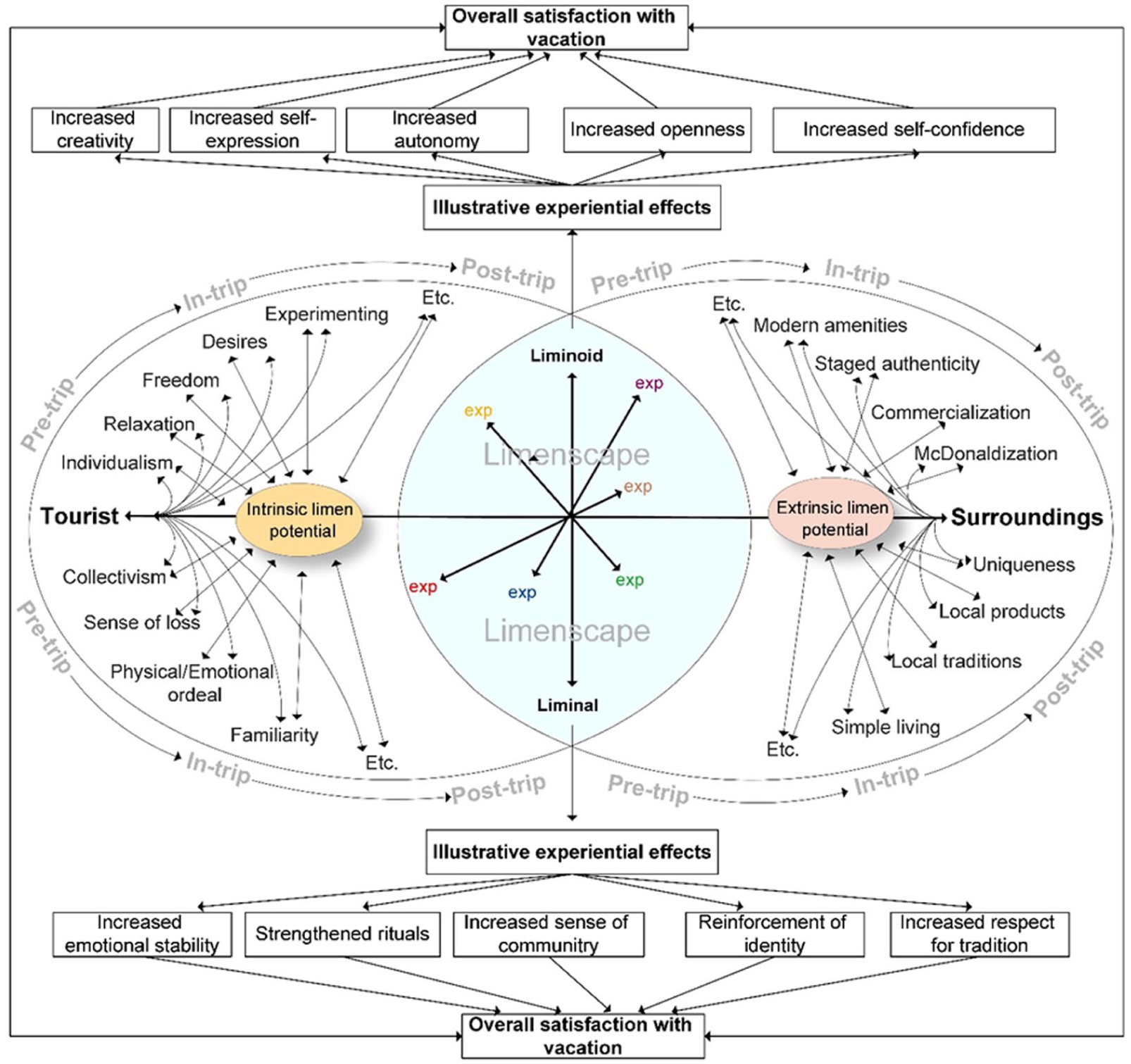
Limen experiences in tourism model showing intrinsic and extrinsic limen potentials, liminal-liminoid continua, and illustrative experiential effects across the trip timeline.
The Limenscape Construct
Drawing on Lefebvre’s (1991) spatial triad, the Limenscape serves as a conceptual map that plots where travelers situate themselves on each liminal–liminoid continuum across pre-trip, in-trip, and post-trip phases. It materializes through co-creation: personal dispositions meet destination affordances to actualize limen potential.
Core Premises
Tourism experiences entail graded selections along liminal–liminoid continua.
These selections arise from the interaction of intrinsic dispositions and extrinsic cues (co-creation).
The balance of liminal and liminoid qualities evolves from pre-trip anticipation to post-trip reflection.
These dynamics operate across multiple, theoretically derived dimensions, allowing a multidimensional diagnosis.
Illustrative Experiential Effects
The model tentatively links continuum positions to two broad clusters of outcomes. Liminoid-oriented effects (e.g., increased creativity, self-expression, autonomy, openness, and self-confidence) stem from exploratory, playful engagement. Liminal-oriented effects (e.g., heightened emotional stability, strengthened rituals, community cohesion, reinforced identity, and respect for tradition) arise when structured experiences reaffirm social bonds. Because our focus was scale validation, we did not test causal pathways; that task remains open. In conclusion, the Limen Experiences in Tourism model converts liminal-liminoid distinctions into a single, quantitative continuum -operationalized via a paired-percentage response format and cross-entropy-optimized item selection detailed in the next section – furnishing researchers with an empirical index that replaces binary categorizations. This metric both resolves long-standing conceptual ambiguity about “threshold” travel states and supplies a practical scaffold for testing the situational antecedents and behavioral, affective, and social consequences of limen experiences across diverse tourism settings.
Methodology
Research Design Overview
To capture the balance of liminal and liminoid orientations in tourism experiences, we implemented a three-stage research design. This process combined domain-grounded item generation, dual-phase empirical testing, and psychometric validation. The full procedure unfolded over three procedural stages: initial conceptual mapping, pilot testing via a simplified ordinal-scale format, and final validation using an innovative paired-percentage scaling approach. Because the paired-percentage format imposes greater cognitive load on respondents, a six-point Likert-style version was first piloted (n = 996) to identify and remove semantically ambiguous or psychometrically weak items before subjecting respondents to the more cognitively demanding paired-percentage format. This approach prevented confounding item quality issues with format-related response difficulties. A subsequent validation study (n = 929) employed the paired-percentage version to generate precise, trade-off-based assessments of individual preferences. The two-phase progression enhanced construct clarity while mitigating measurement artifacts.
Multi-Source Sampling Strategy
Data collection employed a multi-source approach across four distinct samples, combining panel-based and campus-based recruitment to achieve both scale and demographic diversity (Table 1).
Sample Characteristics.
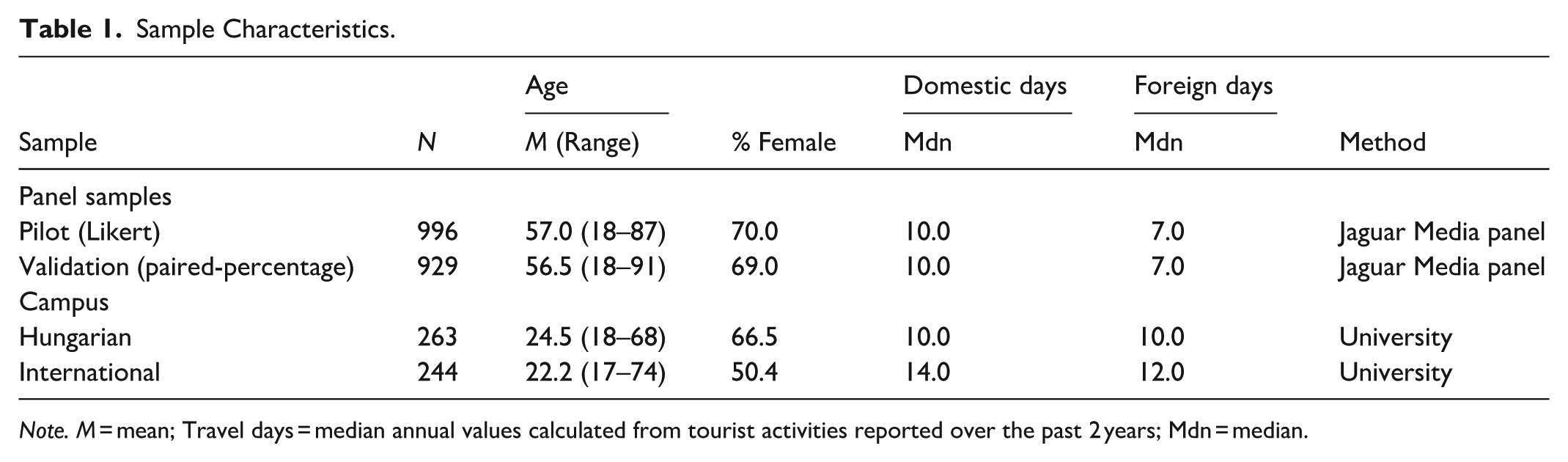
Note. M = mean; Travel days = median annual values calculated from tourist activities reported over the past 2 years; Mdn = median.
The two primary validation studies were conducted in October 2024 by Jaguar Media (jaguarmedia.hu), a Hungarian market research firm with a digital panel exceeding 2 million members. The panel samples were recruited using a targeted strategy that prioritized respondents with high cumulative vacation activity over the previous 2 years. This targeting strategy introduces potential selection bias toward highly active travelers, limiting generalizability to the broader population. This criterion, combined with explicit instructions to exclude business travel and family trips involving child supervision, resulted in samples skewing toward mature adults with greater leisure time availability (mean age approximately 57 in both panel samples). These respondents were well-educated, with the majority holding post-secondary qualifications: in the pilot sample, 41.5% held secondary education, 32.2% bachelor’s degrees, 21.1% master’s degrees, and 5.2% other qualifications. The validation sample showed similar educational attainment (43.0% secondary, 31.7% bachelor’s, 21.9% master’s degrees, and 3.4% other qualifications). The campus samples provided crucial younger cohorts for age-related comparisons, with mean ages of 24.5 and 22.2 respectively. As expected from university populations, the Hungarian campus sample showed 74.5% currently pursuing or having completed secondary education, with 15.6% holding bachelor’s and 6.5% master’s degrees. The international campus sample demonstrated higher educational progression, with only 36.1% at secondary level, 49.6% with bachelor’s degrees, and 13.1% with master’s degrees, reflecting the graduate student composition of international programs. All samples reported substantial travel experience relevant to the study’s tourism focus. The international campus sample reported the highest median foreign travel days (12.0 annually), surpassing the panel samples (7.0), while maintaining similar domestic travel patterns (14.0 days vs. 10.0 days). These travel patterns confirm that respondents across all samples had recent, meaningful tourism experiences to draw upon when completing the survey. The travel activity reported by our respondents (median 10 domestic, 7 foreign days in panel samples) exceeds national population medians reported by Hungarian and EU statistical authorities (typically 5–7 days per capita, including non-travelers; Eurostat, 2024; Központi Statisztikai Hivatal, 2024). However, as national statistics do not provide benchmarks for the subset of the population who actually engage in tourism (i.e., the “tourist population”), direct comparisons to the average European or global tourist are not possible. Our findings therefore generalize specifically to travel-active adults rather than the general population or modal tourist. Importantly, the explicit purpose of including these campus-based university samples was twofold. First, they extend the empirical scope of the study beyond the demographic and cultural profile of the main panel samples. This age-diverse data structure allowed an initial exploratory check of age-related patterns and tentative cultural invariance. Second, the campus samples furnish independent datasets for nomological validity testing – enabling correlations between Limen Scale scores and established tourism constructs to be examined in a demographic segment distinct from the primary validation pool. Rather than serving to numerically balance the panel, the campus samples were recruited to facilitate direct comparative analysis and to test whether the principal empirical patterns – such as the monotonic age-related decline in liminoid experiences – replicate among younger, culturally diverse populations. Primary validation, reliability, and invariance analyses were conducted using the panel data, while the university samples provided a critical means to evaluate whether the core findings replicate across our two student comparisons; no inference is made beyond these samples. Main cross-sample results, including nomological tests, are summarized in the Results section, with full item-level comparisons reported in Appendix 10.
Initial Domain Definition
Item Generation
Recognizing the ambiguity surrounding liminal and liminoid constructs in existing literature, we extended beyond Turner’s classical framework. A systematic review of 74 influential publications – 40 from tourism studies and 34 from relevant social science disciplines – was conducted. Selection criteria included theoretical relevance and citation impact (Google Scholar). This review encompassed diverse domains such as anthropology, event studies, spatial theory, mobility research, and leisure sociology. Table 2 presents selected key publications that were foundational to our research.
Selected Key Literature.
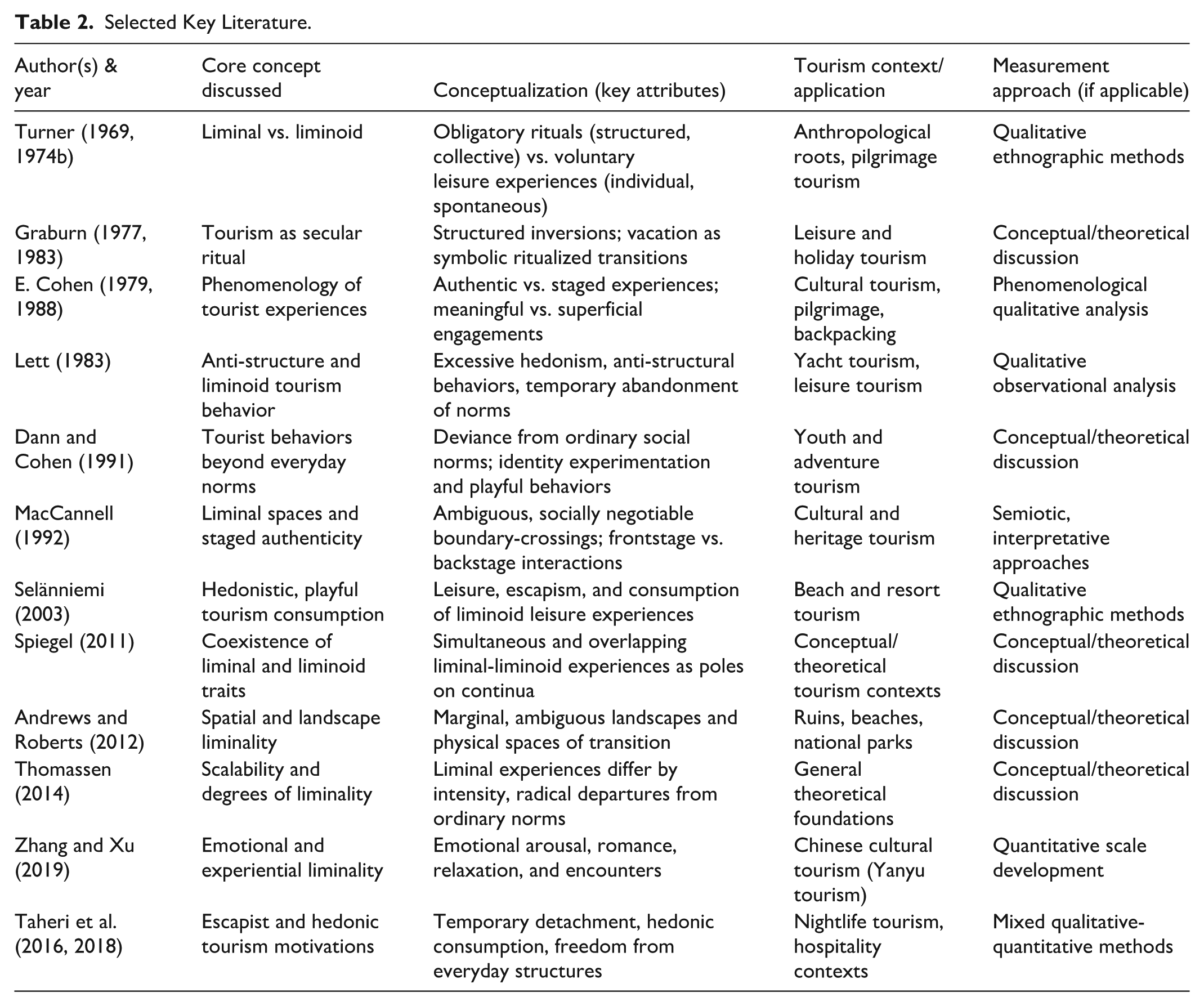
We conducted a qualitative content analysis to extract recurring experiential dimensions classified explicitly or implicitly as liminal or liminoid. From this, 80 candidate items were generated to reflect balanced coverage across conceptual themes such as hedonism, norm inversion, role play, spatial ambiguity, and ritual framing. This initial item pool is presented in Appendix 1. Four distinct stakeholder groups assessed the items: non-tourism scholars and tourism academics (n = 8), who had published high-quality work on limen experiences (n = 8), tourism professionals (n = 29), and members of the target population (n = 144). These groups rated each item for clarity, relevance, and theoretical fit. Following the pilot exploratory factor analysis, we employed a Cross-Entropy optimization approach with Markov Chain Monte Carlo sampling for statistical refinement (Rubinstein & Kroese, 2004), ensuring theoretical oppositions were preserved. Our approach enabled preservation of theoretical oppositions while optimizing expert agreement – constraints that standard factor analysis does not directly incorporate. For example, conventional exploratory factor analysis might have grouped items based solely on statistical clustering, potentially placing theoretically opposed items together (e.g., both “tradition” and “spontaneity” could load on a general “experience intensity” factor despite representing opposite poles of the liminal-liminoid continuum). Cross-entropy optimization helped differentiate opposing poles – for instance, “Freedom of Choice” clearly aligned with liminoid characteristics while “Traditions” aligned with liminal ones.
Scale Development Process
The final measurement instrument employed a paired-percentage format. In this method, respondents are presented with paired experiential poles (e.g., “novelty” vs. “familiarity”) and asked to distribute 100% along each continuum. For example, participants were prompted: “In what proportion are the following two things characteristic of your vacations? Please distribute 100% between them.” Thus, a respondent might allocate 80% to “discovering new things” and 20% to “preferring familiarity.” The paired-percentage format compels participants to explicitly balance opposing attributes, producing more granular and less biased data than traditional ordinal scales. Unlike traditional rating systems, this approach does not assume independent evaluation but instead conceptualizes responses as expressions of dynamic experiential tension. Conceptual poles serve as theoretical anchors rather than fixed categories, allowing for flexible self-positioning along the liminal-liminoid continuum. To address the potential for respondent fatigue, we deliberately limited the scale to only five continua, balancing dimensional comprehensiveness with respondent burden. Additionally, to monitor potential respondent fatigue, open-ended feedback was solicited in both the pilot and validation phases, and post hoc analyses compared reliability and response patterns across the survey sequence. Despite the absence of process-based metrics from Google Forms, post-hoc analyses compared reliability and response patterns between first and last scale items to detect potential fatigue effects. As is common with many online survey platforms, direct process-based evidence – such as dropout rates and completion times – was unavailable, which restricted the use of certain standard respondent engagement analyses. Scale development combined several techniques for initial validation within the study samples. In the Pilot phase, Exploratory Factor Analysis with Diagonally Weighted Least Squares estimation and Promin rotation was conducted (FACTOR 12.04.05). A Confirmatory Factor Analysis followed in the Validation phase (JASP 0.19.1). Item retention was guided by factor loadings, cross-loadings (threshold: ≥0.30), item-total correlations, and theoretical considerations. Measurement invariance was tested across gender, age, and cultural background using R 4.4.1. Reliability was assessed using multiple indicators (McDonald’s ω, Cronbach’s α, Greatest Lower Bound) within a Bayesian framework, implemented in JASP 0.19.1. The combination of classical and Bayesian reliability estimates provides both frequentist benchmarks and distributional uncertainty quantification. Convergence for Bayesian analysis was evaluated via Gelman-Rubin diagnostics. Detailed results, including specific loadings and the item reduction process, are reported in the Results section.
Results
Initial Dimension Identification
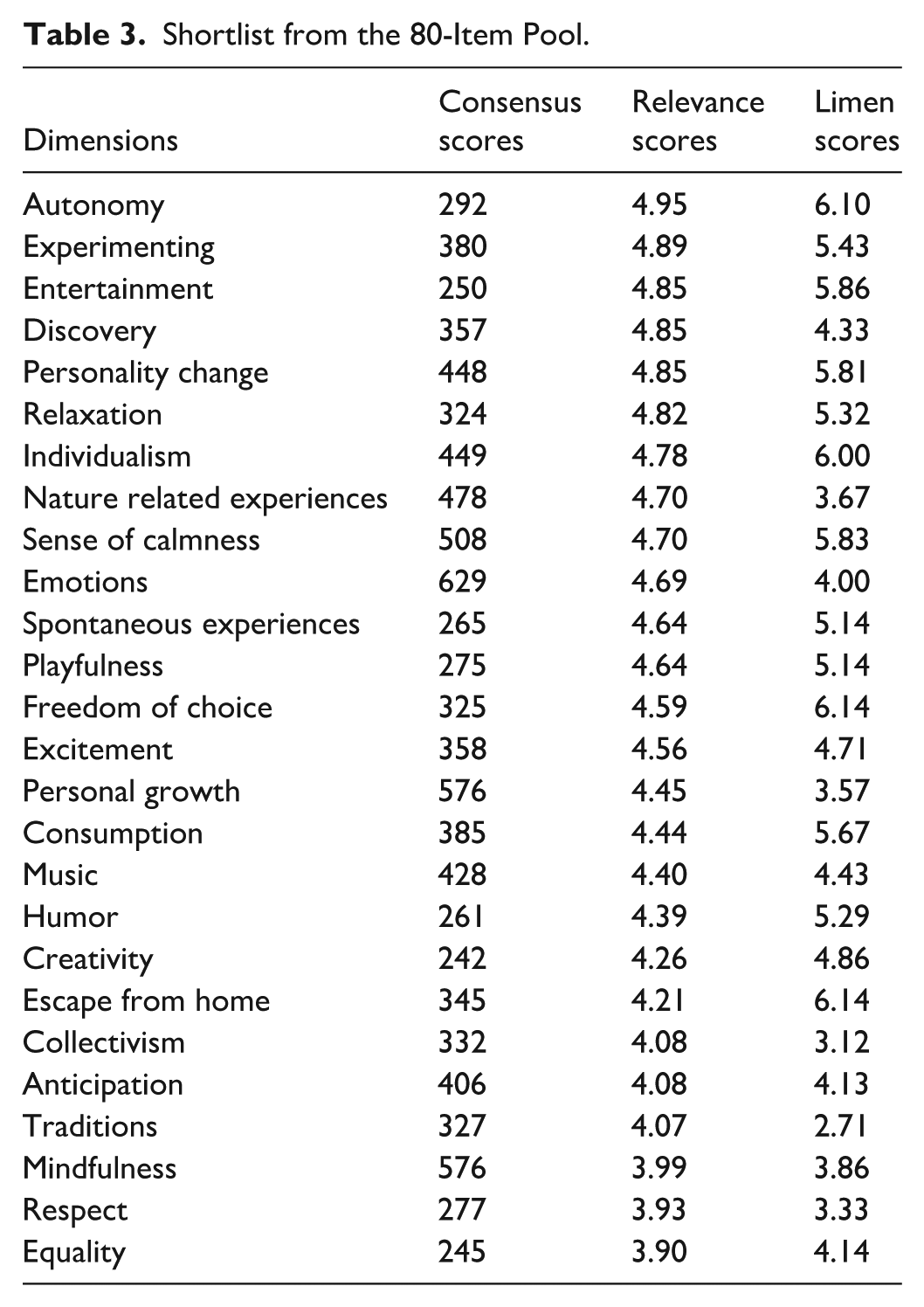
Our Cross-Entropy analysis integrated three key metrics: consensus scores reflecting rater agreement, relevance scores indicating dimension importance, and limen scores differentiating between liminal and liminoid characteristics (Table 3).
Shortlist from the 80-Item Pool.
Inclusion and Exclusion of Dimensions
Building on the cross-entropy analysis, the final selection of dimensions was guided by a hierarchical, two-step process that combined theoretical considerations and numeric thresholds derived from consensus, relevance, and limen scores.
Theoretical Considerations (Top Priority)
First, each potential dimension was examined for conceptual alignment with liminal-liminoid theory in tourism. If a dimension had no clear opposing pole (e.g., no theoretically coherent “other side”), or if it overlapped heavily with higher-priority constructs, or if it did not capture a distinctly liminal-liminoid tension, it was excluded regardless of numeric results. Conversely, theoretically central concepts sometimes stayed in even if their numeric values were borderline.
Numeric Criteria (Second Priority)
For dimensions that passed the theoretical screen, we applied three numeric filters:
Consensus Scores: We favored dimensions with consensus scores below ~400, indicating stronger expert agreement (Higher scores imply more disagreement among raters.)
Relevance Scores: We retained only those with relevance scores above 4, ensuring the item was considered important for tourism contexts.
Limen Scores: If an item’s limen score hovered near 4.0, it meant experts perceived it as equally liminal and liminoid – thus not helping to distinguish the two poles. We generally excluded or down-prioritized such ambiguous items in favor of those leaning clearly to one side (<4 = more liminal; >4 = more liminoid.
In Table 4 we summarize why each dimension in our short-listed pool was either included or excluded under these criteria.
Inclusion and Exclusion Criteria.
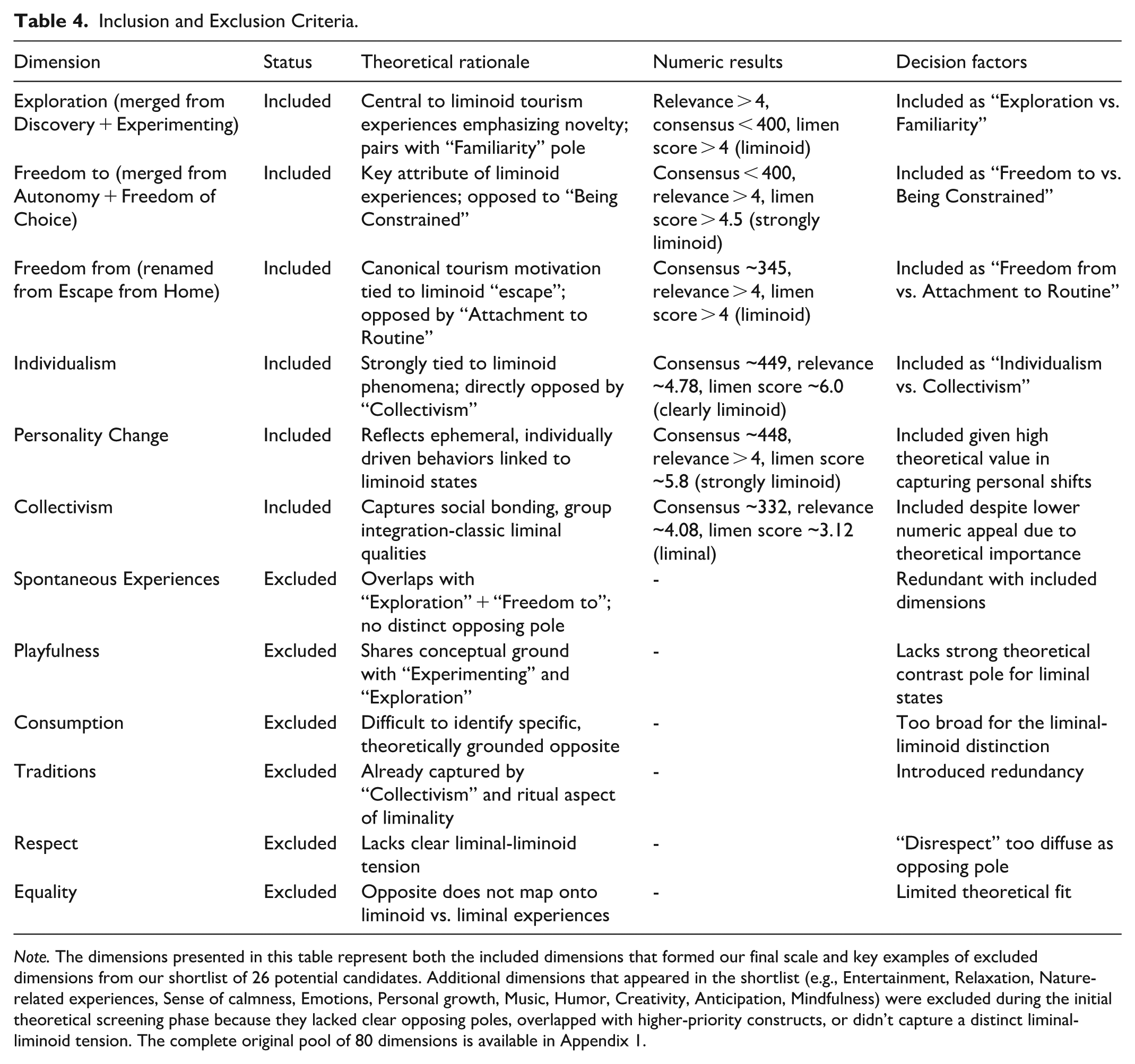
Note. The dimensions presented in this table represent both the included dimensions that formed our final scale and key examples of excluded dimensions from our shortlist of 26 potential candidates. Additional dimensions that appeared in the shortlist (e.g., Entertainment, Relaxation, Nature-related experiences, Sense of calmness, Emotions, Personal growth, Music, Humor, Creativity, Anticipation, Mindfulness) were excluded during the initial theoretical screening phase because they lacked clear opposing poles, overlapped with higher-priority constructs, or didn’t capture a distinct liminal-liminoid tension. The complete original pool of 80 dimensions is available in Appendix 1.
Empirical Validation of Continuum Logic
Figure 2 confirms that scores are widely dispersed across all five continua, demonstrating that respondents treat each pair as a graded continuum rather than two independent variables. Younger travelers (18–34) locate themselves markedly closer to the liminoid pole than older travelers (65+), with 22- to 27-point differences on the Freedom dimensions (Hedges g = 0.82–0.91). Nomological tests are theory-consistent: Exploration and Freedom-to correlate positively with Travel Career Pattern novelty seeking (r = .42 and 0.27), while Individualism aligns with Self-Congruity (r = .21). Together, distributional breadth, known-groups contrasts, and theory-consistent correlations converge to validate the bipolar structure of the five continua. Items with ambiguous limen scores were excluded, ensuring each retained construct shows clear positioning.
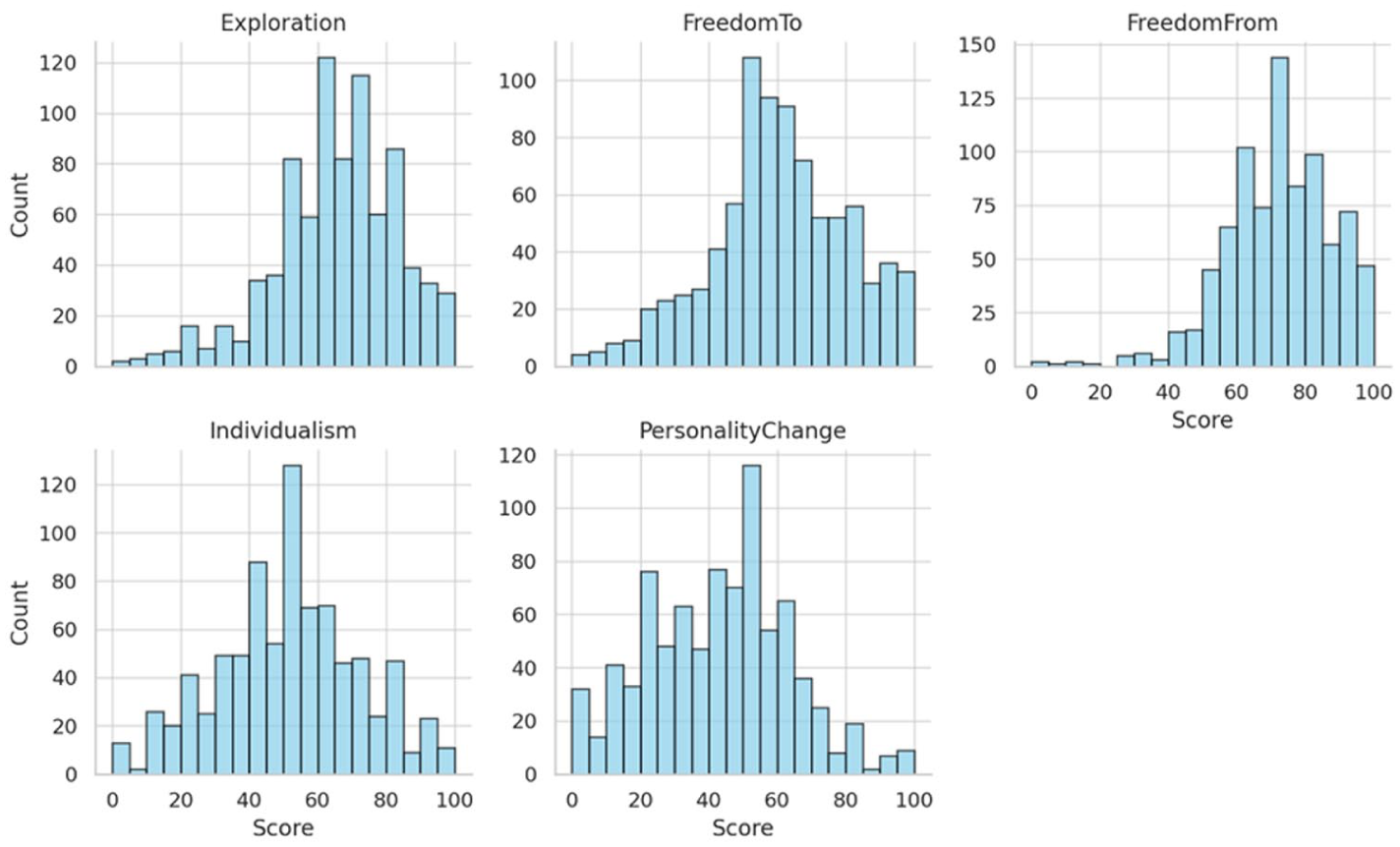
Empirical distributions of respondent scores on the five liminoid-liminal continua.
The histograms reveal broad dispersion across the full theoretical range rather than clustering at extremes, confirming that the continua function as meaningful, continuous variables for subsequent analyses.
Domain Definition
Exploration Versus Familiarity
Liminoid Pole (Exploration)
Characterized by strong inclination toward experiencing new things, exploring unfamiliar places, learning about different cultures, and trying new cuisines.
Liminal Pole (Familiarity)
Encompasses experiences gravitating toward the known and familiar, signifying comfort in predictable environments, familiar customs, and preferred tastes.
These poles parallel Plog’s (1974) allocentric-psychocentric continuum (Cruz-Milán, 2024). Exploration appears as a dimension in various tourism motivation scales (C. K. Lee et al., 2004; Liu et al., 2021; Xie et al., 2008) and psychographic measures (Chow & Murphy, 2011). Familiarity likewise has been measured through specific indicators (Iso-Ahola & Allen, 1982; Mo et al., 1993) or as a separate dimension (S. Lee et al., 2008; Toyama & Yamada, 2012).
Freedom to Versus Being Constrained
Liminoid Pole (Freedom to Act)
Encompasses an individual’s exercise of autonomy during vacations, highlighting experiences with personal decision authority and freedom from external constraints.
Liminal Pole (Being Constrained)
Covers situations where choices are limited by external factors, including obligations to conform to planned activities and restrictions on personal freedom.
Tourism literature recognizes dual promises of liberation and license (Caruana & Crane, 2011). Freedom indicators appear in tourism experience scales (Kim et al., 2012) and constraints have been measured in various contexts (Hung & Petrick, 2010; M. Li et al., 2011).
Freedom From (Escape from Routine) versus Attachment to Routine
Liminoid Pole (Escape from Routine)
Encapsulates preference for breaking away from daily routines and home responsibilities during vacations.
Liminal Pole (Attachment to Routine)
Reflects a tendency to maintain ties with familiar aspects of home life during vacation.
Escape is widely recognized as a primary travel motivation (Chylińska, 2022; Uysal et al., 2009), appearing in numerous scales (Kim et al., 2012; Snepenger et al., 2006; Uysal et al., 1993). Home attachment, though less measured directly, relates to psychocentricity constructs (Cruz-Milán, 2023).
Individualism Versus Collectivism
Liminoid Pole (Individualism)
Characterized by preference for personal autonomy and independence, highlighting experiences where individuals prefer solo activities and find solitude restful.
Liminal Pole (Collectivism)
Includes inclination to integrate with others, signifying preference for adapting to fellow travelers’ needs, enjoying group activities, and finding relaxation in others’ company. Turner (1982, p. 52) notes liminoid phenomena are “generated by and for individuals.” Individualism appears in tourism scales (Ahn & McKercher, 2018; Han et al., 2017), while Turner’s “communitas” concept parallels collectivism in tourism theory (E. Cohen, 1985; Prayag et al., 2021).
Personality Change Versus Personality Status Quo
Liminoid Pole (Personality Change)
Captures ephemeral, individually driven behavioral shifts – “vacation personas” – that occur outside formal rites. These shifts lack social recognition or structured reintegration (Turner, 1969), and align with Turner’s liminoid concept of voluntary, reversible transformations in modern contexts (Turner, 1974b, pp. 39–41).
Liminal Pole (Personality Status Quo)
Reflects maintenance of core identity despite changed settings, paradoxically mirroring how liminal rites ultimately reinforce social structures (Turner, 1969).
This continuum illustrates the pattern inversion outlined in the Literature Review: the behavioral shifts tourists report may look transformative, yet their voluntary, playful character places them on the liminoid side of the continuum. Liminoid behavior is commonplace during vacations (Baltaci & Cakici, 2022a), supporting Kahana’s (2024) contention that tourism settings are more accurately characterized as liminoid than liminal. Although instruments exist for discrete tourist behaviors (Cheng et al., 2013; Tsaur et al., 2018), systematic measurement of travelers’ self-perceived behavioral change remains scarce. While Freedom to and Individualism share conceptual ground in emphasizing autonomy, factor analysis (details in next section) confirmed they capture distinct aspects of the tourism experience. Freedom to measures behavioral autonomy – the ability to act without external constraints during vacation. Individualism captures social preference – the desire for solitary versus group experiences. The moderate correlation between these dimensions (r = .183) suggests that travelers can experience behavioral freedom while still preferring group activities, or feel constrained despite preferring solitude. Figure 3 illustrates how the continuum operates in practice, showing that intermediate positions represent genuine mixed states rather than measurement artifacts. For example, a tourist scoring 60% Exploration/40% Familiarity might engage in “Guided Discovery” – structured exploration that balances novelty-seeking with comfort zones.
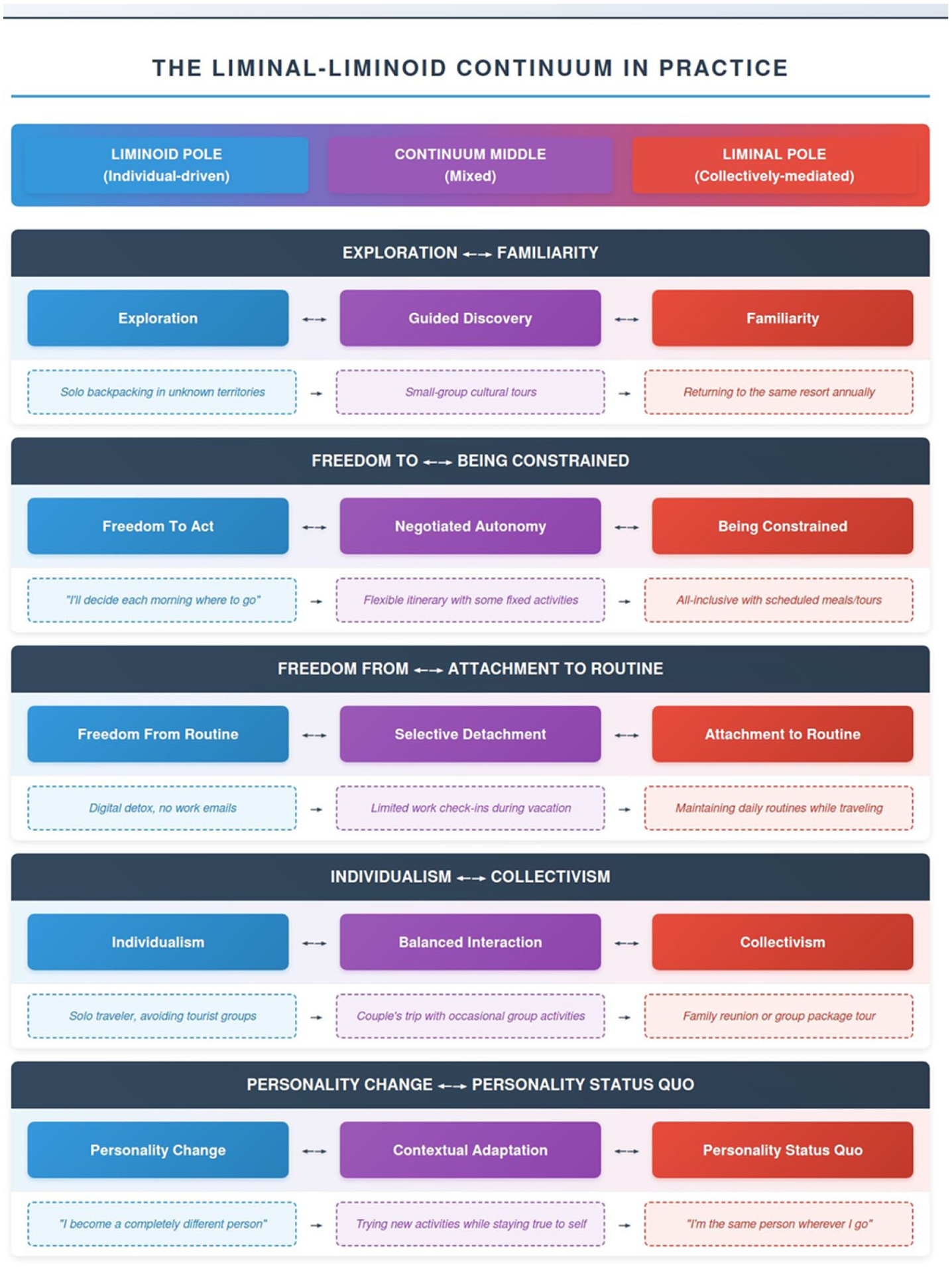
The liminal-liminoid continuum in practice.
Scale Development Results
Unless noted otherwise, all psychometric properties and validation results refer to the panel samples. Subgroup results for campus samples are included in the Supplemental Material.
Factor Structure
The Solomon Test demonstrated excellent potential sample equivalence with a communality ratio (S) of 0.9977. Kaiser-Meyer-Olkin values for the theoretical subsamples were 0.7995 and 0.7977, indicating good sampling adequacy. Factor analysis confirmed the five-dimension structure (Table 5), with factor loadings ranging from 0.498 to 0.974.
Exploratory Factor Analysis Results.
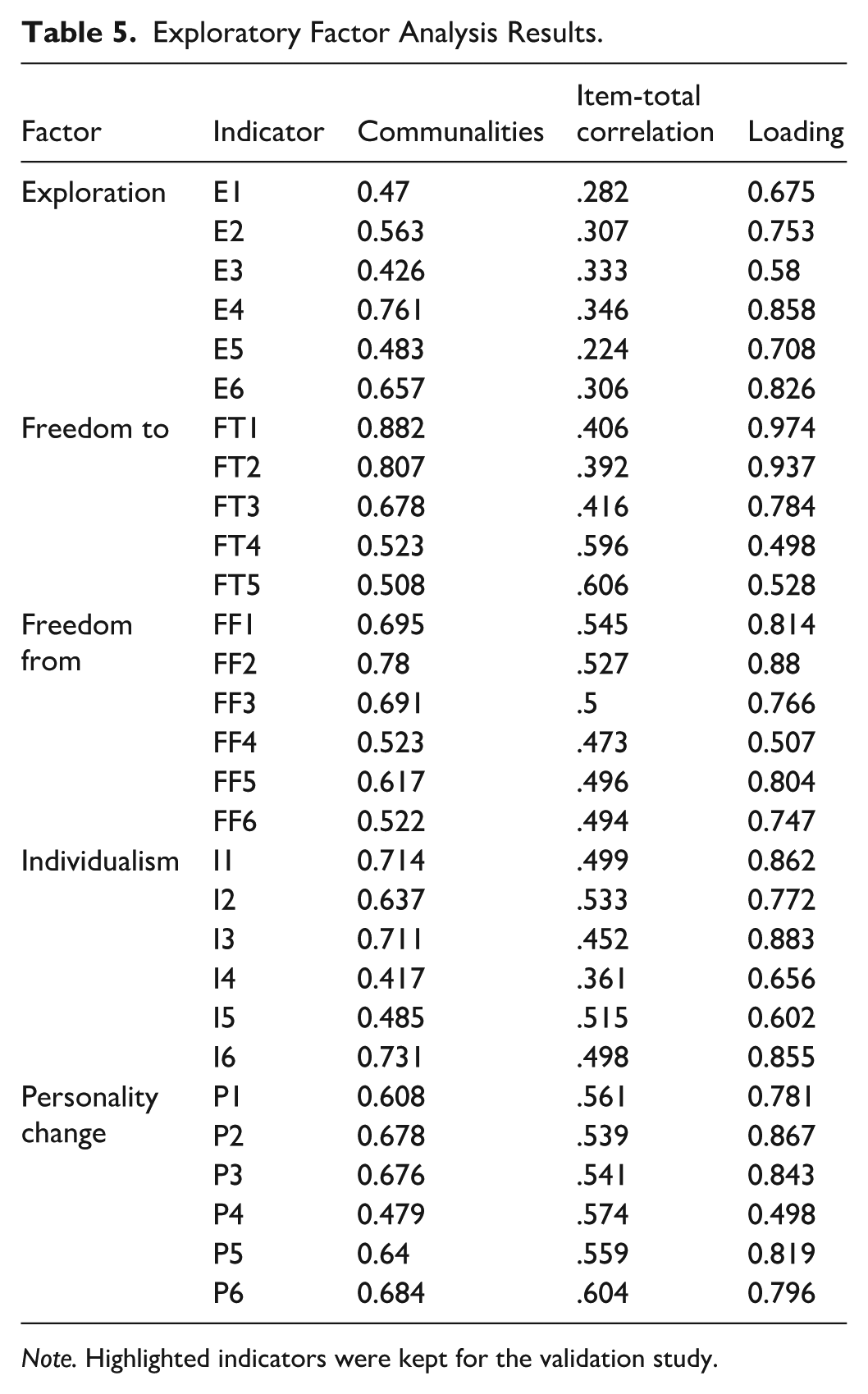
Note. Highlighted indicators were kept for the validation study.
Factor analysis results guided item reduction while maintaining construct coverage. Items were excluded based on multiple criteria, including low item-total correlations, substantial cross-loadings, and theoretical considerations. Additionally, the “importance” indicators were removed during the validation stage because they reflected a separate layer of meaning – one that focused on subjective significance rather than the direct presence or intensity of the experiences themselves. We treated cross-loadings of ≥0.30 as indicative of potential overlap, but in practice, all cross-loadings in our pilot data were under 0.30 ranging from 0.11 to 0.28 (see Appendix 4 for the full pattern matrix), eliminating the need to remove dimensions or items on that basis. Therefore, dimension-level decisions primarily rested on conceptual considerations and overall factor coherence, rather than on problematic cross-loadings.
Validation Results
Respondent Fatigue
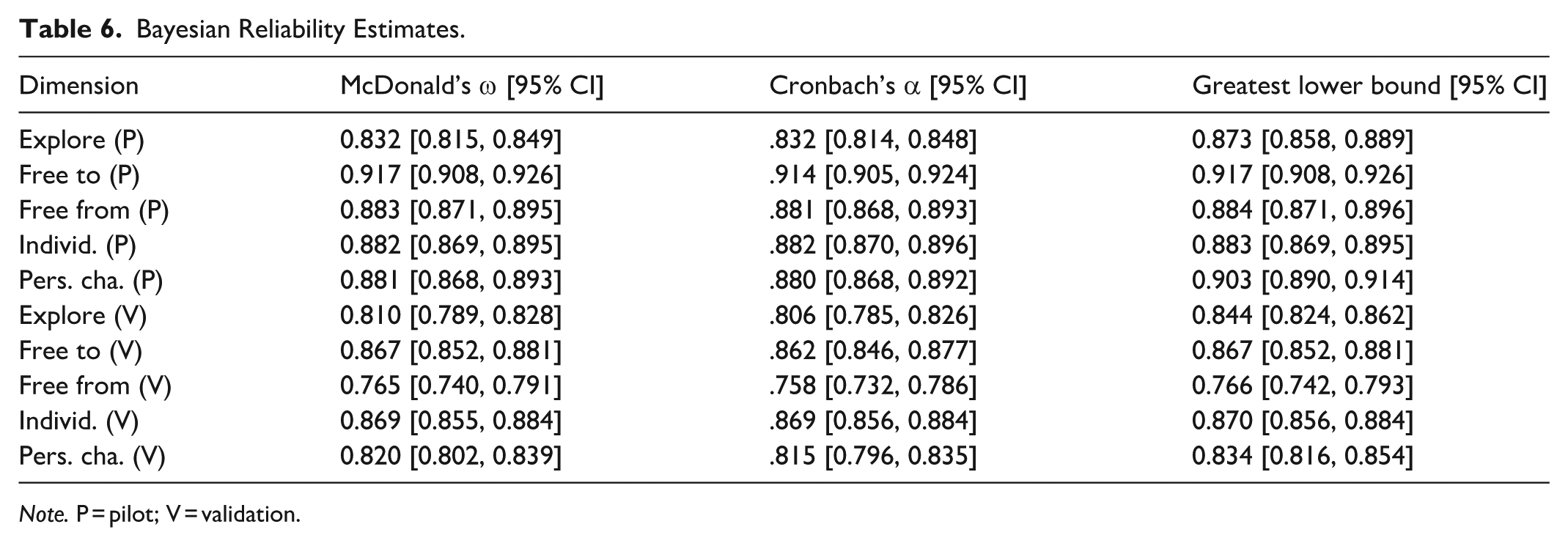
The potential for respondent fatigue is an important methodological concern, particularly with cognitively demanding formats such as paired-percentage scaling. We employed several proxy measures to assess potential fatigue indicators. First, we systematically reviewed participants’ open-ended feedback (N ≈ 2,000). Qualitative indicators were rare: among roughly 500 open comments from both waves, only five mentioned burden or confusion – one noted the survey “took about 22–25 min at work,” another said “many questions feel repetitive,” a third found “some items hard to answer,” a fourth called the questionnaire “very tiring,” and a fifth felt “several questions are ambiguous.” With fatigue-related remarks at 1% of feedback, these anecdotes support the psychometric evidence of minimal large-scale fatigue while pointing to survey length and wording as areas for future refinement. Second, psychometric analysis comparing internal consistency (McDonald’s ω) between the first and second halves of the survey revealed no decline in reliability across any dimension (e.g., ω = 0.810–0.820 for Exploration, ω = 0.764–0.820 for Personality Change). Third, analysis of response patterns across all dimensions found no systematic trends such as declining variance or increasing extremity; the higher proportion of zero responses for Personality Change items reflected expected polarization rather than satisficing behavior. While these proxy indicators do not suggest obvious fatigue effects, the limitations of this assessment approach are discussed in the Limitations section.
Reliability Evidence
Bayesian reliability analysis demonstrated consistently high values across dimensions (McDonald’s ω: 0.764–0.869). The analysis revealed strong internal consistency across both pilot and validation samples, with minimal variation between studies except for the “Freedom From” dimension (Table 6).
Bayesian Reliability Estimates.
Note. P = pilot; V = validation.
Validity Evidence
Validity testing revealed strong psychometric properties across all dimensions (Table 7). Average Variance Extracted values exceeded 0.5, and Maximum Shared Variance values remained below Average Variance Extracted for all factors. The strongest relationship emerged between Freedom dimensions (r = .340), while the weakest appeared between Exploration and Personality Change (r = .089).
Convergent and Discriminant Validity.
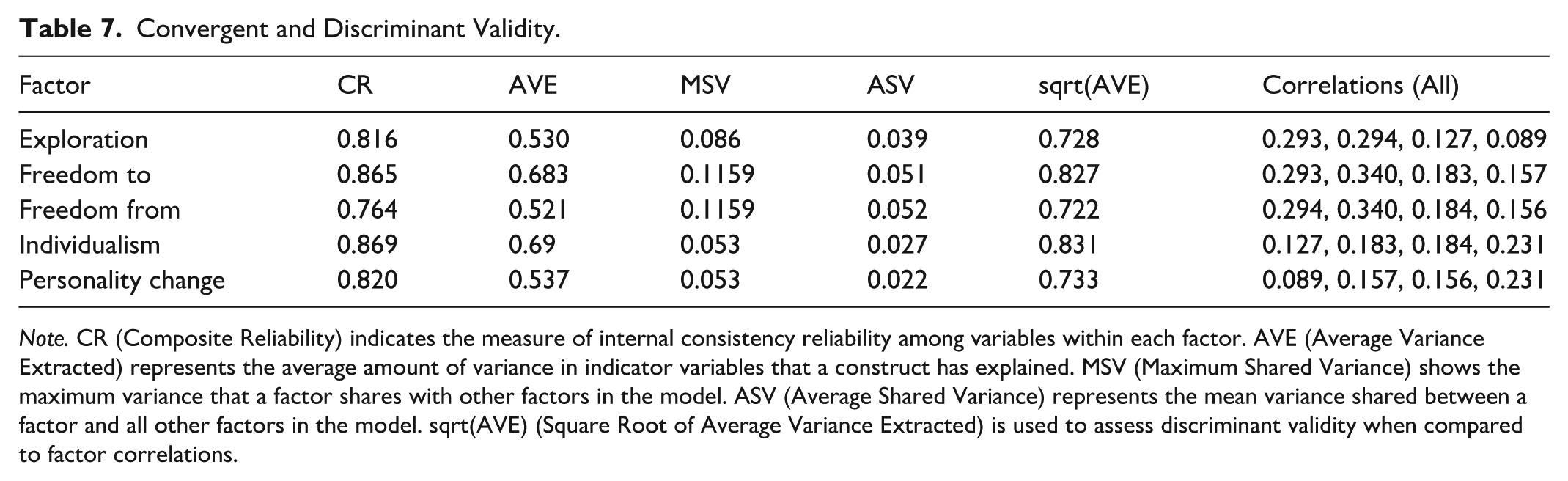
Note. CR (Composite Reliability) indicates the measure of internal consistency reliability among variables within each factor. AVE (Average Variance Extracted) represents the average amount of variance in indicator variables that a construct has explained. MSV (Maximum Shared Variance) shows the maximum variance that a factor shares with other factors in the model. ASV (Average Shared Variance) represents the mean variance shared between a factor and all other factors in the model. sqrt(AVE) (Square Root of Average Variance Extracted) is used to assess discriminant validity when compared to factor correlations.
Measurement Invariance
Analysis confirmed the scale’s consistency across gender groups, as shown in Table 8, and most age categories, though strict invariance across age groups was not achieved. The factor structure remained stable across the demographic groups included in our sample; however, the sample’s strong skew toward older Hungarian adults and limited representation of other groups precludes any assertion of broad applicability.
Gender Invariance.

Note. ΔCFI (Change in Comparative Fit Index) represents the difference in CFI values between two models, used to evaluate measurement invariance. ΔRMSEA (Change in Root Mean Square Error of Approximation) indicates the difference in RMSEA values between two models, assessing the change in model fit. ΔSRMR (Change in Standardized Root Mean Square Residual) shows the difference in SRMR values between two models, evaluating the change in residual fit.
Liminal-Liminoid Distribution Patterns
The validation study revealed distinct patterns across dimensions (Figure 4). The Exploration dimension showed strong liminoid tendencies, with high mean scores for seeking new experiences (66.56%) and discovering natural beauty (62.30%). Freedom dimensions similarly leaned toward liminoid characteristics, with Freedom from scoring highest in escaping responsibilities (70.50%).
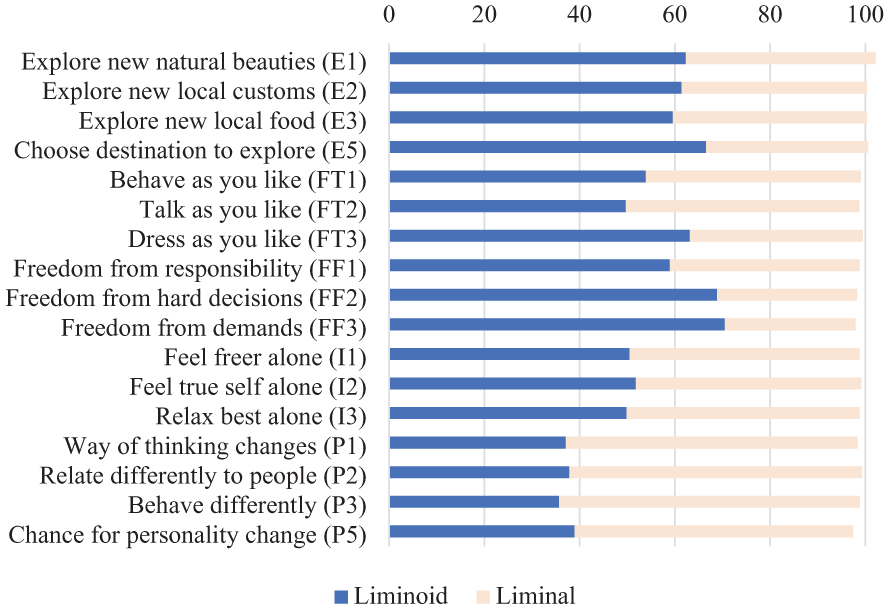
Mean values for liminoid-liminal pairs.
The Individualism dimension presented a more balanced profile, with scores hovering around the midpoint for self-expression (51.79%) and solitary experiences (50.52%). The Personality Change dimension leaned toward the liminal pole, with markedly lower scores for transformation opportunities (38.95%) and behavioral changes (37.86%).
The absence of bimodal distributions or extreme clustering in these data demonstrates that respondents position themselves along continua rather than selecting discrete categories.
Dimensional Interactions
Analysis revealed complex interaction patterns within the Limenscape (Figure 5).
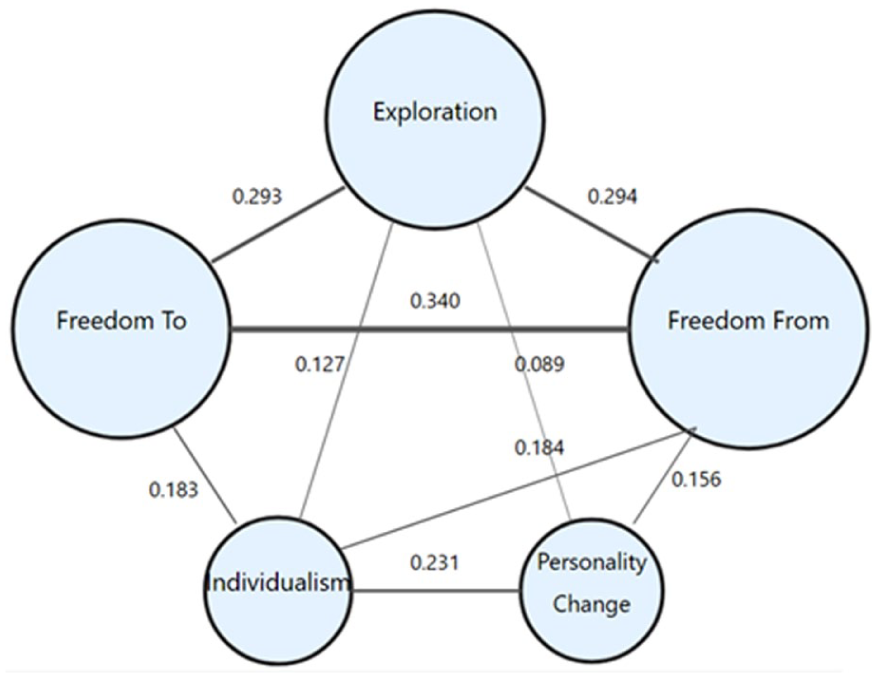
Dimensional interactions.
The correlation map (Figure 3) shows that the two Freedom continua cluster most closely (r ≈ .34), while Exploration connects moderately to each. Individualism aligns modestly with all dimensions, strongest with Personality Change (r ≈ .23), whereas Exploration and Personality Change remain largely independent (r ≈ .09). These patterns confirm that no single factor dominates; each continuum taps a distinct aspect of threshold experience. Beyond these core dimensional relationships, additional exploratory analyses examining intrinsic-extrinsic effects, including relationships between dimension importance and vacation valuation as well as attribution patterns, are reported in Appendix 11.
Relative Importance of Dimensions
Analysis revealed three key patterns supporting the Limenscape concept (Figure 6). First, dimension importance ratings showed a clear hierarchical structure. Freedom from routine emerged as most central (mean = 5.04), followed by Exploration (4.61) and Freedom to act (4.60). Individual Aspects (3.09) and Personal Change (2.99) played secondary roles.
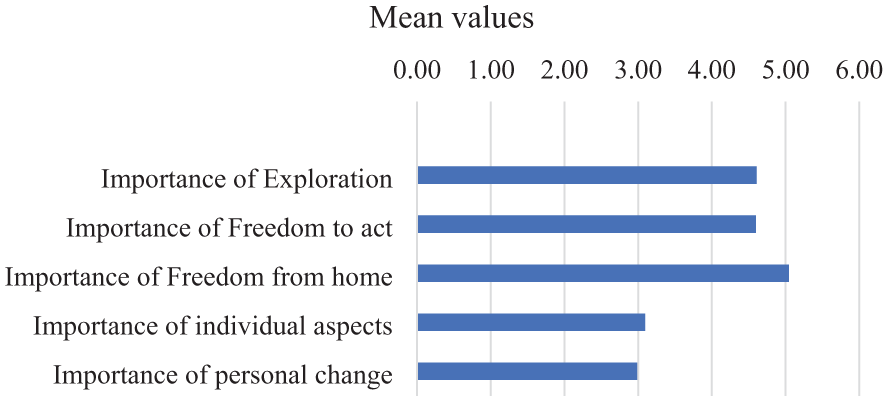
Relative importance of dimensions.
Confirmatory Factor Analysis
The results indicated strong support for the 17-item, five-factor structure. Model fit indices demonstrated excellent fit (CFI = 0.976, TLI = 0.970, RMSEA = 0.039). Factor loadings proved substantial and statistically significant, with values ranging from 13.952 to 23.266. Factor covariances, though significant, suggested distinct dimensions, with the strongest covariance between Freedom dimensions (0.340) and the weakest between Exploration and Personality Change (0.088). These results support the structural integrity of the Limen Experiences in Tourism Scale and provide initial evidence that the paired-percentage format can model these dimensions effectively within the present samples.
Construct Replicability
Analysis of construct replicability using the Generalized G-H index (Ferrando & Lorenzo-Seva, 2018) demonstrated strong stability across all five dimensions. The H indices ranged from 0.828 to 0.890, exceeding the 0.80 threshold that indicates well-defined latent variables. Personality Change (F5) exhibited the highest replicability (H = 0.890), followed by Exploration (F1, H = 0.876), Freedom to Act (F2, H = 0.863), Individualism (F4, H = 0.845), and Freedom from Routine (F3, H = 0.828). These results indicate that the identified factors are likely to remain stable when replicated in studies using similar methodologies and populations, supporting the construct’s dimensional structure within the present empirical context. However, as with all psychometric indices, full confirmation of cross-contextual stability requires direct empirical validation in future studies employing diverse samples.
Age-Related Differences in Liminal-Liminoid Experiences
Panel Data
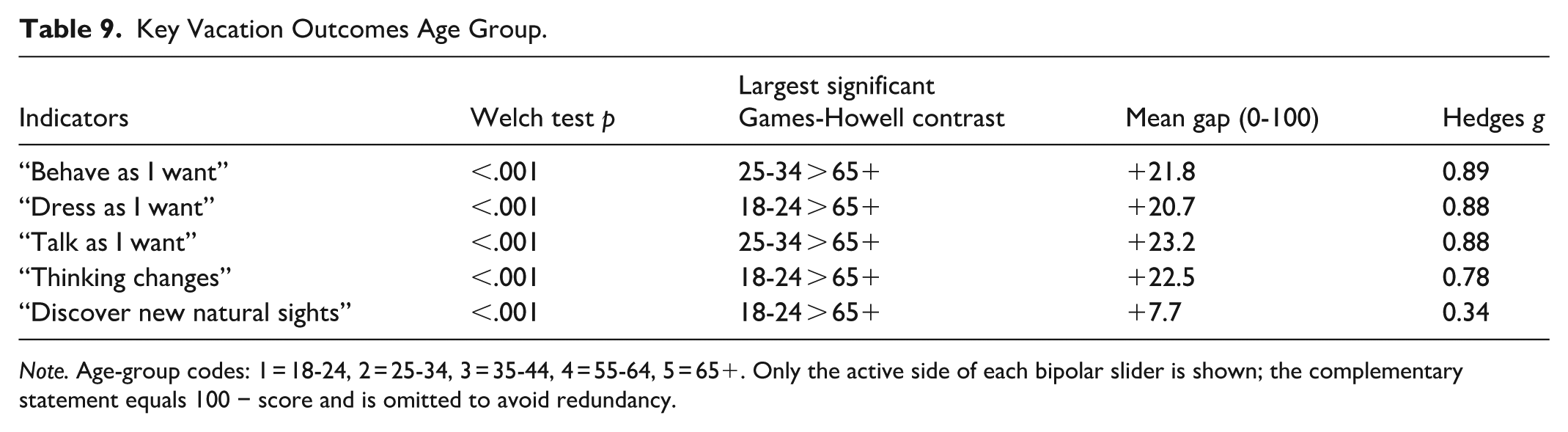
To isolate substantively meaningful patterns, we applied Welch-corrected ANOVAs and retained only those bipolar items whose age contrasts exceeded both statistical (α = .05) and practical (Hedges g ≥ 0.30) thresholds. The resulting profile (Table 9) pinpoints five core facets in which liminoid vacation experiences deteriorate monotonically from early adulthood to later life.
Key Vacation Outcomes Age Group.
Note. Age-group codes: 1 = 18-24, 2 = 25-34, 3 = 35-44, 4 = 55-64, 5 = 65+. Only the active side of each bipolar slider is shown; the complementary statement equals 100 − score and is omitted to avoid redundancy.
Robust Welch tests, followed by Games-Howell contrasts, indicate that age-related differences concentrate in autonomy and openness: younger travelers report markedly greater freedom to act, speak and dress as they wish, and stronger cognitive change while away. Effect sizes are large (g ≈ 0.8–0.9) for all three behavioral items and the thinking scale, and moderate (g ≈ 0.3) for discovering new natural sights. No other novelty or social-orientation indicator exceeded a g = 0.30 threshold. Thus, the older group’s profile is defined less by social motives than by a pronounced retreat from self-directed novelty and autonomy.
Cross-Sample Comparison: University Respondents versus Older Panel Respondents
To assess the robustness and generalizability of age-related differences in liminal-liminoid vacation experiences, we directly compared the aggregated university-based group (ages 18–25, N = 432) to the older panel sample (ages 50+, N = 625) using identical psychometric items. Across all five key dimensions, university respondents reported markedly higher scores than their older panel counterparts. Specifically, young adults reported greater perceived autonomy – behaving as they want (M = 0.62 vs. 0.50, Hedges’ g = 0.47, p < .001), dressing as they want (M = 0.71 vs. 0.60, g = 0.44, p < .001), and talking as they want (M = 0.61 vs. 0.46, g = 0.55, p < .001). They also reported more pronounced cognitive transformation during travel (“my way of thinking changes”: M = 0.54 vs. 0.35, g = 0.70, p < .001), and greater inclination to discover new natural beauties (M = 0.67 vs. 0.60, g = 0.31, p < .001). All between-group differences were highly significant (Welch’s t-tests, all p < .001) and effect sizes ranged from moderate to large. These findings reinforce the monotonic age trends identified within the panel data, demonstrating that age-related contrasts in liminal-liminoid experiences are not only present within a single sampling frame, but persist when comparing a university-based youth group to a panel of older, experienced leisure travelers. This cross-sample consistency provisionally replicates the age effect across both Hungarian panel samples (pilot and validation) and the university samples, confirming its stability beyond any single dataset.
Preliminary Cultural Comparisons in Limen Experiences
We conducted preliminary invariance testing and examined mean differences in limen dimensions across four cultural regions: Asia (n = 118), Hungary (n = 159), Africa (n = 45), and Middle East (n = 32). Given the small sample sizes for some regions, these analyses should be considered exploratory. Preliminary invariance testing suggested consistent factor structures for most dimensions, with Individualism showing the strongest configural invariance (all cultural pairs) and Freedom To also demonstrating high invariance (5/6 cultural pairs). Metric invariance was supported across all dimensions, with factor loading differences ranging from 0.009 to 0.086, well below the recommended threshold of 0.10 (see Appendix 5 for detailed results). Kruskal-Wallis tests with Dunn’s post-hoc comparisons revealed varying degrees of cultural differences across dimensions. Freedom From and Individualism dimensions showed high cultural variability, with all indicators differing significantly across cultures (p < .01). Exploration showed high variability (3/4 indicators, 75%), Personality Change moderate variability (2/4 indicators, 50%), and Freedom To the lowest cultural variability (1/3 indicators, 33%). Notable differences in our sample included: African respondents reporting higher Freedom From (mean = 0.71) than Asian respondents (mean = 0.57, p < .01); Hungarian respondents scoring lower on Individualism (mean = 0.48) than other groups (means 0.53–0.62, p < .01); and Middle Eastern respondents showing lower Exploration scores (mean = 0.54) than other groups (means 0.67–0.70, p < .01). However, these multi-group invariance checks for Africa (n = 45) and the Middle East (n = 32) must be interpreted with great caution. Both subsamples fall well below the commonly recommended minimum of n ≥ 100 for configural and metric invariance testing, rendering statistical power insufficient and parameter estimates potentially unstable. Accordingly, the results presented here serve merely as a preliminary assessment of configural and metric similarity – not as definitive evidence of cross-cultural invariance. Robust generalizability claims await replication in larger, more balanced regional samples. For detailed results of cultural comparisons see Appendix 6.
Nomological Validity
The Limen Experiences in Tourism scale demonstrated significant correlations with established tourism constructs, confirming its nomological validity (Table 4). All five dimensions showed statistically significant positive correlations with the Travel Career Pattern scale (r = 0.27–0.42, p < .01), with Exploration exhibiting the strongest relationship (r = .42, p < .01). Personality Change correlated most strongly with Travel Motivation (r = .35, p < .01), while Freedom To showed the strongest association with Tourist Role Preference (r = .20, p < .01). The pattern of correlations remained consistent even when controlling for other dimensions through partial correlations (see Appendix 7 for detailed analysis). Multiple regression analysis revealed that the established tourism scales explain significant variance in all Limen dimensions, with combined R² values ranging from 9.6% to 18.4%. Travel Career Pattern emerged as the most consistent predictor, significantly contributing to all five dimensions and explaining most variance in Exploration (13.0% unique variance, p < .01). Other scales made distinct contributions: Travel Motivation significantly predicted Personality Change (β = .201, p < .01), Tourist Role Preference predicted Freedom To (β = .181, p < .01), and Self-Congruity predicted Freedom From (β = .120, p < .05).
Discussion and Conclusion
Resolving Measurement Challenges
Our findings challenge established theoretical relationships in tourism literature. The negligible correlation between Exploration and Personality Change (r = .089) contradicts the widely-held assumption that novelty-seeking catalyzes personal transformation (E. Cohen, 1972; Pearce & Lee, 2005). This disconnect becomes intelligible through age-stratified analysis: younger travelers (18–34) maintain the expected novelty-transformation link, while older cohorts (65+) seek novel experiences without accompanying identity change. Such pronounced age variations warrant further investigation into how demographic factors moderate transformation processes in tourism contexts. The relationship between individualism and vacation valuation proved equally counterintuitive. Respondents scoring lower on the Individualism dimension were 4.39 times more likely to rate vacations as highly important – challenging assumptions about tourism’s increasingly individualistic nature (Hofstede, 1980; Santos et al., 2017). This suggests that collective travel orientations may enhance rather than diminish tourism’s perceived significance. The paired-percentage format, requiring respondents to position themselves between individualistic and collectivistic poles, facilitated detection of this unexpected relationship by capturing relative preferences rather than absolute intensities.
Theoretical Advancement
Our five-continuum scale empirically validates Turner’s distinction between structured, communal liminal episodes and voluntary, autonomy-driven liminoid play (Turner, 1974b). Exploration and both Freedom continua load on the liminoid pole, whereas Collectivism and Status-Quo items align with the liminal pole. This confirms that Turner’s organizing principles remain detectable in contemporary tourism while advancing the continuum vision proposed by Graburn (1983) and Spiegel (2011): liminal and liminoid tendencies can coexist in graded proportions, not as binaries. The age-contingent nature of the Exploration-Personality Change relationship reveals how transformation operates differently across life stages. Turner’s distinction between obligatory liminal transformation and optional liminoid experimentation gains new nuance: our data suggest that even within liminoid tourism, the transformation potential varies systematically by age. Younger travelers appear to use novel experiences as identity laboratories, while older travelers seek novelty for its own sake, maintaining stable identities. This life-stage specification extends threshold theory beyond Turner’s original voluntary/obligatory distinction.
Methodological Innovation
The Limen Experiences in Tourism Scale addresses past shortcomings by combining a five-continuum architecture with a paired-percentage response format. The latter obliges travelers to make explicit trade-offs, yielding proportional data and exposing subtle overlaps in liminal and liminoid strivings that ordinal scales conceal. The paired-percentage format proved feasible despite initial concerns about cognitive demands, with completion rates and reliability matching traditional scales. While the method demonstrated measurement invariance across several demographic groups, full cross-cultural validation remains a priority for future research (see Limitations for detailed discussion).
With this methodological foundation established, we can now examine how the scale reveals patterns that previous measurement approaches obscured.
Empirical Findings and Their Theoretical Implications
The dimensional relationships revealed through our analysis both confirm and challenge established tourism theory. As expected, Exploration strongly predicts perceived holiday importance, reaffirming novelty-seeking as a core tourism motivation (Pearce & Lee, 2005). Similarly, both Freedom dimensions – Freedom to Act and Freedom from Routine – emerge as significant predictors of vacation valuation, supporting longstanding conceptualizations of tourism as escape (Dann, 1981). These confirmatory findings validate our scale’s alignment with foundational tourism constructs. More revealing are the age-related patterns that emerged across dimensions. Freedom-seeking and transformational orientations show marked generational differences, with scores declining systematically from younger (18–34) to older (65+) cohorts. These age gradients illuminate why the overall correlation between Exploration and Personality Change appears negligible – the relationship exists but varies dramatically across life stages. This finding suggests that tourism’s psychological functions may fundamentally shift with age, from identity experimentation in youth to experience accumulation in later life. The scale’s nomological network further establishes its theoretical positioning. Moderate correlations with established measures – such as the alignment between our Exploration dimension and Travel Career Pattern’s novelty-seeking (r = .42) – demonstrate convergent validity while maintaining sufficient independence to justify the new instrument. The relatively modest correlation between Personality Change and existing transformation scales (r = .35) suggests our continuum-based approach captures aspects of identity fluidity that single-pole measures miss.
These theoretical and empirical advances carry direct implications for tourism practice, as we explore in the following section.
Managerial and Policy Implications
Relevance of the Liminal-Liminoid Construct for Tourism Practice
The Limen Experiences in Tourism Scale translates decades of anthropological theory into a practical diagnostic tool for the tourism industry addressing four key needs:
Theory-informed market understanding: From van Gennep’s rites of passage to Turner’s (1974a) framework, tourism practitioners already leverage threshold concepts informally – festivals create ritual-like atmospheres for collective bonding (liminal), while yoga retreats target personalized self-exploration (liminoid). Our scale systematizes this intuitive knowledge, enabling precise measurement of where travelers position themselves on each liminal-liminoid continuum.
Strategic product development: Contemporary tourists increasingly seek psychological renewal and identity experimentation. The scale enables destinations to design and balance “structured communal rituals” (liminal) alongside “individually curated experiences” (liminoid), then measure guest preferences to optimize offerings.
Evidence-based segmentation: Providers could refine messaging by identifying specific traveler profiles. For instance, travelers scoring high on Freedom dimensions but low on Personality Change want autonomy without transformation – requiring different offerings than those seeking deep personal change.
Industry-aligned innovation: Recent reports document growing demand for frameworks capturing evolving tourist expectations. The OECD Tourism Trends and Policies 2024 calls for granular evidence on fragmented motivations, while the World Economic Forum’s Future of Travel and Tourism 2025 identifies urgent needs for experiential innovation. The CrowdRiff (2025) DMO Trends Report (CrowdRiff, 2025) emphasizes authentic and emotionally resonant offerings, and the WTTC Consumer Trends Report 2023 (World Travel & Tourism Council, 2023) documents movement toward personalization and meaning-rich experiences. Field practitioners have long intuited the power of threshold experiences: Brooker and Joppe (2014) describe “liminal innovators” who experiment with transformative design elements despite lacking structured guidance. Our model offers such guidance – translating a theoretical continuum into practical diagnostics that align with emerging consumer demands. While industry reports emphasize authenticity, emotional resonance, and personalization without explicitly naming liminal-liminoid concepts, these priorities align directly with our validated dimensions.
Practical Applications of the Limen Experiences Scale
The Limen Experiences in Tourism Scale offers destination managers a novel diagnostic framework for understanding how visitors engage with structure, autonomy, and identity across the tourism spectrum. Its paired-percentage methodology enables more nuanced segmentation than traditional ordinal tools, but also demands careful implementation – both methodologically and contextually. Given the exploratory nature of our cross-cultural validation, we recommend cautious piloting within specific local settings before broader deployment.
To guide such implementation, we propose a five-step process that moves from assessment to design and strategic intervention. This conceptual scaffold can support destination managers, experience designers, and policy-makers in translating liminal theory into applied practice:
Threshold profiling: Use the Limen Scale in pre- and post-visit surveys to map visitor preferences across five continua (e.g., Exploration-Familiarity, Collectivism-Individualism). The paired-percentage format (e.g., 70% Freedom/30% Routine) captures more granular visitor dispositions than Likert-style items. We recommend digital deployment – via mobile apps or kiosks – that enforces the 100% constraint and includes short instructional aids. Pilot testing can improve interface usability and data quality.
Limen fingerprint analysis: Segment visitors based on meaningful combinations of tendencies rather than isolated traits. Profiles such as Transformative Individualists (high Exploration and Freedom, low Collectivism), Social Traditionalists (high Collectivism, high Routine), or Balanced Explorers (mid-range across dimensions) allow for tailored intervention strategies.
Experience ecosystem mapping: Audit current offerings to identify how well they correspond to liminal profiles. Mapping products and activities onto the five continua can reveal overconcentration in certain experience types – for example, highly structured formats – or identify underserved visitor groups.
Multidimensional experience design: Create offerings that intentionally integrate multiple threshold dimensions. For instance, a “Transformative Discovery” itinerary might combine self-paced exploration with reflective spaces and opportunities for identity play, calibrated to the needs of autonomy-oriented profiles.
Dynamic experience sequencing: Move beyond static design by structuring temporal progressions. A heritage destination might begin with collective rituals (e.g., storytelling or group tours) and transition over time toward individualistic and open-ended engagement. This sequencing approach reflects the lived, evolving nature of threshold experiences.
In the following section, we present a destination-specific scenario – a managerial playbook – demonstrating how this five-step framework can be operationalized at heritage tourism sites. This applied case study translates the conceptual model into concrete interventions, marketing strategies, and evaluation metrics aligned with the scale’s psychometric dimensions.
Managerial Playbook: Operationalizing the Limen Scale at Heritage Sites
This illustrative case study demonstrates how the Limen framework can be applied within a heritage tourism context. While grounded in our validated psychometric model, the following strategies are intended as adaptable templates, not prescriptive rules, and should be calibrated to local visitor profiles, cultural expectations, and site-specific constraints.
Segment-based Design Strategy
The Limen Scale enables segmentation of visitors along five continua – such as Exploration-Familiarity or Individualism-Collectivism – via a 17-item paired-percentage instrument. When deployed digitally (e.g., QR-linked surveys at entry points or post-visit email prompts), even modest response rates can generate actionable data. For high-traffic sites, monthly samples of 300 to 500 responses are feasible for initial profiling.
Based on our observed distributions, we suggest a provisional three-segment model:
Transformative Individualists (high Exploration and Freedom from Routine): autonomous, introspective, and novelty-seeking.
Social Traditionalists (high Collectivism, high Routine): group-oriented, conventional, and structure-preferring.
Balanced Explorers (mid-range across dimensions): flexible, mainstream visitors without strong extremes.
Segment-aligned Experience Development
Once segments are identified, destinations can align offerings accordingly. For sites with a strong presence of Transformative Individualists – often younger, solo, or repeat visitors – individualized programing is key. Examples include early-morning self-guided access, customizable audio tours, or quiet reflection zones. These features support unstructured, self-directed engagement. In contrast, when Social Traditionalists dominate – typically family groups or heritage-driven tourists – group-focused rituals and tightly scheduled tours become more effective. Programing that fosters shared memory-making (e.g., storytelling circles or cultural reenactments) resonates with this segment’s values. Balanced Explorers, the most adaptable group, benefit from modular experiences. These might include opt-in guided elements, flexible pathways, and curated “choose-your-own” narratives that accommodate a range of preferences.
Messaging and Market Positioning
Communications should reflect segment-specific expectations. Messaging for Transformative Individualists might emphasize autonomy and discovery: “Your story. Your pace.” or “Discover what others overlook.” Social Traditionalists respond better to collective narratives: “Join fellow heritage lovers” or “Explore the past – together.” Balanced Explorers can be reached through integrative messaging such as “Freedom within tradition.” These distinctions can inform both content strategy and distribution across digital and partner channels.
Toward a Threshold-based Evaluation Framework
The same segmentation logic supports outcome assessment. Managers may monitor behavioral indicators (e.g., engagement with unstructured tools, time in reflective spaces, or participation in group rituals), as well as perceptual shifts via exit surveys (e.g., changes in perspective, mood, or cultural appreciation). These metrics can guide iterative design and support the scaling of successful formats.
Implementation and Scalability
We recommend a phased implementation strategy: initial baseline profiling, pilot interventions aligned with dominant segments, continuous feedback collection, and iterative redesign. CRM integration and dashboarding tools can aid in tracking visitor evolution over time.
The model is meant to be updated as new evidence emerges. The Limen framework is not a one-size-fits-all system, but a flexible toolkit that evolves with stakeholder feedback, site-specific challenges, and visitor transformations. The framework helps managers replace one-size-fits-all packages with offers that reflect guests’ differing needs for structure and autonomy.
Integrating with Previous Literature and Future Directions
The interplay of Freedom dimensions and Exploration resonates with classic push-pull motivational frameworks (Pearce & Lee, 2005), now empirically quantified through our paired-percentage methodology. The unexpected Individualism patterns challenge Western-centric assumptions in tourism theory (Hofstede, 1980; Triandis, 2001), while the modest Exploration-Personality Change correlation suggests novelty exposure alone does not drive transformation. Future research should pursue multiple directions. Longitudinal designs could assess temporal stability of liminal-liminoid preferences across travel contexts. Cross-cultural studies beyond our Hungarian-centered samples are essential to establish broader generalizability. Technology-mediated tourism research could examine how digital tools influence the intrinsic-extrinsic balance of these dimensions. Theoretical integration offers additional opportunities. Investigating whether specific liminal-liminoid configurations predict Turner’s communitas during festivals or examining connections with flow theory and mindfulness could enrich understanding of optimal tourist experiences. Such interdisciplinary approaches may reveal how threshold experiences operate within broader experiential frameworks in contemporary tourism.
Limitations and Methodological Considerations
Methodological Format Constraints
Although the paired-percentage format is novel, it still needs to be tested in a wider range of cultural settings. A critical limitation affecting our age-related findings is the cross-sectional design, which confounds age, cohort, and period effects. The observed patterns associated with different age groups could reflect: (1) age effects (developmental changes that occur as individuals age), (2) cohort effects (differences between people born in different eras who experienced different historical contexts), or (3) period effects (contemporary influences affecting different age groups differently). Our design cannot distinguish between these three explanations. Longitudinal research tracking the same individuals over time would be necessary to determine whether these patterns represent stable developmental changes, generational differences in values and preferences, or other factors. Additionally, longitudinal or panel data could reveal whether changes in Exploration or Freedom dimensions reflect stable preferences or contextual shifts.
Sample Composition and Cultural Generalizability
Sample composition and generalizability considerations include our multi-age group approach strengthening the findings, with campus samples (mean ages 22–25) complementing panel samples (mean ages 56–57). However, certain demographic patterns require cautious interpretation. The consistent female overrepresentation (66–70%) and predominantly Hungarian composition of panel samples limit generalizability to male travelers or other national contexts. Small regional subsamples for measurement invariance analyses, particularly for Africa (n = 45) and the Middle East (n = 32), fall well below established thresholds for robust multi-group CFA (Cheung & Lau, 2012; Meade et al., 2005). This results in low statistical power and potentially unstable parameter estimates. Consequently, cultural invariance results should be interpreted strictly as preliminary, not supporting substantive claims of cross-cultural generalizability. Beyond statistical constraints, potential cultural variability in the interpretation of core dimensions such as “Freedom from Routine” or “Individualism” must be considered. For instance, collectivist cultures may interpret “escape from routine” not as a personal liberation but as a disruption of familial or social obligations. Likewise, the continuum-based nature of liminal-liminoid experiences may be read differently in hierarchical or ritual-centric societies, where transitional states hold sacred rather than playful connotations. Moreover, the paired-percentage scaling format, while psychometrically robust in our samples, may not align with response tendencies in cultures that emphasize harmony or ambivalence, potentially requiring adaptation. Future cross-cultural studies should not only test statistical invariance but also examine how cultural scripts shape respondents’ interpretive schemas.
Implementation and Platform Limitations
Implementation and measurement challenges include platform constraints preventing collection of completion time and dropout data, limiting definitive assessment of respondent fatigue beyond proxy measures. Any undetected fatigue would likely have increased error variance and attenuated effect sizes, making our findings conservative. Future research should employ survey platforms capable of tracking completion times and dropout patterns to provide more definitive evidence regarding respondent burden in paired-percentage scaling formats. While the Limen framework offers a theoretically grounded approach to understanding tourism experiences, successful implementation requires addressing the cognitive demands of the paired-percentage format. Destinations should consider their target respondent populations, available survey infrastructure, and response rate requirements when deciding whether to implement the full scale or adapt it for their specific contexts.
Theoretical Adaptation and Conceptual Boundaries
Theoretical framework adaptation considerations include our operationalization of liminal-liminoid concepts, while grounded in Turner’s theoretical distinctions, necessarily adapting his anthropological framework for tourism contexts. The extent to which our dimensional structure captures Turner’s original conceptualization versus representing a tourism-specific extension requires further theoretical development and empirical validation.
This research represents an important advance in understanding liminal-liminoid experiences, though several limitations warrant attention. By integrating theoretical insights from Turner, Graburn, and Spiegel with a novel measurement approach, we have moved beyond broad conceptual discussions to offer empirical evidence validated across mature and younger traveler cohorts. The Limen framework provides an initial foundation for studying threshold experiences, though its broader applicability awaits validation in more diverse cultural and demographic contexts. As subsequent research tests and refines these concepts, we anticipate a richer, more adaptive understanding of how liminal and liminoid states shape tourism phenomena and ultimately enrich the traveler’s journey.
Supplemental Material
sj-zip-1-jtr-10.1177_00472875251372143 – Supplemental material for Limenscape: Operationalizing the Liminoid and the Liminal in Tourism
Supplemental material, sj-zip-1-jtr-10.1177_00472875251372143 for Limenscape: Operationalizing the Liminoid and the Liminal in Tourism by Attila Lengyel, Sándor Kovács, Veronika Fenyves, Márta Kóródi, Katalin Csobán Vargáné, Éva Bába Bácsné, Zoltán Bács and Müller Anetta in Journal of Travel Research
Footnotes
Acknowledgements
The authors would like to thank all authors and tourism professionals who provided their expertise during the preparatory phases of our work and also all the survey participants for giving their precious time.

Ethical Considerations
The University of Debrecen Clinical Center’s Regional and Institutional Ethics Committee reviewed and approved this research protocol (approval number: DE RKEB/IKEB-3823-2024).
Consent to Participate
Each participant provided informed consent in accordance with both the Declaration of Helsinki and GDPR requirements.
Author Contribution
Attila Lengyel: Conceptualization; Formal analysis; Supervision; Validation; Writing - original draft; Writing - review & editing. Sándor Kovács: Formal analysis; Methodology; Software; Supervision. Veronika Fenyves: Formal analysis; Funding acquisition; Project administration; Resources; Supervision. Márta Kóródi: Data curation; Project administration; Resources; Supervision. Katalin Csobán Vargáné: Investigation; Validation; Visualization; Writing - review & editing. Éva Bába Bácsné: Funding acquisition; Project administration; Resources; Supervision; Visualization. Zoltán Bács: Project administration; Resources; Supervision. Müller Anetta: Investigation; Resources; Visualization; Writing - original draft; Writing - review & editing.
Funding
The authors disclosed receipt of the following financial support for the research, authorship, and/or publication of this article: This work was supported by the University of Debrecen Program for Scientific Publication.
Declaration of Conflicting Interests
The authors declared no potential conflicts of interest with respect to the research, authorship, and/or publication of this article.
Data Availability Statement
Use of Artificial Intelligence
Artificial intelligence was not used in any part of the project.
Supplemental Material
Supplemental material for this article is available online.
Author Biographies
References
Supplementary Material
Please find the following supplemental material available below.
For Open Access articles published under a Creative Commons License, all supplemental material carries the same license as the article it is associated with.
For non-Open Access articles published, all supplemental material carries a non-exclusive license, and permission requests for re-use of supplemental material or any part of supplemental material shall be sent directly to the copyright owner as specified in the copyright notice associated with the article.
