







Abstract
The management of yaws has changed in recent years. Mass treatment with oral azithromycin has replaced intramuscular benzathine benzylpenicillin. Treponemal and non-treponemal serology (equivalent to TPHA and RPR) point-of-care blood testing is now available. In addition, recent studies in yaws endemic regions have shown that a significant number of leg ulcers in children which are clinically suggestive of yaws are caused by Haemophilus ducreyi. It is noteworthy that the World Health Organization has also set the ambitious goal to eliminate yaws by 2020.
Introduction
The neglected tropical disease yaws is a non-venereal treponemal infection caused by Treponema pallidum subspecies pertenue. It causes skin lesions, mainly leg ulcers and papillomata. Its potential to cause destructive bone lesions in up to 10% of cases in its later stages is its most serious consequence. 1
Children aged under 15 years are the group most affected. Infection is transmitted by person-to-person contact particularly with exudative lesions. Without treatment primary lesions heal but latent infection may develop and subsequent relapse allows continued transmission. In the past, mass drug administration (MDA) with i.m. benzathine benzylpenicillin failed to eradicate yaws in some countries. This was largely due to inadequate post-MDA follow-up and difficulties reaching some very remote populations.
Recent advances
Two recent advances have been instrumental in the World Health Organization (WHO) adopting a new strategy to eliminate yaws by 2020. The strategy known as the Morges strategy is based on initial mass treatment of endemic communities with oral azithromycin (MDA) in place of parenteral benzathine benzylpenicillin followed by resurveys every 6 months to detect and treat remaining cases. 2 The post-MDA 6-monthly surveys will now use in-the-field fingerprick antitreponemal antibody testing to help to confirm remaining cases.
It has been shown that a single dose of oral Azithromycin is as effective as i.m. benzathine benzylpenicillin in the treatment of yaws. 3 In 2012, WHO introduced single dose oral azithromycin 30 mg/kg to replace i.m. benzathine benzylpenicillin.
The serology for treponemal infection is complex. Laboratory based tests for T. pallidum detect either ‘Treponemal’ or ‘Non-treponemal’ antibodies. The former (TP) remain positive for life; while the latter (NTP) become negative after successful treatment. A positive NTP when combined with a positive TP is used to confirm active infection. Rapid point-of-care fingerprick tests that combine both TP and NTP antibody detection recently became available. The sensitivity and specificity of the TP component of the rapid test is 88.4% and 95.2%, respectively. For the NTP, the sensitivity and specificity is 87.9% and 92.5%, respectively. 4 This has greatly enhanced the ability to confirm active yaws in remote areas.
Ulcers in Vanuatu
The Pacific island nation of Vanuatu is one of the remaining countries with yaws. In 2012, Vanuatu started a yaws elimination program. The southern island of Tanna was targeted in an azithromycin MDA campaign. Before and 1 year after the campaign, clinical and point-of-care serological surveys were conducted to assess the impact of this intervention.
Prior to the MDA campaign we conducted a clinical, photographic and dual point-of-care serological survey in randomly selected schools. We examined 285 children: 15.8% had lesions consistent with a clinical diagnosis of yaws, i.e. moist ulcers (4.9%) or papillomas (10.8%). The overall dual seropositivity (TP and NTP) was 16.5%. However only 13.3% of children with lesions were dual seropositive indicating active yaws infection. None of the moist ulcers were dual seropositive. At this time, Chen et al. during another community survey examined 155 children with moist ulcers. Using PCR they isolated DNA of Treponema pallidum in 15.5% and surprisingly Haemophilus ducreyi in 38.7% of ulcers. 5 Yaws was responsible for only a small minority of moist ulcers.
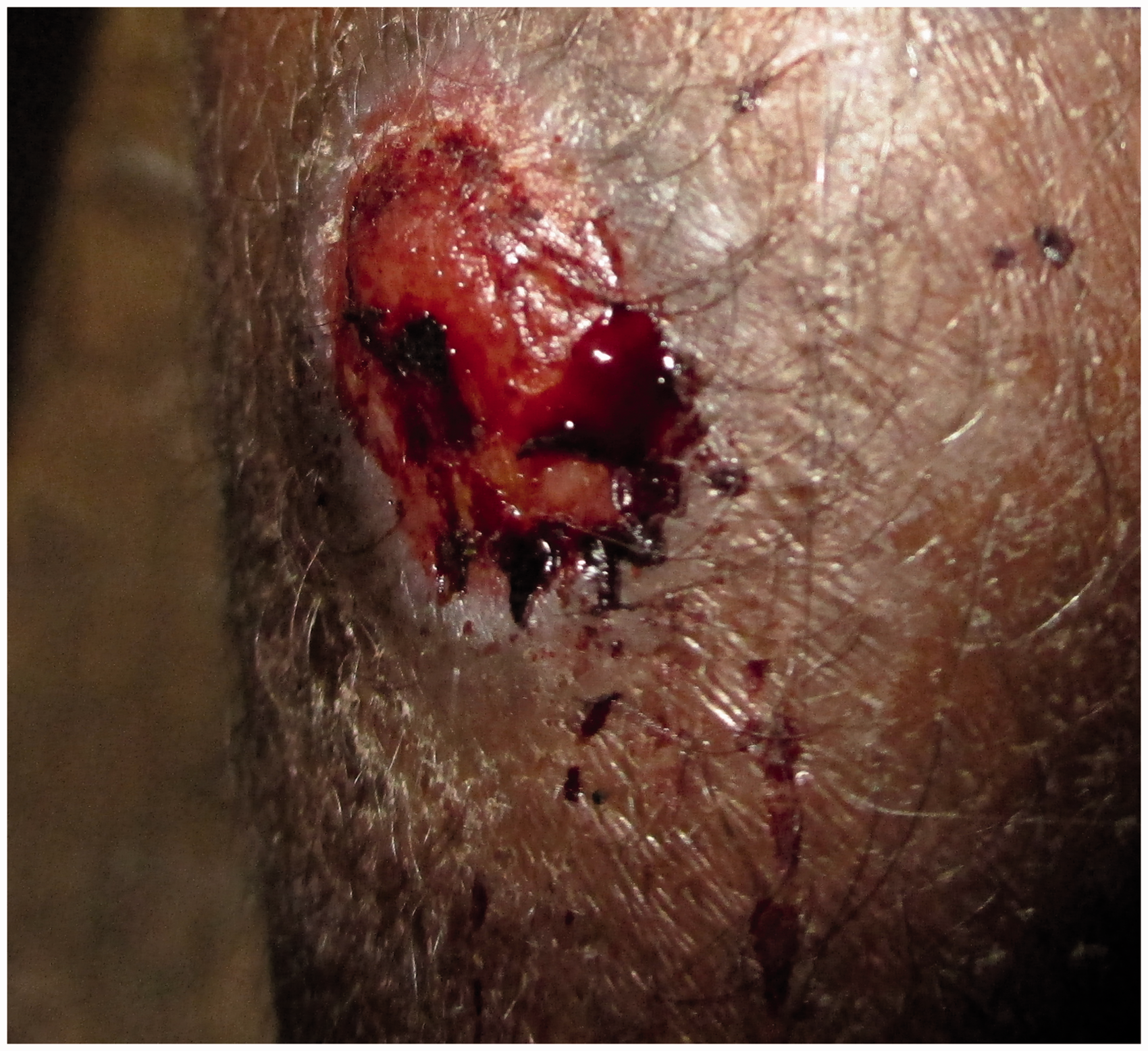
Review of the photographs of ulcers from our school survey showed no significant clinical difference between seropositive and seronegative lesions. In addition, we also compared our photographs of ulcers seen on Tanna Island with those seen during a previous health survey on another island (Paama). Yaws has not previously been reported on Paama but 5% of children surveyed had leg ulcers or papilloma. We again noted no significant clinical difference between the ulcers on Tanna and those on Paama. All children on Paama were TP negative confirming the absence of yaws (Ian Traise, personal communication, December 2012).
Following the MDA with Azithromycin in Tanna the dual seropositivity rate fell to 7.6%, but moist ulcers were not eliminated. Ulcers were still present but in reduced numbers and were less florid. The persistence of some ulcers was to be expected as the majority of ulcers were not caused by yaws. H ducreyi did cause some of these ulcers but the aetiology of the remainder is unknown. The clinical features of these ulcers did not assist with diagnosis. It has been shown that with yaws and H ducreyi ulcers there are some differences, but clinical distinction is unreliable except in classical cases which are uncommon. 6
The prevalence of skin ulcers in Vanuatu varies widely. In remote inland villages in Tanna affected by volcanic dust and with poor access to water, the prevalence is 15%. In coastal villages, for example in Paama with better access to water and no yaws, the prevalence is 5%.
Treponema and non-treponema positive ulcer. Treponema and non-treponema negative ulcer.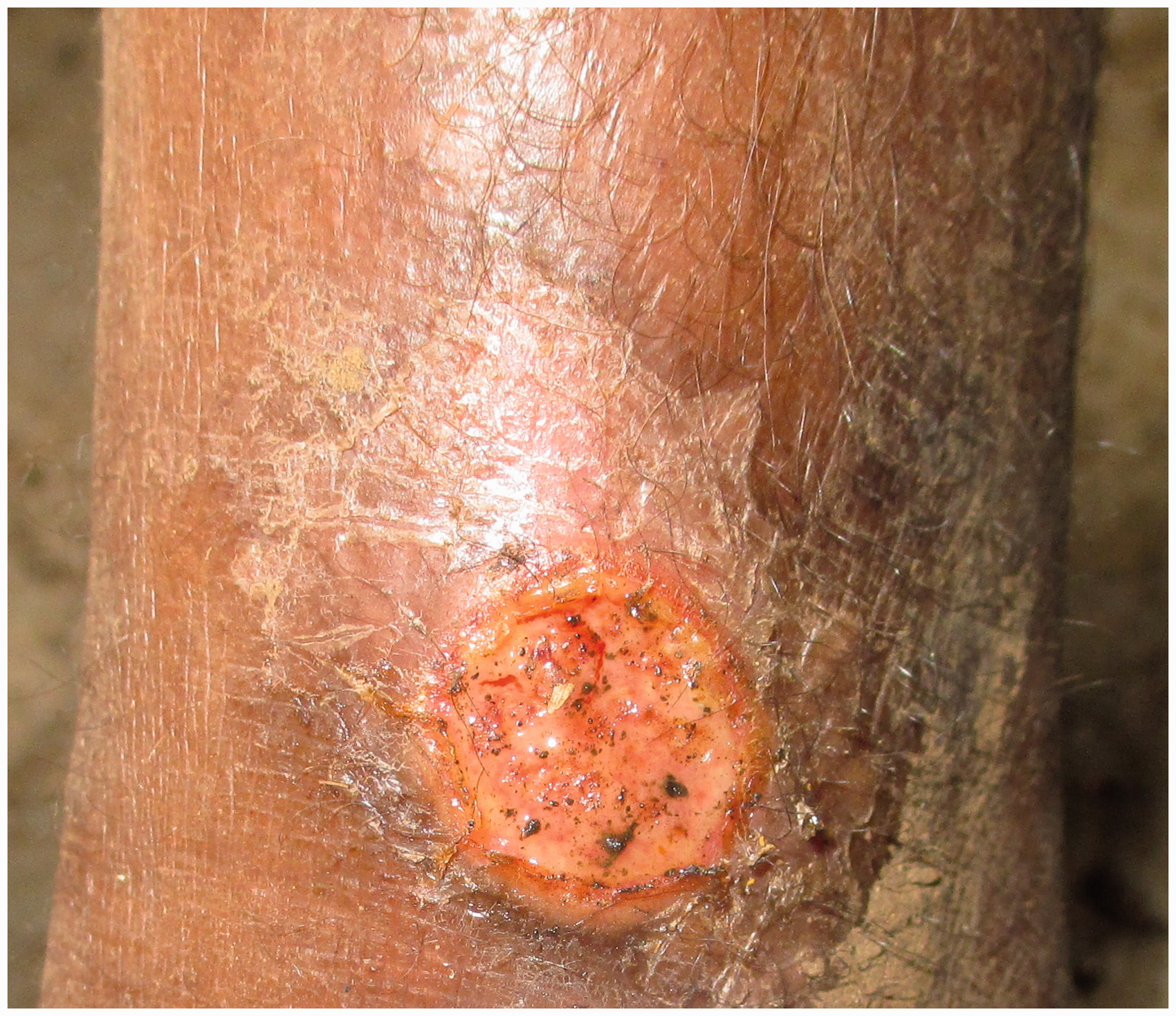
Conclusion
Skin ulcers in children will remain a significant public health problem in tropical developing countries. Oral azithromycin for the treatment of yaws and the use of point-of-care TP and NTP tests to exclude active cases of yaws will greatly assist the yaws elimination program. The majority of leg ulcers even in yaws endemic areas are not caused by yaws and the challenge that remains is to reduce the prevalence of these non-yaws ulcers. These ulcers, although not associated with late destructive bone lesions, are a significant public health problem. The reduction in the prevalence of these ulcers and other skin infections will rely on implementation of basic public health policies that provide better water supply and promote improved hygiene. The appropriate use of antibiotics will also be necessary.
To achieve this goal further research is needed into the aetiology of skin ulcers, their bacterial causes, their drug sensitivity and resistance. The clinical difficulty in the diagnosis of leg ulcers has parallels with the diagnosis of genital ulcers. In treatment of genital ulcers a syndromic approach to their management has been used for many years. In the future when more information on the aetiology of leg ulcers emerges a syndromic approach to their treatment may need to be adopted.
Footnotes
Acknowledgements
The authors would like to acknowledge the staff of the Ministry of Health Vanuatu and the staff of the Centre for Disease Control and Prevention, Atlanta, GA, USA. The findings and conclusions in this report are those of the authors and do not necessarily represent the views of WHO and CDC Atlanta.
Declaration of conflicting interests
None declared.
Funding
This research was funded by the World Health Organization through the Ministry of Health Vanuatu.