







Abstract

Whether or not it affects them personally, everybody in academia is aware of the old adage “publish or perish” (or, if they’re not yet aware of it, they’ll become aware of it soon enough). It’s so well known that it requires no explanation; but that’s not to say that it doesn’t merit any discussion. For those of us who must publish or else perish, publication requirements vary according to the nature of our posts. Some institutions or departments expect higher levels of research output, usually in exchange for lighter teaching loads, while others expect lower levels, usually in exchange for heavier teaching loads. The combined, but variable, demands of teaching and research are presumably considered to be effectively equivalent across the spectrum of higher education. Those of us who may not face immediate consequences for not publishing (e.g., tenured faculty, non-tenure-track faculty, graduate students) are nonetheless interested in conducting, presenting, and publishing research. We hope to be encouraged to do so, and we may even be expected to do so. So, even where “publish or perish” isn’t a rule per se it is still a guiding academic principle that affects us all in one way or another.
Given the central role that research plays in our professional lives, it’s normal that we would be curious about research as an activity, as a process. Here, we look at the number of co-authored articles in a sample of linguistics journals as a means of gauging how much linguistic scholarship is carried out individually and how much of it is conducted collaboratively. Of course, collaborating on research isn’t necessarily the same thing as co-authoring an article, but since we can’t look at all forms of linguistic teamwork, we necessarily have to consider just a sample of it. Our interest in gauging the extent of co-authorship in linguistics, which we take to be an easily observable and quantifiable, if only approximate, measure of collaboration within the field, initially grew out of a policy for tenure-track faculty in the Department of Languages, Literatures, and Linguistics (LLL) at Indiana State University (ISU), which states that no more than one co-authored article, out of a minimum of four publications, will be counted toward promotion and tenure (P&T). In the fall of 2015, both authors joined LLL: Brian as a new tenure-track assistant professor of linguistics and Margherita as a new graduate student in the master’s program in TESL and Linguistics. LLL welcomes a new cohort of MA students every year and also welcomed seven new tenure-track faculty members in the past two years: three linguists to replace retiring colleagues and one professor each in French, German, Latin, and Spanish. Clearly, LLL is in a period of transition. During this period of transition, a number of LLL’s new faculty members, including its three new linguists, expressed surprise and dissatisfaction with the department’s P&T policy summarized above. As a result, Brian thought that it could be worthwhile to collect data that might show that the policy is inconsistent with the current state of linguistic scholarship and should, therefore, be revised. Prior to starting our investigation, the authors expected to find that a large proportion of linguistic research—and possibly an increasing amount of it—was co-authored (i.e., collaborative) work. While this is important to us, personally, for the reasons mentioned above, knowing about current publishing trends should be of more general interest to linguists and, especially, to early-career scholars.
Primarily for methodological simplicity, but also connected to our own motivation for looking into this question at this particular time, we decided to limit our data collection to articles published in peer-reviewed journals, to the exclusion of several other types of research output (e.g., conference meeting programs, conference proceedings volumes, other edited collections). We selected a dozen linguistics journals among numerous others that we could have chosen. Our selections include American Speech, English Language & Linguistics, Journal of English Linguistics, Journal of Phonetics, Journal of Sociolinguistics, Language, Language in Society, Language Variation & Change, Linguistic Inquiry, Natural Language & Linguistic Theory, Phonology, and Studies in Second Language Acquisition. We looked at the table of contents for the second issue of each of these twelve journals in each of the following eight years, spanning approximately the last twenty-five years, with intentionally heavier sampling for recent years: 1990, 1995, 2000, 2005, 2010, 2012, 2014, 2016. We noted how many articles were in each issue and how many of them were written by more than one author. We attempted to limit our data collection to full research articles and only those that occurred in print, to the exclusion of online-only content (e.g., in Language). The exclusion of online-only content is not a reflection of how we feel or how we think the field feels about online content; rather, we were simply striving for consistency in our sampling procedures. We omitted volume 23 (1995) of the Journal of Phonetics and volume 23 (1990-1995) of the Journal of English Linguistics from the sample: the relevant issue of Journal of Phonetics 23 is a double issue with an unusually large number of articles, almost all of which are co-authored (18/19), and Journal of English Linguistics volume 23 is another double issue that represents a full six years of the journal. Finally, there are no data from English Language and Linguistics or the Journal of Sociolinguistics for 1990 or 1995, as both of these journals were first published in 1997; nor are there any data from Phonology for 2016, as volume 33.2 was not available by the time we finished collecting the data for this column. 1
We found that, overall, 173 of the 413 linguistics articles in our sample (42 percent) were co-authored pieces. As shown in Figure 1, the highest rates of co-authorship are found in Linguistic Inquiry, Language Variation and Change, and Journal of Phonetics: each in excess of 50 percent over the full duration of these roughly twenty-five years. The lowest rates are found in Journal of Sociolinguistics, Language in Society, and American Speech: each below 30 percent over this whole period. Furthermore, and perhaps most interestingly, for all twelve of these journals combined, there has been a discernable increase in the rate of co-authorship in our sample during the past two and a half decades, as can be seen in Figure 2: up from approximately one-quarter (12/43 = 28 percent) in 1990 to approximately one-half (30/58 = 52 percent) in 2016. The slope of the linear model that has been fitted to the data (1.05) indicates an increase in the rate of co-authorship of approximately 1 percent per year during the period covered by the data; the r-squared value (0.88) indicates a reasonably good fit of the linear model to the observed data. 2
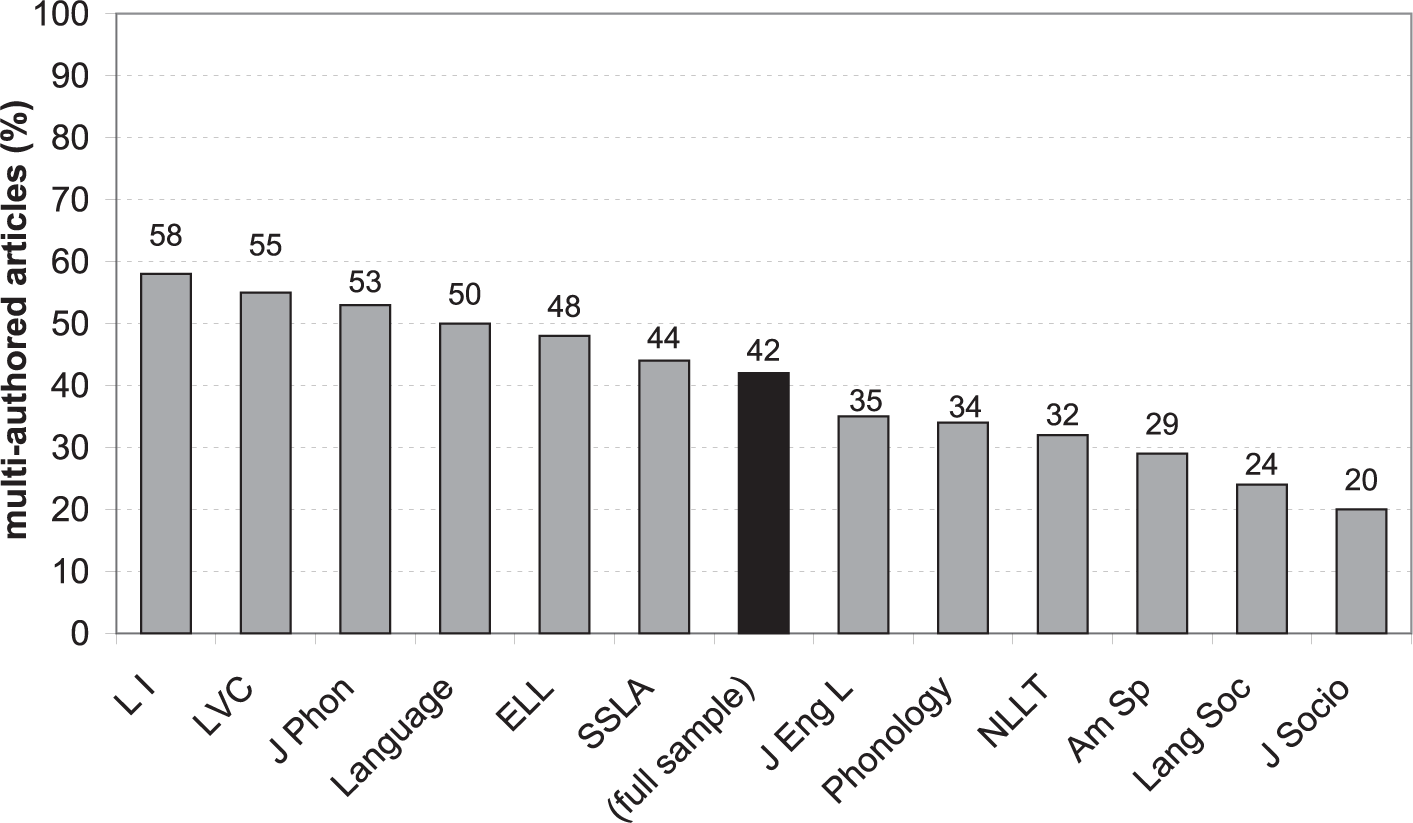
Co-Authorship by Journal
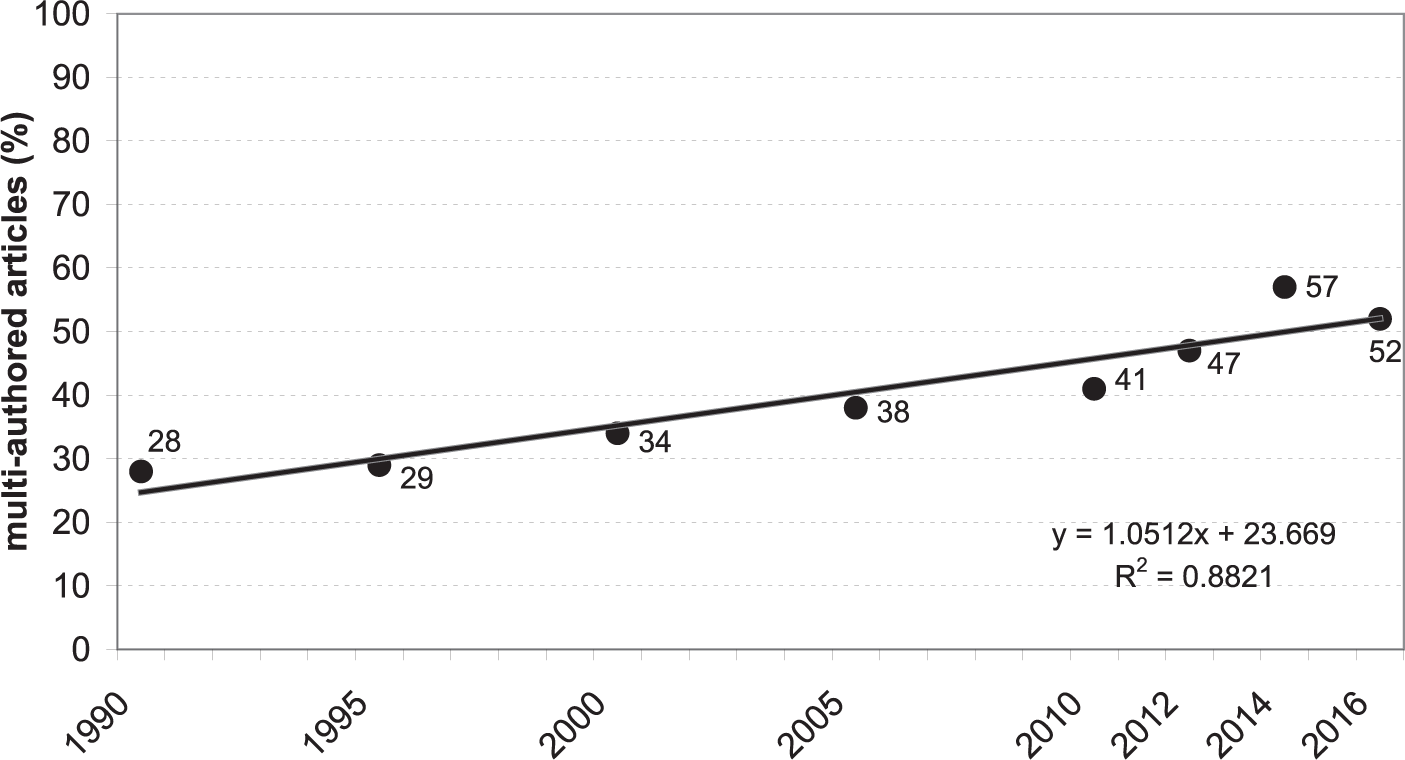
Co-Authorship by Year of Publication
Although we are unable to say why co-authorship is increasing—assuming that the trend that we’ve observed in our data is, indeed, representative of the field more generally—we can offer some thoughts about what this increase means to us. Most obviously, it suggests that the field is more receptive to collaboration (or, at the very least, to publishing collaborative research) than it was just twenty to thirty years ago. This could reflect a genuine openness of spirit, or it could merely be due to researchers having become more successful at overcoming obstacles to collaboration. 3 In the latter scenario, if linguists have always put great value on collaboration but, for whatever reason(s), weren’t as successful at it as we are now, then we should rejoice in the fact that we are finally able to engage in the types of research relationships that we have long desired. In the former scenario, if linguists see value in collaboration that we didn’t see before, then we should embrace those partnerships for all that they are now believed to be worth. 4
Perhaps the greatest benefit to young scholars, particularly when working with a more seasoned researcher—whether it be a student working with a faculty member, a postdoc working with a supervising professor, or a junior professor working with a more senior colleague—is the mentorship that they receive. For undergraduate and master’s students, who often have limited, if any, research experience, effective mentorship can serve as a slingshot that helps propel them into the next stage of their education. For PhD students and postdocs, it can be instrumental in helping to get them shortlisted for job vacancies. Even for those students who do not plan on continuing their education or are not able to pursue a career in academia, participating in collaborative research projects can help to develop and nurture valuable job skills. The ability to work effectively with others and to function as part of a team are highly sought-after skills both within and outside of academia. In this sense, research collaboration constitutes a form of experiential learning: a very popular concept in educational settings these days. For early-career researchers, the experience of working with colleagues, particularly but not necessarily more experienced senior colleagues, could give them a boost in advancing from assistant to associate professor or from lecturer to senior lecturer.
A further benefit is that participating in research collaborations increases our research productivity and, consequently, enhances our visibility and our reputation, regardless of whether we are at the stage of our careers where we are seeking to make a name for ourselves or to maintain a good name that we have already worked hard to establish. In some cases, such as the current period of transition that we are experiencing in LLL at ISU, reestablishing the visibility and the reputation of (especially) our MA program as a whole, via each of its core faculty members, will plausibly be key to the long-term success of our program. It is in our best interest that prospective students see our program as one where we are doing interesting things, where they will have the opportunity to do engaging and challenging work either in collaboration with us or with our support and encouragement, and where they will be able to succeed both in our program and in whatever they choose to do after they finish it. Achieving these goals can be facilitated by embracing the culture of research collaboration that increasingly exists within the field.
For individuals with essentially no publishing experience, working with an experienced co-author can help to render the sometimes daunting process more manageable. Having relevant knowledge of style sheets, the peer-review process, acceptance rates, publication timelines, and the like can make the entire process less mysterious and stressful. Another advantage of working with others is that your co-authors may be able to anticipate some of the reviewers’ criticism even before you submit the manuscript to your targeted journal (although co-authorship per se isn’t necessarily the only way to achieve this).
There are also things to be cautious about when engaging in collaborative research. We don’t attempt to, nor could we, cover all of the pros and cons of co-authorship here. Nonetheless, we would be remiss if we didn’t mention a few issues that can arise with co-authorship. For instance, in spite of the many potential benefits to be gained from working with others, it would be prudent to exercise due caution in seeking out research partnerships. Each author of the paper bears ethical (and, possibly, legal) responsibility for its contents. If any one member of the team doesn’t fulfill their responsibilities adequately, then every member of the team could be held accountable for their lapses. Therefore, it’s important to know and to trust those you’re getting involved with. Most often, however, this probably shouldn’t be a major source of concern, as we believe most academics are trustworthy.
When the research team is in place, deciding who gets co-author status and who merely gets thanked for their contributions in the acknowledgments can sometimes be a delicate or contentious matter. Are data collection and/or data coding sufficient contributions to justify co-authorship? In our opinion, the answer is probably yes, but each research team has to work out its own criteria for determining what merits authorship. Perhaps a reasonable point of departure for discussing this would be an assessment of who contributed to the analysis of the data, after which the question of whether other contributing roles are also deserving of authorship could be considered. A related point with a similar solution (i.e., each research team ultimately has to sort this out for themselves) is whose name will be listed first, second, third, and so on.
An additional challenge that we’ve encountered is learning how to provide constructive critical feedback in a way that respects, yet transcends, the social relationship between or among the co-authors, particularly when there is a power difference between them. For example, when a student is working on an article with a professor, it might be difficult for the student to give critical feedback to the professor because of their unequal status outside of the collaboration. In this case, it would be appropriate for the professor to reassure the student that both parties need to be able to give and receive criticism in order to successfully write the article. Similarly, in student-professor research teams, there is a risk of falling into a pattern of “professor-know-it-all” and “uninformed-student,” which could be discouraging for the student. Any discouragement might be mitigated, however, if feedback is framed not as criticism but as an opportunity to grow and improve. After all, anonymous reviewers aren’t necessarily going to be concerned with whether their comments might ruffle our feathers. Ideally, collaboration should be approached as a partnership of equal contributing participants even when a status difference exists in the relationship.
In conclusion, we’ve seen that co-authorship has increased in our sample of linguistics articles published over the last few decades. This increase suggests that there is a growing interest in collaborating with other individuals in the field. Just as in any other endeavor, there are positive and negative aspects of co-authorship. In this column, we’ve discussed some of each, and as a final recommendation we want to encourage researchers of all stripes—students, new professors, and experienced professors alike—to embrace co-authorship and to collaborate with each other as the benefits and rewards can be numerous. The chance to work with colleagues on a topic of common interest may not occur every day, so diving into co-authorship is an opportunity not to be missed. Finally, if, in pursuit of this goal, you happen to be faced with obstacles that impede or discourage collaboration, whatever they may be, then strive to eliminate or, at least, minimize those restrictions.
Footnotes
Acknowledgements
We are grateful to our colleague Melanie D’Amico and to the editors and staff of JEngL—Matt Gordon, Peter Grund, and Corinna Cook—for commenting on earlier drafts of this article and offering helpful suggestions for its improvement. The authors alone bear full responsibility for any and all errors and/or shortcomings that remain.
Declaration of Conflicting Interests
The author(s) declared no potential conflicts of interest with respect to the research, authorship, and/or publication of this article.
Funding
The author(s) disclosed receipt of the following financial support for the research, authorship, and/or publication of this article: This article was largely researched and written by the two authors while the second author was supported by a summer graduate research assistantship from the LLL department at ISU.