






Abstract
This study examines the use, evolution, and pragmatic functions of bloody in British teen talk from the 1990s to 2016. Drawing on spoken data from four corpora representing different time periods, the findings reveal a marked decline in the use of bloody among teenagers, greater than that observed among older speakers during the same span. Rather than reflecting language innovation, this is interpreted as a generational change. Two main factors may account for this trend: (i) the rise of fuck, whose extreme multifunctionality has taken over many of the roles of bloody, and (ii) the weakening of bloody’s status as a strong swear word for both teens and adults. Syntactically, bloody is now more often used as a noun intensifier than as an intensifier of adjectives, adverbs, or verbs. Pragmatically, beyond expressing frustration, anger, and irritation, bloody in teen talk is also adopting new pragmatic functions such as conveying surprise, disbelief, and humor.
1. Introduction
Swearing has received a great deal of attention in recent decades, not only in English but in many other languages (Pinker 2007; Jay & Janschewitz 2008; Dewaele 2010; Ljung 2011; Stapleton, Beers Fägersten, Stephens & Loveday 2022). This is due to its status as a broad and productive area of language; it is closely tied to culture and social change (Tagliamonte 2019), directly connected to speakers’ emotions (Dewaele 2004, 2006, 2010) and is responsible for triggering a number of effects and attitudes within individuals (Pinker 2007; Stapleton 2020). Moreover, it is a topic with which the wider population is very often engaged, as illustrated by headlines and articles in the mainstream press: “Britain’s most-popular swear word revealed–and it’s no longer ‘bloody.’ A recent study has revealed what the United Kingdom’s most commonly used swear word is over a 20-year period” (The Daily Star 2021); “Swear words in different languages have one thing in common” (CNN 2022); “WTF? Americans and Britons swear more than Australians online, research finds” (The Guardian 2025). Despite all this, few studies have focused on the evolution of swearing practices, that is, how swearing has developed over time with special attention to language of teenagers.
The current paper forms part of a wider research project on the evolution of swearing in British teen talk from the 1990s to 2016, covering a period of approximately twenty-five years. More specifically, it examines the development of bloody, including its main uses and pragmatic functions. The analysis is based on British teenagers’ spoken data, extracted from several corpora, each representing a specific time period; additional information has also been drawn from general reference and slang dictionaries.
The taboo word bloody has traditionally been regarded as a distinctly British term, although recent studies (Drummond 2020; Love 2021) have highlighted its general decline in use across English. One of the hypotheses we aim to test in what follows is whether this term has also fallen out of use in teen talk or, conversely, if it continues to occupy a central role in their swearing practices. We will also explore the factors that may account for any decline observed here. Furthermore, we will examine whether this pattern of decline reflects a generational change (Labov 1972) or, alternatively, current patterns of bloody constitute an innovative feature introduced by teenagers, as these speakers often function as agents of linguistic innovation and change (Eckert 2000; Stenström, Andersen & Hasund 2002; Tagliamonte 2016; Cheshire, Adams & Hall 2024).
In that we are dealing with the phenomenon of swearing, it needs to be clarified that we have opted for a traditional definition of the notion. Thus, we take it to involve (i) a reference to something that may be regarded as taboo, (ii) an expression of strong emotions or attitudes (emotive language), and (iii) something which is intended, or has potential, to cause offense (Stapleton, Beers Fägersten, Stephens & Loveday 2022:1). Also, the three previous conditions may not necessarily be present in all cases, since the expression and meaning conveyed by swear words is often context and speaker-dependent (Jay & Janschewitz 2008).
For the present purposes, only non-literal uses of the term will be considered. In its literal sense, as in His finger was bloody, the term bloody refers to the presence of blood, that is, the finger is described as being covered or stained with blood. While this may be considered unpleasant or indeed disgusting, it is not generally viewed as taboo or offensive. As we shall see later, some associations have been drawn with God’s and Virgin’s Mary blood, “By our lady!,” and also with menstruation. In the nineteenth century bloody was directly connected with the working-class people to the extent that its blasphemous content was reinforced by this social class association (Hughes 1991).
The paper will be organized as follows. Section 2 will provide a brief account of research on swearing, with special attention to the phenomenon in teen talk and the role of age. Section 3 will then review the limited literature on bloody with reference to the attitudes aroused by this term in general British speakers today. Section 4 goes on to outline the objectives and hypotheses, while Section 5 describes the methodology. This is followed by the results section, which presents frequency data on bloody in comparison to other swear terms, with special attention to fuck. The aim here is to provide a more comprehensive view of the issue and to explore the extent to which fuck may be taking over functions traditionally associated with bloody. This section will also address the issue of the grammatical roles and pragmatics of this taboo word. Finally, Section 7 will summarize the main conclusions and offer suggestions for further research.
2. Research on Swearing: Brief Account
The literature on swearing is far too extensive for an exhaustive account, and in what follows only a brief review of available research is provided.
Work on swearing has addressed a wide range of dimensions. Andersson and Trudgill (1990), and McEnery (2006) have focused on patterns of use, while others, such as Millwood-Hargrave (2000) and Jay (2009), have examined speakers’ attitudes toward swearing. In parallel, several studies have explored its psychological and social effects on individuals (Dewaele 2017; Jay 1992, 2000; O’Driscoll 2020; Stapleton 2020; Stapleton, Beers Fägersten, Stephens & Loveday 2022).
The pragmatics of swearing in discourse has also attracted considerable scholarly attention, with contributions from Wajnryb (2004), Pinker (2007), Jay and Janschewitz (2008), Beers Fägersten and Stapleton (2017), Cavazza and Guidetti (2014), Allan (2023), and McEnery, Brookes, Hanks, Gerigk, and Egbert (2023), among others. These studies often consider the various factors that condition swearing, including age, gender, the type of interlocutor, and the situational context (see Jay & Janschewitz 2008).
A cross-linguistic perspective has been adopted by several authors, including Dewaele (2006, 2010, 2017), Ljung (2011), Stapleton, Beers Fägersten, Stephens, and Loveday (2022), and Stenström (2006, 2017). Notably, Stenström has compared swearing practices among Spanish and British teenagers.
Finally, changes in swearing over time have become a major focus of research (Hughes 1991; Mohr 2013; Drummond 2020; Love 2021; Love & Stenström 2023). Mohr (2013), for example, traces the history, function, and evolution of the phenomenon in English, and devotes the final section of her book to shifts in public attitudes toward its use.
In some cases, very large corpora drawn from social media have been used to investigate swearing, for example in the case of English and Nordic languages (Bamman, Eisenstein & Schnoebelen 2014; Wang, Chen, Taghavi & Sheth 2014; Coats 2021).
Drummond (2020), using an ethnographical approach based on individual and group interviews, focuses on the evolution of swearing in teen talk by comparing his sample materials, collected in 2015, to data from the spoken part of the BNC2014. Some swear words, such as fuck, shit, and piss, were found to be far more common in his own materials than in previous data, whereas bloody is notably less frequent. However, he also highlights the importance of understanding the nuanced roles that swearing plays in the communicative practices of marginalized youth, where it contributes to enhancing group solidarity and establishing rapport among peers and friends.
The study by Love (2021) is particularly relevant here, in that it examines the evolution of swearing in British English casual conversation from the 1990s to the 2010s. Love shows that there has been a significant decline in swearing over the past few decades, with a reduction of almost 28 percent. It seems that several reasons may account for this decline. First, he notes that swearing peaks when individuals are in their twenties, and decreases thereafter. However, such a decline was less pronounced in the 2010s, suggesting that people are more apt to continue swearing later in life than they were in the 1990s. Secondly, he finds that men swear more than women, but that this gender gap has narrowed over time, possibly due to changing norms and attitudes toward gender and language use. Additionally, while bloody was the most popular swear word in the 1990s, by the 2010s fuck had become more prevalent, clearly surpassing bloody.
Love and Stenström (2023) focus specifically on fuck and its variants, demonstrating how this taboo term has undergone a grammaticalization process, losing part of its original meaning and offensive force. Fuck has indeed received the most attention of all items in the swearing repertoire (Sheidlower 1995; McEnery & Xiao 2004; Aijmer 2018; Love & Stenström 2023), especially in comparison to bloody. However, other taboo terms, such as bitch (Vinter 2017; Siikavaara 2020) and cunt (Dewaele 2018; Siikavaara 2020), have also been the subject of monographic investigations.
Swearing practices in the adolescent and teenage group has been discussed extensively in a number of studies (McEnery & Xiao 2004; McEnery 2006:44; Beers Fägersten 2012; Stenström 2017; Schweinberger 2018; Love 2021), all of them dealing with English, in that “teenagers are notorious for their frequent use of slang, seemingly ‘unnecessary’ fillers and discourse markers . . ., and not least swearwords . . .” (Stenström 2017:157). Teenagers very often swear as a way to reinforce their identity, rebel against adult norms and conventions, and strengthen group affinity. Most scholars agree that the frequency and perceived intensity of swearing tend to decrease with age, particularly as individuals enter the labor market and begin raising their own children (Holmes 1992; McEnery 2006; Jay 2009). Stenström (1995:78-79) has also shown how teenagers differ not only in the frequency and purposes of their swearing but also in the use of different swear words as teens favor strong taboo words (i.e., fucking, shit), whereas adults lean more toward weak religious taboos (i.e., God, blimey, crikey).
3. Previous Research on
Bloody
: Function, Origins, and Attitudes
The literature on this swear word is, as noted above, quite restricted, especially compared to work on swearing in general and on other swear terms. Biscetti has perhaps devoted most attention to this taboo word, with the publication of two studies (2004, 2008). In the former, she provides a detailed synchronic analysis of the behavior of bloody as an intensifier in specific contexts, arguing that it does not follow the pattern of so-called traditional intensifiers and, for this reason, might better be considered as a “pragmatic focus marker,” one which does not intensify a single word but modifies the illocutionary force of the whole utterance in which it occurs. She also explores some of the meanings that the term can convey, including emotion, aggression, and sarcasm.
Biscetti’s 2008 study investigates the same word diachronically from its first attestation as a simple intensifier in 1676 (bloody drunk) to the new role as an expletive and taboo word that it had developed by 1750. She questions the traditional and widely accepted explanation given by the OED, in which it was said to be a euphemistic alteration of ‘byrLady.’ In her view, the collocation bloody drunk should be considered as the real origin of this intensifier function of bloody with a taboo character. In addition, she also claims that the taboo meaning of this word could be linked to the transubstantiation of the blood of Christ.
The history of this term has indeed been the subject of opposing and controversial proposals. The OED, in a recent updated version, contributes to the debate by suggesting that bloody originates from the expression bloody whore, which refers to the Whore of Babylon and explicitly alludes to literal bloodshed; Rawson (1981), however, in his dictionary of euphemisms, suggests that the term probably derives from plain ordinary blood rather than from “By Our Lady” or “God’s Blood.”
Leaving the question of origins aside, Biber, Johansson, Leech, Conrad & Finegan (1999:564) report that bloody is more common overall in informal speech than in writing, and in British English than in in American English, where its existence is merely anecdotal. However, Wierzbicka (2002) claims that bloody is ‘the great Australian adjective,’ full of meaning in this variety of English, and is linked to traditional attitudes and values of Australian society. In turn, O’Keefe and Mark (2021:98) find that bloody is quite rare in Irish English since it occurred twelve times more frequently in the British sample than in the Irish one.
It is also interesting, and relevant for our study, to consider speakers’ perceptions of the word, in that it may be the case that it is no longer regarded as a strong swear or offensive term but rather as a mild one, especially as compared to fuck. Green’s Dictionary of Slang notes that the term was once considered a “horrid word” but that this perception has changed over time. Partridge (1937) expresses a similar view, noting that bloody was once considered one of the strongest swear words among polite speakers, but that ‘taboo-wise, its place has been taken by the synonymous fucking.’
Various surveys on speaker attitudes toward swear words confirm such a trend. Table 1 presents the results of a survey 1 conducted in 2021 by the media regulatory body Ofcom on viewers’ perceptions of swear words on television. The survey categorizes such terms into three groups, ranging from mild to strong. Bloody is classified in the mild group, alongside other taboo words such as chav, bugger, cow, and bitch. The moderate group, which contains words with a somewhat greater potential for offense, includes bastard, dickhead, and shit. Finally, the highly offensive group includes terms such as fuck and motherfucker.
Results of a Survey Conducted by Ofcom on Viewers’ Perceptions of Swear Words on Television
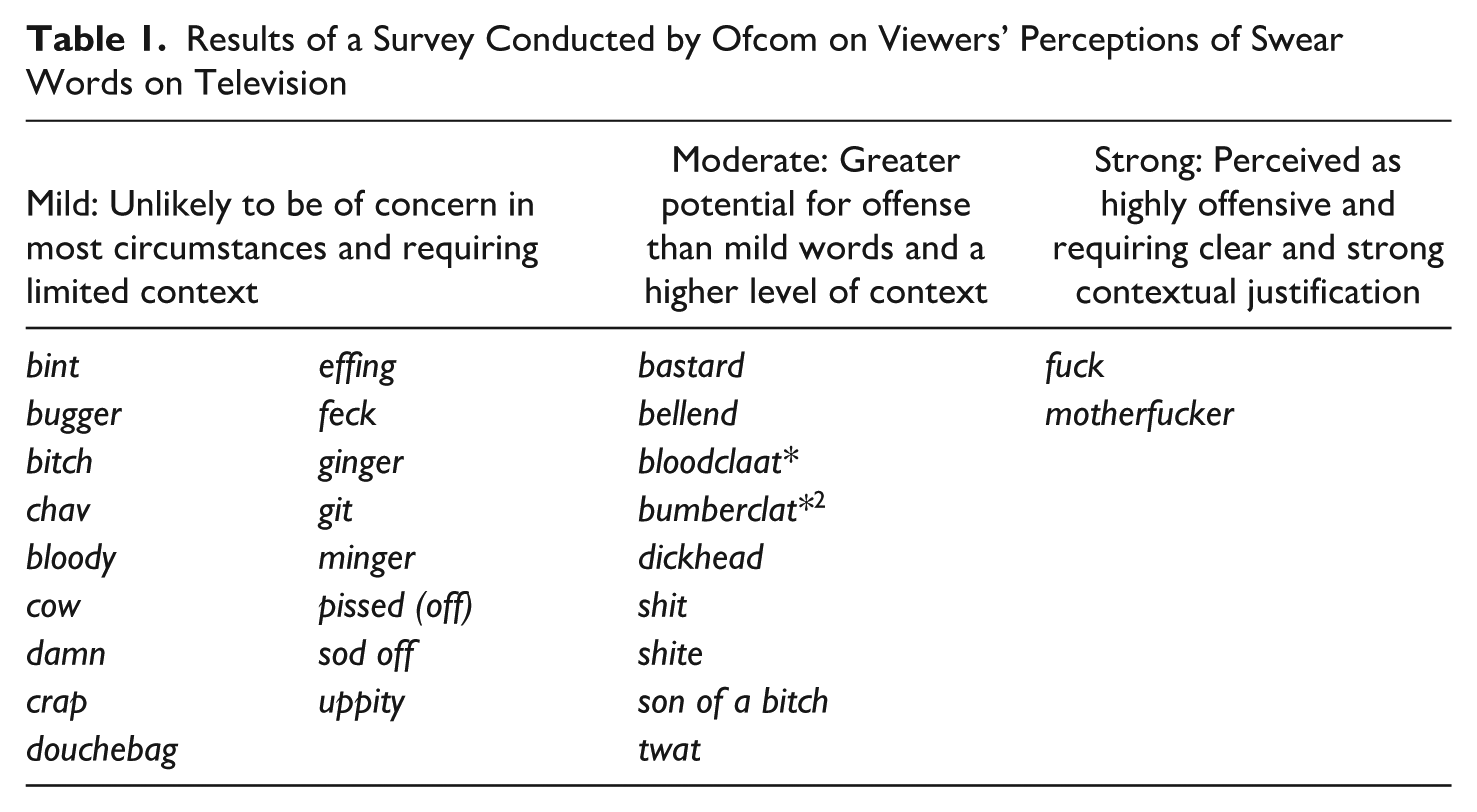
The results of this survey regarding bloody are also reflected in posts from several forums on the Reddit and Quora social media networks (February 2024 and February 2019, respectively), in which participants discuss the attitudes of British speakers toward this word. 3 All the contributees here affirm that the term is no longer considered rude or profane and is even regarded as ‘benign.’ Furthermore, it is possible that these attitudes may correlate with production. That is, this swear word may have lost its strong taboo and offensive original meaning.
4. Objectives and Research Hypotheses
The main aim of this paper, as noted above, is to examine whether the decline in the use of bloody as an intensifier and expletive, already observed in general British English (Love 2021), is also reflected in the language of teenagers. Thus, the main hypothesis of the study could be stated as follows: “Teenagers will show a greater decrease in the use of bloody over time and this decline will be more pronounced among them than among other age groups.”
We also aim to explore the potential causes behind any decline noted here. Three possible explanations are considered: (i) lexical competition from other swear words, such as shit and fuck (Love 2021; Love & Stenström 2023); (ii) semantic bleaching, whereby bloody is increasingly perceived by general speakers as mild and no longer taboo, as discussed in Section 3; and (iii) the influence of American English over English in general (Leech, Hundt, Mair & Smith 2009; Gonçalves, Loureiro-Porto, Ramasco & Sánchez 2018), which features scant use of bloody and favors fuck(ing) instead, in line with the first explanation.
Additionally, given that adolescents are frequently described as agents of linguistic innovation and change (Eckert 2000; Stenström, Andersen & Hasund 2002; Tagliamonte 2016), we also investigate whether current usage patterns of bloody represent a new trend initiated by teenagers or a generational change (Labov 1972). Finally, the study examines changes in the use of bloody over time by considering its grammatical roles and pragmatic functions. While bloody is often used to express anger, frustration, or exasperation, and is typically associated with negative affect (Biscetti 2004; McEnery 2006), we also explore whether it serves further functions in contemporary teen discourse.
5. Method
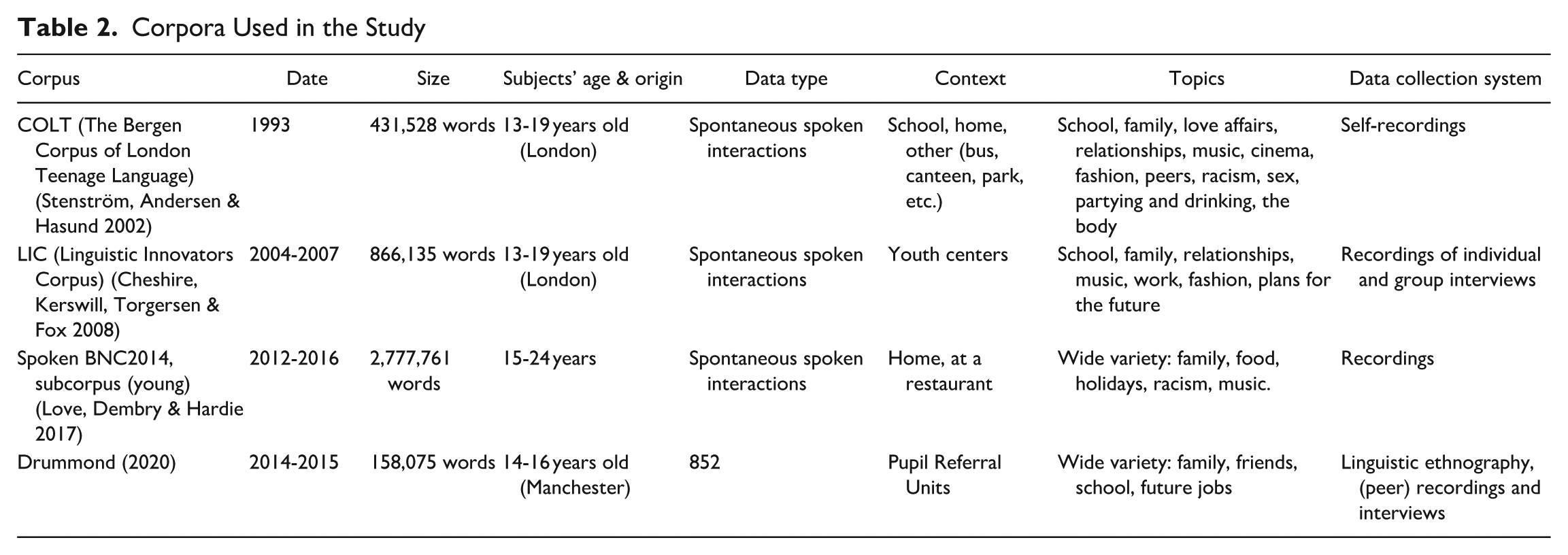
This is largely a corpus-based study. Table 1 provides detailed information on the four main corpora which served as reference sources: the Bergen Corpus of London Teenage Language (COLT), 1993, the Linguistic Innovators Corpus (LIC), compiled between 2004 and 2007, a subsample of the Spoken British National Corpus 2014 restricted to the data produced by speakers belonging to the 15-24 age group, and Drummond’s dataset (2020). These can be regarded as comparable corpora, in that they all consist of spontaneous spoken data, mainly conversations, and the samples analyzed were restricted to young speakers from the London area, except for Drummond, whose informants are from the Manchester region, and the subset of Spoken BNC2014, which includes speakers from other parts of Britain in addition to London. However, this variation in the origins of speakers across England should not have a great impact on the results obtained since there is little evidence in current corpora or existing literature to suggest that bloody is regionally restricted in contemporary British English. Kerswill (2013) and Drummond (2024) have shown how adolescent speech in urban centers across England tends to exhibit considerable uniformity, with little micro-regional variation. Furthermore, the nature of the data and the profile of the speakers are quite similar, and Drummond (2020) drew insightful comparisons between his data and those derived from Spoken BNC2014.
Individual and group interviews were used for data collection in the case of LIC and Drummond, whereas in Spoken BNC2014 the conversations were recorded with the participants’ consent, and in COLT they were self-recorded. The interview format in LIC and Drummond is informal and highly conversational, avoiding a strict question-answer structure. These interactions closely resemble natural conversation in which the speakers actively engage in lively chats, including a high number of interruptions, overlaps, exclamations, hesitations, and reformulations.
Most of the speakers range in age from thirteen to nineteen years, except for Spoken BNC2014, in which this range expands from fifteen to twenty-four, due to the way the data are organized. The recordings were all conducted in similar contexts (school, home, restaurants, canteens, parks, youth clubs, etc.) and the topics of discussion also coincide, covering a wide array of issues common to teen talk, such as family relationships, work, plans, music, food, holidays, school, etc.
The four corpora differ considerably in size, with Drummond’s the smallest at 158,075 words and BNC2014 subcorpus the largest at 2,800,000. Thus, normalized frequencies per 10,000 words were calculated in each case. The corpora also represent different time periods, from the 1990s (COLT) to 2015 (BNC2014 and Drummond), with LIC occupying a mid-point, covering the period from 2004 to 2007. It should also be pointed out that whereas Drummond’s study was published in 2020, the data collection itself was conducted five years earlier. Apart from its relatively small size compared to the other three corpora, this dataset also differs in terms of its compilation method, which is based on an ethnographic study, and in its focus on a small group of informants within a specific context, namely Pupil Referral Units.
Despite the great similarities of these four corpora, differences in terms of the origins of some speakers, age range, and the way that data were collected, should be borne in mind. The results, then, will be interpreted with care, without making absolute or definitive claims.
In addition to these corpora, we also used as a starting-point BNC1994 and BNC2014, analyzing only spoken data; the main aim was to obtain an overview of the research issue in question and see up to what extent there was a general decline in the use of bloody and how the frequency of this swear word varied according to different age groups. The information gathered at this stage laid the foundation for the subsequent analysis. Apart from this, we also investigated the position of bloody with respect to other swear words and, most particularly, with fucking, as the latter stands out as the most frequent across all age groups of speakers (Table 2).
Corpora Used in the Study
Searches were conducted to retrieve all cases of bloody attested in the four corpora. These included cases of bloody as an adjective or adverb, and bloody as an expletive, in this case followed at times by hell/shit/cow or by euphemistic variants of hell such as heck or hey. The data were retrieved automatically and, in a second phase, filtered manually and coded. Each token was assigned to a single grammatical function as an intensifier of nouns (bloody tea party), adjectives (bloody clever), verbs (don’t bloody know), or adverbs (bloody well), or as an expletive 4 (bloody hell!) (see Section 6.3). Unclear or false negatives were excluded from the analysis, in that they represented literal uses of bloody in the sense of “covered with blood” (1), or instances of repetition, which are common in speech (2). These exclusions were minimal, amounting to only 12 tokens out of a total of 683 (1.8 percent).
(1) It was like (2) It was
6. Results
6.1. Preliminary Findings
As just mentioned, our first step was to consult the British National Corpus in order to carry out an overall comparison of British English usage from 1994 and 2014, considering only spoken data. This was done to obtain a general, preliminary picture of the phenomenon under investigation. The results reveal a marked decline in the use of bloody: while in the spoken component of BNC1994 (10.4 million words) the normalized frequency per 10,000 words was 7.40 (1999 tokens), in spoken BNC2014 (11.2 million words) it had fallen to 1.33 (682 tokens), representing a decrease of about 82 percent over the course of two decades.
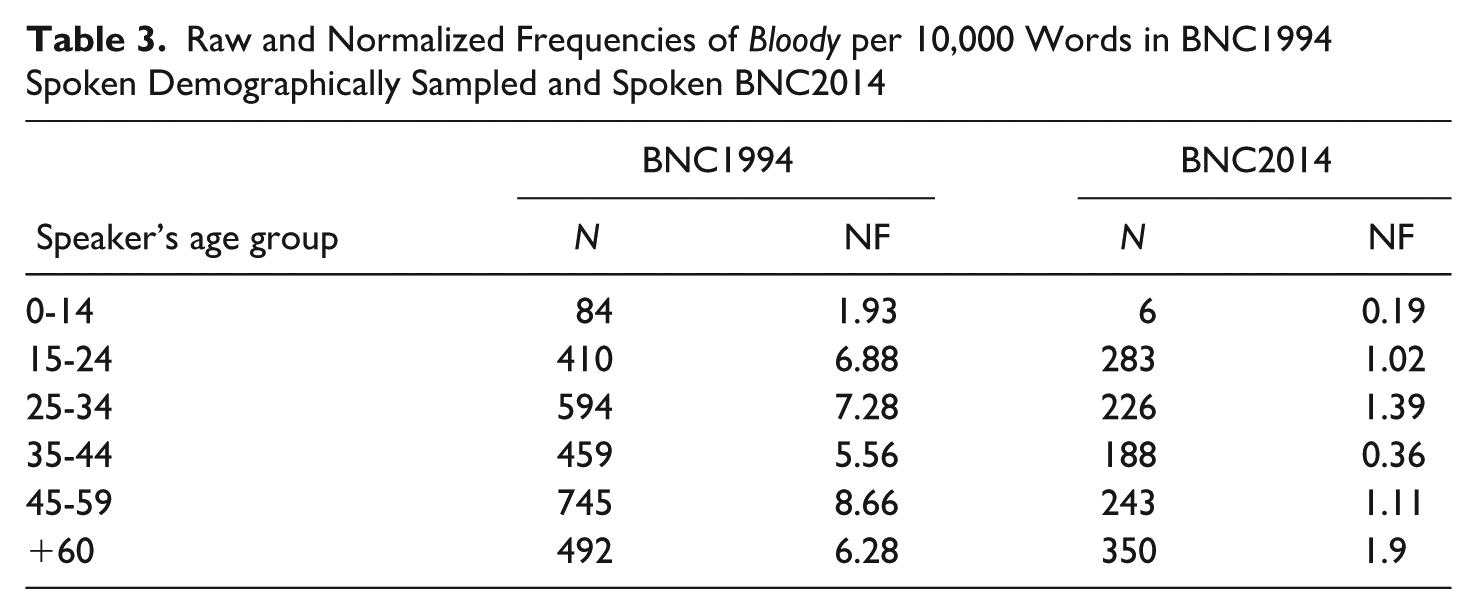
A closer look at the data, considering specifically the role of age (Table 3), confirms that the decline in usage spans all speaker age groups. In the spoken subcorpus of BNC1994, the highest normalized frequency occurred in the forty-five to fifty-nine age group (866.545), while in Spoken BNC2014 it is the 60+ age group (189.643) that shows the highest frequency. This suggests a generational shift: speakers who were most likely to use bloody in the 1990s have continued to use it into old age, while younger generations have not adopted it to the same extent. Moreover, bloody is used almost exclusively by speakers over the age of twenty-four in 2014, with very low frequencies among children and teenagers. While bloody is more frequently used almost by speakers over twenty-four in both 1994 and 2014, the increase with age is not wholly gradual. The most marked difference occurs between the forty-five and fifty-nine in 1994, while in 2014 speakers over sixty are the most frequent users, something which seems to be logical since these speakers form part of the same age cohort, that is, people who were in the forty-five to fifty-nine age bracket in 1994 would be in the over sixty bracket in 2014.
Raw and Normalized Frequencies of Bloody per 10,000 Words in BNC1994 Spoken Demographically Sampled and Spoken BNC2014
6.2. Frequency and Evolution of Bloody from Youth Corpora
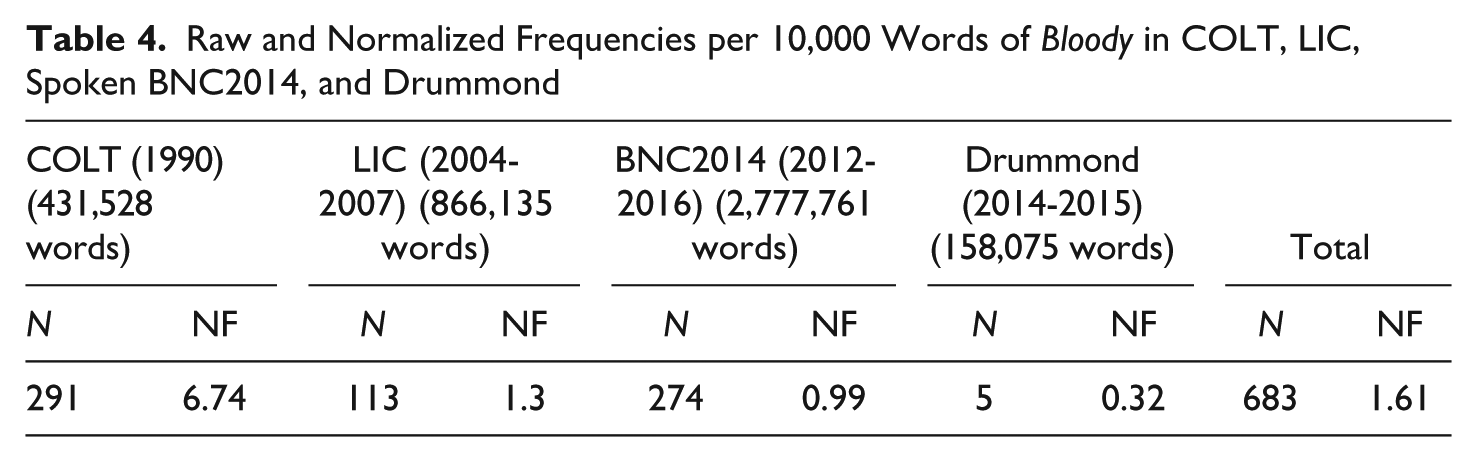
Searches were conducted using the previous findings based on the general comparison between the spoken component of BNC1994 and Spoken BNC2014, considering general spoken British English data (see Table 3). The results in Table 4 and Figure 1, focused specifically on teen talk data, confirm the earlier trend and clearly show a marked decline in the use of bloody from the 1990s to 2015. In COLT (1993), the normalized frequency per 10,000 words is 6.74, whereas in Drummond (2020) this reduces to only 0.32, with only five tokens recorded. Such a downward trend is particularly evident when comparing COLT to LIC (2004-2007), where the normalized frequency drops from 6.74 in the former to just 1.3 in the latter. In Spoken BNC2014, a total of 274 occurrences were found, with a normalized frequency of 0.99 per 10,000 words.
Raw and Normalized Frequencies per 10,000 Words of Bloody in COLT, LIC, Spoken BNC2014, and Drummond
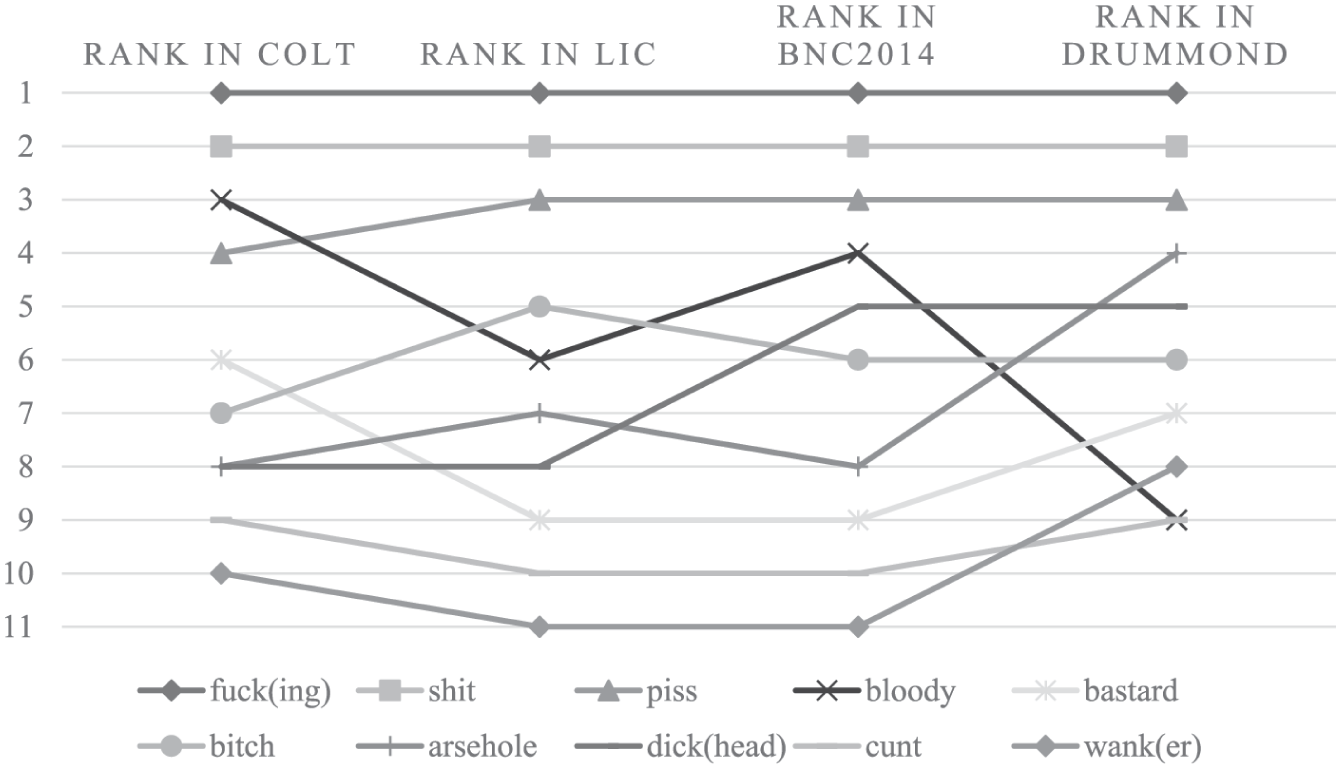
Evolution of the Most Common Swear Words in the Corpora Analyzed
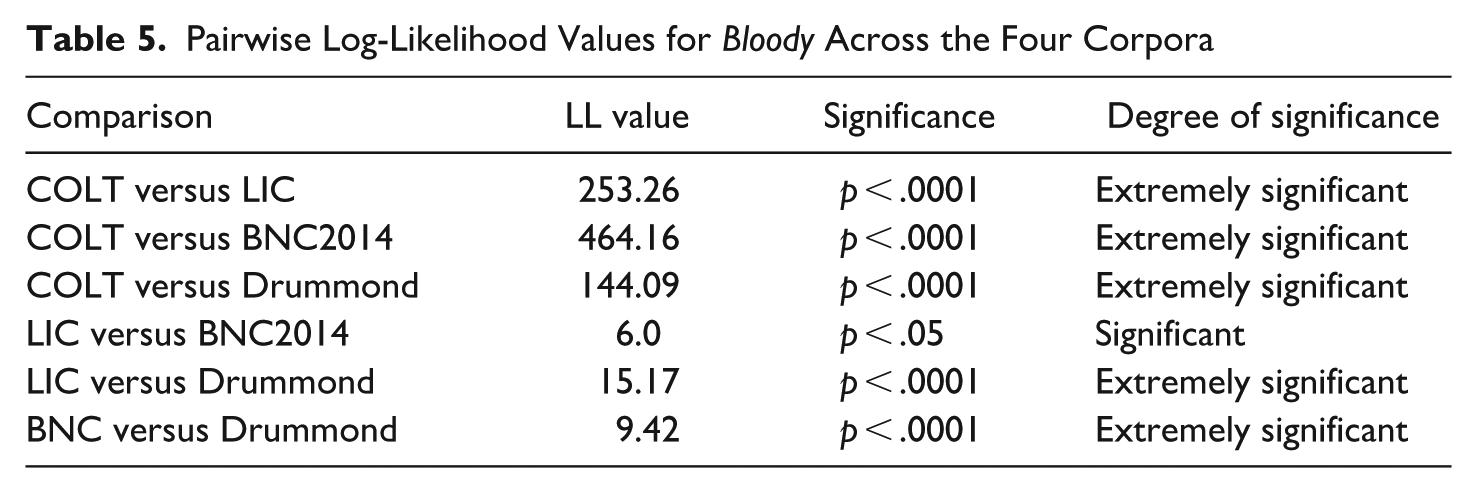
To assess the significance of these differences, a log-likelihood (LL) test was applied following Rayson and Garside (2000). As shown in Table 5, all pairwise comparisons yield statistically significant results. In most cases, the LL values exceed the critical threshold for p < .0001, indicating extremely significant differences. This is particularly evident in the contrasts between COLT (1993) and Spoken BNC2014 (LL = 464.16), COLT (1993) and LIC (2004-2007; LL = 253.26), and COLT (1993) and Drummond (2020; LL = 144.09). Later comparisons also show statistically meaningful contrasts, albeit to a lesser extent. Notably, the comparison between LIC and Spoken BNC2014 produces a lower LL value (LL = 6.0), which corresponds to p < .05 and is therefore significant, although not extremely so. The remaining comparisons, that is, LIC versus Drummond (LL = 15.17) and Spoken BNC2014 versus Drummond (LL = 9.42), remain within the p < .0001 threshold. These findings support the hypothesis of a continued decline in the use of bloody, one which is particularly sharp from the 1990s to the early 2000s, and somewhat more moderate thereafter.
Pairwise Log-Likelihood Values for Bloody Across the Four Corpora
However, any account of bloody would be incomplete without examining its position in relation to other prominent swear words. That is, it is also important to know where and how this taboo term fits within the broader system of popular swearing.
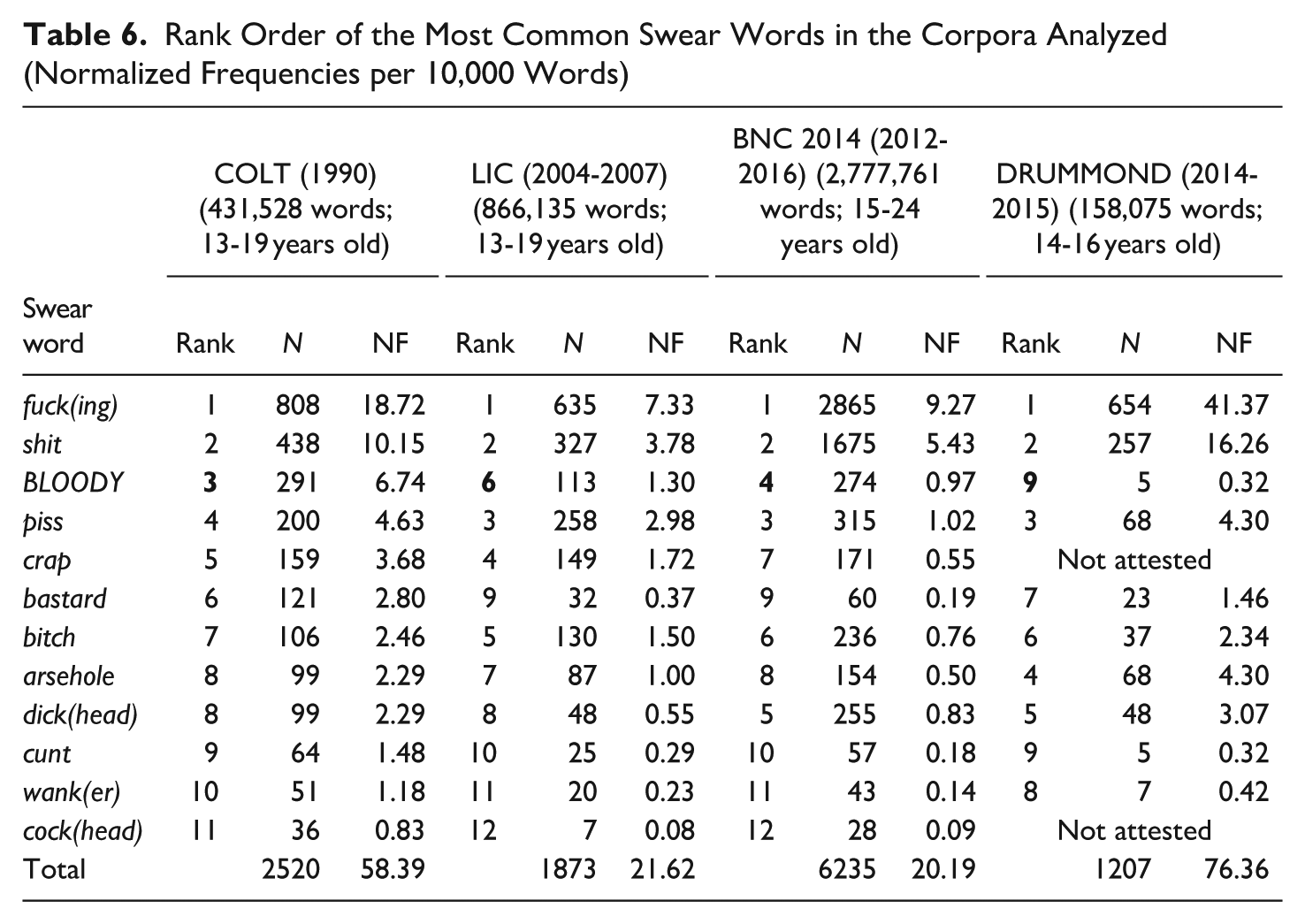
The data in Table 6 present the raw and normalized frequencies per 10,000 words for a set of twelve common swear words across the four teen talk corpora analyzed, while Figure 1 shows the evolution of each term therein. Two main criteria were used for the selection of these twelve swear terms: they are all considered essentially taboo, although differing in their degree of offensiveness, and the selected corpora contain sufficient tokens for analysis. Values for bloody are shown in bold to highlight the contrast with other swear words more clearly.
Rank Order of the Most Common Swear Words in the Corpora Analyzed (Normalized Frequencies per 10,000 Words)
In most cases, the searches also included relevant inflectional and derivational variants of the terms, such as arsed, arsehole asshole for
A general pattern is observed. Excluding COLT, the three other corpora (LIC, Spoken BNC2014, and Drummond) show how fuck(ing), shit, and piss are consistently among the most frequently-used terms. Similarly, with minor variations, cunt, wank(er), and cock(head) tend to occupy the lowest positions. Focusing on bloody in all four corpora, we note that while it sits in the third position in COLT, it drops to sixth place in LIC, fourth place in Spoken BNC2014, and, contrary to expectations, occupies the joint-lowest position in Drummond, alongside cunt. A decline was indeed expected but not to such a high extent. This finding reinforces previous evidence observed when comparing the spoken subcorpus of BNC1994 and Spoken BNC2014 data by age group (Section 6.1), which showed a sharp decline of bloody in contemporary teen talk. Not only has its frequency significantly decreased, but its relative position compared to other swear words also confirms this downward trend within the broader repertoire of swear words used by British teenagers.
6.2.1. Bloody Versus Fuck(ing/ed)
The next question to be addressed concerns the factors that may account for the decline in the use of bloody. A first hypothesis here is that other swear words, fuck(ing) in particular, may be taking over or adopting functions that were traditionally associated with bloody, more specifically, those of intensifier and expletive. As noted above, this possibility has been suggested in previous studies (Drummond 2020; Love 2021).
To test this hypothesis, we retrieved and analyzed all the tokens where fuck and its morphological variants occurred in the sample selected of young speakers of spoken BNC2014 (see Figure 2). Data were coded into different categories based on previous taxonomies (McEnery & Xiao 2004; Drummond 2020; Love & Stenström 2023). The results indicate that fuck has not only become markedly more frequent but also significantly more multifunctional with respect to BNC1994 (Love & Stenström 2023). It frequently functions as an intensifier of nouns (every fucking week), adjectives (It’s fucking sad), verbs (You fucking stink), and adverbs (fucking slowly), as well as being used as an expletive (Fucking hell!). Fuck also occurs as a noun with a range of variants ((mother)fucker(y): That’s fuckery; You know the big motherfuckers), as a predicative or attributive adjective (I’m gonna be pretty fucked; the fucking message), and as a verb, either independently or in combination with particles such as off, up, or around (Fuck you; I told him to fuck off).
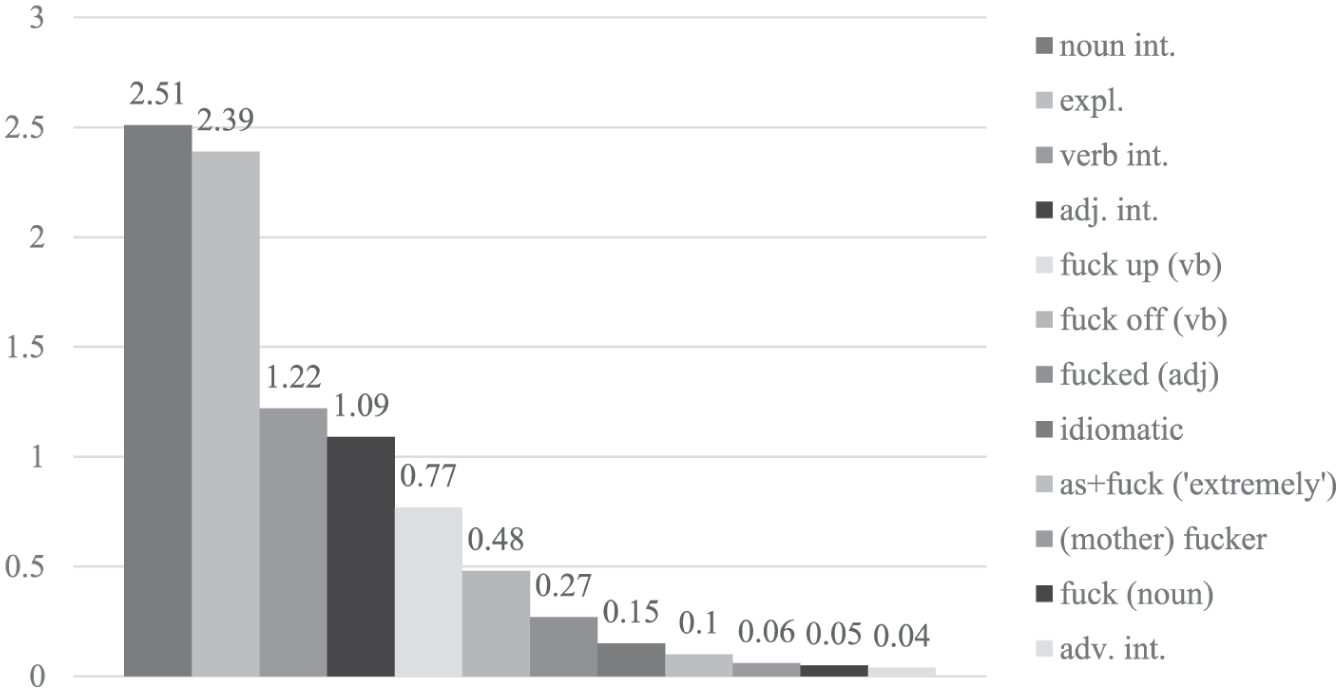
Fuck Word Categories in Spoken BNC2014 (Normalized Frequencies per 10,000 Words)
More recently, the frequency of idiomatic constructions involving fuck has increased considerably (He just wants to beat the fuck out of everyone; Everyone in my flat is like freaking the fuck out), and we also observe the intensifying as + fuck construction (He’s lazy as fuck), which further illustrates the high functional flexibility of this term.
In contrast, as will be shown in Section 6.3, bloody displays a considerably more restricted functional range, being primarily used as an intensifier for nouns, adjectives, verbs, and, very rarely, adverbs, as well as functioning as an expletive. This evidence thus confirms the hypothesis that fuck is adopting other values traditionally associated with bloody.
6.3. Grammatical Roles of Bloody
As mentioned above, bloody exhibits a far narrower grammatical range than fucking and fuck(er/ed) put together although not so narrower than fucking alone, being used primarily as an intensifier (for nouns, adjectives, and less frequently, verbs and adverbs) and as an expletive. Each token was manually coded according to its grammatical function based on its syntactic position and collocational context, following the categories outlined in Table 7.
Bloody Grammatical Categories (Normalized Frequencies per 10,000 Words)
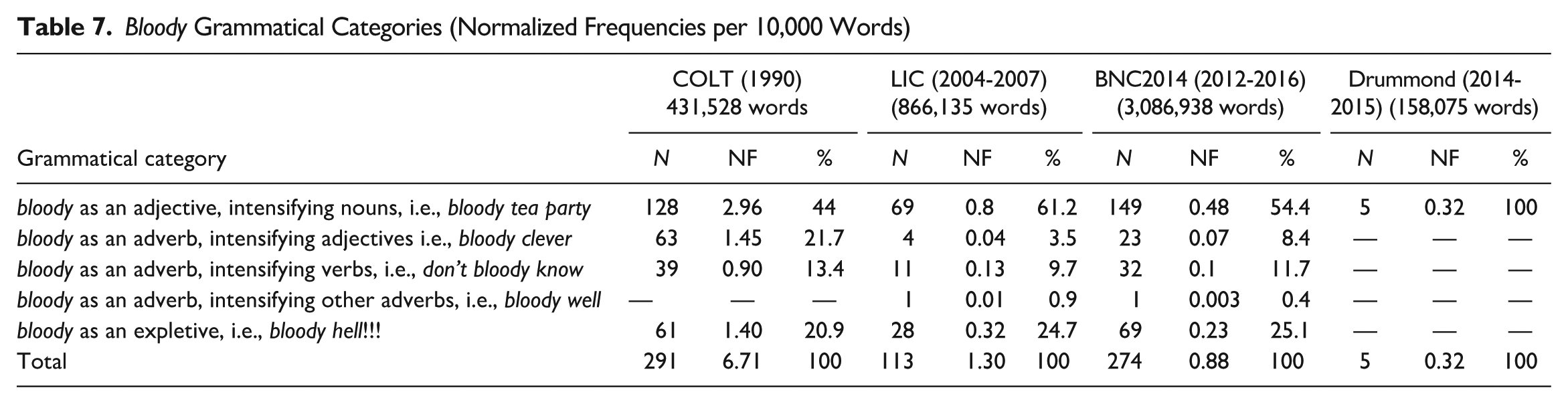
The figures and percentages set out in this table indicate that bloody is undergoing significant change, not only in terms of frequency (which is clearly declining) but also in patterns of usage. It functions mainly as an adjective intensifier modifying nouns and as an expletive, with these uses increasing over time at the expense of its other functions, namely as an adverb modifying adjectives, verbs, and other adverbs. This reduction in its grammatical roles may account for the increasing tendency of fucking to take over those roles that were traditionally played by bloody.
The overall percentages calculated to assess the distribution of these functions provide further insight into this shift. For instance, in COLT, bloody as an adjective intensifying nouns accounted for 44 percent of its total uses; this increased to 61.2 percent in LIC and to 54.4 percent in Spoken BNC2014, both considerably higher than in COLT, although with a modest decline from LIC to Spoken BNC2014. In Drummond only five examples of this swear word are recorded, and they all correspond to the category of noun intensifier. In all these cases these differences are statistically significant when calculating LL values. Thus, when comparing COLT versus LIC, the LL value is 82.49 whereas in the case of CLT versus Spoken BNC2014 the LL value is 193.78. Something similar applies when comparing COLT versus Drummond (LL 50.45) and LIC versus Spoken BNC2014 LL 11.05.
A similar trend is observed in its function as an expletive; in COLT, this accounted for 20.9 percent and rose to 24.7 percent in LIC and to 25.1 percent in Spoken BNC2014. As before, the differences here are statistically significant. When comparing COLT versus LIC, the LL value is 46.11 and the comparison with Spoken BNC2014 yields an even higher LL value of 94.34. In contrast, the difference between LIC and BNC2014 is not statistically significant (LL = 2.57).
If we consider the grammatical roles of bloody in further detail, we see that it can intensify a wide variety of nouns, from common nouns (3), proper nouns (4), and nominal vocatives (abusives) (5): (3) She nicked my fags and my (4) You know, not just watch (5) You
As an intensifier of adjectives, it tends to collocate with adjectives expressing negative prosody (6) (stupid, awful, stressful, creepy, ridiculous), although it may also occur with adjectives denoting something positive (7) (fit, peaceful, amazing, fantastic, good, easy, etc.). However, negative collocates clearly prevail over positive ones. This aligns with previous studies (Biscetti 2004) and with examples of its use found in the dictionaries consulted.
(6) That hat helmet looks so (7) He’s
It can also function as an adverb intensifying or modifying verbs, which at times may be negative (8). In all these cases bloody occupies preverbal (main verb) position: (8) I don’t
Looking at the type of verbs that bloody modifies, we observe that a large group of these are transitive (do, see, stop, start, fancy, tell, play, give, know), although intransitive verbs are also found (swim, run away, lie, jump), and even copulative ones (be). The nature of the verb in terms of its complementation pattern does not seem to condition its use.
(9) I can’t (10) Yes they (11) I’ll
Bloody is very rarely used as an adverbial intensifier modifying other adverbs, and when it does so, it collocates almost exclusively with well: (12) Yes, you did, you did
Finally, it can function as an expletive, either on its own (13), in combination with hell (14), or with other expressions with a euphemistic value, that is, heck, Nora (15), and as part of a wh- sentence (16):
(13)
(14) I don’t know.
(15)
(16) I thought what the
By contrast, and as discussed in Section 6.2.1, fuck functions as a noun, verb, adjective, adverbial intensifier, and expletive, and appears in a growing number of idiomatic constructions. On the other hand, bloody is becoming increasingly restricted to the roles of intensifier of nouns and expletive. This suggests that fuck is exhibiting greater grammatical versatility and a broader range of pragmatic functions.
6.4. Pragmatics of Bloody
In this section we consider the pragmatics of bloody in the language of teenagers specifically. To identify and classify the pragmatic functions of the term we adopted a qualitative approach grounded in the frameworks of Biscetti (2004, 2008), Stenström (1999, 2006), Jay and Janschewitz (2008), Ljung (2011), and Norrick (2012), among others. These studies describe a range of pragmatic roles for taboo words, including expressive, confrontational, and relational uses although they do not focus specifically on bloody or consider a large sample of its tokens. Bloody has been traditionally associated with the expression of irritation or anger, or as a common intensifier with insults. However, in our analysis we observed additional functions in the language of teenagers that merit close consideration. These functions should not be regarded as totally distinct as there could be cases in which several interpretations may be possible. For example, a speaker may be using bloody to express irritation with a confrontational use, thus combining functions 6.4.1. and 6.4.3 below.
Drawing on these, and based on a close analysis of the examples in the current dataset, which included the full interactions in which they occurred, we identified seven recurring functions, which are outlined below. Each category is supported by attested examples from the corpora analyzed. The focus here is not to trace the diachronic evolution of the pragmatic uses of bloody, but rather to explore how this term functions within the everyday speech of adolescents, as attested in the corpora under study.
6.4.1. Expressing Irritation, Annoyance, or Frustration
This is one of the most common uses of bloody, although not the only one, with speakers channeling their frustration through expressions containing the term. It is found across the four corpora considered. This has been called ‘cathartic swearing’ (Pinker 2007; Jay & Janschewitz 2008), and can be observed in the examples below. In (17) the speaker is irritated by the flies around them and resorts to the use of this term to express frustration. In example (18) the speaker is annoyed because someone has stolen their cigarettes and lighter, expressing their irritation with a phrase which includes bloody.
(17) (18) She nicked my fags and my
6.4.2. Conveying a Categorical Opinion or Belief Often Preceded by a Negative
The intensifying force of bloody may also serve to convey a speaker’s categorical opinion or belief in response to a previous statement or claim. This can be seen in the following example; note that the phrase immediately preceding the one containing bloody is negative, allowing the speaker to contradict them emphatically with the help of the intensifier.
(19) can’t be Kent as that’s a
6.4.3. Confrontational Use
At times, the use of bloody can attain a degree of force that conveys confrontation or strong exasperation. In the following example the speaker is reporting a situation in which they are preparing breakfast for their younger brother, who is indecisive about whether he wants Weetabix or another type of cereal. As the conversation progresses, the speaker loses patience and emphatically urges him to decide. Here, bloody intensifies the imperative ‘Make up your mind!,’ expressing frustration and urgency, and strengthening the speaker’s exasperation and impatience in a confrontational manner.
(20) They get up at eight o’clock in the morning and say, <mimicking> Jo, I want my cereal. And you say . . . how many Weetabix do you want, one? <mimicking>No, no, no, two. Sam, how many Weetabix do you want, one? Make up your
There are also situations in which the degree of confrontation is so great that it comes close to verbal aggression, something that was observed by Stenström (1995:74) in a previous study on taboos in teen talk.
6.4.4. Adding a Tone of Humor
Contrary to what might perhaps be supposed, bloody can also contribute to humor in conversation by helping to relieve tension or mitigating a strong statement. The humorous function of bloody may involve straightforward exaggeration to provoke laughter, or alternatively a more ironic or sarcastic tone. Such usage is particularly common in exchanges between speakers with high levels of familiarity, where mild swearing enhances informality and playfulness, a phenomenon known as ‘social swearing’ (Ljung 2011).
The following example (21) illustrates this, where the speaker engages in humorous exaggeration, claiming that someone was ‘always high’ because they ate dog food, making the situation sound absurd. Here, bloody intensifies the joke, reinforcing the humor of the claim.
(21) A: and Scoobs yeah I liked Shaggy I always thought he was he could’ve been my uncle innit? innit? B: well we all got to admit he was a little high A: he was always high. he’s eating
As a variant of this, we find the use of bloody in stories, personal anecdotes or conversational narratives where swearing also plays an important role (Norrick 2012). Thus, it is common for speakers to resort to the use of bloody to convey exaggeration that may have humoristic overtones.
This can be observed in the following example, a conversation in which the speakers are recounting their experiences playing cricket at Ascot when they were all drunk.
(22) A: Remember when you were pissed at Ascot? . . . B: That’s right. C: Best cricket of my life. A: We played cricket at Ascot B: A: C: A: Yeah we were fucked (BNC2014)
Here we have an instance of jocular repetition and correction of the previous utterance. Humor or amusement is obtained by “Bloody drunk.”
6.4.5. Expressing Surprise
As an expletive (e.g., bloody hell), bloody frequently expresses surprise or shock, which can be either positive or negative. In (23), Speaker A recounts a shocking event that they witnessed in a supermarket, where a man poured vinegar over an elderly woman and then set fire to her. In response, Speaker B reacts with the expletive bloody hell, expressing both surprise and disbelief.
(23) A: I was in the supermarket the other day and then this bloke, I saw this bloke pick up this massive bottle of er . . . vinegar right, and he took the top off. There was some old woman just going down the aisle and he just started pouring it all over her B: Yeah! A: and <unclear> describe, well seasoned you know and . . . and then he got his lighter out and he just set fire to her B:
6.4.6. Insults and Derogatory Uses
Bloody, as mentioned above, often collocates with abusives and slurs, these usually having an insulting and even aggressive intention, as the examples that follow illustrate. Such uses can be found in all four of the corpora considered.
(24) You (25) He’s
6.4.7. Unmarked Swearing
In some cases, bloody appears to function as a habitual or routinized element of speech, with little overt emotional force. In such instances, the speaker uses bloody not to express strong affect, but as part of a conventional way of speaking that aligns with peer-group norms. This type of swearing has been described as “unmarked” or pragmatically bleached and is especially common in teen talk, where swearing often serves a social bonding function (Drummond 2020; Stapleton 2020). In (27) the speaker expresses frustration about attending band practice because it takes up part of their free time. Bloody is used twice in a short stretch of discourse to emphasize this frustration. However, it also reflects the speaker’s habitual way of expressing themselves, as bloody appears to be part of their conventional speech style.
(27) I wanna come round to band practice tomorrow . . . and I won’t get there until
7. Conclusions and Suggestions for Further Research
Bloody is not particularly common in the speech of British teenagers when compared to other taboo words used in everyday interactions, such as fuck, piss, and shit. It appears to be more frequent among mature adults and elderly speakers, although its use among the latter group has declined significantly from the 1990s to the mid-2010s. We can therefore conclude that our hypothesis is confirmed since British teenagers exhibit a greater decrease in the use of bloody over time, and this decline is more pronounced among them than among other age groups.
The data also suggest that bloody, as a swear word, cannot be regarded as a marker of innovation or language change driven by younger speakers, as is the case with other features prevalent in their speech, such as the quotative (be) like, invariant tags such as innit (Palacios Martínez 2015; Pichler 2021), and certain uses of discourse markers (e.g., you get me, still) (Torgersen, Gabrielatos & Hoffmann 2017; Cheshire, Adams & Hall 2024). Instead, we are observing a generational shift: bloody is used across age groups, but it is gradually falling out of use. This decline in frequency appears to be motivated by two primary factors: (i) the growing dominance of other swear words, particularly fuck, which has taken over many of the functions of bloody due to its extreme multifunctionality and versatility; (ii) the reduced perception of bloody as a strong or offensive swear word among adults, and even less so among teenagers.
A third contributing factor is the narrowing of the grammatical roles of bloody. It now functions predominantly as a noun intensifier and expletive, while its use as an intensifier for adjectives, adverbs, and verbs has become noticeably less frequent. A fourth possible hypothesis, mentioned above, relates to the broader Americanization of the English language, in light of the near-absence of bloody in American English today where fuck really dominates, as well as its limited presence across many varieties of English, except for Australian English (Wierzbicka 2002; Allan & Burridge 2006, 2009; Schweinberger & Burridge 2025). This hypothesis, however, has not been confirmed with our data and requires further study.
The findings reported here should be interpreted with caution, given the differences observed across the four corpora in terms of the origins of some of the speakers, the compilation methods used, and the size of the samples analyzed.
Pragmatically, bloody can convey frustration, anger, irritation, and disapproval, but it may also express surprise or disbelief when functioning as an expletive. It is often found in abusive or slurring language, but may also contribute a humorous, comic, or ironic tone to interactions. Additionally, bloody features in conversational narratives, where it can add emphasis and exaggeration, making a story more engaging.
Given the frequent use of slang and taboo language in teen talk, it is not surprising to find bloody co-occurring with other swear words in their speech as part of their habitual, unmarked swearing. Contextual factors seem especially relevant in the speech of teens: the frequent use of taboo terms may help to reinforce social bonds and affirm group identity, a practice often referred to as social swearing.
Nevertheless, further work is needed on the distribution of bloody as intensifier and expletive across different varieties of English. The use of recent corpora such as GloWBE (Corpus of Global Web-Based English) and CoBISE (Corpus of British Isles Spoken English) could provide more up-to-date findings here. Additionally, incorporating data from platforms such as Twitter/X or Reddit (e.g., the Pushshift Corpus) would be useful in providing insights into contemporary patterns of usage.
Finally, a large-scale, systematic comparison between teenage and adult speech, expanding on Stenström’s (1995) preliminary work, remains to be carried out. Such a study would not only allow for a comparison of frequency, but also of the pragmatic functions assigned to different swear words. This would shed light on how teenagers and adults differ in their use of bloody and similar terms in everyday spoken discourse.
Footnotes
Acknowledgements
I would like to express my gratitude to the two reviewers of this study, as well as to the editors of the journal, for their insightful suggestions and comments, which have significantly enriched and improved the original version. Special thanks are given to the Spanish Ministry of Science, Innovation and Universities (grant PID2021-122267NB-100) and the Regional Government of Galicia (Consellería de Cultura, Educación, Formación Profesional e Universidades, grant ED431B2024/09). Their support is gratefully acknowledged.
Declaration of Conflicting Interests
The author declared no potential conflicts of interest with respect to the research, authorship, and/or publication of this article.
Funding
The author disclosed receipt of the following financial support for the research, authorship, and/or publication of this article: The European Regional Development Fund and the Spanish Agencia Estatal de Investigación (PID2021-122267NB-I00). The Regional Government of Galicia (Consellería de Cultura, Educación e Universidade, grant ED431B 2024/09).
