







Abstract
Life satisfaction is a key indicator of wellbeing in later life and a central focus of several aging theories. While engaging in physical and social activities supports life satisfaction, less is understood about the role of activity meaningfulness and perceived fulfillment. This study examines whether engagement in meaningful activities or perceived fulfillment has a greater effect on life satisfaction among older adults. Using data from the Well Elderly 2 Study (N = 460; ages 60–90), we found that both meaningful activity engagement and perceived fulfillment were positively associated with life satisfaction after controlling for socio-demographic factors. Perceived fulfillment demonstrated a slightly stronger relationship. These findings highlight the importance of meaningful activities in enhancing life satisfaction and suggest that service providers promote both meaningful engagement and fulfillment to support cognitive and emotional wellbeing. Strategies are discussed to empower older adults to age in place and improve their quality of life.
Keywords
Introduction
Age and life satisfaction are closely linked in older adulthood, as age can significantly impact life satisfaction levels (Cho & Cheon, 2023). In turn, life satisfaction plays a crucial role in promoting longevity (Diener & Chan, 2011). Various developmental and aging theories, such as Erikson's psychosocial theory of development (Woods & Witte, 1981), selective optimization with compensation (SOC) theory (Baltes & Baltes, 1990), and continuity theory (Kepic, 2016), provide valuable frameworks for understanding how older adults achieve life satisfaction in later stages of life. These theories emphasize the importance of adapting to life's challenges, maximizing the use of available resources, and preserving a stable sense of identity to maintain wellbeing in later life. The term “older adults” encompasses multiple generations, ranging from individuals in their sixties to those over 100. While life satisfaction varies across the lifespan, research shows it correlates significantly with age among older adults. Specifically, life satisfaction tends to be highest between ages 65 and 79 (Cho & Cheon, 2023; Office for National Statistics, 2016) but declines sharply after 80, with a particularly steep drop beyond age 90 (Office for National Statistics, 2016). This decline has substantial implications both individually and societally. As global population aging accelerates, healthcare expenditures for older adults are rising (Chen et al., 2023). Addressing life satisfaction in older adults is, therefore, essential—not only to improve individual wellbeing but also to reduce healthcare burdens and enhance overall social welfare.
Service providers in health and social service settings who work to improve life satisfaction in their older adult clients often target related factors. However, factors such as education, financial status, religion, and employment (Dolan et al., 2008) can be difficult to alter. Physical activity levels and social participation are more easily adjusted factors that have been positively correlated with life satisfaction (Baeriswyl & Oris, 2023). Even a moderate level of physical activity has been associated with increased life satisfaction in older adults (An et al., 2020). In a study regarding social participation and life satisfaction in older adults, Baeriswyl and Oris (2023) indicate that the impact of social participation on life satisfaction is dependent on several factors such as the frequency of the activity, the type of activity, and the other participants. One key implication of the study revolved around how meaningful the activity was to the individual.
The meaningfulness of activities is a relatively underutilized aspect of activity participation. Meaningful activity engagement refers to the frequency with which a person engages in activities that are of value to them. Unlike the literature on social participation, an activity does not necessarily have to be social to be meaningful. Solitarily reading a book or watching a movie might be considered more meaningful to one, while going out with family or friends might be more meaningful to another. Similarly, both physical and sedentary activities can vary in meaning to an individual. According to the continuity theory of aging, meaningful activity engagement is an important contributor to successful aging (Eakman, 2007). Continuity theory posits that older adults place great value on continuing to participate in activities enjoyed earlier in their lifespan (Kepic, 2016). Although those activities may decrease in frequency or may need to be adapted to fit new physical or cognitive limitations, continued engagement in preferred activities is regarded as a key feature in optimal aging. The theory of SOC can be considered an extension of continuity theory in that it not only encourages older adults to participate in valued activities but also focuses on the adaptation of these activities to potential limitations due to the aging process (Kepic, 2016). The SOC indicates that older adults who prioritize activities of higher value (i.e., selection) and work to overcome obstacles to participation (i.e., compensation) will experience greater life satisfaction (Baltes & Baltes, 1990). Baltes and Baltes (1990) emphasized the importance of the meaning of the activity to the individual. Engaging in meaningful activities has also been found to improve cognitive health by providing a sense of purpose as well as reducing feelings of loneliness (Miyata et al., 2022).
Another related concept to meaningful activity engagement is an individual's perceived fulfillment with their activity participation. Fulfillment levels can be considered the result of an internal comparison between what an individual perceives as reality and an internalized ideal. As such, the perceived fulfillment of activity participation has both a cognitive and a subjective focus. There is no objective measure related to the number of activities participated in or even in how much value they place on the activities, as with meaningful engagement. Perceived fulfillment is completely an internal, subjective evaluation. In basic terms, are they satisfied with their activity levels? For example, a person might report low meaningful activity engagement and still be satisfied with their activity participation levels. Perceived fulfillment of activity participation is particularly significant in later life. In Erikson's psychosocial development theory, the final stage, Integrity vs. Despair, involves older adults reflecting on their lives and how meaningful they believed their experiences to be. Achieving a sense of ego integrity is positively correlated with higher life satisfaction (Woods & Witte, 1981). A critical component of this stage is the sense of fulfillment derived from both their past experiences and their present activities. Current literature further emphasizes the role of perceived fulfillment in psychological wellbeing and healthy aging. For example, studies have shown that perceived meaningful activity participation significantly enhances psychological fulfillment (Maruta et al., 2020) and reduces social frailty (Akaida et al., 2023; Miyata et al., 2022), which can cause major issues in later life. These findings highlight the importance of addressing perceived fulfillment among older adults and underscore the need for tailored approaches. By understanding and enhancing perceived fulfillment, practitioners can develop more effective strategies to promote life satisfaction, ultimately supporting healthier and more fulfilling aging experiences.
Despite the established links between engagement in meaningful activity, the perceived fulfillment of activity participation, and life satisfaction, significant gaps remain in the existing literature. Firstly, the concept of meaningful activity has mostly been investigated within occupational therapy (e.g., Akaida et al., 2024; Clark et al., 1997; Travers et al., 2016) and partially addressed in psychology (Hooker et al., 2020), with limited studies conducted with older adults aged 65 and older (Akaida et al., 2024). This shows the necessity of re-examining meaningful activity in older age as a primary concept within other fields, such as social work or gerontology, to determine if it can serve as a mechanism to improve life satisfaction for older adults. Additionally, the studies that have referred to life satisfaction and engagement in meaningful activities have not differentiated between the impact of frequency of meaningful activity participation and perceived fulfillment of activity participation. Although they are similar in nature, the methods used to address each concept vary greatly. Identifying which aspect is more influential would enhance the development of more targeted programs or policies to effectively enhance life satisfaction among community-dwelling older adults. Therefore, the purpose of this study is to explore the relationship between meaningful activity engagement and life satisfaction among older adults and to determine if either a participant's perceived fulfillment with their activity level or meaningful activity engagement has a higher impact on life satisfaction among older adults.
Methods
Data
The data analyzed in this study were taken from the Well Elderly 2 dataset and contained self-reported measures of life satisfaction, depression, and individual health-related quality of life (Clark et al., 2012). The Well Elderly 2 study was a face-to-face survey collected from 21 different sites in Los Angeles, California. Locations included community centers for older adults, retirement communities, and senior housing (Jackson et al., 2009). Participants included older adults who could speak English or Spanish, were able to understand and complete the survey administered by a study assistant, and could attend the intervention. Both a baseline questionnaire and a follow-up questionnaire (offered 6 months after the intervention) were completed by participants, but only the baseline data (n = 460) were used in this study. As the data were taken from a de-identified, publicly available dataset, this study was exempted by the university's Institutional Review Board.
Measures
Life Satisfaction
Life satisfaction was measured utilizing the Life Satisfaction Index-Z (LSI-Z; Wood et al., 1969). This assessment is used to rate the quality of life and wellbeing of older adults. The LSI-Z score consists of a sum of 13 items marked on a 3-point scale (0 = Disagree, 1 = Unsure, and 2 = Agree), ranging from 0 to 26, with higher scores indicating a higher level of life satisfaction. For example, one question was, “As I look back on my life, I am fairly well satisfied.” The scale's reliability was reported as .79 (Wood et al., 1969) with an acceptable Cronbach's alpha for the current study (α = .77).
Perceived Fulfillment of Activity Participation
Perceived fulfillment of activity participation was measured by the global portion of the meaningful activity participation assessment scale (MAPA global version; Eakman et al., 2010). This scale consists of six items presented on a 7-point scale (1 = “not at all” to 7 = “a great deal”). For example, “Overall, are your activities personally fulfilling for you?” Responses ranged from 6 to 42. A higher score indicates a higher level of participant satisfaction with their involvement in activities. The reliability of the MAPA was .84 (Eakman et al., 2010). In the current study, Cronbach's alpha for this measure was (α = .56).
Engagement in Meaningful Activity
Meaningful activity engagement was assessed via a version of the MAPA (Eakman et al., 2010) revised for the Well Elderly 2 study. The engagement in meaningful activity score ranged from 0 to 696, with higher scores indicating more frequent participation in meaningful activities. The score was derived from the combination of two subscales: one measuring how frequently a participant engaged in a particular activity, and the second measuring the meaning each activity held for an individual. Both scales included the same activities (e.g., helping others, medical visits, shopping, socializing with friends, etc.). Meaningfulness item responses, after recoding, ranged from 0 (I do not do this) to 4 (extremely meaningful), and activity frequency item responses, after recoding, ranged from 0 (not at all) to 6 (every day). Frequency items were multiplied by meaningfulness items, and the results were then summed to create the final score. Five primary revisions were made, resulting in a 29-item scale where the original scale included 28 items. Revisions included: (a) additional variables: shopping, going out to movies or restaurants, and sexual or intimate activities; (b) splitting the “socializing” item into two items: socializing with friends and socializing with family; (c) collapsing two variables (i.e., “religious activities” and “prayer/meditation”) into religious or spiritual activities; (d) creating the “reading” item by integrating “reading magazines/newspapers” and “other reading”; (e) collapsing “community organization” and “volunteer activities” into club/organization or volunteer activities. Internal consistency for meaningful activity engagement in the current study was high (α = .85).
Socio-Demographic Characteristics
Socio-demographic characteristics included age (birth year), race/ethnicity (1 = non-minority, 2 = minority), gender (1 = male, 2 = female), marital status (1 = single, 2 = married or living with a life partner), income, and educational level (from 1 = less than high school to 5 = graduate school completed). General health condition was also measured by Short-Form Health Survey version 2 (SF-36v2; Ware et al., 2000). For the current study, we only used six items from the SF-36v2 to understand the overall health condition among participants. It consists of six items presented on a 5-point scale ranging from 1 (poor) to 5 (excellent), with items reverse-coded for ease of interpretation. For example, one of the questions is “In general, would you say your health is?”. The scale score is calculated by summing the scores of all five items; scores may range from 5 to 25. A higher total score indicates that people have better overall health conditions.
Data Analysis
These data were analyzed on the univariate, bivariate, and multivariate levels. First, descriptive statistics were used to gain a basic understanding of the sample characteristics, including socio-demographic variables, engagement in meaningful activities, perceived fulfillment of activity participation, and life satisfaction. Second, bivariate correlations were conducted to examine the relationships among study variables and to ensure the absence of collinearity. Third, multivariate linear regressions were performed to assess the impact of factors on life satisfaction. The variables were entered in the following sequence: participant's socio-demographic variables, engagement in meaningful activities, and perceived fulfillment of activity participation. All analyses were performed using SPSS Statistics 27.
Results
Descriptive Characteristics of the Sample
Table 1 shows the overall characteristics of the sample. The mean age was approximately 74 years, ranging from 60 to 90 years old. The majority of participants were racially and ethnically minority group members (n = 286, 62.6%), female (n = 303, 65.9%), single (n = 377, 82%), made less than $1000 per month (n = 240, 52%), and attended some college or trade school (n = 158,34.3%). The mean score for general health conditions was 16.74(SD = 4.21). The score for engagement in meaningful activity was 197.78 (SD =87.70), and the perceived fulfillment of activity participation had a mean score of 31.43 (SD = 6.23). Life satisfaction had a mean score of 16.85 (SD = 5.63).
Demographics of Sample (n = 460).
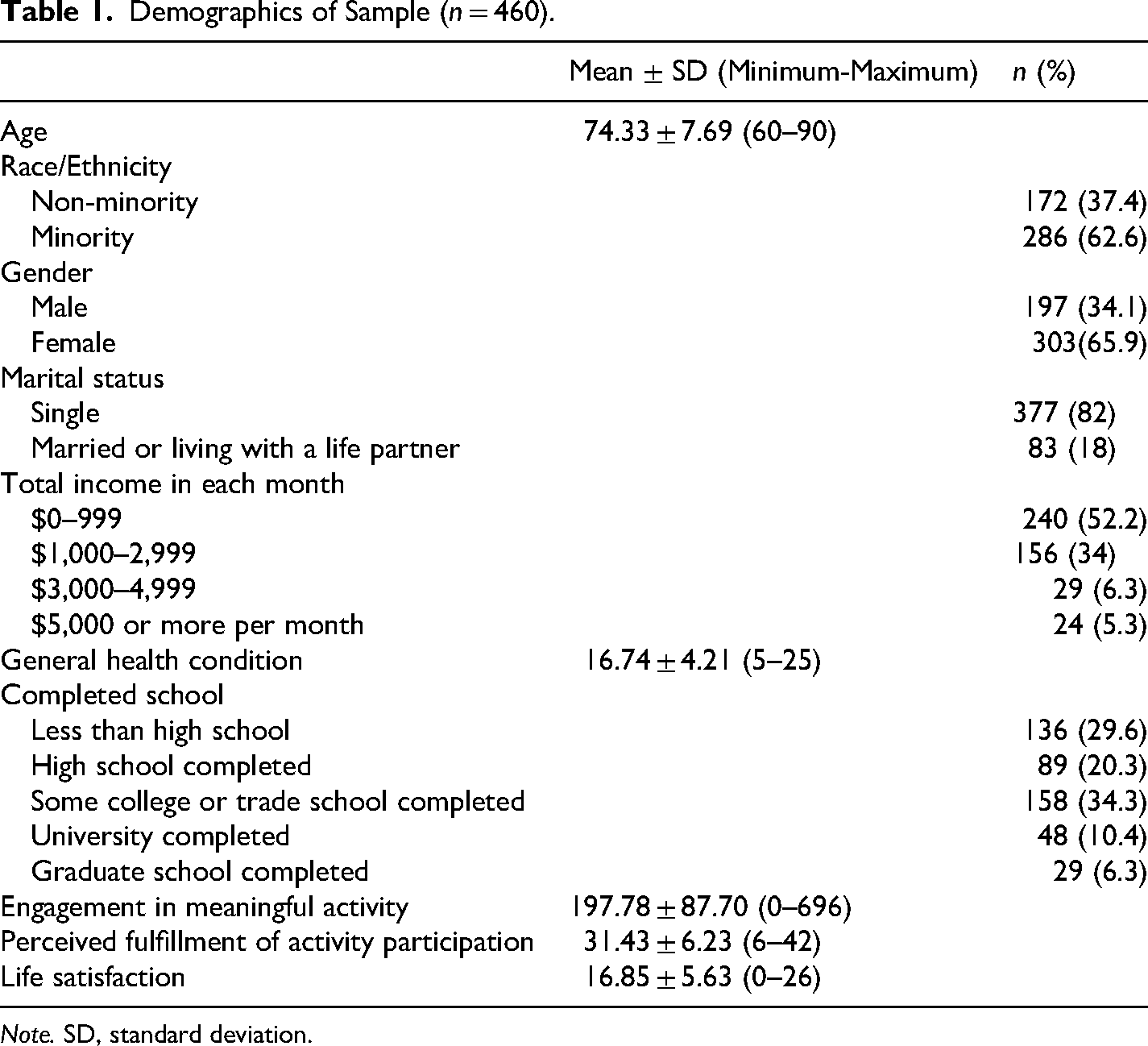
Note. SD, standard deviation.
Descriptive Profile of Engagement in Meaningful Activities
This descriptive profile highlights the types of meaningful activities that participants engaged in most frequently and those that they engaged in least frequently. As shown in Table 2, to clarify participant responses to the activities listed on the MAPA scale, the activities have been organized into five domains: (a) recreational activities, (b) social participation activities, (c) health and wellbeing activities, (d) functional living activities, and (e) hobbies and creative activities. The top two activities participants reported as having the most meaning and engagement were recreational activities (i.e., radio/TV and reading), while the second most meaningful activities engaged in were social participation activities (i.e., talking on the telephone and socializing with friends).
Frequency of Meaningful Activity Engagement Among Older Adults.
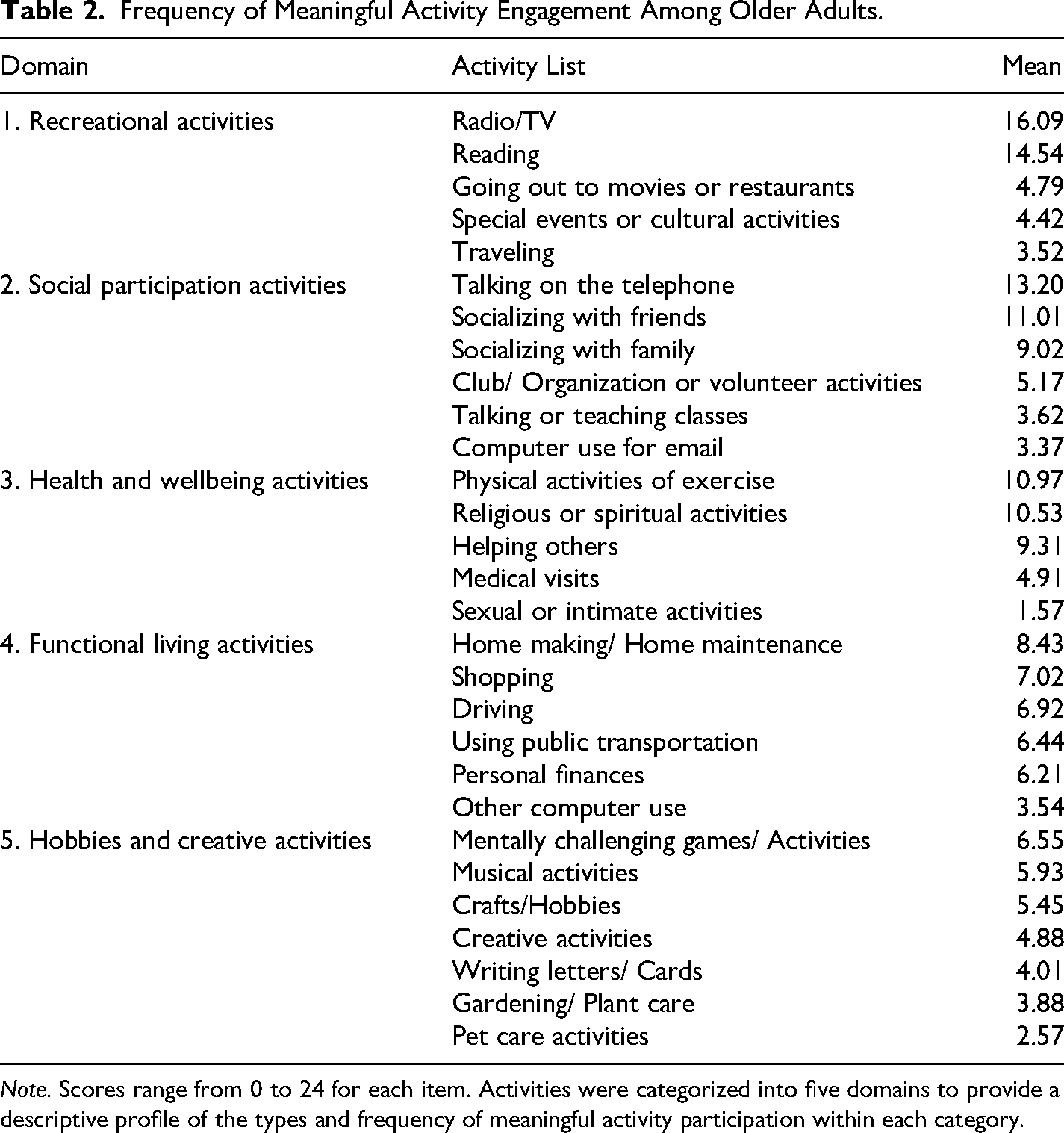
Note. Scores range from 0 to 24 for each item. Activities were categorized into five domains to provide a descriptive profile of the types and frequency of meaningful activity participation within each category.
Bivariate Correlations
Table 3 displays the bivariate correlations among the study variables. Overall, the variables showed the anticipated correlations, and there was no indication of collinearity. Both engagement in meaningful activity (r = .29, p < .01) and perceived fulfillment of activity participation (r = .46, p < .01) were positively associated with life satisfaction among older adults. Age (r = .14, p < .01), marital status (r = .10, p < .05), general health condition (r = .47 p < .01), and educational level (r = .09, p < .05) were also positively associated with life satisfaction among older adults. Participants with greater overall health conditions, who were married, with a higher educational level, and the oldest older adults were more likely to have a higher level of life satisfaction. However, race/ethnicity, gender, and income were not associated with life satisfaction
Bivariate Correlations Among Study Variables.
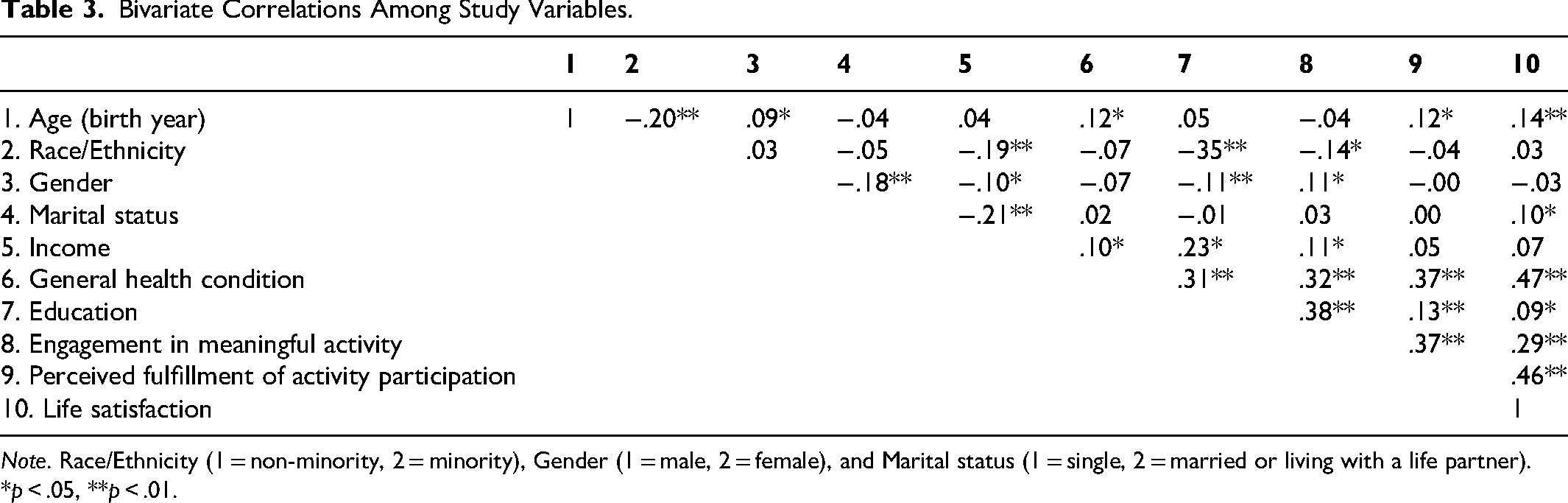
Note. Race/Ethnicity (1 = non-minority, 2 = minority), Gender (1 = male, 2 = female), and Marital status (1 = single, 2 = married or living with a life partner).
*p < .05, **p < .01.
Regression Models of Life Satisfaction
Table 4 presents the results of the regression models for life satisfaction. Results of the first model revealed that several socio-demographic variables contributed significantly to life satisfaction among older adults (F (7, 432) = 19.95, p < .000), accounting for 24% of the variation. Age (β = .17, p < .01), marital status (β = .09, p < .05), and general health condition (β = .46, p < .000) were more likely to be associated with a higher level of life satisfaction. The last model, when engagement in meaningful activity and perceived fulfillment of activity participation were included, explained an additional 1.0% of the variance (F (9, 430) = 24.82, p < .000). Hence, older adults with a higher level of engagement in meaningful activity (β = .11, p < .05) and perceived fulfillment of activity participation (β = .30, p < .000) were significantly associated with a higher level of life satisfaction after controlling for the effect of socio-demographic variables.
Regression Model of Life Satisfaction.
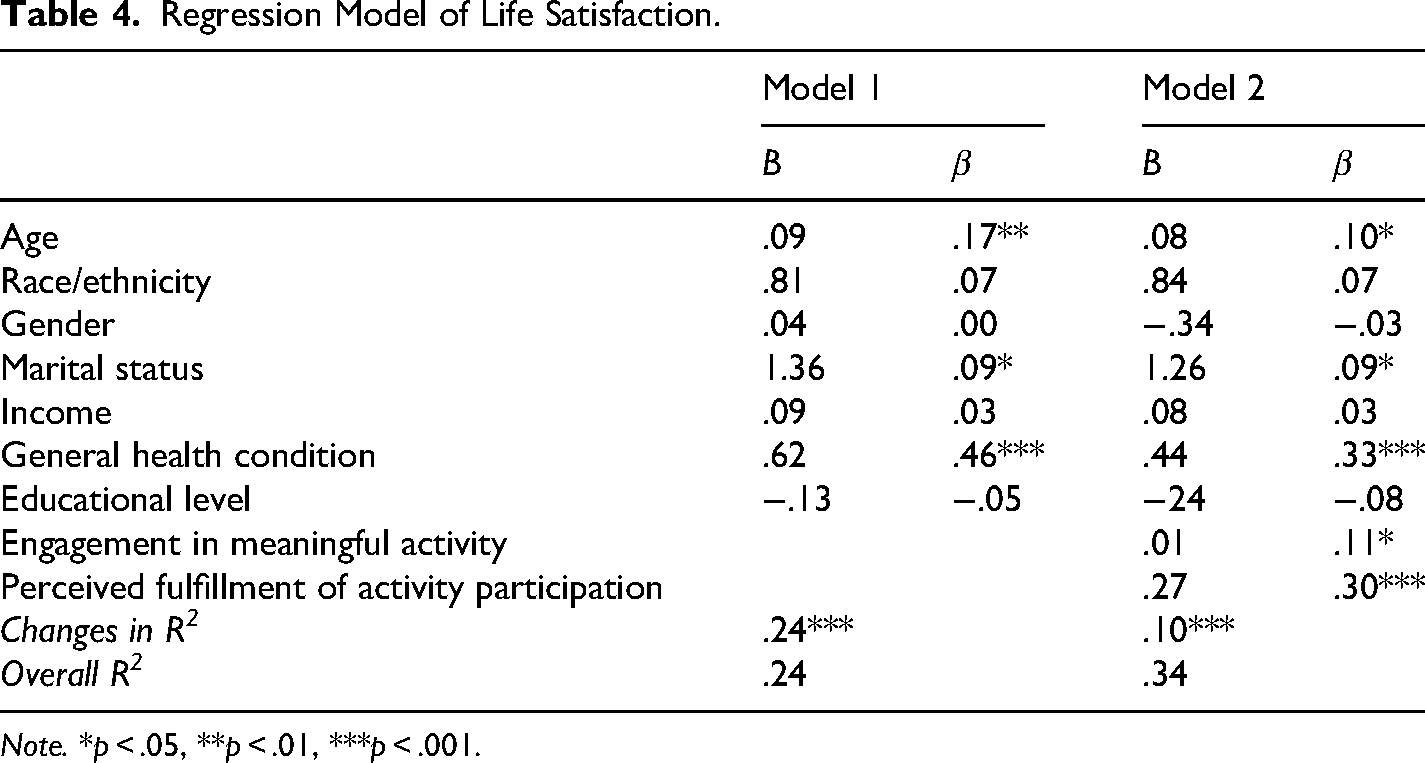
Note. *p < .05, **p < .01, ***p < .001.
Discussion
Given the increasing emphasis on the health and wellbeing of older adults and the overlooked importance of meaningful activity, this study investigated the relationship between meaningful activity engagement and life satisfaction. It also seeks to determine whether perceived fulfillment with their activity level or meaningful activity engagement has a higher impact on life satisfaction among older adults, as corresponds with a number of aging theories.
First, this study found that older adults who more frequently engage in meaningful activities report higher levels of life satisfaction. This finding is consistent with the parallel literature on social participation and life satisfaction (de Lira et al., 2018; Feng et al., 2020; Goh et al., 2019), which indicates that social activity and engagement in community physical activities are positively associated with quality of life among older adults. However, as older adults age, social participation decreases, suggesting that other avenues for enhancing life satisfaction are warranted. While the existing literature emphasizes the frequency of social participation, it does not consider the value that an individual places on a particular activity. The results of the current study are corroborated in the nascent meaningful activity literature (Baeriswyl & Oris, 2023). Meaningful activity engagement was found to be significantly and positively linked with improved life satisfaction regardless of the activity's level of social connection. Consistent with continuity theory (Atchley, 1989) and the selective optimization and compensation theory of aging (Baltes & Baltes, 1990), this finding focuses on the perceived value of an activity rather than the type of activity. According to these theories, older adults are likely to prefer to participate in activities that were valued earlier in their lifespan in their later years (i.e., continuity theory). Additionally, older adults who prioritize their preferred activities and work to overcome obstacles to participating in them are also more likely to experience successful aging (i.e., SOC theory). In other words, preferred activities aren’t likely to change despite potential changes in physical or cognitive health, and older adults who participate in activities meaningful to them are more likely to experience optimal aging.
This finding has implications for service providers in health and social service settings as well as policymakers. Practitioners desiring to enhance meaningful activity engagement may benefit from assisting clients with identifying the activities that hold the most emotional value to them and using brainstorming methods for prioritizing those with the most impact. Practitioners may have the option to use the structured activity list from the MAPA scale (e.g., homemaking, socializing with family, or volunteering) as a starting point for brainstorming. However, these lists should not be represented as exhaustive. They cannot capture the full range of older adults’ evolving preferences. Tailoring activities to the client's own preference and incorporating open-ended questions are essential for ensuring interventions remain personally relevant and impactful. To assist this process, practitioners might recommend engagement in the local senior or community centers to identify new activities for older adults who are not satisfied with their current activity pool. These centers can play a pivotal role by offering educational workshops or classes tailored for older adults as they explore new options. Some older adults already have valuable activities in their lives, but others lack the necessary knowledge or skills for successful engagement. In this case, workshops or programs can be instrumental in offering older adults the opportunity to learn new skills or develop existing activities such as knitting, painting, and golf. By increasing the opportunities to learn new skills, older adults may discover new avenues for meaningful activities leading to greater overall life satisfaction.
On the policy side, with the indirect positive physical and mental benefits of meaningful activity and activity satisfaction via improvements in life satisfaction, policy acknowledgments can raise awareness of these benefits and encourage older adults to prioritize and mindfully engage. There are many policies in place worldwide to give recommendations for physical activity levels for older adults (Milner & Milner, 2016). For example, the World Health Organization, the US Department of Health and Human Services, the European Innovation Partnership on Active and Healthy Ageing, and others have guidelines and initiatives to promote physical activity in older adults. Mental health policies are also on the rise globally, with mention of activity guidelines such as the World Health Organization Mental Health Action Plan, the NHS Long Term Plan (United Kingdom), and others (Moitra et al., 2023). Although our findings on meaningful activity engagement and perceived fulfillment of activity participation straddle both activities related to mental and physical health, this aspect of activity engagement has not yet been specifically addressed in physical and mental health policies. These two branches of health-related activities are individually acknowledged; however, the nature of the current research impacts both policy areas, highlighting the need for a more integrated approach to increase life satisfaction and improve health outcomes among older adults.
Second, our study found that perceived fulfillment of activity participation is positively associated with life satisfaction among older adults, which is consistent with the literature on satisfaction with meaningful activity (Akaida et al., 2023; Miyata et al., 2022). This suggests that the subjective sense of fulfillment through activities significantly affects life satisfaction in older age. Additionally, when comparing meaningful activity engagement and perceived fulfillment with activity participation among older adults, this study found that perceived fulfillment had a significantly stronger relationship with life satisfaction. This finding implies that although meaningful activity engagement is important to an older adult's quality of life, the individual's internal view of whether or not they are fulfilling their perceived goals in relation to activity participation may have a stronger link to life satisfaction levels. The connection between higher perceived fulfillment with activity participation and greater life satisfaction among older adults reveals a potentially important insight: older adults who feel satisfied with their activity participation—regardless of how frequently they engage in activities—report higher overall quality of life. Given the early stage of this research and the measure's limited reliability, this finding should be interpreted with caution; however, the cognitive focus on activity participation aligns with definitions of life satisfaction that emphasize comparisons between one's current life and ideal state (e.g., Campbell, 1981; Streib & Schneider, 1971). It also resonates with Erikson's final stage of psychosocial development, Integrity vs. Despair, where achieving a sense of fulfillment with one's past and present life leads to greater life satisfaction (Woods & Witte, 1981).
These findings offer valuable opportunities for service providers in health and social service settings to enhance older adult client satisfaction and development through a cognitive/emotional focus on activity participation. Initially, service providers can assess their older adult clients’ fulfillment levels with their activity participation to determine a baseline of satisfaction. Based on this assessment, service providers could assist clients with techniques to enhance their satisfaction while monitoring their fulfillment levels periodically to make adjustments. This can be done through the use of cognitive behavioral techniques such as cognitive restructuring and reframing. Older adult clients might be encouraged to identify the activities in which they most frequently engage and identify aspects of the activity they like. Clients could then be encouraged to utilize cognitive restructuring techniques to impede negative thoughts regarding dissatisfaction with these activities. Service providers can also utilize Dialectical Behavior Therapy (DBT), which is an offshoot of CBT focusing on emotions and acceptance of self (Chapman, 2006). DBT was originally developed to treat borderline personality disorder and suicide ideation, but has since been adapted to treat a variety of issues. Newlove (2011) found positive results when investigating the use of DBT in improving quality of life. One component of DBT, mindfulness, involves focusing on the present moment. This technique might be used to encourage clients to savor the satisfaction they feel as they engage in each activity to maximize the meaningfulness the client experiences. For example, while reading, a client might be encouraged to savor the comfort of the chair they sit in, their immersion in the story they read, and the connection they feel with the characters. Other appropriate techniques might focus on acceptance of self or their present activity level (e.g., radical acceptance; Chapman, 2006).
The results of the current study indicate that meaningful activity engagement is a promising area for future research. To advance this line of inquiry, further development and validation of the MAPA scale are essential. Although the MAPA scale used is one of the few scales that assesses both the personal importance of an activity and the frequency of participation (Eakman et al., 2010), it has limited reliability data and relies on a predetermined list of activities. If a participant's preferred activities are not included, it may affect the effectiveness of the results. This implies measurement validity. Thus, future research should expand the MAPA scale to allow for the customization of a participant's preferred activities. It could be adjusted to create a tool for practitioners to use with clients in investigating their meaningful activity engagement. In addition, validation studies with diverse populations would enhance the scale's reliability and generalizability.
Overall, our findings suggest that prioritizing meaningful activity engagement and focusing on older adults’ satisfaction levels with their activity participation are viable avenues of intervention for clinicians seeking to promote optimal aging and life satisfaction in their clients. Results from our second research question further indicate that when practitioners need to prioritize their sessions, focusing on cognitive techniques may have a greater impact than increasing meaningful activity engagement. While having both strategies available is helpful for practitioners, knowing which to prioritize when necessary can be equally valuable.
Limitations
As with all studies, there are some limitations. First, the data analyzed were cross-sectional, so causal inferences cannot be made. Longitudinal data analyses would assist this endeavor in the future. Second, the data utilized were collected in a specific geographic area, and so the generalizability of the data is limited to older adults in the Los Angeles, California area. For example, the Well Elderly 2 study had a higher proportion of racial and ethnic minority participants than is present in the general population of the United States. This demographic distinctiveness can be considered both a strength and a limitation. While it improves the representation of an often underrepresented population, it may also limit the generalizability of the findings to broader populations. To expand the generalizability of the data, future studies should focus on obtaining a wider representative sample. Third, a more detailed marital status variable may enhance the interpretation of the relationship between this variable and the results. It may be beneficial to broaden the characterization of the “single” response option to include more details (e.g., never married, separated, divorced, widowed). Fourth, the reliability of the MAPA global scale was not reported in the original study. The current study's Cronbach alpha was lower than preferred for this statistic (α = .56). Additional research on the MAPA global scale to establish and/or strengthen the reliability of this scale would be beneficial. Lastly, the list of activities provided for selection in the MAPA scale is limited. Eakman (2007) attempted to develop items that could encompass multiple ways of doing things–for example, “socializing with family” could be done in person, over the phone, via videoconferencing, or any other method of communication. Despite this, the absence of an individual's preferred activities from the scale could result in bias in the study's results. Adaptation may be necessary to maintain relevance and to better reflect the client's individual preferences.
Conclusion
As life expectancy increases in modern society, life satisfaction is becoming more important than ever to keep older adults healthy. Older adults strive to maintain or enhance their life satisfaction as a protective factor against physical and cognitive decline, and to improve the feasibility of aging-in-place and successful aging. This study went beyond the findings of previous studies and found meaningful activity engagement and perceived fulfillment in activity participation to be significant contributors to strengthening life satisfaction. In particular, it has provided concrete recommendations, suggesting methods to incorporate these concepts in practice. This research expands the likelihood of improving the situation of older adults through new approaches to help them increase their life satisfaction and to live healthier and more fulfilling lives in the community.
Footnotes
Ethical Approval
This study was exempted by the Dongguk University Institutional Review Board (DUIRB2024-06-07).
Funding
The authors received no financial support for the research, authorship, and/or publication of this article.
Declaration of Conflicting Interests
The authors declared no potential conflicts of interest with respect to the research, authorship, and/or publication of this article.
