







Abstract
Background
Subjective isolation and loneliness reflect cognitive and emotional dimensions of social disconnection, respectively, yet whether their association differs by age group—and whether it operates at both between-person and within-person levels—remains unclear.
Methods
Using three waves of a quota-based online panel survey conducted nationwide in Japan (25,403 observations; 15,634 individuals), we estimated hybrid random-effects models to decompose between- and within-person associations. Interaction models were estimated on a restricted panel sample (17,971 observations; 8,707 individuals), adjusting for sociodemographic and health-related covariates.
Results
Subjective isolation was strongly associated with loneliness at both the between-person and within-person levels, with both associations significantly weaker among older adults than working-age adults.
Discussion
The association between subjective isolation and loneliness varies across the adult life course, with older adults showing a weaker coupling between the two dimensions of social disconnection.
Introduction
Social relationships are widely recognized as fundamental determinants of health, psychological well-being, and longevity across the life course. A substantial body of research demonstrates that individuals who lack meaningful social connections face elevated risks of depression, cognitive decline, and cardiovascular disease (Holt-Lunstad et al., 2010; Leigh-Hunt et al., 2017), as well as premature mortality (Rico-Uribe et al., 2018; Steptoe et al., 2013). As populations age globally, concerns regarding social disconnection have intensified, particularly in societies experiencing rapid demographic and social change. However, the conceptualization of social disconnection is far from straightforward. A critical distinction in contemporary scholarship differentiates between subjective isolation—often defined as a cognitive appraisal that one's social relationships are insufficient, though empirical measures may capture more specific aspects of perceived social inadequacy—and loneliness, the emotional distress arising from perceived deficits in social connection (Cornwell & Waite, 2009a; Hawkley & Cacioppo, 2010; Weiss, 1973). Although these constructs are positively associated, they capture related but conceptually distinguishable aspects of social experience (Cornwell & Waite, 2009b; National Academies of Sciences, Engineering, and Medicine [NASEM], 2020; Valtorta et al., 2016). Understanding how they interrelate, and whether their association differs across age groups, is essential for advancing theoretical clarity and informing policy responses.
Recent years have witnessed growing recognition that social disconnection represents not merely an individual psychological experience but also a structural and demographic phenomenon. Global population aging, declining fertility, increased geographic mobility, and changes in family structures have altered the nature of interpersonal ties across societies (World Health Organization [WHO], 2025). These macro-level transformations have intensified scholarly interest in how individuals experience social relationships and how these experiences affect well-being across different stages of the life course. Scholars increasingly emphasize that the consequences of social disconnection cannot be fully understood without considering the interplay between structural conditions, cultural expectations, and individual perceptions. In this context, examining the relationship between subjective isolation and loneliness provides a crucial lens through which to understand how individuals perceive their social environments and how such perceptions are associated with reported emotional experiences.
Social disconnection has also emerged as a recognized public health and policy concern in many advanced economies. Governments and international organizations have begun to treat loneliness and isolation as social problems with broad implications for health and health care. The United Kingdom, for instance, established a ministerial position dedicated to loneliness policy (Department for Digital, Culture, Media and Sport [DCMS], 2018), and similar initiatives have followed elsewhere. These developments reflect a growing recognition that social relationships are a fundamental component of healthy aging. Yet effective policy responses require a clearer understanding of the conditions under which perceptions of social insufficiency are associated with reported loneliness, and whether these associations operate similarly across different stages of adulthood.
Conceptual Distinctions Between Subjective Isolation and Loneliness
Early theoretical work by Weiss (1973) distinguished between emotional and social loneliness, emphasizing that feelings of loneliness arise not simply from objective isolation but from unmet relational needs. Later scholarship expanded this distinction, arguing that perceived social isolation reflects cognitive evaluations of network adequacy, whereas loneliness reflects the affective consequences of those evaluations (Cornwell & Waite, 2009b; Hawkley & Cacioppo, 2010). Cornwell and Waite (2009a) further clarified that social disconnectedness (structural isolation) and perceived isolation (subjective appraisal) represent related but conceptually distinguishable aspects of social experience. NASEM (2020) similarly underscored the importance of distinguishing social isolation from loneliness in both research and intervention design, a point also emphasized by Valtorta et al. (2016) in their systematic review proposing a novel framework for classifying social relationship measures along structural—functional and objective—subjective dimensions.
This conceptual distinction is particularly important because structural indicators of social connection—such as network size, frequency of contact, or participation in social activities—do not necessarily correspond to individuals’ subjective experiences. Some individuals with relatively small networks report little loneliness, whereas others embedded in large social networks may still experience profound emotional isolation. This divergence suggests that cognitive appraisals of relationship adequacy are closely associated with individuals’ emotional responses to social environments. From this perspective, subjective isolation can be understood as a cognitive appraisal through which individuals evaluate whether their relationships meet their expectations, needs, or social norms.
Furthermore, theoretical frameworks in social psychology emphasize that emotional responses often arise from discrepancies between relational standards (ideal and ought guides) and the actual behaviors of relational partners (Boldero et al., 2009). Loneliness is therefore conceptualized as the affective signal that emerges when individuals perceive a mismatch between the social connections they desire and those they currently experience. Subjective isolation represents one form of this discrepancy appraisal, capturing individuals’ perceptions that their social ties are insufficient in quantity or quality. By distinguishing between the cognitive appraisal of relational adequacy and the emotional experience of loneliness, researchers can examine more precisely how social environments relate to psychological well-being.
Despite the theoretical clarity of these distinctions, empirical research often blurs the boundary between isolation and loneliness. Many studies operationalize social disconnection using single indicators or treat isolation and loneliness as interchangeable constructs (Cornwell & Waite, 2009b; NASEM, 2020; Valtorta et al., 2016). Such practices obscure the nature of the associations between cognitive perceptions of social relationships and emotional outcomes. A more refined analytical approach requires examining not only whether subjective isolation is associated with loneliness, but under what conditions and for whom this association is stronger or weaker.
Understanding this relationship is particularly important in aging societies where social networks may shrink due to retirement, bereavement, or health limitations, yet the emotional consequences of these changes may vary widely across individuals.
Relatively few studies have explicitly addressed how this association varies across contexts and populations, representing a significant gap in the literature.
Age Differences in Social Disconnection
Age is a key axis along which experiences of social relationships evolve. The convoy model emphasizes that social roles, expectations, and opportunities shift across adulthood, influencing both network structures and subjective evaluations of social ties (Antonucci et al., 2014). Socioemotional selectivity theory (SST; Carstensen, 1992; Carstensen et al., 1999) posits that as individuals perceive their future time horizons as limited, they prioritize emotionally meaningful relationships over expansive networks. For younger and middle-aged adults, who typically perceive time as open-ended, social goals are often directed toward expanding social networks and opportunities, and perceived social insufficiency may be more strongly associated with loneliness. In contrast, older adults tend to prioritize emotionally close relationships and may maintain smaller but more satisfying networks—a pattern that reflects adaptive prioritization rather than social deficit. As a result, the association between perceived isolation and loneliness may be comparatively weaker among older adults (Cornwell & Waite, 2009a).
In addition to SST, other perspectives on aging suggest that the emotional responses to social circumstances may change across the life course. For example, research on emotion regulation across adulthood suggests that older adults tend to prioritize positive emotional experiences and employ regulatory strategies that introduce positive affect, rather than simply suppressing or avoiding negative emotions (Livingstone & Isaacowitz, 2021; Urry & Gross, 2010; ). As a result, older adults may be better equipped to maintain emotional well-being even when their social circumstances are objectively limited. Empirical studies consistently find that older individuals report higher levels of emotional well-being and lower negative affect compared to younger adults (Charles et al., 2023). Furthermore, older adults tend to show reduced reactivity to negative social experiences, often disengaging from interpersonal conflict more effectively than younger adults (Scheibe & Carstensen, 2010). Such findings imply that similar social circumstances may be associated with different emotional outcomes depending on individuals’ developmental stage.
Another relevant perspective emphasizes the role of social role expectations. During working-age adulthood, individuals are typically expected to maintain active social and professional networks that facilitate career advancement, family formation, and social participation. Failure to maintain such networks may therefore be interpreted as a deviation from normative life-course expectations, potentially intensifying feelings of loneliness. In contrast, later life is often characterized by transitions such as retirement, widowhood, and reduced social obligations. These transitions may normalize smaller social networks and alter individuals’ interpretations of social engagement. Consequently, perceived isolation may carry different emotional meanings depending on life stage.
Taken together, these theoretical perspectives suggest that age may moderate the relationship between perceived social isolation and loneliness. Yet empirical evidence directly testing this moderating role remains limited. Some studies identify elevated loneliness in young adulthood and later life (Victor & Yang, 2012), whereas others reveal a more complex nonlinear trajectory with multiple peaks across adulthood (Luhmann & Hawkley, 2016). These inconsistencies may reflect differences in measurement, cohort effects, or contextual factors. Importantly, most prior research focuses on age differences in the levels of loneliness rather than on the association between perceived isolation and loneliness. Whether this association is stronger in midlife, when social and occupational expectations are high, or attenuated in later life, when role transitions may normalize smaller networks, remains insufficiently understood. Addressing this gap is essential for understanding how social relationships shape well-being across adulthood and for designing age-sensitive interventions.
Between-Person and Within-Person Processes
Another limitation of existing literature lies in the analytic design. Cross-sectional studies cannot disentangle between-person differences from within-person change, and even panel studies often fail to distinguish these levels when using approaches that treat all observations as independent. Between-person associations address whether individuals who are generally more isolated also report greater loneliness relative to others, whereas within-person associations capture whether increases in perceived isolation for a given individual correspond to increases in loneliness over time (Curran & Bauer, 2011). Failure to distinguish these levels risks conflating stable characteristics with dynamic processes. For example, individuals with chronically limited networks may consistently report higher loneliness (between-person effect), but whether transient increases in perceived isolation intensify loneliness within individuals remains an open empirical question—one that requires analytic designs capable of separating these levels of analysis. Hybrid models provide precisely such a framework.
Disaggregating within-person and between-person variations is therefore essential, as these levels reflect distinct sources of variation: between-person effects capture enduring individual differences, whereas within-person effects capture fluctuations over time (Bell & Jones, 2015). Recognizing this distinction has important implications for both theory and intervention design.
Hybrid (correlated random-effects) models provide a methodological framework for separating between- and within-person components in panel data (Bell & Jones, 2015; Mundlak, 1978; Schunck, 2013). By incorporating individual-level means and deviations from those means, hybrid models estimate both stable differences and intraindividual changes while retaining time-invariant predictors such as age group.
This approach addresses limitations of traditional fixed-effects models, which eliminate between-person variation, and standard random-effects models (Allison, 2009). By utilizing hybrid models, this study can account for unobserved time-invariant heterogeneity, such as personality traits (e.g., extraversion or neuroticism), which may influence cross-sectional associations between social perceptions and emotional states. Applying this modeling strategy enables a clearer assessment of whether age differences operate at the between- and within-person levels.
The Japanese Context
Japan provides an important context for examining social disconnection across age groups. Rapid population aging, declining fertility, and shifts in family structure have transformed social networks and intergenerational relationships. Previous research has linked social participation and network engagement to mental health and well-being among Japanese adults (Sugisawa et al., 1994; Tsuji et al., 2018). However, fewer studies have explicitly examined subjective isolation and its association with loneliness across different stages of adulthood using longitudinal data.
Cultural norms emphasizing group belonging and interdependence may shape the meaning of perceived isolation differently across cohorts. In Japan, the cultural emphasis on “Sekentei” (social reputation) and “Kizuna” (social bonds) creates strong normative expectations for social participation. Working-age adults may experience perceived isolation as a significant deviation from these normative expectations, and this perception may in turn be more strongly associated with loneliness. Older adults, conversely, may interpret reduced network size as consistent with life-stage transitions. Moreover, Japan's emergence as a “super-aged” society (Cabinet Office, Government of Japan, 2024a) with rising rates of single-person households and “lonely deaths” (Kodokushi) underscores the urgency of understanding how cognitive perceptions of social insufficiency relate to emotional experiences of loneliness. Japan thus offers a theoretically and empirically important setting in which to examine whether and how the association between subjective isolation and loneliness varies across age groups.
The Present Study
Drawing on three waves of a quota-based online panel survey conducted nationwide in Japan, this study investigates whether and how subjective isolation is associated with loneliness across age groups. We pursue two primary objectives. First, we estimate between-person and within-person associations between subjective isolation and loneliness using hybrid random-effects models. Although previous studies have established associations between perceived isolation and loneliness, most rely on cross-sectional data and cannot distinguish stable between-person differences from intraindividual change over time. Specifically, we examine whether individuals who are generally more isolated experience greater loneliness and whether increases in perceived isolation over time correspond to increases in loneliness within individuals.
Second, we examine whether these associations differ between working-age and older adults. Based on SST and life-course perspectives, we anticipate that subjective isolation will be positively associated with loneliness at both levels. However, we consider competing hypotheses regarding age moderation. If older adults adapt to smaller networks and prioritize emotionally meaningful ties, the association between perceived isolation and loneliness may be attenuated in later life. Alternatively, cumulative losses in older adulthood may strengthen the association between perceived isolation and loneliness. By integrating longitudinal modeling with age-specific theoretical frameworks, this study aims to provide a more rigorous empirical examination of the association between the cognitive and emotional dimensions of social disconnection, with implications for interventions designed to address social disconnection across different stages of adulthood.
Method
Data and Sample
The data for this study were obtained from the Survey on Satisfaction and Quality of Life, a nationwide longitudinal survey conducted annually by the Cabinet Office, Government of Japan, since 2019. The survey aims to provide evidence-based insights into the socioeconomic structure of Japanese society by assessing citizens’ well-being and life satisfaction (Cabinet Office, Government of Japan, 2024b).
This study utilized data from the third wave (fiscal year 2022, collected between February 10 and 25, 2022), the fifth wave (fiscal year 2023, collected between February 10 and March 5, 2023), and the sixth wave (fiscal year 2024, collected between February 2 and 28, 2024), because measures of loneliness and subjective isolation were included only in these waves.
The survey is based on a registered internet panel of individuals aged 15 to 89 years and does not constitute a nationally representative probability sample. Although web-based nonprobability panels have well-documented limitations in representativeness (Bethlehem, 2010; Couper, 2000), they are widely used in population research due to their feasibility in collecting large-scale longitudinal data. To reduce demographic imbalances, the survey employed quota sampling based on age, gender, and regional distribution.
Some respondents participated in multiple survey waves, enabling the construction of a short longitudinal panel that includes both balanced and unbalanced panel cases.
The analytic strategy distinguishes between a full sample and a restricted panel sample used for different model specifications. The full sample includes individuals aged 15 years and older who participated in at least one wave and had complete data on key variables. After excluding cases with missing data on loneliness, subjective isolation, and covariates, the full sample comprised 25,403 person-wave observations nested within 15,634 individuals. Because hybrid models without interaction terms can be estimated using all available observations, this full sample was used for baseline models.
For models examining age interactions and within-person change, we restricted the sample to respondents observed in at least two waves. This restriction ensures sufficient within-person variation for the decomposition of effects. The resulting restricted sample consisted of 17,971 person-wave observations from 8,707 individuals.
Descriptive statistics (see Table 1) and the main hybrid models with interaction terms (see Table 3) are based on this restricted sample, whereas baseline models without interaction terms use the full sample.
Descriptive Statistics.
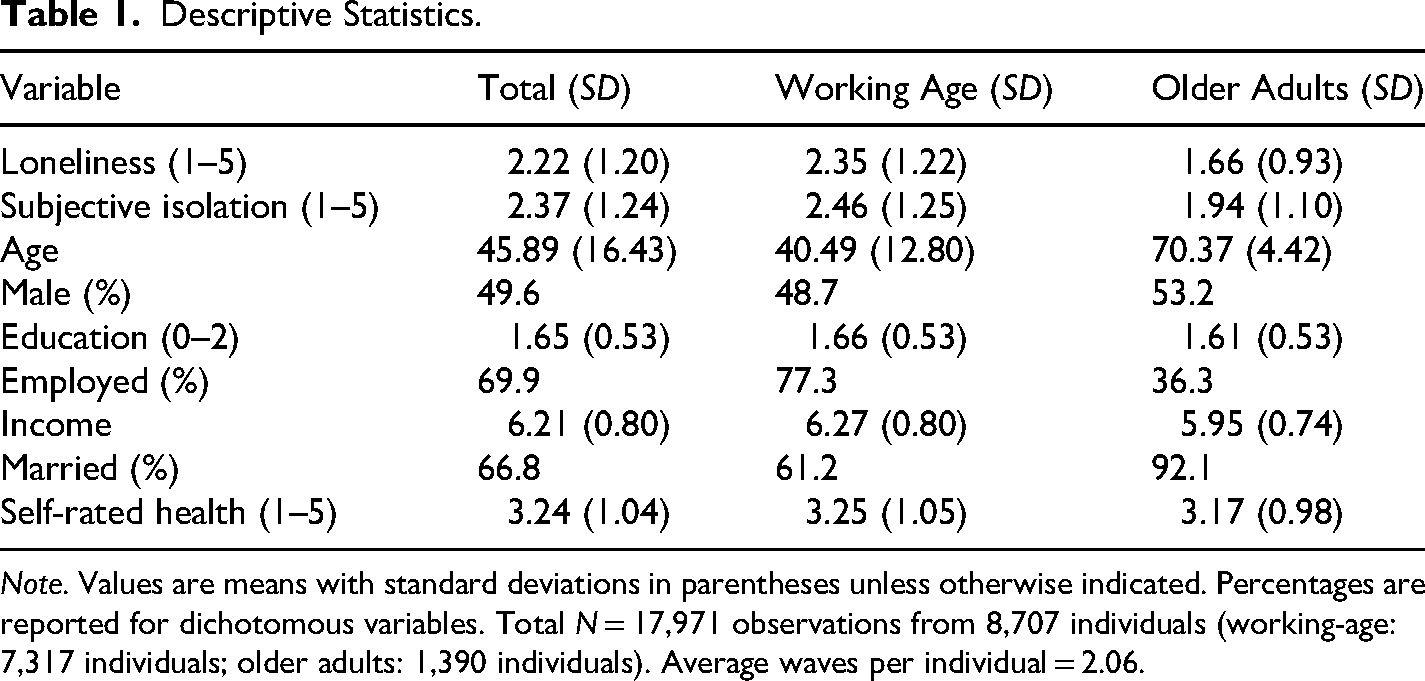
Note. Values are means with standard deviations in parentheses unless otherwise indicated. Percentages are reported for dichotomous variables. Total N = 17,971 observations from 8,707 individuals (working-age: 7,317 individuals; older adults: 1,390 individuals). Average waves per individual = 2.06.
Comparisons between the full and restricted samples indicated no substantive differences in key variables (see Supplemental Table 1).
Additional robustness analyses were conducted using alternative age thresholds (60 and 70 years) and cross-sectional models based on baseline wave data (see Supplemental Tables 2 and 3).
To examine age differences, respondents were categorized as working-age adults or older adults based on age at each wave, with individuals aged 65 years and older classified as older adults, consistent with conventions in Japanese aging research. Although age is inherently time-varying, the age-group indicator was treated as time-invariant for analytic simplicity. Only a small proportion of respondents transitioned into the older age category during the observation period (2.38%), and sensitivity analyses treating age group as time-varying confirmed that this did not materially affect the results.
Measures
Loneliness
Loneliness was assessed at each wave using a single-item self-report measure asking respondents: “I feel that I am lonely.” Responses were recorded on a 5-point Likert scale ranging from 1 (“not at all”) to 5 (“always”), with higher values indicating greater loneliness.
Although multi-item instruments such as the UCLA Loneliness Scale are often preferred, single-item measures are widely used in large-scale population surveys due to questionnaire constraints. Prior research suggests that single-item loneliness measures show moderate convergent validity with established multi-item scales (Mund et al., 2023) and consistent associations with mental health outcomes such as depression, anxiety, and life satisfaction (Reinwarth et al., 2023). However, it is important to note that single-item measures capture a relatively narrow aspect of the broader construct of loneliness and may overlap conceptually with measures of perceived social disconnection.
Subjective Isolation
Subjective isolation was measured using a single-item question intended to capture respondents’ perceived lack of meaningful social connection: “I feel that I have no one to enjoy activities with.” Responses were recorded on a 5-point scale (1–5), with higher scores indicating stronger perceived isolation. Although this item captures perceived social disconnection, it reflects a relatively specific aspect of isolation—namely, the absence of companionship—rather than a broader evaluation of relational adequacy.
Although this item captures an important aspect of perceived social disconnection, it reflects a relatively specific dimension of isolation—namely, the perceived absence of companionship for shared activities—rather than a comprehensive evaluation of relational adequacy. This operationalization is narrower than the theoretical construct as defined in prior work (Cornwell & Waite, 2009a), and readers should interpret the findings with this limitation in mind. Conceptually, subjective isolation is often defined as a cognitive appraisal of one's social relationships, in contrast to loneliness as an emotional experience. However, the use of single-item measures for both constructs may limit their empirical separation and introduce potential conceptual overlap between the predictor and outcome.
Both constructs were assessed using single-item measures, which is common in large-scale surveys due to questionnaire length constraints and respondent burden. While this approach limits the ability to capture the full multidimensional nature of each construct, single-item measures have been used as parsimonious proxies in population-based research. Future research employing validated multi-item scales would allow for a more comprehensive assessment of the cognitive and emotional dimensions of social disconnection.
Covariates
All models include sociodemographic and health-related covariates selected on the basis of their established associations with social disconnection and loneliness in prior research: sex (0 = female, 1 = male), age (in years), educational attainment (three categories), employment status (0 = not employed, 1 = employed), household income (log-transformed), marital status (0 = unmarried, 1 = married), and self-rated health (1 = poor to 5 = excellent). Wave indicators were included to account for period time trends and period-specific factors across survey years.
Between-Person and Within-Person Decomposition
To distinguish between-person differences from intraindividual change, time-varying predictors were decomposed into person-specific means and within-person deviations following the hybrid (correlated random-effects) approach.
For each time-varying variable 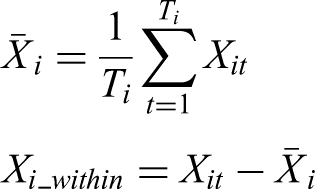
This decomposition was applied to subjective isolation and all time-varying covariates included in the models. The dependent variable (loneliness) was not decomposed, as hybrid models estimate between- and within-person associations through the decomposition of predictors.
By separating these components for subjective isolation and all time-varying covariates, the models distinguish enduring individual differences from short-term fluctuations, while retaining time-invariant predictors—such as age group—in their original form.
Analytic Strategy
Hybrid Random-Effects Models
We estimated hybrid random-effects models, also referred to as correlated random-effects models, to simultaneously assess between-person and within-person associations. This approach builds on the framework proposed by Mundlak (1978) and is recommended when researchers seek to retain both time-invariant predictors and within-person variation.
The general model specification is:
Including person-level means explicitly models the potential correlation between predictors and random effects, thereby relaxing the strict exogeneity assumption required by conventional random-effects models (Allison, 2009; Bell & Jones, 2015)
The between-person coefficient reflects the association between individuals’ average levels of perceived isolation and their average levels of loneliness, whereas the within-person coefficient reflects the association between deviations from an individual's typical isolation level and the corresponding changes in loneliness.
Age Moderation
To test whether the association between subjective isolation and loneliness differed by age group, interaction terms were included between the age group indicator and both the between-person and within-person components of subjective isolation.
This specification enables the examination of age differences at two levels: between-person differences (captured by interactions with person-level means) and within-person associations (captured by interactions with within-person deviations).
Predicted marginal effects and 95% confidence intervals were computed to facilitate interpretation of the interaction terms across age groups. Although loneliness and subjective isolation were measured on 5-point Likert scales, both were treated as continuous variables in the main analyses, consistent with common practice in social science research using ordered scales with five or more response categories. To assess the sensitivity of this assumption, supplementary analyses using ordered logistic regression yielded substantively similar results (see Supplemental Table 4). All analyses were conducted in Stata/MP 19.
Model Estimation
Models were estimated using random-effects generalized least-squares regression. Cluster-robust standard errors were specified at the individual level to account for the nonindependence of the repeated observations within persons.
Variance components were examined to assess the intraclass correlation coefficient (ρ), reflecting the proportion of total variance in loneliness attributable to stable between-person differences. A higher ρ indicates that individuals differ substantially in their typical levels of loneliness, supporting the use of hybrid modeling approaches. Model comparisons were evaluated using changes in explained variance and Wald tests for nested model specifications.
Robustness Checks
To assess the robustness of the findings, supplementary analyses tested alternative age thresholds (60 and 70 years). The direction and significance of the age moderation effects remained consistent across these alternative thresholds (see Supplemental Table 2), suggesting that the findings are not sensitive to the specific age cutoff used.
Additional analyses were conducted using data from the baseline wave only (Wave 4), estimated via ordinary least-squares regression with age interaction terms. The direction and relative magnitude of the associations were consistent with those observed in the main hybrid models, supporting the robustness of the primary findings (see Supplemental Table 3).
Ethical Considerations
The data used in this study were obtained from the Social Science Japan Data Archive (SSJDA), Institute of Social Science, The University of Tokyo (Survey Numbers 1559, 1613, and 1746). The original survey was conducted by the Cabinet Office of Japan and adhered to the established ethical guidelines.
This study involved secondary analysis of anonymized data. According to institutional guidelines, additional ethical approval was not required.
Results
Descriptive Statistics
Table 1 presents descriptive statistics for the restricted panel sample used in the main analysis (17,971 person-wave observations from 8,707 individuals), stratified by age group. Descriptive statistics for the full sample are provided in Supplemental Table 1. Respondents had a mean age of 45.9 years (SD = 16.4), and 49.6% were male. Approximately 16% of individuals were classified as older adults (aged 65 and above; n = 1,390 out of 8,707), reflecting the demographic composition of the sample.
Mean loneliness in the restricted sample was 2.22 (SD = 1.20) on a 5-point scale. Working-age adults reported higher average loneliness (M = 2.35, SD = 1.22) compared with older adults (M = 1.66, SD = 0.93). The difference of approximately 0.70 scale points corresponds to more than half a standard deviation of the older-adult distribution, suggesting a substantive age difference in average loneliness.
A similar pattern was observed for subjective isolation. The overall mean level of subjective isolation was 2.37 (SD = 1.24), with working-age adults reporting higher perceived isolation (M = 2.46, SD = 1.25) than older adults (M = 1.94, SD = 1.10). Thus, both perceived isolation and loneliness were, on average, lower among older adults in this sample.
Between-person correlations (Table 2) further clarify the relationships among key constructs. Between-person correlations between person-mean subjective isolation and person-mean loneliness were strong (r = .74, p < .001), indicating substantial shared variance at the stable individual level.
Between-Person Correlations Among Key Variables.
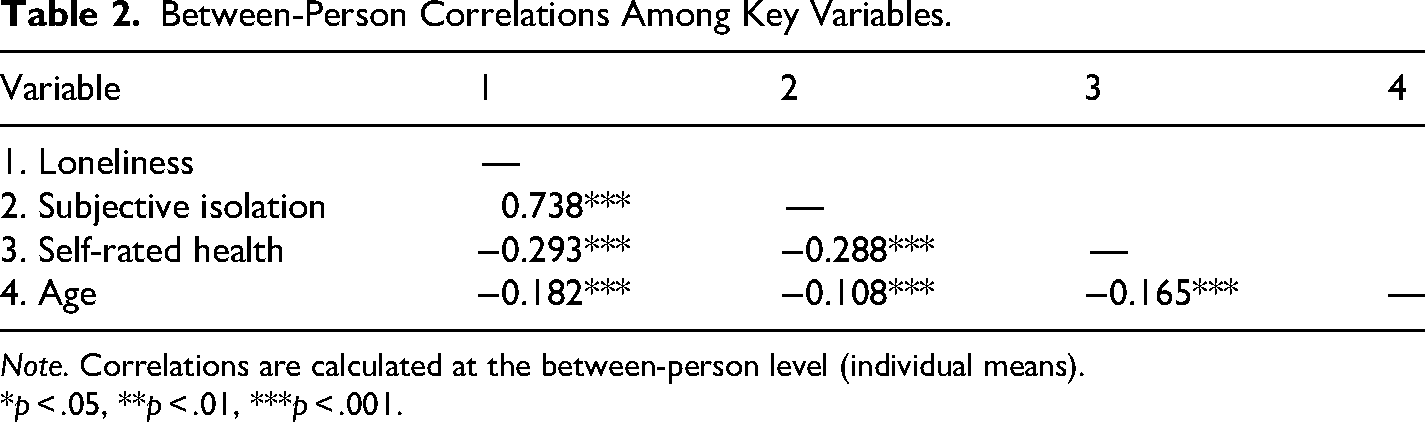
Note. Correlations are calculated at the between-person level (individual means).
*p < .05, **p < .01, ***p < .001.
Self-rated health was negatively associated with both subjective isolation (r = −.29, p < .001) and loneliness (r = −.29, p < .001), indicating that individuals reporting poorer health also tended to report higher perceived isolation and loneliness. Age was modestly and negatively correlated with both subjective isolation and loneliness, consistent with the descriptive differences observed between working-age and older adults reported above.
Between- and Within-Person Associations Between Subjective Isolation and Loneliness
Table 3 presents results from the full hybrid model, including subjective isolation and its interaction with age group. Variance components indicated that approximately 37% of the total variance in loneliness was attributable to stable between-person differences (ρ = 0.366), justifying the hybrid modeling approach and underscoring the importance of distinguishing between- and within-person associations. A baseline model without interaction terms is presented in Supplemental Table 5.
Hybrid Random-Effects Models Predicting Loneliness.
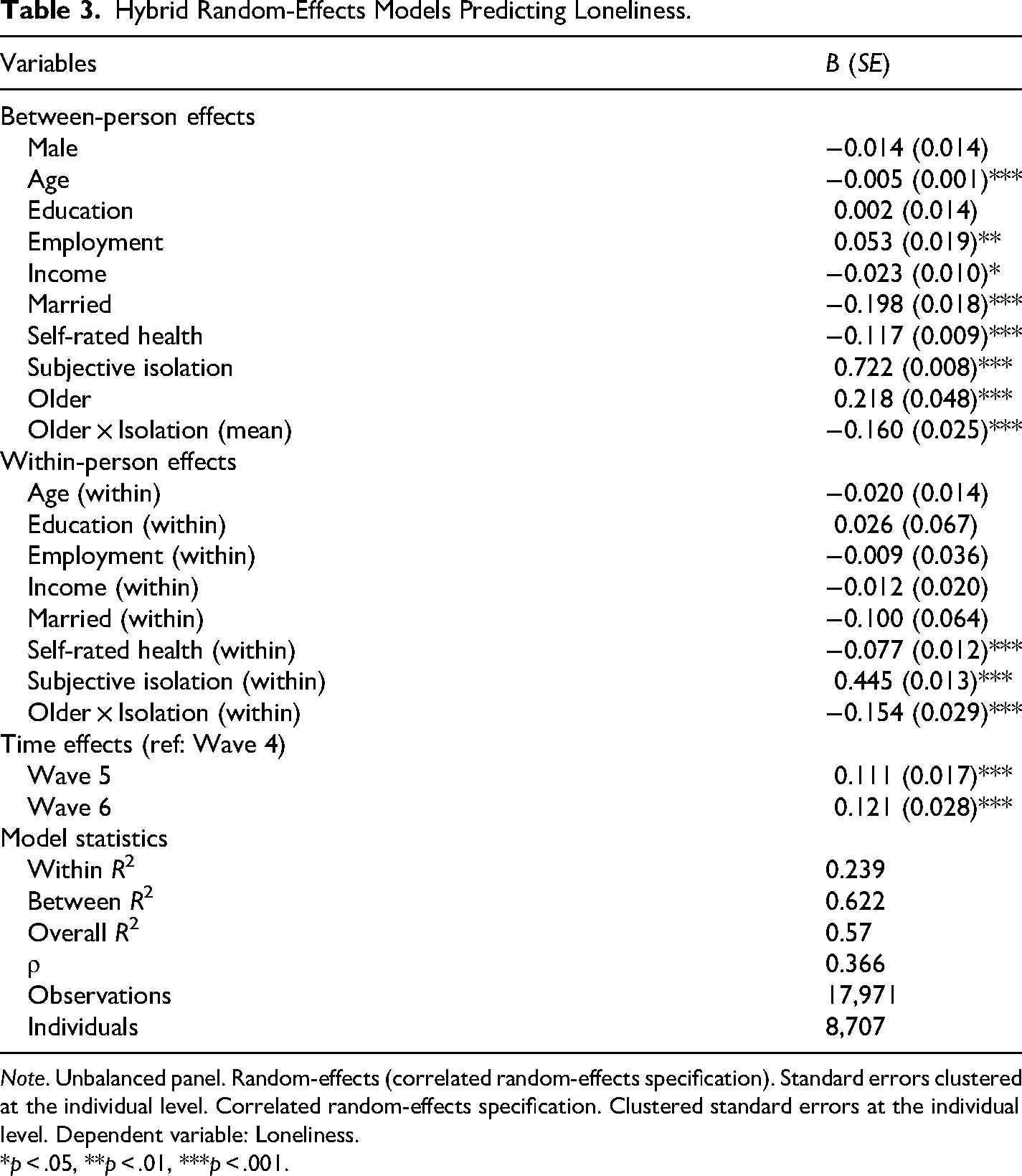
Note. Unbalanced panel. Random-effects (correlated random-effects specification). Standard errors clustered at the individual level. Correlated random-effects specification. Clustered standard errors at the individual level. Dependent variable: Loneliness.
*p < .05, **p < .01, ***p < .001.
Between-Person Effects
At the between-person level, average subjective isolation was positively associated with higher loneliness (b = 0.722, SE = 0.008, p < .001). This coefficient represents a relatively large association given that both variables are measured on the same 5-point scale.
Including subjective isolation substantially increased the explained variance in loneliness relative to the baseline model (see Supplemental Table 5), underscoring its role as a key correlate of between-person differences in loneliness.
Within-Person Effects
At the within-person level, deviations above an individual's typical level of subjective isolation were also significantly associated with higher loneliness (b = 0.445, SE = 0.013, p < .001). This finding suggests that increases in perceived isolation relative to an individual's own average were associated with higher loneliness across waves.
Notably, the between-person coefficient exceeded the within-person coefficient in magnitude. This pattern suggests that stable differences in perceived isolation across individuals are more strongly associated with loneliness than short-term within-person fluctuations. However, the within-person association remains meaningful, suggesting that loneliness varies alongside changes in perceived isolation over time.
Age Differences in Associations
To assess whether these associations differed by age group, interaction terms between age group and both the between- and within-person components of subjective isolation were included.
Between-Person Age Interaction
The interaction between older adulthood and the between-person component of subjective isolation was negative and statistically significant (b = −0.160, SE = 0.025, p < .001). This coefficient indicates that the association between average subjective isolation and loneliness was weaker among older adults than working-age adults.
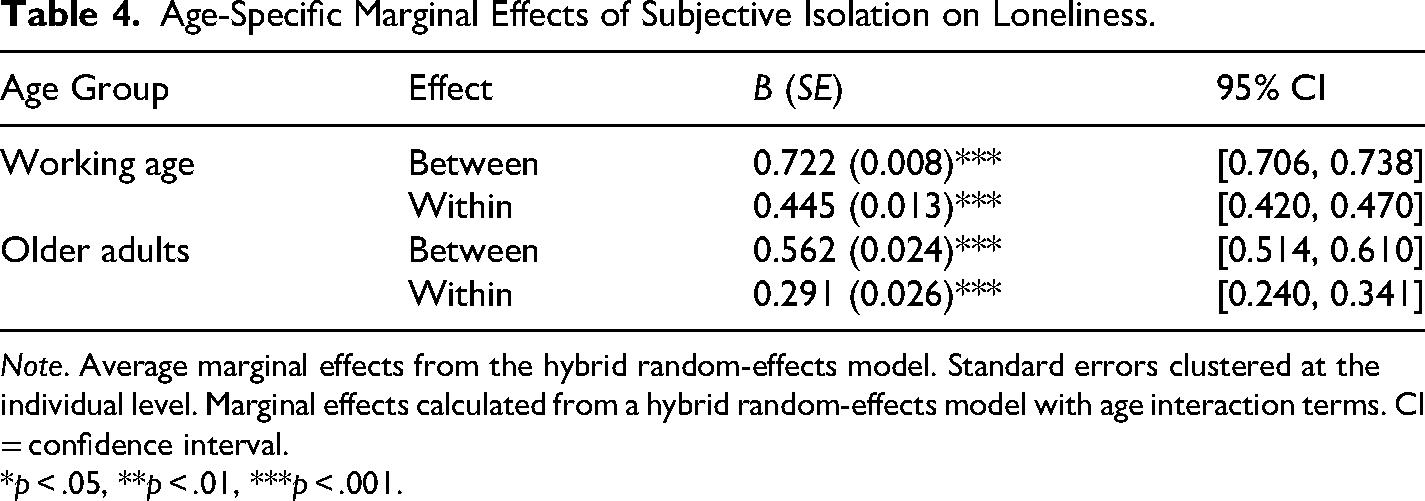
Marginal effects presented in Table 4 illustrate this pattern more clearly. Among working-age adults, the between-person association was 0.722 (SE = 0.008, p < .001), compared with 0.562 (SE = 0.024, p < .001) among older adults. Thus, although perceived isolation was positively associated with loneliness in both groups, the association was approximately 22% smaller among older adults (0.562 vs. 0.722)
Age-Specific Marginal Effects of Subjective Isolation on Loneliness.
Note. Average marginal effects from the hybrid random-effects model. Standard errors clustered at the individual level. Marginal effects calculated from a hybrid random-effects model with age interaction terms. CI = confidence interval.
*p < .05, **p < .01, ***p < .001.
Within-Person Age Interaction
A parallel pattern emerged at the within-person level. The interaction between older adulthood and within-person subjective isolation was negative and statistically significant (b = −0.154, SE = 0.029, p < .001). Marginal effects indicate that the within-person association was 0.445 (SE = 0.013, p < .001) among working-age adults and 0.291 (SE = 0.026, p < .001) among older adults.
These results suggest that short-term rises in perceived isolation were associated with a smaller corresponding rise in loneliness among older adults than among working-age adults.
The attenuation of the association at both levels suggests that age differences in the isolation–loneliness link are not confined to stable individual characteristics but also extend to dynamic, within-person processes.
Predicted Margins
Figure 1 displays predicted loneliness values across the levels of subjective isolation (between-person effect) for working-age and older adults, holding covariates at their means. For both groups, predicted loneliness increased with subjective isolation, consistent with the regression estimates.
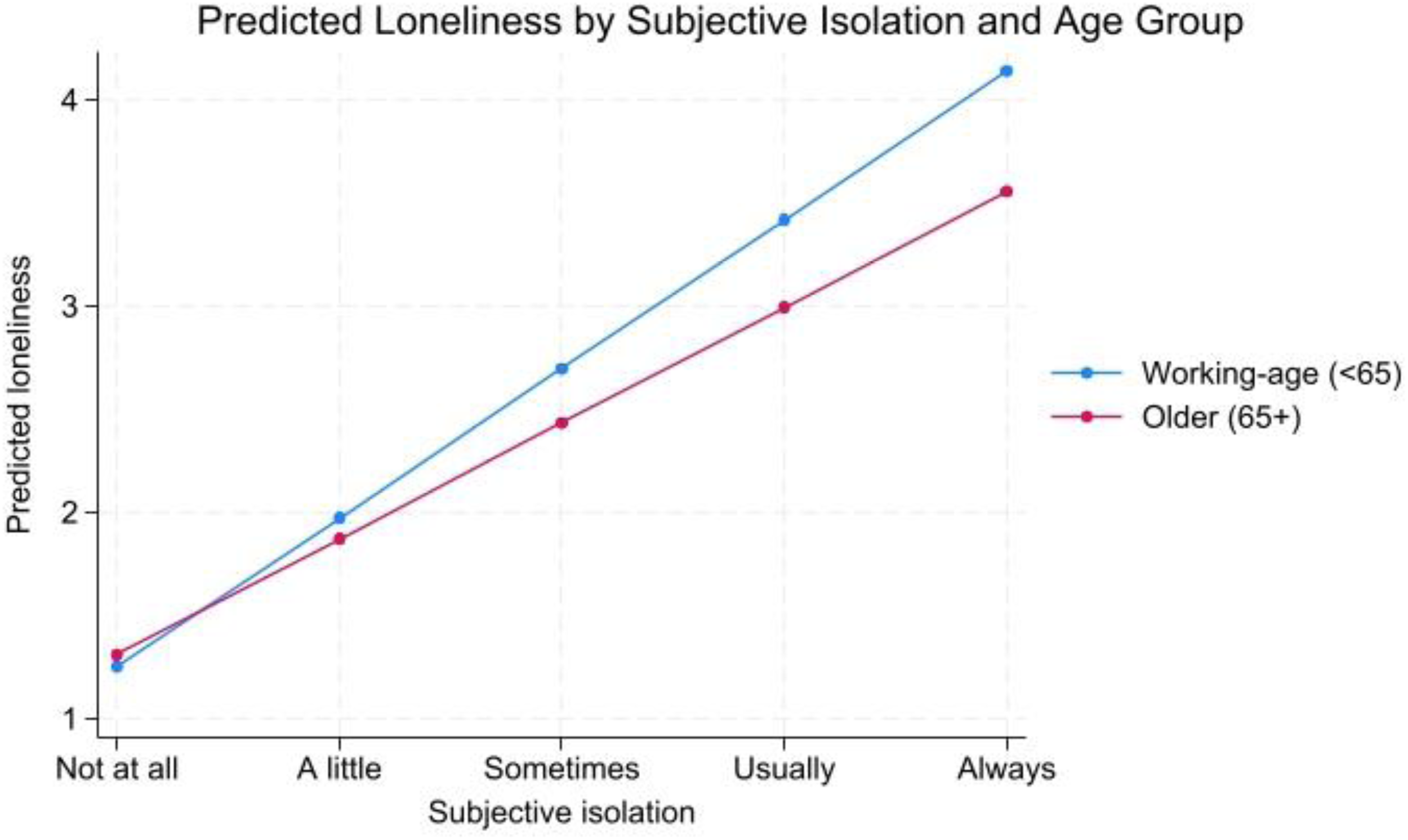
Predicted loneliness by subjective isolation and age group (between-person effect).
However, the slope of the predicted line was steeper for working-age adults. At lower levels of subjective isolation, predicted loneliness values were relatively similar across age groups. As subjective isolation increased, the predicted gap in loneliness between the two groups widened, with working-age adults showing consistently higher predicted values.
These patterns suggest that age differences in the association between subjective isolation and loneliness are particularly pronounced at higher levels of perceived isolation.
Robustness Analyses
Supplementary analyses using alternative age thresholds (60 and 70 years) produced comparable patterns (see Supplemental Table 2), suggesting that the findings were not sensitive to the specific operational definition of older adulthood.
Additional models using data from the baseline wave only (Wave 4) yielded consistent patterns of association. Subjective isolation remained positively associated with loneliness, and the age interaction retained both its direction and statistical significance (see Supplemental Table 3).
Summary of Findings
Across three waves of panel data from Japan, subjective isolation was positively associated with loneliness at both the between-person and within-person levels, with the between-person association somewhat larger in magnitude than the within-person association. Both associations were significantly weaker among older adults than among working-age adults. These findings suggest that the association between perceived social insufficiency and loneliness varies meaningfully across the adult life course—a pattern observed in a society undergoing rapid demographic aging and structural change in social relationships.
Discussion
Theoretical Implications
Distinguishing Cognitive and Emotional Dimensions
The findings of this study are consistent with the conceptual distinction between subjective isolation and loneliness as related but separable dimensions of social disconnection. Although the constructs were strongly correlated, the analytic separation suggests meaningful differentiation in how cognitive appraisals of social connection are associated with emotional distress. Subjective isolation captures the perception that one's social relationships are inadequate, whereas loneliness reflects the affective response to that perception. These findings are consistent with theoretical perspectives that conceptualize loneliness as an interpretive emotional signal rather than a direct reflection of objective social conditions (Hawkley & Cacioppo, 2010).
By distinguishing between-person and within-person components, this study contributes to the theoretical understanding of how these constructs operate over time. Stable individual differences in perceived isolation were more strongly associated with loneliness than short-term fluctuations. This suggests that enduring cognitive orientations toward social connectedness—possibly related to personality traits, attachment styles, or long-standing social conditions— are more strongly associated with emotional experiences than momentary changes.
At the same time, the significant within-person association indicates that loneliness is not purely trait-like. When individuals experienced increases in perceived isolation relative to their own typical level, they also reported increases in loneliness. This finding aligns with the dynamic models of social well-being, which emphasize responsiveness to changing social circumstances (Curran & Bauer, 2011).
These results suggest that loneliness is associated with both stable dispositions and situational responsiveness. Some individuals may possess chronic tendencies toward perceiving social relationships as inadequate, whereas others may experience episodic loneliness triggered by temporary changes in their social environments. Recognizing this dual structure helps reconcile prior debates regarding whether loneliness reflects stable personality traits or situational experiences.
These findings align with theoretical perspectives that position loneliness as an interpretive response to perceived social circumstances, rather than a simple reflection of objective network characteristics. Social environments provide information about relationship availability, which individuals evaluate against cognitive frameworks shaped by expectations, cultural norms, and prior experiences. Such frameworks may partly account for the strong between-person association observed in this study.
Life-Course Differentiation
A central finding of this study concerns age moderation. Both between-person and within-person associations between subjective isolation and loneliness were significantly weaker among older adults compared with working-age adults. Substantively, the association between subjective isolation and loneliness was approximately 20% weaker among older adults, indicating life-course differences in how perceived isolation is associated with emotional experiences.
Several theoretical perspectives may help interpret this pattern. SST proposes that as individuals age and perceive their future time horizon as limited, they increasingly prioritize emotionally meaningful relationships and invest more selectively in their social networks, reducing the emotional impact of perceived social inadequacy (Carstensen, 1992; Carstensen et al., 1999). Consequently, perceived social inadequacy may be less strongly associated with emotional distress in later life.
In contrast, midlife is often characterized by competing social demands and strong normative expectations regarding productivity, family roles, and social embeddedness. Perceived deficits in social connection during this period may be more strongly associated with loneliness. The stronger association observed among working-age adults suggests that perceived isolation may be more strongly associated with loneliness during midlife, a pattern consistent with research indicating heightened loneliness vulnerability in midlife populations (Luhmann & Hawkley, 2016).
Another interpretation involves adaptation and resilience. Older adults may develop coping strategies that are associated with reduced emotional responses to perceived isolation. Alternatively, they may recalibrate expectations regarding social contact, which may be related to a reduced discrepancy between desired and actual relationships (Akhter-Khan et al., 2023; Carstensen, 2021).
Importantly, these findings do not suggest that older adults are immune to loneliness. Rather, they indicate that the association between perceived isolation and loneliness differs in magnitude across the life course (Luhmann & Hawkley, 2016). The weaker association observed in later life may be related to factors such as emotional regulation, selective social investment (Carstensen, 2021; González et al., 2023), or the recalibration of relationship expectations in response to age-related contextual changes (Akhter-Khan et al., 2023).
The present findings are consistent with this life-course perspective. That the attenuation of the isolation–loneliness association was observed at both the between-person and within-person levels suggests that age-related differences in this link are not simply a product of stable compositional differences but may also reflect dynamic processes that unfold as individuals adapt to the changing social landscape of later life.
Methodological Contributions
This study also contributes methodologically by applying hybrid random-effects models to disentangle between-person and within-person processes. Many prior studies rely on cross-sectional designs that conflate these sources of variation. By decomposing predictors into person-specific means and within-person deviations, this study demonstrates that subjective isolation is associated with loneliness at both the between-person and within-person levels (Bell & Jones, 2015; Mundlak, 1978).
The consistency of findings across panel-based hybrid models and cross-sectional robustness analyses provides additional support for the observed associations. The age moderation pattern remained consistent across analytic strategies and alternative age thresholds. This consistency suggests that the observed life-course differentiation is not solely attributable to specific modeling assumptions.
Moreover, the variance decomposition revealed that a substantial portion of loneliness variance resides between individuals, underscoring that a substantial share of who reports loneliness is explained by enduring individual differences rather than short-term fluctuations. At the same time, significant within-person associations confirm that capturing intraindividual change over time provides information that cross-sectional designs cannot supply.
Implications for Research on Aging
The results are inconsistent with the common assumption that loneliness is primarily a problem of older age. In this quota-based online panel sample, older adults reported lower average levels of both subjective isolation and loneliness, and the association between these constructs was weaker among them. This pattern aligns with emerging research suggesting that loneliness may be particularly pronounced during midlife rather than exclusively concentrated in older age (Luhmann & Hawkley, 2016).
These findings have implications for how aging research conceptualizes vulnerability to loneliness. Rather than treating older adulthood as uniformly high risk, researchers may benefit from attending to variation in the emotional consequences of perceived isolation across the life course. The present results suggest that working-age adults, who face strong normative expectations around social productivity and network maintenance, may be particularly sensitive to the perceptions of social insufficiency.
Future research should examine whether these patterns generalize across cultural contexts. Japan's rapidly aging population, declining fertility, and cultural emphasis on group belonging and intergenerational ties may shape age-differentiated experiences of isolation and loneliness in ways that differ from Western contexts. Comparative cross-national research could help assess whether the weaker association observed in later life is consistent across contexts or varies by cultural conditions.
Policy and Practical Implications
The findings have potential implications for interventions targeting loneliness. Programs aimed at reducing loneliness often focus disproportionately on older adults. While older adults remain an important population, the present results suggest that interventions addressing perceived isolation in midlife may also warrant attention.
Given that subjective isolation is associated with loneliness, interventions that address perceptions of social adequacy—such as cognitive-behavioral approaches—may be worth examining as a complement to purely network-focused strategies. Additionally, workplace-based or community-based programs that strengthen meaningful social engagement during midlife may be particularly relevant for this age group.
For older adults, strategies may focus less on reducing immediate emotional reactions to perceived isolation and more on maintaining meaningful connections and preventing functional decline. The weaker association observed in later life may reflect adaptive capacities among older adults that social programs and community support structures might seek to reinforce.
Limitations
Several limitations should be acknowledged.
First, loneliness and subjective isolation were measured using single-item indicators. Although such measures are widely used in large-scale population surveys, multi-item scales may capture additional nuance and reduce measurement error. Future studies employing validated multi-item instruments may therefore provide a more detailed assessment of these constructs.
Second, the panel data include only three waves, which limits the ability to examine long-term trajectories. More extended longitudinal designs would allow researchers to explore dynamic processes across longer time spans and to apply cross-lagged models to assess directionality more rigorously.
Third, although hybrid models help reduce bias from unobserved time-invariant heterogeneity, they cannot eliminate bias arising from time-varying unobserved confounders. Future studies incorporating more detailed measures of social network structure, personality traits, and life events may better account for residual confounding and provide more precise estimates of these associations.
Fourth, subjective isolation and loneliness were measured contemporaneously within each survey wave. As a result, the temporal ordering of these constructs cannot be established, and the associations reported throughout should be interpreted as correlational rather than causal. Future research using designs with temporal separation between predictors and outcomes would allow for stronger inferences about directionality.
Fifth, the data were drawn from a nonprobability online panel. Although quota sampling was used to approximate population distributions across age, gender, and region, selection bias may still be present because participation in online panels is voluntary.
Finally, the dichotomous age-group classification simplifies life-course heterogeneity. Older adulthood is itself diverse, and future research should examine whether associations differ among subgroups such as the young-old and oldest-old.
Conclusion
Using data from a quota-based online panel survey conducted nationwide in Japan and hybrid random-effects models, this study finds that subjective isolation is positively associated with loneliness at both the between-person and within-person levels. Crucially, the strength of this association varies across the life course, with stronger associations at both the between-person and within-person levels observed among working-age adults than among older adults.
These findings suggest the importance of distinguishing cognitive and emotional dimensions of social disconnection and highlight what longitudinal designs can reveal about age-differentiated patterns that cross-sectional approaches cannot. Loneliness is not concentrated in older age; rather, the strength of its association with perceived isolation varies across adulthood. In a society like Japan, where demographic aging and shifting social structures are reshaping the landscape of social relationships, these life-course distinctions may be especially consequential for theory, research, and the design of interventions aimed at promoting social well-being.
Supplemental Material
sj-docx-1-ahd-10.1177_00914150261456741 - Supplemental material for Age Differences in the Association Between Subjective Isolation and Loneliness: Evidence from a Hybrid Panel Model
Supplemental material, sj-docx-1-ahd-10.1177_00914150261456741 for Age Differences in the Association Between Subjective Isolation and Loneliness: Evidence from a Hybrid Panel Model by Hwang Choe in The International Journal of Aging and Human Development
Footnotes

Ethical Considerations
Ethical approval was not required for this study as it utilized a de-identified secondary dataset provided by the Social Science Japan Data Archive (SSJDA), Center for Social Process Data Science, Institute of Social Science, The University of Tokyo.
Funding
The author received no financial support for the research, authorship, and/or publication of this article.
Declaration of Conflicting Interests
The author declared no potential conflicts of interest with respect to the research, authorship, and/or publication of this article.
Supplemental Material
Supplemental material for this article is available online.
Author Biography
References
Supplementary Material
Please find the following supplemental material available below.
For Open Access articles published under a Creative Commons License, all supplemental material carries the same license as the article it is associated with.
For non-Open Access articles published, all supplemental material carries a non-exclusive license, and permission requests for re-use of supplemental material or any part of supplemental material shall be sent directly to the copyright owner as specified in the copyright notice associated with the article.
