






Abstract
Research Questions:
Using a sample of 56,807 community college students and 10,343 faculty from 105 community colleges, this study asked which faculty behaviors were associated with student learning, and if there were differences in those behaviors based on faculty type.
Methods:
Our two-stage analysis used data from the Community College Survey of Student Engagement (CCSSE) and the Community College Faculty Survey of Student Engagement (CCFSSE). We used hierarchical linear modeling (HLM) to identify faculty practices that predict student learning, with a random-effects ANOVA model and a means-as-outcomes model. After identifying the faculty practices that most strongly predicted learning, we identified differences in frequency of their use based on faculty type.
Results:
Three of the four strongest indicators of student learning were an emphasis on (a) support to help students succeed, (b) contact among students from different backgrounds, and (c) amount of study time. Talking about career plans with an instructor or advisor predicted career learning, academic learning, and personal development. Full-time faculty, faculty teaching career and technical education, developmental faculty, and faculty who had taught a course more than 20 times used these effective practices more than other faculty.
Conclusions:
Introducing students to institutional support for their success was the strongest predictor in the model, but part-time faculty, faculty teaching only college-level courses, and faculty with less experience in a course engaged in this behavior less often than their peers. Part-time faculty may need more information about support available to students, and college-level faculty could benefit by emphasizing support services.
Introduction
The experience of community college (CC) students takes place almost exclusively in the classroom, making CC faculty the primary institutional agents with whom students interact (Deil-Amen, 2011; Lundberg, 2014). Some of the benefits to students when they engage with faculty include higher GPAs (Dika, 2012; Kim & Sax, 2009), learning (Cox & Orehovec, 2007; Kim & Lundberg, 2016; Lundberg & Schreiner, 2004), and intent to persist (Barnett, 2011). Much of student-faculty interaction research is based on four-year college students, but a growing and substantial body of research focuses on the experiences of CC student engagement with faculty. Qualitative studies of CC students uncover students’ experiences with CC faculty that shaped their success (Bensimon & Dowd, 2009; Deil-Amen, 2011), but quantitative studies with a large national datasets are needed to generalize findings more broadly (Doran & Brown, 2025)
Compounding the challenge of understanding the way faculty shape student learning is the changing composition of college faculty because of decreases in funding to public higher education for the past four decades (Laderman & Kunkle, 2022). Decreases in tenure-track faculty and full-time faculty are two common strategies Taylor and Holley (2024) identified and described as “a faculty model that made some concession to its changing environment” (p. 638). As institutions with declining resources employ strategies to build a faculty, identifying effective teaching practices and the types of faculty who most often employ those practices is essential.
Our study is modeled after Lancaster and Lundberg’s (2019) study of a particular CC that uncovered faculty behaviors that predicted student learning and identified faculty who most often engaged those behaviors. Utilizing a multi-institutional national sample of 56,807 CC students and 10,343 faculty from the same set of 105 CCs, this study examines measures of both institutional- and student-level effects. Like Lancaster and Lundberg, we use data from the Community College Survey of Student Engagement (CCSSE) and the Community College Faculty Survey of Student Engagement (CCFSSE) to identify faculty behaviors that predict learning, and then we identify types of faculty who use those behaviors most often.
Literature Review
Student-faculty Interaction
Qualitative studies have captured specific ways faculty support CC student success. In Deil-Amen’s (2011) study, institutional agents, primarily faculty, were reported by 92% of the students as being instrumental in their integration into the CC experience, and that integration took place primarily during class time. Students described faculty as sharing institutional information with them, enabling them to use college services and supports more effectively. Faculty also employed specific affirmations of individual students and more general affirmations of the class, such as encouraging questions and responding to those questions with respect and care. Students recounted their engagement with peers in the classroom and in course-related work. Deil-Amen described faculty as creating social and academic integration in the classroom, employing teaching practices that encouraged students to engage with one another over course material. One study investigating Deil-Amen’s framework found faculty confirmation of CC students’ value and abilities contributed to the students’ self-efficacy (Peaslee, 2018). Other studies found that faculty support enabled students to navigate the CC environment (Rucks-Ahidiana & Bork, 2020), earn higher grades (Evans et al., 2016), feel a greater sense of belonging (García & Garza, 2016; Garza et al., 2021), and feel a lesser sense of isolation (Pichon et al., 2019). Together, these studies find the roles of CC faculty go far beyond course material. Community college faculty play a central role in providing affirmation and information about how to access institutional sources of support, and creating an academic community are central roles for CC faculty. Like Deil-Amen’s (2011) study, more recent research (Aguilar-Smith & Gonzalez, 2021) has found that CC faculty see their role extending beyond communicating their belief in the students’ ability to succeed at the college, to understanding the students’ responsibilities outside of college.
Quantitative studies of CC faculty verify the central role of faculty as contributors to student success, with students’ sense that their instructor was available, helpful, and sympathetic as the strongest predictor of student learning (Lancaster & Lundberg, 2019; Lundberg et al., 2018). Xiong and Wood (2020) found CC faculty validation of students was a precursor for meaningful student-faculty interaction. Price and Tovar (2014) focused on high impact practices at the CC level and found CCSSE benchmarks support for learners and active and collaborative learning predicted CC graduation rates. Active and collaborative learning combined students working together during class and outside of class, students tutoring one another, and time for students to discuss ideas from readings with the instructor, similar to the type of faculty engagement Deil-Amen reported. Support for learners included items about students’ awareness of institutional support for their success. Another study found student faculty interaction and discussing career plans with faculty predicted grades for CC students (Tovar, 2015).
Faculty Types
CC faculty are diverse in terms of preparation through a traditional academic pathway or through industry experience; employment as full or part-time; instruction of students in transfer courses, developmental courses, or Career and Technical Education (CTE), and in terms of how much experience they bring to the classroom. Effective instruction may vary based on course type, so practices in a transfer-level course may not be effective in a CTE course or a developmental education course. Following Lancaster and Lundberg (2019), our study focuses on effective practices of types of faculty based on contract (full-time or part-time), level of instruction (transfer, developmental, or CTE), and years of experience teaching a particular course.
Part-time Faculty
As funding to public higher education has declined (Laderman & Kunkle, 2022), institutions have adjusted by changing the types and number of faculty they employ (Finkelstein & Li, 2022; Taylor & Holley, 2024). One strategy to address funding shortfalls for CCs has been to increase part-time faculty, who currently comprise 65% of CC faculty (Phillippe, 2024). Compared with full-time faculty, part-time faculty earn lower pay, have fewer opportunities for engagement in the department and in professional development, and often lack office space (Bickerstaff & Chavarín. 2018; Kisker et al., 2023). Part-time faculty often teach at multiple campuses, limiting their time with students (Ran & Sanders, 2020). A study of department chairs found little investment in part-time faculty development, often hiring part-time faculty to fill last-minute teaching vacancies (Zoromski & Sasso, 2024). Part-time faculty engaged less often in high impact teaching practices than their full-time peers (CCCSE, 2014), which may be attributed to less departmental attention to professional development for them.
Most studies have found a higher proportion of part-time faculty was negatively related to student outcomes, including retention (Jaeger & Eagan, 2011), degree completion (Eagan & Jaeger, 2009), and graduation and transfer rates (Carrier et al., 2023). However, these effects may be due to other differences in courses taught by part-time faculty, such as more evening and weekend courses. In a longitudinal study of CCs across the nation, graduation rates of full-time students were negatively related to the percentage of part-time faculty at the institution (Yu et al. 2023).
Studies indicate a greater percentage of full-time faculty may benefit students who are poorly served in higher education. A study of California CCs found a greater percentage of full-time faculty was associated with higher completion rates for academically unprepared and economically disadvantaged students (Wassmer & Galloway, 2023). Ran and Sanders (2020) found students in developmental and gateway courses with part-time faculty had lower re-enrollment rates than those with full-time faculty. In developmental and gateway courses, full-time faculty tended to be more knowledgeable about support strategies and services than part-time faculty (Ran & Sanders, 2020). This suggests part-time faculty may be less able to provide the information and support that contributed to student success in Deil-Amen’s study (2011). Compared with full-time faculty, part-time faculty less frequently referred students to support services, met less often with them outside of class time, spent less time preparing for class and giving feedback, and had less teaching experience (CCCSE, 2014). However, Lancaster and Lundberg’s (2019) single-institution study found the only difference between part-time and full-time faculty was that full-time faculty more often emphasized new skills in their courses.
Developmental Faculty
Students in developmental courses are less likely to meet their educational goals, and many have been unable to move to college-level courses (Bailey et al., 2010). Colleges have implemented developmental education reforms that research has shown to improve student passing rates (Cullinan & Kopko, 2022; Ran & Lin, 2022). However, less is known about how faculty practices and student-faculty interaction contribute to learning for students in developmental courses. In Lancaster and Lundberg’s (2019) study, the strongest predictor of students’ learning was the extent to which students found their instructor to be available, helpful, and sympathetic; developmental students scored their instructors significantly lower than other students on that measure.
Faculty with More Teaching Experience
A program at the City University of New York (CUNY) system in which experienced faculty mentor novice faculty teaching developmental education courses led to developmental students becoming college-ready in math and reading/writing at a greater rate than students in the control group (Scrivener et al., 2018). Central to the success of the CUNY program was the pairing of new faculty with faculty who used a student-centered approach to learning and who had taught the course multiple times (Cormier & Bickerstaff, 2020). Their focus on student-centered learning is consistent with Deil-Amen’s (2011) findings, and their assumption that teaching a course multiple times benefits students is consistent with Lancaster and Lundberg’s (2019) findings.
Career and Technical Education Faculty
Although there is no universal definition, CTE faculty are generally described as educators who teach vocational and technical programs designed to prepare students with the skills necessary for specific careers or industries such as healthcare, computer information sciences, and mechanic and repair technology (Gauthier, 2021; Soliz, 2023; Williams et al., 2024). In contrast, non-CTE faculty typically teach courses in academic fields such as humanities, social sciences, and natural sciences with the goal of preparing students for transfer to a baccalaureate-granting college or university.
The role of CTE in community colleges has been debated. Some see it as limiting students' further educational aspirations and preparation by focusing too exclusively on career preparation (Ravitch, 2013), while others view it as fulfilling a central mission in terms of workforce development (Stevens et al., 2019). CTE faculty saw the role of CTE as accomplishing both missions, with the possibility of no conflict between the two (Gauthier, 2021). The qualifications for CTE faculty vary by state, can be difficult to find, and may be confusing (Bartlett, 2002; Bazile & Walter, 2009). A minimum standard for CTE faculty is often an associate degree or certification from industry, which some critics argue limits CTE instructors’ competence in fostering learning beyond the technical focus of their courses (Fletcher et al, 2018; Pryor et al., 2012). In a study of CC faculty who transitioned from industry, faculty were concerned about their lack of professional training in education and their lack of familiarity with institutional policies that might help them guide their students (Wagner, et al, 2021). However, those faculty also brought strengths in terms of bringing industry examples into the classroom, exposing students to field experiences outside the classroom, and mentoring students. Compared with their faculty peers in other areas of the college, CTE faculty are more likely to be employed part-time as they maintain full-time employment in industry (Levin et al., 2011). An overlooked strength of CTE classes is the hands-on nature of their classrooms, problem-focused instruction, and active engagement of students (Gauthier, 2021).
Similar Studies at the Four-Year College Level
At the four-year college level, several studies including data from students and faculty at the same institutions using NSSE and the FSSE have a similar design to that of Lancaster and Lundberg (2019) and to the design of our study. Two studies found students engaged more in effective learning practices when faculty emphasized those practices, and students enjoyed more learning gains at institutions where faculty emphasize good educational practices (Kuh et al., 2004; Nelson Laird et al., 2008). Identifying effective practices by faculty type, Kuh and colleagues (2004) found that women, Faculty of Color, and full-time faculty engaged more often in the good practices identified in NSSE and FSSE, while faculty with more years of teaching experience engaged less often in active and collaborative learning and enriching educational experiences than their counterparts with fewer years of teaching experience. In a summary of studies using FSSE and NSSE data, Kuh and Lingenfelter (2020) state, “the greater the number of academic staff who believe it is important for their students to participate in high-impact practices (HIPs) before they graduate, the greater the number of students who participate in these practices” (p. 177).
Conceptual Framework
Our conceptual framework is based on Deil-Amen’s (2011) construct of CC faculty as the key institutional agents who foster social and academic integration in the classroom, introduce students to institutional supports, and affirm students in their ability to succeed. Central to Deil-Amen’s model is the concept that student engagement with peers and faculty occurs primarily in the classroom, yet its effects extend beyond classroom learning. Such engagement is created by faculty who are affirming, helpful, and who use the classroom to create moments of social and academic integration. Effective faculty also use the classroom to make sure students understand the institutional support available to them. Grounded in Deil-Amen’s model, and following the same line of reasoning as Lancaster and Lundberg (2019), we hypothesize that faculty behaviors shape student learning, and that engagement of effective practices varies by faculty type. Our study focuses on the practices CC faculty engage with students, the extent to which students find faculty available and helpful, and the extent to which students understand the supports available to them at the college. Given that faculty are the primary institutional agents with whom students interact, our assumption is that at least some of that awareness comes from faculty instruction.
Following Bensimon’s (2007) argument that student success is the responsibility of the institution and its agents, Deil-Amen (2011) casts faculty as the institutional agents responsible for socio-academic moments that foster student success. Our study follows in that line of reasoning, placing responsibility on faculty for fostering student learning. We build on Deil-Amen’s framework by testing the model with a large national sample, using similar measures to predict student learning. Then, we ask which types of faculty engage in those effective behaviors most often.
Specifically, the questions are:
What community college faculty behaviors predict general education learning, personal development, and career learning?
What types of faculty engage in those effective behaviors most often?
Method
Data Source and Sample
This research utilized data extracted from the 2023 CCSSE and the 2023 CCFSSE, national databases including respondents from 2021, 2022, and 2023. To ensure proper alignment between student and faculty responses, we included only institutions that administered both CCSSE and CCFSSE in the same calendar year. This approach minimized potential mismatches in timing and ensured that data reflected the same institutional context. Student respondents included 28.1% in 2021, 34.3% in 2022, and 37.5% in 2023; faculty respondents included 35.6%, 36.4%, and 28.0%, respectively. Although we considered analyzing each year separately, combining data increased statistical power and enabled more robust subgroup comparisons, enhancing the generalizability of our findings across community colleges.
CCSSE was originally developed in 2001 to provide CC administrators with critical information about the relationship between various aspects of student engagement that the literature has demonstrated are related to success. While considerable literature existed on student engagement, the vast majority was based on the experiences of students attending four-year colleges and universities (e.g., Astin, 1984; Chickering & Gamson, 1987; Pace, 1984; Pascarella & Terenzini, 1991) which can be vastly different from the experiences of students enrolled in CCs. CCSSE was developed to gather information specifically on the experiences of CC students. Several early revisions, based on pilot and field tests, resulted in the first national version launched in 2005; additional revisions were implemented in 2017 to reflect changes in the CC environment. 1 The CCSSE survey provides CC administrators with actionable data highlighting educationally effective activities used as well as those underutilized at their institutions to inform practices and policies with the goal of maximizing student learning outcomes.
CCSSE is administered every spring between January and mid-May. Colleges participate on varying schedules: some every three years, some every other year, and a small number every year. Students in credit-bearing and developmental math and English courses are eligible to participate. Colleges have two options for administering the survey: either on paper in randomly selected survey-eligible classes or online. For the online administration, colleges distribute a link to the survey in Qualtrics to all eligible students. 2 Students are asked to respond to the survey thinking about their overall experience for the entire academic year.
Student success is not a unidimensional construct. While students contribute one dimension of their ultimate success, the institution (including faculty and staff) also contributes to this success. CCFSSE, first administered in 2005, was developed to obtain an understanding of the contributions faculty make to student success. Faculty are asked about their teaching practices, their interactions with students both inside and outside of the classroom as well as other aspects of their responsibilities at the college. Periodically, additional questions are added to the survey to collect additional information such as the faculty role in advising and participation in professional development. This survey is administered in conjunction with CCSSE, although not all colleges that administer CCSSE also administer CCFSSE. 3
The faculty survey is administered online. Since many faculty teach multiple courses and/or multiple sections of the same course, and the classroom environment can differ from one section to another, the research staff at the Center for Community College Student Engagement (CCCSE) randomly select one course section the faculty member is teaching during the spring academic term, and faculty are instructed to answer the survey thinking only about their experiences in that specific course section. We recognize that instructors may adapt their pedagogy depending on course level, audience, or modality. However, given the CCFSSE protocol, we must treat the CCCSE-selected course as a proxy for overall teaching practice. This approach assumes a degree of consistency in instructional style, supported by research showing that instructors often develop stable teaching schemas over time (Kember & Kwan, 2000). Still, variation is possible, and this limitation should be considered when interpreting faculty-level findings.
Both CCSSE and CCFSSE include demographic questions. CCSSE items include questions regarding the frequency of student behaviors in the classroom, uses of various support services, their assessment of their learning gains across different domains, and involvement in other diverse facets of the college journey. The CCFSSE parallels many of the CCSSE items but focuses on insights from the faculty's viewpoint. Additionally, CCFSSE inquires about how faculty spend their time and additional responsibilities outside of the classroom. Where the items touch on the same topics, the difference between the student and faculty surveys lies in the item stems: CCSSE asks students to think about how often they engage in specific behaviors or activities throughout the academic year, while CCFSSE asks faculty about their perception of how often students engage in those behaviors or activities in their selected course. Using these similar questions, our study used a two-step analysis. First, we identified the student behaviors that predicted self-reported learning, and then we identified the types of faculty who most often use those behaviors.
Student Data
Our total sample included 59,982 students. We first removed 1,651 students who did not respond to questions on gender, race, or enrollment status, reducing the sample to 58,331. Expectation-Maximization (EM) procedures were then used to impute missing values for continuous variables, resulting in the imputation of 1,016 cases (1.7% of the adjusted sample). This approach follows recommendations by Tabachnick and Fidell (2007) and Allison (2002) for handling missing data under the assumption that values are missing at random. After deleting cases with missing data on categorical variables, the final analytical sample was 56,807 students. Of these, 63.7% were enrolled full-time, and 36.3% were enrolled part-time. In terms of gender, 66.1% identified as women and 33.9% as men. Regarding race and ethnicity, 55.8% identified as White and 44.2% as Students of Color.
Faculty Data
The initial faculty sample consisted of 11,025 instructors. Similar to student data, Expectation-Maximization (EM) procedures were applied to impute missing values in 485 cases (4.4% of the sample). Analyses of missingness patterns indicated no evidence of systematic missingness in the teaching data; missing values appeared to occur at random. Following deletion of cases with missing categorical data, the final analytical sample consisted of 10,343 faculty members. In this sample, 37.8% were part-time, 62.2% full-time; 32.5% identified as teaching career and technical education (CTE) courses. Faculty teaching assignments varied, with 3.5% teaching only developmental-level courses, 86.4% teaching only college-level courses, and 10.1% teaching a mix of both. Regarding teaching experience, 20.7% had taught the course 0–3 times, 42.9% had taught it 4–20 times, and 36.4% had taught it 21 or more times.
Dependent Variables
The first step of this study used three dependent variables which measure learning, based on students' self-reports. A potential limitation of our study is reliance on self-reported learning, which has been questioned for its validity (Porter, 2011). However, in a study of the self-reported student measures of learning in the CCSSE, McCormick and McClenney (2012) found a relationship between CCSSE self-reported items and GPA and degree attainment. Using exploratory factor analysis (EFA), the nine items resulted in three conceptual domains: career learning (α = .882), academic learning (α = .844), and personal development (α = .671). The three distinct factors had strong loadings ranging from .712 to .894 supporting the construct validity of the groupings. This factor structure aligned closely with prior studies using CCSSE data (e.g., Lancaster & Lundberg, 2019; McCormick & McClenney, 2012). We further confirmed the reliability of each composite scale using Cronbach’s alpha, which indicated acceptable to strong internal consistency. This psychometric validation supports our use of these composite scales as dependent variables. See the top panel of Table 1 for a list of the items in each of these domains.
Variable Definitions and Scales.
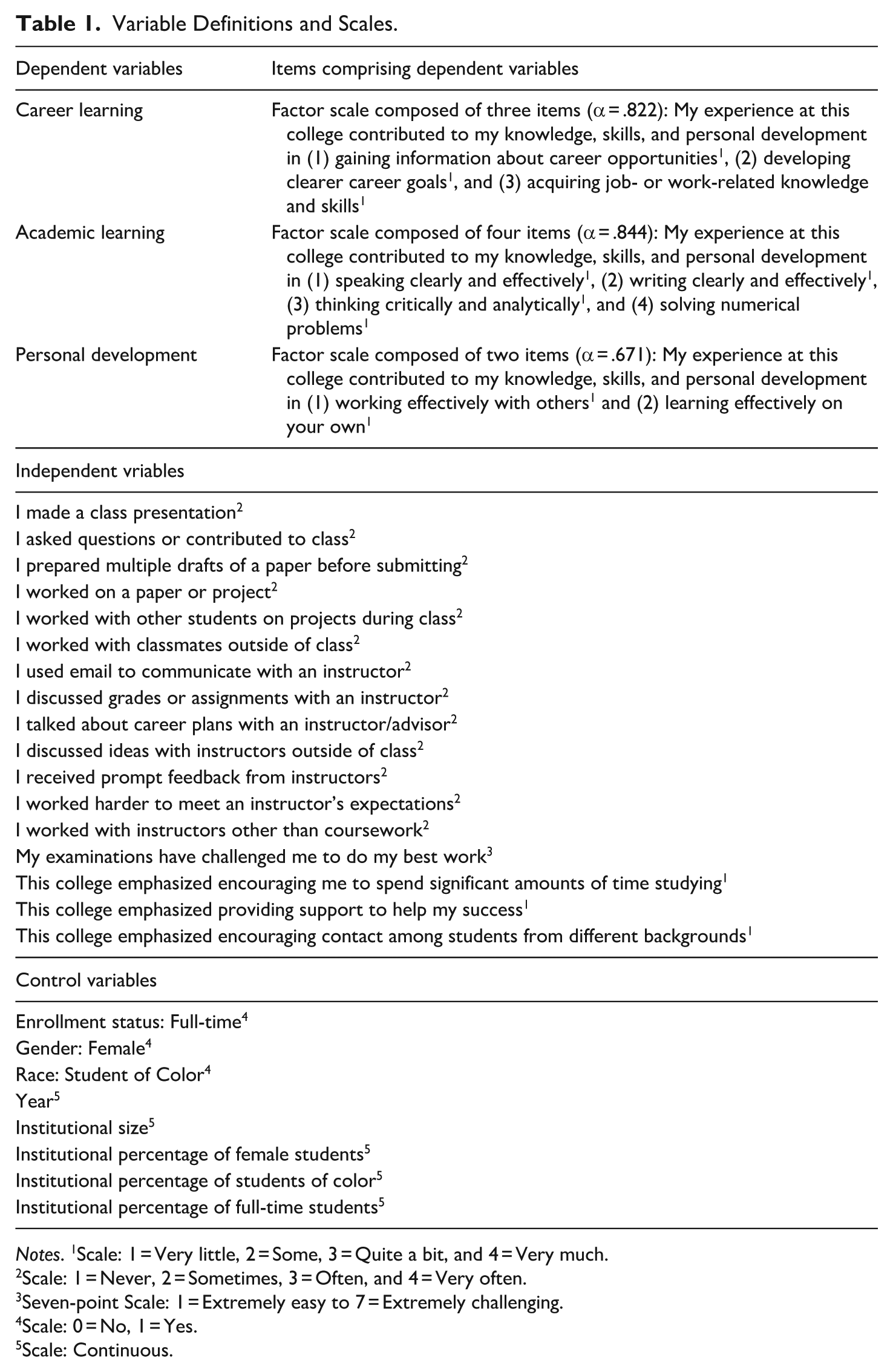
Notes. 1Scale: 1 = Very little, 2 = Some, 3 = Quite a bit, and 4 = Very much.
Scale: 1 = Never, 2 = Sometimes, 3 = Often, and 4 = Very often.
Seven-point Scale: 1 = Extremely easy to 7 = Extremely challenging.
Scale: 0 = No, 1 = Yes.
Scale: Continuous.
Independent Variables
The CCSSE and CCFSSE share a common set of variables that capture students’ and faculty’s perceptions of behaviors and practices associated with engagement. For instance, both surveys include items such as “worked with other students on projects during class” or “received prompt feedback from instructors.” In this study, we used 17 variables drawn from the CCFSSE, all measured on a 4-point Likert scale, to assess how frequently instructors perceived these behaviors occurred in the course section they were asked to reflect on. These variables were selected based on their theoretical relevance to student engagement, particularly in terms of student-faculty interaction, and instructional practices, as well as their alignment with items in the student CCSSE instrument. They served as independent variables in the first research question of the study. For several variables—such as “emphasizing support to help students succeed”—the items measure the degree to which the course emphasized values or behaviors. These “emphases” do not capture direct behavior but rather the extent to which instructors communicated the importance of certain practices. For instance, “providing support” includes actions like referring students to advising, tutoring, and other institutional services, as well as faculty themselves offering academic guidance and emotional encouragement both in and out of the classroom. It reflects the instructor’s role in helping students understand and access institutional resources while also serving as a consistent source of academic and emotional support throughout their learning experience. Although the scale is labeled as “course emphasis,” it is based on faculty self-report and should be interpreted as the instructor’s intentional focus or messaging around these supports within the course. See the middle panel of Table 1 for a list of these variables.
We also included four student-level demographic variables as control variables. Gender was classified as man or woman because the responses for “other” (n = 788, 1.3%) and “I prefer not to respond” (n = 940, 1.6%) were few and non-specific. Race was coded as “White” and “Student of Color” due to small subgroup sizes, which limited statistical power for more granular comparisons. While this binary coding is a limitation, it allowed us to retain race in the model while maintaining model stability. We acknowledge that this approach oversimplifies the diversity within the Student of Color category and recommend future research explore disaggregated racial groups where sample size permits. Student enrollment status was classified as full-time or part-time. A fourth control was the year when the student took the survey, 2021, 2022, or 2023. Year was coded as a continuous variable. Furthermore, we included four institution-level control variables—institutional size, percentage of full-time students, percentage of female students, and percentage of Students of Color—to account for contextual differences that may influence student engagement and learning. These factors help reduce omitted variable bias in multilevel modeling and reflect institutional characteristics known to shape learning environments (Mayhew et al., 2016). We did not include institution-level faculty variables because the outcome of interest is student-reported learning gains, and faculty data could not be reliably linked to individual student responses due to the absence of a unique student-faculty identifier.
Analysis
Our analysis comprised two stages. Stage one utilized data gathered from the CCSSE and stage two drew from data collected through the CCFSSE.
Analysis of Student Data
To analyze student data, this study utilized HLM to explore how faculty practices and behaviors relate to the learning outcomes while considering various student- and institution-level factors. By employing HLM, the study aimed to address significant drawbacks associated with ordinary least squares (OLS) analysis, such as aggregation bias and inaccurately estimated precision, as highlighted by Raudenbush and Bryk (2002). The study developed and examined both unconditional (random-effect ANOVA) and conditional (means-as-outcomes) models using HLM 6.08.
Random-Effects ANOVA Model
The random-effects ANOVA model used is a fully unconditional model, consisting of two equations (Equations 1 and 2). In this model, the dependent variable (individual student's score on an outcome measure, Yij) is predicted at the student level by a group mean (student mean score of an outcome measure within each institution, β0j) and a student-level random error (rij). The intercept of the student-level model (β0j) is then predicted at the institution level by a grand mean (student mean score of an outcome measure across all institutions, γ00) and an institution-level random error (u0j). Before developing a conditional model, this fully unconditional model was tested using our CC student sample to estimate the total variance in each outcome measure (i.e., career learning, academic learning, and personal development) in terms of variance between and within institutions.
Level-1 Model

where i = 1, 2,. . .,n j students in institution j, and j = 1, 2, . . .,105 institutions.
Level-2 Model

Means-as-Outcomes Model
We then proceeded to construct a means-as-outcomes model, a conditional model, to explore the correlation between faculty practices/behaviors and each of our student learning outcomes, while adjusting for pertinent student- and institution-level factors. In this modeling phase, we enhanced the previously described random-effects ANOVA model by integrating 21 level-1 (student-level) and four level-2 (institution-level) predictors. As depicted in Equations 3 and 4, the dependent variable (individual student's score on an outcome measure, Yij) was forecasted by a group mean (intercept, β0j), a student-level random error (rij), a set of student-level variables including four control variables, and 17 faculty practice and behavior variables at the level-1 model. Subsequently, the intercept of the student-level model (i.e., each institution’s mean score on an outcome measure) was conditioned by a grand mean (i.e., student mean score on an outcome measure across all institutions, γ00), an institution-level random error (u0j), and four institution-level predictors at level-2.
Level-l model

where i = 1, 2,. . .,n j students in institution j, and j = 1, 2, . . .,105 institutions.
Level-2 model

Analysis of Faculty Data
Our second set of analyses utilized data from the faculty survey to investigate whether faculty members' utilization of engaging practices and behaviors varied depending on their characteristics. To address this question, we adopted a two-step approach. Initially, we selected faculty practices and behaviors that emerged as strong and significant predictors of learning, as identified in response to our first research question. Following Lancaster and Lundberg’s (2019) decision, these strong predictors were defined as those demonstrating a positive regression coefficient across all three student learning outcomes and a standardized regression coefficient exceeding .100 for at least one of the outcomes. Four of the 17 faculty practice and behavior variables met this criterion: (1) emphasizing support to help students succeed, (2) emphasizing contact among students from different backgrounds, (3) emphasizing the amount of time students should spend studying, and (4) talking with students about career plans. Subsequently, we conducted comparisons of means to discern disparities in the frequency of such faculty behaviors practiced by different faculty groups. Following the model of Lancaster and Lundberg (2019) faculty groups were categorized based on employment status (part-time or full-time), teaching area (CTE or non-CTE), course level taught (developmental, college-level, or a combination of developmental and college-level courses), and prior course experience, which we grouped into 0–3, 4–20, or 21 or more prior course sections taught. This categorization is the same as the study we are replicating (Lancaster & Lundberg, 2019), and the concept of more experience reflecting better teaching aligns with studies of effective teaching finding a correlation between years of teaching and student learning (Berliner, 2004). On the CCFSSE, having taught the course 0 to 3 times is the lowest level of experience, and more having taught 21 or more times is the highest level of experience. We consider the 4 to 20 course range to represent instructors with intermediate experience. While the group sizes are uneven, the thresholds reflect established models of faculty development and instructional growth. Independent samples t-tests were employed to explore differences between the two dichotomous variables. Analysis of variance (ANOVA) was utilized to assess differences based on prior course experience and course level taught.
Methodological Limitations
The study is limited by our decision to treat gender and race as dichotomous variables. As mentioned earlier, gender was classified as “man” or “woman” in this study because responses for “other” and “I prefer not to respond” were minimal, non-specific, and insufficient for robust statistical analysis. This decision aligns with the primary focus of the study, which was not to examine gender diversity but to identify key faculty behaviors that contribute to CC student learning. Similarly, race was categorized as “Student of Color” or “White.” This dichotomous classification aimed to simplify the analysis in line with the study’s objectives, which did not include an in-depth examination of racial differences. While this approach provides a broad understanding of racial representation, it oversimplifies the diversity within the “Student of Color” category and obscures the varied experiences of specific racial or ethnic groups. However, given the study’s purpose and the sample’s distribution, we believe that more detailed racial classifications were not feasible for meaningful statistical analysis.
Another limitation of this study is that the Personal Development factor was represented by only two items. While best practices in scale development recommend at least three items per factor to ensure construct validity and reliability, only two relevant items were available in the CCFSSE dataset. Despite this limitation, we decided to use this factor scale due to its theoretical relevance and acceptable internal consistency.
Our study is also limited by its nonrandom sample. Institutions administer the CCSSE and CCFSSE to assess the ways the college engages students in good educational practices. Thus, our sample likely overrepresents the experiences of students and faculty at institutions that are interested in engagement, institutions that value engagement enough to fund its assessment, and institutions where faculty are encouraged to create engaging classroom experiences.
A further limitation of this study relates to the interpretation of faculty practice variables drawn from the CCFSSE. The survey language itself is vague and CCCSE does not provide any additional clarification. This limited our ability to fully interpret or contextualize several variables—particularly items labeled broadly, such as “worked with instructors on activities other than coursework” or “emphasized support to help students succeed.” While we made informed inferences based on related literature and existing frameworks, we cannot be certain what specific behaviors faculty or students were referencing when responding to these items. As such, caution is warranted in interpreting the meaning and implications of these variables. Future research using primary data collection could address this limitation by exploring faculty practices through more precise, behaviorally anchored items.
Results
Estimation of Random-Effects ANOVA Models
Table 2 summarizes the results of the estimation of random-effect ANOVA models, the fully unconditional models of this study. The estimated intercept term (γ00) for each outcome measure indicated that the predicted grand mean of CC students’ career learning, academic learning, and personal development were 2.793 (SD = 0.87; range = 1.00 to 4.14), 2.885 (SD = 0.75; range = 1.00 to 4.08), and 3.010 (SD = 0.78; range = 1.00 to 4.20), respectively. This finding indicates that students from CCs in our study generally believed that they achieved “quite a bit” of gains in these learning outcomes as a result of their college experience, irrespective of the institution they attended. These means are consistent with those observed in previous research using CCSSE learning outcomes (e.g., Lancaster & Lundberg, 2019), supporting the reliability of the self-reported scales used in this study.
Estimation of Unconditional Models for Student Learning Gains (n = 56,807).
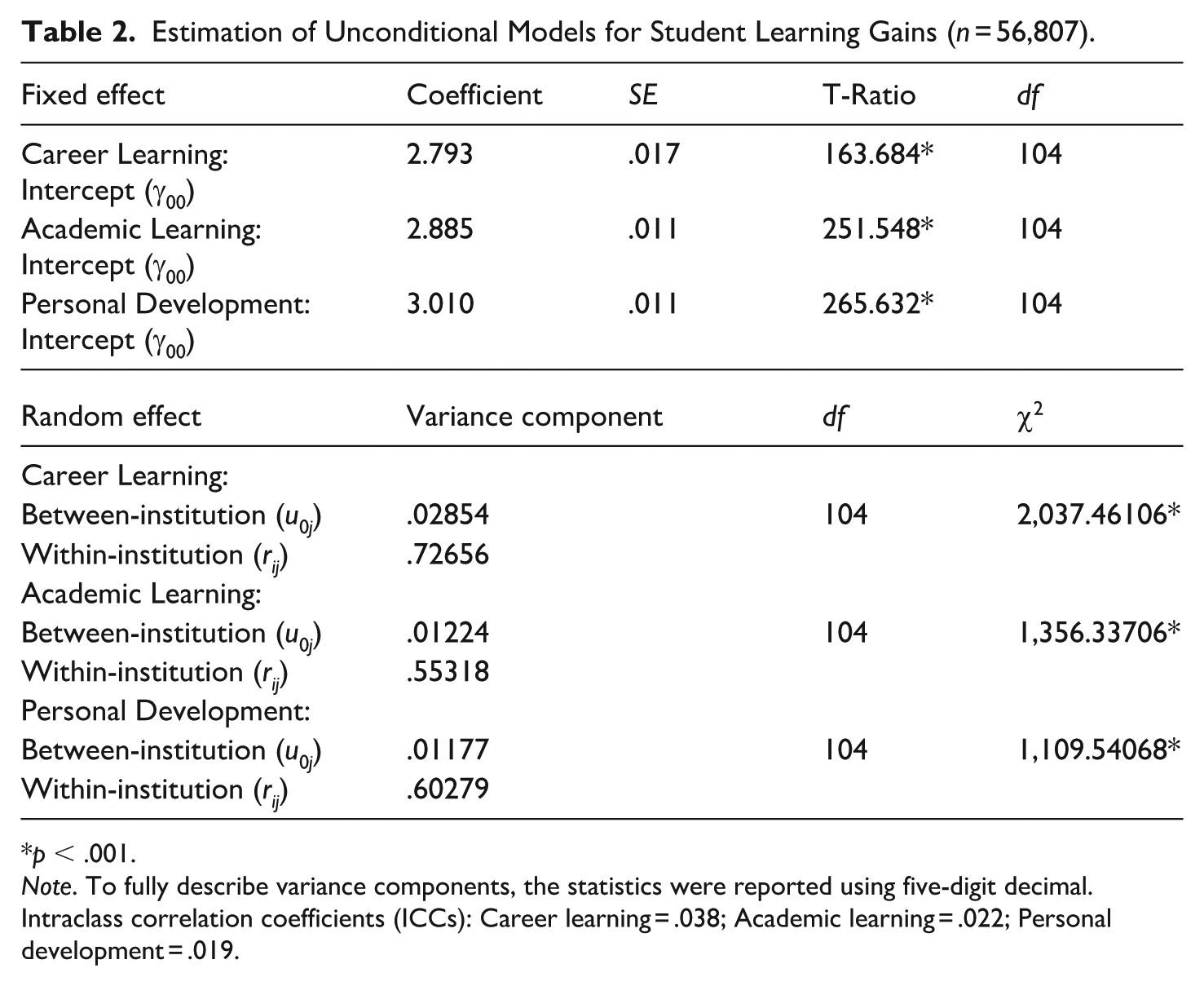
p < .001.
Note. To fully describe variance components, the statistics were reported using five-digit decimal. Intraclass correlation coefficients (ICCs): Career learning = .038; Academic learning = .022; Personal development = .019.
Utilizing the results from the random-effects ANOVA models, we additionally computed intraclass correlation coefficients (ICCs) to assess the extent of variation present in each outcome measure within and between institutions (Raudenbush & Bryk, 2002). The ICC was determined using the formula ρ = τ00 / (τ00 + σ2). The findings from this calculation revealed that 3.8% of the variation in career learning stemmed from variances between institutions, whereas a smaller percentage of variance in academic learning (2.2%) and personal development (1.9%) could be attributed to differences between institutions. These results suggest that most of the variation in each of the three outcome measures in this study can be accounted for by differences among the individual level-1 units (students). However, the statistically significant estimated variances of intercepts for all three outcome measures indicate that average student learning scores differ across institutions in ways not fully explained by individual student characteristics alone. This suggests meaningful institutional variation that could reflect structural or contextual differences, such as policies, resources, or engagement practices. While our subsequent models controlled for select institutional variables (e.g., size, percentage of full-time students, gender, and race composition), the presence of significant between-institution variance indicates that additional unmeasured institutional factors—such as institutional culture or student support infrastructure—may influence student learning. These elements, though not captured in our dataset, may vary meaningfully across institutions and warrant future investigation.
Estimation of Means-as-Outcomes Models
Table 3 summarizes the standardized regression coefficients (beta weights) estimated from the means-as-outcomes (conditional) models of this study, displaying how faculty practices and behaviors affect three different domains of student learning gains after controlling for the confounding effects of student demographics and institutional characteristics. Overall, our results showed that most of 17 faculty-practice and behavior variables predicted all three learning outcomes, though some had very small or no effects. Among the variables, supporting students to help their success was the strongest predictor of the three student learning outcomes.
Estimation of Conditional Models for Student Learning Gains (n = 56,807).
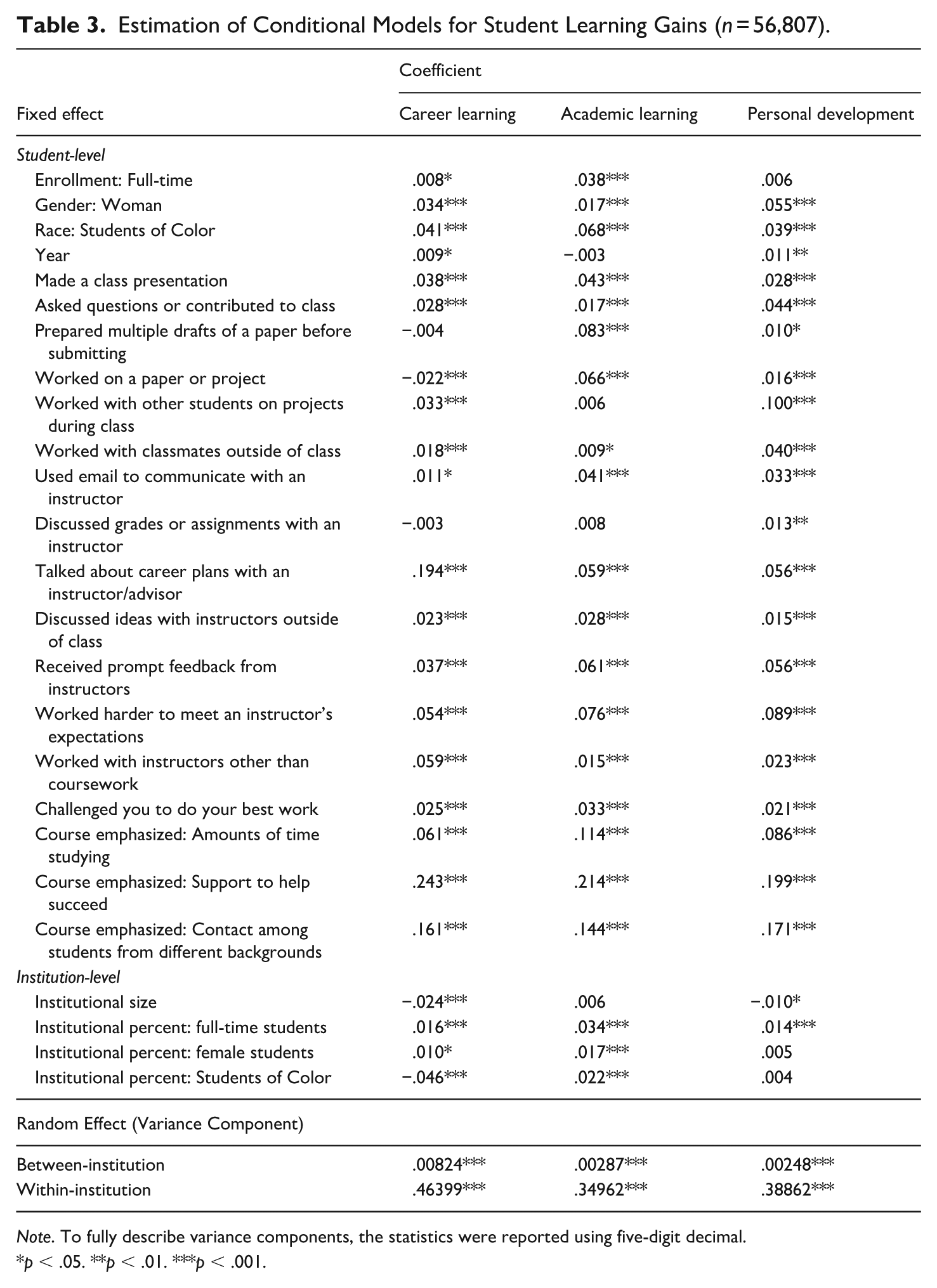
Note. To fully describe variance components, the statistics were reported using five-digit decimal.
p < .05. **p < .01. ***p < .001.
We found that all the faculty practice and behavior variables positively predicted career learning except three: one had a small negative effect, and two had no effect. Supporting students to help them succeed had the strongest positive effect on students’ career learning, followed by talking about career plans with an instructor/advisor and encouraging contact among students from different backgrounds. For academic learning, 15 variables had a positive effect while two had no effect. Providing support to students to help them succeed was the strongest predictor, followed by encouraging contact among students from different backgrounds and encouraging students to spend significant amounts of time studying. For personal development, all 17 faculty-practice and behavior variables positively predicted learning gains. Providing support to students to help them succeed was the strongest positive predictor of students’ personal development, followed by encouraging contact among students from different backgrounds and encouraging students to spend significant amounts of time studying.
Variations in the Use of Faculty Practices and Behaviors
Through the estimation of means-as-outcomes models, we could identify faculty practices and behaviors that best predict learning gains for CC students. Using the four variables that predicted outcomes with regression coefficients greater than .100 on any of the learning outcomes, we investigated how such faculty practices and behaviors varied depending on faculty characteristics such as employment status, course level taught, course experience, and teaching area. Table 4 displays the mean scores of the four best faculty practices and behaviors across various faculty groups.
Differences in the Use of Engaging Practices by Faculty Groups (n = 10,343).
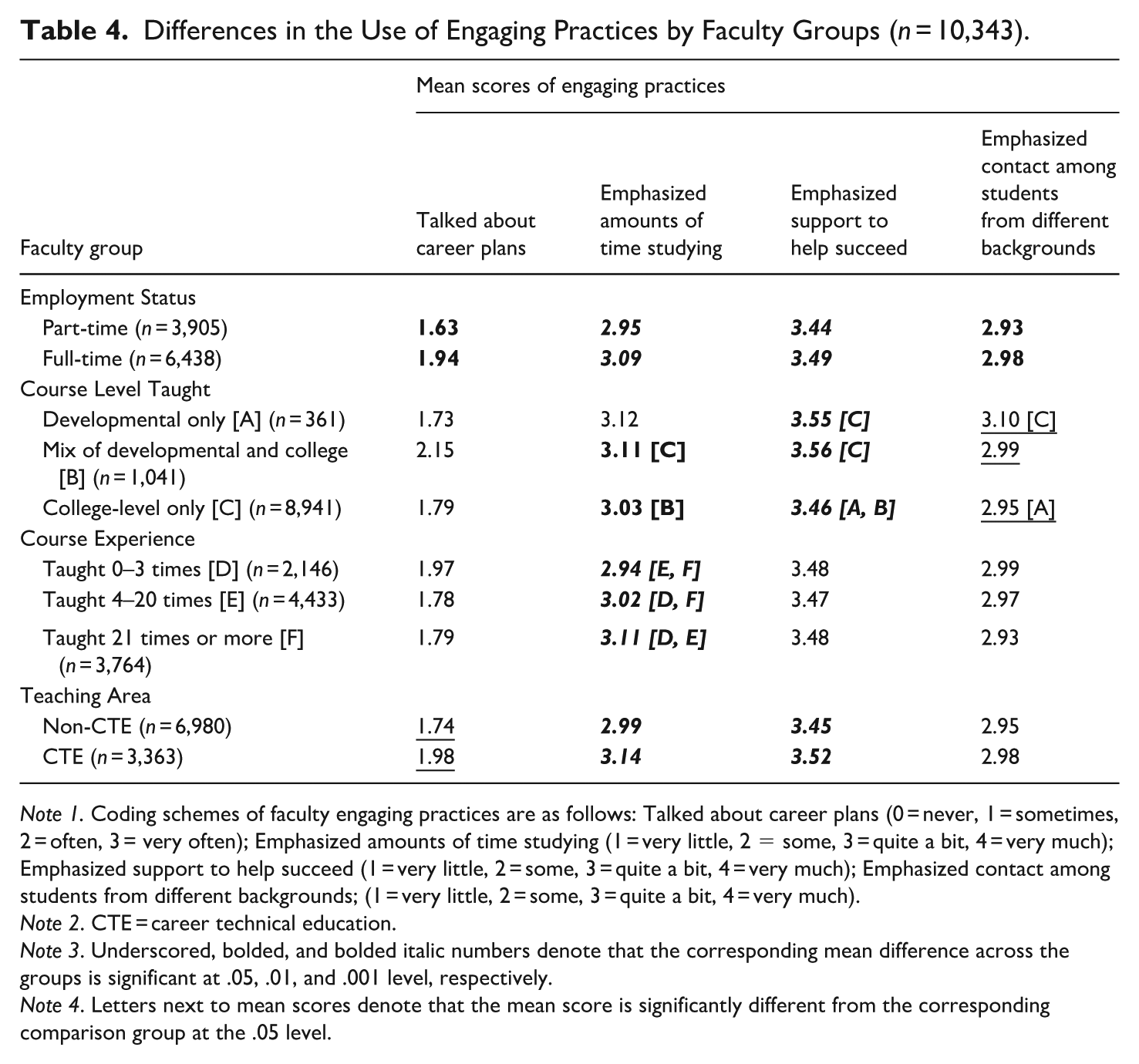
Note 1. Coding schemes of faculty engaging practices are as follows: Talked about career plans (0 = never, 1 = sometimes, 2 = often, 3 = very often); Emphasized amounts of time studying (1 = very little, 2 = some, 3 = quite a bit, 4 = very much); Emphasized support to help succeed (1 = very little, 2 = some, 3 = quite a bit, 4 = very much); Emphasized contact among students from different backgrounds; (1 = very little, 2 = some, 3 = quite a bit, 4 = very much).
Note 2. CTE = career technical education.
Note 3. Underscored, bolded, and bolded italic numbers denote that the corresponding mean difference across the groups is significant at .05, .01, and .001 level, respectively.
Note 4. Letters next to mean scores denote that the mean score is significantly different from the corresponding comparison group at the .05 level.
Compared with part-time faculty, full-time faculty tended to talk more frequently with their students about career plans and were more likely to emphasize the amount of time studying, providing support to help students succeed, and contact among students from different backgrounds. Faculty teaching only college-level courses were less likely to emphasize the amount of time studying, providing support to help students succeed, and contact among students from different backgrounds than faculty teaching developmental courses only or faculty teaching both developmental and college-level courses. Faculty with more teaching experience more frequently emphasized encouraging students to spend significant amounts of time studying as compared to their peers with less teaching experience. In terms of variation by teaching area, CTE faculty appeared to talk more frequently with their students about career plans, and were more likely to emphasize the amount of time studying and providing support to help students succeed as compared to their peers teaching non-CTE subjects.
Among the statistically significant differences identified in these analyses, the effect sizes ranged from .001 to .17, indicating small effects based on conventional benchmarks (Cohen, 1988). While modest in magnitude, small effect sizes are common in large-scale, multilevel educational studies where numerous factors influence outcomes simultaneously (Hattie, 2009; Lipsey et al., 2012). Importantly, even small effects can have practical significance when applied across large populations or institutional systems. As Hattie (2009) notes in his synthesis of over 800 meta-analyses, educational interventions often yield small effect sizes that are still meaningful when they align with cumulative, consistent practices that influence learning over time.
Discussion
We set out to identify the behaviors of faculty that predict student learning and then to identify the types of faculty who engage in those behaviors most frequently. Because students are situated within institutions that differ from one another, we tested predictors of student learning at the student level and the institution level. Overall, student-level variables were far stronger predictors of outcomes than institution-level variables, consistent with other findings that it is more important how a student engages in college than about where that student attends college (Mayhew et al., 2016). The CCSSE and CCFSSE contain measures of effective faculty practices, and our sample was very large; thus, it is no surprise that nearly every faculty practice item had at least a small positive effect on student learning. This suggests faculty should continue engaging in these practices. The only negative effects were three small effects on career learning: two about writing papers, and a third about discussing grades with faculty, all of which are not central aspects of career education. In terms of institutional effects, between-college effects were far smaller than the within-college effects; this means that what faculty do in their classrooms is a far stronger predictor of student learning than the characteristics of the college. Rather than focus on institutional characteristics of size and student enrollment as influences on learning, colleges should focus on the practices faculty engage with students.
At the student level, faculty shaped student learning primarily through the things they emphasized in their courses, and these emphases varied somewhat by faculty type. Providing support for students had the biggest effect on learning in all three domains (i.e., career learning, academic learning, and personal development). This aligns with other findings that CC students consider faculty use of the classroom to explain campus services and supports as an important contributor to their success (Deil-Amen, 2011; Alcantar & Hernandez, 2020). We found small significant differences by faculty type. Those should not outweigh the major finding that faculty emphasizing support, interactional diversity, time studying, and engaging with students around career interests are all associated strongly with student learning.
Full-time vs. Part-time Faculty
Full-time faculty used all four of the most productive practices more often than part-time faculty. Those practices were emphasizing study time, support for students, encouraging contact among students of different backgrounds, and talking about career goals. The strongest predictor in the model, emphasizing support for students, may be more difficult for part-time faculty to emphasize because they are less familiar with the range of supports available at the college (Ran & Sanders, 2020). Part-time faculty typically have no access to an office or other area to have conversations with students, so the opportunities to discuss grades, assignments, and career plans with students may be more limited for them. Given that part-time faculty make up nearly two-thirds of CC faculty (Phillippe, 2024), many students will benefit from efforts to increase part-time faculty members’ awareness of campus services, including encouragement to share those services with students. Other studies have found percentage of full-time faculty predicts retention, graduation, and transfer for CC students (Carrier et al., 2023 Eagan & Jaeger, 2009), but the reasons for that relationship have been unclear. Our findings that part-time faculty engaged less often in the four behaviors that most strongly predicted learning suggests a potential reason.
Teaching Domain
Our study found CTE faculty and faculty who taught developmental courses engaged more frequently in teaching practices that led to academic learning, personal development, and career learning than their peers who taught only college-level courses. The workforce mission of CC has been presented by some as thwarting the broader education of mission of CCs (Gauthier, 2020), but our study finds CTE faculty engage in teaching practices and student engagement that benefits learning broadly. Though not surprising, CTE faculty also engaged more frequently in talking about career plans with students. Such conversations fit with Deil-Amen’s (2011) socio-academic integrative moments, wherein faculty connect course material to issues of value in students’ lives. Like demystifying the college process, faculty engagement around careers might demystify career planning.
Like faculty in CTE, faculty who teach some or all developmental courses emphasized support for students and the amount of time needed for studying more than faculty who only teach college-level courses. Students enroll in developmental courses because they have been shortchanged by our educational system; our study suggests developmental faculty are better at emphasizing the support and study skills that developmental students may not have learned about earlier in their educational experiences
Course Experience
Teaching a course multiple times paid off. Faculty who taught a course 21 times or more emphasized the amount of time needed for studying more than their colleagues who taught the course less frequently. This may seem like a minor finding or an unimportant emphasis, but its role in student learning was stronger than other practices that often get more attention, such as requiring multiple drafts of a paper, assigning collaborative work on class projects, providing prompt feedback, and engaging with students outside of class.
Implications for Practice
Emphasizing support, time for study, and engagement among diverse groups are all practices that faculty can adopt, and which they might more readily adopt if they understood their value. However, institutions rarely focus on these practices. Professional development around fostering class participation, designing collaborative assignments, and other good pedagogical practices are common. In our study, those practices did not predict learning as well as emphasizing support, time for study, and contact among peers with different backgrounds. A practical application of our findings is to teach faculty about the value of these practices and to provide direct instruction about how such efforts might be implemented.
Community colleges rely heavily on part-time faculty, yet part-time faculty scored lower than full-time faculty on all four of the strongest predictors of learning: emphasizing support for learners, time for studying, contact among students from different backgrounds, and talking with students about career plans. Part-time faculty have less information about the supports available to students and less access to office space to meet with students (Ran & Sanders, 2020), so it is reasonable that our study found part-time faculty emphasize those supports less than their full-time colleagues. Institutional expectations about amount of time studying may be less clear for part-time faculty who are not engaged in department meetings and other institutional forums about expectations for student effort. Orientations and professional development for part-time faculty should focus on introducing part-time faculty to available supports for students, norms around expectations for student study time, and opportunities for students to have contact with peers from different backgrounds. Then, part-time faculty can more effectively emphasize these elements in their classes. Providing part-time faculty with a space for conversation with students could increase their conversations with students about career plans.
Our study supports Aguilar-Smith and Gonzales’ (2020) recommendation that CCs identify paid opportunities for part-time faculty to increase their service to the CC, possibly through leading professional development programs. Part-time faculty are less costly to the institution than full-time faculty in a purely short-term financial sense, but they often carry a heavy workload that includes travel between multiple institutions and less availability to students (Ran & Sanders, 2020). In the immediate short-term (e.g., this year’s budget), the use of part-time faculty saves money in both salary out-lays and benefit costs, but in the longer-term, especially in places that include completion rates as part of performance-based funding, if fewer students complete, funding is lost. A deeper investment in creating a manageable workload and appropriate professional development for part-time faculty could benefit student success.
Future Research
Our study was grounded on Deil-Amen’s (2011) concept of the CC classroom as a site of socio-academic integration, relying primarily on faculty to provide the interpersonal and informational support students need to understand, navigate, and succeed in the CC. Indeed, our study found that an emphasis on providing support for students to succeed was the strongest predictor of their learning. However, what we did not uncover was how, from the instructor’s perspective, that emphasis is given. Some frameworks for future research on faculty support for students include the ways faculty engage culturally relevant pedagogy (Ladson-Billings, 1995), culturally responsive pedagogy (Ladson-Billings, 2014), and equity-minded practices (McNair et al., 2020). These frameworks put students’ experiences, cultures, and strengths at the forefront, assuming the role of the institution is to support the strengths students already bring with them to college, but that may be overlooked or undervalued by the institution. Future research could investigate how and why faculty go beyond course content to focus on the supports that might help their students to succeed.
Like decades of research that have uncovered the benefits of interactional diversity (Gurin et al., 2002; Hu & Kuh, 2003; Mayhew et al., 2016), our study found that students benefit when faculty encourage contact among students from different backgrounds. Full-time faculty and faculty who teach only developmental courses emphasize this form of contact more often than part-time faculty and faculty who teach at least some college-level courses. The reasons for this difference are unclear, but future research could investigate in greater detail the reasons why some faculty emphasize this well-documented catalyst for learning more than others.
Exploring the strategies and practices of faculty in CTE and in developmental education poses another promising area for future research. Both groups engage in more productive educational practices than their peers who teach transfer-level courses. Given the lack of research on CC faculty in general, and on CTE and developmental faculty in particular, the positive findings of this study may be a harbinger of additional practices of CTE and developmental faculty that could apply to other faculty types. Students in developmental education and in CTE may not have transfer goals, and effective teaching might vary based on students’ goals. Future research could investigate efficacy of teaching practices based on students’ goals.
Our study focused on four faculty types, but a similar study could focus on race/ethnicity of faculty. Cross and Carman (2022) found an association between the percentage of faculty from underrepresented racial and ethnic groups and graduation and transfer rates for students from underrepresented racial and ethnic groups. A follow-up to that study could identify the effective teaching practices employed by faculty based on race/ethnicity, similar to how this study looked at teaching practices by faculty type.
Our study focused on CC students and faculty using a national dataset. Community colleges are shaped by the communities and states in which they are located, so further study could include geographic location in the analysis. Likewise, institutions could use our approach to study their own campuses, using data from students and faculty at the same campus or district. Such research could be supplemented with in-depth focus group and interview data to help further explore nuances not available using survey data.
Conclusion
Like other research (Alcantar & Hernandez, 2020; Bensimon & Dowd, 2009; Deil-Amen, 2011), this study found faculty play a central role in student success through the support they provide. New findings of this study are that full-time faculty engage more often in four practices that we found to be stronger predictors of self-reported student learning than part-time faculty do, and CTE faculty and faculty that teach at least some developmental courses engage in these practices more than faculty teaching only college-level courses. Consistent with Deil-Amen’s findings, a valuable role of faculty is emphasizing the supports available to students and demystifying what it takes to succeed in college. However, faculty must first learn what those supports are, a task especially challenging for part-time faculty who are often left out of faculty orientations or workshops on such topics. Including part-time faculty as full members of the community means including them in such programs and compensating them for their participation. Faculty emphases on study time, supports for success, and interaction across diverse groups were strong predictors of learning; however, these are not often included in measures of faculty practice. Further investigation about how faculty incorporate these practices and how students interpret something as an emphasis will be an important next step in understanding the ways CC faculty practices can more effectively lead to student learning.
Footnotes

Funding
The authors received no financial support for the research, authorship, and/or publication of this article.
Declaration of Conflicting Interests
The authors declared no potential conflicts of interest with respect to the research, authorship, and/or publication of this article.
Data Availability Statement
Data are not available in a publicly accessible location.
Human Subjects
The data used in this paper were collected as part of program evaluation which The University of Texas at Austin IRB has determined does not meet the qualifications for human subjects review. All individual and institutional identifiers were masked prior to distribution of the data set to the authors.