







Abstract
This study explores the role cultural humility plays in attitudes and discrimination towards people identifying as gay or lesbian among religious individuals. Specifically, we explore cultural humility as a possible predictor of less discriminatory attitudes towards lesbians and gay men above and beyond the effects of conservatism and religious orientation. Consistent with prior work, we expected that (a) intrinsic religious orientation, extrinsic religious orientation, and conservatism would be positively related to discriminatory attitudes and (b) that quest religious orientation and cultural humility would be negatively related to discriminatory attitudes. Participants (N = 231) were recruited through MTurk after the 2016 Pulse Nightclub shooting in Orlando, Florida to understand the attitudes and experiences held by Americans. Participants completed measures of religious orientation, attitudes, and behaviors towards lesbians and gay men, and cultural humility regarding LGBT issues. Results supported the hypothesis that cultural humility predicts less discrimination towards lesbians and gay men beyond conservatism and religious orientation. Results, limitations, and future directions are discussed.
Religion is a cultural meaning system that provides a structure of morals and values for millions of adherents around the world. Religion has been defined as adherence to a set of beliefs and practices within a community and tradition (Hill et al., 2000). Studies focused on religion in psychology accelerated after research positively linked religious affiliation with mental and physical health benefits (e.g., Smith, McCullough, & Poll, 2003). Despite general patterns linking religious involvement with positive outcomes (e.g., Fiala, Bjorck, & Gorsuch, 2002; Kim & Esquivel, 2011), some religious experiences or involvement are associated with deleterious mental and physical health and can impair relationship functioning.
Indeed, research has also documented social drawbacks of religion. Certain religious constructs (e.g., fundamentalism, right-wing authoritarianism, and extrinsic religiosity) are associated with discriminatory beliefs and actions (Duck & Hunsberger, 1999; Hunsberger & Jackson, 2005). Likewise, conservative politicians appealed to theologically conservative beliefs to create and enforce discriminatory laws (Killough, 2018; Tumulty, 2014). Political intensification around culture war issues and the election of Donald Trump have led to increases in LGBT individuals being the victims of discrimination and violence (Dashow, 2017).
These escalations of hostility coincide with political conflict, in which conservatives have advocated against equal rights for marriage after the 2015 Supreme Court ruling requiring all US states to recognize and honor same-sex marriages (Tumulty, 2014). Many states (e.g., North Carolina, Texas, and Mississippi) have introduced bills that place religious freedom in opposition to protections for LGBT people. For example, the First Amendment Defense Act aims to protect government employees who wish to cite their religious beliefs and the right to religious freedom as reasons to not provide services to people whose ideals or identities conflict with their religious beliefs (e.g., a government employee refusing to issue a marriage license to a gay couple; Killough, 2018). Furthermore, the election of Donald Trump as the US president, a conservative-controlled legislature, and the placement of conservative Supreme Court Justices have left many LGBT individuals feeling distressed and threatened by the trajectory of declining protections for LGBT people. For those advocating for LGBT rights, the strong support of Donald Trump by White Evangelicals has increased the saliency of the perceived threat that religious institutions may harm the goals of LGBT people who aspire to live within a society that respects their human rights.
With political polarization amplifying over the past several decades (Abramowitz & Saunders, 2008), it is important to explore civic virtues that can encourage investment in public spaces among communities that have increasingly grown hostile toward each other’s political ideology (with an intermingling of religious ideological conflict in the United States). One candidate for a civic virtue that could reduce contempt and animosity for political enemies is cultural humility.
Cultural Humility
Cultural humility was introduced as a complement to multicultural competence language (Davis et al., 2018; Tervalon & Murray-Garcias, 1998), although it was only recently introduced into empirical studies of psychotherapy (Hook et al., 2013). Cultural humility is defined as the ability for an individual to maintain an open stance about important cultural identity aspects of another (Hook et al., 2013). Previous research has found that humility is associated with greater tolerance and less aggression toward out-group members (Van Tongeren et al., 2016).
At the heart of cultural humility is a commitment to regulate a sense of cultural superiority over others. It is almost tautological to say that people prefer their own cultural values. Cultural humility counterbalances tendencies towards ethnocentrism and strong group pressures to express contempt or other moral emotions as a way of pressuring others to conform to one’s own cultural values. It requires respect for autonomy, because in areas of fierce and fundamental disagreement, the tendency is to morally judge another. Cultural humility regulates this default tendency.
However, cultural humility is not merely superficial tolerance that is based on relativizing issues. People can hold beliefs with conviction and express genuine cultural humility. Some issues likely require a person to choose a side. For example, almost all members of our society agree that slavery was such an issue. On the other hand, we fiercely disagree on things such as the degree to which our society is racist and whether abortion is a human right or a moral wrong. Regardless of the issue or identity, cultural humility is marked by a commitment to treat the other as human, with all the dignities that status entails, which means refusing to engage in dehumanization for any reason. Higher levels of cultural humility help facilitate the base for a relationship, even among those who hold diametrically opposing views. This foundation is what allows for an individual to be firm in their own beliefs, while at the same time still respect the beliefs of another.
This line of thought has powerful implications for the importance of attempts to depolarize conflict in order to reduce political hostility. For example, for theological conservatives who base their worldviews primarily on the interpretation of biblical scripture, it might be fruitful to have people engage in honest reflection on the possibility that their tradition may have been wrong on sexual ethics, as well as the potential moral implications of being wrong. This process will likely cause uncomfortable feelings of ambiguity. It may not necessarily result in any change in beliefs per se, but it ought to create an opportunity for greater nuance in how those beliefs are held. Moreover, it may help people grant careful thought for how to share those beliefs with others and interact with those who may not align with their beliefs.
Initial research provides indirect evidence for the idea that cultural humility may help decrease prejudice towards LGBT individuals. For example, one study found that a cultural humility curriculum helped individuals gain more knowledge and develop more positive attitudes towards gay, lesbian, and bisexual individuals (Grubb, Hutcherson, Amiel, Bogart, & Laird, 2013). Recent research has found evidence that humility, as well as specific variations of humility (e.g., relational and intellectual humility), can help weaken negative attitudes and aggressive behaviors towards religious out-group individuals (Van Tongeren et al., 2016). In a similar fashion, cultural humility has gained traction as a possible buffer of negative beliefs and actions, as a robust predictor of social attitudes. With robust evidence linking cultural humility to less prejudice (towards racial or sexual minorities), it may be the case that holding an open stance towards one’s sexual ethic can help reduce negative attitudes that lead to contempt towards sexual minorities (Whitely, 2009).
Religion and Discrimination
Although most religions endorse warmth-based virtues such as compassion and love (Worthington & Berry, 2005), they may also endorse conscientiousness-based virtues that, when combined with a conservative sexual ethic, promote the exclusion and marginalization of sexual minorities from community life. Allport and Ross (1967) theorized that different types of religious orientations might explain how religion may be particularly prone to collusion with prejudicial attitudes within a society. In their original theorizing, they focused on racial tolerance, but others have expanded their theorizing to address other types of prejudice. According to their original ideas, intrinsic religiosity (i.e., religion for its own sake) ought to lead to greater racial tolerance, because people’s motivations are towards religion as an end in and of itself. In contrast, extrinsic religiosity (i.e., approaching religion for its instrumental benefits) might easily lend itself to collusion and conformance with racist ideology. A recent meta-analysis found clear support that extrinsic religiosity is related to prejudice, whereas results within intrinsic religiosity were mixed (Hall, Matz, & Wood, 2010). The construct of quest religiosity (which is associated with embracing doubt and uncertainty in one’s religious beliefs and viewing religion as a journey where changes are common) was the only construct within this meta-analysis that showed a negative relationship with racial prejudice.
Social Conservatism and Discrimination against Lesbians and Gay Men
Subsequent work on religious orientation has examined attitudes towards sexual minorities. Meta-analytic results of 61 empirical studies indicated that most forms of religiosity, including but not limited to fundamentalism and intrinsic religiosity, were not only associated with a conservative sexual ethic on average, but were also associated with derogatory attitudes towards lesbians and gay men (Whitely, 2009). In contrast to research on racism, intrinsic religiosity was the more robust, positive predictor of prejudice towards sexual minorities, whereas extrinsic religiosity showed no relationship. These results may suggest that extrinsically religious people were more influenced by the changes in beliefs regarding sexual ethics that have happened within the past several decades (Twenge, Sherman, & Wells, 2015). Once again, quest orientation was related to affirming attitudes towards LGBT individuals (Whitely, 2009).
A major limitation of this meta-analysis is that it did not consider accounting for beliefs about sexual ethics (e.g., theologically conservative versus progressive) when exploring the relationship between intrinsic religiosity and attitudes towards LGBT individuals (e.g., Miller & Chamberlain, 2013; Whitely, 2009). Some have noted the possibility of social conservatism and the specific teachings of religious communities as confounding variables (e.g., Fisher, Derison, Polley III, Cadman, & Johnston, 1994), but many studies seem to ignore these possible conflicts (e.g., Miller & Chamberlain, 2013).
Although some people assert that holding a theologically conservative sexual ethic is indicative of having a derisive and prejudicial attitude (i.e., these beliefs maintain societal structures that have undermined the flourishing of LGBT people; Greene, 2009), there is a difference between holding a conservative sexual ethic and allowing that ideology to support and justify the mistreatment of LGBT people. Theologically conservative religious communities persist and are growing in many parts of the world, especially in South America and Africa (Emerson & Hartman, 2006). Thus, it is important to consider factors that can address how theological conservatives hold and express their sexual beliefs within relationships with sexual minorities within their communities.
Only a few studies have explored how socially conservative ideologies and religiosity may influence prejudice towards LGBT individuals and rights (e.g., Fabros, 2015; van der Toorn, Jost, Packer, Noorbaloochi, & Van Bavel, 2017). In Fabros (2015), undergraduates (N = 159) were randomly assigned to receive feedback that they were prejudiced or they were told they held neutral attitudes towards LGBT+. In the Prejudice Condition, participants reported greater religiosity, which may indicate that religion served as a justification to help explain the feedback they received. What the authors did not consider is the degree to which religiosity may function differently for participants identifying as both religious and politically liberal. In a set of five studies (samples from the USA and Canada), van der Toorn et al. (2017) provided evidence that political conservatism mediated the relationship between religiosity and sexual prejudice. In both studies, an important limitation is that authors conflated religiosity with a conservative sexual ethic, but many religious individuals hold an LGBT affirming sexual ethic.
Overview and Hypotheses
The goal of this study was to explore the role cultural humility plays in attitudes towards lesbians and gay men, because the measure we used does not focus on attitudes towards bisexual or transgender individuals. Because many previous studies have found conflicting evidence on the relationship between religious orientation and prejudice towards LGBT individuals (e.g., Miller & Chamberlain, 2013; Whitely, 2009), we also sought to consider the relationship between religious orientation (i.e., intrinsic, extrinsic, and quest religiosity) and attitudes towards lesbians and gay men. Finally, to statistically control for possible covariation, we also measured social conservatism.
Based on previous research (e.g., Hall, Matz, & Wood, 2010), we expected that intrinsic religiosity, extrinsic religiosity, and social conservatism would have positive relationships with prejudice toward lesbians and gay men, whereas quest orientation and cultural humility would have negative relationships with prejudice toward lesbians and gay men. Our primary hypothesis was that cultural humility would be negatively associated with prejudicial attitudes towards lesbians and gay men (i.e., less bias), after controlling social conservatism and religious orientation.
Method
Participants and Procedure
Participants were 231 adults (69.4% female) recruited through Amazon Mechanical Turk (MTurk) after the 2016 Pulse Nightclub shooting in Orlando, Florida. The sample age ranged from 20 to 73, representing different generational groups. In terms of race/ethnicity, 70.8% were White (Non-Hispanic), 12.0% Hispanic or Latino(a), 10.5% Black or African American, 2.9% Asian or Asian American, 1.0% Native Hawaiian or other Pacific Islander, 1.9% Mixed Race/ethnicity, 0.5% American Indian or Alaska Native, and 0.5% other. A majority of participants identified as heterosexual (87.0%), 7.2% identified as bisexual, 3.4% identified as lesbian, 1.0% identified as gay, and 1.4% identified as other. Two-thirds (66%) of participants reported a current religious affiliation, 36.4% reported themselves being religious, and 57.9% stated religion was at least “somewhat important” in their life.
Participants were recruited through MTurk and compensated with $1.00 for completing the questionnaires. All participants were informed about the survey’s intention to better understand the attitudes and experiences held by Americans after the Pulse Nightclub shooting in Orlando, Florida on June 12, 2016. Participants were warned about the possible discomfort, pain, and/or distress the questions may cause and were given the option to stop the survey at any time without any penalties. Consent was then queried and required to continue with the questionnaire. At the end of the survey, participants were debriefed and given a list of national resources in case the survey caused any distress or harm.
Measures
Religious orientation
Religious orientation was measured using the 18-item New Indices of Religious Orientation measure (NIRO; Francis, 2007). This scale consists of three subscales measuring extrinsic, intrinsic, and quest religiosity, each with six items. The items are scored on a 5-pt. Likert scale ranging from 1 = disagree strongly to 5 = agree strongly, with higher scores indicating stronger identification with each orientation type. An example item of extrinsic religiosity is, “While I am a religious person, I do not let religion influence my daily life.” An example item of intrinsic religiosity is, “My religious beliefs really shape my whole approach to life.” An example item of quest orientation is, “For me, doubting is an important part of what it means to be religious.” The scale has been shown to be internally consistent, with Cronbach’s alphas ranging from .84 to .91 (Francis, 2007). The NIRO subscales were all found to be internally consistent in this study with Cronbach’s alphas ranging from .80 to .93. The NIRO has also shown convergent validity, with the subscales being correlated with religious attendance, prayer, and self-reported religiosity (Francis, 2007).
Attitudes towards lesbians and gay men
Attitudes towards lesbians and gay men were measured using the 8-item version of the Attitudes toward Lesbians and Gay Men Scale (ATGLS; Herek, 1988). This scale consists of two subscales measuring attitudes towards lesbians and towards gay men, each with four items. In this study, the full-scale score was used. The items are rated on a 4-pt. Likert-like scale ranging from 1 = disagree strongly to 4 = agree strongly, with higher scores indicating more prejudice towards lesbians and gay men. An example item is, “Sex between two men is just plain wrong.” The ATGLS has been found to be internally consistent, with Cronbach’s alphas scores ranging from .80 to .85 (Herek, 1988, 1994). The measure was found to be internally consistent with this sample, with a Cronbach’s alpha of .93. The ATLGS subscales have been found to be correlated with other relevant constructs, such as religiosity and endorsement of policies that discriminate against sexual minorities (Herek, 1994). The scale has also been found to have discriminant validity among different samples (e.g., members of lesbian and gay organizations versus nonstudent adults who support anti-gay rights; Herek, 1988, 1994).
Cultural humility
Perceived cultural humility was measured using a modified version of the 12-item Cultural Humility Scale (CHS; Hook et al., 2013). The scale consists of two subscales: positive and negative. Positive cultural humility represents other-oriented characteristics, while negative cultural humility represents a sense of superiority (Hook et al., 2013). The items are rated on a 5-pt. Likert-type scale ranging from 1 = strongly disagree to 5 = strongly agree, with higher scores indicating more self-perceived cultural humility (negative cultural humility items are reverse coded). The scale was modified to assess cultural humility towards LGBT individuals by prompting each item with, “Regarding LGBT individuals, I …” An example item is, “… I am open-minded.” This scale has previously shown internal consistency, with Cronbach’s alphas ranging from .86 to .93 in a variety of samples (Hook et al., 2013; McElroy, 2018). Both subscales were found to be internally consistent with the current sample with Cronbach’s alphas of .89 for positive cultural humility and .72 for negative cultural humility.
Social conservatism
Social conservatism was measured using a self-report single item. The item asked, “In terms of social and cultural issues, how liberal or conservative are you?” The item was rated on a 7-pt. scale ranging from 1 = extremely liberal to 7 = extremely conservative, with a higher score indicating more social conservatism.
Results
Preliminary Analyses
A total of 231 participants partially or fully completed the survey. Patterns of missing data were examined to address issues with invalid protocols. Overall there was less than 12% of data missing per variable. No participants were eliminated. Next, Little’s Missing Completely at Random (MCAR) test was completed to examine the pattern of missing data. Little’s MCAR test was found to be not significant, indicating data was missing completely at random (p = .945). Missing data were deleted listwise for the regression analysis. Afterwards, scales were appropriately reverse-coded and examined for outliers and normality. No outliers were found within the variables. Also, the skewness and kurtosis for all variables were within an acceptable range (George & Mallery, 2010).
Primary Analyses
Correlations and descriptive statistics are reported in Table 1. As predicted, both extrinsic and intrinsic religiosity were positively correlated with prejudicial attitudes towards lesbians and gay men (r = .40, p < .001; r = .48, p < .001). The magnitude of the relationships was stronger than expected but in line with previous research. In contrast to our hypotheses, quest orientation was not significantly related to discriminatory attitudes. Both subscales of cultural humility were significantly related with attitudes of prejudice in the expected directions; however, positive cultural humility had a stronger relationship with prejudicial attitudes than negative cultural humility (r = -.64, p < .001; r = -.26, p < .001). Also, as predicted, social conservatism was strongly, positively correlated with attitudes towards lesbians and gay men (r = .60, p < .001).
Means, SD, and intercorrelations of measures.
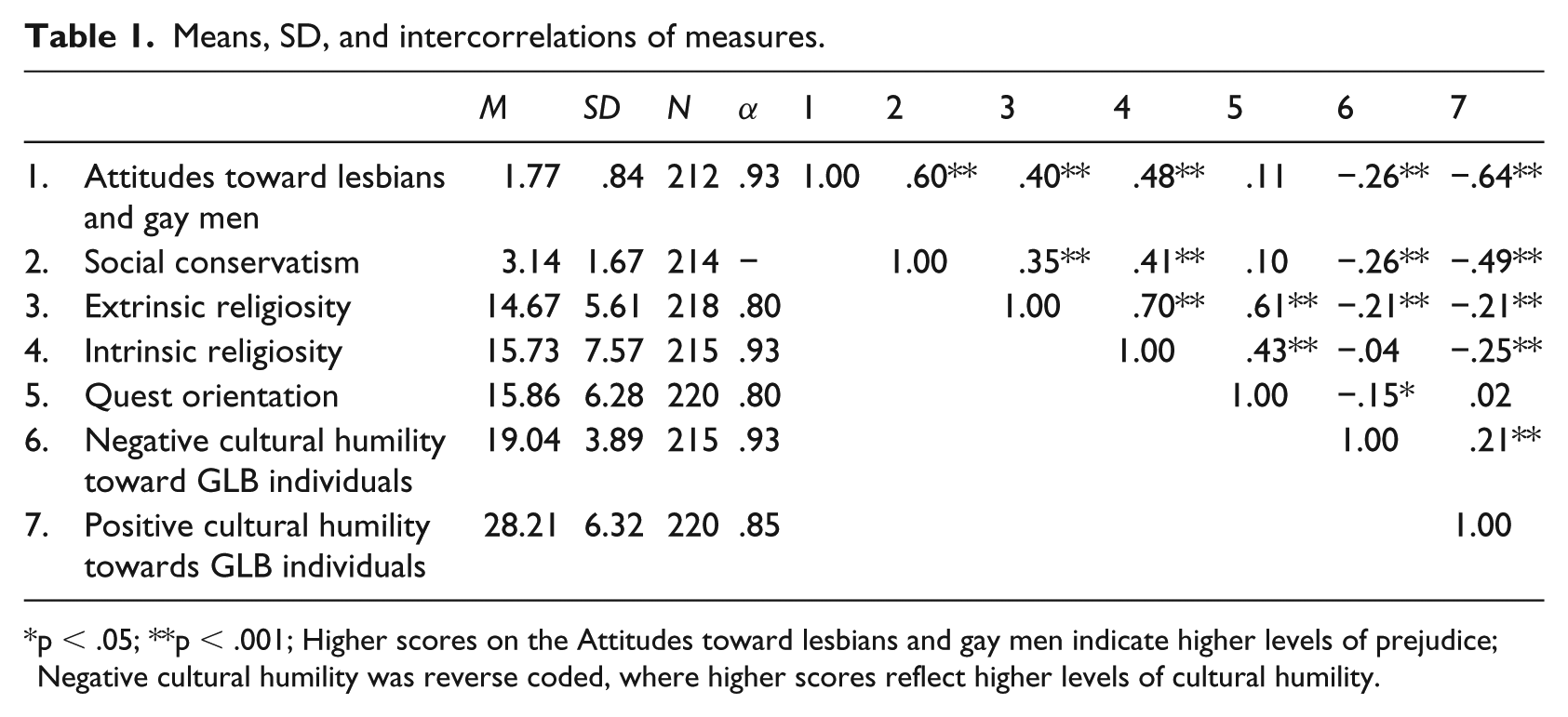
p < .05; **p < .001; Higher scores on the Attitudes toward lesbians and gay men indicate higher levels of prejudice; Negative cultural humility was reverse coded, where higher scores reflect higher levels of cultural humility.
We hypothesized that cultural humility would predict attitudes towards lesbians and gay men over and above religious orientation and social conservatism. To examine this hypothesis, a hierarchical linear regression analysis was conducted with social conservatism entered in Step 1, religious orientation in Step 2, and cultural humility in Step 3. The results are summarized in Table 2. Results showed that in Step 1, social conservatism was a significant positive predictor of prejudicial attitudes (F (4, 188) = 40.64, p < .001, R2 = .37) and accounted for 37.3% of the variation in attitudes towards lesbians and gay men. The religious orientation variables, added in Step 2, accounted for an additional 9.0% of the variance in prejudicial attitudes (R2 = .46, ΔR2 = .09). Specifically, intrinsic religiosity was a significant positive predictor, but extrinsic and quest religious orientation were not significant. Lastly, the cultural humility variables were also found to be significant predictors in Step 3 (R2 = .60, ΔR2 = .14) and explained an additional 14.1% of the variance in attitudes. Positive cultural humility was a significant negative predictor, but negative cultural humility was not significant. In the final step of the model that included all the predictor variables, social conservatism, intrinsic religiosity, and positive cultural humility were all significant predictors of prejudicial attitudes towards lesbians and gay men. Overall, the six variables accounted for a total of 60.4% of the variance in these social attitudes.
Summary of hierarchical linear regression for variables predicting attitudes towards lesbians and gay men.
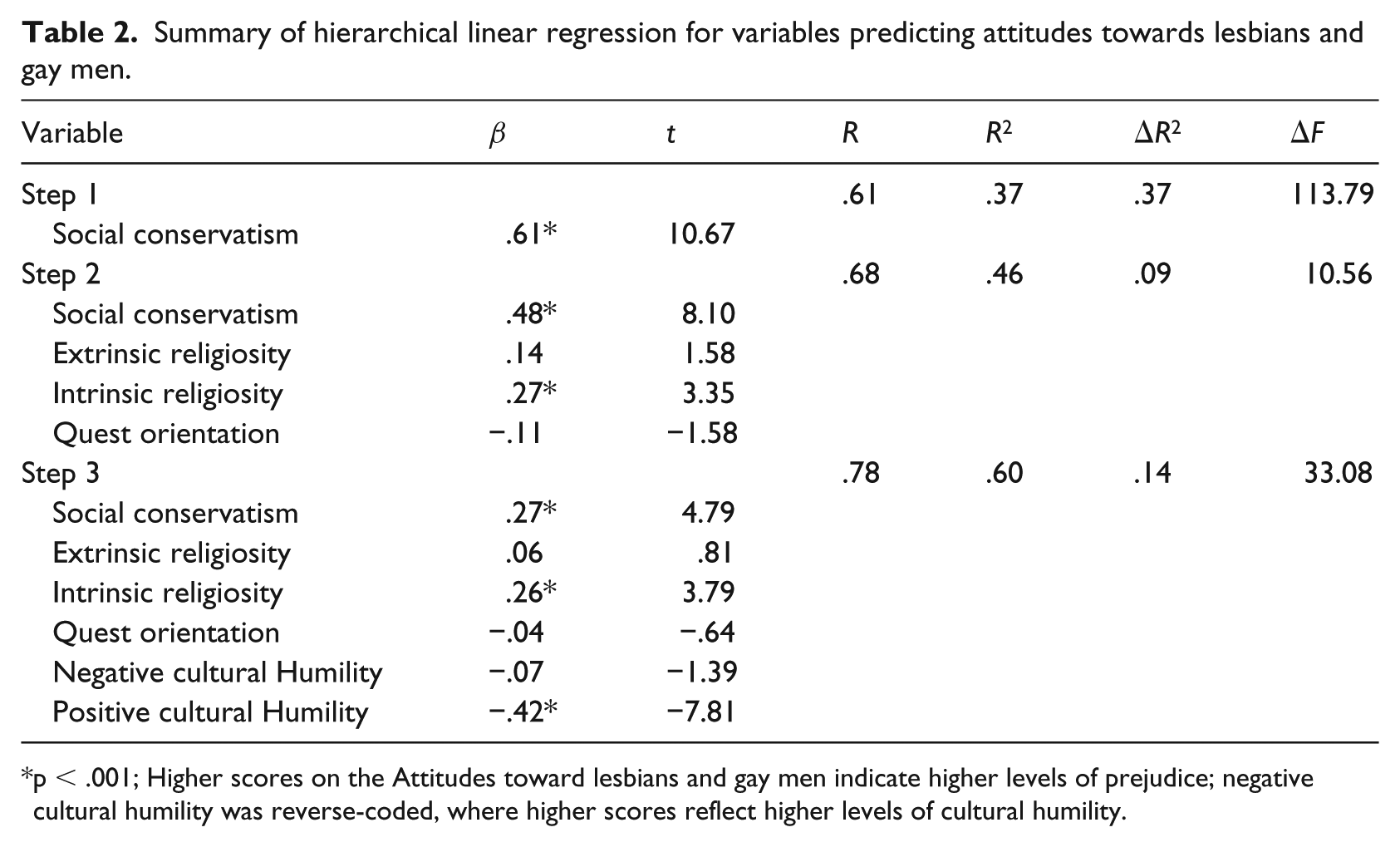
p < .001; Higher scores on the Attitudes toward lesbians and gay men indicate higher levels of prejudice; negative cultural humility was reverse-coded, where higher scores reflect higher levels of cultural humility.
Discussion
Recent changes to the socio-cultural and political landscapes around the world have increased tensions among cultural groups. In many cases, religious beliefs seem to amplify the potential for conflict, because individuals may use religious beliefs as defenses for prejudiced behaviors. The purpose of this article was to examine the role of cultural humility alongside other constructs such as religious orientation and political conservatism. In prior research, religious orientations tend to show a weak to moderate relationship with prejudice towards the LGBT community. These studies have not tended to disentangle conservatism from religiosity (e.g., some people are strongly religious and have a strong commitment to a progressive sexual ethic; e.g., Miller & Chamberlain, 2013; Whitely, 2009). It is important to explore other constructs that may provide a more nuanced understanding of people’s attitudes towards lesbians and gay men.
Consistent with prior research, we found that both extrinsic and intrinsic religiosity were moderately related to prejudicial attitudes towards lesbians and gay men; quest orientation was unrelated (e.g. Whitley, 2009). Conceptually, in regions where most religious communities hold conservative sexual ethics, intrinsic religiosity ought to be associated with greater prejudice. We might expect to see greater variability for people with higher extrinsic religiosity, because people are engaged in religion for its instrumental value and, as holding a conservative sexual ethic becomes viewed as increasingly contentious, extrinsically religious people may attempt to draw on positive aspects of religious involvement (e.g., community support) while also distancing from contested beliefs (Allport & Ross, 1967; Batson, Schoenrade, & Ventis, 1993; Kirkpatrick, 1989). Therefore, we suggest careful interpretation of potential sample moderators when understanding how religious orientation may relate to prejudice towards lesbians and gay men.
Our primary hypothesis was that cultural humility, after controlling for religious orientation and political conservatism, would incrementally predict attitudes towards lesbians and gay men. This hypothesis was supported, particularly for the positive subscale of the Cultural Humility Scale. Likewise, when entered in the same step, intrinsic religiosity and political conservatism were both positively related to greater prejudice towards lesbians and gay men. This finding is important, because it highlights the need to examine both systemic forces that may increase prejudice as well as individual factors that may help mitigate prejudice.
As more religious people reconsider and renegotiate their convictions regarding sexual ethics, it is crucial to refine theorizing. The present study adds to a scarce body of research attempting to explore the relationship between religious constructs and prejudice in a way that considers the possibility of more nuanced relationships, especially as certain systems become more progressive and seek to guard the rights of sexual minorities. For example, the teachings of religious communities play a crucial role shaping ideology. People in an affirming religious community ought to internalize more affirming values, and in some communities, these progressive messages may relate strongly to intrinsic religiosity because they are core beliefs within the religious community (Chonody, Woodfor, Smith, & Silverschanz, 2013).
Limitations and Future Directions
Our study had several important limitations. First, the data were collected in the aftermath of the Pulse shooting. It is possible that the public outcry after these events may have temporarily amplified empathy for the plight of LGBT people, which could have affected the relationships between variables. So, it seems prudent to continue to explore the role of cultural humility alongside other predictors of prejudice (e.g., political conservatism and religious orientation) across a range of samples and religious communities, especially given that our sample was predominately White and heterosexual. In order to appropriately revise theorizing on religious orientation, it is crucial to study how these constructs may remain stable or change as lesbians or gay men experience the process of coming out and also seek supportive relationships and communities throughout their lifespan.
Second, our results were based on cross-sectional data. Cross-sectional data are not sufficient to test causal relationships, which has been well documented in the field (MacKinnon, Lockwood, Hoffman, West, & Sheets, 2002). In order to develop a more robust theory of how religious orientation may related to prejudice, it will be important to use research designs that can incorporate a variety of factors and begin to parse the causal sequence of relationships. Furthermore, some ideas may call for experimental methods (e.g., testing whether people with high extrinsic religiosity are more or less affected by environmental cues).
A third limitation is that we did not include any measures of people’s perceptions of the attitudes of their local religious community or other salient social systems (e.g., workplace attitudes). For example, we hypothesize that the relationship between intrinsic religiosity and prejudice towards lesbians and gay men would be strongest in communities that have a very strong commitment to a conservative sexual ethic. Within this context, given the strong systemic pressure, we might expect cultural humility or extrinsic religiosity to show weaker positive (or even negative) relationships with prejudice towards lesbians and gay men. Thus, we call for more rigorous study examining the relationship between religion and prejudice towards lesbians and gay men and clearly defining the boundary conditions and mechanisms by which these relationships operate.
Conclusions
The research program on religious orientation and prejudice is one of the most robust and long-standing literatures in the psychology of religious. Yet, the USA is undergoing major shifts in ideology, and it is an important time to sharpen the theorizing in order to refine its explanatory power. Previous research has revealed an inconsistent link between religion and prejudice, suggesting the presence of moderating variables. Given political polarization and growing diversity in recent years, it is vital to sharpen our understanding of how religion can help or harm attempts to promote peace between communities with different cultural beliefs about sexual ethics. The present study raises the provocative possibility that cultural humility, both of individuals and larger systems, may play an important role in helping people reduce volatile reactions towards people with different values, particularly with respect to contentious topics such as abortion, sexuality, stem cell research, and so forth, where many people have strong moral reactions to difference and feel that it is morally wrong and dangerous to relativize or tolerate other views. Perhaps, regardless of whether communities find themselves on the conservative or liberal side of an issue, there is the possibility for individuals to build a value of cultural humility into the fabric of their community and in how it handles interactions with cultural and political opposition.
Footnotes
Funding
The author(s) disclosed receipt of the following financial support for the research, authorship, and/or publication of this article: This study was part of the Humility Grant, funded by the John Templeton Foundation (#60622).
