






Abstract
We conclude the special issue by addressing some ongoing limitations within scholarship on humility and cultural humility that ought to temper our reading of the extant literature. We also discuss four critiques of initial scholarship in this area. We end with some suggestions for future research on cultural humility.
Introduction
Research on cultural humility joins the crowded space of scholarship on humility, which has been characterized from the outset by several paradoxes (Worthington, Davis, & Hook, 2017). The first paradox was the presumed measurement problems: asking people to report on their own humility seemed akin to asking people to brag about themselves. Now, there are over 25 survey-based measures of humility (McElroy-Heltzel, Davis, DeBlaere, Worthington, & Hook, 2018). But other paradoxes have also emerged over time.
A second paradox is related to timing: cultural humility scholarship accelerated during heated political and religious polarization. To many, humility may seem like an old-fashioned virtue that makes less sense in the Twitter era. Sure, we may all agree that we like it when other people are humble (such as a romantic partner; Van Tongeren, Davis, & Hook, 2014), but in a society characterized by rising individualism, humility ranks near the bottom of virtues people wish upon themselves (e.g. Park, Peterson, & Seligman, 2004). Perhaps, virtues like humility are going out of style, at least in America, where young people seem increasingly suspicious of submitting to or aligning with systems larger than themselves (e.g. marriage, church, government; Twenge, 2017).
A third paradox we see in this special issue – and beyond – is the tension between humility and Christianity. On one hand, humility is a core aspect of the character of Jesus (e.g. Philippians 2). Such descriptions of Jesus as humble seem to point to humility as an important or even foundational virtue. Yet, it could strike some as paradoxical that white evangelical Christians aligned with Donald Trump, a presidential candidate known for his brash, blunt and egotistical persona and style. Societal trends raise questions about what it means for Christians to practise cultural humility. For example, parts of the US (e.g. Pacific Northwest) are becoming post-Christian (Mercier, Kramer, & Shariff, 2018). Once-strong Christian institutions (e.g. universities and seminaries) struggle with enrolment. Alumni who hold the purse strings may be increasingly out of step with the rapid ideological changes happening within a younger demographic, who may be less committed to traditional religious institutions and more open regarding social issues such as sexuality and sexual ethics (Twenge, 2017; Twenge, Sherman, & Wells, 2017). Do Christians actually value cultural humility? Is this true across the political spectrum?
These days, brash overconfidence seems oddly effective. Does cultural humility have anything to offer a society that grows more ideologically entrenched year after year? Perhaps this kind of question underlies the emergence of scholarship on humility and its subdomains. Maybe cultural humility is more important than ever, given the many forces that have weakened trust in civic spaces or larger systems. Perhaps a generation of humans is trying to come to terms with rapid changes in connection with a worldwide culture, as well as rapid changes in technology that make the world increasingly smaller or more interconnected.
Given that a key aspect of cultural humility involves awareness and ownership of limitations, it seems fitting to end the special issue by considering some limitations and critiques that might temper our reading of the extant literature on cultural humility. To that end, we conclude this special issue by, first, describing three limitations that ought to temper our reading of current scholarship. Second, we anticipate three critiques of a cynic who may wonder how much the virtue of cultural humility can really help address some of the major problems we face in our country and world. We end with some suggestions for future research.
Limitation 1: Definitional and measurement sprawl
One limitation of the field of cultural humility is the current state of definitions and measures. The key problems related to measurement of humility have shifted over the past 15 years. Initially, the field was stuck because people doubted whether humility could be studied with self-reports. The field began to move forward after several research teams began to utilize multiple methods to study humility (e.g. self-report, other-report, trait-relevant behaviour; for a review, see Davis, Worthington, & Hook, 2010; Van Tongeren, Davis, Hook, & Witvliet, 2019).
The new problem is what McElroy et al. (2018) called an ‘embarrassment of riches’. We suppose that many measures are better than no measures. However, we now have over 25 measures of humility, including measures that assess a growing number of humility subdomains. With so many measures that have limited evidence of validity, it is difficult for researchers to pick measures, and challenging to compare findings across studies that use different measures. The centrifugal forces that have caused definitional sprawl (e.g. interdisciplinary interest as well as interest in a broad range of contexts in which humility might be important) have continued. Therefore, in broader research on humility, we expect to see increasingly rigorous tests of criterion-related validity (McElroy et al., 2018) and these increasing standards will invariably work their way into the study of cultural humility.
Limitation 2: Unclear conceptual relations between subdomains of humility
A second limitation pertains to ambiguity in relating various subdomains of humility to each other. For example, a pressing question raised by the current special issue involves the relationship between cultural humility and intellectual humility. Indeed, several studies have adapted the Cultural Humility Scale (Hook, Davis, Owen, Worthington, & Utsey, 2013) in order to measure intellectual humility regarding religious beliefs (e.g. Hook et al., 2017). How are these subdomains similar or different from each other? Is one construct broader than the other?
Perhaps cultural humility is a special case of intellectual humility. In this view, subdomains of humility involve contexts that make humility more difficult, because they strain egotism and selfishness. Intellectual humility involves humility expressed during the exchange of ideas. There is a potential for conflict when people exchange ideas about things that matter (i.e. that influence allocation of resources). Belonging to a cultural group, and adopting a cultural identity, leads to various commitment and loyalty-related biases, which have many benefits for the individual and group, but also have a shadow side. When taken to an extreme, these commitments may lead to a closing off of one’s worldview in a way that makes ideas impermeable to new information. This kind of closing off of one’s worldview could be religious or ideological (Williamson, Hood, Ahmad, Sadiq, & Hill, 2010).
Or perhaps intellectual humility is a special case of cultural humility. Current theorizing on cultural humility complements other multicultural theories that posit unconscious processes may contribute to biases. For people to begin to take ownership of these biases, they must commit to a lifelong process of engaging with different cultural communities and perspectives. Some accounts of intellectual humility seem to emphasize more conscious processes and meta-cognitive skills (e.g. awareness and ownership of limitations). We might view cultural humility as the broader construct to the degree that researchers conceptualize intellectual humility as involving meta-cognition and slower cognitive processes.
Until researchers clarify these conceptual questions, it is important that readers consider research on subdomains of humility (e.g. cultural, intellectual, political, or religious humility) tentatively. The multiplication of definitions and constructs runs the risk of calling different things the same thing or calling the same things different things (i.e. jingle and jangle fallacies; Block, 1995).
Limitation 3: Questions about the universality of humility and its subdomains
A third limitation is an extension of a major critique of positive psychology: that it has ethnocentric tendencies that began with Seligman’s attempt to offer a ‘scientific’ alternative to traditionally religious or cultural perspectives on virtue or character strengths (Wong, 2011). The initiative took a massive array of virtues across cultures and history and distilled them into a list of 24 character strengths, which have subsequently been distilled down to three factors (cf. Davis, 2018; Miller, 2018; Snow, 2018). Given that the power to define good and evil is a key aspect of the dominant culture, is it any surprise that multicultural scholars have looked at the positive psychology movement with some wariness?
Furthermore, even though cultures might promote a similar set of virtues, the meaning and priority of virtues may different substantially across cultures. Accordingly, it may not be wise to assume that cultural humility means the same thing across cultures and subcultures. Perhaps the definitional sprawl reflects the need to attend to cultural diversity in how humility and its subdomains are understood by different cultural groups.
Perhaps the Achilles heel of humility scholarship is still measurement problems, but not the one we thought. Researchers originally assumed a modesty effect (i.e. truly humble people might underreport their humility, whereas narcissistic individuals might overreport their humility) was the primary problem, but perhaps the more fundamental measurement challenge is to consider how cultural diversity influences the understanding and practice of humility and its subdomains. Has current research sufficiently considered the cross-cultural validity of cultural humility measures and the degree to which people belonging to different cultures judge humility in the same way?
Consider a basic challenge to the universality of our current understanding of cultural humility: a compositional model of cultural humility judgments (see Figure 1). This is a process model, akin to Lazarus and Folkman’s (1984) appraisal-based models of stress and coping theory, which considers the causal chain of events that leads a judge to adjust their appraisal of a target person’s cultural humility. Consistent with our prior theorizing on relational humility (Davis et al., 2011), this model predicts that when people engage in selfish or offensive behaviour, the judge is likely to perceive the target person as less humble. In the context of multicultural counseling, for example, a client who experiences a cultural microaggression in therapy will tend to view the therapist as less culturally humble. Thus, the model predicts that perceptions of cultural humility will cause similar relational consequences across cultures (e.g. lower commitment and relationship quality; Davis et al., 2013; Hook et al., 2015; Hook et al., 2016).
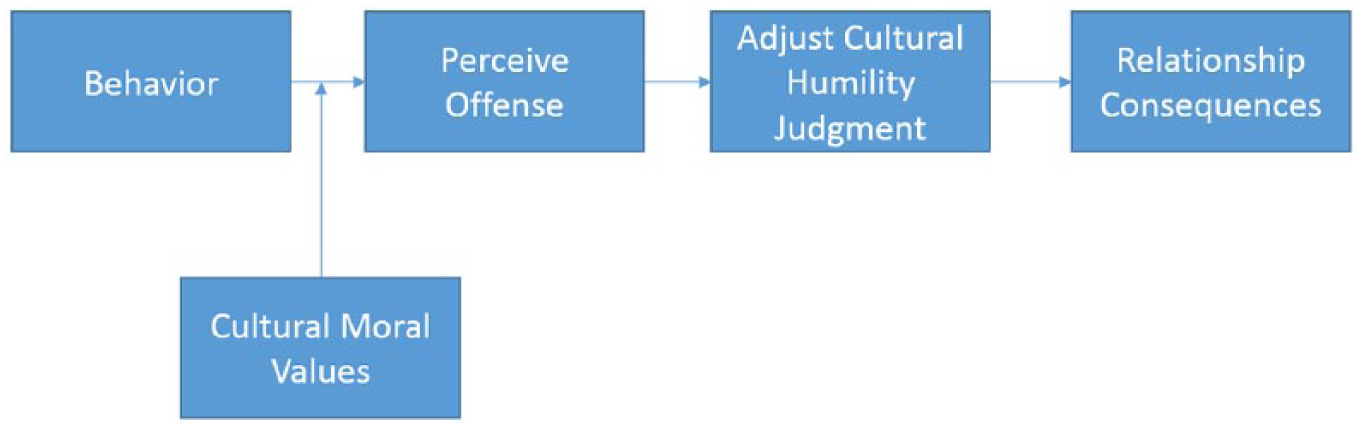
Compositional model of a humility judgment.
Here is the new piece to consider: how might a person’s moral values influence the link between a humility-relevant behaviour and the subsequent judgment of the target person’s cultural humility? The compositional model claims that cultural humility judgments will be contextualized to the normative values of the judge. Consider an example behaviour. A student stands up to a teacher who commits a microaggression in class. The teacher inadvertently refers to a Latinx student by the same name as another Latinx student in the cohort. When the teacher realizes her mistake, she quickly apologizes and gives an account for the cultural mistake. The student does not relent. She berates the teacher for her mistake and refuses to ‘take care of her feelings or let her off the hook’. The teacher again apologizes for the mistake and agrees that it is not anyone else’s job to take care of her feelings. Afterwards, the class is divided on how they viewed the interchange in a way that leads to ongoing ruptures in the cohort. One group sided with the student who protested the teacher’s behaviour. The other group sided with the teacher.
We could use one of several value taxonomies to evaluate this situation. From the perspective of moral foundations theory (see McLaughlin et al., 2019), students higher in individualizing values ought to be more inclined to side with the student against the potential for exploitation from powerful systems. In contrast, students higher in binding values ought to be more attuned to threats that individuals pose against the stability and cohesion of the group. The moral values of the judge may influence the degree to which behaviours are deemed culturally offensive and thus relevant to a target person’s reputation of cultural humility.
If you agree with this reasoning, the compositional model ought to temper how we interpret the existing scholarship on cultural humility. We need to be careful to attend to the dominant values within a system. Contrasting two existing articles might help illustrate the issues we have in mind. Initial studies on cultural humility examined the degree to which clients view their therapists as culturally humble (e.g. Hook et al., 2013). In these studies, clients provided a rating of their therapists’ cultural humility, based on their own values, and that appraisal was related to relationship constructs (e.g. therapy alliance). Ideally, samples would have some degree of cultural diversity, both in terms of marginalized identities and political ideology.
A recent study used a different method, which may change how we understand the construct. Namely, this study examined cultural humility in group psychotherapy, having clients rate the cultural humility of the group as a whole (Kivlighan, Adams, Drinane, Tao, & Owen, 2019). In this case, cultural humility is not necessarily contextualized to the moral values of each client, but rather represents an aggregation of perspectives within a particular group.
We need to keep in mind that, under certain circumstances, a measure of cultural humility has the potential to reflect pernicious group norms. Imagine an extreme example: what if a psychotherapy group was composed of committed white supremacists and only one person of color? Here, we might see a weakened relationship between cultural humility (which now represents the group’s perspective of the therapist) and better therapy outcomes for the client of colour. Moon and Sandage (2019) seemed to have in mind another example: the context of harmful training norms, without sufficient supports, putting undue pressure on therapists of colour. Taken together, we encourage readers to carefully consider this perspective and potential moral values of those evaluating cultural humility.
Anticipating four objections from a critic
Given these limitations, we want to proactively address four objections that a critic might have of early scholarship on cultural humility. The point of this section is not to defend our thinking, but to ask questions and raise critiques that might accelerate and strengthen the next wave of scholarship on cultural humility. Indeed, anticipating these critiques can inform strategies of advancing scholarship on cultural humility.
Objection 1: Cultural humility is politically aligned
A critic might warn that cultural humility has the potential to be politically biased. For example, Captari et al. (2019) found a moderate correlation between cultural humility and political orientation (i.e. being more liberal). We see similar results for some measures of humility (HEXACO; Ashton, Lee, & DeVries, 2014), but not others (e.g. Leary et al., 2017). To the degree that cultural humility is politically biased, it may not be as helpful for addressing disagreements affected by religious or political polarization.
In response to this concern, the compositional model suggests that ideological bias should not be exclusive to progressive topics. Political liberals might find it easier to express cultural humility towards (and endorse items related to) pro-choice or immigration. In contrast, they might find it much more difficult to express cultural humility while engaging issues related to political conservatism, such as valuing free markets, lower taxes, or pro-life legislation. Most likely, when researchers contextualize humility measures to specific topics or issues, it will be important to carefully control for degree of commitment or conviction in order to avoid conflating cultural humility with degree of conviction regarding the topic.
Indeed, to judge cultural humility accurately requires observing trait-relevant behaviour (Funder, 1995). Just as courage requires seeing someone’s response to danger, accurately judging cultural humility may require observing someone’s response to having core cultural beliefs challenged. Based on this logic, not all cultural beliefs and values are equally challenging to engage. It ought to be harder to demonstrate cultural humility when engaging beliefs and values that oppose one’s core convictions. Commitment-related biases (e.g. confirmation bias) ought to make it more difficult to demonstrate cultural humility towards views of the opposing side.
Therefore, this critique about potential political bias suggests the need for additional fine-tuning to ensure that measures do not conflate ideological commitments with cultural humility (Worthington, 2018). For example, how would we expect to see someone respond when engaging another with diametrically opposed perspectives? What about when a person holds identities that make trust more difficult? Does it matter what the issue is? Does it matter if, within society, there is a clear majority perspective? When would we view someone as culturally humble even if that person is taking a minority perspective? Is it ever appropriate to refuse to compromise one’s position? When would we count someone as culturally humble even though they stick to their convictions and refuse to compromise?
Objection 2: The powerful will use cultural humility language to exert their will
A critic might also warn that cultural humility language has the potential to be used coercively to malign the perspective of any opposing group. From this viewpoint, it is arbitrary who dominates humility language. For example, a clever study of sports fans demonstrated that people hold reciprocal views of each other – namely, Red Sox fans and Yankee fans had very similar views of each other’s poor character, they just brought different evidence to bear (Kenny, Gomes, & Kowal, 2015). A critic might warn that cultural humility serves a similar ingroup function of defining the boundaries of good and bad behaviour. As such, the construct may, in and of itself, have limited power to call people to express cultural humility towards outgroup members. How unfortunate would it be if cultural humility language not only proved powerless to promote greater virtue, but even antagonized cultural division through honouring the ‘right side’ (i.e. my perspective) and maligning the ‘wrong side’ (i.e. the other person’s perspective).
We see this concern as important, formidable, and difficult to dismiss easily. In the context of fierce political polarization, what keeps one group or another from appropriating virtue language for the purpose of increasing power to pursue collective interests? Can anything help cultural humility transcend a tendency towards ethnocentrism? Is there anything about the social sciences that can counteract polarization (e.g. political, religious, etc.)? None of the available options is ideologically neutral. For example, one set of studies might focus on cultural humility judgments of racial ethnic minorities. Another set of studies might focus on cultural humility judgments across the therapist’s clinical load, which may involve predominately white clients. According to the compositional model, we might expect these two approaches to diverge from each other and potentially have different correlates.
Objection 3: What does cultural humility look like when one person is ‘clearly right’?
A critic might also raise concerns about how to appropriately recognize cultural humility when a ‘clearly right’ person is engaging a ‘clearly wrong’ person. Many would agree that there are some cultural values or beliefs (e.g. racism, human rights) that require an uncompromising stance. In short, evil requires an uncompromising stance. Nonetheless, ideas of good and evil can also justify ethnocentric and sometimes genocidal tendencies in humans (Baumeister & Campbell, 1999). Indeed, most people have certain convictions they hold dearly, even as sacred, but the devil is in the detail: we are hard pressed to agree about what to put on the list and how to prioritize the list.
Yet again, this is a very difficult critique. How should we think about cultural humility in the context of disagreement on core convictions? Indeed, for polarized topics (e.g. abortion, gay rights), groups perpetuate attitudes that increase loyalty and commitment (i.e. ‘if you are not for us, you are against us’). What does cultural humility look like for topics where the ‘right side’ is fiercely being contested and opposing groups are seeking every advantage to gain ideological power to tip the scales of public opinion? Does cultural humility call for something different when one’s side ‘wins’? Does cultural humility call for something different at different stages of activism (e.g. holding a minority view, a contested view, or a newly acquired dominant view)? How can cultural humility balance commitment and integrity to one’s convictions while also curbing hostility and maintaining dignity and respect towards ideological enemies?
Objection 4: Is cultural humility just ‘in the eye of the beholder’?
A final critique is that cultural humility is nothing more than the subjective perspective of the judge – nothing more than something ‘in the eye of the beholder.’ How can our science escape a form of cultural relativism that has little power to hold oppressors accountable for immoral behaviour? Is there any aspect of cultural humility that is the same across identities and would be apparent, no matter the perspective, positionality and degree of power? If so, then a malicious culture will invariably endorse a malicious form of cultural humility.
Here we want to tread carefully. This may be a question that goes beyond the authority of our discipline, but writing as humans, we do not agree that it is a critique researchers can ignore – and certainly anyone who claims to be drawing on psychological science to serve in the role of a cultural healer under any name (e.g. psychologist, counsellor, pastor, or priest). Maybe our best response, for now, is to let the question stand for itself. We do not want to insult the kind of dialectical tension that may be required to answer this kind of question well. It is difficult to imagine a culturally neutral space or way of operationalizing cultural humility. In subtle ways, the researcher is part of the process – not entirely objective or divorced from the process of defining good and evil – taking hold of the power to define good (i.e. cultural humility) and evil (i.e. cultural arrogance). Thus, we remain hopeful that there are ways to study cultural humility that do not succumb entirely to a form of cultural relativism that forgoes any authority to call an oppressor to account – but we do suspect any strategy may require assumptions that go beyond psychological science.
How now shall we live?
Now that we have named three limitations and anticipated four key critiques, how now shall we live? Here are two challenges to the community of scholars interested in cultural humility. First, embrace the chaos. Although many scholars have noted the need to consolidate definitions and measures, we see some extremely powerful centrifugal forces that will likely make consolidation difficult. Social scientists have begun to explore humility as a virtue that might help with ideological conflict, such as political, religious, or cultural differences.
Initial empirical work on cultural humility emerged within counselling psychology, which has a strong progressive lean. To make a difference within counseling psychology, theory on cultural humility will need to attend to some of the issues raised by Moon and Sandage (2019). At the same time, public intellectuals such as Jon Haidt have begun to use humility language to describe a very different vision for political life in the United States (Lukianoff & Haidt, 2015). In their recent book, Haidt and Lukianoff (2018) suggested that microaggression theory contradicts ancient (e.g. religious and philosophical teachings) and modern (e.g. principles of cognitive-behavioural therapy) wisdom.
Given that humility language is being used to challenge dominant themes within the multicultural literature, it is almost certain that the psychological and public discourse regarding humility and its subdomains is heading for an ideological clash. Indeed, even within this special issue, we see cultural humility being applied to very different systems, including faith-based non-profits (Shannonhouse et al., 2019), psychotherapy within prisons (Gafford et al., 2019) and training gaps in supporting therapists of colour (Moon & Sandage, 2019).
Given the political polarization within academia (Duarte et al., 2015), we anticipate that studying cultural humility across a variety of settings and cultures will begin to surface many of our assumptions and potential biases as scholars. Some systems have broad political representation (such as business, healthcare, veterans’ administration hospitals). Other areas have become bifurcated in various ways, such as religious people preferring to seek mental health services from a religious leader or some marginalized groups being highly reluctant to seek mental health services at all. Humans seem to have ethnocentric tendencies, and scientists do not appear to be an exception. Thus, we see pluralism as the friend of healthy science. Conceptual tension is good. Science requires falsifiable tests, and sometimes we need a real person to take an alternative viewpoint.
Second, pause and acknowledge disciplinary limits (Bollinger, 2018). We have been involved with several interdisciplinary projects to study humility. Although these conversations can sometimes feel disorienting, because they challenge basic disciplinary assumptions, they can also bring us into greater awareness of disciplinary limitations. For example, Hunter and Nedelisky (2017) contend that the vast majority of positive psychology provides descriptive evidence (examining consequences of behaviour) and rarely, if ever, approaches anything that could be construed as a falsifiable test of one moral theory against another. To maintain the public trust, psychologists studying virtue will need to hold themselves to very high standards. We must be our own harshest critics. We never want to be seen as coming up with clever ways of using science to demonstrate harm that aligns with our own peculiar moral inclinations, while ignoring the potential moral perspective of others. Eventually, a scientist more clever than us may come along testing their own moral inclinations.
Conclusion
This seems like an excellent place to end – minding the limitations of our discipline and habits of thinking. Readers of the Journal of Psychology and Theology may find common ground and allies in various other traditions (e.g. feminism, multiculturalism) that have warned against the overreach of science and observational methods. The overreach happens especially when moralism gets conflated with theorizing: science becomes scientism – a tool used to exert power. The scientist is always part of a community of flawed humans, each approaching observation with a cultural frame that guides interpretation, with all its embedded assumptions and values. We join with the multicultural community in acknowledging that the potential for disciplinary overreach is especially high when it comes to the study of virtue – attempts to define good and evil. Does our science provide the tools for measuring good and evil, or must we suffice for something a little less noble (Davis et al., 2018)?
So, perhaps as a starting place to engage the protests of our hypothetical critic, we can each examine our own cultural traditions for potential wisdom and insight – for a more potent form of cultural humility that can call us to rise above ethnocentrism and to transcend self-interest and in-group favouritism. What can reduce the potential for bias, selfishness and self-deceit? What can keep systems from using humility language as a weapon of coercion and conformance?
To any who look to Jesus as an expression of goodness and virtue, we ask you to think of the parable of the man who tried to deal with the speck in another person’s eye before dealing with the log in his own eye. First, deal with the log in one’s own eye, Jesus said. Do this, before trying to do surgery on another person’s eye. The parable does not preclude confronting injustice in others, but it does imply a particular ordering. While one’s own vision is impaired by an object, it would be foolish to mess with such a vulnerable and crucial part of another person’s body and being. In human conflict, it is quite common for people to take sides, view the conflict as a zero sum, and frame the other as morally inferior. Perhaps this is why non-violent resistance is such a powerful means of protest. For any positive movement to occur, someone has to create the space to stop a cycle of defensiveness, escalation and entrenchment and lay new ground for trust and cooperation.
Footnotes
Funding
The author(s) received no financial support for the research, authorship and/or publication of this article.
