






Abstract
Asynchronous, anonymous online debaters might be less likely than face-to-face debaters to value their public self-image (face), and thus disagree more freely. In this study, we examined whether polite disagreements (as opposed to rude ones) help online debaters win over audience members. An analysis of the most voted-on 100 political debates on Debate.org (200 debaters; 1,750 voters; 472,652 words) showed that debate initiators who used politer face-saving strategies to disagree (i.e., using expressions such as negatives with agree words rather than disagree or harsh rejection words) were more likely to receive more audience votes and win their debates. These results suggest that politeness tactics during online debates increase effectiveness, align with normative ideals, and yield pragmatic gain.
In our digitally networked society, participatory democracy increasingly occurs via online mass communication (Loader & Mercea, 2011; Papacharissi, 2002, 2004; Price, 2009). As described by Coe et al. (2014), “the 21st century’s vast, interactive media environment has created broader opportunities for public debate” (p. 658). However, online exchanges can often be fraught with incivility, defined as “features of discussion that convey an unnecessary disrespectful tone toward the discussion forum, its participants, or its topics” (Coe et al., 2014, p. 660). Incivility has been studied extensively, particularly as it relates to online political discussions (Kenski et al., 2020; Papacharissi, 2004). Our study examines a different aspect of online disagreements. We focus on forms of civility (rather than incivility)—politeness and face considerations—to examine whether respectful face saving actions help sway an audience to one’s arguments. Specifically, this study examines whether online debaters’ politeness tactics during disagreements are related to audience evaluations of their performances.
When opposing parties in an argument or debate disagree, they can try to appear more likeable to their audience by showing respect (which highlights politeness strategies), or they can choose to rudely spotlight their opponents’ flaws (which highlights face-threatening acts and potentially incivility; Coe et al., 2014; Tracy, 2008). To test how an audience’s evaluations may differ depending on debaters’ choices of tactics, our study examined debates on the online platform Debate.org, a website created in 2007 to enable individuals “to have a platform to voice their opinions and to share ideas on any topic they choose” (Debate.org, n.d., n.p.). Users can start a debate or contribute their opinions to on-going debates about specific topics. Afterwards, audience members can vote for their perceived winner of the debate. These debates represent real-life instantiations of online arguments in which lay individuals engage. Furthermore, they capture lay individuals’ enacted behaviors, which offers an understanding of argumentation practices among the public, as opposed to analyses of undergraduate students or professional debaters, which are less representative of the general population. Past studies have also found that individuals tend to argue about public topics, such as politics, in online environments (Cionea et al., 2017). Accordingly, the category with the most debates on Debate.org is politics. Therefore, this study selected the top 100 completed and voted-on political debates on the website for further analysis of politeness strategies. We aimed to understand which attributes of disagreement messages were more likely to persuade the audience and win votes. Specifically, our study builds on politeness theory to develop a theoretical model of how polite and rude disagreement tactics influence audience evaluation of online debaters’ arguments.
Politeness theory (Brown & Levinson, 1987) posits that individuals actively manage their face or self-image in social interactions, seeking to make a good impression on interaction partners or redress affronts to their or other people’s self-esteem. Politeness captures the strategies that interactants rely on to accomplish such face needs and engage in social interactions that prevent face threats (i.e., damage to another person’s social self-image). To delineate it from other concepts, politeness has been contrasted with civility/incivility, especially in online environments (Papacharissi, 2004). Politeness captures “individual manners that facilitate the exchange of ideas without threatening the face of one’s audience” (Coe et al., 2014, p. 660). Incivility has had numerous conceptualizations, with some key features highlighting disrespect toward other interactants (Coe et al., 2014). According to Jamieson et al. (2017), uncivil discourse is perceived as rude and inappropriate. Thus, incivility involves face-threatening behaviors and little concern for polite, face-affirming strategies. However, incivility goes much further than impoliteness; it is intolerable, inappropriate, and much more problematic in online exchanges than impoliteness (Bejan, 2017). Our study’s focus rests particularly on politeness strategies and their effects in online disagreements, not incivility per se.
Politeness Strategies in Online Argumentation
While some arguments occur only between two people, others occur in front of an audience. In most arguments and debates, opposing sides strive to make claims and support them with evidence, warrants, and backing, if needed (Toulmin, 2003). Moreover, participants often criticize each other’s ideas while keeping their aggression in check. In a debate, each participant influences the other’s public self-image (face; Dailey et al., 2005) but at the same time, the existence of an audience presents another target for a debater’s focus. Rather than focusing only on an opponent, a debater can also try to win over the audience (e.g., Just et al., 1990), and might use tactics primarily aimed at the latter, at the expense of the former if needed.
Consider a debater’s strategic approach to politeness when disagreeing with an opponent. Disagreement suggests that the opponent is wrong, which can harm his or her public self-image (a face-threatening act, Tracy, 2008). But a debater might also disagree politely to reduce the threat to the opponent’s face (i.e., to save face; Brown & Levinson, 1987). According to politeness theory (Brown & Levinson, 1987), affronts to a person’s self-esteem (positive face) or freedom to act (negative face) vary by status differences, familiarity, and degree of affront, and people redress them accordingly based on politeness strategies. For example, consider this phrasing: “If we do not limit marijuana sales to adults, then I do not agree that we should legalize marijuana.” The absence of the word you and the uses of if, we, and not agree all help to save face, as the disagreement is not directed to a specific person but rather to the idea being debated. The absence of the direct term you and the use of the hypothetical if distances the face-threatening act from the opponent. Furthermore, the use of we demonstrates shared positioning and claims common cause (Chiu, 2008), as opposed to an oppositional confrontation. Unlike the faster processing and faster emotional response in the amygdala to the single word disagree, the two words not agree require additional cognitive processing, of both the idea of agreement and its negation in the cerebral cortex, thereby slowing down the speed of an emotional response from the other party and diminishing its harshness (Linebarger, 1987; Salzman & Fusi, 2010). We illustrate this process in the theoretical model in Figure 1.
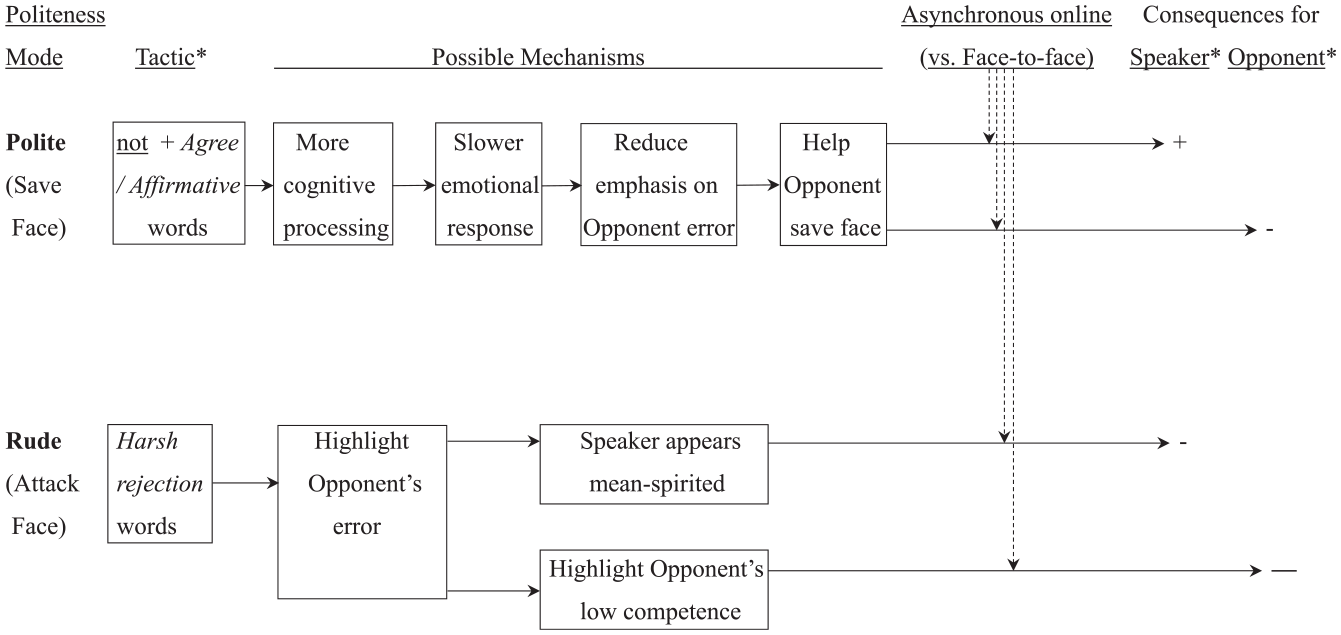
Theoretical model of possible mechanisms for polite disagreements (save face) versus rude disagreements (attack face).
By showing respect to opposing views and softening disagreement, people who disagree politely appear more considerate and likable (Dailey et al., 2005). The benefits of polite disagreement are so strong that it is the accepted norm among peers during face-to-face conversations; lack of redress during a face-to-face disagreement is noticeably rude and generally considered unacceptable (Samra-Fredericks, 2010).
Unlike interpersonal dyadic arguments, however, debates often focus more on the audience, with less regard for the opponent. The goal of a debate is to win the audience over by demonstrating that one’s arguments are superior to the opponent’s. Therefore, debaters might rudely spotlight their opponents’ flaws and increase the severity of their face-threatening disagreement (face attack, Tracy, 2008). Consider the following face attack: “Smith’s study of emergency room patients debunks your myth of safe marijuana use.” Rather than using typically cautious academic language to interpret results (“the results suggest that . . .”), the face attack personalizes (your) and harshly rejects (debunks) the opponent’s claim as disconnected from reality (myth). When an audience perceives a debater as successfully face-attacking an opponent, they deem the attacker more competent and forceful than the opponent (Dailey et al., 2005). However, debaters who use face attacks can appear verbally aggressive or even mean-spirited. As a result, audiences who perceive a debater as rude can end up favoring the opponent. For example, in Dailey et al.’s (2005) study of 207 undergraduate students viewing one of the three 2000 Bush-Gore U.S. presidential debates, those who gave Gore higher rudeness ratings viewed him as less presidential than Bush.
Unlike face-to-face debates, online debates are more anonymous and asynchronous. They allow debaters to conceal their true identity and allow more time between responses, both of which might dampen the emotional impacts of disagreements (including offensive face attacks) and politeness tactics (Chen et al., 2012a). Online debaters and audience members typically display far fewer personal attributes (e.g., names, facial expressions, voice intonations) than in face-to-face debates. This reduces sensory information (visual, auditory, tactile) and increases the psychological distance among participants, thus focusing attention on the written texts rather than personal attributes (Chen et al., 2012b). As a result, online anonymity fosters more egalitarian and content-focused discussions, and reduces both face concerns and deference to higher-status individuals compared to in-person, face-to-face debates (Chen et al., 2012a). These reduced face and status concerns enable participants to disagree with one another more freely (Reinig & Mejias, 2004). Furthermore, whereas face-to-face disagreements often reduce participation, online disagreements increase participation in open forums, suggesting that disagreements are more acceptable online (Chen & Chiu, 2008).
Asynchronous debaters have more time to read each other’s arguments before responding, which facilitates slower emotional responses, greater reflection, and clearer (often edited) subsequent arguments compared with face-to-face disagreements. As online debaters need not respond immediately, they are less likely to retaliate impulsively or emotionally (Chen et al., 2012b). Furthermore, because participants in asynchronous interactions also have more time to gather relevant information, contemplate ideas, and critically evaluate claims before responding, debaters often display higher levels of cognition online than they do in face-to-face interactions (Hara et al., 2000).
Compared to synchronous face-to-face debaters, asynchronous online debaters are often more psychologically distant from one another in both space and time. Therefore, they might have less concern for one another’s face and might adjust their politeness tactics accordingly during disagreements. In previous research, while face-to-face debaters typically accompanied face-threatening acts with face-saving measures (Samra-Fredericks, 2010), online debaters were more likely to attack face with negative social cues (“☹”), aggressive messages (“WRONG!!!”), or offensive comments (“You’re such an idiot”) than to save face with positive social cues (“☺,” “totally agree”) (Chen et al., 2012a). As a result, whether face-saving tactics help online debaters win over audience members (as they can for face-to-face debaters) is an open question that this study addresses.
In summary, this study tests which politeness tactics win over online debate audiences during disagreements. Specifically, we focus on online debaters’ choices of not agree, disagree, or harsher rejections (debunk, dismiss, or other words from the reject category of the linguistic inquiry word count [LIWC] database [Pennebaker, Francis et al., 2015]). Moreover, we focus on the first (topic) sentence of each message, as these statements often serve to introduce and organize (advance organize) subsequent argumentative content and strategy (Williams & Stevens, 1972). Hence, we propose two hypotheses:
H1: Online debaters who use “not” before agree (or other affirmative words) rather than other forms of disagreement receive higher debate scores.
H2: Online debaters who use harsh rejection words rather than other forms of disagreement receive lower debate scores.
In addition, past studies have suggested that debater characteristics (e.g., political party affiliation, gender, race), voter characteristics, advocacy strategies, and other politeness strategies can influence perceptions of behaviors and performance, including audience evaluations of a debate (Dailey et al., 2005; Fingerhut, 2016; Harp & Tremayne, 2006). Specifically, as people prefer to interact with others like themselves (homophily, Brechwald & Prinstein, 2011), audience members who share attributes (gender, religion, political party, etc.) with a debater might be more inclined to vote for him or her. Therefore, we controlled for these factors in this study to reduce omitted variable bias (Kennedy, 2008).
Method
We tested whether the choice of debaters’ politeness words while disagreeing impacts the audience’s ratings of debaters’ performances. On Debate.org , an initiator (aka instigator) can propose a resolution statement or a topic to be debated (e.g., “Gay marriage should be allowed”), and a challenger (aka contender) can argue against it. When this happens, the two debaters typically engage in three or four rounds of debate. In each round, the initiator and the challenger write an argument or rebuttal. The initiator chooses the length of the voting period after the debate, which ranges from three days to six months. After the debate ends, any community observer can vote to help determine the winner. As of September 2019, there are over 600,000 users and over 83,000 total debates on Debate.org .
In March 2017, we selected the 100 political debates with the most votes from November 2007 to March 2017 (see debate topics in Table 1). A total of 200 debaters wrote 472,652 words in these debates (averaging 681 words for each of the 696 messages), and 1,750 users voted, with many users voting in multiple debates. For a sample size of 100 at α = .05, statistical power is: (a) 0.98 for an effect size of 0.40, (b) 0.84 for an effect size of 0.30, and (c) 0.51 for an effect size of 0.20 (calculated with the statistical power calculator at https://www.statskingdom.com/33test_power_regression.html; for a discussion of statistical power see Cohen et al., 2003).
Summary Statistics (N = 100).
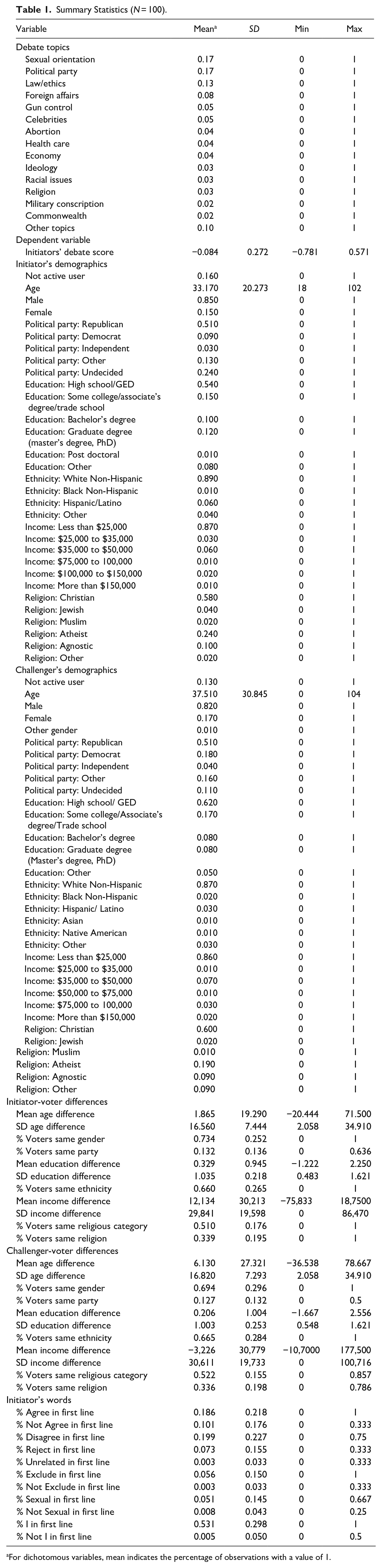
For dichotomous variables, mean indicates the percentage of observations with a value of 1.
Each person voting on Debate.org can rate both the initiator and challenger of a debate on a scale ranging from 0 to 7 points. A debater’s best possible result is to receive 7 points from a voter while the opponent receives 0 points (7–0). Conversely, the worst debate performance is 0 to 7. To calculate audience evaluation of each debate, we created a debate score as follows: For each debate, we calculated the product of the maximum score times the number of voters (maximum score), summed up the total ratings by all voters for the debate initiator (initiator score) and for the challenger (challenger score), and applied the following formula:
The best possible debate score for a debate initiator is 100%, and the best possible debate score for a challenger is −100% (100% = [7 × voters–0]/7 × voters; −100% = [0–7 × voters]/7 × voters; where voters is the number of voters). These debate scores served as the dependent variable for testing our hypotheses, with greater scores indicating more favorable evaluations.
In addition, on Debate.org , members can decide which information on their profile pages to disclose to other users. To control various demographics and to reduce omitted variables bias (Kennedy, 2008), we retrieved the publicly available demographics of debaters and voters from their profile pages on the website (active status, name identification, age, gender, political party affiliation, education, ethnic background, income, and religion) and included them as control variables when testing our hypotheses. Here, active status means whether a user account was active at the time of data collection. As we selected the most voted-on debates during the past 10 years, some participants in those debates were no longer active users. Strictly speaking, active status did not play a role in the voting process (i.e., all participants were active at that time), but it may signal a certain individual propensity (e.g., shared characteristics of those who closed accounts). Thus, we decided to control for active status. Overall, sixteen percent of the data for these demographic variables were missing. None of the words in the messages were missing.
In addition, we computed six variables capturing the percentage of voters who matched the debate initiator’s (a) active status, (b) name identification, (c) gender, (d) race, (e) religion, and (f) political party, respectively. We also computed six additional explanatory variables. These included three means of the differences (and their standard deviations) between the voters and the debate initiator for the following continuous variables: age, years of schooling, and income. Likewise, we created the same 12 parallel variables for voters and the challengers by replacing debate initiator variables with debate challenger variables in the above procedure.
We wrote a computer program to create word variables. First, we pre-processed the data with the Freeling (Padró et al., 2016) software, which predicts unknown words (like a smart spell checker) and converts nouns and verbs into their base forms (singular nouns: oxen → ox; and bare infinitives: am → be). Each word/phrase was compared to categories of words/phrases; specifically, agree, disagree, and harsh rejections (see Supplemental Appendix A; based on the LIWC by Pennebaker, Francis et al., 2015). Grounded in politeness theory (Brown & Levinson, 1987) and politeness of disagreements (Chiu & Khoo, 2003), the starting points for these categories are Posemo and Negemo categories in the LIWC (Pennebaker, Francis et al., 2015). For each major category (e.g., agree), we removed words that did not fit the category (e.g., rejoice). We also consulted www.thesaurus.com and included synonyms of words within each category (e.g., accept synonyms include assent). The first author and a research assistant qualitatively rated the goodness of fit of each word to its category, retaining those in which both agreed. For messages with agree words, we tested for a negative (e.g., “not,” “never”) that reversed the meaning of the phrase or clause, which would yield a not agree categorization.
As word categories cannot list all possibilities, mismatches might occur (e.g., the simile “your idea is like a whale in the desert” technically does not have any disagree words). We addressed such possibilities in three ways. First, our variables indicate whether a message has at least one such word (none vs. some) rather than their total number of instances, thereby removing ambiguity regarding multiple instances (e.g., three vs. four). Second, if mismatches are not systematically biased, then they are measurement errors, which reduce confidence in non-significant results but retain it for significant results (Kennedy, 2008). Third, an author’s coding of the first sentence of 100 messages (14% of 696 messages) using human judgment versus the computer program’s word category approach showed high human-computer inter-coder reliability as calculated via agreement percentage and Krippendorff’s (2012) alpha: agree (94%; α = .89), not agree (89%; α = .83), disagree (90%; α = .84) and harsh rejections (87%; α = .80).
Next, we computed the percentage of the three rounds of messages written by a debater that included at least one such word. For example, if disagree appears in two of the three rounds, then the variable %_disagree will have a value of 2/3 or 67%. We repeated our analysis on two subsets of the data. As long quotes attributed to others might not reflect a debater’s own word preferences, we create a subset of the data that omits all long quotes beyond five words (e.g., “all that glitters is not gold,” [from Shakespeare’s Merchant of Venice, 1612]). As the first sentence of a message frames and organizes the rest of the message (Williams & Stevens, 1972), it might capture a debater’s stance clearly, so we created another subset of the original data that only had the first sentence of each message.
Testing the hypotheses about initiators’ debate scores requires overcoming four analytic difficulties: (a) missing data, (b) simultaneous, multiple effects, (c) nested data of topics of debates, and (d) false positives. We addressed these with (a) Markov Chain Monte Carlo multiple imputation (MCMC-MI), (b) ordinary least squares regressions, sequential sets of variables, and χ2 log likelihood tests, and (c) a two-stage linear step-up procedure.
First, missing data (16% [of demographics] in this data set) can bias the results (specifically, the parameter estimates), raise the complexity of the data analyses, and reduce estimation efficiency (Peugh & Enders, 2004). Therefore, we used MCMC-MI to estimate the values of the missing data, which addresses this issue more effectively than deletion, mean substitution, or simple imputation according to computer simulations (Peugh & Enders, 2004).
Second, multiple explanatory variables can have simultaneous effects on the outcome (initiators’ debate scores; Cohen et al., 2003). Therefore, we used ordinary least squares (OLS) regressions (Kennedy, 2008) to model them properly. Furthermore, entering one set of variables at a time into OLS (sequential sets) estimates the differences in initiators’ debate scores as explained by each set (explained variance, Cohen et al., 2003). To test whether a set of explanatory variables were significantly linked to initiators’ debate scores, we used the χ2 log likelihood test (Cohen et al., 2003).
Third, as debates within the same topic might resemble one another more than debates on different topics, an ordinary least squares regression underestimates the standard errors, so we used a multilevel analysis (Goldstein, 2011; also known as hierarchical linear modeling, Bryk & Raudenbush, 1992).
Fourth, testing multiple hypotheses increases the likelihood that at least one of them incorrectly rejects a null hypothesis (a false positive). We reduced the likelihood of false positives by using the two-stage linear step-up procedure, which outperformed 13 other methods in computer simulations (Benjamini et al., 2006).
We modeled an initiator’s debate score in sequential sets of multi-level regressions (Kennedy, 2008). We entered the variables according to time constraints, expected causal relationships, and likely importance. Each bold phrase in the following equation indicates a
The debate score of initiator i on topic t has the grand mean intercept β0 with the debater- and topic-level unexplained components (residuals) eit and ft. First, we entered the initiator’s demographics: inactive user (vs. active user), name identified (vs. name not identified), age, gender (male, female, or other gender), political party (Republican, Democrat, Independent, other party, or undecided), education (high school/GED, some college/associate’s degree/trade school, bachelor’s degree, graduate degree such as master’s degree or Ph.D., post-doctoral degree, or other), ethnicity (White non-Hispanic, Black non-Hispanic, Hispanic/Latino, Asian, Native American, or other), income ($25,000–$35,000; $35,000–$50,000; $50,000–$75,000; $75,000–$100,000; $100,000–$150,000; more than $150,000; or less than $25,000), and religion (Christian, Jewish, Muslim, Buddhist, Atheist, Agnostic, or other) (
We also tested whether debate scores tended to be higher or lower for specific debate topics (
Next, we entered ten variables that reflect similarities and differences between the debate’s initiator and its voters (
We then entered the initiator’s total number of words and percentages of rounds including the following word categories: agree, disagree, reject, unrelated, exclude, sexual, personal pronouns, and their negative counterparts such as not agree (
Results
Challengers won 58% of the debates, initiators won 39%, and 3% were tied. The mean initiator’s debate score was −0.084 (barely losing a debate), ranging from an actual minimum of -0.781 to an actual maximum of 0.571 (complete challenger domination of debate = −1.000, tie = 0, and complete initiator domination of debate = 1.000). See summary statistics in Table 1 and Figures 2 to 4. The first sentence of each message accounted for more explained variance in debate score than models of the entire messages and models of messages without longer quotes, while showing similar results. Therefore, we have reported results based on first sentence analyses only. (Other results and correlation-covariance matrix are available upon request).
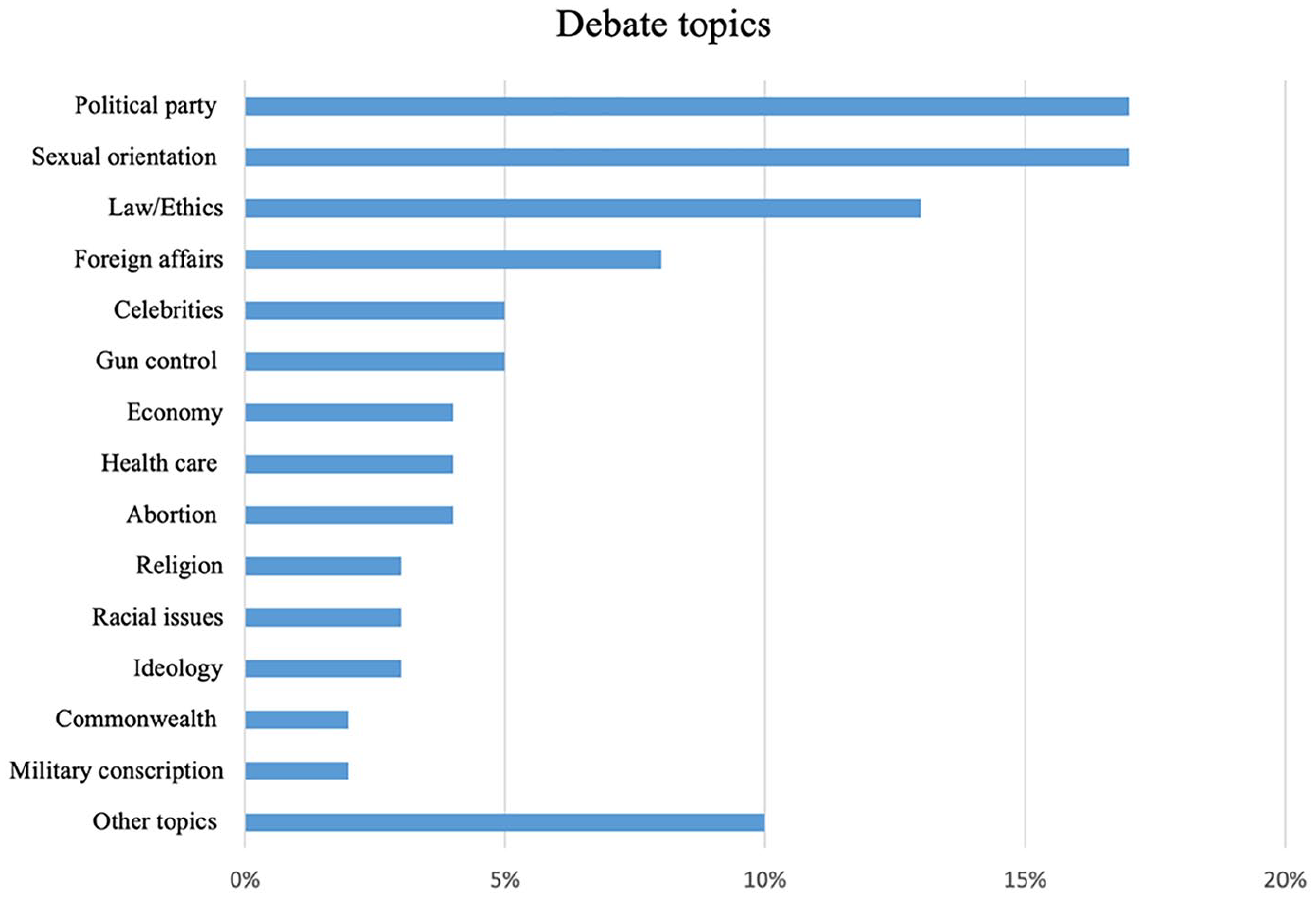
Percentage of debates on each topic.
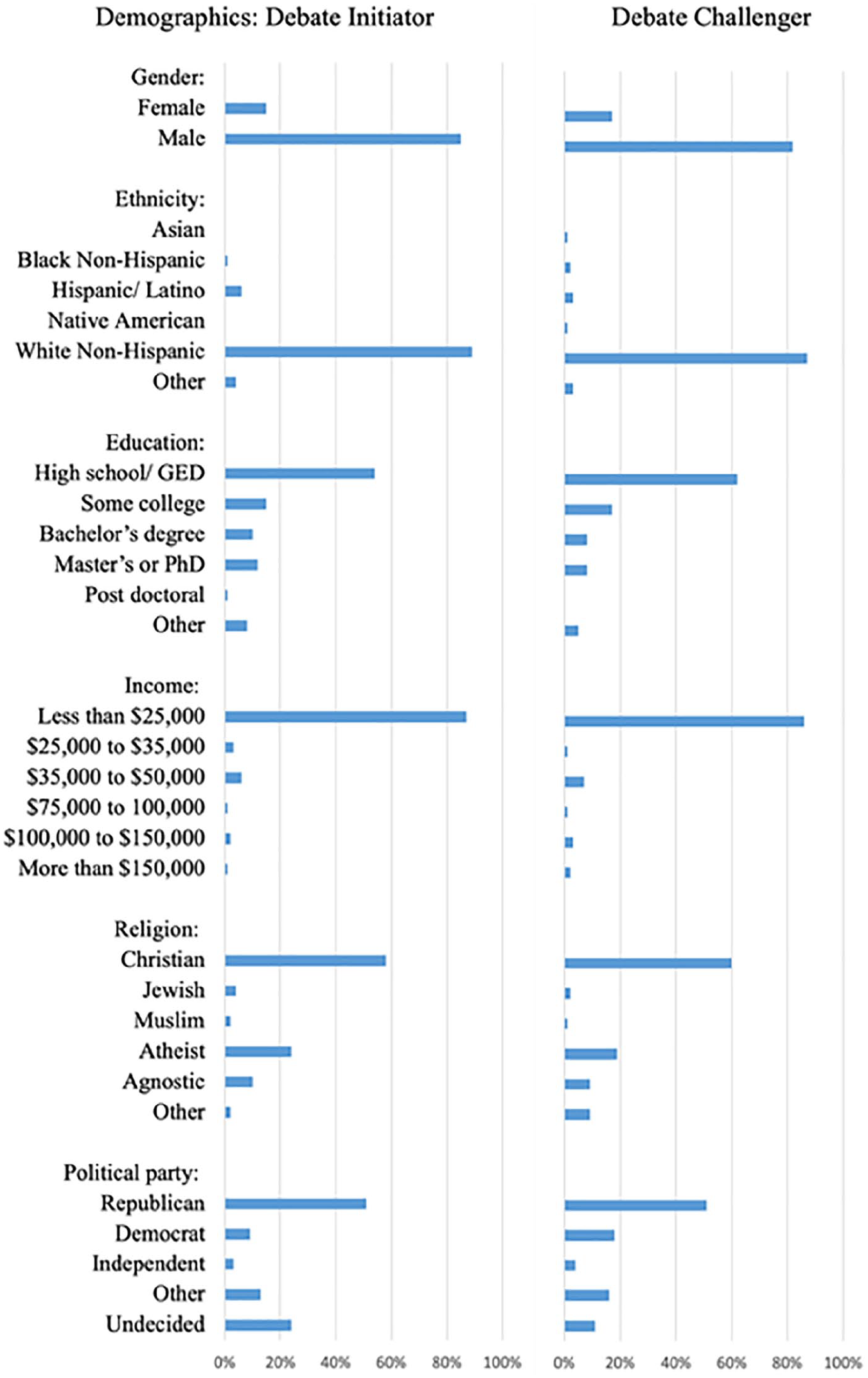
Self-reported demographics of debate initiators and challengers.
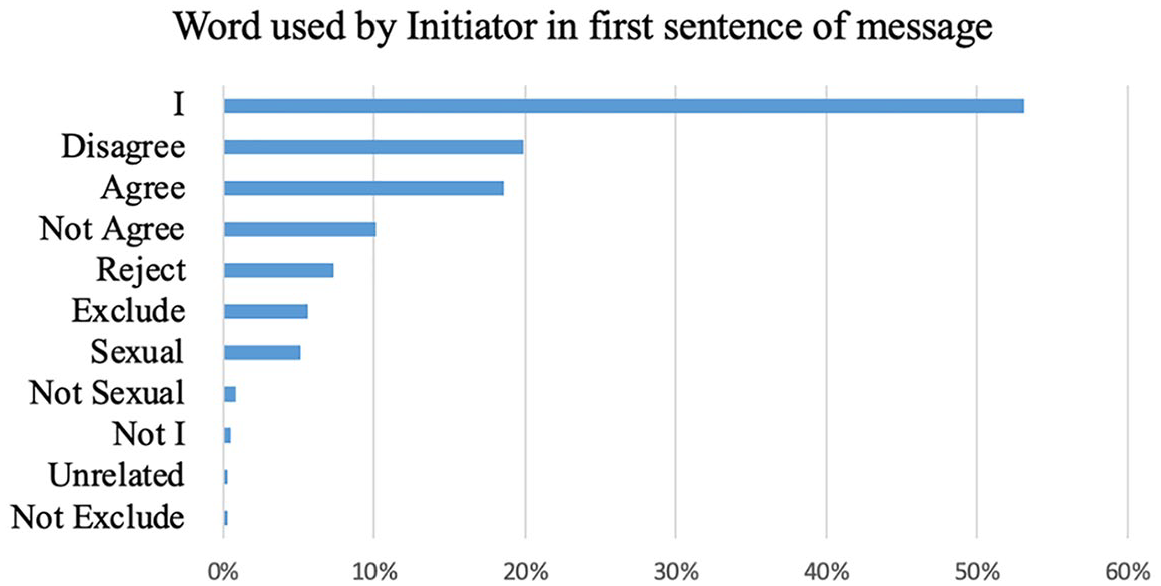
Percentage of first sentences of messages by an initiator with (a) a specific word or (b) a word phrase with “not.”
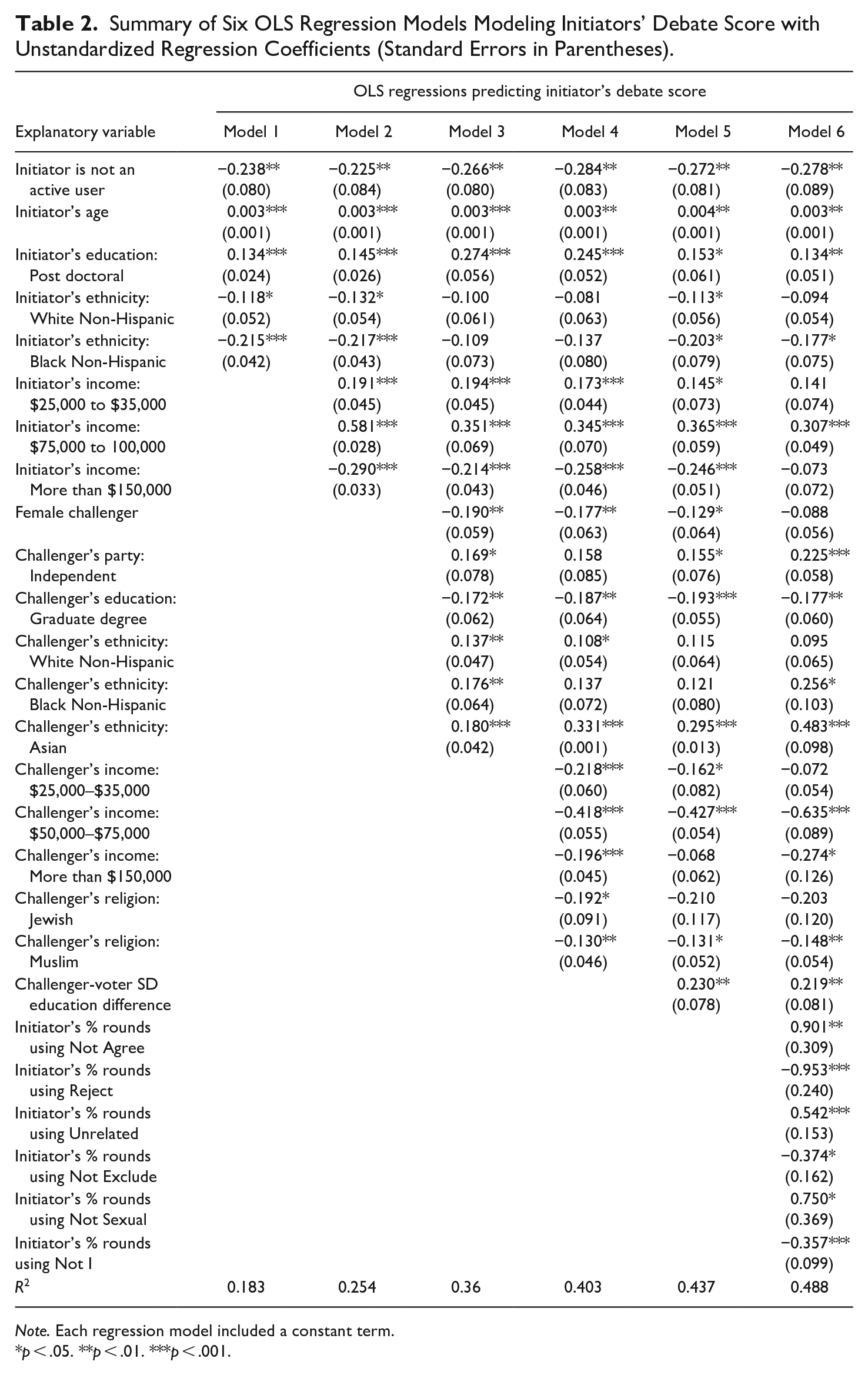
We tested the extent to which initiators’ demographics, challengers’ demographics, challenger-voter differences, and initiators’ words were related to initiators’ debate scores via a multilevel regression. However, the differences in debate scores across topics were not significant, accounting for about 2% of the variance, with 98% at the debate level; thus, the multilevel analysis was not needed, and an ordinary least square regression sufficed. The results discussed below focus on the use of categories of words, while controlling for all other demographic and difference variables.
In the first sentence of a debate round, initiators use of disagree categories of words did not yield significant differences in their debate scores, but their use of not agree categories of words yielded higher debate scores than otherwise. Initiators who used a negative (e.g., not) to reverse “agree” words in the first sentence in one more debate round than the mean had 0.30 more points in their debate scores, 2% higher on average (0.30 = 0.901/3 rounds; see Table 2, right bottom; 2% = 0.30/14; 14 = 7–[−7]; range of possible scores: −7 to 7). This result supported the first hypothesis: debaters who use “not” before agree (or other affirmative words) rather than other disagreements received higher debate scores.
Summary of Six OLS Regression Models Modeling Initiators’ Debate Score with Unstandardized Regression Coefficients (Standard Errors in Parentheses).
Note. Each regression model included a constant term.
p < .05. **p < .01. ***p < .001.
By contrast, initiators who used reject words in the first sentence in one more debate round than the mean averaged 0.32 points fewer in debate scores or −2% on average (-0.32 = -0.953/3; see Table 2, right bottom; −2% = −0.32/14). This result supported the second hypothesis. Controlling for other variables, initiators who choose a phrase such as not agree, rather than disagree or a harsh rejection had higher debate scores (+2% vs. disagree and +4% vs. harsh rejections; 4% = 2% – −2%).
Notably, female challengers were more successful than male challengers (as measured by debate score), in part because of initiators’ use of harsh rejection words. Even after controlling for other demographic differences, initiators scored 13% lower when facing (perceived) female challengers rather than (perceived) male challengers. Facing female challengers, initiators used harsher rejections, which accounted for 32% of the challenger gender difference (mediation test: z = 1.972; p = .049).
Discussion
Expanding on past education psychology studies on politeness during disagreements (e.g., Chen & Chiu, 2008; Chen et al., 2012a, 2012b) and audience perception of candidates in face-to-face debates (Dailey et al., 2005), this study applied politeness theory to disagreements in online debates about sociopolitical issues. Among the 100 asynchronous, online political debates with the most votes on Debate.org before March 2017, debate initiators who introduced their disagreement with an opponent by using politer face-saving measures (not agree > disagree > harsher rejection words) in the first sentence of their debate rounds had higher debate scores, supporting both of the proposed hypotheses. These results suggest that polite, face-saving tactics can be more effective than rude face attacks at winning over audiences during disagreements. Being respectful of opposing views and softening a disagreement to appear more considerate and likeable wins over audiences more often than harsh face attacks (Brown & Levinson, 1987; Tracy, 2008). These results also underscore the importance of the first sentence in a message for persuading audiences. In addition, the study also highlights the potential of computer categorization to aid analyses of large data sets.
Moreover, polite disagreements, which can be classified as micro-communicative actions for personal gain, can induce more macro-social good, such as more civil public discourse (Chiu & Khoo, 2003). Previous research (Papacharissi, 2004) has reported that, in online debates, about 22% of the messages posted were impolite, and all of them were replies to a debate. In contrast, this study provides evidence that politeness strategies can support not only normative ideals but also pragmatic gain during disagreements. Those who used politeness strategies more often than others received more audience votes in their debates. Although our study only examined whether debaters received audience votes, the benefits of politeness may extend beyond just winning a vote to other positive evaluations. Hence, these results prompt further research into whether those who deploy more civil narratives or polite argumentative tactics have a higher chance of swaying their audiences during online disagreements. Such results would elucidate whether politeness strategies during disagreements in debates can create both personal gain and greater social good. The possibility of incentivizing politeness and engaging in more civil discourse might not only enhance argumentation (as individuals may move from personal attacks to debating actual ideas and arguments) but also potentially transform online platforms into authentic public sphere spaces where a genuine exchange of ideas can occur. As Rossini (2020) has argued, removing foul or offensive language and changing the tone can transform an otherwise uncivil comment into a civil one. Our results align with this suggestion, in that incentivizing politeness in online forums where arguers try to persuade each other can generate a social gain in the form of civil debates.
Furthermore, the medium effect size of our results (Cohen et al., 2003) is similar to that for politeness during face-to-face debates (e.g., Dailey et al., 2005) but smaller than the large effect sizes in less formal face-to-face discussions (e.g., Chiu, 2008; Chiu & Khoo, 2003). These results suggest that the greater anonymity and asynchrony of online debates do not eliminate the impact of politeness tactics. Further studies are needed, however, to establish meaningful differences in effect sizes and patterns of effect sizes across mediums. Nevertheless, our results, based on actual debates engaged in by lay individuals, suggest that politeness strategies can be effective in asynchronous, anonymous (online) debates just as they are in synchronous, face-to-face ones. Future studies can examine whether these results generalize across other platforms besides Debate.org, on which individuals debate issues and which are prone to incivility. Such studies can test whether politeness tactics yield both individual and collective rewards across various debate contexts: on-/off-line, synchronous/asynchronous, identified/anonymous, or layperson/academic.
Another key issue is the demographics of Debate.org. Although there is no publicly available information on the user dynamics of the site as a whole, our sample demographics suggest that the Debate.org community seems to skew young, male, and with lower levels of education and household income (see Table 1). This composition is a close match to the demographics of those who rely on social media for political information, except for gender (Mitchell et al., 2020). Unlike the general social media user trend, about 84% of our study demographics (i.e., debaters) were male. However, this could be understood in the context of the main activity on the site: debate. Research in argumentation has shown that men are more argumentative and verbally aggressive than women (e.g., Leaper & Ayres, 2007; Park et al., 2016) and thus might be more inclined to engage in debates. In a way, it is not surprising that the site is more male-dominated. Interestingly, those few female debaters were more successful in receiving votes, particularly when facing initiators’ harsh rejection words. This could be because female participants might be superior debaters who provoked their opponents, or because the mostly male initiators simply use harsher rejections when debating women online. Future studies can determine the extent to which either or both of these phenomena account for the greater success of female challengers. Also, whether the suggested patterns would operate similarly in online debate communities with different demographic compositions awaits further investigation.
Methodologically, the results of this study reveal that analyzing the first sentence of each message is as effective as analyzing whole messages with respect to politeness strategies. Thus, using the first sentence (instead of an entire argument) might be an efficient way to analyze online incivility or intolerance in large online datasets. Future studies can further confirm our approach. The primacy effect in attribution also supports the validity of the analytic approach of using only the first sentence, which frames and advance organizes the message (Williams & Stevens, 1972). When judging others, prior cues or information tend to exert a stronger influence on our overall impression of a person (primacy effect, Asch, 1946). In these online debates, the debater’s assessment of their opponent’s initial sentence might have served as a primary reference point for anchoring their judgment of the opponent’s entire argument (Jones et al., 1968).
Finally, this study’s examination of actual debates enacted by lay individuals on issues of public concern contributes to our knowledge of how argumentation and politeness function beyond the walls of a laboratory in which participants are artificially exposed to experimental conditions. Using actual debate texts, deployed strategies, and evaluations of argumentation styles in real online data ensures higher ecological validity of the findings and further establishes their direct implications and high generalizability.
Our study provided an empirical test of our politeness theory hypotheses in the context of lay debates about sociopolitical issues. As expected, the use of polite face-saving strategies was more likely to gain an audience’s votes than the use of face-threatening attacks. A main contribution of this study lies in the proposed theoretical model that elaborates possible paths of enactment for polite vs. rude disagreement strategies. This study tested only a part of the model; future research should test other parts of it as well to gain a better understanding and further ability to predict how disagreements can evolve based on the first few lines in an online exchange. Second, this study delineated three disagreements strategies (not agree, disagree, and harsher rejection words) that yielded different results with online audiences, suggesting a more refined classification of impoliteness may be needed. The effects of using impoliteness when disagreeing in an online debate are not uniformly negative; they depend on the form of disagreement and the extent of the face threat it expresses. In other words, the manner in which individuals disagree matters in debates.
From a practical standpoint, our study results suggest that incentivizing individuals to use more polite strategies in their online exchanges has definite benefits for how audiences perceive them. Disagreeing and engaging in a debate about a potentially controversial topic does not necessarily have to involve incivility. Our results suggest that politeness can be helpful in achieving the goal of winning over an audience. Second, our results also highlight how much influence the beginning sentences in an exchange carry in audiences’ evaluation of debaters. Similar to primacy effects, these results suggest that debaters should choose their responses carefully and strategically when engaging in a debate in order to reap the maximum benefits.
This study’s limitations include a limited number of debaters, voters, topics, contexts, and categorization definitions of words/phrases, as well as dictionary development, bag-of-word approach limitations, and mechanism aspects. As challengers rarely used the not agree or harsh rejection categories of words/phrases, statistical comparison with disagree words was not possible. Future studies can examine whether this phenomenon is common or specific to these debate challengers.
Likewise, a study involving different debaters (e.g., topic experts vs. amateurs) or voters (e.g., topic experts) might reveal different results. Furthermore, debates on different topics (non-political) or in different contexts (e.g., synchronous online debates) might yield different results. As illustrated in Figure 1, this research focused on asynchronous online debates, where debaters (a speaker and an opponent) and the audience necessarily exist. Therefore, data were gathered from asynchronous online debates that followed this format, particularly with anonymous lay debaters and judges. The findings need to be understood in the context of this argumentative setting. Indeed, Debate.org is a specific voting-oriented forum where people discuss topics with a purpose of “winning” debates. However, debates across online venues (e.g., social media, news comments sections) can differ both structurally and functionally, so considering how to generalize the results to other types of argumentative online interactions requires great caution.
Future studies might also test whether different definitions of not agree, disagree, or harsh rejections yield different results. Using combinations of word categories to determine such constructs will necessarily miss idiomatic expressions (e.g., “when hell freezes over”). Rigorous development of a dictionary requires (a) word collection, (b) judge ratings, (c) base rate analyses, (d) generation of candidate word lists, and (e) psychometric evaluation (summary variables can also be added; Pennebaker, Boyd et al., 2015). As this study did not execute (c) and (e), future studies should do so. More generally, bag-of-word approaches miss many meaningful aspects of communication at higher levels (sentence, paragraph, etc.), such as relations among words in a sentence, relations among sentences within a paragraph, key metaphors, overarching themes, stance, genre, and so on. Hence, future analyses can incorporate some of the surrounding contextual aspects of these isolated words or triangulate the results with human interpretations of the debates. Capturing these phenomena might also enable finer-grained assessments of subtler or harsher disagreements. Lastly, researchers can test each possible and unexplored component of our proposed theoretical mechanism (e.g., cognitive processing, emotional response) to examine the direct and indirect effects that politeness has on each of the components and consequences, ideally with causal or longitudinal data.
Overall, this study contributed new knowledge to our understanding of how and why individuals use politeness strategies in online, asynchronous debates about public issues. We theoretically proposed and empirically showed the importance of both face concerns and the first sentences in one’s argument with an opponent. If one’s goal is to acquire an audience’s votes, then our results suggest that politeness is an important strategy to consider. Furthermore, politeness may function to incentivize online debaters to engage in more civil public discourse, which would benefit both society in general and a person’s ability to engage in constructive public discourse on controversial issues.
Supplemental Material
sj-docx-1-crx-10.1177_00936502211053456 – Supplemental material for Serving the Greater Social Good for Personal Gain: Effects of Polite Disagreements in Online Debates
Supplemental material, sj-docx-1-crx-10.1177_00936502211053456 for Serving the Greater Social Good for Personal Gain: Effects of Polite Disagreements in Online Debates by Ming Ming Chiu, Yu Won Oh, Jeong-Nam Kim and Ioana A. Cionea in Communication Research
Footnotes
Declaration of Conflicting Interests
The authors declared no potential conflicts of interest with respect to the research, authorship, and/or publication of this article.
Funding
The authors received no financial support for the research, authorship, and/or publication of this article.

Supplemental Material
Supplemental material for this article is available online.
Author Biographies
References
Supplementary Material
Please find the following supplemental material available below.
For Open Access articles published under a Creative Commons License, all supplemental material carries the same license as the article it is associated with.
For non-Open Access articles published, all supplemental material carries a non-exclusive license, and permission requests for re-use of supplemental material or any part of supplemental material shall be sent directly to the copyright owner as specified in the copyright notice associated with the article.
